
Bioactive Wound Dressing Market Overview:
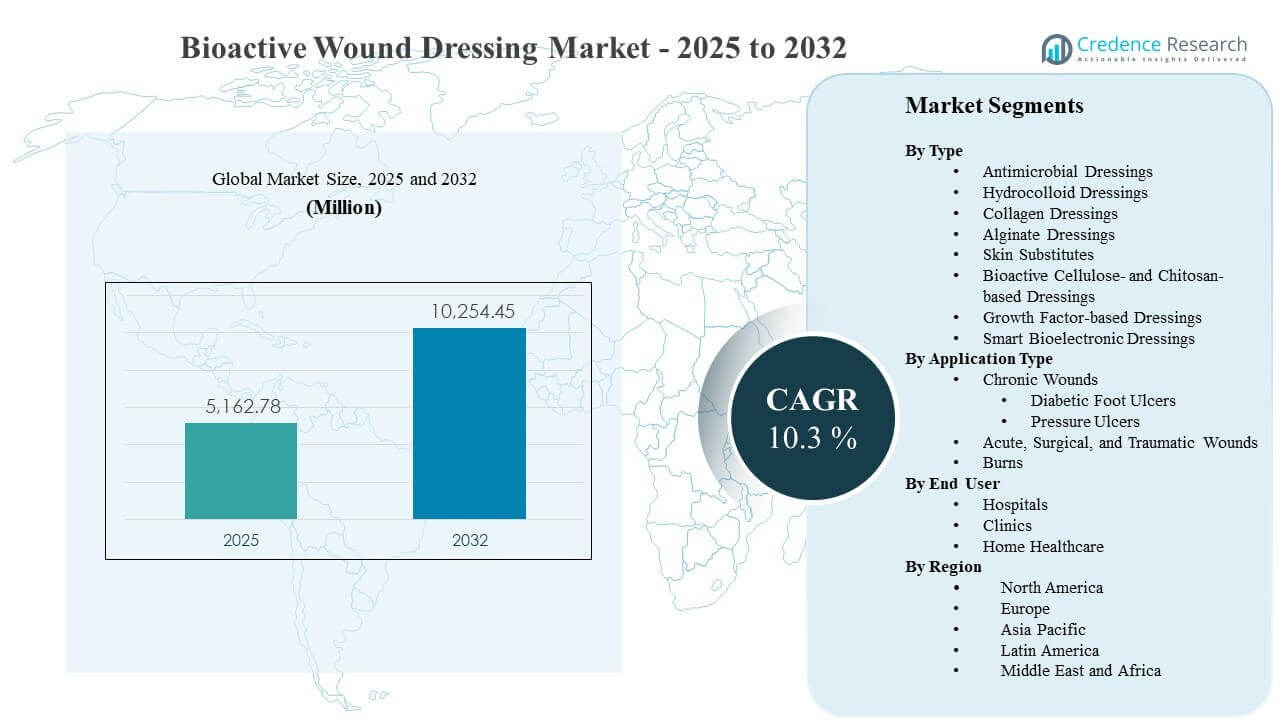
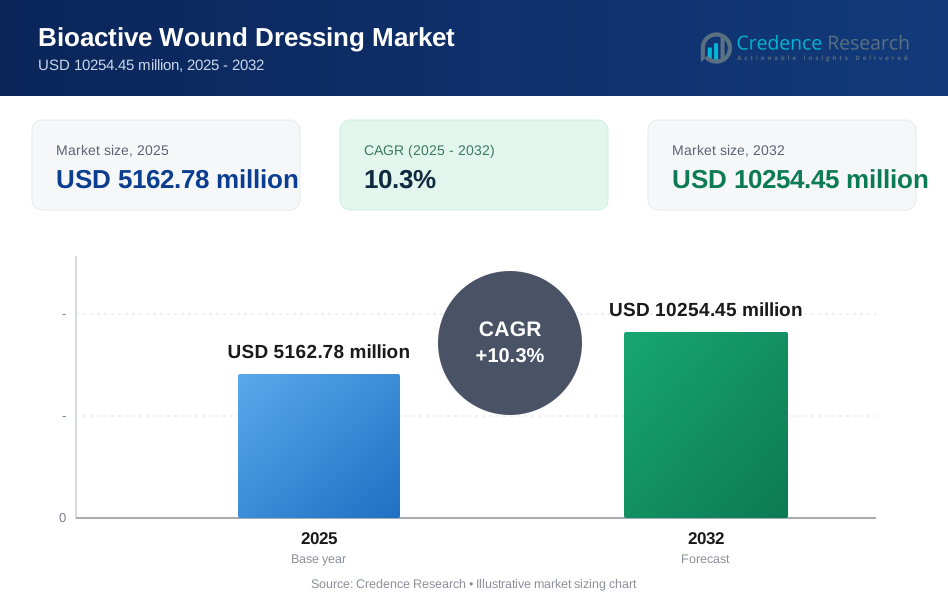
The global Bioactive Wound Dressing Market size was estimated at USD 5162.78 million in 2025 and is expected to reach USD 10254.45 million by 2032, growing at a CAGR of 10.3% from 2025 to 2032. Rising clinical and economic pressure to accelerate closure of hard-to-heal wounds is strengthening adoption of bioactive solutions that can address infection risk, moisture balance, and tissue regeneration within a single care pathway. Bioactive wound dressing demand is also supported by the growing chronic disease burden and higher procedural volumes that expand the treated wound pool across hospital and outpatient settings, with North America remaining a major revenue anchor due to established advanced wound care utilization.
| REPORT ATTRIBUTE | DETAILS |
|---|---|
| Historical Period | 2020-2024 |
| Base Year | 2025 |
| Forecast Period | 2026-2032 |
| Bioactive Wound Dressing Market Size 2025 | USD 5162.78 million |
| Bioactive Wound Dressing Market, CAGR | 10.3% |
| Bioactive Wound Dressing Market Size 2032 | USD 10254.45 million |
Key Market Trends & Insights
- The global Bioactive Wound Dressing Market increased from USD 5162.78 million (2025) to an expected USD 10254.45 million (2032) at a CAGR of 10.3% during 2025–2032.
- Skin Substitutes accounted for the largest share of 41.6% in 2025, supported by their role in complex chronic wounds and high-acuity care pathways.
- Acute, Surgical, and Traumatic Wounds held 45.2% share in 2025, reflecting high treatment volumes and standardized post-procedure wound management protocols.
- Inpatient settings represented 77.4% share in 2025, driven by higher case complexity, clinician oversight, and formulary-led purchasing.
- Regional revenue in 2025 was led by North America (41.7%), followed by Europe (25.4%), Asia Pacific (23.6%), Latin America (5.9%), and Middle East & Africa (3.4%).
Segment Analysis
Bioactive wound dressings are increasingly selected when conventional dressings do not deliver predictable outcomes in chronic and high-risk wounds. The clinical value proposition is anchored in faster closure, reduced infection complications, and fewer dressing changes, which can improve patient comfort and lower total care intensity. Rising diabetes prevalence and the associated diabetic foot ulcer burden continue to expand the addressable pool for advanced therapies, while aging populations increase pressure ulcer incidence and recurrence risk. Providers are also standardizing wound pathways, which increases repeatable use of advanced products once protocolized.
Purchasing decisions are strongly influenced by evidence, ease of use, and site-of-care suitability. Hospital adoption remains high due to multidisciplinary care teams, availability of debridement and adjunct therapies, and stronger reimbursement pathways for advanced products. At the same time, outpatient clinics and home healthcare programs are expanding advanced wound care delivery as products become simpler to apply and are designed for longer wear time. This creates a pathway for higher volume usage beyond inpatient care, particularly for stable chronic wounds under longitudinal monitoring.
By Type Insights
Skin Substitutes accounted for the largest share of 41.6% in 2025. These products benefit from strong clinician familiarity in complex wounds where tissue regeneration support and structural coverage are prioritized. Hospital formularies and advanced wound clinics often prefer biologic matrices for difficult-to-heal wounds because they align with protocol-based escalation after standard care fails. Ongoing product improvements and broader clinical evidence reinforce premium positioning and repeat ordering within chronic wound pathways.
By Application Type Insights
Acute, Surgical, and Traumatic Wounds accounted for the largest share of 45.2% in 2025. High procedural volumes create steady throughput for post-operative wound management, where consistency and ease of use matter at scale. Standardized discharge pathways and infection-prevention priorities encourage selection of advanced materials that can stabilize the wound environment and reduce complications. Trauma care also supports advanced use when wound complexity increases, accelerating demand for higher-performance dressings.
By End User Insights
Inpatient settings accounted for the largest share of 77.4% in 2025. Hospitals treat higher-acuity wounds with greater comorbidity burden, requiring clinician oversight and access to adjunct therapies that make advanced products more deployable. Centralized procurement and formulary frameworks also favor vendors with broad portfolios and evidence packages, supporting stable utilization across departments. Inpatient dominance is further reinforced by reimbursement structures and quality metrics tied to infection prevention and wound outcomes.
Bioactive Wound Dressing Market Drivers
Rising chronic wound burden linked to diabetes and aging
Higher prevalence of diabetes and vascular disease is expanding the treated population for diabetic foot ulcers and other chronic wounds that require advanced therapies. Aging demographics increase pressure ulcer risk and wound recurrence, raising longitudinal demand for products that support reliable closure. Providers face pressure to reduce infection complications and re-admissions, which increases willingness to adopt dressings with antimicrobial and regenerative performance. As wound care pathways become protocolized, advanced products see higher repeat utilization across standardized clinical steps.
- For instance, Organogenesis’ Apligraf showed complete healing in 56% of diabetic foot ulcer patients at 12 weeks versus 38% with standard therapy, while median time to closure improved to 65 days from 90 days in its multicenter pivotal trial. As wound care pathways become protocolized, advanced products see higher repeat utilization across standardized clinical steps.
Hospital protocol standardization and quality-driven care pathways
Hospitals are increasingly applying protocol-led wound assessment and escalation pathways to reduce variation in outcomes. Bioactive dressings fit these pathways by offering more predictable healing support in complex cases and improving workflow efficiency through longer wear times. Infection prevention and complication reduction targets reinforce adoption of dressings that manage bioburden and exudate more effectively than basic alternatives. As multidisciplinary wound teams expand, ordering becomes more consistent and vendor relationships become stickier through formulary positioning.
- For instance, Mölnlycke states that Mepilex Border Flex can stay in place for up to 7 days, and its clinical evidence summary reports an 88% reduced risk of pressure-ulcer development when five-layer soft silicone foam dressings were added to ICU prevention protocols.
Technology innovation in materials and multimodal functionality
Innovation in biomaterials, antimicrobial technologies, and regenerative cues is strengthening clinical differentiation and expanding use cases. Collagen matrices, bioactive cellulose/chitosan materials, and growth-factor-linked concepts improve performance in hard-to-heal wounds where conventional moisture balance alone is insufficient. Smart and bioelectronic concepts support future integration of monitoring and response, improving adherence to care plans and enabling earlier intervention when wounds deteriorate. These improvements support premium pricing and reduce switching back to commodity dressings once performance is demonstrated.
Shift toward total cost of care and resource efficiency
Providers and payers are increasingly focused on total cost of care rather than unit product cost, especially for chronic wounds that drive repeated visits. Bioactive products can reduce dressing change frequency, lower infection-related complications, and shorten care timelines, improving staffing efficiency. This economic logic is particularly relevant in inpatient settings where nursing time and length of stay are major cost drivers. As value-based care expands, demand strengthens for solutions that can demonstrate outcome improvement and operational savings.
Bioactive Wound Dressing Market Challenges
Bioactive wound dressings face adoption barriers related to reimbursement variability, evidence thresholds, and budget constraints across sites of care. Hospitals may require strong clinical documentation, local pathway alignment, and formulary approvals before scaling use, which slows uptake for newer technologies. Pricing premiums can limit penetration in cost-sensitive settings where basic dressings remain the default option. Procurement teams also evaluate vendor reliability and supply continuity, making consistent availability a critical requirement for standardization.
- For instance, Organogenesis states that Apligraf is backed by randomized controlled trials that supported FDA approval, with 57% of venous leg ulcers closed by week 24 versus 40% for control, a median time to closure of 99 days versus 184 days, and 56% of diabetic foot ulcers closed by week 12 versus 38% for control.
Market complexity is increased by heterogeneous wound types, patient comorbidities, and differences in clinician practice patterns. Outcomes can vary by debridement quality, offloading adherence, infection control, and patient compliance, which can complicate product-level attribution. Product selection is also influenced by training needs and ease-of-application, particularly when expanding use into outpatient and home settings. Regulatory requirements and claims limitations can further constrain how value is communicated, reducing speed of switching from incumbent solutions.
Bioactive Wound Dressing Market Trends and Opportunities
Advanced wound care is expanding beyond inpatient settings as outpatient clinics scale specialized wound programs and seek tools that support repeatable outcomes. Longer wear designs, simplified application, and bundled care kits enable broader use in clinics and supervised home healthcare pathways. This trend supports higher treatment volumes for stable chronic wounds and post-discharge management, increasing addressable demand for products that balance performance with usability. Companies that align training, service, and evidence with these settings can gain share through pathway adoption.
- For instance, Smith+Nephew reported in a randomized 50-patient trial that its PICO Single Use NPWT system reduced surgical site infections by 74% versus standard care, with infection rates of 8.3% compared with 32.0%, and shortened average length of stay to 6.1 days from 14.7 days; the company also states that PICO is suitable for both hospital and community settings.
Technology convergence is creating opportunities for next-generation bioactive platforms that combine antimicrobial control, moisture management, and regenerative support within integrated systems. Smart bioelectronic concepts can enable monitoring, early-warning indicators, and more personalized care decisions, supporting earlier intervention and improved adherence. As wound documentation becomes more digital, data-enabled solutions may gain preference in organized care networks seeking measurable outcomes. This creates whitespace for differentiated products that can demonstrate both clinical value and workflow efficiency.
Regional Insights
North America
North America held the leading revenue share of 41.7% in 2025. The region benefits from established advanced wound care utilization, high treatment intensity for chronic wounds, and mature hospital procurement pathways that support portfolio-based contracting. Specialized wound clinics and integrated care networks also strengthen repeat usage once products are embedded into standardized protocols. Higher diabetes prevalence and strong emphasis on infection prevention continue to sustain demand for advanced solutions.
Europe
Europe accounted for 25.4% share in 2025. Demand is supported by structured healthcare systems and increasing emphasis on evidence-led product selection in hospital and community care pathways. Advanced wound care adoption is strengthened by specialist services in major markets and ongoing modernization of clinical protocols. Sustainability and material innovation also influence procurement priorities, particularly where procurement frameworks encourage standardized product rationalization.
Asia Pacific
Asia Pacific represented 23.6% share in 2025. Growth is driven by expanding access to advanced care in urban hospitals, rising diabetes prevalence, and increasing investments in healthcare infrastructure. Adoption remains uneven across countries due to reimbursement variability and affordability constraints, but modernization of clinical pathways is improving uptake in higher-acuity settings. As outpatient wound programs expand, demand is expected to broaden beyond tertiary hospitals into clinics and supervised home care.
Latin America
Latin America held 5.9% share in 2025. Adoption is supported by private healthcare expansion and improving availability of advanced wound care products in major urban centers. However, budget sensitivity and variability in access to specialist wound clinics constrain penetration in broader public systems. Vendors that offer clear training pathways and cost-effective protocols can accelerate adoption in high-burden chronic wound segments.
Middle East & Africa
Middle East & Africa accounted for 3.4% share in 2025. Demand is concentrated in countries with higher healthcare spending and better access to advanced wound care services, while broader penetration is constrained by affordability and uneven specialist availability. Hospital infrastructure investments and expansion of private care networks are improving access to advanced products in select markets. Continued focus on diabetes management and infection prevention supports gradual expansion of advanced dressing utilization.
Competitive Landscape
Competition in the bioactive wound dressing market is shaped by portfolio breadth, clinical evidence, and the ability to win hospital formulary access through differentiated performance claims and service support. Leading suppliers compete on infection control, regenerative performance, wear time, and ease of application, while also emphasizing clinician education and pathway integration. Contracting strength and distribution reach influence purchasing decisions, particularly in large hospital networks. Innovation cycles remain active as companies refresh legacy products and introduce advanced materials to defend share.
3M competes by leveraging broad wound care capabilities and strong relationships across hospital procurement channels, supporting adoption through standardized workflows and clinician familiarity. The company’s positioning typically emphasizes usability, performance consistency, and pathway fit across acute and chronic settings. Portfolio breadth can support cross-selling across departments, strengthening contract resilience. Product refresh cycles also help maintain relevance in high-volume indications where hospitals prefer proven brands.
The industry research and growth report includes detailed analyses of the competitive landscape of the market and information about key companies, including:
- 3M
- Smith & Nephew plc
- Mölnlycke Health Care AB
- ConvaTec Group plc
- B. Braun SE
- Coloplast A/S
- Organogenesis Holdings Inc.
- Integra LifeSciences Holdings Corporation
Qualitative and quantitative analysis of companies has been conducted to help clients understand the wider business environment as well as the strengths and weaknesses of key industry players. Data is qualitatively analyzed to categorize companies as pure play, category-focused, industry-focused, and diversified; it is quantitatively analyzed to categorize companies as dominant, leading, strong, tentative, and weak.
Recent Developments
- In April 2025, Convatec announced regulatory approval for ConvaNiox, which it described as the first nitric oxide-generating multimodal dressing for the wound care market, with an initial rollout planned later in 2025 across France, Germany, Italy, Poland, Spain, and the UK.
- In July 2025, Convatec said it had secured regulatory clearance in the UK, EU, Australia, and the US for Aquacel ConvaFiber, a next-generation dressing built on its Hydrofiber technology, and added that the product is scheduled for launch in 2026.
- In July 2025, MiMedx Group and Vaporox announced a strategic collaboration to co-promote and co-market their wound care offerings, while MiMedx also made an investment in Vaporox and received certain exclusivity rights related to possible acquisition discussions.
- In November 2025, Solventum announced a definitive agreement to acquire Acera Surgical for $725 million in cash plus up to $125 million in contingent payments, saying the deal is intended to accelerate adoption of Acera’s Restrata products in the acute care market.
Report Scope
| Report Attribute | Details |
| Market size value in 2025 | USD 5162.78 million |
| Revenue forecast in 2032 | USD 10254.45 million |
| Growth rate (CAGR) | 10.3% (2025–2032) |
| Base year | 2025 |
| Forecast period | 2026-2032 |
| Quantitative units | USD million |
| Segments covered | By Type; By Application Type; By End User |
| Regional scope | North America, Europe, Asia Pacific, Latin America, Middle East & Africa |
| Key companies profiled | 3M; Smith & Nephew plc; Mölnlycke Health Care AB; ConvaTec Group plc; B. Braun SE; Coloplast A/S; Organogenesis Holdings Inc.; Integra LifeSciences Holdings Corporation |
| No. of Pages | 328 |
Segmentation
By Type
- Antimicrobial Dressings
- Hydrocolloid Dressings
- Collagen Dressings
- Alginate Dressings
- Skin Substitutes
- Bioactive Cellulose- and Chitosan-based Dressings
- Growth Factor-based Dressings
- Smart Bioelectronic Dressings
By Application Type
- Chronic Wounds [Diabetic Foot Ulcers, Pressure Ulcers]
- Acute, Surgical, and Traumatic Wounds
- Burns
By End User
- Hospitals
- Clinics
- Home Healthcare
By Region
- North America
- U.S.
- Canada
- Mexico
- Europe
- Germany
- France
- U.K.
- Italy
- Spain
- Rest of Europe
- Asia Pacific
- China
- Japan
- India
- South Korea
- South-east Asia
- Rest of Asia Pacific
- Latin America
- Brazil
- Argentina
- Rest of Latin America
- Middle East & Africa
- GCC Countries
- South Africa
- Rest of the Middle East and Africa
Request a Free Sample
Fill in your details and we'll send you a free sample report.
- Sample data tables & charts
- Research methodology
Need a Custom Version of This Report?
Tailor the scope, geography, or segments to your exact requirements.
- Custom geography or segment scope
- Direct access to our analyst team
Frequently Asked Questions
What is the market size of the Bioactive Wound Dressing Market in 2025 and its forecast for 2032?
What is the CAGR for the Bioactive Wound Dressing Market during 2025–2032?
What is the largest segment in the Bioactive Wound Dressing Market?
What factors are driving growth in this market?
Who are the leading companies in the Bioactive Wound Dressing Market?
Which region leads the Bioactive Wound Dressing Market in 2025?
Table of Content
Chapter 1. Report Introduction
- 1.1 Report Description & Purpose
- 1.1.1 Report Title & Market Definition
- 1.1.2 Unique Selling Propositions (USP) & Key Differentiators
- 1.1.3 Value Proposition for Stakeholders
- 1.2 Research Objectives
- 1.2.1 Market Sizing Objectives (Volume & Revenue)
- 1.2.2 Segmentation Objectives
- 1.2.3 Competitive Intelligence Objectives
- 1.2.4 Forecast & Scenario Objectives
- 1.3 Report Scope
- 1.3.1 Bioactive Wound Dressing Scope – Types & Subtypes Covered
- 1.3.2 Geographic Scope – Regions & Countries Covered
- 1.3.3 Historical Period, Base Year & Forecast Period (2025; forecast to 2032)
- 1.3.4 Inclusions & Exclusions
- 1.4 HS Code & Classification Framework
- 1.5 Currency, Units & Pricing Basis
- 1.6 Target Stakeholders
- 1.7 Limitations & Assumptions
Chapter 2. Executive Summary
- 2.1 Global Bioactive Wound Dressing Market Snapshot
- 2.1.1 Market Size – Historical (2025) & Forecast (2025-2032) (2025: USD 5162.78 million → 2032: USD 10254.45 million)
- 2.1.2 Volume & Revenue – Global Totals
- 2.1.3 Key Market Highlights – Top Five Facts
- 2.2 Bioactive Wound Dressing Market Segmentation Snapshot
- 2.2.1 Market Split by Region – 2025 vs. 2032
- 2.3 Competitive Snapshot
- 2.3.1 Top 10 Players by Revenue Share – 2025
- 2.3.2 Top 10 Players by Volume Share – 2025
- 2.3.3 Recent Strategic Developments (18-Month Summary)
- 2.4 Key Investment Highlights & Strategic Conclusions
Chapter 3. Bioactive Wound Dressing Market Dynamics & Industry Analysis
- 3.1 Market Overview & Context
- 3.1.1 Bioactive Wound Dressing Market Position in the Broader Automotive Value Chain
- 3.1.2 OEM vs. Replacement Market Dynamics
- 3.1.3 Market Maturity & Development Stage by Region
- 3.2 Bioactive Wound Dressing Market Drivers
- 3.3 Bioactive Wound Dressing Market Restraints & Challenges
- 3.4 Bioactive Wound Dressing Market Opportunities
- 3.5 Porter's Five Forces Analysis
- 3.5.1 Threat of New Entrants
- 3.5.2 Bargaining Power of Suppliers
- 3.5.3 Bargaining Power of Buyers
- 3.5.4 Threat of Substitutes
- 3.5.5 Competitive Rivalry – Intensity Assessment
- 3.6 Bioactive Wound Dressing Value Chain Analysis
- 3.6.1 Upstream – Raw Material/Input Suppliers
- 3.6.1.1 Raw Material/Input 1
- 3.6.1.2 Raw Material/Input 2
- 3.6.1.3 Raw Material/Input 3
- 3.6.2 Midstream – Production/Manufacturing/Service Delivery
- 3.6.2.1 Production/Process Overview
- 3.6.2.2 Key Facility Locations & Capacity by Manufacturer
- 3.6.3 Downstream – Distribution & End Consumer
- 3.6.3.1 Primary Channel – B2B/OEM
- 3.6.3.2 Secondary Channels – Dealer, Retail, Online, Direct
- 3.6.4 Value Chain Profitability Analysis
- 3.6.1 Upstream – Raw Material/Input Suppliers
- 3.7 PESTEL Analysis
- 3.7.1 Political Factors
- 3.7.2 Economic Factors
- 3.7.3 Social Factors
- 3.7.4 Technological Factors
- 3.7.5 Environmental Factors
- 3.7.6 Legal Factors
- 3.8 Bioactive Wound Dressing Supply Chain Analysis
- 3.8.1 Raw Material/Input Supply Risk Assessment
- 3.8.2 Manufacturing Concentration Risk (Geographic Exposure)
- 3.8.3 Trade Disruption Impact Analysis
- 3.9 Regulatory & Policy Landscape
Note: The regulatory and policy landscape section covers regulations based on their applicability to the market, Bioactive Wound Dressing category, geography, and scope of the study. Only regulatory frameworks with a material impact on operations, compliance, trade, sustainability, or market access are analyzed in detail.
Chapter 4. Key Investment Pockets & Opportunity Analysis
- 4.1 Bioactive Wound Dressing Market Attractiveness Analysis
- 4.1.1 By Region – Investment Attractiveness Matrix (Volume × CAGR)
- 4.2 Absolute Revenue Growth Opportunity
- 4.2.1 By Region – Absolute USD Growth Through 2032
- 4.3 Incremental Volume Opportunity
- 4.3.1 By Region – Incremental Volume Through 2032
- 4.3.2 Segment – Incremental Volume
- 4.4 Emerging Submarket Opportunity Deep Dive (Subject to Applicability)
- 4.5 Emerging Market Opportunity Scorecards
- 4.5.1 United States
- 4.5.2 Europe
- 4.5.3 Asia
- 4.5.4 Middle East & Africa
Note: Emerging Market Opportunity Scorecards will be included based on relevance and strategic importance. Regions listed are indicative and may vary depending on data availability and market dynamics.
Chapter 5. Bioactive Wound Dressing Import-Export Analysis & Trade Flows
- 5.1 Global Trade Overview
- 5.1.1 Global Export Value by Country (2025)
- 5.1.2 Global Export Volume by Country (2025)
- 5.1.3 Global Import Value by Country (2025)
- 5.1.4 Global Import Volume by Country (2025)
- 5.1.5 Net Trade Balance by Country (2025)
- 5.2 Export Analysis – Segment
- 5.2.1 Type 1 (HS Code)
- 5.2.2 Type 2 (HS Code)
- 5.2.3 Type 3 (HS Code)
- 5.2.4 Type 4 (HS Code)
- 5.2.5 Type 5 (HS Code)
- 5.3 Import Analysis – Segment
- 5.3.1 Type 1 (HS Code)
- 5.3.2 Type 2 (HS Code)
- 5.3.3 Type 3 (HS Code)
- 5.3.4 Type 4 (HS Code)
- 5.3.5 Type 5 (HS Code)
- 5.4 Average Unit Trade Prices
- 5.4.1 Average Export Price – Segment & Country
- 5.4.2 Average Import Price – Segment & Source Country
- 5.4.3 Price Trends (2025)
- 5.5 Key Trade Route Analysis
- 5.5.1 Trade Route 1
- 5.5.2 Trade Route 2
- 5.5.3 Trade Route 3
- 5.5.4 Trade Route 4
- 5.5.5 Trade Route 5
- 5.6 Trade Policy Impact Assessment
- 5.6.1 US Anti-Dumping & Section 301 Tariffs
- 5.6.2 EU Customs Union Impact
- 5.6.3 Major Free Trade Agreements
- 5.6.4 USMCA Rules of Origin
Note: Trade policy analysis will be included only where relevant to the Bioactive Wound Dressing market.
Chapter 6. Competitive Landscape & Company Benchmarking
- 6.1 Bioactive Wound Dressing Market Concentration & Structure
- 6.1.1 Herfindahl-Hirschman Index (HHI) – vs. 2025
- 6.1.2 Tier 1, Tier 2 & Tier 3 Market Structure
- 6.1.3 Global, Regional & Local Player Dynamics
- 6.2 Bioactive Wound Dressing Market Share Analysis – 2025
- 6.2.1 Global Revenue Share by Company
- 6.2.2 Global Volume Share by Company
- 6.2.3 Regional Revenue Share
- 6.2.4 Market Share Evolution ( vs. 2025)
- 6.2.5 OEM Segment Share by Company
- 6.2.6 Replacement Segment Share by Company
- 6.3 Production/Delivery Capacity & Facility Analysis
- 6.3.1 Global Installed Capacity
- 6.3.2 Capacity Utilization Rates
- 6.3.3 Production/Output Volume
- 6.3.4 Facility Locations & Capacity Map
- 6.3.5 Planned Capacity Additions
- 6.4 Bioactive Wound Dressing Competitive Benchmarking Matrix
- 6.4.1 Revenue, Volume, CAGR & Profitability Comparison
- 6.4.2 Channel Revenue Mix
- 6.4.3 Geographic Revenue Exposure
- 6.4.4 R&D Intensity
- 6.4.5 Sustainability Maturity
- 6.5 Strategic Developments in Bioactive Wound Dressing (Last 24 Months)
- 6.5.1 Mergers, Acquisitions & Divestments
- 6.5.2 New Bioactive Wound Dressing Launches
- 6.5.3 Facility Expansions
- 6.5.4 Strategic Alliances, Joint Ventures & Partnerships
- 6.5.5 Distribution Expansion & Market Entry
- 6.5.6 Sustainability & ESG Initiatives
- 6.6 Competitive Strategy Mapping
- 6.6.1 Leader, Challenger, Follower & Niche Classification
- 6.6.2 Pricing Strategy Comparison
- 6.6.3 Channel Strategy Matrix
Note: Strategic developments are included based on their materiality and the availability of reliable information.
Chapter 7. Global Bioactive Wound Dressing Market – By Distribution Channel
- 7.1 Segment Overview
- 7.1.1 Volume & Revenue Split by Channel (2025 & 2032)
- 7.1.2 Channel Mix Evolution (2025-2032)
Chapter 8. Regional Market Analysis – Global Overview
- 8.1 Global Regional Overview
- 8.1.1 Regional Volume Share
- 8.1.2 Regional Revenue Share
- 8.1.3 Regional Volume by Region
- 8.1.4 Regional Revenue by Region
- 8.1.5 Regional Forecast Through 2032
- 8.2 Cross-Regional Segment Analysis
- 8.2.1 By Distribution Channel
- 8.2.2 By Brand/Price Tier
Chapter 9. North America Bioactive Wound Dressing Market
- 9.1 United States
- 9.2 Canada
- 9.3 Mexico
Chapter 10. Europe Bioactive Wound Dressing Market
- 10.1 Germany
- 10.2 France
- 10.3 Italy
- 10.4 United Kingdom
- 10.5 Spain
- 10.6 Poland
- 10.7 Russia
- 10.8 Netherlands
- 10.9 Belgium
- 10.10 Sweden
- 10.11 Denmark
- 10.12 Norway
- 10.13 Rest of Europe
Chapter 11. Asia Pacific Bioactive Wound Dressing Market
- 11.1 China
- 11.2 India
- 11.3 Japan
- 11.4 South Korea
- 11.5 Thailand
- 11.6 Indonesia
- 11.7 Vietnam
- 11.8 Malaysia
- 11.9 Australia
- 11.10 Rest of Asia Pacific
Chapter 12. Latin America Bioactive Wound Dressing Market
- 12.1 Brazil
- 12.2 Argentina
- 12.3 Colombia
- 12.4 Chile
- 12.5 Rest of Latin America
Chapter 13. Middle East Bioactive Wound Dressing Market
- 13.1 Saudi Arabia
- 13.2 United Arab Emirates
- 13.3 Turkey
- 13.4 Israel
- 13.5 Iran
- 13.6 Rest of the Middle East
Chapter 14. Africa Bioactive Wound Dressing Market
- 14.1 South Africa
- 14.2 Egypt
- 14.3 Nigeria
- 14.4 Morocco
- 14.5 Rest of Africa
Chapter 15. Bioactive Wound Dressing Company Profiles
- 15.1 [Company 01]
- 15.1.1 Company Overview
- 15.1.2 Key Management Personnel
- 15.1.3 Products & Services Portfolio
- 15.1.4 Financial Performance
- 15.1.5 Key Market Focus & Geographic Presence
- 15.1.6 Recent Developments & Strategic Initiatives
Note: The company profile list is preliminary and may change based on research findings, market developments, data availability, and client requirements.
Chapter 16. Appendices
- Appendix A – List of Abbreviations & Acronyms
- Appendix B – Industry Classification Code Reference – Full Series
- Appendix C – Production & Capacity Data Tables
- Appendix D – End-Use & Demand Base Tables
- Appendix E – Consumption & Replacement Rate Assumptions
- Appendix F – ASP Reference Tables
- Appendix G – Manufacturing & Facility Database
- Appendix H – Import-Export Data Tables
- Appendix I – Regulatory Summary Tables
- Appendix J – Primary Research Participant List (Anonymized)
- Appendix K – Primary Research Questionnaire Framework
- Appendix L – Data Sources & Bibliography
- Appendix M – Market Size Divergence & Source Comparison
Chapter 17. Research Methodology
- 17.1 Research Framework & Philosophy
- 17.2 Secondary Research – Sources, Hierarchy & Data Extraction
- 17.3 Data Modeling – Bottom-Up & Top-Down Market Sizing
- 17.4 Primary Research – Stakeholder Framework, LOI & Sample Sizes
- 17.5 Forecast Methodology – Regression, Scenario & Sensitivity Analysis
- 17.6 Quality Control – Four-Layer Validation Framework
- 17.7 Limitations & Standard Assumptions
- 17.8 Disclaimer
