
Three carriers and new private networks set core spending
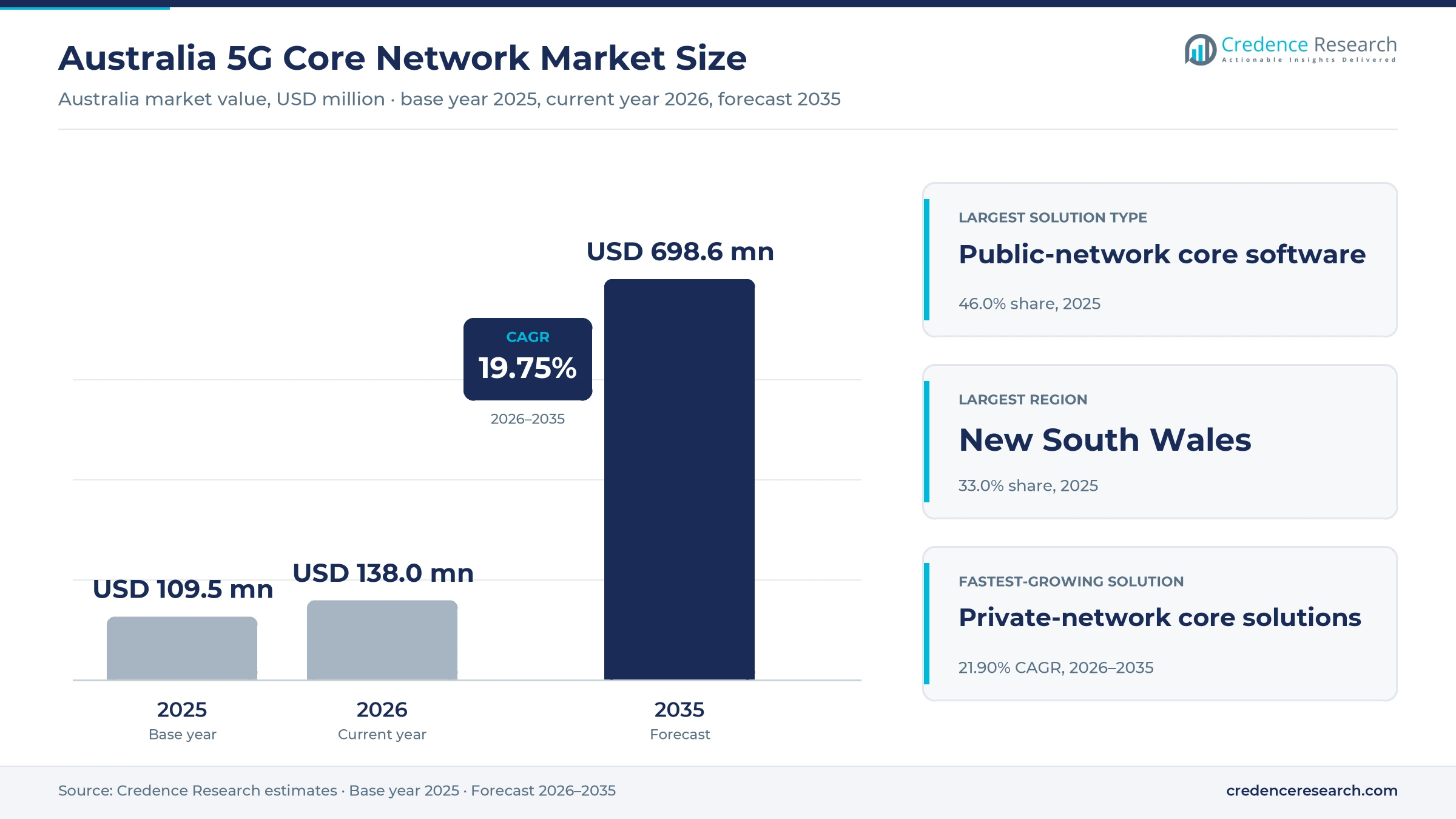
The Australia 5G core network market was valued at USD 109.5 million in 2025 and is projected to increase from USD 138.0 million in 2026 to USD 698.6 million by 2035, registering a CAGR of 19.75% during 2026–2035. Spending comes from Telstra, Optus and TPG Telecom as they move traffic onto standalone platforms, and from mines, rail lines and event venues that now run dedicated networks. New South Wales held the largest regional share, 33.0% in 2025, because it holds the largest population and major rail and mining projects. Western Australia is the fastest-growing region at 20.91% a year, as it posted the quickest population growth in the year to March 2026. Compliance now forms part of core network budgets as well, because Australia’s Triple Zero Custodian law commenced on Oct. 31, 2025, after the Optus outage of Sept. 18, 2025, and it raised penalties for emergency-call failures. As a result, buyers now weigh testing and monitoring alongside capacity when they renew core contracts.
Which carrier and enterprise purchases make up Australian core spending?
The market counts spending on core software, integration, managed operation and dedicated enterprise cores that serve 5G traffic in Australia. Buyers are the three national mobile carriers, along with mining, rail, port and public safety operators that run private networks. Most carrier purchases are multi-year vendor agreements, and they combine software licenses with support and upgrades.
The estimate excludes radio equipment, towers, transmission and spectrum fees, even though those items compete for the same capital budgets. It also excludes the mobile service revenue that carriers earn from subscribers. Value moves from vendors and integrators to carriers and enterprises, and managed services are counted where a third party operates the core.
Australia 5G Core Network Market Insights
- The market rises from USD 109.5 million in 2025 to USD 698.6 million by 2035, a 19.75% CAGR, as carriers and enterprises fund standalone platforms and programmable services across Australia.
- New South Wales held 33.0% of 2025 value, supported by the largest state population and by private network projects such as the Cadia mine and Sydney Metro West.
- Public-network core software led solution types with 46.0% in 2025, reflecting multi-year carrier purchases by Telstra, Optus and TPG Telecom on their national mobile networks.
- The Triple Zero Custodian law commenced on Oct. 31, 2025, and it has made pre-change testing and network monitoring a standing part of core operations for carriers.
- Ericsson supplies cloud-native cores to Telstra and TPG Telecom, while BAI Communications and X4000 Communications hold spectrum that lets them pursue enterprise networks directly.
Carrier software leads while private cores gain the most
Why carrier software leads and private cores grow fastest
Based on solution type, the market is categorized into public-network core software, professional services, managed core services and private-network core solutions. Public-network core software led with 46.0% of 2025 value because national carriers buy at scale, and TelecomLead reported in August 2026 that Telstra alone ran 26.027 million retail mobile services. Private-network core solutions grow fastest at 21.90% a year as dedicated sites multiply, and IT Brief reported in November 2024 that BAI Communications secured up to 50 MHz of 3.8 GHz spectrum. Migration projects also draw on cloud professional services skills held by integrators.
How cloud-native platforms displaced older packet cores
Based on technology, the market is categorized into cloud-native standalone core, virtualised standalone core and 5G-enabling evolved packet core. Cloud-native standalone core led with 56.0% of 2025 value because TPG Telecom consolidated 4G, non-standalone and standalone data onto one Ericsson dual-mode core, according to TelecomTalk in December 2023. The same segment grows fastest at 21.04% a year as Telstra, which reported a cloud-native core in May 2020 according to RCR Wireless, adds 5G Advanced functions. Older function virtualization stacks keep some share while carriers finish their migrations.
Why mobile broadband pays for most core capacity
Based on application, the market is categorized into enhanced mobile broadband, enterprise service differentiation and industrial operational connectivity. Enhanced mobile broadband led with 62.0% of 2025 value because consumer traffic still sizes the core, and Telstra said in February 2025 that mobile data demand on its network had tripled over the past five years, according to Ericsson. Industrial operational connectivity grows fastest at 21.94% a year as machine control outgrows Wi-Fi, and RCR Wireless reported in August 2024 that private 5G at the Cadia mine reached 150 Mbps upload against 20–30 Mbps on Wi-Fi.
How direct contracts and integrators divide core sales
Based on sales channel, the market is categorized into direct vendor contracts, operator-led solutions and integrator-led solutions. Direct vendor contracts led with 50.0% of 2025 value because carriers negotiate core supply themselves, as TPG Telecom did when it chose Ericsson in September 2021, according to Technology Decisions. Integrator-led solutions grow fastest at 21.32% a year as enterprises seek a single accountable partner. In February 2026, ChannelLife reported that Metro Trains West named BAI Communications as delivery partner for a private 5G train system on Sydney Metro West.
| Segment Group | Leading Sub-segment | Share, 2025 | Fastest-growing Sub-segment | CAGR, 2026–2035 |
|---|---|---|---|---|
| By Solution Type | Public-network core software | 46.0% | Private-network core solutions | 21.90% |
| By Technology | Cloud-native standalone core | 56.0% | Cloud-native standalone core | 21.04% |
| By Application | Enhanced mobile broadband | 62.0% | Industrial operational connectivity | 21.94% |
| By Sales Channel | Direct vendor contracts | 50.0% | Integrator-led solutions | 21.32% |
Request a Free Sample
Fill in your details and we'll send you a free sample report.
- Sample data tables & charts
- Research methodology
Standalone, programmability and voice rules drive budgets
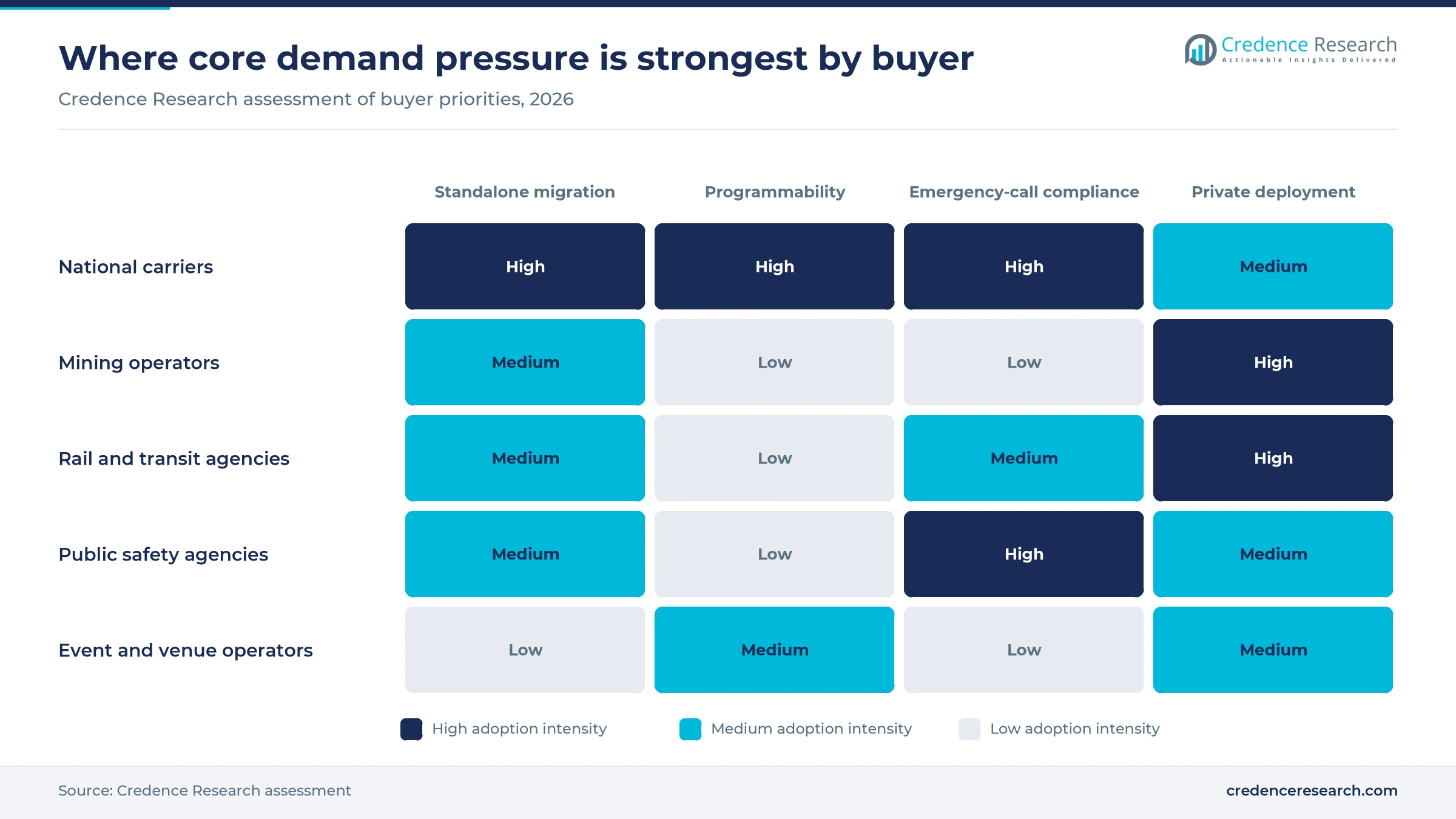
Standalone platform migration moves traffic to new cores
Standalone migration lifts spending because each carrier must move subscribers, policy and data sessions from older packet platforms to a service-based core. Telstra set the pace in May 2020, when RCR Wireless reported that Ericsson had added a cloud-native core able to carry standalone traffic, while 5G covered parts of 32 cities and towns. TPG Telecom followed, and TelecomTalk reported in December 2023 that a single consolidated core then handled all of its data traffic. Optus has since shown what the platform can carry, recording 3.4 Gbps downlink and 200 Mbps uplink at its Sydney campus on a live standalone network, according to the IEEE Communications Society Technology Blog in May 2026. As a result, cloud-native platforms held 56.0% of 2025 value.
Programmable network evolution opens paid service tiers
Programmability gives carriers a reason to fund the core beyond capacity, because tailored connectivity requires policy control and exposed network functions. Telstra committed to this model in a four-year deal that Ericsson and Telstra announced on Feb. 19, 2025, which covers 5G Advanced software and Open RAN-ready hardware and aims to double 5G capacity. In the same release, Telstra said demand for mobile data on its network had tripled in five years, and it described a move away from one-size-fits-all plans. TelecomLead reported in August 2026 that about 1,200 Telstra sites had reached 5G Advanced capability in fiscal 2026. Core platforms that support slicing therefore turn radio upgrades into sellable tiers. In turn, enterprise customers gain a reason to pay for assured performance.
Voice-core modernization follows the closure of 3G
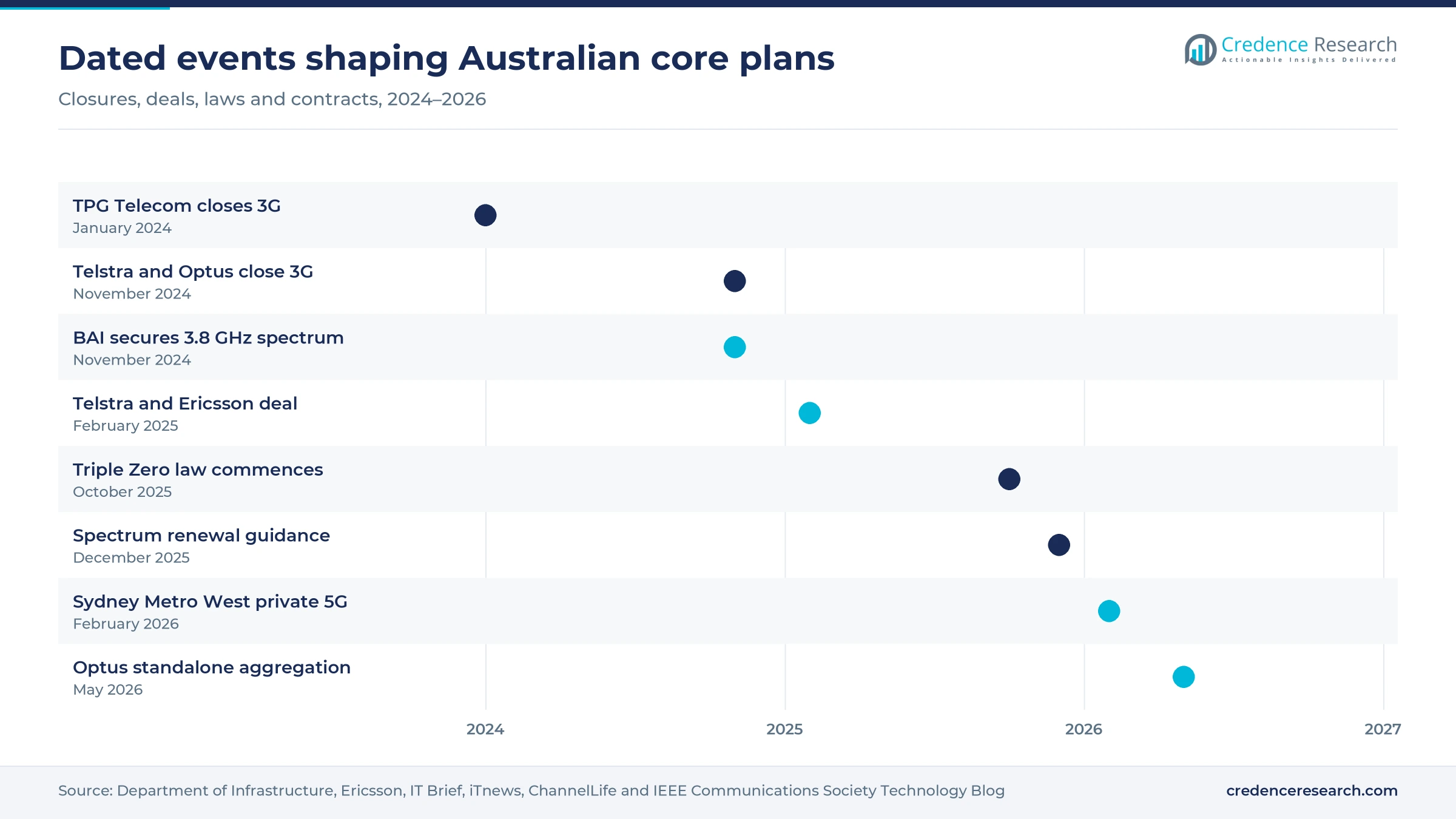
Voice-core work has become unavoidable because calls now depend entirely on packet voice systems rather than circuit fallback. TPG Telecom closed 3G in January 2024, and Telstra and Optus followed in November 2024, according to the Department of Infrastructure, which warned that phones without VoLTE cannot call over 4G. This change put emergency calling on the same platforms that carry data, and the Triple Zero Custodian law commenced on Oct. 31, 2025, to oversee it. Telecoms.com reported that the maximum penalty for breaching Triple Zero rules rose to A$30 million, while carriers must test emergency calling during upgrades and maintenance. Consequently, voice functions now attract testing, redundancy and monitoring budgets. These requirements reach every national carrier and support recurring demand for managed support.
High mobile penetration and data growth size the core
A dense subscriber base keeps core capacity growing even though Australia adds relatively few new users. World Bank data show 112.58 mobile subscriptions per 100 people in Australia in 2024, which points to more active lines than residents. Machine traffic adds to this load, and TelecomLead reported that Telstra’s IoT connections rose 12.5% to 11.074 million in fiscal 2026. Carriers are funding the capacity, with Optus saying in May 2026 that it invested about A$1.5 billion in networks and IT systems in fiscal 2026. Therefore, Enhanced mobile broadband kept 62.0% of 2025 value in this report. That spending pattern suggests capacity, rather than new coverage, still sets the size of most core contracts at the largest carriers.
Resilience work and private networks reshape core demand
Shift toward 5G Advanced functions on standalone cores
Carriers are shifting from coverage milestones toward features that only work well on standalone platforms. Optus and Ericsson demonstrated aggregation of 180 MHz across 2.3 GHz and 3.5 GHz on commercial devices, including the Samsung Galaxy S26 Ultra, according to the IEEE Communications Society Technology Blog in May 2026. The same source reported Telstra deploying Ericsson carrier aggregation optimization across more than 50 live 5G Advanced sites. Telstra’s four-year Ericsson deal of February 2025 also covers 5G Advanced software, according to Ericsson. As a result, core upgrades increasingly arrive as feature releases rather than one-time replacements, so carriers now budget for recurring software work across each network.
Rise of resilience as a core operating requirement
Resilience has risen from an engineering concern to a board-level purchase criterion since the Optus outage of Sept. 18, 2025. ChannelNews reported that Optus is speeding up the transfer of network monitoring from Nokia, which it had planned to complete by May 2027, and adding 150 staff to a process center of excellence. Optus said in May 2026 that it has expanded automated Triple Zero testing and set up a dedicated 24/7 monitoring team. The Department of Infrastructure reported that the regulator was directed to require public outage registers by June 30, 2026. These steps raise demand for observability and change-control tools around the core. In turn, testing and monitoring now compete with new features for core budgets at each carrier.
Opportunity in private cores for mines and industrial sites
Mining offers a clear opening because automated equipment needs reliable uplink that Wi-Fi struggles to provide underground. RCR Wireless reported in August 2024 that a trial at the Cadia mine in New South Wales, begun in February 2023, reached about 90 Mbps upload on access drives, and false safety stops had been a problem under Wi-Fi. Newmont then extended its Ericsson private 5G work to underground and surface operations. Fierce Network separately reported that the Australian Grand Prix Corporation ran private 5G at Albert Park for ticketing and point-of-sale systems in March 2025. These cases show that private network demand now reaches beyond mining sites. Vendors that can package a small core with spectrum access can therefore address Industrial operational connectivity growth of 21.94% a year.
Opportunity in mission-critical rail and public safety cores
Rail and emergency agencies present a second opening, because their contracts run for many years and demand high availability. ChannelLife reported in February 2026 that BAI Communications will deliver a private 5G train communication system for the 24 km Sydney Metro West line, which is scheduled to open in 2032 with 16 driverless trains. That contract is described as Australia’s first for a 5GMCX-based rail radio system, offering a pathway to the FRMCS standard. BAI also manages the NSW Public Safety Network, which connects more than 50 agencies and 75,000 terminals, according to RCR Wireless in July 2026. As a result, mission-critical work can support long-term demand for Integrator-led solutions, the group growing at 21.32% a year.
Spectrum fees and outage liability test core investment
Spectrum renewal costs compete with core budgets
Spectrum renewal is the largest competing call on capital because guidance from the Australian Communications and Media Authority in December 2025 put renewals at A$7.3 billion, up to A$2.3 billion more than carriers expected. Most licenses renew between 2028 and 2032, so the cost falls within this forecast period. Telstra warned of downward pressure on network spending, while Optus cited a threat to funding for upgrades. Vendors may therefore face longer sales cycles and phased orders. Carriers can respond by favoring software releases that reuse existing cores.
Outage liability raises the cost of every core change
Upgrades now carry greater legal and reputational risk, and the Optus outage of Sept. 18, 2025, shows why. RNZ reported that about 75% of calls from 605 Triple Zero callers failed over almost 14 hours, and the independent review found at least 10 mistakes during a routine upgrade. Carriers and their contractors must now absorb extra testing and approvals, which slows release schedules. Automated pre-change testing can reduce that burden, although it adds cost to each migration.
Rising traffic and tight capital limit core upgrade payback
Payback remains uncertain because traffic keeps rising while capital budgets stay tight. Telstra said in February 2025 that mobile data demand on its network had tripled over five years, according to Ericsson. TelecomLead reported that Telstra’s capital spending slipped 0.7% to A$3.365 billion in fiscal 2026. Finance teams therefore question new platforms unless paid tiers are visible. Vendors can respond with phased licensing tied to service launches.
Supplier concentration exposes carriers to shared faults
Reliance on a small supplier group concentrates operational risk, since Telstra and TPG Telecom both selected Ericsson for their cloud-native cores. Fault detection is one concern, and Capacity reported that a Dapto tower outage on Sept. 28, 2025, lasted about nine hours after Ericsson equipment failed to raise an alarm, according to Optus. Although that fault was limited to one site, it shows how vendor tooling shapes recovery times. Multi-vendor designs can reduce the exposure, but they add integration cost for carriers.
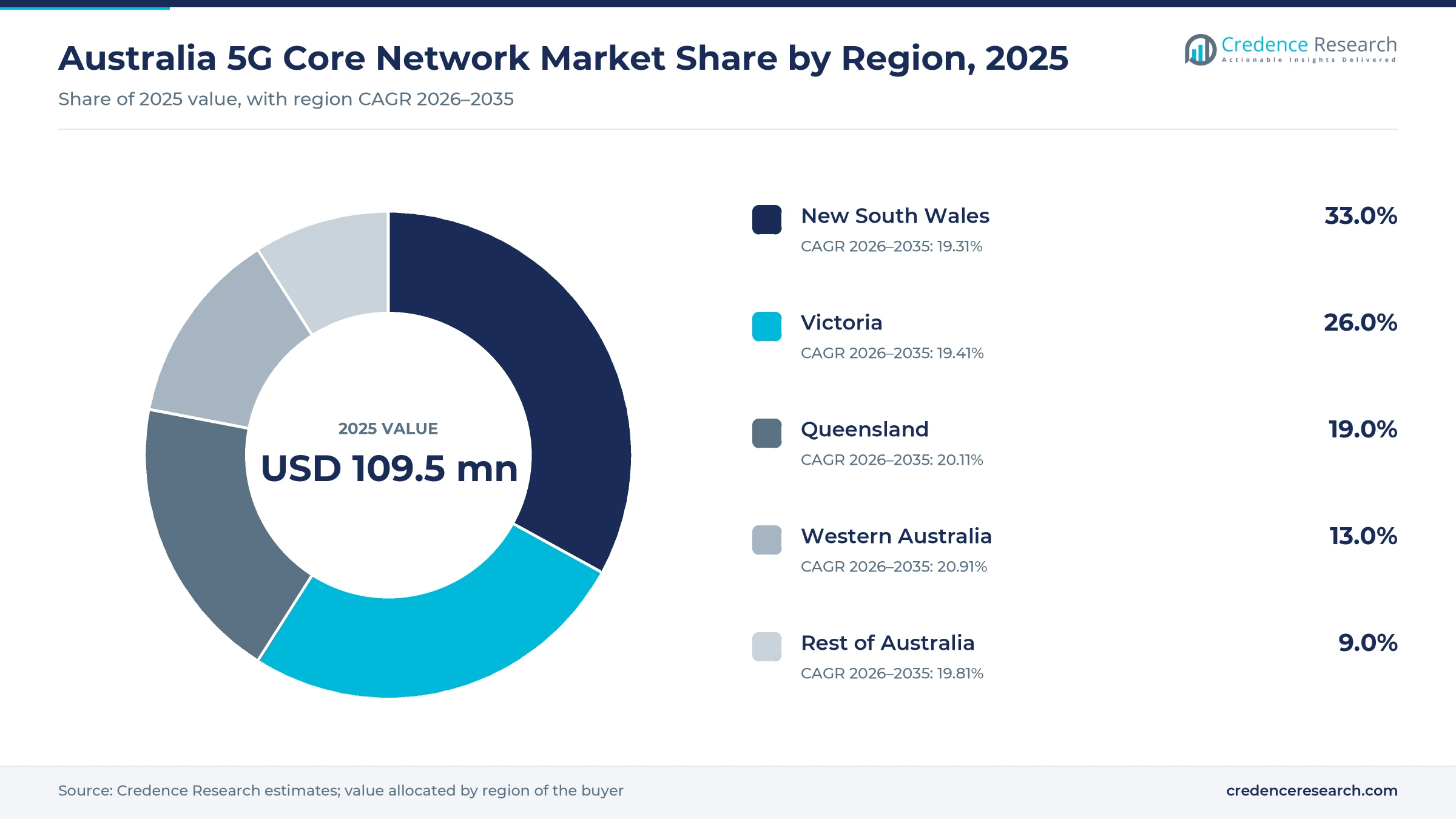
Population and major projects put New South Wales ahead
| Region | Value, 2025 (USD million) | Share, 2025 | CAGR, 2026–2035 |
|---|---|---|---|
| New South Wales | 36.1 | 33.0% | 19.31% |
| Victoria | 28.5 | 26.0% | 19.41% |
| Queensland | 20.8 | 19.0% | 20.11% |
| Western Australia | 14.2 | 13.0% | 20.91% |
| Rest of Australia | 9.9 | 9.0% | 19.81% |
New South Wales leads on population and major projects
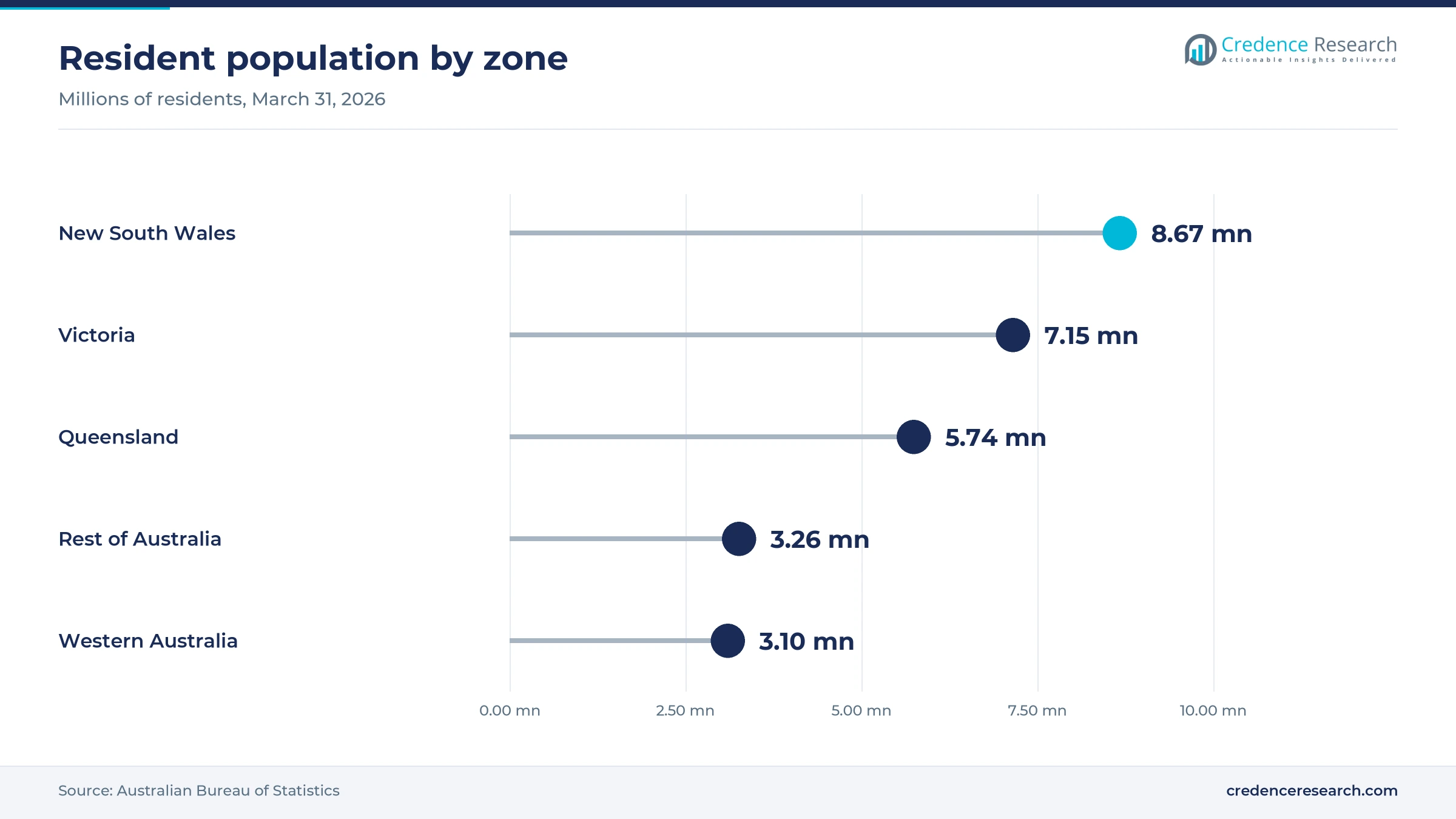
New South Wales held 33.0% of 2025 value and grows at 19.31% a year. The Australian Bureau of Statistics counted 8.67 million residents on March 31, 2026, the largest state total, which gives it the deepest subscriber base. Project demand adds to that base, since the Cadia mine and the 24 km Sydney Metro West line both sit in the state. In addition, Optus used its Sydney campus for its May 2026 standalone demonstration, which reflects the concentration of engineering work there.
Victoria follows on subscriber scale and event networks
Victoria held 26.0% of 2025 value and grows at 19.41% a year. The Australian Bureau of Statistics counted 7.15 million residents on March 31, 2026, after an annual gain of 109,500, the largest increase of any state. That gain lifts core demand in Melbourne and its suburbs, adding traffic that carrier platforms must carry. Enterprise use is also visible there, because the Australian Grand Prix Corporation ran private 5G at Albert Park during the March 2025 race.
Queensland adds regional spectrum and steady user growth
Queensland held 19.0% of 2025 value and grows at 20.11% a year. The Australian Bureau of Statistics counted 5.74 million residents on March 31, 2026, up 1.6% in a year. Spectrum access is a local feature too, because X4000 Communications won 75% of Queensland’s area-wide millimeter-wave licenses in May 2022, according to TechPartner. These holdings give private network buyers in the state another supply option beyond the national carriers.
Western Australia grows fastest on population and resources
Western Australia held 13.0% of 2025 value and grows at 20.91% a year, the fastest pace among the zones. The Australian Bureau of Statistics counted 3.10 million residents on March 31, 2026, and its 2.1% annual growth rate was the fastest of any state or territory. That pace supports core demand as carriers add capacity for new residents. Credence Research also assumes that resource operators will favor private cores here, following the underground results reported at Cadia in New South Wales.
Rest of Australia remains a smaller and more dispersed base
Rest of Australia held 9.0% of 2025 value and grows at 19.81% a year. This zone combines South Australia, Tasmania, the Northern Territory and the Australian Capital Territory, which together held about 3.26 million residents on March 31, 2026, according to the Australian Bureau of Statistics. Low density limits core demand across those four jurisdictions, so these areas mostly rely on platforms hosted elsewhere. Dedicated sites are likely to supply much of the incremental spending.
Dated deals and rulings that moved Australian core plans
| Development | Status and market relevance |
|---|---|
| In February 2025, Telstra and Ericsson announced a four-year deal covering 5G Advanced software and Open RAN-ready hardware. | Under way, and it frames Telstra’s programmable network plans. |
| In July 2025, Vocus completed its A$5.25 billion purchase of TPG Telecom’s fiber assets and enterprise, government and wholesale business. | Completed, while TPG Telecom kept its mobile radio network and mobile business. |
| In October 2025, the Triple Zero Custodian law commenced after passing both houses of Parliament on Oct. 28, 2025. | In force, and it raises compliance demands on every carrier core. |
| In December 2025, the Australian Communications and Media Authority raised its estimate of spectrum renewal fees to A$7.3 billion. | Consulted on, and it adds pressure to carrier budgets through 2032. |
| In February 2026, BAI Communications was reported as delivery partner for a private 5G train system on Sydney Metro West. | Contracted, with the line scheduled to open in 2032. |
Cloud-native functions change how carriers run the core
- Dual-mode cores let carriers such as TPG Telecom run 4G, non-standalone and standalone data on one platform, which removes parallel upgrade work.
- Network exposure functions give developers controlled access to carrier capabilities, and the Aduna venture counts Telstra and Ericsson among its founding members.
- Edge-hosted user planes place traffic handling closer to users, which is why core planners track edge computing sites alongside central facilities.
- Automated pre-change testing checks emergency call paths before and after upgrades, a practice Optus said in May 2026 it had expanded.
Need a Custom Version of This Report?
Tailor the scope, geography, or segments to your exact requirements.
- Custom geography or segment scope
- Direct access to our analyst team
Ericsson anchors carriers as specialists chase enterprises
Ericsson holds the strongest position among carriers, since Telstra and TPG Telecom both selected it for cloud-native cores, and Optus used Ericsson for its May 2026 standalone demonstration. Nokia competes through carrier services and partnerships, including a February 2022 memorandum with TPG Telecom on private networks for mining and energy, although Optus is now moving network monitoring away from it. Telstra acts as both buyer and seller, because Telstra Purple supplied equipment and spectrum for the Cadia trial. BAI Communications competes through licensed spectrum and long-term rail and public safety work, while X4000 Communications sells spectrum with an end-to-end network offer. Vocus operates more than 50,000 km of owned fiber after its TPG Telecom deal, an asset base closer to dark fiber and enterprise connectivity than to core supply. Competition therefore depends on carrier references, spectrum access and the ability to take operational responsibility.
Carrier, vendor and spectrum roles in Australian core supply
| Company | Type | Role in the market |
|---|---|---|
| Ericsson | Core and radio vendor | Supplies cloud-native cores to Telstra and TPG Telecom, and private 5G technology for Newmont at Cadia |
| Nokia | Vendor and services provider | Signed a private network memorandum with TPG Telecom in February 2022 and handled Optus network monitoring |
| Telstra | Carrier and integrator | Runs an Ericsson cloud-native core and sells private networks through Telstra Purple |
| BAI Communications | Private network provider | Holds 3.8 GHz and millimeter-wave spectrum and delivers the Sydney Metro West train system |
| X4000 Communications | Spectrum holder and integrator | Offers private 5G using area-wide millimeter-wave licenses with partner equipment |
| Vocus | Fiber and enterprise carrier | Owns more than 50,000 km of fiber and buys mobile access under an agreement with Optus Wholesale |
Where Australian core spending moves after standalone
Credence Research’s view is that the Australian core network market is moving from a migration story to an operating story. The first standalone platforms are already live, so the next budgets will favor features, testing and accountable operation. Carrier software remains the largest pool, yet the outage findings of December 2025 show that a technically sound core can still fail through poor procedures. Vendors should therefore price services around change safety as well as capacity. Private networks offer faster growth from a small base, although results at sites such as Cadia must be repeated widely before they become routine purchases.
Population data and carrier records underpin the estimates
The report uses 2025 as the base year and forecasts values for 2026 through 2035 from the Credence Research market model. Segment and regional splits are Credence Research estimates rather than published statistics. Regional zones were built from Australian Bureau of Statistics population data and known project locations. Supporting evidence came from company releases, government and regulator documents, World Bank data, carrier results and telecom trade publications. No interviews or surveys were conducted for this edition, so assumptions about spending per subscriber and private network uptake are the most judgment-heavy inputs.
Enterprise cores and programmability shape growth to 2035
The core network market is forecast to reach USD 698.6 million by 2035, growing at a 19.75% rate through 2026–2035. Carrier migration should dominate early years, while 5G Advanced services and license renewals between 2028 and 2032 shape spending in the middle of the period. Enterprise cores should then add a larger share, particularly if mining and rail deployments repeat the performance reported at Cadia and delivery on Sydney Metro West proceeds toward its 2032 opening. Regulation will remain a steady influence, because Triple Zero obligations apply to each change that carriers make to their networks. Buyers are likely to reward vendors that can prove safe upgrades.
Frequently Asked Questions
How big is the Australia 5G core network market?
Which solution type leads the Australian market?
Which region holds the largest share in Australia?
Which region grows fastest in this market?
What drives Australian 5G core spending?
Why are private 5G cores growing quickly in Australia?
What are the main challenges for this market?
Which companies are active in the market?
Table of Content
Chapter 1 Market Segmentation
- 1.1 Segmentation Framework
- 1.1.1 Product and Service Classification
- 1.1.2 Application and End-Use Classification
- 1.1.3 Technology and Solution Classification
- 1.1.4 Customer and Distribution Channel Classification
- 1.1.5 Geographic Segmentation
- 1.1.6 Market Segment Definitions and Boundaries
- 1.2 By Solution Type
- 1.2.1 Public-network core software
- 1.2.2 Professional services
- 1.2.3 Managed core services
- 1.2.4 Private-network core solutions
- 1.3 By Technology
- 1.3.1 Cloud-native standalone core
- 1.3.2 Virtualised standalone core
- 1.3.3 5G-enabling evolved packet core
- 1.4 By Application
- 1.4.1 Enhanced mobile broadband
- 1.4.2 Enterprise service differentiation
- 1.4.3 Industrial operational connectivity
- 1.5 By Sales Channel
- 1.5.1 Direct vendor contracts
- 1.5.2 Operator-led solutions
- 1.5.3 Integrator-led solutions
Chapter 2 Introduction
- 2.1 Report Objectives and Scope
- 2.2 Product Definition and Industry Terminology
- 2.3 Market Inclusions and Exclusions
- 2.4 Research Process
- 2.4.1 Primary Research and Expert Interviews
- 2.4.2 Secondary Research and Source Review
- 2.4.3 Top-Down and Bottom-Up Estimation
- 2.4.4 Data Triangulation and Verification
- 2.5 Market Size Measurement Basis
- 2.5.1 2025: USD 109.5 million → 2035: USD 698.6 million
- 2.6 Historical and Forecast Reference Periods
- 2.6.1 Historical Period: 2018-2025
- 2.6.2 Base Year: 2025
- 2.6.3 Forecast Period: 2025-2035
- 2.7 Research Assumptions and Limitations
Chapter 3 Executive Summary
- 3.1 Market Snapshot and Key Findings
- 3.2 Base-Year Market Size, 2025
- 3.3 Forecast Market Size, 2035
- 3.4 Revenue and Volume Growth Outlook
- 3.5 Key Demand and Supply Indicators
- 3.6 Leading Market Segments
- 3.7 Fastest-Growing Market Opportunities
- 3.8 Regional Performance Highlights
- 3.9 Technology and Industry Transformation
- 3.10 Competitive Landscape Summary
- 3.11 Analyst View and Strategic Implications
Chapter 4 Australia 5G Core Network Market Trends and Developments
- 4.1 Historical Industry Development, 2018-2025
- 4.2 Recent Market Trends and Developments
- 4.3 Demand and Customer Behavior Trends
- 4.4 Technology and Product Innovation
- 4.5 Artificial Intelligence, Automation and Digitalization
- 4.6 Local Manufacturing and Supply Chain Realignment
- 4.7 Industry Partnerships, Mergers and Acquisitions
- 4.8 Sustainability and Circular Economy Developments
- 4.9 Government and Private Sector Investment Trends
- 4.10 Emerging Business Models and Commercialization
- 4.11 Industry Developments and Announcements
Chapter 5 Australia 5G Core Network Market Production, Supply and Demand Analysis
- 5.1 Demand Trend and Consumption Analysis, 2018-2025
- 5.2 Demand Forecast, 2025-2035
- 5.3 Production and Output Trend, 2018-2025
- 5.4 Production and Output Forecast, 2025-2035
- 5.5 Installed Capacity and Capacity Utilization
- 5.6 Company-Wise Production Plants and Statistics
- 5.6.1 Installed Production Capacity
- 5.6.2 Actual Production
- 5.6.3 Planned Capacity and Expansion Targets
- 5.7 Supply Chain Structure and Procurement Trends
- 5.8 Supply-Demand Gap and Bottlenecks
- 5.9 Import Dependence and Sourcing Structure
- 5.10 Contract Manufacturing and Outsourcing
- 5.11 Regional Supply and Demand Concentration
Chapter 6 Australia 5G Core Network Market Pricing Analysis
- 6.1 Pricing Structure and Measurement
- 6.2 Historical Pricing Trends, 2018-2025
- 6.3 Pricing Outlook, 2025-2035
- 6.4 Average Selling Price and Unit Economics
- 6.5 Pricing by Product and Market Segment
- 6.6 Geographic Pricing Differences
- 6.7 Key Input, Energy, Labor and Logistics Costs
- 6.8 Contract Pricing and Purchasing Models
- 6.9 Pricing Sensitivity and Competitive Positioning
- 6.10 Price, Margin and Profitability Implications
Chapter 7 Australia 5G Core Network Market Dynamics
- 7.1 Market Growth Drivers
- 7.1.1 Demand-Side Drivers
- 7.1.2 Technology and Innovation Drivers
- 7.1.3 Infrastructure and Investment Drivers
- 7.1.4 Regulatory and Policy Drivers
- 7.2 Market Restraints
- 7.2.1 Cost and Affordability Constraints
- 7.2.2 Technology and Adoption Barriers
- 7.2.3 Supply Chain and Operational Constraints
- 7.3 Market Challenges
- 7.3.1 Competitive Pressure and Margin Erosion
- 7.3.2 Skills, Infrastructure and Implementation Gaps
- 7.4 Emerging Market Opportunities
- 7.5 Market Dynamics Impact and Time-Horizon Assessment
Chapter 8 Australia 5G Core Network Value Chain Analysis
- 8.1 Industry Value Chain Overview
- 8.2 Upstream Suppliers and Critical Inputs
- 8.3 Technology and Component Providers
- 8.4 Manufacturing or Service Delivery
- 8.5 Distribution, Channel Partners and Integrators
- 8.6 Downstream Applications and End Users
- 8.7 Value Addition and Profit Pools
- 8.8 Vertical Integration and Outsourcing
- 8.9 Supplier Concentration and Risk
- 8.10 Supply Chain Localization and Resilience
Chapter 9 Australia 5G Core Network Market Regulations and Policies
- 9.1 Relevant Laws, Standards and Compliance Frameworks
- 9.2 Product, Service, Safety and Quality Requirements
- 9.3 Government Policies, Incentives and Subsidies
- 9.4 Imports, Exports and Trade Barriers
- 9.5 Public Procurement and Local Content Requirements
- 9.6 Environmental and Sustainability Compliance
- 9.7 Data Protection, AI and Cybersecurity Compliance
- 9.8 Upcoming Policy Changes and Market Implications
Chapter 10 Australia 5G Core Network Market Hotspots and Opportunities
- 10.1 Market Opportunity Mapping and Growth Hotspots
- 10.2 High-Growth Applications and Customer Groups
- 10.3 Underserved Markets and White-Space Opportunities
- 10.4 Emerging Technology and Product Opportunities
- 10.5 New Capacity and Investment Hotspots
- 10.6 Market Entry and Expansion Opportunities
- 10.7 Distribution and Partnership Opportunities
- 10.8 Near-Term and Long-Term Commercial Potential
- 10.9 Opportunity Attractiveness and Execution Risks
Chapter 11 Australia 5G Core Network Market Outlook, 2025-2035
- 11.1 Market Size and Analysis
- 11.1.1 Revenue (Market Measurement: 2025: USD 109.5 million → 2035: USD 698.6 million)
- 11.1.2 Market Volume and Quantity Sold
- 11.1.3 Historical Market Size, 2018-2025
- 11.1.4 Base-Year Market Size, 2025
- 11.2 Market Forecast, 2025-2035
- 11.2.1 Revenue Forecast to 2035
- 11.2.2 Volume Forecast to 2035
- 11.2.3 CAGR and Year-on-Year Growth
- 11.2.4 Incremental Revenue Opportunity
- 11.3 Forecast Assumptions and Scenario Analysis
- 11.3.1 Base-Case Forecast
- 11.3.2 Optimistic and Conservative Scenarios
- 11.3.3 Technology, Pricing and Policy Sensitivities
- 11.4 Market Attractiveness and Growth Outlook
Chapter 12 Australia 5G Core Network Market Segmentation and Outlook
- 12.1 Segmentation Summary and Market Shares, 2025
- 12.2 Largest and Fastest-Growing Segments
- 12.3 By Solution Type - Market Size and Forecast, 2025-2035
- 12.3.1 Segment Definition and Scope
- 12.3.2 Historical Market Size, 2018-2025
- 12.3.3 Revenue Forecast, 2025-2035
- 12.3.4 Volume Forecast, 2025-2035
- 12.3.5 Base-Year Market Share, 2025
- 12.3.6 Segment CAGR and Growth Drivers
- 12.3.7 Subsegment Market Size and Forecast
- 12.3.7.1 Public-network core software
- 12.3.7.2 Professional services
- 12.3.7.3 Managed core services
- 12.3.7.4 Private-network core solutions
- 12.3.8 Subsegment Pricing and Adoption Trends
- 12.3.9 Leading Suppliers and Competition
- 12.3.10 Regional Demand and Opportunities
- 12.4 By Technology - Market Size and Forecast, 2025-2035
- 12.4.1 Segment Definition and Scope
- 12.4.2 Historical Market Size, 2018-2025
- 12.4.3 Revenue Forecast, 2025-2035
- 12.4.4 Volume Forecast, 2025-2035
- 12.4.5 Base-Year Market Share, 2025
- 12.4.6 Segment CAGR and Growth Drivers
- 12.4.7 Subsegment Market Size and Forecast
- 12.4.7.1 Cloud-native standalone core
- 12.4.7.2 Virtualised standalone core
- 12.4.7.3 5G-enabling evolved packet core
- 12.4.8 Subsegment Pricing and Adoption Trends
- 12.4.9 Leading Suppliers and Competition
- 12.4.10 Regional Demand and Opportunities
- 12.5 By Application - Market Size and Forecast, 2025-2035
- 12.5.1 Segment Definition and Scope
- 12.5.2 Historical Market Size, 2018-2025
- 12.5.3 Revenue Forecast, 2025-2035
- 12.5.4 Volume Forecast, 2025-2035
- 12.5.5 Base-Year Market Share, 2025
- 12.5.6 Segment CAGR and Growth Drivers
- 12.5.7 Subsegment Market Size and Forecast
- 12.5.7.1 Enhanced mobile broadband
- 12.5.7.2 Enterprise service differentiation
- 12.5.7.3 Industrial operational connectivity
- 12.5.8 Subsegment Pricing and Adoption Trends
- 12.5.9 Leading Suppliers and Competition
- 12.5.10 Regional Demand and Opportunities
- 12.6 By Sales Channel - Market Size and Forecast, 2025-2035
- 12.6.1 Segment Definition and Scope
- 12.6.2 Historical Market Size, 2018-2025
- 12.6.3 Revenue Forecast, 2025-2035
- 12.6.4 Volume Forecast, 2025-2035
- 12.6.5 Base-Year Market Share, 2025
- 12.6.6 Segment CAGR and Growth Drivers
- 12.6.7 Subsegment Market Size and Forecast
- 12.6.7.1 Direct vendor contracts
- 12.6.7.2 Operator-led solutions
- 12.6.7.3 Integrator-led solutions
- 12.6.8 Subsegment Pricing and Adoption Trends
- 12.6.9 Leading Suppliers and Competition
- 12.6.10 Regional Demand and Opportunities
- 12.7 Segment Growth Comparison
- 12.8 Segment Attractiveness and Priority Matrix
Chapter 13 Australia 5G Core Network End-Use and Application Market Outlook
- 13.1 End-Use Industry and Customer Demand Structure
- 13.2 Leading Applications and Customer Groups
- 13.3 End-Use Market Size, Share and Forecast
- 13.4 Major End-Use Industry Deep Dives
- 13.4.1 Customer Requirements and Use Cases
- 13.4.2 Demand and Replacement Cycles
- 13.4.3 Technical and Regulatory Considerations
- 13.4.4 Purchasing and Procurement Models
- 13.4.5 Leading Vendors and Distribution Channels
- 13.4.6 Forecast and Commercial Opportunities
- 13.5 Emerging Applications and Cross-Segment Demand
- 13.6 End-Use Industry Investment Priorities
Chapter 14 Australia 5G Core Network Geographic Market Outlook, 2025-2035
- 14.1 Domestic Market Distribution and Demand Clusters
- 14.2 State- or Province-Wise Market Size and Forecast, 2025-2035
- 14.3 City and Metropolitan Market Outlook
- 14.4 Industrial, Manufacturing and Commercial Clusters
- 14.5 Geographic Concentration of Key End Users
- 14.6 Local Pricing and Purchasing Differences
- 14.7 Domestic Production Facilities and Capacity Map
- 14.8 Local Infrastructure and Project Pipeline
- 14.9 State-Level Policy and Incentive Differences
- 14.10 Subnational Investment Hotspots and Opportunities
- 14.11 Distribution and Logistics Networks
- 14.12 Domestic Competitive Footprint
Chapter 15 Australia 5G Core Network Technology, Innovation and Sustainability Outlook
- 15.1 Technology Landscape and Maturity
- 15.2 Product, Process and Service Innovation
- 15.3 AI, Automation and Digital Tools in the Industry
- 15.4 Technology Adoption and Performance Benchmarking
- 15.5 Innovation Pipeline and R&D Investment
- 15.6 Patent and Intellectual Property Trends
- 15.7 Energy Efficiency and Resource Management
- 15.8 Sustainability, Recycling and Circularity
- 15.9 Technology Roadmap, 2025-2035
- 15.10 Risks of Obsolescence and Technology Substitution
Chapter 16 Australia 5G Core Network Market Key Strategic Imperatives
- 16.1 Growth and Market Entry Priorities
- 16.2 High-Return Products and Segments
- 16.3 Pricing, Profitability and Cost Optimization
- 16.4 Technology Investment and Product Differentiation
- 16.5 Supply Chain Localization and Resilience
- 16.6 Distribution and Customer Acquisition
- 16.7 Partnership, Acquisition and Capacity Strategy
- 16.8 Regional Expansion Priorities
- 16.9 Short-, Medium- and Long-Term Actions
Chapter 17 Competition Outlook
- 17.1 Industry Competition Characteristics
- 17.2 Market Structure and Concentration
- 17.3 Market Share and Competitive Positioning, 2025
- 17.4 Company-Wise Revenue and Product Benchmarking
- 17.5 Production and Service Capacity Benchmarking
- 17.6 Technology, Pricing and Differentiation
- 17.7 Regional Footprint and Distribution Strength
- 17.8 Mergers, Acquisitions and Strategic Alliances
- 17.9 New Entrants and Competitive Threats
- 17.10 Porter's Five Forces and Industry Attractiveness
- 17.11 Competitive Outlook, 2025-2035
Chapter 18 Company Profiles
- 18.1 Company Coverage and Selection Criteria
- 18.2 Ericsson
- 18.2.1 Business Description
- 18.2.2 Company Ownership and Geographic Presence
- 18.2.3 Product and Service Portfolio
- 18.2.4 Manufacturing and Operating Footprint
- 18.2.5 Production Capacity and Expansion Plans
- 18.2.6 Financial Performance and Investment
- 18.2.7 Market Share and Competitive Position
- 18.2.8 Technology and Innovation Capabilities
- 18.2.9 Strategic Alliances or Partnerships
- 18.2.10 Recent Developments
- 18.2.11 Growth Strategy and Outlook
- 18.3 Nokia
- 18.4 Hewlett Packard Enterprise
- 18.5 Druid Software
- 18.6 Telstra
- 18.7 Vocus
- 18.8 BAI Communications
- 18.9 Mastercom
- 18.10 X4000 Communications
- 18.11 Red Hat
- 18.12 Other Relevant Market Participants
Note: Every listed company is profiled on the structure shown under the first company. The company list is preliminary and may change based on research findings, market developments, data availability and client requirements.
Chapter 19 Disclaimer
- 19.1 Research and Forecast Disclaimer
- 19.2 Data Source and Estimation Limitations
Note: The depth of individual sections depends on data availability for this market. Volume, capacity, trade and other unit-based metrics are included where applicable.

