
Chronic ulcers in older patients anchor product demand
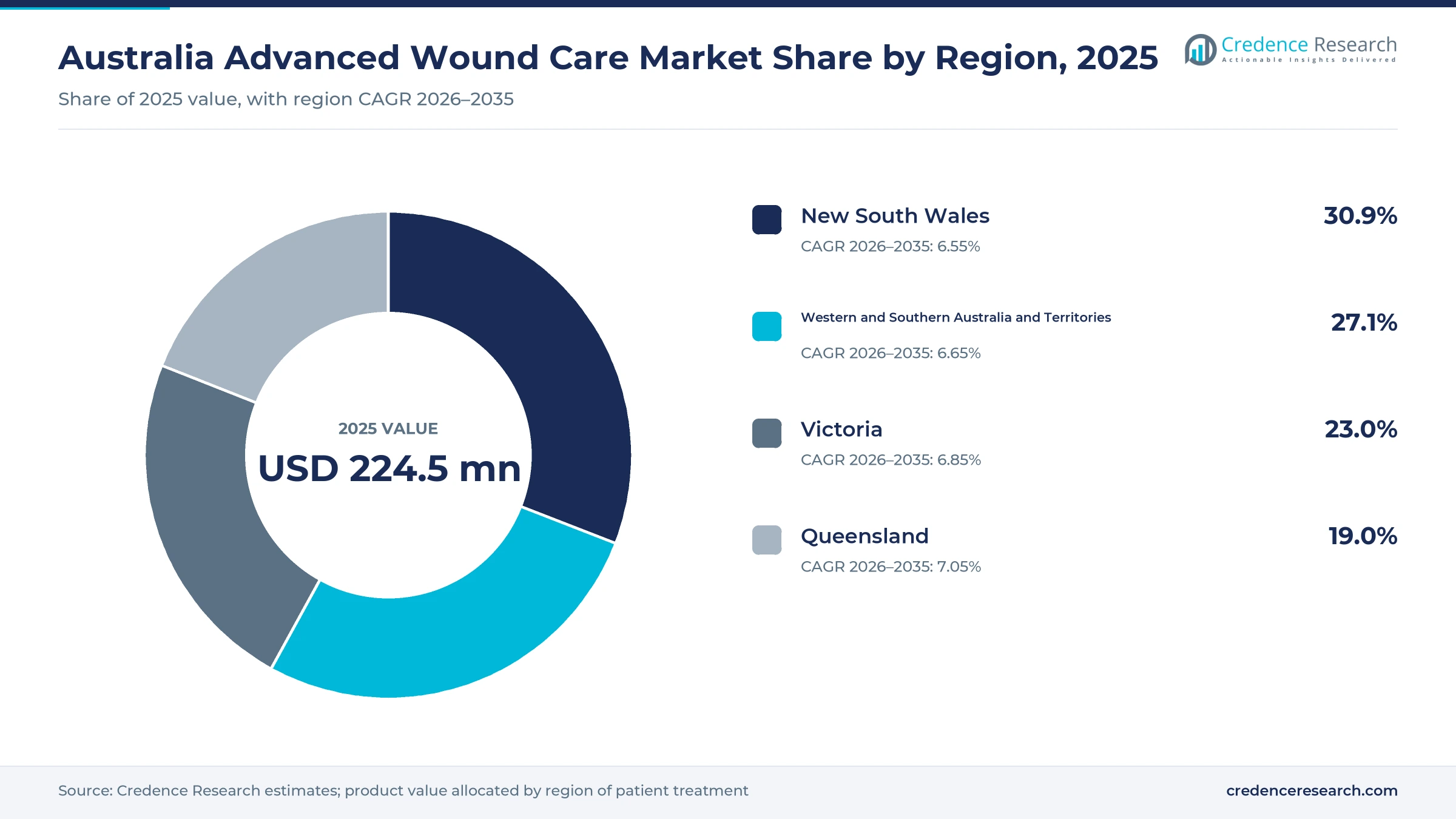
The Australia advanced wound care market was valued at USD 224.5 million in 2025 and is projected to increase from USD 246.0 million in 2026 to USD 442.5 million by 2035, registering a CAGR of 6.74% during 2026–2035. Demand comes from hospitals, aged care homes, community nurses and podiatrists that treat chronic ulcers, surgical incisions and burns with modern dressings, negative pressure systems and bioactive products. New South Wales held the largest regional share, 30.9% in 2025, because the state has the largest population and the densest network of public hospitals and wound clinics. Queensland is the fastest-growing region at 7.05% a year, as population growth and an older age profile raise treatment volumes. Most products are imported and supplied through local subsidiaries of global medical device makers and national distributors. A federal scheme that pays the full cost of dressings for eligible older patients with diabetes began in May 2025.
Which dressings and therapies does the estimate cover?
The estimate measures the value of advanced dressings, negative pressure wound therapy, wound bioactives and advanced adjunctive products sold or supplied in Australia. It covers hospitals and acute care, residential aged care, community and specialist care, and retail-supported self-care. Values are measured at the first point of sale to the treating provider or patient.
The estimate excludes basic gauze, plain adhesive bandages and first aid kits, as well as clinician fees and hospital bed costs. The value chain runs from global manufacturers and their Australian subsidiaries through medical distributors and state purchasing agencies to hospitals, aged care homes, community nursing services, pharmacies and the patients who change dressings at home.
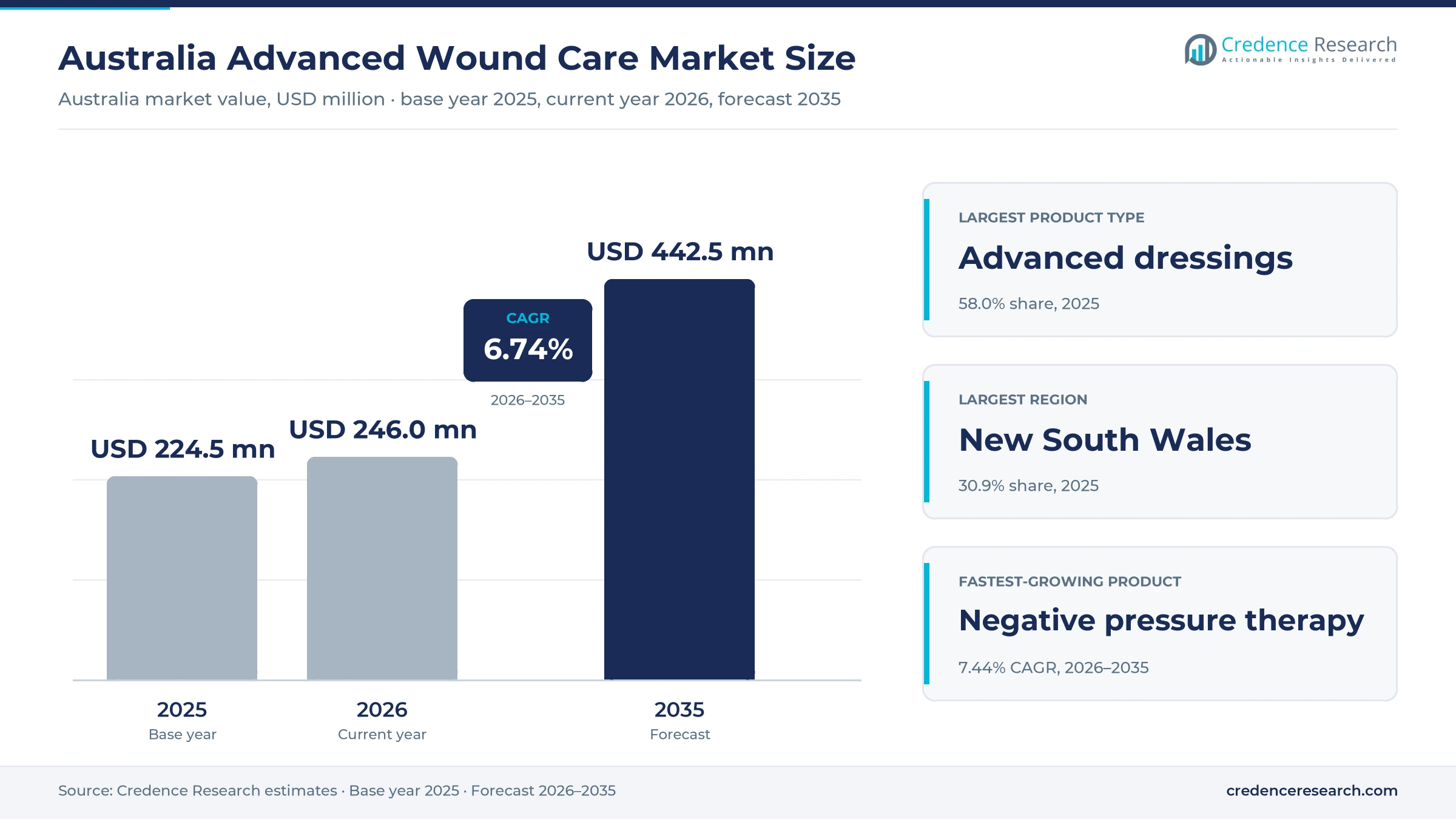
Australia Advanced Wound Care Market Insights
- The Australia advanced wound care market was valued at USD 224.5 million in 2025 and is projected to reach USD 442.5 million by 2035, registering a CAGR of 6.74% during 2026–2035.
- New South Wales held a 30.9% share of 2025 value, because the state has the largest population and hospital network.
- Advanced dressings led product demand with a 58.0% share of 2025 value, because foam, silicone and gelling fiber dressings are first-line care.
- People aged 65 and over made up 18.09% of the Australian population in 2025, which raises the number of slow-healing ulcers.
- A federal scheme that pays for dressings for eligible older patients with diabetes and chronic wounds began in May 2025.
Dressings lead while negative pressure grows fastest
Why do advanced dressings lead the product mix?
Based on product type, the market is categorized into advanced dressings, negative pressure wound therapy, wound bioactives and advanced adjunctive products. Advanced dressings led with a 58.0% share of 2025 value, because foam, silicone and gelling fiber dressings are used on almost every chronic ulcer. Negative pressure wound therapy grows fastest at 7.44% a year, as single-use pumps let patients continue treatment at home.
How does community care change where treatment happens?
Based on care setting, the market is categorized into hospitals and acute care, residential aged care, community and specialist care, and retail-supported self-care. Hospitals and acute care led with a 46.0% share of 2025 value, because surgical and complex wounds start treatment in hospital. Community and specialist care grows fastest at 7.27% a year, as funded dressings reach patients through nurses, podiatrists and general practices.
Why do chronic wounds dominate treatment spending?
Based on disease area, the market is categorized into chronic wounds, acute surgical wounds and burns and traumatic wounds. Chronic wounds led with a 62.0% share of 2025 value, because ulcers in older people with diabetes heal slowly and need many dressing changes. Chronic wounds also grow fastest at 6.99% a year, while specialist burn treatment stays concentrated in a few hospitals.
How do retail and digital channels gain share?
Based on sales channel, the market is categorized into direct institutional contracts, medical distributors and retail and digital dispensing. Direct institutional contracts led with a 52.0% share of 2025 value, because hospitals and state agencies buy under supply contracts. Retail and digital dispensing grows fastest at 7.61% a year, as patients and community nurses order dressings online for home delivery.
| Segment Group | Leading Sub-segment | Share, 2025 | Fastest-growing Sub-segment | CAGR, 2026–2035 |
|---|---|---|---|---|
| By Product Type | Advanced dressings | 58.0% | Negative pressure wound therapy | 7.44% |
| By Care Setting | Hospitals and acute care | 46.0% | Community and specialist care | 7.27% |
| By Disease Area | Chronic wounds | 62.0% | Chronic wounds | 6.99% |
| By Sales Channel | Direct institutional contracts | 52.0% | Retail and digital dispensing | 7.61% |
Request a Free Sample
Fill in your details and we'll send you a free sample report.
- Sample data tables & charts
- Research methodology
Ageing, funded consumables and portable pumps lift use
How does an older population raise treatment intensity?
Age-related treatment intensity lifts spending, because older patients heal slowly and need more dressing changes, compression and specialist visits. People aged 65 and over made up 18.09% of the Australian population in 2025, up from 17.08% in 2022, according to World Bank data. More than 450,000 Australians are affected by chronic wounds each year, according to Monash University, which puts the cost to the health and aged care system above $6 billion a year. Diabetes prevalence also reaches 18.7% among people aged 75 and over, which raises the number of foot and leg ulcers. As a result, chronic wounds hold a 62.0% share of 2025 value and grow at 6.99% a year, the fastest disease area rate.
Why does targeted consumables funding widen access?
Targeted consumables funding widens access, because the federal government now pays for dressings that many older patients once bought themselves. The Chronic Wound Consumables Scheme covers the full cost of products such as bandages, dressings and adhesives for eligible patients from May 2025, according to the Department of Health. Eligible patients have diabetes and a chronic wound and are aged over 65, or are First Nations people aged 50 or over. The scheme received $39 million in federal funding, and products are delivered at no cost to the home or clinic. Mölnlycke lists Mepilex Border Flex, Mepilex Ag, Exufiber and Mepilex Up among the products it supplies under the scheme. In turn, community and specialist care grows at 7.27% a year, the fastest care setting rate.
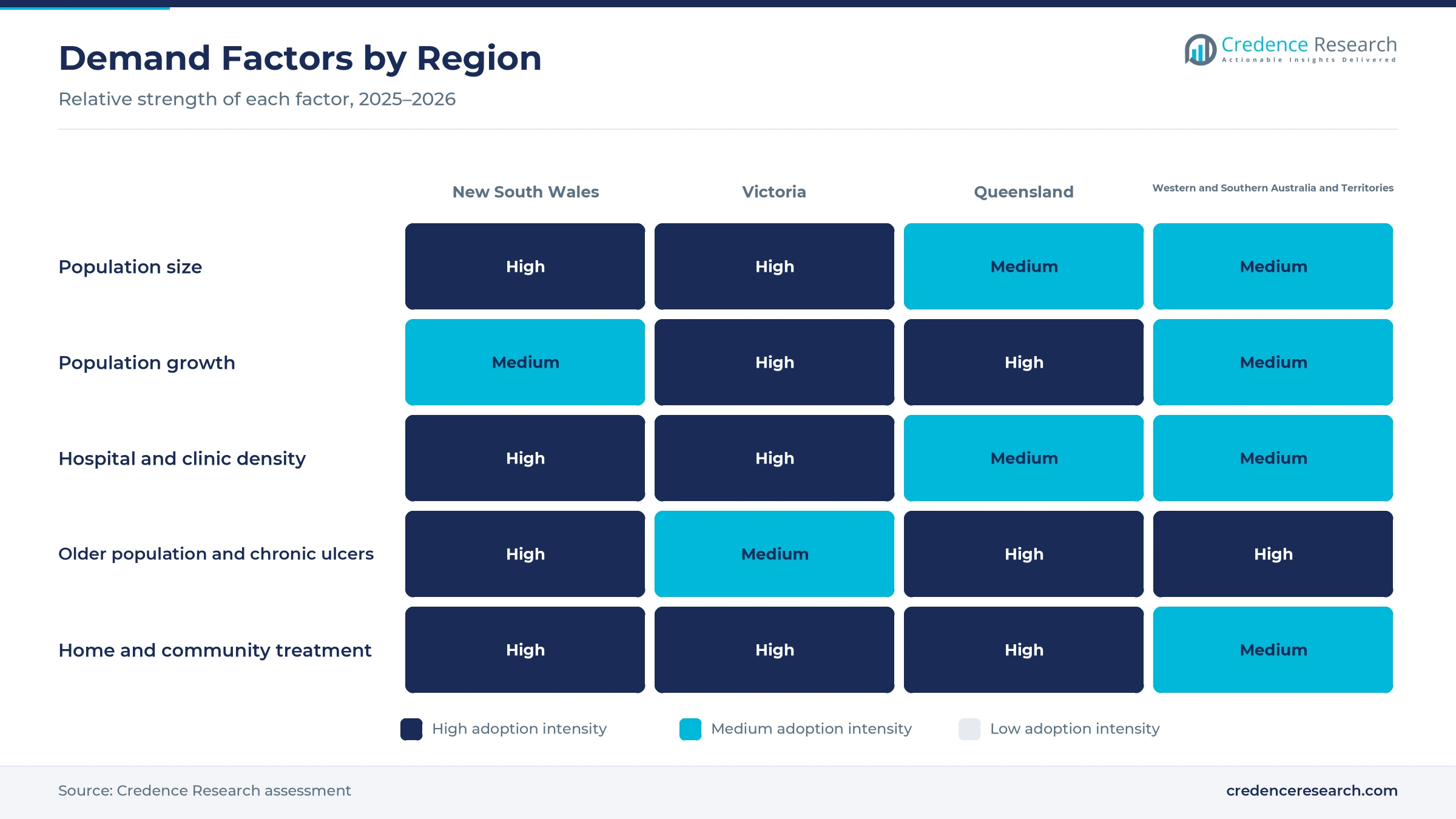
How do portable pumps move therapy out of hospital?
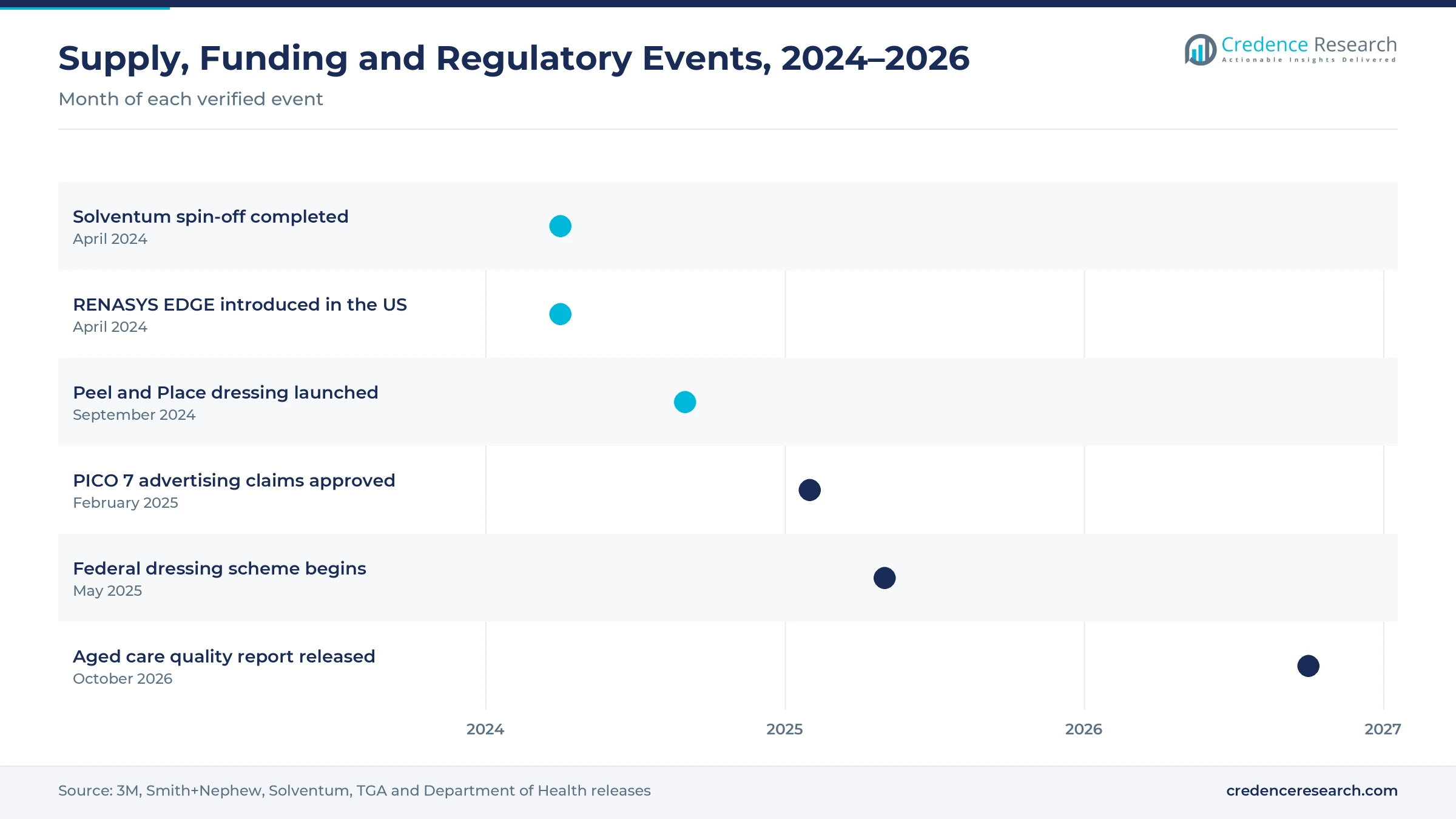
Portable therapy commercialization moves negative pressure treatment out of hospital wards, because single-use and wearable pumps let patients heal at home. The Therapeutic Goods Administration approved restricted advertising claims for the battery-powered, single-use PICO 7 system on Feb. 27, 2025, according to the regulator. Those claims cover a lower risk of surgical site infections after cesarean section, and home use is allowed under clinical supervision. Solventum also launched its Peel and Place dressing for vacuum-assisted closure therapy in the United States and Canada on Sept. 10, 2024, with up to seven days of wear and 67% fewer weekly home nursing visits than a standard foam dressing. As a result, negative pressure wound therapy grows at 7.44% a year, the fastest product rate.
Why does aged care quality reporting sustain demand?
Aged care quality reporting sustains demand, because residential homes must report pressure injuries to the government every quarter. The national quality indicator program included 2,564 residential care homes in the April to June 2026 quarter, out of 2,569 homes that received government subsidies. That quarterly report was released on Oct. 16, 2026, which keeps pressure injury rates visible to residents, families and regulators. Australia also spent 10.4% of its gross domestic product on health in 2023, up from 9.89% in 2022, according to World Bank data. In turn, residential aged care holds a meaningful part of demand, while advanced dressings keep a 58.0% share of 2025 value as homes use foam and silicone dressings to prevent and treat pressure injuries.
Home treatment and supplier change reshape the market
How is the shift to home-based therapy changing supply?
The shift to home-based therapy is changing how products reach patients, because more chronic ulcers are now treated outside hospital. Smith+Nephew introduced the RENASYS EDGE negative pressure system in the United States on April 1, 2024, for patients with chronic wounds who live at home. The device is compact and quiet, and it uses near field communication to give clinicians quick setup support. The federal dressing scheme also delivers products to homes or clinics at no cost, for patients aged over 65 or First Nations patients aged 50 or over. Online suppliers such as Medisa list Convatec Aquacel and Essity Cutimed products for home buyers. As a result, retail and digital dispensing grows at 7.61% a year, the fastest channel rate, as patients and nurses order dressings online.
Why is supplier separation reshaping product focus?
The rise of focused health care suppliers is reshaping product strategy, because separated companies can invest more directly in wound products. 3M completed the spin-off of its health care business as Solventum on April 1, 2024, and the new company trades on the New York Stock Exchange. 3M kept 19.9% of Solventum shares and plans to sell that stake within five years. Solventum Australia now markets negative pressure wound therapy and advanced dressings through its own local website and sales team. In turn, negative pressure suppliers compete more directly on dressing wear time, nurse workload and home use, which supports wound care spending on negative pressure therapy through 2035.
Can diabetic ulcer prevention open new demand?
Diabetic ulcer prevention opens new demand, because the number of Australians with diabetes keeps rising with age and weight. About 1.3 million people, or 5.3% of the population, had diabetes in 2022, according to the Australian Bureau of Statistics. Prevalence rose from 3.3% in 2001 to 5.3% in 2022, which adds more people at risk of foot and leg ulcers each year. The federal scheme also covers diabetic foot ulcers, venous leg ulcers and pressure injuries, but not acute surgical wounds. As a result, suppliers that train podiatrists and nurses on early treatment can lift use in community and specialist care, the fastest-growing care setting in wound care.
Is there room for growth in funded leg ulcer care?
Funded leg ulcer care creates room for growth, because venous ulcers in older people often need months of compression and dressing changes. The federal scheme covers products such as dressings, bandages and compression systems for eligible patients with diabetes. Clinicians must first complete free one-hour online training modules, available from March 2025, before they can order through the scheme portal, which was funded with $39 million. Eligible clinicians include general practitioners, nurses, nurse practitioners, podiatrists and Aboriginal and Torres Strait Islander health practitioners. In turn, suppliers that offer clinician education, simple product ranges and fast home delivery can win share in community wound care, where Queensland and Victoria each grew 1.6% in the year to March 2026.
Eligibility gaps, tenders and skills limit uptake
How do eligibility limits narrow funded demand?
Eligibility limits narrow funded demand, because the federal scheme covers only older patients with diabetes and a chronic wound. Patients funded through aged care services, hospitals, state wound clinics or veterans programs are excluded from the scheme. As a result, many people with pressure injuries or venous ulcers still pay for dressings themselves. Suppliers respond with patient support programs, lower-cost dressing ranges and advocacy for wider eligibility rules.
Why do state tenders pressure product prices?
State tenders pressure product prices, because public hospitals buy most dressings through large multi-year supply contracts. Purchasing agencies compare unit prices across similar foam, silicone and fiber dressings before awarding contracts. In turn, suppliers with premium products must show fewer dressing changes or faster healing to justify higher prices. Companies respond with outcome data, bundled supply agreements and nurse education that lowers total treatment cost.
How do clinical skill gaps slow product uptake?
Clinical skill gaps slow product uptake, because choosing the right dressing or pump depends on accurate wound assessment. Many general practices and aged care homes rely on staff with limited specialist wound training. As a result, chronic ulcers may receive basic dressings for months before referral to specialist care. Suppliers and health services respond with online training, clinical guidelines and outreach programs run by specialist wound nurses.
Why do evidence demands slow bioactive adoption?
Evidence demands slow the adoption of wound bioactives, because funders and hospitals want clear proof of faster healing before paying higher prices. Products such as collagen dressings and growth factor therapies often have small trials with mixed results. In turn, purchasing committees restrict these products to complex cases. Suppliers respond with local case series, registry data and cost studies that compare total treatment cost.
New South Wales leads while Queensland grows fastest
| Region | Value, 2025 (USD million) | Share, 2025 | CAGR, 2026–2035 |
|---|---|---|---|
| New South Wales | 69.4 | 30.9% | 6.55% |
| Western and Southern Australia and Territories | 60.8 | 27.1% | 6.65% |
| Victoria | 51.6 | 23.0% | 6.85% |
| Queensland | 42.7 | 19.0% | 7.05% |
Why does new South Wales hold the largest share?
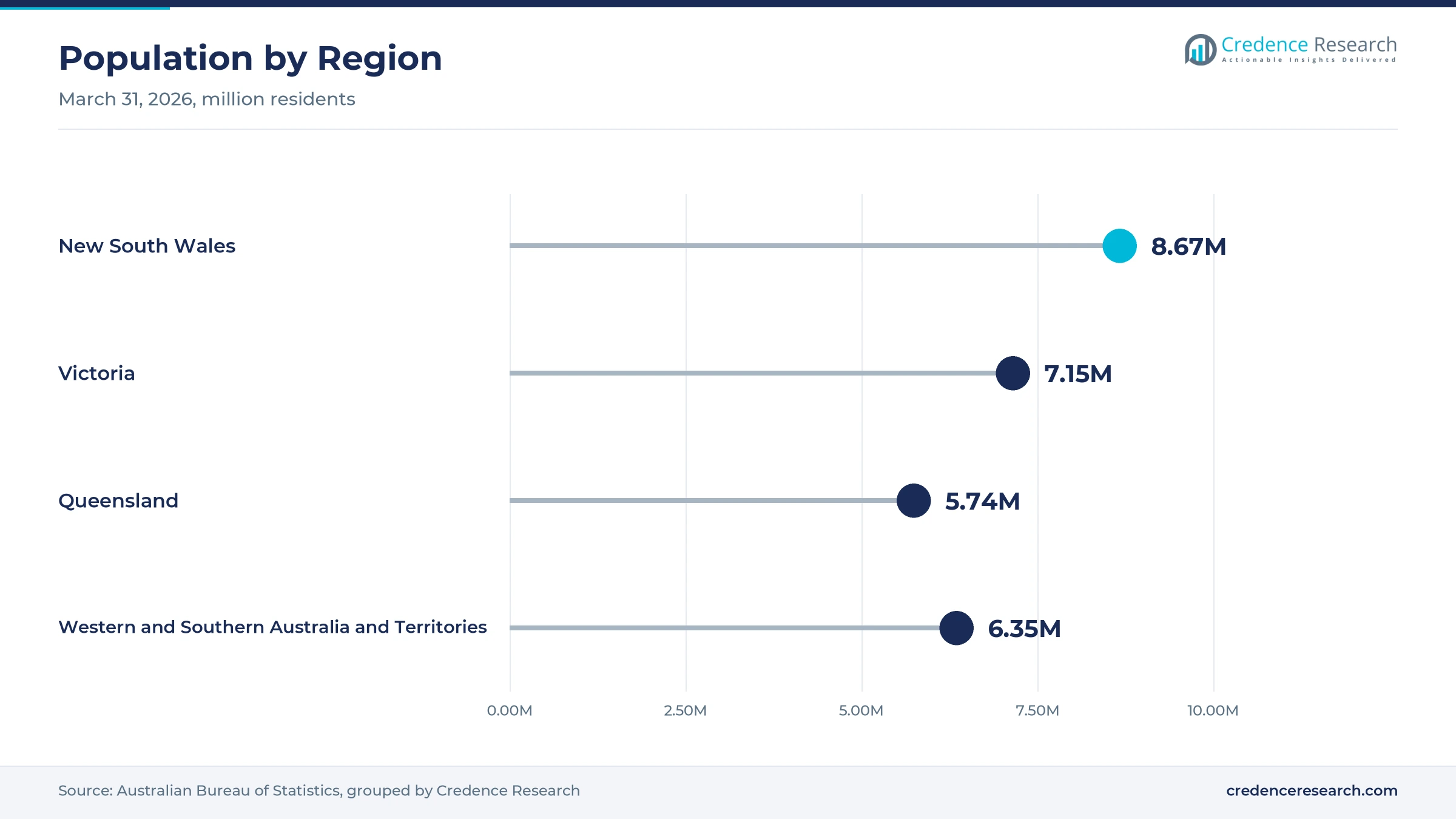
New South Wales held a 30.9% share of 2025 value and grows at 6.55% a year, because the state had about 8.67 million residents at March 31, 2026. The state added about 97,000 residents in the year to March 2026, a growth rate of 1.1%. However, growth is slower than in Queensland and Victoria, which keeps the state below the national rate. Sydney also hosts the head offices of many dressing suppliers and national distributors, which concentrates hospital wound care contracts in the state.
How does Victoria support treatment demand?
Victoria held a 23.0% share of 2025 value and grows at 6.85% a year, because the state had about 7.15 million residents at March 31, 2026. Victoria added about 109,500 residents in the year to March 2026, the largest increase of any state, which expands the base of patients treated in hospitals and community services. Melbourne also has large public hospital networks and community nursing services that buy dressings and negative pressure systems under state supply contracts.
Why is Queensland the fastest-growing region?
Queensland held a 19.0% share of 2025 value and grows fastest at 7.05% a year, because its population reached about 5.74 million at March 31, 2026. The state grew 1.6% in the year to March 2026, and many retirees settle in coastal areas, which raises demand for chronic ulcer treatment in community care. As a result, community nurses and podiatrists in the state order more funded dressings for older patients with diabetes and leg ulcers.
What shapes demand across the western and southern states?
Western and Southern Australia and Territories held a 27.1% share of 2025 value and grows at 6.65% a year. The region had about 6.35 million residents at March 31, 2026, across five states and territories. Western Australia grew fastest at 2.1%, while Tasmania grew slowest at 0.6%, which balances regional growth.
Spin-offs, launches and a federal scheme marked 2024 to 2026
| Development | Status and market relevance |
|---|---|
| In April 2024, 3M completed the spin-off of its health care business as Solventum. | Created a focused supplier of negative pressure and dressing products |
| In April 2024, Smith+Nephew introduced the RENASYS EDGE negative pressure system in the United States. | Targets home treatment of chronic wounds |
| In September 2024, Solventum launched its Peel and Place negative pressure dressing in the United States and Canada. | Offers up to seven days of wear and fewer nursing visits |
| In February 2025, the Therapeutic Goods Administration approved advertising claims for the PICO 7 system. | Supports single-use negative pressure use after cesarean section |
| In May 2025, the federal Chronic Wound Consumables Scheme began for eligible patients. | Pays the full cost of dressings for older patients with diabetes |
Single-use pumps, silicone foams and gelling fibers spread
- Single-use negative pressure systems run on batteries without a canister, which lets patients go home with a pump after surgery.
- Silicone-bordered foam dressings stay in place for several days and lift off gently, which suits fragile skin in older patients.
- Gelling fiber dressings absorb fluid and form a soft gel, which holds exudate away from the surrounding skin.
- Extended-wear negative pressure dressings combine the dressing and drape in one piece, which cuts application time and nurse visits.
Need a Custom Version of This Report?
Tailor the scope, geography, or segments to your exact requirements.
- Custom geography or segment scope
- Direct access to our analyst team
Global suppliers compete on outcomes and nurse time
Competition is led by global medical device makers that sell through Australian subsidiaries and national distributors. Smith+Nephew Australia supplies the PICO single-use negative pressure system, while Solventum Australia markets vacuum-assisted closure therapy and advanced dressings. Mölnlycke Health Care Australia supplies Mepilex and Exufiber dressings, including products listed under the federal dressing scheme. Convatec Australia sells Aquacel gelling fiber and foam dressings, and Essity Australia sells Cutimed and Leukomed products through medical and online suppliers. Companies compete on healing outcomes, wear time, nurse workload and clinical education rather than on unit price alone. State tenders reward suppliers that can show lower total treatment cost. Smaller distributors compete on delivery speed and range breadth for aged care homes and community nursing services.
Companies profiled and their roles in this market
| Company | Type | Role in the market |
|---|---|---|
| Smith+Nephew Australia | Device maker | Sponsors the PICO 7 single-use negative pressure system |
| Solventum Australia | Device maker | Markets vacuum-assisted closure therapy and dressings locally |
| Mölnlycke Health Care Australia | Dressing maker | Supplies Mepilex and Exufiber under the federal scheme |
| Convatec Australia | Dressing maker | Sells Aquacel gelling fiber and foam dressings |
| Essity Australia | Dressing maker | Sells Cutimed and Leukomed dressing ranges |
Credence Research view on Australian chronic ulcer care
Credence Research's view is that Australian demand for modern dressings and negative pressure therapy will grow steadily because an ageing population lives with more slow-healing ulcers. Advanced dressings remain the base of the market, while negative pressure therapy grows fastest as single-use pumps move treatment into the home. Federal funding for dressings widens access for older patients with diabetes. However, eligibility limits, state tenders and skill gaps will keep pressure on suppliers. Companies that combine proven outcomes, clinician education and reliable home delivery should gain share fastest.
How the Australian dressing and therapy estimate was built
The report uses 2025 as the base year on a calendar basis, and market values come from the Credence Research model. That model combines population and ageing statistics, diabetes prevalence data, health spending data, federal scheme rules, regulator decisions and company information on dressings and negative pressure systems. Segment splits and regional growth rates are Credence Research estimates, while regional shares follow the client-defined split. Sources used are official statistics, government and regulator websites, university publications and company websites, and no interviews or surveys were used.
Ageing and home treatment carry demand to 2035
Product value is expected to reach USD 442.5 million by 2035, a 6.74% CAGR during 2026–2035, as ageing and home treatment keep demand rising. Growth should stay steady through 2028 while the federal dressing scheme reaches more clinicians and patients. After that, single-use negative pressure systems and extended-wear dressings will carry more growth as care moves out of hospital. Wider scheme eligibility would raise this outlook, while tighter state tenders would lower it. Companies with strong outcome data and home delivery networks are expected to gain the most.
Frequently Asked Questions
How big is the Australia advanced wound care market?
Which product type leads Australian demand?
Which region leads the Australian market?
Why do chronic wounds dominate treatment spending?
What does the Chronic Wound Consumables Scheme cover?
How is negative pressure therapy moving into the home?
Who are the leading companies in Australian wound products?
What are the main challenges for suppliers?
Table of Content
Chapter 1 Market Segmentation
- 1.1 Segmentation Framework
- 1.1.1 Product and Service Classification
- 1.1.2 Application and End-Use Classification
- 1.1.3 Technology and Solution Classification
- 1.1.4 Customer and Distribution Channel Classification
- 1.1.5 Geographic Segmentation
- 1.1.6 Market Segment Definitions and Boundaries
- 1.2 By Product Type
- 1.2.1 Advanced dressings
- 1.2.2 Negative pressure wound therapy
- 1.2.3 Wound bioactives
- 1.2.4 Advanced adjunctive products
- 1.3 By Care Setting
- 1.3.1 Hospitals and acute care
- 1.3.2 Residential aged care
- 1.3.3 Community and specialist care
- 1.3.4 Retail-supported self-care
- 1.4 By Disease Area
- 1.4.1 Chronic wounds
- 1.4.2 Acute surgical wounds
- 1.4.3 Burns and traumatic wounds
- 1.5 By Sales Channel
- 1.5.1 Direct institutional contracts
- 1.5.2 Medical distributors
- 1.5.3 Retail and digital dispensing
Chapter 2 Introduction
- 2.1 Report Objectives and Scope
- 2.2 Product Definition and Industry Terminology
- 2.3 Market Inclusions and Exclusions
- 2.4 Research Process
- 2.4.1 Primary Research and Expert Interviews
- 2.4.2 Secondary Research and Source Review
- 2.4.3 Top-Down and Bottom-Up Estimation
- 2.4.4 Data Triangulation and Verification
- 2.5 Market Size Measurement Basis
- 2.5.1 2025: USD 224.5 million → 2035: USD 442.5 million
- 2.6 Historical and Forecast Reference Periods
- 2.6.1 Historical Period: 2018-2025
- 2.6.2 Base Year: 2025
- 2.6.3 Forecast Period: 2025-2035
- 2.7 Research Assumptions and Limitations
Chapter 3 Executive Summary
- 3.1 Market Snapshot and Key Findings
- 3.2 Base-Year Market Size, 2025
- 3.3 Forecast Market Size, 2035
- 3.4 Revenue and Volume Growth Outlook
- 3.5 Key Demand and Supply Indicators
- 3.6 Leading Market Segments
- 3.7 Fastest-Growing Market Opportunities
- 3.8 Regional Performance Highlights
- 3.9 Technology and Industry Transformation
- 3.10 Competitive Landscape Summary
- 3.11 Analyst View and Strategic Implications
Chapter 4 Australia Advanced Wound Care Market Trends and Developments
- 4.1 Historical Industry Development, 2018-2025
- 4.2 Recent Market Trends and Developments
- 4.3 Demand and Customer Behavior Trends
- 4.4 Technology and Product Innovation
- 4.5 Artificial Intelligence, Automation and Digitalization
- 4.6 Local Manufacturing and Supply Chain Realignment
- 4.7 Industry Partnerships, Mergers and Acquisitions
- 4.8 Sustainability and Circular Economy Developments
- 4.9 Government and Private Sector Investment Trends
- 4.10 Emerging Business Models and Commercialization
- 4.11 Industry Developments and Announcements
Chapter 5 Australia Advanced Wound Care Market Production, Supply and Demand Analysis
- 5.1 Demand Trend and Consumption Analysis, 2018-2025
- 5.2 Demand Forecast, 2025-2035
- 5.3 Production and Output Trend, 2018-2025
- 5.4 Production and Output Forecast, 2025-2035
- 5.5 Installed Capacity and Capacity Utilization
- 5.6 Company-Wise Production Plants and Statistics
- 5.6.1 Installed Production Capacity
- 5.6.2 Actual Production
- 5.6.3 Planned Capacity and Expansion Targets
- 5.7 Supply Chain Structure and Procurement Trends
- 5.8 Supply-Demand Gap and Bottlenecks
- 5.9 Import Dependence and Sourcing Structure
- 5.10 Contract Manufacturing and Outsourcing
- 5.11 Regional Supply and Demand Concentration
Chapter 6 Australia Advanced Wound Care Market Pricing Analysis
- 6.1 Pricing Structure and Measurement
- 6.2 Historical Pricing Trends, 2018-2025
- 6.3 Pricing Outlook, 2025-2035
- 6.4 Average Selling Price and Unit Economics
- 6.5 Pricing by Product and Market Segment
- 6.6 Geographic Pricing Differences
- 6.7 Key Input, Energy, Labor and Logistics Costs
- 6.8 Contract Pricing and Purchasing Models
- 6.9 Pricing Sensitivity and Competitive Positioning
- 6.10 Price, Margin and Profitability Implications
Chapter 7 Australia Advanced Wound Care Market Dynamics
- 7.1 Market Growth Drivers
- 7.1.1 Demand-Side Drivers
- 7.1.2 Technology and Innovation Drivers
- 7.1.3 Infrastructure and Investment Drivers
- 7.1.4 Regulatory and Policy Drivers
- 7.2 Market Restraints
- 7.2.1 Cost and Affordability Constraints
- 7.2.2 Technology and Adoption Barriers
- 7.2.3 Supply Chain and Operational Constraints
- 7.3 Market Challenges
- 7.3.1 Competitive Pressure and Margin Erosion
- 7.3.2 Skills, Infrastructure and Implementation Gaps
- 7.4 Emerging Market Opportunities
- 7.5 Market Dynamics Impact and Time-Horizon Assessment
Chapter 8 Australia Advanced Wound Care Value Chain Analysis
- 8.1 Industry Value Chain Overview
- 8.2 Upstream Suppliers and Critical Inputs
- 8.3 Technology and Component Providers
- 8.4 Manufacturing or Service Delivery
- 8.5 Distribution, Channel Partners and Integrators
- 8.6 Downstream Applications and End Users
- 8.7 Value Addition and Profit Pools
- 8.8 Vertical Integration and Outsourcing
- 8.9 Supplier Concentration and Risk
- 8.10 Supply Chain Localization and Resilience
Chapter 9 Australia Advanced Wound Care Market Regulations and Policies
- 9.1 Relevant Laws, Standards and Compliance Frameworks
- 9.2 Product, Service, Safety and Quality Requirements
- 9.3 Government Policies, Incentives and Subsidies
- 9.4 Imports, Exports and Trade Barriers
- 9.5 Public Procurement and Local Content Requirements
- 9.6 Environmental and Sustainability Compliance
- 9.7 Upcoming Policy Changes and Market Implications
Chapter 10 Australia Advanced Wound Care Market Hotspots and Opportunities
- 10.1 Market Opportunity Mapping and Growth Hotspots
- 10.2 High-Growth Applications and Customer Groups
- 10.3 Underserved Markets and White-Space Opportunities
- 10.4 Emerging Technology and Product Opportunities
- 10.5 New Capacity and Investment Hotspots
- 10.6 Market Entry and Expansion Opportunities
- 10.7 Distribution and Partnership Opportunities
- 10.8 Near-Term and Long-Term Commercial Potential
- 10.9 Opportunity Attractiveness and Execution Risks
Chapter 11 Australia Advanced Wound Care Market Outlook, 2025-2035
- 11.1 Market Size and Analysis
- 11.1.1 Revenue (Market Measurement: 2025: USD 224.5 million → 2035: USD 442.5 million)
- 11.1.2 Market Volume and Quantity Sold
- 11.1.3 Historical Market Size, 2018-2025
- 11.1.4 Base-Year Market Size, 2025
- 11.2 Market Forecast, 2025-2035
- 11.2.1 Revenue Forecast to 2035
- 11.2.2 Volume Forecast to 2035
- 11.2.3 CAGR and Year-on-Year Growth
- 11.2.4 Incremental Revenue Opportunity
- 11.3 Forecast Assumptions and Scenario Analysis
- 11.3.1 Base-Case Forecast
- 11.3.2 Optimistic and Conservative Scenarios
- 11.3.3 Technology, Pricing and Policy Sensitivities
- 11.4 Market Attractiveness and Growth Outlook
Chapter 12 Australia Advanced Wound Care Market Segmentation and Outlook
- 12.1 Segmentation Summary and Market Shares, 2025
- 12.2 Largest and Fastest-Growing Segments
- 12.3 By Product Type - Market Size and Forecast, 2025-2035
- 12.3.1 Segment Definition and Scope
- 12.3.2 Historical Market Size, 2018-2025
- 12.3.3 Revenue Forecast, 2025-2035
- 12.3.4 Volume Forecast, 2025-2035
- 12.3.5 Base-Year Market Share, 2025
- 12.3.6 Segment CAGR and Growth Drivers
- 12.3.7 Subsegment Market Size and Forecast
- 12.3.7.1 Advanced dressings
- 12.3.7.2 Negative pressure wound therapy
- 12.3.7.3 Wound bioactives
- 12.3.7.4 Advanced adjunctive products
- 12.3.8 Subsegment Pricing and Adoption Trends
- 12.3.9 Leading Suppliers and Competition
- 12.3.10 Regional Demand and Opportunities
- 12.4 By Care Setting - Market Size and Forecast, 2025-2035
- 12.4.1 Segment Definition and Scope
- 12.4.2 Historical Market Size, 2018-2025
- 12.4.3 Revenue Forecast, 2025-2035
- 12.4.4 Volume Forecast, 2025-2035
- 12.4.5 Base-Year Market Share, 2025
- 12.4.6 Segment CAGR and Growth Drivers
- 12.4.7 Subsegment Market Size and Forecast
- 12.4.7.1 Hospitals and acute care
- 12.4.7.2 Residential aged care
- 12.4.7.3 Community and specialist care
- 12.4.7.4 Retail-supported self-care
- 12.4.8 Subsegment Pricing and Adoption Trends
- 12.4.9 Leading Suppliers and Competition
- 12.4.10 Regional Demand and Opportunities
- 12.5 By Disease Area - Market Size and Forecast, 2025-2035
- 12.5.1 Segment Definition and Scope
- 12.5.2 Historical Market Size, 2018-2025
- 12.5.3 Revenue Forecast, 2025-2035
- 12.5.4 Volume Forecast, 2025-2035
- 12.5.5 Base-Year Market Share, 2025
- 12.5.6 Segment CAGR and Growth Drivers
- 12.5.7 Subsegment Market Size and Forecast
- 12.5.7.1 Chronic wounds
- 12.5.7.2 Acute surgical wounds
- 12.5.7.3 Burns and traumatic wounds
- 12.5.8 Subsegment Pricing and Adoption Trends
- 12.5.9 Leading Suppliers and Competition
- 12.5.10 Regional Demand and Opportunities
- 12.6 By Sales Channel - Market Size and Forecast, 2025-2035
- 12.6.1 Segment Definition and Scope
- 12.6.2 Historical Market Size, 2018-2025
- 12.6.3 Revenue Forecast, 2025-2035
- 12.6.4 Volume Forecast, 2025-2035
- 12.6.5 Base-Year Market Share, 2025
- 12.6.6 Segment CAGR and Growth Drivers
- 12.6.7 Subsegment Market Size and Forecast
- 12.6.7.1 Direct institutional contracts
- 12.6.7.2 Medical distributors
- 12.6.7.3 Retail and digital dispensing
- 12.6.8 Subsegment Pricing and Adoption Trends
- 12.6.9 Leading Suppliers and Competition
- 12.6.10 Regional Demand and Opportunities
- 12.7 Segment Growth Comparison
- 12.8 Segment Attractiveness and Priority Matrix
Chapter 13 Australia Advanced Wound Care Geographic Market Outlook, 2025-2035
- 13.1 Domestic Market Distribution and Demand Clusters
- 13.2 State- or Province-Wise Market Size and Forecast, 2025-2035
- 13.3 City and Metropolitan Market Outlook
- 13.4 Industrial, Manufacturing and Commercial Clusters
- 13.5 Geographic Concentration of Key End Users
- 13.6 Local Pricing and Purchasing Differences
- 13.7 Domestic Production Facilities and Capacity Map
- 13.8 Local Infrastructure and Project Pipeline
- 13.9 State-Level Policy and Incentive Differences
- 13.10 Subnational Investment Hotspots and Opportunities
- 13.11 Distribution and Logistics Networks
- 13.12 Domestic Competitive Footprint
Chapter 14 Australia Advanced Wound Care Technology, Innovation and Sustainability Outlook
- 14.1 Technology Landscape and Maturity
- 14.2 Product, Process and Service Innovation
- 14.3 AI, Automation and Digital Tools in the Industry
- 14.4 Technology Adoption and Performance Benchmarking
- 14.5 Innovation Pipeline and R&D Investment
- 14.6 Patent and Intellectual Property Trends
- 14.7 Energy Efficiency and Resource Management
- 14.8 Sustainability, Recycling and Circularity
- 14.9 Technology Roadmap, 2025-2035
- 14.10 Risks of Obsolescence and Technology Substitution
Chapter 15 Australia Advanced Wound Care Market Key Strategic Imperatives
- 15.1 Growth and Market Entry Priorities
- 15.2 High-Return Products and Segments
- 15.3 Pricing, Profitability and Cost Optimization
- 15.4 Technology Investment and Product Differentiation
- 15.5 Supply Chain Localization and Resilience
- 15.6 Distribution and Customer Acquisition
- 15.7 Partnership, Acquisition and Capacity Strategy
- 15.8 Regional Expansion Priorities
- 15.9 Short-, Medium- and Long-Term Actions
Chapter 16 Competition Outlook
- 16.1 Industry Competition Characteristics
- 16.2 Market Structure and Concentration
- 16.3 Market Share and Competitive Positioning, 2025
- 16.4 Company-Wise Revenue and Product Benchmarking
- 16.5 Production and Service Capacity Benchmarking
- 16.6 Technology, Pricing and Differentiation
- 16.7 Regional Footprint and Distribution Strength
- 16.8 Mergers, Acquisitions and Strategic Alliances
- 16.9 New Entrants and Competitive Threats
- 16.10 Porter's Five Forces and Industry Attractiveness
- 16.11 Competitive Outlook, 2025-2035
Chapter 17 Company Profiles
- 17.1 Company Coverage and Selection Criteria
- 17.2 Smith+Nephew Australia
- 17.2.1 Business Description
- 17.2.2 Company Ownership and Geographic Presence
- 17.2.3 Product and Service Portfolio
- 17.2.4 Manufacturing and Operating Footprint
- 17.2.5 Production Capacity and Expansion Plans
- 17.2.6 Financial Performance and Investment
- 17.2.7 Market Share and Competitive Position
- 17.2.8 Technology and Innovation Capabilities
- 17.2.9 Strategic Alliances or Partnerships
- 17.2.10 Recent Developments
- 17.2.11 Growth Strategy and Outlook
- 17.3 Solventum Australia
- 17.4 Mölnlycke Health Care Australia
- 17.5 Convatec Australia
- 17.6 Essity Australia
- 17.7 Other Relevant Market Participants
Note: Every listed company is profiled on the structure shown under the first company. The company list is preliminary and may change based on research findings, market developments, data availability and client requirements.
Chapter 18 Disclaimer
- 18.1 Research and Forecast Disclaimer
- 18.2 Data Source and Estimation Limitations
Note: The depth of individual sections depends on data availability for this market. Volume, capacity, trade and other unit-based metrics are included where applicable.

