
Public-access laws turn devices into civic equipment
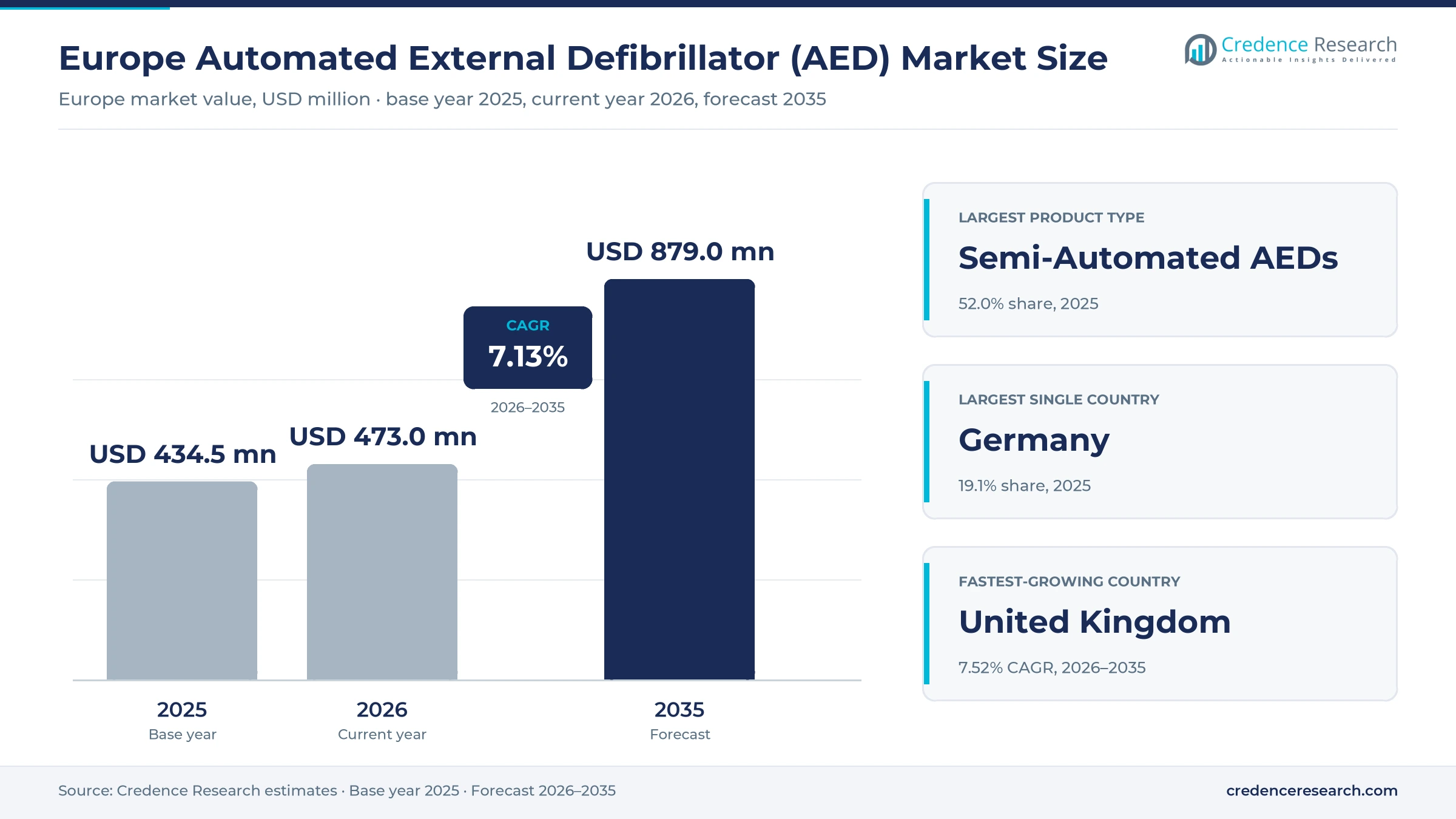
The Europe automated external defibrillator (AED) market was valued at USD 434.5 million in 2025 and is projected to increase from USD 473.0 million in 2026 to USD 879.0 million by 2035, registering a CAGR of 7.13% during 2026–2035. Demand comes from public venues, schools, workplaces, ambulance services and hospitals that must shorten the time between collapse and the first shock. Germany was the largest single country, with 19.1% of 2025 value, because it records about 136,000 out-of-hospital cardiac arrests a year. The United Kingdom is the fastest-growing country at 7.52% a year, as school programs and national device registries widen placement. Regulation is also changing supply, because devices sold in the EU must move to Medical Device Regulation certificates before the extended 2027 and 2028 deadlines. As a result, suppliers with certified, connected and easy-to-use devices are gaining ground in public tenders.
Which shock devices and buyer groups are counted here?
The estimate measures the value of semi-automated, fully automated and compact personal automated external defibrillators sold in Germany, the United Kingdom, France, Italy, Spain and the rest of Europe. It counts new units bought by hospitals, ambulance services, public venues, employers and households. Values are stated in USD million at current prices and are assigned to the country where the device is installed.
The estimate excludes manual professional defibrillators, implantable devices and wearable vests, along with replacement pads, batteries, cabinets and training courses sold separately. The value chain runs from device makers through distributors, public tender frameworks and online retailers to venue owners, which register units with ambulance services and maintain them.
Europe Automated External Defibrillator (AED) Market Insights
- The market was valued at USD 434.5 million in 2025 and is projected to reach USD 879.0 million by 2035, registering a CAGR of 7.13% during 2026–2035.
- Germany held 19.1% of regional value in 2025, the largest single-country share, because it records about 136,000 cardiac arrests outside hospitals each year.
- Semi-automated AEDs led with 52.0% of 2025 value, because public tenders and ambulance services still favor units that ask the rescuer to press the shock button.
- The European Resuscitation Council released its 2025 guidelines on Oct. 22, 2025, recommending visible devices in unlocked cabinets available 24 hours a day.
- Royal Philips agreed in January 2025 to sell its Emergency Care business, and Heartstream launched as an independent company in January 2026.
Semi-automated units and public venues lead demand
Why do semi-automated units still lead purchases?
Based on product type, the market is categorized into semi-automated AEDs, fully automated AEDs and compact personal AEDs. Semi-Automated AEDs led with 52.0% of 2025 value, because ambulance services and many public buyers prefer rescuers to confirm the shock. Compact Personal AEDs grow fastest at 8.66% a year from a small base, as households and small businesses look for lighter and cheaper devices that need less upkeep.
Which care settings buy the most devices?
Based on care setting, the market is categorized into hospitals and clinics, emergency medical services, public access venues, workplaces and home care. Public Access Venues led with 30.0% of 2025 value, because laws in France and Italy require devices in public buildings and transport hubs. Home Care grows fastest at 8.58% a year, as older patients and their families buy devices for homes far from ambulance stations.
How do buyers source their devices?
Based on distribution channel, the market is categorized into direct institutional sales, medical device distributors, public tenders and frameworks and e-commerce and specialist retail. Direct Institutional Sales led with 34.0% of 2025 value, because hospital groups and ambulance trusts buy straight from makers with service contracts. E-Commerce and Specialist Retail grows fastest at 8.40% a year, as small venues and households order devices and cabinets online.
Which device features gain the most ground?
Based on technology, the market is categorized into biphasic waveform systems, CPR feedback-enabled AEDs, connected fleet-managed AEDs, self-testing AEDs and pediatric-mode AEDs. Biphasic Waveform Systems led with 38.0% of 2025 value, because biphasic shock delivery is standard across the installed base. Connected Fleet-Managed AEDs grow fastest at 8.61% a year, as owners of large fleets pay for remote status checks that flag expired pads and batteries.
| Segment Group | Leading Sub-segment | Share, 2025 | Fastest-growing Sub-segment | CAGR, 2026–2035 |
|---|---|---|---|---|
| By Product Type | Semi-Automated AEDs | 52.0% | Compact Personal AEDs | 8.66% |
| By Care Setting | Public Access Venues | 30.0% | Home Care | 8.58% |
| By Distribution Channel | Direct Institutional Sales | 34.0% | E-Commerce and Specialist Retail | 8.40% |
| By Technology | Biphasic Waveform Systems | 38.0% | Connected Fleet-Managed AEDs | 8.61% |
Request a Free Sample
Fill in your details and we'll send you a free sample report.
- Sample data tables & charts
- Research methodology
Cardiac arrest burden and mandates sustain purchases
How does the cardiac arrest burden sustain demand?
The persistent out-of-hospital cardiac arrest burden is the core demand driver, because survival depends on a shock within minutes of collapse. In Germany, about 136,000 people had a cardiac arrest outside a hospital in 2024, an average of 370 a day, according to Deutsches Ärzteblatt, citing the German Resuscitation Registry. Bystanders delivered the first shock before rescuers arrived in only 2% of cases, which shows how rarely a device reaches the patient in time. The United Kingdom also records more than 40,000 such arrests each year, and fewer than one in ten patients survive, according to the British Heart Foundation. As a result, Germany and the United Kingdom keep adding public automated external defibrillators to close this gap.
Why does population ageing widen the at-risk base?
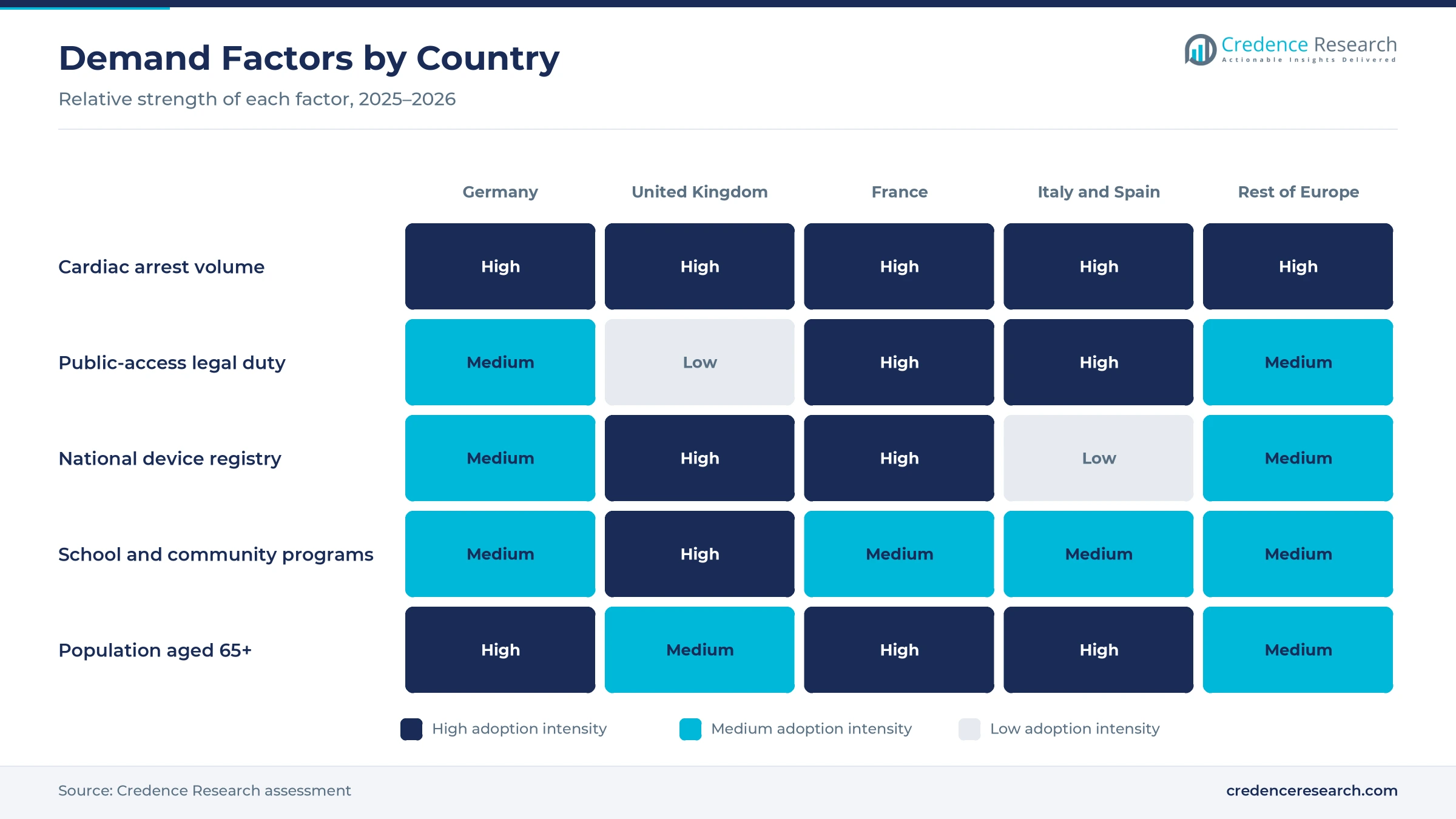
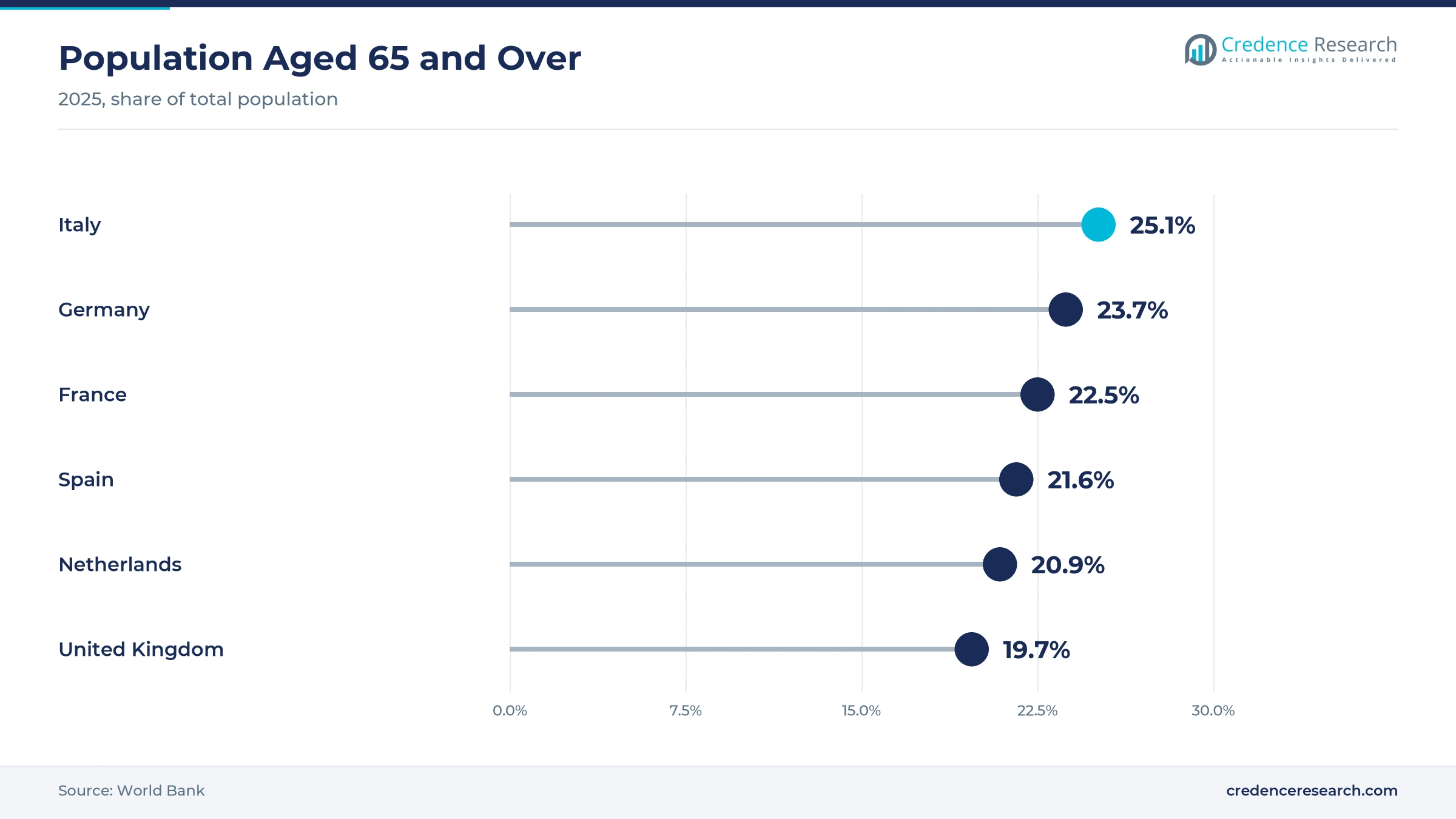
Population ageing expands the at-risk base, because cardiac arrest risk rises with age and many patients collapse at home or in public places. People aged 65 and over made up about 25.1% of the population in Italy and 23.7% in Germany in 2025, according to World Bank data. France stood at 22.5% and Spain at 21.6% in the same year, so every large country faces a growing pool of older adults. The average German cardiac arrest patient was 69.9 years old in 2024, while about 45% of patients were under 70. In turn, home care grows fastest among care settings at 8.58% a year, as families of older patients buy simple devices for their homes.
How do public-access mandates create steady orders?
Public-access mandates and institutional programs create steady orders, because laws turn device placement into a legal duty for venue owners. France's law of June 28, 2018 required devices in public buildings in three phases, from Jan. 1, 2020 for the largest venues to Jan. 1, 2022 for smaller ones, according to Banque des Territoires. Italy's Law 116 of Aug. 4, 2021 requires devices in public offices with at least 15 employees and in airports, stations and ports, backed by up to €2 million a year. Because installed units also need pads, batteries and replacement after their service life, public access venues led care settings with 30.0% of 2025 value.
Why do registries and dispatcher links lift device value?
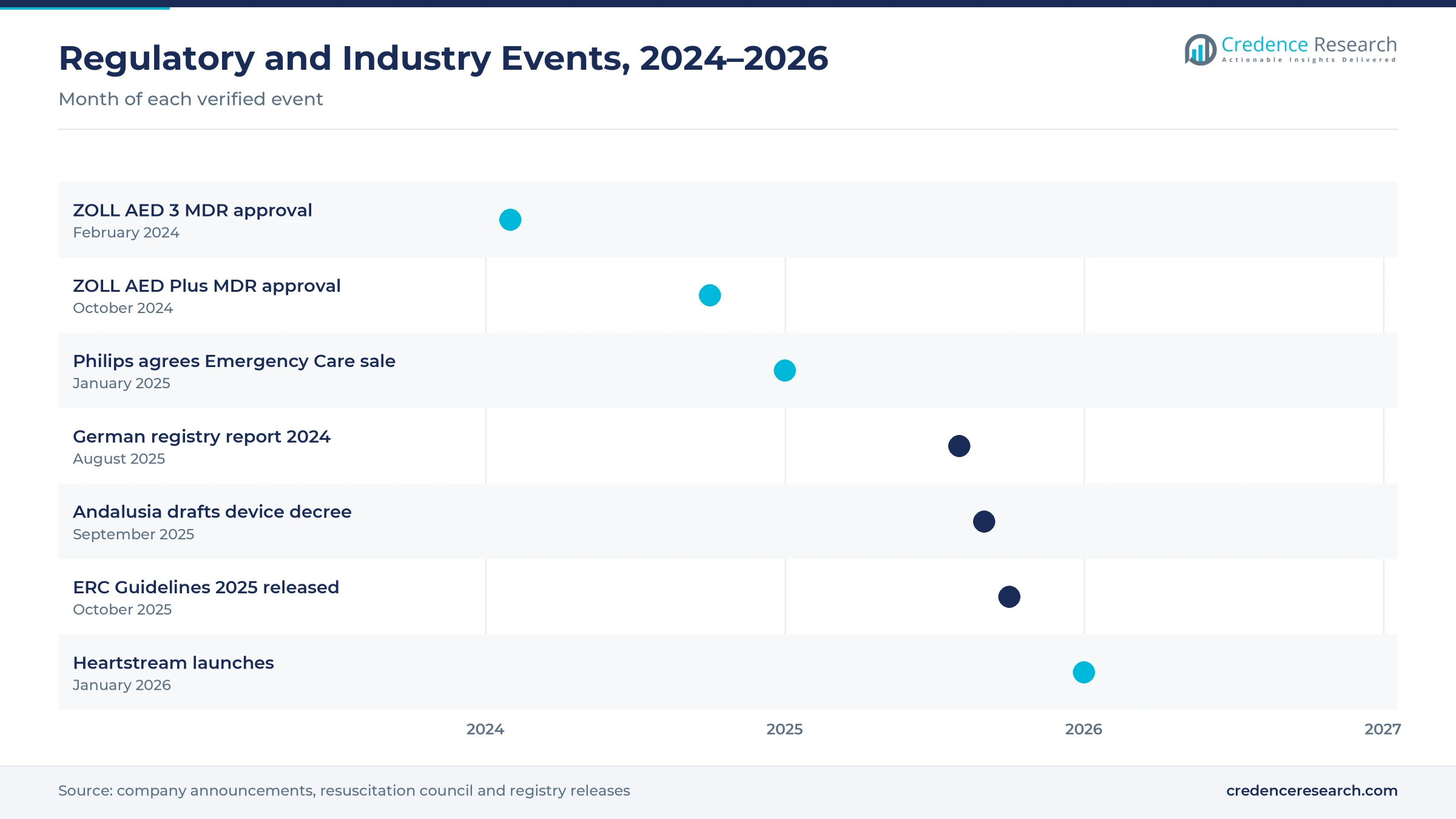
Device registries and dispatcher links lift the value of each installed unit, because emergency call handlers can now send bystanders to the nearest cabinet. The British Heart Foundation said The Circuit, the national registry, held 124,000 devices in October 2026, up from 100,000 in 2024. The European Resuscitation Council released its 2025 guidelines on Oct. 22, 2025, recommending visible devices in unlocked cabinets that are available 24 hours a day. In September 2025, Andalusia also began drafting a decree to link public devices to 112 dispatchers through geolocation. Therefore, connected fleet-managed AEDs grow fastest among technologies at 8.61% a year, as owners pay for remote status monitoring.
MDR recertification and new owners reshape supply
How is the shift to MDR certificates reshaping ranges?
Suppliers are shifting their ranges to EU Medical Device Regulation certificates, because older directive certificates expire under fixed deadlines. Regulation (EU) 2023/607 entered into force on March 20, 2023 and extended the transition to 2027 for class III devices and to 2028 for class IIb and IIa devices. ZOLL announced on Feb. 8, 2024 that its AED 3 had received MDR approval and CE marking, and its AED Plus followed on Oct. 2, 2024. ZOLL also received MDR approval for its Zenix monitor and defibrillator on Feb. 10, 2026. The same rules apply to cardiac rhythm management devices, so notified bodies face long queues. As a result, tenders increasingly ask for MDR-certified models, and makers with older ranges face pressure to recertify or withdraw products.
Why is the rise of new ownership models notable?
Ownership changes are rising among large suppliers, because diversified health technology groups are narrowing their focus. Royal Philips announced on Jan. 28, 2025 that it would sell its Emergency Care business, including AEDs, to Bridgefield Capital, according to a Philips press release. The deal included a license to use the Philips brand for up to 15 years, which protects the installed base of HeartStart devices in Europe. Heartstream then launched as an independent emergency care company on Jan. 14, 2026, selling HeartStart AEDs, Tempus and Intrepid monitors and software. In turn, buyers now weigh long-term service and spare-part commitments more heavily when they renew framework contracts.
Can home and compact devices open a new buyer group?
Home and compact devices offer an opening, because most European devices still sit in public buildings rather than near older patients at home. Germany's lay resuscitation rate rose from 14% in 2010 to 55.4% in 2024, according to a federal health ministry fact sheet from November 2025, so more relatives now feel able to act. The same fact sheet estimates that immediate bystander CPR could save about 10,000 lives a year in Germany. HeartHero also obtained a CE mark in 2020 for Elliot, a compact device designed to be cheap and portable. Therefore, compact personal AEDs grow fastest among product types at 8.66% a year as prices fall.
Is CPR education creating room for coaching devices?
CPR education creates room for coaching devices, because newly trained bystanders want clear voice and screen guidance during a rescue. England made CPR education part of the national curriculum in 2021, and Northern Ireland made CPR and device awareness compulsory at Key Stage 3 from the 2022/23 school year. CPR-related questions were also added to the U.K. driving theory test in 2026, according to the British Heart Foundation. Mindray's BeneHeart C Series uses its ResQNavi prompts and step-by-step animation to guide rescuers, which shows how makers respond. As a result, schools and workplaces in the United Kingdom are replacing older units with coaching models that suit trained but nervous rescuers. England's £19 million school program had already placed more than 20,000 devices by July 2023, so many pupils now train beside real units.
Recertification costs and patchy rules slow rollout
How do MDR costs pressure smaller makers?
MDR recertification costs pressure smaller makers, because each model needs new clinical and technical files reviewed by a notified body. The extended deadlines of 2027 and 2028 give more time, but they do not remove the cost or the queue for reviews. As a result, some niche models may leave the market, which narrows choice for tenders. Makers can mitigate this by cutting the number of variants and sharing platforms across public and professional devices.
Why do unregistered and expired devices limit impact?
Unregistered and poorly maintained devices limit impact, because a cabinet that dispatchers cannot see or that holds expired pads cannot save a patient. St John Ambulance said in 2022 that tens of thousands of U.K. devices were still unknown to ambulance services. In turn, owners may hesitate to buy more units until they can manage the ones they have. Connected monitoring and registry campaigns are the main ways to close this gap.
How do fragmented national rules slow placement?
Fragmented rules slow placement, because each country and sometimes each region sets its own duty to install and its own training rules. In Spain, autonomous communities write their own rules, and Andalusia's Decree 22/2012 requires demonstrable CPR and device knowledge for public use. This means that venue owners in different regions face different costs and liability. Wider adoption of the 2025 European guidelines, which say no prior training is needed, would ease this barrier.
Why does low bystander confidence remain a risk?
Low bystander confidence remains a risk, because a device only helps when someone nearby is willing to open the cabinet and use it. The EuReCa TWO study of 28 countries found bystander CPR rates ranging from 13% to 82% in late 2017. As a result, devices in countries with weak training sit unused, which weakens the case for new purchases. Public campaigns, school training and dispatcher coaching are the main forms of mitigation.
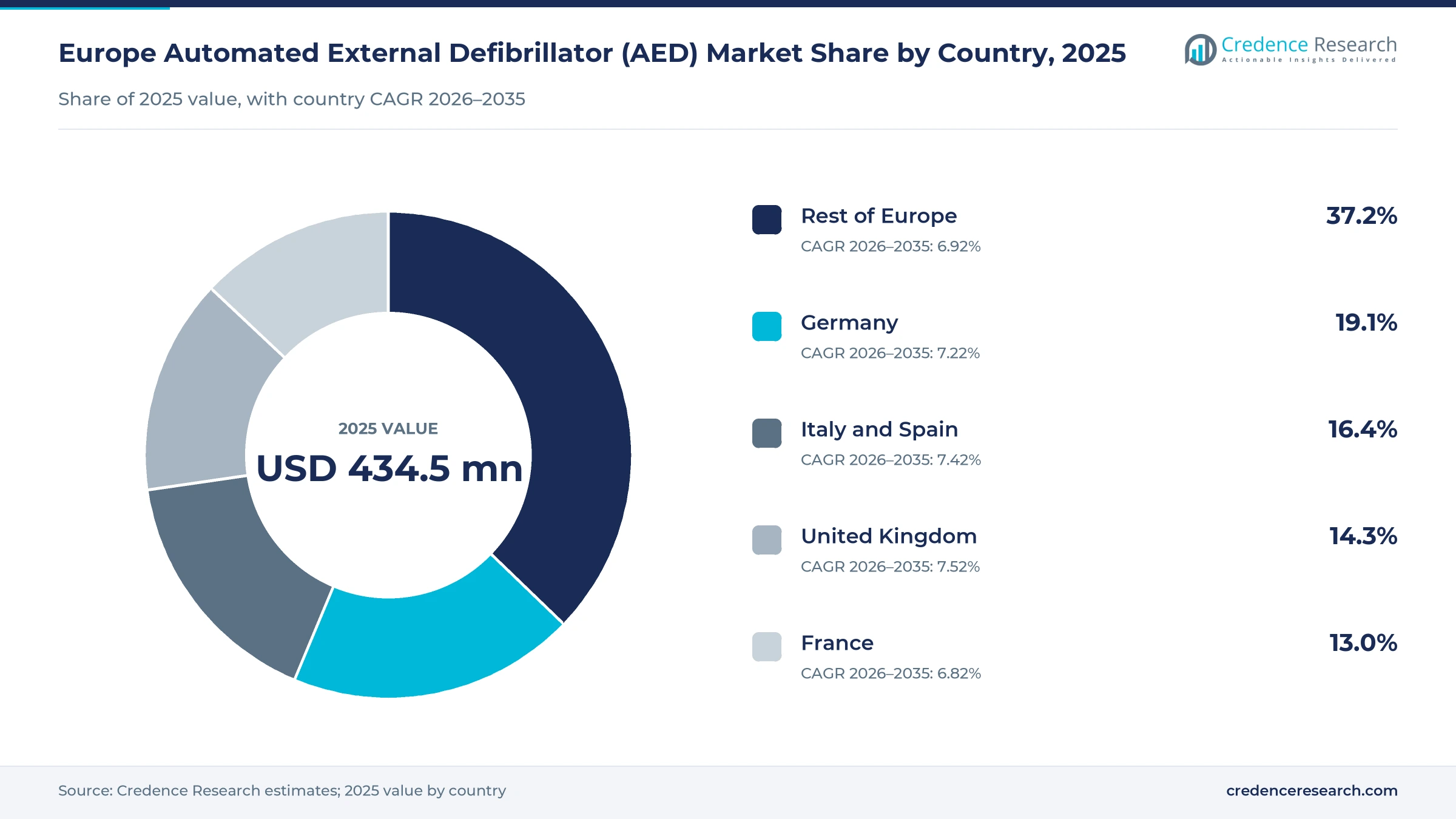
Germany leads single countries while the U.K. grows fast
| Country | Value, 2025 (USD million) | Share, 2025 | CAGR, 2026–2035 |
|---|---|---|---|
| Rest of Europe | 161.6 | 37.2% | 6.92% |
| Germany | 83.0 | 19.1% | 7.22% |
| Italy and Spain | 71.3 | 16.4% | 7.42% |
| United Kingdom | 62.1 | 14.3% | 7.52% |
| France | 56.5 | 13.0% | 6.82% |
Why does the rest of Europe hold the largest combined share?
The rest of Europe held 37.2% of 2025 value and grows at 6.92% a year, because it combines the Nordic, Benelux, Alpine and Central European countries under one heading. The Netherlands and Poland each had about 20.8% to 20.9% of their populations aged 65 and over in 2025, so demand there follows the same ageing pattern as in larger countries. Nordic and Dutch dispatcher networks that alert volunteers also support steady orders for registered devices.
How does Germany sustain the largest single-country share?
Germany held 19.1% of 2025 value and grows at 7.22% a year, the largest single-country share of regional demand. It records about 136,000 out-of-hospital cardiac arrests a year, the most of any country in the region. The German Resuscitation Registry covers about 42 million people served by 198 emergency medical services, which gives buyers detailed data on response times and cardiac arrest treatment. Bystander resuscitation rose from 49.9% to 52.0% in the latest report, which supports more public devices in towns and rural areas.
What drives demand in Italy and Spain?
Italy and Spain held 16.4% of 2025 value and grow at 7.42% a year in the regional demand model. Both countries have old populations and active public-access programs that keep orders coming. Italy had about 25.1% of its population aged 65 and over in 2025, the highest share among the large countries. Law 116 of 2021 requires devices in public offices, airports, stations and ports, while Andalusia is drafting rules to link Spanish public devices to emergency dispatchers.
Why is the United Kingdom growing fastest?
The United Kingdom held 14.3% of 2025 value and grows fastest at 7.52% a year in the regional demand model. School and community programs keep widening placement across England, Scotland, Wales and Northern Ireland. A £19 million program delivered more than 20,000 devices to almost 18,000 state schools in England by July 2023, according to the Department for Education. The government's £1 million community fund, opened in September 2023, aimed to place about 2,000 more devices with match funding.
How do French venue rules shape demand?
France held 13.0% of 2025 value and grows at 6.82% a year in the regional demand model. Its venue obligation is now fully phased in, so demand is shifting from first installation to replacement. Decree 2018-1186 set the deadlines, and Decree 2018-1259 created a national database of installed devices. France had about 22.5% of its population aged 65 and over in 2025, which keeps replacement steady.
MDR approvals and a Philips spin-off marked 2024-2026
| Development | Status and market relevance |
|---|---|
| In February 2024, ZOLL announced that its AED 3 had received approval and CE marking under the EU Medical Device Regulation. | Placed ZOLL among the first makers with MDR-certified public-access devices for European tenders |
| In October 2024, ZOLL received EU MDR approval for its AED Plus defibrillator. | Extended MDR coverage across its public-access range |
| In January 2025, Royal Philips announced the sale of its Emergency Care business, including AEDs, to Bridgefield Capital. | Included a license to use the Philips brand for up to 15 years |
| In October 2025, the European Resuscitation Council released its 2025 guidelines for resuscitation. | Recommends visible public devices in unlocked cabinets, available 24 hours a day |
| In January 2026, Heartstream launched as an independent emergency care company selling HeartStart AEDs. | Continues Philips-branded sales under a multi-year licensing agreement |
Coaching, self-tests and cloud links define new units
- Voice and screen coaching guides untrained rescuers, and Mindray's ResQNavi prompts add step-by-step animation in selected BeneHeart C Series versions.
- Cloud fleet monitoring reports device status over 4G or Wi-Fi, so fleet managers receive automatic alerts when a unit needs attention.
- Automatic self-tests check the battery and electrodes daily or weekly, as in the SCHILLER FRED PA-1, which has a six-year battery life.
- Fully automatic shock delivery removes the need to press a button, and makers such as SCHILLER offer both semi-automated and fully automated versions of the same model.
Need a Custom Version of This Report?
Tailor the scope, geography, or segments to your exact requirements.
- Custom geography or segment scope
- Direct access to our analyst team
Resuscitation specialists compete on service and MDR
Competition is led by resuscitation specialists that sell to ambulance services, hospitals and public venues across the region. ZOLL competes on early MDR certification, real CPR feedback and fleet software for public owners. Heartstream now sells HeartStart devices under the Philips brand after its separation from Royal Philips. Mindray competes on price, coaching prompts and cloud monitoring for large fleets. SCHILLER makes its FRED PA-1 in Wissembourg, France and competes on local production and long battery life. Stryker, Nihon Kohden, CU Medical Systems, Progetti Medical and corpuls also compete in national tenders for automated external defibrillators. Smaller national suppliers often win regional frameworks by bundling cabinets, training and maintenance visits. Rivals compete on certification status, service contracts, consumables pricing and links to cardiac monitoring devices used by ambulance crews.
Companies profiled and their roles in this market
| Company | Type | Role in the market |
|---|---|---|
| ZOLL Medical Corporation | Resuscitation specialist | Received EU MDR approval for the AED 3 in February 2024 and the AED Plus in October 2024 |
| Royal Philips (Heartstream) | Emergency care supplier | Sold its Emergency Care business, which launched as Heartstream in January 2026 under the Philips brand |
| Mindray | Medical device maker | Sells the BeneHeart C Series in the United Kingdom with ResQNavi coaching and cloud alerts |
| SCHILLER AG | Cardiology and emergency device maker | Makes the FRED PA-1 in Wissembourg, France, with daily or weekly self-tests |
Credence Research view on public-access device demand
Credence Research's view is that demand for automated external defibrillators in Europe will grow on laws, registries and ageing rather than on new clinical evidence. France and Italy have already written placement into law, so their demand is moving toward replacement and service. The United Kingdom and Germany offer the most new placements, because registries and school programs keep adding sites. Suppliers with MDR-certified, connected and coaching devices are best placed, while makers that delay recertification risk losing tender access before the 2028 deadline.
How the Europe device estimate was built
The report uses 2025 as the base year, with values in USD million at current prices. Market values come from the Credence Research model, and country, product type, care setting, distribution channel and technology splits are Credence Research estimates. Inputs include national resuscitation registry reports, government laws and decrees, World Bank population data, resuscitation council guidance, company announcements and trade press. Country shares follow the client's regional split, and growth tilts reflect public policy and registry activity. No interviews or surveys were used in preparing these estimates.
Connected fleets and home units drive growth to 2035
The market is expected to reach USD 879.0 million by 2035, a 7.13% CAGR during 2026–2035, as ageing populations and public-access rules keep orders steady. The United Kingdom should gain the most share, while Germany stays the largest single country. Connected fleet-managed and compact personal devices are expected to grow faster than older units, as owners want remote checks and households start to buy. Wider registry use and simpler training rules would lift this outlook, while delays in MDR recertification would lower it.
Frequently Asked Questions
How big is the Europe automated external defibrillator (AED) market?
Which country leads European device demand?
Which country grows fastest?
Which product type holds the largest share?
How do public-access laws affect demand?
How does the EU Medical Device Regulation affect suppliers?
Who are the main companies in the market?
Which technology grows fastest?
Table of Content
Chapter 1 Market Segmentation
- 1.1 Segmentation Framework
- 1.1.1 Product and Service Classification
- 1.1.2 Application and End-Use Classification
- 1.1.3 Technology and Solution Classification
- 1.1.4 Customer and Distribution Channel Classification
- 1.1.5 Geographic Segmentation
- 1.1.6 Market Segment Definitions and Boundaries
- 1.2 By Product Type
- 1.2.1 Semi-Automated AEDs
- 1.2.2 Fully Automated AEDs
- 1.2.3 Compact Personal AEDs
- 1.3 By Care Setting
- 1.3.1 Hospitals and Clinics
- 1.3.2 Emergency Medical Services
- 1.3.3 Public Access Venues
- 1.3.4 Workplaces
- 1.3.5 Home Care
- 1.4 By Technology
- 1.4.1 Biphasic Waveform Systems
- 1.4.2 CPR Feedback-Enabled AEDs
- 1.4.3 Connected Fleet-Managed AEDs
- 1.4.4 Self-Testing AEDs
- 1.4.5 Pediatric-Mode AEDs
- 1.5 By Country
- 1.5.1 Germany
- 1.5.2 United Kingdom
- 1.5.3 France
- 1.5.4 Italy and Spain
- 1.5.5 Rest of Europe
Chapter 2 Introduction
- 2.1 Report Objectives and Scope
- 2.2 Product Definition and Industry Terminology
- 2.3 Market Inclusions and Exclusions
- 2.4 Research Process
- 2.4.1 Primary Research and Expert Interviews
- 2.4.2 Secondary Research and Source Review
- 2.4.3 Top-Down and Bottom-Up Estimation
- 2.4.4 Data Triangulation and Verification
- 2.5 Market Size Measurement Basis
- 2.5.1 2025: USD 434.5 million → 2035: USD 879.0 million
- 2.6 Historical and Forecast Reference Periods
- 2.6.1 Historical Period: 2018-2025
- 2.6.2 Base Year: 2025
- 2.6.3 Forecast Period: 2025-2035
- 2.7 Research Assumptions and Limitations
Chapter 3 Executive Summary
- 3.1 Market Snapshot and Key Findings
- 3.2 Base-Year Market Size, 2025
- 3.3 Forecast Market Size, 2035
- 3.4 Revenue and Volume Growth Outlook
- 3.5 Key Demand and Supply Indicators
- 3.6 Leading Market Segments
- 3.7 Fastest-Growing Market Opportunities
- 3.8 Regional Performance Highlights
- 3.9 Technology and Industry Transformation
- 3.10 Competitive Landscape Summary
- 3.11 Analyst View and Strategic Implications
Chapter 4 Europe Automated External Defibrillator (AED) Market Trends and Developments
- 4.1 Historical Industry Development, 2018-2025
- 4.2 Recent Market Trends and Developments
- 4.3 Demand and Customer Behavior Trends
- 4.4 Technology and Product Innovation
- 4.5 Artificial Intelligence, Automation and Digitalization
- 4.6 Local Manufacturing and Supply Chain Realignment
- 4.7 Industry Partnerships, Mergers and Acquisitions
- 4.8 Sustainability and Circular Economy Developments
- 4.9 Government and Private Sector Investment Trends
- 4.10 Emerging Business Models and Commercialization
- 4.11 Industry Developments and Announcements
Chapter 5 Europe Automated External Defibrillator (AED) Market Production, Supply and Demand Analysis
- 5.1 Demand Trend and Consumption Analysis, 2018-2025
- 5.2 Demand Forecast, 2025-2035
- 5.3 Production and Output Trend, 2018-2025
- 5.4 Production and Output Forecast, 2025-2035
- 5.5 Installed Capacity and Capacity Utilization
- 5.6 Company-Wise Production Plants and Statistics
- 5.6.1 Installed Production Capacity
- 5.6.2 Actual Production
- 5.6.3 Planned Capacity and Expansion Targets
- 5.7 Supply Chain Structure and Procurement Trends
- 5.8 Supply-Demand Gap and Bottlenecks
- 5.9 Import Dependence and Sourcing Structure
- 5.10 Contract Manufacturing and Outsourcing
- 5.11 Regional Supply and Demand Concentration
Chapter 6 Europe Automated External Defibrillator (AED) Market Pricing Analysis
- 6.1 Pricing Structure and Measurement
- 6.2 Historical Pricing Trends, 2018-2025
- 6.3 Pricing Outlook, 2025-2035
- 6.4 Average Selling Price and Unit Economics
- 6.5 Pricing by Product and Market Segment
- 6.6 Geographic Pricing Differences
- 6.7 Key Input, Energy, Labor and Logistics Costs
- 6.8 Contract Pricing and Purchasing Models
- 6.9 Pricing Sensitivity and Competitive Positioning
- 6.10 Price, Margin and Profitability Implications
Chapter 7 Europe Automated External Defibrillator (AED) Market Dynamics
- 7.1 Market Growth Drivers
- 7.1.1 Demand-Side Drivers
- 7.1.2 Technology and Innovation Drivers
- 7.1.3 Infrastructure and Investment Drivers
- 7.1.4 Regulatory and Policy Drivers
- 7.2 Market Restraints
- 7.2.1 Cost and Affordability Constraints
- 7.2.2 Technology and Adoption Barriers
- 7.2.3 Supply Chain and Operational Constraints
- 7.3 Market Challenges
- 7.3.1 Competitive Pressure and Margin Erosion
- 7.3.2 Skills, Infrastructure and Implementation Gaps
- 7.4 Emerging Market Opportunities
- 7.5 Market Dynamics Impact and Time-Horizon Assessment
Chapter 8 Europe Automated External Defibrillator (AED) Value Chain Analysis
- 8.1 Industry Value Chain Overview
- 8.2 Upstream Suppliers and Critical Inputs
- 8.3 Technology and Component Providers
- 8.4 Manufacturing or Service Delivery
- 8.5 Distribution, Channel Partners and Integrators
- 8.6 Downstream Applications and End Users
- 8.7 Value Addition and Profit Pools
- 8.8 Vertical Integration and Outsourcing
- 8.9 Supplier Concentration and Risk
- 8.10 Supply Chain Localization and Resilience
Chapter 9 Europe Automated External Defibrillator (AED) Market Regulations and Policies
- 9.1 Relevant Laws, Standards and Compliance Frameworks
- 9.2 Product, Service, Safety and Quality Requirements
- 9.3 Government Policies, Incentives and Subsidies
- 9.4 Imports, Exports and Trade Barriers
- 9.5 Public Procurement and Local Content Requirements
- 9.6 Environmental and Sustainability Compliance
- 9.7 Upcoming Policy Changes and Market Implications
Chapter 10 Europe Automated External Defibrillator (AED) Market Hotspots and Opportunities
- 10.1 Market Opportunity Mapping and Growth Hotspots
- 10.2 High-Growth Applications and Customer Groups
- 10.3 Underserved Markets and White-Space Opportunities
- 10.4 Emerging Technology and Product Opportunities
- 10.5 New Capacity and Investment Hotspots
- 10.6 Market Entry and Expansion Opportunities
- 10.7 Distribution and Partnership Opportunities
- 10.8 Near-Term and Long-Term Commercial Potential
- 10.9 Opportunity Attractiveness and Execution Risks
Chapter 11 Europe Automated External Defibrillator (AED) Market Outlook, 2025-2035
- 11.1 Market Size and Analysis
- 11.1.1 Revenue (Market Measurement: 2025: USD 434.5 million → 2035: USD 879.0 million)
- 11.1.2 Market Volume and Quantity Sold
- 11.1.3 Historical Market Size, 2018-2025
- 11.1.4 Base-Year Market Size, 2025
- 11.2 Market Forecast, 2025-2035
- 11.2.1 Revenue Forecast to 2035
- 11.2.2 Volume Forecast to 2035
- 11.2.3 CAGR and Year-on-Year Growth
- 11.2.4 Incremental Revenue Opportunity
- 11.3 Forecast Assumptions and Scenario Analysis
- 11.3.1 Base-Case Forecast
- 11.3.2 Optimistic and Conservative Scenarios
- 11.3.3 Technology, Pricing and Policy Sensitivities
- 11.4 Market Attractiveness and Growth Outlook
Chapter 12 Europe Automated External Defibrillator (AED) Market Segmentation and Outlook
- 12.1 Segmentation Summary and Market Shares, 2025
- 12.2 Largest and Fastest-Growing Segments
- 12.3 By Product Type - Market Size and Forecast, 2025-2035
- 12.3.1 Segment Definition and Scope
- 12.3.2 Historical Market Size, 2018-2025
- 12.3.3 Revenue Forecast, 2025-2035
- 12.3.4 Volume Forecast, 2025-2035
- 12.3.5 Base-Year Market Share, 2025
- 12.3.6 Segment CAGR and Growth Drivers
- 12.3.7 Subsegment Market Size and Forecast
- 12.3.7.1 Semi-Automated AEDs
- 12.3.7.2 Fully Automated AEDs
- 12.3.7.3 Compact Personal AEDs
- 12.3.8 Subsegment Pricing and Adoption Trends
- 12.3.9 Leading Suppliers and Competition
- 12.3.10 Regional Demand and Opportunities
- 12.4 By Care Setting - Market Size and Forecast, 2025-2035
- 12.4.1 Segment Definition and Scope
- 12.4.2 Historical Market Size, 2018-2025
- 12.4.3 Revenue Forecast, 2025-2035
- 12.4.4 Volume Forecast, 2025-2035
- 12.4.5 Base-Year Market Share, 2025
- 12.4.6 Segment CAGR and Growth Drivers
- 12.4.7 Subsegment Market Size and Forecast
- 12.4.7.1 Hospitals and Clinics
- 12.4.7.2 Emergency Medical Services
- 12.4.7.3 Public Access Venues
- 12.4.7.4 Workplaces
- 12.4.7.5 Home Care
- 12.4.8 Subsegment Pricing and Adoption Trends
- 12.4.9 Leading Suppliers and Competition
- 12.4.10 Regional Demand and Opportunities
- 12.5 By Technology - Market Size and Forecast, 2025-2035
- 12.5.1 Segment Definition and Scope
- 12.5.2 Historical Market Size, 2018-2025
- 12.5.3 Revenue Forecast, 2025-2035
- 12.5.4 Volume Forecast, 2025-2035
- 12.5.5 Base-Year Market Share, 2025
- 12.5.6 Segment CAGR and Growth Drivers
- 12.5.7 Subsegment Market Size and Forecast
- 12.5.7.1 Biphasic Waveform Systems
- 12.5.7.2 CPR Feedback-Enabled AEDs
- 12.5.7.3 Connected Fleet-Managed AEDs
- 12.5.7.4 Self-Testing AEDs
- 12.5.7.5 Pediatric-Mode AEDs
- 12.5.8 Subsegment Pricing and Adoption Trends
- 12.5.9 Leading Suppliers and Competition
- 12.5.10 Regional Demand and Opportunities
- 12.6 By Country - Market Size and Forecast, 2025-2035
- 12.6.1 Segment Definition and Scope
- 12.6.2 Historical Market Size, 2018-2025
- 12.6.3 Revenue Forecast, 2025-2035
- 12.6.4 Volume Forecast, 2025-2035
- 12.6.5 Base-Year Market Share, 2025
- 12.6.6 Segment CAGR and Growth Drivers
- 12.6.7 Subsegment Market Size and Forecast
- 12.6.7.1 Germany
- 12.6.7.2 United Kingdom
- 12.6.7.3 France
- 12.6.7.4 Italy and Spain
- 12.6.7.5 Rest of Europe
- 12.6.8 Subsegment Pricing and Adoption Trends
- 12.6.9 Leading Suppliers and Competition
- 12.6.10 Regional Demand and Opportunities
- 12.7 Segment Growth Comparison
- 12.8 Segment Attractiveness and Priority Matrix
Chapter 13 Europe Automated External Defibrillator (AED) Geographic Market Outlook, 2025-2035
- 13.1 Regional Market Size and Country-Level Shares, 2025
- 13.2 Country Market Size Comparison, 2025
- 13.3 Country Market Forecasts, 2025-2035
- 13.4 Subregional Industrial and Demand Clusters
- 13.5 Intra-Regional Pricing and Cost Differences
- 13.6 Cross-Border Trade and Supply Networks
- 13.7 Regional Supply and Demand Balances
- 13.8 Country Opportunity Comparison and Prioritization
Note: Every listed country is covered on the structure shown under the first country.
Chapter 14 Europe Automated External Defibrillator (AED) Technology, Innovation and Sustainability Outlook
- 14.1 Technology Landscape and Maturity
- 14.2 Product, Process and Service Innovation
- 14.3 AI, Automation and Digital Tools in the Industry
- 14.4 Technology Adoption and Performance Benchmarking
- 14.5 Innovation Pipeline and R&D Investment
- 14.6 Patent and Intellectual Property Trends
- 14.7 Energy Efficiency and Resource Management
- 14.8 Sustainability, Recycling and Circularity
- 14.9 Technology Roadmap, 2025-2035
- 14.10 Risks of Obsolescence and Technology Substitution
Chapter 15 Europe Automated External Defibrillator (AED) Market Key Strategic Imperatives
- 15.1 Growth and Market Entry Priorities
- 15.2 High-Return Products and Segments
- 15.3 Pricing, Profitability and Cost Optimization
- 15.4 Technology Investment and Product Differentiation
- 15.5 Supply Chain Localization and Resilience
- 15.6 Distribution and Customer Acquisition
- 15.7 Partnership, Acquisition and Capacity Strategy
- 15.8 Regional Expansion Priorities
- 15.9 Short-, Medium- and Long-Term Actions
Chapter 16 Competition Outlook
- 16.1 Industry Competition Characteristics
- 16.2 Market Structure and Concentration
- 16.3 Market Share and Competitive Positioning, 2025
- 16.4 Company-Wise Revenue and Product Benchmarking
- 16.5 Production and Service Capacity Benchmarking
- 16.6 Technology, Pricing and Differentiation
- 16.7 Regional Footprint and Distribution Strength
- 16.8 Mergers, Acquisitions and Strategic Alliances
- 16.9 New Entrants and Competitive Threats
- 16.10 Porter's Five Forces and Industry Attractiveness
- 16.11 Competitive Outlook, 2025-2035
Chapter 17 Company Profiles
- 17.1 Company Coverage and Selection Criteria
- 17.2 ZOLL Medical Corporation
- 17.2.1 Business Description
- 17.2.2 Company Ownership and Geographic Presence
- 17.2.3 Product and Service Portfolio
- 17.2.4 Manufacturing and Operating Footprint
- 17.2.5 Production Capacity and Expansion Plans
- 17.2.6 Financial Performance and Investment
- 17.2.7 Market Share and Competitive Position
- 17.2.8 Technology and Innovation Capabilities
- 17.2.9 Strategic Alliances or Partnerships
- 17.2.10 Recent Developments
- 17.2.11 Growth Strategy and Outlook
- 17.3 Stryker Corporation
- 17.4 Royal Philips
- 17.5 SCHILLER AG
- 17.6 Nihon Kohden Corporation
- 17.7 Mindray
- 17.8 CU Medical Systems
- 17.9 Progetti Medical
- 17.10 corpuls
- 17.11 A.M.I. Italia S.r.l.
- 17.12 Other Relevant Market Participants
Note: Every listed company is profiled on the structure shown under the first company. The company list is preliminary and may change based on research findings, market developments, data availability and client requirements.
Chapter 18 Disclaimer
- 18.1 Research and Forecast Disclaimer
- 18.2 Data Source and Estimation Limitations
Note: The depth of individual sections depends on data availability for this market. Volume, capacity, trade and other unit-based metrics are included where applicable.

