
New hospitals and staff safety drive security spending
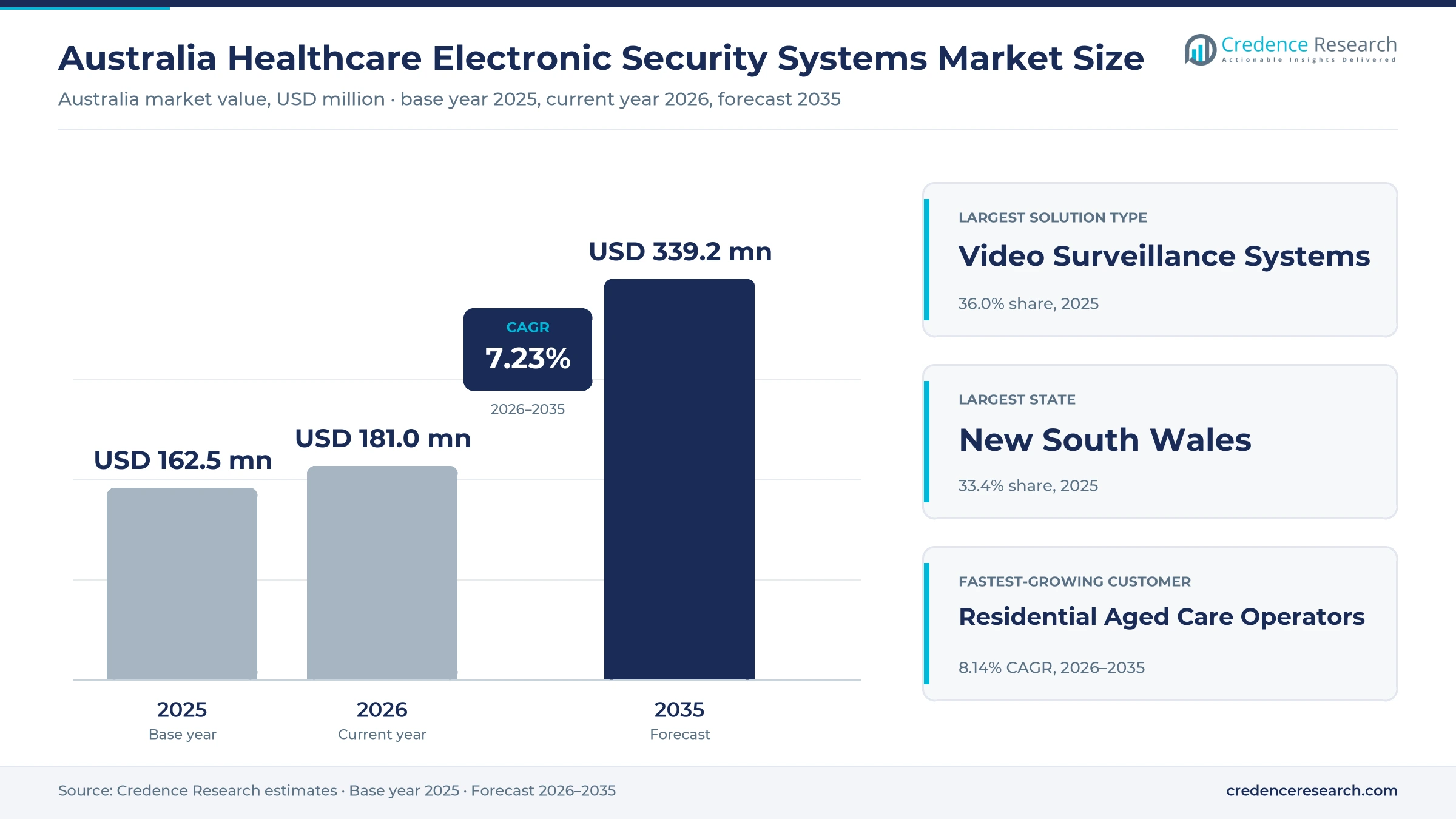
The Australia healthcare electronic security systems market was valued at USD 162.5 million in 2025 and is projected to increase from USD 181.0 million in 2026 to USD 339.2 million by 2035, registering a CAGR of 7.23% during 2026–2035. Demand comes from a large state hospital construction pipeline, from health department programs that protect clinicians against violence, and from aged care reform that raises reporting and safety obligations for residential operators. New South Wales held the largest share, 33.4% in 2025, because it has the most residents and health infrastructure funding of A$12.4 billion over four years. Queensland is the fastest-growing state at 7.75% a year, as its Hospital Rescue Plan adds about 2,600 beds across new and expanded hospitals. In turn, the Aged Care Act 2024 took effect in November 2025 and changed serious incident reporting, which pushes aged care homes toward better monitoring and alert coverage.
Which cameras, alarms and services are counted?
The estimate counts spending by Australian hospitals, aged care homes and community health services on video surveillance, electronic access control, duress and intrusion alarms, and integrated security management platforms. It includes installation projects, maintenance contracts and recurring monitoring or subscription fees, whether systems run on premises, in a hybrid setup or as cloud-managed services.
The estimate excludes manned guarding hours, fire detection, nurse call handsets bought without security functions, and pure cybersecurity software for clinical networks. The value chain runs from camera, reader and alarm manufacturers through security integrators and monitoring centers to state health departments, private hospital groups and aged care providers that buy and operate the systems.
Australia Healthcare Electronic Security Systems Market Insights
- The Australia healthcare electronic security systems market was valued at USD 162.5 million in 2025 and is projected to reach USD 339.2 million by 2035, registering a CAGR of 7.23% during 2026–2035.
- New South Wales held a 33.4% share of 2025 value, because it has the most residents and health infrastructure funding of A$12.4 billion over four years.
- Video surveillance systems led solution types with a 36.0% share of 2025 value, because cameras cover entrances, emergency departments, wards and car parks.
- The Aged Care Act 2024 and Aged Care Rules 2025 took effect on Nov. 1, 2025, and changed serious incident reporting for aged care providers across Australia.
- Residential aged care operators grow fastest among customer types at 8.14% a year during 2026–2035, as reform and resident safety obligations widen system coverage.
Cameras lead while integrated platforms grow fastest
Why do camera systems hold the largest share?
Based on solution type, the market is categorized into Video Surveillance Systems, Electronic Access Control Systems, Duress and Intrusion Systems, and Integrated Security Platforms. Video Surveillance Systems led with a 36.0% share of 2025 value, because cameras protect every public entrance and car park. Integrated Security Platforms grow fastest at 8.21% a year, as hospitals tie cameras, access control and alarms into one console.
Which operators buy the most security technology?
Based on customer type, the market is categorized into Public Hospital Operators, Private Hospital Operators, Residential Aged Care Operators and Community Health Operators. Public Hospital Operators led with a 52.0% share of 2025 value, because state health departments fund most new hospital buildings. Residential Aged Care Operators grow fastest at 8.14% a year, as reform raises safety duties for homes.
Which uses of security systems expand fastest?
Based on application, the market is categorized into Public Area Surveillance, Restricted Area Protection, Staff Safety Response and Patient and Resident Protection. Public Area Surveillance led with a 34.0% share of 2025 value, because entrances, waiting rooms and car parks need constant coverage. Staff Safety Response grows fastest at 7.94% a year, as duress alarms and body-worn cameras spread.
How quickly are cloud-managed systems gaining share?
Based on deployment model, the market is categorized into On-Premises, Hybrid and Cloud-Managed systems. On-Premises led with a 62.0% share of 2025 value, because public hospitals keep video and access data on local networks. Cloud-Managed systems grow fastest at 8.83% a year, as multi-site aged care groups and community health services prefer central monitoring of alarms and cameras without installing servers at every site.
| Segment Group | Leading Sub-segment | Share, 2025 | Fastest-growing Sub-segment | CAGR, 2026–2035 |
|---|---|---|---|---|
| By Solution Type | Video Surveillance Systems | 36.0% | Integrated Security Platforms | 8.21% |
| By Customer Type | Public Hospital Operators | 52.0% | Residential Aged Care Operators | 8.14% |
| By Application | Public Area Surveillance | 34.0% | Staff Safety Response | 7.94% |
| By Deployment Model | On-Premises | 62.0% | Cloud-Managed | 8.83% |
Request a Free Sample
Fill in your details and we'll send you a free sample report.
- Sample data tables & charts
- Research methodology
New hospitals, staff safety and aged care rules lift demand
How does the hospital construction pipeline lift spending?
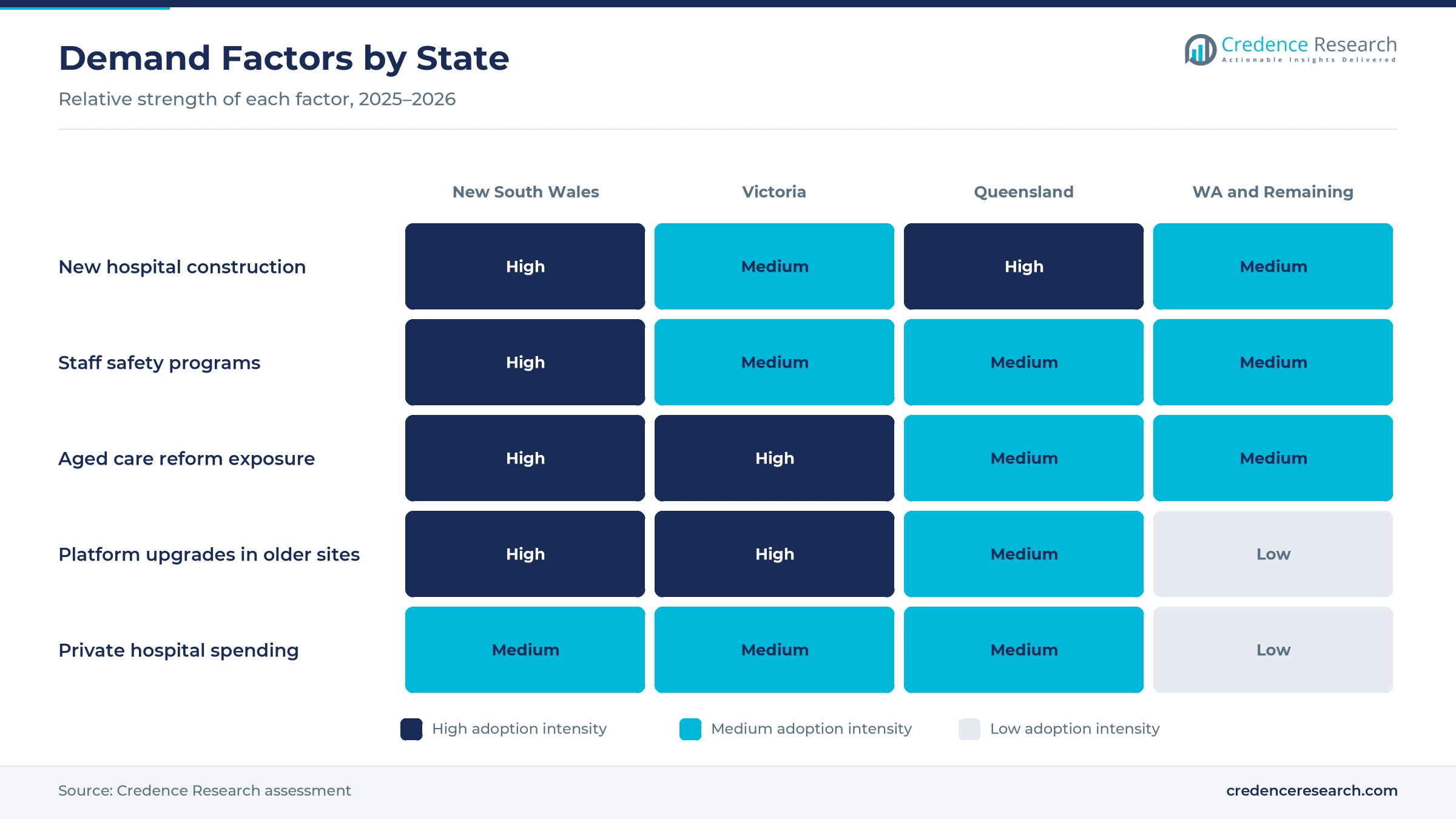
New and expanded hospitals create the largest pool of project revenue, because every building is fitted with cameras, card readers and duress points before it opens. The Queensland Government said in its December 2025 Hospital Rescue Plan update that the program will add at least 2,600 beds, including a 400-bed Coomera hospital whose main construction starts in the second half of 2026. The NSW 2025-26 Budget set aside A$12.4 billion over four years for health infrastructure, including A$2.0 billion for the new Bankstown Hospital. Western Australia also signed an A$1.8 billion design and construct contract with Webuild and its Clough subsidiary in May 2025 for the new Women and Babies Hospital in Perth. As a result, Video Surveillance Systems lead solution types with 36.0% of 2025 value.
Why is staff safety investment rising in public hospitals?
Violence against clinicians has turned duress alarms, cameras and controlled entry into a workforce retention issue for state health departments. When NSW Health formed a Safety Taskforce in July 2026, the NSW Nurses and Midwives' Association cited a report in which 88% of surveyed nurses and midwives had experienced violence in the past year. The body-worn camera trial for NSW Health security staff covers 15 hospitals and has been extended to November 2026. The earlier Anderson Review made 107 recommendations, while NSW Health reported A$19 million of emergency department security work, including CCTV upgrades, access controls and remote locking of public doors. In turn, Staff Safety Response grows fastest among applications at 7.94% a year.
What do the new incident rules mean for care homes?
Aged care reform pushes residential operators to detect, record and prevent harm more rigorously, which lifts spending on monitoring and alert systems. The Aged Care Act 2024 and the Aged Care Rules 2025 started on Nov. 1, 2025, and changed how providers report serious incidents under the Serious Incident Response Scheme. Residential services lodged 14,824 such notifications in the April to June quarter of 2025, including 7,221 for unreasonable use of force, according to the Aged Care Quality and Safety Commission. The sector is also large and dispersed, with 707 providers running 2,590 residential aged care homes at June 30, 2025, according to GEN aged care data. Consequently, Residential Aged Care Operators grow fastest among customer types at 8.14% a year.
How do population growth and aging widen the patient base?
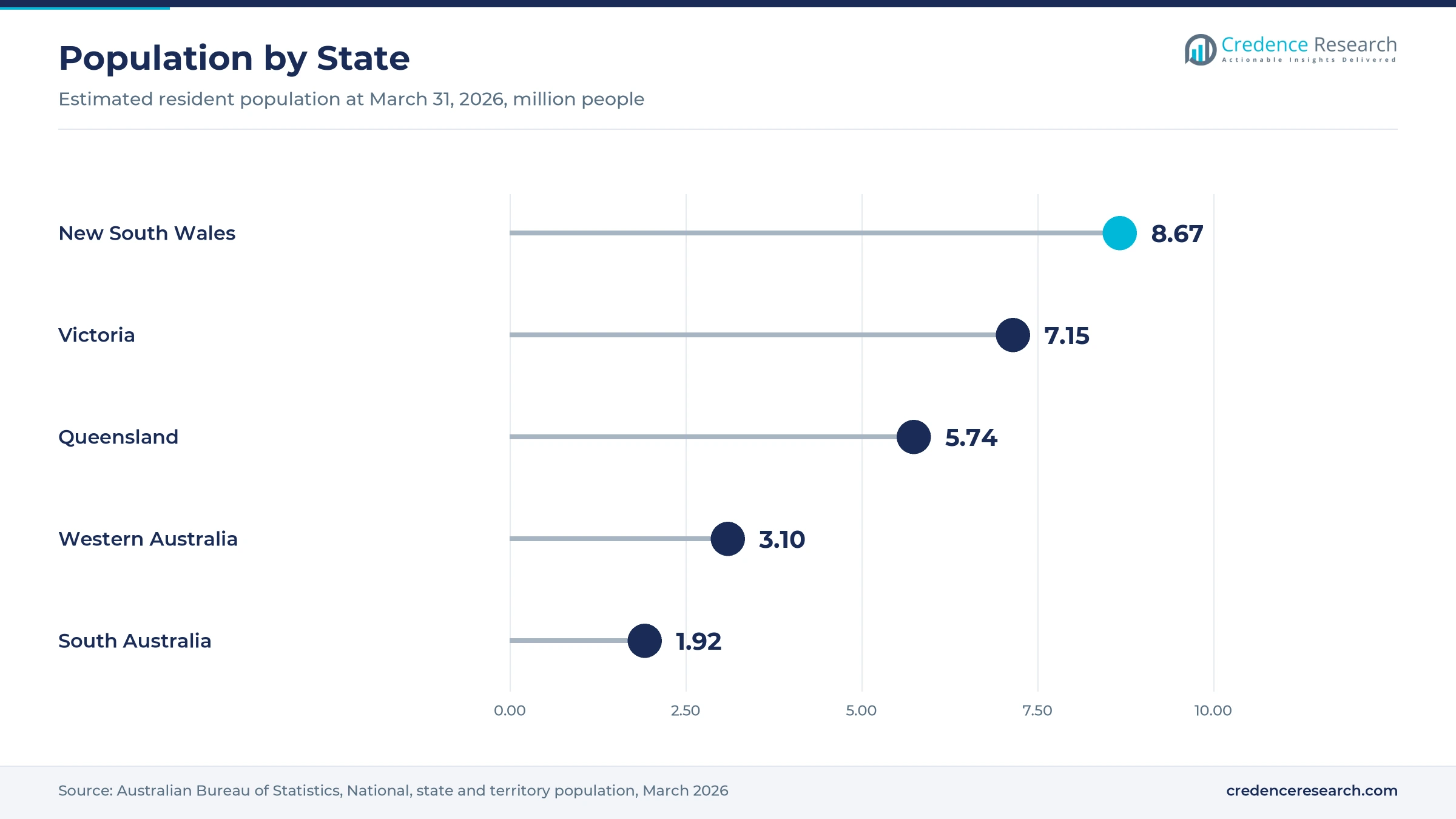
A larger and older population raises the number of patients and residents who need protection from wandering, falls and aggressive incidents. People aged 65 and over made up about 18.1% of the Australian population in 2025, up from about 17.1% in 2022, according to the World Bank. The Australian Bureau of Statistics counted 27.9 million residents at March 31, 2026, after annual growth of 1.4%. Victoria's 2025-26 Budget also committed A$634 million to open and operate nine new or expanded hospitals, including the new Footscray Hospital. As a result, Staff Safety Response and Public Area Surveillance both gain from extra beds, entrances and waiting areas across the states.
Body-worn cameras and unified platforms gain ground
Why is evidence capture on the rise in hospital wards?
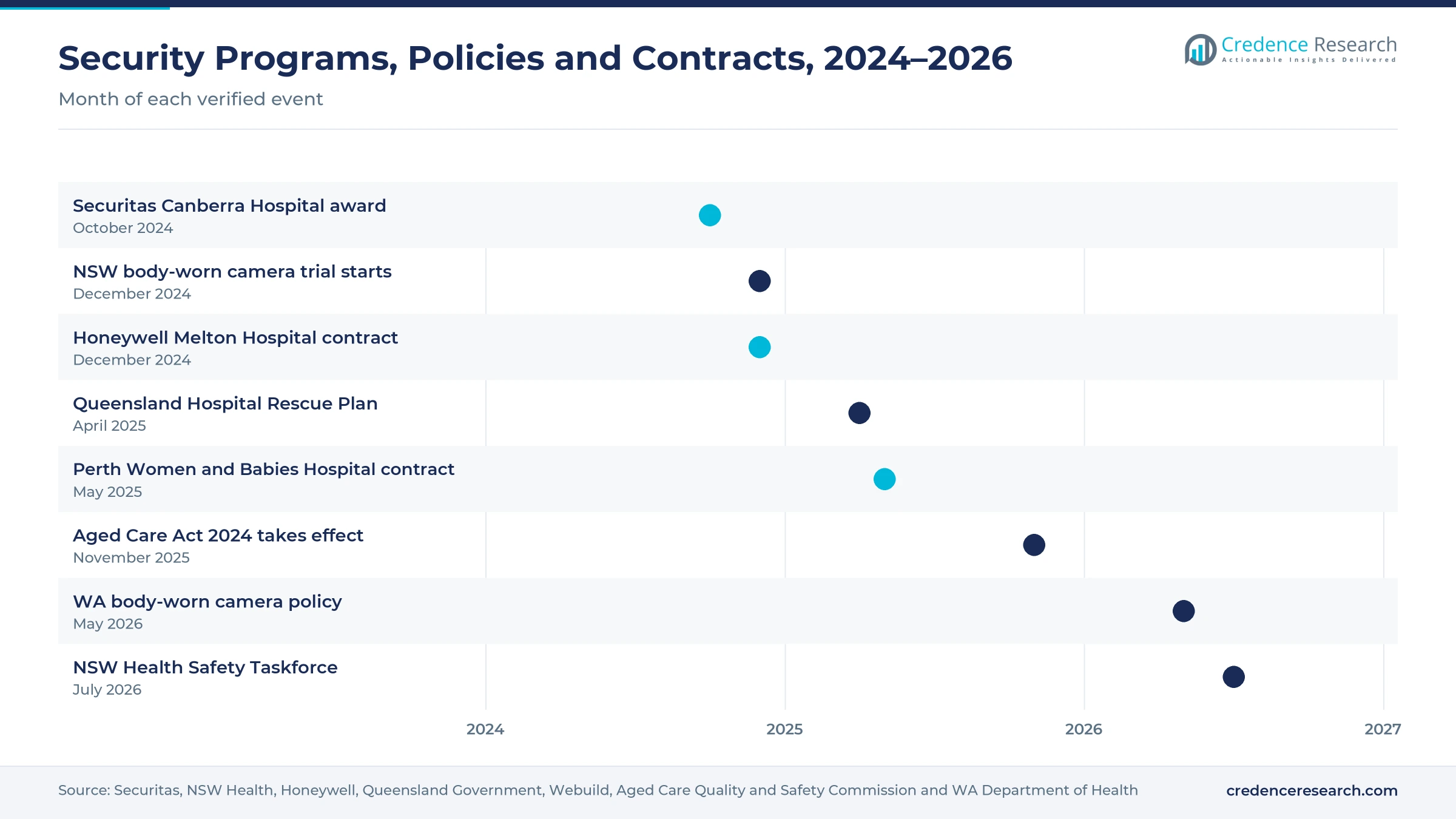
Body-worn cameras are moving from pilot projects toward formal health policy, which adds recording, storage and evidence management to hospital security budgets. NSW Health started its trial at Royal North Shore Hospital in December 2024 and expanded it to 15 hospitals by March 2025, including Wollongong and Shoalhaven. Westmead, Lismore Base and Port Macquarie Base hospitals joined in August 2025, and an independent evaluation will follow the trial. Western Australia then made policy MP 0196/26 effective on May 18, 2026, setting mandatory rules on camera activation, training, footage storage and access for health security officers. In turn, hospitals are linking camera recordings with duress alarms and incident reporting systems.
How is the shift toward unified security platforms emerging?
Large hospital projects increasingly merge cameras, card readers, intruder alarms and communications into one management platform. Securitas Electronic Security won an Australian Security Industry Award for Excellence in October 2024 for the Canberra Hospital Expansion, which uses more than 4,000 field devices across access control, high-definition cameras and intruder detection. Chubb and SAAB earlier built a single interface at the Queensland Children's Hospital that combined access control, video management, communications and asset tracking. Honeywell also holds 25-year building technology contracts at the new Footscray and Melton hospitals in Victoria. As a result, Integrated Security Platforms grow fastest at 8.21% a year.
Can central alarm desks win regional care home contracts?
Multi-site aged care groups offer an opening for monitored and subscription services, because few homes employ their own security engineers. Not-for-profit organizations operated 59% of residential care services at June 30, 2025, and many run dispersed regional homes with small facility teams. Intelligent Monitoring Group bought ADT Security from Johnson Controls in August 2023, creating a locally owned monitoring platform with national reach. Hosted video surveillance services let a central team review alarms from many homes without on-site servers. Consequently, Cloud-Managed systems grow fastest among deployment models at 8.83% a year, from a small base.
Can replacing aging ward devices pay off for integrators?
Older public hospitals present a steady retrofit opportunity, because many camera, alarm and door systems were installed in separate projects over two decades. NSW Health reported more than 3,000 CCTV cameras in its public hospitals in February 2021 and spent A$5 million upgrading staff duress alarms in emergency departments. Victoria's Health Service Violence Prevention Fund reached A$40 million in June 2017 and had supported more than 60 health services with alarms, CCTV, access control doors and lighting. Those earlier device fleets now need replacement and integration into newer platforms. As a result, Public Hospital Operators keep 52.0% of 2025 value through maintenance and upgrade contracts.
Privacy rules, private hospital stress and long builds
How do privacy rules slow camera rollouts?
Privacy and dignity rules limit where and how hospitals and aged care homes can record patients and residents. Western Australia's body-worn camera policy requires recordings to be proportionate to the threat and to respect privacy and rights, with set rules on footage storage and access. As a result, operators must add governance, training and secure storage before they deploy new cameras. Vendors respond with role-based access, audit trails and automatic retention controls.
Why does private hospital stress delay upgrades?
Financial pressure on private hospital groups can defer discretionary security upgrades. Healthscope, which runs 37 private hospitals, entered receivership on May 26, 2025, after lenders ended support for its owner, and the Commonwealth Bank provided a funding package of A$100 million to keep operations running. In turn, capital requests for cameras and access control compete with clinical equipment and wage costs. Vendors respond with leasing and service contracts that spread payments.
How do long hospital build times delay revenue?
Hospital projects take many years to move from announcement to fit-out, which pushes security revenue into later years. Queensland expects both the first stage of the new Bundaberg hospital and the first 400 beds at Coomera in 2031, with 200 more Coomera beds in 2032. As a result, integrators must carry bid and design costs long before installation starts. Suppliers respond by securing early design roles with builders and health infrastructure agencies.
Why do connected devices raise new cyber risks?
Networked cameras, readers and building controllers expand the attack surface of hospital networks. Honeywell's Footscray Hospital contract includes a cybersecurity suite to protect operational technology, which shows that owners now treat building systems as cyber assets. In turn, buyers ask security vendors for patching, network segmentation and monitoring commitments. Smaller integrators without these skills may lose tenders to larger firms that can manage both physical and network risk.
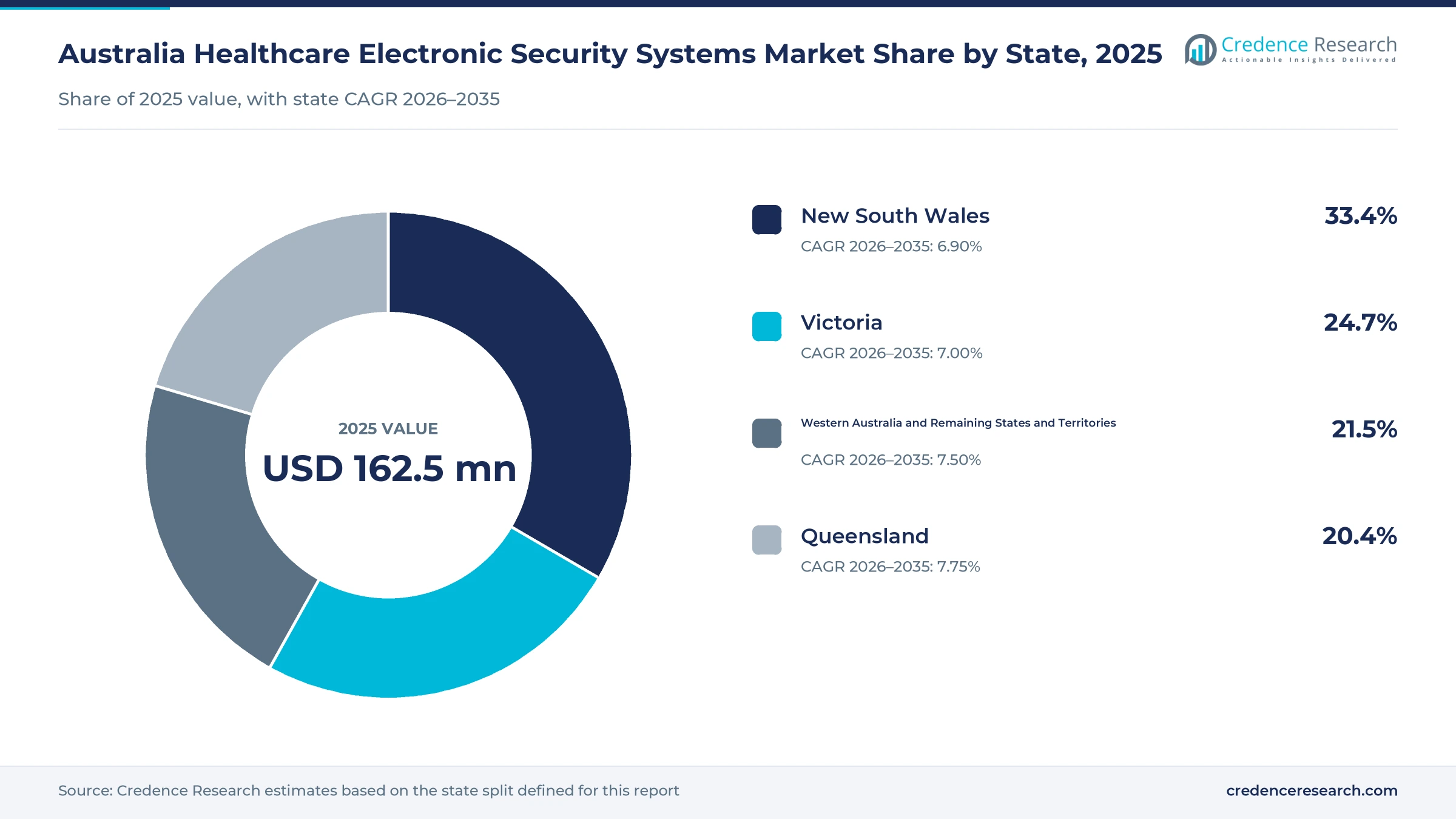
New South Wales leads as Queensland grows fastest
| State | Value, 2025 (USD million) | Share, 2025 | CAGR, 2026–2035 |
|---|---|---|---|
| New South Wales | 54.3 | 33.4% | 6.90% |
| Victoria | 40.1 | 24.7% | 7.00% |
| Western Australia and Remaining States and Territories | 34.9 | 21.5% | 7.50% |
| Queensland | 33.1 | 20.4% | 7.75% |
How do budget and safety programs keep NSW ahead?
New South Wales held 33.4% of 2025 value and grows at 6.90% a year, as hospital redevelopments and staff safety reforms run side by side. The state budget allocates A$12.4 billion over four years to health infrastructure, including the A$910 million Rouse Hill Hospital project. NSW Health also runs formed a Safety Taskforce in July 2026 to advise on staff, patient and visitor safety in public hospitals. The state had 8.67 million residents at March 31, 2026, the largest population of any region in the country.
How do new hospital openings shape demand in Victoria?
Victoria held a 24.7% share of 2025 value and grows at 7.00% a year, as new hospitals open and older sites are upgraded. The 2025-26 state budget funds the opening of nine new or expanded hospitals, including Footscray, Frankston and Maryborough. The new Footscray Hospital has more than 500 beds in a project worth A$1.5 billion. Victoria also recorded population growth of 1.6% in the year to March 2026, which adds demand for emergency and community care.
Why does Queensland grow fastest to 2035?
Queensland held a 20.4% share of 2025 value and grows fastest at 7.75% a year, as the Hospital Rescue Plan moves into construction. The program includes new hospitals at Coomera, Toowoomba and Bundaberg and ten major expansions. Toowoomba is planned with 538 overnight beds and an 84-bed acute mental health facility, with stage one due in 2029. Logan Hospital also adds 112 overnight beds in 2027, which expands secure inpatient areas.
What adds demand in the west and smaller states?
Western Australia and Remaining States and Territories held a 21.5% share of 2025 value and grow at 7.50% a year. Western Australia had the fastest population growth among states at 2.1% in the year to March 2026. Its A$1.8 billion Women and Babies Hospital and its new body-worn camera policy add demand. In the Australian Capital Territory, ACT Health now runs one of the largest CCure security management systems globally after the Canberra Hospital Expansion.
Trials, policies and hospital contracts, 2024–2026
| Development | Status and market relevance |
|---|---|
| In October 2024, Securitas Electronic Security won an Australian Security Industry Award for Excellence for the Canberra Hospital Expansion installation of more than 4,000 field devices. | Shows the scale of integrated hospital security projects |
| In December 2024, NSW Health started a body-worn camera trial for security staff at Royal North Shore Hospital, later extending it to other public hospitals. | Adds recording and evidence systems to staff safety programs |
| In April 2025, the Queensland Government released its Hospital Rescue Plan with about 2,600 new beds across three new hospitals and ten expansions. | Creates a multi-year pipeline of new security installations |
| In November 2025, the Aged Care Act 2024 and Aged Care Rules 2025 took effect, changing serious incident reporting for aged care providers. | Raises monitoring and alert needs in residential homes |
| In July 2026, NSW Health formed a Safety Taskforce on aggression, covering hospital security systems, and extended its body-worn camera trial to November 2026. | Keeps staff safety technology high on state agendas |
Cameras, card readers and duress links converge
- Video surveillance systems cover entrances, emergency departments, wards and car parks, and increasingly feed footage to central control rooms.
- Electronic access control systems restrict pharmacies, birthing suites, mental health units and plant rooms to authorized staff with cards or mobile credentials.
- Duress and intrusion systems let staff summon Code Black or Code Grey teams through personal and fixed alarms, and link to nurse call and paging tools.
- Integrated security platforms join cameras, readers, alarms and communications in one interface, as at the Canberra Hospital Expansion.
Need a Custom Version of This Report?
Tailor the scope, geography, or segments to your exact requirements.
- Custom geography or segment scope
- Direct access to our analyst team
Integrators and monitoring firms compete for contracts
Competition in Australian hospital and aged care security splits between large integrators that win new-building packages and monitoring companies that hold recurring service contracts. Securitas Electronic Security delivered the integrated access control, camera and intruder detection installation at the Canberra Hospital Expansion. Chubb Fire & Security Australia, with SAAB, built an integrated access control and video management system at the Queensland Children's Hospital. Johnson Controls sold ADT Security in Australia and New Zealand to Intelligent Monitoring Group in 2023 and still hires security technicians in Sydney for access control, CCTV and intercom work. Intelligent Monitoring Group now runs ADT Security as a locally owned monitoring business. Honeywell holds 25-year building technology contracts at the Footscray and Melton hospitals. Rivals compete on design capability, health project references, service coverage in regional areas and the ability to secure connected devices.
Which companies lead hospital security in Australia?
| Company | Type | Role in the market |
|---|---|---|
| Chubb Fire & Security Australia | Security integrator | Integrated access control and video management at the Queensland Children's Hospital with SAAB |
| Securitas Australia | Security integrator | Integrated access control, camera and intruder detection at the Canberra Hospital Expansion |
| Johnson Controls Australia | Security technology provider | Access control, CCTV and intercom service teams in Sydney |
| Intelligent Monitoring Group / ADT Security Australia | Monitoring provider | Bought ADT Security in Australia and New Zealand from Johnson Controls in 2023 |
| Honeywell Building Technologies Australia | Building technology provider | 25-year building technology contracts at Footscray and Melton hospitals |
Credence Research view on hospital and aged care security
Credence Research's view is that the Australia healthcare electronic security systems market will grow steadily, because new hospitals, staff safety programs and aged care reform all add devices and monitoring needs. Public hospitals remain the largest buyers, while residential aged care operators add the fastest growth as reporting and safety duties rise. Integrated platforms will gain share as owners replace separate camera, door and alarm systems. Privacy rules, private hospital finances and long build times will shape how quickly that demand turns into installed systems.
How the hospital and aged care security estimate was built
The report uses 2025 as the base year on a calendar basis, and market values come from the Credence Research model. That model combines hospital construction programs, state health budgets, aged care sector data, population statistics and company announcements. Segment splits and state growth rates are Credence Research estimates, while state shares follow the regional split defined for this report. Sources used are government agencies, health regulators, official statistics, international agency data, industry award records, trade press and company publications, and no interviews or surveys were used.
New hospitals and aged care reform carry growth to 2035
Australian healthcare security spending is expected to reach USD 339.2 million by 2035, a 7.23% CAGR during 2026–2035, as new hospitals open and older sites replace aging systems. Growth should be strongest in Queensland as the Hospital Rescue Plan delivers new beds, while New South Wales keeps the largest share. Aged care homes will add steady demand for monitored alerts and cameras under the new Act. Suppliers that combine integrated platforms, regional service coverage and strong cyber controls should win the largest share of new work.
Frequently Asked Questions
How big is the Australia healthcare electronic security systems market?
Which solution type leads hospital security spending in Australia?
Which state leads healthcare security spending?
How does staff safety affect demand for security systems?
How does aged care reform affect security spending?
Which deployment model grows fastest?
Which companies lead healthcare security in Australia?
What are the main challenges for this market?
Table of Content
Chapter 1 Market Segmentation
- 1.1 Segmentation Framework
- 1.1.1 Product and Service Classification
- 1.1.2 Application and End-Use Classification
- 1.1.3 Technology and Solution Classification
- 1.1.4 Customer and Distribution Channel Classification
- 1.1.5 Geographic Segmentation
- 1.1.6 Market Segment Definitions and Boundaries
- 1.2 By Solution Type
- 1.2.1 Video Surveillance Systems
- 1.2.2 Electronic Access Control Systems
- 1.2.3 Duress and Intrusion Systems
- 1.2.4 Integrated Security Platforms
- 1.3 By Customer Type
- 1.3.1 Public Hospital Operators
- 1.3.2 Private Hospital Operators
- 1.3.3 Residential Aged Care Operators
- 1.3.4 Community Health Operators
- 1.4 By Application
- 1.4.1 Public Area Surveillance
- 1.4.2 Restricted Area Protection
- 1.4.3 Staff Safety Response
- 1.4.4 Patient and Resident Protection
- 1.5 By Deployment Model
- 1.5.1 On-Premises
- 1.5.2 Hybrid
- 1.5.3 Cloud-Managed
- 1.6 By State
- 1.6.1 New South Wales
- 1.6.2 Victoria
- 1.6.3 Queensland
- 1.6.4 Western Australia and Remaining States and Territories
Chapter 2 Introduction
- 2.1 Report Objectives and Scope
- 2.2 Product Definition and Industry Terminology
- 2.3 Market Inclusions and Exclusions
- 2.4 Research Process
- 2.4.1 Primary Research and Expert Interviews
- 2.4.2 Secondary Research and Source Review
- 2.4.3 Top-Down and Bottom-Up Estimation
- 2.4.4 Data Triangulation and Verification
- 2.5 Market Size Measurement Basis
- 2.5.1 2025: USD 162.5 million → 2035: USD 339.2 million
- 2.6 Historical and Forecast Reference Periods
- 2.6.1 Historical Period: 2018-2025
- 2.6.2 Base Year: 2025
- 2.6.3 Forecast Period: 2025-2035
- 2.7 Research Assumptions and Limitations
Chapter 3 Executive Summary
- 3.1 Market Snapshot and Key Findings
- 3.2 Base-Year Market Size, 2025
- 3.3 Forecast Market Size, 2035
- 3.4 Revenue and Volume Growth Outlook
- 3.5 Key Demand and Supply Indicators
- 3.6 Leading Market Segments
- 3.7 Fastest-Growing Market Opportunities
- 3.8 Regional Performance Highlights
- 3.9 Technology and Industry Transformation
- 3.10 Competitive Landscape Summary
- 3.11 Analyst View and Strategic Implications
Chapter 4 Australia Healthcare Electronic Security Systems Market Trends and Developments
- 4.1 Historical Industry Development, 2018-2025
- 4.2 Recent Market Trends and Developments
- 4.3 Demand and Customer Behavior Trends
- 4.4 Technology and Product Innovation
- 4.5 Artificial Intelligence, Automation and Digitalization
- 4.6 Local Manufacturing and Supply Chain Realignment
- 4.7 Industry Partnerships, Mergers and Acquisitions
- 4.8 Sustainability and Circular Economy Developments
- 4.9 Government and Private Sector Investment Trends
- 4.10 Emerging Business Models and Commercialization
- 4.11 Industry Developments and Announcements
Chapter 5 Australia Healthcare Electronic Security Systems Market Production, Supply and Demand Analysis
- 5.1 Demand Trend and Consumption Analysis, 2018-2025
- 5.2 Demand Forecast, 2025-2035
- 5.3 Production and Output Trend, 2018-2025
- 5.4 Production and Output Forecast, 2025-2035
- 5.5 Installed Capacity and Capacity Utilization
- 5.6 Company-Wise Production Plants and Statistics
- 5.6.1 Installed Production Capacity
- 5.6.2 Actual Production
- 5.6.3 Planned Capacity and Expansion Targets
- 5.7 Supply Chain Structure and Procurement Trends
- 5.8 Supply-Demand Gap and Bottlenecks
- 5.9 Import Dependence and Sourcing Structure
- 5.10 Contract Manufacturing and Outsourcing
- 5.11 Regional Supply and Demand Concentration
Chapter 6 Australia Healthcare Electronic Security Systems Market Pricing Analysis
- 6.1 Pricing Structure and Measurement
- 6.2 Historical Pricing Trends, 2018-2025
- 6.3 Pricing Outlook, 2025-2035
- 6.4 Average Selling Price and Unit Economics
- 6.5 Pricing by Product and Market Segment
- 6.6 Geographic Pricing Differences
- 6.7 Key Input, Energy, Labor and Logistics Costs
- 6.8 Contract Pricing and Purchasing Models
- 6.9 Pricing Sensitivity and Competitive Positioning
- 6.10 Price, Margin and Profitability Implications
Chapter 7 Australia Healthcare Electronic Security Systems Market Dynamics
- 7.1 Market Growth Drivers
- 7.1.1 Demand-Side Drivers
- 7.1.2 Technology and Innovation Drivers
- 7.1.3 Infrastructure and Investment Drivers
- 7.1.4 Regulatory and Policy Drivers
- 7.2 Market Restraints
- 7.2.1 Cost and Affordability Constraints
- 7.2.2 Technology and Adoption Barriers
- 7.2.3 Supply Chain and Operational Constraints
- 7.3 Market Challenges
- 7.3.1 Competitive Pressure and Margin Erosion
- 7.3.2 Skills, Infrastructure and Implementation Gaps
- 7.4 Emerging Market Opportunities
- 7.5 Market Dynamics Impact and Time-Horizon Assessment
Chapter 8 Australia Healthcare Electronic Security Systems Value Chain Analysis
- 8.1 Industry Value Chain Overview
- 8.2 Upstream Suppliers and Critical Inputs
- 8.3 Technology and Component Providers
- 8.4 Manufacturing or Service Delivery
- 8.5 Distribution, Channel Partners and Integrators
- 8.6 Downstream Applications and End Users
- 8.7 Value Addition and Profit Pools
- 8.8 Vertical Integration and Outsourcing
- 8.9 Supplier Concentration and Risk
- 8.10 Supply Chain Localization and Resilience
Chapter 9 Australia Healthcare Electronic Security Systems Market Regulations and Policies
- 9.1 Relevant Laws, Standards and Compliance Frameworks
- 9.2 Product, Service, Safety and Quality Requirements
- 9.3 Government Policies, Incentives and Subsidies
- 9.4 Imports, Exports and Trade Barriers
- 9.5 Public Procurement and Local Content Requirements
- 9.6 Environmental and Sustainability Compliance
- 9.7 Upcoming Policy Changes and Market Implications
Chapter 10 Australia Healthcare Electronic Security Systems Market Hotspots and Opportunities
- 10.1 Market Opportunity Mapping and Growth Hotspots
- 10.2 High-Growth Applications and Customer Groups
- 10.3 Underserved Markets and White-Space Opportunities
- 10.4 Emerging Technology and Product Opportunities
- 10.5 New Capacity and Investment Hotspots
- 10.6 Market Entry and Expansion Opportunities
- 10.7 Distribution and Partnership Opportunities
- 10.8 Near-Term and Long-Term Commercial Potential
- 10.9 Opportunity Attractiveness and Execution Risks
Chapter 11 Australia Healthcare Electronic Security Systems Market Outlook, 2025-2035
- 11.1 Market Size and Analysis
- 11.1.1 Revenue (Market Measurement: 2025: USD 162.5 million → 2035: USD 339.2 million)
- 11.1.2 Market Volume and Quantity Sold
- 11.1.3 Historical Market Size, 2018-2025
- 11.1.4 Base-Year Market Size, 2025
- 11.2 Market Forecast, 2025-2035
- 11.2.1 Revenue Forecast to 2035
- 11.2.2 Volume Forecast to 2035
- 11.2.3 CAGR and Year-on-Year Growth
- 11.2.4 Incremental Revenue Opportunity
- 11.3 Forecast Assumptions and Scenario Analysis
- 11.3.1 Base-Case Forecast
- 11.3.2 Optimistic and Conservative Scenarios
- 11.3.3 Technology, Pricing and Policy Sensitivities
- 11.4 Market Attractiveness and Growth Outlook
Chapter 12 Australia Healthcare Electronic Security Systems Market Segmentation and Outlook
- 12.1 Segmentation Summary and Market Shares, 2025
- 12.2 Largest and Fastest-Growing Segments
- 12.3 By Solution Type - Market Size and Forecast, 2025-2035
- 12.3.1 Segment Definition and Scope
- 12.3.2 Historical Market Size, 2018-2025
- 12.3.3 Revenue Forecast, 2025-2035
- 12.3.4 Volume Forecast, 2025-2035
- 12.3.5 Base-Year Market Share, 2025
- 12.3.6 Segment CAGR and Growth Drivers
- 12.3.7 Subsegment Market Size and Forecast
- 12.3.7.1 Video Surveillance Systems
- 12.3.7.2 Electronic Access Control Systems
- 12.3.7.3 Duress and Intrusion Systems
- 12.3.7.4 Integrated Security Platforms
- 12.3.8 Subsegment Pricing and Adoption Trends
- 12.3.9 Leading Suppliers and Competition
- 12.3.10 Regional Demand and Opportunities
- 12.4 By Customer Type - Market Size and Forecast, 2025-2035
- 12.4.1 Segment Definition and Scope
- 12.4.2 Historical Market Size, 2018-2025
- 12.4.3 Revenue Forecast, 2025-2035
- 12.4.4 Volume Forecast, 2025-2035
- 12.4.5 Base-Year Market Share, 2025
- 12.4.6 Segment CAGR and Growth Drivers
- 12.4.7 Subsegment Market Size and Forecast
- 12.4.7.1 Public Hospital Operators
- 12.4.7.2 Private Hospital Operators
- 12.4.7.3 Residential Aged Care Operators
- 12.4.7.4 Community Health Operators
- 12.4.8 Subsegment Pricing and Adoption Trends
- 12.4.9 Leading Suppliers and Competition
- 12.4.10 Regional Demand and Opportunities
- 12.5 By Application - Market Size and Forecast, 2025-2035
- 12.5.1 Segment Definition and Scope
- 12.5.2 Historical Market Size, 2018-2025
- 12.5.3 Revenue Forecast, 2025-2035
- 12.5.4 Volume Forecast, 2025-2035
- 12.5.5 Base-Year Market Share, 2025
- 12.5.6 Segment CAGR and Growth Drivers
- 12.5.7 Subsegment Market Size and Forecast
- 12.5.7.1 Public Area Surveillance
- 12.5.7.2 Restricted Area Protection
- 12.5.7.3 Staff Safety Response
- 12.5.7.4 Patient and Resident Protection
- 12.5.8 Subsegment Pricing and Adoption Trends
- 12.5.9 Leading Suppliers and Competition
- 12.5.10 Regional Demand and Opportunities
- 12.6 By Deployment Model - Market Size and Forecast, 2025-2035
- 12.6.1 Segment Definition and Scope
- 12.6.2 Historical Market Size, 2018-2025
- 12.6.3 Revenue Forecast, 2025-2035
- 12.6.4 Volume Forecast, 2025-2035
- 12.6.5 Base-Year Market Share, 2025
- 12.6.6 Segment CAGR and Growth Drivers
- 12.6.7 Subsegment Market Size and Forecast
- 12.6.7.1 On-Premises
- 12.6.7.2 Hybrid
- 12.6.7.3 Cloud-Managed
- 12.6.8 Subsegment Pricing and Adoption Trends
- 12.6.9 Leading Suppliers and Competition
- 12.6.10 Regional Demand and Opportunities
- 12.7 By State - Market Size and Forecast, 2025-2035
- 12.7.1 Segment Definition and Scope
- 12.7.2 Historical Market Size, 2018-2025
- 12.7.3 Revenue Forecast, 2025-2035
- 12.7.4 Volume Forecast, 2025-2035
- 12.7.5 Base-Year Market Share, 2025
- 12.7.6 Segment CAGR and Growth Drivers
- 12.7.7 Subsegment Market Size and Forecast
- 12.7.7.1 New South Wales
- 12.7.7.2 Victoria
- 12.7.7.3 Queensland
- 12.7.7.4 Western Australia and Remaining States and Territories
- 12.7.8 Subsegment Pricing and Adoption Trends
- 12.7.9 Leading Suppliers and Competition
- 12.7.10 Regional Demand and Opportunities
- 12.8 Segment Growth Comparison
- 12.9 Segment Attractiveness and Priority Matrix
Chapter 13 Australia Healthcare Electronic Security Systems End-Use and Application Market Outlook
- 13.1 End-Use Industry and Customer Demand Structure
- 13.2 Leading Applications and Customer Groups
- 13.3 End-Use Market Size, Share and Forecast
- 13.4 Major End-Use Industry Deep Dives
- 13.4.1 Customer Requirements and Use Cases
- 13.4.2 Demand and Replacement Cycles
- 13.4.3 Technical and Regulatory Considerations
- 13.4.4 Purchasing and Procurement Models
- 13.4.5 Leading Vendors and Distribution Channels
- 13.4.6 Forecast and Commercial Opportunities
- 13.5 Emerging Applications and Cross-Segment Demand
- 13.6 End-Use Industry Investment Priorities
Chapter 14 Australia Healthcare Electronic Security Systems Geographic Market Outlook, 2025-2035
- 14.1 Domestic Market Distribution and Demand Clusters
- 14.2 State- or Province-Wise Market Size and Forecast, 2025-2035
- 14.3 City and Metropolitan Market Outlook
- 14.4 Industrial, Manufacturing and Commercial Clusters
- 14.5 Geographic Concentration of Key End Users
- 14.6 Local Pricing and Purchasing Differences
- 14.7 Domestic Production Facilities and Capacity Map
- 14.8 Local Infrastructure and Project Pipeline
- 14.9 State-Level Policy and Incentive Differences
- 14.10 Subnational Investment Hotspots and Opportunities
- 14.11 Distribution and Logistics Networks
- 14.12 Domestic Competitive Footprint
Chapter 15 Australia Healthcare Electronic Security Systems Technology, Innovation and Sustainability Outlook
- 15.1 Technology Landscape and Maturity
- 15.2 Product, Process and Service Innovation
- 15.3 AI, Automation and Digital Tools in the Industry
- 15.4 Technology Adoption and Performance Benchmarking
- 15.5 Innovation Pipeline and R&D Investment
- 15.6 Patent and Intellectual Property Trends
- 15.7 Energy Efficiency and Resource Management
- 15.8 Sustainability, Recycling and Circularity
- 15.9 Technology Roadmap, 2025-2035
- 15.10 Risks of Obsolescence and Technology Substitution
Chapter 16 Australia Healthcare Electronic Security Systems Market Key Strategic Imperatives
- 16.1 Growth and Market Entry Priorities
- 16.2 High-Return Products and Segments
- 16.3 Pricing, Profitability and Cost Optimization
- 16.4 Technology Investment and Product Differentiation
- 16.5 Supply Chain Localization and Resilience
- 16.6 Distribution and Customer Acquisition
- 16.7 Partnership, Acquisition and Capacity Strategy
- 16.8 Regional Expansion Priorities
- 16.9 Short-, Medium- and Long-Term Actions
Chapter 17 Competition Outlook
- 17.1 Industry Competition Characteristics
- 17.2 Market Structure and Concentration
- 17.3 Market Share and Competitive Positioning, 2025
- 17.4 Company-Wise Revenue and Product Benchmarking
- 17.5 Production and Service Capacity Benchmarking
- 17.6 Technology, Pricing and Differentiation
- 17.7 Regional Footprint and Distribution Strength
- 17.8 Mergers, Acquisitions and Strategic Alliances
- 17.9 New Entrants and Competitive Threats
- 17.10 Porter's Five Forces and Industry Attractiveness
- 17.11 Competitive Outlook, 2025-2035
Chapter 18 Company Profiles
- 18.1 Company Coverage and Selection Criteria
- 18.2 Chubb Fire & Security Australia
- 18.2.1 Business Description
- 18.2.2 Company Ownership and Geographic Presence
- 18.2.3 Product and Service Portfolio
- 18.2.4 Manufacturing and Operating Footprint
- 18.2.5 Production Capacity and Expansion Plans
- 18.2.6 Financial Performance and Investment
- 18.2.7 Market Share and Competitive Position
- 18.2.8 Technology and Innovation Capabilities
- 18.2.9 Strategic Alliances or Partnerships
- 18.2.10 Recent Developments
- 18.2.11 Growth Strategy and Outlook
- 18.3 Securitas Australia
- 18.4 Johnson Controls Australia
- 18.5 Intelligent Monitoring Group / ADT Security Australia
- 18.6 Honeywell Building Technologies Australia
- 18.7 Other Relevant Market Participants
Note: Every listed company is profiled on the structure shown under the first company. The company list is preliminary and may change based on research findings, market developments, data availability and client requirements.
Chapter 19 Disclaimer
- 19.1 Research and Forecast Disclaimer
- 19.2 Data Source and Estimation Limitations
Note: The depth of individual sections depends on data availability for this market. Volume, capacity, trade and other unit-based metrics are included where applicable.

