Antibodies widen from psoriasis into eczema, hives and HS
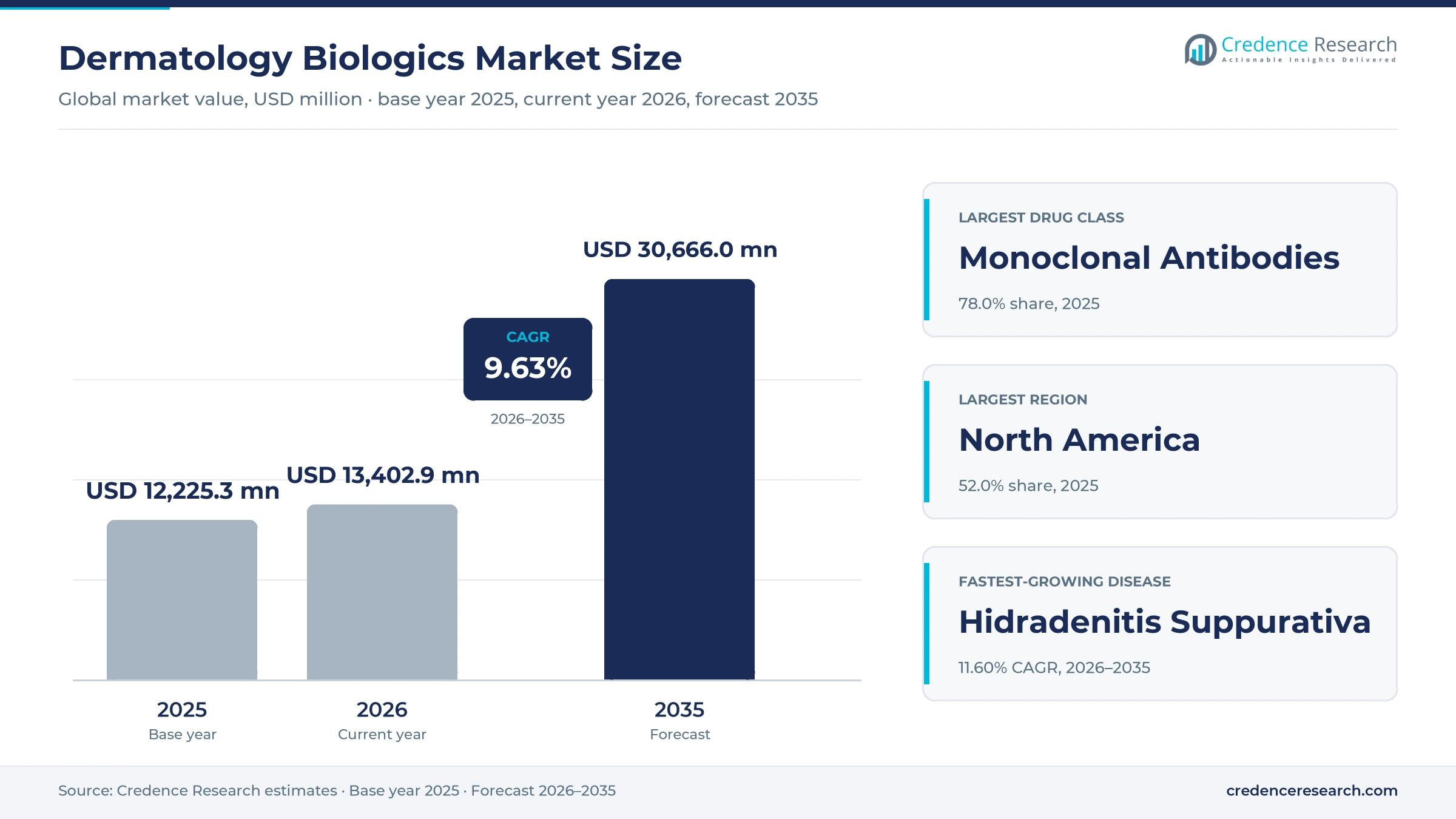
The global dermatology biologics market was valued at USD 12.23 billion in 2025 and is projected to increase from USD 13.40 billion in 2026 to USD 30.67 billion by 2035, registering a CAGR of 9.63% during 2026–2035. Demand comes from moderate to severe plaque psoriasis, atopic dermatitis, hidradenitis suppurativa and chronic hives, where patients who fail topical therapy move to injectable antibodies that block specific immune signals. North America held the largest regional share, 52.0% in 2025, because U.S. payers cover high-cost specialty therapy and new labels reach the U.S. first. Asia Pacific is the fastest-growing region at 11.59% a year, as Japan, China and Australia widen reimbursement and specialist access. The main commercial change is the spread of interleukin-targeting antibodies from psoriasis into eczema, prurigo nodularis and chronic hives, together with the arrival of ustekinumab copies in 2025.
What does the dermatology biologics market include?
The market counts manufacturer revenue from biologic and targeted immune therapies prescribed for chronic inflammatory skin disease. It covers monoclonal antibodies against interleukins and IgE, fusion proteins, recombinant proteins, cytokine-based products and a small oral line of targeted immune therapies that compete for the same moderate to severe patients. Buyers include specialty and retail pharmacies, hospital pharmacies, integrated health systems and public payers.
The scope excludes topical creams, conventional oral systemic drugs such as methotrexate and cyclosporine, aesthetic toxins and fillers, and antibodies used mainly for skin cancer. Revenue from the same molecules in arthritis, bowel disease or asthma is also left out, because only skin indications are counted in the market value.
Dermatology Biologics Market Insights
- The dermatology biologics market grows from USD 12.23 billion in 2025 to USD 30.67 billion by 2035, a 9.63% CAGR over 2026–2035, as antibody labels spread across chronic skin disease.
- North America held 52.0% of global dermatology biologics value in 2025, backed by specialty pharmacy coverage and early launches of new skin indications.
- Monoclonal antibodies led drug classes with 78.0% of 2025 value, because nearly every new psoriasis, eczema and hives therapy is an antibody.
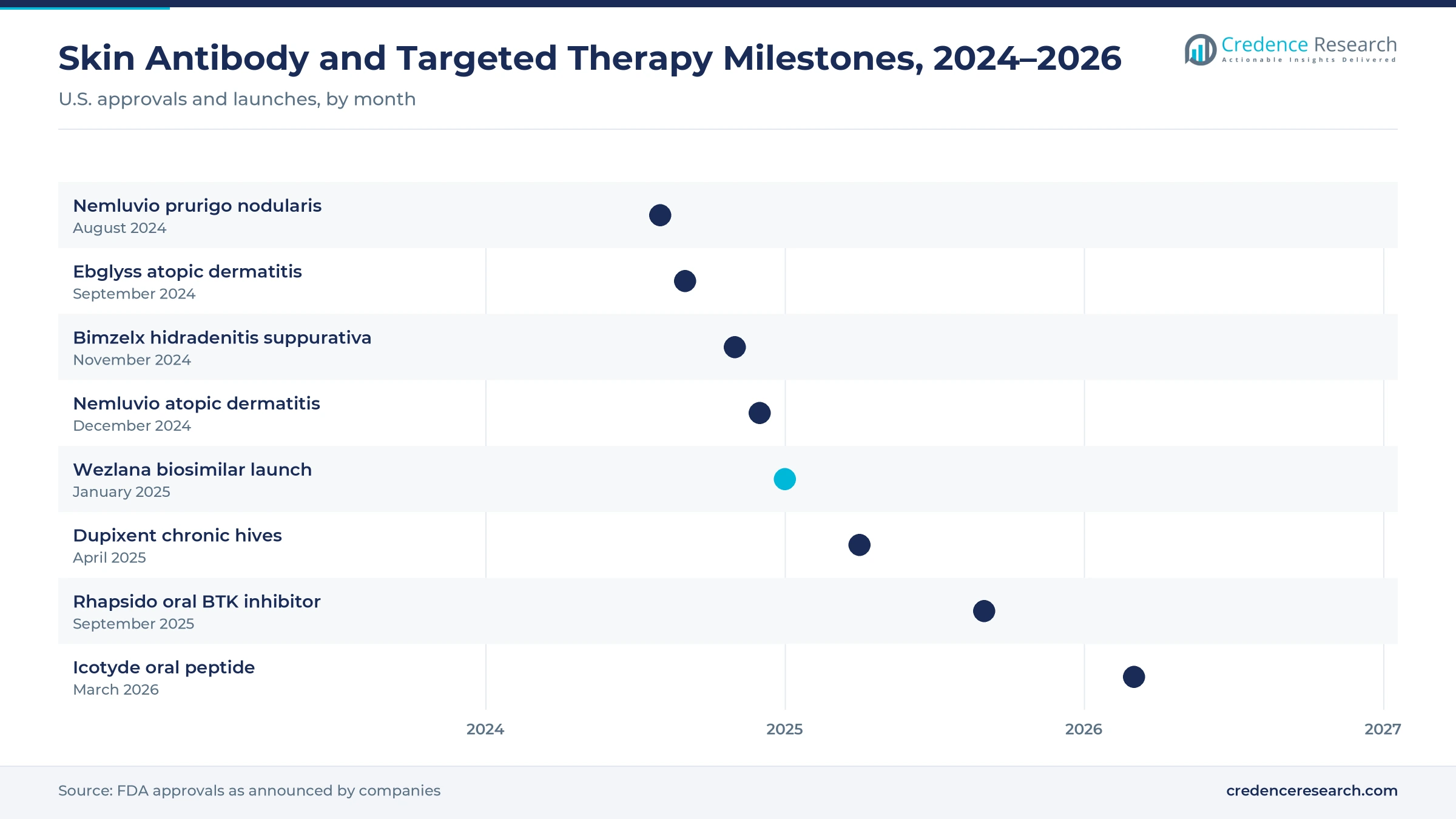
- The FDA approved Dupixent for chronic spontaneous urticaria in April 2025, the first new targeted therapy for the condition in over a decade.
- Amgen launched Wezlana, the first U.S. Stelara biosimilar, on Jan. 1, 2025, opening psoriasis antibody pricing to substitution by pharmacists.
Antibodies and psoriasis lead while HS grows fastest
Why do monoclonal antibodies dominate?
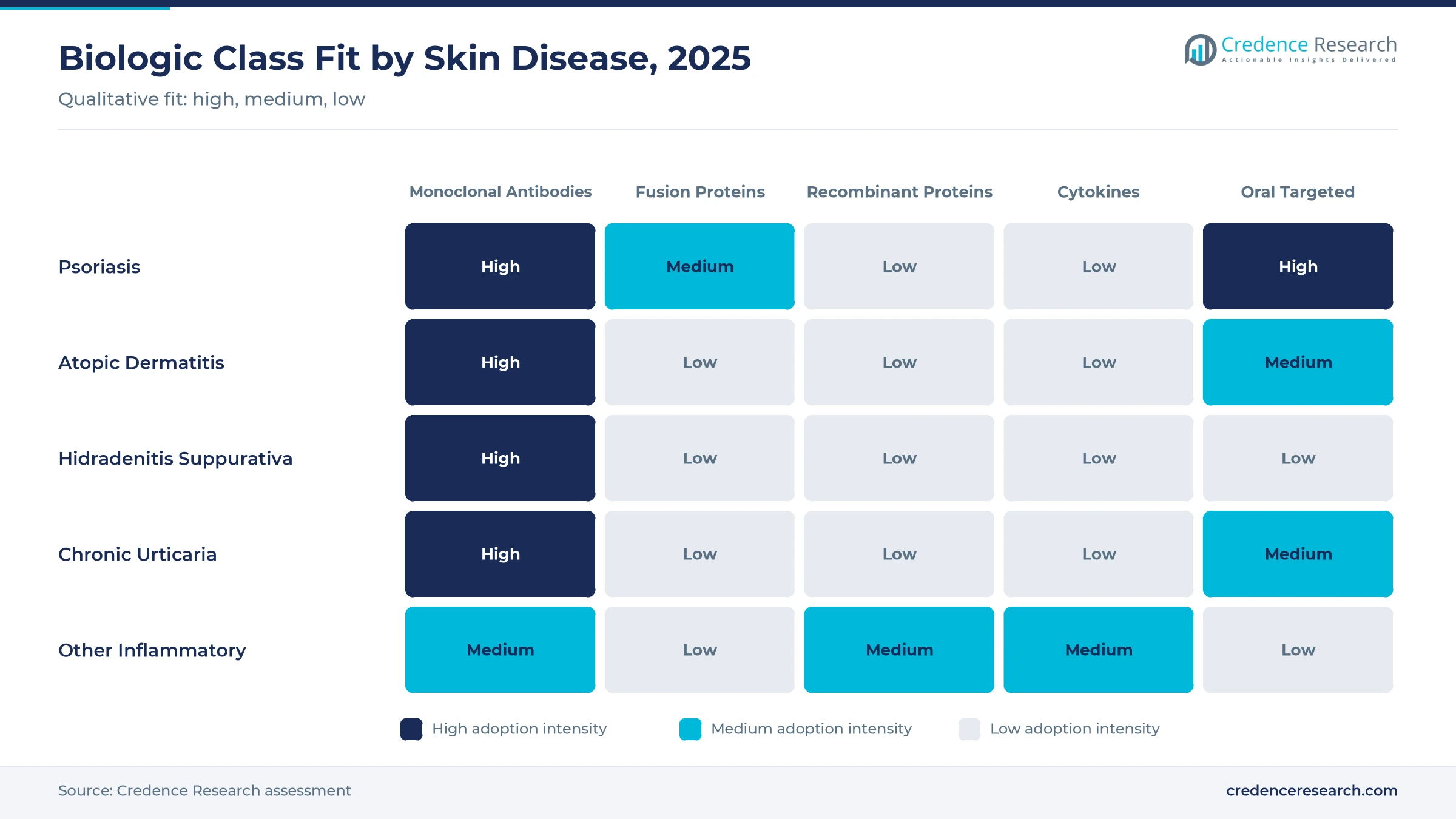
Based on drug class, the market is categorized into monoclonal antibodies, fusion proteins, recombinant proteins, cytokines and others. Monoclonal Antibodies led with a 78.0% share of 2025 value, because antibodies against IL-17, IL-23, IL-13, IL-4 receptor and IgE now set the standard for moderate to severe skin disease. The others group grows fastest at 12.56% a year, as targeted oral peptides and kinase inhibitors give patients an option without injections.
How do psoriasis and eczema split the value?
Based on disease type, the market is categorized into psoriasis, atopic dermatitis, hidradenitis suppurativa, chronic idiopathic urticaria, inflammatory skin disorders and others. Psoriasis led with a 46.0% share of 2025 value, because plaque psoriasis care adopted antibodies more than a decade earlier. Hidradenitis Suppurativa grows fastest at 11.60% a year, as IL-17 antibodies extend into a painful disease that had few approved options.
Will pills dent the injection lead?
Based on route of administration, the market is categorized into injection and oral products. Injection products led with a 94.0% share of 2025 value, because antibodies are large proteins that must be given under the skin or by infusion. Oral products grow fastest at 14.09% a year, as a once-daily IL-23 receptor peptide and a twice-daily BTK inhibitor reached U.S. patients in 2025 and 2026.
Which channel dispenses most skin antibodies?
Based on distribution channel, the market is categorized into hospital pharmacy, retail pharmacy, online pharmacy and others. Retail Pharmacy led with a 44.0% share of 2025 value, because specialty pharmacies inside retail networks fill most self-injected pens after payer approval. Online Pharmacy grows fastest at 11.65% a year, as mail-order specialty services, digital prior authorization and home delivery of cold-chain pens expand in the U.S. and Europe.
| Segment Group | Leading Sub-segment | Share, 2025 | Fastest-growing Sub-segment | CAGR, 2026–2035 |
|---|---|---|---|---|
| By Drug Class | Monoclonal Antibodies | 78.0% | Others | 12.56% |
| By Disease Type | Psoriasis | 46.0% | Hidradenitis Suppurativa | 11.60% |
| By Route of Administration | Injection | 94.0% | Oral | 14.09% |
| By Distribution Channel | Retail Pharmacy | 44.0% | Online Pharmacy | 11.65% |
Request a Free Sample
Fill in your details and we'll send you a free sample report.
- Sample data tables & charts
- Research methodology
New labels, younger patients and longer dosing intervals
How do new labels widen the treated population?
Each new skin indication adds patients who previously had no targeted option, which is the main engine of growth. On April 18, 2025, the FDA approved Dupixent for chronic spontaneous urticaria in patients aged 12 and older, the first new targeted therapy for the condition in over a decade. Sanofi and Regeneron estimate that more than 300,000 people in the U.S. still have symptoms despite antihistamines. As a result, allergists and dermatologists can move uncontrolled hives patients onto an antibody, which adds a new prescription pool through 2035.
Why does atopic dermatitis add the most new patients?
Atopic dermatitis is far more common than psoriasis in children and young adults, so new antibodies reach a large untreated base. In September 2024, the FDA approved Eli Lilly's Ebglyss, an IL-13 inhibitor, for patients aged 12 and older with moderate to severe eczema treatment needs. Galderma followed in December 2024 when Nemluvio received U.S. approval for the same group. These launches give dermatologists more choices after topical failure, which raises the share of eczema patients on systemic therapy.
How do longer dosing intervals support adherence?
Patients are more likely to stay on therapy when injections are less frequent, and newer antibodies compete on that point. Ebglyss moves to one 250 mg maintenance injection every four weeks after the induction phase, according to its U.S. label. Galderma states that Nemluvio is given by subcutaneous injection every four weeks in atopic dermatitis. Because fewer injections mean fewer missed doses, monthly maintenance supports persistence, and persistence lifts annual spending per patient across the eczema segment.
Why does a large untreated psoriasis base remain?
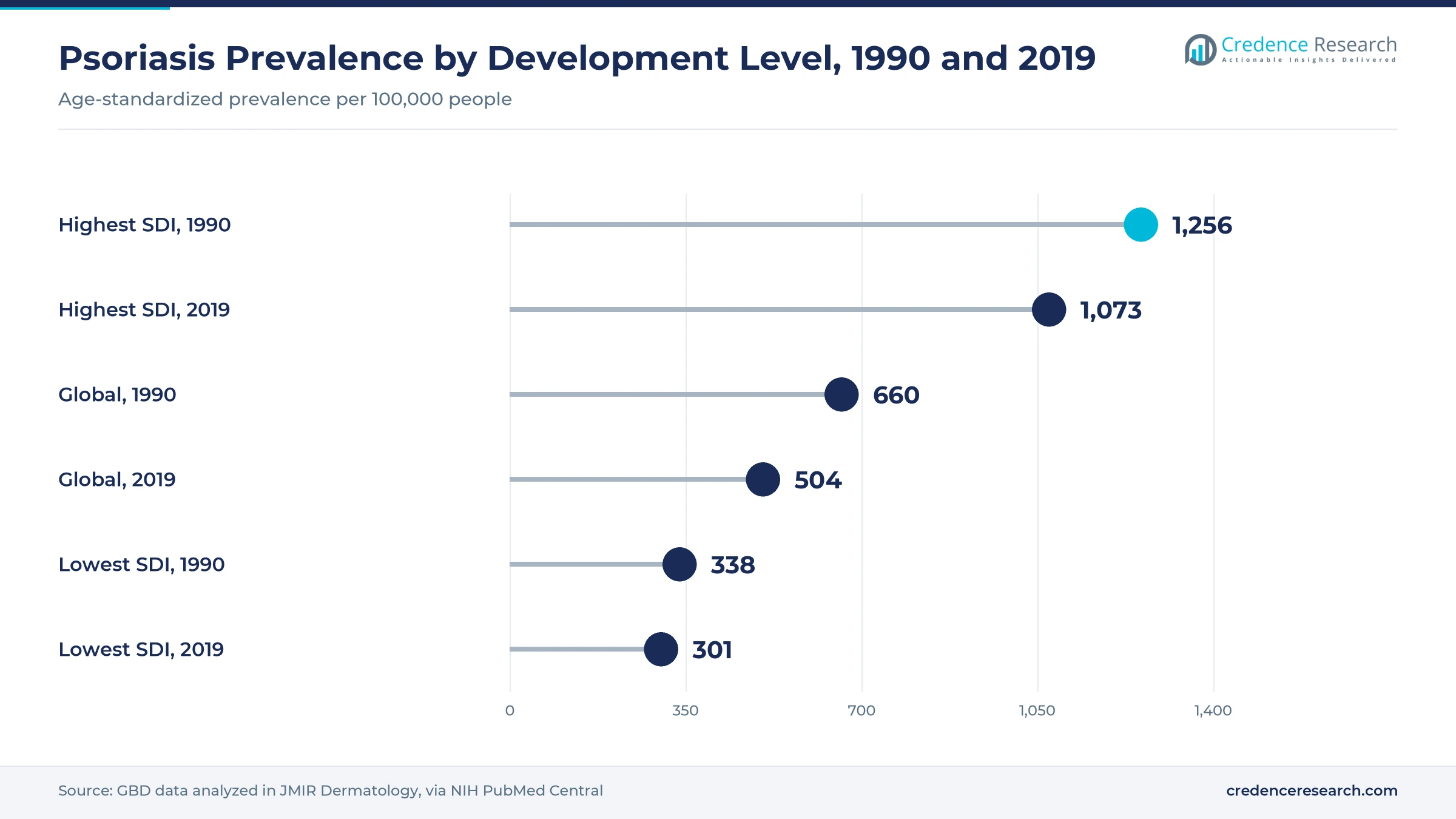
Psoriasis is common in high-income countries, which keeps demand for antibodies strong even in mature markets. GBD data analyzed in JMIR Dermatology show an age-standardized prevalence of 1,073 per 100,000 people in the highest SDI quintile in 2019, against 301 in the lowest quintile. Many patients with moderate disease still use only topical treatment or phototherapy. In turn, lower-cost biosimilars and oral options can bring part of that population onto targeted care.
Oral peptides, monthly maintenance and HS expansion
Why are targeted oral options rising?
Many patients prefer a pill to an injection, and the first targeted oral alternatives now reach skin clinics. On March 18, 2026, Johnson & Johnson announced FDA approval of Icotyde, the first targeted oral peptide that blocks the IL-23 receptor, for plaque psoriasis in adults and patients aged 12 and older. The once-daily pill was jointly developed with Protagonist Therapeutics under a license agreement. This shift gives payers and dermatologists a first-line systemic choice before injections, which explains why the oral line grows fastest.
How is hidradenitis suppurativa becoming an antibody market?
Hidradenitis suppurativa causes painful nodules and tunnels in the skin, and approved options remained few until recently. In November 2024, the FDA approved UCB's Bimzelx, which blocks both IL-17A and IL-17F, for adults with moderate to severe disease after the BE HEARD I and BE HEARD II trials. The approval became the fifth U.S. indication for the antibody. This rise in options brings more HS patients to specialists, which makes it the fastest-growing disease segment.
Where is the opening in chronic hives?
Chronic spontaneous urticaria offers a clear opening, because many patients stay symptomatic on high-dose antihistamines. Novartis cites 1.7 million people in the U.S. living with chronic spontaneous urticaria and received FDA approval for Rhapsido, a twice-daily oral BTK inhibitor, on Sept. 30, 2025. Together with antibody options, it widens care for chronic spontaneous urticaria beyond antihistamines. Suppliers that educate allergists and dermatologists can capture this underserved group.
Can biosimilars open access in price-sensitive markets?
Biosimilars offer an opening to reach patients that payers previously excluded on cost, especially in public health systems. Amgen launched Wezlana on Jan. 1, 2025, as the first Stelara copy in the U.S., and six other ustekinumab copies were expected during 2025. Wider availability of lower-cost ustekinumab copies lets health systems treat more psoriasis patients within fixed budgets. However, volume gains come with lower prices per dose, so value grows more slowly than patient numbers.
Prior authorization, biosimilar pricing and safety rules
How do payer controls slow access?
Insurers treat skin antibodies as high-cost specialty therapy, so most plans require prior authorization and step therapy. Patients often must fail topical steroids, phototherapy or older systemic drugs before a plan pays for an antibody. These rules delay treatment by weeks and push some patients to stop the process altogether. As a result, uptake in moderate disease lags clinical guidelines, and suppliers spend heavily on hub services and copay programs to help patients start therapy.
Why does biosimilar entry cut originator value?
Biosimilar entry turns a premium psoriasis antibody into a price-competitive molecule within a few years. Interchangeable status lets pharmacists substitute Wezlana for Stelara without a new prescription, which speeds switching in the U.S. In turn, originators lose value on older antibodies such as ustekinumab and etanercept, the main reason fusion proteins grow slowest among drug classes. Suppliers respond by moving patients to newer IL-23 and IL-17 antibodies before copies arrive.
What safety requirements shape prescribing?
Antibodies that change immune signaling require screening and monitoring for infections before and during long-term therapy. Each class also carries its own labeled warnings, which dermatologists must review with patients before the first dose and at follow-up visits. Dermatologists must monitor patients over years of use, which adds clinic visits and lab costs. This burden slows uptake in community practice, especially where specialist supply is thin.
Why do cold-chain logistics raise costs?
Biologics are proteins that must be shipped and stored refrigerated, which raises distribution costs compared with tablets and creams. Specialty pharmacies need cold-chain packaging, temperature monitoring and patient training on self-injection. In Latin America, Africa and parts of Asia, limited cold-chain capacity outside large cities restricts where patients can fill a prescription. These hurdles keep biologic use concentrated in urban specialist centers, which slows expansion in emerging markets.
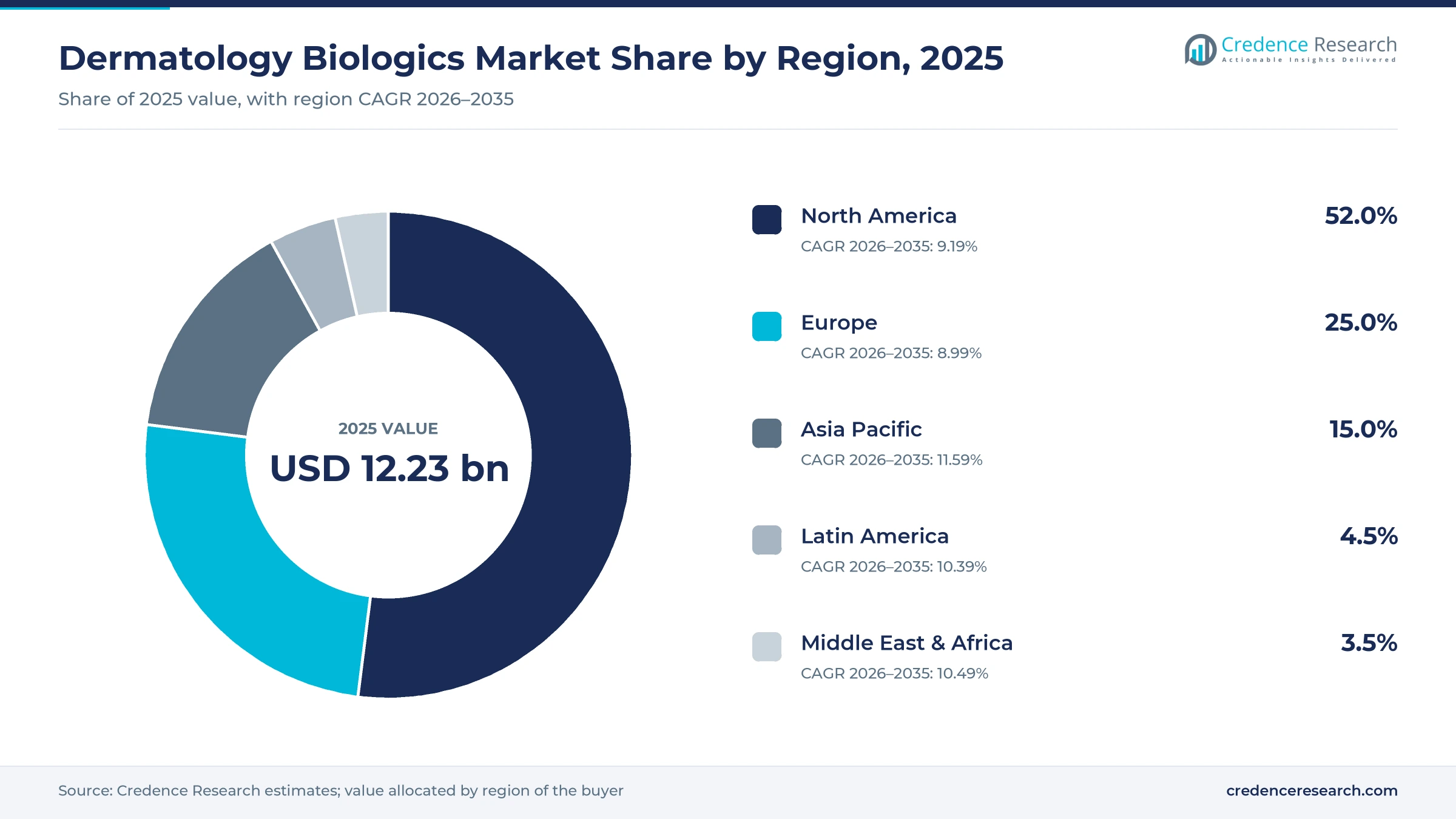
North America leads while Asia Pacific grows fastest
| Region | Value, 2025 (USD billion) | Share, 2025 | CAGR, 2026–2035 |
|---|---|---|---|
| North America | 6.36 | 52.0% | 9.19% |
| Europe | 3.06 | 25.0% | 8.99% |
| Asia Pacific | 1.83 | 15.0% | 11.59% |
| Latin America | 0.55 | 4.5% | 10.39% |
| Middle East & Africa | 0.43 | 3.5% | 10.49% |
North America leads on specialty coverage
North America held a 52.0% share of 2025 value and grows at 9.19% a year through 2035. The U.S. accounts for most regional spending, because commercial plans and Medicare Part D cover specialty antibodies after prior authorization. Most new skin indications, including Ebglyss, Nemluvio, Dupixent for hives and Icotyde, launched in the U.S. first. However, the seven ustekinumab copies expected in 2025 lowers prices for older psoriasis therapy and slows regional value growth.
Europe grows through tenders and biosimilars
Europe held a 25.0% share of 2025 value and grows at 8.99% a year, the slowest pace among the five regions. Germany, France, the U.K., Italy and Spain account for most regional demand, with national health systems that restrict antibodies to patients who fail conventional systemic drugs. Tenders and early biosimilar adoption hold prices down for adalimumab, etanercept and ustekinumab. Because of that, volume grows faster than value, and newer IL-23 and IL-13 antibodies carry most of the gains.
Asia Pacific grows on coverage and specialists
Asia Pacific held a 15.0% share of 2025 value and is the fastest-growing region at 11.59% a year. Japan and Australia have mature reimbursement for psoriasis and eczema antibodies, while China adds new antibodies to its national reimbursement list after price talks. India and Southeast Asia rely more on biosimilars and out-of-pocket payment. As specialist numbers and insurance coverage rise, more patients with moderate to severe disease move onto targeted therapy.
Latin America depends on public access programs
Latin America held a 4.5% share of 2025 value and grows at 10.39% a year through 2035. Brazil and Mexico account for most regional demand, where public health systems buy psoriasis antibodies through centralized purchasing. Biosimilars help public payers treat more patients, although currency swings and budget limits delay newer launches.
Middle East and Africa start from a small base
The Middle East & Africa held a 3.5% share of 2025 value and grows at 10.49% a year. Saudi Arabia, the United Arab Emirates and Israel lead regional use, with insurers that cover branded antibodies for psoriasis and eczema. In much of Africa, access remains limited to a few urban hospitals with cold-chain storage.
Eczema, hives and HS approvals from 2024 to 2026
| Development | Status and market relevance |
|---|---|
| In September 2024, the FDA approved Eli Lilly's Ebglyss (lebrikizumab) for moderate to severe atopic dermatitis in patients aged 12 and older. | Approved. Adds an IL-13 antibody with monthly maintenance dosing. |
| In November 2024, UCB announced FDA approval of Bimzelx for adults with moderate to severe hidradenitis suppurativa. | Approved. The fifth U.S. indication for the dual IL-17A and IL-17F antibody. |
| In January 2025, Amgen launched Wezlana in the U.S. as the first interchangeable Stelara biosimilar. | Launched. Opens ustekinumab to pharmacist substitution and lower prices. |
| In April 2025, Sanofi and Regeneron announced FDA approval of Dupixent for chronic spontaneous urticaria in patients aged 12 and older. | Approved. The first new targeted hives therapy in over a decade. |
| In March 2026, Johnson & Johnson announced FDA approval of Icotyde, an oral IL-23 receptor peptide for plaque psoriasis. | Approved. The first targeted oral peptide in the segment. |
IL-13, IL-17 and IL-23 targeting reshape skin care
- IL-23 inhibitors block a cytokine pathway that sustains psoriasis plaques, and newer agents in the class compete on long gaps between maintenance doses.
- Dual IL-17A and IL-17F blockade inhibits two related cytokines at once and has extended from psoriasis into hidradenitis suppurativa.
- IL-13 and IL-31 antibodies target itch and skin barrier pathways in atopic dermatitis and prurigo nodularis with monthly maintenance dosing.
- Oral receptor peptides such as icotrokinra block the IL-23 receptor from the gut, giving a once-daily pill in place of an injection.
- Autoinjector pens let patients self-inject at home and reduce clinic visits, which supports retail and mail-order specialty dispensing.
Need a Custom Version of This Report?
Tailor the scope, geography, or segments to your exact requirements.
- Custom geography or segment scope
- Direct access to our analyst team
Originators defend share as Stelara copies arrive
Competition in skin antibodies is led by large immunology companies that defend share with new targets, new labels and less frequent dosing. Novartis competes in chronic hives, where it gained FDA approval for the oral BTK inhibitor Rhapsido in September 2025. Amgen agreed in 2019 to acquire apremilast rights from Celgene, and sells the Stelara copy Wezlana. Merck and Co., Pfizer and AstraZeneca bring immunology scale, antibody manufacturing and pipelines across inflammatory disease. Celgene is now part of Bristol Myers Squibb, which completed the acquisition in November 2019. Outside the listed group, Sanofi and Regeneron, Eli Lilly, UCB, Galderma and Johnson & Johnson hold key eczema, HS and psoriasis brands. Because biosimilars now erode older molecules, share shifts toward companies with newer IL-23, IL-17 and IL-13 therapies and oral options.
Companies profiled and their roles in this market
| Company | Type | Role in the market |
|---|---|---|
| Merck and Co. Inc. | Diversified biopharma | Antibody manufacturing scale and immunology pipeline |
| Novartis AG | Immunology | Rhapsido (remibrutinib) oral BTK inhibitor for chronic hives |
| Pfizer Inc. | Diversified biopharma | Inflammation and immunology portfolio |
| Amgen Inc. | Biotechnology | Wezlana ustekinumab biosimilar and apremilast |
| AstraZeneca | Diversified biopharma | Respiratory and immunology antibody pipeline |
| Celgene Corporation | Part of Bristol Myers Squibb | Legacy immunology business, sold apremilast rights to Amgen |
Eczema and HS carry the growth after psoriasis
Credence Research's view is that atopic dermatitis, hidradenitis suppurativa and chronic hives will carry most of the growth in skin antibodies through 2035, while psoriasis keeps the largest share. Psoriasis value faces pressure from ustekinumab copies, yet newer IL-23 and IL-17 antibodies still gain patients. Monthly maintenance dosing and oral options lower the burden of long-term therapy, which supports adherence. Companies that pair new targets with payer support programs and broad specialist reach are best placed to gain share as treatment spreads in Asia Pacific and Latin America.
How the 2025 baseline and forecast were built
The report uses 2025 as the base year and forecasts market value to 2035, with growth rates stated for 2026–2035. Market values come from the Credence Research market model, which combines treated patient numbers by skin condition, the share of patients on targeted therapy and average net prices by region and channel. Splits by drug class, disease type, route of administration, distribution channel and region are Credence Research estimates. Sources used include FDA approval announcements, company press releases and filings, and published GBD epidemiology. No primary interviews or surveys were used to build the estimates in this report.
Atopic dermatitis closes the gap on psoriasis by 2035
By 2035, the market reaches USD 30.67 billion, with eczema, HS and chronic hives growing faster than psoriasis. Monoclonal antibodies keep the leading share, though targeted oral peptides and kinase inhibitors take a larger part of first-line systemic care. Ustekinumab and etanercept copies lower prices for older therapy, which frees payer budgets to treat more patients. Asia Pacific gains share as China and Japan expand reimbursement, while North America stays the largest region. Mail-order specialty pharmacies handle a growing part of self-injected pens and refills.
Frequently Asked Questions
How big is the dermatology biologics market?
Which drug class leads the market?
Which disease type grows fastest?
Which region holds the largest share?
Why are oral options growing in this market?
How do biosimilars affect the market?
Who are the leading companies?
What are the main challenges?
Table of Content
Chapter 1 Market Segmentation
- 1.1 Segmentation Framework
- 1.1.1 Product and Service Classification
- 1.1.2 Application and End-Use Classification
- 1.1.3 Technology and Solution Classification
- 1.1.4 Customer and Distribution Channel Classification
- 1.1.5 Geographic Segmentation
- 1.1.6 Market Segment Definitions and Boundaries
- 1.2 By Drug Class
- 1.2.1 Monoclonal Antibodies
- 1.2.2 Fusion Proteins
- 1.2.3 Recombinant Proteins
- 1.2.4 Cytokines
- 1.2.5 Others
- 1.3 By Disease Type
- 1.3.1 Psoriasis
- 1.3.2 Atopic Dermatitis
- 1.3.3 Hidradenitis Suppurativa
- 1.3.4 Chronic Idiopathic Urticaria
- 1.3.5 Inflammatory Skin Disorders
- 1.3.6 Others
- 1.4 By Route of Administration
- 1.4.1 Injection
- 1.4.2 Oral
Chapter 2 Introduction
- 2.1 Report Objectives and Scope
- 2.2 Product Definition and Industry Terminology
- 2.3 Market Inclusions and Exclusions
- 2.4 Research Process
- 2.4.1 Primary Research and Expert Interviews
- 2.4.2 Secondary Research and Source Review
- 2.4.3 Top-Down and Bottom-Up Estimation
- 2.4.4 Data Triangulation and Verification
- 2.5 Market Size Measurement Basis
- 2.5.1 2025: USD 12.23 billion → 2035: USD 30.67 billion
- 2.6 Historical and Forecast Reference Periods
- 2.6.1 Historical Period: 2018-2025
- 2.6.2 Base Year: 2025
- 2.6.3 Forecast Period: 2025-2035
- 2.7 Research Assumptions and Limitations
Chapter 3 Executive Summary
- 3.1 Market Snapshot and Key Findings
- 3.2 Base-Year Market Size, 2025
- 3.3 Forecast Market Size, 2035
- 3.4 Revenue and Volume Growth Outlook
- 3.5 Key Demand and Supply Indicators
- 3.6 Leading Market Segments
- 3.7 Fastest-Growing Market Opportunities
- 3.8 Regional Performance Highlights
- 3.9 Technology and Industry Transformation
- 3.10 Competitive Landscape Summary
- 3.11 Analyst View and Strategic Implications
Chapter 4 Global Dermatology Biologics Market Trends and Developments
- 4.1 Historical Industry Development, 2018-2025
- 4.2 Recent Market Trends and Developments
- 4.3 Demand and Customer Behavior Trends
- 4.4 Technology and Product Innovation
- 4.5 Artificial Intelligence, Automation and Digitalization
- 4.6 Local Manufacturing and Supply Chain Realignment
- 4.7 Industry Partnerships, Mergers and Acquisitions
- 4.8 Sustainability and Circular Economy Developments
- 4.9 Government and Private Sector Investment Trends
- 4.10 Emerging Business Models and Commercialization
- 4.11 Industry Developments and Announcements
Chapter 5 Global Dermatology Biologics Market Production, Supply and Demand Analysis
- 5.1 Demand Trend and Consumption Analysis, 2018-2025
- 5.2 Demand Forecast, 2025-2035
- 5.3 Production and Output Trend, 2018-2025
- 5.4 Production and Output Forecast, 2025-2035
- 5.5 Installed Capacity and Capacity Utilization
- 5.6 Company-Wise Production Plants and Statistics
- 5.6.1 Installed Production Capacity
- 5.6.2 Actual Production
- 5.6.3 Planned Capacity and Expansion Targets
- 5.7 Supply Chain Structure and Procurement Trends
- 5.8 Supply-Demand Gap and Bottlenecks
- 5.9 Import Dependence and Sourcing Structure
- 5.10 Contract Manufacturing and Outsourcing
- 5.11 Regional Supply and Demand Concentration
Chapter 6 Global Dermatology Biologics Market Pricing Analysis
- 6.1 Pricing Structure and Measurement
- 6.2 Historical Pricing Trends, 2018-2025
- 6.3 Pricing Outlook, 2025-2035
- 6.4 Average Selling Price and Unit Economics
- 6.5 Pricing by Product and Market Segment
- 6.6 Geographic Pricing Differences
- 6.7 Key Input, Energy, Labor and Logistics Costs
- 6.8 Contract Pricing and Purchasing Models
- 6.9 Pricing Sensitivity and Competitive Positioning
- 6.10 Price, Margin and Profitability Implications
Chapter 7 Global Dermatology Biologics Market Dynamics
- 7.1 Market Growth Drivers
- 7.1.1 Demand-Side Drivers
- 7.1.2 Technology and Innovation Drivers
- 7.1.3 Infrastructure and Investment Drivers
- 7.1.4 Regulatory and Policy Drivers
- 7.2 Market Restraints
- 7.2.1 Cost and Affordability Constraints
- 7.2.2 Technology and Adoption Barriers
- 7.2.3 Supply Chain and Operational Constraints
- 7.3 Market Challenges
- 7.3.1 Competitive Pressure and Margin Erosion
- 7.3.2 Skills, Infrastructure and Implementation Gaps
- 7.4 Emerging Market Opportunities
- 7.5 Market Dynamics Impact and Time-Horizon Assessment
Chapter 8 Global Dermatology Biologics Value Chain Analysis
- 8.1 Industry Value Chain Overview
- 8.2 Upstream Suppliers and Critical Inputs
- 8.3 Technology and Component Providers
- 8.4 Manufacturing or Service Delivery
- 8.5 Distribution, Channel Partners and Integrators
- 8.6 Downstream Applications and End Users
- 8.7 Value Addition and Profit Pools
- 8.8 Vertical Integration and Outsourcing
- 8.9 Supplier Concentration and Risk
- 8.10 Supply Chain Localization and Resilience
Chapter 9 Global Dermatology Biologics Market Regulations and Policies
- 9.1 Relevant Laws, Standards and Compliance Frameworks
- 9.2 Product, Service, Safety and Quality Requirements
- 9.3 Government Policies, Incentives and Subsidies
- 9.4 Imports, Exports and Trade Barriers
- 9.5 Public Procurement and Local Content Requirements
- 9.6 Environmental and Sustainability Compliance
- 9.7 Upcoming Policy Changes and Market Implications
Chapter 10 Global Dermatology Biologics Market Hotspots and Opportunities
- 10.1 Market Opportunity Mapping and Growth Hotspots
- 10.2 High-Growth Applications and Customer Groups
- 10.3 Underserved Markets and White-Space Opportunities
- 10.4 Emerging Technology and Product Opportunities
- 10.5 New Capacity and Investment Hotspots
- 10.6 Market Entry and Expansion Opportunities
- 10.7 Distribution and Partnership Opportunities
- 10.8 Near-Term and Long-Term Commercial Potential
- 10.9 Opportunity Attractiveness and Execution Risks
Chapter 11 Global Dermatology Biologics Market Outlook, 2025-2035
- 11.1 Market Size and Analysis
- 11.1.1 Revenue (Market Measurement: 2025: USD 12.23 billion → 2035: USD 30.67 billion)
- 11.1.2 Market Volume and Quantity Sold
- 11.1.3 Historical Market Size, 2018-2025
- 11.1.4 Base-Year Market Size, 2025
- 11.2 Market Forecast, 2025-2035
- 11.2.1 Revenue Forecast to 2035
- 11.2.2 Volume Forecast to 2035
- 11.2.3 CAGR and Year-on-Year Growth
- 11.2.4 Incremental Revenue Opportunity
- 11.3 Forecast Assumptions and Scenario Analysis
- 11.3.1 Base-Case Forecast
- 11.3.2 Optimistic and Conservative Scenarios
- 11.3.3 Technology, Pricing and Policy Sensitivities
- 11.4 Market Attractiveness and Growth Outlook
Chapter 12 Global Dermatology Biologics Market Segmentation and Outlook
- 12.1 Segmentation Summary and Market Shares, 2025
- 12.2 Largest and Fastest-Growing Segments
- 12.3 By Drug Class - Market Size and Forecast, 2025-2035
- 12.3.1 Segment Definition and Scope
- 12.3.2 Historical Market Size, 2018-2025
- 12.3.3 Revenue Forecast, 2025-2035
- 12.3.4 Volume Forecast, 2025-2035
- 12.3.5 Base-Year Market Share, 2025
- 12.3.6 Segment CAGR and Growth Drivers
- 12.3.7 Subsegment Market Size and Forecast
- 12.3.7.1 Monoclonal Antibodies
- 12.3.7.2 Fusion Proteins
- 12.3.7.3 Recombinant Proteins
- 12.3.7.4 Cytokines
- 12.3.7.5 Others
- 12.3.8 Subsegment Pricing and Adoption Trends
- 12.3.9 Leading Suppliers and Competition
- 12.3.10 Regional Demand and Opportunities
- 12.4 By Disease Type - Market Size and Forecast, 2025-2035
- 12.4.1 Segment Definition and Scope
- 12.4.2 Historical Market Size, 2018-2025
- 12.4.3 Revenue Forecast, 2025-2035
- 12.4.4 Volume Forecast, 2025-2035
- 12.4.5 Base-Year Market Share, 2025
- 12.4.6 Segment CAGR and Growth Drivers
- 12.4.7 Subsegment Market Size and Forecast
- 12.4.7.1 Psoriasis
- 12.4.7.2 Atopic Dermatitis
- 12.4.7.3 Hidradenitis Suppurativa
- 12.4.7.4 Chronic Idiopathic Urticaria
- 12.4.7.5 Inflammatory Skin Disorders
- 12.4.7.6 Others
- 12.4.8 Subsegment Pricing and Adoption Trends
- 12.4.9 Leading Suppliers and Competition
- 12.4.10 Regional Demand and Opportunities
- 12.5 By Route of Administration - Market Size and Forecast, 2025-2035
- 12.5.1 Segment Definition and Scope
- 12.5.2 Historical Market Size, 2018-2025
- 12.5.3 Revenue Forecast, 2025-2035
- 12.5.4 Volume Forecast, 2025-2035
- 12.5.5 Base-Year Market Share, 2025
- 12.5.6 Segment CAGR and Growth Drivers
- 12.5.7 Subsegment Market Size and Forecast
- 12.5.7.1 Injection
- 12.5.7.2 Oral
- 12.5.8 Subsegment Pricing and Adoption Trends
- 12.5.9 Leading Suppliers and Competition
- 12.5.10 Regional Demand and Opportunities
- 12.6 Segment Growth Comparison
- 12.7 Segment Attractiveness and Priority Matrix
Chapter 13 Global Dermatology Biologics Geographic Market Outlook, 2025-2035
- 13.1 Regional Market Size and Share, 2025
- 13.2 Regional Market Forecast, 2025-2035
- 13.3 Regional Pricing, Production and Demand Differences
- 13.4 North America
- 13.4.1 United States
- 13.4.2 Canada
- 13.4.3 Mexico
- 13.5 Europe
- 13.5.1 Germany
- 13.5.2 France
- 13.5.3 Italy
- 13.5.4 United Kingdom
- 13.5.5 Spain
- 13.5.6 Poland
- 13.5.7 Russia
- 13.5.8 Netherlands
- 13.5.9 Belgium
- 13.5.10 Sweden
- 13.5.11 Denmark
- 13.5.12 Norway
- 13.5.13 Rest of Europe
- 13.6 Asia Pacific
- 13.6.1 China
- 13.6.2 India
- 13.6.3 Japan
- 13.6.4 South Korea
- 13.6.5 Thailand
- 13.6.6 Indonesia
- 13.6.7 Vietnam
- 13.6.8 Malaysia
- 13.6.9 Australia
- 13.6.10 Rest of Asia Pacific
- 13.7 Latin America
- 13.7.1 Brazil
- 13.7.2 Argentina
- 13.7.3 Colombia
- 13.7.4 Chile
- 13.7.5 Rest of Latin America
- 13.8 Middle East
- 13.8.1 Saudi Arabia
- 13.8.2 United Arab Emirates
- 13.8.3 Turkey
- 13.8.4 Israel
- 13.8.5 Iran
- 13.8.6 Rest of the Middle East
- 13.9 Africa
- 13.9.1 South Africa
- 13.9.2 Egypt
- 13.9.3 Nigeria
- 13.9.4 Morocco
- 13.9.5 Rest of Africa
- 13.10 Regional Investment, Policy and Supply Chain Differences
- 13.11 Regional Competitive Landscape
- 13.12 Geographic Growth Hotspots
Chapter 14 Global Dermatology Biologics Technology, Innovation and Sustainability Outlook
- 14.1 Technology Landscape and Maturity
- 14.2 Product, Process and Service Innovation
- 14.3 AI, Automation and Digital Tools in the Industry
- 14.4 Technology Adoption and Performance Benchmarking
- 14.5 Innovation Pipeline and R&D Investment
- 14.6 Patent and Intellectual Property Trends
- 14.7 Energy Efficiency and Resource Management
- 14.8 Sustainability, Recycling and Circularity
- 14.9 Technology Roadmap, 2025-2035
- 14.10 Risks of Obsolescence and Technology Substitution
Chapter 15 Global Dermatology Biologics Market Key Strategic Imperatives
- 15.1 Growth and Market Entry Priorities
- 15.2 High-Return Products and Segments
- 15.3 Pricing, Profitability and Cost Optimization
- 15.4 Technology Investment and Product Differentiation
- 15.5 Supply Chain Localization and Resilience
- 15.6 Distribution and Customer Acquisition
- 15.7 Partnership, Acquisition and Capacity Strategy
- 15.8 Regional Expansion Priorities
- 15.9 Short-, Medium- and Long-Term Actions
Chapter 16 Competition Outlook
- 16.1 Industry Competition Characteristics
- 16.2 Market Structure and Concentration
- 16.3 Market Share and Competitive Positioning, 2025
- 16.4 Company-Wise Revenue and Product Benchmarking
- 16.5 Production and Service Capacity Benchmarking
- 16.6 Technology, Pricing and Differentiation
- 16.7 Regional Footprint and Distribution Strength
- 16.8 Mergers, Acquisitions and Strategic Alliances
- 16.9 New Entrants and Competitive Threats
- 16.10 Porter's Five Forces and Industry Attractiveness
- 16.11 Competitive Outlook, 2025-2035
Chapter 17 Company Profiles
- 17.1 Company Coverage and Selection Criteria
- 17.2 Merck and Co. Inc.
- 17.2.1 Business Description
- 17.2.2 Company Ownership and Geographic Presence
- 17.2.3 Product and Service Portfolio
- 17.2.4 Manufacturing and Operating Footprint
- 17.2.5 Production Capacity and Expansion Plans
- 17.2.6 Financial Performance and Investment
- 17.2.7 Market Share and Competitive Position
- 17.2.8 Technology and Innovation Capabilities
- 17.2.9 Strategic Alliances or Partnerships
- 17.2.10 Recent Developments
- 17.2.11 Growth Strategy and Outlook
- 17.3 Novartis AG
- 17.4 Pfizer Inc.
- 17.5 Amgen Inc.
- 17.6 AstraZeneca
- 17.7 Celgene Corporation
- 17.8 Other Relevant Market Participants
Note: Every listed company is profiled on the structure shown under the first company. The company list is preliminary and may change based on research findings, market developments, data availability and client requirements.
Chapter 18 Disclaimer
- 18.1 Research and Forecast Disclaimer
- 18.2 Data Source and Estimation Limitations
Note: The depth of individual sections depends on data availability for this market. Volume, capacity, trade and other unit-based metrics are included where applicable.