
| REPORT ATTRIBUTE | DETAILS |
|---|---|
| Historical Period | 2019-2022 |
| Base Year | 2023 |
| Forecast Period | 2024-2032 |
| Nurse Call Systems Market Size 2023 | USD 2651.20 Million |
| Nurse Call Systems Market CAGR | 13.00% |
| Nurse Call Systems Market Size 2032 | USD 7964.32 Million |
Market Insights
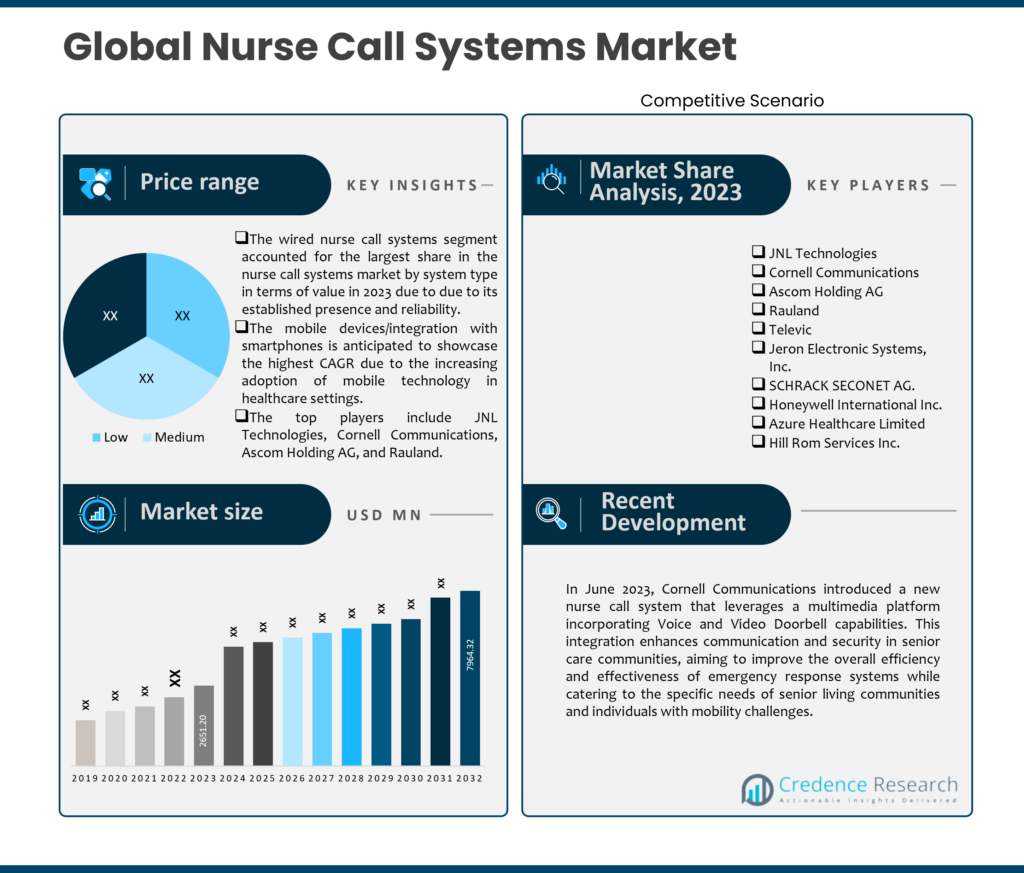
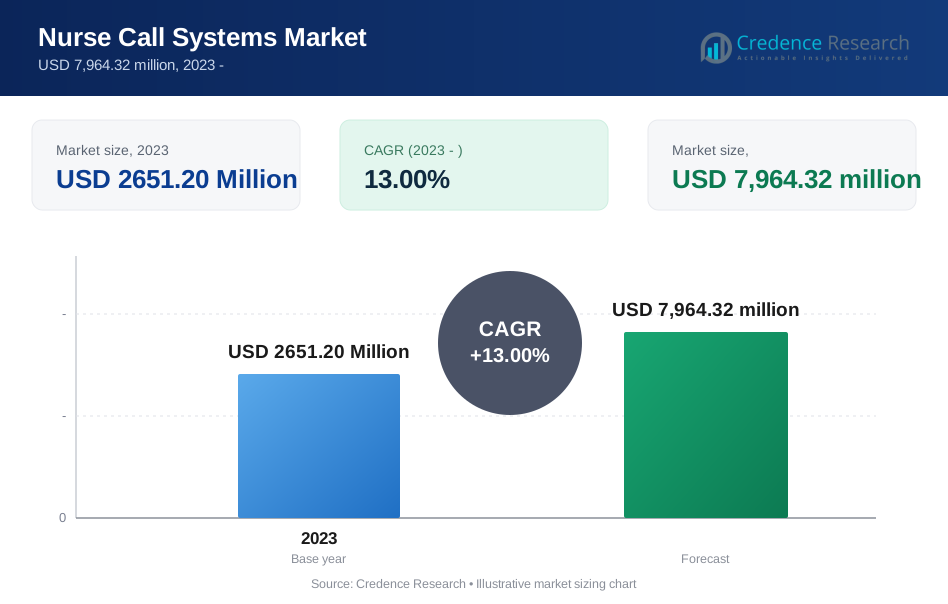
- The global demand for Nurse Call Systems was valued at USD 2651.20 Million in 2023 and is expected to reach USD 7964.32 Million in 2032, growing at a CAGR of 13.00% between 2024 and 2032.
- The wired nurse call system is the market leader by system type, accounting for a significant portion of total value in 2023, while the wireless nurse call systems segment is expected to grow rapidly throughout the forecast period.
- The Nurse Call Buttons/Patient Stations segment dominates the global need by component, accounting for a significant portion in 2023. The mobile devices/integration with smartphones segment is predicted to expand at a high CAGR.
- Over the projection period, the visual-based nurse call system is expected to expand at the highest rate, while the combined audio-visual systems dominate the market in 2023 with a substantial share.
- The hospitals segment is the dominant portion, with a substantial market share in 2023, while the ambulatory care centers segment is expected to grow at the highest rate.
- North America is dominating the Nurse Call Systems industry with a substantial share in 2023, while Asia Pacific is expected to grow at the highest rate during the forecast period.
- The market's primary possibilities include integrating Artificial intelligence (AI) and digitalization, which would enable real-time patient monitoring and predictive insights.
Executive Summary
Market Definition
A Nurse Call System is a communication tool used in healthcare facilities to enable patients to alert nursing staff when assistance is needed. These systems typically consist of call buttons or cords placed within patient rooms or other areas, which patients can activate to request help. The signal from these buttons is transmitted to a central monitoring station or directly to handheld devices carried by nurses or caregivers. This enables nursing staff to receive real-time notifications of patient requests and promptly respond to them. Nurse Call Systems help improve patient safety, enhance staff efficiency, and streamline communication within healthcare settings.
Market Overview
The global Nurse Call Systems Market has witnessed steady growth in recent years and is expected to grow at a CAGR of 13.00% between 2024 and 2032. The market was valued at USD 2651.20 million in 2023 and is expected to reach USD 7964.32 million in 2032.
A substantial increase in healthcare expenditure is observed in emerging economies such as India and China. This surge in investment has led to a proliferation of hospitals, particularly in the private sector, which are expected to incur greater infrastructure expenses. Consequently, there is a heightened demand for Nurse Call Systems as these facilities prioritize the implementation of advanced communication tools to enhance patient care and safety.
Moreover, innovations in communication and information technology enable the development of systems that optimize workflow, patient monitoring, and emergency management. Integration of Internet protocol-based systems and wireless technologies not only enhances the efficiency of Nurse Call Systems but also contributes to reducing medical errors and false alarms, thereby fostering their adoption across healthcare facilities. Additionally, the increasing prevalence of neurological disorders among the geriatric population underscores the importance of advanced monitoring and patient care solutions, further boosting the demand for Nurse Call Systems in nursing homes and assisted living centers.
Furthermore, as the global population ages and preferences shift towards long-term in-home care, there is a growing need for Nurse Call Systems tailored to home healthcare settings. The prevalence of conditions such as Alzheimer's disease highlights the necessity for specialized care solutions, driving market growth.
Segmentation by System Type
- Wired nurse call system is the leading segment by system type and holds a substantial share in 2023, their physical connections and lack of dependence on wireless signals. This perception of reliability makes healthcare providers hesitant to switch to newer technologies unless there are compelling reasons to do so.
- The wireless nurse call systems segment is expected to exhibit a significant CAGR during the forecast period owing to the greater flexibility and scalability compared to wired systems. They eliminate the need for complex wiring installations, making them suitable for both new construction and retrofit projects.
Segmentation by Component
- The Nurse Call Buttons/Patient Stations segment boasts the dominating position in the Nurse Call Systems industry, holding a massive share in 2023. This is attributed to their essential communication tools, allowing patients to summon assistance or alert caregivers in case of emergencies promptly.
- The Mobile Devices/Integration with Smartphones segment is expected to grow with the highest CAGR during the projected period due to technological advancements and the increasing prevalence of smartphones and mobile devices in healthcare settings.
- The other applications, including caregiver stations/nurse consoles and central monitoring stations, further contribute significantly to the growth of the market.
Segmentation by Communication Method
- The Combined Audio-Visual Systems boasts the dominating position in the Nurse Call Systems industry, holding a massive share in 2023 as they offer a comprehensive solution by integrating both auditory and visual components, ensuring effective communication between patients and caregivers.
- Visual-Based Nurse Call Systems is expected to grow at the highest rate due to increasing recognition of visual communication's importance in healthcare settings.
Segmentation by Integration and Interoperability
- Integration with Electronic Health Records (EHR) boasts the dominating position in the Nurse Call Systems industry, holding a massive share in 2023 as it facilitates seamless communication and data exchange between the Nurse Call System and the broader healthcare infrastructure.
- Integration with Nurse Communication Systems is expected to grow at the highest rate due to the real-time communication between caregivers, enhancing coordination and responsiveness.
- Interoperability with Other Hospital Systems seamlessly integrates with a wide range of hospital systems and devices, patient monitoring systems, and alarm management systems.
Segmentation by Application
- The hospital industry is leading the market share with a significant share in 2023. This is primarily due to the larger patient population compared to other healthcare facilities.
- The ambulatory care centers are expected to post the highest CAGR during the forecast period. This is attributed to the convenience, cost-effectiveness, and shorter wait times for patients seeking non-emergency medical services.
- nursing homes, assisted living facilities, hospice care facilities, and rehabilitation centers also significantly contribute to the growth of the market
Segmentation by Region
- North America is fueling the growth of the Nurse Call Systems industry with a massive share in 2023 due to its well-established healthcare system and high adoption of digital healthcare solutions. With a robust infrastructure, healthcare facilities in the region are well-equipped to integrate advanced technologies like nurse call systems seamlessly into their operations.
- The Asia Pacific market is expected to grow at the highest rate during the forecasted period.
- The rest of the world, including Latin America, the Middle East, and Africa, supplies the remaining demand for the Nurse Call Systems industry.
North America is poised to lead the nurse call systems market over the forecast period, primarily due to its well-established healthcare system and high adoption of digital healthcare solutions. With a robust infrastructure in place, healthcare facilities in the region are well-equipped to integrate advanced technologies like nurse call systems seamlessly into their operations. This strong foundation creates a favorable environment for the growth of the market, as healthcare providers prioritize the adoption of innovative solutions to enhance patient care and operational efficiency.
Furthermore, the increasing burden of chronic diseases and the aging population contribute to the rising demand for Nurse Call Systems in North America. As the prevalence of chronic conditions continues to escalate, healthcare facilities face a surge in hospital admissions, driving the need for effective communication and patient monitoring systems. Moreover, the prevalence of cancer in the region, as highlighted by the American Cancer Society's Cancer Facts and Figures 2022 report, further underscores the importance of Nurse Call Systems in healthcare settings. With an estimated 1.9 million new cancer cases and over 600,000 cancer-related deaths projected in the United States alone, there is a pressing need for efficient communication and patient care solutions in oncology departments. Nurse Call Systems offer a means to streamline communication between patients and caregivers, ensuring prompt responses to medical emergencies and enhancing the quality of care delivered. As the region continues to prioritize patient safety and quality of care, the market for Nurse Call Systems is expected to experience significant growth.
On the other hand, Asia Pacific is expected to witness remarkable growth due to its sizable geriatric population and the increasing flow of patients seeking care in outpatient clinics and nursing homes. According to the United Nations Economic and Social Commission for Asia and the Pacific (ESCAP), the Asia-Pacific population is aging faster than any other region globally, with 630 million people aged 60 years or over. By 2050, this number is projected to reach 1.3 billion. The significant presence of older individuals, particularly women, underscores the pressing need for advanced healthcare technologies like Nurse Call Systems to cater to their specific care requirements.
Moreover, the presence of domestic manufacturers in countries like India and China is intensifying competition in emerging markets such as the Asia Pacific. These manufacturers are striving to establish a competitive advantage in their home countries to gain a broad domestic consumer base. This increased competition is driving innovation and product development, leading to a wider range of Nurse Call Systems offerings tailored to the specific needs of the Asia Pacific market.
Key Highlights of the Report
The Global Nurse Call Systems Market is segmented by system type, component, communication method, integration and interoperability, application, and region. Wired Nurse Call Systems are the most popular segment, while Nurse Call Buttons/Patient Stations are the primary segment in form. In addition, the hospital is the most demanding application, with the North American region leading the market growth.
The growth of the nurse call systems market is propelled by the increased healthcare spending in emerging economies, leading to more hospitals and higher adoption rates. Health reforms and technological advancements are also driving growth, with innovations improving patient care and safety. Strategic partnerships between companies are enhancing emergency response capabilities, while the rising prevalence of neurological disorders among the elderly is increasing demand for specialized monitoring solutions.
Nonetheless, North America is anticipated to have the greatest share of the worldwide Nurse Call Systems Market, its well-established healthcare system and high adoption of digital healthcare solutions. With a robust infrastructure in place, healthcare facilities in the region are well-equipped to integrate advanced technologies like nurse call systems seamlessly into their operations. Furthermore, the market is anticipated to expand at the highest rate in the Asia-Pacific region due to its large geriatric population and the increasing flow of patients seeking care in outpatient clinics and nursing homes.
What Are the Main Drivers of the Global Nurse Call Systems Market?
The growth of the nurse call systems market is propelled by the increased healthcare spending in emerging economies, leading to more hospitals and higher adoption rates. Health reforms and technological advancements are also driving growth, with innovations improving patient care and safety. Strategic partnerships between companies are enhancing emergency response capabilities, while the rising prevalence of neurological disorders among the elderly is increasing demand for specialized monitoring solutions.
What Are the Major Challenges Faced by the Global Nurse Call Systems Market?
The high costs associated with the implementation of nurse call systems present a significant challenge to market growth. Despite the advantages these systems offer, cost remains a primary barrier to widespread adoption, particularly in emerging countries. The efficacy of these systems is contingent upon factors such as the quality of software, hardware components, and the level of staff training within healthcare facilities.
What Are the Growth Opportunities in the Global Nurse Call Systems Market?
Integration of Artificial intelligence (AI) and digitalization are poised to revolutionize the Nurse Call Systems market. AI-driven analytics enable real-time patient monitoring and predictive insights, while digital solutions facilitate seamless communication between patients and healthcare providers. Embracing these innovations promises enhanced patient outcomes and operational efficiency, driving market growth in the future.
Market Drivers
Rise in Geriatric population and Incidence of Neurological Disorders Globally
The rise in the geriatric population, coupled with an increased prevalence of neurological disorders, is a significant driver of growth in the Nurse Call Systems market. The World Aging Population Report 2020 Highlights projected a substantial increase in the elderly population globally, from 727 million in 2020 to an estimated 1.5 billion by 2050. This demographic shift correlates with higher rates of hospital admissions, surgeries, and occurrences of neurological conditions and chronic diseases, driving up the demand for Nurse Call Systems to ensure efficient care delivery.
The prevalence of neurological diseases, such as Alzheimer's, among the elderly further contributes to market growth. For example, estimates from the Centers for Disease Control and Prevention (CDC) indicate that approximately 6.7 million Americans aged 65 or older had Alzheimer's disease in 2023, indicating a significant need for specialized care solutions.
Additionally, there is a growing demand for mobile Nurse Call Systems, prompting major players to enhance their offerings with integrated solutions. For instance, Acurio Health's collaboration with health IT provider Rauland Australia to equip The George Centre in Sydney with nurse call solutions reflects this trend. The increasing deployment of nurse call stations across healthcare facilities is expected to drive market growth during the forecast period.
Market Restraints
High Costs Associated with the Implementation of Nurse Call Systems
The high costs associated with the implementation of nurse call systems present a significant constraint on market growth. Despite the advantages these systems offer, cost remains a primary barrier to widespread adoption, particularly in emerging countries. The efficacy of these systems is contingent upon factors such as the quality of software, hardware components, and the level of staff training within healthcare facilities.
The procurement cost of a fully integrated nurse call system for a single room is intricately divided into several components, encompassing installation expenses, implementation costs, training modules for nurses, base hardware, and software expenditures. Additionally, healthcare settings that have deployed these devices are obligated to cover ongoing expenses such as software maintenance fees. The average pricing of these systems varies significantly based on the specific type of room where they are installed.
Opportunities
Integration of Artificial intelligence (AI) and Digitalization
Artificial intelligence (AI) and digitalization represent transformative opportunities for the future of the nurse call systems market. By harnessing AI algorithms and digital solutions, nurse call systems can evolve beyond simple communication tools into intelligent platforms capable of proactive patient care and operational optimization. AI-driven analytics offer the potential to revolutionize patient care by continuously monitoring and analyzing patient data in real time. This not only enables healthcare providers to detect and respond to patient needs more accurately and promptly but also facilitates predictive insights into patient health trends, allowing for early interventions and personalized care plans.
Furthermore, digitalization facilitates seamless communication and information exchange between patients and healthcare professionals, transcending traditional boundaries and enhancing care coordination. Patients can easily communicate their needs and preferences, while healthcare providers can remotely monitor patient status and efficiently allocate resources. As AI and digitalization technologies continue to advance, the future of Nurse Call Systems is expected to offer enhanced patient outcomes, improved operational efficiency, and greater overall satisfaction for both patients and healthcare providers. Embracing these innovations will be key to unlocking the full potential of nurse call systems and driving market growth in the years to come.
Competitive Landscape
Key Players
The global nurse call systems market is highly competitive, with several key players. Some of the major players in the market and their market share are as follows:
- JNL Technologies
- Cornell Communications
- Ascom Holding AG
- Rauland
- Televic
- Jeron Electronic Systems, Inc.
- SCHRACK SECONET AG.
- Honeywell International Inc.
- Azure Healthcare Limited
- Hill Rom Services Inc.
- Others
These organizations prioritize product innovation to stay competitive.
The global Nurse Call Systems market's key players continually seek to stay ahead by offering new products and developments.
In August 2023, Ascom introduced the Myco4, a professional smartphone designed to enhance workflow continuity and care delivery in healthcare settings. The Myco4 integrates advanced features such as a high-resolution camera and advanced audio capabilities, making it an ideal tool for healthcare professionals to manage their workflow effectively.
In June 2023, Cornell Communications introduced a new nurse call system that leverages a multimedia platform incorporating Voice and Video Doorbell capabilities. This integration enhances communication and security in senior care communities, aiming to improve the overall efficiency and effectiveness of emergency response systems while catering to the specific needs of senior living communities and individuals with mobility challenges.
How are Companies Performing in the Nurse Call Systems Market?
The global Nurse Call Systems Market is highly competitive, with several key players.
Startups are playing a pivotal role in driving innovation and contributing to the growth of the Nurse Call Systems industry. These dynamic companies bring fresh perspectives, agile development processes, and disruptive technologies to the healthcare landscape. One key area where startups are making an impact is in developing cost-effective and user-friendly Nurse Call Systems tailored to the needs of smaller healthcare facilities, clinics, and assisted living centers. These systems often leverage cloud-based platforms, wireless technologies, and mobile applications to offer flexible and scalable solutions that are easy to implement and manage. By providing affordable alternatives to traditional Nurse Call Systems, startups are democratizing access to advanced communication tools and empowering a wider range of healthcare providers to enhance patient care and safety.
Furthermore, startups are driving innovation in remote patient monitoring and telemedicine through the integration of Nurse Call Systems with wearable devices, smart sensors, and telehealth platforms. By enabling real-time monitoring of patient vitals, activities, and emergencies, these integrated solutions facilitate early intervention, proactive care management, and remote consultations, particularly for patients with chronic conditions or those receiving post-acute care at home. This holistic approach to patient care not only improves health outcomes but also reduces healthcare costs and enhances patient satisfaction.
Moreover, startups are leveraging artificial intelligence (AI), machine learning, and predictive analytics to enhance the capabilities of Nurse Call Systems. By analyzing vast amounts of patient data, these intelligent systems can identify patterns, predict adverse events, and prioritize patient needs, allowing healthcare providers to deliver more personalized and proactive care. Additionally, AI-powered Nurse Call Systems can optimize workflow efficiency, resource allocation, and staff responsiveness, leading to better operational outcomes and improved patient experiences.
Summary of Key Findings
- The demand for Nurse Call Systems is increasing due to the increased healthcare spending in emerging economies, leading to more hospitals and higher adoption rates. Health reforms and technological advancements are also driving growth, with innovations improving patient care and safety. Strategic partnerships between companies are enhancing emergency response capabilities, while the rising prevalence of neurological disorders among the elderly is increasing demand for specialized monitoring solutions.
- Market segmented by system type, component, communication method, integration and interoperability, application, and region.
- The nurse call buttons/patient stations segment boasts the dominating position in the nurse call systems industry. This is attributed to their essential communication tools, allowing patients to promptly summon assistance or alert caregivers in case of emergencies.
- The combined audio-visual systems boast the dominating position in the nurse call systems industry, as they offer a comprehensive solution by integrating both auditory and visual components, ensuring effective communication between patients and caregivers.
- North America is leading market growth; the market is highly competitive with key players including JNL Technologies, Cornell Communications, Ascom Holding AG, Rauland, Televic, Jeron Electronic Systems, Inc., SCHRACK SECONET AG., Honeywell International Inc., Azure Healthcare Limited, and Hill Rom Services Inc., Others.
Future Outlook
- Positive outlook for the global nurse call systems market with significant growth potential in the Asia Pacific region.
- One of the main factors promoting the market's expansion is increased healthcare spending in emerging economies, leading to more hospitals and higher adoption rates.
- During the forecast period, high costs associated with the implementation of nurse call systems are expected to act as significant factors restraining the growth of the Nurse Call Systems market
- To stay competitive, key firms in the Nurse Call Systems Market should prioritize the integration of artificial intelligence (AI) and digitalization.
How CXOs Can Benefit from the Credence Research Nurse Call Systems Market Report
The Credence Research Nurse Call Systems Market Report provides CXOs with a comprehensive overview of the market, including:
- Market size and growth forecast:The report provides detailed estimates of the global Nurse Call Systems Market size, segmented by grade, application, form, end-use industry, and region. It also includes forecasts for the market through 2032 based on key trends and drivers.
- Market segmentation:The report segments the Nurse Call Systems Market by system type, component, communication method, integration and interoperability, application, and region. This segmentation provides CXOs with a granular understanding of the market and the opportunities in each segment.
- Competitive Landscape:The report profiles the key players in the Nurse Call Systems Market and provides insights into their strategies, product offerings, and financial performance. This information can help CXOs to identify and assess their competition.
- Key trends and drivers:The report identifies and analyses the key trends and drivers shaping the Nurse Call Systems Market. This information can help CXOs make informed decisions about their investments and strategies.
CXOs can use the insights from the Credence Research Nurse Call Systems Market Report to:
- Identify growth opportunities:The report can help CXOs identify new growth opportunities in the nurse call systems market. For example, the report identifies the increased healthcare spending in emerging economies, leading to more hospitals and higher adoption rates.
- Make informed investment decisions:The report can help CXOs make informed investment decisions about the nurse call systems industry. For example, it provides insights into the key factors to consider when evaluating and selecting nurse call system providers.
- Develop competitive strategies:The report can help CXOs develop competitive strategies for their Nurse Call Systems businesses. For example, the report identifies the key strategies that Nurse Call Systems providers are using to differentiate themselves from their competitors.
- Track market developments:The report can help CXOs monitor market developments and stay ahead of the curve. For example, it provides insights into the latest trends and innovations in the Nurse Call Systems Market.
Overall, the Credence Research Nurse Call Systems Market Report is a valuable resource for CXOs who are looking to gain a deeper understanding of the market and identify opportunities for growth.
Segmentation
-
By System Type
- Wired Nurse Call Systems
- Wireless Nurse Call Systems
-
By Component
- Nurse Call Buttons/Patient Stations
- Caregiver Stations/Nurse Consoles
- Central Monitoring Stations
- Mobile Devices/Integration with Smartphones
-
By Communication Method
- Audio-Based Nurse Call Systems
- Visual-Based Nurse Call Systems
- Combined Audio-Visual Systems
-
By Integration and Interoperability
- Food and Beverage Industry
- Pharmaceutical Industry
- Cosmetics and Personal Care Industry
- Agriculture and Agrochemical Industry
-
By Application
- Hospitals
- Nursing Homes
- Assisted Living Facilities
- Hospice Care Facilities
- Rehabilitation Centers
- Ambulatory Care Centers
-
By Region
- North America
- US
- Canada
- Mexico
- Europe
- Germany
- France
- UK.
- Italy
- Spain
- Rest of Europe
- Asia Pacific
- China
- Japan
- India
- South Korea
- South-east Asia
- Rest of Asia Pacific
- Latin America
- Brazil
- Argentina
- Rest of Latin America
- Middle East & Africa
- GCC Countries
- South Africa
- Rest of the Middle East and Africa
- North America
Adjacent Markets
In the Nurse Call Systems Market, several adjacent markets have high revenue growth opportunities. The key adjacent markets for Nurse Call Systems Market -
|
Adjacent Markets |
||
| Remote patient monitoring (RPM) market | Pediatric Home-use Medical Devices Market | Intravascular Ultrasound (IVUS) Devices Market |
| Refurbished Medical Imaging Equipment Market | Safety Pen Needles Market | Diabetes Devices Market |
| Smart Drug Delivery Systems Market | Arthroscopic Visualization Instrument Market | Patient monitoring systems market |
Request a Free Sample
Fill in your details and we'll send you a free sample report.
- Sample data tables & charts
- Research methodology
Need a Custom Version of This Report?
Tailor the scope, geography, or segments to your exact requirements.
- Custom geography or segment scope
- Direct access to our analyst team
Frequently Asked Questions
What is the current size of the global Nurse Call Systems market?
What is the expected growth rate of the Nurse Call Systems Market between 2024 and 2032?
Which segment is leading the market share in terms of system type?
Which segment is leading the market share in terms of Components?
Which segment is expected to post the highest CAGR during the forecast period in terms of Communication Method?
Which region is fueling the growth of the Nurse Call Systems Market?
Who are the major players in the global Nurse Call Systems Market?
What are the major market drivers of the global Nurse Call Systems market?
What is the major market restraint of the Nurse Call Systems market?
What are the major market opportunities of the global Nurse Call Systems market?
Table of Content
Chapter 1. Report Introduction
- 1.1 Report Description & Purpose
- 1.1.1 Report Title & Market Definition
- 1.1.2 Unique Selling Propositions (USP) & Key Differentiators
- 1.1.3 Value Proposition for Stakeholders
- 1.2 Research Objectives
- 1.2.1 Market Sizing Objectives (Volume & Revenue)
- 1.2.2 Segmentation Objectives
- 1.2.3 Competitive Intelligence Objectives
- 1.2.4 Forecast & Scenario Objectives
- 1.3 Report Scope
- 1.3.1 Nurse Call Systems Scope – Types & Subtypes Covered
- 1.3.2 Geographic Scope – Regions & Countries Covered
- 1.3.3 Historical Period, Base Year & Forecast Period (2023; forecast to the forecast period)
- 1.3.4 Inclusions & Exclusions
- 1.4 HS Code & Classification Framework
- 1.5 Currency, Units & Pricing Basis
- 1.6 Target Stakeholders
- 1.7 Limitations & Assumptions
Chapter 2. Executive Summary
- 2.1 Global Nurse Call Systems Market Snapshot
- 2.1.1 Market Size – Historical (2023) & Forecast (the forecast period) (2023: USD 2651.20 Million → forecast year: USD 7,964.32 million)
- 2.1.2 Volume & Revenue – Global Totals
- 2.1.3 Key Market Highlights – Top Five Facts
- 2.2 Nurse Call Systems Market Segmentation Snapshot
- 2.2.1 Market Split by Region – 2023 vs.
- 2.3 Competitive Snapshot
- 2.3.1 Top 10 Players by Revenue Share – 2023
- 2.3.2 Top 10 Players by Volume Share – 2023
- 2.3.3 Recent Strategic Developments (18-Month Summary)
- 2.4 Key Investment Highlights & Strategic Conclusions
Chapter 3. Nurse Call Systems Market Dynamics & Industry Analysis
- 3.1 Market Overview & Context
- 3.1.1 Nurse Call Systems Market Position in the Broader Automotive Value Chain
- 3.1.2 OEM vs. Replacement Market Dynamics
- 3.1.3 Market Maturity & Development Stage by Region
- 3.2 Nurse Call Systems Market Drivers
- 3.3 Nurse Call Systems Market Restraints & Challenges
- 3.4 Nurse Call Systems Market Opportunities
- 3.5 Porter's Five Forces Analysis
- 3.5.1 Threat of New Entrants
- 3.5.2 Bargaining Power of Suppliers
- 3.5.3 Bargaining Power of Buyers
- 3.5.4 Threat of Substitutes
- 3.5.5 Competitive Rivalry – Intensity Assessment
- 3.6 Nurse Call Systems Value Chain Analysis
- 3.6.1 Upstream – Raw Material/Input Suppliers
- 3.6.1.1 Raw Material/Input 1
- 3.6.1.2 Raw Material/Input 2
- 3.6.1.3 Raw Material/Input 3
- 3.6.2 Midstream – Production/Manufacturing/Service Delivery
- 3.6.2.1 Production/Process Overview
- 3.6.2.2 Key Facility Locations & Capacity by Manufacturer
- 3.6.3 Downstream – Distribution & End Consumer
- 3.6.3.1 Primary Channel – B2B/OEM
- 3.6.3.2 Secondary Channels – Dealer, Retail, Online, Direct
- 3.6.4 Value Chain Profitability Analysis
- 3.6.1 Upstream – Raw Material/Input Suppliers
- 3.7 PESTEL Analysis
- 3.7.1 Political Factors
- 3.7.2 Economic Factors
- 3.7.3 Social Factors
- 3.7.4 Technological Factors
- 3.7.5 Environmental Factors
- 3.7.6 Legal Factors
- 3.8 Nurse Call Systems Supply Chain Analysis
- 3.8.1 Raw Material/Input Supply Risk Assessment
- 3.8.2 Manufacturing Concentration Risk (Geographic Exposure)
- 3.8.3 Trade Disruption Impact Analysis
- 3.9 Regulatory & Policy Landscape
Note: The regulatory and policy landscape section covers regulations based on their applicability to the market, Nurse Call Systems category, geography, and scope of the study. Only regulatory frameworks with a material impact on operations, compliance, trade, sustainability, or market access are analyzed in detail.
Chapter 4. Key Investment Pockets & Opportunity Analysis
- 4.1 Nurse Call Systems Market Attractiveness Analysis
- 4.1.1 By Region – Investment Attractiveness Matrix (Volume × CAGR)
- 4.2 Absolute Revenue Growth Opportunity
- 4.2.1 By Region – Absolute USD Growth Through the forecast period
- 4.3 Incremental Volume Opportunity
- 4.3.1 By Region – Incremental Volume Through the forecast period
- 4.3.2 Segment – Incremental Volume
- 4.4 Emerging Submarket Opportunity Deep Dive (Subject to Applicability)
- 4.5 Emerging Market Opportunity Scorecards
- 4.5.1 United States
- 4.5.2 Europe
- 4.5.3 Asia
- 4.5.4 Middle East & Africa
Note: Emerging Market Opportunity Scorecards will be included based on relevance and strategic importance. Regions listed are indicative and may vary depending on data availability and market dynamics.
Chapter 5. Nurse Call Systems Import-Export Analysis & Trade Flows
- 5.1 Global Trade Overview
- 5.1.1 Global Export Value by Country (2023)
- 5.1.2 Global Export Volume by Country (2023)
- 5.1.3 Global Import Value by Country (2023)
- 5.1.4 Global Import Volume by Country (2023)
- 5.1.5 Net Trade Balance by Country (2023)
- 5.2 Export Analysis – Segment
- 5.2.1 Type 1 (HS Code)
- 5.2.2 Type 2 (HS Code)
- 5.2.3 Type 3 (HS Code)
- 5.2.4 Type 4 (HS Code)
- 5.2.5 Type 5 (HS Code)
- 5.3 Import Analysis – Segment
- 5.3.1 Type 1 (HS Code)
- 5.3.2 Type 2 (HS Code)
- 5.3.3 Type 3 (HS Code)
- 5.3.4 Type 4 (HS Code)
- 5.3.5 Type 5 (HS Code)
- 5.4 Average Unit Trade Prices
- 5.4.1 Average Export Price – Segment & Country
- 5.4.2 Average Import Price – Segment & Source Country
- 5.4.3 Price Trends (2023)
- 5.5 Key Trade Route Analysis
- 5.5.1 Trade Route 1
- 5.5.2 Trade Route 2
- 5.5.3 Trade Route 3
- 5.5.4 Trade Route 4
- 5.5.5 Trade Route 5
- 5.6 Trade Policy Impact Assessment
- 5.6.1 US Anti-Dumping & Section 301 Tariffs
- 5.6.2 EU Customs Union Impact
- 5.6.3 Major Free Trade Agreements
- 5.6.4 USMCA Rules of Origin
Note: Trade policy analysis will be included only where relevant to the Nurse Call Systems market.
Chapter 6. Competitive Landscape & Company Benchmarking
- 6.1 Nurse Call Systems Market Concentration & Structure
- 6.1.1 Herfindahl-Hirschman Index (HHI) – vs. 2023
- 6.1.2 Tier 1, Tier 2 & Tier 3 Market Structure
- 6.1.3 Global, Regional & Local Player Dynamics
- 6.2 Nurse Call Systems Market Share Analysis – 2023
- 6.2.1 Global Revenue Share by Company
- 6.2.2 Global Volume Share by Company
- 6.2.3 Regional Revenue Share
- 6.2.4 Market Share Evolution ( vs. 2023)
- 6.2.5 OEM Segment Share by Company
- 6.2.6 Replacement Segment Share by Company
- 6.3 Production/Delivery Capacity & Facility Analysis
- 6.3.1 Global Installed Capacity
- 6.3.2 Capacity Utilization Rates
- 6.3.3 Production/Output Volume
- 6.3.4 Facility Locations & Capacity Map
- 6.3.5 Planned Capacity Additions
- 6.4 Nurse Call Systems Competitive Benchmarking Matrix
- 6.4.1 Revenue, Volume, CAGR & Profitability Comparison
- 6.4.2 Channel Revenue Mix
- 6.4.3 Geographic Revenue Exposure
- 6.4.4 R&D Intensity
- 6.4.5 Sustainability Maturity
- 6.5 Strategic Developments in Nurse Call Systems (Last 24 Months)
- 6.5.1 Mergers, Acquisitions & Divestments
- 6.5.2 New Nurse Call Systems Launches
- 6.5.3 Facility Expansions
- 6.5.4 Strategic Alliances, Joint Ventures & Partnerships
- 6.5.5 Distribution Expansion & Market Entry
- 6.5.6 Sustainability & ESG Initiatives
- 6.6 Competitive Strategy Mapping
- 6.6.1 Leader, Challenger, Follower & Niche Classification
- 6.6.2 Pricing Strategy Comparison
- 6.6.3 Channel Strategy Matrix
Note: Strategic developments are included based on their materiality and the availability of reliable information.
Chapter 7. Global Nurse Call Systems Market – By Distribution Channel
- 7.1 Segment Overview
- 7.1.1 Volume & Revenue Split by Channel (2023 & )
- 7.1.2 Channel Mix Evolution (the forecast period)
Chapter 8. Regional Market Analysis – Global Overview
- 8.1 Global Regional Overview
- 8.1.1 Regional Volume Share
- 8.1.2 Regional Revenue Share
- 8.1.3 Regional Volume by Region
- 8.1.4 Regional Revenue by Region
- 8.1.5 Regional Forecast Through the forecast period
- 8.2 Cross-Regional Segment Analysis
- 8.2.1 By Distribution Channel
- 8.2.2 By Brand/Price Tier
Chapter 9. North America Nurse Call Systems Market
- 9.1 United States
- 9.2 Canada
- 9.3 Mexico
Chapter 10. Europe Nurse Call Systems Market
- 10.1 Germany
- 10.2 France
- 10.3 Italy
- 10.4 United Kingdom
- 10.5 Spain
- 10.6 Poland
- 10.7 Russia
- 10.8 Netherlands
- 10.9 Belgium
- 10.10 Sweden
- 10.11 Denmark
- 10.12 Norway
- 10.13 Rest of Europe
Chapter 11. Asia Pacific Nurse Call Systems Market
- 11.1 China
- 11.2 India
- 11.3 Japan
- 11.4 South Korea
- 11.5 Thailand
- 11.6 Indonesia
- 11.7 Vietnam
- 11.8 Malaysia
- 11.9 Australia
- 11.10 Rest of Asia Pacific
Chapter 12. Latin America Nurse Call Systems Market
- 12.1 Brazil
- 12.2 Argentina
- 12.3 Colombia
- 12.4 Chile
- 12.5 Rest of Latin America
Chapter 13. Middle East Nurse Call Systems Market
- 13.1 Saudi Arabia
- 13.2 United Arab Emirates
- 13.3 Turkey
- 13.4 Israel
- 13.5 Iran
- 13.6 Rest of the Middle East
Chapter 14. Africa Nurse Call Systems Market
- 14.1 South Africa
- 14.2 Egypt
- 14.3 Nigeria
- 14.4 Morocco
- 14.5 Rest of Africa
Chapter 15. Nurse Call Systems Company Profiles
- 15.1 [Company 01]
- 15.1.1 Company Overview
- 15.1.2 Key Management Personnel
- 15.1.3 Products & Services Portfolio
- 15.1.4 Financial Performance
- 15.1.5 Key Market Focus & Geographic Presence
- 15.1.6 Recent Developments & Strategic Initiatives
Note: The company profile list is preliminary and may change based on research findings, market developments, data availability, and client requirements.
Chapter 16. Appendices
- Appendix A – List of Abbreviations & Acronyms
- Appendix B – Industry Classification Code Reference – Full Series
- Appendix C – Production & Capacity Data Tables
- Appendix D – End-Use & Demand Base Tables
- Appendix E – Consumption & Replacement Rate Assumptions
- Appendix F – ASP Reference Tables
- Appendix G – Manufacturing & Facility Database
- Appendix H – Import-Export Data Tables
- Appendix I – Regulatory Summary Tables
- Appendix J – Primary Research Participant List (Anonymized)
- Appendix K – Primary Research Questionnaire Framework
- Appendix L – Data Sources & Bibliography
- Appendix M – Market Size Divergence & Source Comparison
Chapter 17. Research Methodology
- 17.1 Research Framework & Philosophy
- 17.2 Secondary Research – Sources, Hierarchy & Data Extraction
- 17.3 Data Modeling – Bottom-Up & Top-Down Market Sizing
- 17.4 Primary Research – Stakeholder Framework, LOI & Sample Sizes
- 17.5 Forecast Methodology – Regression, Scenario & Sensitivity Analysis
- 17.6 Quality Control – Four-Layer Validation Framework
- 17.7 Limitations & Standard Assumptions
- 17.8 Disclaimer
