
A young online shopper base moves clothing buying to phones
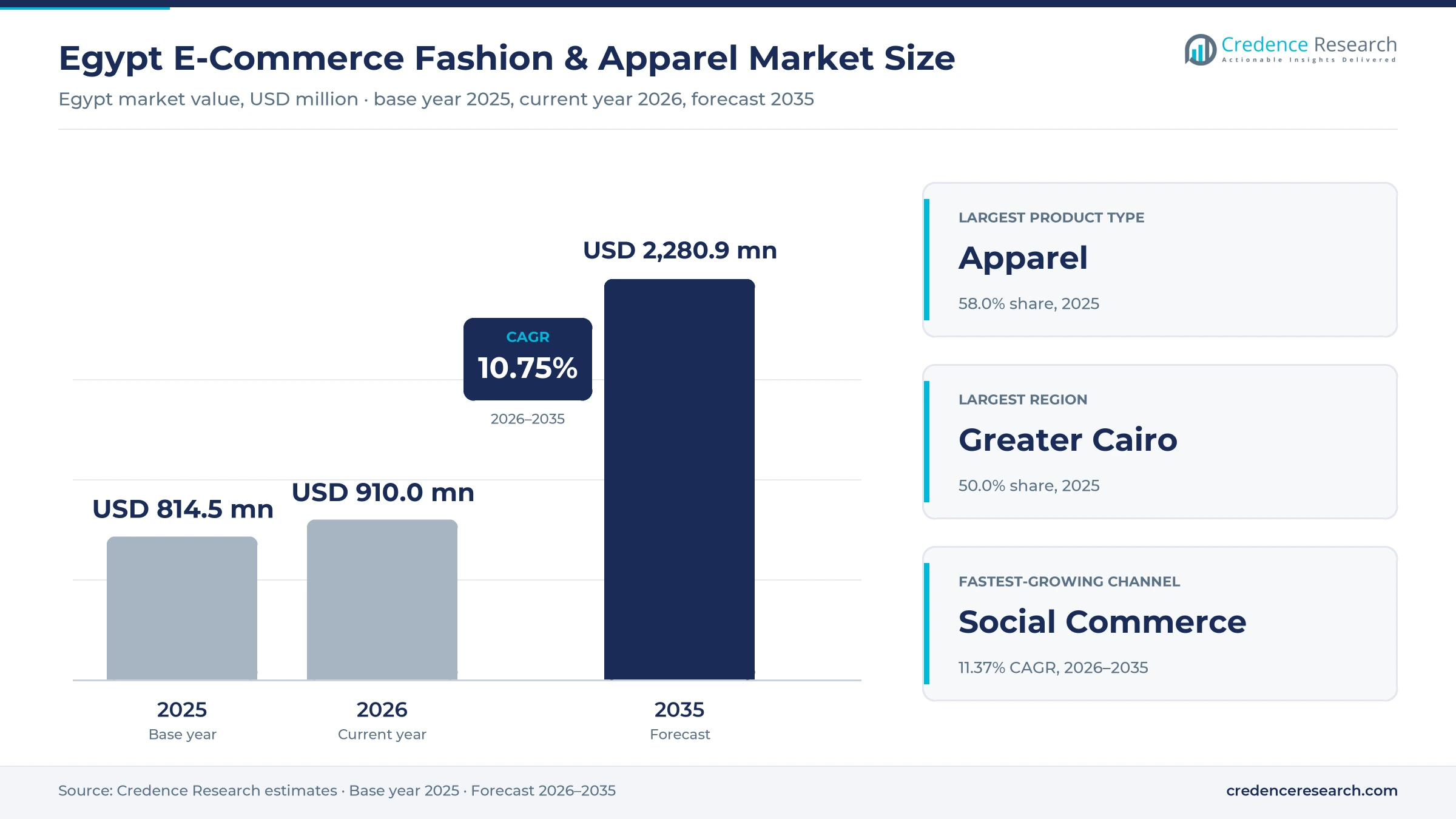
The Egypt e-commerce fashion & apparel market was valued at USD 814.5 million in 2025 and is projected to increase from USD 910.0 million in 2026 to USD 2.28 billion by 2035, registering a CAGR of 10.75% during 2026–2035. Demand comes from a population that passed 108 million in August 2025, wider internet use and fast growth in bank accounts, mobile wallets and instant transfers that make prepaid orders easier. Greater Cairo held the largest regional share, 50.0% in 2025, because the capital region combines the densest delivery coverage with the largest group of young, connected shoppers. Upper Egypt is the fastest-growing region at 11.61% a year, as couriers and marketplaces extend reliable delivery south along the Nile. On the commercial side, Egyptian ready-made garment exports rose 20% in 2025, and new factories in the Suez Canal Economic Zone are adding local capacity that brands and sellers can draw on for faster restocking.
What online clothing spending does the estimate include?
The estimate measures consumer spending on apparel, footwear, sportswear, bags and accessories ordered online for delivery or pickup in Egypt. It covers purchases on horizontal marketplaces, brand websites and apps, social commerce storefronts and specialist fashion e-tailers, whether paid by card, wallet, instant transfer or cash on delivery. Values are stated in USD million at current prices for each calendar year.
The estimate excludes clothing bought in physical stores, secondhand resale between individuals and business purchases of uniforms or workwear. It also excludes garment exports and fabric sold to manufacturers. The value chain runs from local and imported garment makers through brands, sellers and marketplaces to couriers, payment providers and finally to shoppers.
Egypt E-Commerce Fashion & Apparel Market Insights
- The market was valued at USD 814.5 million in 2025 and is projected to reach USD 2.28 billion by 2035, registering a CAGR of 10.75% during 2026–2035.
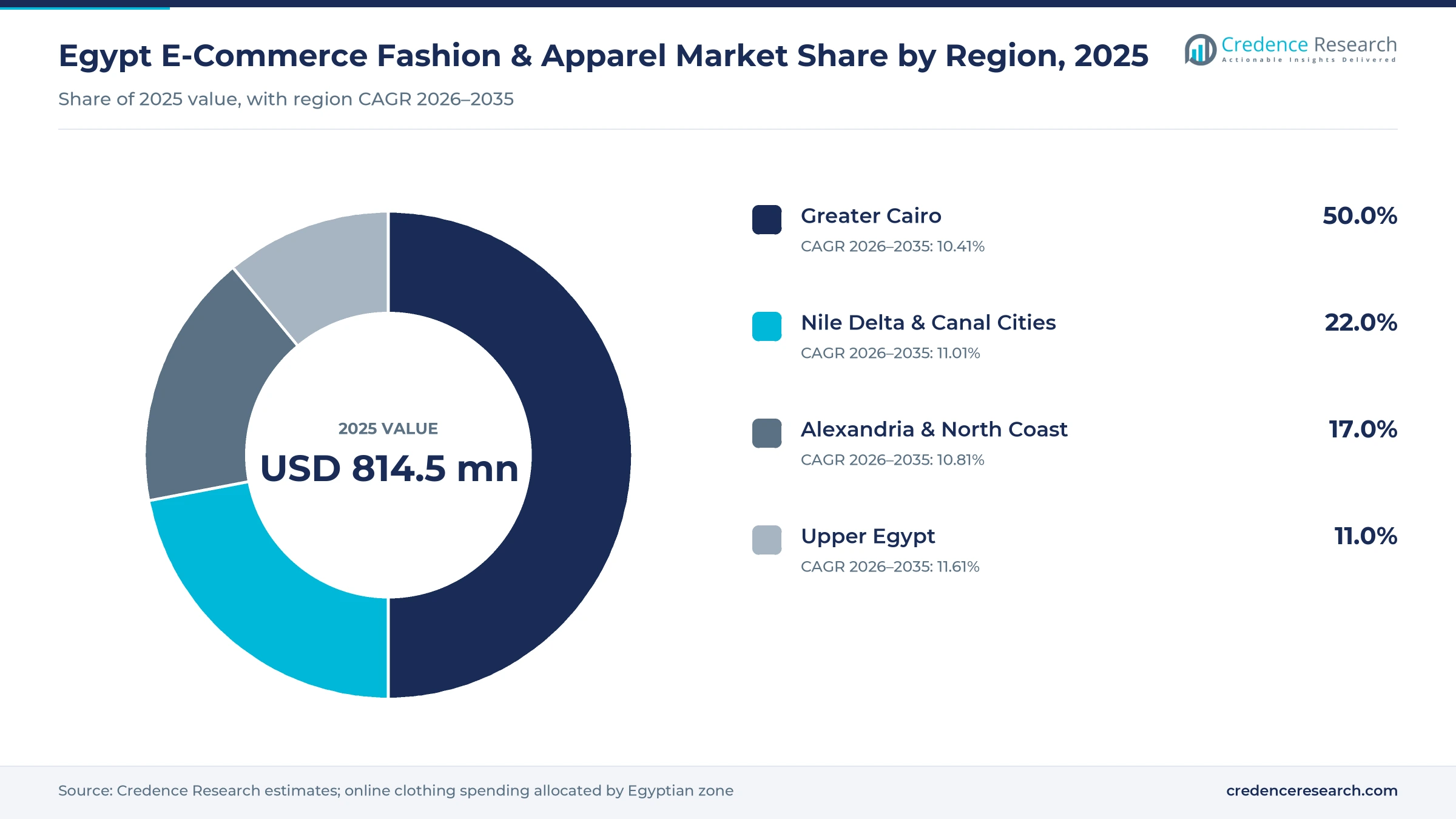
- Greater Cairo held 50.0% of 2025 online clothing spending, because the capital region has the densest courier coverage and most connected shoppers.
- Apparel led product types with 58.0% of 2025 value, as everyday tops, trousers and modest wear are the most frequent online purchases.
- Financial inclusion reached 76.3% of Egyptians aged 15 and above in June 2025, which widens the pool of shoppers who can pay online.
- Egyptian ready-made garment exports climbed to USD 3.394 billion in 2025, showing a growing local manufacturing base for domestic brands.
Apparel, value pricing and marketplaces lead online spend
Why does apparel lead online clothing spending?
Based on product type, the market is categorized into apparel, footwear, bags and accessories, and sportswear. Apparel led with 58.0% of 2025 value, because tops, trousers, abayas and children's clothing are bought often and are easy to ship. Sportswear grows fastest at 11.63% a year, as gyms, running clubs and school sports widen demand for training wear among young shoppers.
Which price tier gains the most share?
Based on price tier, the market is categorized into value, mid-market, premium and luxury fashion. Value led with 42.0% of 2025 value, because high inflation pushed many households toward lower-priced labels and marketplace deals. Premium grows fastest at 11.22% a year, as upper-income shoppers in new cities buy international brands online when stores are far away.
How do Ramadan and Eid shape online buying?
Based on purchase occasion, the market is categorized into everyday casual, work and formal, Ramadan and Eid, and weddings and celebrations. Everyday Casual led with 52.0% of 2025 value, because basics are replaced through the year. Ramadan and Eid grows fastest at 11.18% a year, as families buy new outfits for each child before the holidays and marketplaces run large seasonal campaigns.
Where do shoppers place their clothing orders?
Based on distribution channel, the market is categorized into horizontal marketplaces, brand e-commerce, social commerce and fashion e-tailers. Horizontal Marketplaces led with 44.0% of 2025 value, because broad platforms offer wide choice, promotions and cash on delivery. Social Commerce grows fastest at 11.37% a year, as small brands sell through Instagram, Facebook and WhatsApp with instant transfer payments.
| Segment Group | Leading Sub-segment | Share, 2025 | Fastest-growing Sub-segment | CAGR, 2026–2035 |
|---|---|---|---|---|
| By Product Type | Apparel | 58.0% | Sportswear | 11.63% |
| By Price Tier | Value | 42.0% | Premium | 11.22% |
| By Purchase Occasion | Everyday Casual | 52.0% | Ramadan and Eid | 11.18% |
| By Distribution Channel | Horizontal Marketplaces | 44.0% | Social Commerce | 11.37% |
Request a Free Sample
Fill in your details and we'll send you a free sample report.
- Sample data tables & charts
- Research methodology
Connectivity, payments and local factories lift demand
How does a large connected shopper base lift demand?
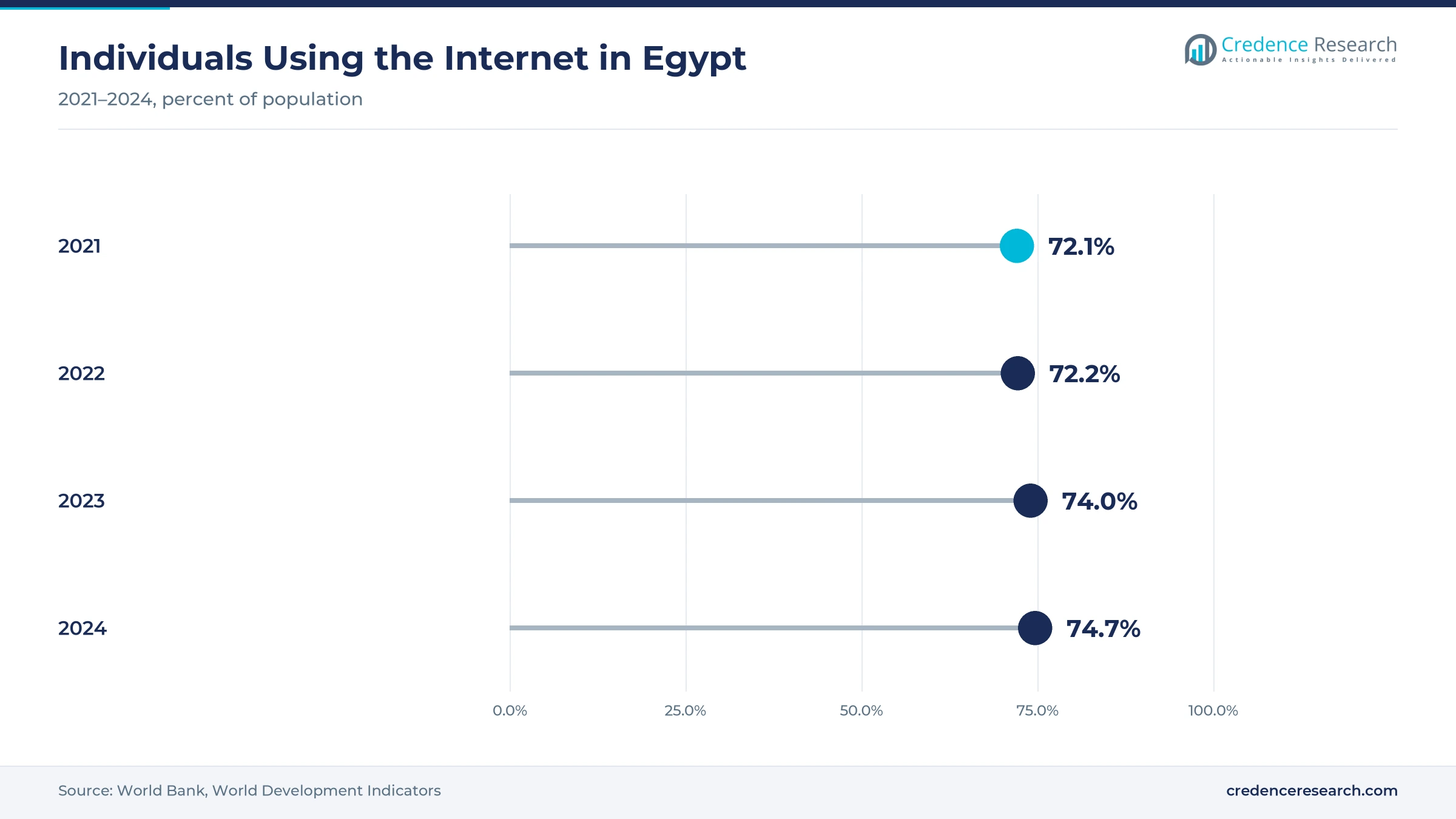
A large and connected shopper base is the main demand driver, because most online fashion apparel orders now start on a phone. Egypt's population reached 108 million on Aug. 16, 2025 and 108.75 million by Feb. 28, 2026, according to CAPMAS population clock figures. Individuals using the internet reached 74.6% of the population in 2024, up from 72.1% in 2021, according to World Bank data. In turn, each new internet user adds a potential buyer of low-priced basics and seasonal outfits through the online retail channel. Apparel held 58.0% of 2025 value, the largest product type, because tops and trousers are the most frequent first online purchase.
Why does financial inclusion support prepaid orders?
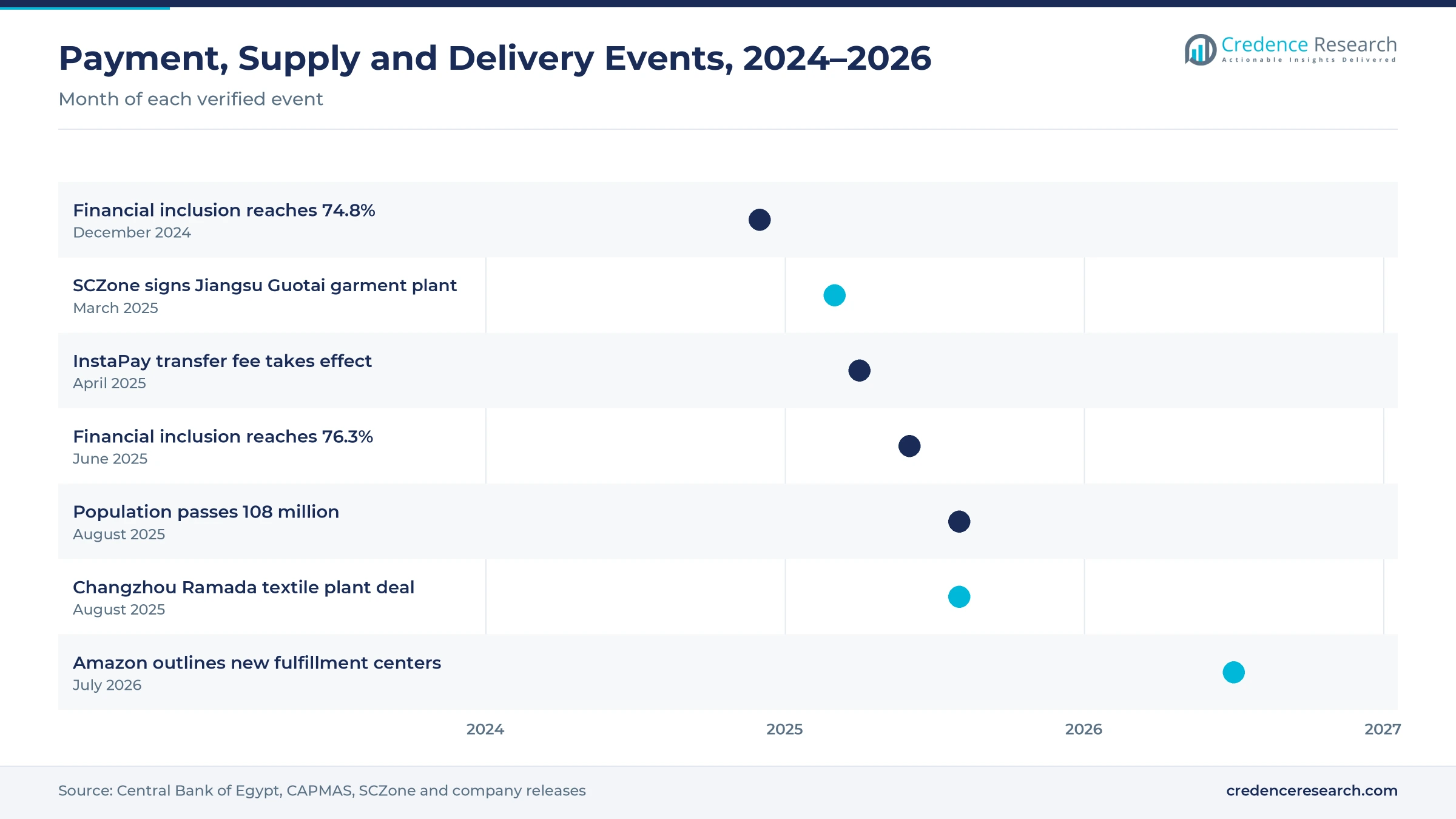
Financial inclusion and digital transaction readiness support prepaid orders, because shoppers with accounts can pay by card, wallet or instant transfer instead of cash. The financial inclusion rate reached 76.3% of Egyptians aged 15 and above in June 2025, up from 74.8% in December 2024, according to Central Bank of Egypt figures. About 53.8 million of 70.5 million eligible citizens now hold transaction accounts, and the rate for women rose to 70%. InstaPay processed 20.3 million transactions in its first year, and a 0.1% transfer fee applied from April 1, 2025. As a result, fashion apparel sellers on social platforms can take payment before shipping, which lowers failed deliveries.
How does local garment production shorten fashion supply?
Localization of fashion supply shortens restocking, because brands can source fabrics and finished garments inside the country rather than wait for imports. Egyptian ready-made garment exports climbed 20% to USD 3.394 billion in 2025 from USD 2.846 billion in 2024, according to Zawya. In March 2025, the Suez Canal Economic Zone signed a USD 10 million agreement with Jiangsu Guotai for a 21,000-square-meter garment factory in Qantara West, with about 2,000 direct jobs, according to Business Today Egypt. In turn, a deeper ready-made garment base gives local labels such as Carina Wear access to nearby suppliers and faster new collections.
Why does faster delivery expand online reach?
Faster delivery expands online reach, because shoppers order more often when parcels arrive quickly and returns are simple. Amazon said in July 2026 that its activity has supported more than 100,000 direct and indirect jobs since it entered Egypt in 2021, according to Ahram Online. The company is also building new fulfillment centers and delivery facilities with private developers and runs 20-minute delivery in selected areas of Cairo, Giza, Alexandria and the North Coast. Its delivery runs through independent partner businesses that employ delivery associates. As a result, Upper Egypt becomes the fastest-growing zone in this report, as courier networks reach more governorates along the Nile.
Social selling and fast delivery reshape online clothing
How is social commerce shifting fashion sales?
Social commerce is shifting fashion apparel sales toward small brands that sell through Instagram, Facebook and WhatsApp storefronts. These sellers rely on instant transfers and mobile wallets, and the June 2025 inclusion rate of 76.3% gives them a much wider base of shoppers who can pay before delivery. Women's inclusion rose to 70% in June 2025, which matters because women lead most clothing purchases for families. In Your Shoe, a direct-to-consumer brand with seven physical locations, reached more than 90,000 customers by selling across more than 75 product lines. Social commerce grows at 11.37% a year, the fastest channel, as payment links and mobile wallets replace cash on delivery.
Why are global retailers shifting to omnichannel models?
Global retailers are shifting toward omnichannel models that link stores, websites and apps in the same city. H&M launched its Egyptian online store in November 2019, letting shoppers order online, collect in store and return items at any of its 13 Egyptian branches. DeFacto, present since 2013, opened its 25th store at Maxim Mall in New Cairo and reports strong online channels alongside its mall network. LC Waikiki told the trade minister in October 2023 that it planned to grow from 38 to 100 Egyptian stores within five years. Brand e-commerce grows at a steady pace in this report, because store networks act as pickup and return points that build trust in online orders.
Can sportswear open a fast-growing online category?
Sportswear offers a clear opening, because young shoppers buy training wear and sneakers for both sport and daily outfits. Egypt has a young population that passed 108 million in 2025, and internet use reached 74.6% of residents in 2024. At the same time, marketplaces carry wide ranges of international and local sports labels that many cities lack in stores. Sportswear grows at 11.63% a year, the fastest product type in this report, while footwear remains the second-largest product type. Therefore, sellers that offer clear size guides, easy exchanges and bundles of tops, shorts and shoes can capture repeat orders from students and young professionals.
Is there room to grow Ramadan and Eid campaigns?
Ramadan and Eid campaigns offer an opening, because families buy new outfits for each child and adult before the holidays. Ramadan and Eid purchases grow at 11.18% a year, the fastest purchase occasion in this report. Wider payment access supports these peaks, with 53.8 million citizens holding transaction accounts in June 2025. Amazon also runs 20-minute delivery in parts of Cairo, Giza and Alexandria, which shows how fast fulfillment is reaching the largest cities. As a result, brands that plan stock, modest wear collections and last-mile delivery capacity ahead of the season can capture a large share of annual demand within a few weeks.
Inflation, cash habits and returns squeeze online margins
How does inflation limit online clothing budgets?
Inflation limits online fashion apparel budgets, because households give priority to food, housing and school costs when prices rise. Shoppers trade down to value labels, wait for marketplace promotions and buy fewer items per order. As a result, sellers face thinner margins and must manage stock carefully to avoid heavy discounting. Local production helps keep shelf prices lower, but imported fabrics and accessories still tie costs to the exchange rate.
Why do cash payments and failed deliveries raise costs?
Cash payments and failed deliveries raise costs, because many shoppers still prefer to pay the courier at the door. Orders refused at delivery must be shipped back, checked and restocked, which adds transport and handling costs for each parcel. Therefore, sellers encourage prepaid orders with small discounts and faster shipping. Wider use of instant transfers and wallets should ease this problem, although cash on delivery will remain common outside large cities.
How do size uncertainty and returns hurt margins?
Size uncertainty and returns hurt fashion apparel margins, because sizing varies widely between local and international labels. Shoppers often order two sizes and return one, which doubles shipping and handling for a single sale. In turn, brands invest in size charts, customer photos and easy exchange policies to build confidence. Return-ready packaging helps, but smaller sellers often lack the warehouse space and staff to process returns quickly.
Why does marketplace competition pressure sellers?
Marketplace competition pressures fashion apparel sellers, because thousands of listings compete for the same search results and promotions. Large platforms set commission rates, delivery terms and campaign calendars that smaller brands must follow to stay visible. Jumia reported lower corporate sales in Egypt in its third quarter 2025 results, which shows how demand can shift between channels. As a result, brands spread sales across several platforms and their own social storefronts.
Greater Cairo leads while Upper Egypt grows fastest
| Region | Value, 2025 (USD million) | Share, 2025 | CAGR, 2026–2035 |
|---|---|---|---|
| Greater Cairo | 407.2 | 50.0% | 10.41% |
| Nile Delta & Canal Cities | 179.2 | 22.0% | 11.01% |
| Alexandria & North Coast | 138.5 | 17.0% | 10.81% |
| Upper Egypt | 89.6 | 11.0% | 11.61% |
Why does Greater Cairo lead online clothing spending?
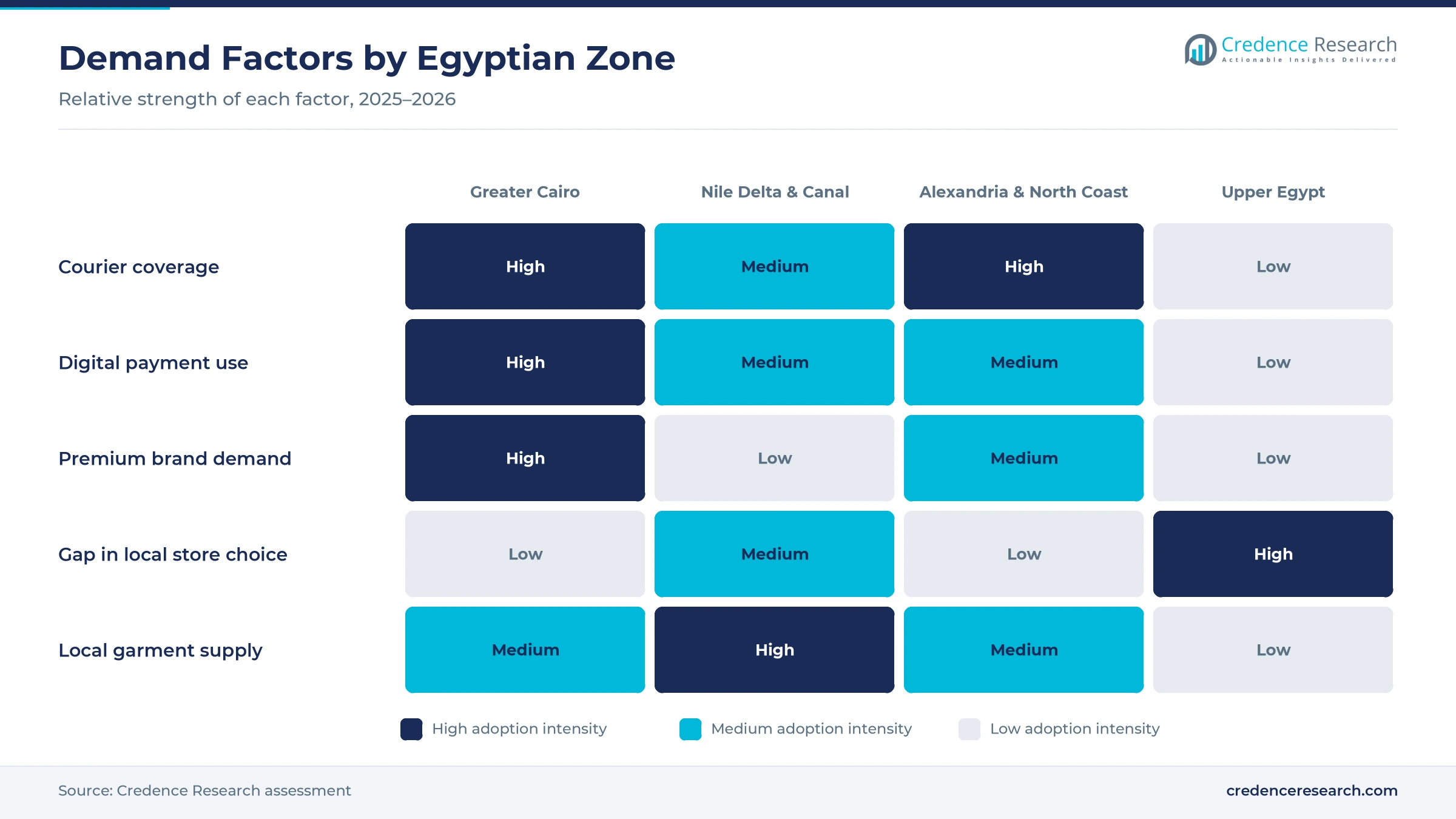
Greater Cairo held 50.0% of 2025 value and grows at 10.41% a year, the slowest pace among the four zones because its base is already large. Cairo and Giza host most brand warehouses, marketplace hubs and courier depots, so next-day and same-day delivery are common. New Cairo malls such as Maxim Mall also anchor store networks that support online pickup and returns. As a result, the capital region remains the testing ground for new brands and campaigns.
How do the Nile Delta and Canal Cities add demand?
The Nile Delta and Canal Cities held 22.0% of 2025 value and grow at 11.01% a year, supported by large populations in governorates close to Cairo. Couriers serve many Delta cities from Cairo depots within one or two days, which makes online orders practical. The Suez Canal Economic Zone also hosts new garment and textile factories in Qantara West. Therefore, the zone combines rising online demand with growing local garment supply.
What keeps Alexandria and the North Coast growing?
Alexandria and the North Coast held 17.0% of 2025 value and grow at 10.81% a year, supported by the country's second-largest city and busy summer resorts. Amazon runs 20-minute delivery in selected areas of Alexandria and the North Coast, which shows strong demand for fast fulfillment. DeFacto also opened a store at Green Plaza Mall in Alexandria. In turn, summer and holiday seasons create clear peaks for casual and resort wear.
Why does Upper Egypt grow fastest?
Upper Egypt held 11.0% of 2025 value and grows at 11.61% a year, the fastest pace among the four zones. Many cities along the Nile south of Cairo have few international fashion stores, so online platforms give shoppers access to brands and sizes that are not available locally. Wider financial inclusion and instant transfers also make prepaid orders easier. As a result, courier coverage and cash collection networks decide how quickly this demand turns into sales.
Factories, payment rules and delivery mark 2024 to 2026
| Development | Status and market relevance |
|---|---|
| In March 2025, the Suez Canal Economic Zone signed a USD 10 million agreement with Jiangsu Guotai for a garment factory in Qantara West. | Adds about 2,000 direct jobs and local ready-made clothing capacity |
| In April 2025, InstaPay began charging a 0.1% transfer fee, with a minimum of EGP 0.50 and a maximum of EGP 20. | Sets the cost of instant transfers that many social sellers use for prepaid orders |
| In August 2025, Changzhou Ramada Blanket Industry committed USD 22.6 million to a textile and garment facility in Qantara West. | Adds 1,500 jobs and fabric capacity in the Suez Canal Economic Zone |
| In September 2025, the Central Bank of Egypt reported financial inclusion of 76.3% as of June 2025. | Widens the pool of shoppers who can pay online by card, wallet or transfer |
| In July 2026, Amazon said it is building new fulfillment centers and delivery facilities in Egypt with private developers. | Supports faster delivery for marketplace orders, including clothing and footwear |
Instant payments and size tools change how shoppers buy
- Instant payment networks such as InstaPay let shoppers pay social sellers before shipping, which reduces cash handling and refused deliveries.
- Size recommendation tools use past orders and body measurements to suggest the right fit, which lowers returns on apparel and footwear and cuts the cost of reverse shipping for sellers.
- Micro-fulfillment centers placed inside large cities support same-day and 20-minute delivery for urgent purchases, such as outfits needed before Eid or a wedding.
- Social storefront features on Instagram, Facebook and WhatsApp let small brands show catalogs, chat with buyers and share payment links.
Need a Custom Version of This Report?
Tailor the scope, geography, or segments to your exact requirements.
- Custom geography or segment scope
- Direct access to our analyst team
Marketplaces and global brands compete with local labels
Competition in the Egypt e-commerce fashion & apparel market combines horizontal marketplaces, global fashion retailers and fast-growing local brands. Amazon Egypt and Jumia Egypt compete on assortment, promotions and delivery speed, and Amazon is building new fulfillment and delivery facilities. H&M, LC Waikiki, DeFacto and Max Fashion run mall store networks, and H&M and DeFacto link those stores with online orders, pickup and returns, and LC Waikiki has outlined plans to grow its Egyptian store count. Local labels such as Carina Wear and In Your Shoe compete on price, local style and direct relationships with shoppers on social platforms. Rivals compete on price, size range, delivery speed, payment options, return policies and the speed of new collections, while local garment sourcing increasingly shapes margins and stock availability.
Companies profiled and their roles in this market
| Company | Type | Role in the market |
|---|---|---|
| Amazon Egypt | Horizontal marketplace | Building new fulfillment centers and runs 20-minute delivery in selected cities |
| Jumia Egypt | Horizontal marketplace | Reported lower corporate sales in Egypt in its third quarter 2025 results |
| H&M Egypt | Global fashion retailer | Runs an Egyptian online store with in-store collection and returns since 2019 |
| LC Waikiki Egypt | Global value fashion retailer | Outlined plans to grow from 38 to 100 Egyptian stores |
| DeFacto Egypt | Global value fashion retailer | Operates more than 25 Egyptian stores and online channels |
| In Your Shoe | Local direct-to-consumer brand | Sells more than 75 product lines through stores and online channels |
Credence Research view on payments and local sourcing
Credence Research's view is that Egypt e-commerce fashion & apparel spending will grow at a double-digit pace, driven by wider internet use, rising financial inclusion and faster delivery beyond Greater Cairo. Marketplaces will keep the largest share, but social commerce and brand sites should gain as instant transfers replace cash on delivery. Local garment capacity in the Suez Canal Economic Zone gives domestic labels a sourcing advantage. However, inflation and returns will keep margins thin, so winners will pair value pricing with reliable sizing, prepaid incentives and fast restocking.
How the online clothing spending estimate was built
The report uses 2025 as the base year on a calendar basis, with values in USD million at current prices. Market values come from the Credence Research model, which starts from household clothing spending and applies online penetration and average order value assumptions by product type and channel. Regional, segment and channel splits are Credence Research estimates built from population, internet use and delivery coverage indicators. Sources used are World Bank data, Central Bank of Egypt and CAPMAS releases, trade press and company announcements, and no interviews or surveys were used.
Double-digit growth through 2035 as access widens
Egypt e-commerce fashion & apparel spending is expected to reach USD 2.28 billion by 2035, a 10.75% CAGR during 2026–2035, as more shoppers go online, pay digitally and receive faster deliveries. Growth should stay strong in 2026 and 2027 as social commerce and marketplace campaigns expand. After that, Upper Egypt and the Delta should add more new demand, while Greater Cairo shifts toward premium and brand sites. Lower inflation would lift this outlook, while weaker household incomes or higher delivery costs would lower it.
Frequently Asked Questions
How big is the Egypt e-commerce fashion & apparel market?
Which region leads online clothing spending?
Which region grows fastest?
Which product type holds the largest share?
Which sales channel grows fastest?
How does financial inclusion affect online fashion buying?
Who are the leading online fashion companies in Egypt?
How does local garment production support online fashion?
Table of Content
Chapter 1 Market Segmentation
- 1.1 Segmentation Framework
- 1.1.1 Product and Service Classification
- 1.1.2 Application and End-Use Classification
- 1.1.3 Technology and Solution Classification
- 1.1.4 Customer and Distribution Channel Classification
- 1.1.5 Geographic Segmentation
- 1.1.6 Market Segment Definitions and Boundaries
- 1.2 By Product Type
- 1.2.1 Apparel
- 1.2.2 Footwear
- 1.2.3 Sportswear
- 1.2.4 Bags & Accessories
- 1.3 By Price Tier
- 1.3.1 Value
- 1.3.2 Mid-Market
- 1.3.3 Premium
- 1.3.4 Luxury
- 1.4 By Purchase Occasion
- 1.4.1 Everyday Casual
- 1.4.2 Ramadan and Eid
- 1.4.3 Work and Formal
- 1.4.4 Weddings and Celebrations
Chapter 2 Introduction
- 2.1 Report Objectives and Scope
- 2.2 Product Definition and Industry Terminology
- 2.3 Market Inclusions and Exclusions
- 2.4 Research Process
- 2.4.1 Primary Research and Expert Interviews
- 2.4.2 Secondary Research and Source Review
- 2.4.3 Top-Down and Bottom-Up Estimation
- 2.4.4 Data Triangulation and Verification
- 2.5 Market Size Measurement Basis
- 2.5.1 2025: USD 814.5 million → 2035: USD 2.28 billion
- 2.6 Historical and Forecast Reference Periods
- 2.6.1 Historical Period: 2018-2025
- 2.6.2 Base Year: 2025
- 2.6.3 Forecast Period: 2025-2035
- 2.7 Research Assumptions and Limitations
Chapter 3 Executive Summary
- 3.1 Market Snapshot and Key Findings
- 3.2 Base-Year Market Size, 2025
- 3.3 Forecast Market Size, 2035
- 3.4 Revenue and Volume Growth Outlook
- 3.5 Key Demand and Supply Indicators
- 3.6 Leading Market Segments
- 3.7 Fastest-Growing Market Opportunities
- 3.8 Regional Performance Highlights
- 3.9 Technology and Industry Transformation
- 3.10 Competitive Landscape Summary
- 3.11 Analyst View and Strategic Implications
Chapter 4 Egypt E-Commerce Fashion & Apparel Market Trends and Developments
- 4.1 Historical Industry Development, 2018-2025
- 4.2 Recent Market Trends and Developments
- 4.3 Demand and Customer Behavior Trends
- 4.4 Technology and Product Innovation
- 4.5 Artificial Intelligence, Automation and Digitalization
- 4.6 Local Manufacturing and Supply Chain Realignment
- 4.7 Industry Partnerships, Mergers and Acquisitions
- 4.8 Sustainability and Circular Economy Developments
- 4.9 Government and Private Sector Investment Trends
- 4.10 Emerging Business Models and Commercialization
- 4.11 Industry Developments and Announcements
Chapter 5 Egypt E-Commerce Fashion & Apparel Market Production, Supply and Demand Analysis
- 5.1 Demand Trend and Consumption Analysis, 2018-2025
- 5.2 Demand Forecast, 2025-2035
- 5.3 Production and Output Trend, 2018-2025
- 5.4 Production and Output Forecast, 2025-2035
- 5.5 Installed Capacity and Capacity Utilization
- 5.6 Company-Wise Production Plants and Statistics
- 5.6.1 Installed Production Capacity
- 5.6.2 Actual Production
- 5.6.3 Planned Capacity and Expansion Targets
- 5.7 Supply Chain Structure and Procurement Trends
- 5.8 Supply-Demand Gap and Bottlenecks
- 5.9 Import Dependence and Sourcing Structure
- 5.10 Contract Manufacturing and Outsourcing
- 5.11 Regional Supply and Demand Concentration
Chapter 6 Egypt E-Commerce Fashion & Apparel Market Pricing Analysis
- 6.1 Pricing Structure and Measurement
- 6.2 Historical Pricing Trends, 2018-2025
- 6.3 Pricing Outlook, 2025-2035
- 6.4 Average Selling Price and Unit Economics
- 6.5 Pricing by Product and Market Segment
- 6.6 Geographic Pricing Differences
- 6.7 Key Input, Energy, Labor and Logistics Costs
- 6.8 Contract Pricing and Purchasing Models
- 6.9 Pricing Sensitivity and Competitive Positioning
- 6.10 Price, Margin and Profitability Implications
Chapter 7 Egypt E-Commerce Fashion & Apparel Market Dynamics
- 7.1 Market Growth Drivers
- 7.1.1 Demand-Side Drivers
- 7.1.2 Technology and Innovation Drivers
- 7.1.3 Infrastructure and Investment Drivers
- 7.1.4 Regulatory and Policy Drivers
- 7.2 Market Restraints
- 7.2.1 Cost and Affordability Constraints
- 7.2.2 Technology and Adoption Barriers
- 7.2.3 Supply Chain and Operational Constraints
- 7.3 Market Challenges
- 7.3.1 Competitive Pressure and Margin Erosion
- 7.3.2 Skills, Infrastructure and Implementation Gaps
- 7.4 Emerging Market Opportunities
- 7.5 Market Dynamics Impact and Time-Horizon Assessment
Chapter 8 Egypt E-Commerce Fashion & Apparel Value Chain Analysis
- 8.1 Industry Value Chain Overview
- 8.2 Upstream Suppliers and Critical Inputs
- 8.3 Technology and Component Providers
- 8.4 Manufacturing or Service Delivery
- 8.5 Distribution, Channel Partners and Integrators
- 8.6 Downstream Applications and End Users
- 8.7 Value Addition and Profit Pools
- 8.8 Vertical Integration and Outsourcing
- 8.9 Supplier Concentration and Risk
- 8.10 Supply Chain Localization and Resilience
Chapter 9 Egypt E-Commerce Fashion & Apparel Market Regulations and Policies
- 9.1 Relevant Laws, Standards and Compliance Frameworks
- 9.2 Product, Service, Safety and Quality Requirements
- 9.3 Government Policies, Incentives and Subsidies
- 9.4 Imports, Exports and Trade Barriers
- 9.5 Public Procurement and Local Content Requirements
- 9.6 Environmental and Sustainability Compliance
- 9.7 Upcoming Policy Changes and Market Implications
Chapter 10 Egypt E-Commerce Fashion & Apparel Market Hotspots and Opportunities
- 10.1 Market Opportunity Mapping and Growth Hotspots
- 10.2 High-Growth Applications and Customer Groups
- 10.3 Underserved Markets and White-Space Opportunities
- 10.4 Emerging Technology and Product Opportunities
- 10.5 New Capacity and Investment Hotspots
- 10.6 Market Entry and Expansion Opportunities
- 10.7 Distribution and Partnership Opportunities
- 10.8 Near-Term and Long-Term Commercial Potential
- 10.9 Opportunity Attractiveness and Execution Risks
Chapter 11 Egypt E-Commerce Fashion & Apparel Market Outlook, 2025-2035
- 11.1 Market Size and Analysis
- 11.1.1 Revenue (Market Measurement: 2025: USD 814.5 million → 2035: USD 2.28 billion)
- 11.1.2 Market Volume and Quantity Sold
- 11.1.3 Historical Market Size, 2018-2025
- 11.1.4 Base-Year Market Size, 2025
- 11.2 Market Forecast, 2025-2035
- 11.2.1 Revenue Forecast to 2035
- 11.2.2 Volume Forecast to 2035
- 11.2.3 CAGR and Year-on-Year Growth
- 11.2.4 Incremental Revenue Opportunity
- 11.3 Forecast Assumptions and Scenario Analysis
- 11.3.1 Base-Case Forecast
- 11.3.2 Optimistic and Conservative Scenarios
- 11.3.3 Technology, Pricing and Policy Sensitivities
- 11.4 Market Attractiveness and Growth Outlook
Chapter 12 Egypt E-Commerce Fashion & Apparel Market Segmentation and Outlook
- 12.1 Segmentation Summary and Market Shares, 2025
- 12.2 Largest and Fastest-Growing Segments
- 12.3 By Product Type - Market Size and Forecast, 2025-2035
- 12.3.1 Segment Definition and Scope
- 12.3.2 Historical Market Size, 2018-2025
- 12.3.3 Revenue Forecast, 2025-2035
- 12.3.4 Volume Forecast, 2025-2035
- 12.3.5 Base-Year Market Share, 2025
- 12.3.6 Segment CAGR and Growth Drivers
- 12.3.7 Subsegment Market Size and Forecast
- 12.3.7.1 Apparel
- 12.3.7.2 Footwear
- 12.3.7.3 Sportswear
- 12.3.7.4 Bags & Accessories
- 12.3.8 Subsegment Pricing and Adoption Trends
- 12.3.9 Leading Suppliers and Competition
- 12.3.10 Regional Demand and Opportunities
- 12.4 By Price Tier - Market Size and Forecast, 2025-2035
- 12.4.1 Segment Definition and Scope
- 12.4.2 Historical Market Size, 2018-2025
- 12.4.3 Revenue Forecast, 2025-2035
- 12.4.4 Volume Forecast, 2025-2035
- 12.4.5 Base-Year Market Share, 2025
- 12.4.6 Segment CAGR and Growth Drivers
- 12.4.7 Subsegment Market Size and Forecast
- 12.4.7.1 Value
- 12.4.7.2 Mid-Market
- 12.4.7.3 Premium
- 12.4.7.4 Luxury
- 12.4.8 Subsegment Pricing and Adoption Trends
- 12.4.9 Leading Suppliers and Competition
- 12.4.10 Regional Demand and Opportunities
- 12.5 By Purchase Occasion - Market Size and Forecast, 2025-2035
- 12.5.1 Segment Definition and Scope
- 12.5.2 Historical Market Size, 2018-2025
- 12.5.3 Revenue Forecast, 2025-2035
- 12.5.4 Volume Forecast, 2025-2035
- 12.5.5 Base-Year Market Share, 2025
- 12.5.6 Segment CAGR and Growth Drivers
- 12.5.7 Subsegment Market Size and Forecast
- 12.5.7.1 Everyday Casual
- 12.5.7.2 Ramadan and Eid
- 12.5.7.3 Work and Formal
- 12.5.7.4 Weddings and Celebrations
- 12.5.8 Subsegment Pricing and Adoption Trends
- 12.5.9 Leading Suppliers and Competition
- 12.5.10 Regional Demand and Opportunities
- 12.6 Segment Growth Comparison
- 12.7 Segment Attractiveness and Priority Matrix
Chapter 13 Egypt E-Commerce Fashion & Apparel Geographic Market Outlook, 2025-2035
- 13.1 Regional Market Size and Country-Level Shares, 2025
- 13.2 Country Market Size Comparison, 2025
- 13.3 Country Market Forecasts, 2025-2035
- 13.4 Subregional Industrial and Demand Clusters
- 13.5 Intra-Regional Pricing and Cost Differences
- 13.6 Cross-Border Trade and Supply Networks
- 13.7 Regional Supply and Demand Balances
- 13.8 Country Opportunity Comparison and Prioritization
Note: Every listed country is covered on the structure shown under the first country.
Chapter 14 Egypt E-Commerce Fashion & Apparel Technology, Innovation and Sustainability Outlook
- 14.1 Technology Landscape and Maturity
- 14.2 Product, Process and Service Innovation
- 14.3 AI, Automation and Digital Tools in the Industry
- 14.4 Technology Adoption and Performance Benchmarking
- 14.5 Innovation Pipeline and R&D Investment
- 14.6 Patent and Intellectual Property Trends
- 14.7 Energy Efficiency and Resource Management
- 14.8 Sustainability, Recycling and Circularity
- 14.9 Technology Roadmap, 2025-2035
- 14.10 Risks of Obsolescence and Technology Substitution
Chapter 15 Egypt E-Commerce Fashion & Apparel Market Key Strategic Imperatives
- 15.1 Growth and Market Entry Priorities
- 15.2 High-Return Products and Segments
- 15.3 Pricing, Profitability and Cost Optimization
- 15.4 Technology Investment and Product Differentiation
- 15.5 Supply Chain Localization and Resilience
- 15.6 Distribution and Customer Acquisition
- 15.7 Partnership, Acquisition and Capacity Strategy
- 15.8 Regional Expansion Priorities
- 15.9 Short-, Medium- and Long-Term Actions
Chapter 16 Competition Outlook
- 16.1 Industry Competition Characteristics
- 16.2 Market Structure and Concentration
- 16.3 Market Share and Competitive Positioning, 2025
- 16.4 Company-Wise Revenue and Product Benchmarking
- 16.5 Production and Service Capacity Benchmarking
- 16.6 Technology, Pricing and Differentiation
- 16.7 Regional Footprint and Distribution Strength
- 16.8 Mergers, Acquisitions and Strategic Alliances
- 16.9 New Entrants and Competitive Threats
- 16.10 Porter's Five Forces and Industry Attractiveness
- 16.11 Competitive Outlook, 2025-2035
Chapter 17 Company Profiles
- 17.1 Company Coverage and Selection Criteria
- 17.2 Amazon Egypt
- 17.2.1 Business Description
- 17.2.2 Company Ownership and Geographic Presence
- 17.2.3 Product and Service Portfolio
- 17.2.4 Manufacturing and Operating Footprint
- 17.2.5 Production Capacity and Expansion Plans
- 17.2.6 Financial Performance and Investment
- 17.2.7 Market Share and Competitive Position
- 17.2.8 Technology and Innovation Capabilities
- 17.2.9 Strategic Alliances or Partnerships
- 17.2.10 Recent Developments
- 17.2.11 Growth Strategy and Outlook
- 17.3 noon Egypt
- 17.4 Jumia Egypt
- 17.5 H&M Egypt
- 17.6 LC Waikiki Egypt
- 17.7 Zara Egypt
- 17.8 DeFacto Egypt
- 17.9 Max Fashion Egypt
- 17.10 Carina Wear
- 17.11 InYourShoe
- 17.12 Other Relevant Market Participants
Note: Every listed company is profiled on the structure shown under the first company. The company list is preliminary and may change based on research findings, market developments, data availability and client requirements.
Chapter 18 Disclaimer
- 18.1 Research and Forecast Disclaimer
- 18.2 Data Source and Estimation Limitations
Note: The depth of individual sections depends on data availability for this market. Volume, capacity, trade and other unit-based metrics are included where applicable.

