
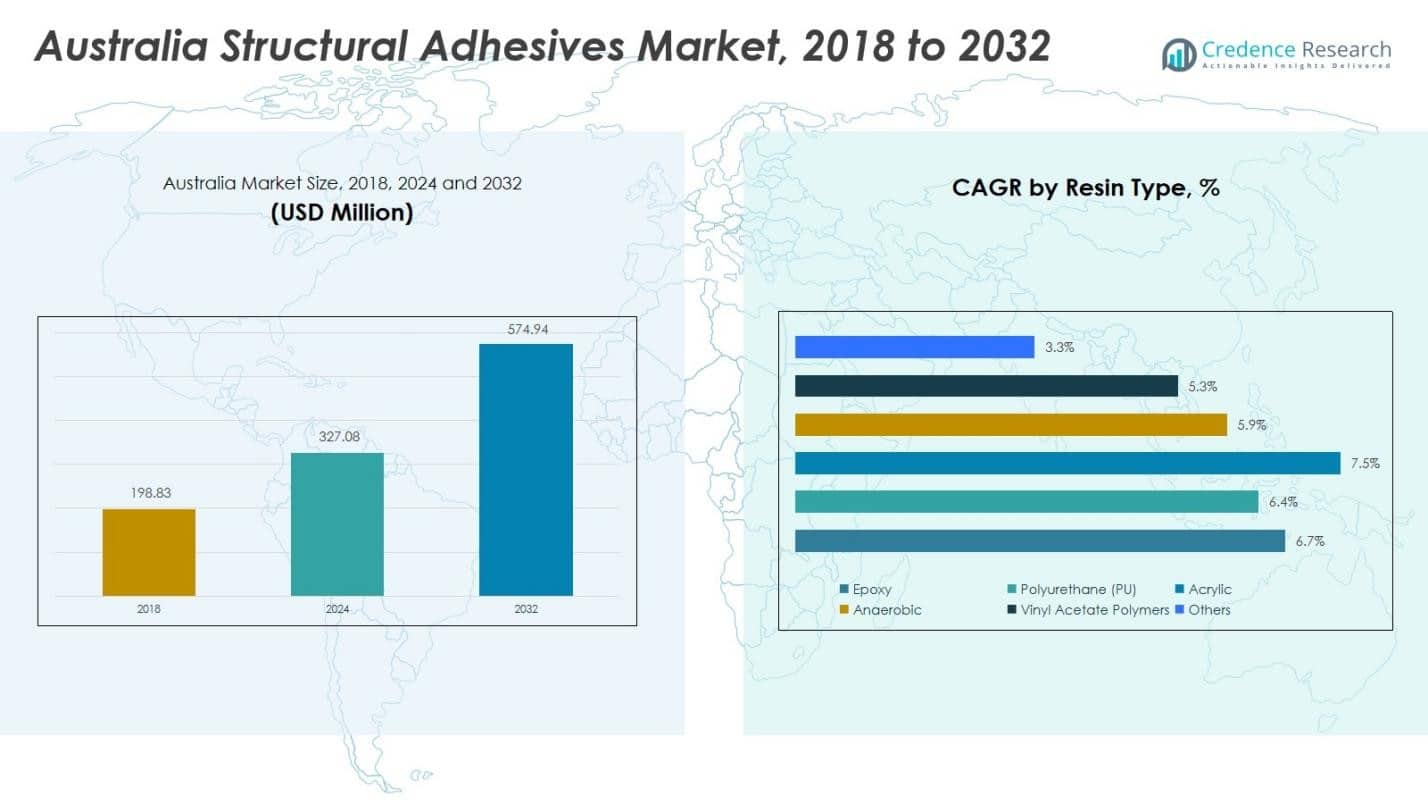
Australia Structural Adhesives Market size was valued at USD 198.83 Million in 2018, rising to USD 327.08 Million in 2024, and is anticipated to reach USD 574.94 Million by 2032, at a CAGR of 6.80% during the forecast period.
| REPORT ATTRIBUTE | DETAILS |
|---|---|
| Historical Period | 2020-2023 |
| Base Year | 2024 |
| Forecast Period | 2025-2032 |
| Australia Structural Adhesives Market Size 2024 | USD 327.08 Million |
| Australia Structural Adhesives Market, CAGR | 6.80% |
| Australia Structural Adhesives Market Size 2032 | USD 574.94 Million |
The Australia Structural Adhesives Market is highly competitive, led by prominent players including Henkel AG & Co. KGaA, Sika AG, 3M Company, Arkema S.A., H.B. Fuller Company, RPM International Inc., Huntsman Corporation, Dow Inc., Illinois Tool Works Inc., and Lord Corporation. These companies focus on product innovation, strategic partnerships, and regional expansion to strengthen their market presence. They offer a diverse portfolio of high-performance adhesives, including epoxy, polyurethane, and acrylic formulations, catering to automotive, aerospace, construction, and industrial applications. New South Wales emerges as the leading region, commanding a market share of 28% due to its strong industrial base, automotive and aerospace manufacturing hubs, and ongoing infrastructure development. The combination of established players and robust regional demand continues to drive growth, with companies investing in sustainable, eco-friendly, and technologically advanced adhesive solutions to maintain leadership in the evolving market.
Market Insights
- The Australia Structural Adhesives Market was valued at USD 327.08 Million in 2024 and is projected to reach USD 574.94 Million by 2032, growing at a CAGR of 6.80%.
- Growth is driven by rising demand from automotive, aerospace, and construction sectors, along with increasing adoption of lightweight and durable materials.
- Key trends include a shift toward eco-friendly water-based adhesives and the growing use of composite materials in high-performance applications, creating opportunities for specialized bonding solutions.
- The market is highly competitive, with major players such as Henkel AG & Co. KGaA, Sika AG, 3M Company, Arkema S.A., and H.B. Fuller Company investing in R&D, product innovation, and regional expansion to maintain market leadership.
- Regionally, New South Wales leads with a 28% market share, followed by Victoria at 22% and Queensland at 18%, while the epoxy resin segment dominates by resin type with a 38% share in 2024.
Market Segmentation Analysis:
By Resin Type:
The Australia structural adhesives market by resin type is led by the Epoxy segment, capturing 38% of the market share in 2024. Epoxy adhesives dominate due to their exceptional mechanical strength, chemical resistance, and versatility across automotive, aerospace, and construction applications. Polyurethane (PU) and Acrylic adhesives follow, driven by demand in flexible bonding and rapid-curing applications. Growth is fueled by the increasing adoption of lightweight materials in automotive manufacturing and rising infrastructure investments, which require durable bonding solutions that can withstand environmental stressors and provide long-term reliability.
For instance, Westlake Epoxy introduced its sustainable AZURES range, featuring SVHC-free epoxy resins for durable structural bonding in construction and infrastructure projects.
By Substrate:
In terms of substrate, Metal dominates with a 42% market share, reflecting the extensive use of structural adhesives in automotive, aerospace, and industrial applications. Metal bonding requirements for high-strength, fatigue-resistant joints drive demand for advanced adhesive solutions. Composite materials are rapidly gaining traction, especially in aerospace and high-performance automotive sectors, due to their lightweight and high-strength properties. Wood and plastic substrates hold moderate shares, primarily in construction and consumer goods. Drivers include the increasing need for lightweight and durable material assemblies and the growing trend of replacing mechanical fasteners with adhesive solutions.
For instance, Master Bond’s EP21TDCHT-LO epoxy adhesive is NASA outgassing certified and withstands 1,000 hours at 85°C/85% RH, enabling reliable bonding between aluminum and titanium in aerospace structures.
By Technology:
Within technology, the Solvent-based segment leads with a 45% market share, favored for its strong adhesion properties and compatibility with diverse substrates, including metals and composites. Water-based adhesives are growing steadily due to environmental regulations and sustainability initiatives, offering low VOC emissions and safer handling. Other technologies, such as hot-melt and anaerobic adhesives, cater to niche applications requiring rapid curing or specialized bonding. The market is propelled by strict environmental norms, rising demand for high-performance adhesives in automotive and aerospace sectors, and manufacturers’ shift toward eco-friendly bonding solutions without compromising strength.
Key Growth Drivers
Rising Demand from Automotive and Aerospace Sectors
The growth of the Australia structural adhesives market is strongly driven by the increasing adoption of lightweight materials in automotive and aerospace industries. Manufacturers are replacing traditional mechanical fasteners with structural adhesives to enhance fuel efficiency, reduce weight, and improve joint durability. The expansion of electric vehicle production further boosts demand, as adhesives ensure reliability and structural integrity while accommodating complex designs. Rising investments in advanced aircraft manufacturing and automotive assembly lines are expected to sustain robust market growth throughout the forecast period.
For instance, Henkel’s structural inserts integrated during the body-in-white stage help reduce vehicle weight by over 40 kg while maintaining crash safety, which is critical for electric vehicle production.
Infrastructure and Construction Development
The ongoing infrastructure and construction projects across Australia are significantly driving the structural adhesives market. Adhesives are increasingly used for bonding metal, wood, and composite materials in buildings, bridges, and industrial facilities due to their superior strength, durability, and resistance to environmental stress. Urbanization, government initiatives for sustainable construction, and the growing preference for lightweight and high-performance materials further stimulate adoption. As construction activities expand, structural adhesives provide cost-effective and efficient alternatives to conventional fastening methods, enhancing the overall market potential.
For instance, Sika Australia’s epoxy and resin-based structural adhesives are being used in major strengthening projects such as bridge retrofits and concrete reinforcement applications that enhance load capacity and seismic performance.
Technological Advancements in Adhesive Formulations
Continuous innovation in adhesive technologies is boosting the Australia structural adhesives market. Development of high-performance formulations, including solvent-based, water-based, and specialized epoxies, enables applications across diverse substrates such as metals, composites, and plastics. Improved curing times, enhanced chemical resistance, and eco-friendly low-VOC products attract industries seeking sustainable yet durable bonding solutions. Manufacturers’ focus on research and development, combined with adoption of automated adhesive application systems, ensures precise, reliable performance, strengthening market growth and positioning structural adhesives as critical components in modern manufacturing.
Key Trends & Opportunities
Shift Toward Lightweight and Composite Materials
A growing trend in the Australia structural adhesives market is the increased use of composite and lightweight materials across automotive, aerospace, and industrial sectors. Structural adhesives offer reliable bonding for composites, reducing weight while maintaining strength. This shift presents opportunities for specialized adhesives designed for high-performance materials. Manufacturers are investing in advanced solutions that cater to these applications, creating potential for product differentiation and growth. The trend aligns with global sustainability goals and the increasing adoption of electric and hybrid vehicles, which require efficient weight management.
For instance, 3M's automotive structural adhesives are engineered to bond lightweight materials such as aluminum and composites, enhancing vehicle performance by reducing weight and improving assembly efficiency without compromising strength.
Eco-Friendly and Sustainable Adhesives
Sustainability is becoming a key focus in the Australia structural adhesives market, with opportunities arising from water-based and low-VOC adhesive formulations. Regulatory pressures and environmental awareness drive the adoption of eco-friendly solutions across construction, automotive, and industrial applications. Companies are innovating to develop adhesives that minimize environmental impact without compromising performance, appealing to environmentally conscious clients. This trend allows manufacturers to differentiate their products, strengthen brand reputation, and tap into growing demand for green solutions, making sustainability a major growth lever for the market.
For instance, BASF has developed solvent-free, UV-curable acrylic hotmelt adhesives that save the equivalent CO2 emissions of 5,000 trees while delivering low odor and zero volatile organic compounds (VOC), appealing to eco-conscious clients in construction and automotive sectors.
Key Challenges
High Cost of Advanced Adhesives
The structural adhesives market in Australia faces challenges due to the high cost of advanced formulations, such as epoxies and polyurethane adhesives. These products often require sophisticated manufacturing processes and specialized raw materials, which increase overall prices. Small and medium-sized enterprises may struggle to adopt high-performance adhesives due to budget constraints. Price sensitivity among end-users in automotive, construction, and industrial sectors can limit market penetration. Manufacturers must balance performance benefits with cost-effectiveness to maintain competitiveness and encourage broader adoption of structural adhesive solutions.
Stringent Regulatory Compliance
Regulatory compliance presents another key challenge for the Australia structural adhesives market. Adhesives must meet strict environmental, health, and safety standards, particularly regarding VOC emissions, chemical handling, and workplace safety. Compliance adds complexity to manufacturing, increases production costs, and may slow down the introduction of new products. Companies must invest in research, testing, and certification to ensure adherence to local and international standards. Navigating these regulatory requirements while maintaining high-performance adhesive properties remains a critical challenge for market participants.
Regional Analysis
New South Wales
New South Wales leads the Australia structural adhesives market with a market share of 28%, driven by its strong automotive, aerospace, and construction sectors. The region’s industrial hubs and urban infrastructure projects create substantial demand for high-performance adhesives. Adoption of epoxy and polyurethane adhesives for metal and composite bonding is significant, particularly in transportation and industrial manufacturing. Rising investment in sustainable construction and infrastructure expansion supports market growth. Furthermore, the presence of key manufacturing and R&D facilities facilitates advanced adhesive applications, ensuring that New South Wales remains the most prominent contributor to the national structural adhesives market.
Victoria
Victoria accounts for a market share of 22%, benefiting from its diversified industrial base and ongoing urban development initiatives. The automotive and construction industries drive demand for epoxy and acrylic adhesives, while wood and metal bonding applications are expanding in residential and commercial projects. Government investments in sustainable infrastructure and smart construction technologies are enhancing the adoption of advanced structural adhesives. The region also hosts numerous industrial clusters that promote the use of high-performance adhesives in manufacturing processes. These factors collectively position Victoria as a critical growth region for structural adhesives in Australia.
Queensland
Queensland holds a market share of 18%, primarily fueled by construction, mining, and industrial manufacturing activities. The structural adhesives market thrives on the demand for durable bonding solutions for metal, composites, and plastics in infrastructure and industrial facilities. Epoxy and polyurethane adhesives dominate due to their high strength and chemical resistance. Expansion in urban infrastructure, along with rising mining operations requiring specialized adhesives, supports market growth. Queensland’s focus on sustainable construction practices and increased use of lightweight materials further boosts demand. Strategic industrial zones and a growing emphasis on technology-driven adhesive applications reinforce Queensland’s importance in the Australian market.
Western Australia
Western Australia captures a market share of 15%, driven by its mining, industrial, and construction sectors. The market growth is supported by the demand for structural adhesives in metal and composite bonding for industrial equipment, transportation, and infrastructure projects. Epoxy adhesives remain the most preferred resin type due to their strength and versatility, while solvent-based and water-based adhesives gain traction under environmental regulations. Industrial expansion, particularly in heavy machinery and resource-based manufacturing, propels market adoption. Western Australia’s emphasis on high-performance bonding solutions and growing infrastructure development ensures consistent demand for structural adhesives across multiple sectors.
South Australia
South Australia represents a market share of 9%, supported by industrial manufacturing, construction, and automotive sectors. The adoption of structural adhesives, particularly epoxy and acrylic types, is rising due to applications in metal, wood, and composite materials. Infrastructure upgrades, urban development, and sustainable construction initiatives encourage the use of environmentally friendly and high-strength adhesives. Industrial clusters and specialized manufacturing facilities contribute to the growth of adhesive applications in automotive assembly and industrial equipment. South Australia continues to expand its structural adhesives market through technological adoption and sectoral investments, establishing a steady growth trajectory within the national market.
Tasmania
Tasmania holds a market share of 5%, driven by its smaller-scale industrial, construction, and marine sectors. The market growth is supported by epoxy and polyurethane adhesives for bonding metals, composites, and plastics in niche applications. Infrastructure projects, residential construction, and specialized manufacturing contribute to adhesive demand. The region emphasizes eco-friendly and water-based adhesive solutions due to environmental concerns, creating opportunities for sustainable product adoption. Tasmania’s market remains modest but steady, with growth fueled by targeted industrial and construction projects and rising awareness of high-performance adhesives’ advantages in enhancing durability and operational efficiency.
Australian Capital Territory (ACT)
The Australian Capital Territory accounts for a market share of 3%, primarily driven by government buildings, public infrastructure, and small-scale industrial applications. Epoxy and acrylic adhesives are widely used for metal, wood, and composite bonding in institutional and residential construction. Sustainable building initiatives and urban development projects support market growth, alongside increasing adoption of advanced adhesive technologies for lightweight and durable material assemblies. Although the market is smaller in scale, ACT’s strategic focus on high-quality construction and government infrastructure development ensures consistent demand for structural adhesives and provides opportunities for niche, high-performance adhesive solutions.
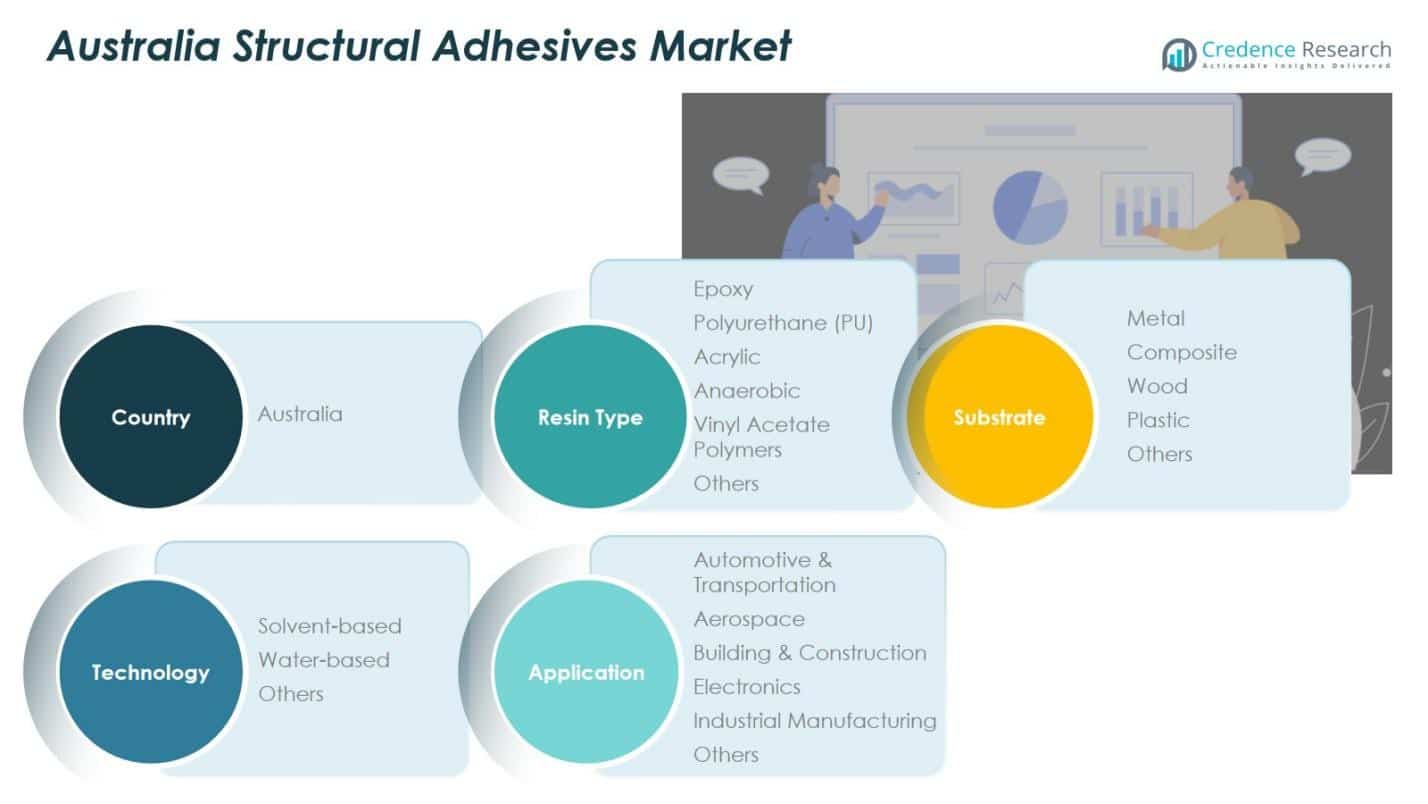
Market Segmentations:
By Resin Type:
- Epoxy
- Polyurethane (PU)
- Acrylic
- Anaerobic
- Vinyl Acetate Polymers
- Others
By Substrate:
- Metal
- Composite
- Wood
- Plastic
- Others
By Technology:
- Solvent-based
- Water-based
- Others
By Application:
- Automotive & Transportation
- Aerospace
- Building & Construction
- Electronics
- Industrial Manufacturing
- Others
By Region
- New Southwales
- Victoria
- Queensland
- Western Australia
- South Australia
- Tasmania
- Australian Capital Territory
Competitive Landscape
The competitive landscape of the Australia Structural Adhesives Market is dominated by key players including Henkel AG & Co. KGaA, Sika AG, 3M Company, Arkema S.A., H.B. Fuller Company, RPM International Inc., Huntsman Corporation, Dow Inc., Illinois Tool Works Inc., and Lord Corporation. These companies focus on product innovation, strategic partnerships, and regional expansions to strengthen their market presence. The market is highly competitive, with companies investing in high-performance epoxy, polyurethane, and acrylic adhesives to meet growing demand in automotive, aerospace, construction, and industrial sectors. Mergers and acquisitions, along with technological advancements in eco-friendly and water-based adhesives, are driving differentiation. Market participants also emphasize research and development to develop customized bonding solutions and enhance customer loyalty. The increasing adoption of lightweight materials, infrastructure development, and sustainability initiatives further intensifies competition, compelling key players to continuously innovate and expand their product portfolios to maintain market leadership.
Key Player Analysis
- Henkel AG & Co. KGaA
- Sika AG
- 3M Company
- Arkema S.A.
- B. Fuller Company
- RPM International Inc.
- Huntsman Corporation
- Dow Inc.
- Illinois Tool Works Inc.
- Lord Corporation
Recent Developments
- In April 2025, Geared Up Culcha introduced its new line of GUC Industrial Silicone Sealants in Australia, reflecting continued product innovation in the country’s adhesives and sealants industry, with potential applications overlapping structural bonding segments.
- In January 2023, H.B. Fuller Company introduced its Enviro Range of performance sealants and adhesives in Australia, developed with the firm’s PolyXSil Hybrid Enviro Technology. This eco-friendly range supports sustainable construction practices and promotes locally manufactured adhesive solutions.
- In September 2024, Bostik, under Arkema Group, launched the Kizen™ LIME adhesive line, featuring up to 80% bio-based ingredients, advancing its sustainability agenda in industrial adhesives.
- In 2022, Bostik Australia Pty Ltd, part of Arkema Group, unveiled new engineering and repair adhesives for the marine sector under its Born2Bond™ range, designed to replace mechanical fasteners and improve lightweight assembly.
Report Coverage
The research report offers an in-depth analysis based on Resin Type, Substrate, Technology, Appllication and Geography. It details leading market players, providing an overview of their business, product offerings, investments, revenue streams, and key applications. Additionally, the report includes insights into the competitive environment, SWOT analysis, current market trends, as well as the primary drivers and constraints. Furthermore, it discusses various factors that have driven market expansion in recent years. The report also explores market dynamics, regulatory scenarios, and technological advancements that are shaping the industry. It assesses the impact of external factors and global economic changes on market growth. Lastly, it provides strategic recommendations for new entrants and established companies to navigate the complexities of the market.
Future Outlook
- The Australia structural adhesives market is expected to witness steady growth driven by increasing automotive and aerospace production.
- Rising infrastructure and construction activities will boost demand for high-performance adhesives.
- Adoption of lightweight materials in manufacturing will further enhance structural adhesive applications.
- Epoxy and polyurethane adhesives will continue to dominate due to their strength and versatility.
- Growth in water-based and eco-friendly adhesives will accelerate due to sustainability regulations.
- Expansion of industrial manufacturing and urban development projects will create new market opportunities.
- Technological advancements in adhesive formulations will improve performance and application efficiency.
- Increased use of composites and multi-material assemblies will drive specialized adhesive demand.
- Key players will focus on product innovation, strategic partnerships, and regional expansion.
- The market will benefit from government initiatives promoting sustainable construction and industrial development.

Request a Free Sample
Fill in your details and we'll send you a free sample report.
- Sample data tables & charts
- Research methodology
Need a Custom Version of This Report?
Tailor the scope, geography, or segments to your exact requirements.
- Custom geography or segment scope
- Direct access to our analyst team
Frequently Asked Questions
What is the current market size for Australia Structural Adhesives Market, and what is its projected size in 2032?
At what Compound Annual Growth Rate is the Australia Structural Adhesives Market projected to grow between 2025 and 2032?
Which Australia Structural Adhesives Market segment held the largest share in 2024?
What are the primary factors fueling the growth of the Australia Structural Adhesives Market?
Who are the leading companies in the Australia Structural Adhesives Market?
Which region commanded the largest share of the Australia Structural Adhesives Market in 2024?
Table of Content
Chapter 1 Market Segmentation
- 1.1 Segmentation Framework
- 1.1.1 Product and Service Classification
- 1.1.2 Application and End-Use Classification
- 1.1.3 Technology and Solution Classification
- 1.1.4 Customer and Distribution Channel Classification
- 1.1.5 Geographic Segmentation
- 1.1.6 Market Segment Definitions and Boundaries
Chapter 2 Introduction
- 2.1 Report Objectives and Scope
- 2.2 Product Definition and Industry Terminology
- 2.3 Market Inclusions and Exclusions
- 2.4 Research Process
- 2.4.1 Primary Research and Expert Interviews
- 2.4.2 Secondary Research and Source Review
- 2.4.3 Top-Down and Bottom-Up Estimation
- 2.4.4 Data Triangulation and Verification
- 2.5 Market Size Measurement Basis
- 2.5.1 2024: USD 327.08 Million → 2032: USD 574.94 Million
- 2.6 Historical and Forecast Reference Periods
- 2.6.1 Base Year: 2024
- 2.6.2 Forecast Period: 2024-2032
- 2.7 Research Assumptions and Limitations
Chapter 3 Executive Summary
- 3.1 Market Snapshot and Key Findings
- 3.2 Base-Year Market Size, 2024
- 3.3 Forecast Market Size, 2032
- 3.4 Revenue and Volume Growth Outlook
- 3.5 Key Demand and Supply Indicators
- 3.6 Leading Market Segments
- 3.7 Fastest-Growing Market Opportunities
- 3.8 Regional Performance Highlights
- 3.9 Technology and Industry Transformation
- 3.10 Competitive Landscape Summary
- 3.11 Analyst View and Strategic Implications
Chapter 4 Australia Structural Adhesives Market Trends and Developments
- 4.1 Historical Industry Development
- 4.2 Recent Market Trends and Developments
- 4.3 Demand and Customer Behavior Trends
- 4.4 Technology and Product Innovation
- 4.5 Artificial Intelligence, Automation and Digitalization
- 4.6 Local Manufacturing and Supply Chain Realignment
- 4.7 Industry Partnerships, Mergers and Acquisitions
- 4.8 Sustainability and Circular Economy Developments
- 4.9 Government and Private Sector Investment Trends
- 4.10 Emerging Business Models and Commercialization
- 4.11 Industry Developments and Announcements
Chapter 5 Australia Structural Adhesives Market Production, Supply and Demand Analysis
- 5.1 Demand Trend and Consumption Analysis
- 5.2 Demand Forecast, 2024-2032
- 5.3 Production and Output Trend
- 5.4 Production and Output Forecast, 2024-2032
- 5.5 Installed Capacity and Capacity Utilization
- 5.6 Company-Wise Production Plants and Statistics
- 5.6.1 Installed Production Capacity
- 5.6.2 Actual Production
- 5.6.3 Planned Capacity and Expansion Targets
- 5.7 Supply Chain Structure and Procurement Trends
- 5.8 Supply-Demand Gap and Bottlenecks
- 5.9 Import Dependence and Sourcing Structure
- 5.10 Contract Manufacturing and Outsourcing
- 5.11 Regional Supply and Demand Concentration
Chapter 6 Australia Structural Adhesives Market Pricing Analysis
- 6.1 Pricing Structure and Measurement
- 6.2 Historical Pricing Trends
- 6.3 Pricing Outlook, 2024-2032
- 6.4 Average Selling Price and Unit Economics
- 6.5 Pricing by Product and Market Segment
- 6.6 Geographic Pricing Differences
- 6.7 Key Input, Energy, Labor and Logistics Costs
- 6.8 Contract Pricing and Purchasing Models
- 6.9 Pricing Sensitivity and Competitive Positioning
- 6.10 Price, Margin and Profitability Implications
Chapter 7 Australia Structural Adhesives Market Dynamics
- 7.1 Market Growth Drivers
- 7.1.1 Demand-Side Drivers
- 7.1.2 Technology and Innovation Drivers
- 7.1.3 Infrastructure and Investment Drivers
- 7.1.4 Regulatory and Policy Drivers
- 7.2 Market Restraints
- 7.2.1 Cost and Affordability Constraints
- 7.2.2 Technology and Adoption Barriers
- 7.2.3 Supply Chain and Operational Constraints
- 7.3 Market Challenges
- 7.3.1 Competitive Pressure and Margin Erosion
- 7.3.2 Skills, Infrastructure and Implementation Gaps
- 7.4 Emerging Market Opportunities
- 7.5 Market Dynamics Impact and Time-Horizon Assessment
Chapter 8 Australia Structural Adhesives Value Chain Analysis
- 8.1 Industry Value Chain Overview
- 8.2 Upstream Suppliers and Critical Inputs
- 8.3 Technology and Component Providers
- 8.4 Manufacturing or Service Delivery
- 8.5 Distribution, Channel Partners and Integrators
- 8.6 Downstream Applications and End Users
- 8.7 Value Addition and Profit Pools
- 8.8 Vertical Integration and Outsourcing
- 8.9 Supplier Concentration and Risk
- 8.10 Supply Chain Localization and Resilience
Chapter 9 Australia Structural Adhesives Market Regulations and Policies
- 9.1 Relevant Laws, Standards and Compliance Frameworks
- 9.2 Product, Service, Safety and Quality Requirements
- 9.3 Government Policies, Incentives and Subsidies
- 9.4 Imports, Exports and Trade Barriers
- 9.5 Public Procurement and Local Content Requirements
- 9.6 Environmental and Sustainability Compliance
- 9.7 Upcoming Policy Changes and Market Implications
Chapter 10 Australia Structural Adhesives Market Hotspots and Opportunities
- 10.1 Market Opportunity Mapping and Growth Hotspots
- 10.2 High-Growth Applications and Customer Groups
- 10.3 Underserved Markets and White-Space Opportunities
- 10.4 Emerging Technology and Product Opportunities
- 10.5 New Capacity and Investment Hotspots
- 10.6 Market Entry and Expansion Opportunities
- 10.7 Distribution and Partnership Opportunities
- 10.8 Near-Term and Long-Term Commercial Potential
- 10.9 Opportunity Attractiveness and Execution Risks
Chapter 11 Australia Structural Adhesives Market Outlook, 2024-2032
- 11.1 Market Size and Analysis
- 11.1.1 Revenue (Market Measurement: 2024: USD 327.08 Million → 2032: USD 574.94 Million)
- 11.1.2 Market Volume and Quantity Sold
- 11.1.3 Historical Market Size
- 11.1.4 Base-Year Market Size, 2024
- 11.2 Market Forecast, 2024-2032
- 11.2.1 Revenue Forecast to 2032
- 11.2.2 Volume Forecast to 2032
- 11.2.3 CAGR and Year-on-Year Growth
- 11.2.4 Incremental Revenue Opportunity
- 11.3 Forecast Assumptions and Scenario Analysis
- 11.3.1 Base-Case Forecast
- 11.3.2 Optimistic and Conservative Scenarios
- 11.3.3 Technology, Pricing and Policy Sensitivities
- 11.4 Market Attractiveness and Growth Outlook
Chapter 12 Australia Structural Adhesives Market Segmentation and Outlook
- 12.1 Segmentation Summary and Market Shares, 2024
- 12.2 Largest and Fastest-Growing Segments
- 12.3 Segment Growth Comparison
- 12.4 Segment Attractiveness and Priority Matrix
Chapter 13 Australia Structural Adhesives Geographic Market Outlook, 2024-2032
- 13.1 Domestic Market Distribution and Demand Clusters
- 13.2 State- or Province-Wise Market Size and Forecast, 2024-2032
- 13.3 City and Metropolitan Market Outlook
- 13.4 Industrial, Manufacturing and Commercial Clusters
- 13.5 Geographic Concentration of Key End Users
- 13.6 Local Pricing and Purchasing Differences
- 13.7 Domestic Production Facilities and Capacity Map
- 13.8 Local Infrastructure and Project Pipeline
- 13.9 State-Level Policy and Incentive Differences
- 13.10 Subnational Investment Hotspots and Opportunities
- 13.11 Distribution and Logistics Networks
- 13.12 Domestic Competitive Footprint
Chapter 14 Australia Structural Adhesives Technology, Innovation and Sustainability Outlook
- 14.1 Technology Landscape and Maturity
- 14.2 Product, Process and Service Innovation
- 14.3 AI, Automation and Digital Tools in the Industry
- 14.4 Technology Adoption and Performance Benchmarking
- 14.5 Innovation Pipeline and R&D Investment
- 14.6 Patent and Intellectual Property Trends
- 14.7 Energy Efficiency and Resource Management
- 14.8 Sustainability, Recycling and Circularity
- 14.9 Technology Roadmap, 2024-2032
- 14.10 Risks of Obsolescence and Technology Substitution
Chapter 15 Australia Structural Adhesives Market Key Strategic Imperatives
- 15.1 Growth and Market Entry Priorities
- 15.2 High-Return Products and Segments
- 15.3 Pricing, Profitability and Cost Optimization
- 15.4 Technology Investment and Product Differentiation
- 15.5 Supply Chain Localization and Resilience
- 15.6 Distribution and Customer Acquisition
- 15.7 Partnership, Acquisition and Capacity Strategy
- 15.8 Regional Expansion Priorities
- 15.9 Short-, Medium- and Long-Term Actions
Chapter 16 Competition Outlook
- 16.1 Industry Competition Characteristics
- 16.2 Market Structure and Concentration
- 16.3 Market Share and Competitive Positioning, 2024
- 16.4 Company-Wise Revenue and Product Benchmarking
- 16.5 Production and Service Capacity Benchmarking
- 16.6 Technology, Pricing and Differentiation
- 16.7 Regional Footprint and Distribution Strength
- 16.8 Mergers, Acquisitions and Strategic Alliances
- 16.9 New Entrants and Competitive Threats
- 16.10 Porter's Five Forces and Industry Attractiveness
- 16.11 Competitive Outlook, 2024-2032
Chapter 17 Company Profiles
- 17.1 Company Coverage and Selection Criteria
- 17.2 Leading Market Participants – Standard Profile Structure
- 17.2.1 Business Description
- 17.2.2 Company Ownership and Geographic Presence
- 17.2.3 Product and Service Portfolio
- 17.2.4 Manufacturing and Operating Footprint
- 17.2.5 Production Capacity and Expansion Plans
- 17.2.6 Financial Performance and Investment
- 17.2.7 Market Share and Competitive Position
- 17.2.8 Technology and Innovation Capabilities
- 17.2.9 Strategic Alliances or Partnerships
- 17.2.10 Recent Developments
- 17.2.11 Growth Strategy and Outlook
- 17.3 Other Relevant Market Participants
Note: Every listed company is profiled on the structure shown under the first company. The company list is preliminary and may change based on research findings, market developments, data availability and client requirements.
Chapter 18 Disclaimer
- 18.1 Research and Forecast Disclaimer
- 18.2 Data Source and Estimation Limitations
Note: The depth of individual sections depends on data availability for this market. Volume, capacity, trade and other unit-based metrics are included where applicable.

