
| REPORT ATTRIBUTE | DETAILS |
|---|---|
| Historical Period | 2020-2023 |
| Base Year | 2024 |
| Forecast Period | 2025-2032 |
| Automatic Gate and Door Opening System Market Size 2024 | USD 3270 million |
| Automatic Gate and Door Opening System Market, CAGR | 7% |
| Automatic Gate and Door Opening System Market Size 2032 | USD 5618.47 million |
Market Overview
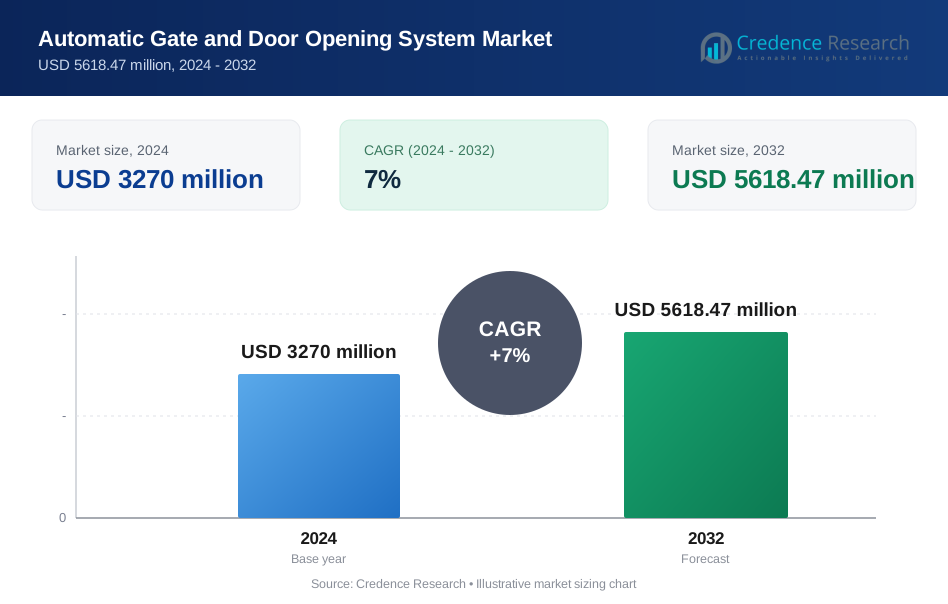
Automatic Gate and Door Opening System Market size was valued at USD 3270 million in 2024 and is anticipated to reach USD 5618.47 million by 2032, at a CAGR of 7% during the forecast period (2024-2032).
Key drivers propelling the market include the growing need for security solutions in both residential and commercial settings. Automatic gates and doors provide a convenient and secure means of access, reducing human intervention and the risk of unauthorized entry. The rising demand for automated solutions is particularly evident in high-traffic areas such as airports, malls, and office buildings, where efficiency and safety are paramount. Additionally, the integration of IoT and smart technologies into gate and door systems has enhanced functionality, enabling remote access control, monitoring, and integration with other smart home devices. These innovations are further fueling market growth, as consumers increasingly seek seamless integration with other technologies. Moreover, the increasing popularity of energy-efficient systems contributes to the expansion of the market, as automatic doors and gates are designed to reduce energy consumption by optimizing opening and closing functions, which appeals to businesses and homeowners looking to reduce operational costs.
Regionally, North America holds the largest share of the Automatic Gate and Door Opening System Market, accounting for over 35% in 2023. This dominance is attributed to the rapid adoption of smart technologies, high demand for automated security solutions, and the presence of key industry players. Furthermore, strict regulations concerning safety and security in both residential and commercial sectors have spurred demand for automated systems. Europe follows closely, driven by growing infrastructure developments and the increasing focus on energy-efficient technologies. The region’s emphasis on sustainability and green building standards further supports the market growth. The Asia Pacific region is anticipated to witness the highest growth rate, fueled by rapid urbanization, increasing investments in smart cities, and the rising demand for automation in residential and commercial buildings. Additionally, the expansion of key industries like manufacturing and retail in emerging economies is expected to significantly drive demand.
Market Insights:
- The Automatic Gate and Door Opening System Market is projected to grow from USD 3270 million in 2024 to USD 5618.47 million by 2032, driven by increased demand for security solutions in residential and commercial sectors.
- High-traffic areas such as airports, malls, and office buildings are seeing significant adoption of automated solutions due to the need for improved efficiency and security.
- The integration of IoT and smart technologies is enhancing system functionality, allowing for remote access control, monitoring, and seamless integration with other smart home devices.
- Energy-efficient systems are gaining popularity, as automatic gates and doors help reduce energy consumption by optimizing opening and closing cycles, particularly in high-traffic environments.
- Technological advancements in automation and sensor technologies are making these systems more affordable and accessible, driving higher adoption rates in both residential and commercial sectors.
- The high initial installation costs and complexity of maintenance and repair remain key challenges, particularly for small businesses and residential properties.
- North America holds the largest market share, with strong growth driven by smart technology adoption, security needs, and energy efficiency requirements, particularly in urban areas.
Market Drivers:
Increasing Demand for Enhanced Security Solutions:
The rising demand for security systems in both residential and commercial settings is a primary driver for the growth of the automatic gate and door opening system market. Automatic gates and doors provide a convenient, secure means of access, significantly reducing human intervention while enhancing the overall security of properties. These systems help in preventing unauthorized access, particularly in high-risk areas such as industrial sites, office buildings, airports, and shopping malls, where security is paramount. The growing concerns about crime and unauthorized entry have led property owners to seek automated solutions that offer enhanced safety features, including integrated security technologies such as surveillance cameras, motion sensors, and biometric access controls.
Automation and Smart Integration:
The increasing shift toward automation and the integration of smart technologies is another critical factor driving the demand for automatic gate and door opening systems. Consumers and businesses alike are gravitating toward solutions that offer seamless integration with smart home and building management systems. For instance, Infineon Technologies provides scalable solutions that enable automatic door systems to be integrated into smart homes, offering features such as remote control, diagnostics, and easy connectivity for enhanced user convenience and security. The use of IoT (Internet of Things) technologies allows for remote control, monitoring, and management of gates and doors from mobile devices or central control systems. This integration is particularly valuable in commercial properties, where large-scale automation of access points is essential for improving operational efficiency. Smart gates and doors can also be programmed to provide personalized entry, streamlining the user experience while enhancing security.
Growing Focus on Energy Efficiency:
Energy efficiency is becoming an increasingly important consideration in building and infrastructure design, driving the demand for automatic gate and door opening systems. Automatic systems help minimize energy waste by optimizing door and gate opening and closing cycles, thus reducing heating or cooling losses. For instance, ASSA ABLOY’s automatic doors are engineered to minimize energy loss by opening only when necessary and closing quickly, which is particularly beneficial in buildings with high foot traffic or in regions with extreme temperatures. These systems are designed to reduce the amount of energy spent on manual operations or inefficient traditional doors, contributing to lower energy consumption. This makes them an attractive option for commercial and residential applications, especially in regions with stringent environmental regulations or where energy-saving technologies are incentivized.
Technological Advancements and Cost Reduction:
Technological advancements in automation, sensor technologies, and materials science have significantly reduced the cost of automatic gate and door systems. Innovations such as high-performance sensors, improved motors, and more durable materials have led to the development of cost-effective solutions that are increasingly accessible to both residential and commercial sectors. The widespread availability of these advanced systems has led to higher adoption rates, as businesses and homeowners are more willing to invest in automated systems that offer long-term benefits. Additionally, the decreasing cost of these systems, coupled with their enhanced functionality, has led to increased penetration across emerging markets, where the adoption of smart technologies is on the rise.
Market Trends:
Integration of Smart Technologies:
One of the most significant trends in the Automatic Gate and Door Opening System Market is the integration of smart technologies. Consumers and businesses are increasingly adopting IoT-enabled systems, allowing gates and doors to be remotely controlled and monitored via smartphones or integrated home automation systems. These systems provide enhanced convenience, security, and energy efficiency, enabling users to control access points from anywhere in the world. Additionally, the incorporation of voice recognition, facial recognition, and biometrics into access control systems is becoming more prevalent, further improving security and personalization.
Energy-Efficient Solutions:
There is a growing demand for energy-efficient automatic gate and door opening systems, driven by global sustainability efforts and stringent environmental regulations. Modern systems are designed with energy-saving features, such as automated closing and opening mechanisms that minimize energy loss. For instance, ASSA ABLOY’s energy-efficient automatic doors are engineered to minimize air leakage and maintain indoor climate control, which helps prevent heat or cold air from escaping and directly contributes to reducing energy bills and improving building performance. This trend is particularly noticeable in commercial buildings, where reducing energy consumption is a priority. Energy-efficient automatic doors help maintain indoor climate control by preventing heat or cold air from escaping, which contributes to reducing energy bills and improving overall building performance.
Advancements in Sensor Technologies:
Advancements in sensor technologies are reshaping the functionality of automatic gate and door systems. The latest systems utilize infrared, motion, and pressure sensors for precise detection, ensuring smooth operation even in high-traffic areas. For instance, Cognitive Market Research notes that infrared sensors are now widely adopted in commercial and public buildings due to their reliability and accuracy in detecting motion, which enhances user safety and operational efficiency. These sensors help increase the reliability of automatic gates and doors by reducing malfunctioning risks and enhancing user safety. Moreover, these systems are now able to adjust their operations based on traffic flow, optimizing the user experience while enhancing security.
Rising Adoption in Emerging Markets:
The Automatic Gate and Door Opening System Market is seeing increased adoption in emerging economies, where urbanization and infrastructure development are driving demand for automated systems. As cities expand and modernize, there is a growing need for secure and efficient access control systems in both residential and commercial properties. The trend of adopting automatic gate and door systems is gaining momentum in these regions as affordability improves, making them accessible to a broader consumer base.
Market Challenges Analysis:
High Initial Installation Costs:
One of the key challenges facing the Automatic Gate and Door Opening System Market is the high initial installation costs. The integration of advanced technologies such as sensors, motors, and IoT connectivity can be expensive, particularly for large-scale commercial applications. For instance, the Housing Authority of the City of San Antonio, Texas (SAHA) has publicly issued invitations for bids specifically to address the installation, maintenance, and replacement of automatic gates across its properties, highlighting the need for skilled contractors and comprehensive service contracts to ensure quality and safety for residents. The cost of these systems can be prohibitive for small businesses or residential properties, limiting their adoption. Furthermore, installation requires skilled labor, and any system modifications or upgrades can incur additional costs, making it a significant investment. These high upfront costs may deter potential customers, especially in regions where cost sensitivity is a major factor. As a result, businesses and property owners are often hesitant to invest in these solutions, especially when traditional manual gates and doors may offer lower initial costs. To address this challenge, manufacturers are focusing on offering more affordable and scalable solutions to expand their customer base.
Maintenance and Repair Complexity:
Another challenge in the market is the complexity of maintenance and repair. Automatic gate and door systems often require regular maintenance to ensure optimal performance, particularly in high-traffic areas. The integration of advanced sensors, motors, and control systems increases the risk of malfunctions, which can result in costly repairs or downtime. Moreover, specialized technicians are often needed for troubleshooting and repairs, adding to operational costs. For businesses or property owners with limited access to qualified service providers, the maintenance burden can be a significant deterrent, affecting long-term adoption rates. Additionally, the need for ongoing upgrades to keep systems compatible with evolving technologies further complicates the management of these automated solutions. This can lead to increased lifecycle costs, ultimately reducing the overall appeal of automatic gate and door systems for potential customers.
Market Opportunities:
The Automatic Gate and Door Opening System Market presents significant opportunities for growth, primarily driven by the increasing demand for smart and automated solutions across various sectors. With the rising adoption of smart home technologies and the growing focus on security, there is a growing need for advanced access control systems that offer convenience, safety, and energy efficiency. As residential and commercial properties become more automated, the integration of automatic gates and doors with other smart devices, such as home security systems and IoT platforms, presents a compelling market opportunity. These systems not only enhance the user experience but also improve operational efficiency and reduce energy consumption, making them attractive to both property owners and businesses looking to modernize their infrastructure.
Additionally, emerging markets, particularly in Asia Pacific, represent a significant growth opportunity due to rapid urbanization, increasing infrastructure development, and rising disposable incomes. As cities expand and new commercial and residential complexes are developed, the demand for efficient, secure, and automated access solutions will continue to rise. Moreover, technological advancements, such as the integration of AI, machine learning, and biometric identification, open new avenues for innovation in the market. These technologies can improve security and functionality, offering a competitive edge to companies that incorporate them into their product offerings. As the market matures, the ability to provide customized and scalable solutions tailored to specific customer needs will further fuel expansion.
Market Segmentation Analysis:
By Type
The market is segmented into sliding gates, swing gates, and barrier gates. Sliding gates are preferred for their space efficiency, making them ideal for both residential and commercial properties. They provide secure access control, particularly in locations with limited space. Swing gates, which operate via hinges, offer a traditional choice, particularly for residential areas but are also increasingly utilized in commercial settings with larger entryways. Barrier gates, commonly seen in automated parking systems, enable smooth traffic flow in high-traffic areas and are favored for their speed and efficiency.
By Access Control System
Access control systems in the market include electronic locks, biometric systems, RFID systems, and keypads. Electronic locks are gaining popularity due to their ease of use and seamless integration with existing systems, offering a straightforward approach to access control. Biometric systems, such as fingerprint and facial recognition, are increasingly used in high-security areas, providing an added layer of security and convenience for users. RFID-based systems are favored for their contactless functionality, offering fast and efficient access, especially in commercial applications. Keypad-based systems remain a reliable, cost-effective option, widely used in residential and smaller commercial spaces. These systems enhance the versatility and security of automatic gates and door opening solutions.
Segmentations:
By Type
- Sliding Gates
- Swing Gates
- Barrier Gates
By Access Control System
- Electronic Locks
- Biometric Systems
- RFID Systems
- Keypad Systems
By Region
- North America
- U.S.
- Canada
- Mexico
- Europe
- UK
- France
- Germany
- Italy
- Spain
- Russia
- Belgium
- Netherlands
- Austria
- Sweden
- Poland
- Denmark
- Switzerland
- Rest of Europe
- Asia Pacific
- China
- Japan
- South Korea
- India
- Australia
- Thailand
- Indonesia
- Vietnam
- Malaysia
- Philippines
- Taiwan
- Rest of Asia Pacific
- Latin America
- Brazil
- Argentina
- Peru
- Chile
- Colombia
- Rest of Latin America
- Middle East
- UAE
- KSA
- Israel
- Turkey
- Iran
- Rest of Middle East
- Africa
- Egypt
- Nigeria
- Algeria
- Morocco
- Rest of Africa
Regional Analysis:
North America North America holds the largest market share of 35%, driven by high adoption rates of smart technologies and automated solutions across both residential and commercial sectors. The region is home to several key players, and its demand for security systems and automation continues to grow, particularly in urban areas. The United States contributes significantly to this market growth due to its vast commercial infrastructure, where security automation is increasingly seen as a necessity. Additionally, strict safety regulations and an emphasis on energy efficiency are encouraging the adoption of advanced systems. The market in North America continues to thrive as technology integration in smart homes and commercial spaces accelerates, making it a hub for innovation in the field. The ongoing trend of digitization in both private and public sectors further supports the growth of automated systems.
Europe Europe holds a market share of 28%, with a strong demand for energy-efficient and sustainable building solutions. The growing focus on reducing carbon footprints and optimizing operational efficiency has driven the adoption of automatic gates and doors, especially in commercial buildings and residential complexes. Key markets such as Germany, the UK, and France are leading the charge, investing in infrastructure modernization and stringent safety standards. The European market is also influenced by regulatory pressures to meet environmental and energy-saving standards, which automatically pushes for automated access solutions. Technological advancements and government incentives further propel the region's market growth, positioning Europe as a leader in energy-conscious automation. Additionally, the region's emphasis on creating smart cities increases the need for intelligent security systems in both private and commercial sectors.
Asia Pacific The Asia Pacific region holds a market share of 26%, with rapid urbanization and increased infrastructure development in countries like China, India, and Japan fueling market growth. The region is experiencing significant shifts toward smart city initiatives and advanced building management systems, where automated gate and door systems play a key role. As disposable incomes rise and urbanization expands, there is a growing demand for secure and energy-efficient access control solutions. The availability of cost-effective products and a growing focus on energy efficiency are driving the adoption of these systems in emerging economies. This trend is expected to continue as more cities embrace smart technologies, making Asia Pacific a key region for future market expansion. Governments in the region are also supporting the development of infrastructure that incorporates advanced automation technologies.
Key Player Analysis:
- BENINCA Group
- Katers Automation
- King Gates SRL
- Chamberlain Group
- CAME BPT UK Ltd
- Ken Wan
- Roteco SRL
- Aleko Products
- Homelife Integration
- Ditec Entrematic
Competitive Analysis:
The Automatic Gate and Door Opening System Market is highly competitive, with several key players striving to capture market share through technological advancements, product innovation, and strategic partnerships. Major companies such as Assa Abloy, Chamberlain Group, and DoorKing dominate the market, offering a range of automated solutions for residential, commercial, and industrial applications. These companies focus on integrating smart technologies, such as IoT, sensors, and biometric access systems, to enhance the functionality of their products. Additionally, regional players are also gaining traction by providing cost-effective solutions tailored to local market needs, particularly in emerging economies. Competition is intensified by the growing demand for energy-efficient and secure automated systems, with many players focusing on sustainability and energy-saving features. Companies are also exploring new business models, such as subscription-based services for maintenance and remote monitoring, to differentiate themselves in the market and improve customer engagement.
Recent Developments:
- In April 2025, Chamberlain Group’s LiftMaster brand began shipping its new TECHNA lineup of smart barrier gate operators, which feature high-efficiency brushless DC motors, advanced battery backup, solar kit compatibility, built-in Wi-Fi, and integrated myQ technology for remote monitoring and predictive maintenance. These innovations were showcased at ISC West in Las Vegas in April 2025.
- In January 2025, CAME announced global advancements in its gate automation portfolio, including enhanced CAME CONNECT cloud-based remote management, adaptive speed and torque technology, and new digital control panels with wireless safety features (CXN BUS, RIO wireless system).
- In May 2024, Katers Automation was mentioned in strategic business reports as actively contributing to the market’s growth, particularly through the integration of IoT and smart home compatibility in its latest gate automation solutions.
Market Concentration & Characteristics:
The Automatic Gate and Door Opening System Market exhibits a moderate to high concentration, with a few dominant players holding significant market share. Major companies such as Assa Abloy, Chamberlain Group, and DoorKing lead the market by offering innovative products with advanced features, including IoT integration, smart access controls, and energy-efficient systems. These companies leverage economies of scale, strong brand recognition, and extensive distribution networks to maintain their competitive edge. However, the market also includes numerous regional players catering to local demands with cost-effective solutions. The market is characterized by continuous technological advancements, with a focus on enhancing security, automation, and sustainability. Additionally, there is an increasing trend towards customization, as consumers seek solutions tailored to specific needs. While the larger players dominate the commercial and residential sectors, regional and smaller companies are gaining traction by offering niche products and services that address the unique demands of emerging markets.
Report Coverage:
The research report offers an in-depth analysis based on Type, Access Control System and Region. It details leading market players, providing an overview of their business, product offerings, investments, revenue streams, and key applications. Additionally, the report includes insights into the competitive environment, SWOT analysis, current market trends, as well as the primary drivers and constraints. Furthermore, it discusses various factors that have driven market expansion in recent years. The report also explores market dynamics, regulatory scenarios, and technological advancements that are shaping the industry. It assesses the impact of external factors and global economic changes on market growth. Lastly, it provides strategic recommendations for new entrants and established companies to navigate the complexities of the market.
Future Outlook:
- The integration of artificial intelligence and machine learning is enhancing the adaptability and intelligence of automatic gate and door systems, enabling them to learn user behaviors and improve security protocols.
- Advancements in sensor technologies, such as infrared and radar sensors, are improving the accuracy and responsiveness of automatic entry systems, contributing to enhanced user experience and operational efficiency.
- The growing emphasis on energy efficiency is driving the development of solar-powered and low-energy automatic gate and door systems, aligning with global sustainability goals.
- The increasing adoption of smart home technologies is propelling the demand for automated entry solutions that offer remote monitoring and control via smartphones and other connected devices.
- Urbanization and infrastructure development are expanding the need for automatic gate and door systems in residential complexes, commercial establishments, and public transportation hubs.
- The rising focus on accessibility and compliance with regulatory standards is promoting the adoption of touchless and ADA-compliant automatic entry solutions in public and commercial buildings.
- The proliferation of contactless access control methods, including biometric and RFID technologies, is enhancing security and convenience in various sectors.
- The industrial sector is increasingly utilizing automated entry systems to streamline operations, improve security, and manage high-traffic areas effectively.
- The Asia-Pacific region is experiencing rapid growth in demand for automatic gate and door systems, driven by industrialization, urbanization, and increasing security concerns.
- Ongoing research and development efforts are focusing on integrating advanced technologies, such as IoT and robotics, into automatic gate and door systems to enhance functionality and user experience.
Request a Free Sample
Fill in your details and we'll send you a free sample report.
- Sample data tables & charts
- Research methodology
Market Dynamics
Growing Need for Enhanced Security Solutions
Automatic gate and door opening systems are increasingly adopted in both residential and commercial settings to prevent unauthorized access and improve property security, especially in high-risk and high-traffic areas such as airports, malls, and office buildings.
Integration of IoT and Smart Technologies
The adoption of IoT-enabled and smart technologies allows for remote access control, monitoring, and seamless integration with other smart home or building management systems, making these solutions more attractive and functional for end users.
Focus on Energy Efficiency and Sustainability
Automatic gates and doors are designed to optimize opening and closing cycles, reducing energy loss and operational costs, which is particularly appealing in regions with strict energy regulations and among businesses seeking to lower their carbon footprint.
Technological Advancements and Cost Reduction
Improvements in sensor technology, automation, and materials have made automatic gate and door systems more affordable and reliable, increasing their accessibility and adoption across both developed and emerging markets.
Urbanization and Infrastructure Development
Rapid urbanization and the expansion of smart cities, especially in Asia Pacific and emerging markets, are driving demand for automated access solutions in new residential complexes, commercial buildings, and public infrastructure projects.
Need a Custom Version of This Report?
Tailor the scope, geography, or segments to your exact requirements.
- Custom geography or segment scope
- Direct access to our analyst team
Frequently Asked Questions
What is the market size of the Automatic Gate and Door Opening System Market?
What are the key drivers of growth in the Automatic Gate and Door Opening System Market?
Which region holds the largest market share for Automatic Gate and Door Opening Systems?
Which region is expected to witness the highest growth in the Automatic Gate and Door Opening System Market?
Table of Content
Chapter 1 Market Segmentation
- 1.1 Segmentation Framework
- 1.1.1 Product and Service Classification
- 1.1.2 Application and End-Use Classification
- 1.1.3 Technology and Solution Classification
- 1.1.4 Customer and Distribution Channel Classification
- 1.1.5 Geographic Segmentation
- 1.1.6 Market Segment Definitions and Boundaries
- 1.2 By Type
- 1.2.1 Sliding Gates
- 1.2.2 Swing Gates
- 1.2.3 Barrier Gates
- 1.3 By End User
- 1.3.1 Residential
- 1.3.2 Commercial
- 1.3.3 Industrial
- 1.3.4 Public Infrastructure
- 1.4 By Access Control System
- 1.4.1 Electronic Locks
- 1.4.2 Biometric Systems
- 1.4.3 RFID Systems
- 1.4.4 Keypad Systems
Chapter 2 Introduction
- 2.1 Report Objectives and Scope
- 2.2 Product Definition and Industry Terminology
- 2.3 Market Inclusions and Exclusions
- 2.4 Research Process
- 2.4.1 Primary Research and Expert Interviews
- 2.4.2 Secondary Research and Source Review
- 2.4.3 Top-Down and Bottom-Up Estimation
- 2.4.4 Data Triangulation and Verification
- 2.5 Market Size Measurement Basis
- 2.5.1 2024: USD 3270 million → 2032: USD 5618.47 million
- 2.6 Historical and Forecast Reference Periods
- 2.6.1 Base Year: 2024
- 2.6.2 Forecast Period: 2024-2032
- 2.7 Research Assumptions and Limitations
Chapter 3 Executive Summary
- 3.1 Market Snapshot and Key Findings
- 3.2 Base-Year Market Size, 2024
- 3.3 Forecast Market Size, 2032
- 3.4 Revenue and Volume Growth Outlook
- 3.5 Key Demand and Supply Indicators
- 3.6 Leading Market Segments
- 3.7 Fastest-Growing Market Opportunities
- 3.8 Regional Performance Highlights
- 3.9 Technology and Industry Transformation
- 3.10 Competitive Landscape Summary
- 3.11 Analyst View and Strategic Implications
Chapter 4 Global Automatic Gate and Door Opening System Market Trends and Developments
- 4.1 Historical Industry Development
- 4.2 Recent Market Trends and Developments
- 4.3 Demand and Customer Behavior Trends
- 4.4 Technology and Product Innovation
- 4.5 Artificial Intelligence, Automation and Digitalization
- 4.6 Local Manufacturing and Supply Chain Realignment
- 4.7 Industry Partnerships, Mergers and Acquisitions
- 4.8 Sustainability and Circular Economy Developments
- 4.9 Government and Private Sector Investment Trends
- 4.10 Emerging Business Models and Commercialization
- 4.11 Industry Developments and Announcements
Chapter 5 Global Automatic Gate and Door Opening System Market Production, Supply and Demand Analysis
- 5.1 Demand Trend and Consumption Analysis
- 5.2 Demand Forecast, 2024-2032
- 5.3 Production and Output Trend
- 5.4 Production and Output Forecast, 2024-2032
- 5.5 Installed Capacity and Capacity Utilization
- 5.6 Company-Wise Production Plants and Statistics
- 5.6.1 Installed Production Capacity
- 5.6.2 Actual Production
- 5.6.3 Planned Capacity and Expansion Targets
- 5.7 Supply Chain Structure and Procurement Trends
- 5.8 Supply-Demand Gap and Bottlenecks
- 5.9 Import Dependence and Sourcing Structure
- 5.10 Contract Manufacturing and Outsourcing
- 5.11 Regional Supply and Demand Concentration
Chapter 6 Global Automatic Gate and Door Opening System Market Pricing Analysis
- 6.1 Pricing Structure and Measurement
- 6.2 Historical Pricing Trends
- 6.3 Pricing Outlook, 2024-2032
- 6.4 Average Selling Price and Unit Economics
- 6.5 Pricing by Product and Market Segment
- 6.6 Geographic Pricing Differences
- 6.7 Key Input, Energy, Labor and Logistics Costs
- 6.8 Contract Pricing and Purchasing Models
- 6.9 Pricing Sensitivity and Competitive Positioning
- 6.10 Price, Margin and Profitability Implications
Chapter 7 Global Automatic Gate and Door Opening System Market Dynamics
- 7.1 Market Growth Drivers
- 7.1.1 Demand-Side Drivers
- 7.1.2 Technology and Innovation Drivers
- 7.1.3 Infrastructure and Investment Drivers
- 7.1.4 Regulatory and Policy Drivers
- 7.2 Market Restraints
- 7.2.1 Cost and Affordability Constraints
- 7.2.2 Technology and Adoption Barriers
- 7.2.3 Supply Chain and Operational Constraints
- 7.3 Market Challenges
- 7.3.1 Competitive Pressure and Margin Erosion
- 7.3.2 Skills, Infrastructure and Implementation Gaps
- 7.4 Emerging Market Opportunities
- 7.5 Market Dynamics Impact and Time-Horizon Assessment
Chapter 8 Global Automatic Gate and Door Opening System Value Chain Analysis
- 8.1 Industry Value Chain Overview
- 8.2 Upstream Suppliers and Critical Inputs
- 8.3 Technology and Component Providers
- 8.4 Manufacturing or Service Delivery
- 8.5 Distribution, Channel Partners and Integrators
- 8.6 Downstream Applications and End Users
- 8.7 Value Addition and Profit Pools
- 8.8 Vertical Integration and Outsourcing
- 8.9 Supplier Concentration and Risk
- 8.10 Supply Chain Localization and Resilience
Chapter 9 Global Automatic Gate and Door Opening System Market Regulations and Policies
- 9.1 Relevant Laws, Standards and Compliance Frameworks
- 9.2 Product, Service, Safety and Quality Requirements
- 9.3 Government Policies, Incentives and Subsidies
- 9.4 Imports, Exports and Trade Barriers
- 9.5 Public Procurement and Local Content Requirements
- 9.6 Environmental and Sustainability Compliance
- 9.7 Upcoming Policy Changes and Market Implications
Chapter 10 Global Automatic Gate and Door Opening System Market Hotspots and Opportunities
- 10.1 Market Opportunity Mapping and Growth Hotspots
- 10.2 High-Growth Applications and Customer Groups
- 10.3 Underserved Markets and White-Space Opportunities
- 10.4 Emerging Technology and Product Opportunities
- 10.5 New Capacity and Investment Hotspots
- 10.6 Market Entry and Expansion Opportunities
- 10.7 Distribution and Partnership Opportunities
- 10.8 Near-Term and Long-Term Commercial Potential
- 10.9 Opportunity Attractiveness and Execution Risks
Chapter 11 Global Automatic Gate and Door Opening System Market Outlook, 2024-2032
- 11.1 Market Size and Analysis
- 11.1.1 Revenue (Market Measurement: 2024: USD 3270 million → 2032: USD 5618.47 million)
- 11.1.2 Market Volume and Quantity Sold
- 11.1.3 Historical Market Size
- 11.1.4 Base-Year Market Size, 2024
- 11.2 Market Forecast, 2024-2032
- 11.2.1 Revenue Forecast to 2032
- 11.2.2 Volume Forecast to 2032
- 11.2.3 CAGR and Year-on-Year Growth
- 11.2.4 Incremental Revenue Opportunity
- 11.3 Forecast Assumptions and Scenario Analysis
- 11.3.1 Base-Case Forecast
- 11.3.2 Optimistic and Conservative Scenarios
- 11.3.3 Technology, Pricing and Policy Sensitivities
- 11.4 Market Attractiveness and Growth Outlook
Chapter 12 Global Automatic Gate and Door Opening System Market Segmentation and Outlook
- 12.1 Segmentation Summary and Market Shares, 2024
- 12.2 Largest and Fastest-Growing Segments
- 12.3 By Type - Market Size and Forecast, 2024-2032
- 12.3.1 Segment Definition and Scope
- 12.3.2 Historical Market Size
- 12.3.3 Revenue Forecast, 2024-2032
- 12.3.4 Volume Forecast, 2024-2032
- 12.3.5 Base-Year Market Share, 2024
- 12.3.6 Segment CAGR and Growth Drivers
- 12.3.7 Subsegment Market Size and Forecast
- 12.3.7.1 Sliding Gates
- 12.3.7.2 Swing Gates
- 12.3.7.3 Barrier Gates
- 12.3.8 Subsegment Pricing and Adoption Trends
- 12.3.9 Leading Suppliers and Competition
- 12.3.10 Regional Demand and Opportunities
- 12.4 By End User - Market Size and Forecast, 2024-2032
- 12.4.1 Segment Definition and Scope
- 12.4.2 Historical Market Size
- 12.4.3 Revenue Forecast, 2024-2032
- 12.4.4 Volume Forecast, 2024-2032
- 12.4.5 Base-Year Market Share, 2024
- 12.4.6 Segment CAGR and Growth Drivers
- 12.4.7 Subsegment Market Size and Forecast
- 12.4.7.1 Residential
- 12.4.7.2 Commercial
- 12.4.7.3 Industrial
- 12.4.7.4 Public Infrastructure
- 12.4.8 Subsegment Pricing and Adoption Trends
- 12.4.9 Leading Suppliers and Competition
- 12.4.10 Regional Demand and Opportunities
- 12.5 By Access Control System - Market Size and Forecast, 2024-2032
- 12.5.1 Segment Definition and Scope
- 12.5.2 Historical Market Size
- 12.5.3 Revenue Forecast, 2024-2032
- 12.5.4 Volume Forecast, 2024-2032
- 12.5.5 Base-Year Market Share, 2024
- 12.5.6 Segment CAGR and Growth Drivers
- 12.5.7 Subsegment Market Size and Forecast
- 12.5.7.1 Electronic Locks
- 12.5.7.2 Biometric Systems
- 12.5.7.3 RFID Systems
- 12.5.7.4 Keypad Systems
- 12.5.8 Subsegment Pricing and Adoption Trends
- 12.5.9 Leading Suppliers and Competition
- 12.5.10 Regional Demand and Opportunities
- 12.6 Segment Growth Comparison
- 12.7 Segment Attractiveness and Priority Matrix
Chapter 13 Global Automatic Gate and Door Opening System End-Use and Application Market Outlook
- 13.1 End-Use Industry and Customer Demand Structure
- 13.2 Leading Applications and Customer Groups
- 13.3 End-Use Market Size, Share and Forecast
- 13.4 Major End-Use Industry Deep Dives
- 13.4.1 Customer Requirements and Use Cases
- 13.4.2 Demand and Replacement Cycles
- 13.4.3 Technical and Regulatory Considerations
- 13.4.4 Purchasing and Procurement Models
- 13.4.5 Leading Vendors and Distribution Channels
- 13.4.6 Forecast and Commercial Opportunities
- 13.5 Emerging Applications and Cross-Segment Demand
- 13.6 End-Use Industry Investment Priorities
Chapter 14 Global Automatic Gate and Door Opening System Geographic Market Outlook, 2024-2032
- 14.1 Regional Market Size and Share, 2024
- 14.2 Regional Market Forecast, 2024-2032
- 14.3 Regional Pricing, Production and Demand Differences
- 14.4 North America
- 14.4.1 United States
- 14.4.2 Canada
- 14.4.3 Mexico
- 14.5 Europe
- 14.5.1 Germany
- 14.5.2 France
- 14.5.3 Italy
- 14.5.4 United Kingdom
- 14.5.5 Spain
- 14.5.6 Poland
- 14.5.7 Russia
- 14.5.8 Netherlands
- 14.5.9 Belgium
- 14.5.10 Sweden
- 14.5.11 Denmark
- 14.5.12 Norway
- 14.5.13 Rest of Europe
- 14.6 Asia Pacific
- 14.6.1 China
- 14.6.2 India
- 14.6.3 Japan
- 14.6.4 South Korea
- 14.6.5 Thailand
- 14.6.6 Indonesia
- 14.6.7 Vietnam
- 14.6.8 Malaysia
- 14.6.9 Australia
- 14.6.10 Rest of Asia Pacific
- 14.7 Latin America
- 14.7.1 Brazil
- 14.7.2 Argentina
- 14.7.3 Colombia
- 14.7.4 Chile
- 14.7.5 Rest of Latin America
- 14.8 Middle East
- 14.8.1 Saudi Arabia
- 14.8.2 United Arab Emirates
- 14.8.3 Turkey
- 14.8.4 Israel
- 14.8.5 Iran
- 14.8.6 Rest of the Middle East
- 14.9 Africa
- 14.9.1 South Africa
- 14.9.2 Egypt
- 14.9.3 Nigeria
- 14.9.4 Morocco
- 14.9.5 Rest of Africa
- 14.10 Regional Investment, Policy and Supply Chain Differences
- 14.11 Regional Competitive Landscape
- 14.12 Geographic Growth Hotspots
Chapter 15 Global Automatic Gate and Door Opening System Technology, Innovation and Sustainability Outlook
- 15.1 Technology Landscape and Maturity
- 15.2 Product, Process and Service Innovation
- 15.3 AI, Automation and Digital Tools in the Industry
- 15.4 Technology Adoption and Performance Benchmarking
- 15.5 Innovation Pipeline and R&D Investment
- 15.6 Patent and Intellectual Property Trends
- 15.7 Energy Efficiency and Resource Management
- 15.8 Sustainability, Recycling and Circularity
- 15.9 Technology Roadmap, 2024-2032
- 15.10 Risks of Obsolescence and Technology Substitution
Chapter 16 Global Automatic Gate and Door Opening System Market Key Strategic Imperatives
- 16.1 Growth and Market Entry Priorities
- 16.2 High-Return Products and Segments
- 16.3 Pricing, Profitability and Cost Optimization
- 16.4 Technology Investment and Product Differentiation
- 16.5 Supply Chain Localization and Resilience
- 16.6 Distribution and Customer Acquisition
- 16.7 Partnership, Acquisition and Capacity Strategy
- 16.8 Regional Expansion Priorities
- 16.9 Short-, Medium- and Long-Term Actions
Chapter 17 Competition Outlook
- 17.1 Industry Competition Characteristics
- 17.2 Market Structure and Concentration
- 17.3 Market Share and Competitive Positioning, 2024
- 17.4 Company-Wise Revenue and Product Benchmarking
- 17.5 Production and Service Capacity Benchmarking
- 17.6 Technology, Pricing and Differentiation
- 17.7 Regional Footprint and Distribution Strength
- 17.8 Mergers, Acquisitions and Strategic Alliances
- 17.9 New Entrants and Competitive Threats
- 17.10 Porter's Five Forces and Industry Attractiveness
- 17.11 Competitive Outlook, 2024-2032
Chapter 18 Company Profiles
- 18.1 Company Coverage and Selection Criteria
- 18.2 Assa Abloy
- 18.2.1 Business Description
- 18.2.2 Company Ownership and Geographic Presence
- 18.2.3 Product and Service Portfolio
- 18.2.4 Manufacturing and Operating Footprint
- 18.2.5 Production Capacity and Expansion Plans
- 18.2.6 Financial Performance and Investment
- 18.2.7 Market Share and Competitive Position
- 18.2.8 Technology and Innovation Capabilities
- 18.2.9 Strategic Alliances or Partnerships
- 18.2.10 Recent Developments
- 18.2.11 Growth Strategy and Outlook
- 18.3 Chamberlain Group
- 18.4 DoorKing
- 18.5 BENINCA Group
- 18.6 CAME BPT UK Ltd
- 18.7 Katers Automation
- 18.8 King Gates SRL
- 18.9 Ditec Entrematic
- 18.10 Aleko Products
- 18.11 Roteco SRL
- 18.12 Other Relevant Market Participants
Note: Every listed company is profiled on the structure shown under the first company. The company list is preliminary and may change based on research findings, market developments, data availability and client requirements.
Chapter 19 Disclaimer
- 19.1 Research and Forecast Disclaimer
- 19.2 Data Source and Estimation Limitations
Note: The depth of individual sections depends on data availability for this market. Volume, capacity, trade and other unit-based metrics are included where applicable.

