
Market Overview
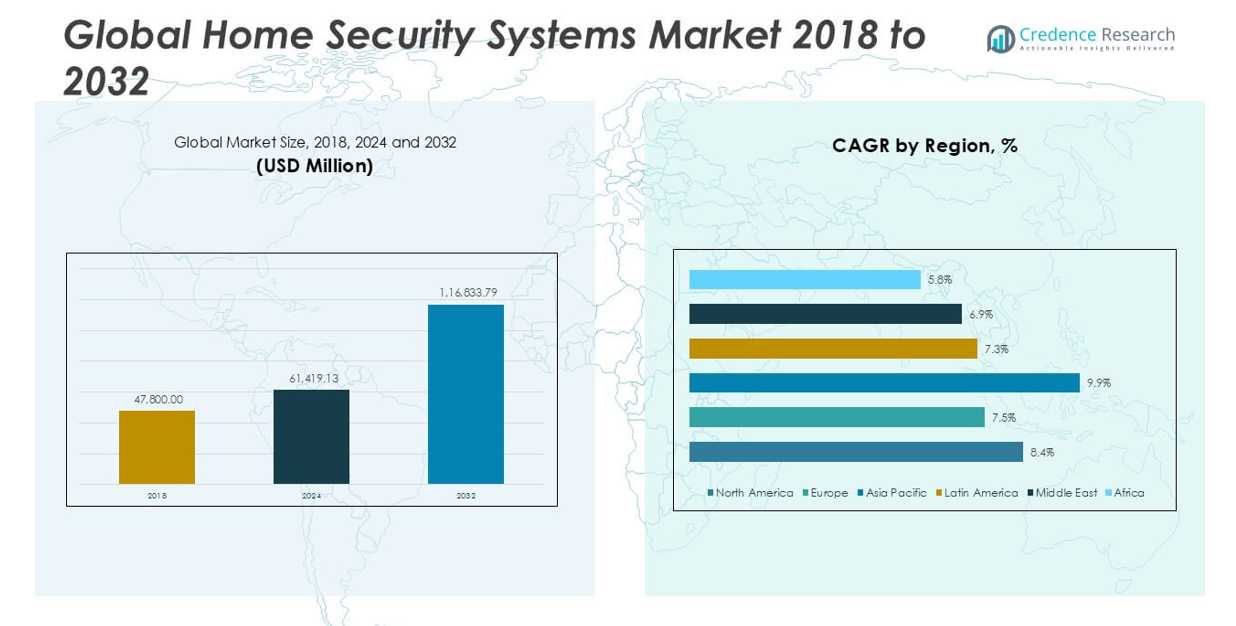
The Home Security Systems Market size was valued at USD 47,800.00 million in 2018 and USD 61,419.13 million in 2024. It is anticipated to reach USD 1,16,833.79 million by 2032, growing at a CAGR of 8.42% during the forecast period.
| REPORT ATTRIBUTE | DETAILS |
|---|---|
| Historical Period | 2020-2023 |
| Base Year | 2024 |
| Forecast Period | 2025-2032 |
| Home Security Systems Market Size 2024 | USD 61,419.13 million |
| Home Security Systems Market, CAGR | 8.42% |
| Home Security Systems Market Size 2032 | USD 1,16,833.79 million |
The Home Security Systems market is driven by leading players such as ADT Inc., Honeywell International Inc., Johnson Controls International plc, ASSA ABLOY AB, Securitas AB, Bosch Security Systems, and Alarm.com Holdings, Inc. These companies maintain a strong global presence through advanced product portfolios, professional monitoring services, and continuous technological innovation, particularly in smart home integration and AI-based surveillance solutions. North America dominates the global market, holding approximately 43% of the total market share in 2024, supported by high consumer awareness, widespread adoption of smart technologies, and the presence of key industry leaders.
Market Insights
- The Home Security Systems market was valued at USD 61,419.13 million in 2024 and is projected to reach USD 1,16,833.79 million by 2032, growing at a CAGR of 8.42% during the forecast period.
- Increasing crime rates, rising safety concerns, and growing demand for smart, integrated security solutions are major drivers fueling market growth globally.
- The market is witnessing strong trends such as the rapid adoption of AI-powered video surveillance and the growing preference for DIY and self-installed home security systems.
- Key players like ADT Inc., Honeywell International Inc., and Alarm.com Holdings, Inc. dominate the competitive landscape, focusing on technological innovation, product diversification, and expanding professional monitoring services.
- North America holds the largest regional share at 43%, followed by Asia Pacific at 25% and Europe at 20%; by segment, video surveillance systems lead with a 40% share, while the professional-installed and monitored segment dominates the security segment.
Market Segmentation Analysis:
By Home Type:
In the Home Security Systems market, independent homes accounted for the dominant share, holding approximately 65% of the market in 2024. The preference for independent homes is driven by the higher risk perception associated with stand-alone properties, which often lack shared security infrastructure found in condominiums or apartments. Homeowners in this segment prioritize comprehensive security solutions, including perimeter protection and video surveillance, to mitigate potential threats. Additionally, increasing urbanization and rising disposable incomes enable independent homeowners to invest in advanced security systems, further supporting this segment’s market leadership.
- For instance, ADT Inc. has deployed more than 6 million residential security systems across independent homes in the United States, offering extensive coverage through their network of over 200 monitoring centers.
By Security:
The professional-installed and monitored segment leads the market, capturing nearly 50% of the total share in 2024. This dominance is primarily driven by the growing consumer trust in professionally managed services, which offer 24/7 surveillance and rapid emergency response. Homeowners prefer these systems due to their reliability and seamless integration with emergency services. The rising concerns over burglary and fire incidents have further bolstered the demand for professionally monitored solutions. Although DIY and self-installed systems are gaining traction for their cost-effectiveness, they remain secondary to professional solutions in terms of adoption and market value.
- For instance, Vivint Inc. professionally monitors over 1.9 million customer locations and processes more than 9 million system events daily, providing continuous protection and real-time emergency coordination.
By Systems:
The video surveillance system segment dominates the Home Security Systems market, holding around 40% of the market share in 2024. This growth is largely driven by the increasing affordability of high-definition cameras, advancements in video analytics, and the integration of smart technologies like mobile alerts and remote access. Consumers prefer video surveillance for real-time monitoring and evidence collection, which significantly enhances the effectiveness of home security. Additionally, rising crime rates and increasing consumer awareness about proactive security measures continue to drive the widespread adoption of video surveillance systems over other security solutions.
Market Overview
Increasing Crime Rates and Rising Safety Concerns
The steady rise in burglary, property crimes, and security threats is a significant driver for the home security systems market. Homeowners are increasingly prioritizing the safety of their families and properties, which is fueling demand for advanced security solutions. Consumers now seek integrated systems that offer real-time monitoring, mobile access, and immediate alerts. This growing awareness and proactive approach to home protection are pushing both urban and suburban residents to adopt reliable home security technologies, contributing to sustained market growth.
- For instance, Alarm.com processes over 150 million security system signals each day, enabling real-time crime detection and instant emergency notifications for millions of users worldwide.
Advancements in Smart Home Technologies
The rapid development of smart home technologies is a major catalyst for the home security systems market. Integration of Internet of Things (IoT), artificial intelligence (AI), and smart sensors has made security systems more user-friendly, customizable, and accessible via smartphones and voice-controlled devices. These technological advancements allow seamless connectivity, remote surveillance, and automation, enhancing the consumer experience. The demand for intelligent, energy-efficient, and interconnected home security solutions is steadily increasing, encouraging manufacturers to innovate and expand their product offerings.
- For instance, Honeywell International Inc. has developed over 400 smart home security product variants integrated with AI and voice control, supporting millions of connected devices globally.
Growing Adoption of Professional Monitoring Services
The increasing preference for professional monitoring services is significantly driving market growth. Homeowners are opting for these services due to their 24/7 surveillance, faster emergency response, and reduced false alarms. Professional-installed systems offer high reliability and peace of mind, especially for independent homeowners who require comprehensive protection. The convenience of managed security services, combined with competitive subscription pricing and value-added features, has further accelerated their adoption, solidifying their dominant position in the market.
Key Trends & Opportunities
Expansion of DIY and Self-Monitored Solutions
The growing popularity of do-it-yourself (DIY) and self-monitored home security systems presents a major market opportunity. These solutions attract price-sensitive consumers who prefer affordable, easy-to-install options without long-term contracts. Increasing availability of wireless and portable devices enables homeowners and renters to customize their security setups. Companies offering user-friendly mobile apps and integration with smart home devices further enhance market appeal. This trend is expected to continue, opening opportunities for manufacturers to develop more flexible, modular, and cost-effective security solutions.
- For instance, SimpliSafe, Inc. has sold over 4 million DIY home security systems, with installations taking as little as 30 minutes, making it one of the most accessible options in the market.
Rising Demand for AI-Powered Video Surveillance
The home security systems market is witnessing a strong trend toward AI-powered video surveillance solutions. These systems offer advanced features such as facial recognition, real-time motion detection, and automated threat assessment, providing homeowners with enhanced security and rapid response capabilities. The integration of AI with cloud storage and predictive analytics is creating smarter, more efficient surveillance networks. This evolving trend represents a significant opportunity for manufacturers to deliver differentiated, intelligent security offerings that address growing consumer expectations for proactive home protection.
- For instance, Hangzhou Hikvision Digital Technology Co., Ltd. has deployed over 40 million AI-powered surveillance cameras globally, with more than 10 million units capable of real-time facial recognition.
Key Challenges
High Initial Investment Costs
One of the primary challenges in the home security systems market is the high initial investment associated with advanced security installations. Professional-installed systems, particularly those with integrated smart technologies, can be expensive for middle and lower-income households. Despite long-term benefits, the upfront costs often deter potential buyers, especially in developing regions. This pricing barrier limits market penetration and forces consumers to opt for basic or self-installed alternatives, which may not offer the same level of protection.
Privacy Concerns and Data Security Risks
Privacy and data security remain significant challenges for the home security systems market. As smart security devices become increasingly connected to the internet, they are more vulnerable to hacking, data breaches, and unauthorized surveillance. Consumers are growing more cautious about sharing personal data and relying on cloud-based storage solutions. Addressing these concerns requires robust cybersecurity protocols and transparent data handling practices, which can increase operational complexity and costs for security system providers.
Complexity of System Integration
System compatibility and integration challenges can hinder the seamless adoption of home security solutions. Many homeowners face difficulties when integrating new security devices with their existing smart home ecosystems, leading to poor user experiences and reduced system efficiency. The lack of standardized platforms often results in interoperability issues, especially when combining products from different manufacturers. This complexity limits consumer confidence and may slow market growth if manufacturers fail to offer fully compatible, plug-and-play solutions.
Regional Analysis
North America:
North America held the largest share in the Home Security Systems market, accounting for approximately 43% of the global revenue in 2024, with a market size of USD 26,446.71 million, up from USD 20,793.00 million in 2018. The market is expected to reach USD 50,250.42 million by 2032, growing at a CAGR of 8.4%. High consumer awareness, strong adoption of smart home technologies, and the presence of major industry players drive market growth in this region. Increasing security concerns and the rising demand for professional monitoring services further support North America’s leading position.
Europe:
Europe captured around 20% of the global Home Security Systems market in 2024, with a market value of USD 12,454.12 million, rising from USD 10,181.40 million in 2018. The market is projected to reach USD 22,052.69 million by 2032, expanding at a CAGR of 7.5%. The increasing focus on smart city initiatives, regulatory emphasis on residential security, and the widespread integration of smart technologies are key growth drivers. European consumers are increasingly investing in advanced video surveillance and fire protection systems, which enhances the market’s expansion across urban and suburban areas.
Asia Pacific:
Asia Pacific emerged as the fastest-growing region, commanding approximately 25% of the global market share in 2024, with revenue reaching USD 15,099.63 million, up from USD 11,233.00 million in 2018. The market is expected to grow to USD 31,952.38 million by 2032, registering a robust CAGR of 9.9%. Rapid urbanization, increasing disposable incomes, and growing consumer awareness regarding home security are driving market growth. Additionally, the expansion of smart home infrastructure and rising adoption of affordable DIY security systems contribute significantly to the region’s accelerating demand.
Latin America:
Latin America accounted for approximately 5% of the global Home Security Systems market in 2024, with a market size of USD 3,316.02 million, up from USD 2,609.88 million in 2018. The market is projected to reach USD 5,779.77 million by 2032, growing at a CAGR of 7.3%. Increasing urban population, rising security concerns in major cities, and gradual economic improvement are key factors supporting market growth. Consumers in this region are increasingly adopting cost-effective and user-friendly security solutions, particularly self-installed and DIY systems, to safeguard their homes.
Middle East:
The Middle East held nearly 3% of the global Home Security Systems market in 2024, with revenue growing to USD 1,971.15 million, up from USD 1,649.10 million in 2018. The market is anticipated to reach USD 3,342.09 million by 2032, expanding at a CAGR of 6.9%. The region’s market growth is driven by increasing residential development, rising investments in smart home technologies, and growing consumer awareness about safety. The demand for video surveillance and professional monitoring services is steadily increasing in urban centers, enhancing market prospects.
Africa:
Africa contributed around 3% of the global Home Security Systems market in 2024, with revenue reaching USD 2,131.49 million, up from USD 1,333.62 million in 2018. The market is forecasted to grow to USD 3,456.44 million by 2032, at a CAGR of 5.8%. Although the market is still developing, the increasing need for affordable security solutions and the gradual expansion of smart home devices are driving adoption. Growth is primarily concentrated in emerging urban areas, where rising crime rates and increasing security concerns are encouraging consumers to invest in basic, scalable security systems.Bottom of Form
Market Segmentations:
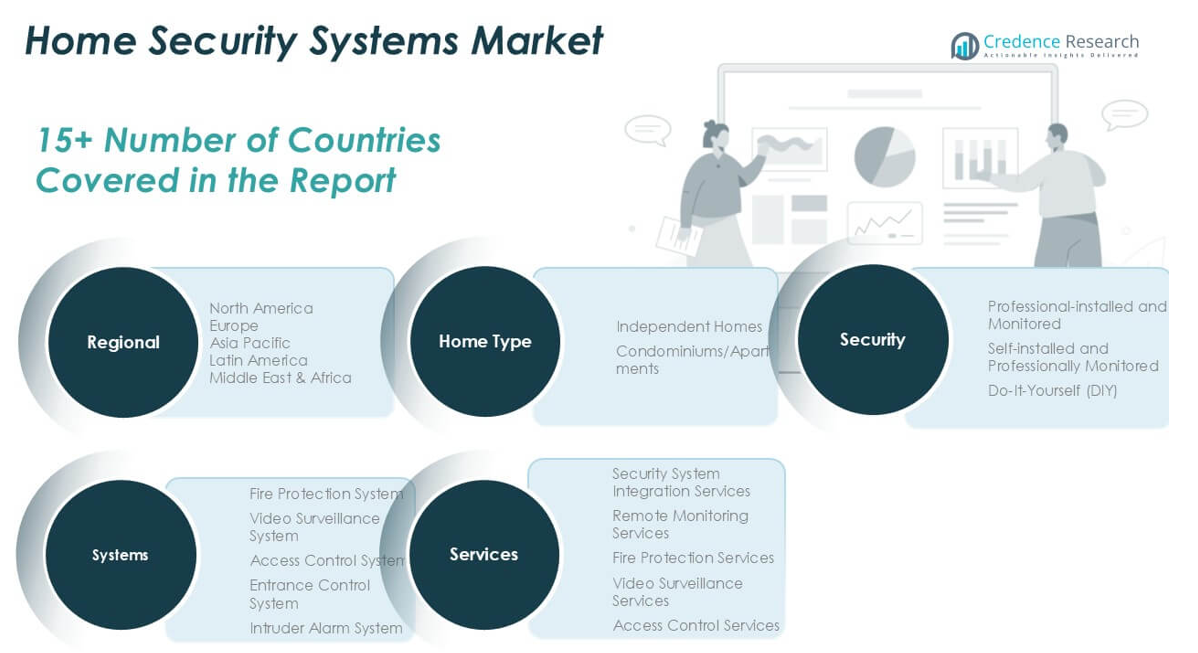
By Home Type
- Independent Homes
- Condominiums/Apartments
By Security
- Professional-installed and Monitored
- Self-installed and Professionally Monitored
- Do-It-Yourself (DIY)
By Systems
- Fire Protection System
- Video Surveillance System
- Access Control System
- Entrance Control System
- Intruder Alarm System
By Services
- Security System Integration Services
- Remote Monitoring Services
- Fire Protection Services
- Video Surveillance Services
- Access Control Services
By Geography
- North America
- U.S.
- Canada
- Mexico
- Europe
- Germany
- France
- U.K.
- Italy
- Spain
- Rest of Europe
- Asia Pacific
- China
- Japan
- India
- South Korea
- South-east Asia
- Rest of Asia Pacific
- Latin America
- Brazil
- Argentina
- Rest of Latin America
- Middle East & Africa
- GCC Countries
- South Africa
- Rest of the Middle East and Africa
Competitive Landscape
The Home Security Systems market is highly competitive, with key players focusing on technological innovation, strategic partnerships, and product diversification to strengthen their market positions. Major companies such as ADT Inc., Honeywell International Inc., Johnson Controls International plc, ASSA ABLOY AB, and Securitas AB dominate the industry with extensive product portfolios and strong global distribution networks. These market leaders are heavily investing in smart home integration, AI-powered video surveillance, and advanced monitoring solutions to meet evolving consumer demands. Additionally, companies like Alarm.com Holdings, Inc., SimpliSafe, Inc., and Vivint, Inc. are driving competition through user-friendly, self-installation security systems targeting cost-conscious and tech-savvy consumers. The competitive landscape is further shaped by regional players such as Godrej & Boyce in Asia and emerging brands offering affordable, scalable solutions. Continuous innovation, focus on cybersecurity, and expansion of subscription-based professional monitoring services remain critical strategies for sustaining competitive advantage in this rapidly evolving market.
Key Player Analysis
- ADT Inc.
- Honeywell International Inc.
- Johnson Controls International plc
- ASSA ABLOY AB
- Securitas AB
- Bosch Security Systems
- Allegion plc
- UTC Fire & Security
- com Holdings, Inc.
- Comcast Corporation
- Frontpoint Security Solutions, LLC
- Vivint, Inc.
- Godrej & Boyce Manufacturing Company Limited
- SimpliSafe, Inc.
- Hangzhou Hikvision Digital Technology Co., Ltd.
- Axis Communications AB (Canon Inc.)
- Hanwha Techwin Co., Ltd.
- Melrose Industries
- Legrand
- Schneider Electric
Recent Developments
- In June 2025, Honeywell launched Honeywell Connected Solutions, an AI-powered platform that integrates building software and technologies into a single interface for more efficient operations. The platform offers advanced encryption, remote monitoring, predictive maintenance, and energy management solutions, enhancing building security and operational efficiency.
- In June 2025, Resideo (which markets Honeywell Home products) introduced the Honeywell Home X2S Smart Thermostat at CES 2025. The device is Matter-enabled, ENERGY STAR certified, and compatible with Amazon Alexa, Google Home, and Apple Home. It features advanced energy-saving capabilities and can be managed via the First Alert app, which supports automatic away mode and integration with utility energy programs.
- In March 2025, Johnson Controls Global Security Products released updates to its access control and video surveillance portfolio, including the C- CURE IQ 3.10 Release, iSTAR G2 Controller Upgrades, and enhancements to the victor VideoEdge NVR Portfolio. These updates focus on next-generation enterprise and commercial access control and video surveillance.
- In January 2025, ADT unveiled the new ADT+ Security System at CES 2025. This system features extended range, reduced interference, and flexible installation options. It is designed for seamless integration with Google Nest products and emphasizes customer-focused innovation. ADT also introduced the Trusted Neighbor™ service, a digital solution that allows homeowners to securely grant access to trusted individuals, such as neighbors or service providers, using smart locks and the ADT+ app.
- In January 2024, Bosch Building Technologies continues to develop advanced fire alarm and life safety systems. The company also operates as a system integrator in select countries, offering security, energy efficiency, and building automation solutions. While no specific new home security product was announced in 2025, Bosch remains focused on integrating building security with automation and life safety technologies.
Market Concentration & Characteristics
The Home Security Systems Market is moderately concentrated, with a mix of global leaders and regional players competing for market share. It is characterized by rapid technological advancements, increasing consumer demand for smart, integrated solutions, and strong brand competition. Major companies such as ADT Inc., Honeywell International Inc., and Alarm.com Holdings, Inc. lead the market by offering professional monitoring services, advanced video surveillance, and smart home integrations. It demonstrates steady growth driven by the rising need for residential security, increasing urbanization, and expanding smart home adoption. The market displays a balance between professionally installed systems and self-installed, user-friendly solutions, appealing to a wide range of consumers. It remains highly responsive to innovation in artificial intelligence, mobile connectivity, and cloud-based services. The growing penetration of DIY solutions and subscription-based models provides both established and emerging companies with opportunities to capture new customer segments. The Home Security Systems Market emphasizes product reliability, ease of use, and seamless integration with home automation systems, which influence consumer purchasing decisions. Companies actively pursue partnerships, acquisitions, and continuous product upgrades to sustain competitive advantage. Pricing, data security, and system interoperability continue to shape the competitive dynamics within the market
Report Coverage
The research report offers an in-depth analysis based on Home Type, Security, Systems, Services and Geography. It details leading market players, providing an overview of their business, product offerings, investments, revenue streams, and key applications. Additionally, the report includes insights into the competitive environment, SWOT analysis, current market trends, as well as the primary drivers and constraints. Furthermore, it discusses various factors that have driven market expansion in recent years. The report also explores market dynamics, regulatory scenarios, and technological advancements that are shaping the industry. It assesses the impact of external factors and global economic changes on market growth. Lastly, it provides strategic recommendations for new entrants and established companies to navigate the complexities of the market.
Future Outlook
- The Home Security Systems market is expected to continue growing steadily, driven by increasing consumer focus on residential safety.
- Demand for smart, integrated security solutions will rise as smart home adoption expands globally.
- Professional monitoring services will maintain strong growth due to consumer preference for 24/7 security and rapid emergency response.
- DIY and self-installed home security systems will gain further popularity among cost-conscious and tech-savvy consumers.
- AI-powered video surveillance systems with features like facial recognition and motion detection will see increased adoption.
- Mobile app-based remote monitoring and cloud-based storage will become standard features in home security systems.
- Companies will focus on enhancing cybersecurity and data protection to address growing consumer privacy concerns.
- Partnerships and acquisitions will accelerate as key players aim to strengthen market position and expand product offerings.
- Emerging markets in Asia Pacific, Latin America, and Africa will offer significant growth opportunities due to rising urbanization.
- System interoperability and seamless integration with existing smart home devices will become critical purchasing factors for consumers.

Request a Free Sample
Fill in your details and we'll send you a free sample report.
- Sample data tables & charts
- Research methodology
Market Dynamics
Increasing Crime Rates and Safety Concerns
Rising incidents of burglary, property crimes, and security threats are prompting homeowners to invest in advanced home security systems, driving market growth as consumers seek to protect their families and assets.
Advancements in Smart Home Technologies
Integration of IoT, AI, and smart sensors has made home security systems more user-friendly, customizable, and accessible, encouraging adoption by enabling features like remote monitoring, automation, and seamless connectivity with other smart devices.
Growing Adoption of Professional Monitoring Services
Consumer preference for 24/7 surveillance, rapid emergency response, and reduced false alarms is fueling demand for professionally installed and monitored security solutions, which offer higher reliability and peace of mind.
Expansion of DIY and Self-Monitored Solutions
The availability of affordable, easy-to-install DIY security systems is attracting cost-conscious and tech-savvy consumers, expanding the market by lowering entry barriers and enabling greater customization.
Rising Demand for AI-Powered Video Surveillance
The adoption of AI-powered video surveillance systems with features like facial recognition, real-time motion detection, and automated threat assessment is enhancing security effectiveness and driving the uptake of advanced home security solutions.
Need a Custom Version of This Report?
Tailor the scope, geography, or segments to your exact requirements.
- Custom geography or segment scope
- Direct access to our analyst team
Frequently Asked Questions
What is the current size of the Home Security Systems Market?
What are the key segments within the Home Security Systems Market?
What are some challenges faced by the Home Security Systems Market?
Who are the major players in the Home Security Systems Market?
Table of Content
Chapter 1 Market Segmentation
- 1.1 Segmentation Framework
- 1.1.1 Product and Service Classification
- 1.1.2 Application and End-Use Classification
- 1.1.3 Technology and Solution Classification
- 1.1.4 Customer and Distribution Channel Classification
- 1.1.5 Geographic Segmentation
- 1.1.6 Market Segment Definitions and Boundaries
- 1.2 By Systems
- 1.2.1 Fire Protection System
- 1.2.2 Video Surveillance System
- 1.2.3 Access Control System
- 1.2.4 Entrance Control System
- 1.2.5 Intruder Alarm System
- 1.3 By Security
- 1.3.1 Professional-installed and Monitored
- 1.3.2 Self-installed and Professionally Monitored
- 1.3.3 Do-It-Yourself (DIY)
- 1.4 By Services
- 1.4.1 Security System Integration Services
- 1.4.2 Remote Monitoring Services
- 1.4.3 Fire Protection Services
- 1.4.4 Video Surveillance Services
- 1.4.5 Access Control Services
- 1.5 By Home Type
- 1.5.1 Independent Homes
- 1.5.2 Condominiums/Apartments
Chapter 2 Introduction
- 2.1 Report Objectives and Scope
- 2.2 Product Definition and Industry Terminology
- 2.3 Market Inclusions and Exclusions
- 2.4 Research Process
- 2.4.1 Primary Research and Expert Interviews
- 2.4.2 Secondary Research and Source Review
- 2.4.3 Top-Down and Bottom-Up Estimation
- 2.4.4 Data Triangulation and Verification
- 2.5 Market Size Measurement Basis
- 2.5.1 2024: USD 61,419.13 million → 2032: USD 116,833.79 million
- 2.6 Historical and Forecast Reference Periods
- 2.6.1 Base Year: 2024
- 2.6.2 Forecast Period: 2024-2032
- 2.7 Research Assumptions and Limitations
Chapter 3 Executive Summary
- 3.1 Market Snapshot and Key Findings
- 3.2 Base-Year Market Size, 2024
- 3.3 Forecast Market Size, 2032
- 3.4 Revenue and Volume Growth Outlook
- 3.5 Key Demand and Supply Indicators
- 3.6 Leading Market Segments
- 3.7 Fastest-Growing Market Opportunities
- 3.8 Regional Performance Highlights
- 3.9 Technology and Industry Transformation
- 3.10 Competitive Landscape Summary
- 3.11 Analyst View and Strategic Implications
Chapter 4 Global Home Security Systems Market Trends and Developments
- 4.1 Historical Industry Development
- 4.2 Recent Market Trends and Developments
- 4.3 Demand and Customer Behavior Trends
- 4.4 Technology and Product Innovation
- 4.5 Artificial Intelligence, Automation and Digitalization
- 4.6 Local Manufacturing and Supply Chain Realignment
- 4.7 Industry Partnerships, Mergers and Acquisitions
- 4.8 Sustainability and Circular Economy Developments
- 4.9 Government and Private Sector Investment Trends
- 4.10 Emerging Business Models and Commercialization
- 4.11 Industry Developments and Announcements
Chapter 5 Global Home Security Systems Market Production, Supply and Demand Analysis
- 5.1 Demand Trend and Consumption Analysis
- 5.2 Demand Forecast, 2024-2032
- 5.3 Production and Output Trend
- 5.4 Production and Output Forecast, 2024-2032
- 5.5 Installed Capacity and Capacity Utilization
- 5.6 Company-Wise Production Plants and Statistics
- 5.6.1 Installed Production Capacity
- 5.6.2 Actual Production
- 5.6.3 Planned Capacity and Expansion Targets
- 5.7 Supply Chain Structure and Procurement Trends
- 5.8 Supply-Demand Gap and Bottlenecks
- 5.9 Import Dependence and Sourcing Structure
- 5.10 Contract Manufacturing and Outsourcing
- 5.11 Regional Supply and Demand Concentration
Chapter 6 Global Home Security Systems Market Pricing Analysis
- 6.1 Pricing Structure and Measurement
- 6.2 Historical Pricing Trends
- 6.3 Pricing Outlook, 2024-2032
- 6.4 Average Selling Price and Unit Economics
- 6.5 Pricing by Product and Market Segment
- 6.6 Geographic Pricing Differences
- 6.7 Key Input, Energy, Labor and Logistics Costs
- 6.8 Contract Pricing and Purchasing Models
- 6.9 Pricing Sensitivity and Competitive Positioning
- 6.10 Price, Margin and Profitability Implications
Chapter 7 Global Home Security Systems Market Dynamics
- 7.1 Market Growth Drivers
- 7.1.1 Demand-Side Drivers
- 7.1.2 Technology and Innovation Drivers
- 7.1.3 Infrastructure and Investment Drivers
- 7.1.4 Regulatory and Policy Drivers
- 7.2 Market Restraints
- 7.2.1 Cost and Affordability Constraints
- 7.2.2 Technology and Adoption Barriers
- 7.2.3 Supply Chain and Operational Constraints
- 7.3 Market Challenges
- 7.3.1 Competitive Pressure and Margin Erosion
- 7.3.2 Skills, Infrastructure and Implementation Gaps
- 7.4 Emerging Market Opportunities
- 7.5 Market Dynamics Impact and Time-Horizon Assessment
Chapter 8 Global Home Security Systems Value Chain Analysis
- 8.1 Industry Value Chain Overview
- 8.2 Upstream Suppliers and Critical Inputs
- 8.3 Technology and Component Providers
- 8.4 Manufacturing or Service Delivery
- 8.5 Distribution, Channel Partners and Integrators
- 8.6 Downstream Applications and End Users
- 8.7 Value Addition and Profit Pools
- 8.8 Vertical Integration and Outsourcing
- 8.9 Supplier Concentration and Risk
- 8.10 Supply Chain Localization and Resilience
Chapter 9 Global Home Security Systems Market Regulations and Policies
- 9.1 Relevant Laws, Standards and Compliance Frameworks
- 9.2 Product, Service, Safety and Quality Requirements
- 9.3 Government Policies, Incentives and Subsidies
- 9.4 Imports, Exports and Trade Barriers
- 9.5 Public Procurement and Local Content Requirements
- 9.6 Environmental and Sustainability Compliance
- 9.7 Data Protection, AI and Cybersecurity Compliance
- 9.8 Upcoming Policy Changes and Market Implications
Chapter 10 Global Home Security Systems Market Hotspots and Opportunities
- 10.1 Market Opportunity Mapping and Growth Hotspots
- 10.2 High-Growth Applications and Customer Groups
- 10.3 Underserved Markets and White-Space Opportunities
- 10.4 Emerging Technology and Product Opportunities
- 10.5 New Capacity and Investment Hotspots
- 10.6 Market Entry and Expansion Opportunities
- 10.7 Distribution and Partnership Opportunities
- 10.8 Near-Term and Long-Term Commercial Potential
- 10.9 Opportunity Attractiveness and Execution Risks
Chapter 11 Global Home Security Systems Market Outlook, 2024-2032
- 11.1 Market Size and Analysis
- 11.1.1 Revenue (Market Measurement: 2024: USD 61,419.13 million → 2032: USD 116,833.79 million)
- 11.1.2 Market Volume and Quantity Sold
- 11.1.3 Historical Market Size
- 11.1.4 Base-Year Market Size, 2024
- 11.2 Market Forecast, 2024-2032
- 11.2.1 Revenue Forecast to 2032
- 11.2.2 Volume Forecast to 2032
- 11.2.3 CAGR and Year-on-Year Growth
- 11.2.4 Incremental Revenue Opportunity
- 11.3 Forecast Assumptions and Scenario Analysis
- 11.3.1 Base-Case Forecast
- 11.3.2 Optimistic and Conservative Scenarios
- 11.3.3 Technology, Pricing and Policy Sensitivities
- 11.4 Market Attractiveness and Growth Outlook
Chapter 12 Global Home Security Systems Market Segmentation and Outlook
- 12.1 Segmentation Summary and Market Shares, 2024
- 12.2 Largest and Fastest-Growing Segments
- 12.3 By Systems - Market Size and Forecast, 2024-2032
- 12.3.1 Segment Definition and Scope
- 12.3.2 Historical Market Size
- 12.3.3 Revenue Forecast, 2024-2032
- 12.3.4 Volume Forecast, 2024-2032
- 12.3.5 Base-Year Market Share, 2024
- 12.3.6 Segment CAGR and Growth Drivers
- 12.3.7 Subsegment Market Size and Forecast
- 12.3.7.1 Fire Protection System
- 12.3.7.2 Video Surveillance System
- 12.3.7.3 Access Control System
- 12.3.7.4 Entrance Control System
- 12.3.7.5 Intruder Alarm System
- 12.3.8 Subsegment Pricing and Adoption Trends
- 12.3.9 Leading Suppliers and Competition
- 12.3.10 Regional Demand and Opportunities
- 12.4 By Security - Market Size and Forecast, 2024-2032
- 12.4.1 Segment Definition and Scope
- 12.4.2 Historical Market Size
- 12.4.3 Revenue Forecast, 2024-2032
- 12.4.4 Volume Forecast, 2024-2032
- 12.4.5 Base-Year Market Share, 2024
- 12.4.6 Segment CAGR and Growth Drivers
- 12.4.7 Subsegment Market Size and Forecast
- 12.4.7.1 Professional-installed and Monitored
- 12.4.7.2 Self-installed and Professionally Monitored
- 12.4.7.3 Do-It-Yourself (DIY)
- 12.4.8 Subsegment Pricing and Adoption Trends
- 12.4.9 Leading Suppliers and Competition
- 12.4.10 Regional Demand and Opportunities
- 12.5 By Services - Market Size and Forecast, 2024-2032
- 12.5.1 Segment Definition and Scope
- 12.5.2 Historical Market Size
- 12.5.3 Revenue Forecast, 2024-2032
- 12.5.4 Volume Forecast, 2024-2032
- 12.5.5 Base-Year Market Share, 2024
- 12.5.6 Segment CAGR and Growth Drivers
- 12.5.7 Subsegment Market Size and Forecast
- 12.5.7.1 Security System Integration Services
- 12.5.7.2 Remote Monitoring Services
- 12.5.7.3 Fire Protection Services
- 12.5.7.4 Video Surveillance Services
- 12.5.7.5 Access Control Services
- 12.5.8 Subsegment Pricing and Adoption Trends
- 12.5.9 Leading Suppliers and Competition
- 12.5.10 Regional Demand and Opportunities
- 12.6 By Home Type - Market Size and Forecast, 2024-2032
- 12.6.1 Segment Definition and Scope
- 12.6.2 Historical Market Size
- 12.6.3 Revenue Forecast, 2024-2032
- 12.6.4 Volume Forecast, 2024-2032
- 12.6.5 Base-Year Market Share, 2024
- 12.6.6 Segment CAGR and Growth Drivers
- 12.6.7 Subsegment Market Size and Forecast
- 12.6.7.1 Independent Homes
- 12.6.7.2 Condominiums/Apartments
- 12.6.8 Subsegment Pricing and Adoption Trends
- 12.6.9 Leading Suppliers and Competition
- 12.6.10 Regional Demand and Opportunities
- 12.7 Segment Growth Comparison
- 12.8 Segment Attractiveness and Priority Matrix
Chapter 13 Global Home Security Systems Geographic Market Outlook, 2024-2032
- 13.1 Regional Market Size and Share, 2024
- 13.2 Regional Market Forecast, 2024-2032
- 13.3 Regional Pricing, Production and Demand Differences
- 13.4 North America
- 13.4.1 United States
- 13.4.2 Canada
- 13.4.3 Mexico
- 13.5 Europe
- 13.5.1 Germany
- 13.5.2 France
- 13.5.3 Italy
- 13.5.4 United Kingdom
- 13.5.5 Spain
- 13.5.6 Poland
- 13.5.7 Russia
- 13.5.8 Netherlands
- 13.5.9 Belgium
- 13.5.10 Sweden
- 13.5.11 Denmark
- 13.5.12 Norway
- 13.5.13 Rest of Europe
- 13.6 Asia Pacific
- 13.6.1 China
- 13.6.2 India
- 13.6.3 Japan
- 13.6.4 South Korea
- 13.6.5 Thailand
- 13.6.6 Indonesia
- 13.6.7 Vietnam
- 13.6.8 Malaysia
- 13.6.9 Australia
- 13.6.10 Rest of Asia Pacific
- 13.7 Latin America
- 13.7.1 Brazil
- 13.7.2 Argentina
- 13.7.3 Colombia
- 13.7.4 Chile
- 13.7.5 Rest of Latin America
- 13.8 Middle East
- 13.8.1 Saudi Arabia
- 13.8.2 United Arab Emirates
- 13.8.3 Turkey
- 13.8.4 Israel
- 13.8.5 Iran
- 13.8.6 Rest of the Middle East
- 13.9 Africa
- 13.9.1 South Africa
- 13.9.2 Egypt
- 13.9.3 Nigeria
- 13.9.4 Morocco
- 13.9.5 Rest of Africa
- 13.10 Regional Investment, Policy and Supply Chain Differences
- 13.11 Regional Competitive Landscape
- 13.12 Geographic Growth Hotspots
Chapter 14 Global Home Security Systems Technology, Innovation and Sustainability Outlook
- 14.1 Technology Landscape and Maturity
- 14.2 Product, Process and Service Innovation
- 14.3 AI, Automation and Digital Tools in the Industry
- 14.4 Technology Adoption and Performance Benchmarking
- 14.5 Innovation Pipeline and R&D Investment
- 14.6 Patent and Intellectual Property Trends
- 14.7 Energy Efficiency and Resource Management
- 14.8 Sustainability, Recycling and Circularity
- 14.9 Technology Roadmap, 2024-2032
- 14.10 Risks of Obsolescence and Technology Substitution
Chapter 15 Global Home Security Systems Market Key Strategic Imperatives
- 15.1 Growth and Market Entry Priorities
- 15.2 High-Return Products and Segments
- 15.3 Pricing, Profitability and Cost Optimization
- 15.4 Technology Investment and Product Differentiation
- 15.5 Supply Chain Localization and Resilience
- 15.6 Distribution and Customer Acquisition
- 15.7 Partnership, Acquisition and Capacity Strategy
- 15.8 Regional Expansion Priorities
- 15.9 Short-, Medium- and Long-Term Actions
Chapter 16 Competition Outlook
- 16.1 Industry Competition Characteristics
- 16.2 Market Structure and Concentration
- 16.3 Market Share and Competitive Positioning, 2024
- 16.4 Company-Wise Revenue and Product Benchmarking
- 16.5 Production and Service Capacity Benchmarking
- 16.6 Technology, Pricing and Differentiation
- 16.7 Regional Footprint and Distribution Strength
- 16.8 Mergers, Acquisitions and Strategic Alliances
- 16.9 New Entrants and Competitive Threats
- 16.10 Porter's Five Forces and Industry Attractiveness
- 16.11 Competitive Outlook, 2024-2032
Chapter 17 Company Profiles
- 17.1 Company Coverage and Selection Criteria
- 17.2 ADT Inc.
- 17.2.1 Business Description
- 17.2.2 Company Ownership and Geographic Presence
- 17.2.3 Product and Service Portfolio
- 17.2.4 Manufacturing and Operating Footprint
- 17.2.5 Production Capacity and Expansion Plans
- 17.2.6 Financial Performance and Investment
- 17.2.7 Market Share and Competitive Position
- 17.2.8 Technology and Innovation Capabilities
- 17.2.9 Strategic Alliances or Partnerships
- 17.2.10 Recent Developments
- 17.2.11 Growth Strategy and Outlook
- 17.3 Honeywell International Inc.
- 17.4 Johnson Controls International plc
- 17.5 ASSA ABLOY AB
- 17.6 Securitas AB
- 17.7 Bosch Security Systems
- 17.8 Alarm.com Holdings, Inc.
- 17.9 SimpliSafe, Inc.
- 17.10 Vivint, Inc.
- 17.11 Hangzhou Hikvision Digital Technology Co., Ltd.
- 17.12 Other Relevant Market Participants
Note: Every listed company is profiled on the structure shown under the first company. The company list is preliminary and may change based on research findings, market developments, data availability and client requirements.
Chapter 18 Disclaimer
- 18.1 Research and Forecast Disclaimer
- 18.2 Data Source and Estimation Limitations
Note: The depth of individual sections depends on data availability for this market. Volume, capacity, trade and other unit-based metrics are included where applicable.

