
| REPORT ATTRIBUTE | DETAILS |
|---|---|
| Historical Period | 2020-2023 |
| Base Year | 2024 |
| Forecast Period | 2025-2032 |
| Bio Vanillin Market Size 2024 | USD 320.62 million |
| Bio Vanillin Market, CAGR | 5.51% |
| Bio Vanillin Market Size 2032 | USD 507.81 million |
Market Overview
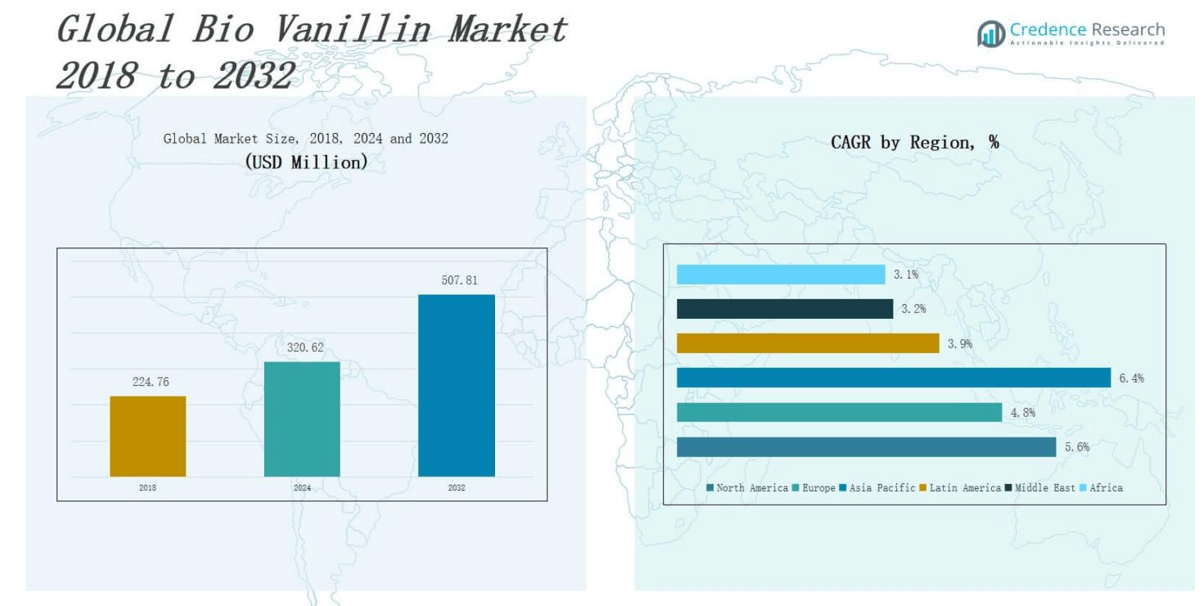
The Bio Vanillin Market size was valued at USD 224.76 million in 2018 to USD 320.62 million in 2024 and is anticipated to reach USD 507.81 million by 2032, at a CAGR of 5.51 % during the forecast period.
The Bio Vanillin market is driven by the growing demand for natural and sustainable flavoring agents across the food and beverage, cosmetics, and pharmaceutical industries. Consumers are increasingly prioritizing clean-label products, prompting manufacturers to replace synthetic additives with bio-based alternatives. Rising awareness of health and environmental concerns accelerates the shift toward bio vanillin derived through fermentation or enzymatic processes, offering reduced toxicity and a lower carbon footprint. Regulatory support for natural ingredients and restrictions on petrochemical-derived vanillin further encourage market adoption. Technological advancements in biosynthesis and microbial fermentation have enhanced production efficiency and purity levels, supporting scalability. Key players are investing in biotechnological innovations to meet rising demand and cost competitiveness. The trend toward premium and organic food products boosts the incorporation of bio vanillin in bakery, dairy, and confectionery applications. Additionally, expanding applications in personal care and aromatherapy highlight its multifunctional appeal, reinforcing its relevance in diverse consumer segments and global markets.
The Bio Vanillin Market exhibits diverse geographical growth, with Asia Pacific leading in volume share due to rising demand in China, India, and Southeast Asia. Europe dominates in revenue share, supported by strict regulatory standards and strong demand in Germany, France, and the UK. North America follows, driven by clean-label adoption across the U.S. and Canada. Latin America, particularly Brazil, shows moderate growth in food and fragrance applications. The Middle East and Africa represent emerging markets, with increasing uptake in the GCC countries, South Africa, and Egypt. Key players include Solvay SA, Givaudan SA, International Flavors & Fragrances Inc., Firmenich SA, Omega Ingredients, Advanced Biotech, Takasago International Corp, Borregaard ASA, Prinova Group, and Archer-Daniels Midland Co. These companies focus on biotechnological innovation, sustainability, and global distribution to expand their presence across these diverse regional markets.
Market Insights
- The Bio Vanillin Market was valued at USD 224.76 million in 2018 and is projected to reach USD 507.81 million by 2032, growing at a CAGR of 5.51%.
- Demand for natural and clean-label products is driving adoption across food, beverage, personal care, and pharmaceutical sectors.
- Europe holds the largest revenue share at nearly 30%, led by Germany, France, and the UK with strong regulatory backing for natural ingredients.
- Asia Pacific leads in volume share and shows the fastest growth, driven by rising demand in China, India, and Southeast Asia.
- North America accounts for over 20% of global revenue, with major brands in the U.S. and Canada investing in fermentation technologies and clean-label innovation.
- High production costs and limited raw material availability remain key challenges, affecting scalability and price competitiveness in mass-market applications.
- Key players such as Solvay SA, Givaudan SA, IFF, Firmenich SA, and Borregaard ASA are expanding through biotechnological innovations and global distribution strategies.
Market Drivers
Rising Demand for Natural Ingredients in Food and Beverage
The Bio Vanillin Market is gaining traction due to the global shift toward natural and clean-label food products. Consumers increasingly reject synthetic additives, prompting manufacturers to replace artificial vanillin with bio-based alternatives. It appeals to health-conscious buyers seeking transparency in ingredient sourcing. Natural flavoring is no longer a niche preference but a mainstream expectation. Regulatory bodies in North America and Europe encourage natural ingredient use. This momentum drives strong adoption across bakery, dairy, and confectionery sectors.
- For instance, Nestlé reformulated several of its chocolate and dairy products in Europe to use bio vanillin derived from natural sources, responding to consumer demand for clean-label ingredients and transparency in sourcing.
Supportive Regulatory Framework and Sustainability Goals
Stringent regulations against synthetic additives in several regions are accelerating the growth of the Bio Vanillin Market. Governments and food safety authorities are tightening restrictions on petrochemical-based flavorings. It benefits from this shift by aligning with eco-friendly sourcing and sustainable production. Environmental concerns are prompting industries to reduce carbon footprints, driving the preference for bio-based vanillin. Sustainability certifications give bio vanillin a competitive edge. Demand from ethically driven brands is rising steadily.
- For instance, Symrise developed new biotechnological processes to produce vanillin from renewable resources, moving away from synthetic, petrochemical-based methods to meet regulatory and sustainability targets.
Advancements in Fermentation and Biotechnology
Innovations in microbial fermentation and biotechnological processes have enhanced the production efficiency of bio vanillin. The Bio Vanillin Market is evolving through continuous improvements in yield, purity, and scalability. It now offers a commercially viable alternative to synthetic vanillin with a lower environmental impact. Biotech companies are optimizing enzymatic pathways and fermentation strains to increase output. These advancements make bio vanillin more accessible and cost-effective. This progress is critical to expanding industrial applications and global supply chains.
Rising Use in Personal Care and Pharmaceutical Products
Beyond food, the Bio Vanillin Market benefits from increased demand in cosmetics and pharmaceuticals. Natural aroma compounds are widely used in perfumes, creams, and medicinal formulations. It offers a safer, hypoallergenic alternative to synthetic fragrance agents. Consumer awareness around ingredient safety supports this transition. Bio vanillin’s multifunctional nature expands its commercial viability. Its soothing properties and mild aroma are valued in personal care and wellness applications across developed markets.
Market Trends
Expansion of Clean-Label and Organic Product Portfolios
The Bio Vanillin Market reflects a strong trend toward clean-label and organic product development. Consumers increasingly demand transparency in ingredients, driving food and beverage brands to use natural flavoring agents. It fits clean-label criteria and supports marketing claims tied to wellness and sustainability. Brands are launching organic-certified products that include bio vanillin as a key flavoring. The push for “free from” formulations is also encouraging broader adoption. Market positioning around purity and authenticity strengthens its appeal globally.
- For instance, Borregaard produces bio-based vanillin from Norway spruce, certified by the Programme for the Endorsement of Forest Certification (PEFC), offering a product that is 100% renewable and provides a 90% reduction in CO₂ emissions compared to vanillin synthesized from crude oil.
Technological Innovation in Bioprocessing and Fermentation
Continuous innovation in biotechnological methods is shaping the Bio Vanillin Market. Fermentation processes using engineered microbes and lignin valorization are becoming more efficient. It is now produced at commercial scale with better yield and purity. Industry players are adopting enzyme-based methods that reduce by-products and waste. These advancements lower production costs while maintaining quality standards. The integration of precision fermentation is making bio vanillin a sustainable solution with consistent flavor performance.
- For instance, Solvay expanded its bio vanillin portfolio in 2023 by introducing products like Rhovanil Natural Delica, derived from bioconversion of ferulic acid in rice bran, demonstrating enhanced sustainable sourcing and product diversification.
Rising Adoption in Fragrance and Cosmetic Formulations
Cosmetics and personal care brands are increasingly replacing synthetic fragrances with bio-derived ingredients. The Bio Vanillin Market is expanding into high-value segments such as perfumes, lotions, and skincare. It delivers a mild, pleasant aroma that aligns with growing demand for naturally sourced fragrance compounds. Natural beauty trends are accelerating this shift across Europe, North America, and parts of Asia. Premium and eco-conscious brands are leading the transition. Bio vanillin supports regulatory compliance in clean beauty markets.
Strategic Collaborations and Vertical Integration Efforts
Key players are forming strategic partnerships to scale production and ensure supply chain stability. The Bio Vanillin Market is witnessing increased vertical integration, where companies control fermentation inputs and downstream processing. It helps maintain quality control and reduce dependency on external suppliers. Joint ventures between flavor houses and biotech firms are enabling faster market access. These collaborations support large-scale commercialization and foster innovation. Expanding global distribution networks reflects growing commercial confidence in the segment.
Market Challenges Analysis
High Production Costs and Price Competitiveness
The Bio Vanillin Market faces significant cost-related challenges that hinder broader adoption. Bio-based vanillin production involves complex biotechnological processes that are more expensive than traditional synthetic routes. It requires specialized fermentation infrastructure and skilled expertise, increasing overall manufacturing costs. Price-sensitive industries, especially in developing markets, often prefer synthetic vanillin due to its affordability. The high cost differential limits penetration in mass-market food and beverage segments. Without cost parity, many manufacturers hesitate to transition to bio vanillin despite sustainability benefits.
Limited Raw Material Availability and Supply Chain Constraints
Raw material sourcing and process scalability remain key obstacles for the Bio Vanillin Market. It depends on specific biomass or feedstock, such as ferulic acid or lignin, which may not be available in consistent quality or quantity. It suffers from variability in agricultural supply chains, affecting output stability. Seasonal fluctuations and regional sourcing restrictions further constrain supply reliability. These issues complicate long-term procurement planning for large-scale manufacturers. Market growth depends on building resilient supply chains that can meet rising demand sustainably.
Market Opportunities
Expansion into Emerging Economies and New Applications
The Bio Vanillin Market holds strong growth potential across emerging economies in Asia-Pacific, Latin America, and the Middle East. Rising disposable income and increasing demand for premium, natural products are reshaping consumer preferences in these regions. It can capitalize on this shift by offering clean-label solutions in packaged foods, beverages, and cosmetics. Rapid urbanization and growing health awareness are expanding the base for natural flavorings. The market has an opportunity to enter pharmaceutical and nutraceutical applications, where natural excipients are gaining regulatory and commercial acceptance. Strategic localization of production facilities can improve accessibility and cost efficiency.
Growing Preference for Sustainable and Transparent Sourcing
Sustainability-driven procurement strategies across industries are creating new opportunities for the Bio Vanillin Market. Brands seek natural, traceable ingredients that align with ESG goals and consumer expectations. It supports carbon reduction targets and responsible sourcing initiatives. Certifications such as USDA Organic and Fairtrade enhance its appeal to environmentally conscious manufacturers. Opportunities also exist in formulating plant-based products, where synthetic additives are often rejected. Strong demand from vegan and cruelty-free product lines further expands its use across premium and niche categories.
Market Segmentation Analysis:
By Source
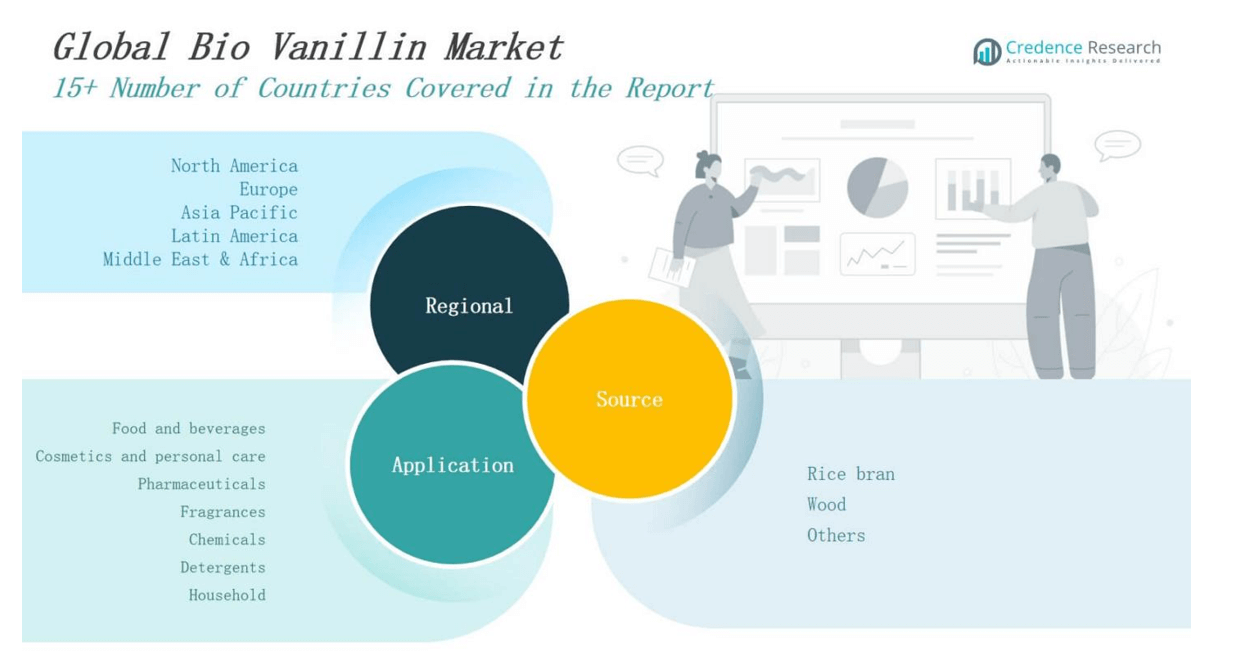
The Bio Vanillin Market is segmented by source into rice bran, wood, and others. Rice bran remains a dominant feedstock due to its renewable availability and cost efficiency in extraction. It supports large-scale production through fermentation and enzymatic conversion. Wood-based vanillin appeals to manufacturers focused on lignin-derived compounds and sustainable forestry practices. The “others” category includes various biomass and agricultural residues, offering flexibility in sourcing strategies. It allows producers to diversify raw material supply and adapt to regional feedstock availability.
- For instance, Borregaard is the only company globally producing vanillin from wood, specifically Norway spruce, through a process that uses spent sulfite liquor and is integrated within a biorefinery system.
By Application
The Bio Vanillin Market finds application across food and beverages, cosmetics and personal care, pharmaceuticals, fragrances, chemicals, detergents, and household products. Food and beverages lead in volume and revenue, driven by rising demand for natural flavoring in bakery, dairy, and confectionery. Cosmetics and personal care adopt bio vanillin for its mild scent and hypoallergenic profile. Pharmaceuticals use it in formulations where natural excipients are preferred. Fragrance and detergent manufacturers integrate it into eco-friendly product lines. It continues to expand in household applications, supported by clean-label and sustainability trends.
- For instance, Nestlé uses bio vanillin in its chocolate and ice cream products to provide a natural vanilla flavor, responding to consumer demand for clean-label ingredients in confectionery and dairy items.
Segments:
Based on Source
- Rice Bran
- Wood
- Others
Based on Application
- Food and Beverages
- Cosmetics and Personal Care
- Pharmaceuticals
- Fragrances
- Chemicals
- Detergents
- Household
Based on Region
- North America
- U.S.
- Canada
- Mexico
- Europe
- Germany
- France
- U.K.
- Italy
- Spain
- Rest of Europe
- Asia Pacific
- China
- Japan
- India
- South Korea
- South-east Asia
- Rest of Asia Pacific
- Latin America
- Brazil
- Argentina
- Rest of Latin America
- Middle East & Africa
- GCC Countries
- South Africa
- Rest of the Middle East and Africa
Regional Analysis
North America
The North America Bio Vanillin Market size was valued at USD 47.70 million in 2018 to USD 66.59 million in 2024 and is anticipated to reach USD 106.08 million by 2032, at a CAGR of 5.6% during the forecast period. North America holds a significant market share due to strong demand for clean-label food and natural flavoring agents. It benefits from well-established food processing, cosmetics, and pharmaceutical sectors that actively adopt bio-based ingredients. Major manufacturers in the U.S. and Canada prioritize sustainable sourcing and invest in fermentation technologies. Regulatory support for natural additives reinforces market penetration. It continues to expand in personal care and nutraceutical applications, especially among premium product lines. The region contributes over 20% to global revenue share.
Europe
The Europe Bio Vanillin Market size was valued at USD 69.95 million in 2018 to USD 96.51 million in 2024 and is anticipated to reach USD 144.73 million by 2032, at a CAGR of 4.8% during the forecast period. Europe commands the largest market share globally, accounting for nearly 30% of the total revenue. Strong consumer preference for natural, organic, and ethically sourced ingredients drives demand. Strict EU regulations discourage synthetic additives and support the adoption of bio vanillin across food, fragrance, and pharmaceutical industries. It benefits from advanced bioprocessing infrastructure and a well-regulated sourcing ecosystem. Germany, France, and the UK remain key consumption centers for bio-based flavorings.
Asia Pacific
The Asia Pacific Bio Vanillin Market size was valued at USD 86.36 million in 2018 to USD 128.37 million in 2024 and is anticipated to reach USD 217.35 million by 2032, at a CAGR of 6.4% during the forecast period. Asia Pacific holds the fastest growth rate and over 35% of the global volume share. Rising disposable income and demand for premium, clean-label food products fuel regional expansion. It benefits from abundant biomass availability and a growing bioprocessing ecosystem in China, India, and Southeast Asia. Local producers are scaling fermentation capacity to meet domestic and export needs. Bio vanillin adoption in personal care and household sectors is accelerating, supported by regional brand development and retail penetration.
Latin America
The Latin America Bio Vanillin Market size was valued at USD 10.39 million in 2018 to USD 14.64 million in 2024 and is anticipated to reach USD 20.46 million by 2032, at a CAGR of 3.9% during the forecast period. Latin America holds a modest share of the Bio Vanillin Market, contributing approximately 5% to global revenue. Brazil leads regional consumption, driven by growing demand in food and beverage applications. Local manufacturers seek alternatives to synthetic additives to comply with international export standards. It faces challenges in production scalability but benefits from regional agricultural biomass. Expanding cosmetic and fragrance industries create new application areas. Regional distribution partnerships support broader market reach.
Middle East
The Middle East Bio Vanillin Market size was valued at USD 6.10 million in 2018 to USD 7.92 million in 2024 and is anticipated to reach USD 10.52 million by 2032, at a CAGR of 3.2% during the forecast period. The Middle East contributes less than 3% of global market share but shows steady growth in food, fragrance, and hospitality sectors. Consumer awareness around natural products is gradually increasing in GCC countries. It sees demand from high-end personal care and food service brands promoting clean-label positioning. Regional importers play a key role in supplying bio vanillin to premium product lines. Limited local production creates reliance on global suppliers. Dubai and Saudi Arabia serve as major consumption hubs.
Africa
The Africa Bio Vanillin Market size was valued at USD 4.26 million in 2018 to USD 6.59 million in 2024 and is anticipated to reach USD 8.68 million by 2032, at a CAGR of 3.1% during the forecast period. Africa remains a nascent market, holding less than 2% of global volume share. It shows early-stage demand primarily in South Africa and Egypt. Growth is driven by rising urbanization, expanding packaged food consumption, and awareness of natural product benefits. It relies heavily on imports due to limited local production capacity. Challenges include pricing constraints and lack of infrastructure for biosynthesis. Government programs encouraging sustainable agriculture could improve long-term sourcing potential.
Key Player Analysis
- International Flavors & Fragrances Inc.
- Solvay SA
- Advanced Biotech
- Givaudan SA
- Omega Ingredients
- Takasago International Corp
- Borregaard ASA
- Prinova Group
- Archer-Daniels Midland Co. (ADM)
- Firmenich SA
Competitive Analysis
The Bio Vanillin Market features a competitive landscape driven by innovation, sustainable sourcing, and strategic partnerships. Leading players such as Solvay SA, Givaudan SA, International Flavors & Fragrances Inc., and Firmenich SA dominate through advanced fermentation technologies and global distribution networks. It is characterized by continuous investment in bioprocess development to improve yield, purity, and cost-efficiency. Companies compete by expanding their natural ingredient portfolios and aligning with clean-label trends. Smaller firms like Omega Ingredients and Advanced Biotech target niche applications and regional markets with customized solutions. Strategic collaborations between biotech firms and flavor houses are enhancing scalability and product quality. It also sees competition from synthetic vanillin producers, pressuring bio-based suppliers to match price points without compromising sustainability. Market players focus on certifications, traceability, and ESG compliance to gain preference among environmentally conscious customers. The competition continues to intensify as demand grows across food, personal care, and pharmaceutical industries.
Recent Developments
- In 2023, Lallemand completed its acquisition of Swiss biotech firm Evolva, which specializes in yeast-based fermentation technology for natural aroma ingredients. Lallemand now uses this capability to produce high‑purity (98%) vanillin from sugar sources.
- In June 2023, Borregaard ASA signed a large-scale supply agreement with a global food manufacturer to provide bio vanillin, strengthening its position in the natural flavor ingredients market.
- In January 2023, Solvay launched the first mass-balanced, ISCC PLUS-certified Rhovanil® natural vanillin, aligning with environmental and traceability standards.
- In January 2024, Danstar Ferment AG (a Lallemand affiliate) finalized the acquisition of Evolva AG, strengthening its fermentation capabilities for high-purity bio vanillin production.
Market Concentration & Characteristics
The Bio Vanillin Market is moderately concentrated, with a few major players accounting for a significant share of global production and supply. It is shaped by companies such as Solvay SA, Givaudan SA, International Flavors & Fragrances Inc., and Firmenich SA, which lead in technological capabilities and biotechnological innovation. These firms control critical fermentation and biosynthesis processes, securing strong positions in both developed and emerging markets. It exhibits high barriers to entry due to the need for advanced infrastructure, regulatory compliance, and proprietary microbial strains. Smaller companies compete by offering region-specific solutions or targeting niche applications. The market emphasizes sustainability, product purity, and traceability, characteristics that influence buyer preferences across food, personal care, and pharmaceutical sectors. Pricing remains sensitive, particularly in developing regions, but demand for clean-label ingredients sustains competitive activity. It evolves through continuous R&D and strategic partnerships, which shape its long-term trajectory and innovation potential.
Report Coverage
The research report offers an in-depth analysis based on Source, Application and Region. It details leading market players, providing an overview of their business, product offerings, investments, revenue streams, and key applications. Additionally, the report includes insights into the competitive environment, SWOT analysis, current market trends, as well as the primary drivers and constraints. Furthermore, it discusses various factors that have driven market expansion in recent years. The report also explores market dynamics, regulatory scenarios, and technological advancements that are shaping the industry. It assesses the impact of external factors and global economic changes on market growth. Lastly, it provides strategic recommendations for new entrants and established companies to navigate the complexities of the market.
Future Outlook
- Demand for bio vanillin will continue rising as clean-label and natural ingredients gain wider consumer acceptance.
- Food and beverage manufacturers will increasingly replace synthetic vanillin with bio-based alternatives to meet regulatory and consumer expectations.
- Technological advancements in microbial fermentation and enzymatic synthesis will improve production efficiency and scalability.
- Key players will expand production capacity to meet growing demand across global markets.
- Asia Pacific will maintain its position as the fastest-growing region due to industrial expansion and changing dietary preferences.
- Europe will retain a stronghold in premium product segments driven by regulatory compliance and sustainability goals.
- Applications in cosmetics and personal care will grow, fueled by the shift toward hypoallergenic and natural fragrance formulations.
- Price competitiveness will improve as fermentation technologies become more cost-effective and widely adopted.
- Strategic partnerships between biotech firms and flavor houses will shape future market development.
- Supply chain optimization and raw material security will remain key priorities for long-term market growth.

Request a Free Sample
Fill in your details and we'll send you a free sample report.
- Sample data tables & charts
- Research methodology
Market Dynamics
Rising Demand for Natural Ingredients in Food and Beverage
Consumers are increasingly seeking clean-label and natural products, prompting manufacturers to replace synthetic vanillin with bio-based alternatives. This shift is especially strong in bakery, dairy, and confectionery sectors, where transparency and health consciousness are driving adoption.
Supportive Regulatory Framework and Sustainability Goals
Stringent regulations in Europe and North America are restricting synthetic additives and encouraging the use of natural, bio-based vanillin. Sustainability certifications and environmental concerns further incentivize manufacturers to adopt bio vanillin, aligning with corporate ESG goals.
Advancements in Fermentation and Biotechnology
Continuous innovation in microbial fermentation and enzymatic processes has improved the yield, purity, and scalability of bio vanillin production. These technological advancements are making bio vanillin more commercially viable and cost-competitive, supporting broader market adoption.
Expansion into Personal Care and Pharmaceutical Applications
Bio vanillin is increasingly used in cosmetics, personal care, and pharmaceuticals due to its hypoallergenic properties and natural aroma. This diversification beyond food and beverage is expanding the market's reach and relevance across multiple high-value sectors.
Strategic Collaborations and Vertical Integration
Key players are forming partnerships and integrating supply chains to ensure raw material security and production efficiency. These collaborations enable large-scale commercialization, improve quality control, and support global distribution, driving market growth.
Need a Custom Version of This Report?
Tailor the scope, geography, or segments to your exact requirements.
- Custom geography or segment scope
- Direct access to our analyst team
Frequently Asked Questions
What is the current size of the Bio Vanillin Market?
What factors are driving the growth of the Bio Vanillin Market?
What are the key segments within the Bio Vanillin Market?
Who are the major players in the Bio Vanillin Market?
Table of Content
Chapter 1 Market Segmentation
- 1.1 Segmentation Framework
- 1.1.1 Product and Service Classification
- 1.1.2 Application and End-Use Classification
- 1.1.3 Technology and Solution Classification
- 1.1.4 Customer and Distribution Channel Classification
- 1.1.5 Geographic Segmentation
- 1.1.6 Market Segment Definitions and Boundaries
- 1.2 By Source
- 1.2.1 Rice Bran
- 1.2.2 Wood
- 1.2.3 Others
- 1.3 By Application
- 1.3.1 Food and Beverages
- 1.3.2 Cosmetics and Personal Care
- 1.3.3 Pharmaceuticals
- 1.3.4 Fragrances
- 1.3.5 Chemicals
- 1.3.6 Detergents
- 1.3.7 Household
Chapter 2 Introduction
- 2.1 Report Objectives and Scope
- 2.2 Product Definition and Industry Terminology
- 2.3 Market Inclusions and Exclusions
- 2.4 Research Process
- 2.4.1 Primary Research and Expert Interviews
- 2.4.2 Secondary Research and Source Review
- 2.4.3 Top-Down and Bottom-Up Estimation
- 2.4.4 Data Triangulation and Verification
- 2.5 Market Size Measurement Basis
- 2.5.1 2024: USD 320.62 million → 2032: USD 507.81 million
- 2.6 Historical and Forecast Reference Periods
- 2.6.1 Base Year: 2024
- 2.6.2 Forecast Period: 2024-2032
- 2.7 Research Assumptions and Limitations
Chapter 3 Executive Summary
- 3.1 Market Snapshot and Key Findings
- 3.2 Base-Year Market Size, 2024
- 3.3 Forecast Market Size, 2032
- 3.4 Revenue and Volume Growth Outlook
- 3.5 Key Demand and Supply Indicators
- 3.6 Leading Market Segments
- 3.7 Fastest-Growing Market Opportunities
- 3.8 Regional Performance Highlights
- 3.9 Technology and Industry Transformation
- 3.10 Competitive Landscape Summary
- 3.11 Analyst View and Strategic Implications
Chapter 4 Global Bio Vanillin Market Trends and Developments
- 4.1 Historical Industry Development
- 4.2 Recent Market Trends and Developments
- 4.3 Demand and Customer Behavior Trends
- 4.4 Technology and Product Innovation
- 4.5 Artificial Intelligence, Automation and Digitalization
- 4.6 Local Manufacturing and Supply Chain Realignment
- 4.7 Industry Partnerships, Mergers and Acquisitions
- 4.8 Sustainability and Circular Economy Developments
- 4.9 Government and Private Sector Investment Trends
- 4.10 Emerging Business Models and Commercialization
- 4.11 Industry Developments and Announcements
Chapter 5 Global Bio Vanillin Market Production, Supply and Demand Analysis
- 5.1 Demand Trend and Consumption Analysis
- 5.2 Demand Forecast, 2024-2032
- 5.3 Production and Output Trend
- 5.4 Production and Output Forecast, 2024-2032
- 5.5 Installed Capacity and Capacity Utilization
- 5.6 Company-Wise Production Plants and Statistics
- 5.6.1 Installed Production Capacity
- 5.6.2 Actual Production
- 5.6.3 Planned Capacity and Expansion Targets
- 5.7 Supply Chain Structure and Procurement Trends
- 5.8 Supply-Demand Gap and Bottlenecks
- 5.9 Import Dependence and Sourcing Structure
- 5.10 Contract Manufacturing and Outsourcing
- 5.11 Regional Supply and Demand Concentration
Chapter 6 Global Bio Vanillin Market Pricing Analysis
- 6.1 Pricing Structure and Measurement
- 6.2 Historical Pricing Trends
- 6.3 Pricing Outlook, 2024-2032
- 6.4 Average Selling Price and Unit Economics
- 6.5 Pricing by Product and Market Segment
- 6.6 Geographic Pricing Differences
- 6.7 Key Input, Energy, Labor and Logistics Costs
- 6.8 Contract Pricing and Purchasing Models
- 6.9 Pricing Sensitivity and Competitive Positioning
- 6.10 Price, Margin and Profitability Implications
Chapter 7 Global Bio Vanillin Market Dynamics
- 7.1 Market Growth Drivers
- 7.1.1 Demand-Side Drivers
- 7.1.2 Technology and Innovation Drivers
- 7.1.3 Infrastructure and Investment Drivers
- 7.1.4 Regulatory and Policy Drivers
- 7.2 Market Restraints
- 7.2.1 Cost and Affordability Constraints
- 7.2.2 Technology and Adoption Barriers
- 7.2.3 Supply Chain and Operational Constraints
- 7.3 Market Challenges
- 7.3.1 Competitive Pressure and Margin Erosion
- 7.3.2 Skills, Infrastructure and Implementation Gaps
- 7.4 Emerging Market Opportunities
- 7.5 Market Dynamics Impact and Time-Horizon Assessment
Chapter 8 Global Bio Vanillin Value Chain Analysis
- 8.1 Industry Value Chain Overview
- 8.2 Upstream Suppliers and Critical Inputs
- 8.3 Technology and Component Providers
- 8.4 Manufacturing or Service Delivery
- 8.5 Distribution, Channel Partners and Integrators
- 8.6 Downstream Applications and End Users
- 8.7 Value Addition and Profit Pools
- 8.8 Vertical Integration and Outsourcing
- 8.9 Supplier Concentration and Risk
- 8.10 Supply Chain Localization and Resilience
Chapter 9 Global Bio Vanillin Market Regulations and Policies
- 9.1 Relevant Laws, Standards and Compliance Frameworks
- 9.2 Product, Service, Safety and Quality Requirements
- 9.3 Government Policies, Incentives and Subsidies
- 9.4 Imports, Exports and Trade Barriers
- 9.5 Public Procurement and Local Content Requirements
- 9.6 Environmental and Sustainability Compliance
- 9.7 Upcoming Policy Changes and Market Implications
Chapter 10 Global Bio Vanillin Market Hotspots and Opportunities
- 10.1 Market Opportunity Mapping and Growth Hotspots
- 10.2 High-Growth Applications and Customer Groups
- 10.3 Underserved Markets and White-Space Opportunities
- 10.4 Emerging Technology and Product Opportunities
- 10.5 New Capacity and Investment Hotspots
- 10.6 Market Entry and Expansion Opportunities
- 10.7 Distribution and Partnership Opportunities
- 10.8 Near-Term and Long-Term Commercial Potential
- 10.9 Opportunity Attractiveness and Execution Risks
Chapter 11 Global Bio Vanillin Market Outlook, 2024-2032
- 11.1 Market Size and Analysis
- 11.1.1 Revenue (Market Measurement: 2024: USD 320.62 million → 2032: USD 507.81 million)
- 11.1.2 Market Volume and Quantity Sold
- 11.1.3 Historical Market Size
- 11.1.4 Base-Year Market Size, 2024
- 11.2 Market Forecast, 2024-2032
- 11.2.1 Revenue Forecast to 2032
- 11.2.2 Volume Forecast to 2032
- 11.2.3 CAGR and Year-on-Year Growth
- 11.2.4 Incremental Revenue Opportunity
- 11.3 Forecast Assumptions and Scenario Analysis
- 11.3.1 Base-Case Forecast
- 11.3.2 Optimistic and Conservative Scenarios
- 11.3.3 Technology, Pricing and Policy Sensitivities
- 11.4 Market Attractiveness and Growth Outlook
Chapter 12 Global Bio Vanillin Market Segmentation and Outlook
- 12.1 Segmentation Summary and Market Shares, 2024
- 12.2 Largest and Fastest-Growing Segments
- 12.3 By Source - Market Size and Forecast, 2024-2032
- 12.3.1 Segment Definition and Scope
- 12.3.2 Historical Market Size
- 12.3.3 Revenue Forecast, 2024-2032
- 12.3.4 Volume Forecast, 2024-2032
- 12.3.5 Base-Year Market Share, 2024
- 12.3.6 Segment CAGR and Growth Drivers
- 12.3.7 Subsegment Market Size and Forecast
- 12.3.7.1 Rice Bran
- 12.3.7.2 Wood
- 12.3.7.3 Others
- 12.3.8 Subsegment Pricing and Adoption Trends
- 12.3.9 Leading Suppliers and Competition
- 12.3.10 Regional Demand and Opportunities
- 12.4 By Application - Market Size and Forecast, 2024-2032
- 12.4.1 Segment Definition and Scope
- 12.4.2 Historical Market Size
- 12.4.3 Revenue Forecast, 2024-2032
- 12.4.4 Volume Forecast, 2024-2032
- 12.4.5 Base-Year Market Share, 2024
- 12.4.6 Segment CAGR and Growth Drivers
- 12.4.7 Subsegment Market Size and Forecast
- 12.4.7.1 Food and Beverages
- 12.4.7.2 Cosmetics and Personal Care
- 12.4.7.3 Pharmaceuticals
- 12.4.7.4 Fragrances
- 12.4.7.5 Chemicals
- 12.4.7.6 Detergents
- 12.4.7.7 Household
- 12.4.8 Subsegment Pricing and Adoption Trends
- 12.4.9 Leading Suppliers and Competition
- 12.4.10 Regional Demand and Opportunities
- 12.5 Segment Growth Comparison
- 12.6 Segment Attractiveness and Priority Matrix
Chapter 13 Global Bio Vanillin End-Use and Application Market Outlook
- 13.1 End-Use Industry and Customer Demand Structure
- 13.2 Leading Applications and Customer Groups
- 13.3 End-Use Market Size, Share and Forecast
- 13.4 Major End-Use Industry Deep Dives
- 13.4.1 Customer Requirements and Use Cases
- 13.4.2 Demand and Replacement Cycles
- 13.4.3 Technical and Regulatory Considerations
- 13.4.4 Purchasing and Procurement Models
- 13.4.5 Leading Vendors and Distribution Channels
- 13.4.6 Forecast and Commercial Opportunities
- 13.5 Emerging Applications and Cross-Segment Demand
- 13.6 End-Use Industry Investment Priorities
Chapter 14 Global Bio Vanillin Geographic Market Outlook, 2024-2032
- 14.1 Regional Market Size and Share, 2024
- 14.2 Regional Market Forecast, 2024-2032
- 14.3 Regional Pricing, Production and Demand Differences
- 14.4 North America
- 14.4.1 United States
- 14.4.2 Canada
- 14.4.3 Mexico
- 14.5 Europe
- 14.5.1 Germany
- 14.5.2 France
- 14.5.3 Italy
- 14.5.4 United Kingdom
- 14.5.5 Spain
- 14.5.6 Poland
- 14.5.7 Russia
- 14.5.8 Netherlands
- 14.5.9 Belgium
- 14.5.10 Sweden
- 14.5.11 Denmark
- 14.5.12 Norway
- 14.5.13 Rest of Europe
- 14.6 Asia Pacific
- 14.6.1 China
- 14.6.2 India
- 14.6.3 Japan
- 14.6.4 South Korea
- 14.6.5 Thailand
- 14.6.6 Indonesia
- 14.6.7 Vietnam
- 14.6.8 Malaysia
- 14.6.9 Australia
- 14.6.10 Rest of Asia Pacific
- 14.7 Latin America
- 14.7.1 Brazil
- 14.7.2 Argentina
- 14.7.3 Colombia
- 14.7.4 Chile
- 14.7.5 Rest of Latin America
- 14.8 Middle East
- 14.8.1 Saudi Arabia
- 14.8.2 United Arab Emirates
- 14.8.3 Turkey
- 14.8.4 Israel
- 14.8.5 Iran
- 14.8.6 Rest of the Middle East
- 14.9 Africa
- 14.9.1 South Africa
- 14.9.2 Egypt
- 14.9.3 Nigeria
- 14.9.4 Morocco
- 14.9.5 Rest of Africa
- 14.10 Regional Investment, Policy and Supply Chain Differences
- 14.11 Regional Competitive Landscape
- 14.12 Geographic Growth Hotspots
Chapter 15 Global Bio Vanillin Technology, Innovation and Sustainability Outlook
- 15.1 Technology Landscape and Maturity
- 15.2 Product, Process and Service Innovation
- 15.3 AI, Automation and Digital Tools in the Industry
- 15.4 Technology Adoption and Performance Benchmarking
- 15.5 Innovation Pipeline and R&D Investment
- 15.6 Patent and Intellectual Property Trends
- 15.7 Energy Efficiency and Resource Management
- 15.8 Sustainability, Recycling and Circularity
- 15.9 Technology Roadmap, 2024-2032
- 15.10 Risks of Obsolescence and Technology Substitution
Chapter 16 Global Bio Vanillin Market Key Strategic Imperatives
- 16.1 Growth and Market Entry Priorities
- 16.2 High-Return Products and Segments
- 16.3 Pricing, Profitability and Cost Optimization
- 16.4 Technology Investment and Product Differentiation
- 16.5 Supply Chain Localization and Resilience
- 16.6 Distribution and Customer Acquisition
- 16.7 Partnership, Acquisition and Capacity Strategy
- 16.8 Regional Expansion Priorities
- 16.9 Short-, Medium- and Long-Term Actions
Chapter 17 Competition Outlook
- 17.1 Industry Competition Characteristics
- 17.2 Market Structure and Concentration
- 17.3 Market Share and Competitive Positioning, 2024
- 17.4 Company-Wise Revenue and Product Benchmarking
- 17.5 Production and Service Capacity Benchmarking
- 17.6 Technology, Pricing and Differentiation
- 17.7 Regional Footprint and Distribution Strength
- 17.8 Mergers, Acquisitions and Strategic Alliances
- 17.9 New Entrants and Competitive Threats
- 17.10 Porter's Five Forces and Industry Attractiveness
- 17.11 Competitive Outlook, 2024-2032
Chapter 18 Company Profiles
- 18.1 Company Coverage and Selection Criteria
- 18.2 Solvay SA
- 18.2.1 Business Description
- 18.2.2 Company Ownership and Geographic Presence
- 18.2.3 Product and Service Portfolio
- 18.2.4 Manufacturing and Operating Footprint
- 18.2.5 Production Capacity and Expansion Plans
- 18.2.6 Financial Performance and Investment
- 18.2.7 Market Share and Competitive Position
- 18.2.8 Technology and Innovation Capabilities
- 18.2.9 Strategic Alliances or Partnerships
- 18.2.10 Recent Developments
- 18.2.11 Growth Strategy and Outlook
- 18.3 Givaudan SA
- 18.4 International Flavors & Fragrances Inc. (IFF)
- 18.5 Firmenich SA
- 18.6 Borregaard ASA
- 18.7 Omega Ingredients
- 18.8 Advanced Biotech
- 18.9 Takasago International Corp
- 18.10 Prinova Group
- 18.11 Archer-Daniels Midland Co. (ADM)
- 18.12 Other Relevant Market Participants
Note: Every listed company is profiled on the structure shown under the first company. The company list is preliminary and may change based on research findings, market developments, data availability and client requirements.
Chapter 19 Disclaimer
- 19.1 Research and Forecast Disclaimer
- 19.2 Data Source and Estimation Limitations
Note: The depth of individual sections depends on data availability for this market. Volume, capacity, trade and other unit-based metrics are included where applicable.

