| REPORT ATTRIBUTE | DETAILS |
|---|---|
| Historical Period | 2020-2023 |
| Base Year | 2024 |
| Forecast Period | 2025-2032 |
| Bottle Grade Pet Chips Market Size 2024 | USD 11,765.94 million |
| Bottle Grade Pet Chips Market, CAGR | 5.62% |
| Bottle Grade Pet Chips Market Size 2032 | USD 18,805.05 million |
Market Overview:
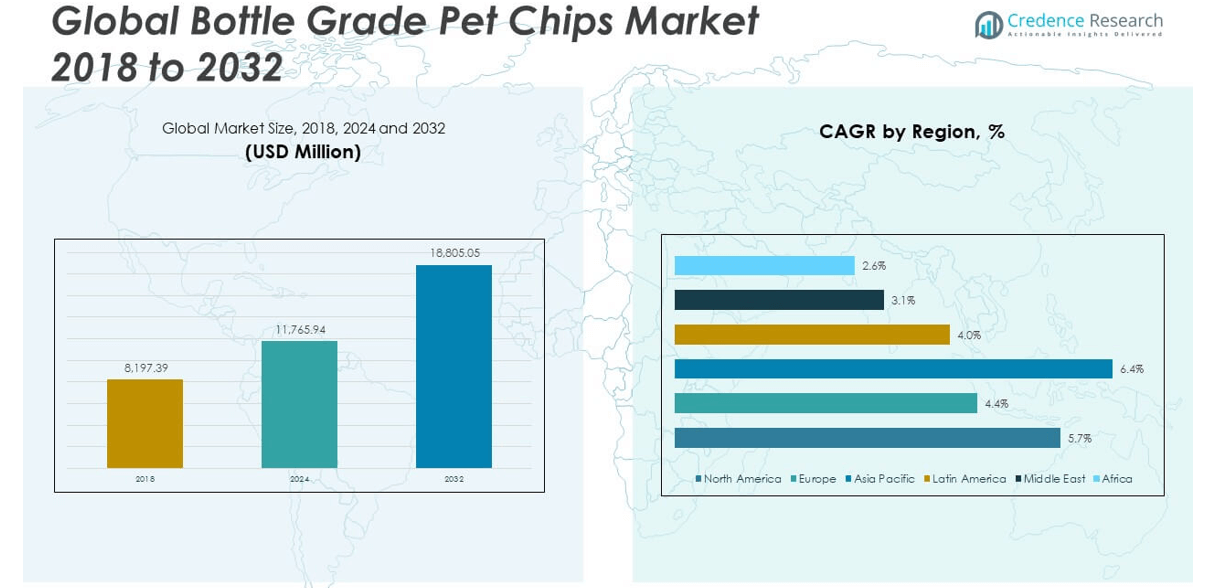
The Global Bottle Grade Pet Chips Market size was valued at USD 8,197.39 million in 2018 to USD 11,765.94 million in 2024 and is anticipated to reach USD 18,805.05 million by 2032, at a CAGR of 5.62% during the forecast period.
The global bottle grade PET chips market is witnessing robust growth, fueled by multiple interlinked drivers that reflect evolving industry trends and consumer preferences. One of the primary factors propelling the market is the escalating demand for lightweight, durable, and cost-effective packaging materials in the beverage industry. PET bottles are extensively used for packaging bottled water, carbonated drinks, juices, and edible oils due to their clarity, strength, and recyclability. The exponential rise in the consumption of packaged beverages particularly in fast-growing economies is significantly driving the demand for bottle grade PET chips. Additionally, growing environmental consciousness and regulatory mandates to curb plastic waste have accelerated the shift toward sustainable packaging solutions. This has led to a sharp increase in the use of recycled PET (rPET) chips, especially in food-grade applications. Advances in recycling technology and the availability of food-grade rPET are supporting this transition, enabling major beverage and FMCG companies to align their packaging with circular economy goals.
Regionally, Asia-Pacific dominates the global bottle grade PET chips market, both in terms of volume and growth rate, driven by a strong manufacturing base, rapid urbanization, and increasing consumption of bottled beverages across countries like China, India, Indonesia, and Vietnam. The region benefits from a large population base, rising disposable incomes, and expanding retail and foodservice sectors, all of which contribute to higher demand for PET bottles and chips. Moreover, regional governments are investing heavily in plastic waste management and recycling infrastructure, further propelling the market for rPET chips. North America holds a significant market share due to mature beverage consumption patterns, the presence of key PET chip producers, and growing regulatory emphasis on sustainable packaging. Europe follows closely, supported by strict environmental regulations, strong consumer preference for eco-friendly packaging, and well-developed recycling ecosystems. Meanwhile, Latin America and the Middle East & Africa are emerging as promising regions, supported by demographic growth, urban expansion, and increasing adoption of modern packaging solutions.
Market Insights:
- The Global Bottle Grade PET Chips Market grew from USD 8,197.39 million in 2018 to USD 11,765.94 million in 2024 and is projected to reach USD 18,805.05 million by 2032, registering a CAGR of 5.62% during the forecast period.
- The increasing consumption of bottled water, soft drinks, and functional beverages is driving widespread use of PET bottles, reinforcing demand for bottle grade PET chips due to their strength, transparency, and portability.
- Regulatory pressure and rising environmental awareness are accelerating the use of recycled PET (rPET) chips in food and beverage packaging, supporting a global shift toward circular packaging models.
- Innovations in melt filtration, polymerization, and energy-efficient processes are improving the clarity, strength, and food-grade safety of PET chips, supporting high-volume and high-quality output.
- Rapid urbanization, rising middle-class income, and growth of the organized food and beverage sectors in Asia-Pacific, Latin America, and Africa are significantly increasing demand for PET-based packaging.
- Fluctuations in prices of key raw materials like PTA and MEG, along with supply chain disruptions, create cost instability that affects chip production and pricing across the value chain.
- The restricted availability and high cost of food-grade recycled PET, due to stringent safety standards and limited recycling capacity, continue to hinder widespread rPET adoption despite strong demand.
Market Drivers:
Rising Demand for PET Bottles in Beverage and Packaged Water Industries
The Global Bottle Grade PET Chips Market is expanding rapidly due to the surge in demand for PET bottles across the beverage and packaged water segments. Increasing consumption of bottled water, soft drinks, and juices has elevated the need for PET bottles owing to their lightweight, transparent, and shatter-resistant properties. Consumers prefer PET packaging for its convenience and portability, while manufacturers benefit from its cost-effectiveness and ease of transportation. Leading beverage brands are investing in PET packaging to meet shifting consumer preferences away from glass and metal containers. This transition is particularly strong in urban regions where packaged beverages dominate retail shelves. The continuous rollout of new bottled water and ready-to-drink products is reinforcing the use of bottle grade PET chips globally.
- For example, Coca-Cola’s 2024 sustainability report confirms that the company has transitioned several product lines, such as Dasani and Smartwater, to 100% recycled PET (rPET) bottles in the U.S. and Europe, reducing virgin plastic use by approximately 20,000 metric tons per year.
Shift Toward Recyclable and Sustainable Packaging Materials
Sustainability regulations and environmental awareness are transforming the dynamics of the Global Bottle Grade PET Chips Market. Governments and regulatory bodies are enforcing stricter policies around single-use plastics and promoting the use of recyclable materials. PET is widely recognized for its recyclability, and companies are turning to recycled PET (rPET) chips to align with these evolving mandates. The growing consumer demand for eco-conscious products is pushing major food and beverage companies to adopt sustainable packaging strategies. Brands are actively replacing virgin PET with food-grade rPET to reduce their carbon footprint and demonstrate environmental responsibility. These efforts are creating a steady increase in demand for bottle grade PET chips with circular lifecycle attributes.
- For instance, Danone’s Evian has achieved 100% rPET packaging for its 500ml bottles, a move verified by third-party sustainability audits.
Advancements in PET Chip Manufacturing and Processing Technologies
Innovation in chip manufacturing is supporting the expansion of the Global Bottle Grade PET Chips Market. Enhanced polymerization techniques and process optimization are allowing manufacturers to produce chips with superior clarity, strength, and consistency. Companies are investing in advanced melt filtration systems to ensure higher purity and performance of chips used in food-contact applications. Automation and precision in chip production are improving yield and quality, which supports high-volume supply for global packaging operations. Adoption of energy-efficient technologies is also helping manufacturers reduce operational costs while maintaining quality standards. These technological improvements are positioning PET chips as a preferred material in both virgin and recycled forms.
Growth in Emerging Economies and Expansion of Food and Beverage Sectors
Rising urbanization and middle-class expansion in emerging economies are accelerating the growth of the Global Bottle Grade PET Chips Market. Countries across Asia-Pacific, Latin America, and Africa are witnessing a sharp rise in demand for bottled water and packaged foods, which is driving the need for high-quality PET bottles. The expansion of organized retail and e-commerce platforms in these regions is further boosting packaged goods consumption. Local producers and global FMCG companies are ramping up PET-based packaging to cater to the increasing demand. These developments are encouraging greater investment in PET chip production facilities within emerging markets. It continues to benefit from rising consumption patterns and expanding industrial applications in these high-growth regions.
Market Trends:
Emergence of Bio-Based PET Chips to Support Green Transition Goals
The Global Bottle Grade PET Chips Market is witnessing a rising trend in the development and commercialization of bio-based PET chips. These chips are derived from renewable sources such as sugarcane and corn starch, reducing dependency on fossil fuels. Leading chemical and packaging companies are investing in bio-based PET to meet environmental regulations and corporate sustainability targets. The ability of bio-PET to maintain similar mechanical properties as conventional PET makes it suitable for food and beverage applications. Several global brands are piloting bio-PET bottles to strengthen their green portfolios. It is gaining traction in both developed and developing markets as companies seek low-carbon alternatives to virgin PET.
- For example, Toray Industries of Japan, in collaboration with Gevo, has successfully produced 100% bio-based PET fiber using bio-based paraxylene (PX) technology, demonstrating the feasibility of fully renewable PET at a commercial scale.
Adoption of Digital Technologies to Optimize PET Chip Production
Digital transformation is shaping the operational landscape of the Global Bottle Grade PET Chips Market. Companies are leveraging Industry 4.0 tools such as IoT sensors, advanced process controls, and real-time analytics to enhance production efficiency. These technologies help monitor polymerization parameters, detect inconsistencies, and maintain uniform chip quality across large-scale manufacturing. Predictive maintenance and automated quality assurance are reducing downtime and operational costs. Producers are adopting AI-driven solutions to improve resource utilization and energy efficiency during chip production. It is embracing digital innovation to achieve consistent product performance and competitive manufacturing standards.
Increasing Focus on Lightweighting and Resin Efficiency in Bottle Design
Lightweighting is emerging as a strategic trend within the Global Bottle Grade PET Chips Market. Brands are redesigning PET bottles to use less resin while retaining strength and durability, in a bid to reduce costs and material usage. This trend supports sustainability goals and aligns with regulatory expectations for waste minimization. Innovations in chip formulation are allowing manufacturers to produce high-strength PET using lower weight-to-volume ratios. Lightweight bottles also lower logistics costs, offering savings in distribution and storage. It supports this trend by supplying chips that can achieve high clarity and impact resistance with reduced material input.
- For example, KHS, in partnership with Husky Technologies, recently engineered the "Factor 101" PET bottle, which uses just 5.89 grams of material to hold 591 milliliters (20 ounces) of liquid 30% less than the standard 7 grams used for a 500 ml bottle in the U.S. market.
Strategic Collaborations and Mergers to Strengthen Supply Chain Position
The Global Bottle Grade PET Chips Market is experiencing a surge in strategic alliances, joint ventures, and mergers aimed at reinforcing supply chains and expanding production capacity. Global and regional players are partnering to develop closed-loop recycling systems and increase the availability of food-grade rPET. These collaborations often involve technology sharing, raw material sourcing agreements, and expansion of recycling capabilities. The industry is also seeing vertical integration efforts, where companies are entering downstream packaging or upstream monomer production. It is becoming increasingly consolidated, with players focusing on scale, integration, and strategic positioning to meet rising global demand.
Market Challenges Analysis:
Volatility in Raw Material Prices and Supply Chain Disruptions Affect Cost Stability
The Global Bottle Grade PET Chips Market faces significant challenges from fluctuating raw material prices, particularly purified terephthalic acid (PTA) and monoethylene glycol (MEG). These petrochemical-based inputs are subject to oil price volatility, geopolitical tensions, and regional supply constraints, which impact production costs and profit margins. Frequent disruptions in logistics and transportation, especially in global trade corridors, create uncertainties in the timely availability of feedstocks. This volatility limits manufacturers' ability to maintain long-term pricing strategies and stable supply commitments. Market participants must constantly adjust procurement models and hedge against price swings to sustain operations. It remains exposed to cost instability that directly affects downstream pricing in packaging and beverage industries.
Limited Availability and High Cost of Food-Grade Recycled PET Restrains Circular Goals
Sourcing sufficient volumes of food-grade recycled PET (rPET) remains a major challenge for the Global Bottle Grade PET Chips Market. Strict regulatory requirements for food-contact safety limit the number of approved rPET suppliers, creating bottlenecks in supply chains. High purification standards, coupled with limited advanced recycling capacity, drive up production costs for rPET chips. While demand for sustainable packaging continues to rise, supply limitations prevent many manufacturers from scaling up rPET usage. Smaller players face difficulties competing with global firms that secure long-term contracts for quality recycled feedstock. It continues to face pressure balancing sustainability objectives with economic and technical feasibility.
Market Opportunities:
Expansion of Recycling Infrastructure and Investment in Circular Economy Solutions
The Global Bottle Grade PET Chips Market holds strong opportunities in the ongoing global push toward recycling infrastructure development. Government policies and private sector initiatives are accelerating the construction of advanced recycling plants capable of producing food-grade rPET. Emerging economies in Asia-Pacific, Latin America, and Africa are receiving international funding to modernize waste management systems. This trend enables higher recovery rates of used PET bottles, creating a more reliable supply of recyclable feedstock. Companies that invest in closed-loop systems and bottle-to-bottle recycling technologies stand to gain competitive advantage. It can benefit from expanded recycling networks and increased demand for sustainable packaging inputs.
Rising Demand for Premium and Functional Beverage Packaging
The growing market for health-focused, premium, and functional beverages is creating new demand in the Global Bottle Grade PET Chips Market. Consumers are showing strong preference for visually appealing, lightweight, and safe packaging formats that PET offers. Specialty beverages such as vitamin-infused water, plant-based drinks, and wellness shots require high-quality PET bottles with enhanced clarity and barrier properties. This shift opens avenues for chip manufacturers to offer value-added solutions tailored to premium brands. It can capture value by supplying customized PET grades that meet the needs of high-growth beverage segments.
Market Segmentation Analysis:
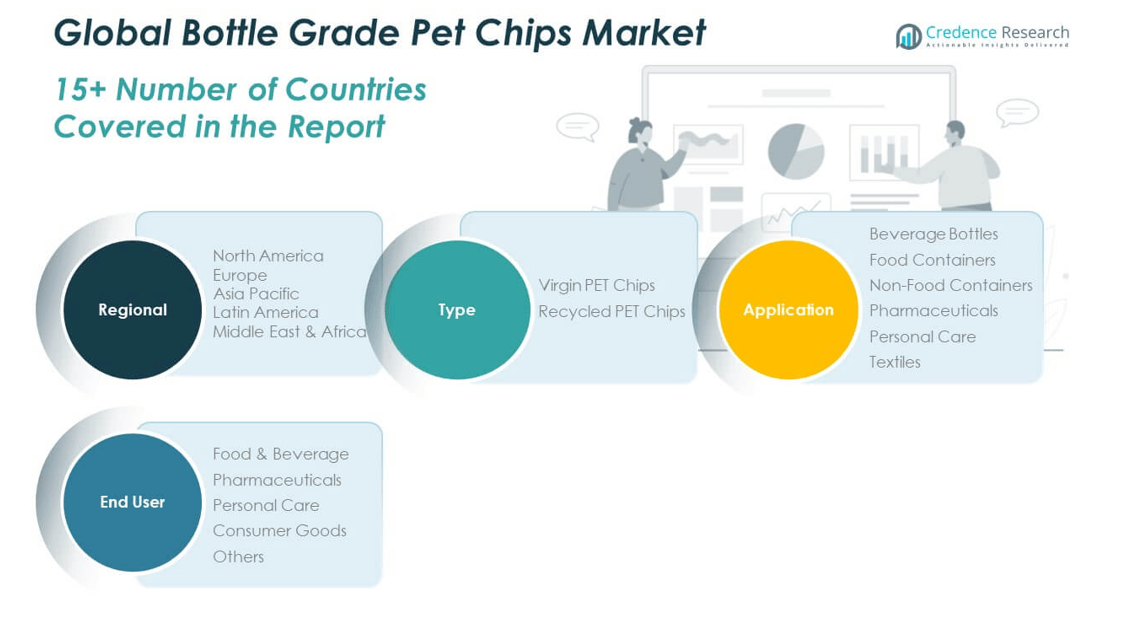
The Global Bottle Grade PET Chips Market is segmented by type, application, and end user, each contributing distinct value to the industry's growth trajectory.
By type, the market is divided into virgin PET chips and recycled PET chips. Virgin PET chips dominate due to their widespread use in high-clarity, food-grade applications, while recycled PET chips are gaining traction as sustainability goals reshape industry practices.
- For example, Indorama Ventures, a global leader in PET production, supplies virgin PET chips for Coca-Cola’s high-clarity, food-grade beverage bottles. Their IVL Virent™ resin is used in transparent bottles that require strict compliance with FDA and EFSA food safety standards.
By application, beverage bottles account for the largest share, driven by the high global demand for bottled water, carbonated drinks, and juices. Food containers follow closely, supported by the need for safe, lightweight, and durable packaging. Non-food containers, pharmaceuticals, personal care, and textiles are emerging segments with growing requirements for high-performance PET materials. It continues to diversify with evolving packaging trends across industries.
- For example, Amcor’s AmLite Ultra Recyclable containers utilize virgin PET chips to create lightweight, transparent food trays and lidding for ready meals and fresh produce. These containers meet stringent oxygen and moisture barrier requirements, extending shelf life and maintaining food safety.
By end user, the food and beverage segment leads due to its dependency on PET-based packaging. Pharmaceuticals, personal care, and consumer goods industries also contribute significantly, with increased emphasis on hygiene, shelf stability, and visual appeal.
Segmentation:
By Type
- Virgin PET Chips
- Recycled PET Chips
By Application
- Beverage Bottles
- Food Containers
- Non-Food Containers
- Pharmaceuticals
- Personal Care
- Textiles
By End User
- Food & Beverage
- Pharmaceuticals
- Personal Care
- Consumer Goods
- Others
By Region
- North America
- U.S.
- Canada
- Mexico
- Europe
- Germany
- France
- U.K.
- Italy
- Spain
- Rest of Europe
- Asia Pacific
- China
- Japan
- India
- South Korea
- South-east Asia
- Rest of Asia Pacific
- Latin America
- Brazil
- Argentina
- Rest of Latin America
- Middle East & Africa
- GCC Countries
- South Africa
- Rest of the Middle East and Africa
Regional Analysis:
North America
The North America Bottle Grade PET Chips Market size was valued at USD 2,453.85 million in 2018 to USD 3,468.72 million in 2024 and is anticipated to reach USD 5,566.48 million by 2032, at a CAGR of 5.7% during the forecast period. North America holds a 24% share of the Global Bottle Grade PET Chips Market, driven by high per capita consumption of bottled beverages and advanced recycling infrastructure. The United States leads regional demand, supported by strong investments in sustainable packaging solutions and high regulatory standards. Major beverage companies continue to adopt recycled PET chips in response to increasing consumer awareness about environmental impact. The region benefits from a mature supply chain and availability of food-grade rPET from local recyclers. It is also influenced by policy shifts such as Extended Producer Responsibility (EPR), which encourages circular material use. The presence of global packaging leaders strengthens the region’s role in market innovation.
Europe
The Europe Bottle Grade PET Chips Market size was valued at USD 1,625.91 million in 2018 to USD 2,213.38 million in 2024 and is anticipated to reach USD 3,236.68 million by 2032, at a CAGR of 4.4% during the forecast period. Europe accounts for 15% of the Global Bottle Grade PET Chips Market, supported by stringent environmental policies and strong recycling practices. Countries like Germany, France, and the Netherlands lead in PET bottle collection and reuse rates. Brands operating in the region are under regulatory pressure to meet minimum recycled content requirements in food-grade bottles. The European market shows rising demand for high-clarity and lightweight PET chips to align with eco-design principles. It is influenced by innovation in chemical recycling technologies that improve the purity of rPET chips. Investment in pan-European circular economy initiatives is further fueling regional growth.
Asia Pacific
The Asia Pacific Bottle Grade PET Chips Market size was valued at USD 3,387.44 million in 2018 to USD 5,051.93 million in 2024 and is anticipated to reach USD 8,594.08 million by 2032, at a CAGR of 6.4% during the forecast period. Asia Pacific dominates the Global Bottle Grade PET Chips Market with a 38% share, driven by rapid urbanization, growing packaged beverage consumption, and expanding retail infrastructure. China and India are the largest contributors, supported by domestic manufacturing capacity and rising consumer demand. The region is witnessing growing investments in rPET production to meet sustainability targets set by multinational companies. Increasing use of bottled water in urban centers continues to boost demand for PET chips. It benefits from economies of scale, low production costs, and strong government support for recycling infrastructure. Regional growth is also supported by public-private partnerships promoting waste segregation and circular packaging.
Latin America
The Latin America Bottle Grade PET Chips Market size was valued at USD 395.39 million in 2018 to USD 560.61 million in 2024 and is anticipated to reach USD 795.21 million by 2032, at a CAGR of 4.0% during the forecast period. Latin America holds a 4% share of the Global Bottle Grade PET Chips Market, with Brazil and Mexico being key contributors. Increasing consumption of carbonated drinks and packaged water is creating demand for PET-based packaging. Local brands are gradually adopting recycled PET chips in response to sustainability concerns and corporate responsibility initiatives. Collection and sorting systems in the region are improving, although gaps in food-grade recycling persist. It benefits from regional efforts to harmonize environmental policies and attract investment in polymer recovery facilities. Government-backed awareness programs are supporting consumer participation in recycling initiatives.
Middle East
The Middle East Bottle Grade PET Chips Market size was valued at USD 206.82 million in 2018 to USD 268.54 million in 2024 and is anticipated to reach USD 353.98 million by 2032, at a CAGR of 3.1% during the forecast period. The region contributes 2% to the Global Bottle Grade PET Chips Market, supported by rising demand for bottled water due to climatic conditions and limited access to potable water. Gulf countries are expanding their bottled beverage sectors to meet tourism and hospitality requirements. However, the region’s recycling ecosystem remains underdeveloped compared to global standards. Governments are launching national sustainability visions to promote closed-loop packaging systems. It is gradually adopting rPET solutions in response to growing pressure from global sustainability benchmarks. Infrastructure gaps remain a key area of focus for market players seeking regional growth.
Africa
The Africa Bottle Grade PET Chips Market size was valued at USD 127.98 million in 2018 to USD 202.76 million in 2024 and is anticipated to reach USD 258.63 million by 2032, at a CAGR of 2.6% during the forecast period. Africa currently holds a 1% share of the Global Bottle Grade PET Chips Market. Demand is driven by population growth, urbanization, and rising consumption of bottled water in regions with poor municipal water supply. The continent is seeing early-stage development of PET recycling infrastructure, mostly led by private initiatives and non-governmental organizations. South Africa leads in rPET usage and collection efforts due to national producer responsibility legislation. It remains in a nascent stage but offers long-term opportunities as awareness of sustainable packaging increases. Investment in local manufacturing and waste recovery systems is essential to support future growth.
Key Player Analysis:
- Indorama Ventures
- Far Eastern New Century
- Alpek S.A.B. de C.V.
- DAK Americas
- JBF Industries Ltd.
- Dhunseri Petrochem Ltd.
- M&G Chemicals
- Lotte Chemical Corporation
- Toray Industries Inc.
- Reliance Industries Limited
Competitive Analysis:
The Global Bottle Grade PET Chips Market is highly competitive, with a mix of multinational corporations and regional manufacturers striving to expand production capacity and product quality. Leading players include Indorama Ventures, Reliance Industries, Sinopec Yizheng Chemical Fibre, Far Eastern New Century, and Alpek S.A.B. de C.V. These companies focus on backward integration, technological advancement, and strategic partnerships to strengthen market presence. It is influenced by innovation in food-grade recycled PET (rPET) and the growing demand for sustainable materials. Players are investing in expansion projects and recycling capabilities to secure long-term supply contracts with major beverage brands. Market dynamics are shaped by product differentiation, cost efficiency, and compliance with stringent food safety and environmental standards. Competitive pressure continues to intensify as new entrants target niche applications and regional demand.
Recent Developments:
- On June 24, 2025, Indorama Ventures Public Company Limited announced a strategic collaboration with PolySource to co-develop and distribute specialized polymer solutions. This marks a notable expansion within its PET value chain, reinforcing its dedication to innovation and customization in packaging applications
- In September 2024 partnership between Indorama Ventures, Dhunseri Ventures, and Varun Beverages to construct PET recycling plants in India is directly related to bottle grade PET chips. The joint venture targets a significant increase in recycled PET (rPET) capacity, which is primarily used for bottle-grade applications.
Market Concentration & Characteristics:
The Global Bottle Grade PET Chips Market exhibits a moderately concentrated structure, with a few dominant players controlling a significant share of global production capacity. It features characteristics such as high capital intensity, vertical integration, and strong emphasis on quality control and food safety compliance. Leading producers operate large-scale facilities with advanced polymerization technologies to meet rising demand for virgin and recycled PET chips. The market shows steady consolidation through mergers and capacity expansions, particularly in Asia and North America. It requires consistent raw material supply and access to robust recycling infrastructure to maintain competitiveness. Buyers in the market prioritize clarity, consistency, and regulatory compliance, shaping product specifications and supplier selection.
Report Coverage:
The research report offers an in-depth analysis based on Type, Application and End User. It details leading market players, providing an overview of their business, product offerings, investments, revenue streams, and key applications. Additionally, the report includes insights into the competitive environment, SWOT analysis, current market trends, as well as the primary drivers and constraints. Furthermore, it discusses various factors that have driven market expansion in recent years. The report also explores market dynamics, regulatory scenarios, and technological advancements that are shaping the industry. It assesses the impact of external factors and global economic changes on market growth. Lastly, it provides strategic recommendations for new entrants and established companies to navigate the complexities of the market.
Future Outlook:
- Demand for food-grade recycled PET chips will grow due to stricter sustainability mandates across global packaging sectors.
- Technological advancements in bio-based PET chip production will support the shift toward renewable feedstocks.
- Major beverage companies will increase long-term sourcing agreements, strengthening supply chain stability.
- Investment in advanced recycling infrastructure will improve availability of high-purity rPET chips.
- Lightweight bottle design innovations will drive demand for high-performance PET chip grades.
- Emerging markets in Asia-Pacific and Africa will offer new growth avenues through rising packaged beverage consumption.
- Regulatory pressures on single-use plastics will push producers toward circular economy models.
- Strategic mergers and acquisitions will intensify competition and consolidate market positions.
- Adoption of digital manufacturing tools will enhance process control and operational efficiency.
- Expansion of local PET chip manufacturing in underserved regions will reduce reliance on imports.

Request a Free Sample
Fill in your details and we'll send you a free sample report.
- Sample data tables & charts
- Research methodology
Market Dynamics
Surge in Packaged Beverage Consumption
The rapid increase in consumption of bottled water, soft drinks, and juices - especially in urban and emerging markets - has significantly boosted demand for bottle grade PET chips due to their lightweight, clarity, and shatter-resistant properties.
Shift Toward Sustainable and Recyclable Packaging
Growing environmental awareness and stricter regulations on single-use plastics are accelerating the adoption of recycled PET (rPET) chips, as brands and manufacturers seek to align with circular economy goals and reduce their carbon footprint.
Technological Advancements in PET Chip Manufacturing
Innovations in polymerization, melt filtration, and energy-efficient processes are enabling the production of PET chips with superior clarity, strength, and food-grade safety, supporting high-volume and high-quality output for global packaging needs.
Expansion of Recycling Infrastructure
Investments in advanced recycling plants and closed-loop systems, particularly in Asia-Pacific and emerging markets, are increasing the availability of food-grade rPET chips, supporting both sustainability mandates and supply chain reliability.
Growth of Organized Retail and Food & Beverage Sectors in Emerging Economies
Rapid urbanization, rising middle-class incomes, and the expansion of modern retail and foodservice sectors in regions like Asia-Pacific and Latin America are driving higher demand for PET-based packaging, further fueling market growth.
Need a Custom Version of This Report?
Tailor the scope, geography, or segments to your exact requirements.
- Custom geography or segment scope
- Direct access to our analyst team
Frequently Asked Questions
What is the current size of the Global Bottle Grade PET Chips Market?
What are the key segments within the Global Bottle Grade PET Chips Market?
What are some challenges faced by the Global Bottle Grade PET Chips Market?
Who are the major players in the Global Bottle Grade PET Chips Market?
Table of Content
Chapter 1 Market Segmentation
- 1.1 Segmentation Framework
- 1.1.1 Product and Service Classification
- 1.1.2 Application and End-Use Classification
- 1.1.3 Technology and Solution Classification
- 1.1.4 Customer and Distribution Channel Classification
- 1.1.5 Geographic Segmentation
- 1.1.6 Market Segment Definitions and Boundaries
- 1.2 By Type
- 1.2.1 Virgin PET Chips
- 1.2.2 Recycled PET Chips
- 1.3 By End User
- 1.3.1 Food & Beverage
- 1.3.2 Pharmaceuticals
- 1.3.3 Personal Care
- 1.3.4 Consumer Goods
- 1.3.5 Others
- 1.4 By Application
- 1.4.1 Beverage Bottles
- 1.4.2 Food Containers
- 1.4.3 Non-Food Containers
- 1.4.4 Pharmaceuticals
- 1.4.5 Personal Care
- 1.4.6 Textiles
Chapter 2 Introduction
- 2.1 Report Objectives and Scope
- 2.2 Product Definition and Industry Terminology
- 2.3 Market Inclusions and Exclusions
- 2.4 Research Process
- 2.4.1 Primary Research and Expert Interviews
- 2.4.2 Secondary Research and Source Review
- 2.4.3 Top-Down and Bottom-Up Estimation
- 2.4.4 Data Triangulation and Verification
- 2.5 Market Size Measurement Basis
- 2.5.1 2024: USD 11,765.94 million → 2032: USD 18,805.05 million
- 2.6 Historical and Forecast Reference Periods
- 2.6.1 Base Year: 2024
- 2.6.2 Forecast Period: 2024-2032
- 2.7 Research Assumptions and Limitations
Chapter 3 Executive Summary
- 3.1 Market Snapshot and Key Findings
- 3.2 Base-Year Market Size, 2024
- 3.3 Forecast Market Size, 2032
- 3.4 Revenue and Volume Growth Outlook
- 3.5 Key Demand and Supply Indicators
- 3.6 Leading Market Segments
- 3.7 Fastest-Growing Market Opportunities
- 3.8 Regional Performance Highlights
- 3.9 Technology and Industry Transformation
- 3.10 Competitive Landscape Summary
- 3.11 Analyst View and Strategic Implications
Chapter 4 Global Bottle Grade Pet Chips Market Trends and Developments
- 4.1 Historical Industry Development
- 4.2 Recent Market Trends and Developments
- 4.3 Demand and Customer Behavior Trends
- 4.4 Technology and Product Innovation
- 4.5 Artificial Intelligence, Automation and Digitalization
- 4.6 Local Manufacturing and Supply Chain Realignment
- 4.7 Industry Partnerships, Mergers and Acquisitions
- 4.8 Sustainability and Circular Economy Developments
- 4.9 Government and Private Sector Investment Trends
- 4.10 Emerging Business Models and Commercialization
- 4.11 Industry Developments and Announcements
Chapter 5 Global Bottle Grade Pet Chips Market Production, Supply and Demand Analysis
- 5.1 Demand Trend and Consumption Analysis
- 5.2 Demand Forecast, 2024-2032
- 5.3 Production and Output Trend
- 5.4 Production and Output Forecast, 2024-2032
- 5.5 Installed Capacity and Capacity Utilization
- 5.6 Company-Wise Production Plants and Statistics
- 5.6.1 Installed Production Capacity
- 5.6.2 Actual Production
- 5.6.3 Planned Capacity and Expansion Targets
- 5.7 Supply Chain Structure and Procurement Trends
- 5.8 Supply-Demand Gap and Bottlenecks
- 5.9 Import Dependence and Sourcing Structure
- 5.10 Contract Manufacturing and Outsourcing
- 5.11 Regional Supply and Demand Concentration
Chapter 6 Global Bottle Grade Pet Chips Market Pricing Analysis
- 6.1 Pricing Structure and Measurement
- 6.2 Historical Pricing Trends
- 6.3 Pricing Outlook, 2024-2032
- 6.4 Average Selling Price and Unit Economics
- 6.5 Pricing by Product and Market Segment
- 6.6 Geographic Pricing Differences
- 6.7 Key Input, Energy, Labor and Logistics Costs
- 6.8 Contract Pricing and Purchasing Models
- 6.9 Pricing Sensitivity and Competitive Positioning
- 6.10 Price, Margin and Profitability Implications
Chapter 7 Global Bottle Grade Pet Chips Market Dynamics
- 7.1 Market Growth Drivers
- 7.1.1 Demand-Side Drivers
- 7.1.2 Technology and Innovation Drivers
- 7.1.3 Infrastructure and Investment Drivers
- 7.1.4 Regulatory and Policy Drivers
- 7.2 Market Restraints
- 7.2.1 Cost and Affordability Constraints
- 7.2.2 Technology and Adoption Barriers
- 7.2.3 Supply Chain and Operational Constraints
- 7.3 Market Challenges
- 7.3.1 Competitive Pressure and Margin Erosion
- 7.3.2 Skills, Infrastructure and Implementation Gaps
- 7.4 Emerging Market Opportunities
- 7.5 Market Dynamics Impact and Time-Horizon Assessment
Chapter 8 Global Bottle Grade Pet Chips Value Chain Analysis
- 8.1 Industry Value Chain Overview
- 8.2 Upstream Suppliers and Critical Inputs
- 8.3 Technology and Component Providers
- 8.4 Manufacturing or Service Delivery
- 8.5 Distribution, Channel Partners and Integrators
- 8.6 Downstream Applications and End Users
- 8.7 Value Addition and Profit Pools
- 8.8 Vertical Integration and Outsourcing
- 8.9 Supplier Concentration and Risk
- 8.10 Supply Chain Localization and Resilience
Chapter 9 Global Bottle Grade Pet Chips Market Regulations and Policies
- 9.1 Relevant Laws, Standards and Compliance Frameworks
- 9.2 Product, Service, Safety and Quality Requirements
- 9.3 Government Policies, Incentives and Subsidies
- 9.4 Imports, Exports and Trade Barriers
- 9.5 Public Procurement and Local Content Requirements
- 9.6 Environmental and Sustainability Compliance
- 9.7 Upcoming Policy Changes and Market Implications
Chapter 10 Global Bottle Grade Pet Chips Market Hotspots and Opportunities
- 10.1 Market Opportunity Mapping and Growth Hotspots
- 10.2 High-Growth Applications and Customer Groups
- 10.3 Underserved Markets and White-Space Opportunities
- 10.4 Emerging Technology and Product Opportunities
- 10.5 New Capacity and Investment Hotspots
- 10.6 Market Entry and Expansion Opportunities
- 10.7 Distribution and Partnership Opportunities
- 10.8 Near-Term and Long-Term Commercial Potential
- 10.9 Opportunity Attractiveness and Execution Risks
Chapter 11 Global Bottle Grade Pet Chips Market Outlook, 2024-2032
- 11.1 Market Size and Analysis
- 11.1.1 Revenue (Market Measurement: 2024: USD 11,765.94 million → 2032: USD 18,805.05 million)
- 11.1.2 Market Volume and Quantity Sold
- 11.1.3 Historical Market Size
- 11.1.4 Base-Year Market Size, 2024
- 11.2 Market Forecast, 2024-2032
- 11.2.1 Revenue Forecast to 2032
- 11.2.2 Volume Forecast to 2032
- 11.2.3 CAGR and Year-on-Year Growth
- 11.2.4 Incremental Revenue Opportunity
- 11.3 Forecast Assumptions and Scenario Analysis
- 11.3.1 Base-Case Forecast
- 11.3.2 Optimistic and Conservative Scenarios
- 11.3.3 Technology, Pricing and Policy Sensitivities
- 11.4 Market Attractiveness and Growth Outlook
Chapter 12 Global Bottle Grade Pet Chips Market Segmentation and Outlook
- 12.1 Segmentation Summary and Market Shares, 2024
- 12.2 Largest and Fastest-Growing Segments
- 12.3 By Type - Market Size and Forecast, 2024-2032
- 12.3.1 Segment Definition and Scope
- 12.3.2 Historical Market Size
- 12.3.3 Revenue Forecast, 2024-2032
- 12.3.4 Volume Forecast, 2024-2032
- 12.3.5 Base-Year Market Share, 2024
- 12.3.6 Segment CAGR and Growth Drivers
- 12.3.7 Subsegment Market Size and Forecast
- 12.3.7.1 Virgin PET Chips
- 12.3.7.2 Recycled PET Chips
- 12.3.8 Subsegment Pricing and Adoption Trends
- 12.3.9 Leading Suppliers and Competition
- 12.3.10 Regional Demand and Opportunities
- 12.4 By End User - Market Size and Forecast, 2024-2032
- 12.4.1 Segment Definition and Scope
- 12.4.2 Historical Market Size
- 12.4.3 Revenue Forecast, 2024-2032
- 12.4.4 Volume Forecast, 2024-2032
- 12.4.5 Base-Year Market Share, 2024
- 12.4.6 Segment CAGR and Growth Drivers
- 12.4.7 Subsegment Market Size and Forecast
- 12.4.7.1 Food & Beverage
- 12.4.7.2 Pharmaceuticals
- 12.4.7.3 Personal Care
- 12.4.7.4 Consumer Goods
- 12.4.7.5 Others
- 12.4.8 Subsegment Pricing and Adoption Trends
- 12.4.9 Leading Suppliers and Competition
- 12.4.10 Regional Demand and Opportunities
- 12.5 By Application - Market Size and Forecast, 2024-2032
- 12.5.1 Segment Definition and Scope
- 12.5.2 Historical Market Size
- 12.5.3 Revenue Forecast, 2024-2032
- 12.5.4 Volume Forecast, 2024-2032
- 12.5.5 Base-Year Market Share, 2024
- 12.5.6 Segment CAGR and Growth Drivers
- 12.5.7 Subsegment Market Size and Forecast
- 12.5.7.1 Beverage Bottles
- 12.5.7.2 Food Containers
- 12.5.7.3 Non-Food Containers
- 12.5.7.4 Pharmaceuticals
- 12.5.7.5 Personal Care
- 12.5.7.6 Textiles
- 12.5.8 Subsegment Pricing and Adoption Trends
- 12.5.9 Leading Suppliers and Competition
- 12.5.10 Regional Demand and Opportunities
- 12.6 Segment Growth Comparison
- 12.7 Segment Attractiveness and Priority Matrix
Chapter 13 Global Bottle Grade Pet Chips End-Use and Application Market Outlook
- 13.1 End-Use Industry and Customer Demand Structure
- 13.2 Leading Applications and Customer Groups
- 13.3 End-Use Market Size, Share and Forecast
- 13.4 Major End-Use Industry Deep Dives
- 13.4.1 Customer Requirements and Use Cases
- 13.4.2 Demand and Replacement Cycles
- 13.4.3 Technical and Regulatory Considerations
- 13.4.4 Purchasing and Procurement Models
- 13.4.5 Leading Vendors and Distribution Channels
- 13.4.6 Forecast and Commercial Opportunities
- 13.5 Emerging Applications and Cross-Segment Demand
- 13.6 End-Use Industry Investment Priorities
Chapter 14 Global Bottle Grade Pet Chips Geographic Market Outlook, 2024-2032
- 14.1 Regional Market Size and Share, 2024
- 14.2 Regional Market Forecast, 2024-2032
- 14.3 Regional Pricing, Production and Demand Differences
- 14.4 North America
- 14.4.1 United States
- 14.4.2 Canada
- 14.4.3 Mexico
- 14.5 Europe
- 14.5.1 Germany
- 14.5.2 France
- 14.5.3 Italy
- 14.5.4 United Kingdom
- 14.5.5 Spain
- 14.5.6 Poland
- 14.5.7 Russia
- 14.5.8 Netherlands
- 14.5.9 Belgium
- 14.5.10 Sweden
- 14.5.11 Denmark
- 14.5.12 Norway
- 14.5.13 Rest of Europe
- 14.6 Asia Pacific
- 14.6.1 China
- 14.6.2 India
- 14.6.3 Japan
- 14.6.4 South Korea
- 14.6.5 Thailand
- 14.6.6 Indonesia
- 14.6.7 Vietnam
- 14.6.8 Malaysia
- 14.6.9 Australia
- 14.6.10 Rest of Asia Pacific
- 14.7 Latin America
- 14.7.1 Brazil
- 14.7.2 Argentina
- 14.7.3 Colombia
- 14.7.4 Chile
- 14.7.5 Rest of Latin America
- 14.8 Middle East
- 14.8.1 Saudi Arabia
- 14.8.2 United Arab Emirates
- 14.8.3 Turkey
- 14.8.4 Israel
- 14.8.5 Iran
- 14.8.6 Rest of the Middle East
- 14.9 Africa
- 14.9.1 South Africa
- 14.9.2 Egypt
- 14.9.3 Nigeria
- 14.9.4 Morocco
- 14.9.5 Rest of Africa
- 14.10 Regional Investment, Policy and Supply Chain Differences
- 14.11 Regional Competitive Landscape
- 14.12 Geographic Growth Hotspots
Chapter 15 Global Bottle Grade Pet Chips Technology, Innovation and Sustainability Outlook
- 15.1 Technology Landscape and Maturity
- 15.2 Product, Process and Service Innovation
- 15.3 AI, Automation and Digital Tools in the Industry
- 15.4 Technology Adoption and Performance Benchmarking
- 15.5 Innovation Pipeline and R&D Investment
- 15.6 Patent and Intellectual Property Trends
- 15.7 Energy Efficiency and Resource Management
- 15.8 Sustainability, Recycling and Circularity
- 15.9 Technology Roadmap, 2024-2032
- 15.10 Risks of Obsolescence and Technology Substitution
Chapter 16 Global Bottle Grade Pet Chips Market Key Strategic Imperatives
- 16.1 Growth and Market Entry Priorities
- 16.2 High-Return Products and Segments
- 16.3 Pricing, Profitability and Cost Optimization
- 16.4 Technology Investment and Product Differentiation
- 16.5 Supply Chain Localization and Resilience
- 16.6 Distribution and Customer Acquisition
- 16.7 Partnership, Acquisition and Capacity Strategy
- 16.8 Regional Expansion Priorities
- 16.9 Short-, Medium- and Long-Term Actions
Chapter 17 Competition Outlook
- 17.1 Industry Competition Characteristics
- 17.2 Market Structure and Concentration
- 17.3 Market Share and Competitive Positioning, 2024
- 17.4 Company-Wise Revenue and Product Benchmarking
- 17.5 Production and Service Capacity Benchmarking
- 17.6 Technology, Pricing and Differentiation
- 17.7 Regional Footprint and Distribution Strength
- 17.8 Mergers, Acquisitions and Strategic Alliances
- 17.9 New Entrants and Competitive Threats
- 17.10 Porter's Five Forces and Industry Attractiveness
- 17.11 Competitive Outlook, 2024-2032
Chapter 18 Company Profiles
- 18.1 Company Coverage and Selection Criteria
- 18.2 Indorama Ventures
- 18.2.1 Business Description
- 18.2.2 Company Ownership and Geographic Presence
- 18.2.3 Product and Service Portfolio
- 18.2.4 Manufacturing and Operating Footprint
- 18.2.5 Production Capacity and Expansion Plans
- 18.2.6 Financial Performance and Investment
- 18.2.7 Market Share and Competitive Position
- 18.2.8 Technology and Innovation Capabilities
- 18.2.9 Strategic Alliances or Partnerships
- 18.2.10 Recent Developments
- 18.2.11 Growth Strategy and Outlook
- 18.3 Far Eastern New Century
- 18.4 Alpek S.A.B. de C.V.
- 18.5 DAK Americas
- 18.6 JBF Industries Ltd.
- 18.7 Dhunseri Petrochem Ltd.
- 18.8 M&G Chemicals
- 18.9 Lotte Chemical Corporation
- 18.10 Toray Industries Inc.
- 18.11 Reliance Industries Limited
- 18.12 Other Relevant Market Participants
Note: Every listed company is profiled on the structure shown under the first company. The company list is preliminary and may change based on research findings, market developments, data availability and client requirements.
Chapter 19 Disclaimer
- 19.1 Research and Forecast Disclaimer
- 19.2 Data Source and Estimation Limitations
Note: The depth of individual sections depends on data availability for this market. Volume, capacity, trade and other unit-based metrics are included where applicable.