
| REPORT ATTRIBUTE | DETAILS |
|---|---|
| Historical Period | 2019-2022 |
| Base Year | 2023 |
| Forecast Period | 2024-2032 |
| Edible Oils Market Size 2023 | USD 215945.2 Million |
| Edible Oils Market, CAGR | 5.20% |
| Edible Oils Market Size 2032 | USD 340788.72 Million |
Market Insights
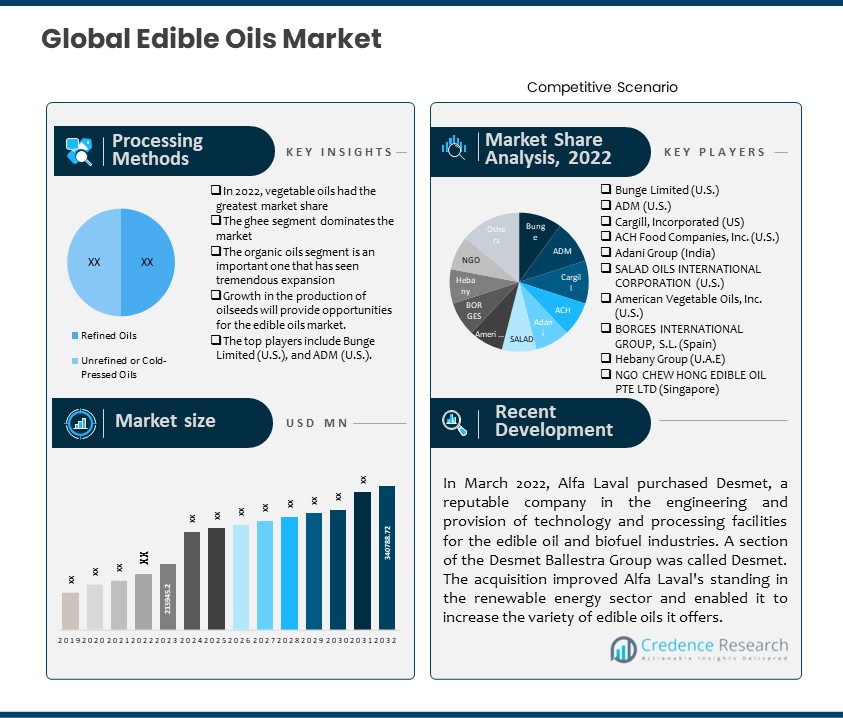
- The global market for edible oils is expected to grow from its estimated USD 215945.2 million in 2023 to USD 340788.72 million in 2032 at a compound annual growth rate (CAGR) of 5.20% between 2024 and 2032.
- The significant category is vegetable oils. On the other hand, palm oil is expected to grow at a strong CAGR.
- The leading animal oils and fats segment is ghee.
- The CAGR for refined oils is expected to be the highest during the projection period.
- The bottled oils segment will have the highest CAGR throughout the prediction period.
- Organic oils are estimated to have the greatest CAGR during the forecast period.
- The cooking and frying category is predicted to grow fastest over the projection period.
- Asia Pacific dominated the edible oils market.
- Regarding the edible oils market share, Europe is expected to come second.
- North America is anticipated to grow fastest in the edible oils market.
- The demand for food items rises as the world's population grows, and urbanization trends affect eating patterns and increase the consumption of processed foods and edible oils, which in turn boost the global market's expansion.
- The need for healthier oil options is influenced by a number of reasons, including rising earnings and improving standards of living, as well as growing consumer awareness of health issues. These factors support the growth of the edible oil market.
Executive Summary
Market Definition
Cooking or edible oil is any liquid fat that can be used for food that comes from plants, animals, or microorganisms. Edible oils are the main source of unsaturated fats and vitamin E in human diets and are frequently used in both home cooking and industrial food processing globally. Through regular dietary consumption, edible oils offer a concentrated supply of energy and vital fatty acids. In addition, lipids are a crucial component of cell membranes and a transporter of fat-soluble vitamins. Lipids also give food its flavor, texture, and mouthfeel.
Market Overview
The edible oils sector is estimated to develop at a 5.20% compound annual growth rate (CAGR) between 2024 and 2032, maintaining its current upward trend. The market will keep developing, rising from its estimated value of USD 215945.2 million in 2023 to USD 340788.72 million in 2032.
An increasing number of health-conscious consumers are consuming high-quality edible oils and cooking oils, and the demand from various applications, like confectionery, which primarily produces candies, is driving the global edible oil market. Additionally, there is a strong demand for organic health-based products. In addition, refined olive oil and coconut oil are becoming more and more popular in a variety of baking applications because of their neutral flavors, which preserve the food's unique taste. In contrast to mustard oil, they also don't have any bitter taste.
The industry has also been served by the demand for non-GMO edible oil, which has increased the market shares of key market categories, including palm, canola, and soybean oil, as well as sunflower, coconut, and olive oils. One of the most popular vegetable oils is palm oil. Palm oil production has increased dramatically in the last few years, with Malaysia and Indonesia accounting for nearly all of the rise. However, as customers become more conscious of the harm deforestation causes to the environment and choose the International Palm Oil Free Certification, the corresponding extensive deforestation is limiting the usage of palm oil in several food industries.
Segmentation by Type of Edible Oils
- Vegetable oils dominated the market. The demand for food goods, especially vegetable oils, is rising due to the world's population growth and rising rates of urbanization, especially in densely populated urban regions.
- The palm oil category will exhibit a sizable CAGR during the projected period. Palm oil is one of the most widely available edible oils worldwide. Europe, China, India, and Indonesia are the main consumers of palm oil.
- Other types of edible oils, such as soybean oil, canola oil, sunflower oil, olive oil, corn oil, coconut oil, peanut oil, sesame oil, and other vegetable oils, additionally support the need for edible oils.
Segmentation by Animal Oils and Fats
- Ghee is the main source of animal fats and oils. Due to its traditional use in baking, cooking, and religious activities, ghee has cultural significance in many places. South Asian cuisines, such as those from Bangladesh, Pakistan, and India, rely heavily on this ingredient's potent flavor and fragrance.
- The butter category will likely register a significant CAGR during forecasting. The demand for butter is significantly influenced by the food service industry, which includes bakeries, cafes, and restaurants. In many food service establishments, butter is a basic component that is used for baking, cooking, and seasoning different dishes.
- Other animal oils and fats, such as lard and tallow, also contribute to the demand for edible oils.
Segmentation by Processing Methods
- The refined oils category is projected to grow at the fastest rate over the projection period. Refined oils are sold through various retail channels, such as supermarkets, hypermarkets, convenience stores, and internet platforms. They are also extensively used in the food service industry, which includes fast-food chains, cafes, and restaurants, for food preparation and cooking.
- Other processing methods, including unrefined or cold-pressed oils, also influence the need for edible oils.
Segmentation by Packaging and Presentation
- The bottled oils segment will likely have the highest CAGR during the projection period. Bottled oils are fundamental components of many different cuisines across the globe, representing a wide range of cooking techniques and culinary traditions. The demand for bottled oils used in classic and inventive recipes is influenced by the popularity of ethnic cuisines, fusion cooking, and global culinary trends.
- Other packaging and presentations, such as bulk packaging, flexible packaging, and specialty packaging, also contribute to the demand for edible oils.
Segmentation by Specialty and Health-Oriented Oils
- Organic oils are expected to have the highest CAGR during the prediction period. The accessibility and purchasing behavior of consumers are influenced by the availability of organic oils in retail establishments such as supermarkets, health food stores, specialty grocers, and online platforms. With the use of product placement, marketing campaigns, and merchandising, retailers may effectively promote organic oils to consumers who are concerned about their health and the environment.
- Other specialty and health-oriented oils, such as cold-pressed oils, extra virgin olive oil, omega-3 enriched oils, and high-oleic oils, also contribute to the demand for edible oils.
Segmentation by End-Use Applications
- The cooking and frying will be expected to have the foremost CAGR during the prediction period. When it comes to cooking oils, consumers are influenced by factors such as convenience and packaging. Convenience and utility in the kitchen may make bottled oils with pour-through spouts, resealable lids, and clear labeling more appealing to customers.
- Other end-use applications, such as baking and confectionery, salad dressings and marinades, snack foods and chips, processed foods, and nutritional supplements, also contribute to the demand for edible oils.
Segmentation by Region
- Asia Pacific leads the edible oils market. This is because of the increasing demand for edible oils from Asia Pacific countries like India, China, and others.
- Europe is estimated to rank second in market size for edible oils.
- North America will witness the most rapid growth in the edible oils market.
- Regions such as Africa, the Middle East, and Latin America cover the remaining requirement for edible oils.
The majority of edible oil sales occur through supermarkets and convenience stores. Among the largest retail chains are Walmart, Carrefour, SPAR, and Reliance Mart. On a larger scale, a number of customers favor shopping in convenience stores for food items like edible oils in order to support regional companies. In general, a single owner or a family owns and runs these establishments. Therefore, making purchases at convenience stores would directly support or contribute to the local economy. Convenience stores are also the preferred shopping destination for consumers due to their broad availability of edible oils and fat items. For example, there are currently about 155,000 convenience stores in the United States.
The Asia Pacific region holds a dominant position in the edible oils market. This is a result of urbanization, growing disposable income, and population growth in developing nations like Bangladesh, India, and China. The growing trend of consumers seeking nutritional supplements is one of the main drivers of the edible oil market's expansion. The shift towards a more inventive and health-conscious approach, resulting from the growing popularity of leading a healthy lifestyle, is beneficial to the industry. Additionally, the market is expected to benefit from the growing popularity of low-calorie content oil among middle-class age groups in the aforementioned economies. These factors are anticipated to drive the growth of the Asia Pacific edible oils market.
Throughout the forecast, North America's edible oils market is anticipated to expand fastest. Due to the region's shifting eating habits and hectic lives, North America has one of the largest potential markets for edible oils. This is because processed food products are becoming more and more popular there. The North American food processing industry is seeing a sharp increase in the number of enterprises operating there. Fast food, with its high fat and oil content, is becoming more and more popular among customers in today's world. Soybean oils, which are widely used in savory and snack meals, convenience foods, and decadent baking and confectionery products, are in high demand in the United States market.
Soybeans are mostly produced and exported from the United States. In the US, nearly 90% of oilseeds are produced from soybeans. In the US edible oil market, major players include Bunge Ltd. and Cargill, Incorporated. These businesses have gained substantial market shares through partnerships, mergers, expansions, acquisitions, and the efficient and productive scaling of their operations. The ability of global giants to create unique edible oils with high sensory profiles that are also healthful and versatile will determine the trajectory of edible oil growth in the US in the future.
Key Highlights of the Report
The global edible oils market is segmented by type of edible oils, animal oils and fats, processing methods, packaging and presentation, specialty and health-oriented oils, end-use applications, and region. Vegetable oils are the market spearhead. Refined oils are the top category. The bottled oils category is anticipated to increase at the highest CAGR throughout the projection period. The cooking and frying segment will experience the highest CAGR during the forecast period. The edible oils market is expanding mostly in Asia Pacific.
The Food and Agricultural Organization reports that because of population growth, there has been an exponential increase in the world's population, which is expected to reach 9.7 billion by 2050. Furthermore, urbanization is predicted to accelerate, negatively affecting the world's food need. Edible oils are vital components of food that are used in many different ways in homes, businesses, and food service. Edible oil demand is therefore supported by the expanding population and the constantly changing needs of consumers.
The Asia Pacific is expected to account for the largest portion of the global edible oils market. Higher disposable incomes from rapid economic development in nations like China, India, Indonesia, and Vietnam allow customers to purchase a greater range of processed foods and edible oils. The North American region is also assumed to have the market's sharpest growth. In North America, there is a growing market for edible oil products that are both practical and useful. New products, including spray oils, flavored oils, infused oils, and specialty oils with particular culinary uses or health benefits, are being introduced by manufacturers. These goods provide consumers with distinctive flavor profiles or useful qualities with convenience, variety, and added value.
Which Key Factors Are Driving The Global Edible Oils Market?
Several factors influence the edible oil market, including the need for the food sector, improvements in the efficiency and quality of oilseed processing and extraction techniques, and the aging population and multicultural demographics that affect the demand for particular oils.
What Are The Main Challenges Confronting The Edible Oils Market Globally?
A number of issues are hindering the growth of the edible oils industry, such as supply chain interruptions caused by labor shortages or transportation delays and limitations in the technologies used for oilseed extraction, cultivation, and refining.
What Market Opportunities Exist For Edible Oils Globally?
Campaigns to raise customer awareness and educate them about nutrition, intelligent packaging, and convenience are just a few of the areas in which edible oils could expand.
Market Drivers
Multiple factors propel the edible oils industry across the globe. The primary factors propelling the global edible oils market are as follows:
Growth in the Production of Oilseeds
In view of the growing interest in edible oils, an article published in the National Research Center's bulletin in Egypt states that throughout the past three decades, the area devoted to oilseed farming has expanded by 82%, while production has climbed by roughly the same amount. Additionally, the food industry was expected to consume the majority of the projected 249 million metric tons of vegetable oils consumed in 2022, according to the Organization for Economic Co-operation and Development (OECD). The growth in edible oil consumption per person in low- and middle-income Asia Pacific countries is the cause of the aforementioned rise in oil demand. In order to meet the rising demand from consumers, it is therefore anticipated that as oilseed output rises, so will the production and supply of edible oils.
Market Restraints
There are several obstacles that the global edible oils market must overcome to continue growing. Among them are the following:
Edible Oil Prices are Highly Volatile
The conflict in Ukraine has caused agricultural commodities to reach previously unheard-of heights in price. Edible oil prices have increased significantly as a result of the crisis, and trade policy responses around the world have further limited supply and increased costs. Edible oil prices have gone up by about 30% on average. Sunflower oil is the product that has been affected the most, rising by almost 40%. Sunflower oil, which accounts for roughly 13% of the vegetable oils traded on global markets, is a major export from countries around the Black Sea. As a result, the rise in edible oil prices has significantly hampered the expansion of the global edible oil sector.
Opportunities
There are plenty of potential prospects in the global edible oils industry. Among these are the following:
Growing Popularity of Microencapsulation Technologies
A popular approach that is being embraced by the expanding food sector is microencapsulation. A 2019 study from the Federal University of Santa Catarina, Brazil, found that oil encapsulation can broaden the spectrum of its applications in the food business and either avoid or lessen oxidation reactions. Oil encapsulation helps processed food products maintain their flavor, shelf life, antioxidant content, and storage duration. Owing to its advantages in a variety of culinary applications, edible oil encapsulation is gradually becoming more and more well-known in the food industry worldwide, which is helping to drive the growth of the edible oil market.
Competitive Landscape
Key Players
There are several major competitors in the fiercely competitive global edible oils market. The following are a few of the leading market participants and their market shares:
- Bunge Limited (U.S.)
- ADM (U.S.)
- Cargill, Incorporated (US)
- ACH Food Companies, Inc. (U.S.)
- Adani Group (India)
- SALAD OILS INTERNATIONAL CORPORATION (U.S.)
- American Vegetable Oils, Inc. (U.S.)
- BORGES INTERNATIONAL GROUP, S.L. (Spain)
- Hebany Group (U.A.E)
- NGO CHEW HONG EDIBLE OIL PTE LTD (Singapore)
- TITAN OILS Inc., (Canada)
- Ragasa - Derechos Reservados (Mexico)
- SOVENA (Thailand)
- Sunora Foods (Canada)
- Others
These companies prioritize product innovation, distribution channel expansion, mergers, and acquisitions to remain competitive.
The largest suppliers in the global edible oils market continuously work to keep one step ahead of the competition by developing innovative concepts and products.
In November 2021, Cargill purchased an edible oil refinery in Nellore, Andhra Pradesh. By upgrading and purchasing the plant, Cargill will increase its footprint and capacity for producing edible oil in southern India and fortify its current supply chain in order to satisfy rising consumer demand.
In November 2021, Bunge announced that it would invest over EUR 300 million (USD 343 million) in the expansion project in order to establish the new facility in the HoogTij industrial neighborhood of the Port of Amsterdam. The firm claimed that it was an important step in making the most of Bunge's asset footprint in Europe and that it would increase the company's operational flexibility and efficiency. The company hopes to position its brand better to meet rising consumer demand by providing a greater selection of innovative edible oils and fats derived from sustainably harvested plants with the aid of the new facility.
Summary of Key Findings
- Increasing oilseed output is anticipated to support market expansion over the forecast period.
- The market is segmented by type of edible oils, animal oils and fats, processing methods, packaging and presentation, specialty and health-oriented oils, end-use applications, and region.
- The most popular type of edible oil in the market is vegetable oil.
- Refined oils are the foremost category.
- Regarding CAGR, bottled oils are expected to grow fastest during the forecast period.
- The category for organic oils will likely see the highest CAGR during the anticipated time frame.
- Asia Pacific is leading market development; the market is highly competitive with key players including Bunge Limited (U.S.), ADM (U.S.), Cargill, Incorporated (US), ACH Food Companies, Inc. (U.S.), Adani Group (India), SALAD OILS INTERNATIONAL CORPORATION (U.S.), American Vegetable Oils, Inc. (U.S.), BORGES INTERNATIONAL GROUP, S.L. (Spain), Hebany Group (U.A.E), NGO CHEW HONG EDIBLE OIL PTE LTD (Singapore), TITAN OILS Inc., (Canada), Ragasa - Derechos Reservados (Mexico), SOVENA (Thailand), Sunora Foods (Canada), and Others.
Future Outlook
- The edible oils industry is expected to increase significantly in Asia Pacific and has a positive outlook worldwide.
- The expansion and growth of the fast food industry are driving up demand for edible oils.
- Demand can be constrained by unfavorable opinions regarding the health effects of some edible oils, especially those that are heavy in saturated fat.
- To stay ahead of the competition, key enterprises must develop new products, expand their market reach, and keep their prices competitive.
How CXOs Can Benefit from the Credence Research Edible Oils Market Report
CXOs may get a detailed picture of the market in the Credence Research Edible Oils Market Report, which includes:
- Market size and growth forecast: The report provides detailed estimates of the global edible oils market size, segmented by type of edible oils, animal oils and fats, processing methods, packaging and presentation, specialty and health-oriented oils, end-use applications, and region. It also includes forecasts for the market through 2032 based on key trends and drivers.
- Market segmentation: The research report breaks down the market for edible oils into segments based on the type of edible oils, animal oils and fats, processing methods, packaging and presentation, specialty and health-oriented oils, end-use applications, and region. This segmentation provides CXOs with a granular understanding of the market and the opportunities in each segment.
- Competitive landscape: The research report offers a detailed analysis of the major companies in the edible oils industry, including information on their business plans, product lines, and earnings. CXOs can use this information to evaluate and identify their competitors.
- Key trends and drivers: The research report identifies and evaluates the main trends and factors influencing the market for edible oils. CXOs can use this information to make well-informed choices regarding their plans and investments.
CXOs can use the insights from the Credence Research Edible Oils Market Report to:
- Identify growth opportunities: This analysis may help CXOs identify new growth opportunities in the edible oils sector. For example, the report identifies the growing demand for edible oils from the cooking and frying industries as a key opportunity.
- Make informed investment decisions: The report helps CXOs choose edible oils wisely. For example, the research study provides information on the critical factors to consider when selecting edible oil solutions and evaluating edible oil suppliers.
- Develop competitive strategies: CXOs can use the research report to develop competitive strategies for their edible oils businesses. For example, the research paper outlines the main strategies suppliers utilize to differentiate themselves from competitors.
- Track market developments: This research report may help CXOs stay ahead of the curve by tracking market developments. For instance, it offers insights into the most recent developments and trends in the market for edible oils.
In general, CXOs seeking to expand their industry knowledge and spot growth prospects will find the Credence Research Edible Oils Market Report useful.
Segmentation
- By Type of Edible Oils
- Vegetable Oils
- Soybean Oil
- Palm Oil
- Canola Oil
- Sunflower Oil
- Olive Oil
- Corn Oil
- Coconut Oil
- Peanut Oil
- Sesame Oil
- Other Vegetable Oils
- By Animal Oils and Fats
- Lard
- Tallow
- Butter
- Ghee
- By Processing Methods
- Refined Oils
- Unrefined or Cold-Pressed Oils
- By Packaging and Presentation
- Bottled Oils
- Bulk Packaging
- Flexible Packaging
- Specialty Packaging
- By Specialty and Health-Oriented Oils
- Organic Oils
- Cold-Pressed Oils
- Extra Virgin Olive Oil
- Omega-3 Enriched Oils
- High-Oleic Oils
- By End-Use Applications
- Cooking and Frying
- Baking and Confectionery
- Salad Dressings and Marinades
- Snack Foods and Chips
- Processed Foods
- Nutritional Supplements
- By Region
- North America
- The U.S.
- Canada
- Mexico
- Europe
- Germany
- France
- The U.K.
- Italy
- Spain
- Rest of Europe
- Asia Pacific
- China
- Japan
- India
- South Korea
- South-east Asia
- Rest of Asia Pacific
- Latin America
- Brazil
- Argentina
- Rest of Latin America
- Middle East & Africa
- GCC Countries
- South Africa
- Rest of Middle East and Africa
- North America

Request a Free Sample
Fill in your details and we'll send you a free sample report.
- Sample data tables & charts
- Research methodology
Market Dynamics
Population Growth and Urbanization
Rapid population growth and increasing urbanization, especially in Asia Pacific, are driving higher consumption of processed foods and edible oils, supporting overall market expansion.
Health and Wellness Trends
Rising consumer awareness about health and nutrition is fueling demand for healthier oil options, such as organic, cold-pressed, and high-oleic oils, boosting premium segments within the edible oils market.
Expansion of Food Processing Industry
Growth in the global food processing sector, including fast food and convenience foods, is increasing the need for various edible oils as essential ingredients in manufacturing and food service.
Innovation in Packaging and Product Formats
The introduction of convenient packaging formats like bottled and specialty oils, as well as value-added products such as omega-3 enriched and flavored oils, is attracting new consumer segments and increasing market penetration.
Need a Custom Version of This Report?
Tailor the scope, geography, or segments to your exact requirements.
- Custom geography or segment scope
- Direct access to our analyst team
Frequently Asked Questions
How much does the global market currently hold for edible oils?
What is the projected growth rate of the edible oils market between 2024 and 2032?
What market segment is leading in terms of edible oil types?
Which end-use applications segment is estimated to have the highest CAGR throughout the forecast period?
Who are the main players in the global edible oils industry?
Table of Content
Chapter 1 Market Segmentation
- 1.1 Segmentation Framework
- 1.1.1 Product and Service Classification
- 1.1.2 Application and End-Use Classification
- 1.1.3 Technology and Solution Classification
- 1.1.4 Customer and Distribution Channel Classification
- 1.1.5 Geographic Segmentation
- 1.1.6 Market Segment Definitions and Boundaries
- 1.2 By Processing Methods
- 1.2.1 Refined Oils
- 1.2.2 Unrefined or Cold-Pressed Oils
- 1.3 By Type of Edible Oils
- 1.3.1 Vegetable Oils
- 1.3.2 Palm Oil
- 1.3.3 Soybean Oil
- 1.3.4 Canola Oil
- 1.3.5 Sunflower Oil
- 1.3.6 Olive Oil
- 1.4 By Animal Oils and Fats
- 1.4.1 Ghee
- 1.4.2 Butter
- 1.4.3 Lard
- 1.4.4 Tallow
- 1.5 By End-Use Applications
- 1.5.1 Cooking and Frying
- 1.5.2 Baking and Confectionery
- 1.5.3 Salad Dressings and Marinades
- 1.5.4 Snack Foods and Chips
Chapter 2 Introduction
- 2.1 Report Objectives and Scope
- 2.2 Product Definition and Industry Terminology
- 2.3 Market Inclusions and Exclusions
- 2.4 Research Process
- 2.4.1 Primary Research and Expert Interviews
- 2.4.2 Secondary Research and Source Review
- 2.4.3 Top-Down and Bottom-Up Estimation
- 2.4.4 Data Triangulation and Verification
- 2.5 Market Size Measurement Basis
- 2.5.1 2023: USD 215,945.2 million → 2032: USD 340,788.72 million
- 2.6 Historical and Forecast Reference Periods
- 2.6.1 Base Year: 2023
- 2.6.2 Forecast Period: 2023-2032
- 2.7 Research Assumptions and Limitations
Chapter 3 Executive Summary
- 3.1 Market Snapshot and Key Findings
- 3.2 Base-Year Market Size, 2023
- 3.3 Forecast Market Size, 2032
- 3.4 Revenue and Volume Growth Outlook
- 3.5 Key Demand and Supply Indicators
- 3.6 Leading Market Segments
- 3.7 Fastest-Growing Market Opportunities
- 3.8 Regional Performance Highlights
- 3.9 Technology and Industry Transformation
- 3.10 Competitive Landscape Summary
- 3.11 Analyst View and Strategic Implications
Chapter 4 Global Edible Oils Market Trends and Developments
- 4.1 Historical Industry Development
- 4.2 Recent Market Trends and Developments
- 4.3 Demand and Customer Behavior Trends
- 4.4 Technology and Product Innovation
- 4.5 Artificial Intelligence, Automation and Digitalization
- 4.6 Local Manufacturing and Supply Chain Realignment
- 4.7 Industry Partnerships, Mergers and Acquisitions
- 4.8 Sustainability and Circular Economy Developments
- 4.9 Government and Private Sector Investment Trends
- 4.10 Emerging Business Models and Commercialization
- 4.11 Industry Developments and Announcements
Chapter 5 Global Edible Oils Market Production, Supply and Demand Analysis
- 5.1 Demand Trend and Consumption Analysis
- 5.2 Demand Forecast, 2023-2032
- 5.3 Production and Output Trend
- 5.4 Production and Output Forecast, 2023-2032
- 5.5 Installed Capacity and Capacity Utilization
- 5.6 Company-Wise Production Plants and Statistics
- 5.6.1 Installed Production Capacity
- 5.6.2 Actual Production
- 5.6.3 Planned Capacity and Expansion Targets
- 5.7 Supply Chain Structure and Procurement Trends
- 5.8 Supply-Demand Gap and Bottlenecks
- 5.9 Import Dependence and Sourcing Structure
- 5.10 Contract Manufacturing and Outsourcing
- 5.11 Regional Supply and Demand Concentration
Chapter 6 Global Edible Oils Market Pricing Analysis
- 6.1 Pricing Structure and Measurement
- 6.2 Historical Pricing Trends
- 6.3 Pricing Outlook, 2023-2032
- 6.4 Average Selling Price and Unit Economics
- 6.5 Pricing by Product and Market Segment
- 6.6 Geographic Pricing Differences
- 6.7 Key Input, Energy, Labor and Logistics Costs
- 6.8 Contract Pricing and Purchasing Models
- 6.9 Pricing Sensitivity and Competitive Positioning
- 6.10 Price, Margin and Profitability Implications
Chapter 7 Global Edible Oils Market Dynamics
- 7.1 Market Growth Drivers
- 7.1.1 Demand-Side Drivers
- 7.1.2 Technology and Innovation Drivers
- 7.1.3 Infrastructure and Investment Drivers
- 7.1.4 Regulatory and Policy Drivers
- 7.2 Market Restraints
- 7.2.1 Cost and Affordability Constraints
- 7.2.2 Technology and Adoption Barriers
- 7.2.3 Supply Chain and Operational Constraints
- 7.3 Market Challenges
- 7.3.1 Competitive Pressure and Margin Erosion
- 7.3.2 Skills, Infrastructure and Implementation Gaps
- 7.4 Emerging Market Opportunities
- 7.5 Market Dynamics Impact and Time-Horizon Assessment
Chapter 8 Global Edible Oils Value Chain Analysis
- 8.1 Industry Value Chain Overview
- 8.2 Upstream Suppliers and Critical Inputs
- 8.3 Technology and Component Providers
- 8.4 Manufacturing or Service Delivery
- 8.5 Distribution, Channel Partners and Integrators
- 8.6 Downstream Applications and End Users
- 8.7 Value Addition and Profit Pools
- 8.8 Vertical Integration and Outsourcing
- 8.9 Supplier Concentration and Risk
- 8.10 Supply Chain Localization and Resilience
Chapter 9 Global Edible Oils Market Regulations and Policies
- 9.1 Relevant Laws, Standards and Compliance Frameworks
- 9.2 Product, Service, Safety and Quality Requirements
- 9.3 Government Policies, Incentives and Subsidies
- 9.4 Imports, Exports and Trade Barriers
- 9.5 Public Procurement and Local Content Requirements
- 9.6 Environmental and Sustainability Compliance
- 9.7 Upcoming Policy Changes and Market Implications
Chapter 10 Global Edible Oils Market Hotspots and Opportunities
- 10.1 Market Opportunity Mapping and Growth Hotspots
- 10.2 High-Growth Applications and Customer Groups
- 10.3 Underserved Markets and White-Space Opportunities
- 10.4 Emerging Technology and Product Opportunities
- 10.5 New Capacity and Investment Hotspots
- 10.6 Market Entry and Expansion Opportunities
- 10.7 Distribution and Partnership Opportunities
- 10.8 Near-Term and Long-Term Commercial Potential
- 10.9 Opportunity Attractiveness and Execution Risks
Chapter 11 Global Edible Oils Market Outlook, 2023-2032
- 11.1 Market Size and Analysis
- 11.1.1 Revenue (Market Measurement: 2023: USD 215,945.2 million → 2032: USD 340,788.72 million)
- 11.1.2 Market Volume and Quantity Sold
- 11.1.3 Historical Market Size
- 11.1.4 Base-Year Market Size, 2023
- 11.2 Market Forecast, 2023-2032
- 11.2.1 Revenue Forecast to 2032
- 11.2.2 Volume Forecast to 2032
- 11.2.3 CAGR and Year-on-Year Growth
- 11.2.4 Incremental Revenue Opportunity
- 11.3 Forecast Assumptions and Scenario Analysis
- 11.3.1 Base-Case Forecast
- 11.3.2 Optimistic and Conservative Scenarios
- 11.3.3 Technology, Pricing and Policy Sensitivities
- 11.4 Market Attractiveness and Growth Outlook
Chapter 12 Global Edible Oils Market Segmentation and Outlook
- 12.1 Segmentation Summary and Market Shares, 2023
- 12.2 Largest and Fastest-Growing Segments
- 12.3 By Processing Methods - Market Size and Forecast, 2023-2032
- 12.3.1 Segment Definition and Scope
- 12.3.2 Historical Market Size
- 12.3.3 Revenue Forecast, 2023-2032
- 12.3.4 Volume Forecast, 2023-2032
- 12.3.5 Base-Year Market Share, 2023
- 12.3.6 Segment CAGR and Growth Drivers
- 12.3.7 Subsegment Market Size and Forecast
- 12.3.7.1 Refined Oils
- 12.3.7.2 Unrefined or Cold-Pressed Oils
- 12.3.8 Subsegment Pricing and Adoption Trends
- 12.3.9 Leading Suppliers and Competition
- 12.3.10 Regional Demand and Opportunities
- 12.4 By Type of Edible Oils - Market Size and Forecast, 2023-2032
- 12.4.1 Segment Definition and Scope
- 12.4.2 Historical Market Size
- 12.4.3 Revenue Forecast, 2023-2032
- 12.4.4 Volume Forecast, 2023-2032
- 12.4.5 Base-Year Market Share, 2023
- 12.4.6 Segment CAGR and Growth Drivers
- 12.4.7 Subsegment Market Size and Forecast
- 12.4.7.1 Vegetable Oils
- 12.4.7.2 Palm Oil
- 12.4.7.3 Soybean Oil
- 12.4.7.4 Canola Oil
- 12.4.7.5 Sunflower Oil
- 12.4.7.6 Olive Oil
- 12.4.8 Subsegment Pricing and Adoption Trends
- 12.4.9 Leading Suppliers and Competition
- 12.4.10 Regional Demand and Opportunities
- 12.5 By Animal Oils and Fats - Market Size and Forecast, 2023-2032
- 12.5.1 Segment Definition and Scope
- 12.5.2 Historical Market Size
- 12.5.3 Revenue Forecast, 2023-2032
- 12.5.4 Volume Forecast, 2023-2032
- 12.5.5 Base-Year Market Share, 2023
- 12.5.6 Segment CAGR and Growth Drivers
- 12.5.7 Subsegment Market Size and Forecast
- 12.5.7.1 Ghee
- 12.5.7.2 Butter
- 12.5.7.3 Lard
- 12.5.7.4 Tallow
- 12.5.8 Subsegment Pricing and Adoption Trends
- 12.5.9 Leading Suppliers and Competition
- 12.5.10 Regional Demand and Opportunities
- 12.6 By End-Use Applications - Market Size and Forecast, 2023-2032
- 12.6.1 Segment Definition and Scope
- 12.6.2 Historical Market Size
- 12.6.3 Revenue Forecast, 2023-2032
- 12.6.4 Volume Forecast, 2023-2032
- 12.6.5 Base-Year Market Share, 2023
- 12.6.6 Segment CAGR and Growth Drivers
- 12.6.7 Subsegment Market Size and Forecast
- 12.6.7.1 Cooking and Frying
- 12.6.7.2 Baking and Confectionery
- 12.6.7.3 Salad Dressings and Marinades
- 12.6.7.4 Snack Foods and Chips
- 12.6.8 Subsegment Pricing and Adoption Trends
- 12.6.9 Leading Suppliers and Competition
- 12.6.10 Regional Demand and Opportunities
- 12.7 Segment Growth Comparison
- 12.8 Segment Attractiveness and Priority Matrix
Chapter 13 Global Edible Oils End-Use and Application Market Outlook
- 13.1 End-Use Industry and Customer Demand Structure
- 13.2 Leading Applications and Customer Groups
- 13.3 End-Use Market Size, Share and Forecast
- 13.4 Major End-Use Industry Deep Dives
- 13.4.1 Customer Requirements and Use Cases
- 13.4.2 Demand and Replacement Cycles
- 13.4.3 Technical and Regulatory Considerations
- 13.4.4 Purchasing and Procurement Models
- 13.4.5 Leading Vendors and Distribution Channels
- 13.4.6 Forecast and Commercial Opportunities
- 13.5 Emerging Applications and Cross-Segment Demand
- 13.6 End-Use Industry Investment Priorities
Chapter 14 Global Edible Oils Geographic Market Outlook, 2023-2032
- 14.1 Regional Market Size and Share, 2023
- 14.2 Regional Market Forecast, 2023-2032
- 14.3 Regional Pricing, Production and Demand Differences
- 14.4 North America
- 14.4.1 United States
- 14.4.2 Canada
- 14.4.3 Mexico
- 14.5 Europe
- 14.5.1 Germany
- 14.5.2 France
- 14.5.3 Italy
- 14.5.4 United Kingdom
- 14.5.5 Spain
- 14.5.6 Poland
- 14.5.7 Russia
- 14.5.8 Netherlands
- 14.5.9 Belgium
- 14.5.10 Sweden
- 14.5.11 Denmark
- 14.5.12 Norway
- 14.5.13 Rest of Europe
- 14.6 Asia Pacific
- 14.6.1 China
- 14.6.2 India
- 14.6.3 Japan
- 14.6.4 South Korea
- 14.6.5 Thailand
- 14.6.6 Indonesia
- 14.6.7 Vietnam
- 14.6.8 Malaysia
- 14.6.9 Australia
- 14.6.10 Rest of Asia Pacific
- 14.7 Latin America
- 14.7.1 Brazil
- 14.7.2 Argentina
- 14.7.3 Colombia
- 14.7.4 Chile
- 14.7.5 Rest of Latin America
- 14.8 Middle East
- 14.8.1 Saudi Arabia
- 14.8.2 United Arab Emirates
- 14.8.3 Turkey
- 14.8.4 Israel
- 14.8.5 Iran
- 14.8.6 Rest of the Middle East
- 14.9 Africa
- 14.9.1 South Africa
- 14.9.2 Egypt
- 14.9.3 Nigeria
- 14.9.4 Morocco
- 14.9.5 Rest of Africa
- 14.10 Regional Investment, Policy and Supply Chain Differences
- 14.11 Regional Competitive Landscape
- 14.12 Geographic Growth Hotspots
Chapter 15 Global Edible Oils Technology, Innovation and Sustainability Outlook
- 15.1 Technology Landscape and Maturity
- 15.2 Product, Process and Service Innovation
- 15.3 AI, Automation and Digital Tools in the Industry
- 15.4 Technology Adoption and Performance Benchmarking
- 15.5 Innovation Pipeline and R&D Investment
- 15.6 Patent and Intellectual Property Trends
- 15.7 Energy Efficiency and Resource Management
- 15.8 Sustainability, Recycling and Circularity
- 15.9 Technology Roadmap, 2023-2032
- 15.10 Risks of Obsolescence and Technology Substitution
Chapter 16 Global Edible Oils Market Key Strategic Imperatives
- 16.1 Growth and Market Entry Priorities
- 16.2 High-Return Products and Segments
- 16.3 Pricing, Profitability and Cost Optimization
- 16.4 Technology Investment and Product Differentiation
- 16.5 Supply Chain Localization and Resilience
- 16.6 Distribution and Customer Acquisition
- 16.7 Partnership, Acquisition and Capacity Strategy
- 16.8 Regional Expansion Priorities
- 16.9 Short-, Medium- and Long-Term Actions
Chapter 17 Competition Outlook
- 17.1 Industry Competition Characteristics
- 17.2 Market Structure and Concentration
- 17.3 Market Share and Competitive Positioning, 2023
- 17.4 Company-Wise Revenue and Product Benchmarking
- 17.5 Production and Service Capacity Benchmarking
- 17.6 Technology, Pricing and Differentiation
- 17.7 Regional Footprint and Distribution Strength
- 17.8 Mergers, Acquisitions and Strategic Alliances
- 17.9 New Entrants and Competitive Threats
- 17.10 Porter's Five Forces and Industry Attractiveness
- 17.11 Competitive Outlook, 2023-2032
Chapter 18 Company Profiles
- 18.1 Company Coverage and Selection Criteria
- 18.2 Bunge Limited
- 18.2.1 Business Description
- 18.2.2 Company Ownership and Geographic Presence
- 18.2.3 Product and Service Portfolio
- 18.2.4 Manufacturing and Operating Footprint
- 18.2.5 Production Capacity and Expansion Plans
- 18.2.6 Financial Performance and Investment
- 18.2.7 Market Share and Competitive Position
- 18.2.8 Technology and Innovation Capabilities
- 18.2.9 Strategic Alliances or Partnerships
- 18.2.10 Recent Developments
- 18.2.11 Growth Strategy and Outlook
- 18.3 ADM
- 18.4 Cargill, Incorporated
- 18.5 Adani Group
- 18.6 BORGES INTERNATIONAL GROUP, S.L.
- 18.7 SOVENA
- 18.8 NGO CHEW HONG EDIBLE OIL PTE LTD
- 18.9 Sunora Foods
- 18.10 ACH Food Companies, Inc.
- 18.11 SALAD OILS INTERNATIONAL CORPORATION
- 18.12 Other Relevant Market Participants
Note: Every listed company is profiled on the structure shown under the first company. The company list is preliminary and may change based on research findings, market developments, data availability and client requirements.
Chapter 19 Disclaimer
- 19.1 Research and Forecast Disclaimer
- 19.2 Data Source and Estimation Limitations
Note: The depth of individual sections depends on data availability for this market. Volume, capacity, trade and other unit-based metrics are included where applicable.

