
Cooker-led demand meets a formalizing supply base
The India kitchenware products market was valued at USD 5.65 billion in 2025 and is projected to increase from USD 6.14 billion in 2026 to USD 12.53 billion by 2035, registering a CAGR of 8.25% during 2026–2035. Demand rests on household replacement of cookers and pans, new home setups, festive gifting and food-service procurement. South India held the largest regional share, 31.1% in 2025, helped by high urban spending in Telangana, Tamil Nadu and Karnataka. East and Central India is the fastest-growing region at 8.93% a year as marketplace delivery reaches smaller towns and household budgets rise from a lower base. GST on cookers and cookware fell from about 12% to 5% in September 2025, which narrowed the price gap between branded and unbranded goods. The Cookware, Utensils and Cans Quality Control Order then brought stainless steel and aluminum utensils under mandatory BIS marking in phases through April 2026, which favors certified manufacturers.
What does the India kitchenware products market count?
The report counts sales of non-electric cookware, kitchen tools, food storage and bakeware bought in India by households and food-service operators. Buyers purchase through neighborhood utensil shops, large-format stores, online marketplaces and brand-owned outlets, with replacement and gifting forming a large share of purchases across the year.
Electric kitchen appliances such as mixer grinders, induction cooktops and chimneys are excluded, even when the same companies sell them, because they follow separate buying cycles and service models. The value chain runs from stainless steel, aluminum, polymer and glass suppliers through contract and owned plants to distributors, retailers and marketplaces.
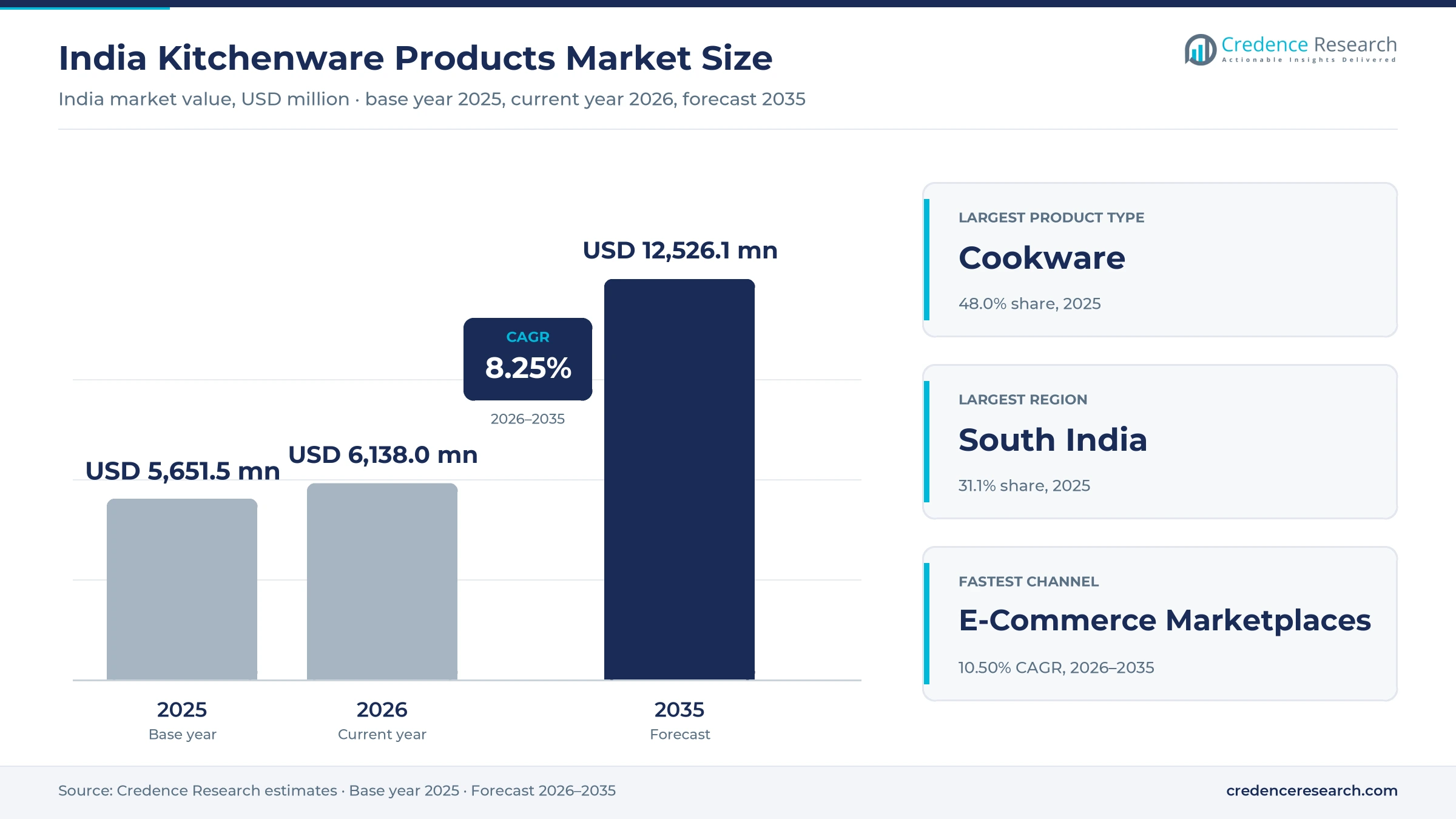
India Kitchenware Products Market Insights
- The market grows from USD 5.65 billion in 2025 to USD 12.53 billion by 2035, at an 8.25% CAGR, as branded products replace unbranded utensils in more households.
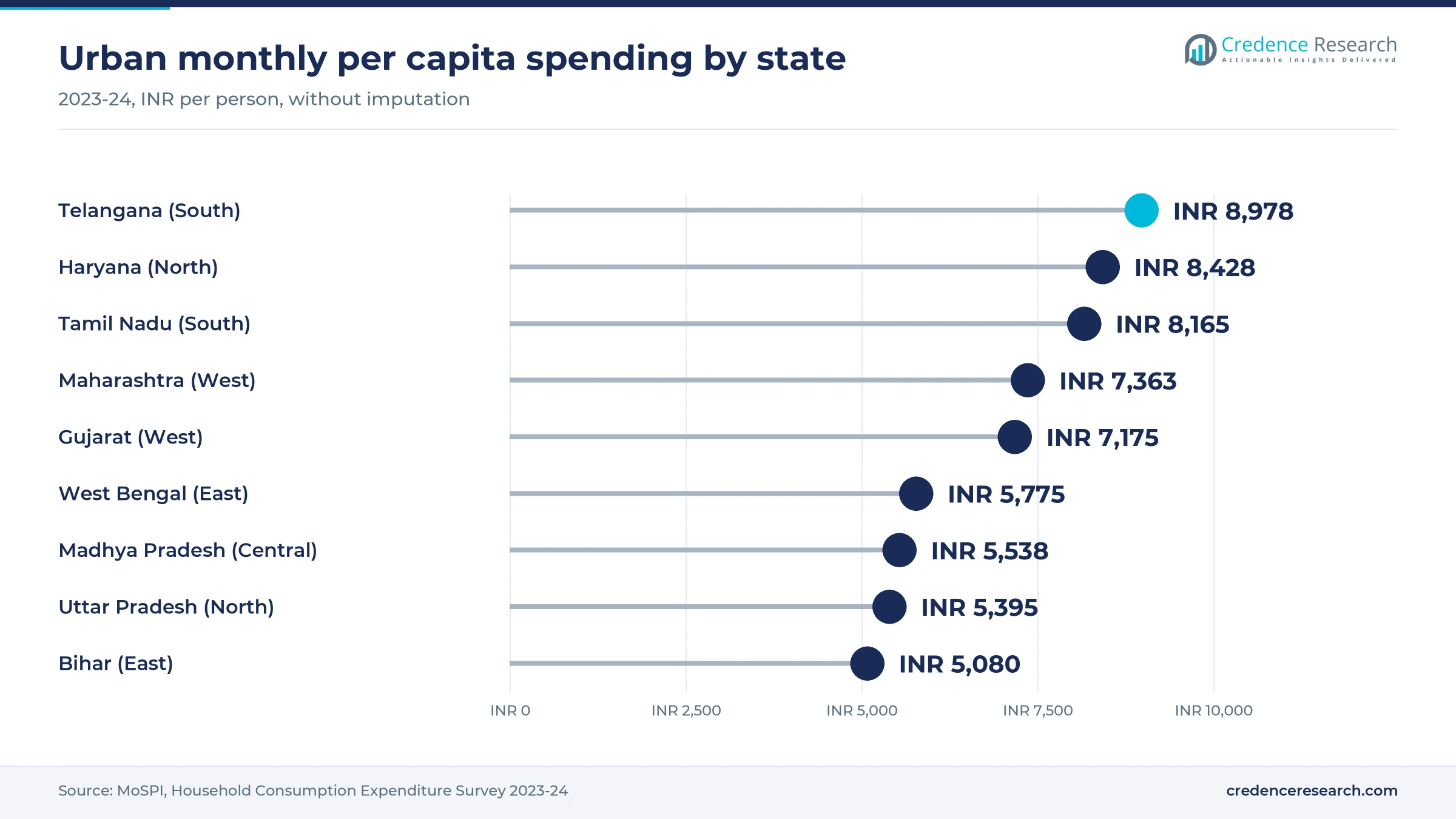
- South India held 31.1% of 2025 value, supported by urban monthly spending of INR 8,978 per person in Telangana, according to MoSPI survey data for 2023-24.
- Cookware held 48.0% of 2025 value, while independent retailers kept 52.0% of sales even as marketplaces gained share quickly during 2025.
- The Quality Control Order reached micro enterprises on April 1, 2026, completing a phased BIS rollout that favors certified makers over informal utensil workshops across the country.
- Hawkins, Borosil, Cello World and Tramontina have all announced or opened capacity since February 2025, which shows confidence in domestic demand and local sourcing for this category.
Cookware and steel lead while storage and glass gain
Why do cookers and pans anchor category value?
Based on product type, the market is categorized into cookware, kitchen tools, food storage and bakeware. Cookware led with 48.0% of 2025 value because cookers and pans anchor brand portfolios, and Hawkins Cookers began commercial production at a fourth factory in Jaunpur, Uttar Pradesh, in June 2025 for pressure cookers and cookware, according to Business Standard. Food Storage grows fastest at 8.90% a year as storage capacity moves onshore, with Borosil announcing an INR 42 crore plant in Bharuch, Gujarat, on March 10, 2026, for storage jars, bottles and jugs.
Which materials win as coatings face scrutiny?
Based on material, the market is categorized into Stainless Steel, Aluminium, Non-Metal and Cast Iron. Stainless Steel led with 41.0% of 2025 value because kitchenware takes at least two-fifths of stainless steel use in India, according to a January 2019 Jindal Stainless release, and buyers weighing non-stick cookware received cautionary ICMR guidance in 2024. Non-Metal grows fastest at 9.22% a year as glass and polymer supply deepens, with Borosil raising its Jaipur borosilicate furnace from 25 to 32 metric tons a day, according to a Multibagg summary of its fiscal 2026 results published May 22, 2026.
How do household structure and catering shape buying?
Based on customer type, the market is categorized into established family households, nuclear households, single-person households and food-service buyers. Established Family Households led with 52.0% of 2025 value because multigenerational homes remain common, and an IIPS abstract puts three-generation households at about 31% in 2020 with a mean household size of 4.5. Food-Service Buyers grow fastest at 9.46% a year as dining out expands, with the National Restaurant Association of India projecting food services rising from INR 5.69 lakh crore in fiscal 2024 to INR 7.76 lakh crore by fiscal 2028.
Where does the sale still happen, and what is shifting?
Based on distribution channel, the market is categorized into independent retailers, modern retail, e-commerce marketplaces and brand-direct channels. Independent Retailers led with 52.0% of 2025 value because utensil shops remain the main contact point, and TTK Prestige reported general trade at about 40% of its sales on Oct. 28, 2025. E-Commerce Marketplaces grow fastest at 10.50% a year as online retail takes mix, with Stove Kraft reporting e-commerce at about 34% of third-quarter fiscal 2026 sales on its Jan. 31, 2026, investor call.
| Segment Group | Leading Sub-segment | Share, 2025 | Fastest-growing Sub-segment | CAGR, 2026–2035 |
|---|---|---|---|---|
| By Product Type | Cookware | 48.0% | Food Storage | 8.90% |
| By Material | Stainless Steel | 41.0% | Non-Metal | 9.22% |
| By Customer Type | Established Family Households | 52.0% | Food-Service Buyers | 9.46% |
| By Distribution Channel | Independent Retailers | 52.0% | E-Commerce Marketplaces | 10.50% |
Request a Free Sample
Fill in your details and we'll send you a free sample report.
- Sample data tables & charts
- Research methodology
Tax cuts, online reach and BIS rules lift branded sales
Household consumption upgrading and lower GST on utensils
Higher household budgets and a lower tax rate are pulling buyers toward branded cookers, pans and storage sets. MoSPI survey data put average monthly per capita spending at INR 4,122 in rural India and INR 6,996 in urban India in 2023-24, up about 9% and 8% in a year, with non-food items taking about 53% and 60% of budgets. TTK Prestige said cookers and cookware moved from about 12% to 5% GST, covering close to 50% of its portfolio, and that about 70% of its second-quarter growth came from volume. In turn, the Confederation of All India Traders counted record Diwali 2025 trade of INR 6.05 lakh crore, up 25% from 2024, which supported gifting demand across South India and other regions.
Digital retail and non-metro reach widen the buyer base
Marketplaces now reach utensil buyers who previously depended on one local shop, which lifts demand for national brands in smaller towns. Business Standard reported on Nov. 4, 2025, that Amazon India drew 2.76 billion festive visits, with more than 70% from tier-2 and tier-3 cities, and that categories including home and kitchen saw multi-fold growth. The same report said nearly 45% of Meesho customers came from tier-4 and smaller towns, and that Flipkart listings from trade hubs such as Surat and Bhiwandi rose about 1.4 times. As a result, E-Commerce Marketplaces reach 10.50% annual growth in this model, while TTK Prestige described e-commerce and quick commerce as its hypergrowth channels in October 2025.
Formalization and premium mix favor certified brands
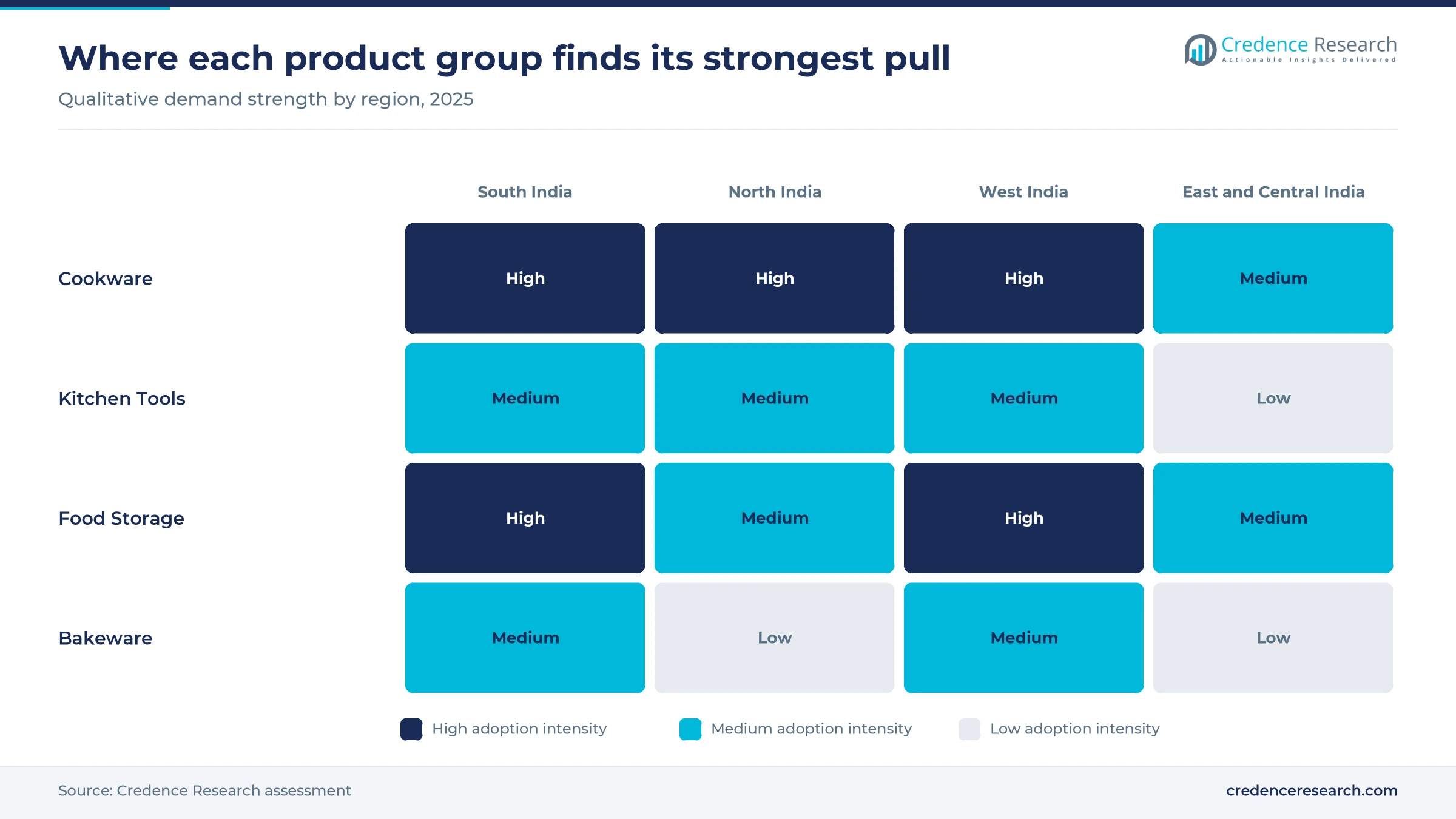
Mandatory certification is moving volume from informal workshops toward organized producers, and premium ranges are consolidating at the same time. SGS reported that the revised 2025 order applies IS 14756:2024 and IS 1660:2024, with effective dates of Oct. 1, 2025, for general enterprises, Jan. 1, 2026, for small enterprises and April 1, 2026, for micro enterprises. TTK Prestige management said in October 2025 that the premium end is consolidating and growing while the mass end stays intensely competitive. Its Judge value brand also grew about 50% in that quarter, which shows organized labels attacking both ends of the price ladder.
Domestic capacity additions bring supply closer to buyers
Manufacturers are building plants near demand centers, which shortens lead times and supports wider assortments in regional markets. Hawkins Cookers opened a fourth factory in Jaunpur in June 2025, while TTK Prestige deployed about INR 30 crore in the first half of fiscal 2026, mainly for a cookware expansion at Karjan near Vadodara. Aequs and Brazil's Tramontina announced an INR 80 crore cookware joint venture in the Hubballi Durable Goods Cluster on Feb. 11, 2025, according to a PTI report. Investywise reported in May 2026 that Cello World's stainless steel bottle facility had faced delays, with INR 75.44 crore invested and a further timeline extension under preparation. Together these investments support the forecast by adding certified local supply close to regional buyers.
Coating safety and new homes reshape product demand
Shift from coated pans toward steel and cast iron
Coating safety has become a mainstream buying question, and it is steering part of the premium basket toward uncoated metal. The Week reported on June 1, 2024, that ICMR dietary guidelines advised against heating Teflon-coated cookware beyond 170 degrees Celsius and advised replacing pans once coatings wear. The Indian Stainless Steel Development Association welcomed the advice, while Wonderchef founder Ravi Saxena defended coatings free from PFOA and heavy metals. Manufacturers have responded with hybrids, and Stove Kraft told investors on Jan. 31, 2026, that it had just launched a CERACLAD stainless steel ceramic-coated range. Stove Kraft also reported about 40% to 45% utilization at its cast iron plant, which leaves room to scale that line.
Rise of domestic glass and polymer storage supply
Food storage and serveware are moving from imported glass toward locally made ranges, which supports the Non-Metal segment and its 9.22% growth. Multibagg reported that Cello World's Falna glassware plant in Rajasthan ran at about 55% utilization in the second quarter of fiscal 2026, targeted 80% by the fourth quarter and was widening its range from 110 to 150 items. Borosil plans to commission its Bharuch plant by December 2026, using borosilicate 3.3 glass tubes for jars and jugs. These lines compete directly with imported glass tableware on price and delivery time. Cello World also reported about 85% utilization at its Daman opalware plant, which signals steady household demand for lower-priced non-metal sets.
Opportunity in starter kits for newly built homes
Government housing completions create a clear opening for starter sets of cookers, pans and containers priced for first-time homeowners. The Ministry of Rural Development reported 2.92 crore houses completed under PMAY-G out of 3.86 crore sanctioned as of Dec. 9, 2025. All India Radio reported on Oct. 17, 2026, that a further 1.93 lakh homes were approved under PMAY-U 2.0, taking urban sanctions above 20 lakh. Stove Kraft can reach these buyers through 313 Pigeon outlets across 21 states and 138 cities, with a target of 500 stores by 2027. Wonderchef reported 32 exclusive outlets in August 2025 and plans to double them, which gives brands a bundle-selling format outside the metro areas.
Opportunity in institutional and food-service supply
Bulk buyers offer an opening for commercial-grade vessels and storage that sit outside the usual retail assortment of kitchenware products. NRAI figures show food services at INR 5.69 lakh crore in fiscal 2024, growing about 8.1% a year, which supports the 9.46% rate for Food-Service Buyers. PM POSHAN covers about 11.20 lakh schools and 11.80 crore children, according to the Education Ministry, and each school kitchen requires durable cooking vessels. TTK Prestige said in October 2025 that canteen and institutional sales form the balance of its channel mix after general trade, large-format stores and exclusive retail. Suppliers with IS-marked product and tender experience are therefore best placed to win this volume as IS marking spreads through the supply base.
Metal costs and compliance squeeze small manufacturers
Aluminum and steel input costs compress margins
Metal prices remain the most direct risk for utensil makers. Whalesbook reported on March 26, 2026, that aluminum on the London Metal Exchange rose above USD 3,500 per metric ton, while India's roughly 3,500 aluminum-processing small firms ran near 65% capacity with little margin to absorb the rise. Stove Kraft also announced price increases effective around March 2026, according to its January investor call. Large brands can pass on some of this cost, but smaller workshops often cannot, so hedging and lighter gauge designs become necessary.
Certification deadlines strain micro enterprises
BIS marking raises entry costs for the workshops that supply much of the economy tier. The final compliance date for micro enterprises fell on April 1, 2026, after the government had already moved it from March 1, 2025, in the 2025 revision of the order. Makers must meet updated versions of IS 14756 and IS 1660, which require testing and licensing. Some small producers may therefore exit or become contract suppliers, while enforcement gaps could still leave unmarked goods in rural markets.
Imported steel and glass pressure domestic pricing
Cheap imports limit pricing power for local manufacturers of steel and glass kitchenware products. India's stainless steel imports rose to 1.73 million metric tons in fiscal 2025, and the Indian Stainless Steel Development Association sought anti-dumping duties in June 2025, according to Outlook Business. Multibagg also reported in its second-quarter fiscal 2026 review that Chinese dumping was an active problem for Cello World's glassware line. Domestic plants running below full utilization absorb this pressure through thinner margins until trade remedies or scale close the gap.
Channel conflict and thin online margins
The channels growing fastest are also the least profitable, which complicates brand strategy. TTK Prestige said in October 2025 that e-commerce is low-margin and that its general trade growth had slowed to about 2% to 3%, even as it added about 25 exclusive stores in a quarter. Independent dealers may respond by favoring local labels with wider margins. Brands therefore need separate online-only assortments and firm dealer pricing to avoid eroding the shops that still hold most sales.
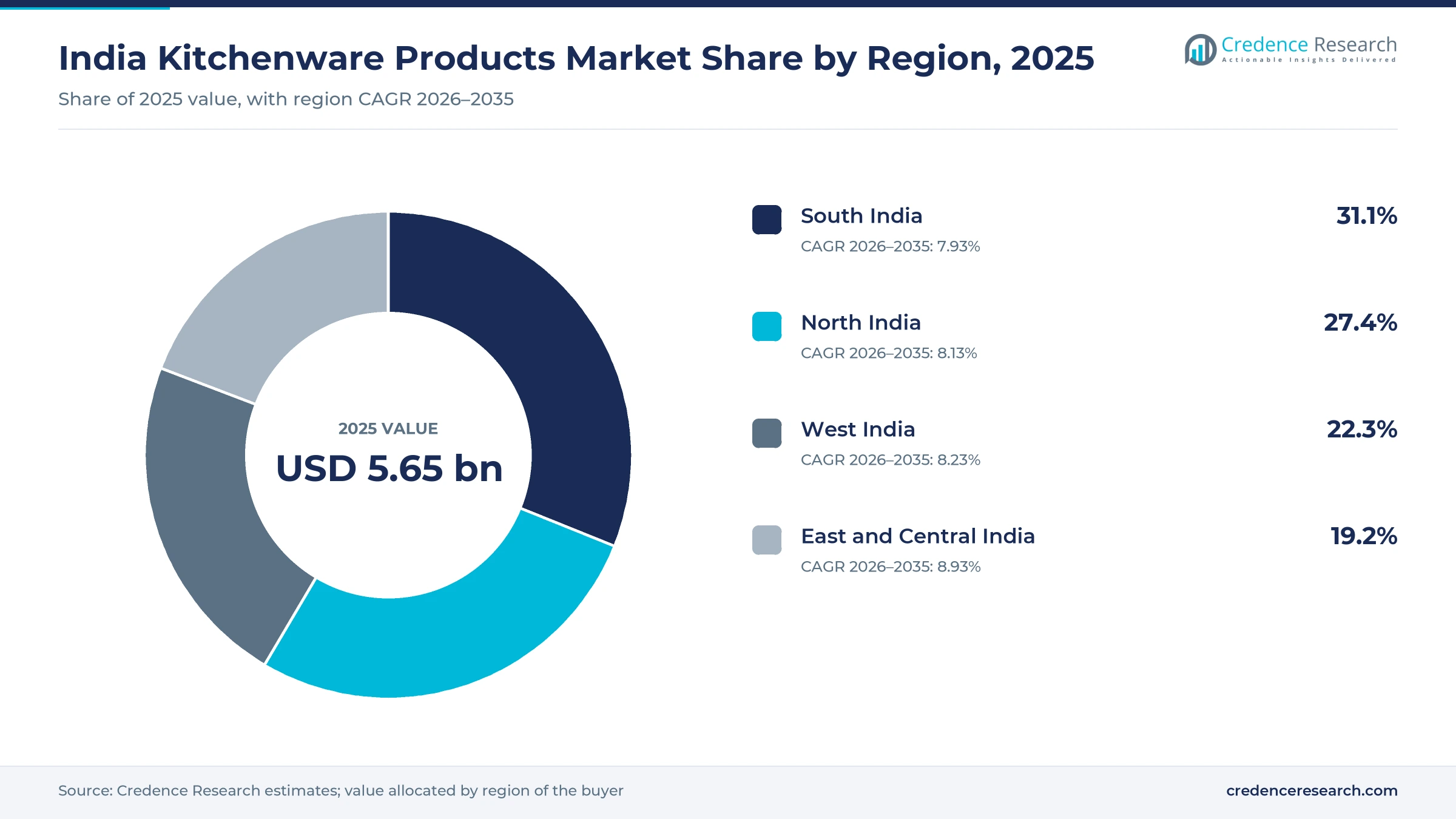
South India leads as East and Central India gains
| Region | Value, 2025 (USD billion) | Share, 2025 | CAGR, 2026–2035 |
|---|---|---|---|
| South India | 1.76 | 31.1% | 7.93% |
| North India | 1.55 | 27.4% | 8.13% |
| West India | 1.26 | 22.3% | 8.23% |
| East and Central India | 1.09 | 19.2% | 8.93% |
South India leads on urban spending and steel habits
South India held 31.1% of 2025 value and grows at 7.93% a year. MoSPI data show 2023-24 urban monthly per capita spending of INR 8,978 in Telangana, INR 8,165 in Tamil Nadu and INR 8,076 in Karnataka, well above the urban average. An IIPS abstract puts single-generation households at 26.2% in Tamil Nadu in 2020, the highest among states, which supports small-set sales. Tramontina's Hubballi venture adds local supply, which shortens delivery routes for southern dealers and marketplaces.
North India pairs large family homes with new capacity
North India held 27.4% of 2025 value and grows at 8.13% a year. Spending is uneven across this region, with MoSPI showing urban monthly spending of INR 8,428 in Haryana against INR 5,395 in Uttar Pradesh. Three-generation households were most common in Haryana and Uttar Pradesh in the early NFHS rounds, according to the IIPS abstract, which sustains demand for larger cookers. Hawkins' Jaunpur factory and Signoraware's base in Ambala, Haryana, keep cookware and lunch-box supply close to these buyers.
West India combines trade hubs and steady upgrades
West India held 22.3% of 2025 value and grows at 8.23% a year. MoSPI data show urban monthly spending of INR 7,363 in Maharashtra and INR 7,175 in Gujarat, which supports mid-priced and premium sets in the larger cities. The region also hosts supply, including TTK Prestige's Karjan cookware unit, Borosil's Bharuch project and Cello World's Daman opalware plant. Business Standard also named Surat and Bhiwandi among the trade hubs behind Flipkart's rise in listings, which strengthens fulfillment for western buyers.
East and Central India gains from a low base
East and Central India held 19.2% of 2025 value and is the fastest-growing region at 8.93% a year. Household budgets remain lower, with MoSPI showing urban monthly spending of INR 5,080 in Bihar and INR 5,538 in Madhya Pradesh, so economy cookers and aluminum vessels still lead. However, Bhubaneswar and Durgapur ranked among Flipkart's fastest-growing tier-2 markets in festive 2025, and PMAY-U 2.0 approvals in October 2026 included Bihar, Odisha and West Bengal, which adds first-time buyers.
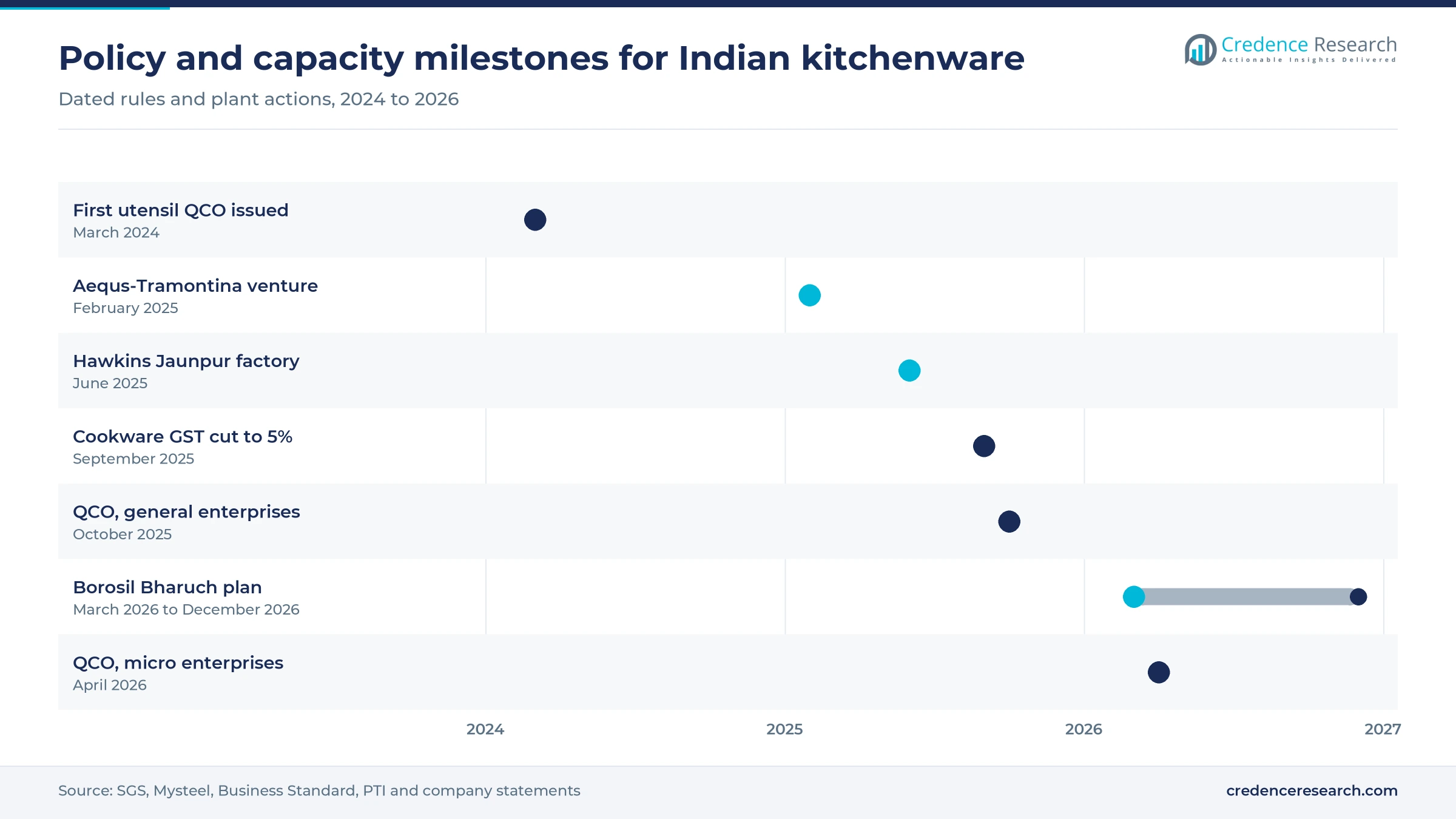
Plants and BIS deadlines marked 2025 and 2026
| Development | Status and market relevance |
|---|---|
| In February 2025, Aequs and Tramontina announced an INR 80 crore joint venture to make cookware in the Hubballi Durable Goods Cluster in Karnataka. | Announced; adds a foreign brand's local capacity for India and export buyers |
| In June 2025, Hawkins Cookers began commercial production at its fourth factory in Jaunpur, Uttar Pradesh, for pressure cookers and cookware. | Operating; extends northern and eastern supply |
| In September 2025, cookware moved from 12% to 5% GST, and Stove Kraft said on Sept. 20, 2025, that it would reflect the new rates in pricing. | In force; lowers shelf prices before the festive season |
| In March 2026, Borosil announced an INR 42 crore glassware plant in Bharuch and an INR 50 crore furnace expansion in Jaipur. | Under construction; Bharuch output is planned from December 2026 |
| In April 2026, the final Quality Control Order date for micro enterprises took effect for stainless steel and aluminum utensils. | In force; completes the phased BIS rollout |
Coatings, insulation and certification set new benchmarks
- Ceramic-coated stainless ranges combine a steel body with a coating alternative, as seen in Stove Kraft's CERACLAD launch, and sit alongside enameled cast iron at the premium end.
- Vacuum-insulated steel lines are scaling locally, with Borosil's Hydra unit planned at about 3.6 million units a year, according to Multibagg, for insulated bottles.
- Borosilicate glass forming gives storage ware heat tolerance, and Borosil's third forming line at Jaipur adds output for borosilicate ware.
- IS-marked production requires conformity testing and a BIS license under IS 14756 and IS 1660, which raises process discipline and gives buyers a visible mark of compliance.
Need a Custom Version of This Report?
Tailor the scope, geography, or segments to your exact requirements.
- Custom geography or segment scope
- Direct access to our analyst team
Listed brands widen retail reach and local capacity
Competition splits between listed national brands with broad pressure cooker and cookware ranges, housewares specialists built on plastics, glass and steel storage, and a long tail of regional utensil makers. TTK Prestige and Hawkins rely on cooker heritage and dealer depth, while Stove Kraft pushes Pigeon through its own stores and marketplaces. Cello World uses more than 4,000 distributors and 150,000 retailers, according to Multibagg, to move consumerware and Borosil builds on glass credibility. Wonderchef relies on chef-led branding and a growing network of exclusive outlets in larger cities. Foreign entrants such as Tramontina are localizing rather than importing, which narrows the premium price advantage of domestic labels. Many of these companies also sell in the consumer appliance category, so retail shelf space and advertising budgets are shared across lines. Price competition remains sharpest in the mass tier, where BIS compliance now separates certified producers from informal rivals.
Companies profiled and their roles in this market
| Company | Type | Role in the market |
|---|---|---|
| TTK Prestige Limited | National brand | Cookers and cookware under Prestige and Judge; expanding its Karjan cookware unit and exclusive stores |
| Hawkins Cookers Limited | National brand | Pressure cookers and cookware under Hawkins, Futura and Miss Mary; fourth factory opened at Jaunpur in June 2025 |
| Stove Kraft Limited | National brand | Pigeon cookers and cookware, cast iron line and CERACLAD range; 313 Pigeon outlets as of January 2026 |
| Cello World Limited | Housewares specialist | Consumerware, glassware at Falna and opalware at Daman; stainless steel bottle facility delayed as of May 2026 |
| Borosil Limited | Housewares specialist | Glass storage and bakeware, Jaipur furnace expansion and planned Bharuch plant |
| Wonderchef Home Appliances Pvt. Ltd. | Direct-led brand | Chef-endorsed cookware with 32 exclusive outlets as of August 2025 |
| Techno Plastic Industries (Signoraware) | Storage specialist | Food containers and lunch boxes from Ambala, Haryana, established in 1981 |
Organized brands should gain from the tax and BIS reset
Credence Research's view is that the 2025 tax cut and the BIS rollout together mark a clear formalization push for kitchenware products, and that organized brands should keep taking share from informal workshops through 2030. The main uncertainty is margin rather than volume, because metal costs and low-margin online channels can absorb much of the tax gain. Food storage and non-metal lines look best placed for mix gains, while aluminum vessels should defend volume in lower-income zones. Buyers planning capacity should weigh eastern and central distribution ahead of further metro expansion.
How the estimates in this report were built
The report uses 2025 as the base year and 2026 to 2035 as the forecast period, with values from the Credence Research market model. Segment and regional splits are Credence Research estimates informed by public data. Sources used were government statistics and notices, certification-body bulletins, company earnings calls and filings, and named business press. Household spending by state comes from the MoSPI survey for 2023-24. No interviews or surveys were conducted for this edition, and company-level sales are not shown.
Branded and online share should keep rising to 2035
The market is forecast to reach USD 12.53 billion by 2035 at an 8.25% CAGR over 2026–2035, adding value through both volume and a richer product mix. Cookware should remain the largest product group, although food storage and non-metal lines gain share as domestic glass and polymer capacity comes online. Marketplace and brand-owned channels should take share from independent shops, without displacing them in smaller towns. East and Central India should narrow its gap with richer regions as incomes rise and PMAY homes fill. Input costs, import pressure and uneven BIS enforcement remain the main risks to this outlook.
Frequently Asked Questions
How big is the India kitchenware products market?
Which product type leads the market?
Which region holds the largest share?
How did the GST change affect kitchenware?
What do the BIS rules require from manufacturers?
Which sales channel is growing fastest?
What are the main challenges for suppliers?
Who are the leading companies?
Table of Content
Chapter 1 Market Segmentation
- 1.1 Segmentation Framework
- 1.1.1 Product and Service Classification
- 1.1.2 Application and End-Use Classification
- 1.1.3 Technology and Solution Classification
- 1.1.4 Customer and Distribution Channel Classification
- 1.1.5 Geographic Segmentation
- 1.1.6 Market Segment Definitions and Boundaries
- 1.2 By Product Type
- 1.2.1 Cookware
- 1.2.2 Food Storage
- 1.2.3 Kitchen Tools
- 1.2.4 Bakeware
- 1.3 By Material
- 1.3.1 Stainless Steel
- 1.3.2 Aluminium
- 1.3.3 Non-Metal
- 1.3.4 Cast Iron
- 1.4 By Customer Type
- 1.4.1 Established Family Households
- 1.4.2 Nuclear Households
- 1.4.3 Food-Service Buyers
- 1.4.4 Single-Person Households
Chapter 2 Introduction
- 2.1 Report Objectives and Scope
- 2.2 Product Definition and Industry Terminology
- 2.3 Market Inclusions and Exclusions
- 2.4 Research Process
- 2.4.1 Primary Research and Expert Interviews
- 2.4.2 Secondary Research and Source Review
- 2.4.3 Top-Down and Bottom-Up Estimation
- 2.4.4 Data Triangulation and Verification
- 2.5 Market Size Measurement Basis
- 2.5.1 2025: USD 5.65 billion → 2035: USD 12.53 billion
- 2.6 Historical and Forecast Reference Periods
- 2.6.1 Historical Period: 2018-2025
- 2.6.2 Base Year: 2025
- 2.6.3 Forecast Period: 2025-2035
- 2.7 Research Assumptions and Limitations
Chapter 3 Executive Summary
- 3.1 Market Snapshot and Key Findings
- 3.2 Base-Year Market Size, 2025
- 3.3 Forecast Market Size, 2035
- 3.4 Revenue and Volume Growth Outlook
- 3.5 Key Demand and Supply Indicators
- 3.6 Leading Market Segments
- 3.7 Fastest-Growing Market Opportunities
- 3.8 Regional Performance Highlights
- 3.9 Technology and Industry Transformation
- 3.10 Competitive Landscape Summary
- 3.11 Analyst View and Strategic Implications
Chapter 4 India Kitchenware Products Market Trends and Developments
- 4.1 Historical Industry Development, 2018-2025
- 4.2 Recent Market Trends and Developments
- 4.3 Demand and Customer Behavior Trends
- 4.4 Technology and Product Innovation
- 4.5 Artificial Intelligence, Automation and Digitalization
- 4.6 Local Manufacturing and Supply Chain Realignment
- 4.7 Industry Partnerships, Mergers and Acquisitions
- 4.8 Sustainability and Circular Economy Developments
- 4.9 Government and Private Sector Investment Trends
- 4.10 Emerging Business Models and Commercialization
- 4.11 Industry Developments and Announcements
Chapter 5 India Kitchenware Products Market Production, Supply and Demand Analysis
- 5.1 Demand Trend and Consumption Analysis, 2018-2025
- 5.2 Demand Forecast, 2025-2035
- 5.3 Production and Output Trend, 2018-2025
- 5.4 Production and Output Forecast, 2025-2035
- 5.5 Installed Capacity and Capacity Utilization
- 5.6 Company-Wise Production Plants and Statistics
- 5.6.1 Installed Production Capacity
- 5.6.2 Actual Production
- 5.6.3 Planned Capacity and Expansion Targets
- 5.7 Supply Chain Structure and Procurement Trends
- 5.8 Supply-Demand Gap and Bottlenecks
- 5.9 Import Dependence and Sourcing Structure
- 5.10 Contract Manufacturing and Outsourcing
- 5.11 Regional Supply and Demand Concentration
Chapter 6 India Kitchenware Products Market Pricing Analysis
- 6.1 Pricing Structure and Measurement
- 6.2 Historical Pricing Trends, 2018-2025
- 6.3 Pricing Outlook, 2025-2035
- 6.4 Average Selling Price and Unit Economics
- 6.5 Pricing by Product and Market Segment
- 6.6 Geographic Pricing Differences
- 6.7 Key Input, Energy, Labor and Logistics Costs
- 6.8 Contract Pricing and Purchasing Models
- 6.9 Pricing Sensitivity and Competitive Positioning
- 6.10 Price, Margin and Profitability Implications
Chapter 7 India Kitchenware Products Market Dynamics
- 7.1 Market Growth Drivers
- 7.1.1 Demand-Side Drivers
- 7.1.2 Technology and Innovation Drivers
- 7.1.3 Infrastructure and Investment Drivers
- 7.1.4 Regulatory and Policy Drivers
- 7.2 Market Restraints
- 7.2.1 Cost and Affordability Constraints
- 7.2.2 Technology and Adoption Barriers
- 7.2.3 Supply Chain and Operational Constraints
- 7.3 Market Challenges
- 7.3.1 Competitive Pressure and Margin Erosion
- 7.3.2 Skills, Infrastructure and Implementation Gaps
- 7.4 Emerging Market Opportunities
- 7.5 Market Dynamics Impact and Time-Horizon Assessment
Chapter 8 India Kitchenware Products Value Chain Analysis
- 8.1 Industry Value Chain Overview
- 8.2 Upstream Suppliers and Critical Inputs
- 8.3 Technology and Component Providers
- 8.4 Manufacturing or Service Delivery
- 8.5 Distribution, Channel Partners and Integrators
- 8.6 Downstream Applications and End Users
- 8.7 Value Addition and Profit Pools
- 8.8 Vertical Integration and Outsourcing
- 8.9 Supplier Concentration and Risk
- 8.10 Supply Chain Localization and Resilience
Chapter 9 India Kitchenware Products Market Regulations and Policies
- 9.1 Relevant Laws, Standards and Compliance Frameworks
- 9.2 Product, Service, Safety and Quality Requirements
- 9.3 Government Policies, Incentives and Subsidies
- 9.4 Imports, Exports and Trade Barriers
- 9.5 Public Procurement and Local Content Requirements
- 9.6 Environmental and Sustainability Compliance
- 9.7 Upcoming Policy Changes and Market Implications
Chapter 10 India Kitchenware Products Market Hotspots and Opportunities
- 10.1 Market Opportunity Mapping and Growth Hotspots
- 10.2 High-Growth Applications and Customer Groups
- 10.3 Underserved Markets and White-Space Opportunities
- 10.4 Emerging Technology and Product Opportunities
- 10.5 New Capacity and Investment Hotspots
- 10.6 Market Entry and Expansion Opportunities
- 10.7 Distribution and Partnership Opportunities
- 10.8 Near-Term and Long-Term Commercial Potential
- 10.9 Opportunity Attractiveness and Execution Risks
Chapter 11 India Kitchenware Products Market Outlook, 2025-2035
- 11.1 Market Size and Analysis
- 11.1.1 Revenue (Market Measurement: 2025: USD 5.65 billion → 2035: USD 12.53 billion)
- 11.1.2 Market Volume and Quantity Sold
- 11.1.3 Historical Market Size, 2018-2025
- 11.1.4 Base-Year Market Size, 2025
- 11.2 Market Forecast, 2025-2035
- 11.2.1 Revenue Forecast to 2035
- 11.2.2 Volume Forecast to 2035
- 11.2.3 CAGR and Year-on-Year Growth
- 11.2.4 Incremental Revenue Opportunity
- 11.3 Forecast Assumptions and Scenario Analysis
- 11.3.1 Base-Case Forecast
- 11.3.2 Optimistic and Conservative Scenarios
- 11.3.3 Technology, Pricing and Policy Sensitivities
- 11.4 Market Attractiveness and Growth Outlook
Chapter 12 India Kitchenware Products Market Segmentation and Outlook
- 12.1 Segmentation Summary and Market Shares, 2025
- 12.2 Largest and Fastest-Growing Segments
- 12.3 By Product Type - Market Size and Forecast, 2025-2035
- 12.3.1 Segment Definition and Scope
- 12.3.2 Historical Market Size, 2018-2025
- 12.3.3 Revenue Forecast, 2025-2035
- 12.3.4 Volume Forecast, 2025-2035
- 12.3.5 Base-Year Market Share, 2025
- 12.3.6 Segment CAGR and Growth Drivers
- 12.3.7 Subsegment Market Size and Forecast
- 12.3.7.1 Cookware
- 12.3.7.2 Food Storage
- 12.3.7.3 Kitchen Tools
- 12.3.7.4 Bakeware
- 12.3.8 Subsegment Pricing and Adoption Trends
- 12.3.9 Leading Suppliers and Competition
- 12.3.10 Regional Demand and Opportunities
- 12.4 By Material - Market Size and Forecast, 2025-2035
- 12.4.1 Segment Definition and Scope
- 12.4.2 Historical Market Size, 2018-2025
- 12.4.3 Revenue Forecast, 2025-2035
- 12.4.4 Volume Forecast, 2025-2035
- 12.4.5 Base-Year Market Share, 2025
- 12.4.6 Segment CAGR and Growth Drivers
- 12.4.7 Subsegment Market Size and Forecast
- 12.4.7.1 Stainless Steel
- 12.4.7.2 Aluminium
- 12.4.7.3 Non-Metal
- 12.4.7.4 Cast Iron
- 12.4.8 Subsegment Pricing and Adoption Trends
- 12.4.9 Leading Suppliers and Competition
- 12.4.10 Regional Demand and Opportunities
- 12.5 By Customer Type - Market Size and Forecast, 2025-2035
- 12.5.1 Segment Definition and Scope
- 12.5.2 Historical Market Size, 2018-2025
- 12.5.3 Revenue Forecast, 2025-2035
- 12.5.4 Volume Forecast, 2025-2035
- 12.5.5 Base-Year Market Share, 2025
- 12.5.6 Segment CAGR and Growth Drivers
- 12.5.7 Subsegment Market Size and Forecast
- 12.5.7.1 Established Family Households
- 12.5.7.2 Nuclear Households
- 12.5.7.3 Food-Service Buyers
- 12.5.7.4 Single-Person Households
- 12.5.8 Subsegment Pricing and Adoption Trends
- 12.5.9 Leading Suppliers and Competition
- 12.5.10 Regional Demand and Opportunities
- 12.6 Segment Growth Comparison
- 12.7 Segment Attractiveness and Priority Matrix
Chapter 13 India Kitchenware Products End-Use and Application Market Outlook
- 13.1 End-Use Industry and Customer Demand Structure
- 13.2 Leading Applications and Customer Groups
- 13.3 End-Use Market Size, Share and Forecast
- 13.4 Major End-Use Industry Deep Dives
- 13.4.1 Customer Requirements and Use Cases
- 13.4.2 Demand and Replacement Cycles
- 13.4.3 Technical and Regulatory Considerations
- 13.4.4 Purchasing and Procurement Models
- 13.4.5 Leading Vendors and Distribution Channels
- 13.4.6 Forecast and Commercial Opportunities
- 13.5 Emerging Applications and Cross-Segment Demand
- 13.6 End-Use Industry Investment Priorities
Chapter 14 India Kitchenware Products Geographic Market Outlook, 2025-2035
- 14.1 Domestic Market Distribution and Demand Clusters
- 14.2 State- or Province-Wise Market Size and Forecast, 2025-2035
- 14.3 City and Metropolitan Market Outlook
- 14.4 Industrial, Manufacturing and Commercial Clusters
- 14.5 Geographic Concentration of Key End Users
- 14.6 Local Pricing and Purchasing Differences
- 14.7 Domestic Production Facilities and Capacity Map
- 14.8 Local Infrastructure and Project Pipeline
- 14.9 State-Level Policy and Incentive Differences
- 14.10 Subnational Investment Hotspots and Opportunities
- 14.11 Distribution and Logistics Networks
- 14.12 Domestic Competitive Footprint
Chapter 15 India Kitchenware Products Technology, Innovation and Sustainability Outlook
- 15.1 Technology Landscape and Maturity
- 15.2 Product, Process and Service Innovation
- 15.3 AI, Automation and Digital Tools in the Industry
- 15.4 Technology Adoption and Performance Benchmarking
- 15.5 Innovation Pipeline and R&D Investment
- 15.6 Patent and Intellectual Property Trends
- 15.7 Energy Efficiency and Resource Management
- 15.8 Sustainability, Recycling and Circularity
- 15.9 Technology Roadmap, 2025-2035
- 15.10 Risks of Obsolescence and Technology Substitution
Chapter 16 India Kitchenware Products Market Key Strategic Imperatives
- 16.1 Growth and Market Entry Priorities
- 16.2 High-Return Products and Segments
- 16.3 Pricing, Profitability and Cost Optimization
- 16.4 Technology Investment and Product Differentiation
- 16.5 Supply Chain Localization and Resilience
- 16.6 Distribution and Customer Acquisition
- 16.7 Partnership, Acquisition and Capacity Strategy
- 16.8 Regional Expansion Priorities
- 16.9 Short-, Medium- and Long-Term Actions
Chapter 17 Competition Outlook
- 17.1 Industry Competition Characteristics
- 17.2 Market Structure and Concentration
- 17.3 Market Share and Competitive Positioning, 2025
- 17.4 Company-Wise Revenue and Product Benchmarking
- 17.5 Production and Service Capacity Benchmarking
- 17.6 Technology, Pricing and Differentiation
- 17.7 Regional Footprint and Distribution Strength
- 17.8 Mergers, Acquisitions and Strategic Alliances
- 17.9 New Entrants and Competitive Threats
- 17.10 Porter's Five Forces and Industry Attractiveness
- 17.11 Competitive Outlook, 2025-2035
Chapter 18 Company Profiles
- 18.1 Company Coverage and Selection Criteria
- 18.2 TTK Prestige Limited
- 18.2.1 Business Description
- 18.2.2 Company Ownership and Geographic Presence
- 18.2.3 Product and Service Portfolio
- 18.2.4 Manufacturing and Operating Footprint
- 18.2.5 Production Capacity and Expansion Plans
- 18.2.6 Financial Performance and Investment
- 18.2.7 Market Share and Competitive Position
- 18.2.8 Technology and Innovation Capabilities
- 18.2.9 Strategic Alliances or Partnerships
- 18.2.10 Recent Developments
- 18.2.11 Growth Strategy and Outlook
- 18.3 Hawkins Cookers Limited
- 18.4 Stove Kraft Limited
- 18.5 Wonderchef Home Appliances Pvt. Ltd.
- 18.6 Hamilton Housewares Pvt. Ltd.
- 18.7 Cello World Limited
- 18.8 Borosil Limited
- 18.9 Meyer Housewares India Pvt. Ltd.
- 18.10 Bergner Impex India Pvt. Ltd.
- 18.11 Techno Plastic Industries (Signoraware)
- 18.12 Other Relevant Market Participants
Note: Every listed company is profiled on the structure shown under the first company. The company list is preliminary and may change based on research findings, market developments, data availability and client requirements.
Chapter 19 Disclaimer
- 19.1 Research and Forecast Disclaimer
- 19.2 Data Source and Estimation Limitations
Note: The depth of individual sections depends on data availability for this market. Volume, capacity, trade and other unit-based metrics are included where applicable.

