
Coconut volume and value-added oils anchor Indian demand
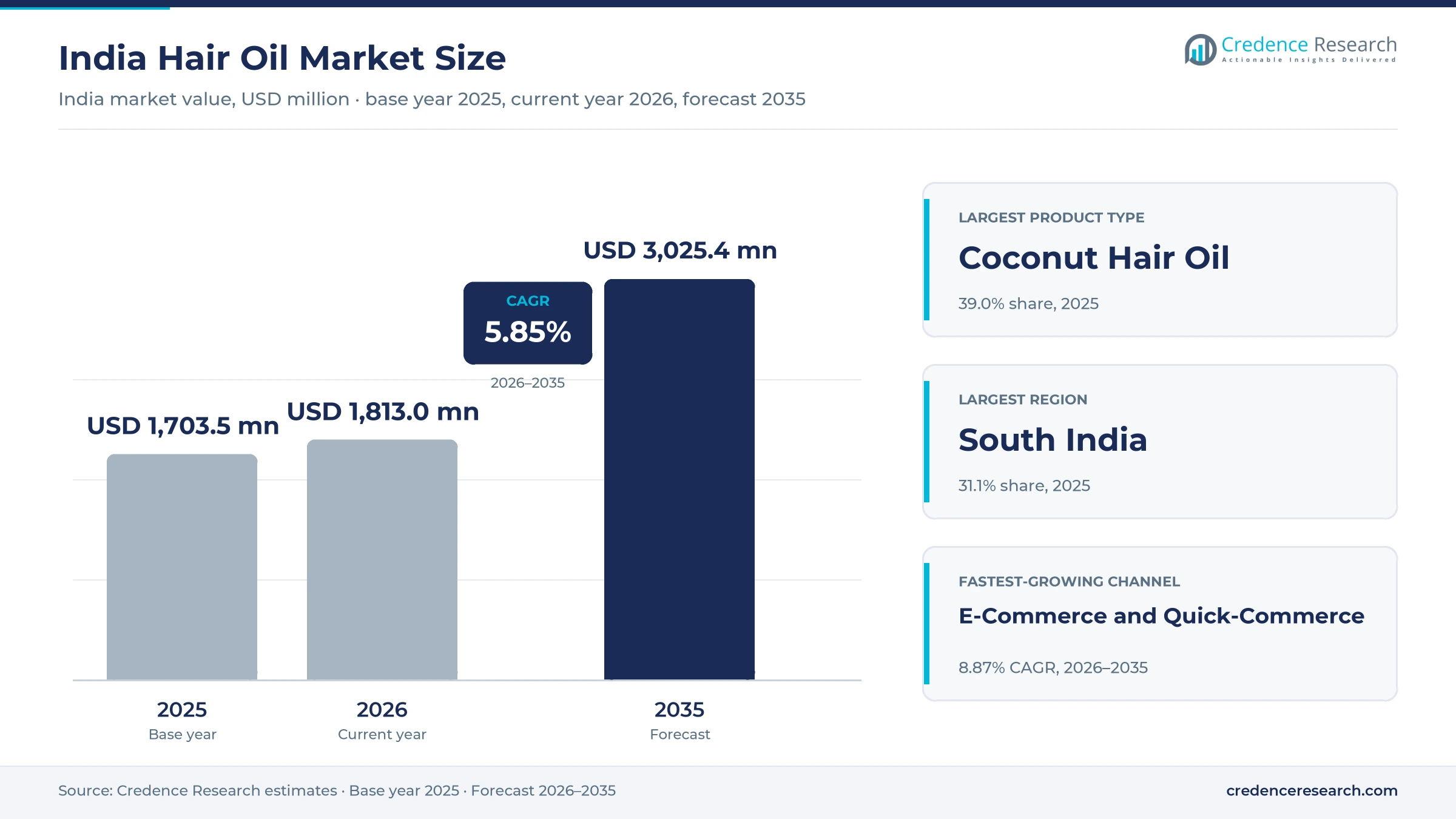
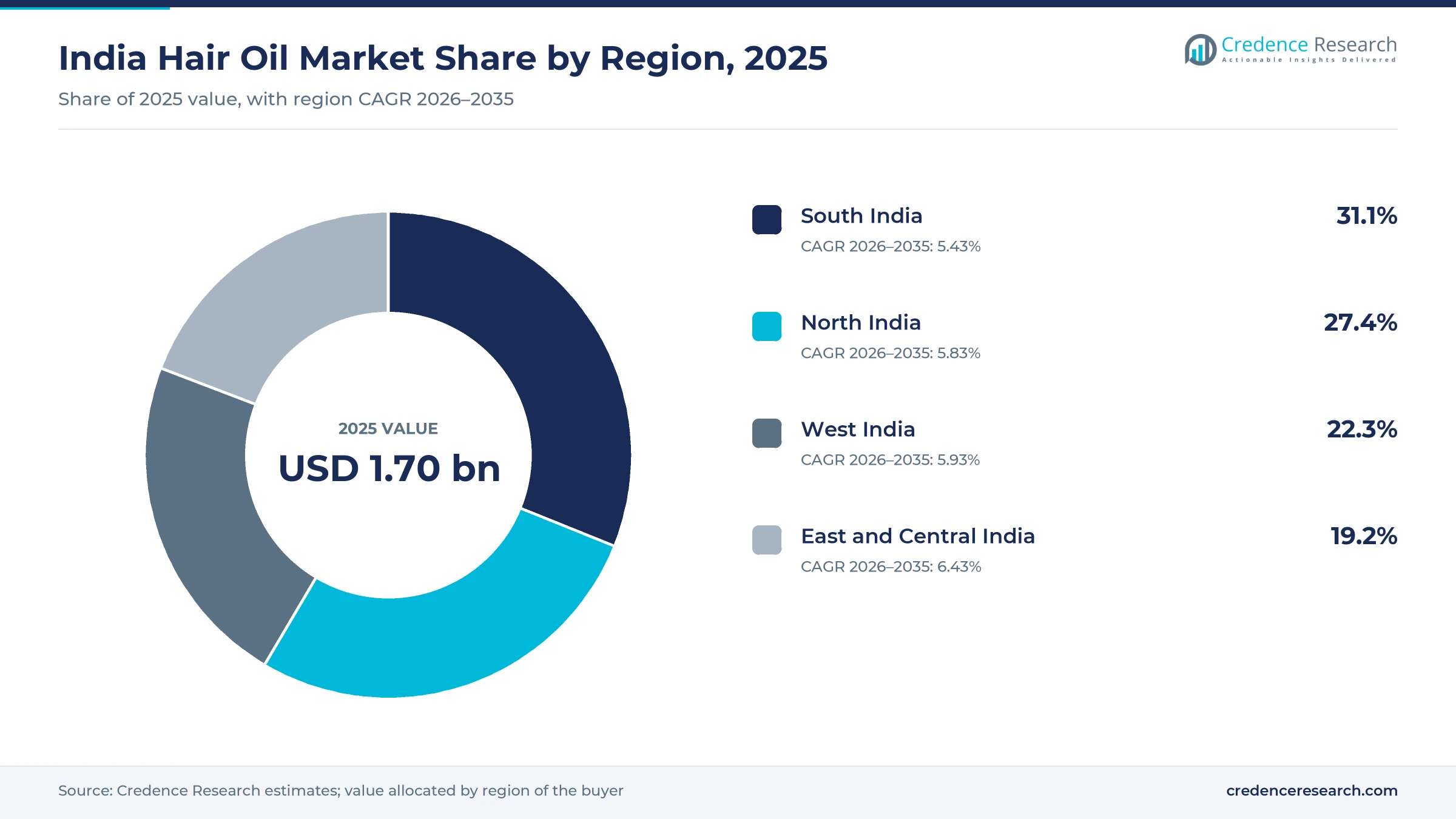
The India hair oil market was valued at USD 1.70 billion in 2025 and is projected to increase from USD 1.81 billion in 2026 to USD 3.03 billion by 2035, registering a CAGR of 5.85% during 2026–2035. Demand rests on a habit that reaches nearly every home, since Bajaj Consumer Care management described near-universal household use in August 2025. South India held the largest regional share, 31.1% in 2025, helped by coconut-growing states and high rural spending in Kerala and Tamil Nadu. East and Central India is the fastest-growing region at 6.43% a year as branded distribution moves deeper into villages. The clearest commercial change came on Sept. 22, 2025, when India cut the goods and services tax on hair oil from 18% to 5%. Value-added oils have since outpaced coconut oil, and quick commerce has become the quickest route to urban buyers.
What does the India hair oil market measure, and how do households buy?
The market counts branded hair oil sold to Indian consumers, including coconut, amla, ayurvedic, light, cooling and treatment oils. Most purchases are routine, small-ticket refills made at neighborhood kirana stores, although urban buyers increasingly order larger bottles or premium oils through online and quick-commerce apps.
The estimate excludes bulk edible coconut oil, shampoos, conditioners and serums. Loose, unbranded coconut oil is also left out, although it remains a conversion source for brands. The value chain runs from copra and base oil suppliers through formulators and packers to distributors, wholesalers and retailers.
India Hair Oil Market Insights
- The India hair oil market grows from USD 1.70 billion in 2025 to USD 3.03 billion by 2035, a 5.85% CAGR built more on mix than on new households.
- South India held 31.1% of 2025 value, supported by coconut-producing states and high rural spending in Kerala and Tamil Nadu.
- Coconut Hair Oil held 39.0% of 2025 value, with Parachute holding a 57% volume share of coconut oil at March 2026.
- India’s Sept. 22, 2025 tax cut moved hair oil from an 18% to a 5% goods and services tax rate, lowering the tax burden on every branded pack.
- Dabur reached a share of about 20% in hair oils by December 2025, its highest ever, while Marico held 29% of value-added oils at March 2026.
Coconut oil leads as ayurvedic oils gain the most value
Why does coconut oil still lead, and which oils are gaining?
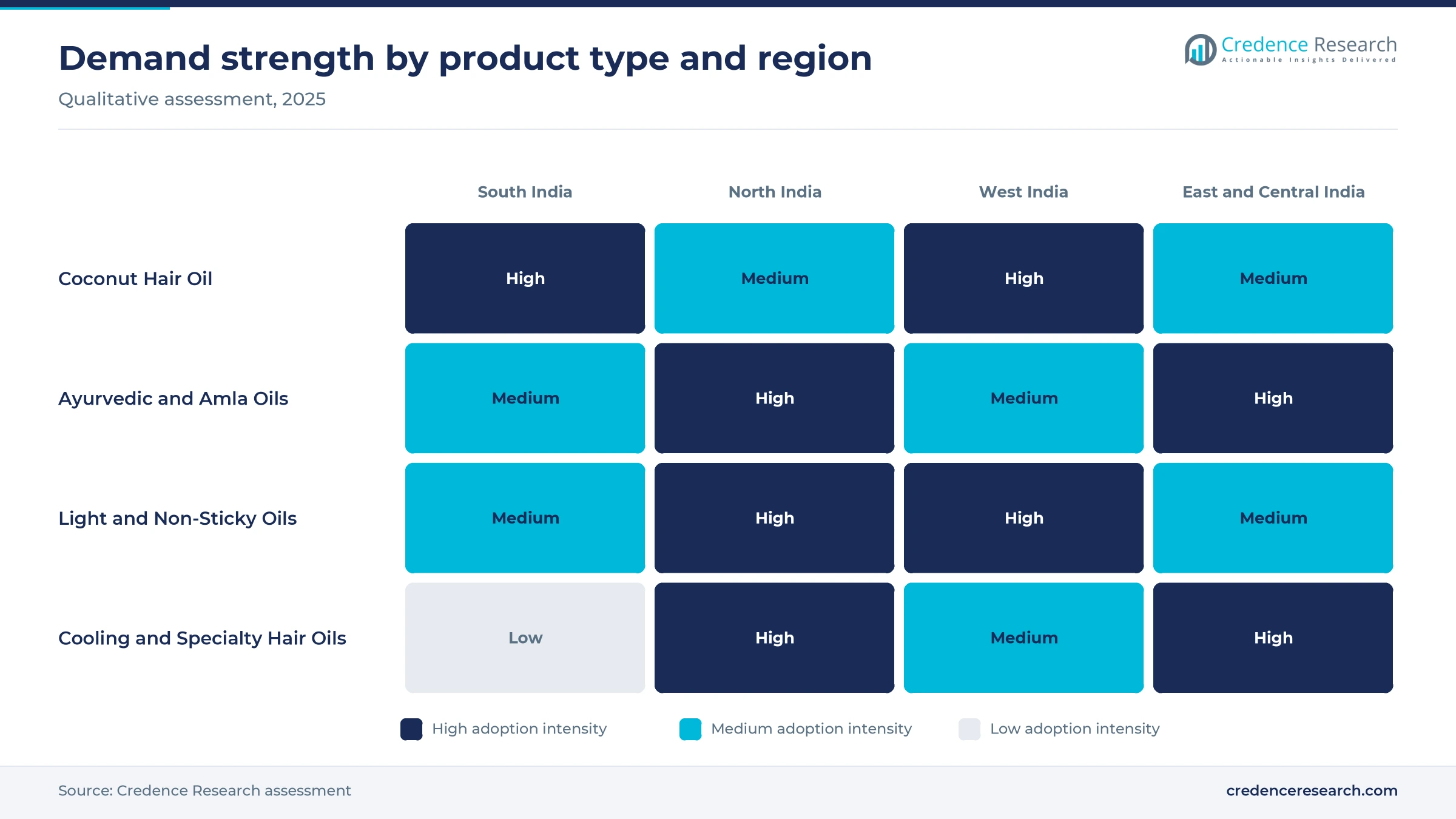
Based on product type, the market is categorized into Coconut Hair Oil, Ayurvedic and Amla Oils, Light and Non-Sticky Oils, and Cooling and Specialty Hair Oils. Coconut Hair Oil led with 39.0% of 2025 value because Marico’s June 2025 investor presentation sized the coconut category near INR 55 billion and showed about 30% of its volume still sold loose. Ayurvedic and Amla Oils grow fastest at 6.96% a year as Indian Pharma Post reported on May 8, 2026 that Dabur’s hair oils rose 28% in the March quarter with a 154-basis-point share gain.
How do price tiers separate mass refills from premium oils?
Based on price tier, the market is categorized into Economy Mass, Mainstream Mass, Masstige and Premium. Mainstream Mass led with 46.0% of 2025 value because Marico’s April 2026 investor presentation still classed 63% of its portfolio as mass and commodity-linked, which reflects the everyday price points most households accept. Premium grows fastest at 7.91% a year as Marico’s April 2026 investor presentation reported visible gains in mid and premium value-added oils, while Apollo Pharmacy lists Indulekha Bringha at INR 513 for 100 ml.
Which buyers set volumes, and which ones pay for results?
Based on customer type, the market is categorized into Family Household Buyers, Women-Focused Personal Care Buyers, Men’s Grooming Buyers and Therapeutic and Concern-Based Buyers. Family Household Buyers led with 52.0% of 2025 value because Bajaj Consumer Care management described oiling on its Aug. 12, 2025 call as a generational habit with household penetration of 92–93%. Therapeutic and Concern-Based Buyers grow fastest at 7.28% a year as Multibagg reported that Emami’s Kesh King range rose 14% in the March 2026 quarter, while Upstox recorded the launch of Navratna Ayurvedic Hairfall Control Oil in the June 2025 quarter.
Where do shoppers buy, and which channel is moving fastest?
Based on distribution channel, the market is categorized into Kirana and General Trade, Modern Trade, E-Commerce and Quick-Commerce, and Pharmacies and Ayurvedic Stores. Kirana and General Trade led with 62.0% of 2025 value because general trade still formed about 62% of Marico’s FY25 sales mix, according to its June 2025 investor presentation, despite falling from about 84% in FY15. E-Commerce and Quick-Commerce grow fastest at 8.87% a year as Multibagg reported in May 2026 that Emami’s quick-commerce sales rose 70% in the March quarter, which shows how fast delivery apps are scaling among urban shoppers.
| Segment Group | Leading Sub-segment | Share, 2025 | Fastest-growing Sub-segment | CAGR, 2026–2035 |
|---|---|---|---|---|
| By Product Type | Coconut Hair Oil | 39.0% | Ayurvedic and Amla Oils | 6.96% |
| By Price Tier | Mainstream Mass | 46.0% | Premium | 7.91% |
| By Customer Type | Family Household Buyers | 52.0% | Therapeutic and Concern-Based Buyers | 7.28% |
| By Distribution Channel | Kirana and General Trade | 62.0% | E-Commerce and Quick-Commerce | 8.87% |
Request a Free Sample
Fill in your details and we'll send you a free sample report.
- Sample data tables & charts
- Research methodology
Premium oils, deeper reach and quick commerce lift value
Premiumization into ayurvedic and benefit-led oils
Households that already oil their hair are trading up to oils promising hair-fall control, ayurvedic actives or lighter textures, which raises value without needing new users. Dabur’s January 2026 results reported 19.1% growth in hair oils and a total share of about 20%, its highest ever. Marico’s April 2026 investor presentation showed value-added hair oils rising 26% in the March quarter, with its share at 29%, about one percentage point higher on a moving annual basis. Emami added Navratna Ayurvedic Hairfall Control Oil in the June 2025 quarter, according to Upstox. As a result, Ayurvedic and Amla Oils are projected to grow at 6.96% a year, while buyers stepping up from basic coconut oil also lift their spending per bottle.
Rural reach and direct distribution expansion
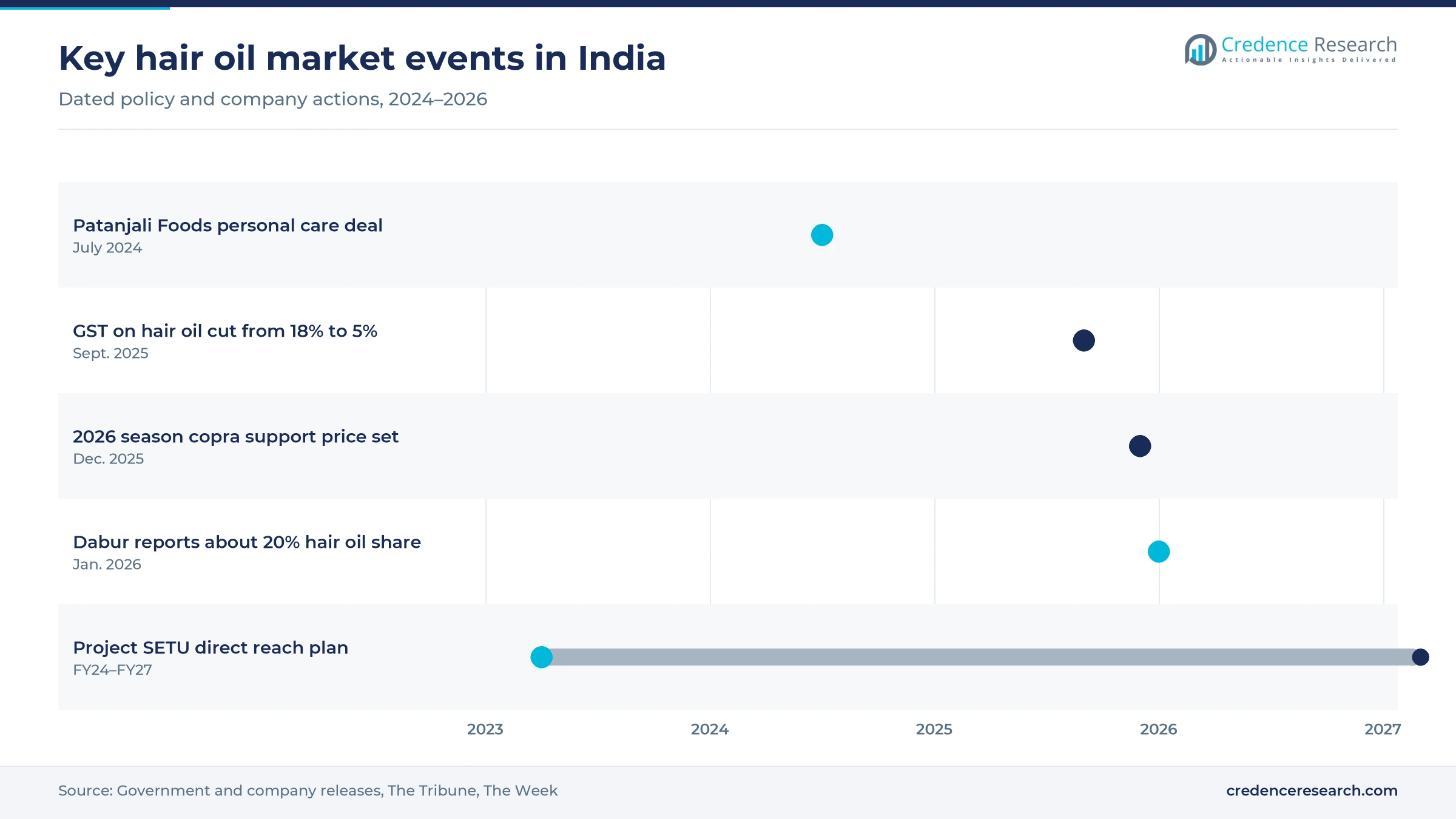
Branded oil still has room to replace loose oil in villages, and companies are funding the salesforce needed to get there. Marico’s Project SETU aims to raise direct reach from about 1 million to 1.5 million outlets across a three-year plan from FY24 to FY27, against total reach of 5.8 million outlets out of 11.3 million in FY25. Dabur’s distribution now covers more than 133,000 villages, and it reported rural demand outperforming urban markets for an eighth straight quarter in December 2025. World Bank data put India’s rural population at 64.6% of the total in 2024, so the addressable base stays large. This pool supports East and Central India, where branded oils still have room to spread.
Omnichannel discovery and urban convenience
Urban shoppers now find and reorder oils online, which helps brands sell larger bottles and premium variants that small shops rarely stock. Marico’s modern trade and e-commerce share rose from about 9% in FY15 to about 31% in FY25, according to its June 2025 investor presentation. Emami’s organized and new-age channels reached 32% of domestic business in FY26, up from 12% in FY20, Multibagg reported in May 2026. Dabur’s quick-commerce sales rose 54% in the March 2026 quarter, according to Indian Pharma Post. Bajaj Consumer Care’s organized trade grew at a strong double-digit rate in the June 2025 quarter, its management said in August 2025. Together, these figures explain why E-Commerce and Quick-Commerce grow at 8.87% a year, led by online retail platforms.
Lower tax and wider household spending power
The tax system changed hair oil affordability in a single step, and that change arrived alongside steady gains in household spending. All India Radio reported on Sept. 9, 2025 that the GST Council had moved hair oil and similar products from 18% to 5%, effective Sept. 22, 2025. Marico’s December 2025 quarterly update named this rationalization as a support for double-digit growth in value-added oils. Official data show why the cut matters, because India’s Ministry of Statistics measured average monthly per capita spending at INR 4,122 in rural areas and INR 6,996 in urban areas during 2023–24. As a result, a small-ticket staple sold in packaged consumer goods channels became cheaper for lower-income homes across the country.
Small packs and scalp actives reshape the category
Shift toward low-unit packs and smaller pack sizes
Brands now manage affordability through pack architecture as much as through list prices, and the change is visible across the leading labels. Outlook Business reported on July 13, 2026 that Bajaj Consumer Care’s sachets and other low-unit packs grew much faster than the Almond Drops brand average, which itself rose in the 30% range in the June quarter. Marico’s December 2025 update explained that Parachute reduced pack sizes instead of raising prices, so its volume was positive only after adjusting for smaller packs. On its Aug. 12, 2025 call, Bajaj said small packs and sachets serve new trial users and price-sensitive buyers. This pattern also shapes demand for cosmetics packaging suppliers, as trial formats need lower-cost materials and shorter production runs.
Rise of scalp actives such as onion and rosemary
Ingredient-led claims are rising in the category as consumers look for specific scalp and hair-fall outcomes rather than general nourishment. Honasa Consumer’s Aug. 13, 2026 press release named rosemary as its second hair ingredient to reach scale behind onion, and Outlook Business reported in April 2024 that the company was focusing on products such as onion hair oil. Marico’s range includes Parachute Advansed Onion Hair Oil, according to its June 2025 investor presentation, while Himalaya markets an Anti-Hair Fall oil built on the same concern. Emami’s Kesh King range grew 14% in the March 2026 quarter. Because these oils overlap with scalp treatment routines, Therapeutic and Concern-Based Buyers are projected to grow at 7.28% a year.
Opportunity to convert loose coconut oil to branded packs
Loose coconut oil is the largest conversion opening in the category, and falling input costs now make that conversion easier to fund. Marico’s June 2025 investor presentation showed about three-tenths of coconut oil volume still sold loose or unbranded, naming loose-to-branded conversion and rural penetration as growth levers. Parachute already held a 57% volume share at March 2026, so the leader gains more from enlarging branded sales than from taking share. Marico’s May 2026 results, summarized by Investywise, cited a 35% correction in copra prices and a return to low single-digit Parachute volume growth. As a result, brands could use lower costs to offer sharper small-pack prices, particularly in East and Central India, where Bihar’s rural monthly spending of INR 3,670 sits below the national average.
Opportunity in chemist, cosmetic and specialty retail
Chemist and cosmetic outlets offer an opening for mid-priced and premium oils that kirana shelves cannot display effectively. Marico’s April 2026 investor presentation said Project SETU’s urban expansion targets chemist, cosmetic and specialty food outlets, reporting visible gains in urban general trade and in mid and premium value-added oils. Apollo Pharmacy lists Indulekha Bringha as a 100% ayurvedic proprietary medicine with a comb applicator, which suits a pharmacist’s recommendation better than a grocery sale. Honasa’s Aug. 13, 2026 release put its coverage at about 300,000 FMCG retail outlets, with general and modern trade each growing more than 40%. These moves support Premium, which is projected to grow at 7.91% a year from a small base.
Copra swings and weak summers test category margins
Copra price swings squeeze coconut oil margins
Coconut oil margins depend on a farm commodity that brands cannot control. India set the 2026 milling copra support price at INR 12,027 per quintal, up INR 445, according to The Week on Dec. 12, 2025, and that floor has risen 129% since 2014. Marico’s December 2025 update said copra had already corrected sharply from its highs. As a result, brands cut pack sizes during upswings and pass on savings late, which leaves smaller labels exposed. Longer-term sourcing and flexible pack ladders are the main mitigation.
Weak summers disrupt cooling oil sales
Cooling oils depend on hot-weather demand, so a soft season can erase growth in a single quarter. Multibagg reported in May 2026 that Emami’s Navratna and Dermicool range fell 21% in the March 2026 quarter on a high base and weather disruption. Upstox also recorded an unusually short summer in the June 2025 quarter, driven by unseasonal rain and an early monsoon. This hurts cooling specialists most and leaves retailers holding stock. Emami’s response is to widen Navratna into ayurvedic hair-fall oil, which reduces its seasonal exposure.
Near-universal usage limits new household gains
Hair oil has few new households to win, since Bajaj Consumer Care management put penetration at 92–93% on its Aug. 12, 2025 call and described category growth as moderate. The same call acknowledged that Almond Drops had lost market share over time and required renewed advertising, with an analyst noting a 46% rise in brand advertising. As a result, one company’s gain often comes directly from a rival, which pushes up promotion costs across the category. Brands are answering with premium variants and dual-use claims instead of chasing penetration.
General trade dependence slows channel transition
Retail structure limits how fast brands can move to premium mixes. Marico’s June 2025 investor presentation showed general trade at about 62% of FY25 sales, while Multibagg reported in May 2026 that wholesale still made up 27% of Emami’s domestic sales. This matters because wholesale-led stores seldom stock premium oils or applicator packs and offer limited visibility for new launches. Smaller labels without direct salesforces are hit hardest, and they often remain regional as a result. Direct distribution programs and selective chemist coverage are the practical remedies now being funded.
East and Central India grow fastest behind South India
| Region | Value, 2025 (USD billion) | Share, 2025 | CAGR, 2026–2035 |
|---|---|---|---|
| South India | 0.53 | 31.1% | 5.43% |
| North India | 0.47 | 27.4% | 5.83% |
| West India | 0.38 | 22.3% | 5.93% |
| East and Central India | 0.33 | 19.2% | 6.43% |
South India anchors coconut supply and premium use
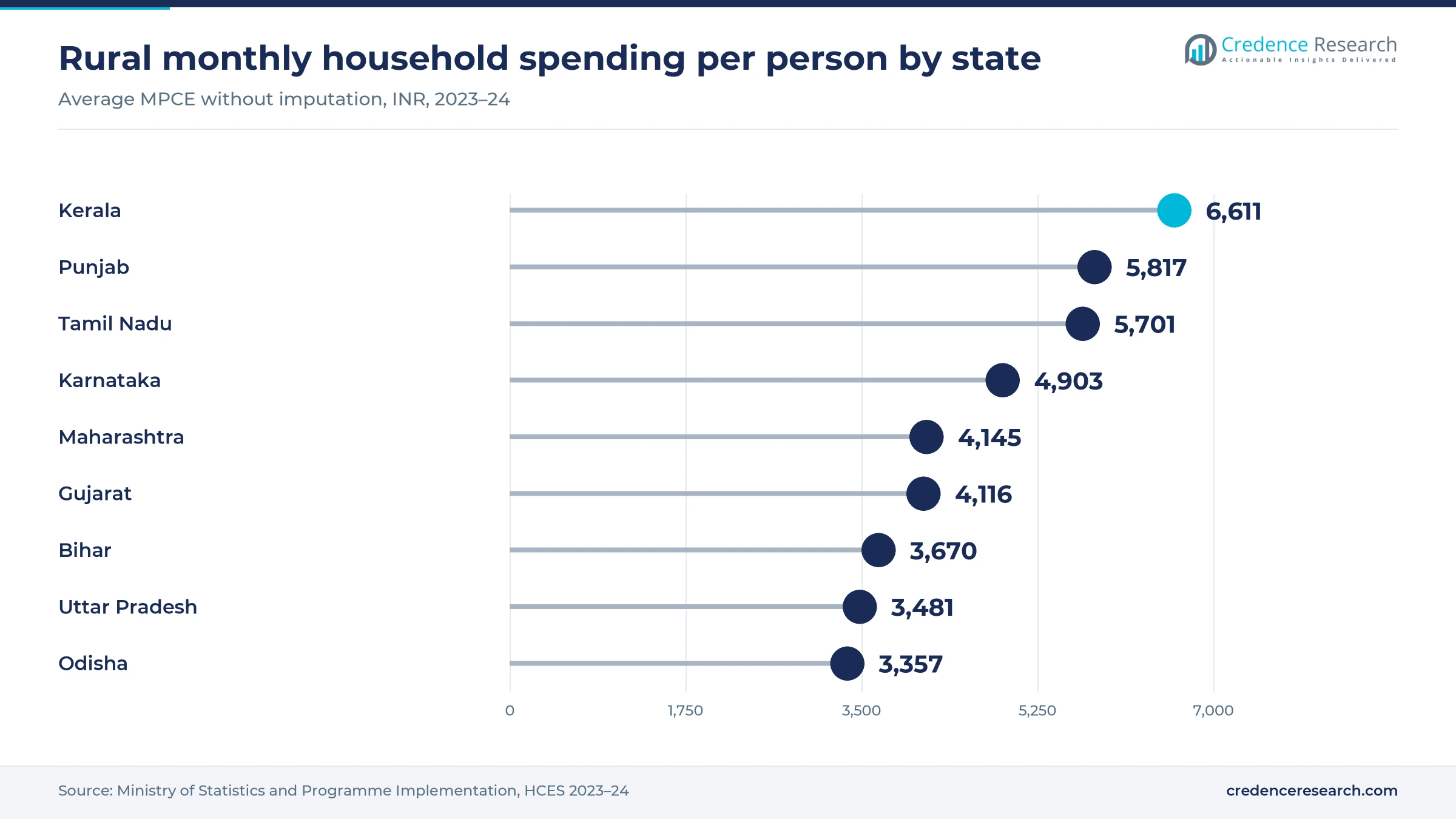
South India held 31.1% of 2025 value and grows at 5.43% a year, the slowest pace among the regions because usage there is already mature. A Press Information Bureau note from August 2026 said Tamil Nadu leads coconut production and Kerala has the largest area, about 754,000 hectares yielding about 5,149.87 million nuts. India’s Ministry of Statistics measured rural monthly spending of INR 6,611 in Kerala and INR 5,701 in Tamil Nadu during 2023–24, which supports premium oils.
North India is built on amla and perfumed oil habits
North India held 27.4% of 2025 value and grows at 5.83% a year, supported by long-standing amla and perfumed oil usage. Dabur’s January 2026 results said every second household in Hindi-speaking markets uses a Dabur hair oil, which indicates how concentrated this region’s preferences are. India’s Ministry of Statistics measured rural monthly spending of INR 5,817 in Punjab and INR 5,377 in Haryana, against INR 3,481 in Uttar Pradesh, during 2023–24. As a result, brands sell mid-priced bottles in the northwest and rely on smaller packs further east.
West India blends organized retail with mid-priced oils
West India held 22.3% of 2025 value and grows at 5.93% a year, with its large cities giving organized retail a stronger position in the buying mix. India’s Ministry of Statistics measured rural monthly spending at INR 4,145 in Maharashtra and INR 4,116 in Gujarat during 2023–24, close to the national rural average of INR 4,122. This balance supports mainstream bottles sold alongside premium purchases made online. Marico’s Project SETU urban program, which targets chemist and cosmetic outlets, also fits the dense city retail found across this region.
East and Central India offers the largest branded headroom
East and Central India held 19.2% of 2025 value and grows the fastest at 6.43% a year because branded oils still have room to spread. India’s Ministry of Statistics measured rural monthly spending at INR 3,670 in Bihar, INR 3,620 in West Bengal, INR 3,357 in Odisha and INR 2,739 in Chhattisgarh during 2023–24, all below the national rural average. As a result, sachets and small bottles carry the growth, and Bajaj Consumer Care reported in August 2025 that these packs bring in price-sensitive buyers and new trial users.
Tax relief and brand moves mark the last two years
| Development | Status and market relevance |
|---|---|
| In July 2024, Patanjali Foods agreed to buy Patanjali Ayurved’s home and personal care business, including Kesh Kanti, for INR 1,100 crore. | Announced July 1, 2024, according to The Tribune; it consolidates Patanjali’s hair care brands in one listed company. |
| In September 2025, India cut the goods and services tax on hair oil from 18% to 5%, effective Sept. 22. | In force; it lowered the tax-inclusive cost of branded oils for households. |
| In December 2025, India set the 2026 season copra support price at INR 12,027 per quintal for milling copra and INR 12,500 for ball copra. | In force; it sets a floor under the main input for coconut hair oil. |
| In January 2026, Dabur reported a hair oil share of about 20%, its highest ever, after a 193-basis-point gain. | Reported in December quarter results; it shows ayurvedic oils taking share from rivals. |
| In August 2026, Honasa Consumer reported coverage of about 300,000 FMCG retail outlets as offline trade grew more than 40%. | Reported for the June 2026 quarter; it shows digital-first brands moving into general trade. |
Formulas and packs now carry the premium story
- Comb applicators such as the Selfie Comb on Indulekha Bringha deliver oil directly to the scalp, according to Apollo Pharmacy, and support a higher shelf price.
- Non-sticky formulations are positioned for daily use, as Himalaya’s non-sticky Anti-Hair Fall oil and Almond Drops address buyers who dislike heavy oils.
- Ayurvedic licensing gives brands a medicine classification, as Apollo Pharmacy shows for Indulekha Bringha, which supports chemist distribution and treatment claims.
- Low-unit packaging allows trial at very low outlay, and Bajaj Consumer Care reported in July 2026 that these packs outgrew its brand average.
Need a Custom Version of This Report?
Tailor the scope, geography, or segments to your exact requirements.
- Custom geography or segment scope
- Direct access to our analyst team
Marico and Dabur set the pace in a contested category
Competition runs along two lines, with Marico defending coconut volume while several rivals press into value-added oils. Marico holds a 57% volume share of coconut oil and 29% of value-added oils at March 2026, drawing on Parachute and Nihar. Dabur has built a share of about 20% through Dabur Amla and its wider hair oil range, while Bajaj Consumer Care relies on Almond Drops in light oils. Emami anchors cooling through Navratna and treatment through Kesh King. Hindustan Unilever brings Indulekha into premium ayurvedic oil, and Honasa Consumer uses onion and rosemary positioning from a digital base. Patanjali consolidated its Kesh Kanti brand in Patanjali Foods after the July 2024 deal. Companies compete mainly on rural reach, advertising, pack ladders and pricing, and quick commerce is now giving smaller brands a lower-cost route to urban buyers.
Companies profiled and their roles in this market
| Company | Type | Role in the market |
|---|---|---|
| Marico Limited | Category leader | Parachute coconut oil, Nihar and Parachute Advansed value-added oils, with Project SETU expanding direct reach |
| Dabur India Limited | Ayurvedic and amla specialist | Holds a hair oil share of about 20% and distributes to more than 133,000 villages |
| Emami Limited | Cooling and treatment specialist | Navratna cooling and hair-fall oils, plus the Kesh King treatment range |
| Bajaj Consumer Care Limited | Light oil specialist | Almond Drops, with fast growth in sachets and other low-unit packs |
| Hindustan Unilever Limited | Premium ayurvedic brand owner | Indulekha Bringha, sold with a comb applicator through pharmacies |
| Honasa Consumer Limited | Digital-first challenger | Mamaearth onion and rosemary hair ranges, now reaching about 300,000 retail outlets |
| Patanjali Ayurved Limited | Ayurvedic mass brand | Transferred its personal care business, including Kesh Kanti, to Patanjali Foods under a July 2024 agreement |
| The Himalaya Wellness Company | Herbal concern-based brand | Anti-Hair Fall oil, listed by PharmEasy at INR 280 for 200 ml |
| Khadi Natural Healthcare | Herbal niche brand | Sells a herbal hair oil collection through its own online store |
Value will outrun volume in a saturated habit category
Credence Research’s view is that this market is now a mix story rather than a penetration story, since nearly every household already buys hair oil. The strongest brands will be those that move loyal users into ayurvedic, hair-fall and lighter oils while keeping small packs affordable for rural shoppers. Coconut oil remains the profit base but carries commodity risk, which explains why Marico has been pushing its value-added range. The assumption most open to challenge is the premium tier’s pace, because that estimate depends on urban chemist and online reach continuing to widen after the tax cut benefit fades.
Company disclosures and official statistics frame the model
The report uses 2025 as the base year and covers forecasts through 2035. All market values in this report come from the Credence Research model. Regional, segment and channel splits are Credence Research estimates, informed by company investor presentations, results releases, conference call records, official statistics from India’s Ministry of Statistics, the Press Information Bureau and the World Bank, and retailer price listings. No primary interviews or surveys were conducted for this edition.
Mid and premium oils set the course toward 2035
Through 2035, the market should keep compounding on value rather than on new users, reaching USD 3.03 billion at a 5.85% CAGR. Ayurvedic and Amla Oils and Premium oils are set to gain share as direct distribution reaches more chemists and villages. Coconut oil will remain the largest product group but will lose some share as loose-to-branded conversion slows, with its margins still following copra. Quick commerce should keep gaining in cities, while East and Central India benefits from rising rural spending. Demand for shampoo and dual-use routines will also shape how brands position pre-wash oils during this period.
Frequently Asked Questions
How big is the India hair oil market?
Which product type leads the India hair oil market?
Which region holds the largest share?
Which region is growing fastest?
How did the 2025 tax change affect hair oil?
Which channel is growing fastest?
Who are the leading hair oil companies in India?
What is the main challenge for hair oil brands?
Table of Content
Chapter 1 Market Segmentation
- 1.1 Segmentation Framework
- 1.1.1 Product and Service Classification
- 1.1.2 Application and End-Use Classification
- 1.1.3 Technology and Solution Classification
- 1.1.4 Customer and Distribution Channel Classification
- 1.1.5 Geographic Segmentation
- 1.1.6 Market Segment Definitions and Boundaries
- 1.2 By Product Type
- 1.2.1 Coconut Hair Oil
- 1.2.2 Ayurvedic and Amla Oils
- 1.2.3 Light and Non-Sticky Oils
- 1.2.4 Cooling and Specialty Hair Oils
- 1.3 By Price Tier
- 1.3.1 Mainstream Mass
- 1.3.2 Economy Mass
- 1.3.3 Masstige
- 1.3.4 Premium
- 1.4 By Customer Type
- 1.4.1 Family Household Buyers
- 1.4.2 Women-Focused Personal Care Buyers
- 1.4.3 Men's Grooming Buyers
- 1.4.4 Therapeutic and Concern-Based Buyers
Chapter 2 Introduction
- 2.1 Report Objectives and Scope
- 2.2 Product Definition and Industry Terminology
- 2.3 Market Inclusions and Exclusions
- 2.4 Research Process
- 2.4.1 Primary Research and Expert Interviews
- 2.4.2 Secondary Research and Source Review
- 2.4.3 Top-Down and Bottom-Up Estimation
- 2.4.4 Data Triangulation and Verification
- 2.5 Market Size Measurement Basis
- 2.5.1 2025: USD 1.70 billion → 2035: USD 3.03 billion
- 2.6 Historical and Forecast Reference Periods
- 2.6.1 Historical Period: 2018-2025
- 2.6.2 Base Year: 2025
- 2.6.3 Forecast Period: 2025-2035
- 2.7 Research Assumptions and Limitations
Chapter 3 Executive Summary
- 3.1 Market Snapshot and Key Findings
- 3.2 Base-Year Market Size, 2025
- 3.3 Forecast Market Size, 2035
- 3.4 Revenue and Volume Growth Outlook
- 3.5 Key Demand and Supply Indicators
- 3.6 Leading Market Segments
- 3.7 Fastest-Growing Market Opportunities
- 3.8 Regional Performance Highlights
- 3.9 Technology and Industry Transformation
- 3.10 Competitive Landscape Summary
- 3.11 Analyst View and Strategic Implications
Chapter 4 India Hair Oil Market Trends and Developments
- 4.1 Historical Industry Development, 2018-2025
- 4.2 Recent Market Trends and Developments
- 4.3 Demand and Customer Behavior Trends
- 4.4 Technology and Product Innovation
- 4.5 Artificial Intelligence, Automation and Digitalization
- 4.6 Local Manufacturing and Supply Chain Realignment
- 4.7 Industry Partnerships, Mergers and Acquisitions
- 4.8 Sustainability and Circular Economy Developments
- 4.9 Government and Private Sector Investment Trends
- 4.10 Emerging Business Models and Commercialization
- 4.11 Industry Developments and Announcements
Chapter 5 India Hair Oil Market Production, Supply and Demand Analysis
- 5.1 Demand Trend and Consumption Analysis, 2018-2025
- 5.2 Demand Forecast, 2025-2035
- 5.3 Production and Output Trend, 2018-2025
- 5.4 Production and Output Forecast, 2025-2035
- 5.5 Installed Capacity and Capacity Utilization
- 5.6 Company-Wise Production Plants and Statistics
- 5.6.1 Installed Production Capacity
- 5.6.2 Actual Production
- 5.6.3 Planned Capacity and Expansion Targets
- 5.7 Supply Chain Structure and Procurement Trends
- 5.8 Supply-Demand Gap and Bottlenecks
- 5.9 Import Dependence and Sourcing Structure
- 5.10 Contract Manufacturing and Outsourcing
- 5.11 Regional Supply and Demand Concentration
Chapter 6 India Hair Oil Market Pricing Analysis
- 6.1 Pricing Structure and Measurement
- 6.2 Historical Pricing Trends, 2018-2025
- 6.3 Pricing Outlook, 2025-2035
- 6.4 Average Selling Price and Unit Economics
- 6.5 Pricing by Product and Market Segment
- 6.6 Geographic Pricing Differences
- 6.7 Key Input, Energy, Labor and Logistics Costs
- 6.8 Contract Pricing and Purchasing Models
- 6.9 Pricing Sensitivity and Competitive Positioning
- 6.10 Price, Margin and Profitability Implications
Chapter 7 India Hair Oil Market Dynamics
- 7.1 Market Growth Drivers
- 7.1.1 Demand-Side Drivers
- 7.1.2 Technology and Innovation Drivers
- 7.1.3 Infrastructure and Investment Drivers
- 7.1.4 Regulatory and Policy Drivers
- 7.2 Market Restraints
- 7.2.1 Cost and Affordability Constraints
- 7.2.2 Technology and Adoption Barriers
- 7.2.3 Supply Chain and Operational Constraints
- 7.3 Market Challenges
- 7.3.1 Competitive Pressure and Margin Erosion
- 7.3.2 Skills, Infrastructure and Implementation Gaps
- 7.4 Emerging Market Opportunities
- 7.5 Market Dynamics Impact and Time-Horizon Assessment
Chapter 8 India Hair Oil Value Chain Analysis
- 8.1 Industry Value Chain Overview
- 8.2 Upstream Suppliers and Critical Inputs
- 8.3 Technology and Component Providers
- 8.4 Manufacturing or Service Delivery
- 8.5 Distribution, Channel Partners and Integrators
- 8.6 Downstream Applications and End Users
- 8.7 Value Addition and Profit Pools
- 8.8 Vertical Integration and Outsourcing
- 8.9 Supplier Concentration and Risk
- 8.10 Supply Chain Localization and Resilience
Chapter 9 India Hair Oil Market Regulations and Policies
- 9.1 Relevant Laws, Standards and Compliance Frameworks
- 9.2 Product, Service, Safety and Quality Requirements
- 9.3 Government Policies, Incentives and Subsidies
- 9.4 Imports, Exports and Trade Barriers
- 9.5 Public Procurement and Local Content Requirements
- 9.6 Environmental and Sustainability Compliance
- 9.7 Upcoming Policy Changes and Market Implications
Chapter 10 India Hair Oil Market Hotspots and Opportunities
- 10.1 Market Opportunity Mapping and Growth Hotspots
- 10.2 High-Growth Applications and Customer Groups
- 10.3 Underserved Markets and White-Space Opportunities
- 10.4 Emerging Technology and Product Opportunities
- 10.5 New Capacity and Investment Hotspots
- 10.6 Market Entry and Expansion Opportunities
- 10.7 Distribution and Partnership Opportunities
- 10.8 Near-Term and Long-Term Commercial Potential
- 10.9 Opportunity Attractiveness and Execution Risks
Chapter 11 India Hair Oil Market Outlook, 2025-2035
- 11.1 Market Size and Analysis
- 11.1.1 Revenue (Market Measurement: 2025: USD 1.70 billion → 2035: USD 3.03 billion)
- 11.1.2 Market Volume and Quantity Sold
- 11.1.3 Historical Market Size, 2018-2025
- 11.1.4 Base-Year Market Size, 2025
- 11.2 Market Forecast, 2025-2035
- 11.2.1 Revenue Forecast to 2035
- 11.2.2 Volume Forecast to 2035
- 11.2.3 CAGR and Year-on-Year Growth
- 11.2.4 Incremental Revenue Opportunity
- 11.3 Forecast Assumptions and Scenario Analysis
- 11.3.1 Base-Case Forecast
- 11.3.2 Optimistic and Conservative Scenarios
- 11.3.3 Technology, Pricing and Policy Sensitivities
- 11.4 Market Attractiveness and Growth Outlook
Chapter 12 India Hair Oil Market Segmentation and Outlook
- 12.1 Segmentation Summary and Market Shares, 2025
- 12.2 Largest and Fastest-Growing Segments
- 12.3 By Product Type - Market Size and Forecast, 2025-2035
- 12.3.1 Segment Definition and Scope
- 12.3.2 Historical Market Size, 2018-2025
- 12.3.3 Revenue Forecast, 2025-2035
- 12.3.4 Volume Forecast, 2025-2035
- 12.3.5 Base-Year Market Share, 2025
- 12.3.6 Segment CAGR and Growth Drivers
- 12.3.7 Subsegment Market Size and Forecast
- 12.3.7.1 Coconut Hair Oil
- 12.3.7.2 Ayurvedic and Amla Oils
- 12.3.7.3 Light and Non-Sticky Oils
- 12.3.7.4 Cooling and Specialty Hair Oils
- 12.3.8 Subsegment Pricing and Adoption Trends
- 12.3.9 Leading Suppliers and Competition
- 12.3.10 Regional Demand and Opportunities
- 12.4 By Price Tier - Market Size and Forecast, 2025-2035
- 12.4.1 Segment Definition and Scope
- 12.4.2 Historical Market Size, 2018-2025
- 12.4.3 Revenue Forecast, 2025-2035
- 12.4.4 Volume Forecast, 2025-2035
- 12.4.5 Base-Year Market Share, 2025
- 12.4.6 Segment CAGR and Growth Drivers
- 12.4.7 Subsegment Market Size and Forecast
- 12.4.7.1 Mainstream Mass
- 12.4.7.2 Economy Mass
- 12.4.7.3 Masstige
- 12.4.7.4 Premium
- 12.4.8 Subsegment Pricing and Adoption Trends
- 12.4.9 Leading Suppliers and Competition
- 12.4.10 Regional Demand and Opportunities
- 12.5 By Customer Type - Market Size and Forecast, 2025-2035
- 12.5.1 Segment Definition and Scope
- 12.5.2 Historical Market Size, 2018-2025
- 12.5.3 Revenue Forecast, 2025-2035
- 12.5.4 Volume Forecast, 2025-2035
- 12.5.5 Base-Year Market Share, 2025
- 12.5.6 Segment CAGR and Growth Drivers
- 12.5.7 Subsegment Market Size and Forecast
- 12.5.7.1 Family Household Buyers
- 12.5.7.2 Women-Focused Personal Care Buyers
- 12.5.7.3 Men's Grooming Buyers
- 12.5.7.4 Therapeutic and Concern-Based Buyers
- 12.5.8 Subsegment Pricing and Adoption Trends
- 12.5.9 Leading Suppliers and Competition
- 12.5.10 Regional Demand and Opportunities
- 12.6 Segment Growth Comparison
- 12.7 Segment Attractiveness and Priority Matrix
Chapter 13 India Hair Oil End-Use and Application Market Outlook
- 13.1 End-Use Industry and Customer Demand Structure
- 13.2 Leading Applications and Customer Groups
- 13.3 End-Use Market Size, Share and Forecast
- 13.4 Major End-Use Industry Deep Dives
- 13.4.1 Customer Requirements and Use Cases
- 13.4.2 Demand and Replacement Cycles
- 13.4.3 Technical and Regulatory Considerations
- 13.4.4 Purchasing and Procurement Models
- 13.4.5 Leading Vendors and Distribution Channels
- 13.4.6 Forecast and Commercial Opportunities
- 13.5 Emerging Applications and Cross-Segment Demand
- 13.6 End-Use Industry Investment Priorities
Chapter 14 India Hair Oil Geographic Market Outlook, 2025-2035
- 14.1 Domestic Market Distribution and Demand Clusters
- 14.2 State- or Province-Wise Market Size and Forecast, 2025-2035
- 14.3 City and Metropolitan Market Outlook
- 14.4 Industrial, Manufacturing and Commercial Clusters
- 14.5 Geographic Concentration of Key End Users
- 14.6 Local Pricing and Purchasing Differences
- 14.7 Domestic Production Facilities and Capacity Map
- 14.8 Local Infrastructure and Project Pipeline
- 14.9 State-Level Policy and Incentive Differences
- 14.10 Subnational Investment Hotspots and Opportunities
- 14.11 Distribution and Logistics Networks
- 14.12 Domestic Competitive Footprint
Chapter 15 India Hair Oil Technology, Innovation and Sustainability Outlook
- 15.1 Technology Landscape and Maturity
- 15.2 Product, Process and Service Innovation
- 15.3 AI, Automation and Digital Tools in the Industry
- 15.4 Technology Adoption and Performance Benchmarking
- 15.5 Innovation Pipeline and R&D Investment
- 15.6 Patent and Intellectual Property Trends
- 15.7 Energy Efficiency and Resource Management
- 15.8 Sustainability, Recycling and Circularity
- 15.9 Technology Roadmap, 2025-2035
- 15.10 Risks of Obsolescence and Technology Substitution
Chapter 16 India Hair Oil Market Key Strategic Imperatives
- 16.1 Growth and Market Entry Priorities
- 16.2 High-Return Products and Segments
- 16.3 Pricing, Profitability and Cost Optimization
- 16.4 Technology Investment and Product Differentiation
- 16.5 Supply Chain Localization and Resilience
- 16.6 Distribution and Customer Acquisition
- 16.7 Partnership, Acquisition and Capacity Strategy
- 16.8 Regional Expansion Priorities
- 16.9 Short-, Medium- and Long-Term Actions
Chapter 17 Competition Outlook
- 17.1 Industry Competition Characteristics
- 17.2 Market Structure and Concentration
- 17.3 Market Share and Competitive Positioning, 2025
- 17.4 Company-Wise Revenue and Product Benchmarking
- 17.5 Production and Service Capacity Benchmarking
- 17.6 Technology, Pricing and Differentiation
- 17.7 Regional Footprint and Distribution Strength
- 17.8 Mergers, Acquisitions and Strategic Alliances
- 17.9 New Entrants and Competitive Threats
- 17.10 Porter's Five Forces and Industry Attractiveness
- 17.11 Competitive Outlook, 2025-2035
Chapter 18 Company Profiles
- 18.1 Company Coverage and Selection Criteria
- 18.2 Marico Limited
- 18.2.1 Business Description
- 18.2.2 Company Ownership and Geographic Presence
- 18.2.3 Product and Service Portfolio
- 18.2.4 Manufacturing and Operating Footprint
- 18.2.5 Production Capacity and Expansion Plans
- 18.2.6 Financial Performance and Investment
- 18.2.7 Market Share and Competitive Position
- 18.2.8 Technology and Innovation Capabilities
- 18.2.9 Strategic Alliances or Partnerships
- 18.2.10 Recent Developments
- 18.2.11 Growth Strategy and Outlook
- 18.3 Dabur India Limited
- 18.4 Emami Limited
- 18.5 Bajaj Consumer Care Limited
- 18.6 Patanjali Ayurved Limited
- 18.7 Hindustan Unilever Limited
- 18.8 CavinKare Private Limited
- 18.9 The Himalaya Wellness Company
- 18.10 Honasa Consumer Limited
- 18.11 Khadi Natural Healthcare
- 18.12 Other Relevant Market Participants
Note: Every listed company is profiled on the structure shown under the first company. The company list is preliminary and may change based on research findings, market developments, data availability and client requirements.
Chapter 19 Disclaimer
- 19.1 Research and Forecast Disclaimer
- 19.2 Data Source and Estimation Limitations
Note: The depth of individual sections depends on data availability for this market. Volume, capacity, trade and other unit-based metrics are included where applicable.

