
| REPORT ATTRIBUTE | DETAILS |
|---|---|
| Historical Period | 2019-2022 |
| Base Year | 2023 |
| Forecast Period | 2024-2032 |
| Builders' Joinery and Carpentry of Wood Market Size 2023 | USD 76152.2 Million |
| Builders' Joinery and Carpentry of Wood Market, CAGR | 4.80% |
| Builders' Joinery and Carpentry of Wood Market Size 2032 | USD 76152.2 Million |
Market Insights
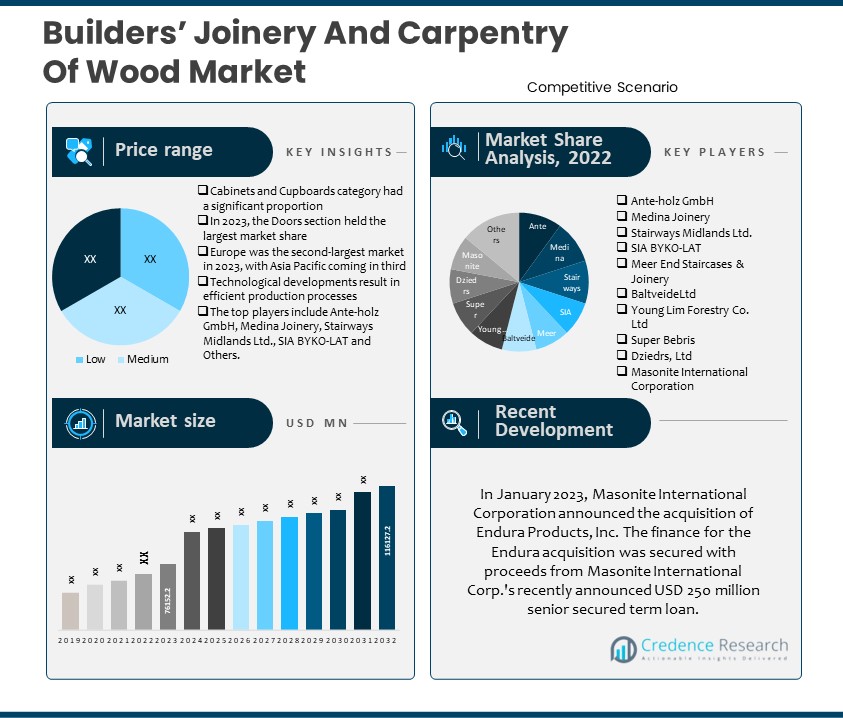
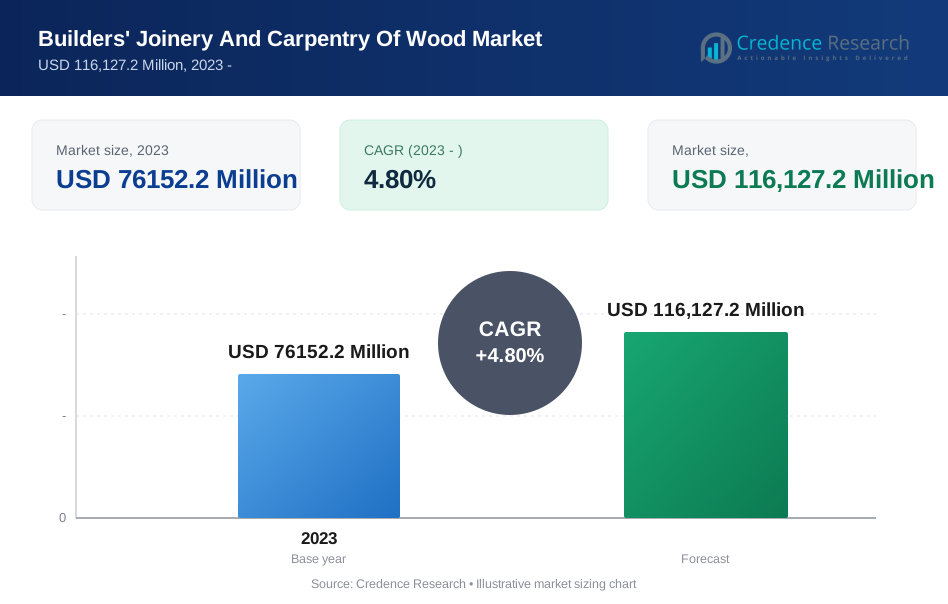
- The global demand for Builders’ Joinery And Carpentry Of Wood was valued at USD 76152.2 Million in 2023 and is expected to reach USD 116127.2 Million in 2032, growing at a CAGR of 4.80% between 2024 and 2032.
- The Doors section had the largest market share in 2023, while the Cabinets and Cupboards category had a significant share.
- Engineered wood is the market's fastest-growing category, although solid wood is also a prominent component of the Builders' Joinery and Carpentry Wood Market.
- Residential construction is a large industrial component, and renovations and remodeling are another important market category.
- In 2023, North America was the largest market for Builders’ Joinery And Carpentry Of Wood , Europe was the second-largest market, and Asia Pacific ranked third.
- Increasing demand for high-quality, customized joinery and carpentry goods propels market expansion.
- Rising raw material costs impede market expansion.
Executive Summary
Market Definition
Builders' joinery and carpentry is the skill or practice of making and assembling wood into various constructions, such as furniture, structures, and buildings. To utilize the tools properly, a competent craftsman and specialized tools are required. Builders can employ traditional ways of cutting, shaping, and joining wood or more sophisticated techniques like CNC routers, saws, drills, and presses.
Market Overview
The global Builders’ Joinery And Carpentry Of Wood Market has witnessed steady growth in recent years and is expected to grow at a CAGR of 4.80% between 2024 and 2032. The market was valued at USD 76152.2 million in 2023 and is expected to reach USD 116127.2 million in 2032.
The global market for builders' joinery and wood carpentry is predicted to develop significantly in the future years, driven by increased demand from industries including as home renovation, furniture manufacture, and construction. Demand is increasing as the population grows and disposable incomes rise. The high cost of raw materials, as well as the demand for trained labor, are significant drivers of the market for builders' joinery and wood carpentry. Furthermore, the growing popularity of alternative materials like metal and plastic is likely to drive up demand for wood in the near future.
The market is being driven by the growing trend of sustainable construction materials, as well as the increased usage of wood joinery and carpentry goods in the repair of existing buildings. Furthermore, the increasing need for individualized and visually pleasing furniture and interior design items is expected to drive up demand for wood joinery and carpentry products.
The Global Builders' Joinery and Carpentry of Wood Market are being driven by rising demand for energy-efficient buildings, increased construction activity in both developed and developing countries and rising demand for wood joinery and carpentry products for interior design and furniture applications. On the other side, growing raw material costs and a shortage of skilled personnel are some of the primary limitations of the market.
Segmentation By Product Type
- The Doors segment held the biggest market share in 2023 and is likely to maintain it during the forecast period. Doors are a crucial component of every building, performing important services such as security, privacy, and access control. Every building, whether residential or commercial, needs doors for entryways, rooms, and internal areas. This intrinsic requirement for doors ensures a steady and significant demand in the market. Wooden doors provide a wide range of design options.
- The Cabinets and Cupboards category has a considerable share of the Builders’ Joinery And Carpentry Of Wood Market.
Segmentation by Material Type
- Engineered wood is the fastest-growing segment in the Market. Its advantages, such as greater stability and resistance to warping, make it a popular choice for a variety of building and carpentry projects. Its adaptability and durability have contributed to its rapid market expansion.
- Solid wood is another popular component of the Builders' Joinery and Carpentry Wood Market. Due to their natural beauty and durability, solid wood goods are widely prized.
Segmentation by End-Use/Application
- Residential construction is a sizable industry segment. Projects such as homes, apartments, and other residential structures generate a large demand for joinery and carpentry wood goods. The need for doors, windows, flooring, and other wooden elements in residential environments adds significantly to this segment's market share.
- Renovations and remodeling are another key market category. These projects involve repairing and improving existing residential and commercial spaces.
Segmentation by Region
- In 2023, North America was the largest market for Builders’ Joinery And Carpentry Of Wood .
- Europe was the second-largest market in 2023, with Asia Pacific coming in third.
- The rest of the world, including Latin America, the Middle East, and Africa, supplies the remaining demand for Builders’ Joinery And Carpentry Of Wood.
North America was the largest market for Builders’ Joinery And Carpentry Of Wood in 2023. Rising disposable incomes and a growing population are driving this region's market expansion. The United States is the largest market in North America, followed by Canada and Mexico.
In 2023, Europe was the second-largest market for Builders’ Joinery And Carpentry Of Wood. This region's market expansion is being driven by expanding demand for wood products in the building industry. Germany is Europe's biggest market, followed by the United Kingdom and France.
Moreover, in 2023, Asia Pacific was the third-largest market for Builders’ Joinery And Carpentry Of Wood. A growing population is driving market expansion in this region. China is the region's largest market, followed by India and Japan.
Key Highlights of the Report
Product Type, Material Type, End-Use/Application, and Region segment the global Builders’ Joinery And Carpentry Of Wood Market. The Doors sector had the most market share in 2023, and Engineered wood is the fastest-growing segment in the market. Moreover, residential construction is a significant market segment, and solid wood is another popular component and North America leading the market growth.
Increased emphasis on energy-efficient materials, increased government assistance in the form of subsidies and incentives, and rising demand for sustainable and eco-friendly joinery and carpentry goods are the market's primary drivers. Furthermore, increasing competition from cheaper, imported joinery and carpentry, increasing rules and standards, and environmental concerns about deforestation or unsustainable harvesting of wood resources are the main limitations of the market.
In 2023, North America represented the largest market for Builders’ Joinery And Carpentry Of Wood . This region's market growth is mainly driven by rising demand for wood products in the construction industry. Furthermore, Europe has the second-largest market for Builders’ Joinery And Carpentry Of Wood . This region's market growth is mainly driven by rising demand for wood products in the construction industry. In addition, Asia Pacific was the world's third-largest market for Builders’ Joinery And Carpentry Of Wood in 2023. A increasing population drives market expansion in this region.
What Are The Main Drivers Of The Global Builders’ Joinery And Carpentry Of Wood Market?
The main factors driving the market are the growing demand for sustainable and environmentally friendly joinery and carpentry goods, the increased emphasis on energy-efficient materials, and the increased government support in the form of subsidies and incentives.
What Are The Major Challenges Faced By The Global Builders’ Joinery And Carpentry Of Wood Market?
The main factors limiting the industry include growing rules and regulations, environmental worries over deforestation, and unsustainable timber resource gathering.
What Are The Growth Opportunities In The Global Builders’ Joinery And Carpentry Of Wood Market?
The Global Builders' Joinery And Carpentry Of Wood Market is a rapidly expanding sector with enormous opportunities. As the world quickly urbanizes, the need for high-quality wood joinery and carpentry is expected to rise as more people invest in their houses and other properties. With a strong emphasis on sustainability and green building, wood joinery and carpentry are becoming increasingly popular as a green building material. Furthermore, rising demand for furniture and fixtures, as well as the growing popularity of DIY projects, are propelling the market forward.
Market Drivers
Several factors drive the global Builders’ Joinery And Carpentry Of Wood Market. The following are the key drivers of the global Builders’ Joinery And Carpentry Of Wood Market:
Increasing demand for high-quality, customized joinery and carpentry products
The growing demand for premium and bespoke joinery and carpentry goods is also helping to drive the expansion of the global builders' joinery and carpentry wood market. People are increasingly looking for innovative designs and high-quality things to make their homes appear more luxury and sophisticated. As a result, wood firms' joinery and carpentry departments have been investing in new technology and techniques to accommodate the increasing demand for custom and premium products. In addition, corporations are concentrating on sustainable materials and methods to accommodate the growing demand for environmentally friendly products.
Urbanisation and Population Growth
The continued trend of urbanization and population increase is a major driver of the global Builders Joinery and Carpentry of Wood market. As the world population grows, so does the demand for residential and commercial building. As wood continues to be a primary material for numerous construction applications, there is a rising need for builders joinery and carpentry services. In cities, new apartment complexes, office buildings, and infrastructural projects are frequently built. Wooden joinery and carpentry are critical components of the construction process, serving as doors, windows, floors, and decorative aspects. This increase in construction activity immediately affects demand for timber joinery and carpentry products and services. Furthermore, urbanization encourages the rebuilding and remodeling of existing structures, with woodwork being a popular choice because to its aesthetic appeal and versatility. As cities and populations expand, the global Builders Joinery and Carpentry of Wood market is expected to thrive, driven by the requirement to accommodate the growing urban population.
Market Restraints
The global Builders’ Joinery And Carpentry Of Wood Market faces some challenges that may hinder its growth. These include the following:
Rising raw material costs
The rising cost of raw materials is a significant growth constraint in the global builders' joinery and carpentry of the wood industry. This is primarily due to increased demand for wood and a limited supply of timber resources. This has increased the cost of obtaining the essential materials, making it more expensive for enterprises to manufacture their products.
Shortage of skilled labor
Another important growth constraint in the global builders' joinery and carpentry wood market is a lack of competent personnel. This is owing to a shortage of competent personnel in the business, as well as the difficulty of educating new employees in the craft. This has resulted in a market bottleneck, making it difficult for enterprises to grow and meet client demands.
Opportunities
The global Builders’ Joinery And Carpentry Of Wood Market offers significant growth opportunities. These include the following:
Rising urbanization and more demand for housing
This trend is driving growth in the global builders' joinery and carpentry of wood industry as more individuals relocate to cities in search of homes. This increased demand for housing has resulted in a boom in the wood joinery and carpentry markets, as these services are frequently required to build and maintain these dwellings. Furthermore, as people become more aware of the environmental effects of construction, they are increasingly turning to more sustainable and eco-friendly joinery and carpentry of wood goods, which is adding to the market's growth.
Competitive Landscape
Key Players
The global Builders’ Joinery And Carpentry Of Wood Market is highly competitive, with several key players. Some of the major players in the market and their market share are as follows:
- Ante-holz GmbH
- Medina Joinery
- Stairways Midlands Ltd.
- SIA BYKO-LAT
- Meer End Staircases & Joinery
- BaltveideLtd
- Young Lim Forestry Co. Ltd
- Super Bebris
- Dziedrs, Ltd
- Masonite International Corporation
- JELD-WEN Holding, Inc.
- Pella Corporation
These organizations prioritize product innovation, Material Type expansion, and mergers and acquisitions to stay competitive.
The global Builders’ Joinery And Carpentry Of Wood Market's key players continually seek to stay ahead by offering new products and developments.
In December 2023, Masonite International Corporation (Masonite), a global leader in the design, manufacture, marketing, and distribution of interior and exterior doors, premium door systems, and patio door solutions, reached an agreement to acquire PGT Innovations. The transaction, valued at around USD 3 billion, includes the transfer of PGT Innovations to Masonite in exchange for cash and Masonite stock. PGT Innovations is a prominent maker of patio doors and luxury window solutions, known for developing technologically sophisticated products for impact-rated glass applications.
In May 2020, Global Builders invented a new technology for wood joinery and carpentry.
In August 2020, Global Builders introduced a new automated technology for wood joinery and carpentry.
In April 2020, Global Builders launched a new line of wood joinery and carpentry tools.
In June 2020, Global Builders introduced a new line of wood joinery and carpentry products.
Summary of Key Findings
- Rising urbanization and increased demand for housing
- Market Segmented By Product Type, Material Type, End-Use/Application, and region.
- Engineered wood is the fastest-growing segment in the market
- Residential building is a significant industrial component
- North America is leading in market growth; the market is highly competitive with key players, including Ante-holz GmbH, Medina Joinery, Stairways Midlands Ltd., SIA BYKO-LAT and Others.
Future Outlook
- Increasing demand for environmentally friendly and sustainable wood products.
- A growing trend toward bespoke and designer woodwork.
- Technological developments result in efficient production processes.
- Growing emphasis on energy-efficient timber doors and windows.
How CXOs Can Benefit from the Credence Research Builders’ Joinery And Carpentry Of Wood Market Report
The Credence Research Builders’ Joinery And Carpentry Of Wood Market Report provides CXOs with a comprehensive overview of the market, including:
- Market size and growth forecast: The report provides detailed estimates of the global Builders’ Joinery And Carpentry Of Wood Market size, segmented By Product Type, Material Type, End-Use/Application, and region. It also includes forecasts for the market through 2032 based on key trends and drivers.
- Market segmentation: The report segments the Builders’ Joinery And Carpentry Of Wood Market By Type, Material Type, End-Use/Application, and region. This segmentation provides CXOs with a granular understanding of the market and the opportunities in each segment.
- Competitive Landscape: The report profiles the key players in the Builders’ Joinery And Carpentry Of Wood Market and provides insights into their strategies, product offerings, and financial performance. This information can help CXOs to identify and assess their competition.
- Key trends and drivers: The report identifies and analyzes the key trends and drivers that are shaping the Builders’ Joinery And Carpentry Of Wood Market. This information can help CXOs to make informed decisions about their investments and strategies.
CXOs can use the insights from the Credence Research Builders’ Joinery And Carpentry Of Wood Market Report to:
- Identify growth opportunities: The report can help CXOs to identify new growth opportunities in the Builders’ Joinery And Carpentry Of Wood Market. For example, it can pinpoint emerging trends in industries like aerospace and automotive, helping executives make informed decisions on expanding their product lines or entering new market segments where Builders’ Joinery And Carpentry Of Wood's properties can be leveraged for success.
- Make informed investment decisions: The report can help CXOs make informed investment decisions about Builders’ Joinery And Carpentry Of Wood. For example, it can provide crucial insights into market trends, competitive landscape, and potential growth areas, empowering executives to allocate resources strategically and seize opportunities for maximizing returns on investments in the Builders’ Joinery And Carpentry Of Wood sector.
- Develop competitive strategies: The report can help CXOs develop competitive strategies for their Builders’ Joinery And Carpentry Of Wood businesses. For example, it can offer valuable insights into market trends, competitor analysis, and innovative End-Use/Applications of Builders’ Joinery And Carpentry Of Wood, enabling executives to stay ahead of the competition and drive business growth in this dynamic industry.
- Track market developments: The report can help CXOs monitor market developments and stay ahead of the curve. For example, it provides insights into the latest trends and innovations in the Builders’ Joinery And Carpentry Of Wood Market.
Overall, the Credence Research Builders’ Joinery And Carpentry Of Wood Market Report is a valuable resource for CXOs who are looking to gain a deeper understanding of the market and identify opportunities for growth.
Segmentation
- By Product Type:
- Doors:
- Interior Doors
- Exterior Doors
- Patio Doors
- Fire Doors
- Others
- Windows:
- Casement Windows
- Sliding Windows
- Double-Hung Windows
- Skylights
- Others
- Staircases and Railings:
- Straight Staircases
- Spiral Staircases
- Balustrades and Handrails
- Others
- Cabinets and Cupboards:
- Kitchen Cabinets
- Bathroom Cabinets
- Storage Cabinets
- Wardrobes
- Others
- Flooring:
- Hardwood Flooring
- Engineered Wood Flooring
- Parquet Flooring
- Laminate Flooring
- Others
- Other Components:
- Mouldings and Trim
- Beams and Columns
- Panels and Cladding
- Shingles and Shakes
- Others
- By Material Type:
- Solid Wood
- Engineered Wood
- Softwood
- Hardwood
- Plywood
- Particleboard
- MDF (Medium-Density Fiberboard)
- Others
- By End-Use Application:
- Residential Construction
- Commercial Construction
- Industrial Construction
- Renovation and Remodeling
- Others
- By Region
- North America
- The U.S.
- Canada
- Mexico
- Europe
- Germany
- France
- The U.K.
- Italy
- Spain
- Rest of Europe
- Asia Pacific
- China
- Japan
- India
- South Korea
- South-east Asia
- Rest of Asia Pacific
- Latin America
- Brazil
- Argentina
- Rest of Latin America
- Middle East & Africa
- GCC Countries
- South Africa
- Rest of the Middle East and Africa
- North America
Request a Free Sample
Fill in your details and we'll send you a free sample report.
- Sample data tables & charts
- Research methodology
Need a Custom Version of This Report?
Tailor the scope, geography, or segments to your exact requirements.
- Custom geography or segment scope
- Direct access to our analyst team
Frequently Asked Questions
What is the current size of the global Builders’ Joinery And Carpentry Of Wood Market?
What is the expected growth rate of the Builders’ Joinery And Carpentry Of Wood Market between 2024 and 2032?
Which segment is leading the market share in terms of Product Type?
Which End-Use Application segment governs the demand for Builders’ Joinery And Carpentry Of Wood worldwide?
Which Material Type segment is expected to post the fastest growth rate during the forecast period?
Who are the major players in the global Builders’ Joinery And Carpentry Of Wood Market?
Table of Content
Chapter 1. Report Introduction
- 1.1 Report Description & Purpose
- 1.1.1 Report Title & Market Definition
- 1.1.2 Unique Selling Propositions (USP) & Key Differentiators
- 1.1.3 Value Proposition for Stakeholders
- 1.2 Research Objectives
- 1.2.1 Market Sizing Objectives (Volume & Revenue)
- 1.2.2 Segmentation Objectives
- 1.2.3 Competitive Intelligence Objectives
- 1.2.4 Forecast & Scenario Objectives
- 1.3 Report Scope
- 1.3.1 Builders' Joinery And Carpentry Of Wood Scope – Types & Subtypes Covered
- 1.3.2 Geographic Scope – Regions & Countries Covered
- 1.3.3 Historical Period, Base Year & Forecast Period (2023; forecast to the forecast period)
- 1.3.4 Inclusions & Exclusions
- 1.4 HS Code & Classification Framework
- 1.5 Currency, Units & Pricing Basis
- 1.6 Target Stakeholders
- 1.7 Limitations & Assumptions
Chapter 2. Executive Summary
- 2.1 Global Builders' Joinery And Carpentry Of Wood Market Snapshot
- 2.1.1 Market Size – Historical (2023) & Forecast (the forecast period) (2023: USD 76152.2 Million → forecast year: USD 116,127.2 Million)
- 2.1.2 Volume & Revenue – Global Totals
- 2.1.3 Key Market Highlights – Top Five Facts
- 2.2 Builders' Joinery And Carpentry Of Wood Market Segmentation Snapshot
- 2.2.1 Market Split by Region – 2023 vs.
- 2.3 Competitive Snapshot
- 2.3.1 Top 10 Players by Revenue Share – 2023
- 2.3.2 Top 10 Players by Volume Share – 2023
- 2.3.3 Recent Strategic Developments (18-Month Summary)
- 2.4 Key Investment Highlights & Strategic Conclusions
Chapter 3. Builders' Joinery And Carpentry Of Wood Market Dynamics & Industry Analysis
- 3.1 Market Overview & Context
- 3.1.1 Builders' Joinery And Carpentry Of Wood Market Position in the Broader Automotive Value Chain
- 3.1.2 OEM vs. Replacement Market Dynamics
- 3.1.3 Market Maturity & Development Stage by Region
- 3.2 Builders' Joinery And Carpentry Of Wood Market Drivers
- 3.3 Builders' Joinery And Carpentry Of Wood Market Restraints & Challenges
- 3.4 Builders' Joinery And Carpentry Of Wood Market Opportunities
- 3.5 Porter's Five Forces Analysis
- 3.5.1 Threat of New Entrants
- 3.5.2 Bargaining Power of Suppliers
- 3.5.3 Bargaining Power of Buyers
- 3.5.4 Threat of Substitutes
- 3.5.5 Competitive Rivalry – Intensity Assessment
- 3.6 Builders' Joinery And Carpentry Of Wood Value Chain Analysis
- 3.6.1 Upstream – Raw Material/Input Suppliers
- 3.6.1.1 Raw Material/Input 1
- 3.6.1.2 Raw Material/Input 2
- 3.6.1.3 Raw Material/Input 3
- 3.6.2 Midstream – Production/Manufacturing/Service Delivery
- 3.6.2.1 Production/Process Overview
- 3.6.2.2 Key Facility Locations & Capacity by Manufacturer
- 3.6.3 Downstream – Distribution & End Consumer
- 3.6.3.1 Primary Channel – B2B/OEM
- 3.6.3.2 Secondary Channels – Dealer, Retail, Online, Direct
- 3.6.4 Value Chain Profitability Analysis
- 3.6.1 Upstream – Raw Material/Input Suppliers
- 3.7 PESTEL Analysis
- 3.7.1 Political Factors
- 3.7.2 Economic Factors
- 3.7.3 Social Factors
- 3.7.4 Technological Factors
- 3.7.5 Environmental Factors
- 3.7.6 Legal Factors
- 3.8 Builders' Joinery And Carpentry Of Wood Supply Chain Analysis
- 3.8.1 Raw Material/Input Supply Risk Assessment
- 3.8.2 Manufacturing Concentration Risk (Geographic Exposure)
- 3.8.3 Trade Disruption Impact Analysis
- 3.9 Regulatory & Policy Landscape
Note: The regulatory and policy landscape section covers regulations based on their applicability to the market, Builders' Joinery And Carpentry Of Wood category, geography, and scope of the study. Only regulatory frameworks with a material impact on operations, compliance, trade, sustainability, or market access are analyzed in detail.
Chapter 4. Key Investment Pockets & Opportunity Analysis
- 4.1 Builders' Joinery And Carpentry Of Wood Market Attractiveness Analysis
- 4.1.1 By Region – Investment Attractiveness Matrix (Volume × CAGR)
- 4.2 Absolute Revenue Growth Opportunity
- 4.2.1 By Region – Absolute USD Growth Through the forecast period
- 4.3 Incremental Volume Opportunity
- 4.3.1 By Region – Incremental Volume Through the forecast period
- 4.3.2 Segment – Incremental Volume
- 4.4 Emerging Submarket Opportunity Deep Dive (Subject to Applicability)
- 4.5 Emerging Market Opportunity Scorecards
- 4.5.1 United States
- 4.5.2 Europe
- 4.5.3 Asia
- 4.5.4 Middle East & Africa
Note: Emerging Market Opportunity Scorecards will be included based on relevance and strategic importance. Regions listed are indicative and may vary depending on data availability and market dynamics.
Chapter 5. Builders' Joinery And Carpentry Of Wood Import-Export Analysis & Trade Flows
- 5.1 Global Trade Overview
- 5.1.1 Global Export Value by Country (2023)
- 5.1.2 Global Export Volume by Country (2023)
- 5.1.3 Global Import Value by Country (2023)
- 5.1.4 Global Import Volume by Country (2023)
- 5.1.5 Net Trade Balance by Country (2023)
- 5.2 Export Analysis – Segment
- 5.2.1 Type 1 (HS Code)
- 5.2.2 Type 2 (HS Code)
- 5.2.3 Type 3 (HS Code)
- 5.2.4 Type 4 (HS Code)
- 5.2.5 Type 5 (HS Code)
- 5.3 Import Analysis – Segment
- 5.3.1 Type 1 (HS Code)
- 5.3.2 Type 2 (HS Code)
- 5.3.3 Type 3 (HS Code)
- 5.3.4 Type 4 (HS Code)
- 5.3.5 Type 5 (HS Code)
- 5.4 Average Unit Trade Prices
- 5.4.1 Average Export Price – Segment & Country
- 5.4.2 Average Import Price – Segment & Source Country
- 5.4.3 Price Trends (2023)
- 5.5 Key Trade Route Analysis
- 5.5.1 Trade Route 1
- 5.5.2 Trade Route 2
- 5.5.3 Trade Route 3
- 5.5.4 Trade Route 4
- 5.5.5 Trade Route 5
- 5.6 Trade Policy Impact Assessment
- 5.6.1 US Anti-Dumping & Section 301 Tariffs
- 5.6.2 EU Customs Union Impact
- 5.6.3 Major Free Trade Agreements
- 5.6.4 USMCA Rules of Origin
Note: Trade policy analysis will be included only where relevant to the Builders' Joinery And Carpentry Of Wood market.
Chapter 6. Competitive Landscape & Company Benchmarking
- 6.1 Builders' Joinery And Carpentry Of Wood Market Concentration & Structure
- 6.1.1 Herfindahl-Hirschman Index (HHI) – vs. 2023
- 6.1.2 Tier 1, Tier 2 & Tier 3 Market Structure
- 6.1.3 Global, Regional & Local Player Dynamics
- 6.2 Builders' Joinery And Carpentry Of Wood Market Share Analysis – 2023
- 6.2.1 Global Revenue Share by Company
- 6.2.2 Global Volume Share by Company
- 6.2.3 Regional Revenue Share
- 6.2.4 Market Share Evolution ( vs. 2023)
- 6.2.5 OEM Segment Share by Company
- 6.2.6 Replacement Segment Share by Company
- 6.3 Production/Delivery Capacity & Facility Analysis
- 6.3.1 Global Installed Capacity
- 6.3.2 Capacity Utilization Rates
- 6.3.3 Production/Output Volume
- 6.3.4 Facility Locations & Capacity Map
- 6.3.5 Planned Capacity Additions
- 6.4 Builders' Joinery And Carpentry Of Wood Competitive Benchmarking Matrix
- 6.4.1 Revenue, Volume, CAGR & Profitability Comparison
- 6.4.2 Channel Revenue Mix
- 6.4.3 Geographic Revenue Exposure
- 6.4.4 R&D Intensity
- 6.4.5 Sustainability Maturity
- 6.5 Strategic Developments in Builders' Joinery And Carpentry Of Wood (Last 24 Months)
- 6.5.1 Mergers, Acquisitions & Divestments
- 6.5.2 New Builders' Joinery And Carpentry Of Wood Launches
- 6.5.3 Facility Expansions
- 6.5.4 Strategic Alliances, Joint Ventures & Partnerships
- 6.5.5 Distribution Expansion & Market Entry
- 6.5.6 Sustainability & ESG Initiatives
- 6.6 Competitive Strategy Mapping
- 6.6.1 Leader, Challenger, Follower & Niche Classification
- 6.6.2 Pricing Strategy Comparison
- 6.6.3 Channel Strategy Matrix
Note: Strategic developments are included based on their materiality and the availability of reliable information.
Chapter 7. Global Builders' Joinery And Carpentry Of Wood Market – By Distribution Channel
- 7.1 Segment Overview
- 7.1.1 Volume & Revenue Split by Channel (2023 & )
- 7.1.2 Channel Mix Evolution (the forecast period)
Chapter 8. Regional Market Analysis – Global Overview
- 8.1 Global Regional Overview
- 8.1.1 Regional Volume Share
- 8.1.2 Regional Revenue Share
- 8.1.3 Regional Volume by Region
- 8.1.4 Regional Revenue by Region
- 8.1.5 Regional Forecast Through the forecast period
- 8.2 Cross-Regional Segment Analysis
- 8.2.1 By Distribution Channel
- 8.2.2 By Brand/Price Tier
Chapter 9. North America Builders' Joinery And Carpentry Of Wood Market
- 9.1 United States
- 9.2 Canada
- 9.3 Mexico
Chapter 10. Europe Builders' Joinery And Carpentry Of Wood Market
- 10.1 Germany
- 10.2 France
- 10.3 Italy
- 10.4 United Kingdom
- 10.5 Spain
- 10.6 Poland
- 10.7 Russia
- 10.8 Netherlands
- 10.9 Belgium
- 10.10 Sweden
- 10.11 Denmark
- 10.12 Norway
- 10.13 Rest of Europe
Chapter 11. Asia Pacific Builders' Joinery And Carpentry Of Wood Market
- 11.1 China
- 11.2 India
- 11.3 Japan
- 11.4 South Korea
- 11.5 Thailand
- 11.6 Indonesia
- 11.7 Vietnam
- 11.8 Malaysia
- 11.9 Australia
- 11.10 Rest of Asia Pacific
Chapter 12. Latin America Builders' Joinery And Carpentry Of Wood Market
- 12.1 Brazil
- 12.2 Argentina
- 12.3 Colombia
- 12.4 Chile
- 12.5 Rest of Latin America
Chapter 13. Middle East Builders' Joinery And Carpentry Of Wood Market
- 13.1 Saudi Arabia
- 13.2 United Arab Emirates
- 13.3 Turkey
- 13.4 Israel
- 13.5 Iran
- 13.6 Rest of the Middle East
Chapter 14. Africa Builders' Joinery And Carpentry Of Wood Market
- 14.1 South Africa
- 14.2 Egypt
- 14.3 Nigeria
- 14.4 Morocco
- 14.5 Rest of Africa
Chapter 15. Builders' Joinery And Carpentry Of Wood Company Profiles
- 15.1 [Company 01]
- 15.1.1 Company Overview
- 15.1.2 Key Management Personnel
- 15.1.3 Products & Services Portfolio
- 15.1.4 Financial Performance
- 15.1.5 Key Market Focus & Geographic Presence
- 15.1.6 Recent Developments & Strategic Initiatives
Note: The company profile list is preliminary and may change based on research findings, market developments, data availability, and client requirements.
Chapter 16. Appendices
- Appendix A – List of Abbreviations & Acronyms
- Appendix B – Industry Classification Code Reference – Full Series
- Appendix C – Production & Capacity Data Tables
- Appendix D – End-Use & Demand Base Tables
- Appendix E – Consumption & Replacement Rate Assumptions
- Appendix F – ASP Reference Tables
- Appendix G – Manufacturing & Facility Database
- Appendix H – Import-Export Data Tables
- Appendix I – Regulatory Summary Tables
- Appendix J – Primary Research Participant List (Anonymized)
- Appendix K – Primary Research Questionnaire Framework
- Appendix L – Data Sources & Bibliography
- Appendix M – Market Size Divergence & Source Comparison
Chapter 17. Research Methodology
- 17.1 Research Framework & Philosophy
- 17.2 Secondary Research – Sources, Hierarchy & Data Extraction
- 17.3 Data Modeling – Bottom-Up & Top-Down Market Sizing
- 17.4 Primary Research – Stakeholder Framework, LOI & Sample Sizes
- 17.5 Forecast Methodology – Regression, Scenario & Sensitivity Analysis
- 17.6 Quality Control – Four-Layer Validation Framework
- 17.7 Limitations & Standard Assumptions
- 17.8 Disclaimer
