
Market Overview
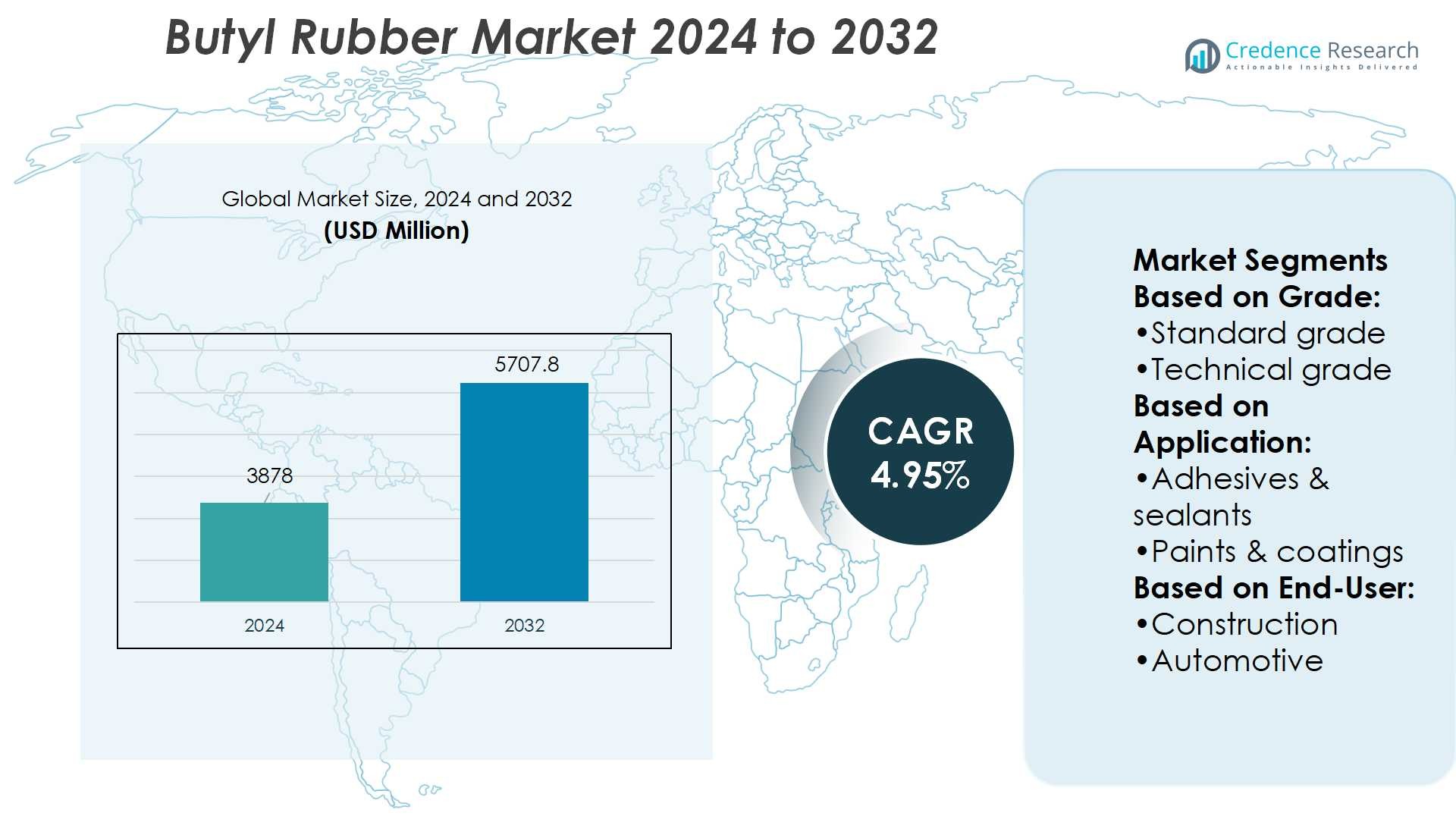
Butyl Rubber Market size was valued at USD 3878 million in 2024 and is anticipated to reach USD 5707.8 million by 2032, at a CAGR of 4.95% during the forecast period.
| REPORT ATTRIBUTE | DETAILS |
|---|---|
| Historical Period | 2020-2023 |
| Base Year | 2024 |
| Forecast Period | 2025-2032 |
| Butyl Rubber Market Size 2024 | USD 3878 Million |
| Butyl Rubber Market, CAGR | 4.95% |
| Butyl Rubber Market Size 2032 | USD 5707.8 Million |
The Butyl Rubber Market is driven by rising demand in automotive, healthcare, and construction industries, supported by its superior air retention, chemical resistance, and durability. Expanding use in tire manufacturing, pharmaceutical packaging, and waterproofing solutions strengthens its position across diverse applications. Trends highlight the growing adoption of halogenated butyl grades for advanced performance, along with sustainable formulations aligning with global environmental standards. Increasing electric vehicle production, stricter fuel efficiency regulations, and healthcare innovation accelerate market expansion. Continuous research, recycling initiatives, and integration into eco-friendly solutions ensure that it adapts to evolving industry needs while sustaining long-term growth opportunities.
The Butyl Rubber Market shows strong geographical presence, with Asia Pacific holding the largest share, followed by North America and Europe, while Latin America and the Middle East & Africa record steady growth. Regional demand is shaped by automotive, healthcare, and construction industries. Key players influencing the market include Exxon Mobil Corporation, LANXESS, SIBUR Holding, Reliance Industries Limited, JSR Corporation, Kiran Rubber Industries, SABIC, Veolia, ARLANXEO, and The Goodyear Tire & Rubber Company, each driving innovation and competitive strategies globally.
Market Insights
- The Butyl Rubber Market was valued at USD 3878 million in 2024 and is projected to reach USD 5707.8 million by 2032, at a CAGR of 4.95%.
- Rising demand from automotive, healthcare, and construction industries drives strong adoption of butyl rubber.
- Expanding use in tire manufacturing, pharmaceutical packaging, and waterproofing solutions strengthens its market position.
- Growing adoption of halogenated butyl grades and sustainable formulations marks key market trends.
- Competition remains high with global players focusing on innovation, capacity expansion, and sustainable strategies.
- Volatility in raw material prices and regulatory pressures act as restraints for manufacturers.
- Asia Pacific leads the market share, followed by North America and Europe, while Latin America and the Middle East & Africa show steady growth across industrial and healthcare applications.
Market Drivers
Rising Demand from the Automotive Industry
The Butyl Rubber Market experiences strong growth due to its wide use in automotive applications. It plays a critical role in tire inner liners, sidewalls, and tubes because of excellent air retention and durability. Automakers prefer it to improve tire performance and extend lifespan under harsh road conditions. The demand for fuel-efficient and high-performance tires further strengthens its adoption. Rising vehicle production across emerging economies drives consumption at a rapid pace. It remains a vital material for manufacturers seeking durability and safety in tire design.
- For instance, the Dhirubhai Ambani Green Energy Giga Complex is home to a solar photovoltaic (PV) module factory with 10 GW annual capacity, expected to scale up in coming years.
Expanding Applications in Pharmaceutical and Healthcare Sectors
The Butyl Rubber Market gains traction from its significant role in pharmaceutical packaging and medical devices. It provides superior resistance to gases and moisture, making it ideal for stoppers, seals, and closures. Pharmaceutical companies rely on it to maintain drug stability and extend shelf life. Growing healthcare spending across developed and developing nations supports higher adoption levels. Demand for sterile and contamination-free packaging further accelerates growth. It positions itself as an essential solution for critical healthcare applications worldwide.
- For instance, Goodyear developed a demonstration tire composed of 70% sustainable material content, using bio-based carbon black alternatives, rice husk silica, and recycled polyester.
Increased Use in Construction and Industrial Applications
The Butyl Rubber Market also benefits from expanding construction and industrial usage. It serves as a key material for sealants, adhesives, and waterproofing membranes due to its chemical resistance and elasticity. Rapid urbanization and infrastructure growth in Asia Pacific and the Middle East create consistent demand. Industrial users adopt it for protective clothing, conveyor belts, and sealing materials. Its ability to withstand extreme weather and chemical exposure strengthens its role in diverse applications. It ensures long-term reliability for industrial and construction needs.
Rising Focus on Sustainable and Advanced Materials
The Butyl Rubber Market witnesses growth driven by innovation in sustainable and high-performance materials. Manufacturers invest in advanced formulations to meet environmental regulations and enhance recyclability. Focus on energy-efficient production and eco-friendly compounds aligns with global sustainability goals. It supports industries aiming to reduce carbon footprints and improve operational efficiency. Demand for next-generation materials in automotive, healthcare, and construction creates new opportunities. It reinforces its relevance by adapting to evolving performance and sustainability standards.
Market Trends
Growing Preference for Halogenated Butyl Rubber in Advanced Applications
The Butyl Rubber Market shows a clear trend toward halogenated grades, including chlorobutyl and bromobutyl. These variants deliver better chemical resistance, heat stability, and adhesion properties. Tire manufacturers increasingly adopt them to meet stricter performance and safety requirements. Pharmaceutical companies also favor halogenated types for closures and stoppers due to superior sealing. Demand growth is evident in automotive and healthcare sectors where performance is critical. It strengthens its position as a material of choice for advanced engineering needs.
- For instance, on an operated-basis the company reduced its greenhouse gas emissions intensity (Scope 1 + Scope 2) from 31.7 metric tons CO₂e per 100 metric tons of production in upstream operations in 2016, down to 20.4.
Rising Integration of Butyl Rubber in Green and Sustainable Solutions
The Butyl Rubber Market aligns with sustainability efforts through eco-friendly innovations. Producers are investing in recyclable formulations and energy-efficient production processes. Automotive firms prefer it in low-resistance tires to reduce emissions and improve fuel economy. Construction industries adopt butyl-based sealants that meet environmental compliance standards. Demand is growing for sustainable packaging and medical solutions built on butyl formulations. It adapts to global sustainability frameworks while supporting new product developments.
- For instance, SABIC’s TRUCIRCLE™ programme is set to process one million metric tons of circular materials annually by 2030, enabling materials that can be reused or recycled in multiple product lifecycles. The Cartagena polycarbonate plant will run on 100% renewable power cutting CO₂ emissions by about 70,000 metric tons per year.
Increasing Adoption in High-Performance Tire Manufacturing
The Butyl Rubber Market benefits from rising use in premium and high-performance tires. It improves air retention and extends tire life under extreme driving conditions. OEMs integrate it in tubeless tires and radial constructions to enhance reliability. Growth in electric vehicles also increases demand for advanced tire materials. Emerging economies report strong vehicle production, further driving market expansion. It plays a decisive role in supporting innovation in modern automotive manufacturing.
Expanding Role in Medical and Pharmaceutical Packaging
The Butyl Rubber Market records a growing trend in healthcare packaging solutions. Rising demand for sterile, airtight, and contamination-resistant materials drives its adoption in vial closures and stoppers. Pharmaceutical producers rely on its barrier properties to ensure drug stability. Increased global vaccination programs expand usage across critical applications. Growing investments in biotechnology and advanced drug delivery systems further support its role. It remains essential for ensuring safety and performance in pharmaceutical packaging.
Market Challenges Analysis
Volatility in Raw Material Prices and Supply Chain Constraints
The Butyl Rubber Market faces challenges from fluctuating prices of raw materials, especially isobutylene and isoprene. Dependence on petrochemical feedstocks exposes manufacturers to oil price volatility and supply disruptions. High input costs directly affect production margins and limit competitive pricing flexibility. Global supply chain disruptions intensify risks, creating shortages and delays in delivery. Industries such as automotive and pharmaceuticals face difficulties in securing consistent supply. It pressures producers to seek alternative sourcing strategies and explore cost-efficient production methods.
Environmental Regulations and Competition from Substitute Materials
The Butyl Rubber Market encounters pressure from strict environmental regulations on petrochemical-derived products. Manufacturers must comply with emission standards and waste management norms, which increase operational costs. Growing awareness of sustainable alternatives introduces competition from synthetic and bio-based elastomers. Industries experiment with silicone, thermoplastic elastomers, and natural rubber blends for certain applications. Rising focus on eco-friendly materials poses long-term substitution risks. It compels producers to innovate sustainable formulations and maintain relevance in evolving market conditions.
Market Opportunities
Expanding Demand in Healthcare and Pharmaceutical Packaging Applications
The Butyl Rubber Market presents strong opportunities in healthcare and pharmaceutical packaging. Its superior barrier properties make it ideal for stoppers, vial closures, and seals that protect drug stability. Rising global demand for vaccines and injectable drugs increases the need for high-quality butyl components. Biopharmaceutical advancements create new applications requiring contamination-free and airtight packaging. Growth in emerging markets with expanding healthcare infrastructure supports further adoption. It positions itself as a vital material in critical medical and pharmaceutical supply chains.
Growth Potential in Sustainable Tire and Construction Solutions
The Butyl Rubber Market gains opportunities from rising demand for sustainable tires and eco-friendly construction materials. Automotive manufacturers seek it for low rolling resistance tires that improve fuel efficiency and align with emission targets. Expanding electric vehicle adoption further strengthens demand for durable and high-performance tire materials. In the construction sector, butyl-based adhesives, sealants, and waterproofing solutions see increased use in energy-efficient infrastructure projects. Growing emphasis on green building standards drives adoption across global construction markets. It enables manufacturers to address both performance requirements and sustainability goals effectively.
Market Segmentation Analysis:
By Grade
The Butyl Rubber Market by grade is divided into standard grade, technical grade, chemical grade, and pharmaceutical grade. Standard grade holds wide use across general applications such as adhesives and coatings due to balanced performance and cost efficiency. Technical grade finds demand in specialized applications requiring high durability and resistance to chemicals. Chemical grade is essential for industrial uses, offering strong resistance against solvents and gases. Pharmaceutical grade records strong adoption for stoppers, seals, and medical packaging materials. It delivers superior purity and barrier properties, making it critical for healthcare applications.
- For instance, SIBUR’s standard grade butyl rubber has balanced performance and cost efficiency; for instance, the IMPRAMER R 1675 grade shows a Mooney viscosity ML1+8 at 125 °C value of 46-56 units, with unsaturation (isoprene content) between 1.4 and 1.8 mole %.
By Application
By application, the Butyl Rubber Market covers adhesives and sealants, paints and coatings, textiles, plastics, paper and paperboard, personal care products, and others. Adhesives and sealants represent a major share due to extensive use in construction and automotive. Paints and coatings benefit from its resistance to weathering and chemical exposure. The textile sector integrates butyl formulations for protective clothing and industrial fabrics. Plastics and paper applications use it for flexibility and improved barrier performance. Personal care products utilize it for its safe and stable characteristics, supporting cosmetics and hygiene formulations. It maintains relevance across a broad spectrum of end-use applications.
- For instance, the X_Butyl® CB 1240 (chlorobutyl rubber) grade has an ash content ≤ 0.5 wt % and volatile content ≤ 0.5 wt %, making it suitable for coatings with low impurity requirements.
By End User
In terms of end user, the Butyl Rubber Market is segmented into construction, automotive, packaging, and textile industries. Construction leads adoption for waterproofing membranes, sealants, and adhesives that ensure long-term structural reliability. Automotive records strong demand due to extensive use in tires, tubes, and inner liners. Packaging adopts it for pharmaceutical and food-grade closures that preserve product safety. Textile industries integrate it into industrial fabrics and protective gear. It remains a core material supporting durability, safety, and efficiency across these key end-use sectors.
Segments:
Based on Grade:
- Standard grade
- Technical grade
Based on Application:
- Adhesives & sealants
- Paints & coatings
Based on End-User:
- Construction
- Automotive
Based on the Geography:
- North America
- U.S.
- Canada
- Mexico
- Europe
- Germany
- France
- U.K.
- Italy
- Spain
- Rest of Europe
- Asia Pacific
- China
- Japan
- India
- South Korea
- South-east Asia
- Rest of Asia Pacific
- Latin America
- Brazil
- Argentina
- Rest of Latin America
- Middle East & Africa
- GCC Countries
- South Africa
- Rest of the Middle East and Africa
Regional Analysis
North America
North America holds a market share of 23% in the Butyl Rubber Market and demonstrates stable demand across multiple industries. The region benefits from well-established automotive manufacturing hubs in the United States and Canada, which continue to drive strong consumption of butyl rubber in tire production. Stringent fuel efficiency and safety regulations further support demand for high-performance tire components made from butyl rubber. The pharmaceutical industry in North America also adopts pharmaceutical-grade butyl rubber for drug closures, stoppers, and sterile packaging, expanding its application base. Construction projects in residential and commercial segments rely on butyl-based adhesives and sealants to enhance structural performance and durability. Leading producers in the region continue investing in advanced formulations to comply with environmental standards and extend product life cycles. It remains a key region where technological innovation and regulatory frameworks influence the growth trajectory.
Europe
Europe accounts for a market share of 21% in the Butyl Rubber Market, driven by its strong automotive and healthcare industries. Germany, France, and the United Kingdom serve as central hubs for premium and performance-oriented automotive production, creating significant demand for halogenated butyl rubber in tire manufacturing. The healthcare industry, particularly in Western Europe, uses pharmaceutical-grade butyl rubber for packaging and sterile applications, supported by strict regulations on quality and safety. The construction industry also utilizes butyl rubber for waterproofing membranes and adhesives, particularly in sustainable building projects. Rising emphasis on green technologies and carbon reduction targets drives further research into eco-friendly butyl rubber formulations. European chemical producers collaborate with automotive and healthcare players to optimize formulations for regulatory compliance and high performance. It sustains consistent demand by combining advanced industrial capacity with strict environmental standards.
Asia Pacific
Asia Pacific dominates the Butyl Rubber Market with the largest share of 38%, supported by rapid industrialization, urbanization, and strong automotive production. China, India, Japan, and South Korea act as key contributors, accounting for high consumption across tire manufacturing, pharmaceuticals, and construction applications. Expanding vehicle ownership in China and India continues to boost demand for tires incorporating butyl rubber inner liners. Healthcare advancements in Japan and India strengthen the need for pharmaceutical packaging, creating a steady market for pharmaceutical-grade butyl rubber. Construction activities across emerging cities in Asia Pacific adopt butyl rubber in adhesives and sealants for reliable performance under varying climatic conditions. The region also leads in research and development for cost-efficient production methods, increasing competitiveness at the global level. It emerges as the fastest-growing regional market with vast opportunities across multiple end-use industries.
Latin America
Latin America secures a market share of 10% in the Butyl Rubber Market, led by Brazil and Mexico as primary contributors. Growing automotive assembly operations in Brazil generate significant demand for tires, directly fueling butyl rubber consumption. Pharmaceutical packaging demand expands in Mexico, where drug production and exports continue to rise. Construction activities in Latin American cities also adopt butyl-based waterproofing and sealing materials for infrastructure projects. Economic diversification and government focus on industrial growth further support wider applications in manufacturing and packaging. Regional producers seek to strengthen supply chains and reduce dependence on imports by investing in local capacity. It represents an emerging market with untapped growth potential supported by industrial expansion.
Middle East and Africa
The Middle East and Africa collectively account for a market share of 8% in the Butyl Rubber Market, showing steady progress in industrial and infrastructure applications. Gulf countries such as Saudi Arabia and the UAE invest heavily in construction, driving demand for adhesives, sealants, and waterproofing membranes. South Africa and other parts of Africa witness growing automotive sector activity, expanding the need for butyl rubber in tire production. Pharmaceutical and healthcare packaging markets in the Middle East also adopt pharmaceutical-grade butyl rubber to meet rising demand for sterile medical supplies. Regional producers benefit from proximity to petrochemical feedstocks, which ensures steady availability of raw materials. Governments prioritize infrastructure modernization, creating strong demand in building materials and industrial uses. It continues to expand with rising investments in automotive, healthcare, and construction sectors across both developed and developing economies within the region.
Key Player Analysis
- Veolia
- Reliance Industries Limited
- The Goodyear Tire & Rubber Company
- Kiran Rubber Industries
- Exxon Mobil Corporation
- SABIC
- JSR Corporation
- SIBUR Holding
- ARLANXEO
- LANXESS
Competitive Analysis
The Butyl Rubber Market players including Exxon Mobil Corporation, LANXESS, SIBUR Holding, Reliance Industries Limited, JSR Corporation, Kiran Rubber Industries, SABIC, Veolia, ARLANXEO, and The Goodyear Tire & Rubber Company. The Butyl Rubber Market is highly competitive, driven by innovation, cost optimization, and sustainability initiatives. Companies focus on expanding production capacities and strengthening supply chains to meet rising demand from automotive, construction, and healthcare industries. Advancements in halogenated butyl rubber support adoption in high-performance tires and pharmaceutical packaging, reinforcing market growth. Sustainability plays a central role, with producers investing in eco-friendly manufacturing processes and recyclable formulations to align with global regulations. Strategic collaborations, research partnerships, and regional expansion remain key approaches to enhance market presence. The competitive landscape continues to evolve as manufacturers balance performance, compliance, and innovation to maintain leadership.
Recent Developments
- In March 2025, METEX NØØVISTA, a subsidiary of METABOLIC EXPLORER, and ALINOVA announced an agreement for the marketing of the first 100% bio-based butyric acid for animal nutrition in France.
- In July 2024, ARLANXEO announced that its Butyl plant in Singapore, EPDM plant in Geleen (The Netherlands), and EVM facility in Dormagen (Germany) had received ISCC PLUS certifications. This development is expected to help the company boost the production of sustainable synthetic rubber solutions under its ‘Eco’ label, with ARLANXEO currently producing Eco grades for X_Butyl, Keltan, Levamelt, and standard Levapren.
- In 2024 Formosa Synthetic Rubber Corporation, operated a plant in Ningbo, China, with an annual production capacity of 100,000 metric tons of butyl rubber. This facility primarily produces regular butyl rubber, which is widely used in tire manufacturing, medical closures, and sealants.
- In December 2023, SIBUR's Nizhnekamskneftekhim announced that it had completed the upgradation of its halobutyl rubber (HBR) capacities, increasing them from 150 kilotons to 200 kilotons. This project saw the installation of six new production units and revamping 16 units.
Report Coverage
The research report offers an in-depth analysis based on Grade, Application, End-User and Geography. It details leading market players, providing an overview of their business, product offerings, investments, revenue streams, and key applications. Additionally, the report includes insights into the competitive environment, SWOT analysis, current market trends, as well as the primary drivers and constraints. Furthermore, it discusses various factors that have driven market expansion in recent years. The report also explores market dynamics, regulatory scenarios, and technological advancements that are shaping the industry. It assesses the impact of external factors and global economic changes on market growth. Lastly, it provides strategic recommendations for new entrants and established companies to navigate the complexities of the market.
Future Outlook
- The Butyl Rubber Market will expand with rising demand for high-performance automotive tires.
- Pharmaceutical packaging will remain a strong growth driver due to its superior barrier properties.
- Sustainable and eco-friendly butyl rubber formulations will gain wider adoption across industries.
- Electric vehicle production will create new opportunities for advanced tire applications.
- Construction projects will increase demand for adhesives, sealants, and waterproofing solutions.
- Research in halogenated butyl grades will strengthen their role in specialized applications.
- Emerging economies will witness strong consumption growth supported by industrial expansion.
- Strategic alliances and joint ventures will shape global market competition.
- Recycling initiatives and circular economy models will influence production practices.
- Continuous technological advancements will support diversified applications across end-use sectors.

Request a Free Sample
Fill in your details and we'll send you a free sample report.
- Sample data tables & charts
- Research methodology
Market Dynamics
Rising Demand from the Automotive Industry
Butyl rubber is widely used in tire inner liners, sidewalls, and tubes due to its excellent air retention and durability, making it essential for high-performance and fuel-efficient tires. The growth in vehicle production, especially in emerging economies, is significantly increasing the consumption of butyl rubber.
Expanding Applications in Pharmaceutical and Healthcare Sectors
Butyl rubber's superior resistance to gases and moisture makes it ideal for pharmaceutical packaging, such as stoppers and vial closures, ensuring drug stability and sterility. Growing healthcare spending and the need for contamination-free packaging are accelerating its adoption in medical applications.
Increased Use in Construction and Industrial Applications
The material's chemical resistance and elasticity make it a preferred choice for sealants, adhesives, and waterproofing membranes in construction and industrial sectors. Rapid urbanization and infrastructure development, particularly in Asia Pacific and the Middle East, are driving sustained demand.
Growing Preference for Halogenated Butyl Rubber
Halogenated grades like chlorobutyl and bromobutyl offer enhanced chemical resistance, heat stability, and adhesion, making them increasingly popular in advanced tire manufacturing and pharmaceutical packaging. This trend is driven by stricter performance and safety requirements in automotive and healthcare industries.
Rising Focus on Sustainable and Advanced Materials
Manufacturers are investing in eco-friendly and recyclable butyl rubber formulations to meet global environmental standards and regulatory requirements. The push for sustainable solutions in automotive, construction, and packaging sectors is creating new growth opportunities for innovative butyl rubber products.
Need a Custom Version of This Report?
Tailor the scope, geography, or segments to your exact requirements.
- Custom geography or segment scope
- Direct access to our analyst team
Frequently Asked Questions
What is the current market size for Butyl Rubber Market, and what is its projected size in 2032?
At what Compound Annual Growth Rate is the Butyl Rubber Market projected to grow between 2025 and 2032?
Which Butyl Rubber Market segment held the largest share in 2024?
What are the primary factors fueling the growth of the Butyl Rubber Market?
Who are the leading companies in the Butyl Rubber Market?
Which region commanded the largest share of the Butyl Rubber Market in 2024?
Table of Content
Chapter 1 Market Segmentation
- 1.1 Segmentation Framework
- 1.1.1 Product and Service Classification
- 1.1.2 Application and End-Use Classification
- 1.1.3 Technology and Solution Classification
- 1.1.4 Customer and Distribution Channel Classification
- 1.1.5 Geographic Segmentation
- 1.1.6 Market Segment Definitions and Boundaries
- 1.2 By Grade
- 1.2.1 Standard grade
- 1.2.2 Technical grade
- 1.2.3 Chemical grade
- 1.2.4 Pharmaceutical grade
- 1.3 By End User
- 1.3.1 Construction
- 1.3.2 Automotive
- 1.3.3 Packaging
- 1.3.4 Textile
- 1.4 By Application
- 1.4.1 Adhesives & sealants
- 1.4.2 Paints & coatings
- 1.4.3 Textiles
- 1.4.4 Plastics
- 1.4.5 Paper & paperboard
- 1.4.6 Personal care products
Chapter 2 Introduction
- 2.1 Report Objectives and Scope
- 2.2 Product Definition and Industry Terminology
- 2.3 Market Inclusions and Exclusions
- 2.4 Research Process
- 2.4.1 Primary Research and Expert Interviews
- 2.4.2 Secondary Research and Source Review
- 2.4.3 Top-Down and Bottom-Up Estimation
- 2.4.4 Data Triangulation and Verification
- 2.5 Market Size Measurement Basis
- 2.5.1 2024: USD 3878 million → 2032: USD 5707.8 million
- 2.6 Historical and Forecast Reference Periods
- 2.6.1 Base Year: 2024
- 2.6.2 Forecast Period: 2024-2032
- 2.7 Research Assumptions and Limitations
Chapter 3 Executive Summary
- 3.1 Market Snapshot and Key Findings
- 3.2 Base-Year Market Size, 2024
- 3.3 Forecast Market Size, 2032
- 3.4 Revenue and Volume Growth Outlook
- 3.5 Key Demand and Supply Indicators
- 3.6 Leading Market Segments
- 3.7 Fastest-Growing Market Opportunities
- 3.8 Regional Performance Highlights
- 3.9 Technology and Industry Transformation
- 3.10 Competitive Landscape Summary
- 3.11 Analyst View and Strategic Implications
Chapter 4 Global Butyl Rubber Market Trends and Developments
- 4.1 Historical Industry Development
- 4.2 Recent Market Trends and Developments
- 4.3 Demand and Customer Behavior Trends
- 4.4 Technology and Product Innovation
- 4.5 Artificial Intelligence, Automation and Digitalization
- 4.6 Local Manufacturing and Supply Chain Realignment
- 4.7 Industry Partnerships, Mergers and Acquisitions
- 4.8 Sustainability and Circular Economy Developments
- 4.9 Government and Private Sector Investment Trends
- 4.10 Emerging Business Models and Commercialization
- 4.11 Industry Developments and Announcements
Chapter 5 Global Butyl Rubber Market Production, Supply and Demand Analysis
- 5.1 Demand Trend and Consumption Analysis
- 5.2 Demand Forecast, 2024-2032
- 5.3 Production and Output Trend
- 5.4 Production and Output Forecast, 2024-2032
- 5.5 Installed Capacity and Capacity Utilization
- 5.6 Company-Wise Production Plants and Statistics
- 5.6.1 Installed Production Capacity
- 5.6.2 Actual Production
- 5.6.3 Planned Capacity and Expansion Targets
- 5.7 Supply Chain Structure and Procurement Trends
- 5.8 Supply-Demand Gap and Bottlenecks
- 5.9 Import Dependence and Sourcing Structure
- 5.10 Contract Manufacturing and Outsourcing
- 5.11 Regional Supply and Demand Concentration
Chapter 6 Global Butyl Rubber Market Pricing Analysis
- 6.1 Pricing Structure and Measurement
- 6.2 Historical Pricing Trends
- 6.3 Pricing Outlook, 2024-2032
- 6.4 Average Selling Price and Unit Economics
- 6.5 Pricing by Product and Market Segment
- 6.6 Geographic Pricing Differences
- 6.7 Key Input, Energy, Labor and Logistics Costs
- 6.8 Contract Pricing and Purchasing Models
- 6.9 Pricing Sensitivity and Competitive Positioning
- 6.10 Price, Margin and Profitability Implications
Chapter 7 Global Butyl Rubber Market Dynamics
- 7.1 Market Growth Drivers
- 7.1.1 Demand-Side Drivers
- 7.1.2 Technology and Innovation Drivers
- 7.1.3 Infrastructure and Investment Drivers
- 7.1.4 Regulatory and Policy Drivers
- 7.2 Market Restraints
- 7.2.1 Cost and Affordability Constraints
- 7.2.2 Technology and Adoption Barriers
- 7.2.3 Supply Chain and Operational Constraints
- 7.3 Market Challenges
- 7.3.1 Competitive Pressure and Margin Erosion
- 7.3.2 Skills, Infrastructure and Implementation Gaps
- 7.4 Emerging Market Opportunities
- 7.5 Market Dynamics Impact and Time-Horizon Assessment
Chapter 8 Global Butyl Rubber Value Chain Analysis
- 8.1 Industry Value Chain Overview
- 8.2 Upstream Suppliers and Critical Inputs
- 8.3 Technology and Component Providers
- 8.4 Manufacturing or Service Delivery
- 8.5 Distribution, Channel Partners and Integrators
- 8.6 Downstream Applications and End Users
- 8.7 Value Addition and Profit Pools
- 8.8 Vertical Integration and Outsourcing
- 8.9 Supplier Concentration and Risk
- 8.10 Supply Chain Localization and Resilience
Chapter 9 Global Butyl Rubber Market Regulations and Policies
- 9.1 Relevant Laws, Standards and Compliance Frameworks
- 9.2 Product, Service, Safety and Quality Requirements
- 9.3 Government Policies, Incentives and Subsidies
- 9.4 Imports, Exports and Trade Barriers
- 9.5 Public Procurement and Local Content Requirements
- 9.6 Environmental and Sustainability Compliance
- 9.7 Upcoming Policy Changes and Market Implications
Chapter 10 Global Butyl Rubber Market Hotspots and Opportunities
- 10.1 Market Opportunity Mapping and Growth Hotspots
- 10.2 High-Growth Applications and Customer Groups
- 10.3 Underserved Markets and White-Space Opportunities
- 10.4 Emerging Technology and Product Opportunities
- 10.5 New Capacity and Investment Hotspots
- 10.6 Market Entry and Expansion Opportunities
- 10.7 Distribution and Partnership Opportunities
- 10.8 Near-Term and Long-Term Commercial Potential
- 10.9 Opportunity Attractiveness and Execution Risks
Chapter 11 Global Butyl Rubber Market Outlook, 2024-2032
- 11.1 Market Size and Analysis
- 11.1.1 Revenue (Market Measurement: 2024: USD 3878 million → 2032: USD 5707.8 million)
- 11.1.2 Market Volume and Quantity Sold
- 11.1.3 Historical Market Size
- 11.1.4 Base-Year Market Size, 2024
- 11.2 Market Forecast, 2024-2032
- 11.2.1 Revenue Forecast to 2032
- 11.2.2 Volume Forecast to 2032
- 11.2.3 CAGR and Year-on-Year Growth
- 11.2.4 Incremental Revenue Opportunity
- 11.3 Forecast Assumptions and Scenario Analysis
- 11.3.1 Base-Case Forecast
- 11.3.2 Optimistic and Conservative Scenarios
- 11.3.3 Technology, Pricing and Policy Sensitivities
- 11.4 Market Attractiveness and Growth Outlook
Chapter 12 Global Butyl Rubber Market Segmentation and Outlook
- 12.1 Segmentation Summary and Market Shares, 2024
- 12.2 Largest and Fastest-Growing Segments
- 12.3 By Grade - Market Size and Forecast, 2024-2032
- 12.3.1 Segment Definition and Scope
- 12.3.2 Historical Market Size
- 12.3.3 Revenue Forecast, 2024-2032
- 12.3.4 Volume Forecast, 2024-2032
- 12.3.5 Base-Year Market Share, 2024
- 12.3.6 Segment CAGR and Growth Drivers
- 12.3.7 Subsegment Market Size and Forecast
- 12.3.7.1 Standard grade
- 12.3.7.2 Technical grade
- 12.3.7.3 Chemical grade
- 12.3.7.4 Pharmaceutical grade
- 12.3.8 Subsegment Pricing and Adoption Trends
- 12.3.9 Leading Suppliers and Competition
- 12.3.10 Regional Demand and Opportunities
- 12.4 By End User - Market Size and Forecast, 2024-2032
- 12.4.1 Segment Definition and Scope
- 12.4.2 Historical Market Size
- 12.4.3 Revenue Forecast, 2024-2032
- 12.4.4 Volume Forecast, 2024-2032
- 12.4.5 Base-Year Market Share, 2024
- 12.4.6 Segment CAGR and Growth Drivers
- 12.4.7 Subsegment Market Size and Forecast
- 12.4.7.1 Construction
- 12.4.7.2 Automotive
- 12.4.7.3 Packaging
- 12.4.7.4 Textile
- 12.4.8 Subsegment Pricing and Adoption Trends
- 12.4.9 Leading Suppliers and Competition
- 12.4.10 Regional Demand and Opportunities
- 12.5 By Application - Market Size and Forecast, 2024-2032
- 12.5.1 Segment Definition and Scope
- 12.5.2 Historical Market Size
- 12.5.3 Revenue Forecast, 2024-2032
- 12.5.4 Volume Forecast, 2024-2032
- 12.5.5 Base-Year Market Share, 2024
- 12.5.6 Segment CAGR and Growth Drivers
- 12.5.7 Subsegment Market Size and Forecast
- 12.5.7.1 Adhesives & sealants
- 12.5.7.2 Paints & coatings
- 12.5.7.3 Textiles
- 12.5.7.4 Plastics
- 12.5.7.5 Paper & paperboard
- 12.5.7.6 Personal care products
- 12.5.8 Subsegment Pricing and Adoption Trends
- 12.5.9 Leading Suppliers and Competition
- 12.5.10 Regional Demand and Opportunities
- 12.6 Segment Growth Comparison
- 12.7 Segment Attractiveness and Priority Matrix
Chapter 13 Global Butyl Rubber End-Use and Application Market Outlook
- 13.1 End-Use Industry and Customer Demand Structure
- 13.2 Leading Applications and Customer Groups
- 13.3 End-Use Market Size, Share and Forecast
- 13.4 Major End-Use Industry Deep Dives
- 13.4.1 Customer Requirements and Use Cases
- 13.4.2 Demand and Replacement Cycles
- 13.4.3 Technical and Regulatory Considerations
- 13.4.4 Purchasing and Procurement Models
- 13.4.5 Leading Vendors and Distribution Channels
- 13.4.6 Forecast and Commercial Opportunities
- 13.5 Emerging Applications and Cross-Segment Demand
- 13.6 End-Use Industry Investment Priorities
Chapter 14 Global Butyl Rubber Geographic Market Outlook, 2024-2032
- 14.1 Regional Market Size and Share, 2024
- 14.2 Regional Market Forecast, 2024-2032
- 14.3 Regional Pricing, Production and Demand Differences
- 14.4 North America
- 14.4.1 United States
- 14.4.2 Canada
- 14.4.3 Mexico
- 14.5 Europe
- 14.5.1 Germany
- 14.5.2 France
- 14.5.3 Italy
- 14.5.4 United Kingdom
- 14.5.5 Spain
- 14.5.6 Poland
- 14.5.7 Russia
- 14.5.8 Netherlands
- 14.5.9 Belgium
- 14.5.10 Sweden
- 14.5.11 Denmark
- 14.5.12 Norway
- 14.5.13 Rest of Europe
- 14.6 Asia Pacific
- 14.6.1 China
- 14.6.2 India
- 14.6.3 Japan
- 14.6.4 South Korea
- 14.6.5 Thailand
- 14.6.6 Indonesia
- 14.6.7 Vietnam
- 14.6.8 Malaysia
- 14.6.9 Australia
- 14.6.10 Rest of Asia Pacific
- 14.7 Latin America
- 14.7.1 Brazil
- 14.7.2 Argentina
- 14.7.3 Colombia
- 14.7.4 Chile
- 14.7.5 Rest of Latin America
- 14.8 Middle East
- 14.8.1 Saudi Arabia
- 14.8.2 United Arab Emirates
- 14.8.3 Turkey
- 14.8.4 Israel
- 14.8.5 Iran
- 14.8.6 Rest of the Middle East
- 14.9 Africa
- 14.9.1 South Africa
- 14.9.2 Egypt
- 14.9.3 Nigeria
- 14.9.4 Morocco
- 14.9.5 Rest of Africa
- 14.10 Regional Investment, Policy and Supply Chain Differences
- 14.11 Regional Competitive Landscape
- 14.12 Geographic Growth Hotspots
Chapter 15 Global Butyl Rubber Technology, Innovation and Sustainability Outlook
- 15.1 Technology Landscape and Maturity
- 15.2 Product, Process and Service Innovation
- 15.3 AI, Automation and Digital Tools in the Industry
- 15.4 Technology Adoption and Performance Benchmarking
- 15.5 Innovation Pipeline and R&D Investment
- 15.6 Patent and Intellectual Property Trends
- 15.7 Energy Efficiency and Resource Management
- 15.8 Sustainability, Recycling and Circularity
- 15.9 Technology Roadmap, 2024-2032
- 15.10 Risks of Obsolescence and Technology Substitution
Chapter 16 Global Butyl Rubber Market Key Strategic Imperatives
- 16.1 Growth and Market Entry Priorities
- 16.2 High-Return Products and Segments
- 16.3 Pricing, Profitability and Cost Optimization
- 16.4 Technology Investment and Product Differentiation
- 16.5 Supply Chain Localization and Resilience
- 16.6 Distribution and Customer Acquisition
- 16.7 Partnership, Acquisition and Capacity Strategy
- 16.8 Regional Expansion Priorities
- 16.9 Short-, Medium- and Long-Term Actions
Chapter 17 Competition Outlook
- 17.1 Industry Competition Characteristics
- 17.2 Market Structure and Concentration
- 17.3 Market Share and Competitive Positioning, 2024
- 17.4 Company-Wise Revenue and Product Benchmarking
- 17.5 Production and Service Capacity Benchmarking
- 17.6 Technology, Pricing and Differentiation
- 17.7 Regional Footprint and Distribution Strength
- 17.8 Mergers, Acquisitions and Strategic Alliances
- 17.9 New Entrants and Competitive Threats
- 17.10 Porter's Five Forces and Industry Attractiveness
- 17.11 Competitive Outlook, 2024-2032
Chapter 18 Company Profiles
- 18.1 Company Coverage and Selection Criteria
- 18.2 Exxon Mobil Corporation
- 18.2.1 Business Description
- 18.2.2 Company Ownership and Geographic Presence
- 18.2.3 Product and Service Portfolio
- 18.2.4 Manufacturing and Operating Footprint
- 18.2.5 Production Capacity and Expansion Plans
- 18.2.6 Financial Performance and Investment
- 18.2.7 Market Share and Competitive Position
- 18.2.8 Technology and Innovation Capabilities
- 18.2.9 Strategic Alliances or Partnerships
- 18.2.10 Recent Developments
- 18.2.11 Growth Strategy and Outlook
- 18.3 LANXESS
- 18.4 SIBUR Holding
- 18.5 Reliance Industries Limited
- 18.6 JSR Corporation
- 18.7 Kiran Rubber Industries
- 18.8 SABIC
- 18.9 Veolia
- 18.10 ARLANXEO
- 18.11 The Goodyear Tire & Rubber Company
- 18.12 Other Relevant Market Participants
Note: Every listed company is profiled on the structure shown under the first company. The company list is preliminary and may change based on research findings, market developments, data availability and client requirements.
Chapter 19 Disclaimer
- 19.1 Research and Forecast Disclaimer
- 19.2 Data Source and Estimation Limitations
Note: The depth of individual sections depends on data availability for this market. Volume, capacity, trade and other unit-based metrics are included where applicable.

