
| REPORT ATTRIBUTE | DETAILS |
|---|---|
| Historical Period | 2019-2022 |
| Base Year | 2023 |
| Forecast Period | 2024-2032 |
| Solar Photovoltaic (PV) Market Size 2023 | USD 96512.2 Million |
| Solar Photovoltaic (PV) Market, CAGR | 10.60% |
| Solar Photovoltaic (PV) Market Size 2032 | USD 238989.2 Million |
Market Insights
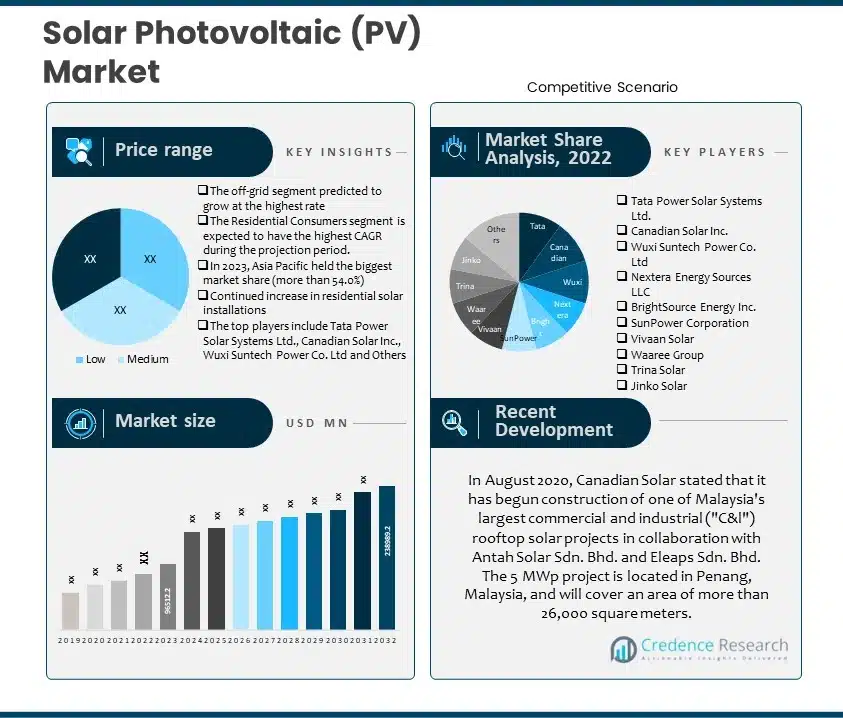
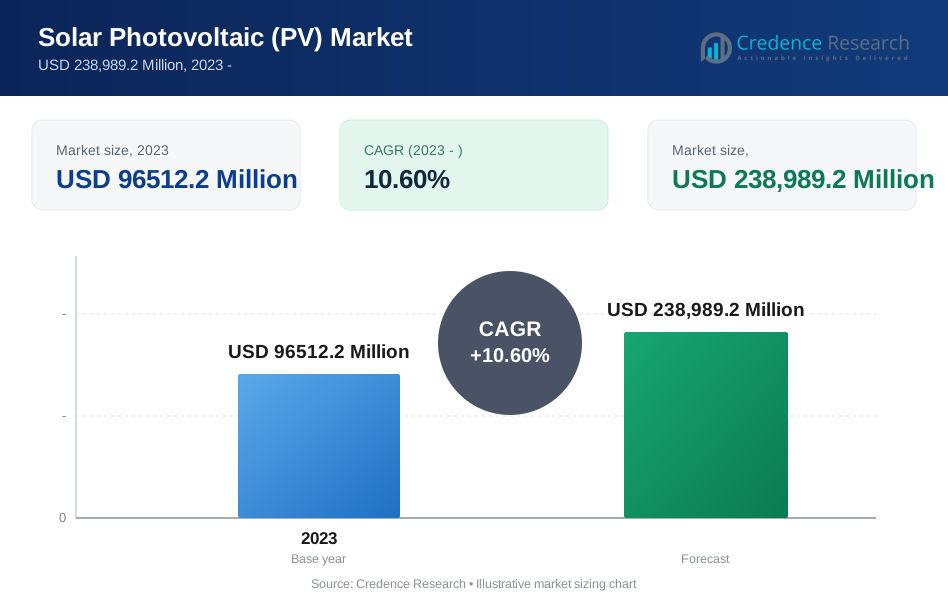
- The global demand for Solar Photovoltaic (PV) was valued at USD 96512.2 Million in 2023 and is expected to reach USD 238989.2 Million in 2032, growing at a CAGR of 10.60% between 2024 and 2032.
- In 2023, the on-grid sector will dominate the solar photovoltaic (PV) business, while the off-grid segment is predicted to develop the quickest in the next years.
- Thin-film solar PV panels' superior durability and compact design resulted in a dominating market share of more than 42.81% by 2023. The crystalline silicon category is predicted to grow at a considerable CAGR, whereas the monocrystalline silicon segment will dominate the solar photovoltaic (PV) industry.
- In 2023, the Commercial and Industrial section accounted for more than 40% of the solar PV panels sector. Utility-scale (Large-scale Power Plants) controlled the market, while the residential category is predicted to develop at the quickest rate in the following years.
- The utility sector dominated the market in 2023 and is predicted to grow at a considerable CAGR between 2023 and 2032, while the Residential Consumers segment is expected to have the highest CAGR during the projection period.
- In 2023, Asia Pacific held the biggest market share (more than 54.0%), with China leading in revenue. The North America market is predicted to rise at a 7.9% CAGR over the forecast period.
- The increasing number of off-grid locations will fuel market expansion.
- Land use limits may limit global market growth.
Executive Summary
Market Definition
The solar photovoltaic (PV) method is a simple, no-moving-parts way to turn sunlight into electricity. Light from the sun is utilized to generate electricity by extracting electrons from their silicon host atoms. Electrons absorb photons, or packets of light energy, which propel them from their high atomic orbit. The favorable government programs and incentives, such as tax cuts and tariffs, will boost corporate prospects while also supporting continuous technology breakthroughs and a growing consumer and regulatory preference for clean energy sources. The market for solar photovoltaic (PV) systems will expand as solar energy costs fall and financial assistance increases.
Market Overview
The global Solar Photovoltaic (PV) Market has witnessed steady growth in recent years and is expected to grow at a CAGR of 10.60% between 2024 and 2032. The market was valued at USD 96512.2 million in 2023 and is expected to reach USD 238989.2 million in 2032.
Solar photovoltaic (PV) is a simple process that converts sunlight into electricity with no moving parts. Sunlight removes electrons from their host silicon atoms in a photovoltaic cell. Photons are tiny packets of light energy that electrons collect and use to drive themselves away from their high-energy atoms.
The favorable government schemes and incentives, such as tax breaks and tariffs, will boost the commercial picture, as will continuous technological advancements and a growing consumer and regulatory preference for clean energy sources. Reduced solar energy prices, along with increased financial support, will allow the solar photovoltaic (PV) business to expand. Product acceptability will be facilitated by widespread resource availability and cost-effectiveness, as well as enhanced market potential. Various regulatory measures, including as asset and financial leveraging, subsidies, and other financial tools, will be employed to improve product acceptance. Furthermore, the execution of numerous solar photovoltaic (PV) installation targets, as well as a shift in focus to reduce carbon emissions, will drive solar photovoltaic (PV) market growth over the projection period.
Segmentation By Type of Solar PV System
- In 2023, the on-grid sector will dominate the solar photovoltaic (PV) industry. An on-grid solar photovoltaic (PV) system generates energy from solar power while being connected to the utility grid. Examples of these systems range from small household systems to enormous utility-scale solar power facilities.
- On the other hand, the off-grid segment, is expected to grow at the fastest rate in the coming years. The use of off-grid solar photovoltaic (PV) systems is expected to grow significantly in emerging and rural regions over the forecast period.
Segmentation By Technology
- Thin-film solar PV panels' enhanced durability and compact design resulted in a leading market share of more than 42.81% in 2023.
- The crystalline silicon category is expected to increase at a significant CAGR over the forecast period, owing to the lightweight and long lifecycle of these panels, as well as the low manufacturing costs of the silicon semiconductors utilized in them.
- In 2023, the monocrystalline silicon segment will dominate the solar photovoltaic (PV) market.
Segmentation by Application
- The Commercial and Industrial segment accounted for more than 40% of the solar PV panels sector in 2023 and is expected to increase at a substantial CAGR of 7.6% during the forecast period. The growth of solar PV panels in the residential market is ascribed to a variety of benefits, including fewer carbon footprints, lower electricity costs, and increased home values. Consumers who use solar systems are eligible for government-issued tax credits.
- In 2023, Utility-scale (Large-scale Power Plants) controlled the solar photovoltaic (PV) market. Several large-scale solar projects are now under construction around the world.
- On the other hand, The residential category is expected to grow at the fastest rate in the coming years.
Segmentation By End-User Segment
- The utility sector dominated the market in 2023 and is expected to grow at a significant CAGR between 2023 and 2032. Many utility-scale solar energy projects are being developed worldwide.
- The Residential Consumers segment is expected to have the fastest CAGR over the projection period.
Segmentation by Region
- In 2023, Asia Pacific held the largest market share (more than 54.0%), with China leading in revenue.
- The North America market is expected to grow at a CAGR of 7.9% over the forecast period.
- The rest of the world, including Latin America, the Middle East, and Africa, supplies the remaining demand for Solar Photovoltaic (PV).
In 2023, Asia Pacific had the biggest market share. The presence of big market participants and a supportive government policy that provides subsidies and financial incentives for photovoltaic projects are critical elements driving the industry's expansion in China.
The North America market is estimated to increase at a CAGR of approximately 7.9% during the forecast period. Residential consumer capacity expansion, together with the introduction of new utility projects, is likely to increase product penetration across the country during the forecast period. Aside from being the greatest hub of panel manufacture, China boasts various solar farms, including the world's largest floating farm, which can generate 40 MW of power. In addition, the country ranks high in global solar PV panel exports. Some nations, such as the United States and India, have imposed restrictions on the number of PV panels imported from China, hurting the country's solar business revenues.
Key Highlights of the Report
Type of Solar PV System, Technology, Application, End-User Segment, and region segment of the global Solar Photovoltaic (PV) Market. In 2023, the on-grid sector will dominate the solar photovoltaic (PV) business, with the Residential Consumers segment predicted to grow at the quickest rate over the forecast period. In addition, utility-scale (large-scale power plants) controlled the industry, while the off-grid segment is predicted to grow at the fastest rate and Asia Pacific, leading the market growth.
The Solar Photovoltaic (PV) Market is being spurred by lowering solar technology costs, government incentives, and growing environmental awareness. However, obstacles such as intermittent energy generation, policy uncertainty, and land use issues operate as barriers. Opportunities include technology breakthroughs that improve solar PV efficiency, the implementation of energy storage systems, and the exploration of new markets and applications for solar energy.
Moreover, In 2023, Asia Pacific held the largest market share. The presence of large market participants, as well as a supportive government policy that provides subsidies and financial incentives for photovoltaic projects, are significant drivers of the industry's growth in China. Furthermore, the North American market is expected to grow at a CAGR of around 7.9% during the forecast period.
What Are The Main Drivers Of The Global Solar Photovoltaic (PV) Market?
The market is primarily driven by falling solar technology costs, government subsidies and policies that promote renewable energy, and rising environmental consciousness, which drives demand for clean energy.
What Are The Major Challenges Faced By The Global Solar Photovoltaic (PV) Market?
Intermittent energy generation, policy uncertainty, and land use issues are among the most significant market restrictions.
What Are The Growth Opportunities In The Global Solar Photovoltaic (PV) Market?
The market's main opportunities are technological advances in solar PV efficiency, the integration of energy storage technologies, and expansion into new markets and applications.
Market Drivers
Several factors drive the global Solar Photovoltaic (PV) Market. The following are the key drivers of the global Solar Photovoltaic (PV) Market:
The rising number of off-grid areas will drive market growth
Off-grid areas have little or no access to grid-connected electricity. These locations rely on secondary photovoltaic sources, such as solar energy. Many places across the world have extensive off-grid sections without access to grid-connected electricity. According to the World Energy Outlook, more than 1 billion people worldwide continue to live without power.
In Sub-Saharan Africa, urban electrification is 60%, whereas rural electrification is 14%. This encourages governments in Sub-Saharan Africa to employ solar energy to meet their power needs in both rural and urban areas. According to Bloomberg New Energy Finance research, around 1.2 GW of solar energy-based projects are predicted to be operational in Sub-Saharan countries by the end of 2021. As a result, the growing number of off-grid locations around the world is likely to enhance this market over the forecast period.
Market Restraints
The global Solar Photovoltaic (PV) Market faces some challenges that may hinder its growth. These include the following:
Land use constraints may hinder global market growth.
Utility-scale solar plants necessitate significant terrestrial power generation. A variety of environmental or technical factors can influence the selection of such land. The usage of such land to deploy solar systems may have an impact on natural regions and biodiversity.
For instance, the deployment of solar photovoltaic plants is extremely challenging in marshes, agricultural land, water bodies, and forests due to land instability and inaccessibility. Large-scale solar energy power plants must evaluate a variety of considerations, including land, transportation networks, the impact on nearby residential areas, and the distance to the electricity grid. The issues as mentioned earlier impede the worldwide sola photovoltaic (PV) market expansion.
Opportunities
The global Solar Photovoltaic (PV) Market offers significant growth opportunities. These include the following:
Increasing investments in solar power resources
Several global environmental regulations are driving power firms to transition to greener and more ecologically friendly energy sources. To reduce their reliance on fossil fuel-based power generation, major countries throughout the world are making significant investments in renewable energy power generation. Solar energy is a main renewable energy source capable of addressing a wide range of global concerns. As a result, increased investments in solar energy resources are creating promising opportunities to expand the worldwide solar photovoltaic (PV) market over the forecast period.
Competitive Landscape
Key Players
The global Solar Photovoltaic (PV) market is highly competitive, with several key players. Some of the major players in the market and their market share are as follows:
- Tata Power Solar Systems Ltd.
- Canadian Solar Inc.
- Wuxi Suntech Power Co. Ltd
- Nextera Energy Sources LLC
- BrightSource Energy Inc.
- SunPower Corporation
- Vivaan Solar
- Waaree Group
- Trina Solar
- Jinko Solar
These organizations prioritize product innovation, Application expansion, and mergers and acquisitions to stay competitive.
The global Solar Photovoltaic (PV) Market's key players continually seek to stay ahead by offering new products and developments.
In May 2023, SJVN Ltd., a state-owned company, secured a 100 MW solar power project worth USD 73.24 million from Rajasthan Urja Vikas Nigam Ltd. SJVN Green Energy Ltd (SGEL), a wholly-owned subsidiary of SJVN, took part in an open competitive tariff bidding process followed by an e-Reverse Auction (e-RA) hosted by Rajasthan Urja Vikas Nigam Ltd (RUVNL).
In November 2022, European Energy, a Danish-based solar park developer, planned to build a 128.5 MW solar park near Helsingborg in southern Sweden. The facility is planned to generate 175 GWh of power annually. Production is set to commence in 2024, following the completion of the project by 2023.
In January 2022, Suntech's 2GW High-efficiency TOPCon Cell production began in Wuxi, China.
In July 2022, Intersect Power placed orders for First Solar's High-Performance Modules totaling 2.4 GW.
Summary of Key Findings
- Increasing investment in solar energy resources.
- The market is segmented by Type of Solar PV System, Technology, Application, End-User Segment, and region.
- Residential Consumers segment is expected to have the highest CAGR during the projection period.
- In 2023, the on-grid sector will dominate the solar photovoltaic (PV) market
- Asia Pacific is leading in market growth; the market is highly competitive, with key players including Tata Power Solar Systems Ltd., Canadian Solar Inc., Wuxi Suntech Power Co. Ltd and Others.
Future Outlook
- Continued increase in residential solar installations
- Increasing emphasis on solar energy storage solutions.
- Technological breakthroughs drive efficiency improvements.
- Increased use of solar electricity in commercial and industrial sectors.
- Government subsidies and programs that promote solar energy expansion.
How CXOs Can Benefit from the Credence Research Solar Photovoltaic (PV) Market Report
The Credence Research Solar Photovoltaic (PV) Market Report provides CXOs with a comprehensive overview of the market, including:
- Market size and growth forecast: The report provides detailed estimates of the global Solar Photovoltaic (PV) Market size, segmented By Type of Solar PV System, Technology, Application, End-User Segment and region. It also includes forecasts for the market through 2032 based on key trends and drivers.
- Market segmentation: The report segments the Solar Photovoltaic (PV) Market By by Type of Solar PV System, Technology, Application, End-User Segment, and region. This segmentation provides CXOs with a granular understanding of the market and the opportunities in each segment.
- Competitive Landscape: The report profiles the key players in the Solar Photovoltaic (PV) Market and provides insights into their strategies, product offerings, and financial performance. This information can help CXOs identify and assess their competition.
- Key trends and drivers: The report identifies and analyzes the key trends and drivers that are shaping the Solar Photovoltaic (PV) Market. This information can help CXOs to make informed decisions about their investments and strategies.
CXOs can use the insights from the Credence Research Solar Photovoltaic (PV) Market Report to:
- Identify growth opportunities: The report can help CXOs identify new growth opportunities in the Solar Photovoltaic (PV) Market. By analyzing the data and trends in the report, they can make informed decisions about where to invest and expand their business.
- Make informed investment decisions: The report can help CXOs make informed investment decisions about Solar Photovoltaic (PV). For example, it may provide useful insights into market trends, customer preferences, the competitive landscape, and growth prospects in the Solar Photovoltaic (PV) Market.
- Develop competitive strategies: The report can help CXOs develop competitive strategies for their Solar Photovoltaic (PV) businesses. For example, by analyzing market trends, client preferences, and the competitive environment mentioned in the report, CXOs can fine-tune their strategies, differentiate their offers, and effectively position their firms in the marketplace.
- Track market developments: The report can help CXOs monitor market developments and stay ahead of the curve. For example, it provides insights into the latest trends and innovations in the Solar Photovoltaic (PV) Market.
Overall, the Credence Research Solar Photovoltaic (PV) Market Report is a valuable resource for CXOs who want to gain a deeper understanding of the market and identify opportunities for growth.
Segmentation
- By Type of Solar PV System:
- Grid-connected PV Systems
- Off-grid (Stand-alone) PV Systems
- Hybrid PV Systems (Combining PV with other energy sources like wind or battery storage)
- By Technology:
- Crystalline Silicon PV Cells
- Monocrystalline Silicon PV Cells
- Polycrystalline Silicon PV Cells
- Thin-film PV Cells
- Amorphous Silicon (a-Si) PV Cells
- Cadmium Telluride (CdTe) PV Cells
- Copper Indium Gallium Selenide (CIGS) PV Cells
- Concentrated PV Cells
- By Application:
- Residential
- Commercial and Industrial
- Utility-scale (Large-scale Power Plants)
- Off-grid Applications (e.g., rural electrification, telecom towers)
- Floating PV Systems
- Building-integrated PV (BIPV)
- By End-User Segment:
- Residential Consumers
- Commercial Enterprises
- Utilities
- Government and Public Sector
- Industrial Sector
- Others
- By Region
- North America
- The U.S.
- Canada
- Mexico
- Europe
- Germany
- France
- The U.K.
- Italy
- Spain
- Rest of Europe
- Asia Pacific
- China
- Japan
- India
- South Korea
- South-east Asia
- Rest of Asia Pacific
- Latin America
- Brazil
- Argentina
- Rest of Latin America
- Middle East & Africa
- GCC Countries
- South Africa
- Rest of the Middle East and Africa
- North America
Request a Free Sample
Fill in your details and we'll send you a free sample report.
- Sample data tables & charts
- Research methodology
Need a Custom Version of This Report?
Tailor the scope, geography, or segments to your exact requirements.
- Custom geography or segment scope
- Direct access to our analyst team
Frequently Asked Questions
What is the current size of the global Solar Photovoltaic (PV) Market?
What is the expected growth rate of the Solar Photovoltaic (PV) Market between 2024 and 2032?
Which segment is leading the market share in terms of Application?
Which Technology segment governs the demand for Solar Photovoltaic (PV) in the world?
Who are the major players in the global Solar Photovoltaic (PV) Market?
Table of Content
Chapter 1. Report Introduction
- 1.1 Report Description & Purpose
- 1.1.1 Report Title & Market Definition
- 1.1.2 Unique Selling Propositions (USP) & Key Differentiators
- 1.1.3 Value Proposition for Stakeholders
- 1.2 Research Objectives
- 1.2.1 Market Sizing Objectives (Volume & Revenue)
- 1.2.2 Segmentation Objectives
- 1.2.3 Competitive Intelligence Objectives
- 1.2.4 Forecast & Scenario Objectives
- 1.3 Report Scope
- 1.3.1 Solar Photovoltaic (PV) Scope – Types & Subtypes Covered
- 1.3.2 Geographic Scope – Regions & Countries Covered
- 1.3.3 Historical Period, Base Year & Forecast Period (2023; forecast to the forecast period)
- 1.3.4 Inclusions & Exclusions
- 1.4 HS Code & Classification Framework
- 1.5 Currency, Units & Pricing Basis
- 1.6 Target Stakeholders
- 1.7 Limitations & Assumptions
Chapter 2. Executive Summary
- 2.1 Global Solar Photovoltaic (PV) Market Snapshot
- 2.1.1 Market Size – Historical (2023) & Forecast (the forecast period) (2023: USD 96512.2 Million → forecast year: USD 238,989.2 Million)
- 2.1.2 Volume & Revenue – Global Totals
- 2.1.3 Key Market Highlights – Top Five Facts
- 2.2 Solar Photovoltaic (PV) Market Segmentation Snapshot
- 2.2.1 Market Split by Region – 2023 vs.
- 2.3 Competitive Snapshot
- 2.3.1 Top 10 Players by Revenue Share – 2023
- 2.3.2 Top 10 Players by Volume Share – 2023
- 2.3.3 Recent Strategic Developments (18-Month Summary)
- 2.4 Key Investment Highlights & Strategic Conclusions
Chapter 3. Solar Photovoltaic (PV) Market Dynamics & Industry Analysis
- 3.1 Market Overview & Context
- 3.1.1 Solar Photovoltaic (PV) Market Position in the Broader Automotive Value Chain
- 3.1.2 OEM vs. Replacement Market Dynamics
- 3.1.3 Market Maturity & Development Stage by Region
- 3.2 Solar Photovoltaic (PV) Market Drivers
- 3.3 Solar Photovoltaic (PV) Market Restraints & Challenges
- 3.4 Solar Photovoltaic (PV) Market Opportunities
- 3.5 Porter's Five Forces Analysis
- 3.5.1 Threat of New Entrants
- 3.5.2 Bargaining Power of Suppliers
- 3.5.3 Bargaining Power of Buyers
- 3.5.4 Threat of Substitutes
- 3.5.5 Competitive Rivalry – Intensity Assessment
- 3.6 Solar Photovoltaic (PV) Value Chain Analysis
- 3.6.1 Upstream – Raw Material/Input Suppliers
- 3.6.1.1 Raw Material/Input 1
- 3.6.1.2 Raw Material/Input 2
- 3.6.1.3 Raw Material/Input 3
- 3.6.2 Midstream – Production/Manufacturing/Service Delivery
- 3.6.2.1 Production/Process Overview
- 3.6.2.2 Key Facility Locations & Capacity by Manufacturer
- 3.6.3 Downstream – Distribution & End Consumer
- 3.6.3.1 Primary Channel – B2B/OEM
- 3.6.3.2 Secondary Channels – Dealer, Retail, Online, Direct
- 3.6.4 Value Chain Profitability Analysis
- 3.6.1 Upstream – Raw Material/Input Suppliers
- 3.7 PESTEL Analysis
- 3.7.1 Political Factors
- 3.7.2 Economic Factors
- 3.7.3 Social Factors
- 3.7.4 Technological Factors
- 3.7.5 Environmental Factors
- 3.7.6 Legal Factors
- 3.8 Solar Photovoltaic (PV) Supply Chain Analysis
- 3.8.1 Raw Material/Input Supply Risk Assessment
- 3.8.2 Manufacturing Concentration Risk (Geographic Exposure)
- 3.8.3 Trade Disruption Impact Analysis
- 3.9 Regulatory & Policy Landscape
Note: The regulatory and policy landscape section covers regulations based on their applicability to the market, Solar Photovoltaic (PV) category, geography, and scope of the study. Only regulatory frameworks with a material impact on operations, compliance, trade, sustainability, or market access are analyzed in detail.
Chapter 4. Key Investment Pockets & Opportunity Analysis
- 4.1 Solar Photovoltaic (PV) Market Attractiveness Analysis
- 4.1.1 By Region – Investment Attractiveness Matrix (Volume × CAGR)
- 4.2 Absolute Revenue Growth Opportunity
- 4.2.1 By Region – Absolute USD Growth Through the forecast period
- 4.3 Incremental Volume Opportunity
- 4.3.1 By Region – Incremental Volume Through the forecast period
- 4.3.2 Segment – Incremental Volume
- 4.4 Emerging Submarket Opportunity Deep Dive (Subject to Applicability)
- 4.5 Emerging Market Opportunity Scorecards
- 4.5.1 United States
- 4.5.2 Europe
- 4.5.3 Asia
- 4.5.4 Middle East & Africa
Note: Emerging Market Opportunity Scorecards will be included based on relevance and strategic importance. Regions listed are indicative and may vary depending on data availability and market dynamics.
Chapter 5. Solar Photovoltaic (PV) Import-Export Analysis & Trade Flows
- 5.1 Global Trade Overview
- 5.1.1 Global Export Value by Country (2023)
- 5.1.2 Global Export Volume by Country (2023)
- 5.1.3 Global Import Value by Country (2023)
- 5.1.4 Global Import Volume by Country (2023)
- 5.1.5 Net Trade Balance by Country (2023)
- 5.2 Export Analysis – Segment
- 5.2.1 Type 1 (HS Code)
- 5.2.2 Type 2 (HS Code)
- 5.2.3 Type 3 (HS Code)
- 5.2.4 Type 4 (HS Code)
- 5.2.5 Type 5 (HS Code)
- 5.3 Import Analysis – Segment
- 5.3.1 Type 1 (HS Code)
- 5.3.2 Type 2 (HS Code)
- 5.3.3 Type 3 (HS Code)
- 5.3.4 Type 4 (HS Code)
- 5.3.5 Type 5 (HS Code)
- 5.4 Average Unit Trade Prices
- 5.4.1 Average Export Price – Segment & Country
- 5.4.2 Average Import Price – Segment & Source Country
- 5.4.3 Price Trends (2023)
- 5.5 Key Trade Route Analysis
- 5.5.1 Trade Route 1
- 5.5.2 Trade Route 2
- 5.5.3 Trade Route 3
- 5.5.4 Trade Route 4
- 5.5.5 Trade Route 5
- 5.6 Trade Policy Impact Assessment
- 5.6.1 US Anti-Dumping & Section 301 Tariffs
- 5.6.2 EU Customs Union Impact
- 5.6.3 Major Free Trade Agreements
- 5.6.4 USMCA Rules of Origin
Note: Trade policy analysis will be included only where relevant to the Solar Photovoltaic (PV) market.
Chapter 6. Competitive Landscape & Company Benchmarking
- 6.1 Solar Photovoltaic (PV) Market Concentration & Structure
- 6.1.1 Herfindahl-Hirschman Index (HHI) – vs. 2023
- 6.1.2 Tier 1, Tier 2 & Tier 3 Market Structure
- 6.1.3 Global, Regional & Local Player Dynamics
- 6.2 Solar Photovoltaic (PV) Market Share Analysis – 2023
- 6.2.1 Global Revenue Share by Company
- 6.2.2 Global Volume Share by Company
- 6.2.3 Regional Revenue Share
- 6.2.4 Market Share Evolution ( vs. 2023)
- 6.2.5 OEM Segment Share by Company
- 6.2.6 Replacement Segment Share by Company
- 6.3 Production/Delivery Capacity & Facility Analysis
- 6.3.1 Global Installed Capacity
- 6.3.2 Capacity Utilization Rates
- 6.3.3 Production/Output Volume
- 6.3.4 Facility Locations & Capacity Map
- 6.3.5 Planned Capacity Additions
- 6.4 Solar Photovoltaic (PV) Competitive Benchmarking Matrix
- 6.4.1 Revenue, Volume, CAGR & Profitability Comparison
- 6.4.2 Channel Revenue Mix
- 6.4.3 Geographic Revenue Exposure
- 6.4.4 R&D Intensity
- 6.4.5 Sustainability Maturity
- 6.5 Strategic Developments in Solar Photovoltaic (PV) (Last 24 Months)
- 6.5.1 Mergers, Acquisitions & Divestments
- 6.5.2 New Solar Photovoltaic (PV) Launches
- 6.5.3 Facility Expansions
- 6.5.4 Strategic Alliances, Joint Ventures & Partnerships
- 6.5.5 Distribution Expansion & Market Entry
- 6.5.6 Sustainability & ESG Initiatives
- 6.6 Competitive Strategy Mapping
- 6.6.1 Leader, Challenger, Follower & Niche Classification
- 6.6.2 Pricing Strategy Comparison
- 6.6.3 Channel Strategy Matrix
Note: Strategic developments are included based on their materiality and the availability of reliable information.
Chapter 7. Global Solar Photovoltaic (PV) Market – By Distribution Channel
- 7.1 Segment Overview
- 7.1.1 Volume & Revenue Split by Channel (2023 & )
- 7.1.2 Channel Mix Evolution (the forecast period)
Chapter 8. Regional Market Analysis – Global Overview
- 8.1 Global Regional Overview
- 8.1.1 Regional Volume Share
- 8.1.2 Regional Revenue Share
- 8.1.3 Regional Volume by Region
- 8.1.4 Regional Revenue by Region
- 8.1.5 Regional Forecast Through the forecast period
- 8.2 Cross-Regional Segment Analysis
- 8.2.1 By Distribution Channel
- 8.2.2 By Brand/Price Tier
Chapter 9. North America Solar Photovoltaic (PV) Market
- 9.1 United States
- 9.2 Canada
- 9.3 Mexico
Chapter 10. Europe Solar Photovoltaic (PV) Market
- 10.1 Germany
- 10.2 France
- 10.3 Italy
- 10.4 United Kingdom
- 10.5 Spain
- 10.6 Poland
- 10.7 Russia
- 10.8 Netherlands
- 10.9 Belgium
- 10.10 Sweden
- 10.11 Denmark
- 10.12 Norway
- 10.13 Rest of Europe
Chapter 11. Asia Pacific Solar Photovoltaic (PV) Market
- 11.1 China
- 11.2 India
- 11.3 Japan
- 11.4 South Korea
- 11.5 Thailand
- 11.6 Indonesia
- 11.7 Vietnam
- 11.8 Malaysia
- 11.9 Australia
- 11.10 Rest of Asia Pacific
Chapter 12. Latin America Solar Photovoltaic (PV) Market
- 12.1 Brazil
- 12.2 Argentina
- 12.3 Colombia
- 12.4 Chile
- 12.5 Rest of Latin America
Chapter 13. Middle East Solar Photovoltaic (PV) Market
- 13.1 Saudi Arabia
- 13.2 United Arab Emirates
- 13.3 Turkey
- 13.4 Israel
- 13.5 Iran
- 13.6 Rest of the Middle East
Chapter 14. Africa Solar Photovoltaic (PV) Market
- 14.1 South Africa
- 14.2 Egypt
- 14.3 Nigeria
- 14.4 Morocco
- 14.5 Rest of Africa
Chapter 15. Solar Photovoltaic (PV) Company Profiles
- 15.1 [Company 01]
- 15.1.1 Company Overview
- 15.1.2 Key Management Personnel
- 15.1.3 Products & Services Portfolio
- 15.1.4 Financial Performance
- 15.1.5 Key Market Focus & Geographic Presence
- 15.1.6 Recent Developments & Strategic Initiatives
Note: The company profile list is preliminary and may change based on research findings, market developments, data availability, and client requirements.
Chapter 16. Appendices
- Appendix A – List of Abbreviations & Acronyms
- Appendix B – Industry Classification Code Reference – Full Series
- Appendix C – Production & Capacity Data Tables
- Appendix D – End-Use & Demand Base Tables
- Appendix E – Consumption & Replacement Rate Assumptions
- Appendix F – ASP Reference Tables
- Appendix G – Manufacturing & Facility Database
- Appendix H – Import-Export Data Tables
- Appendix I – Regulatory Summary Tables
- Appendix J – Primary Research Participant List (Anonymized)
- Appendix K – Primary Research Questionnaire Framework
- Appendix L – Data Sources & Bibliography
- Appendix M – Market Size Divergence & Source Comparison
Chapter 17. Research Methodology
- 17.1 Research Framework & Philosophy
- 17.2 Secondary Research – Sources, Hierarchy & Data Extraction
- 17.3 Data Modeling – Bottom-Up & Top-Down Market Sizing
- 17.4 Primary Research – Stakeholder Framework, LOI & Sample Sizes
- 17.5 Forecast Methodology – Regression, Scenario & Sensitivity Analysis
- 17.6 Quality Control – Four-Layer Validation Framework
- 17.7 Limitations & Standard Assumptions
- 17.8 Disclaimer
