
Cancer Immunotherapy Drug Discovery Outsourcing Market Overview:
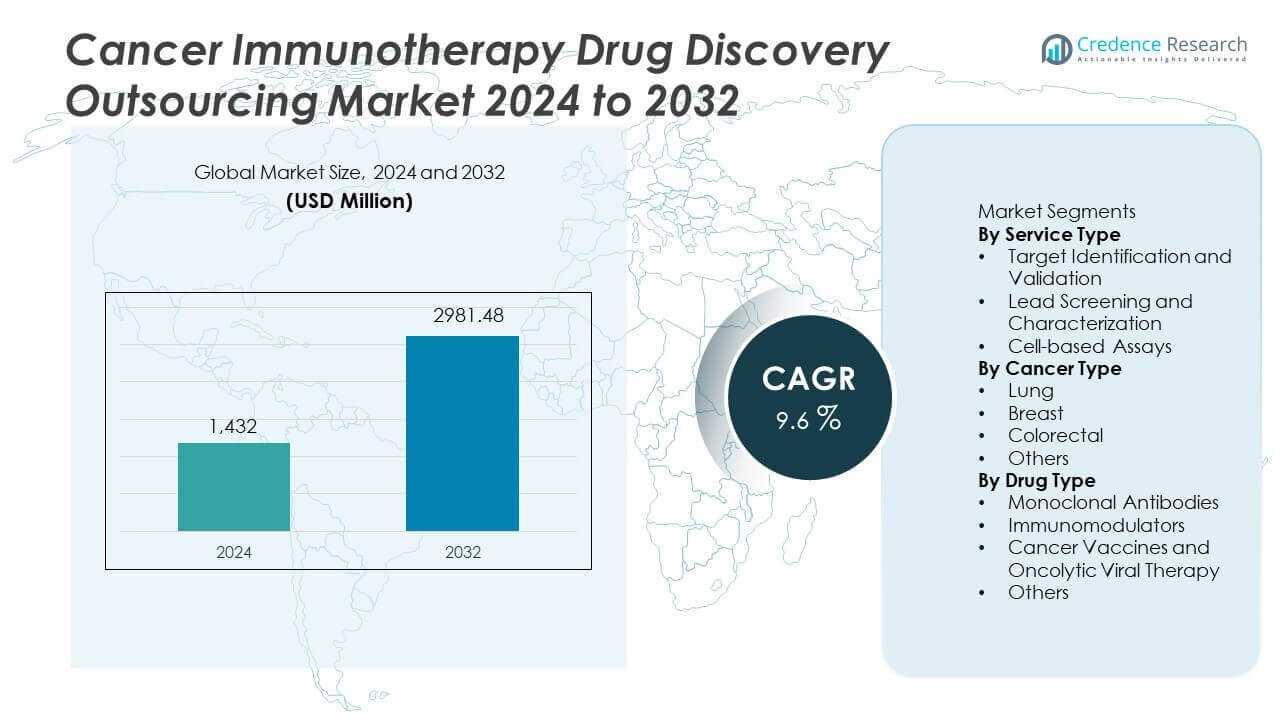
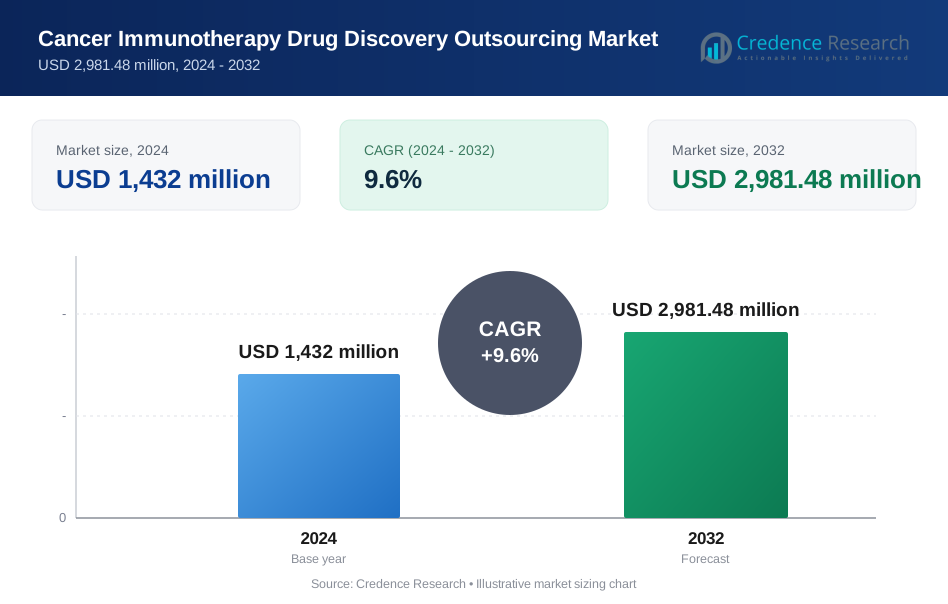
The cancer immunotherapy drug discovery outsourcing market was valued at USD 1,432 million in 2024 and is expected to reach USD 2,981.48 million by 2032. The market is projected to grow at a CAGR of 9.6% during the forecast period.
| REPORT ATTRIBUTE | DETAILS |
|---|---|
| Historical Period | 2020-2023 |
| Base Year | 2024 |
| Forecast Period | 2025-2032 |
| Cancer Immunotherapy Drug Discovery Outsourcing Market Size 2024 | USD 1,432 million |
| Cancer Immunotherapy Drug Discovery Outsourcing Market , CAGR | 9.6% |
| Cancer Immunotherapy Drug Discovery Outsourcing Market Size 2032 | USD 2,981.48 million |
The cancer immunotherapy drug discovery outsourcing market features strong participation from leading players such as Charles River Laboratories, IQVIA, Labcorp Drug Development, WuXi AppTec, Evotec, Crown Bioscience, Syngene International, Lonza Group, ICON plc, and Parexel International. These companies compete through integrated discovery platforms, advanced immune assay capabilities, and global delivery networks. Strategic collaborations with pharmaceutical and biotechnology firms support pipeline expansion and service depth. North America leads the market with a 42% share, driven by high oncology R&D spending and a mature CRO ecosystem. Europe follows with a 27% share, supported by strong academic research and biotech activity. Asia Pacific holds a 21% share, benefiting from cost-efficient services and expanding immuno-oncology pipelines.
Cancer Immunotherapy Drug Discovery Outsourcing Market Insights
- The market reached USD 1,432 million in 2024 and is projected to grow at a CAGR of 9.6% through the forecast period, driven by expanding immuno-oncology pipelines and outsourcing adoption.
- Rising scientific complexity in immunotherapy discovery drives outsourcing demand, as sponsors seek expertise in immune targets, biomarkers, and cell-based assays to reduce early-stage research risk.
- Key trends include increased use of advanced cell-based assays and monoclonal antibody discovery, with monoclonal antibodies leading the drug type segment at a 46% share due to strong clinical success.
- The competitive landscape remains consolidated, with global CROs focusing on integrated discovery platforms, immune assay innovation, and strategic partnerships to strengthen service depth and scalability.
- North America leads with a 42% share, followed by Europe at 27% and Asia Pacific at 21%, while data security concerns and high discovery attrition act as key market restraints.
Cancer Immunotherapy Drug Discovery Outsourcing Market Segmentation Analysis:
By Service Type
Target identification and validation dominates the cancer immunotherapy drug discovery outsourcing market with a 38% share. This segment leads due to growing demand for early-stage research efficiency. Biopharmaceutical companies outsource target discovery to reduce timelines and improve success rates. Advanced genomics, proteomics, and bioinformatics tools support accurate immune target mapping. Service providers offer specialized expertise and scalable discovery platforms. Rising investment in novel immunotherapy mechanisms strengthens demand. Sponsors increasingly prioritize validated targets before advancing pipelines. This strategic focus sustains strong outsourcing activity. Target identification and validation remains the most critical service in discovery workflows.
- For instance, Charles River Laboratories operates high-throughput CRISPR screening platforms capable of performing genome-wide analysis per project.
By Cancer Type
Lung cancer holds the largest share at 34% within the market. High disease prevalence and mortality rates drive strong immunotherapy research focus. Developers prioritize lung cancer due to successful checkpoint inhibitor outcomes. Outsourcing enables faster screening of immune targets and tumor models. CROs provide specialized lung cancer assays and microenvironment analysis. Growing unmet treatment needs support sustained research spending. Combination immunotherapy trials increase discovery complexity. These factors push sponsors toward outsourcing. Lung cancer continues to lead due to high pipeline activity and strong clinical demand.
- For instance, Crown Bioscience maintains over 400 lung cancer patient-derived xenograft models for immuno-oncology research.
By Drug Type
Monoclonal antibodies account for a dominant 46% share of the market. Widespread adoption of antibody-based immunotherapies supports this leadership. Checkpoint inhibitors and bispecific antibodies drive discovery investments. Outsourcing partners assist with antibody screening and optimization. High development costs encourage external collaboration. Established regulatory pathways favor antibody programs. Strong efficacy across multiple cancer types boosts pipeline growth. CROs expand antibody discovery capabilities to meet demand. Continuous innovation sustains strong outsourcing needs. Monoclonal antibodies remain the leading drug type segment.
Key Growth Drivers
Rising Scientific Complexity of Immunotherapy Discovery
Cancer immunotherapy discovery involves complex immune signaling, tumor biology, and biomarker validation. Sponsors increasingly outsource discovery activities to access specialized immunology expertise. External partners provide advanced platforms for immune profiling and target validation. Growing focus on combination immunotherapies further increases discovery complexity. Many biopharma companies lack in-house capabilities for these workflows. Outsourcing reduces scientific risk and accelerates decision-making. Access to experienced researchers improves target quality. This complexity-driven demand strongly supports outsourcing growth. As immunotherapy science evolves, reliance on specialized service providers continues to increase.
- For instance, WuXi AppTec supports immuno-oncology discovery using single-cell sequencing workflows generating data from over 1,000,000 cells per study.
Pressure to Reduce Drug Discovery Time and Costs
Early-stage drug discovery requires significant investment and long timelines. Outsourcing helps sponsors manage costs without expanding internal infrastructure. Service providers offer scalable models and established laboratory capabilities. Sponsors benefit from faster turnaround and reduced operational overhead. Outsourcing also limits long-term hiring and facility expenses. Small and mid-sized biotechs gain flexibility through external partnerships. Faster discovery supports quicker pipeline prioritization. Investors favor efficient R&D models. Cost and time optimization remains a key growth driver. This efficiency-focused approach strengthens sustained outsourcing adoption.
- For instance, Labcorp Drug Development conducts target validation and early discovery studies across more than 85 global laboratory locations.
Expansion of Global Immuno-Oncology Pipelines
Oncology pipelines continue to expand across pharmaceutical and biotechnology companies. Immunotherapy remains a core focus due to durable clinical responses. Sponsors advance multiple immune targets simultaneously across cancer types. This expansion increases demand for parallel discovery programs. Outsourcing partners support multi-project execution and resource scaling. Growing clinical trial activity reinforces early discovery investments. Public and private funding for oncology research remains strong. Pipeline diversification increases discovery complexity. Outsourcing provides the capacity to manage this growth. Pipeline expansion directly fuels market growth.
Key Trends & Opportunities
Growing Use of Advanced Cell-Based and Immune Assays
Cell-based assays play a critical role in immunotherapy discovery. These models better mimic tumor–immune system interactions. Outsourcing providers invest in immune cell assays and functional screening platforms. Sponsors rely on these tools to improve lead selection accuracy. Demand grows for assays measuring immune activation and cytotoxicity. Advanced models support better translational relevance. Service providers differentiate through assay innovation. This trend creates strong service expansion opportunities. Continuous assay development enhances outsourcing value. The shift toward biologically relevant models supports long-term market growth.
- For instance, Evotec operates immune cell screening systems capable of running more than 500,000 cell-based assay data points per week.
Rising Focus on Precision and Personalized Immunotherapy
Precision immunotherapy gains strong traction across oncology research. Drug developers target patient-specific biomarkers and immune signatures. Outsourcing partners support genomics, proteomics, and bioinformatics integration. Customized discovery workflows address tumor heterogeneity. This approach increases demand for flexible and specialized services. CROs offering integrated data and laboratory capabilities gain advantage. Personalized strategies require rapid adaptation and expertise. Outsourcing enables scalable precision research. This trend opens long-term growth opportunities. Personalized immunotherapy strengthens the strategic role of outsourcing partners.
- For instance, IQVIA manages extensive oncology discovery datasets combining tumor genomic profiles with immune biomarker annotations through its collaborations and access to a vast network of patient records.
Key Challenges
High Attrition Rates in Immunotherapy Drug Discovery
Immunotherapy discovery faces high scientific and translational failure rates. Many promising targets fail during clinical development. Preclinical models often lack full predictive accuracy. Sponsors face uncertainty despite advanced discovery tools. Outsourcing partners share scientific risk but cannot eliminate failure. Repeated attrition can reduce R&D spending momentum. Sponsors may delay new discovery investments. Managing expectations remains challenging. High failure risk impacts outsourcing confidence. Attrition remains a key constraint on market growth.
Data Security and Intellectual Property Risks
Drug discovery outsourcing involves sensitive proprietary data. Sponsors remain cautious about intellectual property protection. Cross-border outsourcing increases regulatory complexity. Ensuring data confidentiality across partners is challenging. Any breach can impact long-term collaboration trust. Smaller providers may lack advanced security frameworks. Sponsors conduct strict due diligence before engagement. Compliance requirements increase operational burden. Data governance concerns can delay contracts. Strong security systems are essential for sustained market growth.
Regional Analysis
North America
North America holds a 42% share of the cancer immunotherapy drug discovery outsourcing market, supported by strong biopharmaceutical activity and advanced research infrastructure. The United States drives demand through high oncology R&D spending and a large concentration of CROs. Companies outsource complex discovery tasks such as immune profiling and target validation. Strong venture funding and government grants sustain early-stage research. Mature regulatory frameworks and established outsourcing models enable efficient collaboration. High adoption of novel immunotherapy platforms further strengthens regional leadership. Continued pipeline expansion maintains North America’s dominant market position.
Europe
Europe accounts for a 27% share of the market, driven by robust academic research and expanding biotech clusters. Germany, the United Kingdom, and France lead regional outsourcing activity. Pharmaceutical sponsors emphasize collaborative discovery models and cross-border partnerships. Strong public funding supports immuno-oncology research programs. European CROs offer advanced cell-based assays and translational services. Growing focus on precision medicine increases outsourcing demand. Regulatory alignment across major markets supports smoother operations. Europe sustains steady growth through innovation-led discovery outsourcing.
Asia Pacific
Asia Pacific represents a 21% share, supported by rapid expansion of biotechnology and pharmaceutical sectors. China, Japan, South Korea, and India drive regional growth. Companies outsource discovery to access skilled talent and cost-efficient research services. Government investments strengthen oncology research infrastructure. CROs expand capabilities in biologics and immune assay development. Rising clinical trial activity increases early discovery demand. Strategic partnerships with global sponsors support growth. Asia Pacific continues to emerge as a major outsourcing hub.
Latin America
Latin America holds a 6% share, reflecting gradual development of research ecosystems. Brazil and Mexico lead regional outsourcing efforts. Improving infrastructure supports selective immunotherapy discovery projects. Participation in global oncology trials increases exposure to early-stage research. CROs focus on niche discovery and translational services. Regulatory improvements enhance sponsor confidence. Investment levels remain moderate compared to developed regions. Steady capacity building supports controlled growth in outsourcing adoption.
Middle East & Africa
The Middle East and Africa account for a 4% share, indicating an early-stage market presence. Limited local infrastructure restricts large-scale discovery outsourcing. Israel and South Africa show growing immunotherapy research capabilities. Governments increase investment in healthcare and life sciences. International sponsors engage regional partners for targeted projects. CRO presence remains selective but expanding. Long-term capacity development supports future growth. Strategic investments gradually strengthen regional market participation.
Cancer Immunotherapy Drug Discovery Outsourcing Market Segmentations:
By Service Type
- Target Identification and Validation
- Lead Screening and Characterization
- Cell-based Assays
By Cancer Type
- Lung
- Breast
- Colorectal
- Others
By Drug Type
- Monoclonal Antibodies
- Immunomodulators
- Cancer Vaccines and Oncolytic Viral Therapy
- Others
By Geography
- North America
- U.S.
- Canada
- Mexico
- Europe
- Germany
- France
- U.K.
- Italy
- Spain
- Rest of Europe
- Asia Pacific
- China
- Japan
- India
- South Korea
- South-east Asia
- Rest of Asia Pacific
- Latin America
- Brazil
- Argentina
- Rest of Latin America
- Middle East & Africa
- GCC Countries
- South Africa
- Rest of the Middle East and Africa
Competitive Landscape
Competitive landscape analysis highlights a highly competitive market led by key players such as Charles River Laboratories, IQVIA, Labcorp Drug Development, WuXi AppTec, Evotec, Crown Bioscience, Syngene International, Lonza Group, ICON plc, and Parexel International. These companies compete through scientific depth, integrated service portfolios, and global delivery models. Providers invest heavily in advanced immune assay platforms, cell-based models, and biomarker discovery capabilities. Strategic collaborations with pharmaceutical and biotechnology firms remain a core growth strategy. Many players expand capacity through acquisitions and facility investments. Geographic expansion strengthens access to emerging biotech hubs. Service differentiation focuses on speed, data quality, and translational relevance. Strong compliance frameworks enhance sponsor trust. Continuous technology upgrades and skilled talent retention shape long-term competitiveness in the market.
Key Player Analysis
- Charles River Laboratories
- IQVIA
- Labcorp Drug Development
- WuXi AppTec
- Evotec
- Crown Bioscience
- Syngene International
- Lonza Group
- ICON plc
- Parexel International
Recent Developments
- In September 2025, Charles River Laboratories announced two oncology collaborations. One alliance involved the Parker Institute for Cancer Immunotherapy.
- In May 2025, IQVIA partnered with SCRI Development Innovations to speed oncology trials. The collaboration targets faster data delivery and fewer operational hurdles.
- In May 2025, Labcorp Drug Development expanded its precision oncology portfolio. Updates included new tests and added biopharma solutions for clinical trials.
Report Coverage
The research report offers an in-depth analysis based on Service Type, Cancer Type, Drug Type and Geography. It details leading market players, providing an overview of their business, product offerings, investments, revenue streams, and key applications. Additionally, the report includes insights into the competitive environment, SWOT analysis, current market trends, as well as the primary drivers and constraints. Furthermore, it discusses various factors that have driven market expansion in recent years. The report also explores market dynamics, regulatory scenarios, and technological advancements that are shaping the industry. It assesses the impact of external factors and global economic changes on market growth. Lastly, it provides strategic recommendations for new entrants and established companies to navigate the complexities of the market.
Future Outlook
- Outsourcing demand will rise as immunotherapy pipelines continue to expand globally.
- Service providers will invest more in advanced immune and cell-based assay platforms.
- Precision immunotherapy programs will increase reliance on specialized discovery partners.
- Integration of bioinformatics and wet-lab services will strengthen service differentiation.
- Partnerships between CROs and biopharma companies will deepen across early discovery stages.
- Asia Pacific will gain importance due to expanding research capacity and skilled talent.
- Automation and AI tools will improve discovery speed and data quality.
- Focus on combination immunotherapies will increase discovery complexity and outsourcing needs.
- Data security and compliance frameworks will receive stronger investment from providers.
- Continuous innovation in biologics discovery will sustain long-term market growth.
Request a Free Sample
Fill in your details and we'll send you a free sample report.
- Sample data tables & charts
- Research methodology
Need a Custom Version of This Report?
Tailor the scope, geography, or segments to your exact requirements.
- Custom geography or segment scope
- Direct access to our analyst team
Frequently Asked Questions
What is the current market size for the Cancer Immunotherapy Drug Discovery Outsourcing market, and what is its projected size in 2032?
At what Compound Annual Growth Rate is the Cancer Immunotherapy Drug Discovery Outsourcing market projected to grow between 2024 and 2032?
Which Cancer Immunotherapy Drug Discovery Outsourcing market segment held the largest share in 2024?
What are the primary factors fueling the growth of the Cancer Immunotherapy Drug Discovery Outsourcing market?
Who are the leading companies in the Cancer Immunotherapy Drug Discovery Outsourcing market?
Which region commanded the largest share of the Cancer Immunotherapy Drug Discovery Outsourcing market in 2024?
Table of Content
Chapter 1. Report Introduction
- 1.1 Report Description & Purpose
- 1.1.1 Report Title & Market Definition
- 1.1.2 Unique Selling Propositions (USP) & Key Differentiators
- 1.1.3 Value Proposition for Stakeholders
- 1.2 Research Objectives
- 1.2.1 Market Sizing Objectives (Volume & Revenue)
- 1.2.2 Segmentation Objectives
- 1.2.3 Competitive Intelligence Objectives
- 1.2.4 Forecast & Scenario Objectives
- 1.3 Report Scope
- 1.3.1 Cancer Immunotherapy Drug Discovery Outsourcing Scope – Types & Subtypes Covered
- 1.3.2 Geographic Scope – Regions & Countries Covered
- 1.3.3 Historical Period, Base Year & Forecast Period (2024; forecast to 2032)
- 1.3.4 Inclusions & Exclusions
- 1.4 HS Code & Classification Framework
- 1.5 Currency, Units & Pricing Basis
- 1.6 Target Stakeholders
- 1.7 Limitations & Assumptions
Chapter 2. Executive Summary
- 2.1 Global Cancer Immunotherapy Drug Discovery Outsourcing Market Snapshot
- 2.1.1 Market Size – Historical (2024) & Forecast (2024-2032) (2024: USD 1,432 million → 2032: USD 2,981.48 million)
- 2.1.2 Volume & Revenue – Global Totals
- 2.1.3 Key Market Highlights – Top Five Facts
- 2.2 Cancer Immunotherapy Drug Discovery Outsourcing Market Segmentation Snapshot
- 2.2.1 Market Split by Region – 2024 vs. 2032
- 2.3 Competitive Snapshot
- 2.3.1 Top 10 Players by Revenue Share – 2024
- 2.3.2 Top 10 Players by Volume Share – 2024
- 2.3.3 Recent Strategic Developments (18-Month Summary)
- 2.4 Key Investment Highlights & Strategic Conclusions
Chapter 3. Cancer Immunotherapy Drug Discovery Outsourcing Market Dynamics & Industry Analysis
- 3.1 Market Overview & Context
- 3.1.1 Cancer Immunotherapy Drug Discovery Outsourcing Market Position in the Broader Automotive Value Chain
- 3.1.2 OEM vs. Replacement Market Dynamics
- 3.1.3 Market Maturity & Development Stage by Region
- 3.2 Cancer Immunotherapy Drug Discovery Outsourcing Market Drivers
- 3.3 Cancer Immunotherapy Drug Discovery Outsourcing Market Restraints & Challenges
- 3.4 Cancer Immunotherapy Drug Discovery Outsourcing Market Opportunities
- 3.5 Porter's Five Forces Analysis
- 3.5.1 Threat of New Entrants
- 3.5.2 Bargaining Power of Suppliers
- 3.5.3 Bargaining Power of Buyers
- 3.5.4 Threat of Substitutes
- 3.5.5 Competitive Rivalry – Intensity Assessment
- 3.6 Cancer Immunotherapy Drug Discovery Outsourcing Value Chain Analysis
- 3.6.1 Upstream – Raw Material/Input Suppliers
- 3.6.1.1 Raw Material/Input 1
- 3.6.1.2 Raw Material/Input 2
- 3.6.1.3 Raw Material/Input 3
- 3.6.2 Midstream – Production/Manufacturing/Service Delivery
- 3.6.2.1 Production/Process Overview
- 3.6.2.2 Key Facility Locations & Capacity by Manufacturer
- 3.6.3 Downstream – Distribution & End Consumer
- 3.6.3.1 Primary Channel – B2B/OEM
- 3.6.3.2 Secondary Channels – Dealer, Retail, Online, Direct
- 3.6.4 Value Chain Profitability Analysis
- 3.6.1 Upstream – Raw Material/Input Suppliers
- 3.7 PESTEL Analysis
- 3.7.1 Political Factors
- 3.7.2 Economic Factors
- 3.7.3 Social Factors
- 3.7.4 Technological Factors
- 3.7.5 Environmental Factors
- 3.7.6 Legal Factors
- 3.8 Cancer Immunotherapy Drug Discovery Outsourcing Supply Chain Analysis
- 3.8.1 Raw Material/Input Supply Risk Assessment
- 3.8.2 Manufacturing Concentration Risk (Geographic Exposure)
- 3.8.3 Trade Disruption Impact Analysis
- 3.9 Regulatory & Policy Landscape
Note: The regulatory and policy landscape section covers regulations based on their applicability to the market, Cancer Immunotherapy Drug Discovery Outsourcing category, geography, and scope of the study. Only regulatory frameworks with a material impact on operations, compliance, trade, sustainability, or market access are analyzed in detail.
Chapter 4. Key Investment Pockets & Opportunity Analysis
- 4.1 Cancer Immunotherapy Drug Discovery Outsourcing Market Attractiveness Analysis
- 4.1.1 By Region – Investment Attractiveness Matrix (Volume × CAGR)
- 4.2 Absolute Revenue Growth Opportunity
- 4.2.1 By Region – Absolute USD Growth Through 2032
- 4.3 Incremental Volume Opportunity
- 4.3.1 By Region – Incremental Volume Through 2032
- 4.3.2 Segment – Incremental Volume
- 4.4 Emerging Submarket Opportunity Deep Dive (Subject to Applicability)
- 4.5 Emerging Market Opportunity Scorecards
- 4.5.1 United States
- 4.5.2 Europe
- 4.5.3 Asia
- 4.5.4 Middle East & Africa
Note: Emerging Market Opportunity Scorecards will be included based on relevance and strategic importance. Regions listed are indicative and may vary depending on data availability and market dynamics.
Chapter 5. Cancer Immunotherapy Drug Discovery Outsourcing Import-Export Analysis & Trade Flows
- 5.1 Global Trade Overview
- 5.1.1 Global Export Value by Country (2024)
- 5.1.2 Global Export Volume by Country (2024)
- 5.1.3 Global Import Value by Country (2024)
- 5.1.4 Global Import Volume by Country (2024)
- 5.1.5 Net Trade Balance by Country (2024)
- 5.2 Export Analysis – Segment
- 5.2.1 Type 1 (HS Code)
- 5.2.2 Type 2 (HS Code)
- 5.2.3 Type 3 (HS Code)
- 5.2.4 Type 4 (HS Code)
- 5.2.5 Type 5 (HS Code)
- 5.3 Import Analysis – Segment
- 5.3.1 Type 1 (HS Code)
- 5.3.2 Type 2 (HS Code)
- 5.3.3 Type 3 (HS Code)
- 5.3.4 Type 4 (HS Code)
- 5.3.5 Type 5 (HS Code)
- 5.4 Average Unit Trade Prices
- 5.4.1 Average Export Price – Segment & Country
- 5.4.2 Average Import Price – Segment & Source Country
- 5.4.3 Price Trends (2024)
- 5.5 Key Trade Route Analysis
- 5.5.1 Trade Route 1
- 5.5.2 Trade Route 2
- 5.5.3 Trade Route 3
- 5.5.4 Trade Route 4
- 5.5.5 Trade Route 5
- 5.6 Trade Policy Impact Assessment
- 5.6.1 US Anti-Dumping & Section 301 Tariffs
- 5.6.2 EU Customs Union Impact
- 5.6.3 Major Free Trade Agreements
- 5.6.4 USMCA Rules of Origin
Note: Trade policy analysis will be included only where relevant to the Cancer Immunotherapy Drug Discovery Outsourcing market.
Chapter 6. Competitive Landscape & Company Benchmarking
- 6.1 Cancer Immunotherapy Drug Discovery Outsourcing Market Concentration & Structure
- 6.1.1 Herfindahl-Hirschman Index (HHI) – vs. 2024
- 6.1.2 Tier 1, Tier 2 & Tier 3 Market Structure
- 6.1.3 Global, Regional & Local Player Dynamics
- 6.2 Cancer Immunotherapy Drug Discovery Outsourcing Market Share Analysis – 2024
- 6.2.1 Global Revenue Share by Company
- 6.2.2 Global Volume Share by Company
- 6.2.3 Regional Revenue Share
- 6.2.4 Market Share Evolution ( vs. 2024)
- 6.2.5 OEM Segment Share by Company
- 6.2.6 Replacement Segment Share by Company
- 6.3 Production/Delivery Capacity & Facility Analysis
- 6.3.1 Global Installed Capacity
- 6.3.2 Capacity Utilization Rates
- 6.3.3 Production/Output Volume
- 6.3.4 Facility Locations & Capacity Map
- 6.3.5 Planned Capacity Additions
- 6.4 Cancer Immunotherapy Drug Discovery Outsourcing Competitive Benchmarking Matrix
- 6.4.1 Revenue, Volume, CAGR & Profitability Comparison
- 6.4.2 Channel Revenue Mix
- 6.4.3 Geographic Revenue Exposure
- 6.4.4 R&D Intensity
- 6.4.5 Sustainability Maturity
- 6.5 Strategic Developments in Cancer Immunotherapy Drug Discovery Outsourcing (Last 24 Months)
- 6.5.1 Mergers, Acquisitions & Divestments
- 6.5.2 New Cancer Immunotherapy Drug Discovery Outsourcing Launches
- 6.5.3 Facility Expansions
- 6.5.4 Strategic Alliances, Joint Ventures & Partnerships
- 6.5.5 Distribution Expansion & Market Entry
- 6.5.6 Sustainability & ESG Initiatives
- 6.6 Competitive Strategy Mapping
- 6.6.1 Leader, Challenger, Follower & Niche Classification
- 6.6.2 Pricing Strategy Comparison
- 6.6.3 Channel Strategy Matrix
Note: Strategic developments are included based on their materiality and the availability of reliable information.
Chapter 7. Global Cancer Immunotherapy Drug Discovery Outsourcing Market – By Distribution Channel
- 7.1 Segment Overview
- 7.1.1 Volume & Revenue Split by Channel (2024 & 2032)
- 7.1.2 Channel Mix Evolution (2024-2032)
Chapter 8. Regional Market Analysis – Global Overview
- 8.1 Global Regional Overview
- 8.1.1 Regional Volume Share
- 8.1.2 Regional Revenue Share
- 8.1.3 Regional Volume by Region
- 8.1.4 Regional Revenue by Region
- 8.1.5 Regional Forecast Through 2032
- 8.2 Cross-Regional Segment Analysis
- 8.2.1 By Distribution Channel
- 8.2.2 By Brand/Price Tier
Chapter 9. North America Cancer Immunotherapy Drug Discovery Outsourcing Market
- 9.1 United States
- 9.2 Canada
- 9.3 Mexico
Chapter 10. Europe Cancer Immunotherapy Drug Discovery Outsourcing Market
- 10.1 Germany
- 10.2 France
- 10.3 Italy
- 10.4 United Kingdom
- 10.5 Spain
- 10.6 Poland
- 10.7 Russia
- 10.8 Netherlands
- 10.9 Belgium
- 10.10 Sweden
- 10.11 Denmark
- 10.12 Norway
- 10.13 Rest of Europe
Chapter 11. Asia Pacific Cancer Immunotherapy Drug Discovery Outsourcing Market
- 11.1 China
- 11.2 India
- 11.3 Japan
- 11.4 South Korea
- 11.5 Thailand
- 11.6 Indonesia
- 11.7 Vietnam
- 11.8 Malaysia
- 11.9 Australia
- 11.10 Rest of Asia Pacific
Chapter 12. Latin America Cancer Immunotherapy Drug Discovery Outsourcing Market
- 12.1 Brazil
- 12.2 Argentina
- 12.3 Colombia
- 12.4 Chile
- 12.5 Rest of Latin America
Chapter 13. Middle East Cancer Immunotherapy Drug Discovery Outsourcing Market
- 13.1 Saudi Arabia
- 13.2 United Arab Emirates
- 13.3 Turkey
- 13.4 Israel
- 13.5 Iran
- 13.6 Rest of the Middle East
Chapter 14. Africa Cancer Immunotherapy Drug Discovery Outsourcing Market
- 14.1 South Africa
- 14.2 Egypt
- 14.3 Nigeria
- 14.4 Morocco
- 14.5 Rest of Africa
Chapter 15. Cancer Immunotherapy Drug Discovery Outsourcing Company Profiles
- 15.1 [Company 01]
- 15.1.1 Company Overview
- 15.1.2 Key Management Personnel
- 15.1.3 Products & Services Portfolio
- 15.1.4 Financial Performance
- 15.1.5 Key Market Focus & Geographic Presence
- 15.1.6 Recent Developments & Strategic Initiatives
Note: The company profile list is preliminary and may change based on research findings, market developments, data availability, and client requirements.
Chapter 16. Appendices
- Appendix A – List of Abbreviations & Acronyms
- Appendix B – Industry Classification Code Reference – Full Series
- Appendix C – Production & Capacity Data Tables
- Appendix D – End-Use & Demand Base Tables
- Appendix E – Consumption & Replacement Rate Assumptions
- Appendix F – ASP Reference Tables
- Appendix G – Manufacturing & Facility Database
- Appendix H – Import-Export Data Tables
- Appendix I – Regulatory Summary Tables
- Appendix J – Primary Research Participant List (Anonymized)
- Appendix K – Primary Research Questionnaire Framework
- Appendix L – Data Sources & Bibliography
- Appendix M – Market Size Divergence & Source Comparison
Chapter 17. Research Methodology
- 17.1 Research Framework & Philosophy
- 17.2 Secondary Research – Sources, Hierarchy & Data Extraction
- 17.3 Data Modeling – Bottom-Up & Top-Down Market Sizing
- 17.4 Primary Research – Stakeholder Framework, LOI & Sample Sizes
- 17.5 Forecast Methodology – Regression, Scenario & Sensitivity Analysis
- 17.6 Quality Control – Four-Layer Validation Framework
- 17.7 Limitations & Standard Assumptions
- 17.8 Disclaimer
