Market Overview:
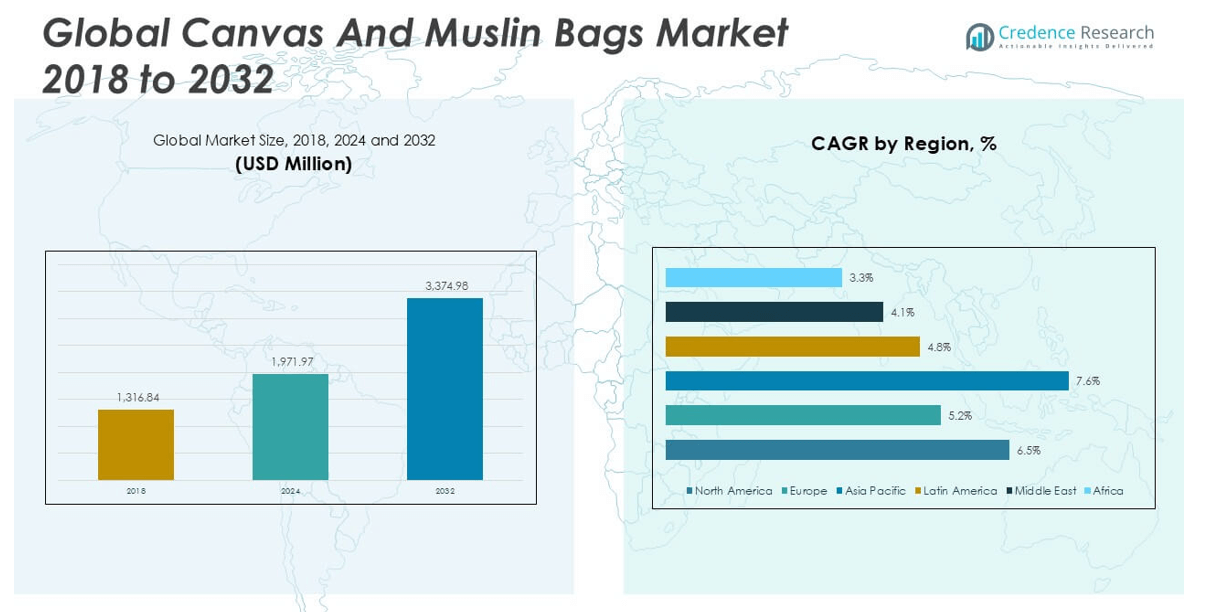
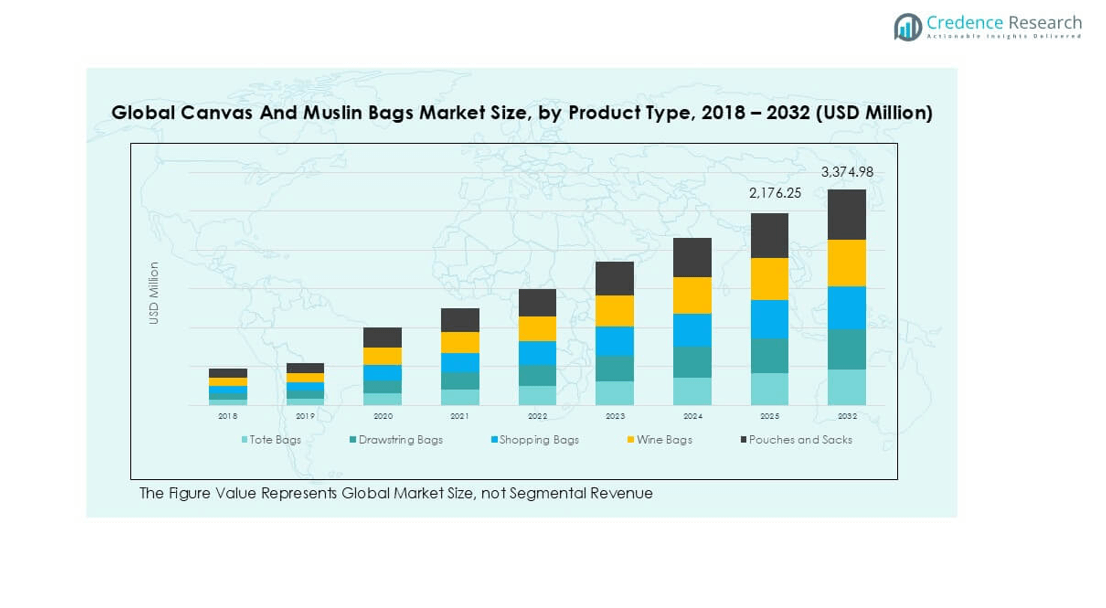
The Canvas and Muslin Bags market size was valued at USD 1,316.84 million in 2018 and grew to USD 1,971.97 million in 2024. It is anticipated to reach USD 3,374.98 million by 2032, expanding at a CAGR of 6.47% during the forecast period.
| REPORT ATTRIBUTE | DETAILS |
|---|---|
| Historical Period | 2020-2023 |
| Base Year | 2024 |
| Forecast Period | 2025-2032 |
| Canvas and Muslin Bags Market Size 2024 | USD 1,971.97 million |
| Canvas and Muslin Bags Market, CAGR | 6.47% |
| Canvas and Muslin Bags Market Size 2032 | USD 3,374.98 million |
The Canvas and Muslin Bags market is led by prominent players such as StateLine Bag, Chapman Bags, Clever Baggers, Berry Global, and Repurpose, all of which focus on sustainability, product innovation, and expanding their global footprint. These companies offer diverse product portfolios, including tote bags, drawstring bags, and custom-printed options, catering to growing consumer demand for eco-friendly packaging. North America emerges as the leading region in this market, accounting for 43.2% of the global share in 2024, driven by strong environmental regulations, high consumer awareness, and widespread retail adoption. Asia Pacific follows closely, supported by rapid urbanization, cost-effective manufacturing, and expanding retail infrastructure.
Market Insights
- The Canvas and Muslin Bags market was valued at USD 1,971.97 million in 2024 and is projected to reach USD 3,374.98 million by 2032, growing at a CAGR of 6.47% during the forecast period.
- The market is driven by increasing environmental awareness and government bans on single-use plastics, leading to greater adoption across retail, food & beverage, and personal care sectors.
- Customization, organic materials, and brand-led eco-friendly campaigns are notable trends, with tote bags and organic cotton segments holding the largest market shares in 2024.
- Key players such as StateLine Bag, Berry Global, and Clever Baggers focus on expanding product portfolios and sustainability strategies, but high production costs and raw material availability remain key restraints.
- North America led the global market with a 43.2% share in 2024, followed by Asia Pacific at 30.4%; the tote bag segment was the top product type, driven by its multipurpose use and consumer preference.
Market Segmentation Analysis:
By Product Type
In the Canvas and Muslin Bags market, Tote Bags emerged as the dominant product type, accounting for the largest market share in 2024. Their popularity stems from their versatility, durability, and aesthetic appeal, making them highly favored for shopping, promotional events, and daily use. The growing demand for reusable and eco-friendly alternatives to plastic bags has significantly fueled the adoption of tote bags across various consumer segments. Moreover, rising environmental awareness and supportive government policies banning single-use plastics further bolster the demand for tote bags within both urban and rural markets.
- For instance, Clever Baggers, a UK-based manufacturer, reported producing over 3.2 million tote bags in 2023 alone, with 75% of these orders being from retail clients replacing plastic bags with sustainable options.
By Material
Among materials, Organic Cotton holds the largest revenue share in the Canvas and Muslin Bags market. Its dominance is driven by increasing consumer preference for sustainable and biodegradable materials. Organic cotton is cultivated without harmful chemicals, aligning with global sustainability goals and attracting environmentally conscious consumers and businesses. Additionally, many brands are incorporating organic cotton bags into their product offerings to enhance eco-credibility and appeal to green consumers. The demand for ethically sourced materials has also contributed to the growth of this segment, especially in developed markets such as Europe and North America.
- For instance, StateLine Bag sources over 1,000 metric tons of certified organic cotton annually, and in 2023, they fulfilled over 1.1 million orders specifically for bags madefrom GOTS-certified organic cotton.
By Application
The Retail and Shopping segment leads in terms of market share within the application category. This dominance is largely attributed to the growing use of canvas and muslin bags by retail brands and supermarkets as part of eco-friendly packaging initiatives. As consumers increasingly demand sustainable shopping experiences, retailers are replacing plastic and paper bags with reusable cotton alternatives. Branding opportunities on these bags also enhance customer engagement and brand visibility. Furthermore, the rise in e-commerce and demand for sustainable packaging solutions has significantly expanded the scope of this segment in the global market.
Market Overview
Rising Environmental Awareness and Government Regulations
Growing global concerns about plastic pollution have significantly increased demand for eco-friendly alternatives such as canvas and muslin bags. Governments worldwide are enforcing bans on single-use plastics and promoting sustainable packaging solutions, which has led to a shift among consumers and retailers toward reusable bags. These regulatory pressures, coupled with heightened public awareness about environmental impact, have made canvas and muslin bags a preferred choice across multiple industries, especially in retail and food & beverage packaging.
- For instance, Berry Global Group Inc. integrated over 23,000 metric tons of recycled material into its packaging products in a single year, driven by its long-term sustainability strategy aligned with global anti-plastic mandates.
Expanding Retail and E-commerce Sector
The global retail and e-commerce sectors are expanding rapidly, driving demand for durable and reusable packaging solutions. Retailers increasingly prefer canvas and muslin bags not only for their functional benefits but also for their marketing value, as these bags offer branding and customization opportunities. E-commerce players are also adopting eco-friendly packaging to align with consumer preferences and sustainability goals. This trend is particularly strong in regions with high online shopping penetration and consumer focus on sustainable choices.
- For instance, Clever Baggers Ltd. fulfilled over 2.7 million customized cotton and canvas bag orders for e-commerce retailers in the UK and EU over the past year alone, incorporating screen printing and digital direct-to-garment technologies for branding.
Consumer Shift Toward Sustainable Fashion and Lifestyle
Consumers are becoming more conscious of their purchasing behavior, with a notable preference for sustainable and ethically produced products. This shift has boosted demand for reusable bags made from organic or recycled materials, such as muslin and canvas. The market is seeing strong adoption from fashion-conscious urban consumers who value products that combine utility with eco-responsibility. Additionally, brands are incorporating these bags into their product lines as complementary items, further driving market growth.
Key Trends & Opportunities
Customization and Branding Opportunities
Canvas and muslin bags offer excellent customization options, making them attractive for promotional and branding purposes. Businesses across various sectors, including cosmetics, food & beverage, and fashion, are leveraging printed and embroidered bags to enhance brand visibility and customer loyalty. As companies seek to create differentiated and eco-conscious brand identities, the demand for customized canvas and muslin bags continues to rise, presenting manufacturers with significant value-added service opportunities.
- For instance, Berry Global customized over 1.5 million branded canvas bags for clients such as Walmart and Target in 2023, with branding orders accounting for approximately 38% of their total fabric bag segment revenue.
Innovation in Sustainable Materials and Designs
Manufacturers are increasingly investing in R&D to develop bags using blends of organic cotton, recycled fibers, and biodegradable coatings to improve durability and aesthetic appeal. New designs featuring zippers, compartments, and reinforced stitching are enhancing functionality, attracting a broader consumer base. These innovations cater to both utility and sustainability demands, helping brands tap into premium consumer segments and expand into new applications such as travel, gifting, and storage.
Key Challenges
High Production Costs and Price Sensitivity Producing canvas and muslin bags-especially from organic or recycled materials entails higher raw material and manufacturing costs compared to plastic or synthetic alternatives. These elevated costs pose challenges in price-sensitive markets, particularly in developing economies where cost often outweighs sustainability concerns. Balancing product quality, eco-compliance, and competitive pricing remains a significant hurdle for manufacturers targeting mass-market adoption.
- For instance, Repurpose, a California-based sustainable goods company, reported that their organic canvas bag production cost per unit was USD 1.48 in 2023, compared to USD 0.14 for their equivalent plastic bag, impacting profitability in emerging markets
Supply Chain Limitations and Raw Material Availability
The availability of high-quality cotton, especially organic or recycled variants, is subject to fluctuations due to climatic conditions, limited farming regions, and certification requirements. Disruptions in raw material supply chains can lead to production delays and inconsistent product quality. Additionally, logistics and warehousing constraints, particularly in emerging markets, further compound the challenge of maintaining stable supply and meeting growing demand.
Competition from Low-cost Substitutes
Despite environmental concerns, the market still faces stiff competition from cheaper plastic, jute, and synthetic fiber alternatives, which may be more accessible or familiar to certain consumer segments. Some businesses and consumers continue to prioritize affordability over sustainability, slowing the overall transition toward reusable fabric bags. This competitive pressure necessitates greater innovation and cost optimization from canvas and muslin bag manufacturers to maintain market relevance.
Regional Analysis
North America
North America accounted for the largest share of the Canvas and Muslin Bags market, holding approximately 43.2% of the global market in 2024, with a valuation of USD 851.29 million, up from USD 574.45 million in 2018. The market is projected to reach USD 1,461.01 million by 2032, registering a CAGR of 6.5% during the forecast period. The region’s dominance stems from high consumer awareness regarding environmental sustainability, strong regulatory frameworks banning single-use plastics, and the presence of established retail and fashion brands that increasingly promote reusable packaging. Rapid expansion in e-commerce further fuels market demand across the U.S. and Canada.
- For instance, Allstate Packaging Inc. increased its reusable bag production by 38% year-on-year in 2023, manufacturing over 4.5 million canvas and muslin bags for U.S.-based retailers, including CVS and Whole Foods.
Europe
Europe captured around 17.7% of the global market share in 2024, with the market size growing from USD 246.55 million in 2018 to USD 349.04 million in 2024. It is expected to reach USD 543.38 million by 2032, expanding at a CAGR of 5.2%. The region benefits from stringent environmental regulations and strong consumer preferences for biodegradable and ethically produced alternatives. Countries like Germany, France, and the UK are actively promoting eco-friendly packaging practices across retail and cosmetics sectors. Public initiatives supporting organic and fair-trade products are also enhancing the demand for canvas and muslin bags in the European market.
- For instance, Paul Hewitt, a German brand, introduced a sustainable packaging initiative in 2023 using canvas pouches and bags, resulting in a reduction of 28,000 kg of plastic waste in their distribution process over the year.
Asia Pacific
Asia Pacific is the fastest-growing region in the Canvas and Muslin Bags market, with a projected CAGR of 7.6%. The market grew from USD 379.55 million in 2018 to USD 600.20 million in 2024, and is forecasted to reach USD 1,120.51 million by 2032, capturing 30.4% of the global share in 2024. Rapid urbanization, growing environmental awareness, and expanding retail infrastructure-especially in China, India, and Southeast Asia-are major growth drivers. Additionally, government initiatives promoting sustainable practices and the rise of eco-conscious consumers are accelerating the adoption of reusable bags. Low production costs and textile expertise also support regional manufacturing capabilities.
Latin America
Latin America held a 4.6% share of the global market in 2024, with the market size increasing from USD 60.88 million in 2018 to USD 90.01 million in 2024, and projected to reach USD 135.95 million by 2032, at a CAGR of 4.8%. Growth in this region is supported by a rising middle-class population, increasing retail activity, and growing awareness of eco-friendly practices, especially in countries like Brazil, Mexico, and Chile. While the market remains relatively smaller compared to developed regions, international trade and brand-led sustainability initiatives are gradually influencing consumer behavior toward reusable and biodegradable bag options.
Middle East
The Middle East Canvas and Muslin Bags market reached USD 48.74 million in 2024, up from USD 35.72 million in 2018, and is projected to hit USD 69.92 million by 2032, recording a CAGR of 4.1%. The region held a 2.5% share of the global market in 2024. Although traditionally reliant on plastic packaging, the region is witnessing a slow shift toward sustainability, driven by government policies and an increasing number of eco-conscious consumers. The UAE and Saudi Arabia are leading initiatives to reduce plastic waste, prompting gradual growth in reusable bag demand across retail, hospitality, and foodservice industries.
Africa
Africa represented the smallest share of the global Canvas and Muslin Bags market in 2024, accounting for 1.7%, with the market size increasing from USD 19.70 million in 2018 to USD 32.69 million in 2024, and expected to reach USD 44.21 million by 2032, expanding at a CAGR of 3.3%. Growth remains modest due to lower disposable incomes and limited infrastructure for sustainable packaging. However, rising urbanization, small-scale retail development, and international environmental partnerships are gradually boosting awareness of reusable and biodegradable packaging alternatives. South Africa and Kenya are among the more progressive markets adopting plastic bans and eco-friendly consumer practices.
Market Segmentations:
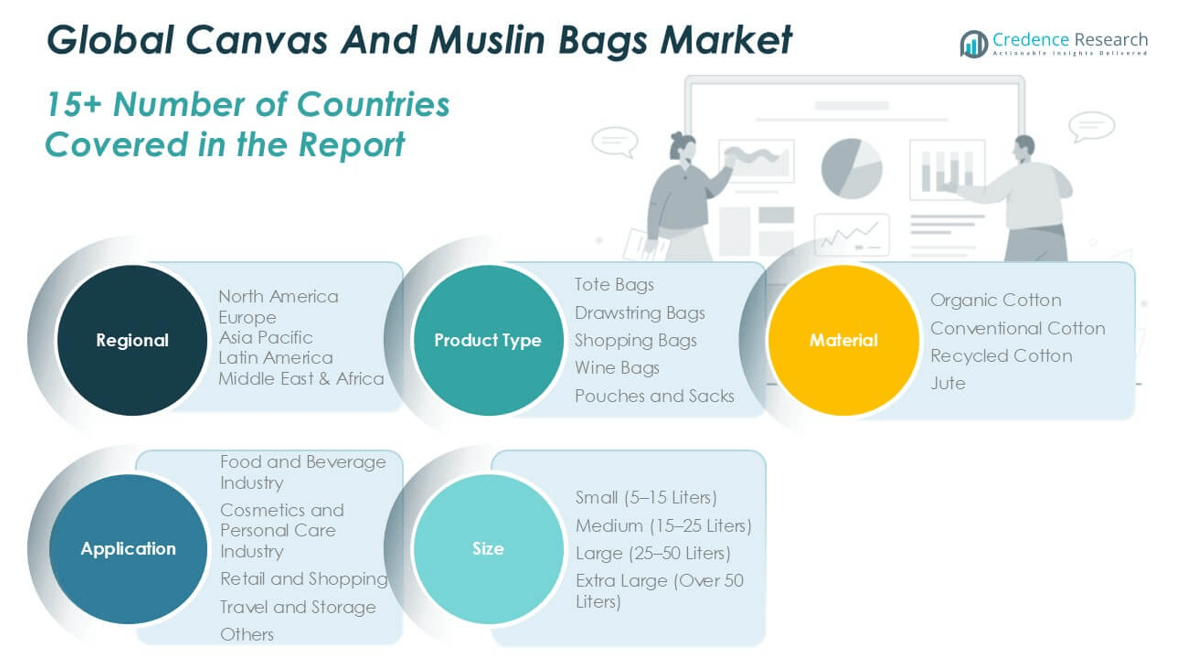
By Product Type
- Tote Bags
- Drawstring Bags
- Shopping Bags
- Wine Bags
- Pouches and Sacks
By Material
- Organic Cotton
- Conventional Cotton
- Recycled Cotton
- Jute
By Application
- Food and Beverage Industry
- Cosmetics and Personal Care Industry
- Retail and Shopping
- Travel and Storage
- Others
By Size
- Small (5–15 Liters)
- Medium (15–25 Liters)
- Large (25–50 Liters)
- Extra Large (Over 50 Liters)
By Geography
- North America
- U.S.
- Canada
- Mexico
- Europe
- Germany
- France
- U.K.
- Italy
- Spain
- Rest of Europe
- Asia Pacific
- China
- Japan
- India
- South Korea
- South-east Asia
- Rest of Asia Pacific
- Latin America
- Brazil
- Argentina
- Rest of Latin America
- Middle East & Africa
- GCC Countries
- South Africa
- Rest of the Middle East and Africa
Competitive Landscape
The competitive landscape of the Canvas and Muslin Bags market is characterized by a mix of established players and emerging brands striving to capitalize on the growing demand for eco-friendly packaging solutions. Key players such as StateLine Bag, Chapman Bags, Clever Baggers, and Berry Global focus on expanding their product portfolios through design innovation, material sustainability, and customization capabilities. These companies leverage strong distribution networks, online retail platforms, and collaborations with retail and fashion brands to enhance market reach. Meanwhile, newer entrants and niche players are differentiating themselves through the use of organic, recycled, and fair-trade certified materials. Strategic activities such as mergers, acquisitions, and partnerships are also evident, as companies aim to strengthen their supply chains and market presence globally. In addition, rising investments in branding, digital marketing, and sustainable manufacturing practices reflect the industry's broader commitment to environmental goals and consumer preference for reusable and biodegradable alternatives over traditional plastic packaging.
- For instance, Berry Global reported a 22% increase in revenue from reusable fabric packaging in FY2023, totaling USD 327 million, while Chapman Bags expanded its export volume to over 40 countries, shipping 1.2 million units globally.
Key Player Analysis
- StateLine Bag
- Chapman Bags
- Clever Baggers
- Ritter
- Landis+Gyr
- SFI Marketing
- Aptiv
- Berry Global
- Repurpose
- DISYS
- Allstate
- Paul Hewitt
Recent Developments
- In May 2025, rePurpose Global partnered with Thrive Market to fund the removal of nature-bound plastic waste. This partnership is part of rePurpose Global's broader mission to address plastic pollution, although it's not specifically tied to canvas or muslin bags. The collaboration aims to recover and repurpose plastic waste that would otherwise end up in the environment.
- In November 2024, Berry Global partnered with T2 Maschinenbau to create PE bags with 50% recycled plastic content, aiming to reduce plastic usage in flexible packaging (though these are not canvas, they reflect the company's direction toward sustainability in bag manufacturing).
- In August 2023, Berry Global launched a new line of recyclable, lightweight, conical bags for food packaging, signaling their expansion into sustainable, fabric-style packaging options beyond traditional plastic films. This move signifies a step towards circular economy principles by offering materials that are more easily recycled and designed for end-of-life recovery.
- In January 2023, Digital Intelligence Systems (DISYS) finalized the acquisition of LinTech Global, Inc., a federal prime contract holder specializing in IT and engineering solutions for government agencies. This acquisition was part of DISYS's strategy to expand its federal portfolio and enhance its IT and engineering capabilities within the public sector. LinTech Global will operate as an independent division within DISYS.
Market Concentration & Characteristics
The Canvas and Muslin Bags Market exhibits moderate market concentration with a mix of established global players and regional manufacturers competing across diverse price points. It remains highly fragmented due to the presence of numerous small and mid-sized producers, particularly in Asia Pacific, where low production costs enable broad participation. Companies compete primarily on sustainability, product customization, and material quality. Innovation in organic and recycled materials supports premium product positioning, while government regulations banning single-use plastics create consistent demand. The market favors companies with strong retail and e-commerce networks. Branding, eco-certifications, and supply chain efficiency play key roles in maintaining competitive advantage.
Report Coverage
The research report offers an in-depth analysis based on Product Type, Material, Application, Size and Geography. It details leading market players, providing an overview of their business, product offerings, investments, revenue streams, and key applications. Additionally, the report includes insights into the competitive environment, SWOT analysis, current market trends, as well as the primary drivers and constraints. Furthermore, it discusses various factors that have driven market expansion in recent years. The report also explores market dynamics, regulatory scenarios, and technological advancements that are shaping the industry. It assesses the impact of external factors and global economic changes on market growth. Lastly, it provides strategic recommendations for new entrants and established companies to navigate the complexities of the market.
Future Outlook
- The demand for canvas and muslin bags will continue to grow due to rising environmental concerns and stricter regulations on single-use plastics.
- Retail and e-commerce sectors are expected to drive significant adoption of reusable bags as part of sustainable packaging initiatives.
- Organic and recycled cotton materials will gain popularity as consumers increasingly prefer eco-friendly and ethically sourced products.
- Product customization and branding opportunities will enhance market growth across promotional and corporate gifting segments.
- Manufacturers will invest more in design innovation and multi-functional features to cater to diverse consumer preferences.
- Asia Pacific will maintain strong growth momentum supported by low production costs and expanding consumer markets.
- Digital sales channels and online customization platforms will play a key role in reaching broader audiences.
- Government and NGO-led sustainability campaigns will further influence consumer behavior toward reusable alternatives.
- Companies with efficient global supply chains and eco-certifications will hold a competitive edge.
- Small and medium enterprises will emerge as strong niche players by focusing on handcrafted and locally sourced materials.

Request a Free Sample
Fill in your details and we'll send you a free sample report.
- Sample data tables & charts
- Research methodology
Market Dynamics
Environmental Regulations and Plastic Bans
Government bans on single-use plastics and strict environmental regulations are compelling retailers and consumers to shift toward reusable alternatives like canvas and muslin bags, directly boosting market demand.
Retail and E-commerce Expansion
The rapid growth of retail and e-commerce sectors is increasing the need for durable, reusable, and customizable packaging solutions, with canvas and muslin bags being adopted for both in-store and online shopping experiences.
Consumer Preference for Sustainable and Ethical Products
Rising consumer awareness about sustainability and ethical sourcing is driving demand for bags made from organic and recycled materials, encouraging brands to expand their eco-friendly product lines.
Customization and Branding Opportunities
Businesses are leveraging the customizable nature of canvas and muslin bags for promotional and branding purposes, which enhances customer engagement and creates additional value for both manufacturers and clients.
Innovation in Materials and Design
Ongoing R&D investments in organic, recycled, and blended materials, as well as new functional designs, are attracting a broader consumer base and enabling premium product positioning in the market.
Need a Custom Version of This Report?
Tailor the scope, geography, or segments to your exact requirements.
- Custom geography or segment scope
- Direct access to our analyst team
Frequently Asked Questions
What is the current size of the Canvas and Muslin Bags Market?
What are the key segments within the Canvas And Muslin Bags Market?
Which segment is leading the Canvas and Muslin Bags Market share?
What are the market drivers in the Canvas and Muslin Bags Market?
Table of Content
Chapter 1 Market Segmentation
- 1.1 Segmentation Framework
- 1.1.1 Product and Service Classification
- 1.1.2 Application and End-Use Classification
- 1.1.3 Technology and Solution Classification
- 1.1.4 Customer and Distribution Channel Classification
- 1.1.5 Geographic Segmentation
- 1.1.6 Market Segment Definitions and Boundaries
- 1.2 By Size
- 1.2.1 Small (5–15 Liters)
- 1.2.2 Medium (15–25 Liters)
- 1.2.3 Large (25–50 Liters)
- 1.2.4 Extra Large (Over 50 Liters)
- 1.3 By Material
- 1.3.1 Organic Cotton
- 1.3.2 Conventional Cotton
- 1.3.3 Recycled Cotton
- 1.3.4 Jute
- 1.4 By Application
- 1.4.1 Food and Beverage Industry
- 1.4.2 Cosmetics and Personal Care Industry
- 1.4.3 Retail and Shopping
- 1.4.4 Travel and Storage
- 1.4.5 Others
- 1.5 By Product Type
- 1.5.1 Tote Bags
- 1.5.2 Drawstring Bags
- 1.5.3 Shopping Bags
- 1.5.4 Wine Bags
- 1.5.5 Pouches and Sacks
Chapter 2 Introduction
- 2.1 Report Objectives and Scope
- 2.2 Product Definition and Industry Terminology
- 2.3 Market Inclusions and Exclusions
- 2.4 Research Process
- 2.4.1 Primary Research and Expert Interviews
- 2.4.2 Secondary Research and Source Review
- 2.4.3 Top-Down and Bottom-Up Estimation
- 2.4.4 Data Triangulation and Verification
- 2.5 Market Size Measurement Basis
- 2.5.1 2024: USD 1,971.97 million → 2032: USD 3,374.98 million
- 2.6 Historical and Forecast Reference Periods
- 2.6.1 Base Year: 2024
- 2.6.2 Forecast Period: 2024-2032
- 2.7 Research Assumptions and Limitations
Chapter 3 Executive Summary
- 3.1 Market Snapshot and Key Findings
- 3.2 Base-Year Market Size, 2024
- 3.3 Forecast Market Size, 2032
- 3.4 Revenue and Volume Growth Outlook
- 3.5 Key Demand and Supply Indicators
- 3.6 Leading Market Segments
- 3.7 Fastest-Growing Market Opportunities
- 3.8 Regional Performance Highlights
- 3.9 Technology and Industry Transformation
- 3.10 Competitive Landscape Summary
- 3.11 Analyst View and Strategic Implications
Chapter 4 Global Canvas and Muslin Bags Market Trends and Developments
- 4.1 Historical Industry Development
- 4.2 Recent Market Trends and Developments
- 4.3 Demand and Customer Behavior Trends
- 4.4 Technology and Product Innovation
- 4.5 Artificial Intelligence, Automation and Digitalization
- 4.6 Local Manufacturing and Supply Chain Realignment
- 4.7 Industry Partnerships, Mergers and Acquisitions
- 4.8 Sustainability and Circular Economy Developments
- 4.9 Government and Private Sector Investment Trends
- 4.10 Emerging Business Models and Commercialization
- 4.11 Industry Developments and Announcements
Chapter 5 Global Canvas and Muslin Bags Market Production, Supply and Demand Analysis
- 5.1 Demand Trend and Consumption Analysis
- 5.2 Demand Forecast, 2024-2032
- 5.3 Production and Output Trend
- 5.4 Production and Output Forecast, 2024-2032
- 5.5 Installed Capacity and Capacity Utilization
- 5.6 Company-Wise Production Plants and Statistics
- 5.6.1 Installed Production Capacity
- 5.6.2 Actual Production
- 5.6.3 Planned Capacity and Expansion Targets
- 5.7 Supply Chain Structure and Procurement Trends
- 5.8 Supply-Demand Gap and Bottlenecks
- 5.9 Import Dependence and Sourcing Structure
- 5.10 Contract Manufacturing and Outsourcing
- 5.11 Regional Supply and Demand Concentration
Chapter 6 Global Canvas and Muslin Bags Market Pricing Analysis
- 6.1 Pricing Structure and Measurement
- 6.2 Historical Pricing Trends
- 6.3 Pricing Outlook, 2024-2032
- 6.4 Average Selling Price and Unit Economics
- 6.5 Pricing by Product and Market Segment
- 6.6 Geographic Pricing Differences
- 6.7 Key Input, Energy, Labor and Logistics Costs
- 6.8 Contract Pricing and Purchasing Models
- 6.9 Pricing Sensitivity and Competitive Positioning
- 6.10 Price, Margin and Profitability Implications
Chapter 7 Global Canvas and Muslin Bags Market Dynamics
- 7.1 Market Growth Drivers
- 7.1.1 Demand-Side Drivers
- 7.1.2 Technology and Innovation Drivers
- 7.1.3 Infrastructure and Investment Drivers
- 7.1.4 Regulatory and Policy Drivers
- 7.2 Market Restraints
- 7.2.1 Cost and Affordability Constraints
- 7.2.2 Technology and Adoption Barriers
- 7.2.3 Supply Chain and Operational Constraints
- 7.3 Market Challenges
- 7.3.1 Competitive Pressure and Margin Erosion
- 7.3.2 Skills, Infrastructure and Implementation Gaps
- 7.4 Emerging Market Opportunities
- 7.5 Market Dynamics Impact and Time-Horizon Assessment
Chapter 8 Global Canvas and Muslin Bags Value Chain Analysis
- 8.1 Industry Value Chain Overview
- 8.2 Upstream Suppliers and Critical Inputs
- 8.3 Technology and Component Providers
- 8.4 Manufacturing or Service Delivery
- 8.5 Distribution, Channel Partners and Integrators
- 8.6 Downstream Applications and End Users
- 8.7 Value Addition and Profit Pools
- 8.8 Vertical Integration and Outsourcing
- 8.9 Supplier Concentration and Risk
- 8.10 Supply Chain Localization and Resilience
Chapter 9 Global Canvas and Muslin Bags Market Regulations and Policies
- 9.1 Relevant Laws, Standards and Compliance Frameworks
- 9.2 Product, Service, Safety and Quality Requirements
- 9.3 Government Policies, Incentives and Subsidies
- 9.4 Imports, Exports and Trade Barriers
- 9.5 Public Procurement and Local Content Requirements
- 9.6 Environmental and Sustainability Compliance
- 9.7 Upcoming Policy Changes and Market Implications
Chapter 10 Global Canvas and Muslin Bags Market Hotspots and Opportunities
- 10.1 Market Opportunity Mapping and Growth Hotspots
- 10.2 High-Growth Applications and Customer Groups
- 10.3 Underserved Markets and White-Space Opportunities
- 10.4 Emerging Technology and Product Opportunities
- 10.5 New Capacity and Investment Hotspots
- 10.6 Market Entry and Expansion Opportunities
- 10.7 Distribution and Partnership Opportunities
- 10.8 Near-Term and Long-Term Commercial Potential
- 10.9 Opportunity Attractiveness and Execution Risks
Chapter 11 Global Canvas and Muslin Bags Market Outlook, 2024-2032
- 11.1 Market Size and Analysis
- 11.1.1 Revenue (Market Measurement: 2024: USD 1,971.97 million → 2032: USD 3,374.98 million)
- 11.1.2 Market Volume and Quantity Sold
- 11.1.3 Historical Market Size
- 11.1.4 Base-Year Market Size, 2024
- 11.2 Market Forecast, 2024-2032
- 11.2.1 Revenue Forecast to 2032
- 11.2.2 Volume Forecast to 2032
- 11.2.3 CAGR and Year-on-Year Growth
- 11.2.4 Incremental Revenue Opportunity
- 11.3 Forecast Assumptions and Scenario Analysis
- 11.3.1 Base-Case Forecast
- 11.3.2 Optimistic and Conservative Scenarios
- 11.3.3 Technology, Pricing and Policy Sensitivities
- 11.4 Market Attractiveness and Growth Outlook
Chapter 12 Global Canvas and Muslin Bags Market Segmentation and Outlook
- 12.1 Segmentation Summary and Market Shares, 2024
- 12.2 Largest and Fastest-Growing Segments
- 12.3 By Size - Market Size and Forecast, 2024-2032
- 12.3.1 Segment Definition and Scope
- 12.3.2 Historical Market Size
- 12.3.3 Revenue Forecast, 2024-2032
- 12.3.4 Volume Forecast, 2024-2032
- 12.3.5 Base-Year Market Share, 2024
- 12.3.6 Segment CAGR and Growth Drivers
- 12.3.7 Subsegment Market Size and Forecast
- 12.3.7.1 Small (5–15 Liters)
- 12.3.7.2 Medium (15–25 Liters)
- 12.3.7.3 Large (25–50 Liters)
- 12.3.7.4 Extra Large (Over 50 Liters)
- 12.3.8 Subsegment Pricing and Adoption Trends
- 12.3.9 Leading Suppliers and Competition
- 12.3.10 Regional Demand and Opportunities
- 12.4 By Material - Market Size and Forecast, 2024-2032
- 12.4.1 Segment Definition and Scope
- 12.4.2 Historical Market Size
- 12.4.3 Revenue Forecast, 2024-2032
- 12.4.4 Volume Forecast, 2024-2032
- 12.4.5 Base-Year Market Share, 2024
- 12.4.6 Segment CAGR and Growth Drivers
- 12.4.7 Subsegment Market Size and Forecast
- 12.4.7.1 Organic Cotton
- 12.4.7.2 Conventional Cotton
- 12.4.7.3 Recycled Cotton
- 12.4.7.4 Jute
- 12.4.8 Subsegment Pricing and Adoption Trends
- 12.4.9 Leading Suppliers and Competition
- 12.4.10 Regional Demand and Opportunities
- 12.5 By Application - Market Size and Forecast, 2024-2032
- 12.5.1 Segment Definition and Scope
- 12.5.2 Historical Market Size
- 12.5.3 Revenue Forecast, 2024-2032
- 12.5.4 Volume Forecast, 2024-2032
- 12.5.5 Base-Year Market Share, 2024
- 12.5.6 Segment CAGR and Growth Drivers
- 12.5.7 Subsegment Market Size and Forecast
- 12.5.7.1 Food and Beverage Industry
- 12.5.7.2 Cosmetics and Personal Care Industry
- 12.5.7.3 Retail and Shopping
- 12.5.7.4 Travel and Storage
- 12.5.7.5 Others
- 12.5.8 Subsegment Pricing and Adoption Trends
- 12.5.9 Leading Suppliers and Competition
- 12.5.10 Regional Demand and Opportunities
- 12.6 By Product Type - Market Size and Forecast, 2024-2032
- 12.6.1 Segment Definition and Scope
- 12.6.2 Historical Market Size
- 12.6.3 Revenue Forecast, 2024-2032
- 12.6.4 Volume Forecast, 2024-2032
- 12.6.5 Base-Year Market Share, 2024
- 12.6.6 Segment CAGR and Growth Drivers
- 12.6.7 Subsegment Market Size and Forecast
- 12.6.7.1 Tote Bags
- 12.6.7.2 Drawstring Bags
- 12.6.7.3 Shopping Bags
- 12.6.7.4 Wine Bags
- 12.6.7.5 Pouches and Sacks
- 12.6.8 Subsegment Pricing and Adoption Trends
- 12.6.9 Leading Suppliers and Competition
- 12.6.10 Regional Demand and Opportunities
- 12.7 Segment Growth Comparison
- 12.8 Segment Attractiveness and Priority Matrix
Chapter 13 Global Canvas and Muslin Bags End-Use and Application Market Outlook
- 13.1 End-Use Industry and Customer Demand Structure
- 13.2 Leading Applications and Customer Groups
- 13.3 End-Use Market Size, Share and Forecast
- 13.4 Major End-Use Industry Deep Dives
- 13.4.1 Customer Requirements and Use Cases
- 13.4.2 Demand and Replacement Cycles
- 13.4.3 Technical and Regulatory Considerations
- 13.4.4 Purchasing and Procurement Models
- 13.4.5 Leading Vendors and Distribution Channels
- 13.4.6 Forecast and Commercial Opportunities
- 13.5 Emerging Applications and Cross-Segment Demand
- 13.6 End-Use Industry Investment Priorities
Chapter 14 Global Canvas and Muslin Bags Geographic Market Outlook, 2024-2032
- 14.1 Regional Market Size and Share, 2024
- 14.2 Regional Market Forecast, 2024-2032
- 14.3 Regional Pricing, Production and Demand Differences
- 14.4 North America
- 14.4.1 United States
- 14.4.2 Canada
- 14.4.3 Mexico
- 14.5 Europe
- 14.5.1 Germany
- 14.5.2 France
- 14.5.3 Italy
- 14.5.4 United Kingdom
- 14.5.5 Spain
- 14.5.6 Poland
- 14.5.7 Russia
- 14.5.8 Netherlands
- 14.5.9 Belgium
- 14.5.10 Sweden
- 14.5.11 Denmark
- 14.5.12 Norway
- 14.5.13 Rest of Europe
- 14.6 Asia Pacific
- 14.6.1 China
- 14.6.2 India
- 14.6.3 Japan
- 14.6.4 South Korea
- 14.6.5 Thailand
- 14.6.6 Indonesia
- 14.6.7 Vietnam
- 14.6.8 Malaysia
- 14.6.9 Australia
- 14.6.10 Rest of Asia Pacific
- 14.7 Latin America
- 14.7.1 Brazil
- 14.7.2 Argentina
- 14.7.3 Colombia
- 14.7.4 Chile
- 14.7.5 Rest of Latin America
- 14.8 Middle East
- 14.8.1 Saudi Arabia
- 14.8.2 United Arab Emirates
- 14.8.3 Turkey
- 14.8.4 Israel
- 14.8.5 Iran
- 14.8.6 Rest of the Middle East
- 14.9 Africa
- 14.9.1 South Africa
- 14.9.2 Egypt
- 14.9.3 Nigeria
- 14.9.4 Morocco
- 14.9.5 Rest of Africa
- 14.10 Regional Investment, Policy and Supply Chain Differences
- 14.11 Regional Competitive Landscape
- 14.12 Geographic Growth Hotspots
Chapter 15 Global Canvas and Muslin Bags Technology, Innovation and Sustainability Outlook
- 15.1 Technology Landscape and Maturity
- 15.2 Product, Process and Service Innovation
- 15.3 AI, Automation and Digital Tools in the Industry
- 15.4 Technology Adoption and Performance Benchmarking
- 15.5 Innovation Pipeline and R&D Investment
- 15.6 Patent and Intellectual Property Trends
- 15.7 Energy Efficiency and Resource Management
- 15.8 Sustainability, Recycling and Circularity
- 15.9 Technology Roadmap, 2024-2032
- 15.10 Risks of Obsolescence and Technology Substitution
Chapter 16 Global Canvas and Muslin Bags Market Key Strategic Imperatives
- 16.1 Growth and Market Entry Priorities
- 16.2 High-Return Products and Segments
- 16.3 Pricing, Profitability and Cost Optimization
- 16.4 Technology Investment and Product Differentiation
- 16.5 Supply Chain Localization and Resilience
- 16.6 Distribution and Customer Acquisition
- 16.7 Partnership, Acquisition and Capacity Strategy
- 16.8 Regional Expansion Priorities
- 16.9 Short-, Medium- and Long-Term Actions
Chapter 17 Competition Outlook
- 17.1 Industry Competition Characteristics
- 17.2 Market Structure and Concentration
- 17.3 Market Share and Competitive Positioning, 2024
- 17.4 Company-Wise Revenue and Product Benchmarking
- 17.5 Production and Service Capacity Benchmarking
- 17.6 Technology, Pricing and Differentiation
- 17.7 Regional Footprint and Distribution Strength
- 17.8 Mergers, Acquisitions and Strategic Alliances
- 17.9 New Entrants and Competitive Threats
- 17.10 Porter's Five Forces and Industry Attractiveness
- 17.11 Competitive Outlook, 2024-2032
Chapter 18 Company Profiles
- 18.1 Company Coverage and Selection Criteria
- 18.2 StateLine Bag
- 18.2.1 Business Description
- 18.2.2 Company Ownership and Geographic Presence
- 18.2.3 Product and Service Portfolio
- 18.2.4 Manufacturing and Operating Footprint
- 18.2.5 Production Capacity and Expansion Plans
- 18.2.6 Financial Performance and Investment
- 18.2.7 Market Share and Competitive Position
- 18.2.8 Technology and Innovation Capabilities
- 18.2.9 Strategic Alliances or Partnerships
- 18.2.10 Recent Developments
- 18.2.11 Growth Strategy and Outlook
- 18.3 Chapman Bags
- 18.4 Clever Baggers
- 18.5 Berry Global
- 18.6 Repurpose
- 18.7 Allstate Packaging
- 18.8 Paul Hewitt
- 18.9 SFI Marketing
- 18.10 Ritter
- 18.11 Aptiv
- 18.12 Other Relevant Market Participants
Note: Every listed company is profiled on the structure shown under the first company. The company list is preliminary and may change based on research findings, market developments, data availability and client requirements.
Chapter 19 Disclaimer
- 19.1 Research and Forecast Disclaimer
- 19.2 Data Source and Estimation Limitations
Note: The depth of individual sections depends on data availability for this market. Volume, capacity, trade and other unit-based metrics are included where applicable.