
Market Overview
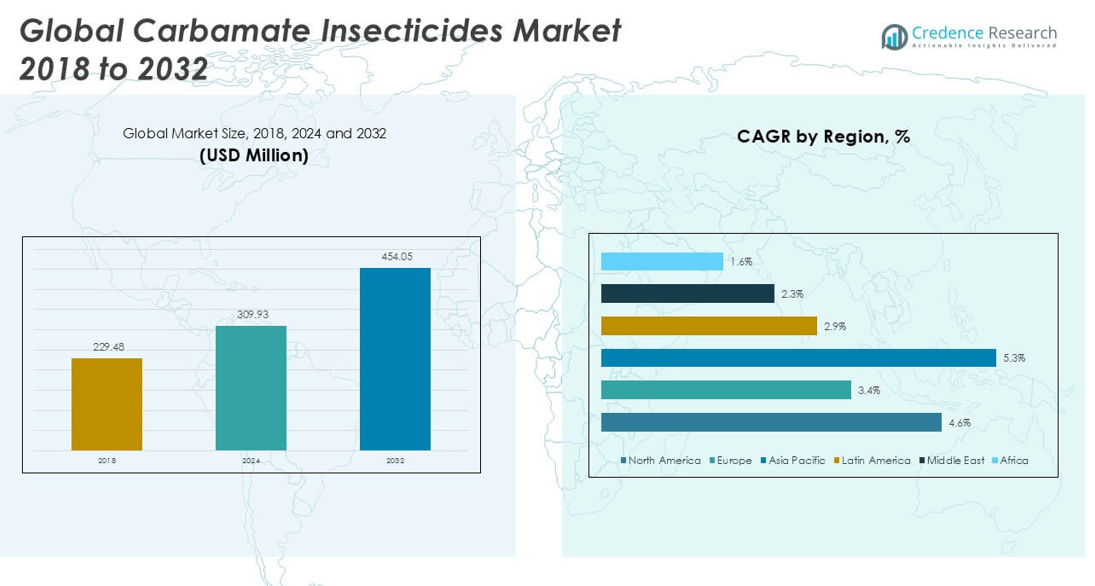
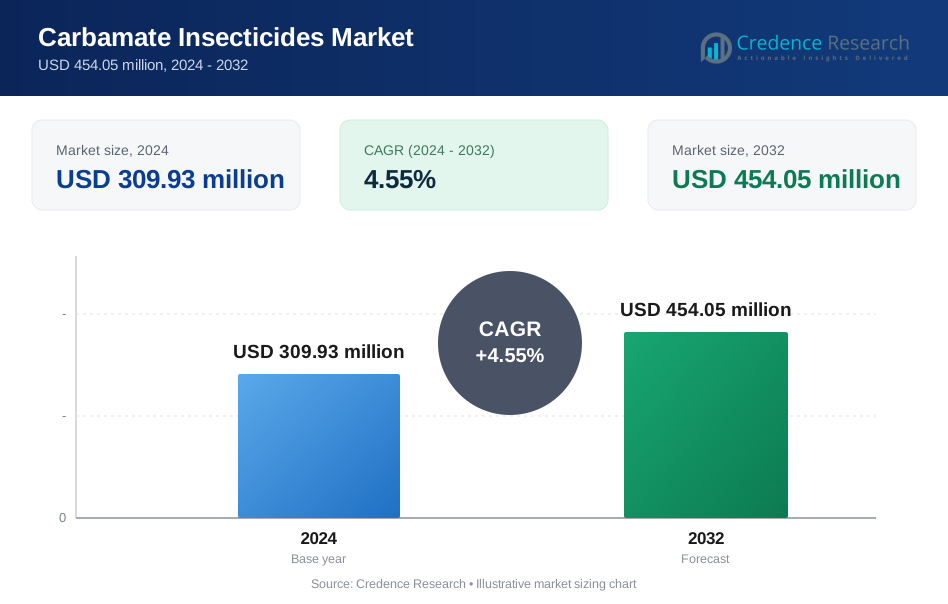
The Carbamate Insecticides market size was valued at USD 229.48 million in 2018 and grew to USD 309.93 million in 2024. It is anticipated to reach USD 454.05 million by 2032, growing at a CAGR of 4.55% during the forecast period.
| REPORT ATTRIBUTE | DETAILS |
|---|---|
| Historical Period | 2020-2023 |
| Base Year | 2024 |
| Forecast Period | 2025-2032 |
| Carbamate Insecticides Market Size 2024 | USD 309.93 million |
| Carbamate Insecticides Market, CAGR | 4.55% |
| Carbamate Insecticides Market Size 2032 | USD 454.05 million |
The carbamate insecticides market is led by prominent players such as Bayer AG, BASF SE, FMC Corporation, ADAMA Agricultural Solutions Ltd., UPL Ltd., Syngenta AG, Arysta LifeScience Corporation, Gowan Company, Nihon Nohyaku Co., Ltd., and Jiangsu Yangnong Chemical Group Co., Ltd. These companies dominate through robust R&D, diverse product portfolios, and extensive global distribution networks. Asia Pacific emerges as the leading region, commanding approximately 44.3% of the global market share in 2024. Its dominance is driven by large-scale agricultural activities, growing food demand, and favorable regulatory conditions that support the widespread use of carbamate insecticides across major economies like China and India.
Market Insights
- The global carbamate insecticides market was valued at USD 309.93 million in 2024 and is projected to reach USD 454.05 million by 2032, growing at a CAGR of 4.55% during the forecast period.
- Growth is primarily driven by increasing agricultural demand for effective pest control and expanding crop production, particularly in emerging economies like India and China.
- Market trends indicate a rising preference for eco-friendly and microencapsulated formulations due to environmental concerns and regulatory pressures, especially in Europe and North America.
- The market is moderately consolidated, with key players like Bayer AG, FMC Corporation, and BASF SE focusing on innovation and partnerships to strengthen their market position.
- Asia Pacific leads with a 44.3% market share, followed by North America (28.2%) and Europe (18.6%); by type, Carbaryl dominates due to its broad-spectrum efficacy, while liquid formulations hold the highest share among formulation types.
Market Segmentation Analysis:
By Type
The carbamate insecticides market by type is led by Carbaryl, accounting for the largest market share in 2024. Its dominance is attributed to its broad-spectrum effectiveness and relatively low toxicity to humans and animals, making it suitable for diverse agricultural applications. Carbaryl’s stability and cost-effectiveness further enhance its adoption across developing regions. Other types such as Methomyl and Aldicarb also contribute significantly due to their high efficacy against pests resistant to other insecticides. However, regulatory restrictions on certain compounds like Carbofuran may limit their usage, thereby influencing the competitive dynamics within the segment.
- For instance, FMC Corporation manufactures Sevin® brand Carbaryl-based insecticide, which is registered for use on more than 250 crops and provides protection against over 130 insect species.
By Application
In terms of application, agriculture remains the dominant segment, holding the highest market share in 2024. The extensive use of carbamate insecticides to control insect pests in crops such as cotton, maize, and fruits drives this trend. The increasing global food demand and the need for enhanced crop yields further stimulate market growth. Moreover, carbamate insecticides are preferred in agriculture due to their rapid action and compatibility with integrated pest management systems. Public health and greenhouse applications follow, supported by rising concerns over vector-borne diseases and ornamental plant protection.
- For instance, Bayer AG’s Temik® Aldicarb insecticide has been applied to over 12 million hectares globally for pest control in crops like sugarcane and citrus, highlighting its scale of agricultural application.
By Formulation
Among the different formulations, the liquid segment holds the leading market share in 2024. Liquid formulations are widely favored due to their ease of application, high penetration, and fast-acting nature. They are particularly effective in large-scale agricultural operations where uniform coverage and efficiency are critical. The growing adoption of advanced spraying equipment further supports the popularity of liquid carbamate insecticides. While granular and wettable powders also serve niche applications, innovations in microencapsulated formulations are gaining traction due to their controlled release properties and reduced environmental impact, hinting at potential growth in future demand.
Market Overview
Increasing Demand for High-Yield Crop Protection
The rising global population has intensified the demand for food production, compelling farmers to adopt efficient pest control solutions. Carbamate insecticides play a crucial role in protecting crops such as cotton, rice, and vegetables from destructive insect infestations. Their broad-spectrum activity and rapid action support higher agricultural productivity and minimize yield losses. As food security becomes a pressing global issue, particularly in developing economies, the reliance on carbamate-based crop protection chemicals continues to rise, driving consistent growth in the market.
- For instance, UPL Ltd. reported that its Lancer Gold®, a carbamate-based product containing Cartap and Thiamethoxam, is used on over 1.2 million hectares of rice farms across India, contributing to increased yields.
Expansion of Agricultural Activities in Emerging Economies
Emerging economies in Asia-Pacific, Latin America, and parts of Africa are experiencing significant expansion in agricultural activities, backed by government subsidies, rural development programs, and improved access to modern agrochemicals. Carbamate insecticides, due to their affordability and proven efficacy, are increasingly adopted by farmers in these regions. Additionally, the shift from subsistence to commercial farming practices boosts the demand for reliable insect control agents, thereby positioning carbamate insecticides as a preferred solution in supporting agricultural intensification.
- For instance, ADAMA Agricultural Solutions reported that its carbamate insecticide portfolio reached over 800,000 hectares in Brazil alone in 2022, driven by soybean and cotton expansion.
Rising Incidence of Vector-Borne Diseases
Growing concerns over vector-borne diseases such as malaria, dengue, and chikungunya are propelling the demand for effective insect control in public health programs. Carbamate insecticides are commonly used in indoor residual spraying (IRS) and other vector management strategies due to their quick knockdown effect on disease-carrying insects. With increased investments by global health organizations and government bodies in disease control initiatives, the application of carbamates in non-agricultural sectors is expanding, contributing notably to overall market growth.
Key Trends & Opportunities
Shift Toward Eco-Friendly and Targeted Formulations
The market is witnessing a trend toward more sustainable and eco-friendly insecticide formulations. Microencapsulated and low-toxicity carbamate products are gaining popularity for offering controlled release, minimizing environmental runoff, and reducing harm to beneficial insects. This shift aligns with global regulatory pressures and consumer preference for environmentally responsible agricultural practices. Innovation in formulation technologies presents a significant opportunity for market players to differentiate their offerings and cater to more environmentally conscious markets.
- For instance, BASF introduced a controlled-release formulation of Methomyl that reduces application frequency by 50%, while maintaining target pest mortality rates above 95% under field trials in southern Europe.
Integration with Integrated Pest Management (IPM) Programs
Carbamate insecticides are increasingly being integrated into IPM systems, which focus on combining biological, cultural, and chemical tools to manage pest populations effectively. Their selective toxicity and compatibility with other pest control techniques make them suitable for IPM adoption. As sustainability becomes a core priority in global agriculture, the demand for insecticides that can be seamlessly used in combination with non-chemical methods is expected to rise, creating growth opportunities for carbamate manufacturers offering adaptable solutions.
- For instance, Syngenta’s carbamate-based products are included in IPM frameworks across more than 900,000 hectares of vegetable farms globally, with proven success in reducing synthetic pesticide use by 35% over a five-year program.
Key Challenges
Regulatory Restrictions and Environmental Concerns
Stringent environmental regulations in regions like Europe and North America have led to the ban or restriction of several carbamate compounds due to concerns over groundwater contamination, non-target species toxicity, and human health risks. These regulatory hurdles limit market expansion and increase the burden of compliance for manufacturers. As a result, companies must invest heavily in reformulation and registration processes, which may hinder the entry of new players and slow down innovation in restricted markets.
Development of Insect Resistance
Repeated and long-term use of carbamate insecticides has led to the development of resistance among various insect species, particularly in agriculture. This resistance diminishes the effectiveness of the products and compels farmers to use higher dosages or switch to alternative chemical classes. The growing challenge of insect resistance not only reduces the lifespan of existing products but also necessitates ongoing R&D investments in resistance management strategies, placing pressure on operational costs.
Competition from Alternative Insecticide Classes
The carbamate insecticides market faces stiff competition from newer and more advanced insecticide classes, such as neonicotinoids, pyrethroids, and biopesticides. These alternatives offer higher specificity, lower environmental impact, and improved safety profiles, making them more attractive to regulators and end-users. As farmers and pest control operators increasingly shift to these modern solutions, the market share of carbamates may decline unless continuous innovation and strategic positioning are undertaken by manufacturers.
Regional Analysis
North America
North America accounted for a significant share of the carbamate insecticides market, valued at USD 65.68 million in 2018, rising to USD 87.31 million in 2024, and projected to reach USD 128.45 million by 2032, growing at a CAGR of 4.6%. In 2024, the region held approximately 28.2% of the global market. This growth is driven by extensive use in agriculture, particularly in the U.S. for high-value crops, and consistent demand in public health programs. Technological advancements in formulation and favorable regulatory frameworks supporting safe chemical usage continue to enhance market expansion in the region.
Europe
Europe’s carbamate insecticides market was valued at USD 45.06 million in 2018, reaching USD 57.68 million in 2024, and is forecasted to grow to USD 77.24 million by 2032, at a CAGR of 3.4%. With a 2024 market share of around 18.6%, the region reflects moderate growth due to stringent environmental regulations limiting the use of certain carbamate compounds. Nonetheless, demand persists in countries like Spain, Italy, and Eastern Europe, where carbamates are still employed in specialty crop farming and greenhouse cultivation. Focus on sustainable pest control is encouraging innovations in safer and more targeted formulations.
Asia Pacific
Asia Pacific dominates the carbamate insecticides market, valued at USD 98.04 million in 2018, increasing to USD 137.41 million in 2024, and expected to reach USD 213.86 million by 2032, growing at the highest CAGR of 5.3%. The region commanded the largest market share of 44.3% in 2024, driven by expansive agricultural activities in countries like China, India, and Southeast Asia. High pest pressure, increasing food production demands, and relatively lenient pesticide regulations have supported widespread adoption. Government support for crop protection and growing awareness of integrated pest management further fuel regional market growth.
Latin America
Latin America’s carbamate insecticides market grew from USD 10.61 million in 2018 to USD 14.15 million in 2024, with projections indicating USD 18.29 million by 2032, at a CAGR of 2.9%. Holding a 2024 market share of approximately 4.6%, the region demonstrates steady growth, particularly in Brazil and Argentina, where agriculture remains a key economic pillar. The use of carbamate insecticides is prevalent in managing pests in soy, corn, and sugarcane crops. However, fluctuating regulatory policies and growing resistance issues may challenge long-term usage, encouraging a gradual shift toward integrated pest management and safer chemical alternatives.
Middle East
The Middle East market for carbamate insecticides was valued at USD 6.45 million in 2018, increased to USD 7.97 million in 2024, and is expected to reach USD 9.86 million by 2032, growing at a CAGR of 2.3%. Representing 2.6% of the global market in 2024, the region sees moderate growth due to its arid climate and limited arable land. However, demand exists in countries with greenhouse farming and date palm cultivation. Government initiatives aimed at boosting domestic food production and pest control programs in urban areas are supporting the continued, though limited, use of carbamate insecticides.
Africa
Africa’s carbamate insecticides market expanded from USD 3.64 million in 2018 to USD 5.41 million in 2024, and is forecast to reach USD 6.35 million by 2032, growing at a CAGR of 1.6%. The region held the smallest market share of 1.7% in 2024. Growth remains constrained due to limited access to advanced agricultural inputs, economic challenges, and infrastructural gaps. Nonetheless, some progress is being made through international aid and government-led pest control initiatives, especially for staple crops. Rising awareness about pest management and gradual adoption of agrochemicals in countries like Kenya and Nigeria offer scope for future development.
Report Scope
| Report Attribute | Details |
| Market size value in 2024 | USD 309.93 million |
| Revenue forecast in 2032 | USD 454.05 million |
| Growth rate (CAGR) | 4.55% (2025–2032) |
| Base year | 2024 |
| Forecast period | 2025-2032 |
| Quantitative units | USD million |
| Segments covered | By Chemistry Subclass; By Active Ingredient; By End Use; By Formulation; By Crop Type; By Mode of Application |
| Regional scope | North America, Europe, Asia Pacific, Latin America, Middle East & Africa |
| Key companies profiled | BASF SE; FMC Corporation; UPL Limited; Bayer Crop Science AG; Syngenta AG; Nufarm Limited; Sumitomo Chemical Co., Ltd.; ADAMA Agricultural Solutions Ltd.; American Vanguard Corporation; Arysta LifeScience Corporation; Mitsui Chemicals, Inc.; Nissan Chemical Corporation; PI Industries Ltd.; Rallis India Limited; Gowan Company LLC; Kumiai Chemical Industry Co., Ltd. |
| No. of Pages | 326 |
Market Segmentations:
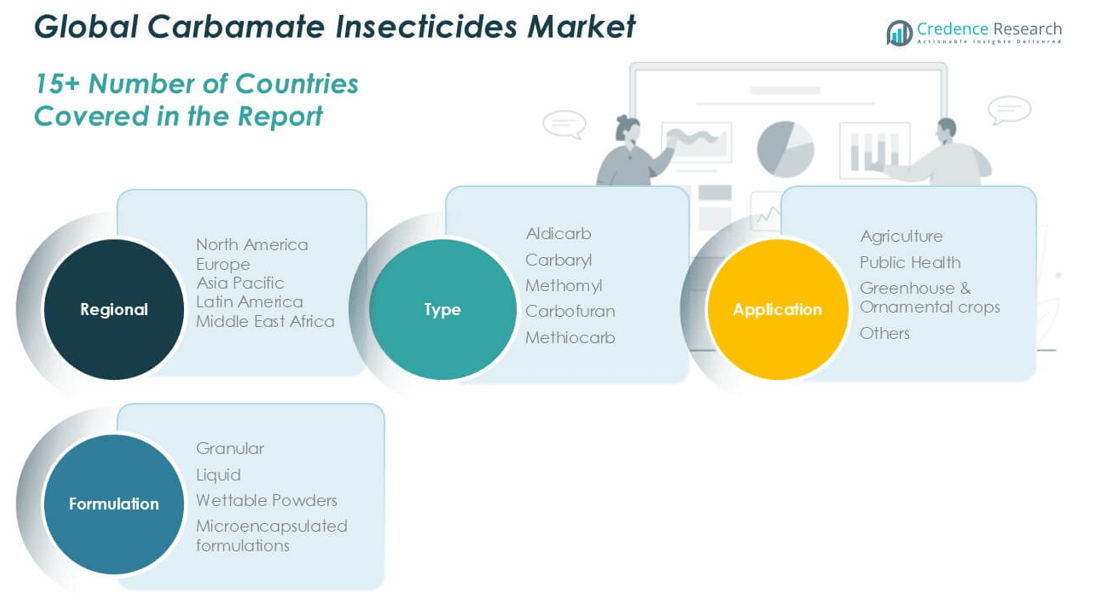
By Type
- Aldicarb
- Carbaryl
- Methomyl
- Carbofuran
- Methiocarb
By Application
- Agriculture
- Public Health
- Greenhouse & Ornamental Crops
- Others
By Formulation
- Granular
- Liquid
- Wettable Powders
- Microencapsulated Formulations
By Geography
- North America
- U.S.
- Canada
- Mexico
- Europe
- Germany
- France
- U.K.
- Italy
- Spain
- Rest of Europe
- Asia Pacific
- China
- Japan
- India
- South Korea
- South-east Asia
- Rest of Asia Pacific
- Latin America
- Brazil
- Argentina
- Rest of Latin America
- Middle East & Africa
- GCC Countries
- South Africa
- Rest of the Middle East and Africa
Competitive Landscape
The competitive landscape of the carbamate insecticides market is moderately consolidated, with a mix of global agrochemical giants and regional players competing based on product efficacy, regulatory compliance, and distribution reach. Key market participants include Bayer AG, BASF SE, ADAMA Agricultural Solutions Ltd., FMC Corporation, Arysta LifeScience Corporation, UPL Ltd., Gowan Company, Nihon Nohyaku Co., Ltd., Jiangsu Yangnong Chemical Group Co., Ltd., and Syngenta AG. These companies focus on expanding their portfolios through R&D investments, strategic acquisitions, and product innovation, particularly in safer and eco-friendly formulations. Regulatory pressures in regions such as Europe have prompted players to shift toward more sustainable alternatives and integrated pest management-compatible solutions. Asia Pacific continues to offer the largest growth opportunities due to its expanding agriculture sector and relaxed regulations. Strategic partnerships with local distributors and government bodies help key players strengthen market penetration, especially in emerging markets where awareness and accessibility are rapidly increasing.
Key Player Analysis
- Bayer AG
- BASF SE
- ADAMA Agricultural Solutions Ltd.
- FMC Corporation
- Arysta LifeScience Corporation
- United Phosphorus Ltd. (UPL Ltd.)
- Gowan Company
- Nihon Nohyaku Co., Ltd.
- Jiangsu Yangnong Chemical Group Co., Ltd.
- Syngenta AG
Recent Developments
- In July 2025, BASF SE is continuing its focus on integrating new pest models and digital applications into its precision insecticide use strategies, aligning with broader sustainability goals. This effort aims to support farmers in using insecticides more efficiently and responsibly. BASF is updating its xarvio® FIELD MANAGER platform with new insect pest models expected to be available by 2025, along with enhancements to disease models to improve fungicide recommendations.
- In June 2025, ADAMA Agricultural Solutions Ltd. is continuing its focus on expanding its long-acting insecticide product line, particularly with enhanced formulations. Their Integrated Pest Management (IPM) strategies include the use of carbamate-based insecticides, which are being offered in response to increasing insect resistance issues in certain markets.
- In May 2025, FMC Corporation continued its commitment to a climate-smart approach by focusing research and development on more sustainable active ingredients, particularly next-generation carbamate insecticides, according to FMC. This involved prioritizing research that led to lower toxicity and improved environmental profiles for these new insecticides, according to FMC.
- In April 2025, Bayer AG is expanding its carbamate insecticide production facilities in Asia to meet the growing global demand for these products, particularly in pest management and vector control. This expansion reflects the continued reliance on carbamates, despite the rise of alternative pest control methods, due to their effectiveness against a wide range of insects and their relatively low cost.
- In April 2024, Bayer released a new carbamate-based insecticide aimed at combating resistant pest species and expanding its reach in emerging markets. This new insecticide is designed to be effective against a broader spectrum of pests, particularly those that have developed resistance to other treatments. The development of this insecticide is part of Bayer's ongoing efforts to provide farmers with effective and sustainable pest control solutions, especially in regions where pest resistance is a growing concern.
Market Concentration & Characteristics
The Carbamate Insecticides Market exhibits a moderate level of market concentration, with a mix of multinational corporations and regional players operating across key agricultural economies. Major companies such as Bayer AG, BASF SE, FMC Corporation, and UPL Ltd. control a significant share through well-established distribution networks, diverse product portfolios, and ongoing investment in formulation innovation. It is characterized by product effectiveness, rapid action against a broad range of pests, and compatibility with integrated pest management systems. The market is driven by high demand from the agricultural sector, particularly in Asia Pacific, where expansive farming and favorable regulatory frameworks support large-scale adoption. In contrast, stricter environmental regulations in Europe and North America restrict the use of certain active ingredients, prompting companies to develop safer and more sustainable alternatives. Product differentiation focuses on formulation type, crop specificity, and environmental impact. Buyers in the market, including large-scale farms and public health agencies, seek cost-effective solutions that ensure both productivity and regulatory compliance. The presence of substitute products and increasing insect resistance add competitive pressure, pushing firms toward research and development.
Report Coverage
The research report offers an in-depth analysis based on Type, Application, Formulation and Geography. It details leading market players, providing an overview of their business, product offerings, investments, revenue streams, and key applications. Additionally, the report includes insights into the competitive environment, SWOT analysis, current market trends, as well as the primary drivers and constraints. Furthermore, it discusses various factors that have driven market expansion in recent years. The report also explores market dynamics, regulatory scenarios, and technological advancements that are shaping the industry. It assesses the impact of external factors and global economic changes on market growth. Lastly, it provides strategic recommendations for new entrants and established companies to navigate the complexities of the market.
Future Outlook
- The carbamate insecticides market is expected to witness steady growth driven by increasing global food demand and expanding agricultural activities.
- Asia Pacific will continue to dominate due to large-scale farming, favorable pesticide regulations, and rising pest pressure.
- Liquid formulations will remain the preferred choice owing to their ease of application and rapid action.
- Carbaryl will retain its position as the leading compound due to its broad-spectrum efficacy and cost-effectiveness.
- Environmental regulations in developed regions will push manufacturers to develop safer and biodegradable formulations.
- Public health applications will grow moderately as governments invest in vector control programs.
- Microencapsulated formulations are likely to gain traction for their controlled release and reduced environmental impact.
- Resistance management will become a key focus area, encouraging integrated pest management strategies.
- Strategic partnerships and product innovation will be critical for companies to maintain competitiveness.
- Emerging markets in Africa and Latin America will present new growth opportunities despite infrastructural and regulatory challenges.
Request a Free Sample
Fill in your details and we'll send you a free sample report.
- Sample data tables & charts
- Research methodology
Need a Custom Version of This Report?
Tailor the scope, geography, or segments to your exact requirements.
- Custom geography or segment scope
- Direct access to our analyst team
Frequently Asked Questions
What is the current size of the Carbamate Insecticides Market?
Who are the major players in the Carbamate Insecticides Market?
What are the key segments within the Carbamate Insecticides Market?
What are the market drivers in the Carbamate Insecticides Market?
Table of Content
Chapter 1. Report Introduction
- 1.1 Report Description & Purpose
- 1.1.1 Report Title & Market Definition
- 1.1.2 Unique Selling Propositions (USP) & Key Differentiators
- 1.1.3 Value Proposition for Stakeholders
- 1.2 Research Objectives
- 1.2.1 Market Sizing Objectives (Volume & Revenue)
- 1.2.2 Segmentation Objectives
- 1.2.3 Competitive Intelligence Objectives
- 1.2.4 Forecast & Scenario Objectives
- 1.3 Report Scope
- 1.3.1 Carbamate Insecticides Scope – Types & Subtypes Covered
- 1.3.2 Geographic Scope – Regions & Countries Covered
- 1.3.3 Historical Period, Base Year & Forecast Period (2024; forecast to 2032)
- 1.3.4 Inclusions & Exclusions
- 1.4 HS Code & Classification Framework
- 1.5 Currency, Units & Pricing Basis
- 1.6 Target Stakeholders
- 1.7 Limitations & Assumptions
Chapter 2. Executive Summary
- 2.1 Global Carbamate Insecticides Market Snapshot
- 2.1.1 Market Size – Historical (2024) & Forecast (2024-2032) (2024: USD 309.93 million → 2032: USD 454.05 million)
- 2.1.2 Volume & Revenue – Global Totals
- 2.1.3 Key Market Highlights – Top Five Facts
- 2.2 Carbamate Insecticides Market Segmentation Snapshot
- 2.2.1 Market Split by Region – 2024 vs. 2032
- 2.3 Competitive Snapshot
- 2.3.1 Top 10 Players by Revenue Share – 2024
- 2.3.2 Top 10 Players by Volume Share – 2024
- 2.3.3 Recent Strategic Developments (18-Month Summary)
- 2.4 Key Investment Highlights & Strategic Conclusions
Chapter 3. Carbamate Insecticides Market Dynamics & Industry Analysis
- 3.1 Market Overview & Context
- 3.1.1 Carbamate Insecticides Market Position in the Broader Automotive Value Chain
- 3.1.2 OEM vs. Replacement Market Dynamics
- 3.1.3 Market Maturity & Development Stage by Region
- 3.2 Carbamate Insecticides Market Drivers
- 3.3 Carbamate Insecticides Market Restraints & Challenges
- 3.4 Carbamate Insecticides Market Opportunities
- 3.5 Porter's Five Forces Analysis
- 3.5.1 Threat of New Entrants
- 3.5.2 Bargaining Power of Suppliers
- 3.5.3 Bargaining Power of Buyers
- 3.5.4 Threat of Substitutes
- 3.5.5 Competitive Rivalry – Intensity Assessment
- 3.6 Carbamate Insecticides Value Chain Analysis
- 3.6.1 Upstream – Raw Material/Input Suppliers
- 3.6.1.1 Raw Material/Input 1
- 3.6.1.2 Raw Material/Input 2
- 3.6.1.3 Raw Material/Input 3
- 3.6.2 Midstream – Production/Manufacturing/Service Delivery
- 3.6.2.1 Production/Process Overview
- 3.6.2.2 Key Facility Locations & Capacity by Manufacturer
- 3.6.3 Downstream – Distribution & End Consumer
- 3.6.3.1 Primary Channel – B2B/OEM
- 3.6.3.2 Secondary Channels – Dealer, Retail, Online, Direct
- 3.6.4 Value Chain Profitability Analysis
- 3.6.1 Upstream – Raw Material/Input Suppliers
- 3.7 PESTEL Analysis
- 3.7.1 Political Factors
- 3.7.2 Economic Factors
- 3.7.3 Social Factors
- 3.7.4 Technological Factors
- 3.7.5 Environmental Factors
- 3.7.6 Legal Factors
- 3.8 Carbamate Insecticides Supply Chain Analysis
- 3.8.1 Raw Material/Input Supply Risk Assessment
- 3.8.2 Manufacturing Concentration Risk (Geographic Exposure)
- 3.8.3 Trade Disruption Impact Analysis
- 3.9 Regulatory & Policy Landscape
Note: The regulatory and policy landscape section covers regulations based on their applicability to the market, Carbamate Insecticides category, geography, and scope of the study. Only regulatory frameworks with a material impact on operations, compliance, trade, sustainability, or market access are analyzed in detail.
Chapter 4. Key Investment Pockets & Opportunity Analysis
- 4.1 Carbamate Insecticides Market Attractiveness Analysis
- 4.1.1 By Region – Investment Attractiveness Matrix (Volume × CAGR)
- 4.2 Absolute Revenue Growth Opportunity
- 4.2.1 By Region – Absolute USD Growth Through 2032
- 4.3 Incremental Volume Opportunity
- 4.3.1 By Region – Incremental Volume Through 2032
- 4.3.2 Segment – Incremental Volume
- 4.4 Emerging Submarket Opportunity Deep Dive (Subject to Applicability)
- 4.5 Emerging Market Opportunity Scorecards
- 4.5.1 United States
- 4.5.2 Europe
- 4.5.3 Asia
- 4.5.4 Middle East & Africa
Note: Emerging Market Opportunity Scorecards will be included based on relevance and strategic importance. Regions listed are indicative and may vary depending on data availability and market dynamics.
Chapter 5. Carbamate Insecticides Import-Export Analysis & Trade Flows
- 5.1 Global Trade Overview
- 5.1.1 Global Export Value by Country (2024)
- 5.1.2 Global Export Volume by Country (2024)
- 5.1.3 Global Import Value by Country (2024)
- 5.1.4 Global Import Volume by Country (2024)
- 5.1.5 Net Trade Balance by Country (2024)
- 5.2 Export Analysis – Segment
- 5.2.1 Type 1 (HS Code)
- 5.2.2 Type 2 (HS Code)
- 5.2.3 Type 3 (HS Code)
- 5.2.4 Type 4 (HS Code)
- 5.2.5 Type 5 (HS Code)
- 5.3 Import Analysis – Segment
- 5.3.1 Type 1 (HS Code)
- 5.3.2 Type 2 (HS Code)
- 5.3.3 Type 3 (HS Code)
- 5.3.4 Type 4 (HS Code)
- 5.3.5 Type 5 (HS Code)
- 5.4 Average Unit Trade Prices
- 5.4.1 Average Export Price – Segment & Country
- 5.4.2 Average Import Price – Segment & Source Country
- 5.4.3 Price Trends (2024)
- 5.5 Key Trade Route Analysis
- 5.5.1 Trade Route 1
- 5.5.2 Trade Route 2
- 5.5.3 Trade Route 3
- 5.5.4 Trade Route 4
- 5.5.5 Trade Route 5
- 5.6 Trade Policy Impact Assessment
- 5.6.1 US Anti-Dumping & Section 301 Tariffs
- 5.6.2 EU Customs Union Impact
- 5.6.3 Major Free Trade Agreements
- 5.6.4 USMCA Rules of Origin
Note: Trade policy analysis will be included only where relevant to the Carbamate Insecticides market.
Chapter 6. Competitive Landscape & Company Benchmarking
- 6.1 Carbamate Insecticides Market Concentration & Structure
- 6.1.1 Herfindahl-Hirschman Index (HHI) – vs. 2024
- 6.1.2 Tier 1, Tier 2 & Tier 3 Market Structure
- 6.1.3 Global, Regional & Local Player Dynamics
- 6.2 Carbamate Insecticides Market Share Analysis – 2024
- 6.2.1 Global Revenue Share by Company
- 6.2.2 Global Volume Share by Company
- 6.2.3 Regional Revenue Share
- 6.2.4 Market Share Evolution ( vs. 2024)
- 6.2.5 OEM Segment Share by Company
- 6.2.6 Replacement Segment Share by Company
- 6.3 Production/Delivery Capacity & Facility Analysis
- 6.3.1 Global Installed Capacity
- 6.3.2 Capacity Utilization Rates
- 6.3.3 Production/Output Volume
- 6.3.4 Facility Locations & Capacity Map
- 6.3.5 Planned Capacity Additions
- 6.4 Carbamate Insecticides Competitive Benchmarking Matrix
- 6.4.1 Revenue, Volume, CAGR & Profitability Comparison
- 6.4.2 Channel Revenue Mix
- 6.4.3 Geographic Revenue Exposure
- 6.4.4 R&D Intensity
- 6.4.5 Sustainability Maturity
- 6.5 Strategic Developments in Carbamate Insecticides (Last 24 Months)
- 6.5.1 Mergers, Acquisitions & Divestments
- 6.5.2 New Carbamate Insecticides Launches
- 6.5.3 Facility Expansions
- 6.5.4 Strategic Alliances, Joint Ventures & Partnerships
- 6.5.5 Distribution Expansion & Market Entry
- 6.5.6 Sustainability & ESG Initiatives
- 6.6 Competitive Strategy Mapping
- 6.6.1 Leader, Challenger, Follower & Niche Classification
- 6.6.2 Pricing Strategy Comparison
- 6.6.3 Channel Strategy Matrix
Note: Strategic developments are included based on their materiality and the availability of reliable information.
Chapter 7. Global Carbamate Insecticides Market – By Distribution Channel
- 7.1 Segment Overview
- 7.1.1 Volume & Revenue Split by Channel (2024 & 2032)
- 7.1.2 Channel Mix Evolution (2024-2032)
Chapter 8. Regional Market Analysis – Global Overview
- 8.1 Global Regional Overview
- 8.1.1 Regional Volume Share
- 8.1.2 Regional Revenue Share
- 8.1.3 Regional Volume by Region
- 8.1.4 Regional Revenue by Region
- 8.1.5 Regional Forecast Through 2032
- 8.2 Cross-Regional Segment Analysis
- 8.2.1 By Distribution Channel
- 8.2.2 By Brand/Price Tier
Chapter 9. North America Carbamate Insecticides Market
- 9.1 United States
- 9.2 Canada
- 9.3 Mexico
Chapter 10. Europe Carbamate Insecticides Market
- 10.1 Germany
- 10.2 France
- 10.3 Italy
- 10.4 United Kingdom
- 10.5 Spain
- 10.6 Poland
- 10.7 Russia
- 10.8 Netherlands
- 10.9 Belgium
- 10.10 Sweden
- 10.11 Denmark
- 10.12 Norway
- 10.13 Rest of Europe
Chapter 11. Asia Pacific Carbamate Insecticides Market
- 11.1 China
- 11.2 India
- 11.3 Japan
- 11.4 South Korea
- 11.5 Thailand
- 11.6 Indonesia
- 11.7 Vietnam
- 11.8 Malaysia
- 11.9 Australia
- 11.10 Rest of Asia Pacific
Chapter 12. Latin America Carbamate Insecticides Market
- 12.1 Brazil
- 12.2 Argentina
- 12.3 Colombia
- 12.4 Chile
- 12.5 Rest of Latin America
Chapter 13. Middle East Carbamate Insecticides Market
- 13.1 Saudi Arabia
- 13.2 United Arab Emirates
- 13.3 Turkey
- 13.4 Israel
- 13.5 Iran
- 13.6 Rest of the Middle East
Chapter 14. Africa Carbamate Insecticides Market
- 14.1 South Africa
- 14.2 Egypt
- 14.3 Nigeria
- 14.4 Morocco
- 14.5 Rest of Africa
Chapter 15. Carbamate Insecticides Company Profiles
- 15.1 [Company 01]
- 15.1.1 Company Overview
- 15.1.2 Key Management Personnel
- 15.1.3 Products & Services Portfolio
- 15.1.4 Financial Performance
- 15.1.5 Key Market Focus & Geographic Presence
- 15.1.6 Recent Developments & Strategic Initiatives
Note: The company profile list is preliminary and may change based on research findings, market developments, data availability, and client requirements.
Chapter 16. Appendices
- Appendix A – List of Abbreviations & Acronyms
- Appendix B – Industry Classification Code Reference – Full Series
- Appendix C – Production & Capacity Data Tables
- Appendix D – End-Use & Demand Base Tables
- Appendix E – Consumption & Replacement Rate Assumptions
- Appendix F – ASP Reference Tables
- Appendix G – Manufacturing & Facility Database
- Appendix H – Import-Export Data Tables
- Appendix I – Regulatory Summary Tables
- Appendix J – Primary Research Participant List (Anonymized)
- Appendix K – Primary Research Questionnaire Framework
- Appendix L – Data Sources & Bibliography
- Appendix M – Market Size Divergence & Source Comparison
Chapter 17. Research Methodology
- 17.1 Research Framework & Philosophy
- 17.2 Secondary Research – Sources, Hierarchy & Data Extraction
- 17.3 Data Modeling – Bottom-Up & Top-Down Market Sizing
- 17.4 Primary Research – Stakeholder Framework, LOI & Sample Sizes
- 17.5 Forecast Methodology – Regression, Scenario & Sensitivity Analysis
- 17.6 Quality Control – Four-Layer Validation Framework
- 17.7 Limitations & Standard Assumptions
- 17.8 Disclaimer
