| REPORT ATTRIBUTE | DETAILS |
|---|---|
| Historical Period | 2020-2023 |
| Base Year | 2024 |
| Forecast Period | 2025-2032 |
| Carved Wood Signs Market Size 2024 | USD 427.50 Million |
| Carved Wood Signs Market, CAGR | 4.79% |
| Carved Wood Signs Market Size 2032 | USD 638.42 Million |
Market Overview
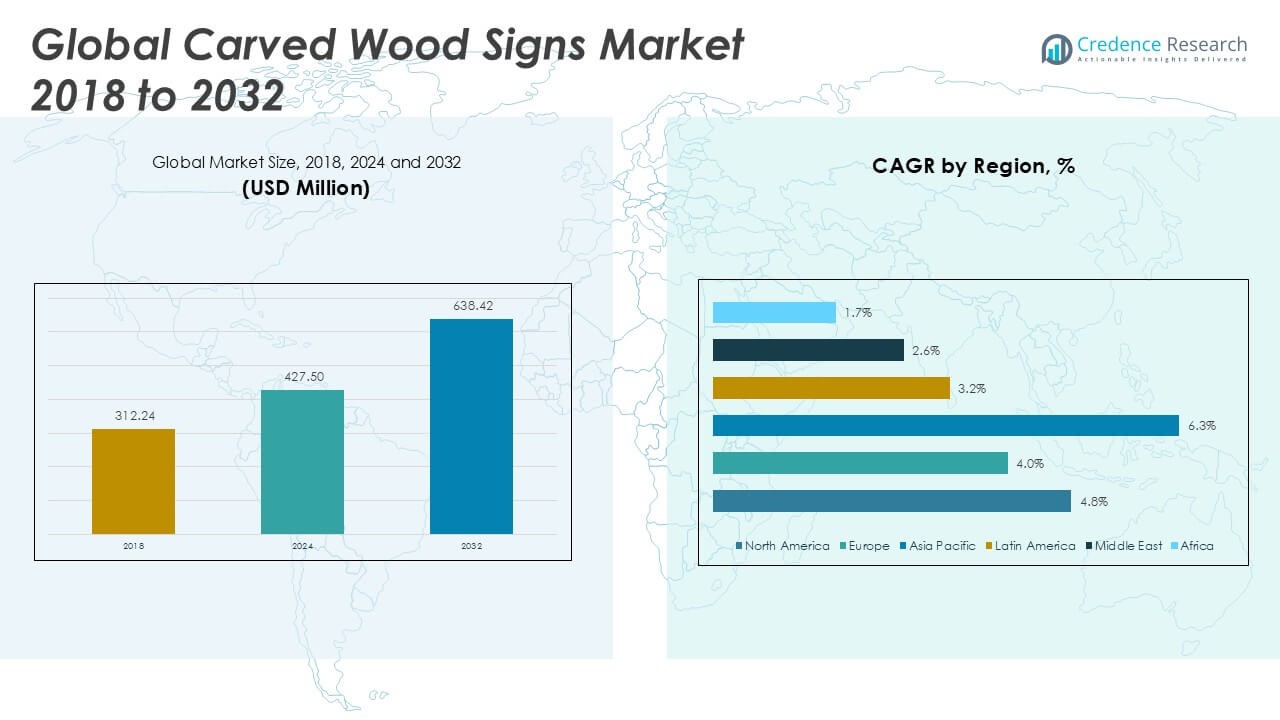
The Carved Wood Signs market size was valued at USD 312.24 million in 2018, reached USD 427.50 million in 2024, and is anticipated to reach USD 638.42 million by 2032, at a CAGR of 4.79% during the forecast period.
Top players in the carved wood signs market include The Carving Company, Art Sign Works, Cedar Sign, Woodland Manufacturing, and Fox Wood Signs. These companies lead through a combination of skilled craftsmanship, advanced carving technologies, and a focus on custom, high-quality products. The Carving Company and Art Sign Works stand out for their extensive portfolios serving both residential and commercial sectors. Woodland Manufacturing leverages CNC technology for scalable production, appealing to larger clients. Regionally, North America dominates the market with a 31.4% share in 2024, driven by strong demand from hospitality, retail, and personalized home décor sectors in the U.S. and Canada. This regional leadership is supported by established manufacturing capabilities and a high preference for sustainable and aesthetic signage.
Market Insights
- The carved wood signs market was valued at USD 427.50 million in 2024 and is projected to reach USD 638.42 million by 2032, growing at a CAGR of 4.79% during the forecast period.
- Growth is primarily driven by rising demand for personalized, eco-friendly signage across commercial and residential sectors, with oak wood holding the dominant type segment share due to its durability and premium appeal.
- Trends include increased adoption of CNC technology for precision carving and the growing use of carved wood signs in interior décor and hospitality branding.
- The market is fragmented, with key players such as The Carving Company, Art Sign Works, and Woodland Manufacturing focusing on customization, quality, and sustainable sourcing to maintain competitiveness.
- North America leads the regional landscape with a 31.4% market share in 2024, followed by Asia Pacific at 21.5% and Europe at 20.0%; high costs and vulnerability to environmental factors act as key restraints to broader adoption.
Market Segmentation Analysis:
By Type:
The carved wood signs market by type is segmented into oak, walnut, pine, and other woods. Among these, oak holds the dominant market share due to its exceptional durability, classic appearance, and high resistance to wear and outdoor elements. Oak’s dense grain structure makes it ideal for intricate carving, which enhances the aesthetic appeal of signage. Demand for oak signs remains strong in both commercial and high-end residential applications. The availability of oak in various finishes and its association with premium branding further drive its adoption across retail stores, hospitality venues, and institutional signage projects.
- For instance, Art Sign Works has processed over 12,000 custom oak signs since 2019 using precision CNC routers, each capable of operating at spindle speeds up to 24,000 RPM, enabling detailed carving in hard oak surfaces.
By Application:
Based on application, the market is segmented into commercial, residential, and others. The commercial segment leads the market, accounting for the largest revenue share. Businesses increasingly use carved wood signs for storefronts, branding, and wayfinding due to their rustic charm and long-lasting visual impact. Growth in the hospitality, retail, and tourism sectors continues to fuel demand, as such signs are often seen as inviting and authentic. The segment benefits from customizability and the increasing preference for sustainable, natural materials in branding strategies, making wood signage a compelling choice for commercial properties.
- For instance, The Carving Company completed over 5,700 commercial signage projects between 2020 and 2023, with individual sign dimensions reaching up to 96 inches in length, tailored for large-scale retail chains and boutique hotel entrances.
Key Growth Drivers
Rising Demand for Custom and Aesthetic Signage
The growing interest in personalized and visually appealing signage is a major driver in the carved wood signs market. Businesses, homeowners, and institutions are increasingly favoring handcrafted wooden signs for their rustic appeal and uniqueness. Customization options, including engraved logos, stylized fonts, and natural finishes, are enabling consumers to reflect identity and branding more effectively. This trend is especially strong in hospitality, retail, and residential sectors, where aesthetic differentiation is crucial. The rise of e-commerce platforms has also made it easier for consumers to access and order customized signage globally.
- For instance, Cedar Sign has expanded its e-commerce operations to serve over 3,000 unique customers in 18 countries, offering more than 1,200 design variations through its online configurator launched in Q4 2022.
Growth in Hospitality and Tourism Sectors
Expanding hospitality and tourism industries are fueling the demand for carved wood signs, particularly in boutique hotels, resorts, restaurants, and heritage sites. These establishments prefer wooden signage to enhance their ambiance and reflect authenticity. Wooden signs are also used extensively for directional, welcome, and informational purposes in tourism-heavy regions. With increasing investments in tourism infrastructure and a global push toward promoting cultural and sustainable travel experiences, the demand for eco-friendly and visually attractive signage like carved wood continues to gain traction across various markets.
- For instance, Woodland Manufacturing delivered 1,480 custom directional signs to resorts and lodges across the U.S. National Park system between 2021 and 2023, all produced using sustainable FSC-certified hardwoods.
Preference for Eco-friendly and Sustainable Materials
A strong shift toward sustainable and biodegradable materials is driving the carved wood signs market. Consumers and businesses are moving away from plastic and metal signage due to growing environmental concerns. Wood, being renewable and recyclable, aligns with green building practices and corporate sustainability goals. This preference is particularly evident in developed regions where environmental regulations are stricter. The use of certified wood sources and eco-conscious production processes further strengthens the market position of wooden signage as a sustainable alternative in both commercial and residential applications.
Key Trends & Opportunities
Integration of Technology with Traditional Craftsmanship
An emerging trend in the market is the fusion of traditional woodcarving techniques with digital design and CNC carving technology. This integration enables high precision, faster production, and scalable customization, which opens opportunities for mass customization and business expansion. Designers can now create intricate patterns and brand-specific elements with consistency and speed. This trend also appeals to tech-savvy small business owners and designers looking to balance artisanal value with operational efficiency, offering a competitive edge in a design-conscious market.
- For instance, Woodland Manufacturing operates 15 industrial-grade CNC routers capable of 3-axis machining at cutting speeds of up to 1,200 inches per minute, allowing production of over 400 custom sign units weekly.
Increasing Adoption in Interior Decor and Home Improvement
Carved wood signs are gaining popularity in interior décor as homeowners seek personalized and rustic elements in their living spaces. From nameplates and motivational quotes to themed room signage, these products are now common in modern home improvement projects. The DIY and home personalization movement further drives this trend, supported by online platforms and craft marketplaces. This expanding use beyond traditional signage roles provides manufacturers with broader customer bases and diversified product lines, especially in regions with growing disposable income and homeownership rates.
- For instance, Fox Wood Signs reported a 64% year-over-year increase in Etsy sales in 2023, fulfilling over 9,200 handcrafted décor sign orders driven by home improvement trends and customization tools integrated into its storefront.
Key Challenges
High Cost and Time-Intensive Production
Carved wood signs often involve labor-intensive processes, especially when handcrafted, which increases production time and cost. Custom orders, in particular, demand skilled craftsmanship and longer lead times, making them less appealing for customers seeking quicker or budget-friendly solutions. While mechanized options exist, they still require significant investment in tools and materials. These cost constraints can limit adoption among price-sensitive segments, especially in developing markets where alternatives like plastic or vinyl signage offer more affordability and faster turnaround.
Vulnerability to Environmental Factors
Despite their visual appeal, carved wood signs are susceptible to environmental damage such as moisture, UV exposure, insect attacks, and temperature fluctuations. Without proper treatment and maintenance, wooden signs can warp, fade, or rot, reducing their lifespan. This vulnerability increases total cost of ownership and may deter potential buyers in harsh climate regions. Manufacturers need to invest in protective coatings and durable wood species, which further adds to production cost, potentially limiting market growth in certain geographies.
Limited Scalability for Small Artisans
While demand for handcrafted and customized signage is rising, small-scale artisans and local workshops often face challenges in scaling operations. Constraints in capital, labor, and access to advanced machinery restrict their ability to fulfill bulk or international orders. Moreover, inconsistent quality and limited marketing capabilities can hamper their competitiveness in the global market. These limitations prevent many talented craftsmen from expanding beyond local markets, narrowing the overall supply base and growth potential for the handcrafted segment of the carved wood signs market.
Regional Analysis
North America
North America held the largest share in the carved wood signs market, accounting for approximately 31.4% of global revenue in 2024. The market was valued at USD 131.52 million in 2018, reaching USD 178.14 million in 2024, and is projected to attain USD 266.79 million by 2032, registering a CAGR of 4.8%. The dominance of the region is supported by strong demand from commercial establishments, particularly in retail, hospitality, and tourism sectors across the United States and Canada. The presence of well-established manufacturers and consumer preference for premium, customized signage further fuel regional growth.
Europe
Europe contributed around 20.0% to the global carved wood signs market in 2024. The market stood at USD 85.97 million in 2018, increased to USD 113.34 million in 2024, and is estimated to reach USD 159.04 million by 2032, growing at a CAGR of 4.0%. Rising demand from the hospitality and interior décor sectors, coupled with growing environmental awareness, has driven the adoption of sustainable signage options like carved wood. Countries such as Germany, France, and the UK show notable demand due to a strong culture of artisanal design and branding aesthetics.
Asia Pacific
Asia Pacific emerged as the fastest-growing regional market, capturing nearly 21.5% of global share in 2024. Valued at USD 66.58 million in 2018, the market expanded to USD 98.05 million in 2024, and is forecasted to reach USD 164.08 million by 2032, with a CAGR of 6.3%. The rapid growth is driven by increasing urbanization, rising disposable incomes, and expanding commercial spaces across countries like China, India, and Japan. A growing preference for rustic and eco-friendly signage in cafes, resorts, and retail stores is accelerating demand throughout the region.
Latin America
Latin America accounted for about 4.7% of the global carved wood signs market in 2024. It was valued at USD 14.78 million in 2018, rose to USD 19.99 million in 2024, and is expected to reach USD 26.43 million by 2032, with a CAGR of 3.2%. Growth in tourism and the small business sector across Brazil, Mexico, and Chile contributes to increasing demand for decorative and directional wood signage. While the market is relatively small, niche demand from boutique hotels and artisan-based businesses offers opportunities for moderate expansion.
Middle East
The Middle East carved wood signs market represented roughly 2.6% of the global market in 2024. It grew from USD 8.78 million in 2018 to USD 10.99 million in 2024, and is projected to reach USD 13.86 million by 2032, at a CAGR of 2.6%. Growth remains modest due to the regional climate, which poses durability challenges for wooden products. However, tourist-focused areas such as the UAE and heritage-based retail centers show interest in carved wood signage for luxury and cultural branding, sustaining a niche demand within the market.
Africa
Africa accounted for an estimated 1.2% share of the global carved wood signs market in 2024. Starting at USD 4.60 million in 2018, the market reached USD 6.99 million in 2024 and is projected to hit USD 8.22 million by 2032, registering the lowest CAGR of 1.7%. Market growth is hindered by economic limitations, limited access to skilled artisans, and the dominance of more affordable signage alternatives. However, in select regions with active tourism or cultural preservation efforts, such as South Africa and Morocco, there is growing appreciation for handcrafted wooden signage.
Market Segmentations:
By Type:
- Oak
- Walnut
- Pine
- Other woods
By Application:
- Commercial
- Residential
- Others
By Geography:
- North America
- Europe
- Asia Pacific
- Latin America
- Middle East
- Africa
Competitive Landscape
The carved wood signs market features a mix of small-scale artisans, regional manufacturers, and niche players focused on customized and handcrafted signage. Companies such as The Carving Company, Art Sign Works, and Cedar Sign have established strong brand identities through high-quality craftsmanship and personalized design offerings. These players compete primarily on the basis of customization, wood quality, durability, and aesthetic appeal. Many businesses emphasize sustainable sourcing and handcrafted authenticity to attract environmentally conscious consumers. E-commerce platforms and social media marketing have enabled small and mid-sized players like Watson’s Wooden Words and Fox Wood Signs to expand their reach beyond local markets. Larger manufacturers, including Woodland Manufacturing, have invested in CNC technology and scalable production to address higher-volume orders. While the market remains fragmented, product differentiation, design innovation, and customer service continue to be key competitive strategies. Collaborations with interior designers, retail chains, and hospitality clients further enhance brand visibility and market positioning.
Key Player Analysis
- Cedar Sign
- The Carving Company
- Art Sign Works
- Sierra Sign Carving
- The Wooden Sign Company
- Woodland Manufacturing
- Hayden Sign Company
- Fox Wood Signs
- Watson's Wooden Words
- Calico Wood Signs
Recent Developments
- In January 2025, Cedar Sign continued to focus on using real Western Red Cedar for their carved wood signs, highlighting its natural durability and resistance to the elements. They introduced a new green finish system with zero VOCs, designed to enhance the wood's appearance and longevity while providing sun and UV protection.
Market Concentration & Characteristics
The Carved Wood Signs Market is moderately fragmented, with a mix of small-scale artisans, regional producers, and a few specialized manufacturers serving both commercial and residential clients. It is characterized by a strong focus on customization, craftsmanship, and premium material use, particularly hardwoods like oak and walnut. Most players operate at a local or national level, offering tailored designs through online platforms and direct customer engagement. The market favors low-volume, high-value production with emphasis on aesthetics and durability. Demand tends to cluster in regions with strong hospitality, tourism, and home décor industries, especially North America and parts of Europe. E-commerce has expanded customer reach for small businesses, but large-scale scalability remains limited due to the handcrafted nature of many products. Brand loyalty is driven by quality, design uniqueness, and customer service. The market remains responsive to trends in sustainable materials and rustic design, which continue to shape buyer preferences and production strategies across the industry.
Report Coverage
The research report offers an in-depth analysis based on Type, Application and Geography. It details leading market players, providing an overview of their business, product offerings, investments, revenue streams, and key applications. Additionally, the report includes insights into the competitive environment, SWOT analysis, current market trends, as well as the primary drivers and constraints. Furthermore, it discusses various factors that have driven market expansion in recent years. The report also explores market dynamics, regulatory scenarios, and technological advancements that are shaping the industry. It assesses the impact of external factors and global economic changes on market growth. Lastly, it provides strategic recommendations for new entrants and established companies to navigate the complexities of the market.
Future Outlook
- The market is expected to witness steady growth driven by rising demand for personalized and decorative signage across residential and commercial sectors.
- Increased adoption of CNC and laser carving technologies will improve production efficiency and design precision.
- Sustainable wood sourcing and eco-friendly production practices will gain more importance among manufacturers and consumers.
- E-commerce and online customization platforms will expand the customer base for small and mid-sized producers.
- Hospitality and tourism sectors will continue to be major contributors to demand for rustic and handcrafted signage.
- North America will retain its leading position, while Asia Pacific is expected to register the fastest growth rate.
- Consumer preference for premium hardwoods such as oak and walnut will drive demand in higher-end segments.
- Integration of carved wood signs in interior design trends will open new growth avenues in urban residential markets.
- Customization and aesthetic differentiation will remain key competitive factors for market players.
- Market fragmentation will persist, with opportunities for niche players offering high-quality, artisanal products.

Request a Free Sample
Fill in your details and we'll send you a free sample report.
- Sample data tables & charts
- Research methodology
Market Dynamics
Rising Demand for Custom and Aesthetic Signage
Businesses and homeowners are increasingly seeking personalized, visually distinctive signage to enhance branding and décor, driving demand for carved wood signs that offer unique designs and handcrafted appeal.
Growth in Hospitality and Tourism Sectors
Boutique hotels, resorts, and tourism destinations favor carved wood signs for their rustic charm and authenticity, fueling market growth as these sectors expand and invest in ambiance-enhancing signage.
Preference for Eco-friendly and Sustainable Materials
With growing environmental awareness, both commercial and residential buyers are shifting toward renewable, biodegradable signage options like wood, supporting market expansion as sustainability becomes a key purchasing criterion.
Integration of CNC and Digital Carving Technologies
The adoption of CNC routers and digital design tools enables higher precision, faster production, and scalable customization, making carved wood signs more accessible and appealing to a broader customer base.
Expansion of E-commerce and Online Customization
Online platforms and configurators allow customers to easily design and order custom wood signs, broadening market reach for small and mid-sized producers and increasing overall market penetration.
Need a Custom Version of This Report?
Tailor the scope, geography, or segments to your exact requirements.
- Custom geography or segment scope
- Direct access to our analyst team
Frequently Asked Questions
What is the current size of the Carved Wood Signs Market?
What factors are driving the growth of the Carved Wood Signs Market?
What are the key segments within the Carved Wood Signs Market?
What are some challenges faced by the Carved Wood Signs Market?
Who are the major players in the Carved Wood Signs Market?
Table of Content
Chapter 1 Market Segmentation
- 1.1 Segmentation Framework
- 1.1.1 Product and Service Classification
- 1.1.2 Application and End-Use Classification
- 1.1.3 Technology and Solution Classification
- 1.1.4 Customer and Distribution Channel Classification
- 1.1.5 Geographic Segmentation
- 1.1.6 Market Segment Definitions and Boundaries
- 1.2 By Type
- 1.2.1 Oak
- 1.2.2 Walnut
- 1.2.3 Pine
- 1.2.4 Other woods
- 1.3 By End User
- 1.3.1 Hospitality & Tourism
- 1.3.2 Retail & Commercial Spaces
- 1.3.3 Homeowners
- 1.3.4 Institutions
- 1.4 By Application
- 1.4.1 Commercial
- 1.4.2 Residential
- 1.4.3 Others
Chapter 2 Introduction
- 2.1 Report Objectives and Scope
- 2.2 Product Definition and Industry Terminology
- 2.3 Market Inclusions and Exclusions
- 2.4 Research Process
- 2.4.1 Primary Research and Expert Interviews
- 2.4.2 Secondary Research and Source Review
- 2.4.3 Top-Down and Bottom-Up Estimation
- 2.4.4 Data Triangulation and Verification
- 2.5 Market Size Measurement Basis
- 2.5.1 2024: USD 427.50 million → 2032: USD 638.42 million
- 2.6 Historical and Forecast Reference Periods
- 2.6.1 Base Year: 2024
- 2.6.2 Forecast Period: 2024-2032
- 2.7 Research Assumptions and Limitations
Chapter 3 Executive Summary
- 3.1 Market Snapshot and Key Findings
- 3.2 Base-Year Market Size, 2024
- 3.3 Forecast Market Size, 2032
- 3.4 Revenue and Volume Growth Outlook
- 3.5 Key Demand and Supply Indicators
- 3.6 Leading Market Segments
- 3.7 Fastest-Growing Market Opportunities
- 3.8 Regional Performance Highlights
- 3.9 Technology and Industry Transformation
- 3.10 Competitive Landscape Summary
- 3.11 Analyst View and Strategic Implications
Chapter 4 Global Carved Wood Signs Market Trends and Developments
- 4.1 Historical Industry Development
- 4.2 Recent Market Trends and Developments
- 4.3 Demand and Customer Behavior Trends
- 4.4 Technology and Product Innovation
- 4.5 Artificial Intelligence, Automation and Digitalization
- 4.6 Local Manufacturing and Supply Chain Realignment
- 4.7 Industry Partnerships, Mergers and Acquisitions
- 4.8 Sustainability and Circular Economy Developments
- 4.9 Government and Private Sector Investment Trends
- 4.10 Emerging Business Models and Commercialization
- 4.11 Industry Developments and Announcements
Chapter 5 Global Carved Wood Signs Market Production, Supply and Demand Analysis
- 5.1 Demand Trend and Consumption Analysis
- 5.2 Demand Forecast, 2024-2032
- 5.3 Production and Output Trend
- 5.4 Production and Output Forecast, 2024-2032
- 5.5 Installed Capacity and Capacity Utilization
- 5.6 Company-Wise Production Plants and Statistics
- 5.6.1 Installed Production Capacity
- 5.6.2 Actual Production
- 5.6.3 Planned Capacity and Expansion Targets
- 5.7 Supply Chain Structure and Procurement Trends
- 5.8 Supply-Demand Gap and Bottlenecks
- 5.9 Import Dependence and Sourcing Structure
- 5.10 Contract Manufacturing and Outsourcing
- 5.11 Regional Supply and Demand Concentration
Chapter 6 Global Carved Wood Signs Market Pricing Analysis
- 6.1 Pricing Structure and Measurement
- 6.2 Historical Pricing Trends
- 6.3 Pricing Outlook, 2024-2032
- 6.4 Average Selling Price and Unit Economics
- 6.5 Pricing by Product and Market Segment
- 6.6 Geographic Pricing Differences
- 6.7 Key Input, Energy, Labor and Logistics Costs
- 6.8 Contract Pricing and Purchasing Models
- 6.9 Pricing Sensitivity and Competitive Positioning
- 6.10 Price, Margin and Profitability Implications
Chapter 7 Global Carved Wood Signs Market Dynamics
- 7.1 Market Growth Drivers
- 7.1.1 Demand-Side Drivers
- 7.1.2 Technology and Innovation Drivers
- 7.1.3 Infrastructure and Investment Drivers
- 7.1.4 Regulatory and Policy Drivers
- 7.2 Market Restraints
- 7.2.1 Cost and Affordability Constraints
- 7.2.2 Technology and Adoption Barriers
- 7.2.3 Supply Chain and Operational Constraints
- 7.3 Market Challenges
- 7.3.1 Competitive Pressure and Margin Erosion
- 7.3.2 Skills, Infrastructure and Implementation Gaps
- 7.4 Emerging Market Opportunities
- 7.5 Market Dynamics Impact and Time-Horizon Assessment
Chapter 8 Global Carved Wood Signs Value Chain Analysis
- 8.1 Industry Value Chain Overview
- 8.2 Upstream Suppliers and Critical Inputs
- 8.3 Technology and Component Providers
- 8.4 Manufacturing or Service Delivery
- 8.5 Distribution, Channel Partners and Integrators
- 8.6 Downstream Applications and End Users
- 8.7 Value Addition and Profit Pools
- 8.8 Vertical Integration and Outsourcing
- 8.9 Supplier Concentration and Risk
- 8.10 Supply Chain Localization and Resilience
Chapter 9 Global Carved Wood Signs Market Regulations and Policies
- 9.1 Relevant Laws, Standards and Compliance Frameworks
- 9.2 Product, Service, Safety and Quality Requirements
- 9.3 Government Policies, Incentives and Subsidies
- 9.4 Imports, Exports and Trade Barriers
- 9.5 Public Procurement and Local Content Requirements
- 9.6 Environmental and Sustainability Compliance
- 9.7 Upcoming Policy Changes and Market Implications
Chapter 10 Global Carved Wood Signs Market Hotspots and Opportunities
- 10.1 Market Opportunity Mapping and Growth Hotspots
- 10.2 High-Growth Applications and Customer Groups
- 10.3 Underserved Markets and White-Space Opportunities
- 10.4 Emerging Technology and Product Opportunities
- 10.5 New Capacity and Investment Hotspots
- 10.6 Market Entry and Expansion Opportunities
- 10.7 Distribution and Partnership Opportunities
- 10.8 Near-Term and Long-Term Commercial Potential
- 10.9 Opportunity Attractiveness and Execution Risks
Chapter 11 Global Carved Wood Signs Market Outlook, 2024-2032
- 11.1 Market Size and Analysis
- 11.1.1 Revenue (Market Measurement: 2024: USD 427.50 million → 2032: USD 638.42 million)
- 11.1.2 Market Volume and Quantity Sold
- 11.1.3 Historical Market Size
- 11.1.4 Base-Year Market Size, 2024
- 11.2 Market Forecast, 2024-2032
- 11.2.1 Revenue Forecast to 2032
- 11.2.2 Volume Forecast to 2032
- 11.2.3 CAGR and Year-on-Year Growth
- 11.2.4 Incremental Revenue Opportunity
- 11.3 Forecast Assumptions and Scenario Analysis
- 11.3.1 Base-Case Forecast
- 11.3.2 Optimistic and Conservative Scenarios
- 11.3.3 Technology, Pricing and Policy Sensitivities
- 11.4 Market Attractiveness and Growth Outlook
Chapter 12 Global Carved Wood Signs Market Segmentation and Outlook
- 12.1 Segmentation Summary and Market Shares, 2024
- 12.2 Largest and Fastest-Growing Segments
- 12.3 By Type - Market Size and Forecast, 2024-2032
- 12.3.1 Segment Definition and Scope
- 12.3.2 Historical Market Size
- 12.3.3 Revenue Forecast, 2024-2032
- 12.3.4 Volume Forecast, 2024-2032
- 12.3.5 Base-Year Market Share, 2024
- 12.3.6 Segment CAGR and Growth Drivers
- 12.3.7 Subsegment Market Size and Forecast
- 12.3.7.1 Oak
- 12.3.7.2 Walnut
- 12.3.7.3 Pine
- 12.3.7.4 Other woods
- 12.3.8 Subsegment Pricing and Adoption Trends
- 12.3.9 Leading Suppliers and Competition
- 12.3.10 Regional Demand and Opportunities
- 12.4 By End User - Market Size and Forecast, 2024-2032
- 12.4.1 Segment Definition and Scope
- 12.4.2 Historical Market Size
- 12.4.3 Revenue Forecast, 2024-2032
- 12.4.4 Volume Forecast, 2024-2032
- 12.4.5 Base-Year Market Share, 2024
- 12.4.6 Segment CAGR and Growth Drivers
- 12.4.7 Subsegment Market Size and Forecast
- 12.4.7.1 Hospitality & Tourism
- 12.4.7.2 Retail & Commercial Spaces
- 12.4.7.3 Homeowners
- 12.4.7.4 Institutions
- 12.4.8 Subsegment Pricing and Adoption Trends
- 12.4.9 Leading Suppliers and Competition
- 12.4.10 Regional Demand and Opportunities
- 12.5 By Application - Market Size and Forecast, 2024-2032
- 12.5.1 Segment Definition and Scope
- 12.5.2 Historical Market Size
- 12.5.3 Revenue Forecast, 2024-2032
- 12.5.4 Volume Forecast, 2024-2032
- 12.5.5 Base-Year Market Share, 2024
- 12.5.6 Segment CAGR and Growth Drivers
- 12.5.7 Subsegment Market Size and Forecast
- 12.5.7.1 Commercial
- 12.5.7.2 Residential
- 12.5.7.3 Others
- 12.5.8 Subsegment Pricing and Adoption Trends
- 12.5.9 Leading Suppliers and Competition
- 12.5.10 Regional Demand and Opportunities
- 12.6 Segment Growth Comparison
- 12.7 Segment Attractiveness and Priority Matrix
Chapter 13 Global Carved Wood Signs End-Use and Application Market Outlook
- 13.1 End-Use Industry and Customer Demand Structure
- 13.2 Leading Applications and Customer Groups
- 13.3 End-Use Market Size, Share and Forecast
- 13.4 Major End-Use Industry Deep Dives
- 13.4.1 Customer Requirements and Use Cases
- 13.4.2 Demand and Replacement Cycles
- 13.4.3 Technical and Regulatory Considerations
- 13.4.4 Purchasing and Procurement Models
- 13.4.5 Leading Vendors and Distribution Channels
- 13.4.6 Forecast and Commercial Opportunities
- 13.5 Emerging Applications and Cross-Segment Demand
- 13.6 End-Use Industry Investment Priorities
Chapter 14 Global Carved Wood Signs Geographic Market Outlook, 2024-2032
- 14.1 Regional Market Size and Share, 2024
- 14.2 Regional Market Forecast, 2024-2032
- 14.3 Regional Pricing, Production and Demand Differences
- 14.4 North America
- 14.4.1 United States
- 14.4.2 Canada
- 14.4.3 Mexico
- 14.5 Europe
- 14.5.1 Germany
- 14.5.2 France
- 14.5.3 Italy
- 14.5.4 United Kingdom
- 14.5.5 Spain
- 14.5.6 Poland
- 14.5.7 Russia
- 14.5.8 Netherlands
- 14.5.9 Belgium
- 14.5.10 Sweden
- 14.5.11 Denmark
- 14.5.12 Norway
- 14.5.13 Rest of Europe
- 14.6 Asia Pacific
- 14.6.1 China
- 14.6.2 India
- 14.6.3 Japan
- 14.6.4 South Korea
- 14.6.5 Thailand
- 14.6.6 Indonesia
- 14.6.7 Vietnam
- 14.6.8 Malaysia
- 14.6.9 Australia
- 14.6.10 Rest of Asia Pacific
- 14.7 Latin America
- 14.7.1 Brazil
- 14.7.2 Argentina
- 14.7.3 Colombia
- 14.7.4 Chile
- 14.7.5 Rest of Latin America
- 14.8 Middle East
- 14.8.1 Saudi Arabia
- 14.8.2 United Arab Emirates
- 14.8.3 Turkey
- 14.8.4 Israel
- 14.8.5 Iran
- 14.8.6 Rest of the Middle East
- 14.9 Africa
- 14.9.1 South Africa
- 14.9.2 Egypt
- 14.9.3 Nigeria
- 14.9.4 Morocco
- 14.9.5 Rest of Africa
- 14.10 Regional Investment, Policy and Supply Chain Differences
- 14.11 Regional Competitive Landscape
- 14.12 Geographic Growth Hotspots
Chapter 15 Global Carved Wood Signs Technology, Innovation and Sustainability Outlook
- 15.1 Technology Landscape and Maturity
- 15.2 Product, Process and Service Innovation
- 15.3 AI, Automation and Digital Tools in the Industry
- 15.4 Technology Adoption and Performance Benchmarking
- 15.5 Innovation Pipeline and R&D Investment
- 15.6 Patent and Intellectual Property Trends
- 15.7 Energy Efficiency and Resource Management
- 15.8 Sustainability, Recycling and Circularity
- 15.9 Technology Roadmap, 2024-2032
- 15.10 Risks of Obsolescence and Technology Substitution
Chapter 16 Global Carved Wood Signs Market Key Strategic Imperatives
- 16.1 Growth and Market Entry Priorities
- 16.2 High-Return Products and Segments
- 16.3 Pricing, Profitability and Cost Optimization
- 16.4 Technology Investment and Product Differentiation
- 16.5 Supply Chain Localization and Resilience
- 16.6 Distribution and Customer Acquisition
- 16.7 Partnership, Acquisition and Capacity Strategy
- 16.8 Regional Expansion Priorities
- 16.9 Short-, Medium- and Long-Term Actions
Chapter 17 Competition Outlook
- 17.1 Industry Competition Characteristics
- 17.2 Market Structure and Concentration
- 17.3 Market Share and Competitive Positioning, 2024
- 17.4 Company-Wise Revenue and Product Benchmarking
- 17.5 Production and Service Capacity Benchmarking
- 17.6 Technology, Pricing and Differentiation
- 17.7 Regional Footprint and Distribution Strength
- 17.8 Mergers, Acquisitions and Strategic Alliances
- 17.9 New Entrants and Competitive Threats
- 17.10 Porter's Five Forces and Industry Attractiveness
- 17.11 Competitive Outlook, 2024-2032
Chapter 18 Company Profiles
- 18.1 Company Coverage and Selection Criteria
- 18.2 The Carving Company
- 18.2.1 Business Description
- 18.2.2 Company Ownership and Geographic Presence
- 18.2.3 Product and Service Portfolio
- 18.2.4 Manufacturing and Operating Footprint
- 18.2.5 Production Capacity and Expansion Plans
- 18.2.6 Financial Performance and Investment
- 18.2.7 Market Share and Competitive Position
- 18.2.8 Technology and Innovation Capabilities
- 18.2.9 Strategic Alliances or Partnerships
- 18.2.10 Recent Developments
- 18.2.11 Growth Strategy and Outlook
- 18.3 Art Sign Works
- 18.4 Cedar Sign
- 18.5 Woodland Manufacturing
- 18.6 Fox Wood Signs
- 18.7 Watson's Wooden Words
- 18.8 Sierra Sign Carving
- 18.9 The Wooden Sign Company
- 18.10 Hayden Sign Company
- 18.11 Calico Wood Signs
- 18.12 Other Relevant Market Participants
Note: Every listed company is profiled on the structure shown under the first company. The company list is preliminary and may change based on research findings, market developments, data availability and client requirements.
Chapter 19 Disclaimer
- 19.1 Research and Forecast Disclaimer
- 19.2 Data Source and Estimation Limitations
Note: The depth of individual sections depends on data availability for this market. Volume, capacity, trade and other unit-based metrics are included where applicable.