
Market Overview
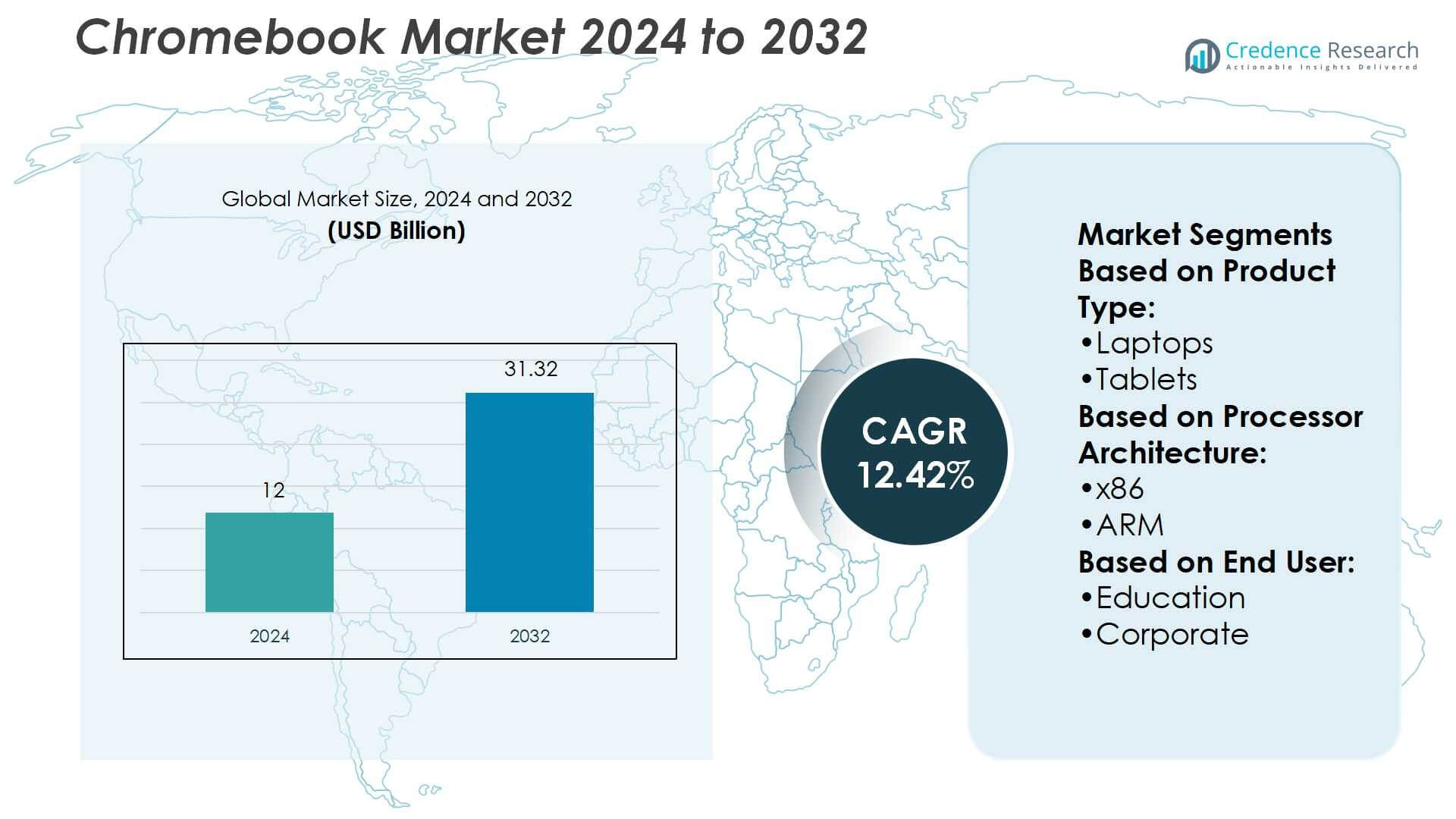
Chromebook Market size was valued USD 12 billion in 2024 and is anticipated to reach USD 31.32 billion by 2032, at a CAGR of 12.42% during the forecast period.
| REPORT ATTRIBUTE | DETAILS |
|---|---|
| Historical Period | 2020-2023 |
| Base Year | 2024 |
| Forecast Period | 2025-2032 |
| Chromebook Market Size 2024 | USD 12 Billion |
| Chromebook Market, CAGR | 12.42% |
| Chromebook Market Size 2032 | USD 31.32 Billion |
The Chromebook Market features strong competition among top players such as HP Inc., Dell Technologies, Lenovo Group, Acer Inc., Samsung Electronics, and ASUS. These companies focus on product innovation, affordability, and integration with cloud-based platforms to strengthen their market positions. Education remains the primary growth driver, prompting vendors to form strategic partnerships with schools and governments for bulk deployments. Among regions, North America leads the global Chromebook Market with a 38% share, supported by large-scale adoption in the U.S. education sector and rising demand from enterprises embracing hybrid work environments.
Market Insights
- The Chromebook Market was valued at USD 12 billion in 2024 and is projected to reach USD 31.32 billion by 2032, registering a CAGR of 12.42%.
- Education is the dominant driver, holding over 55% share, supported by bulk purchases and digital learning initiatives worldwide.
- Market trends highlight rising adoption of ARM-based Chromebooks for energy efficiency and the growing demand for hybrid learning and work solutions.
- Competitive dynamics involve HP Inc., Dell Technologies, Lenovo Group, Acer Inc., Samsung Electronics, and ASUS focusing on product innovation, affordability, and cloud integration.
- North America leads the global market with a 38% share, fueled by strong adoption in the U.S. education sector, while Asia-Pacific accounts for 28% share driven by rapid digitalization and growing student enrollments.
Market Segmentation Analysis:
By Product Type
In the Chromebook Market, laptops dominate the product type segment with nearly 65% share. Their strong adoption stems from affordability, robust battery life, and compatibility with cloud-based applications. Education institutions, in particular, prefer laptops due to their ease of deployment and ability to support collaborative learning environments. Tablets and convertibles/2-in-1 devices are growing segments, driven by flexibility and mobility needs, but laptops remain the leading choice. Their cost-effectiveness and scalability continue to drive adoption across both developed and emerging economies, reinforcing their leading market position.
- For instance, Dell’s Chromebook 3110 2-in-1 weighs 1.42 kg and offers up to 12 hours battery life under typical workloads, making it easy to carry and use throughout a school day. Tablets and convertibles/2-in-1 devices are growing segments, driven by flexibility and mobility needs, but laptops remain the leading choice.
By Processor Architecture
x86-based Chromebooks lead the market with close to 70% share, supported by Intel’s strong processor ecosystem and compatibility with productivity software. The architecture delivers higher performance for multitasking and enterprise-grade applications, which strengthens adoption in education and corporate sectors. ARM-based Chromebooks are expanding in share, fueled by their energy efficiency and cost advantages. They are gaining momentum in consumer segments focused on mobility and longer battery life. Despite this, x86 processors maintain dominance due to established OEM partnerships, consistent performance benchmarks, and integration with widely used enterprise applications.
- For instance, Singtel’s Paragon platform spans 428 points of presence in 362 cities, enabling enterprise services like edge compute and network slicing across its footprint.
By End-User
Education is the dominant end-user segment, accounting for over 55% of the Chromebook Market share. The preference is driven by large-scale government-backed digital learning initiatives and school modernization programs. Chromebooks provide a secure, low-maintenance, and budget-friendly solution, making them highly attractive for academic institutions. The corporate and consumer segments are witnessing steady growth as businesses adopt cloud-first strategies and consumers value lightweight devices. However, education continues to lead due to bulk purchasing programs, strong integration with learning management systems, and rising demand for affordable digital education tools worldwide.
 Key Growth Drivers
Rising Demand in Education Sector
The Chromebook Market is significantly driven by rising adoption in the education sector. Governments and institutions are promoting digital learning, fueling bulk purchases of cost-effective Chromebooks. Their ease of management, fast boot times, and integration with cloud-based tools make them ideal for classroom environments. With strong compatibility with Google Workspace for Education and secure remote updates, schools are increasingly investing in these devices. Growing focus on e-learning and hybrid teaching models further supports demand, making education the most influential growth driver.
- For instance, EchoStar’s subsidiary Hughesnet donated 1,000 STEM education kits to students across America via its National 4-H partnership. Schools receiving kits could engage hands-on learning in science & tech fields.
Growing Corporate Adoption of Cloud-Based Solutions
Businesses adopting cloud-first strategies are boosting Chromebook adoption across corporate environments. Chromebooks offer seamless integration with cloud platforms, enabling remote collaboration and secure data access. Enterprises benefit from lower total cost of ownership, as Chromebooks require minimal IT maintenance and support. Strong performance in web-based applications and virtual desktops is expanding their use for enterprise mobility. Rising demand for secure and lightweight devices in hybrid workplaces reinforces corporate uptake, making this a major driver for long-term market growth.
- For instance, SpaceX launched 134 missions with its Falcon family of rockets. These missions delivered approximately 1,500 metric tonnes of payload to orbit, demonstrating a highly repeatable infrastructure build-out.
Cost-Effectiveness and Long Battery Life
Affordability and extended battery performance are critical growth drivers in the Chromebook Market. These devices deliver value by offering lower upfront costs compared to traditional laptops. Long-lasting battery capacity ensures high productivity for both students and professionals without frequent charging. Cost efficiency also appeals to large-scale deployments in education and government sectors. Combined with durability and automatic updates, Chromebooks reduce operational costs and downtime, strengthening their appeal. This balance of affordability and functionality drives widespread adoption across global end-user segments.
Key Trends & Opportunities
Shift Toward Hybrid Learning and Work Models
Hybrid learning in education and hybrid work in enterprises are creating strong opportunities for Chromebook adoption. Institutions and companies need affordable devices that support video conferencing, cloud-based collaboration, and remote management. Chromebooks meet these requirements with lightweight design, strong security features, and easy scalability. The rise of remote classrooms and distributed teams highlights the demand for cost-effective and portable solutions. This trend ensures steady growth as both students and professionals rely on flexible, cloud-enabled devices to meet their productivity needs.
- For instance, The Suape Port network, which operates in the 3.5 GHz band, effectively demonstrates the use of private 5G to support mission-critical enterprise applications, including automation, safety, and efficiency.
Emergence of ARM-Powered Chromebooks
The growing interest in ARM-based processors presents a strong opportunity for the Chromebook Market. ARM-powered devices deliver energy efficiency, extended battery life, and competitive pricing compared to x86 models. This architecture is gaining traction among consumers seeking lightweight, mobile-first computing. With chipmakers investing in higher-performance ARM designs, Chromebooks are expanding into mainstream usage. This trend aligns with sustainability goals and consumer demand for portable devices. The rise of ARM adoption also enhances vendor competition, fostering product diversity and innovation.
- For instance, The ViaSat-2 satellite has throughput of about 300 Gbit/s at design, though due to anomalies in two Ka-band antennae actual throughput dropped to around 260 Gbit/s.
Key Challenges
Competition from Traditional Laptops and Tablets
The Chromebook Market faces strong competition from traditional laptops and tablets that offer broader software compatibility and higher processing power. While Chromebooks are effective for web-based and educational applications, many users prefer Windows or macOS for advanced tasks. Tablets with detachable keyboards also provide similar mobility with wider app ecosystems. This competitive pressure limits Chromebook adoption in some consumer and enterprise segments. To sustain growth, manufacturers must enhance performance, expand offline capabilities, and differentiate offerings against established computing devices.
Dependence on Internet Connectivity
A major challenge for Chromebooks is their dependence on stable internet connections for optimal functionality. Although offline features have improved, many productivity tools and applications still rely heavily on cloud access. In regions with poor connectivity, this limits their usability and appeal. Students and professionals in remote areas may struggle to maximize the device’s potential, slowing adoption rates. Vendors must continue developing robust offline capabilities and partner with connectivity providers to address this barrier. Overcoming this issue is crucial for wider global expansion.
Regional Analysis
North America
North America holds a dominant position in the Chromebook Market with a 38% share. Strong adoption in the education sector, driven by government-funded digital learning initiatives, supports this lead. The U.S. remains the largest contributor, as school districts prefer bulk purchases for cost efficiency and simplified IT management. Corporate adoption is also rising, fueled by hybrid work trends and the demand for secure cloud-based devices. Technology partnerships between Chromebook manufacturers and educational institutions further strengthen growth. Continuous innovation from leading OEMs sustains the region’s leadership in both education and enterprise usage.
Europe
Europe accounts for 25% of the global Chromebook Market share, supported by increasing integration of digital learning tools across schools and universities. The United Kingdom, Germany, and France lead adoption, driven by government initiatives to modernize classrooms and promote remote education. Demand for secure, low-maintenance devices supports Chromebook penetration in corporate environments as well. The region also benefits from growing emphasis on cost-effective IT infrastructure in public institutions. Rising awareness of sustainability and energy efficiency aligns with Chromebook features, making them attractive to environmentally conscious buyers in both education and enterprise sectors.
Asia-Pacific
Asia-Pacific captures 28% of the Chromebook Market, driven by large-scale adoption in education across countries such as India, Japan, and South Korea. The region benefits from strong government support for digital education programs and rising student enrollments in online learning. Growing demand for affordable devices fuels expansion in emerging economies, while advanced markets emphasize hybrid learning and workplace mobility. Chromebooks’ cost efficiency, lightweight design, and integration with cloud platforms strengthen adoption across both education and corporate sectors. Rising internet penetration and rapid digitalization initiatives ensure continued momentum, positioning Asia-Pacific as a high-growth region in the forecast period.
Latin America
Latin America represents 5% of the Chromebook Market share, with growth largely concentrated in education sectors of Brazil, Mexico, and Argentina. Government-backed programs to expand digital access in schools are key drivers of adoption. Cost-effectiveness and simplified IT management make Chromebooks suitable for large-scale deployments in resource-constrained institutions. However, limited internet connectivity in rural areas poses a barrier to broader market penetration. Despite challenges, increasing investment in digital infrastructure and growing consumer interest in affordable cloud-enabled devices are expected to support steady growth, with education continuing as the dominant application segment across the region.
Middle East & Africa
The Middle East & Africa holds 4% of the Chromebook Market share, with adoption at an early stage compared to other regions. Demand is primarily concentrated in government and public sector programs aimed at improving digital access in education. Countries like the UAE and South Africa are emerging hotspots due to rising investments in e-learning platforms and infrastructure. Affordability and durability of Chromebooks make them appealing in budget-sensitive markets, but limited connectivity and reliance on traditional devices hinder wider adoption. As internet penetration expands, the region presents opportunities for gradual growth in both education and enterprise segments.
Market Segmentations:
By Product Type:
- Laptops
- Tablets
By Processor Architecture:
- x86
- ARM
By End User:
- Education
- Corporate
By Geography
- North America
- U.S.
- Canada
- Mexico
- Europe
- UK
- France
- Germany
- Italy
- Spain
- Russia
- Rest of Europe
- Asia Pacific
- China
- Japan
- South Korea
- India
- Australia
- Southeast Asia
- Rest of Asia Pacific
- Latin America
- Brazil
- Argentina
- Rest of Latin America
- Middle East
- GCC Countries
- Israel
- Turkey
- Rest of Middle East
- Africa
- South Africa
- Egypt
- Rest of Africa
Competitive Landscape
The Chromebook Market players such as Freedomsat, Hughes Network Systems LLC, Singtel, EchoStar Corporation, SpaceX, Embratel, Viasat Inc., Telesat, Starlink, and Speedcast. The Chromebook Market is highly competitive, shaped by strong participation from global OEMs, software providers, and cloud service companies. Manufacturers focus on product innovation, expanding device performance, and enhancing battery efficiency to meet evolving user demands. Education remains the largest revenue-generating segment, encouraging vendors to form partnerships with schools and government bodies for bulk deployments. At the same time, rising adoption in corporate and consumer segments pushes companies to introduce models with improved processing power and offline capabilities. Competitive strategies include aggressive pricing, sustainability-focused designs, and integration with cloud-based ecosystems to strengthen market presence worldwide.
Key Player Analysis
- Freedomsat
- Hughes Network Systems LLC
- Singtel
- EchoStar Corporation
- SpaceX
- Embratel
- Viasat Inc.
- Telesat
- Starlink
- Speedcast
Recent Developments
- In April 2025, Amazon's Project Kuiper successfully launched its KA-01 mission, deploying 27 LEO satellites as part of a 3,200-satellite constellation plan. This marks the beginning of full-scale operations, with service expected to begin later this year, enhancing global broadband coverage and competition.
- In March 2025, Jio Platforms and Bharti Airtel partnered with SpaceX’s Starlink to launch satellite internet services in India. This collaboration addresses challenges in spectrum allocation and aims to provide high-speed connectivity to rural regions where traditional networks face limitations.
- In November 2024, BSNL, in collaboration with Viasat, launched India’s first satellite-to-device service using L-band geostationary satellites. This two-way communication system enables connectivity in remote areas without cellular or Wi-Fi. It supports emergency calls, messaging, and digital payments, advancing India’s non-terrestrial network capabilities.
- In January 2024, Singtel collaborates with Starlink to boost maritime digital solutions, integrating AI, 5G, and edge computing for improved safety and efficiency. Starlink's LEO broadband service enhances connectivity, enabling real-time data analysis and cost reduction.
Report Coverage
The research report offers an in-depth analysis based on Product Type, Processing Architecture, End-User and Geography. It details leading market players, providing an overview of their business, product offerings, investments, revenue streams, and key applications. Additionally, the report includes insights into the competitive environment, SWOT analysis, current market trends, as well as the primary drivers and constraints. Furthermore, it discusses various factors that have driven market expansion in recent years. The report also explores market dynamics, regulatory scenarios, and technological advancements that are shaping the industry. It assesses the impact of external factors and global economic changes on market growth. Lastly, it provides strategic recommendations for new entrants and established companies to navigate the complexities of the market.
Future Outlook
- The education sector will remain the leading driver of Chromebook demand worldwide.
- Corporate adoption will expand as businesses prioritize cloud-first strategies and hybrid work models.
- ARM-based Chromebooks will gain share due to energy efficiency and competitive pricing.
- Enhanced offline features will increase device appeal in regions with limited internet access.
- Government-backed digital learning initiatives will support large-scale deployments in developing economies.
- Sustainability-focused designs will strengthen Chromebook adoption among environmentally conscious buyers.
- Partnerships between OEMs and cloud service providers will improve integration and performance.
- Rising consumer preference for affordable, lightweight devices will fuel steady market penetration.
- Connectivity improvements from satellite and 5G networks will expand Chromebook usability in remote areas.
- Continuous innovations in battery life and processing power will drive long-term market growth.

Request a Free Sample
Fill in your details and we'll send you a free sample report.
- Sample data tables & charts
- Research methodology
Market Dynamics
Education Sector Digitalization
Government-backed digital learning initiatives and school modernization programs are driving large-scale Chromebook deployments, especially due to their affordability, ease of management, and integration with cloud-based educational tools.
Corporate Cloud Adoption
Businesses are increasingly adopting cloud-first strategies and hybrid work models, making Chromebooks attractive for their seamless cloud integration, low IT maintenance, and secure remote collaboration capabilities.
Cost-Effectiveness and Battery Life
Chromebooks offer lower upfront costs and extended battery performance compared to traditional laptops, making them ideal for bulk purchases in education and government sectors, as well as appealing to cost-conscious consumers.
Hybrid Learning and Work Trends
The shift toward hybrid learning in schools and hybrid work in enterprises is boosting demand for portable, secure, and cloud-enabled devices like Chromebooks, which support video conferencing and remote management.
Emergence of ARM-Based Chromebooks
The growing adoption of ARM processors in Chromebooks is enhancing energy efficiency, reducing device costs, and meeting consumer demand for lightweight, mobile-first computing, thereby expanding the market's reach.
Need a Custom Version of This Report?
Tailor the scope, geography, or segments to your exact requirements.
- Custom geography or segment scope
- Direct access to our analyst team
Frequently Asked Questions
What is the current market size for Chromebook Market, and what is its projected size in 2032?
At what Compound Annual Growth Rate is the Chromebook Market projected to grow between 2025 and 2032?
Which Chromebook Market segment held the largest share in 2024?
What are the primary factors fueling the growth of the Chromebook Market?
Who are the leading companies in the Chromebook Market?
Which region commanded the largest share of the Chromebook Market in 2024?
Table of Content
Chapter 1 Market Segmentation
- 1.1 Segmentation Framework
- 1.1.1 Product and Service Classification
- 1.1.2 Application and End-Use Classification
- 1.1.3 Technology and Solution Classification
- 1.1.4 Customer and Distribution Channel Classification
- 1.1.5 Geographic Segmentation
- 1.1.6 Market Segment Definitions and Boundaries
- 1.2 By End User
- 1.2.1 Education
- 1.2.2 Corporate
- 1.2.3 Consumer
- 1.3 By Product Type
- 1.3.1 Laptops
- 1.3.2 Tablets
- 1.3.3 Convertibles/2-in-1 Devices
- 1.4 By Processor Architecture
- 1.4.1 x86
- 1.4.2 ARM
Chapter 2 Introduction
- 2.1 Report Objectives and Scope
- 2.2 Product Definition and Industry Terminology
- 2.3 Market Inclusions and Exclusions
- 2.4 Research Process
- 2.4.1 Primary Research and Expert Interviews
- 2.4.2 Secondary Research and Source Review
- 2.4.3 Top-Down and Bottom-Up Estimation
- 2.4.4 Data Triangulation and Verification
- 2.5 Market Size Measurement Basis
- 2.5.1 2024: USD 12 billion → 2032: USD 31.32 billion
- 2.6 Historical and Forecast Reference Periods
- 2.6.1 Base Year: 2024
- 2.6.2 Forecast Period: 2024-2032
- 2.7 Research Assumptions and Limitations
Chapter 3 Executive Summary
- 3.1 Market Snapshot and Key Findings
- 3.2 Base-Year Market Size, 2024
- 3.3 Forecast Market Size, 2032
- 3.4 Revenue and Volume Growth Outlook
- 3.5 Key Demand and Supply Indicators
- 3.6 Leading Market Segments
- 3.7 Fastest-Growing Market Opportunities
- 3.8 Regional Performance Highlights
- 3.9 Technology and Industry Transformation
- 3.10 Competitive Landscape Summary
- 3.11 Analyst View and Strategic Implications
Chapter 4 Global Chromebook Market Trends and Developments
- 4.1 Historical Industry Development
- 4.2 Recent Market Trends and Developments
- 4.3 Demand and Customer Behavior Trends
- 4.4 Technology and Product Innovation
- 4.5 Artificial Intelligence, Automation and Digitalization
- 4.6 Local Manufacturing and Supply Chain Realignment
- 4.7 Industry Partnerships, Mergers and Acquisitions
- 4.8 Sustainability and Circular Economy Developments
- 4.9 Government and Private Sector Investment Trends
- 4.10 Emerging Business Models and Commercialization
- 4.11 Industry Developments and Announcements
Chapter 5 Global Chromebook Market Production, Supply and Demand Analysis
- 5.1 Demand Trend and Consumption Analysis
- 5.2 Demand Forecast, 2024-2032
- 5.3 Production and Output Trend
- 5.4 Production and Output Forecast, 2024-2032
- 5.5 Installed Capacity and Capacity Utilization
- 5.6 Company-Wise Production Plants and Statistics
- 5.6.1 Installed Production Capacity
- 5.6.2 Actual Production
- 5.6.3 Planned Capacity and Expansion Targets
- 5.7 Supply Chain Structure and Procurement Trends
- 5.8 Supply-Demand Gap and Bottlenecks
- 5.9 Import Dependence and Sourcing Structure
- 5.10 Contract Manufacturing and Outsourcing
- 5.11 Regional Supply and Demand Concentration
Chapter 6 Global Chromebook Market Pricing Analysis
- 6.1 Pricing Structure and Measurement
- 6.2 Historical Pricing Trends
- 6.3 Pricing Outlook, 2024-2032
- 6.4 Average Selling Price and Unit Economics
- 6.5 Pricing by Product and Market Segment
- 6.6 Geographic Pricing Differences
- 6.7 Key Input, Energy, Labor and Logistics Costs
- 6.8 Contract Pricing and Purchasing Models
- 6.9 Pricing Sensitivity and Competitive Positioning
- 6.10 Price, Margin and Profitability Implications
Chapter 7 Global Chromebook Market Dynamics
- 7.1 Market Growth Drivers
- 7.1.1 Demand-Side Drivers
- 7.1.2 Technology and Innovation Drivers
- 7.1.3 Infrastructure and Investment Drivers
- 7.1.4 Regulatory and Policy Drivers
- 7.2 Market Restraints
- 7.2.1 Cost and Affordability Constraints
- 7.2.2 Technology and Adoption Barriers
- 7.2.3 Supply Chain and Operational Constraints
- 7.3 Market Challenges
- 7.3.1 Competitive Pressure and Margin Erosion
- 7.3.2 Skills, Infrastructure and Implementation Gaps
- 7.4 Emerging Market Opportunities
- 7.5 Market Dynamics Impact and Time-Horizon Assessment
Chapter 8 Global Chromebook Value Chain Analysis
- 8.1 Industry Value Chain Overview
- 8.2 Upstream Suppliers and Critical Inputs
- 8.3 Technology and Component Providers
- 8.4 Manufacturing or Service Delivery
- 8.5 Distribution, Channel Partners and Integrators
- 8.6 Downstream Applications and End Users
- 8.7 Value Addition and Profit Pools
- 8.8 Vertical Integration and Outsourcing
- 8.9 Supplier Concentration and Risk
- 8.10 Supply Chain Localization and Resilience
Chapter 9 Global Chromebook Market Regulations and Policies
- 9.1 Relevant Laws, Standards and Compliance Frameworks
- 9.2 Product, Service, Safety and Quality Requirements
- 9.3 Government Policies, Incentives and Subsidies
- 9.4 Imports, Exports and Trade Barriers
- 9.5 Public Procurement and Local Content Requirements
- 9.6 Environmental and Sustainability Compliance
- 9.7 Upcoming Policy Changes and Market Implications
Chapter 10 Global Chromebook Market Hotspots and Opportunities
- 10.1 Market Opportunity Mapping and Growth Hotspots
- 10.2 High-Growth Applications and Customer Groups
- 10.3 Underserved Markets and White-Space Opportunities
- 10.4 Emerging Technology and Product Opportunities
- 10.5 New Capacity and Investment Hotspots
- 10.6 Market Entry and Expansion Opportunities
- 10.7 Distribution and Partnership Opportunities
- 10.8 Near-Term and Long-Term Commercial Potential
- 10.9 Opportunity Attractiveness and Execution Risks
Chapter 11 Global Chromebook Market Outlook, 2024-2032
- 11.1 Market Size and Analysis
- 11.1.1 Revenue (Market Measurement: 2024: USD 12 billion → 2032: USD 31.32 billion)
- 11.1.2 Market Volume and Quantity Sold
- 11.1.3 Historical Market Size
- 11.1.4 Base-Year Market Size, 2024
- 11.2 Market Forecast, 2024-2032
- 11.2.1 Revenue Forecast to 2032
- 11.2.2 Volume Forecast to 2032
- 11.2.3 CAGR and Year-on-Year Growth
- 11.2.4 Incremental Revenue Opportunity
- 11.3 Forecast Assumptions and Scenario Analysis
- 11.3.1 Base-Case Forecast
- 11.3.2 Optimistic and Conservative Scenarios
- 11.3.3 Technology, Pricing and Policy Sensitivities
- 11.4 Market Attractiveness and Growth Outlook
Chapter 12 Global Chromebook Market Segmentation and Outlook
- 12.1 Segmentation Summary and Market Shares, 2024
- 12.2 Largest and Fastest-Growing Segments
- 12.3 By End User - Market Size and Forecast, 2024-2032
- 12.3.1 Segment Definition and Scope
- 12.3.2 Historical Market Size
- 12.3.3 Revenue Forecast, 2024-2032
- 12.3.4 Volume Forecast, 2024-2032
- 12.3.5 Base-Year Market Share, 2024
- 12.3.6 Segment CAGR and Growth Drivers
- 12.3.7 Subsegment Market Size and Forecast
- 12.3.7.1 Education
- 12.3.7.2 Corporate
- 12.3.7.3 Consumer
- 12.3.8 Subsegment Pricing and Adoption Trends
- 12.3.9 Leading Suppliers and Competition
- 12.3.10 Regional Demand and Opportunities
- 12.4 By Product Type - Market Size and Forecast, 2024-2032
- 12.4.1 Segment Definition and Scope
- 12.4.2 Historical Market Size
- 12.4.3 Revenue Forecast, 2024-2032
- 12.4.4 Volume Forecast, 2024-2032
- 12.4.5 Base-Year Market Share, 2024
- 12.4.6 Segment CAGR and Growth Drivers
- 12.4.7 Subsegment Market Size and Forecast
- 12.4.7.1 Laptops
- 12.4.7.2 Tablets
- 12.4.7.3 Convertibles/2-in-1 Devices
- 12.4.8 Subsegment Pricing and Adoption Trends
- 12.4.9 Leading Suppliers and Competition
- 12.4.10 Regional Demand and Opportunities
- 12.5 By Processor Architecture - Market Size and Forecast, 2024-2032
- 12.5.1 Segment Definition and Scope
- 12.5.2 Historical Market Size
- 12.5.3 Revenue Forecast, 2024-2032
- 12.5.4 Volume Forecast, 2024-2032
- 12.5.5 Base-Year Market Share, 2024
- 12.5.6 Segment CAGR and Growth Drivers
- 12.5.7 Subsegment Market Size and Forecast
- 12.5.7.1 x86
- 12.5.7.2 ARM
- 12.5.8 Subsegment Pricing and Adoption Trends
- 12.5.9 Leading Suppliers and Competition
- 12.5.10 Regional Demand and Opportunities
- 12.6 Segment Growth Comparison
- 12.7 Segment Attractiveness and Priority Matrix
Chapter 13 Global Chromebook End-Use and Application Market Outlook
- 13.1 End-Use Industry and Customer Demand Structure
- 13.2 Leading Applications and Customer Groups
- 13.3 End-Use Market Size, Share and Forecast
- 13.4 Major End-Use Industry Deep Dives
- 13.4.1 Customer Requirements and Use Cases
- 13.4.2 Demand and Replacement Cycles
- 13.4.3 Technical and Regulatory Considerations
- 13.4.4 Purchasing and Procurement Models
- 13.4.5 Leading Vendors and Distribution Channels
- 13.4.6 Forecast and Commercial Opportunities
- 13.5 Emerging Applications and Cross-Segment Demand
- 13.6 End-Use Industry Investment Priorities
Chapter 14 Global Chromebook Geographic Market Outlook, 2024-2032
- 14.1 Regional Market Size and Share, 2024
- 14.2 Regional Market Forecast, 2024-2032
- 14.3 Regional Pricing, Production and Demand Differences
- 14.4 North America
- 14.4.1 United States
- 14.4.2 Canada
- 14.4.3 Mexico
- 14.5 Europe
- 14.5.1 Germany
- 14.5.2 France
- 14.5.3 Italy
- 14.5.4 United Kingdom
- 14.5.5 Spain
- 14.5.6 Poland
- 14.5.7 Russia
- 14.5.8 Netherlands
- 14.5.9 Belgium
- 14.5.10 Sweden
- 14.5.11 Denmark
- 14.5.12 Norway
- 14.5.13 Rest of Europe
- 14.6 Asia Pacific
- 14.6.1 China
- 14.6.2 India
- 14.6.3 Japan
- 14.6.4 South Korea
- 14.6.5 Thailand
- 14.6.6 Indonesia
- 14.6.7 Vietnam
- 14.6.8 Malaysia
- 14.6.9 Australia
- 14.6.10 Rest of Asia Pacific
- 14.7 Latin America
- 14.7.1 Brazil
- 14.7.2 Argentina
- 14.7.3 Colombia
- 14.7.4 Chile
- 14.7.5 Rest of Latin America
- 14.8 Middle East
- 14.8.1 Saudi Arabia
- 14.8.2 United Arab Emirates
- 14.8.3 Turkey
- 14.8.4 Israel
- 14.8.5 Iran
- 14.8.6 Rest of the Middle East
- 14.9 Africa
- 14.9.1 South Africa
- 14.9.2 Egypt
- 14.9.3 Nigeria
- 14.9.4 Morocco
- 14.9.5 Rest of Africa
- 14.10 Regional Investment, Policy and Supply Chain Differences
- 14.11 Regional Competitive Landscape
- 14.12 Geographic Growth Hotspots
Chapter 15 Global Chromebook Technology, Innovation and Sustainability Outlook
- 15.1 Technology Landscape and Maturity
- 15.2 Product, Process and Service Innovation
- 15.3 AI, Automation and Digital Tools in the Industry
- 15.4 Technology Adoption and Performance Benchmarking
- 15.5 Innovation Pipeline and R&D Investment
- 15.6 Patent and Intellectual Property Trends
- 15.7 Energy Efficiency and Resource Management
- 15.8 Sustainability, Recycling and Circularity
- 15.9 Technology Roadmap, 2024-2032
- 15.10 Risks of Obsolescence and Technology Substitution
Chapter 16 Global Chromebook Market Key Strategic Imperatives
- 16.1 Growth and Market Entry Priorities
- 16.2 High-Return Products and Segments
- 16.3 Pricing, Profitability and Cost Optimization
- 16.4 Technology Investment and Product Differentiation
- 16.5 Supply Chain Localization and Resilience
- 16.6 Distribution and Customer Acquisition
- 16.7 Partnership, Acquisition and Capacity Strategy
- 16.8 Regional Expansion Priorities
- 16.9 Short-, Medium- and Long-Term Actions
Chapter 17 Competition Outlook
- 17.1 Industry Competition Characteristics
- 17.2 Market Structure and Concentration
- 17.3 Market Share and Competitive Positioning, 2024
- 17.4 Company-Wise Revenue and Product Benchmarking
- 17.5 Production and Service Capacity Benchmarking
- 17.6 Technology, Pricing and Differentiation
- 17.7 Regional Footprint and Distribution Strength
- 17.8 Mergers, Acquisitions and Strategic Alliances
- 17.9 New Entrants and Competitive Threats
- 17.10 Porter's Five Forces and Industry Attractiveness
- 17.11 Competitive Outlook, 2024-2032
Chapter 18 Company Profiles
- 18.1 Company Coverage and Selection Criteria
- 18.2 HP Inc.
- 18.2.1 Business Description
- 18.2.2 Company Ownership and Geographic Presence
- 18.2.3 Product and Service Portfolio
- 18.2.4 Manufacturing and Operating Footprint
- 18.2.5 Production Capacity and Expansion Plans
- 18.2.6 Financial Performance and Investment
- 18.2.7 Market Share and Competitive Position
- 18.2.8 Technology and Innovation Capabilities
- 18.2.9 Strategic Alliances or Partnerships
- 18.2.10 Recent Developments
- 18.2.11 Growth Strategy and Outlook
- 18.3 Dell Technologies
- 18.4 Lenovo Group
- 18.5 Acer Inc.
- 18.6 Samsung Electronics
- 18.7 ASUS
- 18.8 Google
- 18.9 Microsoft
- 18.10 Apple
- 18.11 Toshiba
- 18.12 Other Relevant Market Participants
Note: Every listed company is profiled on the structure shown under the first company. The company list is preliminary and may change based on research findings, market developments, data availability and client requirements.
Chapter 19 Disclaimer
- 19.1 Research and Forecast Disclaimer
- 19.2 Data Source and Estimation Limitations
Note: The depth of individual sections depends on data availability for this market. Volume, capacity, trade and other unit-based metrics are included where applicable.

