Colposcopy Devices Market Overview:
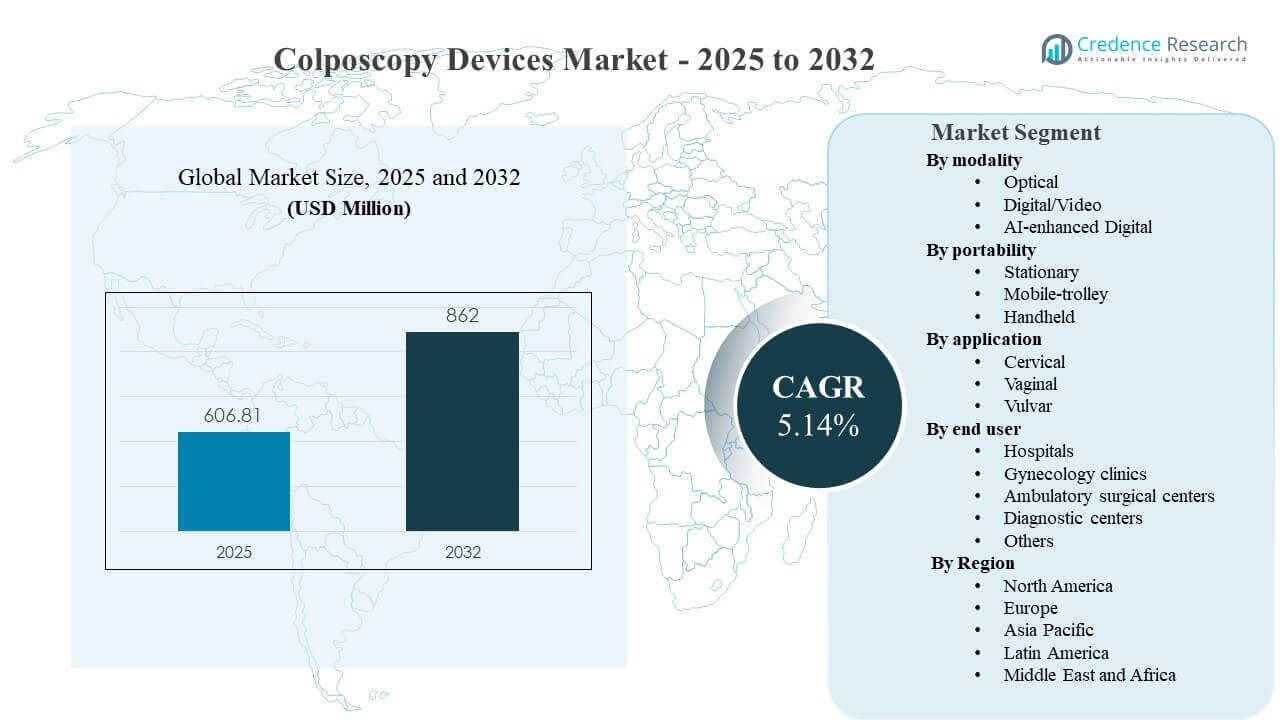
The global Colposcopy Devices Market size was estimated at USD 606.81 million in 2025 and is expected to reach USD 862 million by 2032, growing at a CAGR of 5.14% from 2025 to 2032. Growth is primarily supported by expanding cervical cancer screening coverage and follow-up diagnostics demand, which increases procedure volumes across hospital and outpatient gynecology settings. Upgrades from optical systems to digital and AI-enabled visualization also support replacement demand as providers prioritize documentation, consistency, and workflow efficiency.
| REPORT ATTRIBUTE | DETAILS |
|---|---|
| Historical Period | 2020-2024 |
| Base Year | 2025 |
| Forecast Period | 2026-2032 |
| Colposcopy Devices Market Size 2025 | USD 606.81 million |
| Colposcopy Devices Market, CAGR | 5.14% |
| Colposcopy Devices Market Size 2032 | USD 862 million |
Key Market Trends & Insights
- The Colposcopy Devices Market is projected to grow from USD 606.81 million (2025) to USD 862 million (2032), reflecting a 5.14% CAGR (2025–2032).
- Optical modality accounted for the largest share of 53.80% in 2025, supported by a large installed base and cost-effective deployment in routine screening settings.
- Stationary systems represented 41.90% share in 2025, reflecting continued preference in high-volume examination rooms with standardized setups.
- Cervical applications held 65.40% share in 2025, anchored by colposcopy’s central role in evaluating abnormal cervical screening results.
- North America contributed 36.30% share in 2025, supported by structured screening pathways, established gynecology infrastructure, and stronger replacement cycles.
Segment Analysis
Colposcopy Devices Market segmentation reflects a market balancing legacy optical workflows with accelerating digitization in clinical documentation and referral pathways. Optical platforms remain widely used in routine examinations, but digital/video adoption continues to expand where image capture, standardized reporting, and remote case review improve clinical coordination. AI-enabled imaging is gaining interest in settings seeking greater diagnostic consistency and triage support, particularly as screening volumes rise and quality metrics tighten.
Portability trends are shaped by care decentralization and capacity constraints across women’s health clinics. Stationary systems remain important for high-throughput centers, but mobile-trolley units support room-to-room utilization inside facilities, and handheld devices enable outreach screening and deployment in space-constrained clinics. Application demand is led by cervical evaluation, with vaginal and vulvar examinations representing smaller but clinically important use cases where lesion assessment and differential diagnosis are required.
By Modality Insights
Optical accounted for the largest share of 53.80% in 2025. Optical systems remain preferred for routine colposcopy due to familiarity among clinicians, reliable visualization performance, and comparatively lower acquisition and maintenance requirements. Colposcopy Devices Market procurement in many facilities still prioritizes dependable core visualization over advanced analytics when budgets are constrained. Digital and AI-enhanced upgrades typically gain traction where documentation needs, remote consultation, and multi-site standardization are prioritized.
By Portability Insights
Stationary accounted for the largest share of 41.90% in 2025. Stationary systems are commonly selected for dedicated gynecology examination rooms that emphasize consistent setup, stable imaging, and high patient throughput. Colposcopy Devices Market adoption of stationary units is supported by replacement cycles in established hospital and specialty clinic environments. Mobile-trolley and handheld systems expand access by improving within-facility flexibility and enabling decentralized screening workflows across clinics and outreach programs.
By Application Insights
Cervical accounted for the largest share of 65.40% in 2025. Cervical evaluation remains the primary use case because colposcopy is integral to confirming and characterizing abnormalities identified through screening pathways. Colposcopy Devices Market demand for cervical applications is reinforced by expanding screening coverage and the need for timely follow-up in referral networks. Vaginal and vulvar applications represent smaller shares but remain important in specialty care for targeted lesion visualization and guided assessment.
By End User Insights
Hospitals, gynecology clinics, ambulatory surgical centers, and diagnostic centers represent distinct demand pools shaped by procedure volume, referral patterns, and budget cycles. Hospitals typically concentrate biopsy capability and complex case management, supporting consistent utilization for confirmation workflows. Gynecology clinics drive demand where screening is decentralized and appointment access favors outpatient settings. Ambulatory surgical centers contribute when procedures align with scheduled interventions, and diagnostic centers expand in markets building standalone women’s health diagnostic capacity.
Colposcopy Devices Market Drivers
Expansion of cervical cancer screening and follow-up diagnostics
Colposcopy Devices Market growth is driven by expanding screening coverage and the resulting increase in diagnostic follow-up volume. Health systems that raise screening participation also increase colposcopy demand for confirmation and targeted assessment. Referral pathways prioritize timely evaluation, which supports higher procedure throughput in outpatient gynecology settings. Colposcopy Devices Market demand strengthens when screening programs focus on reducing loss to follow-up through streamlined diagnostics and care coordination.
- For instance, DYSIS Medical reported in the IMPROVE-COLPO study that across 7,555 women evaluated by 159 providers at 45 clinics, the addition of map-assisted biopsies increased CIN2+ detection by 44%, showing how larger screening pathways can translate into greater follow-up diagnostic yield.
Shift toward digital documentation and workflow standardization
Colposcopy Devices Market adoption is supported by increasing preference for digital documentation, image capture, and standardized reporting. Digital/video systems simplify recordkeeping and enable consistent documentation across multi-provider practices. Remote case review and referral coordination also improve when images and reports are shareable within clinical networks. Colposcopy Devices Market replacement cycles accelerate when providers prioritize efficiency, reproducibility, and improved communication across care settings.
Rising interest in decision support and AI-enabled visualization
Colposcopy Devices Market expansion is supported by growing interest in tools that improve diagnostic consistency and triage support. AI-enhanced digital platforms are increasingly positioned to reduce variability in interpretation and support quality initiatives. Sites managing high screening volumes are more likely to evaluate decision-support capabilities when staffing constraints increase. Colposcopy Devices Market demand improves when AI functionality integrates smoothly into clinical workflows without adding operational burden.
- For instance, MobileODT announced a large-scale AI screening deployment with Apollo Hospitals in India designed to screen up to 250 women per day, reflecting how high-volume care sites are testing AI-supported visualization and triage within routine workflows.
Growth of outpatient care delivery and decentralized women’s health services
Colposcopy Devices Market growth is also supported by the expansion of outpatient care models and decentralized women’s health services. Gynecology clinics and diagnostic centers increasingly absorb routine diagnostic volume to reduce hospital congestion. Portability options improve access in space-limited clinics and enable outreach screening in underserved areas. Colposcopy Devices Market utilization increases when portable platforms support screening expansion without requiring major facility redesign.
Colposcopy Devices Market Challenges
Colposcopy Devices Market adoption faces cost and procurement constraints that can slow upgrades from optical systems to digital and AI-enabled platforms. Capital budgets in many facilities prioritize broader imaging and surgical investments, delaying colposcopy replacement cycles. Training requirements for new workflows can also slow utilization gains, particularly when staff turnover is high. Colposcopy Devices Market purchasing decisions may remain conservative when clinical leadership prioritizes proven workflows over incremental feature expansion.
- For instance, DYSIS Medical’s DYSIS Ultra combines computer-aided cervical mapping with onboard storage for 30,000 cases, and its IMPROVE-COLPO study reported a 44% increase in CIN2+ detection after map-assisted biopsies across 7,555 women, 45 clinics, and 159 providers, yet those performance gains do not eliminate the budget, implementation, and training barriers tied to digital platform replacement.
Colposcopy Devices Market demand is also constrained by uneven screening participation and follow-up adherence in several geographies. Screening expansion does not always translate to proportional diagnostic volume if referral networks are fragmented or if patient access barriers persist. Reimbursement variability across sites of care can influence procedure location and device utilization intensity. Colposcopy Devices Market growth is moderated when screening and diagnostic pathways are not aligned operationally.
Colposcopy Devices Market Trends and Opportunities
Colposcopy Devices Market opportunity is increasing in portable and clinic-friendly platforms that support decentralized screening expansion. Handheld and mobile-trolley formats can improve throughput by reducing room bottlenecks and enabling flexible scheduling. Integration with digital reporting tools supports standardized documentation and faster referrals across networks. Colposcopy Devices Market growth improves when portability aligns with scalable service models in women’s health clinics and diagnostic centers.
- For instance, MobileODT’s EVA System is a smartphone-based colposcopy platform used by 150+ clinics and organizations, deployed in 29 countries and 50+ U.S. health systems, and built to support screening volumes of up to 250 women per day.
Colposcopy Devices Market innovation is also expanding around software-driven differentiation, including image management, remote collaboration, and decision-support features. Providers increasingly evaluate platforms based on workflow fit, documentation capabilities, and usability rather than optics alone. Partnerships with screening programs and clinical networks can accelerate adoption through standardized protocols. Colposcopy Devices Market vendors that support training, implementation, and service coverage are positioned to capture upgrade demand.
Regional Insights
North America (36.30% share in 2025)
Colposcopy Devices Market performance in North America, with a 36.30% revenue share in 2025, is supported by established screening pathways, strong gynecology infrastructure, and structured referral networks. Hospital systems and large outpatient groups drive replacement demand when standardization and documentation requirements rise. Digital and workflow-enabled systems gain traction where multi-site practices prioritize consistent reporting. Colposcopy Devices Market adoption is reinforced by stronger service coverage and higher willingness to upgrade equipment in high-volume settings.
Europe (25.70% share in 2025)
Colposcopy Devices Market demand in Europe, representing 25.70% of revenue in 2025, is supported by mature cervical screening programs and consistent diagnostic follow-up in many countries. Procurement emphasizes reliability, documentation quality, and cost-controlled replacement cycles. Digital/video adoption is supported by standardized reporting practices and clinical governance requirements. Colposcopy Devices Market growth is strengthened where outpatient gynecology pathways reduce hospital burden and improve access.
Asia Pacific (26.90% share in 2025)
Colposcopy Devices Market growth in Asia Pacific, accounting for 26.90% share in 2025, is supported by expanding screening coverage, rising women’s health access, and increasing diagnostic capacity across urban and peri-urban settings. Portability is valued where clinic space constraints and outreach screening models shape procurement decisions. Digital documentation and remote consultation support adoption in distributed care networks. Colposcopy Devices Market momentum improves where public health initiatives accelerate screening participation and referral throughput.
Latin America (6.10% share in 2025)
Colposcopy Devices Market development in Latin America, with a 6.10% share in 2025, reflects uneven screening penetration and variable procurement capacity across countries. Demand concentrates in larger urban hospitals and specialty clinics that manage higher diagnostic volumes. Portable formats can support access expansion where facility density is limited. Colposcopy Devices Market growth strengthens when referral pathways and follow-up adherence improve across public and private care providers.
Middle East & Africa (5.00% share in 2025)
Colposcopy Devices Market adoption in the Middle East & Africa, contributing 5.00% share in 2025, varies widely by country, shaped by screening program maturity and specialist availability. Demand is stronger in markets investing in women’s health infrastructure and diagnostic modernization. Portability can support access in distributed clinic networks where capacity is limited. Colposcopy Devices Market growth improves when screening participation increases and diagnostic pathways become more standardized.
Competitive Landscape
Colposcopy Devices Market competition centers on modality differentiation, workflow enablement, and service coverage across sites of care. Vendors compete on optical performance, digital documentation, portability, and clinical usability that supports consistent examinations and reporting. Product positioning increasingly highlights software features, image management, and decision-support capabilities that can improve consistency and throughput. Colposcopy Devices Market players also differentiate through distribution reach, training support, and service responsiveness that influence long-term replacement choices.
CooperSurgical Inc. / Leisegang / Wallach maintains visibility through a women’s health-focused portfolio and broad clinical presence across gynecology workflows. Commercial strategies often emphasize product breadth, clinical training support, and continuity for facilities seeking reliable replacement options across multiple procedure areas. Colposcopy Devices Market positioning benefits when procurement teams prefer fewer vendors and integrated women’s health sourcing. Service coverage and channel execution remain important to sustain installed-base retention and upgrade pull-through.
The industry research and growth report includes detailed analyses of the competitive landscape of the market and information about key companies, including:
- CooperSurgical Inc. / Leisegang / Wallach
- DYSIS Medical Inc.
- MedGyn Products Inc.
- Olympus Corporation
- Carl Zeiss / ZEISS Meditec
- McKesson Corporation
- ATMOS MedizinTechnik GmbH
- Gynex Corporation
- Sailer Instrument Inc.
- Optomic
- You are welcome.
- MobileODT Ltd.
- Kernel Medical Equipment Co. Ltd.
- Welch Allyn / Hillrom / Baxter
Qualitative and quantitative analysis of companies has been conducted to help clients understand the wider business environment as well as the strengths and weaknesses of key industry players. Data is qualitatively analyzed to categorize companies as pure play, category-focused, industry-focused, and diversified; it is quantitatively analyzed to categorize companies as dominant, leading, strong, tentative, and weak.
Recent Developments
- In February 2025, Apgar Danmark A/S acquired DYSIS Medical Limited, taking over the global rights for the production, sales, and distribution of DYSIS medical equipment used in cervical cancer diagnostics. The announcement also noted that Apgar had long-standing experience with DYSIS technology in Denmark and that deliveries of colposcopes and accessories would be supported from its new Denmark warehouse.
Report Scope
| Report Attribute | Details |
| Market size value in 2025 | USD 606.81 million |
| Revenue forecast in 2032 | USD 862 million |
| Growth rate (CAGR) | 5.14% (2025–2032) |
| Base year | 2025 |
| Forecast period | 2026-2032 |
| Quantitative units | USD million |
| Segments covered | By Modality Outlook: Optical, Digital/Video, AI-enhanced Digital; By Portability Outlook: Stationary, Mobile-trolley, Handheld; By Application Outlook: Cervical, Vaginal, Vulvar; By End User Outlook: Hospitals, Gynecology clinics, Ambulatory surgical centers, Diagnostic centers, Others |
| Regional scope | North America, Europe, Asia Pacific, Latin America, Middle East & Africa |
| Key companies profiled | CooperSurgical Inc. / Leisegang / Wallach; DYSIS Medical Inc.; MedGyn Products Inc.; Olympus Corporation; Carl Zeiss / ZEISS Meditec; McKesson Corporation; ATMOS MedizinTechnik GmbH; Gynex Corporation; Seiler Instrument Inc.; Optomic; Ecleris; MobileODT Ltd.; Kernel Medical Equipment Co. Ltd.; Welch Allyn / Hillrom / Baxter |
| No.of Pages | 332 |
By Segmentation
By Modality
- Optical
- Digital/Video
- AI-enhanced Digital
By Portability
- Stationary
- Mobile-trolley
- Handheld
By Application
- Cervical
- Vaginal
- Vulvar
By End User
- Hospitals
- Gynecology clinics
- Ambulatory surgical centers
- Diagnostic centers
- Others
By Region
- North America
- U.S.
- Canada
- Mexico
- Europe
- Germany
- France
- U.K.
- Italy
- Spain
- Rest of Europe
- Asia Pacific
- China
- Japan
- India
- South Korea
- South-east Asia
- Rest of Asia Pacific
- Latin America
- Brazil
- Argentina
- Rest of Latin America
- Middle East & Africa
- GCC Countries
- South Africa
- Rest of the Middle East and Africa

Request a Free Sample
Fill in your details and we'll send you a free sample report.
- Sample data tables & charts
- Research methodology
Market Dynamics
Expansion of cervical cancer screening and follow-up diagnostics
Wider cervical cancer screening programs are increasing the number of women referred for diagnostic colposcopy, driving up procedure volumes in both hospital and outpatient gynecology settings.
Shift toward digital documentation and workflow standardization
Healthcare providers are increasingly adopting digital and video colposcopy systems to improve documentation, enable standardized reporting, and facilitate remote case review, which accelerates replacement demand.
Rising interest in decision support and AI-enabled visualization
AI-enhanced colposcopy platforms are gaining traction as providers seek to improve diagnostic consistency, reduce interpretation variability, and support quality initiatives, especially in high-volume screening environments.
Growth of outpatient care delivery and decentralized women’s health services
The expansion of outpatient gynecology clinics and decentralized diagnostic centers is boosting demand for portable and flexible colposcopy devices, enabling broader access to screening and follow-up care in diverse care settings.
Need a Custom Version of This Report?
Tailor the scope, geography, or segments to your exact requirements.
- Custom geography or segment scope
- Direct access to our analyst team
Frequently Asked Questions
What is the market size of the Colposcopy Devices Market in 2025 and the forecast for 2032?
What is the CAGR for the Colposcopy Devices Market during 2025–2032?
Which segment is the largest in the Colposcopy Devices Market?
What factors are driving growth in the Colposcopy Devices Market?
Who are the leading companies in the Colposcopy Devices Market?
Which region leads the Colposcopy Devices Market?
Table of Content
Chapter 1 Market Segmentation
- 1.1 Segmentation Framework
- 1.1.1 Product and Service Classification
- 1.1.2 Application and End-Use Classification
- 1.1.3 Technology and Solution Classification
- 1.1.4 Customer and Distribution Channel Classification
- 1.1.5 Geographic Segmentation
- 1.1.6 Market Segment Definitions and Boundaries
- 1.2 By End User
- 1.2.1 Hospitals
- 1.2.2 Gynecology clinics
- 1.2.3 Ambulatory surgical centers
- 1.2.4 Diagnostic centers
- 1.2.5 Others
- 1.3 By Modality
- 1.3.1 Optical
- 1.3.2 Digital/Video
- 1.3.3 AI-enhanced Digital
- 1.4 By Application
- 1.4.1 Cervical
- 1.4.2 Vaginal
- 1.4.3 Vulvar
- 1.5 By Portability
- 1.5.1 Stationary
- 1.5.2 Mobile-trolley
- 1.5.3 Handheld
Chapter 2 Introduction
- 2.1 Report Objectives and Scope
- 2.2 Product Definition and Industry Terminology
- 2.3 Market Inclusions and Exclusions
- 2.4 Research Process
- 2.4.1 Primary Research and Expert Interviews
- 2.4.2 Secondary Research and Source Review
- 2.4.3 Top-Down and Bottom-Up Estimation
- 2.4.4 Data Triangulation and Verification
- 2.5 Market Size Measurement Basis
- 2.5.1 2025: USD 606.81 million → 2032: USD 862 million
- 2.6 Historical and Forecast Reference Periods
- 2.6.1 Base Year: 2025
- 2.6.2 Forecast Period: 2025-2032
- 2.7 Research Assumptions and Limitations
Chapter 3 Executive Summary
- 3.1 Market Snapshot and Key Findings
- 3.2 Base-Year Market Size, 2025
- 3.3 Forecast Market Size, 2032
- 3.4 Revenue and Volume Growth Outlook
- 3.5 Key Demand and Supply Indicators
- 3.6 Leading Market Segments
- 3.7 Fastest-Growing Market Opportunities
- 3.8 Regional Performance Highlights
- 3.9 Technology and Industry Transformation
- 3.10 Competitive Landscape Summary
- 3.11 Analyst View and Strategic Implications
Chapter 4 Global Colposcopy Devices Market Trends and Developments
- 4.1 Historical Industry Development
- 4.2 Recent Market Trends and Developments
- 4.3 Demand and Customer Behavior Trends
- 4.4 Technology and Product Innovation
- 4.5 Artificial Intelligence, Automation and Digitalization
- 4.6 Local Manufacturing and Supply Chain Realignment
- 4.7 Industry Partnerships, Mergers and Acquisitions
- 4.8 Sustainability and Circular Economy Developments
- 4.9 Government and Private Sector Investment Trends
- 4.10 Emerging Business Models and Commercialization
- 4.11 Industry Developments and Announcements
Chapter 5 Global Colposcopy Devices Market Production, Supply and Demand Analysis
- 5.1 Demand Trend and Consumption Analysis
- 5.2 Demand Forecast, 2025-2032
- 5.3 Production and Output Trend
- 5.4 Production and Output Forecast, 2025-2032
- 5.5 Installed Capacity and Capacity Utilization
- 5.6 Company-Wise Production Plants and Statistics
- 5.6.1 Installed Production Capacity
- 5.6.2 Actual Production
- 5.6.3 Planned Capacity and Expansion Targets
- 5.7 Supply Chain Structure and Procurement Trends
- 5.8 Supply-Demand Gap and Bottlenecks
- 5.9 Import Dependence and Sourcing Structure
- 5.10 Contract Manufacturing and Outsourcing
- 5.11 Regional Supply and Demand Concentration
Chapter 6 Global Colposcopy Devices Market Pricing Analysis
- 6.1 Pricing Structure and Measurement
- 6.2 Historical Pricing Trends
- 6.3 Pricing Outlook, 2025-2032
- 6.4 Average Selling Price and Unit Economics
- 6.5 Pricing by Product and Market Segment
- 6.6 Geographic Pricing Differences
- 6.7 Key Input, Energy, Labor and Logistics Costs
- 6.8 Contract Pricing and Purchasing Models
- 6.9 Pricing Sensitivity and Competitive Positioning
- 6.10 Price, Margin and Profitability Implications
Chapter 7 Global Colposcopy Devices Market Dynamics
- 7.1 Market Growth Drivers
- 7.1.1 Demand-Side Drivers
- 7.1.2 Technology and Innovation Drivers
- 7.1.3 Infrastructure and Investment Drivers
- 7.1.4 Regulatory and Policy Drivers
- 7.2 Market Restraints
- 7.2.1 Cost and Affordability Constraints
- 7.2.2 Technology and Adoption Barriers
- 7.2.3 Supply Chain and Operational Constraints
- 7.3 Market Challenges
- 7.3.1 Competitive Pressure and Margin Erosion
- 7.3.2 Skills, Infrastructure and Implementation Gaps
- 7.4 Emerging Market Opportunities
- 7.5 Market Dynamics Impact and Time-Horizon Assessment
Chapter 8 Global Colposcopy Devices Value Chain Analysis
- 8.1 Industry Value Chain Overview
- 8.2 Upstream Suppliers and Critical Inputs
- 8.3 Technology and Component Providers
- 8.4 Manufacturing or Service Delivery
- 8.5 Distribution, Channel Partners and Integrators
- 8.6 Downstream Applications and End Users
- 8.7 Value Addition and Profit Pools
- 8.8 Vertical Integration and Outsourcing
- 8.9 Supplier Concentration and Risk
- 8.10 Supply Chain Localization and Resilience
Chapter 9 Global Colposcopy Devices Market Regulations and Policies
- 9.1 Relevant Laws, Standards and Compliance Frameworks
- 9.2 Product, Service, Safety and Quality Requirements
- 9.3 Government Policies, Incentives and Subsidies
- 9.4 Imports, Exports and Trade Barriers
- 9.5 Public Procurement and Local Content Requirements
- 9.6 Environmental and Sustainability Compliance
- 9.7 Upcoming Policy Changes and Market Implications
Chapter 10 Global Colposcopy Devices Market Hotspots and Opportunities
- 10.1 Market Opportunity Mapping and Growth Hotspots
- 10.2 High-Growth Applications and Customer Groups
- 10.3 Underserved Markets and White-Space Opportunities
- 10.4 Emerging Technology and Product Opportunities
- 10.5 New Capacity and Investment Hotspots
- 10.6 Market Entry and Expansion Opportunities
- 10.7 Distribution and Partnership Opportunities
- 10.8 Near-Term and Long-Term Commercial Potential
- 10.9 Opportunity Attractiveness and Execution Risks
Chapter 11 Global Colposcopy Devices Market Outlook, 2025-2032
- 11.1 Market Size and Analysis
- 11.1.1 Revenue (Market Measurement: 2025: USD 606.81 million → 2032: USD 862 million)
- 11.1.2 Market Volume and Quantity Sold
- 11.1.3 Historical Market Size
- 11.1.4 Base-Year Market Size, 2025
- 11.2 Market Forecast, 2025-2032
- 11.2.1 Revenue Forecast to 2032
- 11.2.2 Volume Forecast to 2032
- 11.2.3 CAGR and Year-on-Year Growth
- 11.2.4 Incremental Revenue Opportunity
- 11.3 Forecast Assumptions and Scenario Analysis
- 11.3.1 Base-Case Forecast
- 11.3.2 Optimistic and Conservative Scenarios
- 11.3.3 Technology, Pricing and Policy Sensitivities
- 11.4 Market Attractiveness and Growth Outlook
Chapter 12 Global Colposcopy Devices Market Segmentation and Outlook
- 12.1 Segmentation Summary and Market Shares, 2025
- 12.2 Largest and Fastest-Growing Segments
- 12.3 By End User - Market Size and Forecast, 2025-2032
- 12.3.1 Segment Definition and Scope
- 12.3.2 Historical Market Size
- 12.3.3 Revenue Forecast, 2025-2032
- 12.3.4 Volume Forecast, 2025-2032
- 12.3.5 Base-Year Market Share, 2025
- 12.3.6 Segment CAGR and Growth Drivers
- 12.3.7 Subsegment Market Size and Forecast
- 12.3.7.1 Hospitals
- 12.3.7.2 Gynecology clinics
- 12.3.7.3 Ambulatory surgical centers
- 12.3.7.4 Diagnostic centers
- 12.3.7.5 Others
- 12.3.8 Subsegment Pricing and Adoption Trends
- 12.3.9 Leading Suppliers and Competition
- 12.3.10 Regional Demand and Opportunities
- 12.4 By Modality - Market Size and Forecast, 2025-2032
- 12.4.1 Segment Definition and Scope
- 12.4.2 Historical Market Size
- 12.4.3 Revenue Forecast, 2025-2032
- 12.4.4 Volume Forecast, 2025-2032
- 12.4.5 Base-Year Market Share, 2025
- 12.4.6 Segment CAGR and Growth Drivers
- 12.4.7 Subsegment Market Size and Forecast
- 12.4.7.1 Optical
- 12.4.7.2 Digital/Video
- 12.4.7.3 AI-enhanced Digital
- 12.4.8 Subsegment Pricing and Adoption Trends
- 12.4.9 Leading Suppliers and Competition
- 12.4.10 Regional Demand and Opportunities
- 12.5 By Application - Market Size and Forecast, 2025-2032
- 12.5.1 Segment Definition and Scope
- 12.5.2 Historical Market Size
- 12.5.3 Revenue Forecast, 2025-2032
- 12.5.4 Volume Forecast, 2025-2032
- 12.5.5 Base-Year Market Share, 2025
- 12.5.6 Segment CAGR and Growth Drivers
- 12.5.7 Subsegment Market Size and Forecast
- 12.5.7.1 Cervical
- 12.5.7.2 Vaginal
- 12.5.7.3 Vulvar
- 12.5.8 Subsegment Pricing and Adoption Trends
- 12.5.9 Leading Suppliers and Competition
- 12.5.10 Regional Demand and Opportunities
- 12.6 By Portability - Market Size and Forecast, 2025-2032
- 12.6.1 Segment Definition and Scope
- 12.6.2 Historical Market Size
- 12.6.3 Revenue Forecast, 2025-2032
- 12.6.4 Volume Forecast, 2025-2032
- 12.6.5 Base-Year Market Share, 2025
- 12.6.6 Segment CAGR and Growth Drivers
- 12.6.7 Subsegment Market Size and Forecast
- 12.6.7.1 Stationary
- 12.6.7.2 Mobile-trolley
- 12.6.7.3 Handheld
- 12.6.8 Subsegment Pricing and Adoption Trends
- 12.6.9 Leading Suppliers and Competition
- 12.6.10 Regional Demand and Opportunities
- 12.7 Segment Growth Comparison
- 12.8 Segment Attractiveness and Priority Matrix
Chapter 13 Global Colposcopy Devices End-Use and Application Market Outlook
- 13.1 End-Use Industry and Customer Demand Structure
- 13.2 Leading Applications and Customer Groups
- 13.3 End-Use Market Size, Share and Forecast
- 13.4 Major End-Use Industry Deep Dives
- 13.4.1 Customer Requirements and Use Cases
- 13.4.2 Demand and Replacement Cycles
- 13.4.3 Technical and Regulatory Considerations
- 13.4.4 Purchasing and Procurement Models
- 13.4.5 Leading Vendors and Distribution Channels
- 13.4.6 Forecast and Commercial Opportunities
- 13.5 Emerging Applications and Cross-Segment Demand
- 13.6 End-Use Industry Investment Priorities
Chapter 14 Global Colposcopy Devices Geographic Market Outlook, 2025-2032
- 14.1 Regional Market Size and Share, 2025
- 14.2 Regional Market Forecast, 2025-2032
- 14.3 Regional Pricing, Production and Demand Differences
- 14.4 North America
- 14.4.1 United States
- 14.4.2 Canada
- 14.4.3 Mexico
- 14.5 Europe
- 14.5.1 Germany
- 14.5.2 France
- 14.5.3 Italy
- 14.5.4 United Kingdom
- 14.5.5 Spain
- 14.5.6 Poland
- 14.5.7 Russia
- 14.5.8 Netherlands
- 14.5.9 Belgium
- 14.5.10 Sweden
- 14.5.11 Denmark
- 14.5.12 Norway
- 14.5.13 Rest of Europe
- 14.6 Asia Pacific
- 14.6.1 China
- 14.6.2 India
- 14.6.3 Japan
- 14.6.4 South Korea
- 14.6.5 Thailand
- 14.6.6 Indonesia
- 14.6.7 Vietnam
- 14.6.8 Malaysia
- 14.6.9 Australia
- 14.6.10 Rest of Asia Pacific
- 14.7 Latin America
- 14.7.1 Brazil
- 14.7.2 Argentina
- 14.7.3 Colombia
- 14.7.4 Chile
- 14.7.5 Rest of Latin America
- 14.8 Middle East
- 14.8.1 Saudi Arabia
- 14.8.2 United Arab Emirates
- 14.8.3 Turkey
- 14.8.4 Israel
- 14.8.5 Iran
- 14.8.6 Rest of the Middle East
- 14.9 Africa
- 14.9.1 South Africa
- 14.9.2 Egypt
- 14.9.3 Nigeria
- 14.9.4 Morocco
- 14.9.5 Rest of Africa
- 14.10 Regional Investment, Policy and Supply Chain Differences
- 14.11 Regional Competitive Landscape
- 14.12 Geographic Growth Hotspots
Chapter 15 Global Colposcopy Devices Technology, Innovation and Sustainability Outlook
- 15.1 Technology Landscape and Maturity
- 15.2 Product, Process and Service Innovation
- 15.3 AI, Automation and Digital Tools in the Industry
- 15.4 Technology Adoption and Performance Benchmarking
- 15.5 Innovation Pipeline and R&D Investment
- 15.6 Patent and Intellectual Property Trends
- 15.7 Energy Efficiency and Resource Management
- 15.8 Sustainability, Recycling and Circularity
- 15.9 Technology Roadmap, 2025-2032
- 15.10 Risks of Obsolescence and Technology Substitution
Chapter 16 Global Colposcopy Devices Market Key Strategic Imperatives
- 16.1 Growth and Market Entry Priorities
- 16.2 High-Return Products and Segments
- 16.3 Pricing, Profitability and Cost Optimization
- 16.4 Technology Investment and Product Differentiation
- 16.5 Supply Chain Localization and Resilience
- 16.6 Distribution and Customer Acquisition
- 16.7 Partnership, Acquisition and Capacity Strategy
- 16.8 Regional Expansion Priorities
- 16.9 Short-, Medium- and Long-Term Actions
Chapter 17 Competition Outlook
- 17.1 Industry Competition Characteristics
- 17.2 Market Structure and Concentration
- 17.3 Market Share and Competitive Positioning, 2025
- 17.4 Company-Wise Revenue and Product Benchmarking
- 17.5 Production and Service Capacity Benchmarking
- 17.6 Technology, Pricing and Differentiation
- 17.7 Regional Footprint and Distribution Strength
- 17.8 Mergers, Acquisitions and Strategic Alliances
- 17.9 New Entrants and Competitive Threats
- 17.10 Porter's Five Forces and Industry Attractiveness
- 17.11 Competitive Outlook, 2025-2032
Chapter 18 Company Profiles
- 18.1 Company Coverage and Selection Criteria
- 18.2 CooperSurgical Inc.
- 18.2.1 Business Description
- 18.2.2 Company Ownership and Geographic Presence
- 18.2.3 Product and Service Portfolio
- 18.2.4 Manufacturing and Operating Footprint
- 18.2.5 Production Capacity and Expansion Plans
- 18.2.6 Financial Performance and Investment
- 18.2.7 Market Share and Competitive Position
- 18.2.8 Technology and Innovation Capabilities
- 18.2.9 Strategic Alliances or Partnerships
- 18.2.10 Recent Developments
- 18.2.11 Growth Strategy and Outlook
- 18.3 DYSIS Medical Inc.
- 18.4 MedGyn Products Inc.
- 18.5 Olympus Corporation
- 18.6 Carl Zeiss / ZEISS Meditec
- 18.7 McKesson Corporation
- 18.8 ATMOS MedizinTechnik GmbH
- 18.9 Gynex Corporation
- 18.10 Seiler Instrument Inc.
- 18.11 MobileODT Ltd.
- 18.12 Other Relevant Market Participants
Note: Every listed company is profiled on the structure shown under the first company. The company list is preliminary and may change based on research findings, market developments, data availability and client requirements.
Chapter 19 Disclaimer
- 19.1 Research and Forecast Disclaimer
- 19.2 Data Source and Estimation Limitations
Note: The depth of individual sections depends on data availability for this market. Volume, capacity, trade and other unit-based metrics are included where applicable.