Market Overview
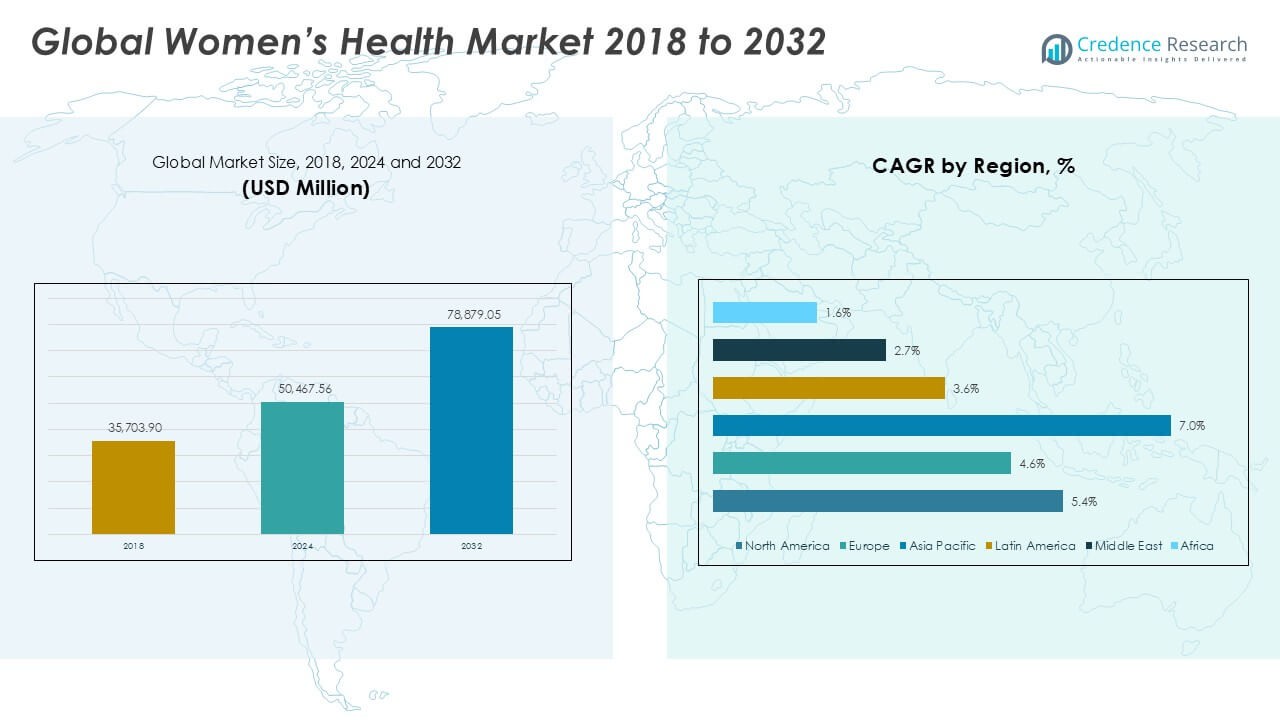
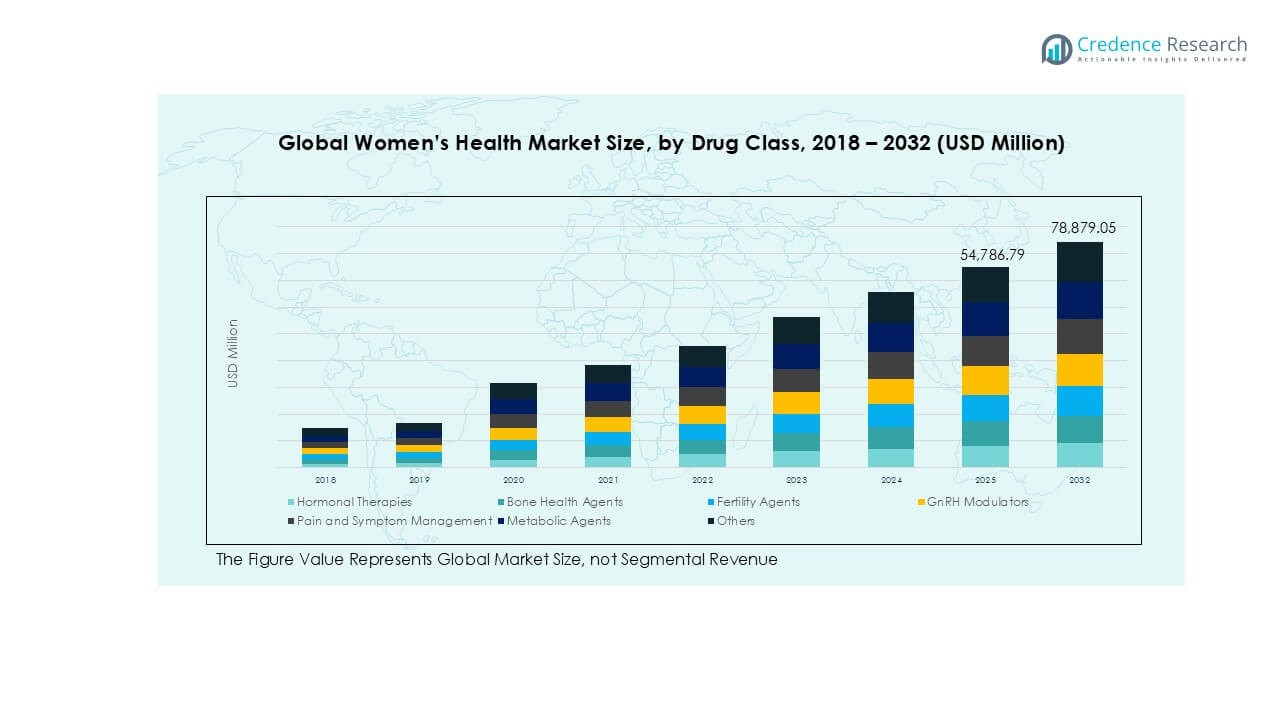
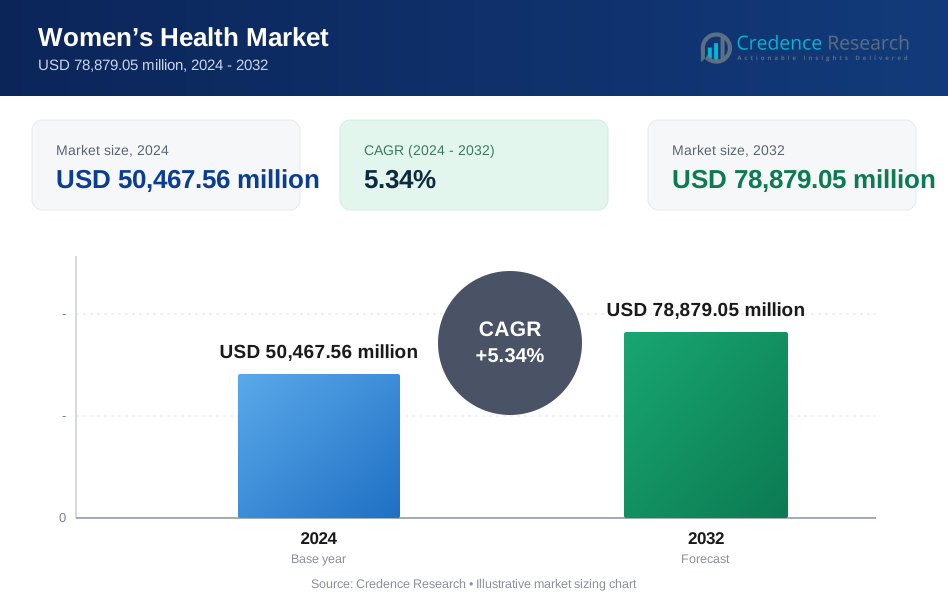
Global Women’s Health Market size was valued at USD 35,703.90 million in 2018 to USD 50,467.56 million in 2024 and is anticipated to reach USD 78,879.05 million by 2032, at a CAGR of 5.34% during the forecast period.
| REPORT ATTRIBUTE | DETAILS |
|---|---|
| Historical Period | 2020-2023 |
| Base Year | 2024 |
| Forecast Period | 2025-2032 |
| Women’s Health Market Size 2024 | USD 50,467.56 Million |
| Women’s Health Market, CAGR | 5.34% |
| Women’s Health Market Size 2032 | USD 78,879.05 Million |
The global women’s health market is shaped by major players such as Abbott Laboratories, Bayer AG, Merck & Co., Inc., Pfizer, Inc., Teva Pharmaceuticals, Ferring B.V., Agile Therapeutics, Amgen, Inc., AstraZeneca PLC, Bristol-Myers Squibb Company, and F. Hoffmann-La Roche Ltd. These companies lead with strong portfolios in hormonal therapies, contraceptives, fertility treatments, and bone health agents. North America dominates the market with a 44.2% share in 2018, driven by advanced healthcare infrastructure and high adoption of women’s health products. Europe follows with 29.3% share, supported by robust regulatory frameworks, while Asia Pacific, with 18.5% share, emerges as the fastest-growing region due to rising healthcare investments and increasing demand for reproductive care solutions.
Market Insights
- The global women’s health market was valued at USD 35,703.90 million in 2018, reached USD 50,467.56 million in 2024, and is projected to attain USD 78,879.05 million by 2032, registering a CAGR of 5.34%.
- Key drivers include the rising prevalence of reproductive disorders, growing cases of postmenopausal osteoporosis, and increasing demand for contraceptives and fertility agents.
- Market trends highlight the shift toward non-hormonal therapies, adoption of digital health platforms, and growing demand for long-acting contraceptives and advanced fertility treatments.
- Competition remains strong with leading players such as Abbott, Bayer, Merck, Pfizer, Teva, Amgen, and Ferring focusing on product launches, clinical trials, and strategic partnerships to strengthen market presence.
- Regional analysis shows North America held 44.2% share in 2018, followed by Europe at 29.3%, while Asia Pacific with 18.5% share is the fastest-growing region. By segment, contraceptives and hormonal therapies remain dominant revenue contributors globally.
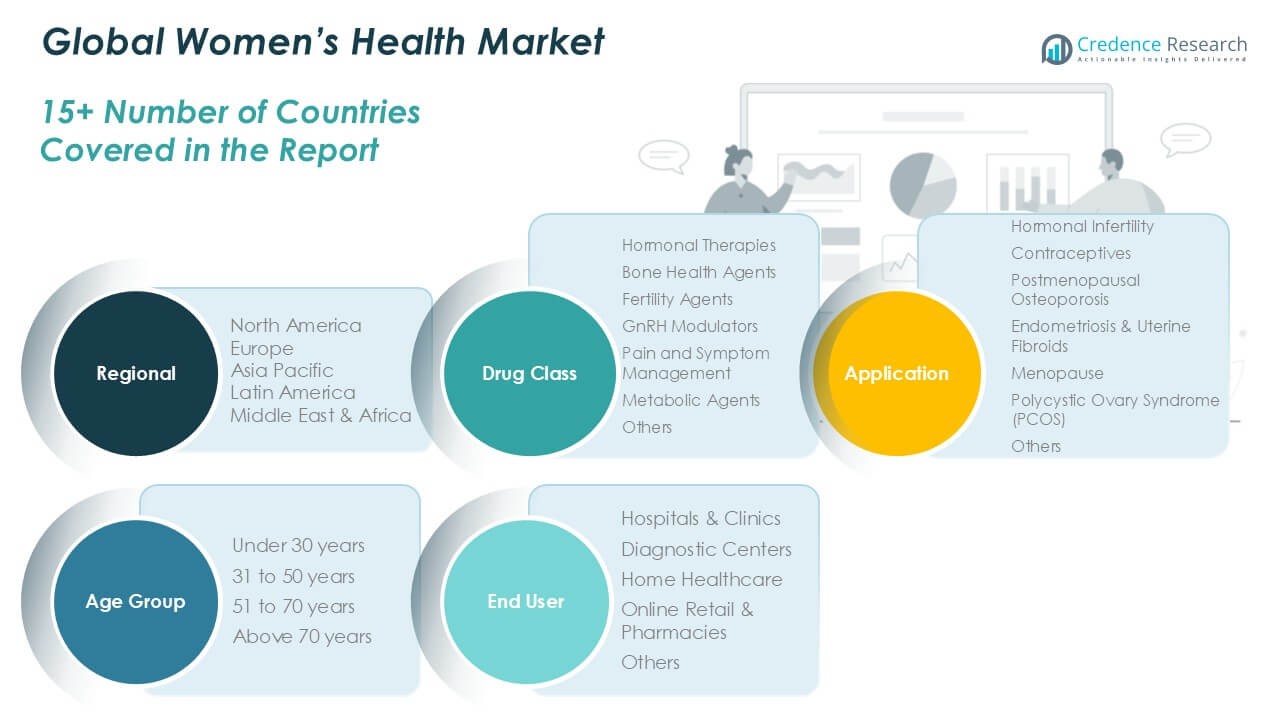
Market Segmentation Analysis:
By Drug Class
Hormonal therapies hold the largest share in the women’s health market due to their broad use in contraceptives, menopause management, and infertility treatments. Strong demand arises from their effectiveness in regulating reproductive health and addressing hormonal imbalances. Bone health agents follow as a key sub-segment driven by rising cases of osteoporosis in aging women. Fertility agents and GnRH modulators are gaining traction with growing awareness of infertility treatments, while pain and symptom management solutions expand with rising endometriosis and menstrual disorder cases. Metabolic agents and others continue to support niche therapeutic needs.
- For instance, once a top-selling product for Bayer with combined annual sales exceeding $1 billion, prescriptions for the contraceptives Yasmin and Yaz have significantly declined over the past decade due to safety concerns, extensive litigation, and competition from generic alternatives.
By Application and Age Group
Contraceptives dominate the application segment, accounting for the largest revenue share. Their use is driven by rising awareness of family planning, favorable government programs, and availability of hormonal and non-hormonal options. Postmenopausal osteoporosis treatment also shows steady growth due to aging populations. Within age group segmentation, women aged 31 to 50 years represent the dominant sub-segment, supported by higher usage of contraceptives, fertility treatments, and preventive healthcare services. Demand in the 51–70 years group is also significant, largely influenced by menopausal care and osteoporosis management.
- For instance, NuvaRing, initially developed by Organon and now manufactured by Organon & Co. (after a series of acquisitions and spin-offs), was a highly popular non-oral contraceptive for many years.
By End User
Hospitals and clinics remain the largest end-user segment, holding a dominant share owing to their wide service coverage, specialized physicians, and advanced infrastructure for women’s healthcare. Diagnostic centers are expanding rapidly with increased adoption of preventive health checkups and fertility screenings. Home healthcare grows steadily, supported by remote monitoring tools and personalized care models. Online retail and pharmacies are emerging as strong channels, driven by consumer preference for convenience and discreet access to contraceptives and hormonal therapies. Other end users add incremental growth through community health programs and non-traditional care models.
Key Growth Drivers
Rising Prevalence of Chronic and Reproductive Health Disorders
The increasing burden of conditions such as osteoporosis, endometriosis, and polycystic ovary syndrome significantly drives the women’s health market. Rising infertility cases and hormonal imbalances further create consistent demand for advanced therapies. Aging populations amplify risks of postmenopausal osteoporosis and related complications. Pharmaceutical companies continue to introduce innovative drugs addressing these unmet needs. This growing prevalence ensures continuous adoption of treatment solutions, making chronic and reproductive health disorders a primary factor boosting market growth globally.
- For instance, Amgen's Prolia (denosumab) has been administered to more than 26 million women with osteoporosis worldwide since its initial launch in June 2010. The medication addresses postmenopausal bone loss, as well as osteoporosis in men and other at-risk patient populations.
Advancements in Hormonal and Non-Hormonal Therapies
Therapeutic innovation is a key growth driver as companies expand their portfolios of hormonal and non-hormonal treatments. Hormonal contraceptives and fertility drugs dominate the space, while newer non-hormonal products appeal to women seeking safer alternatives. Advancements in drug delivery, such as long-acting injectables and transdermal patches, enhance compliance and efficacy. Ongoing clinical trials aim to improve safety profiles, expanding treatment adoption across different age groups. These innovations strengthen accessibility and choice in healthcare, accelerating market growth.
- For instance, Bayer's Mirena intrauterine system is one of the most widely used hormonal intrauterine devices (IUDs) and is a highly effective, long-acting reversible contraceptive. Mirena is available in over 120 countries and is an important component of the overall market for intrauterine contraception, which is used by approximately 160 million women globally.
Government Initiatives and Awareness Programs
Supportive government policies and global awareness campaigns continue to drive adoption of women’s health products. Family planning initiatives, subsidies for contraceptives, and national osteoporosis screening programs boost early adoption. Public and private organizations actively promote awareness of infertility and reproductive health, increasing demand for specialized care. Programs in emerging economies play a critical role in bridging healthcare gaps for women. Combined, these efforts enhance healthcare infrastructure, expand coverage, and accelerate the growth of the women’s health market.
Key Trends & Opportunities
Rising Demand for Fertility and Reproductive Care Solutions
Fertility agents and assisted reproductive technologies are gaining strong momentum as infertility rates climb worldwide. Growing societal acceptance of IVF and related treatments expands the market scope. Advanced fertility drugs and diagnostics support success rates, attracting more women seeking parenthood later in life. Increasing medical tourism for affordable fertility care in Asia-Pacific creates cross-border opportunities. This trend strengthens demand for innovative therapies and positions reproductive care as a high-potential growth area in women’s healthcare.
- For instance, Merck's Gonal-f is a prominent fertility treatment, and the company reports that it has supported the birth of over 6 million babies worldwide.
Expansion of Digital Health and Online Pharmacies
Digital health platforms and online retail channels create new opportunities for women’s health solutions. Telemedicine offers easy access to gynecological consultations, while mobile apps track fertility and menopausal symptoms. Online pharmacies enhance access to contraceptives and hormonal therapies, particularly in regions with limited physical infrastructure. These channels provide privacy and convenience, encouraging wider adoption. Integration of digital tools with traditional care expands market reach, creating a strong opportunity for companies investing in technology-driven healthcare solutions.
Key Challenges
High Treatment Costs and Limited Accessibility
The cost of advanced therapies, fertility treatments, and long-term hormonal care limits adoption, especially in low- and middle-income regions. Despite government subsidies, affordability remains a major barrier for women in rural and underserved areas. Limited healthcare infrastructure and uneven availability of diagnostic facilities further reduce access to timely treatment. This challenge constrains overall market penetration and requires focused investments in affordable and inclusive healthcare delivery systems.
Safety Concerns and Regulatory Hurdles
Concerns around side effects of hormonal therapies and fertility agents act as barriers to wider adoption. Regulatory authorities enforce strict approval standards for women’s health drugs, often delaying product launches. Adverse effects such as cardiovascular risks or bone loss linked with certain treatments create hesitation among patients and providers. Meeting stringent clinical safety requirements increases costs and development timelines for companies. These regulatory and safety challenges continue to affect innovation speed and adoption in the global women’s health market.
Regional Analysis
North America
North America accounted for the largest share of the global women’s health market, representing 44.2% in 2018 with a market size of USD 15,793.44 million. The market grew to USD 22,095.20 million in 2024 and is projected to reach USD 34,628.69 million by 2032 at a CAGR of 5.4%. Growth is driven by strong healthcare infrastructure, high adoption of hormonal therapies, and supportive government programs in reproductive and menopausal care. Rising awareness of osteoporosis and fertility treatments further supports market dominance across the region.
Europe
Europe held a significant share of 29.3% in 2018, with market size at USD 10,477.31 million, advancing to USD 14,293.56 million in 2024. By 2032, it is expected to reach USD 21,078.27 million, growing at a CAGR of 4.6%. The region’s market expansion is supported by strict regulatory frameworks, rising healthcare spending, and strong demand for contraceptives and infertility treatments. Postmenopausal osteoporosis and PCOS therapies contribute to consistent revenue growth. High awareness and government-backed women’s health programs position Europe as the second-largest market globally.
Asia Pacific
Asia Pacific is the fastest-growing region, holding 18.5% share in 2018 with a market size of USD 6,589.51 million. It expanded to USD 10,128.59 million in 2024 and is forecasted to reach USD 18,010.85 million by 2032 at a CAGR of 7.0%. Rapid urbanization, rising infertility rates, and increasing adoption of modern contraceptives are major growth drivers. Expanding healthcare infrastructure in China, India, and Southeast Asia fosters accessibility to advanced treatments. Growing medical tourism for reproductive care further strengthens the region’s market outlook, making it the key growth engine globally.
Latin America
Latin America represented 4.3% of the global share in 2018, valued at USD 1,539.66 million. The market rose to USD 2,146.68 million in 2024 and is projected to reach USD 2,932.39 million by 2032 at a CAGR of 3.6%. Increasing government investments in healthcare and awareness campaigns on contraception and infertility management support gradual market growth. Brazil and Mexico drive the majority of regional demand due to expanding access to diagnostic services and reproductive health facilities. However, limited healthcare access in rural areas slightly constrains growth potential across the region.
Middle East
The Middle East accounted for 2.4% share in 2018, with market value of USD 861.29 million, rising to USD 1,095.98 million in 2024. It is anticipated to reach USD 1,397.46 million by 2032 at a CAGR of 2.7%. Growing adoption of contraceptives, coupled with gradual improvements in healthcare access, drives demand. Fertility treatments are witnessing increased adoption in Gulf countries due to rising infertility cases. However, cultural and social barriers to women’s health treatments restrain rapid expansion. Market growth remains steady but slower compared to other developing regions.
Africa
Africa contributed 1.2% share in 2018, with market size of USD 442.69 million. It reached USD 707.56 million in 2024 and is projected to grow to USD 831.39 million by 2032 at a CAGR of 1.6%, the slowest globally. Limited healthcare infrastructure, affordability challenges, and low access to modern therapies hinder widespread adoption. However, increasing initiatives by international organizations and gradual improvements in urban healthcare access provide opportunities for growth. Contraceptives and maternal care programs drive most of the demand, though penetration remains limited compared to other global regions.
Market Segmentations:
By Drug Class
- Hormonal Therapies
- Bone Health Agents
- Fertility Agents
- GnRH Modulators
- Pain and Symptom Management
- Metabolic Agents
- Others
By Application
- Hormonal Infertility
- Contraceptives
- Postmenopausal Osteoporosis
- Endometriosis & Uterine Fibroids
- Menopause
- Polycystic Ovary Syndrome (PCOS)
- Others
By Age Group
- Under 30 years
- 31 to 50 years
- 51 to 70 years
- Above 70 years
By End User
- Hospitals & Clinics
- Diagnostic Centers
- Home Healthcare
- Online Retail & Pharmacies
- Others
By Geography
- North America
- Europe
- Asia Pacific
- Latin America
- Middle East
- Africa
Competitive Landscape
The global women’s health market is highly competitive, with leading pharmaceutical and biotechnology companies driving innovation across therapeutic areas. Key players include Abbott Laboratories, Bayer AG, Merck & Co., Inc., Pfizer, Inc., Teva Pharmaceuticals, Ferring B.V., Agile Therapeutics, Amgen, Inc., AstraZeneca PLC, Bristol-Myers Squibb Company, and F. Hoffmann-La Roche Ltd. These companies hold strong portfolios spanning hormonal therapies, fertility treatments, contraceptives, and osteoporosis management solutions. Strategic priorities include expanding product pipelines, securing regulatory approvals, and enhancing global distribution networks. Recent developments emphasize partnerships, acquisitions, and the introduction of advanced non-hormonal therapies aimed at reducing side effects and improving patient compliance. Companies also focus on digital health integration and online pharmacy collaborations to strengthen consumer outreach. Intense competition encourages continuous investment in research and development, with players striving to capture demand from emerging regions while maintaining leadership in mature markets.
Key Player Analysis
- Abbott Laboratories
- Bayer AG
- Merck & Co., Inc.
- Pfizer, Inc.
- Teva Pharmaceuticals
- Ferring B.V.
- Agile Therapeutics
- Amgen, Inc.
- AstraZeneca PLC
- Bristol-Myers Squibb Company
- Hoffmann-La Roche Ltd
Recent Developments
- In September 2024, Organon announced acquisition of Dermavant, a subsidiary of Roivant focused on developing and commercializing novel treatments in immuno-dermatology.
- In March 2024, Insud Pharma announced the successful acquisition of Viatris' Women’s Healthcare division, which focuses on oral and injectable contraceptives. This strategic move strengthens Insud Pharma's industrial footprint in India by adding two manufacturing facilities located in Sarigam and Ahmedabad.
- In March 2024, The U.S. FDA granted approval to ELAHERE, developed by AbbVie Inc., for the treatment of adult patients with folate receptor alpha (FRα)-positive, platinum-resistant epithelial ovarian, fallopian tube, or primary peritoneal cancer, who have previously undergone up to three lines of therapy.
- In December 2023, Theramex completed the acquisition of the Femoston and Duphaston in Europe from Viatris. The company acquired these products for the consolidation of its menopause portfolio.
Report Coverage
The research report offers an in-depth analysis based on Drug Class, Application, Age Group, End User and Geography. It details leading market players, providing an overview of their business, product offerings, investments, revenue streams, and key applications. Additionally, the report includes insights into the competitive environment, SWOT analysis, current market trends, as well as the primary drivers and constraints. Furthermore, it discusses various factors that have driven market expansion in recent years. The report also explores market dynamics, regulatory scenarios, and technological advancements that are shaping the industry. It assesses the impact of external factors and global economic changes on market growth. Lastly, it provides strategic recommendations for new entrants and established companies to navigate the complexities of the market.
Future Outlook
- The women’s health market will expand steadily with rising focus on reproductive care.
- Demand for contraceptives will remain dominant due to increasing family planning awareness.
- Fertility treatments will grow strongly as infertility rates rise across developed and emerging regions.
- Advancements in non-hormonal therapies will gain traction for safer treatment alternatives.
- Digital health platforms will play a larger role in diagnosis and remote consultations.
- North America will maintain leadership while Asia Pacific emerges as the fastest-growing region.
- Aging populations will drive higher adoption of osteoporosis and menopause-related therapies.
- Strategic collaborations and acquisitions will shape competition among global pharmaceutical leaders.
- Online pharmacies will expand access to women’s health products and therapies.
- Increasing government initiatives will support wider availability of preventive and specialized care.
Request a Free Sample
Fill in your details and we'll send you a free sample report.
- Sample data tables & charts
- Research methodology
Market Dynamics
Rising Prevalence of Reproductive and Chronic Disorders
Increasing cases of reproductive health issues such as infertility, endometriosis, and polycystic ovary syndrome, as well as chronic conditions like osteoporosis, are fueling demand for specialized women’s health therapies and interventions.
Advancements in Hormonal and Non-Hormonal Therapies
Continuous innovation in both hormonal and non-hormonal treatment options, including long-acting contraceptives and safer alternatives, is expanding the range of effective solutions available to women and improving patient compliance.
Government Initiatives and Awareness Programs
Supportive policies, family planning initiatives, and public awareness campaigns are increasing access to women’s health products and services, particularly in emerging markets, thereby driving market growth.
Expansion of Digital Health and Online Pharmacies
The adoption of telemedicine, mobile health apps, and online pharmacies is making women’s health products and consultations more accessible, especially in regions with limited healthcare infrastructure, thus broadening the market’s reach.
Aging Population and Menopausal Health Needs
The global rise in the aging female population is leading to higher incidence of postmenopausal osteoporosis and related conditions, boosting demand for bone health agents and menopause management therapies.
Need a Custom Version of This Report?
Tailor the scope, geography, or segments to your exact requirements.
- Custom geography or segment scope
- Direct access to our analyst team
Frequently Asked Questions
What is the current market size for Global Women’s Health market, and what is its projected size in 2032?
At what Compound Annual Growth Rate is the Global Women’s Health market projected to grow between 2025 and 2032?
Which Global Women’s Health market segment held the largest share in 2024?
What are the primary factors fueling the growth of the Global Women’s Health market?
Who are the leading companies in the Global Women’s Health market?
Which region commanded the largest share of the Global Women’s Health market in 2024?
Table of Content
Chapter 1 Market Segmentation
- 1.1 Segmentation Framework
- 1.1.1 Product and Service Classification
- 1.1.2 Application and End-Use Classification
- 1.1.3 Technology and Solution Classification
- 1.1.4 Customer and Distribution Channel Classification
- 1.1.5 Geographic Segmentation
- 1.1.6 Market Segment Definitions and Boundaries
- 1.2 By End User
- 1.2.1 Hospitals & Clinics
- 1.2.2 Diagnostic Centers
- 1.2.3 Home Healthcare
- 1.2.4 Online Retail & Pharmacies
- 1.2.5 Others
- 1.3 By Age Group
- 1.3.1 Under 30 years
- 1.3.2 31 to 50 years
- 1.3.3 51 to 70 years
- 1.3.4 Above 70 years
- 1.4 By Drug Class
- 1.4.1 Hormonal Therapies
- 1.4.2 Bone Health Agents
- 1.4.3 Fertility Agents
- 1.4.4 GnRH Modulators
- 1.4.5 Pain and Symptom Management
- 1.4.6 Metabolic Agents
- 1.4.7 Others
- 1.5 By Application
- 1.5.1 Hormonal Infertility
- 1.5.2 Contraceptives
- 1.5.3 Postmenopausal Osteoporosis
- 1.5.4 Endometriosis & Uterine Fibroids
- 1.5.5 Menopause
- 1.5.6 Polycystic Ovary Syndrome (PCOS)
- 1.5.7 Others
Chapter 2 Introduction
- 2.1 Report Objectives and Scope
- 2.2 Product Definition and Industry Terminology
- 2.3 Market Inclusions and Exclusions
- 2.4 Research Process
- 2.4.1 Primary Research and Expert Interviews
- 2.4.2 Secondary Research and Source Review
- 2.4.3 Top-Down and Bottom-Up Estimation
- 2.4.4 Data Triangulation and Verification
- 2.5 Market Size Measurement Basis
- 2.5.1 2024: USD 50,467.56 million → 2032: USD 78,879.05 million
- 2.6 Historical and Forecast Reference Periods
- 2.6.1 Base Year: 2024
- 2.6.2 Forecast Period: 2024-2032
- 2.7 Research Assumptions and Limitations
Chapter 3 Executive Summary
- 3.1 Market Snapshot and Key Findings
- 3.2 Base-Year Market Size, 2024
- 3.3 Forecast Market Size, 2032
- 3.4 Revenue and Volume Growth Outlook
- 3.5 Key Demand and Supply Indicators
- 3.6 Leading Market Segments
- 3.7 Fastest-Growing Market Opportunities
- 3.8 Regional Performance Highlights
- 3.9 Technology and Industry Transformation
- 3.10 Competitive Landscape Summary
- 3.11 Analyst View and Strategic Implications
Chapter 4 Global Women’s Health Market Trends and Developments
- 4.1 Historical Industry Development
- 4.2 Recent Market Trends and Developments
- 4.3 Demand and Customer Behavior Trends
- 4.4 Technology and Product Innovation
- 4.5 Artificial Intelligence, Automation and Digitalization
- 4.6 Local Manufacturing and Supply Chain Realignment
- 4.7 Industry Partnerships, Mergers and Acquisitions
- 4.8 Sustainability and Circular Economy Developments
- 4.9 Government and Private Sector Investment Trends
- 4.10 Emerging Business Models and Commercialization
- 4.11 Industry Developments and Announcements
Chapter 5 Global Women’s Health Market Production, Supply and Demand Analysis
- 5.1 Demand Trend and Consumption Analysis
- 5.2 Demand Forecast, 2024-2032
- 5.3 Production and Output Trend
- 5.4 Production and Output Forecast, 2024-2032
- 5.5 Installed Capacity and Capacity Utilization
- 5.6 Company-Wise Production Plants and Statistics
- 5.6.1 Installed Production Capacity
- 5.6.2 Actual Production
- 5.6.3 Planned Capacity and Expansion Targets
- 5.7 Supply Chain Structure and Procurement Trends
- 5.8 Supply-Demand Gap and Bottlenecks
- 5.9 Import Dependence and Sourcing Structure
- 5.10 Contract Manufacturing and Outsourcing
- 5.11 Regional Supply and Demand Concentration
Chapter 6 Global Women’s Health Market Pricing Analysis
- 6.1 Pricing Structure and Measurement
- 6.2 Historical Pricing Trends
- 6.3 Pricing Outlook, 2024-2032
- 6.4 Average Selling Price and Unit Economics
- 6.5 Pricing by Product and Market Segment
- 6.6 Geographic Pricing Differences
- 6.7 Key Input, Energy, Labor and Logistics Costs
- 6.8 Contract Pricing and Purchasing Models
- 6.9 Pricing Sensitivity and Competitive Positioning
- 6.10 Price, Margin and Profitability Implications
Chapter 7 Global Women’s Health Market Dynamics
- 7.1 Market Growth Drivers
- 7.1.1 Demand-Side Drivers
- 7.1.2 Technology and Innovation Drivers
- 7.1.3 Infrastructure and Investment Drivers
- 7.1.4 Regulatory and Policy Drivers
- 7.2 Market Restraints
- 7.2.1 Cost and Affordability Constraints
- 7.2.2 Technology and Adoption Barriers
- 7.2.3 Supply Chain and Operational Constraints
- 7.3 Market Challenges
- 7.3.1 Competitive Pressure and Margin Erosion
- 7.3.2 Skills, Infrastructure and Implementation Gaps
- 7.4 Emerging Market Opportunities
- 7.5 Market Dynamics Impact and Time-Horizon Assessment
Chapter 8 Global Women’s Health Value Chain Analysis
- 8.1 Industry Value Chain Overview
- 8.2 Upstream Suppliers and Critical Inputs
- 8.3 Technology and Component Providers
- 8.4 Manufacturing or Service Delivery
- 8.5 Distribution, Channel Partners and Integrators
- 8.6 Downstream Applications and End Users
- 8.7 Value Addition and Profit Pools
- 8.8 Vertical Integration and Outsourcing
- 8.9 Supplier Concentration and Risk
- 8.10 Supply Chain Localization and Resilience
Chapter 9 Global Women’s Health Market Regulations and Policies
- 9.1 Relevant Laws, Standards and Compliance Frameworks
- 9.2 Product, Service, Safety and Quality Requirements
- 9.3 Government Policies, Incentives and Subsidies
- 9.4 Imports, Exports and Trade Barriers
- 9.5 Public Procurement and Local Content Requirements
- 9.6 Environmental and Sustainability Compliance
- 9.7 Upcoming Policy Changes and Market Implications
Chapter 10 Global Women’s Health Market Hotspots and Opportunities
- 10.1 Market Opportunity Mapping and Growth Hotspots
- 10.2 High-Growth Applications and Customer Groups
- 10.3 Underserved Markets and White-Space Opportunities
- 10.4 Emerging Technology and Product Opportunities
- 10.5 New Capacity and Investment Hotspots
- 10.6 Market Entry and Expansion Opportunities
- 10.7 Distribution and Partnership Opportunities
- 10.8 Near-Term and Long-Term Commercial Potential
- 10.9 Opportunity Attractiveness and Execution Risks
Chapter 11 Global Women’s Health Market Outlook, 2024-2032
- 11.1 Market Size and Analysis
- 11.1.1 Revenue (Market Measurement: 2024: USD 50,467.56 million → 2032: USD 78,879.05 million)
- 11.1.2 Market Volume and Quantity Sold
- 11.1.3 Historical Market Size
- 11.1.4 Base-Year Market Size, 2024
- 11.2 Market Forecast, 2024-2032
- 11.2.1 Revenue Forecast to 2032
- 11.2.2 Volume Forecast to 2032
- 11.2.3 CAGR and Year-on-Year Growth
- 11.2.4 Incremental Revenue Opportunity
- 11.3 Forecast Assumptions and Scenario Analysis
- 11.3.1 Base-Case Forecast
- 11.3.2 Optimistic and Conservative Scenarios
- 11.3.3 Technology, Pricing and Policy Sensitivities
- 11.4 Market Attractiveness and Growth Outlook
Chapter 12 Global Women’s Health Market Segmentation and Outlook
- 12.1 Segmentation Summary and Market Shares, 2024
- 12.2 Largest and Fastest-Growing Segments
- 12.3 By End User - Market Size and Forecast, 2024-2032
- 12.3.1 Segment Definition and Scope
- 12.3.2 Historical Market Size
- 12.3.3 Revenue Forecast, 2024-2032
- 12.3.4 Volume Forecast, 2024-2032
- 12.3.5 Base-Year Market Share, 2024
- 12.3.6 Segment CAGR and Growth Drivers
- 12.3.7 Subsegment Market Size and Forecast
- 12.3.7.1 Hospitals & Clinics
- 12.3.7.2 Diagnostic Centers
- 12.3.7.3 Home Healthcare
- 12.3.7.4 Online Retail & Pharmacies
- 12.3.7.5 Others
- 12.3.8 Subsegment Pricing and Adoption Trends
- 12.3.9 Leading Suppliers and Competition
- 12.3.10 Regional Demand and Opportunities
- 12.4 By Age Group - Market Size and Forecast, 2024-2032
- 12.4.1 Segment Definition and Scope
- 12.4.2 Historical Market Size
- 12.4.3 Revenue Forecast, 2024-2032
- 12.4.4 Volume Forecast, 2024-2032
- 12.4.5 Base-Year Market Share, 2024
- 12.4.6 Segment CAGR and Growth Drivers
- 12.4.7 Subsegment Market Size and Forecast
- 12.4.7.1 Under 30 years
- 12.4.7.2 31 to 50 years
- 12.4.7.3 51 to 70 years
- 12.4.7.4 Above 70 years
- 12.4.8 Subsegment Pricing and Adoption Trends
- 12.4.9 Leading Suppliers and Competition
- 12.4.10 Regional Demand and Opportunities
- 12.5 By Drug Class - Market Size and Forecast, 2024-2032
- 12.5.1 Segment Definition and Scope
- 12.5.2 Historical Market Size
- 12.5.3 Revenue Forecast, 2024-2032
- 12.5.4 Volume Forecast, 2024-2032
- 12.5.5 Base-Year Market Share, 2024
- 12.5.6 Segment CAGR and Growth Drivers
- 12.5.7 Subsegment Market Size and Forecast
- 12.5.7.1 Hormonal Therapies
- 12.5.7.2 Bone Health Agents
- 12.5.7.3 Fertility Agents
- 12.5.7.4 GnRH Modulators
- 12.5.7.5 Pain and Symptom Management
- 12.5.7.6 Metabolic Agents
- 12.5.7.7 Others
- 12.5.8 Subsegment Pricing and Adoption Trends
- 12.5.9 Leading Suppliers and Competition
- 12.5.10 Regional Demand and Opportunities
- 12.6 By Application - Market Size and Forecast, 2024-2032
- 12.6.1 Segment Definition and Scope
- 12.6.2 Historical Market Size
- 12.6.3 Revenue Forecast, 2024-2032
- 12.6.4 Volume Forecast, 2024-2032
- 12.6.5 Base-Year Market Share, 2024
- 12.6.6 Segment CAGR and Growth Drivers
- 12.6.7 Subsegment Market Size and Forecast
- 12.6.7.1 Hormonal Infertility
- 12.6.7.2 Contraceptives
- 12.6.7.3 Postmenopausal Osteoporosis
- 12.6.7.4 Endometriosis & Uterine Fibroids
- 12.6.7.5 Menopause
- 12.6.7.6 Polycystic Ovary Syndrome (PCOS)
- 12.6.7.7 Others
- 12.6.8 Subsegment Pricing and Adoption Trends
- 12.6.9 Leading Suppliers and Competition
- 12.6.10 Regional Demand and Opportunities
- 12.7 Segment Growth Comparison
- 12.8 Segment Attractiveness and Priority Matrix
Chapter 13 Global Women’s Health End-Use and Application Market Outlook
- 13.1 End-Use Industry and Customer Demand Structure
- 13.2 Leading Applications and Customer Groups
- 13.3 End-Use Market Size, Share and Forecast
- 13.4 Major End-Use Industry Deep Dives
- 13.4.1 Customer Requirements and Use Cases
- 13.4.2 Demand and Replacement Cycles
- 13.4.3 Technical and Regulatory Considerations
- 13.4.4 Purchasing and Procurement Models
- 13.4.5 Leading Vendors and Distribution Channels
- 13.4.6 Forecast and Commercial Opportunities
- 13.5 Emerging Applications and Cross-Segment Demand
- 13.6 End-Use Industry Investment Priorities
Chapter 14 Global Women’s Health Geographic Market Outlook, 2024-2032
- 14.1 Regional Market Size and Share, 2024
- 14.2 Regional Market Forecast, 2024-2032
- 14.3 Regional Pricing, Production and Demand Differences
- 14.4 North America
- 14.4.1 United States
- 14.4.2 Canada
- 14.4.3 Mexico
- 14.5 Europe
- 14.5.1 Germany
- 14.5.2 France
- 14.5.3 Italy
- 14.5.4 United Kingdom
- 14.5.5 Spain
- 14.5.6 Poland
- 14.5.7 Russia
- 14.5.8 Netherlands
- 14.5.9 Belgium
- 14.5.10 Sweden
- 14.5.11 Denmark
- 14.5.12 Norway
- 14.5.13 Rest of Europe
- 14.6 Asia Pacific
- 14.6.1 China
- 14.6.2 India
- 14.6.3 Japan
- 14.6.4 South Korea
- 14.6.5 Thailand
- 14.6.6 Indonesia
- 14.6.7 Vietnam
- 14.6.8 Malaysia
- 14.6.9 Australia
- 14.6.10 Rest of Asia Pacific
- 14.7 Latin America
- 14.7.1 Brazil
- 14.7.2 Argentina
- 14.7.3 Colombia
- 14.7.4 Chile
- 14.7.5 Rest of Latin America
- 14.8 Middle East
- 14.8.1 Saudi Arabia
- 14.8.2 United Arab Emirates
- 14.8.3 Turkey
- 14.8.4 Israel
- 14.8.5 Iran
- 14.8.6 Rest of the Middle East
- 14.9 Africa
- 14.9.1 South Africa
- 14.9.2 Egypt
- 14.9.3 Nigeria
- 14.9.4 Morocco
- 14.9.5 Rest of Africa
- 14.10 Regional Investment, Policy and Supply Chain Differences
- 14.11 Regional Competitive Landscape
- 14.12 Geographic Growth Hotspots
Chapter 15 Global Women’s Health Technology, Innovation and Sustainability Outlook
- 15.1 Technology Landscape and Maturity
- 15.2 Product, Process and Service Innovation
- 15.3 AI, Automation and Digital Tools in the Industry
- 15.4 Technology Adoption and Performance Benchmarking
- 15.5 Innovation Pipeline and R&D Investment
- 15.6 Patent and Intellectual Property Trends
- 15.7 Energy Efficiency and Resource Management
- 15.8 Sustainability, Recycling and Circularity
- 15.9 Technology Roadmap, 2024-2032
- 15.10 Risks of Obsolescence and Technology Substitution
Chapter 16 Global Women’s Health Market Key Strategic Imperatives
- 16.1 Growth and Market Entry Priorities
- 16.2 High-Return Products and Segments
- 16.3 Pricing, Profitability and Cost Optimization
- 16.4 Technology Investment and Product Differentiation
- 16.5 Supply Chain Localization and Resilience
- 16.6 Distribution and Customer Acquisition
- 16.7 Partnership, Acquisition and Capacity Strategy
- 16.8 Regional Expansion Priorities
- 16.9 Short-, Medium- and Long-Term Actions
Chapter 17 Competition Outlook
- 17.1 Industry Competition Characteristics
- 17.2 Market Structure and Concentration
- 17.3 Market Share and Competitive Positioning, 2024
- 17.4 Company-Wise Revenue and Product Benchmarking
- 17.5 Production and Service Capacity Benchmarking
- 17.6 Technology, Pricing and Differentiation
- 17.7 Regional Footprint and Distribution Strength
- 17.8 Mergers, Acquisitions and Strategic Alliances
- 17.9 New Entrants and Competitive Threats
- 17.10 Porter's Five Forces and Industry Attractiveness
- 17.11 Competitive Outlook, 2024-2032
Chapter 18 Company Profiles
- 18.1 Company Coverage and Selection Criteria
- 18.2 Abbott Laboratories
- 18.2.1 Business Description
- 18.2.2 Company Ownership and Geographic Presence
- 18.2.3 Product and Service Portfolio
- 18.2.4 Manufacturing and Operating Footprint
- 18.2.5 Production Capacity and Expansion Plans
- 18.2.6 Financial Performance and Investment
- 18.2.7 Market Share and Competitive Position
- 18.2.8 Technology and Innovation Capabilities
- 18.2.9 Strategic Alliances or Partnerships
- 18.2.10 Recent Developments
- 18.2.11 Growth Strategy and Outlook
- 18.3 Bayer AG
- 18.4 Merck & Co., Inc.
- 18.5 Pfizer, Inc.
- 18.6 Teva Pharmaceuticals
- 18.7 Ferring B.V.
- 18.8 Agile Therapeutics
- 18.9 Amgen, Inc.
- 18.10 AstraZeneca PLC
- 18.11 F. Hoffmann-La Roche Ltd
- 18.12 Other Relevant Market Participants
Note: Every listed company is profiled on the structure shown under the first company. The company list is preliminary and may change based on research findings, market developments, data availability and client requirements.
Chapter 19 Disclaimer
- 19.1 Research and Forecast Disclaimer
- 19.2 Data Source and Estimation Limitations
Note: The depth of individual sections depends on data availability for this market. Volume, capacity, trade and other unit-based metrics are included where applicable.