
Market Overview
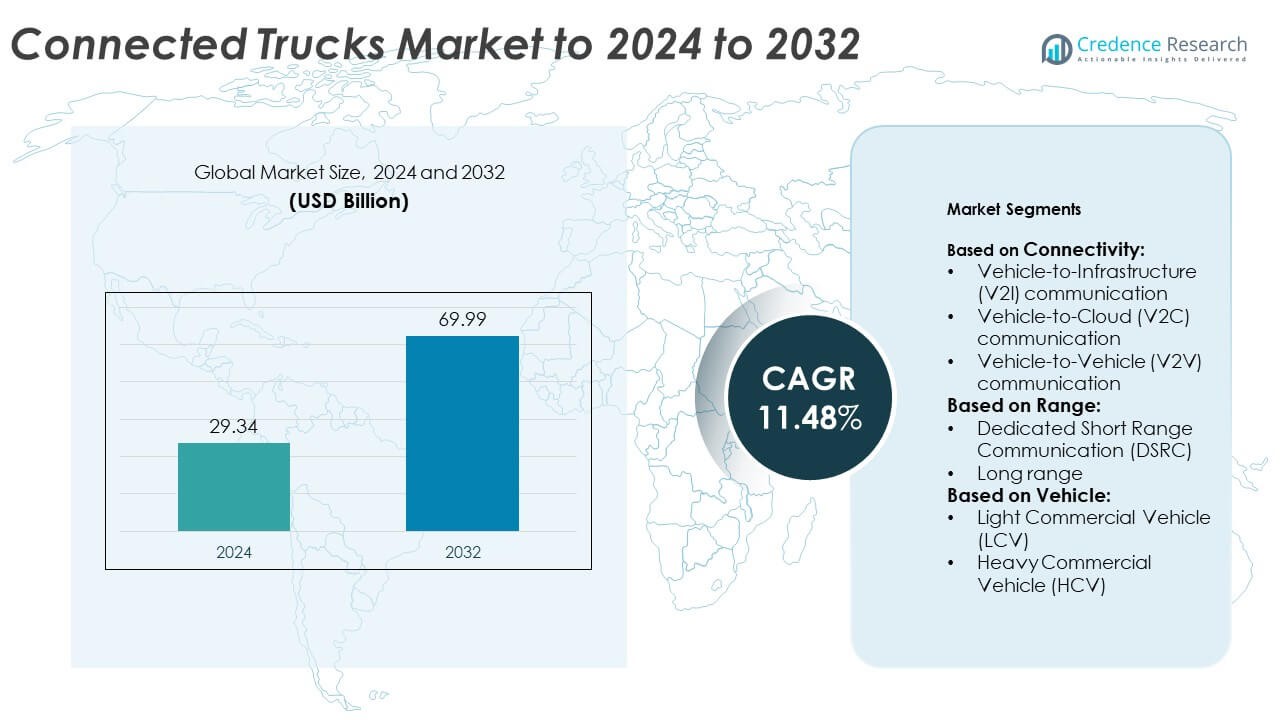
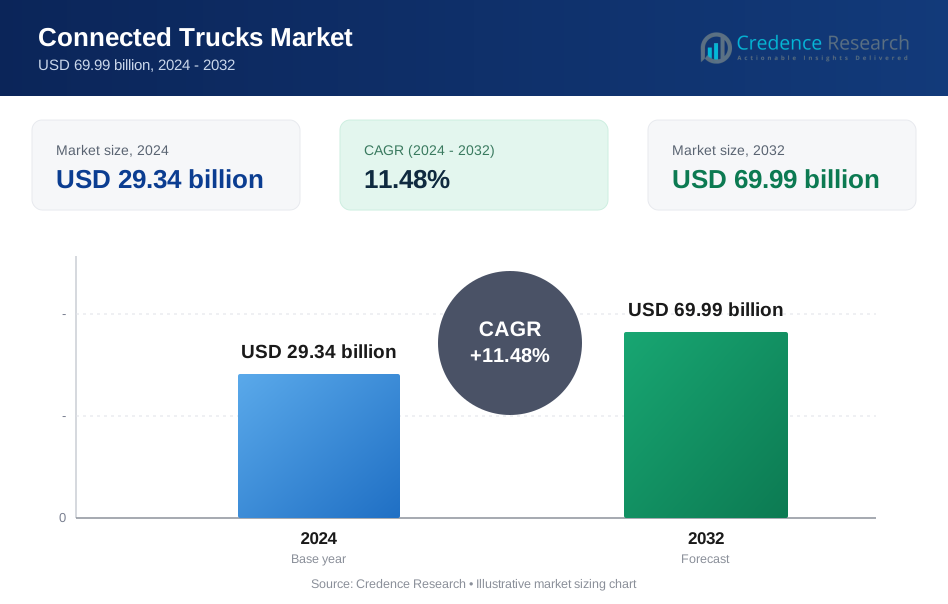
Connected Trucks Market size was valued at USD 29.34 billion in 2024 and is anticipated to reach USD 69.99 billion by 2032, at a CAGR of 11.48% during the forecast period.
| REPORT ATTRIBUTE | DETAILS |
|---|---|
| Historical Period | 2020-2023 |
| Base Year | 2024 |
| Forecast Period | 2025-2032 |
| Connected Trucks Market Size 2024 | USD 29.34 Billion |
| Connected Trucks Market, CAGR | 11.48% |
| Connected Trucks Market Size 2032 | USD 69.99 Billion |
The Connected Trucks Market is dominated by major players such as PACCAR Inc., Volvo Group, Trimble Inc., ZF Friedrichshafen AG, and Samsara Networks Inc. These companies focus on integrating telematics, IoT, and AI technologies to enhance fleet management, predictive maintenance, and driver safety. Strategic partnerships and R&D investments in 5G-based connectivity and cloud analytics are driving technological advancements. North America led the market in 2024 with a 37% share, supported by strong digital infrastructure, advanced logistics networks, and regulatory initiatives promoting connected and autonomous vehicle technologies across commercial fleets.
Market Insights
- The Connected Trucks Market was valued at USD 29.34 billion in 2024 and is projected to reach USD 69.99 billion by 2032, growing at a CAGR of 11.48%.
- Growing demand for real-time fleet monitoring, predictive maintenance, and IoT-based telematics is driving market growth globally.
- Integration of AI, 5G, and vehicle-to-cloud communication is reshaping logistics operations and improving efficiency across connected fleets.
- The market is competitive, with key players investing in R&D and strategic alliances to expand connected mobility solutions and telematics platforms.
- North America led the market in 2024 with 37% share, followed by Europe at 32% and Asia Pacific at 22%, while the Vehicle-to-Cloud (V2C) communication segment held the largest share due to its ability to enable seamless data exchange and remote diagnostics.
Market Segmentation Analysis:
By Connectivity
Vehicle-to-Cloud (V2C) communication dominated the Connected Trucks Market in 2024, accounting for nearly 46% of the total share. V2C enables real-time data exchange between vehicles and centralized platforms, supporting predictive maintenance, route optimization, and over-the-air software updates. The demand is fueled by logistics digitalization and the integration of telematics systems across fleets. Companies such as Volvo Trucks and Daimler Truck AG are enhancing cloud connectivity to improve fleet performance analytics and remote diagnostics, further strengthening V2C’s leadership in connected ecosystems.
- For instance, Volvo Trucks reported over 1,000,000 connected trucks worldwide by 2025, including 218,000 in North America.
By Range
Dedicated Short Range Communication (DSRC) held the largest market share of about 58% in 2024. Its low-latency data transmission supports collision avoidance and traffic management functions crucial for commercial fleets. DSRC ensures reliable vehicle-to-vehicle and vehicle-to-infrastructure connectivity, making it preferred for safety-critical operations. Manufacturers are incorporating DSRC modules in advanced driver assistance systems (ADAS) to enhance situational awareness. Growing government mandates for road safety communication technologies also contribute to DSRC’s continued dominance in connected truck platforms.
- For instance, Scania's network of connected vehicles has been growing, with mid-year 2024 figures showing over 638,000 vehicles in the network, a number that has since been surpassed
By Vehicle
Heavy Commercial Vehicles (HCVs) led the segment in 2024, securing around 62% of the total share. These vehicles benefit the most from connected technologies due to long-haul operations requiring fleet tracking, fuel optimization, and remote maintenance. OEMs such as Scania and PACCAR are deploying connected solutions to enhance uptime and operational transparency for heavy-duty fleets. Increasing adoption of IoT-enabled fleet management and compliance with emission regulations further boost HCV connectivity integration across global logistics and freight networks.
Key Growth Drivers
Rising Demand for Fleet Management Efficiency
Fleet operators are increasingly adopting connected truck technologies to improve route planning, fuel efficiency, and vehicle uptime. Real-time telematics, GPS tracking, and remote diagnostics enhance operational control and reduce downtime. Companies such as Volvo and MAN Truck & Bus integrate advanced fleet management systems that allow continuous monitoring of driver performance and vehicle health. The demand for cost-efficient logistics and predictive maintenance makes fleet optimization a primary growth driver in the connected trucks market.
- For instance, Navistar's OnCommand Connection analyzes sensor inputs from over 375,000 connected vehicles, interpreting more than 70 telematics parameters.
Increasing Integration of IoT and AI Technologies
The integration of IoT and AI enables trucks to communicate seamlessly with infrastructure, cloud systems, and other vehicles. These technologies support autonomous driving, driver assistance, and predictive analytics. OEMs like Daimler and Scania are embedding AI-based analytics into connected truck platforms to improve decision-making and operational safety. The growing reliance on smart sensors and cloud platforms for data-driven logistics performance fuels adoption, making IoT and AI integration a significant driver of market growth.
- For instance, Volvo Trucks claims its fleet generates ~20 GB of data per minute, from over 100 sensors per vehicle.
Government Regulations Promoting Safety and Emission Standards
Governments across regions are enforcing stringent emission and safety norms that push fleets to adopt connected solutions. Vehicle-to-everything (V2X) communication and telematics help operators comply with these standards by monitoring driving patterns and vehicle efficiency. The U.S. and European authorities promote mandatory installation of safety and connectivity features in new trucks. Such policies drive accelerated adoption of connected systems, positioning regulatory compliance as a critical growth driver in the market.
Key Trends & Opportunities
Growth of 5G Connectivity for Real-Time Communication
5G technology enhances communication reliability and bandwidth for connected trucks, enabling instant data transmission between vehicles, infrastructure, and control centers. This advancement supports functions like remote diagnostics, collision alerts, and vehicle platooning. Companies such as Volvo and Hyundai are testing 5G-enabled trucks to improve real-time responsiveness. As telecom infrastructure expands globally, 5G connectivity opens major opportunities for connected fleet operations and autonomous logistics applications.
- For instance, Scania migrated its back-end systems to AWS to support over 20,000 messages per second and reduce latency by ~80 %.
Rising Adoption of Predictive Maintenance Solutions
Predictive maintenance powered by AI and cloud analytics is becoming a key trend in connected truck operations. It allows continuous monitoring of engine performance, tire pressure, and fuel systems, minimizing unexpected breakdowns. Leading OEMs like PACCAR and Navistar are integrating predictive systems that analyze sensor data to optimize service schedules. This trend enhances fleet productivity and reduces operational costs, creating opportunities for aftermarket service providers and technology integrators.
- For instance, using OnCommand Connection, Navistar has helped reduce maintenance costs by up to 40 % and vehicle downtime by up to 40 %.
Key Challenges
High Implementation and Integration Costs
The initial investment for connected truck infrastructure remains a major restraint, especially for small fleet operators. Installing sensors, telematics units, and cloud-based software requires significant capital. Integration with existing fleet systems adds further complexity. Despite long-term efficiency benefits, the high cost of technology deployment and maintenance limits adoption in cost-sensitive markets, slowing overall growth in developing regions.
Data Security and Privacy Concerns
Connected trucks generate vast amounts of sensitive data related to routes, performance, and driver behavior. This creates vulnerability to cyberattacks and data breaches. Unauthorized access or manipulation of vehicle data can disrupt fleet operations or compromise safety. Manufacturers and software providers are investing in encryption, firewalls, and blockchain-based systems to protect data integrity. However, growing cybersecurity risks remain a critical challenge restraining broader adoption of connected trucking technologies.
Regional Analysis
North America
North America led the connected trucks market in 2024 with a 37% share. The region benefits from advanced telematics adoption, strong digital infrastructure, and supportive government policies for fleet safety and emission reduction. The U.S. dominates due to the presence of major OEMs such as PACCAR, Ford, and Navistar, which focus on integrating AI and 5G-enabled communication. High investment in autonomous trucking and the rapid expansion of logistics networks across the U.S. and Canada continue to drive market penetration and strengthen the region’s leadership in connected transportation technologies.
Europe
Europe accounted for around 32% of the connected trucks market in 2024. The region’s growth is driven by stringent carbon emission regulations, the European Green Deal, and strong adoption of vehicle-to-everything (V2X) systems. Germany, the UK, and France are key contributors, supported by OEMs like Daimler, Volvo, and Scania emphasizing advanced connectivity for long-haul fleets. The rise in smart mobility projects and public–private investments in intelligent transportation systems further accelerates the deployment of connected trucks across European logistics and freight corridors.
Asia Pacific
Asia Pacific held about 22% of the connected trucks market in 2024, led by China, Japan, and India. Rapid industrialization, expanding e-commerce logistics, and large-scale fleet digitalization initiatives support strong regional growth. Chinese manufacturers such as BYD and Dongfeng are investing in connected electric trucks, integrating real-time telematics for fleet optimization. Governments in Japan and South Korea are promoting smart transportation and autonomous logistics corridors. The growing penetration of 5G infrastructure and cloud-based fleet analytics strengthens Asia Pacific’s position as a rapidly expanding market for connected trucking solutions.
Latin America
Latin America represented nearly 6% of the connected trucks market in 2024. The region’s growth is supported by increasing adoption of telematics and digital fleet management systems in Brazil, Mexico, and Argentina. Logistics operators are deploying connected solutions to improve delivery efficiency and reduce operational costs. While high implementation costs remain a barrier, strategic partnerships between technology providers and regional transport firms are expanding connected fleet adoption. The ongoing development of 4G and emerging 5G networks further enhances market potential across Latin America’s logistics and transportation sectors.
Middle East & Africa
The Middle East & Africa accounted for around 3% of the connected trucks market in 2024. Growth is driven by infrastructure modernization and rising demand for efficient long-haul logistics across the Gulf countries and South Africa. Governments are investing in smart mobility frameworks to support intelligent transport and freight safety. Saudi Arabia and the UAE are leading adoption through partnerships with global telematics firms. Though the market remains in an early stage, increasing investment in connected fleet monitoring solutions signals steady progress toward digital transformation in the region.
Market Segmentations:
By Connectivity:
- Vehicle-to-Infrastructure (V2I) communication
- Vehicle-to-Cloud (V2C) communication
- Vehicle-to-Vehicle (V2V) communication
By Range:
- Dedicated Short Range Communication (DSRC)
- Long range
By Vehicle:
- Light Commercial Vehicle (LCV)
- Heavy Commercial Vehicle (HCV)
By Geography:
- North America
- U.S.
- Canada
- Mexico
- Europe
- Germany
- France
- U.K.
- Italy
- Spain
- Rest of Europe
- Asia Pacific
- China
- Japan
- India
- South Korea
- South-east Asia
- Rest of Asia Pacific
- Latin America
- Brazil
- Argentina
- Rest of Latin America
- Middle East & Africa
- GCC Countries
- South Africa
- Rest of the Middle East and Africa
Competitive Landscape
The connected trucks market is highly competitive and includes leading players such as PACCAR Inc., Teletrac Navman, Volvo Group, Samsara Networks Inc., Trimble Inc., Geotab, Omnitracs, ZF Friedrichshafen AG, Navistar International Corporation, MiX Telematics, Mercedes-Benz Trucks, WABCO Holdings Inc., Scania AB, TomTom Telematics, Verizon Connect, and Telefonaktiebolaget LM Ericsson. Competition is shaped by advancements in telematics, IoT integration, and real-time data analytics solutions. Companies focus on developing connected platforms that enhance fleet efficiency, safety, and predictive maintenance. Strategic collaborations with software developers, telecom providers, and cloud platforms help strengthen service portfolios. Continuous R&D investment supports the development of AI-enabled fleet monitoring, automated diagnostics, and over-the-air update capabilities. Mergers and partnerships remain central to expanding market reach and accelerating the deployment of connected vehicle infrastructure. This dynamic environment encourages innovation across autonomous driving, vehicle-to-everything communication, and 5G-enabled connectivity solutions to meet evolving logistics and safety demands.
Key Player Analysis
- PACCAR Inc.
- Teletrac Navman
- Volvo Group
- Samsara Networks Inc.
- Trimble Inc.
- Geotab
- Omnitracs
- ZF Friedrichshafen AG
- Navistar International Corporation
- MiX Telematics
- Mercedes-Benz Trucks
- WABCO Holdings Inc.
- Scania AB
- TomTom Telematics
- Verizon Connect
- Telefonaktiebolaget LM Ericsson
Recent Developments
- In 2025, Mercedes-Benz Trucks (a Daimler brand) presented its new electric flagship, the eActros 600,At the transport logistic fair.
- In 2025, Volvo Trucks announced it had surpassed one million connected trucks worldwide.
- In 2024, PACCAR continued the rollout of its PACCAR Connect online fleet management platform, which was introduced by its DAF brand in April 2024.
Report Coverage
The research report offers an in-depth analysis based on Connectivity, Range, Vehicle and Geography. It details leading market players, providing an overview of their business, product offerings, investments, revenue streams, and key applications. Additionally, the report includes insights into the competitive environment, SWOT analysis, current market trends, as well as the primary drivers and constraints. Furthermore, it discusses various factors that have driven market expansion in recent years. The report also explores market dynamics, regulatory scenarios, and technological advancements that are shaping the industry. It assesses the impact of external factors and global economic changes on market growth. Lastly, it provides strategic recommendations for new entrants and established companies to navigate the complexities of the market.
Future Outlook
- The connected trucks market will experience strong growth driven by digital fleet transformation.
- Advancements in AI and IoT will enhance predictive maintenance and route optimization.
- 5G rollout will enable faster communication between vehicles and infrastructure.
- Autonomous trucking technology will expand commercial adoption across logistics networks.
- Fleet operators will increasingly rely on cloud platforms for real-time monitoring.
- Regulatory mandates on safety and emissions will accelerate connected system integration.
- Partnerships between OEMs and tech providers will drive innovation in telematics solutions.
- Cybersecurity investments will grow to protect vehicle data and operational integrity.
- Electric and connected trucks will converge to support sustainable transport goals.
- Developing regions will see rapid adoption with expanding digital infrastructure and logistics demand.
Request a Free Sample
Fill in your details and we'll send you a free sample report.
- Sample data tables & charts
- Research methodology
Need a Custom Version of This Report?
Tailor the scope, geography, or segments to your exact requirements.
- Custom geography or segment scope
- Direct access to our analyst team
Frequently Asked Questions
What is the current market size for Connected Trucks Market, and what is its projected size in 2032?
At what Compound Annual Growth Rate is the Connected Trucks Market projected to grow between 2025 and 2032?
Which Connected Trucks Market segment held the largest share in 2024?
What are the primary factors fueling the growth of the Connected Trucks Market?
Who are the leading companies in the Connected Trucks Market?
Which region commanded the largest share of the Connected Trucks Market in 2024?
Table of Content
Chapter 1. Report Introduction
- 1.1 Report Description & Purpose
- 1.1.1 Report Title & Market Definition
- 1.1.2 Unique Selling Propositions (USP) & Key Differentiators
- 1.1.3 Value Proposition for Stakeholders
- 1.2 Research Objectives
- 1.2.1 Market Sizing Objectives (Volume & Revenue)
- 1.2.2 Segmentation Objectives
- 1.2.3 Competitive Intelligence Objectives
- 1.2.4 Forecast & Scenario Objectives
- 1.3 Report Scope
- 1.3.1 Connected Trucks Scope – Types & Subtypes Covered
- 1.3.2 Geographic Scope – Regions & Countries Covered
- 1.3.3 Historical Period, Base Year & Forecast Period (2024; forecast to 2032)
- 1.3.4 Inclusions & Exclusions
- 1.4 HS Code & Classification Framework
- 1.5 Currency, Units & Pricing Basis
- 1.6 Target Stakeholders
- 1.7 Limitations & Assumptions
Chapter 2. Executive Summary
- 2.1 Global Connected Trucks Market Snapshot
- 2.1.1 Market Size – Historical (2024) & Forecast (2024-2032) (2024: USD 29.34 billion → 2032: USD 69.99 billion)
- 2.1.2 Volume & Revenue – Global Totals
- 2.1.3 Key Market Highlights – Top Five Facts
- 2.2 Connected Trucks Market Segmentation Snapshot
- 2.2.1 Market Split by Region – 2024 vs. 2032
- 2.3 Competitive Snapshot
- 2.3.1 Top 10 Players by Revenue Share – 2024
- 2.3.2 Top 10 Players by Volume Share – 2024
- 2.3.3 Recent Strategic Developments (18-Month Summary)
- 2.4 Key Investment Highlights & Strategic Conclusions
Chapter 3. Connected Trucks Market Dynamics & Industry Analysis
- 3.1 Market Overview & Context
- 3.1.1 Connected Trucks Market Position in the Broader Automotive Value Chain
- 3.1.2 OEM vs. Replacement Market Dynamics
- 3.1.3 Market Maturity & Development Stage by Region
- 3.2 Connected Trucks Market Drivers
- 3.3 Connected Trucks Market Restraints & Challenges
- 3.4 Connected Trucks Market Opportunities
- 3.5 Porter's Five Forces Analysis
- 3.5.1 Threat of New Entrants
- 3.5.2 Bargaining Power of Suppliers
- 3.5.3 Bargaining Power of Buyers
- 3.5.4 Threat of Substitutes
- 3.5.5 Competitive Rivalry – Intensity Assessment
- 3.6 Connected Trucks Value Chain Analysis
- 3.6.1 Upstream – Raw Material/Input Suppliers
- 3.6.1.1 Raw Material/Input 1
- 3.6.1.2 Raw Material/Input 2
- 3.6.1.3 Raw Material/Input 3
- 3.6.2 Midstream – Production/Manufacturing/Service Delivery
- 3.6.2.1 Production/Process Overview
- 3.6.2.2 Key Facility Locations & Capacity by Manufacturer
- 3.6.3 Downstream – Distribution & End Consumer
- 3.6.3.1 Primary Channel – B2B/OEM
- 3.6.3.2 Secondary Channels – Dealer, Retail, Online, Direct
- 3.6.4 Value Chain Profitability Analysis
- 3.6.1 Upstream – Raw Material/Input Suppliers
- 3.7 PESTEL Analysis
- 3.7.1 Political Factors
- 3.7.2 Economic Factors
- 3.7.3 Social Factors
- 3.7.4 Technological Factors
- 3.7.5 Environmental Factors
- 3.7.6 Legal Factors
- 3.8 Connected Trucks Supply Chain Analysis
- 3.8.1 Raw Material/Input Supply Risk Assessment
- 3.8.2 Manufacturing Concentration Risk (Geographic Exposure)
- 3.8.3 Trade Disruption Impact Analysis
- 3.9 Regulatory & Policy Landscape
Note: The regulatory and policy landscape section covers regulations based on their applicability to the market, Connected Trucks category, geography, and scope of the study. Only regulatory frameworks with a material impact on operations, compliance, trade, sustainability, or market access are analyzed in detail.
Chapter 4. Key Investment Pockets & Opportunity Analysis
- 4.1 Connected Trucks Market Attractiveness Analysis
- 4.1.1 By Region – Investment Attractiveness Matrix (Volume × CAGR)
- 4.2 Absolute Revenue Growth Opportunity
- 4.2.1 By Region – Absolute USD Growth Through 2032
- 4.3 Incremental Volume Opportunity
- 4.3.1 By Region – Incremental Volume Through 2032
- 4.3.2 Segment – Incremental Volume
- 4.4 Emerging Submarket Opportunity Deep Dive (Subject to Applicability)
- 4.5 Emerging Market Opportunity Scorecards
- 4.5.1 United States
- 4.5.2 Europe
- 4.5.3 Asia
- 4.5.4 Middle East & Africa
Note: Emerging Market Opportunity Scorecards will be included based on relevance and strategic importance. Regions listed are indicative and may vary depending on data availability and market dynamics.
Chapter 5. Connected Trucks Import-Export Analysis & Trade Flows
- 5.1 Global Trade Overview
- 5.1.1 Global Export Value by Country (2024)
- 5.1.2 Global Export Volume by Country (2024)
- 5.1.3 Global Import Value by Country (2024)
- 5.1.4 Global Import Volume by Country (2024)
- 5.1.5 Net Trade Balance by Country (2024)
- 5.2 Export Analysis – Segment
- 5.2.1 Type 1 (HS Code)
- 5.2.2 Type 2 (HS Code)
- 5.2.3 Type 3 (HS Code)
- 5.2.4 Type 4 (HS Code)
- 5.2.5 Type 5 (HS Code)
- 5.3 Import Analysis – Segment
- 5.3.1 Type 1 (HS Code)
- 5.3.2 Type 2 (HS Code)
- 5.3.3 Type 3 (HS Code)
- 5.3.4 Type 4 (HS Code)
- 5.3.5 Type 5 (HS Code)
- 5.4 Average Unit Trade Prices
- 5.4.1 Average Export Price – Segment & Country
- 5.4.2 Average Import Price – Segment & Source Country
- 5.4.3 Price Trends (2024)
- 5.5 Key Trade Route Analysis
- 5.5.1 Trade Route 1
- 5.5.2 Trade Route 2
- 5.5.3 Trade Route 3
- 5.5.4 Trade Route 4
- 5.5.5 Trade Route 5
- 5.6 Trade Policy Impact Assessment
- 5.6.1 US Anti-Dumping & Section 301 Tariffs
- 5.6.2 EU Customs Union Impact
- 5.6.3 Major Free Trade Agreements
- 5.6.4 USMCA Rules of Origin
Note: Trade policy analysis will be included only where relevant to the Connected Trucks market.
Chapter 6. Competitive Landscape & Company Benchmarking
- 6.1 Connected Trucks Market Concentration & Structure
- 6.1.1 Herfindahl-Hirschman Index (HHI) – vs. 2024
- 6.1.2 Tier 1, Tier 2 & Tier 3 Market Structure
- 6.1.3 Global, Regional & Local Player Dynamics
- 6.2 Connected Trucks Market Share Analysis – 2024
- 6.2.1 Global Revenue Share by Company
- 6.2.2 Global Volume Share by Company
- 6.2.3 Regional Revenue Share
- 6.2.4 Market Share Evolution ( vs. 2024)
- 6.2.5 OEM Segment Share by Company
- 6.2.6 Replacement Segment Share by Company
- 6.3 Production/Delivery Capacity & Facility Analysis
- 6.3.1 Global Installed Capacity
- 6.3.2 Capacity Utilization Rates
- 6.3.3 Production/Output Volume
- 6.3.4 Facility Locations & Capacity Map
- 6.3.5 Planned Capacity Additions
- 6.4 Connected Trucks Competitive Benchmarking Matrix
- 6.4.1 Revenue, Volume, CAGR & Profitability Comparison
- 6.4.2 Channel Revenue Mix
- 6.4.3 Geographic Revenue Exposure
- 6.4.4 R&D Intensity
- 6.4.5 Sustainability Maturity
- 6.5 Strategic Developments in Connected Trucks (Last 24 Months)
- 6.5.1 Mergers, Acquisitions & Divestments
- 6.5.2 New Connected Trucks Launches
- 6.5.3 Facility Expansions
- 6.5.4 Strategic Alliances, Joint Ventures & Partnerships
- 6.5.5 Distribution Expansion & Market Entry
- 6.5.6 Sustainability & ESG Initiatives
- 6.6 Competitive Strategy Mapping
- 6.6.1 Leader, Challenger, Follower & Niche Classification
- 6.6.2 Pricing Strategy Comparison
- 6.6.3 Channel Strategy Matrix
Note: Strategic developments are included based on their materiality and the availability of reliable information.
Chapter 7. Global Connected Trucks Market – By Distribution Channel
- 7.1 Segment Overview
- 7.1.1 Volume & Revenue Split by Channel (2024 & 2032)
- 7.1.2 Channel Mix Evolution (2024-2032)
Chapter 8. Regional Market Analysis – Global Overview
- 8.1 Global Regional Overview
- 8.1.1 Regional Volume Share
- 8.1.2 Regional Revenue Share
- 8.1.3 Regional Volume by Region
- 8.1.4 Regional Revenue by Region
- 8.1.5 Regional Forecast Through 2032
- 8.2 Cross-Regional Segment Analysis
- 8.2.1 By Distribution Channel
- 8.2.2 By Brand/Price Tier
Chapter 9. North America Connected Trucks Market
- 9.1 United States
- 9.2 Canada
- 9.3 Mexico
Chapter 10. Europe Connected Trucks Market
- 10.1 Germany
- 10.2 France
- 10.3 Italy
- 10.4 United Kingdom
- 10.5 Spain
- 10.6 Poland
- 10.7 Russia
- 10.8 Netherlands
- 10.9 Belgium
- 10.10 Sweden
- 10.11 Denmark
- 10.12 Norway
- 10.13 Rest of Europe
Chapter 11. Asia Pacific Connected Trucks Market
- 11.1 China
- 11.2 India
- 11.3 Japan
- 11.4 South Korea
- 11.5 Thailand
- 11.6 Indonesia
- 11.7 Vietnam
- 11.8 Malaysia
- 11.9 Australia
- 11.10 Rest of Asia Pacific
Chapter 12. Latin America Connected Trucks Market
- 12.1 Brazil
- 12.2 Argentina
- 12.3 Colombia
- 12.4 Chile
- 12.5 Rest of Latin America
Chapter 13. Middle East Connected Trucks Market
- 13.1 Saudi Arabia
- 13.2 United Arab Emirates
- 13.3 Turkey
- 13.4 Israel
- 13.5 Iran
- 13.6 Rest of the Middle East
Chapter 14. Africa Connected Trucks Market
- 14.1 South Africa
- 14.2 Egypt
- 14.3 Nigeria
- 14.4 Morocco
- 14.5 Rest of Africa
Chapter 15. Connected Trucks Company Profiles
- 15.1 [Company 01]
- 15.1.1 Company Overview
- 15.1.2 Key Management Personnel
- 15.1.3 Products & Services Portfolio
- 15.1.4 Financial Performance
- 15.1.5 Key Market Focus & Geographic Presence
- 15.1.6 Recent Developments & Strategic Initiatives
Note: The company profile list is preliminary and may change based on research findings, market developments, data availability, and client requirements.
Chapter 16. Appendices
- Appendix A – List of Abbreviations & Acronyms
- Appendix B – Industry Classification Code Reference – Full Series
- Appendix C – Production & Capacity Data Tables
- Appendix D – End-Use & Demand Base Tables
- Appendix E – Consumption & Replacement Rate Assumptions
- Appendix F – ASP Reference Tables
- Appendix G – Manufacturing & Facility Database
- Appendix H – Import-Export Data Tables
- Appendix I – Regulatory Summary Tables
- Appendix J – Primary Research Participant List (Anonymized)
- Appendix K – Primary Research Questionnaire Framework
- Appendix L – Data Sources & Bibliography
- Appendix M – Market Size Divergence & Source Comparison
Chapter 17. Research Methodology
- 17.1 Research Framework & Philosophy
- 17.2 Secondary Research – Sources, Hierarchy & Data Extraction
- 17.3 Data Modeling – Bottom-Up & Top-Down Market Sizing
- 17.4 Primary Research – Stakeholder Framework, LOI & Sample Sizes
- 17.5 Forecast Methodology – Regression, Scenario & Sensitivity Analysis
- 17.6 Quality Control – Four-Layer Validation Framework
- 17.7 Limitations & Standard Assumptions
- 17.8 Disclaimer
