
Market Overview
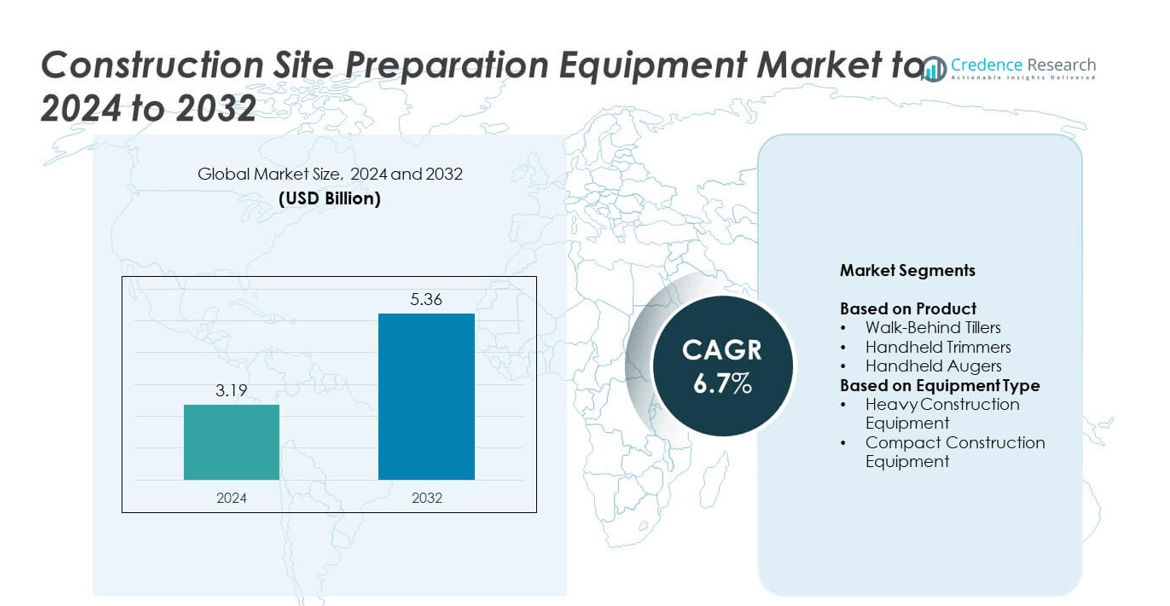
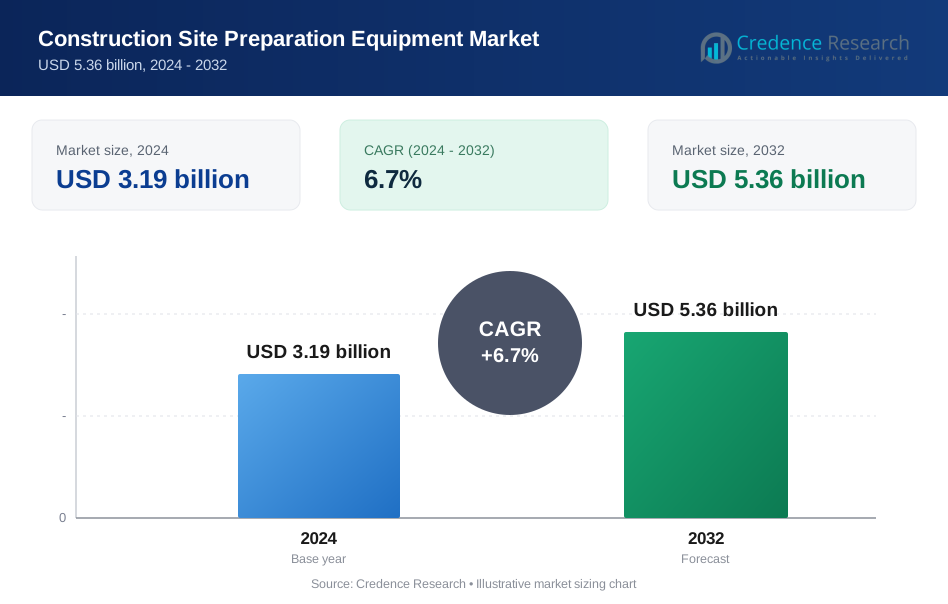
The Construction Site Preparation Equipment Market size was valued at USD 3.19 billion in 2024 and is anticipated to reach USD 5.36 billion by 2032, at a CAGR of 6.7% during the forecast period.
| REPORT ATTRIBUTE | DETAILS |
|---|---|
| Historical Period | 2020-2023 |
| Base Year | 2024 |
| Forecast Period | 2025-2032 |
| Construction Site Preparation Equipment Market Size 2024 | USD 3.19 billion |
| Construction Site Preparation Equipment Market, CAGR | 6.7% |
| Construction Site Preparation Equipment Market Size 2032 | USD 5.36 billion |
The Construction Site Preparation Equipment market is led by prominent companies such as Komatsu, Honda Motor Company, STIHL Inc, Caterpillar, BCS America, Barreto Manufacturing, Volvo Construction Equipment, and Mantis. These players maintain strong market positions through continuous innovation, automation, and eco-friendly machinery development. Their strategies emphasize compact, fuel-efficient, and hybrid models to meet evolving sustainability standards and improve site efficiency. Regionally, Asia Pacific led the market with a 30% share in 2024, driven by rapid industrialization, infrastructure investments, and urban development projects. North America followed with 32%, supported by advanced construction technologies and modernization initiatives across commercial and residential sectors.
Market Insights
- The Construction Site Preparation Equipment market was valued at USD 3.19 billion in 2024 and is expected to reach USD 5.36 billion by 2032, growing at a CAGR of 6.7%.
- Rising infrastructure projects, urban expansion, and modernization of construction processes are driving strong demand for heavy and compact equipment.
- Key trends include the adoption of electric and hybrid machinery, automation, and IoT-based fleet management to improve efficiency and sustainability.
- The market is competitive, with leading companies focusing on advanced technologies, rental services, and eco-friendly equipment designs to gain market share.
- Asia Pacific held a 30% market share in 2024, followed by North America at 32% and Europe at 27%, while the heavy construction equipment segment led with 68% share due to its extensive use in large-scale projects.
Market Segmentation Analysis:
By Product
Walk-behind tillers dominated the market in 2024, accounting for over 42% of the total share. These machines are widely used for soil preparation, landscaping, and small-scale construction due to their efficiency and ease of operation. Growing demand for compact and fuel-efficient tillers in urban construction projects is driving this segment’s growth. Handheld trimmers and augers follow closely, supported by increased use in fencing, gardening, and groundwork applications. Technological advancements in lightweight designs and battery-powered tools are further enhancing operational flexibility and safety across small and medium construction sites.
- For instance, Makita’s 40V XGT earth auger spins at 0–400 / 0–1,500 RPM and drills up to 41 in depth with 8 in diameter
By Equipment Type
Heavy construction equipment held the largest market share of around 68% in 2024, driven by extensive use in large-scale excavation, grading, and earthmoving operations. These machines are essential for site leveling, debris removal, and foundation preparation in infrastructure and commercial projects. Rising global investment in smart cities, highways, and industrial zones continues to strengthen demand for heavy machinery. Meanwhile, compact construction equipment is gaining traction due to its lower emissions, maneuverability, and suitability for confined urban worksites, supporting sustainable and efficient construction operations.
- For instance, the new generation of the Volvo ECR25 Electric excavator features a 40 kWh battery, which is double the capacity of its predecessor
Key Growth Drivers
Rising Infrastructure Development Projects
Expanding public and private infrastructure projects are the primary growth driver for the market. Governments across emerging economies are investing heavily in roadways, airports, and housing projects. These initiatives create consistent demand for excavation, grading, and soil-compaction equipment. Rapid urbanization and industrial expansion in Asia-Pacific further support adoption. Construction firms are increasingly deploying advanced machinery to reduce project timelines and enhance productivity, strengthening the overall equipment demand outlook through 2032.
- For instance, JCB marked its 1-millionth backhoe loader produced, reflecting sustained global project demand.
Shift Toward Automation and Advanced Machinery
The integration of automation, GPS, and telematics in site preparation equipment has improved accuracy and efficiency. Automated systems enable better fuel management, precise grading, and reduced labor dependency. Equipment with real-time monitoring and remote control enhances safety and operational reliability on-site. This technological shift is encouraging contractors to upgrade existing fleets, boosting sales of modern, smart machines. The growing use of digital solutions aligns with global trends in smart construction and Industry 4.0 practices.
- For instance, Caterpillar’s VisionLink monitors over 1.5 million connected assets for fleet optimization.
Increasing Demand for Compact and Energy-Efficient Equipment
Compact construction machines are witnessing growing preference due to their versatility and suitability for confined job sites. Urban redevelopment and residential construction projects rely on smaller, fuel-efficient tools for excavation and finishing works. Manufacturers are introducing hybrid and electric-powered compact models to comply with emission standards. Their cost-effectiveness, ease of transport, and low maintenance needs further boost adoption. This demand shift supports sustainable construction practices and contributes to long-term equipment market expansion.
Key Trends & Opportunities
Adoption of Electric and Hybrid Equipment
Sustainability goals and emission control norms are driving the adoption of electric and hybrid site preparation machinery. Equipment manufacturers are focusing on low-noise, zero-emission designs suited for urban areas. Government incentives and carbon reduction targets are accelerating this transition. Electric models also reduce fuel costs and operational downtime, enhancing project efficiency. As battery technology advances, electric machinery is expected to capture a greater market share across small and mid-scale construction sites globally.
- For instance, Hitachi’s ZX55U-6EB packs a 39.4 kWh battery, fast-charges in ~1.25 hours, and offers ~2 hours runtime, with optional tethered operation.
Integration of IoT and Predictive Maintenance Solutions
The integration of IoT sensors and predictive analytics in construction equipment is transforming maintenance strategies. Real-time monitoring enables early fault detection, minimizing downtime and repair costs. Equipment operators gain valuable data insights on usage patterns, fuel efficiency, and productivity. Predictive maintenance systems extend machine life and enhance reliability, creating long-term cost savings. This trend is promoting the use of connected construction fleets, improving site coordination and decision-making efficiency for contractors and developers.
- For instance, Trimble grade-control users report millimeter-level accuracy and up to 50% productivity improvement on projects.
Key Challenges
High Initial Investment and Maintenance Costs
The high capital investment required for advanced construction equipment remains a major challenge. Smaller contractors often face difficulties in acquiring heavy or automated machinery due to limited budgets. Maintenance, fuel, and spare part expenses further add to operational costs. Despite financing options and leasing services, cost sensitivity among small builders restrains market penetration. Manufacturers are addressing this issue through modular equipment design and service-based rental models to improve accessibility and affordability.
Skilled Labor Shortages and Operational Complexity
The growing sophistication of automated and digital equipment demands skilled operators, which many regions lack. Training costs and time constraints hinder efficient equipment utilization. Mismanagement or improper use can lead to delays and mechanical failures, reducing productivity. The shortage of skilled technicians also affects maintenance quality. To address this, companies are investing in operator training programs and remote-assistance systems. However, the skills gap remains a critical barrier to widespread adoption of modern site preparation equipment.
Regional Analysis
North America
North America held a market share of around 32% in 2024, driven by strong investments in infrastructure modernization and commercial construction. The U.S. remains the key contributor, supported by federal infrastructure funding and rising residential development. The presence of leading equipment manufacturers and high adoption of automated machinery enhance market performance. Canada follows with growing construction activities in urban housing and industrial sectors. The region’s focus on sustainable and energy-efficient equipment is encouraging the adoption of electric and hybrid models, maintaining steady demand for both heavy and compact construction machinery through 2032.
Europe
Europe accounted for approximately 27% of the global market in 2024, supported by steady infrastructure upgrades and urban redevelopment projects. Countries such as Germany, France, and the UK are leading adopters of compact and eco-friendly construction equipment. Strict emission regulations and government-backed green building initiatives are encouraging the use of electric and low-noise machinery. The integration of digital and telematics systems in site preparation tools is gaining traction. Growing emphasis on energy efficiency and worker safety is expected to further enhance equipment demand across public and private infrastructure sectors.
Asia Pacific
Asia Pacific dominated the global market with a 30% share in 2024, driven by rapid urbanization, industrial growth, and government infrastructure initiatives. China, India, and Japan lead in equipment adoption due to extensive construction of transportation networks, smart cities, and industrial parks. Increasing investments in residential and commercial projects boost demand for both heavy and compact equipment. Rising awareness of fuel-efficient and low-emission machinery supports sustainable construction goals. The presence of regional manufacturers and lower equipment costs further strengthen Asia Pacific’s competitive advantage in the global market.
Latin America
Latin America captured around 6% of the market share in 2024, supported by infrastructure expansion and urban development projects in Brazil, Mexico, and Argentina. Growing public investment in transportation and housing sectors is fueling equipment demand. Contractors in the region are increasingly adopting compact and cost-efficient site preparation tools to meet diverse project needs. Economic recovery and foreign investment in industrial construction projects are further supporting market growth. However, fluctuations in raw material prices and limited access to financing continue to affect the pace of equipment modernization across the region.
Middle East & Africa
The Middle East & Africa accounted for about 5% of the market share in 2024, led by large-scale infrastructure projects in the UAE, Saudi Arabia, and South Africa. Ongoing construction in energy, transportation, and tourism sectors drives equipment utilization. Governments are investing in sustainable urban development, boosting demand for heavy machinery and compact equipment. The introduction of smart city projects and industrial zones is further accelerating market expansion. However, challenges such as high import costs and dependency on foreign manufacturers limit market penetration, creating opportunities for regional equipment suppliers.
Market Segmentations:
By Product
- Walk-Behind Tillers
- Handheld Trimmers
- Handheld Augers
By Equipment Type
- Heavy Construction Equipment
- Compact Construction Equipment
By Geography
- North America
- U.S.
- Canada
- Mexico
- Europe
- Germany
- France
- U.K.
- Italy
- Spain
- Rest of Europe
- Asia Pacific
- China
- Japan
- India
- South Korea
- South-east Asia
- Rest of Asia Pacific
- Latin America
- Brazil
- Argentina
- Rest of Latin America
- Middle East & Africa
- GCC Countries
- South Africa
- Rest of the Middle East and Africa
Competitive Landscape
The Construction Site Preparation Equipment market features leading players such as Komatsu, Honda Motor Company, STIHL Inc, Caterpillar, BCS America, Barreto Manufacturing, Volvo Construction Equipment, Ground Hog, Mantis, VST Tillers Tractors, Little Beaver, Chicago Pneumatic, and General Equipment Company. These companies compete through advanced product design, automation, and fuel-efficient technologies. The market is characterized by continuous innovation, focusing on compact and hybrid equipment to meet environmental regulations and improve site productivity. Strategic partnerships, mergers, and expansion into emerging economies strengthen their global presence. Manufacturers are also prioritizing rental solutions and aftersales services to attract small and mid-scale contractors. The integration of IoT-enabled diagnostics, predictive maintenance, and telematics further enhances operational efficiency. Competitive differentiation now depends on sustainability, digital integration, and customer service, positioning technologically advanced and eco-friendly equipment suppliers to capture higher market share in the evolving construction landscape.
Key Player Analysis
- Komatsu
- Honda Motor Company
- STIHL Inc
- Caterpillar
- BCS America, Inc.
- Barreto Manufacturing, Inc.
- Volvo Construction Equipment
- Ground Hog, Inc.
- Mantis (Schiller Grounds Care, Inc.)
- VST Tillers Tractors Ltd.
- Little Beaver, Inc.
- Chicago Pneumatic
- General Equipment Company
Recent Developments
- In 2025, Volvo Construction Equipment Unveiled a new lineup of world-class articulated haulers featuring new electronic systems and an in-house developed transmission, offering up to 15% fuel efficiency improvements. It also announced a strategic global investment of 2,500 MSEK to expand crawler excavator production at three sites to meet growing demand.
- In 2023, Caterpillar Launched updated models like the Cat 995 Wheel Loader and the Cat D10 Dozer, with a focus on improving productivity and meeting strict emissions standards.
- In 2023, Komatsu Partnered with EARTHBRAIN to offer customers a remote control system for construction equipment, aiming to improve safety and productivity. It also continued its focus on electrification, launching a 20-ton PC210LCE electric excavator with an extended battery life.
Report Coverage
The research report offers an in-depth analysis based on Product, Equipment Type and Geography. It details leading market players, providing an overview of their business, product offerings, investments, revenue streams, and key applications. Additionally, the report includes insights into the competitive environment, SWOT analysis, current market trends, as well as the primary drivers and constraints. Furthermore, it discusses various factors that have driven market expansion in recent years. The report also explores market dynamics, regulatory scenarios, and technological advancements that are shaping the industry. It assesses the impact of external factors and global economic changes on market growth. Lastly, it provides strategic recommendations for new entrants and established companies to navigate the complexities of the market.
Future Outlook
- The market will witness steady growth driven by rising global infrastructure investments.
- Adoption of electric and hybrid construction equipment will expand across urban projects.
- Automation and digital control systems will enhance operational precision and safety.
- Compact and fuel-efficient machines will gain preference for residential and confined worksites.
- Asia Pacific will continue to lead market growth supported by industrial and urban development.
- North America and Europe will focus on sustainable and low-emission construction equipment.
- Rental and leasing services will increase as contractors seek cost-effective equipment access.
- Integration of IoT and predictive maintenance will reduce downtime and extend machine life.
- Manufacturers will invest in training programs to address the shortage of skilled operators.
- Government policies promoting sustainable construction will create long-term market opportunities.
Request a Free Sample
Fill in your details and we'll send you a free sample report.
- Sample data tables & charts
- Research methodology
Need a Custom Version of This Report?
Tailor the scope, geography, or segments to your exact requirements.
- Custom geography or segment scope
- Direct access to our analyst team
Frequently Asked Questions
What is the current market size for Construction Site Preparation Equipment Market, and what is its projected size in 2032?
At what Compound Annual Growth Rate is the Construction Site Preparation Equipment Market projected to grow between 2025 and 2032?
Which Construction Site Preparation Equipment Market segment held the largest share in 2024?
4What are the primary factors fueling the growth of the Construction Site Preparation Equipment Market?
Who are the leading companies in the Construction Site Preparation Equipment Market?
Table of Content
Chapter 1. Report Introduction
- 1.1 Report Description & Purpose
- 1.1.1 Report Title & Market Definition
- 1.1.2 Unique Selling Propositions (USP) & Key Differentiators
- 1.1.3 Value Proposition for Stakeholders
- 1.2 Research Objectives
- 1.2.1 Market Sizing Objectives (Volume & Revenue) (Volume Where Applicable)
- 1.2.2 Segmentation Objectives
- 1.2.3 Competitive Intelligence Objectives
- 1.2.4 Forecast & Scenario Objectives
- 1.3 Report Scope
- 1.3.1 Construction Site Preparation Equipment Scope – Segments & Subsegments Covered
- 1.3.2 Geographic Scope – Regions & Countries Covered
- 1.3.3 Historical Period, Base Year & Forecast Period (2024; forecast to 2032)
- 1.3.4 Inclusions & Exclusions
- 1.4 Industry Classification & Applicable Codes
- 1.5 Currency, Measurement Units & Valuation Basis
- 1.6 Target Stakeholders
- 1.7 Limitations & Assumptions
Chapter 2. Executive Summary
- 2.1 Global Construction Site Preparation Equipment Market Snapshot
- 2.1.1 Market Size – Historical (2024) & Forecast (2024-2032) (2024: USD 3.19 billion → 2032: USD 5.36 billion)
- 2.1.2 Volume & Revenue – Global Totals (Volume Where Applicable)
- 2.1.3 Key Market Highlights – Top Five Facts
- 2.2 Construction Site Preparation Equipment Market Segmentation Snapshot
- 2.2.1 Market Split by Region – 2024 vs. 2032
- 2.3 Competitive Snapshot
- 2.3.1 Top 10 Players by Revenue Share – 2024
- 2.3.2 Top 10 Players by Volume Share – 2024 (Volume Where Applicable)
- 2.3.3 Recent Strategic Developments (18-Month Summary)
- 2.4 Key Investment Highlights & Strategic Conclusions
Chapter 3. Construction Site Preparation Equipment Market Dynamics & Industry Analysis
- 3.1 Market Overview & Context
- 3.1.1 Construction Site Preparation Equipment Market Position in the Broader Industry Value Chain
- 3.1.2 Demand Structure & Purchasing Dynamics
- 3.1.3 Market Maturity & Development Stage by Region
- 3.2 Construction Site Preparation Equipment Market Drivers
- 3.3 Construction Site Preparation Equipment Market Restraints & Challenges
- 3.4 Construction Site Preparation Equipment Market Opportunities
- 3.5 Porter's Five Forces Analysis
- 3.5.1 Threat of New Entrants
- 3.5.2 Bargaining Power of Suppliers
- 3.5.3 Bargaining Power of Buyers
- 3.5.4 Threat of Substitutes
- 3.5.5 Competitive Rivalry – Intensity Assessment
- 3.6 Construction Site Preparation Equipment Value Chain Analysis
- 3.6.1 Upstream – Key Inputs, Resources & Suppliers
- 3.6.1.1 Key Input/Resource 1
- 3.6.1.2 Key Input/Resource 2
- 3.6.1.3 Key Input/Resource 3
- 3.6.2 Midstream – Core Operations & Value Creation
- 3.6.2.1 Operating Model & Process Overview
- 3.6.2.2 Key Operating Locations & Capabilities by Company
- 3.6.3 Downstream – Market Channels & End Users
- 3.6.3.1 Direct Sales & Customer Engagement Channels
- 3.6.3.2 Indirect Sales, Intermediaries & Partner Channels
- 3.6.4 Value Chain Profitability Analysis
- 3.6.1 Upstream – Key Inputs, Resources & Suppliers
- 3.7 PESTEL Analysis
- 3.7.1 Political Factors
- 3.7.2 Economic Factors
- 3.7.3 Social Factors
- 3.7.4 Technological Factors
- 3.7.5 Environmental Factors
- 3.7.6 Legal Factors
- 3.8 Construction Site Preparation Equipment Supply Chain Analysis
- 3.8.1 Critical Input & Resource Availability Risk Assessment
- 3.8.2 Supplier & Operational Concentration Risk (Geographic Exposure)
- 3.8.3 Supply & Service Disruption Impact Analysis
- 3.9 Regulatory & Policy Landscape
Note: The regulatory and policy landscape section covers regulations based on their applicability to the market, Construction Site Preparation Equipment category, geography, and scope of the study. Only regulatory frameworks with a material impact on operations, compliance, trade, sustainability, or market access are analyzed in detail.
Chapter 4. Key Investment Pockets & Opportunity Analysis
- 4.1 Construction Site Preparation Equipment Market Attractiveness Analysis
- 4.1.1 By Region – Investment Attractiveness Matrix (Market Size × CAGR)
- 4.2 Absolute Revenue Growth Opportunity
- 4.2.1 By Region – Absolute Revenue Growth Through 2032
- 4.3 Incremental Demand Opportunity
- 4.3.1 By Region – Incremental Demand Through 2032
- 4.3.2 Segment – Incremental Demand
- 4.4 Emerging Submarket Opportunity Deep Dive (Subject to Applicability)
- 4.5 Priority Market Opportunity Scorecards
- 4.5.1 United States
- 4.5.2 Europe
- 4.5.3 Asia
- 4.5.4 Middle East & Africa
Note: Priority market opportunity scorecards reflect the geographic scope and strategic relevance of the study. Listed markets are indicative and may be adapted to the industry.
Chapter 5. Construction Site Preparation Equipment Cross-Border Trade & Market Access Analysis
- 5.1 International Trade & Cross-Border Activity Overview
- 5.1.1 Global Export Value by Country (2024)
- 5.1.2 Global Export Volume by Country (2024) (Volume Where Applicable)
- 5.1.3 Global Import Value by Country (2024)
- 5.1.4 Global Import Volume by Country (2024) (Volume Where Applicable)
- 5.1.5 Net Trade Balance by Country (2024)
- 5.2 Export Analysis – Segment
- 5.2.1 Category 1 (Applicable Classification Code)
- 5.2.2 Category 2 (Applicable Classification Code)
- 5.2.3 Category 3 (Applicable Classification Code)
- 5.2.4 Category 4 (Applicable Classification Code)
- 5.2.5 Category 5 (Applicable Classification Code)
- 5.3 Import Analysis – Segment
- 5.3.1 Category 1 (Applicable Classification Code)
- 5.3.2 Category 2 (Applicable Classification Code)
- 5.3.3 Category 3 (Applicable Classification Code)
- 5.3.4 Category 4 (Applicable Classification Code)
- 5.3.5 Category 5 (Applicable Classification Code)
- 5.4 Cross-Border Pricing & Transaction Benchmarks
- 5.4.1 Export Pricing – Segment & Country
- 5.4.2 Import Pricing – Segment & Source Country
- 5.4.3 Price Trends (2024)
- 5.5 Key Cross-Border Trade & Delivery Routes
- 5.5.1 Cross-Border Trade/Delivery Route 1
- 5.5.2 Cross-Border Trade/Delivery Route 2
- 5.5.3 Cross-Border Trade/Delivery Route 3
- 5.5.4 Cross-Border Trade/Delivery Route 4
- 5.5.5 Cross-Border Trade/Delivery Route 5
- 5.6 Trade Policy & Market Access Impact Assessment
- 5.6.1 Tariff & Non-Tariff Barriers
- 5.6.2 Regional Trade & Economic Integration Frameworks
- 5.6.3 Bilateral & Multilateral Trade Agreements
- 5.6.4 Cross-Border Operating, Licensing & Localization Requirements
Note: This chapter applies where cross-border trade or delivery is relevant to Construction Site Preparation Equipment. Goods, services, and digital offerings are assessed using applicable classifications and transaction measures. Import-export volumes, trade balances, and route analyses are included only where meaningful to the market.
Chapter 6. Competitive Landscape & Company Benchmarking
- 6.1 Construction Site Preparation Equipment Market Concentration & Structure
- 6.1.1 Herfindahl-Hirschman Index (HHI) – vs. 2024
- 6.1.2 Leading, Mid-Sized & Emerging Player Structure
- 6.1.3 Global, Regional & Local Player Dynamics
- 6.2 Construction Site Preparation Equipment Market Share Analysis – 2024
- 6.2.1 Global Revenue Share by Company
- 6.2.2 Global Volume Share by Company (Volume Where Applicable)
- 6.2.3 Regional Revenue Share
- 6.2.4 Market Share Evolution ( vs. 2024)
- 6.2.5 Company Market Share by Key Segment
- 6.2.6 Company Market Share by Customer Group
- 6.3 Operating Scale, Capacity & Infrastructure Analysis
- 6.3.1 Global Operating Scale & Supply Capacity
- 6.3.2 Resource Utilization & Operating Efficiency
- 6.3.3 Output, Service Delivery & Activity Metrics
- 6.3.4 Operating Footprint & Infrastructure Map
- 6.3.5 Planned Operational & Capacity Expansion
- 6.4 Construction Site Preparation Equipment Competitive Benchmarking Matrix
- 6.4.1 Revenue, Growth, Profitability & Operating Metric Comparison
- 6.4.2 Channel Revenue Mix
- 6.4.3 Geographic Revenue Exposure
- 6.4.4 R&D Intensity
- 6.4.5 Sustainability Maturity
- 6.5 Strategic Developments in Construction Site Preparation Equipment (Last 24 Months)
- 6.5.1 Mergers, Acquisitions & Divestments
- 6.5.2 New Products, Services & Solutions in Construction Site Preparation Equipment
- 6.5.3 Operational & Infrastructure Expansions
- 6.5.4 Strategic Alliances, Joint Ventures & Partnerships
- 6.5.5 Distribution Expansion & Market Entry
- 6.5.6 Sustainability & ESG Initiatives
- 6.6 Competitive Strategy Mapping
- 6.6.1 Leader, Challenger, Follower & Niche Classification
- 6.6.2 Pricing Strategy Comparison
- 6.6.3 Channel Strategy Matrix
Note: Strategic developments are included based on their materiality and the availability of reliable information.
Chapter 7. Global Construction Site Preparation Equipment Market – By Sales & Delivery Channel
- 7.1 Segment Overview
- 7.1.1 Volume & Revenue Split by Channel (2024 & 2032) (Volume Where Applicable)
- 7.1.2 Channel Mix Evolution (2024-2032)
Chapter 8. Regional Market Analysis – Global Overview
- 8.1 Global Regional Overview
- 8.1.1 Regional Volume Share (Volume Where Applicable)
- 8.1.2 Regional Revenue Share
- 8.1.3 Regional Volume by Region (Volume Where Applicable)
- 8.1.4 Regional Revenue by Region
- 8.1.5 Regional Forecast Through 2032
- 8.2 Cross-Regional Segment Analysis
- 8.2.1 By Sales & Delivery Channel
- 8.2.2 By Competitive Positioning & Price Tier
Chapter 9. North America Construction Site Preparation Equipment Market
- 9.1 United States
- 9.2 Canada
- 9.3 Mexico
Chapter 10. Europe Construction Site Preparation Equipment Market
- 10.1 Germany
- 10.2 France
- 10.3 Italy
- 10.4 United Kingdom
- 10.5 Spain
- 10.6 Poland
- 10.7 Russia
- 10.8 Netherlands
- 10.9 Belgium
- 10.10 Sweden
- 10.11 Denmark
- 10.12 Norway
- 10.13 Rest of Europe
Chapter 11. Asia Pacific Construction Site Preparation Equipment Market
- 11.1 China
- 11.2 India
- 11.3 Japan
- 11.4 South Korea
- 11.5 Thailand
- 11.6 Indonesia
- 11.7 Vietnam
- 11.8 Malaysia
- 11.9 Australia
- 11.10 Rest of Asia Pacific
Chapter 12. Latin America Construction Site Preparation Equipment Market
- 12.1 Brazil
- 12.2 Argentina
- 12.3 Colombia
- 12.4 Chile
- 12.5 Rest of Latin America
Chapter 13. Middle East Construction Site Preparation Equipment Market
- 13.1 Saudi Arabia
- 13.2 United Arab Emirates
- 13.3 Turkey
- 13.4 Israel
- 13.5 Iran
- 13.6 Rest of the Middle East
Chapter 14. Africa Construction Site Preparation Equipment Market
- 14.1 South Africa
- 14.2 Egypt
- 14.3 Nigeria
- 14.4 Morocco
- 14.5 Rest of Africa
Chapter 15. Construction Site Preparation Equipment Company Profiles
- 15.1 [Company 01]
- 15.1.1 Company Overview
- 15.1.2 Key Management Personnel
- 15.1.3 Products & Services Portfolio
- 15.1.4 Financial Performance
- 15.1.5 Key Market Focus & Geographic Presence
- 15.1.6 Recent Developments & Strategic Initiatives
Note: The company profile list is preliminary and may change based on research findings, market developments, data availability, and client requirements.
Chapter 16. Appendices
- Appendix A – List of Abbreviations & Acronyms
- Appendix B – Industry Classification Code Reference – Full Series
- Appendix C – Supply, Output & Operating Capacity Data Tables
- Appendix D – End-Use & Demand Base Tables
- Appendix E – Demand, Adoption & Usage Assumptions
- Appendix F – Pricing & Revenue Metric Reference Tables
- Appendix G – Company Operations & Infrastructure Database
- Appendix H – Cross-Border Trade & Activity Data Tables (Where Applicable)
- Appendix I – Regulatory Summary Tables
- Appendix J – Primary Research Participant List (Anonymized)
- Appendix K – Primary Research Questionnaire Framework
- Appendix L – Data Sources & Bibliography
- Appendix M – Market Size Divergence & Source Comparison
Chapter 17. Research Methodology
- 17.1 Research Framework & Philosophy
- 17.2 Secondary Research – Sources, Hierarchy & Data Extraction
- 17.3 Data Modeling – Bottom-Up & Top-Down Market Sizing
- 17.4 Primary Research – Stakeholder Framework, LOI & Sample Sizes
- 17.5 Forecast Methodology – Regression, Scenario & Sensitivity Analysis
- 17.6 Quality Control – Four-Layer Validation Framework
- 17.7 Limitations & Standard Assumptions
- 17.8 Disclaimer
