
Market Overview:
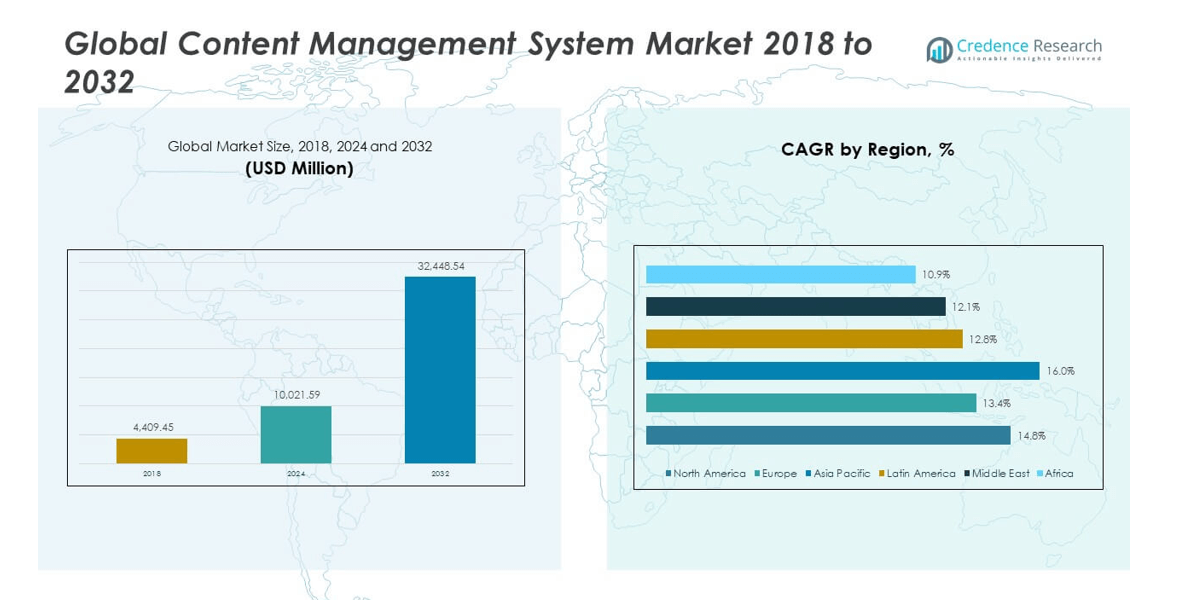
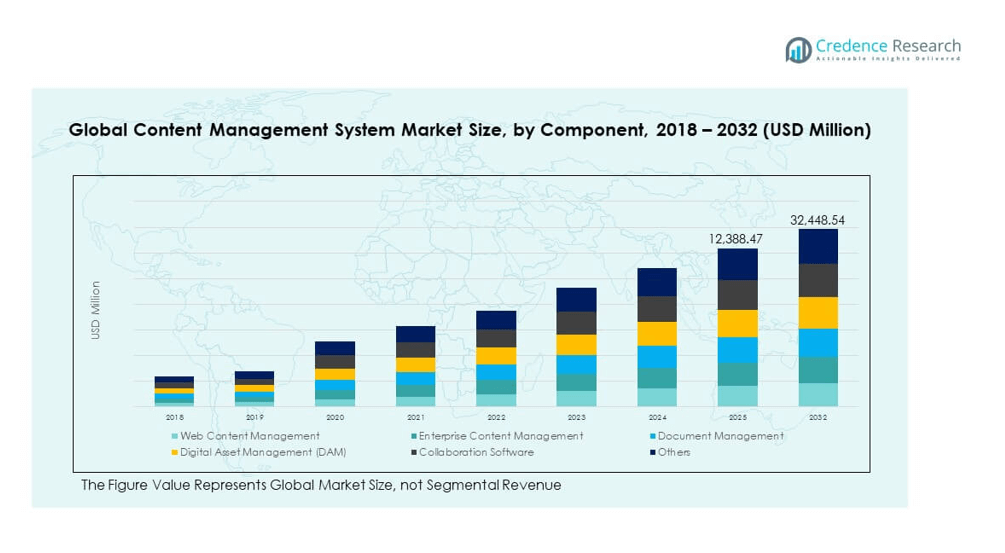
The Global Content Management System Market size was valued at USD 4,409.45 million in 2018 to USD 10,021.59 million in 2024 and is anticipated to reach USD 32,448.54 million by 2032, at a CAGR of 14.75% during the forecast period.
| REPORT ATTRIBUTE | DETAILS |
|---|---|
| Historical Period | 2020-2023 |
| Base Year | 2024 |
| Forecast Period | 2025-2032 |
| Content Management System Market Size 2024 | USD 10,021.59 million |
| Content Management System Market, CAGR | 14.75% |
| Content Management System Market Size 2032 | USD 32,448.54 million |
The market is expanding as organizations prioritize digital transformation and seamless content delivery across multiple channels. The growing need for efficient web content management, coupled with rising demand for personalization, is driving adoption. Enterprises are integrating CMS platforms with advanced analytics and artificial intelligence to enhance user experience, streamline workflows, and improve engagement. Additionally, the rise in e-commerce, mobile applications, and remote collaboration has further accelerated demand for scalable and secure CMS solutions.
Regionally, North America leads the market due to its advanced digital infrastructure and strong presence of global CMS providers. Europe follows closely, supported by regulatory frameworks promoting data management and digital publishing. The Asia-Pacific region is witnessing rapid growth, driven by increasing internet penetration, booming e-commerce, and adoption of cloud-based solutions in countries like China and India. Emerging regions such as Latin America and the Middle East are also gaining traction, fueled by digitalization initiatives and growing investments in IT infrastructure.
Market Insights:
- The Global Content Management System Market was valued at USD 4,409.45 million in 2018, reached USD 10,021.59 million in 2024, and is projected to achieve USD 32,448.54 million by 2032, growing at a CAGR of 14.75%.
- North America led in 2024 with 43.0% share due to strong IT infrastructure and enterprise adoption, followed by Asia Pacific at 30.3% fueled by e-commerce and cloud growth, while Europe accounted for 17.6% driven by regulatory compliance.
- Asia Pacific remains the fastest-growing region with 30.3% share in 2024, supported by government-led digitalization and rapid technology adoption across China, India, and Japan.
- By component, web content management accounted for 31% share in 2024, reflecting its dominance in omnichannel digital delivery.
- Enterprise content management captured 24% share, underlining its importance in compliance, structured workflows, and enterprise-scale data management.
Market Drivers
Rising Demand for Digital Transformation and Efficient Content Delivery Across Industries
The Global Content Management System Market is witnessing strong growth driven by organizations embracing digital transformation to improve customer engagement and operational efficiency. Businesses are adopting CMS platforms to streamline web content publishing and ensure consistent brand presence across multiple digital channels. The demand for omnichannel content delivery has created pressure on enterprises to implement scalable CMS solutions. Companies are focusing on centralized platforms that allow collaboration among marketing, IT, and design teams. Cloud-based CMS adoption is increasing because it reduces infrastructure costs while providing flexibility and accessibility. Enterprises are integrating CMS solutions with customer experience platforms to deliver personalized journeys. It supports organizations in strengthening online visibility and competitive positioning.
- For instance, Adobe Experience Manager Assets enables enterprises to manage and deliver over 250,000 digital assets annually, supporting workflow automation and collaboration across global teams.
Integration of Advanced Analytics and Artificial Intelligence in CMS Platforms
The adoption of artificial intelligence and data-driven insights is reshaping how enterprises manage content. Organizations are deploying AI-enabled CMS solutions to automate workflows and optimize content recommendations. Natural language processing and predictive analytics help companies personalize user experiences more effectively. Businesses can analyze customer preferences to deliver targeted content that improves engagement and conversions. It enhances efficiency by reducing manual intervention in content curation. AI-powered chatbots and recommendation engines are being embedded into CMS platforms to strengthen interaction capabilities. Machine learning capabilities are helping CMS platforms adapt to evolving consumer behavior. This integration ensures sustainable long-term value for enterprises investing in CMS.
Growing Impact of E-Commerce and Mobile Application Expansion on CMS Adoption
The rise of e-commerce platforms and mobile applications is significantly fueling CMS adoption. Enterprises are increasingly relying on CMS platforms to deliver seamless product information across digital storefronts. CMS helps retailers maintain unified content strategies across websites, apps, and digital marketplaces. It ensures real-time updates of product catalogs, prices, and promotional campaigns, enhancing customer trust. Mobile-first strategies are making responsive CMS platforms a necessity for businesses targeting global audiences. Companies are also integrating CMS platforms with payment gateways and logistics systems to improve customer satisfaction. A well-structured CMS enhances search engine rankings, driving higher traffic to e-commerce websites. This trend continues to strengthen CMS demand in the retail and mobile commerce sector.
- For instance, Shopify’s CMS powered over 4.6 million active stores worldwide in 2024, enabling consistent content delivery and seamless shopping experiences across desktop and mobile platforms.
Rising Importance of Remote Collaboration and Cloud-Based Workflows in Enterprises
The shift toward remote work and hybrid office models has accelerated the adoption of cloud-enabled CMS platforms. Organizations seek tools that support collaboration between distributed teams in real time. CMS platforms integrated with cloud infrastructure enable secure access to content repositories from any location. It improves project management efficiency by allowing multiple contributors to edit and approve content simultaneously. Cloud CMS also ensures high data security and compliance with industry regulations. Enterprises value subscription-based models for their affordability and scalability. Remote collaboration has become a core factor influencing IT budgets and investment decisions. Cloud-driven CMS adoption is expected to dominate future enterprise strategies.
Market Trends
Adoption of Headless CMS Architecture to Support Omnichannel Delivery
One of the key trends in the Global Content Management System Market is the growing shift toward headless CMS architectures. This approach separates content creation from content presentation, enabling flexibility across digital platforms. Organizations are leveraging headless CMS to deliver consistent experiences across websites, apps, wearables, and smart devices. It empowers developers to use APIs for content delivery without design restrictions. Headless CMS enhances scalability, making it ideal for enterprises targeting global markets. Businesses adopting this trend can achieve faster time-to-market for new campaigns and products. This architecture is gaining momentum in sectors like retail, media, and entertainment.
Expansion of Low-Code and No-Code CMS Platforms for Non-Technical Users
Low-code and no-code platforms are transforming the CMS landscape by making it accessible to non-technical users. These solutions enable marketers, editors, and business professionals to manage websites without depending heavily on developers. Organizations are adopting such platforms to reduce development time and lower operational costs. It allows rapid prototyping and easier customization of digital experiences. Low-code CMS ensures that enterprises remain agile in responding to market demands. Businesses can launch new sites and campaigns faster with minimal technical intervention. This trend is gaining popularity among small and medium-sized enterprises looking for affordable yet powerful CMS tools.
- For instance, Wix announced that it surpassed 272 million registered users in 2024, showcasing the widespread adoption of its no-code CMS platform among small businesses and entrepreneurs.
Growing Use of Voice Search Optimization and Multilingual Capabilities in CMS
Voice-enabled technologies and multilingual content delivery are emerging as critical factors in CMS innovation. Enterprises are optimizing CMS platforms for voice search to align with evolving consumer search habits. Multilingual support ensures global reach and inclusivity, especially for businesses expanding into new regions. It empowers organizations to maintain cultural relevance in digital communications. CMS providers are integrating tools for seamless translation and localization. Voice search optimization is particularly vital in e-commerce and customer support applications. These capabilities help companies improve accessibility and strengthen customer trust. The trend is shaping the competitive differentiation of modern CMS platforms.
Increasing Role of Cybersecurity Features in CMS Development
Cybersecurity is becoming a central focus in the development of CMS platforms. Organizations face rising risks of data breaches and cyberattacks targeting digital content. CMS providers are embedding advanced security features such as multi-factor authentication and encrypted workflows. It ensures compliance with global data protection regulations while protecting sensitive business content. Enterprises are prioritizing CMS platforms with strong vulnerability management and real-time monitoring tools. Secure hosting environments and automated updates are gaining importance among CMS buyers. This trend reflects the strategic alignment of content management with enterprise risk management. Businesses are prioritizing security as a critical element of CMS adoption.
- For instance, Drupal’s security team released multiple advisories in 2023 including a January update addressing four core vulnerabilities and three plugin issues reinforcing its strong reputation for reliable security support in government and enterprise use cases.
Market Challenges Analysis
High Implementation Costs and Complexity in Integration with Existing IT Infrastructure
The Global Content Management System Market faces challenges due to high implementation costs and integration complexities. Enterprises often struggle with aligning CMS platforms with legacy IT systems and existing workflows. Customization demands significant technical expertise, leading to additional expenses. Smaller businesses face barriers due to limited budgets for enterprise-grade CMS solutions. It creates a divide between large corporations with advanced infrastructure and SMEs with limited resources. Organizations also encounter challenges in training staff to use advanced CMS features. This slows adoption and hinders the expected ROI. The complexity of migrating from traditional systems further impacts the decision-making process.
Growing Concerns Over Data Security, Compliance, and Vendor Lock-In Issues
Security and compliance risks present major obstacles for enterprises adopting CMS platforms. Increasing cyber threats require CMS providers to ensure stronger protective measures, yet vulnerabilities remain a concern. It raises issues of trust among businesses handling sensitive customer data. Vendor lock-in also poses challenges as organizations struggle with limited flexibility once invested in a specific platform. Regulatory frameworks in different regions add further complexity to CMS deployment strategies. Companies need to allocate additional resources to maintain compliance and data integrity. Balancing customization with security often leads to trade-offs that impact efficiency. These concerns continue to influence enterprise CMS adoption strategies.
Market Opportunities
Rising Demand for Personalization and AI-Driven User Experience Enhancements
The Global Content Management System Market is creating strong opportunities through the demand for personalization. Enterprises are adopting AI-enabled CMS platforms to deliver tailored experiences to users. Predictive analytics and machine learning tools enhance content relevance across digital channels. It supports better engagement and strengthens customer loyalty. Businesses investing in personalization strategies see higher conversion rates and customer satisfaction. Industries like retail, banking, and healthcare are early adopters of these technologies. The opportunity to differentiate through intelligent content management is becoming a priority for enterprises worldwide.
Expansion of Cloud-Based CMS Solutions and Emerging Market Adoption
Cloud-based CMS solutions are opening new avenues for adoption in emerging economies. Enterprises are increasingly preferring subscription models for scalability and affordability. It enables organizations to deploy content platforms quickly without large upfront investments. Growing internet penetration and digital adoption in developing countries are fueling CMS demand. Cloud integration also supports mobile-first strategies, which dominate consumer markets in Asia-Pacific, Latin America, and Africa. The opportunity lies in delivering agile solutions tailored to regional needs. Global providers are expanding into these markets to capture new growth.
Market Segmentation Analysis:
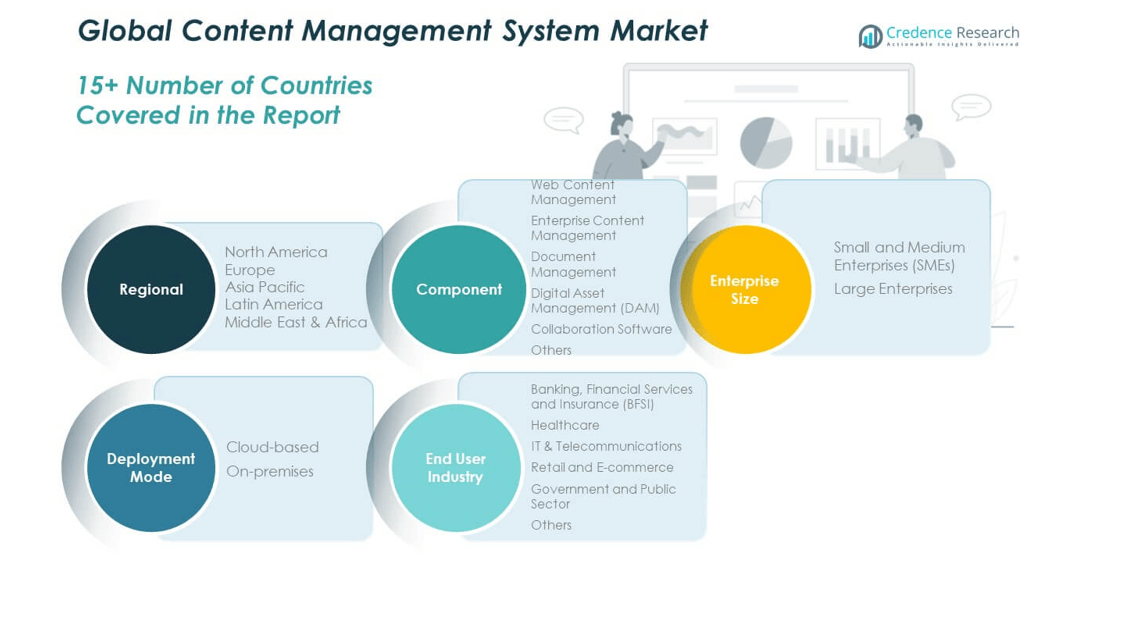
The Global Content Management System Market demonstrates strong diversification across component, enterprise size, deployment mode, and end user industry.
By component, web content management holds significant demand due to its role in enabling businesses to deliver personalized digital experiences across multiple channels. Enterprise content management is gaining traction among large organizations for structured data handling and regulatory compliance, while document management supports efficient workflows across industries. Digital asset management and collaboration software are emerging segments, driven by the growing need to streamline digital assets and enhance team productivity. Other niche solutions cater to specialized requirements in creative and knowledge-intensive sectors.
By enterprise size, large enterprises lead adoption due to higher budgets and the need for advanced integration, while SMEs are increasingly adopting cost-effective and cloud-based solutions to strengthen competitiveness.
By deployment mode, cloud-based platforms dominate due to scalability, affordability, and remote accessibility, while on-premises solutions remain relevant in industries with strict data control requirements.
- For instance, Acquia Cloud Platform powers enterprise-scale Drupal deployments with secure, compliant hosting and Kubernetes-based autoscaling via its Multi-Experience Operations feature, reinforcing its suitability for regulated sectors.
By end user industry, BFSI drives significant adoption with secure document workflows and compliance needs, healthcare emphasizes patient data management, and IT & telecommunications leverage CMS for service delivery. Retail and e-commerce invest in CMS for omnichannel customer engagement, while the government and public sector adopt it to improve transparency and digital service delivery. Collectively, these segments reflect the widespread applicability of content management systems across industries and organizational scales.
- For example, Salesforce CMS is a hybrid content management system that enables centralized content creation and delivery across Experience Cloud, Marketing Cloud, and other channels, offering scalable content workflows for regulated industries.
Segmentation:
By Component
- Web Content Management
- Enterprise Content Management
- Document Management
- Digital Asset Management (DAM)
- Collaboration Software
- Others
By Enterprise Size
- Small and Medium Enterprises (SMEs)
- Large Enterprises
By Deployment Mode
- Cloud-based
- On-premises
By End User Industry
- Banking, Financial Services, and Insurance (BFSI)
- Healthcare
- IT & Telecommunications
- Retail and E-commerce
- Government and Public Sector
- Others
By Region
- North America
- U.S.
- Canada
- Mexico
- Europe
- Germany
- France
- U.K.
- Italy
- Spain
- Rest of Europe
- Asia Pacific
- China
- Japan
- India
- South Korea
- South-east Asia
- Rest of Asia Pacific
- Latin America
- Brazil
- Argentina
- Rest of Latin America
- Middle East & Africa
- GCC Countries
- South Africa
- Rest of the Middle East and Africa
Regional Analysis:
North America
The North America Global Content Management System Market size was valued at USD 1,915.68 million in 2018 to USD 4,308.43 million in 2024 and is anticipated to reach USD 13,989.05 million by 2032, at a CAGR of 14.8% during the forecast period. North America accounts for 43.0% of the total market share in 2024, making it the leading region. The region benefits from advanced IT infrastructure and a strong presence of global technology companies. Enterprises in the U.S. and Canada are early adopters of cloud-based CMS platforms, driven by the need for omnichannel customer engagement. The BFSI, healthcare, and retail industries are among the largest consumers of CMS solutions in the region. High digital literacy and strong e-commerce penetration further fuel growth. The market is supported by robust investment in AI, analytics, and security integration within CMS platforms. It remains the hub for technological innovation and sets global benchmarks for CMS adoption.
Europe
The Europe Global Content Management System Market size was valued at USD 821.19 million in 2018 to USD 1,763.87 million in 2024 and is anticipated to reach USD 5,191.98 million by 2032, at a CAGR of 13.4% during the forecast period. Europe contributes 17.6% of the total market share in 2024. The region’s growth is supported by digital transformation initiatives, strict data protection regulations, and increasing demand for multilingual content management. Countries such as Germany, the UK, and France lead adoption due to their strong enterprise ecosystem. Healthcare, government, and retail sectors demonstrate rising demand for CMS to ensure compliance and enhance service delivery. The General Data Protection Regulation (GDPR) drives the need for secure and compliant CMS solutions. Enterprises in the region also prioritize sustainability and green IT strategies in their technology adoption. It positions Europe as a mature market with a regulatory-driven growth trajectory.
Asia Pacific
The Asia Pacific Global Content Management System Market size was valued at USD 1,306.23 million in 2018 to USD 3,130.44 million in 2024 and is anticipated to reach USD 11,032.80 million by 2032, at a CAGR of 16.0% during the forecast period. Asia Pacific holds 30.3% of the total market share in 2024, making it the fastest-growing region. The market expansion is driven by rapid digitalization, strong growth in e-commerce, and rising mobile-first strategies across emerging economies. China, India, Japan, and South Korea are key contributors due to their large consumer base and thriving IT ecosystems. Governments in the region actively promote digital adoption, boosting demand for enterprise and cloud-based CMS platforms. SMEs are showing increasing adoption to strengthen competitiveness. Cloud penetration and growing investments in artificial intelligence enhance the market potential. It positions Asia Pacific as a high-growth hub with significant opportunities for global and local CMS providers.
Latin America
The Latin America Global Content Management System Market size was valued at USD 191.62 million in 2018 to USD 429.61 million in 2024 and is anticipated to reach USD 1,217.11 million by 2032, at a CAGR of 12.8% during the forecast period. Latin America contributes 4.2% of the total market share in 2024. Brazil and Mexico are leading markets, supported by digitalization in banking, retail, and government sectors. Growing internet penetration and rising consumer demand for digital services accelerate CMS adoption. Enterprises in the region are increasingly shifting toward cloud deployment models to reduce costs. E-commerce growth is creating strong demand for scalable CMS platforms. Despite challenges like limited IT budgets and infrastructure gaps, the region is showing steady progress. Local service providers are collaborating with global CMS vendors to improve accessibility. It reflects a promising emerging market with gradual adoption of advanced digital solutions.
Middle East
The Middle East Global Content Management System Market size was valued at USD 116.17 million in 2018 to USD 239.90 million in 2024 and is anticipated to reach USD 646.98 million by 2032, at a CAGR of 12.1% during the forecast period. The Middle East represents 2.4% of the total market share in 2024. The region’s growth is supported by government-led digital transformation programs in GCC countries. Sectors such as BFSI, healthcare, and public services drive demand for CMS platforms. Cloud adoption is accelerating due to investments in smart city projects and digital governance. Enterprises in countries like the UAE and Saudi Arabia are focusing on delivering efficient digital citizen services. Multilingual content management is becoming a priority to address diverse populations. Despite regional political and economic challenges, investment in IT modernization remains strong. It reflects a market moving steadily toward cloud-first strategies.
Africa
The Africa Global Content Management System Market size was valued at USD 58.56 million in 2018 to USD 149.34 million in 2024 and is anticipated to reach USD 370.63 million by 2032, at a CAGR of 10.9% during the forecast period. Africa accounts for 1.5% of the total market share in 2024, making it the smallest but steadily growing region. South Africa, Nigeria, and Egypt are the key contributors due to rising internet adoption and growing e-commerce activity. Governments are investing in digital public service delivery to improve efficiency. SMEs are showing interest in affordable, cloud-based CMS platforms to enhance online visibility. Infrastructure challenges and budget constraints limit large-scale deployment, yet opportunities exist in education and public sector digitization. Local service providers are emerging to cater to regional needs. It positions Africa as a nascent but promising market for CMS adoption.
Key Player Analysis:
- Adobe Inc.
- Oracle Corporation
- Microsoft Corporation
- OpenText Corporation
- Sitecore Corporation A/S
- Acquia Inc.
- IBM Corporation
- Hyland Software
- SAP SE
- Episerver (Optimizely)
Competitive Analysis:
The Global Content Management System Market is highly competitive, with established players and emerging vendors striving for greater market share. Key companies such as Adobe, Oracle, Microsoft, IBM, and SAP dominate the landscape with comprehensive platforms that integrate advanced analytics, artificial intelligence, and cloud capabilities. Sitecore, Acquia, and OpenText strengthen their presence through innovation and partnerships, while Hyland and Optimizely enhance portfolios with sector-focused offerings. Competition centers on scalability, security, and ease of integration, making differentiation essential. It continues to evolve as companies pursue mergers, acquisitions, and product innovations to expand regional presence and capture demand from industries undergoing digital transformation.
Recent Developments:
- In August 2025, CMS Distribution announced a new partnership with Qualstar, a renowned manufacturer of intelligent data storage solutions. This collaboration is expected to enhance CMS Distribution’s content management offerings by integrating advanced storage capabilities, positively impacting their product delivery to global clients.
- In July 2025, Oracle Corporation entered a landmark agreement with the U.S. General Services Administration (GSA) to modernize federal government systems, offering a 75% discount on Oracle’s license-based technology for public agencies until November 2025. This deal provides access to Oracle’s advanced data management solutions while eliminating data egress fees.
- In June 2025, Adobe Inc. unveiled its Firefly AI-powered image generation app for smartphones, integrating both Adobe and partner AI models on iOS and Android. This move strengthens Adobe’s leadership in mobile creative AI and responds to the social media trend of AI-generated content sharing.
Market Concentration & Characteristics:
The Global Content Management System Market demonstrates a moderately consolidated structure, with a few large vendors holding significant influence alongside a growing number of regional and niche providers. Market concentration is driven by technology leaders offering end-to-end platforms that integrate web content management, enterprise content solutions, and digital asset management. It reflects strong demand across sectors for scalability, security, and personalization, where leading vendors invest heavily in cloud-first strategies and artificial intelligence integration. The market is also characterized by intense competition in open-source and low-code segments, appealing to small and medium enterprises seeking cost-effective and flexible solutions. Regional players expand accessibility by tailoring offerings to local needs, creating a dynamic balance between global giants and emerging innovators. It remains highly adaptive, shaped by evolving digital strategies, regulatory frameworks, and increasing reliance on content-driven customer engagement across industries.
Report Coverage:
The research report offers an in-depth analysis based on component, enterprise size, deployment mode, and end user industry. It details leading market players, providing an overview of their business, product offerings, investments, revenue streams, and key applications. Additionally, the report includes insights into the competitive environment, SWOT analysis, current market trends, as well as the primary drivers and constraints. Furthermore, it discusses various factors that have driven market expansion in recent years. The report also explores market dynamics, regulatory scenarios, and technological advancements that are shaping the industry. It assesses the impact of external factors and global economic changes on market growth. Lastly, it provides strategic recommendations for new entrants and established companies to navigate the complexities of the market.
Future Outlook:
- The Global Content Management System Market will expand with increasing adoption of cloud-first strategies across enterprises.
- Integration of artificial intelligence and machine learning will drive personalization and predictive content delivery.
- Headless and API-driven CMS architectures will gain stronger traction for omnichannel experiences.
- SMEs will accelerate adoption of low-code and open-source CMS platforms to improve digital competitiveness.
- Cybersecurity and compliance features will become critical differentiators in vendor offerings.
- Voice search optimization and multilingual capabilities will strengthen CMS demand in global markets.
- Strategic mergers and acquisitions will reshape the competitive landscape, enhancing portfolios and regional reach.
- Industry-specific CMS solutions will rise, catering to sectors like healthcare, BFSI, and government.
- Collaboration-focused CMS platforms will support hybrid work environments and remote team productivity.
- The market will evolve with continuous innovation, creating sustainable opportunities for both global and regional providers.

Request a Free Sample
Fill in your details and we'll send you a free sample report.
- Sample data tables & charts
- Research methodology
Market Dynamics
Digital Transformation and Omnichannel Content Delivery
Organizations are prioritizing digital transformation to enhance customer engagement and operational efficiency, driving the adoption of CMS platforms that enable seamless content delivery across multiple digital channels and devices.
Integration of AI and Advanced Analytics
The incorporation of artificial intelligence and analytics into CMS platforms allows enterprises to automate workflows, personalize user experiences, and optimize content recommendations, significantly improving engagement and conversion rates.
E-Commerce and Mobile Application Expansion
The rapid growth of e-commerce and mobile-first strategies is fueling demand for CMS solutions that can manage unified content across websites, apps, and digital marketplaces, ensuring real-time updates and consistent customer experiences.
Remote Collaboration and Cloud-Based Workflows
The shift to remote and hybrid work models has accelerated the adoption of cloud-enabled CMS platforms, which support real-time collaboration, secure access, and scalable content management for distributed teams.
Regulatory Compliance and Data Security Needs
Increasing regulatory requirements and concerns over data security are prompting enterprises to adopt CMS solutions with robust compliance features and advanced cybersecurity, especially in sectors like BFSI, healthcare, and government.
Need a Custom Version of This Report?
Tailor the scope, geography, or segments to your exact requirements.
- Custom geography or segment scope
- Direct access to our analyst team
Frequently Asked Questions
What is the current market size for Global Content Management System Market, and what is its projected size in 2032?
At what Compound Annual Growth Rate is the Global Content Management System Market projected to grow between 2024 and 2032?
What are the primary factors fueling the growth of the Global Content Management System Market?
Who are the leading companies in the Global Content Management System Market?
Table of Content
Chapter 1 Market Segmentation
- 1.1 Segmentation Framework
- 1.1.1 Product and Service Classification
- 1.1.2 Application and End-Use Classification
- 1.1.3 Technology and Solution Classification
- 1.1.4 Customer and Distribution Channel Classification
- 1.1.5 Geographic Segmentation
- 1.1.6 Market Segment Definitions and Boundaries
- 1.2 By Component
- 1.2.1 Web Content Management
- 1.2.2 Enterprise Content Management
- 1.2.3 Document Management
- 1.2.4 Digital Asset Management (DAM)
- 1.2.5 Collaboration Software
- 1.2.6 Others
- 1.3 By Deployment Mode
- 1.3.1 Cloud-based
- 1.3.2 On-premises
- 1.4 By Enterprise Size
- 1.4.1 Small and Medium Enterprises (SMEs)
- 1.4.2 Large Enterprises
- 1.5 By End User Industry
- 1.5.1 Banking, Financial Services, and Insurance (BFSI)
- 1.5.2 Healthcare
- 1.5.3 IT & Telecommunications
- 1.5.4 Retail and E-commerce
- 1.5.5 Government and Public Sector
- 1.5.6 Others
Chapter 2 Introduction
- 2.1 Report Objectives and Scope
- 2.2 Product Definition and Industry Terminology
- 2.3 Market Inclusions and Exclusions
- 2.4 Research Process
- 2.4.1 Primary Research and Expert Interviews
- 2.4.2 Secondary Research and Source Review
- 2.4.3 Top-Down and Bottom-Up Estimation
- 2.4.4 Data Triangulation and Verification
- 2.5 Market Size Measurement Basis
- 2.5.1 2024: USD 10,021.59 million → 2032: USD 32,448.54 million
- 2.6 Historical and Forecast Reference Periods
- 2.6.1 Base Year: 2024
- 2.6.2 Forecast Period: 2024-2032
- 2.7 Research Assumptions and Limitations
Chapter 3 Executive Summary
- 3.1 Market Snapshot and Key Findings
- 3.2 Base-Year Market Size, 2024
- 3.3 Forecast Market Size, 2032
- 3.4 Revenue and Volume Growth Outlook
- 3.5 Key Demand and Supply Indicators
- 3.6 Leading Market Segments
- 3.7 Fastest-Growing Market Opportunities
- 3.8 Regional Performance Highlights
- 3.9 Technology and Industry Transformation
- 3.10 Competitive Landscape Summary
- 3.11 Analyst View and Strategic Implications
Chapter 4 Global Content Management System Market Trends and Developments
- 4.1 Historical Industry Development
- 4.2 Recent Market Trends and Developments
- 4.3 Demand and Customer Behavior Trends
- 4.4 Technology and Product Innovation
- 4.5 Artificial Intelligence, Automation and Digitalization
- 4.6 Local Manufacturing and Supply Chain Realignment
- 4.7 Industry Partnerships, Mergers and Acquisitions
- 4.8 Sustainability and Circular Economy Developments
- 4.9 Government and Private Sector Investment Trends
- 4.10 Emerging Business Models and Commercialization
- 4.11 Industry Developments and Announcements
Chapter 5 Global Content Management System Market Production, Supply and Demand Analysis
- 5.1 Demand Trend and Consumption Analysis
- 5.2 Demand Forecast, 2024-2032
- 5.3 Production and Output Trend
- 5.4 Production and Output Forecast, 2024-2032
- 5.5 Installed Capacity and Capacity Utilization
- 5.6 Company-Wise Production Plants and Statistics
- 5.6.1 Installed Production Capacity
- 5.6.2 Actual Production
- 5.6.3 Planned Capacity and Expansion Targets
- 5.7 Supply Chain Structure and Procurement Trends
- 5.8 Supply-Demand Gap and Bottlenecks
- 5.9 Import Dependence and Sourcing Structure
- 5.10 Contract Manufacturing and Outsourcing
- 5.11 Regional Supply and Demand Concentration
Chapter 6 Global Content Management System Market Pricing Analysis
- 6.1 Pricing Structure and Measurement
- 6.2 Historical Pricing Trends
- 6.3 Pricing Outlook, 2024-2032
- 6.4 Average Selling Price and Unit Economics
- 6.5 Pricing by Product and Market Segment
- 6.6 Geographic Pricing Differences
- 6.7 Key Input, Energy, Labor and Logistics Costs
- 6.8 Contract Pricing and Purchasing Models
- 6.9 Pricing Sensitivity and Competitive Positioning
- 6.10 Price, Margin and Profitability Implications
Chapter 7 Global Content Management System Market Dynamics
- 7.1 Market Growth Drivers
- 7.1.1 Demand-Side Drivers
- 7.1.2 Technology and Innovation Drivers
- 7.1.3 Infrastructure and Investment Drivers
- 7.1.4 Regulatory and Policy Drivers
- 7.2 Market Restraints
- 7.2.1 Cost and Affordability Constraints
- 7.2.2 Technology and Adoption Barriers
- 7.2.3 Supply Chain and Operational Constraints
- 7.3 Market Challenges
- 7.3.1 Competitive Pressure and Margin Erosion
- 7.3.2 Skills, Infrastructure and Implementation Gaps
- 7.4 Emerging Market Opportunities
- 7.5 Market Dynamics Impact and Time-Horizon Assessment
Chapter 8 Global Content Management System Value Chain Analysis
- 8.1 Industry Value Chain Overview
- 8.2 Upstream Suppliers and Critical Inputs
- 8.3 Technology and Component Providers
- 8.4 Manufacturing or Service Delivery
- 8.5 Distribution, Channel Partners and Integrators
- 8.6 Downstream Applications and End Users
- 8.7 Value Addition and Profit Pools
- 8.8 Vertical Integration and Outsourcing
- 8.9 Supplier Concentration and Risk
- 8.10 Supply Chain Localization and Resilience
Chapter 9 Global Content Management System Market Regulations and Policies
- 9.1 Relevant Laws, Standards and Compliance Frameworks
- 9.2 Product, Service, Safety and Quality Requirements
- 9.3 Government Policies, Incentives and Subsidies
- 9.4 Imports, Exports and Trade Barriers
- 9.5 Public Procurement and Local Content Requirements
- 9.6 Environmental and Sustainability Compliance
- 9.7 Data Protection, AI and Cybersecurity Compliance
- 9.8 Upcoming Policy Changes and Market Implications
Chapter 10 Global Content Management System Market Hotspots and Opportunities
- 10.1 Market Opportunity Mapping and Growth Hotspots
- 10.2 High-Growth Applications and Customer Groups
- 10.3 Underserved Markets and White-Space Opportunities
- 10.4 Emerging Technology and Product Opportunities
- 10.5 New Capacity and Investment Hotspots
- 10.6 Market Entry and Expansion Opportunities
- 10.7 Distribution and Partnership Opportunities
- 10.8 Near-Term and Long-Term Commercial Potential
- 10.9 Opportunity Attractiveness and Execution Risks
Chapter 11 Global Content Management System Market Outlook, 2024-2032
- 11.1 Market Size and Analysis
- 11.1.1 Revenue (Market Measurement: 2024: USD 10,021.59 million → 2032: USD 32,448.54 million)
- 11.1.2 Market Volume and Quantity Sold
- 11.1.3 Historical Market Size
- 11.1.4 Base-Year Market Size, 2024
- 11.2 Market Forecast, 2024-2032
- 11.2.1 Revenue Forecast to 2032
- 11.2.2 Volume Forecast to 2032
- 11.2.3 CAGR and Year-on-Year Growth
- 11.2.4 Incremental Revenue Opportunity
- 11.3 Forecast Assumptions and Scenario Analysis
- 11.3.1 Base-Case Forecast
- 11.3.2 Optimistic and Conservative Scenarios
- 11.3.3 Technology, Pricing and Policy Sensitivities
- 11.4 Market Attractiveness and Growth Outlook
Chapter 12 Global Content Management System Market Segmentation and Outlook
- 12.1 Segmentation Summary and Market Shares, 2024
- 12.2 Largest and Fastest-Growing Segments
- 12.3 By Component - Market Size and Forecast, 2024-2032
- 12.3.1 Segment Definition and Scope
- 12.3.2 Historical Market Size
- 12.3.3 Revenue Forecast, 2024-2032
- 12.3.4 Volume Forecast, 2024-2032
- 12.3.5 Base-Year Market Share, 2024
- 12.3.6 Segment CAGR and Growth Drivers
- 12.3.7 Subsegment Market Size and Forecast
- 12.3.7.1 Web Content Management
- 12.3.7.2 Enterprise Content Management
- 12.3.7.3 Document Management
- 12.3.7.4 Digital Asset Management (DAM)
- 12.3.7.5 Collaboration Software
- 12.3.7.6 Others
- 12.3.8 Subsegment Pricing and Adoption Trends
- 12.3.9 Leading Suppliers and Competition
- 12.3.10 Regional Demand and Opportunities
- 12.4 By Deployment Mode - Market Size and Forecast, 2024-2032
- 12.4.1 Segment Definition and Scope
- 12.4.2 Historical Market Size
- 12.4.3 Revenue Forecast, 2024-2032
- 12.4.4 Volume Forecast, 2024-2032
- 12.4.5 Base-Year Market Share, 2024
- 12.4.6 Segment CAGR and Growth Drivers
- 12.4.7 Subsegment Market Size and Forecast
- 12.4.7.1 Cloud-based
- 12.4.7.2 On-premises
- 12.4.8 Subsegment Pricing and Adoption Trends
- 12.4.9 Leading Suppliers and Competition
- 12.4.10 Regional Demand and Opportunities
- 12.5 By Enterprise Size - Market Size and Forecast, 2024-2032
- 12.5.1 Segment Definition and Scope
- 12.5.2 Historical Market Size
- 12.5.3 Revenue Forecast, 2024-2032
- 12.5.4 Volume Forecast, 2024-2032
- 12.5.5 Base-Year Market Share, 2024
- 12.5.6 Segment CAGR and Growth Drivers
- 12.5.7 Subsegment Market Size and Forecast
- 12.5.7.1 Small and Medium Enterprises (SMEs)
- 12.5.7.2 Large Enterprises
- 12.5.8 Subsegment Pricing and Adoption Trends
- 12.5.9 Leading Suppliers and Competition
- 12.5.10 Regional Demand and Opportunities
- 12.6 By End User Industry - Market Size and Forecast, 2024-2032
- 12.6.1 Segment Definition and Scope
- 12.6.2 Historical Market Size
- 12.6.3 Revenue Forecast, 2024-2032
- 12.6.4 Volume Forecast, 2024-2032
- 12.6.5 Base-Year Market Share, 2024
- 12.6.6 Segment CAGR and Growth Drivers
- 12.6.7 Subsegment Market Size and Forecast
- 12.6.7.1 Banking, Financial Services, and Insurance (BFSI)
- 12.6.7.2 Healthcare
- 12.6.7.3 IT & Telecommunications
- 12.6.7.4 Retail and E-commerce
- 12.6.7.5 Government and Public Sector
- 12.6.7.6 Others
- 12.6.8 Subsegment Pricing and Adoption Trends
- 12.6.9 Leading Suppliers and Competition
- 12.6.10 Regional Demand and Opportunities
- 12.7 Segment Growth Comparison
- 12.8 Segment Attractiveness and Priority Matrix
Chapter 13 Global Content Management System End-Use and Application Market Outlook
- 13.1 End-Use Industry and Customer Demand Structure
- 13.2 Leading Applications and Customer Groups
- 13.3 End-Use Market Size, Share and Forecast
- 13.4 Major End-Use Industry Deep Dives
- 13.4.1 Customer Requirements and Use Cases
- 13.4.2 Demand and Replacement Cycles
- 13.4.3 Technical and Regulatory Considerations
- 13.4.4 Purchasing and Procurement Models
- 13.4.5 Leading Vendors and Distribution Channels
- 13.4.6 Forecast and Commercial Opportunities
- 13.5 Emerging Applications and Cross-Segment Demand
- 13.6 End-Use Industry Investment Priorities
Chapter 14 Global Content Management System Geographic Market Outlook, 2024-2032
- 14.1 Regional Market Size and Share, 2024
- 14.2 Regional Market Forecast, 2024-2032
- 14.3 Regional Pricing, Production and Demand Differences
- 14.4 North America
- 14.4.1 United States
- 14.4.2 Canada
- 14.4.3 Mexico
- 14.5 Europe
- 14.5.1 Germany
- 14.5.2 France
- 14.5.3 Italy
- 14.5.4 United Kingdom
- 14.5.5 Spain
- 14.5.6 Poland
- 14.5.7 Russia
- 14.5.8 Netherlands
- 14.5.9 Belgium
- 14.5.10 Sweden
- 14.5.11 Denmark
- 14.5.12 Norway
- 14.5.13 Rest of Europe
- 14.6 Asia Pacific
- 14.6.1 China
- 14.6.2 India
- 14.6.3 Japan
- 14.6.4 South Korea
- 14.6.5 Thailand
- 14.6.6 Indonesia
- 14.6.7 Vietnam
- 14.6.8 Malaysia
- 14.6.9 Australia
- 14.6.10 Rest of Asia Pacific
- 14.7 Latin America
- 14.7.1 Brazil
- 14.7.2 Argentina
- 14.7.3 Colombia
- 14.7.4 Chile
- 14.7.5 Rest of Latin America
- 14.8 Middle East
- 14.8.1 Saudi Arabia
- 14.8.2 United Arab Emirates
- 14.8.3 Turkey
- 14.8.4 Israel
- 14.8.5 Iran
- 14.8.6 Rest of the Middle East
- 14.9 Africa
- 14.9.1 South Africa
- 14.9.2 Egypt
- 14.9.3 Nigeria
- 14.9.4 Morocco
- 14.9.5 Rest of Africa
- 14.10 Regional Investment, Policy and Supply Chain Differences
- 14.11 Regional Competitive Landscape
- 14.12 Geographic Growth Hotspots
Chapter 15 Global Content Management System Technology, Innovation and Sustainability Outlook
- 15.1 Technology Landscape and Maturity
- 15.2 Product, Process and Service Innovation
- 15.3 AI, Automation and Digital Tools in the Industry
- 15.4 Technology Adoption and Performance Benchmarking
- 15.5 Innovation Pipeline and R&D Investment
- 15.6 Patent and Intellectual Property Trends
- 15.7 Energy Efficiency and Resource Management
- 15.8 Sustainability, Recycling and Circularity
- 15.9 Technology Roadmap, 2024-2032
- 15.10 Risks of Obsolescence and Technology Substitution
Chapter 16 Global Content Management System Market Key Strategic Imperatives
- 16.1 Growth and Market Entry Priorities
- 16.2 High-Return Products and Segments
- 16.3 Pricing, Profitability and Cost Optimization
- 16.4 Technology Investment and Product Differentiation
- 16.5 Supply Chain Localization and Resilience
- 16.6 Distribution and Customer Acquisition
- 16.7 Partnership, Acquisition and Capacity Strategy
- 16.8 Regional Expansion Priorities
- 16.9 Short-, Medium- and Long-Term Actions
Chapter 17 Competition Outlook
- 17.1 Industry Competition Characteristics
- 17.2 Market Structure and Concentration
- 17.3 Market Share and Competitive Positioning, 2024
- 17.4 Company-Wise Revenue and Product Benchmarking
- 17.5 Production and Service Capacity Benchmarking
- 17.6 Technology, Pricing and Differentiation
- 17.7 Regional Footprint and Distribution Strength
- 17.8 Mergers, Acquisitions and Strategic Alliances
- 17.9 New Entrants and Competitive Threats
- 17.10 Porter's Five Forces and Industry Attractiveness
- 17.11 Competitive Outlook, 2024-2032
Chapter 18 Company Profiles
- 18.1 Company Coverage and Selection Criteria
- 18.2 Adobe Inc.
- 18.2.1 Business Description
- 18.2.2 Company Ownership and Geographic Presence
- 18.2.3 Product and Service Portfolio
- 18.2.4 Manufacturing and Operating Footprint
- 18.2.5 Production Capacity and Expansion Plans
- 18.2.6 Financial Performance and Investment
- 18.2.7 Market Share and Competitive Position
- 18.2.8 Technology and Innovation Capabilities
- 18.2.9 Strategic Alliances or Partnerships
- 18.2.10 Recent Developments
- 18.2.11 Growth Strategy and Outlook
- 18.3 Oracle Corporation
- 18.4 Microsoft Corporation
- 18.5 OpenText Corporation
- 18.6 Sitecore Corporation A/S
- 18.7 Acquia Inc.
- 18.8 IBM Corporation
- 18.9 Hyland Software
- 18.10 SAP SE
- 18.11 Episerver (Optimizely)
- 18.12 Other Relevant Market Participants
Note: Every listed company is profiled on the structure shown under the first company. The company list is preliminary and may change based on research findings, market developments, data availability and client requirements.
Chapter 19 Disclaimer
- 19.1 Research and Forecast Disclaimer
- 19.2 Data Source and Estimation Limitations
Note: The depth of individual sections depends on data availability for this market. Volume, capacity, trade and other unit-based metrics are included where applicable.

