
Market Overview:
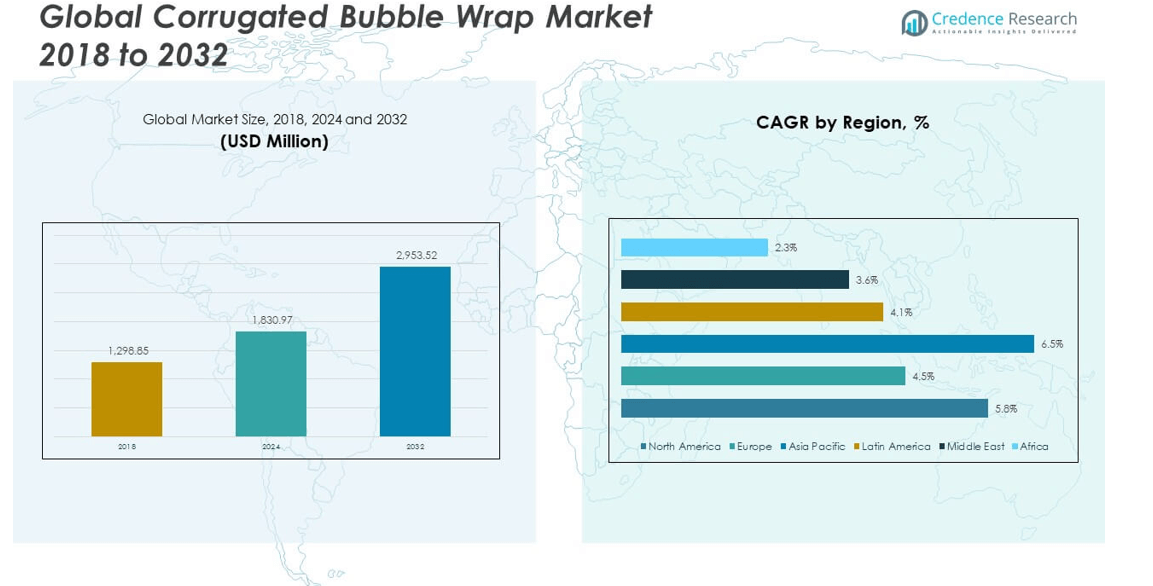
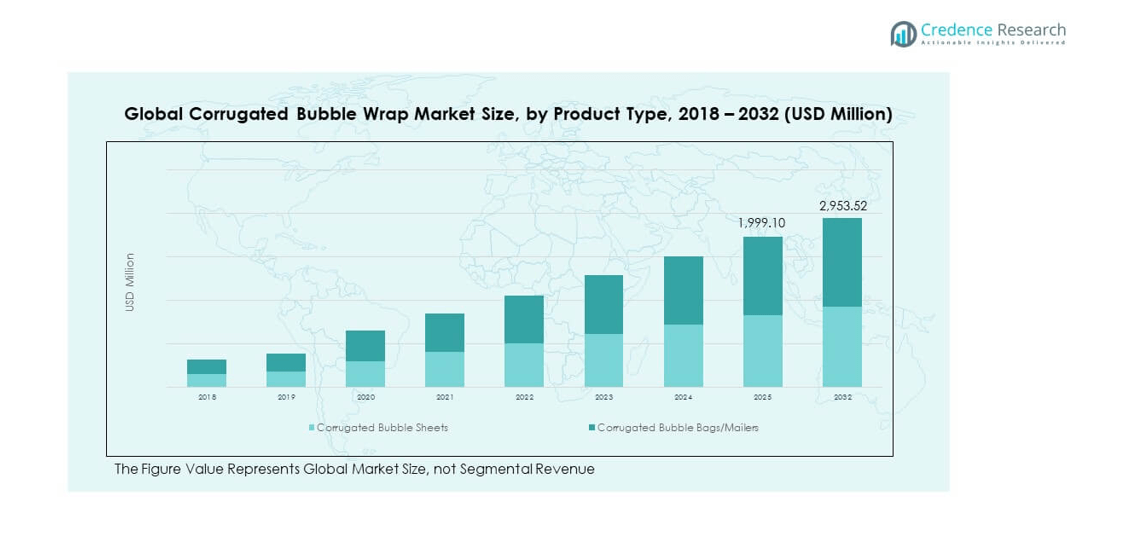
The Global Corrugated Bubble Wrap Market size was valued at USD 1,298.85 million in 2018 to USD 1,830.97 million in 2024 and is anticipated to reach USD 2,953.52 million by 2032, at a CAGR of 5.73% during the forecast period.
| REPORT ATTRIBUTE | DETAILS |
|---|---|
| Historical Period | 2020-2023 |
| Base Year | 2024 |
| Forecast Period | 2025-2032 |
| Corrugated Bubble Wrap Market Size 2024 | USD 1,830.97 million |
| Corrugated Bubble Wrap Market, CAGR | 5.73% |
| Corrugated Bubble Wrap Market Size 2032 | USD 2,953.52 million |
The market thrives as manufacturers continually enhance protective packaging solutions to meet rising e-commerce demand and minimize damage during transit. Companies embrace innovative corrugated designs that combine cushioning and structural strength, prompting widespread adoption across retail, electronics, and food sectors. Additionally, environmental awareness drives the shift toward recyclable and sustainable packaging, encouraging suppliers to invest in eco-friendly materials. As global logistics expand, businesses actively seek versatile and lightweight packaging options, and this pursuit reinforces the prominence of corrugated bubble wrap in supply chains and stimulates sustained market growth.
In regional markets, North America and Western Europe lead in adoption due to mature e-commerce infrastructure and established logistics networks, where businesses prioritize packaging efficiency and sustainability. Meanwhile, Asia-Pacific emerges rapidly as an influential growth zone, fueled by expanding online retail, manufacturing hubs, and increased urbanization across China, India, and Southeast Asia. Latin America and Middle Eastern regions are gaining traction as local industries embrace modern packaging to support growing consumer markets and export activities. These regional dynamics reflect varying levels of development, demand, and the evolving importance of protective corrugated packaging globally.
Market Insights:
- The Global Corrugated Bubble Wrap Market was valued at USD 1,298.85 million in 2018, reached USD 1,830.97 million in 2024, and is projected to hit USD 2,953.52 million by 2032, expanding at a CAGR of 5.73%.
- Asia Pacific leads with a 45.7% share in 2024, supported by manufacturing hubs, e-commerce expansion, and large consumer markets, while North America (27.8%) and Europe (17.6%) follow due to advanced logistics, regulatory frameworks, and established industries.
- Asia Pacific also emerges as the fastest-growing region, driven by rapid urbanization, export-oriented production, and rising online retail penetration.
- Corrugated bubble sheets dominate with nearly 65% share in 2024, reflecting their versatility across bulk shipments and industrial packaging.
- Corrugated bubble bags/mailers account for about 35% share, gaining popularity in e-commerce and retail for lightweight, ready-to-use protective packaging.
Market Drivers
Rising Expansion of E-Commerce and Demand for Protective Packaging
The Global Corrugated Bubble Wrap Market benefits strongly from the accelerating growth of e-commerce, where safe and reliable product delivery has become essential. Consumers increasingly prefer online channels, and this preference compels retailers to focus on durable protective packaging solutions. Corrugated bubble wrap offers cushioning, strength, and adaptability, making it suitable for fragile items and high-volume shipments. The market gains traction as logistics companies adopt it to minimize product returns caused by transit damage. Its lightweight structure lowers shipping costs, supporting widespread adoption. Growing online shopping in emerging economies contributes to consistent demand. The trend shows no sign of slowing, as retailers view efficient packaging as critical to customer satisfaction and retention.
- For example, Sealed Air’s I-Pack® system, implemented by Inex Partners Oy in Finland, processes 400–900 boxes per hour and has doubled productivity by right-sizing cartons and eliminating unnecessary voids. Smurfit Kappa’s TopClip® can topper delivers a 30% lower carbon footprint compared to shrink wrap, offering a fully paper-based, recyclable solution that protects can tops while enhancing product presentation and shelf appeal.
Sustainability and Shift Toward Eco-Friendly Packaging Materials
Sustainability initiatives have created a strong driver for the Global Corrugated Bubble Wrap Market, with governments and consumers favoring recyclable packaging materials. Companies seek alternatives to plastic-based packaging to align with environmental regulations and corporate social responsibility commitments. Corrugated bubble wrap, being recyclable and biodegradable, fits these needs effectively. It reduces environmental impact while maintaining protective performance, making it attractive to manufacturers and end-users. Packaging producers invest in advanced technologies to enhance the eco-profile of corrugated products, further boosting acceptance. Consumer preference for green packaging accelerates its uptake across retail and industrial sectors. It secures an important role in advancing sustainability goals. The trend aligns directly with long-term regulatory and consumer-driven changes in global supply chains.
- For example, according to U.S. EPA data, the recycling rate for corrugated cardboard-a primary material for bubble wrap alternatives stood at 5% in 2018, demonstrating strong sustainable packaging practices adopted by U.S. manufacturers and recyclers.
Expanding Applications Across Electronics, Automotive, and Food Industries
The Global Corrugated Bubble Wrap Market is driven by its increasing application across multiple industries, including electronics, automotive, and food packaging. Electronics manufacturers use it for delicate devices that require shock resistance and secure transit protection. Automotive suppliers rely on it for spare parts packaging, where durability and cushioning are essential. The food industry finds it effective for handling fragile consumables, ensuring freshness and safety in delivery processes. Each sector benefits from the product’s adaptability, contributing to its expanding adoption worldwide. Its cost efficiency further enhances its appeal in both bulk and specialized packaging. Businesses recognize its ability to reduce losses from breakage, strengthening demand across these industries. This diversification of applications secures steady market growth across end-user verticals.
Influence of Global Logistics Growth and Supply Chain Optimization
Growth in global logistics and trade networks has created significant momentum for the Global Corrugated Bubble Wrap Market. Businesses optimize supply chains to ensure faster and safer deliveries, and protective packaging plays a crucial role in meeting this goal. Corrugated bubble wrap’s versatility supports transportation efficiency, offering balance between strength and weight. It becomes integral for companies shipping internationally, where handling risks are higher. Globalization increases cross-border transactions, creating steady demand for reliable packaging solutions. Logistics providers invest in packaging materials that enhance cost savings without compromising safety. The widespread emphasis on operational efficiency strengthens its market role. The product’s ability to integrate into diverse supply chain systems ensures its continued adoption across industries worldwide.
Market Trends
Integration of Automation and Smart Packaging Technologies
The Global Corrugated Bubble Wrap Market is witnessing a trend toward automation and smart packaging integration. Manufacturers adopt advanced machinery that increases production efficiency and ensures consistent product quality. Smart packaging technologies, such as digital printing and trackable labeling, enhance customer communication and brand visibility. Automated systems reduce labor costs and improve throughput in packaging facilities. Businesses use these innovations to scale operations and meet growing demand from e-commerce and logistics. The trend reflects a broader industry shift toward digital transformation in packaging. It strengthens supply chain visibility and customer satisfaction simultaneously. Corrugated bubble wrap becomes part of this modernized approach, integrating seamlessly with evolving packaging technologies.
- For instance, Sealed Air’s I-Pack® automated packaging system was implemented by Inex Partners Oy in Finland, enabling the packaging of 400–900 boxes per hour and doubling picking and packing productivity for e-commerce fulfillment, with automation features that rightsize boxes and eliminate unnecessary voids.
Rising Customization in Protective Packaging Solutions
Another key trend in the Global Corrugated Bubble Wrap Market is the rise of customization to meet specific end-user needs. Businesses demand packaging tailored to unique product dimensions, fragility levels, and branding preferences. Corrugated bubble wrap is now available in various sizes, patterns, and thicknesses, meeting these requirements effectively. Custom solutions reduce material wastage and improve overall packaging efficiency. Industries such as electronics and luxury goods seek specialized solutions that enhance product presentation while providing protection. The ability to customize strengthens competitive advantage for manufacturers. It also enhances sustainability by reducing excess material usage. This trend highlights the growing role of tailored packaging strategies in global commerce.
Digital Commerce Expansion Driving Innovative Distribution Models
The Global Corrugated Bubble Wrap Market is influenced by innovative distribution models created to serve digital commerce expansion. Manufacturers and suppliers establish partnerships with e-commerce platforms for direct supply of packaging materials. Subscription-based packaging solutions and just-in-time delivery systems gain popularity, ensuring cost efficiency for small and large businesses. Warehousing solutions now include bulk availability of corrugated bubble wrap to streamline order fulfillment. Digital marketplaces allow customers to purchase customized protective packaging online. This shift reflects growing alignment between packaging supply and digital trade ecosystems. Businesses leverage these models to improve flexibility and reduce procurement delays. It positions corrugated bubble wrap as an integral component of digital retail infrastructure worldwide.
Focus on Premiumization and Enhanced Product Performance
The Global Corrugated Bubble Wrap Market demonstrates a clear trend toward premiumization of protective packaging products. Manufacturers emphasize higher durability, superior cushioning, and improved barrier properties. These advanced qualities cater to industries handling sensitive products, such as pharmaceuticals and precision instruments. Premium versions enhance safety and customer confidence, supporting their adoption across developed markets. Businesses are willing to invest more in packaging that prevents costly product damage. Producers differentiate themselves by offering premium corrugated solutions with innovative features. This focus elevates the market’s value proposition beyond cost savings. It aligns with growing consumer expectations for quality and reliability in packaging solutions.
- For instance, Smurfit Kappa’s TopClip cardboard can topper delivers a 30% lower carbon footprint compared to shrink wrap for beverage multipacks, being fully paper-based, plastic-free, and designed to fully protect can tops while enhancing product presentation and shelf appeal.
Market Challenges Analysis
High Competition from Alternative Packaging Materials and Cost Pressures
The Global Corrugated Bubble Wrap Market faces strong competition from alternative packaging materials such as molded pulp, foam inserts, and air pillows. These substitutes often claim cost savings, sustainability, or lighter weight advantages, challenging corrugated bubble wrap adoption. Price-sensitive customers, especially in developing regions, prefer cheaper options, creating pressure on margins. Producers must continuously innovate to highlight unique advantages like recyclability and structural strength. Rising raw material costs add further strain, making it difficult to maintain affordability. The need for balance between price and performance creates a recurring challenge. The presence of numerous regional suppliers intensifies competitive rivalry, complicating differentiation strategies. It drives manufacturers to focus on innovation while safeguarding profitability.
Regulatory Restrictions and Environmental Compliance Issues
Regulatory restrictions on packaging waste and sustainability practices present significant challenges for the Global Corrugated Bubble Wrap Market. Governments implement strict rules to reduce environmental impact, compelling producers to comply with eco-friendly standards. Non-compliance can lead to penalties, brand damage, and reduced market access. Meeting these requirements increases production costs and demands investments in greener technologies. Smaller manufacturers often struggle with compliance, reducing their competitiveness. Evolving standards across regions create complexity for global suppliers attempting to meet diverse criteria. Businesses must consistently update processes and materials to stay ahead. The challenge lies in maintaining strong performance while adapting to stringent environmental frameworks worldwide.
Market Opportunities
Rising Global Demand for Eco-Friendly and Sustainable Packaging
The Global Corrugated Bubble Wrap Market presents opportunities through rising demand for eco-friendly packaging alternatives. Growing environmental consciousness among consumers and businesses encourages the shift away from plastics. Corrugated bubble wrap offers recyclability and biodegradability, aligning with sustainability goals. Producers can expand portfolios by introducing innovative variants with higher environmental performance. This appeal resonates strongly with industries seeking to strengthen green credentials. Companies that leverage eco-friendly positioning will secure a competitive edge. The opportunity aligns with future regulatory directions, strengthening its market role. It provides a path for long-term growth through consistent global adoption.
Growth Potential in Emerging Economies and Expanding E-Commerce Channels
Emerging economies create opportunities for the Global Corrugated Bubble Wrap Market as urbanization and rising incomes drive demand for modern packaging. Expanding e-commerce platforms in Asia, Latin America, and Africa require cost-effective and durable protective solutions. Corrugated bubble wrap’s versatility positions it as a preferred choice for these fast-growing markets. Local manufacturing initiatives create avenues for regional production, enhancing supply chain efficiency. The opportunity is reinforced by strong consumer demand for safe product delivery. Businesses entering these regions can benefit from early market penetration strategies. It offers significant growth potential for packaging producers investing in global expansion strategies.
Market Segmentation Analysis:
The Global Corrugated Bubble Wrap Market is segmented
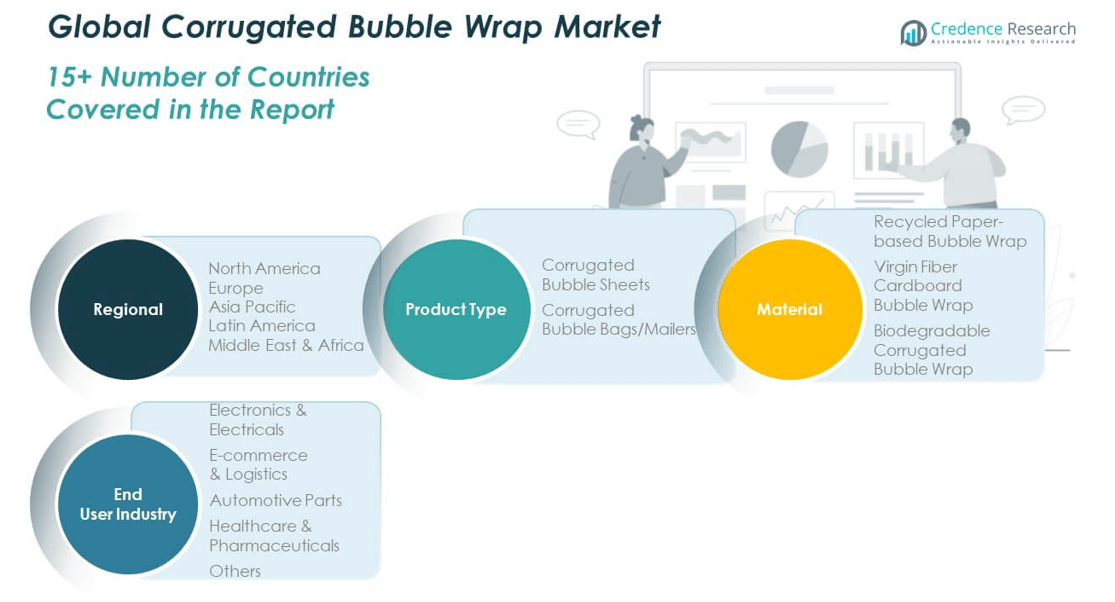
By product type into corrugated bubble sheets and corrugated bubble bags/mailers. Corrugated bubble sheets hold a significant share due to their adaptability across industries, offering cushioning and surface protection for bulk shipments. Corrugated bubble bags/mailers are gaining traction in e-commerce and logistics as they provide ready-to-use, lightweight, and secure solutions for small and fragile items, making them highly relevant for retail and last-mile delivery.
- For example, Prime Line Packaging provides custom bubble mailers, commonly adopted for e-commerce shipments of delicate items such as jewelry and small electronics, due to their lightweight build and enhanced shock absorption.
By material, the market is categorized into recycled paper-based bubble wrap, virgin fiber cardboard bubble wrap, and biodegradable corrugated bubble wrap. Recycled paper-based variants dominate because of growing demand for sustainable and eco-friendly packaging. Virgin fiber cardboard bubble wrap maintains usage in applications requiring extra durability and structural strength. Biodegradable options are emerging rapidly, supported by environmental regulations and consumer preference for green packaging, creating strong growth opportunities in both developed and emerging markets.
- For example, Wynalda Packaging emphasizes the use of virgin fiber sourced from sustainably managed forests, highlighting its importance in maintaining durability, strength, and overall performance in paperboard packaging. The company positions virgin fiber as a key material for ensuring structural integrity while supporting long-term sustainability goals within the packaging industry.
By end user industry, it serves electronics and electricals, e-commerce and logistics, automotive parts, healthcare and pharmaceuticals, and others. Electronics and electricals represent a critical segment, with demand driven by the need for protective packaging of sensitive devices. E-commerce and logistics account for robust growth, fueled by rising online retail penetration and demand for secure delivery solutions. Automotive parts benefit from the need for impact-resistant packaging, while healthcare and pharmaceuticals rely on corrugated bubble wrap for safe transportation of medical devices and supplies. It also finds niche applications across diverse sectors included under the “others” category.
Segmentation:
By Product Type
- Corrugated Bubble Sheets
- Corrugated Bubble Bags/Mailers
By Material
- Recycled Paper-based Bubble Wrap
- Virgin Fiber Cardboard Bubble Wrap
- Biodegradable Corrugated Bubble Wrap
By End User Industry
- Electronics & Electricals
- E-commerce & Logistics
- Automotive Parts
- Healthcare & Pharmaceuticals
- Others
By Region
- North America
- U.S.
- Canada
- Mexico
- Europe
- Germany
- France
- U.K.
- Italy
- Spain
- Rest of Europe
- Asia Pacific
- China
- Japan
- India
- South Korea
- South-east Asia
- Rest of Asia Pacific
- Latin America
- Brazil
- Argentina
- Rest of Latin America
- Middle East & Africa
- GCC Countries
- South Africa
- Rest of the Middle East and Africa
Regional Analysis:
North America
The North America Global Corrugated Bubble Wrap Market size was valued at USD 366.86 million in 2018 to USD 508.86 million in 2024 and is anticipated to reach USD 824.37 million by 2032, at a CAGR of 5.8% during the forecast period. North America holds a market share of 27.8% in 2024, supported by strong e-commerce penetration, advanced logistics infrastructure, and established retail networks. The U.S. drives demand through its thriving electronics, automotive, and healthcare industries. It benefits from consumer preference for sustainable and recyclable packaging, with several manufacturers adopting eco-friendly production processes. Packaging innovation and automation enhance product quality and efficiency. Canada and Mexico contribute through expanding retail and cross-border trade. Regional players emphasize premiumization and durable protective solutions to meet customer expectations.
Europe
The Europe Global Corrugated Bubble Wrap Market size was valued at USD 241.89 million in 2018 to USD 322.26 million in 2024 and is anticipated to reach USD 472.58 million by 2032, at a CAGR of 4.5% during the forecast period. Europe accounts for a 17.6% share of the 2024 market, driven by strong regulations promoting sustainable packaging and recycling practices. It benefits from the presence of leading packaging manufacturers with advanced production technologies. Demand is high across pharmaceuticals, automotive, and industrial applications where product safety is critical. The UK, Germany, France, and Italy remain leading contributors due to high consumption levels and industrial output. E-commerce growth across Western and Eastern Europe also supports adoption. Companies invest in biodegradable solutions to meet evolving consumer preferences. The region positions itself as a hub for eco-friendly and innovation-driven packaging.
Asia Pacific
The Asia Pacific Global Corrugated Bubble Wrap Market size was valued at USD 573.09 million in 2018 to USD 837.42 million in 2024 and is anticipated to reach USD 1,432.47 million by 2032, at a CAGR of 6.5% during the forecast period. Asia Pacific holds the largest share of 45.7% in 2024, led by China, India, Japan, and Southeast Asia. The region benefits from rapid urbanization, expanding e-commerce platforms, and growing manufacturing hubs. It drives demand through high-volume exports of electronics, consumer goods, and automotive components. Rising consumer preference for safe product delivery strengthens adoption in online retail. The availability of low-cost raw materials supports large-scale production and competitive pricing. Companies in this region invest heavily in sustainable materials to align with global environmental standards. It continues to dominate as the most influential market with unmatched growth potential.
Latin America
The Latin America Global Corrugated Bubble Wrap Market size was valued at USD 61.49 million in 2018 to USD 85.61 million in 2024 and is anticipated to reach USD 122.27 million by 2032, at a CAGR of 4.1% during the forecast period. Latin America contributes a market share of 4.7% in 2024, with Brazil and Mexico driving demand. It experiences steady growth from e-commerce expansion and increased focus on packaging for exports. Retail and logistics sectors adopt corrugated bubble wrap to reduce product losses during transit. Automotive and electronics imports create further need for protective packaging. Economic development supports the modernization of supply chains, increasing reliance on efficient packaging solutions. Regional manufacturers emphasize affordable and durable options to serve cost-sensitive consumers. It is emerging as a promising growth zone despite moderate overall size.
Middle East
The Middle East Global Corrugated Bubble Wrap Market size was valued at USD 37.83 million in 2018 to USD 48.92 million in 2024 and is anticipated to reach USD 67.09 million by 2032, at a CAGR of 3.6% during the forecast period. The region represents 2.7% of the 2024 global market share, with GCC countries and Turkey being primary contributors. Strong retail expansion and rising e-commerce adoption fuel packaging demand. Healthcare and pharmaceuticals also generate demand through rising imports of sensitive products. Local industries focus on adopting recyclable and biodegradable packaging to comply with government sustainability programs. Logistics infrastructure upgrades support steady consumption growth. Regional players face competition from international suppliers, yet opportunities arise through localized production. It maintains gradual progress, supported by long-term diversification efforts across Gulf economies.
Africa
The Africa Global Corrugated Bubble Wrap Market size was valued at USD 17.69 million in 2018 to USD 27.90 million in 2024 and is anticipated to reach USD 34.73 million by 2032, at a CAGR of 2.3% during the forecast period. Africa contributes 1.5% of the 2024 market share, reflecting its early stage of adoption. Growth is supported by rising e-commerce penetration and infrastructure development across South Africa, Egypt, and Nigeria. Healthcare and food packaging represent significant drivers due to increased demand for protective materials. Local manufacturers gradually embrace recyclable solutions to meet sustainability needs. Imports dominate supply, limiting regional self-sufficiency. Rising investments in manufacturing and logistics signal future opportunities. It remains a developing market with gradual but consistent adoption of modern packaging solutions.
Key Player Analysis:
- Deluxe Packaging
- Sonoco Products Company
- Conitex Sonoco
- Larsan Packaging Products, Inc.
- Sealed Air Corporation
- Pregis Corporation
- Smurfit Kappa Group
- DS Smith Plc
- International Paper Company
- Mondi Group
Competitive Analysis:
The Global Corrugated Bubble Wrap Market is defined by the presence of multinational corporations and regional producers competing on innovation, sustainability, and cost efficiency. Leading players such as Sealed Air Corporation, Smurfit Kappa Group, DS Smith Plc, and Mondi Group emphasize eco-friendly product portfolios to strengthen their positions. It remains highly competitive with continuous investments in biodegradable materials, automation technologies, and expanded distribution networks. Companies pursue mergers, acquisitions, and regional expansions to capture emerging opportunities. Strategic alliances with e-commerce and logistics providers enhance long-term visibility. Smaller firms focus on localized production and cost leadership to compete with global brands. The market reflects a balance of established leaders driving innovation and regional players catering to price-sensitive demand.
Recent Developments:
- In July 2025, Mondi Group announced the completion of its acquisition of Schumacher Packaging's Western Europe operations. This strategic move added over 1 billion square meters of packaging capacity, expanding Mondi’s footprint in corrugated solutions and enhancing sustainable packaging offerings for e-commerce and FMCG customers. The acquisition also introduced new solid board solutions for Mondi, bolstering product diversity and value creation for clients.
- In January 2025, International Paper finalized its $7.2 billion acquisition of DS Smith Plc, integrating operations from more than 30 countries. This agreement aims to accelerate growth and innovation in sustainable containerboard and corrugated packaging across North America and EMEA regions. The two companies combined their portfolios for broader geographic reach and improved supply chain resilience.
- In June 2024, Sonoco Products Company completed the acquisition of Eviosys, a major global producer of metal packaging, for approximately $3.9 billion. This synergy created a world-leading manufacturer in metal food and aerosol cans, with Sonoco focusing on expanding innovative packaging solutions for customers worldwide.
Market Concentration & Characteristics:
The Global Corrugated Bubble Wrap Market demonstrates moderate concentration, with a few large companies controlling significant revenue share while numerous regional suppliers provide competitive alternatives. It is characterized by strong demand from e-commerce, electronics, and logistics industries, where protective and sustainable packaging is a priority. Innovation in recyclable and biodegradable materials defines the competitive edge, while customization and premiumization strategies strengthen brand differentiation. The market operates within a highly cost-sensitive environment, making efficiency in production and distribution a key success factor. It exhibits steady consolidation trends alongside dynamic regional competition.
Report Coverage:
The research report offers an in-depth analysis based on Product Type, Material and End User Industry. It details leading market players, providing an overview of their business, product offerings, investments, revenue streams, and key applications. Additionally, the report includes insights into the competitive environment, SWOT analysis, current market trends, as well as the primary drivers and constraints. Furthermore, it discusses various factors that have driven market expansion in recent years. The report also explores market dynamics, regulatory scenarios, and technological advancements that are shaping the industry. It assesses the impact of external factors and global economic changes on market growth. Lastly, it provides strategic recommendations for new entrants and established companies to navigate the complexities of the market.
Future Outlook:
- The market will expand with growing e-commerce and logistics networks demanding secure and lightweight packaging solutions.
- Rising adoption of eco-friendly materials will drive innovation in biodegradable and recyclable corrugated bubble wrap.
- Increasing cross-border trade will create stronger demand for durable packaging in international shipping.
- Technological advances in automated production will enhance efficiency and reduce manufacturing costs.
- Customization trends will support growth in tailored packaging for electronics, luxury goods, and retail products.
- Premium product variants with superior cushioning and performance will gain traction in developed markets.
- Regulatory emphasis on reducing plastic waste will strengthen the shift toward corrugated alternatives.
- Emerging economies will become key contributors as urbanization and online retail penetration accelerate.
- Strategic collaborations between packaging companies and logistics providers will shape long-term growth.
- Continuous investment in sustainability and circular economy models will define competitive differentiation.

Request a Free Sample
Fill in your details and we'll send you a free sample report.
- Sample data tables & charts
- Research methodology
Market Dynamics
E-commerce Expansion and Demand for Protective Packaging
The rapid growth of global e-commerce has increased the need for reliable, damage-minimizing packaging solutions. Corrugated bubble wrap is widely adopted by retailers and logistics providers to ensure safe delivery of fragile and high-volume shipments, directly supporting market growth.
Sustainability and Shift Toward Eco-Friendly Packaging
Rising environmental awareness and regulatory pressure are driving manufacturers and end-users to adopt recyclable and biodegradable packaging materials. Corrugated bubble wrap, being paper-based and often recyclable, aligns with these sustainability goals and is increasingly favored over plastic alternatives.
Diversification of Applications Across Key Industries
Corrugated bubble wrap is being used in a growing range of industries, including electronics, automotive, and food, due to its adaptability, cushioning, and cost efficiency. This diversification ensures steady demand as more sectors recognize its protective benefits for sensitive and high-value products.
Global Logistics Growth and Supply Chain Optimization
As international trade and logistics networks expand, businesses require packaging that balances strength, weight, and cost. Corrugated bubble wrap supports efficient, safe, and cost-effective shipping, making it integral to modern supply chains and boosting its global adoption.
Technological Innovation and Customization
Advances in automated production, digital printing, and tailored packaging solutions are enabling manufacturers to meet specific customer requirements for size, branding, and performance. This trend toward customization and premiumization enhances product value and drives market differentiation.
Need a Custom Version of This Report?
Tailor the scope, geography, or segments to your exact requirements.
- Custom geography or segment scope
- Direct access to our analyst team
Frequently Asked Questions
What is the current market size for Global Corrugated Bubble Wrap Market, and what is its projected size in 2032?
At what Compound Annual Growth Rate is the Global Corrugated Bubble Wrap Market projected to grow between 2024 and 2032?
What are the primary factors fueling the growth of the Global Corrugated Bubble Wrap Market?
Who are the leading companies in the Global Corrugated Bubble Wrap Market?
Table of Content
Chapter 1 Market Segmentation
- 1.1 Segmentation Framework
- 1.1.1 Product and Service Classification
- 1.1.2 Application and End-Use Classification
- 1.1.3 Technology and Solution Classification
- 1.1.4 Customer and Distribution Channel Classification
- 1.1.5 Geographic Segmentation
- 1.1.6 Market Segment Definitions and Boundaries
- 1.2 By Material
- 1.2.1 Recycled Paper-based Bubble Wrap
- 1.2.2 Virgin Fiber Cardboard Bubble Wrap
- 1.2.3 Biodegradable Corrugated Bubble Wrap
- 1.3 By Product Type
- 1.3.1 Corrugated Bubble Sheets
- 1.3.2 Corrugated Bubble Bags/Mailers
- 1.4 By End User Industry
- 1.4.1 Electronics & Electricals
- 1.4.2 E-commerce & Logistics
- 1.4.3 Automotive Parts
- 1.4.4 Healthcare & Pharmaceuticals
- 1.4.5 Others
Chapter 2 Introduction
- 2.1 Report Objectives and Scope
- 2.2 Product Definition and Industry Terminology
- 2.3 Market Inclusions and Exclusions
- 2.4 Research Process
- 2.4.1 Primary Research and Expert Interviews
- 2.4.2 Secondary Research and Source Review
- 2.4.3 Top-Down and Bottom-Up Estimation
- 2.4.4 Data Triangulation and Verification
- 2.5 Market Size Measurement Basis
- 2.5.1 2024: USD 1,830.97 million → 2032: USD 2,953.52 million
- 2.6 Historical and Forecast Reference Periods
- 2.6.1 Base Year: 2024
- 2.6.2 Forecast Period: 2024-2032
- 2.7 Research Assumptions and Limitations
Chapter 3 Executive Summary
- 3.1 Market Snapshot and Key Findings
- 3.2 Base-Year Market Size, 2024
- 3.3 Forecast Market Size, 2032
- 3.4 Revenue and Volume Growth Outlook
- 3.5 Key Demand and Supply Indicators
- 3.6 Leading Market Segments
- 3.7 Fastest-Growing Market Opportunities
- 3.8 Regional Performance Highlights
- 3.9 Technology and Industry Transformation
- 3.10 Competitive Landscape Summary
- 3.11 Analyst View and Strategic Implications
Chapter 4 Global Corrugated Bubble Wrap Market Trends and Developments
- 4.1 Historical Industry Development
- 4.2 Recent Market Trends and Developments
- 4.3 Demand and Customer Behavior Trends
- 4.4 Technology and Product Innovation
- 4.5 Artificial Intelligence, Automation and Digitalization
- 4.6 Local Manufacturing and Supply Chain Realignment
- 4.7 Industry Partnerships, Mergers and Acquisitions
- 4.8 Sustainability and Circular Economy Developments
- 4.9 Government and Private Sector Investment Trends
- 4.10 Emerging Business Models and Commercialization
- 4.11 Industry Developments and Announcements
Chapter 5 Global Corrugated Bubble Wrap Market Production, Supply and Demand Analysis
- 5.1 Demand Trend and Consumption Analysis
- 5.2 Demand Forecast, 2024-2032
- 5.3 Production and Output Trend
- 5.4 Production and Output Forecast, 2024-2032
- 5.5 Installed Capacity and Capacity Utilization
- 5.6 Company-Wise Production Plants and Statistics
- 5.6.1 Installed Production Capacity
- 5.6.2 Actual Production
- 5.6.3 Planned Capacity and Expansion Targets
- 5.7 Supply Chain Structure and Procurement Trends
- 5.8 Supply-Demand Gap and Bottlenecks
- 5.9 Import Dependence and Sourcing Structure
- 5.10 Contract Manufacturing and Outsourcing
- 5.11 Regional Supply and Demand Concentration
Chapter 6 Global Corrugated Bubble Wrap Market Pricing Analysis
- 6.1 Pricing Structure and Measurement
- 6.2 Historical Pricing Trends
- 6.3 Pricing Outlook, 2024-2032
- 6.4 Average Selling Price and Unit Economics
- 6.5 Pricing by Product and Market Segment
- 6.6 Geographic Pricing Differences
- 6.7 Key Input, Energy, Labor and Logistics Costs
- 6.8 Contract Pricing and Purchasing Models
- 6.9 Pricing Sensitivity and Competitive Positioning
- 6.10 Price, Margin and Profitability Implications
Chapter 7 Global Corrugated Bubble Wrap Market Dynamics
- 7.1 Market Growth Drivers
- 7.1.1 Demand-Side Drivers
- 7.1.2 Technology and Innovation Drivers
- 7.1.3 Infrastructure and Investment Drivers
- 7.1.4 Regulatory and Policy Drivers
- 7.2 Market Restraints
- 7.2.1 Cost and Affordability Constraints
- 7.2.2 Technology and Adoption Barriers
- 7.2.3 Supply Chain and Operational Constraints
- 7.3 Market Challenges
- 7.3.1 Competitive Pressure and Margin Erosion
- 7.3.2 Skills, Infrastructure and Implementation Gaps
- 7.4 Emerging Market Opportunities
- 7.5 Market Dynamics Impact and Time-Horizon Assessment
Chapter 8 Global Corrugated Bubble Wrap Value Chain Analysis
- 8.1 Industry Value Chain Overview
- 8.2 Upstream Suppliers and Critical Inputs
- 8.3 Technology and Component Providers
- 8.4 Manufacturing or Service Delivery
- 8.5 Distribution, Channel Partners and Integrators
- 8.6 Downstream Applications and End Users
- 8.7 Value Addition and Profit Pools
- 8.8 Vertical Integration and Outsourcing
- 8.9 Supplier Concentration and Risk
- 8.10 Supply Chain Localization and Resilience
Chapter 9 Global Corrugated Bubble Wrap Market Regulations and Policies
- 9.1 Relevant Laws, Standards and Compliance Frameworks
- 9.2 Product, Service, Safety and Quality Requirements
- 9.3 Government Policies, Incentives and Subsidies
- 9.4 Imports, Exports and Trade Barriers
- 9.5 Public Procurement and Local Content Requirements
- 9.6 Environmental and Sustainability Compliance
- 9.7 Upcoming Policy Changes and Market Implications
Chapter 10 Global Corrugated Bubble Wrap Market Hotspots and Opportunities
- 10.1 Market Opportunity Mapping and Growth Hotspots
- 10.2 High-Growth Applications and Customer Groups
- 10.3 Underserved Markets and White-Space Opportunities
- 10.4 Emerging Technology and Product Opportunities
- 10.5 New Capacity and Investment Hotspots
- 10.6 Market Entry and Expansion Opportunities
- 10.7 Distribution and Partnership Opportunities
- 10.8 Near-Term and Long-Term Commercial Potential
- 10.9 Opportunity Attractiveness and Execution Risks
Chapter 11 Global Corrugated Bubble Wrap Market Outlook, 2024-2032
- 11.1 Market Size and Analysis
- 11.1.1 Revenue (Market Measurement: 2024: USD 1,830.97 million → 2032: USD 2,953.52 million)
- 11.1.2 Market Volume and Quantity Sold
- 11.1.3 Historical Market Size
- 11.1.4 Base-Year Market Size, 2024
- 11.2 Market Forecast, 2024-2032
- 11.2.1 Revenue Forecast to 2032
- 11.2.2 Volume Forecast to 2032
- 11.2.3 CAGR and Year-on-Year Growth
- 11.2.4 Incremental Revenue Opportunity
- 11.3 Forecast Assumptions and Scenario Analysis
- 11.3.1 Base-Case Forecast
- 11.3.2 Optimistic and Conservative Scenarios
- 11.3.3 Technology, Pricing and Policy Sensitivities
- 11.4 Market Attractiveness and Growth Outlook
Chapter 12 Global Corrugated Bubble Wrap Market Segmentation and Outlook
- 12.1 Segmentation Summary and Market Shares, 2024
- 12.2 Largest and Fastest-Growing Segments
- 12.3 By Material - Market Size and Forecast, 2024-2032
- 12.3.1 Segment Definition and Scope
- 12.3.2 Historical Market Size
- 12.3.3 Revenue Forecast, 2024-2032
- 12.3.4 Volume Forecast, 2024-2032
- 12.3.5 Base-Year Market Share, 2024
- 12.3.6 Segment CAGR and Growth Drivers
- 12.3.7 Subsegment Market Size and Forecast
- 12.3.7.1 Recycled Paper-based Bubble Wrap
- 12.3.7.2 Virgin Fiber Cardboard Bubble Wrap
- 12.3.7.3 Biodegradable Corrugated Bubble Wrap
- 12.3.8 Subsegment Pricing and Adoption Trends
- 12.3.9 Leading Suppliers and Competition
- 12.3.10 Regional Demand and Opportunities
- 12.4 By Product Type - Market Size and Forecast, 2024-2032
- 12.4.1 Segment Definition and Scope
- 12.4.2 Historical Market Size
- 12.4.3 Revenue Forecast, 2024-2032
- 12.4.4 Volume Forecast, 2024-2032
- 12.4.5 Base-Year Market Share, 2024
- 12.4.6 Segment CAGR and Growth Drivers
- 12.4.7 Subsegment Market Size and Forecast
- 12.4.7.1 Corrugated Bubble Sheets
- 12.4.7.2 Corrugated Bubble Bags/Mailers
- 12.4.8 Subsegment Pricing and Adoption Trends
- 12.4.9 Leading Suppliers and Competition
- 12.4.10 Regional Demand and Opportunities
- 12.5 By End User Industry - Market Size and Forecast, 2024-2032
- 12.5.1 Segment Definition and Scope
- 12.5.2 Historical Market Size
- 12.5.3 Revenue Forecast, 2024-2032
- 12.5.4 Volume Forecast, 2024-2032
- 12.5.5 Base-Year Market Share, 2024
- 12.5.6 Segment CAGR and Growth Drivers
- 12.5.7 Subsegment Market Size and Forecast
- 12.5.7.1 Electronics & Electricals
- 12.5.7.2 E-commerce & Logistics
- 12.5.7.3 Automotive Parts
- 12.5.7.4 Healthcare & Pharmaceuticals
- 12.5.7.5 Others
- 12.5.8 Subsegment Pricing and Adoption Trends
- 12.5.9 Leading Suppliers and Competition
- 12.5.10 Regional Demand and Opportunities
- 12.6 Segment Growth Comparison
- 12.7 Segment Attractiveness and Priority Matrix
Chapter 13 Global Corrugated Bubble Wrap End-Use and Application Market Outlook
- 13.1 End-Use Industry and Customer Demand Structure
- 13.2 Leading Applications and Customer Groups
- 13.3 End-Use Market Size, Share and Forecast
- 13.4 Major End-Use Industry Deep Dives
- 13.4.1 Customer Requirements and Use Cases
- 13.4.2 Demand and Replacement Cycles
- 13.4.3 Technical and Regulatory Considerations
- 13.4.4 Purchasing and Procurement Models
- 13.4.5 Leading Vendors and Distribution Channels
- 13.4.6 Forecast and Commercial Opportunities
- 13.5 Emerging Applications and Cross-Segment Demand
- 13.6 End-Use Industry Investment Priorities
Chapter 14 Global Corrugated Bubble Wrap Geographic Market Outlook, 2024-2032
- 14.1 Regional Market Size and Share, 2024
- 14.2 Regional Market Forecast, 2024-2032
- 14.3 Regional Pricing, Production and Demand Differences
- 14.4 North America
- 14.4.1 United States
- 14.4.2 Canada
- 14.4.3 Mexico
- 14.5 Europe
- 14.5.1 Germany
- 14.5.2 France
- 14.5.3 Italy
- 14.5.4 United Kingdom
- 14.5.5 Spain
- 14.5.6 Poland
- 14.5.7 Russia
- 14.5.8 Netherlands
- 14.5.9 Belgium
- 14.5.10 Sweden
- 14.5.11 Denmark
- 14.5.12 Norway
- 14.5.13 Rest of Europe
- 14.6 Asia Pacific
- 14.6.1 China
- 14.6.2 India
- 14.6.3 Japan
- 14.6.4 South Korea
- 14.6.5 Thailand
- 14.6.6 Indonesia
- 14.6.7 Vietnam
- 14.6.8 Malaysia
- 14.6.9 Australia
- 14.6.10 Rest of Asia Pacific
- 14.7 Latin America
- 14.7.1 Brazil
- 14.7.2 Argentina
- 14.7.3 Colombia
- 14.7.4 Chile
- 14.7.5 Rest of Latin America
- 14.8 Middle East
- 14.8.1 Saudi Arabia
- 14.8.2 United Arab Emirates
- 14.8.3 Turkey
- 14.8.4 Israel
- 14.8.5 Iran
- 14.8.6 Rest of the Middle East
- 14.9 Africa
- 14.9.1 South Africa
- 14.9.2 Egypt
- 14.9.3 Nigeria
- 14.9.4 Morocco
- 14.9.5 Rest of Africa
- 14.10 Regional Investment, Policy and Supply Chain Differences
- 14.11 Regional Competitive Landscape
- 14.12 Geographic Growth Hotspots
Chapter 15 Global Corrugated Bubble Wrap Technology, Innovation and Sustainability Outlook
- 15.1 Technology Landscape and Maturity
- 15.2 Product, Process and Service Innovation
- 15.3 AI, Automation and Digital Tools in the Industry
- 15.4 Technology Adoption and Performance Benchmarking
- 15.5 Innovation Pipeline and R&D Investment
- 15.6 Patent and Intellectual Property Trends
- 15.7 Energy Efficiency and Resource Management
- 15.8 Sustainability, Recycling and Circularity
- 15.9 Technology Roadmap, 2024-2032
- 15.10 Risks of Obsolescence and Technology Substitution
Chapter 16 Global Corrugated Bubble Wrap Market Key Strategic Imperatives
- 16.1 Growth and Market Entry Priorities
- 16.2 High-Return Products and Segments
- 16.3 Pricing, Profitability and Cost Optimization
- 16.4 Technology Investment and Product Differentiation
- 16.5 Supply Chain Localization and Resilience
- 16.6 Distribution and Customer Acquisition
- 16.7 Partnership, Acquisition and Capacity Strategy
- 16.8 Regional Expansion Priorities
- 16.9 Short-, Medium- and Long-Term Actions
Chapter 17 Competition Outlook
- 17.1 Industry Competition Characteristics
- 17.2 Market Structure and Concentration
- 17.3 Market Share and Competitive Positioning, 2024
- 17.4 Company-Wise Revenue and Product Benchmarking
- 17.5 Production and Service Capacity Benchmarking
- 17.6 Technology, Pricing and Differentiation
- 17.7 Regional Footprint and Distribution Strength
- 17.8 Mergers, Acquisitions and Strategic Alliances
- 17.9 New Entrants and Competitive Threats
- 17.10 Porter's Five Forces and Industry Attractiveness
- 17.11 Competitive Outlook, 2024-2032
Chapter 18 Company Profiles
- 18.1 Company Coverage and Selection Criteria
- 18.2 Sealed Air Corporation
- 18.2.1 Business Description
- 18.2.2 Company Ownership and Geographic Presence
- 18.2.3 Product and Service Portfolio
- 18.2.4 Manufacturing and Operating Footprint
- 18.2.5 Production Capacity and Expansion Plans
- 18.2.6 Financial Performance and Investment
- 18.2.7 Market Share and Competitive Position
- 18.2.8 Technology and Innovation Capabilities
- 18.2.9 Strategic Alliances or Partnerships
- 18.2.10 Recent Developments
- 18.2.11 Growth Strategy and Outlook
- 18.3 Smurfit Kappa Group
- 18.4 DS Smith Plc
- 18.5 Mondi Group
- 18.6 Sonoco Products Company
- 18.7 Pregis Corporation
- 18.8 International Paper Company
- 18.9 Deluxe Packaging
- 18.10 Conitex Sonoco
- 18.11 Larsan Packaging Products, Inc.
- 18.12 Other Relevant Market Participants
Note: Every listed company is profiled on the structure shown under the first company. The company list is preliminary and may change based on research findings, market developments, data availability and client requirements.
Chapter 19 Disclaimer
- 19.1 Research and Forecast Disclaimer
- 19.2 Data Source and Estimation Limitations
Note: The depth of individual sections depends on data availability for this market. Volume, capacity, trade and other unit-based metrics are included where applicable.

