
Market Overview
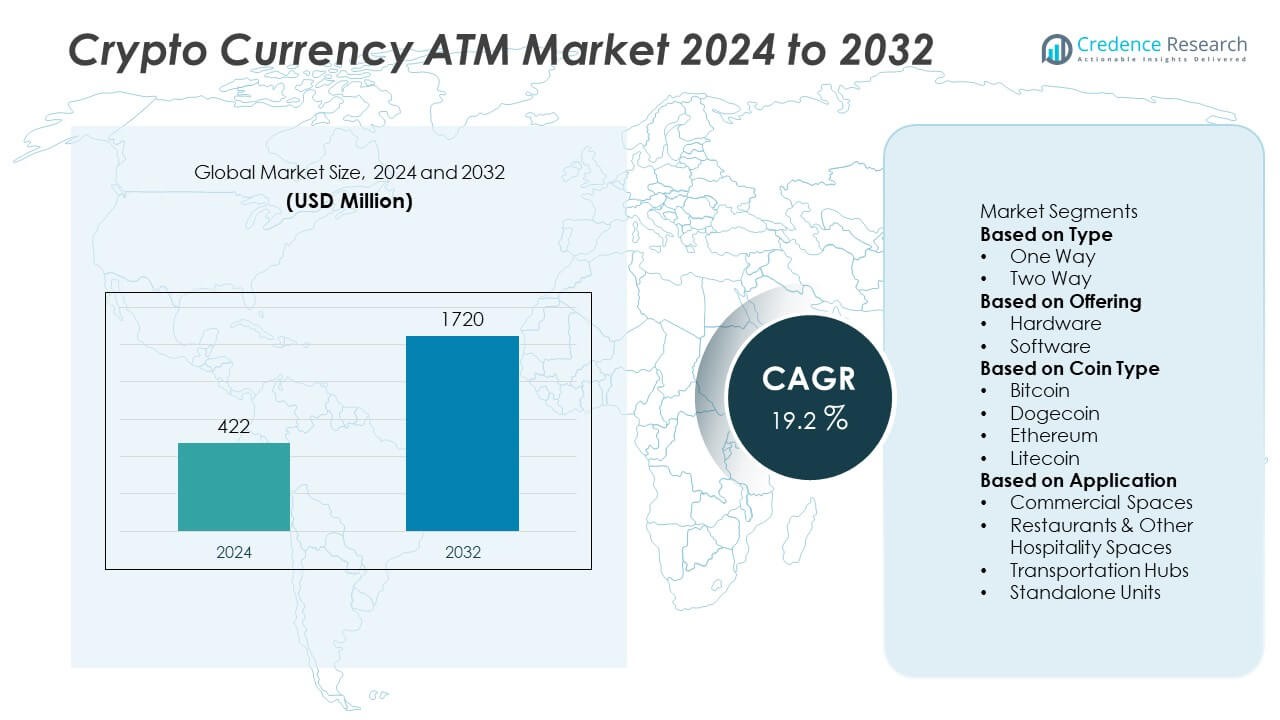
The Crypto Currency ATM Market size was valued at USD 422 million in 2024 and is projected to reach USD 1,720 million by 2032, growing at a CAGR of 19.2%.
| REPORT ATTRIBUTE | DETAILS |
|---|---|
| Historical Period | 2020-2024 |
| Base Year | 2024 |
| Forecast Period | 2025-2032 |
| Crypto Currency ATM Market Size 2024 | USD 422 Million |
| Crypto Currency ATM Market, CAGR | 19.2% |
| Crypto Currency ATM Market Size 2032 | USD 1,720 Million |
The Cryptocurrency ATM market is gaining momentum as rising adoption of digital currencies, increasing demand for faster and more convenient financial transactions, and growing awareness of blockchain technology drive installations worldwide. Regulatory support in select regions, coupled with enhanced security features and user-friendly interfaces, is fostering consumer trust and expanding usage.
The Cryptocurrency ATM market demonstrates strong geographical diversity, with North America leading adoption due to high cryptocurrency usage, robust infrastructure, and favorable regulatory frameworks in certain states. Europe is also witnessing rapid expansion, supported by growing digital payment ecosystems and supportive fintech initiatives. Meanwhile, Asia-Pacific is emerging as a high-potential region, driven by rising crypto awareness, urbanization, and increased remittance activities in countries like India, Singapore, and the Philippines. Latin America and the Middle East are gradually adopting crypto ATMs, fueled by demand for alternative financial systems and cross-border transaction needs. Key players driving innovation and global deployment include Genesis Coin, General Bytes, BitAccess, and Lamassu, who focus on enhancing transaction security, expanding multi-currency support, and improving user experience.
Market Insights
- The global Cryptocurrency ATM market was valued at USD 422 million in 2024 and is projected to reach USD 1,720 million by 2032, expanding at a CAGR of 19.2%.
- Increasing adoption of digital currencies and demand for quick, secure, and user-friendly financial transactions are major factors driving installations worldwide, supported by regulatory acceptance in select economies.
- Key market trends include integration with mobile applications, enhanced security protocols, and multi-currency transaction features that improve customer experience and attract both retail users and businesses.
- Competitive analysis highlights players such as Genesis Coin, General Bytes, BitAccess, and Lamassu, who are focusing on innovation in transaction security, network expansion, and customized machine interfaces to stay ahead in the market.
- Market restraints include regulatory uncertainties in several countries, high initial setup and maintenance costs, and the risks associated with fluctuating cryptocurrency values, which may slow adoption in certain regions.
- North America leads global adoption with strong infrastructure and favorable state-level regulations, Europe follows with fintech-driven growth, and Asia-Pacific shows high growth potential fueled by remittance needs and rapid digital adoption in markets like India, Singapore, and the Philippines.
- Latin America and the Middle East are gradually expanding their adoption of cryptocurrency ATMs, driven by the demand for alternative banking systems and cross-border financial transactions, reflecting opportunities for long-term market growth across emerging economies.
Market Drivers
Rising Demand for Accessible Digital Asset Exchange
The Crypto Currency ATM Market grows on strong demand for convenient and accessible digital asset exchange points. Consumers prefer physical kiosks that allow direct cash-to-crypto and crypto-to-cash transactions without relying on complex online platforms. It provides a bridge between traditional banking and digital currencies, expanding financial access for underbanked populations. Increasing adoption of Bitcoin, Ethereum, and altcoins in retail and personal finance strengthens the relevance of ATM installations. Retail operators integrate ATMs in high-traffic locations, enhancing visibility and convenience. This demand anchors growth and pushes expansion in both urban and semi-urban settings.
- For instance, Coinsource deployed 800 Bitcoin ATMs across Kwik Trip gas stations in Wisconsin, Minnesota, Illinois, and Iowa by mid-2022, offering direct cash-to-crypto access at hundreds of convenient retail points
Expanding Global Acceptance of Cryptocurrencies in Payments
The widespread acceptance of cryptocurrencies in retail and e-commerce payments supports rapid expansion of the Crypto Currency ATM Market. Merchants and service providers across multiple sectors now allow digital currencies, creating the need for easy conversion tools. It helps consumers obtain crypto instantly to complete purchases and transfers, reinforcing transactional flexibility. Regulatory clarity in certain regions encourages legitimate use, while partnerships between ATM providers and payment processors improve operational scale. Rising cross-border remittances conducted through crypto further support installation in regions with large migrant populations. This trend highlights the role of ATMs as payment enablers in the evolving financial landscape.
- For instance, Coinme integrated over 10,000 cash-to-crypto points through its partnership with the Green Dot retail network in July 2025, enabling instant cryptocurrency access for remittance users across major U.S. convenience stores.
Technological Advancements and Security Integration
Continuous technological upgrades drive adoption in the Crypto Currency ATM Market by enhancing efficiency and security. Biometric authentication, QR-based wallets, and advanced encryption protocols provide safer transactions for users. It addresses concerns about fraud and privacy, reinforcing customer trust in public-facing ATM networks. Integration with real-time blockchain monitoring systems ensures regulatory compliance and transaction accuracy. Remote management platforms allow operators to update software and track usage analytics, improving uptime and profitability. These advancements create confidence among institutional investors and accelerate ATM deployment.
Strategic Investments and Expanding Network Deployments
Large-scale investments by ATM manufacturers and fintech firms accelerate the global expansion of the Crypto Currency ATM Market. Strategic collaborations with convenience stores, shopping centers, and fuel stations increase reach and adoption. It enables service providers to target both mature and emerging markets, building a wide geographic footprint. Venture capital funding strengthens product innovation and supports network scaling strategies. Governments in crypto-friendly nations encourage infrastructure development by reducing compliance hurdles for licensed operators. These factors combine to create a strong ecosystem that fuels long-term market growth.
Market Trends
Increasing Integration of Multi-Currency Support
The Crypto Currency ATM Market advances through wider integration of multi-currency capabilities across installed units. Machines that once supported only Bitcoin now offer Ethereum, Litecoin, stablecoins, and a growing portfolio of altcoins. It improves consumer choice and supports broader participation in digital finance ecosystems. Operators invest in software that enables dynamic updates to currency offerings, ensuring responsiveness to market demand. Growing retail adoption of diverse cryptocurrencies strengthens this requirement for multi-currency systems. This trend reflects a shift toward inclusivity and greater transaction flexibility for end users.
- For instance, GENERAL BYTES’ supported 40+ cryptocurrencies, BTC (Bitcoin), BCH (Bitcoin Cash), ETH (Ethereum), LTC (Litecoin), DASH, XMR (Monero), DOGE (Dogecoin), ANT (Aragon Network Token), BTXX, BURST, CLOAK, SMART (SmartCash), FTO, GRS, ICG, LEO, LINDA, LSK, MAX (MaxCoin.
Rising Adoption of Two-Way Transaction Capabilities
Operators expand service features by deploying two-way ATMs, a trend reshaping the Crypto Currency ATM Market. Unlike early models limited to cash-to-crypto, two-way units allow users to convert crypto back to fiat instantly. It strengthens the practical utility of ATMs and builds stronger consumer loyalty. Businesses hosting these ATMs attract more foot traffic, enhancing their revenue models. Transaction volumes rise steadily where two-way functionality is available, encouraging faster rollout in high-demand regions. This evolution positions ATMs as multifunctional gateways rather than simple vending systems.
- For instance, Genesis Coin, a bitcoin ATM software provider, has acquired 5,700 cryptocurrency ATMs from CoinCloud, expanding its powered network to over 12,600 ATMs, of which many are now live under its platforms
Growing Emphasis on Regulatory Compliance and KYC Features
Stricter financial compliance standards shape deployments within the Crypto Currency ATM Market. Regulators demand Know Your Customer and Anti-Money Laundering protocols integrated into ATM systems. It ensures legal adherence while fostering transparency and user trust. Operators deploy identity verification through biometric scans, government-issued IDs, and blockchain-based authentication. Compliance-driven features improve credibility with both governments and financial institutions. This trend redefines ATMs from experimental installations into legitimate, regulated financial infrastructure.
Expansion Across Emerging Markets and Retail Partnerships
Global ATM operators target untapped regions where traditional banking remains limited, shaping the Crypto Currency ATM Market. Emerging markets in Asia-Pacific, Latin America, and Africa attract new investments due to rising crypto adoption. It drives deployment in convenience stores, shopping malls, and fuel stations where cash usage is still dominant. Strategic partnerships with retail chains accelerate expansion and optimize placement in high-traffic locations. Lower installation costs and modular designs make rollouts feasible for small businesses. This expansion underscores the growing role of ATMs in bridging digital and cash-based economies.
Market Challenges Analysis
Regulatory Uncertainty and Compliance Pressures
The Crypto Currency ATM Market faces significant challenges from inconsistent regulatory frameworks across regions. Governments impose varying rules on cryptocurrency transactions, creating barriers for ATM operators in terms of licensing and compliance. It complicates international expansion and increases operational costs due to the need for jurisdiction-specific adjustments. Stricter Know Your Customer and Anti-Money Laundering obligations often require advanced technology integration, which smaller operators struggle to implement. Unclear tax policies further discourage investment and slow network growth in key markets. These factors collectively hinder predictable scaling strategies for industry participants.
High Operational Costs and Security Risks
Sustaining profitability in the Crypto Currency ATM Market remains difficult due to rising operational expenses and security concerns. Hardware procurement, cash handling, and constant software upgrades increase cost burdens for operators. It also faces risks from cyberattacks, skimming attempts, and physical vandalism targeting ATM units. Ensuring transaction security demands sophisticated encryption and biometric verification, raising investment requirements. Limited access to reliable banking partnerships in some regions restricts liquidity and weakens cash management efficiency. These operational and security challenges restrict widespread adoption and slow momentum in developing economies.
Market Opportunities
Expansion into Underbanked and Emerging Economies
The Crypto Currency ATM Market holds strong opportunities in regions with large unbanked populations and limited access to traditional financial services. ATMs serve as convenient gateways for people without bank accounts to participate in digital finance through cash-to-crypto conversions. It enables communities in Asia-Pacific, Africa, and Latin America to integrate into global financial ecosystems. Growing remittance flows across these regions further increase demand for quick, affordable, and decentralized transfer options. Partnerships with local retailers and convenience stores create accessible deployment points that support financial inclusion. This expansion potential highlights the role of ATMs in bridging the gap between conventional banking and cryptocurrency adoption.
Advancements in Technology and Value-Added Services
Rapid innovation creates growth opportunities by enhancing the functionality of the Crypto Currency ATM Market. Machines equipped with biometric authentication, contactless transactions, and multi-currency support deliver greater efficiency and user trust. It allows operators to expand services beyond simple cash-to-crypto exchanges, including bill payments, prepaid card recharges, and cross-border transfers. Integration with blockchain analytics tools also strengthens transparency and compliance while opening doors for institutional participation. Businesses hosting ATMs benefit from higher foot traffic and diversified revenue streams. These technology-driven improvements position ATMs as comprehensive financial service hubs with long-term market potential.
Market Segmentation Analysis:
By Type
The Crypto Currency ATM Market divides into one-way and two-way machines, each addressing different user needs. One-way ATMs dominate early installations by offering cash-to-crypto transactions, providing simplicity for new adopters. Two-way ATMs gain rapid traction with the ability to convert both fiat to crypto and crypto back to fiat, offering greater flexibility for frequent users. It creates higher transaction volumes and strengthens consumer trust by enabling instant liquidity. Two-way systems attract retail operators seeking to maximize foot traffic, while one-way units continue to hold appeal in regions with regulatory restrictions. The balance between both categories defines deployment strategies across global markets.
By Offering
Offerings in the Crypto Currency ATM Market include hardware, software, and services. Hardware forms the foundation, with advanced screens, biometric sensors, and QR scanners driving user experience improvements. Software solutions ensure secure wallet integration, real-time blockchain verification, and compliance with regulatory protocols. It supports efficient transaction processing and allows operators to manage networks remotely. Services such as installation, maintenance, and system upgrades create recurring revenue streams for providers. The growing need for full-service solutions positions this segment as a key driver of long-term adoption.
- For instance, GENERAL BYTES is the global leader in manufacturing and supporting Bitcoin ATMs, with over 18,000 crypto kiosks installed worldwide.
By Coin Type
The Crypto Currency ATM Market spans Bitcoin, Ethereum, Litecoin, and a growing range of altcoins. Bitcoin remains the leading currency supported due to its high recognition and widespread acceptance as a digital asset. Ethereum gains momentum as demand rises for transactions linked to decentralized applications and smart contracts. It encourages ATM providers to expand support for multiple cryptocurrencies, catering to diverse consumer preferences. Litecoin and stablecoins add value by enabling fast, low-cost transactions and hedging against volatility. Broadening coin support strengthens customer engagement and enhances the role of ATMs in mainstream financial ecosystems.
Segments:
Based on Type
- One Way
- Two Way
Based on Offering
- Hardware
- Software
Based on Coin Type
- Bitcoin
- Dogecoin
- Ethereum
- Litecoin
Based on Application
- Commercial Spaces
- Restaurants & Other Hospitality Spaces
- Transportation Hubs
- Standalone Units
Based on the Geography:
- North America
- U.S.
- Canada
- Mexico
- Europe
- UK
- France
- Germany
- Italy
- Spain
- Russia
- Belgium
- Netherlands
- Austria
- Sweden
- Poland
- Denmark
- Switzerland
- Rest of Europe
- Asia Pacific
- China
- Japan
- South Korea
- India
- Australia
- Thailand
- Indonesia
- Vietnam
- Malaysia
- Philippines
- Taiwan
- Rest of Asia Pacific
- Latin America
- Brazil
- Argentina
- Peru
- Chile
- Colombia
- Rest of Latin America
- Middle East
- UAE
- KSA
- Israel
- Turkey
- Iran
- Rest of Middle East
- Africa
- Egypt
- Nigeria
- Algeria
- Morocco
- Rest of Africa
Regional Analysis
North America
North America accounted for the largest share of the Crypto Currency ATM Market in 2024, contributing nearly 45% of the global revenue. The region benefits from early adoption of cryptocurrencies, well-established fintech infrastructure, and a favorable investment environment that supports ATM deployment. The United States dominates installations due to high consumer demand for convenient cash-to-crypto conversions and widespread acceptance of digital currencies in retail transactions. It also benefits from proactive ventures by companies such as CoinFlip and Bitcoin Depot, which continue to expand networks across convenience stores, gas stations, and malls. Regulatory clarity in select states strengthens consumer trust and attracts institutional support for large-scale deployment. Canada adds to growth with a rising number of cryptocurrency enthusiasts, government-backed blockchain initiatives, and a strong remittance industry. North America remains the hub for innovation in ATM technology, integrating two-way transaction models, biometric authentication, and compliance-driven features. This dominance underscores the maturity of the market and its ability to drive global trends in ATM infrastructure.
Europe
Europe holds the second-largest share of the Crypto Currency ATM Market, representing about 25% of the global value in 2024. The region’s adoption is supported by a strong digital payments culture, increasing consumer awareness, and growing retail acceptance of cryptocurrencies. Countries such as the United Kingdom, Germany, Spain, and Switzerland witness steady ATM installations, driven by rising demand for decentralized financial solutions. It benefits from supportive regulatory frameworks in crypto-friendly nations, while stricter guidelines in other regions limit rapid expansion. Major operators partner with retail chains, metro stations, and airports to improve accessibility for consumers. Europe also leads in integrating advanced security features and compliance systems, ensuring safe transactions aligned with EU financial standards. With cross-border transactions becoming more prominent, ATMs provide added convenience for tourists and international workers. The region’s focus on regulatory alignment and fintech innovation positions it as a strong contributor to market growth.
Asia-Pacific
Asia-Pacific captured around 18% of the global Crypto Currency ATM Market share in 2024, with rapid growth potential in the forecast period. Rising cryptocurrency adoption in countries like Japan, Singapore, Australia, and Hong Kong strengthens demand for physical exchange points. It benefits from increasing investments in blockchain infrastructure and growing participation from younger, tech-savvy populations. Japan and Singapore, with their progressive regulatory environments, lead the deployment of compliant ATM networks. Meanwhile, emerging economies such as India and Indonesia show rising consumer interest, though regulatory uncertainty slows large-scale installations. Operators expand through partnerships with local retailers, convenience stores, and transport hubs to capture mass-market potential. Asia-Pacific’s strong mobile payment culture and evolving financial ecosystems are expected to drive faster adoption of ATM networks in the coming years.
Latin America
Latin America accounts for roughly 7% of the global Crypto Currency ATM Market share, but shows significant opportunities due to high demand for remittance and alternative financial services. Countries like Mexico, Brazil, and Argentina drive adoption as populations seek decentralized solutions amid inflation and unstable banking structures. It provides a reliable bridge for cross-border remittances, especially from migrant workers in North America sending funds back home. Operators invest in low-cost deployment models to expand across high-traffic areas such as supermarkets and fuel stations. Despite regulatory challenges, consumer demand for affordable and instant access to cryptocurrencies continues to rise. Partnerships with fintech firms and retail businesses enhance regional expansion. Latin America’s position as a high-growth market makes it an attractive destination for global ATM providers seeking long-term opportunities.
Middle East & Africa
The Middle East & Africa region contributed nearly 5% of the global Crypto Currency ATM Market in 2024, with expansion led by growing interest in digital currencies and improving fintech ecosystems. The United Arab Emirates and South Africa emerge as front-runners, driven by government-backed blockchain initiatives and strong crypto adoption among younger demographics. It supports financial inclusion by providing alternative services to unbanked and underbanked populations across the region. Limited regulatory clarity in some countries restricts rapid rollout, yet partnerships with retail operators and fintech startups encourage steady expansion. Increasing tourism in Gulf countries also drives demand for ATMs that offer multi-currency exchange services. With rising investment in digital infrastructure and growing acceptance of cryptocurrencies in cross-border trade, the region holds promising growth potential. The Middle East & Africa continues to transition from nascent adoption to structured development, paving the way for stronger contributions to the global market.
Key Player Analysis
- Cryptomat
- Bitstop
- GENERAL BYTES s.r.o.
- Byte Federal, Inc
- Coinme
- Lamassu Industries AG
- Bitaccess Inc
- Genesis Coin Inc.
- Coinsource
- com
Competitive Analysis
The competitive landscape of the Cryptocurrency ATM market is defined by a few dominant players who are driving innovation and shaping global adoption. Genesis Coin, General Bytes, BitAccess, and Lamassu are the key companies leading the market, each bringing unique strengths to the industry. Genesis Coin maintains a strong footprint in North America with a large installed base and consistent product upgrades. General Bytes emphasizes modular designs and multi-currency capabilities, appealing to both individual operators and enterprises seeking scalable solutions. BitAccess differentiates itself by integrating advanced compliance tools and cloud-based management systems that simplify operations and enhance regulatory alignment. Lamassu focuses on sleek design, user-friendly interfaces, and open-source software, attracting operators who value flexibility and transparency. These players are actively expanding their global networks through partnerships, reseller programs, and direct installations. Their strategies prioritize transaction security, anti-money laundering (AML) compliance, and seamless customer experience, which are critical to building trust in the cryptocurrency ecosystem. Innovation in areas such as mobile integration, biometric authentication, and expanded digital asset support is further intensifying competition. While barriers such as regulatory uncertainty and installation costs persist, the leading companies continue to strengthen their positions through technological advancements and regional expansion, ensuring sustainable growth and wider accessibility of crypto ATMs worldwide.
Recent Developments
- In July 2025, At the UNFI Holiday & Winter Show in Las Vegas, Bitstop debuted its latest innovations in retail: multi-coin crypto ATMs Gold ATMs that dispense Goldbacks, alongside advanced fraud protection and user education features.
- In July 2025, Coinme expanded its physical “cash-to-crypto” network to over 10,000 U.S. retail locations, adding more than 10,000 outlets via the Green Dot network.
- In June 2025, Coinme agreed to pay a $300,000 penalty to California regulators for violating the state’s crypto ATM transaction limits and failing to include required disclosures-marking the first enforcement action under California’s Digital Financial Assets Law. The settlement also includes $51,700 in restitution to a scam victim.
Market Concentration & Characteristics
The Crypto Currency ATM market shows a moderately concentrated structure with a few established players holding significant influence through extensive networks and consistent technological advancements. It reflects characteristics of rapid innovation, regulatory sensitivity, and strong demand from regions with high crypto adoption. Leading companies focus on enhancing transaction security, compliance features, and multi-currency capabilities to strengthen user trust and differentiate their services. It continues to attract new entrants, yet high installation costs, compliance requirements, and operational complexities create barriers that favor established providers. The market demonstrates dynamic growth patterns, driven by evolving consumer preferences, regional remittance needs, and integration with broader fintech ecosystems. It highlights both consolidation opportunities among larger operators and niche potential for smaller firms catering to specific geographies or user segments.
Report Coverage
The research report offers an in-depth analysis based on Type, Offering, Coin Type, Application and Geography. It details leading market players, providing an overview of their business, product offerings, investments, revenue streams, and key applications. Additionally, the report includes insights into the competitive environment, SWOT analysis, current market trends, as well as the primary drivers and constraints. Furthermore, it discusses various factors that have driven market expansion in recent years. The report also explores market dynamics, regulatory scenarios, and technological advancements that are shaping the industry. It assesses the impact of external factors and global economic changes on market growth. Lastly, it provides strategic recommendations for new entrants and established companies to navigate the complexities of the market.
Future Outlook
- The market will expand with growing consumer adoption of cryptocurrencies for everyday transactions.
- Regulatory clarity in major economies will drive wider acceptance and faster deployment of ATMs.
- Security features such as biometric verification and advanced fraud detection will become standard.
- Multi-currency support will increase, enabling users to access a broader range of digital assets.
- Integration with mobile apps and digital wallets will enhance accessibility and convenience.
- Partnerships with retail chains and financial service providers will boost installation rates.
- Emerging economies will see strong adoption driven by remittance needs and limited banking access.
- Network operators will focus on compliance solutions to align with evolving anti-money laundering rules.
- Competition will intensify as new entrants target niche markets and regional opportunities.
- Continuous innovation in user experience and cost efficiency will define long-term market growth.

Request a Free Sample
Fill in your details and we'll send you a free sample report.
- Sample data tables & charts
- Research methodology
Market Dynamics
Growing Adoption of Digital Currencies
As more consumers and businesses embrace cryptocurrencies for payments and investments, the need for accessible conversion points like ATMs increases, driving installations in both mature and emerging markets.
Demand for Fast and Convenient Transactions
Crypto ATMs offer instant cash-to-crypto and crypto-to-cash transactions, appealing to users who seek quick, user-friendly alternatives to online exchanges, especially in high-traffic retail and transportation locations.
Regulatory Support in Select Regions
Favorable regulatory frameworks in regions such as North America and parts of Europe provide clarity and legitimacy, encouraging investment and large-scale deployment of crypto ATMs.
Technological Advancements and Enhanced Security
Continuous improvements in ATM hardware and software, including biometric authentication, multi-currency support, and advanced encryption, increase user trust and expand the market’s appeal to both retail and institutional customers.
Expansion into Underbanked and Remittance-Driven Markets
Crypto ATMs bridge the gap for unbanked populations and facilitate affordable cross-border remittances, particularly in Asia-Pacific, Latin America, and Africa, fueling growth in regions with limited traditional banking infrastructure.
Need a Custom Version of This Report?
Tailor the scope, geography, or segments to your exact requirements.
- Custom geography or segment scope
- Direct access to our analyst team
Frequently Asked Questions
What is the current market size for Crypto Currency ATM, and what is its projected size in 2032?
At what Compound Annual Growth Rate is the Crypto Currency ATM market projected to grow between 2025 and 2032?
Which Crypto Currency ATM market segment held the largest share in 2024?
What are the primary factors fueling the growth of the Crypto Currency ATM market?
Who are the leading companies in the Crypto Currency ATM market?
Which region commanded the largest share of the Crypto Currency ATM market in 2024?
Table of Content
Chapter 1 Market Segmentation
- 1.1 Segmentation Framework
- 1.1.1 Product and Service Classification
- 1.1.2 Application and End-Use Classification
- 1.1.3 Technology and Solution Classification
- 1.1.4 Customer and Distribution Channel Classification
- 1.1.5 Geographic Segmentation
- 1.1.6 Market Segment Definitions and Boundaries
- 1.2 By Type
- 1.2.1 One Way
- 1.2.2 Two Way
- 1.3 By Offering
- 1.3.1 Hardware
- 1.3.2 Software
- 1.3.3 Services
- 1.4 By Coin Type
- 1.4.1 Bitcoin
- 1.4.2 Ethereum
- 1.4.3 Litecoin
- 1.4.4 Dogecoin
- 1.5 By Application
- 1.5.1 Commercial Spaces
- 1.5.2 Restaurants & Other Hospitality Spaces
- 1.5.3 Transportation Hubs
- 1.5.4 Standalone Units
Chapter 2 Introduction
- 2.1 Report Objectives and Scope
- 2.2 Product Definition and Industry Terminology
- 2.3 Market Inclusions and Exclusions
- 2.4 Research Process
- 2.4.1 Primary Research and Expert Interviews
- 2.4.2 Secondary Research and Source Review
- 2.4.3 Top-Down and Bottom-Up Estimation
- 2.4.4 Data Triangulation and Verification
- 2.5 Market Size Measurement Basis
- 2.5.1 2024: USD 422 million → 2032: USD 1,720 million
- 2.6 Historical and Forecast Reference Periods
- 2.6.1 Base Year: 2024
- 2.6.2 Forecast Period: 2024-2032
- 2.7 Research Assumptions and Limitations
Chapter 3 Executive Summary
- 3.1 Market Snapshot and Key Findings
- 3.2 Base-Year Market Size, 2024
- 3.3 Forecast Market Size, 2032
- 3.4 Revenue and Volume Growth Outlook
- 3.5 Key Demand and Supply Indicators
- 3.6 Leading Market Segments
- 3.7 Fastest-Growing Market Opportunities
- 3.8 Regional Performance Highlights
- 3.9 Technology and Industry Transformation
- 3.10 Competitive Landscape Summary
- 3.11 Analyst View and Strategic Implications
Chapter 4 Global Crypto Currency ATM Market Trends and Developments
- 4.1 Historical Industry Development
- 4.2 Recent Market Trends and Developments
- 4.3 Demand and Customer Behavior Trends
- 4.4 Technology and Product Innovation
- 4.5 Artificial Intelligence, Automation and Digitalization
- 4.6 Local Manufacturing and Supply Chain Realignment
- 4.7 Industry Partnerships, Mergers and Acquisitions
- 4.8 Sustainability and Circular Economy Developments
- 4.9 Government and Private Sector Investment Trends
- 4.10 Emerging Business Models and Commercialization
- 4.11 Industry Developments and Announcements
Chapter 5 Global Crypto Currency ATM Market Production, Supply and Demand Analysis
- 5.1 Demand Trend and Consumption Analysis
- 5.2 Demand Forecast, 2024-2032
- 5.3 Production and Output Trend
- 5.4 Production and Output Forecast, 2024-2032
- 5.5 Installed Capacity and Capacity Utilization
- 5.6 Company-Wise Production Plants and Statistics
- 5.6.1 Installed Production Capacity
- 5.6.2 Actual Production
- 5.6.3 Planned Capacity and Expansion Targets
- 5.7 Supply Chain Structure and Procurement Trends
- 5.8 Supply-Demand Gap and Bottlenecks
- 5.9 Import Dependence and Sourcing Structure
- 5.10 Contract Manufacturing and Outsourcing
- 5.11 Regional Supply and Demand Concentration
Chapter 6 Global Crypto Currency ATM Market Pricing Analysis
- 6.1 Pricing Structure and Measurement
- 6.2 Historical Pricing Trends
- 6.3 Pricing Outlook, 2024-2032
- 6.4 Average Selling Price and Unit Economics
- 6.5 Pricing by Product and Market Segment
- 6.6 Geographic Pricing Differences
- 6.7 Key Input, Energy, Labor and Logistics Costs
- 6.8 Contract Pricing and Purchasing Models
- 6.9 Pricing Sensitivity and Competitive Positioning
- 6.10 Price, Margin and Profitability Implications
Chapter 7 Global Crypto Currency ATM Market Dynamics
- 7.1 Market Growth Drivers
- 7.1.1 Demand-Side Drivers
- 7.1.2 Technology and Innovation Drivers
- 7.1.3 Infrastructure and Investment Drivers
- 7.1.4 Regulatory and Policy Drivers
- 7.2 Market Restraints
- 7.2.1 Cost and Affordability Constraints
- 7.2.2 Technology and Adoption Barriers
- 7.2.3 Supply Chain and Operational Constraints
- 7.3 Market Challenges
- 7.3.1 Competitive Pressure and Margin Erosion
- 7.3.2 Skills, Infrastructure and Implementation Gaps
- 7.4 Emerging Market Opportunities
- 7.5 Market Dynamics Impact and Time-Horizon Assessment
Chapter 8 Global Crypto Currency ATM Value Chain Analysis
- 8.1 Industry Value Chain Overview
- 8.2 Upstream Suppliers and Critical Inputs
- 8.3 Technology and Component Providers
- 8.4 Manufacturing or Service Delivery
- 8.5 Distribution, Channel Partners and Integrators
- 8.6 Downstream Applications and End Users
- 8.7 Value Addition and Profit Pools
- 8.8 Vertical Integration and Outsourcing
- 8.9 Supplier Concentration and Risk
- 8.10 Supply Chain Localization and Resilience
Chapter 9 Global Crypto Currency ATM Market Regulations and Policies
- 9.1 Relevant Laws, Standards and Compliance Frameworks
- 9.2 Product, Service, Safety and Quality Requirements
- 9.3 Government Policies, Incentives and Subsidies
- 9.4 Imports, Exports and Trade Barriers
- 9.5 Public Procurement and Local Content Requirements
- 9.6 Environmental and Sustainability Compliance
- 9.7 Data Protection, AI and Cybersecurity Compliance
- 9.8 Upcoming Policy Changes and Market Implications
Chapter 10 Global Crypto Currency ATM Market Hotspots and Opportunities
- 10.1 Market Opportunity Mapping and Growth Hotspots
- 10.2 High-Growth Applications and Customer Groups
- 10.3 Underserved Markets and White-Space Opportunities
- 10.4 Emerging Technology and Product Opportunities
- 10.5 New Capacity and Investment Hotspots
- 10.6 Market Entry and Expansion Opportunities
- 10.7 Distribution and Partnership Opportunities
- 10.8 Near-Term and Long-Term Commercial Potential
- 10.9 Opportunity Attractiveness and Execution Risks
Chapter 11 Global Crypto Currency ATM Market Outlook, 2024-2032
- 11.1 Market Size and Analysis
- 11.1.1 Revenue (Market Measurement: 2024: USD 422 million → 2032: USD 1,720 million)
- 11.1.2 Market Volume and Quantity Sold
- 11.1.3 Historical Market Size
- 11.1.4 Base-Year Market Size, 2024
- 11.2 Market Forecast, 2024-2032
- 11.2.1 Revenue Forecast to 2032
- 11.2.2 Volume Forecast to 2032
- 11.2.3 CAGR and Year-on-Year Growth
- 11.2.4 Incremental Revenue Opportunity
- 11.3 Forecast Assumptions and Scenario Analysis
- 11.3.1 Base-Case Forecast
- 11.3.2 Optimistic and Conservative Scenarios
- 11.3.3 Technology, Pricing and Policy Sensitivities
- 11.4 Market Attractiveness and Growth Outlook
Chapter 12 Global Crypto Currency ATM Market Segmentation and Outlook
- 12.1 Segmentation Summary and Market Shares, 2024
- 12.2 Largest and Fastest-Growing Segments
- 12.3 By Type - Market Size and Forecast, 2024-2032
- 12.3.1 Segment Definition and Scope
- 12.3.2 Historical Market Size
- 12.3.3 Revenue Forecast, 2024-2032
- 12.3.4 Volume Forecast, 2024-2032
- 12.3.5 Base-Year Market Share, 2024
- 12.3.6 Segment CAGR and Growth Drivers
- 12.3.7 Subsegment Market Size and Forecast
- 12.3.7.1 One Way
- 12.3.7.2 Two Way
- 12.3.8 Subsegment Pricing and Adoption Trends
- 12.3.9 Leading Suppliers and Competition
- 12.3.10 Regional Demand and Opportunities
- 12.4 By Offering - Market Size and Forecast, 2024-2032
- 12.4.1 Segment Definition and Scope
- 12.4.2 Historical Market Size
- 12.4.3 Revenue Forecast, 2024-2032
- 12.4.4 Volume Forecast, 2024-2032
- 12.4.5 Base-Year Market Share, 2024
- 12.4.6 Segment CAGR and Growth Drivers
- 12.4.7 Subsegment Market Size and Forecast
- 12.4.7.1 Hardware
- 12.4.7.2 Software
- 12.4.7.3 Services
- 12.4.8 Subsegment Pricing and Adoption Trends
- 12.4.9 Leading Suppliers and Competition
- 12.4.10 Regional Demand and Opportunities
- 12.5 By Coin Type - Market Size and Forecast, 2024-2032
- 12.5.1 Segment Definition and Scope
- 12.5.2 Historical Market Size
- 12.5.3 Revenue Forecast, 2024-2032
- 12.5.4 Volume Forecast, 2024-2032
- 12.5.5 Base-Year Market Share, 2024
- 12.5.6 Segment CAGR and Growth Drivers
- 12.5.7 Subsegment Market Size and Forecast
- 12.5.7.1 Bitcoin
- 12.5.7.2 Ethereum
- 12.5.7.3 Litecoin
- 12.5.7.4 Dogecoin
- 12.5.8 Subsegment Pricing and Adoption Trends
- 12.5.9 Leading Suppliers and Competition
- 12.5.10 Regional Demand and Opportunities
- 12.6 By Application - Market Size and Forecast, 2024-2032
- 12.6.1 Segment Definition and Scope
- 12.6.2 Historical Market Size
- 12.6.3 Revenue Forecast, 2024-2032
- 12.6.4 Volume Forecast, 2024-2032
- 12.6.5 Base-Year Market Share, 2024
- 12.6.6 Segment CAGR and Growth Drivers
- 12.6.7 Subsegment Market Size and Forecast
- 12.6.7.1 Commercial Spaces
- 12.6.7.2 Restaurants & Other Hospitality Spaces
- 12.6.7.3 Transportation Hubs
- 12.6.7.4 Standalone Units
- 12.6.8 Subsegment Pricing and Adoption Trends
- 12.6.9 Leading Suppliers and Competition
- 12.6.10 Regional Demand and Opportunities
- 12.7 Segment Growth Comparison
- 12.8 Segment Attractiveness and Priority Matrix
Chapter 13 Global Crypto Currency ATM End-Use and Application Market Outlook
- 13.1 End-Use Industry and Customer Demand Structure
- 13.2 Leading Applications and Customer Groups
- 13.3 End-Use Market Size, Share and Forecast
- 13.4 Major End-Use Industry Deep Dives
- 13.4.1 Customer Requirements and Use Cases
- 13.4.2 Demand and Replacement Cycles
- 13.4.3 Technical and Regulatory Considerations
- 13.4.4 Purchasing and Procurement Models
- 13.4.5 Leading Vendors and Distribution Channels
- 13.4.6 Forecast and Commercial Opportunities
- 13.5 Emerging Applications and Cross-Segment Demand
- 13.6 End-Use Industry Investment Priorities
Chapter 14 Global Crypto Currency ATM Geographic Market Outlook, 2024-2032
- 14.1 Regional Market Size and Share, 2024
- 14.2 Regional Market Forecast, 2024-2032
- 14.3 Regional Pricing, Production and Demand Differences
- 14.4 North America
- 14.4.1 United States
- 14.4.2 Canada
- 14.4.3 Mexico
- 14.5 Europe
- 14.5.1 Germany
- 14.5.2 France
- 14.5.3 Italy
- 14.5.4 United Kingdom
- 14.5.5 Spain
- 14.5.6 Poland
- 14.5.7 Russia
- 14.5.8 Netherlands
- 14.5.9 Belgium
- 14.5.10 Sweden
- 14.5.11 Denmark
- 14.5.12 Norway
- 14.5.13 Rest of Europe
- 14.6 Asia Pacific
- 14.6.1 China
- 14.6.2 India
- 14.6.3 Japan
- 14.6.4 South Korea
- 14.6.5 Thailand
- 14.6.6 Indonesia
- 14.6.7 Vietnam
- 14.6.8 Malaysia
- 14.6.9 Australia
- 14.6.10 Rest of Asia Pacific
- 14.7 Latin America
- 14.7.1 Brazil
- 14.7.2 Argentina
- 14.7.3 Colombia
- 14.7.4 Chile
- 14.7.5 Rest of Latin America
- 14.8 Middle East
- 14.8.1 Saudi Arabia
- 14.8.2 United Arab Emirates
- 14.8.3 Turkey
- 14.8.4 Israel
- 14.8.5 Iran
- 14.8.6 Rest of the Middle East
- 14.9 Africa
- 14.9.1 South Africa
- 14.9.2 Egypt
- 14.9.3 Nigeria
- 14.9.4 Morocco
- 14.9.5 Rest of Africa
- 14.10 Regional Investment, Policy and Supply Chain Differences
- 14.11 Regional Competitive Landscape
- 14.12 Geographic Growth Hotspots
Chapter 15 Global Crypto Currency ATM Technology, Innovation and Sustainability Outlook
- 15.1 Technology Landscape and Maturity
- 15.2 Product, Process and Service Innovation
- 15.3 AI, Automation and Digital Tools in the Industry
- 15.4 Technology Adoption and Performance Benchmarking
- 15.5 Innovation Pipeline and R&D Investment
- 15.6 Patent and Intellectual Property Trends
- 15.7 Energy Efficiency and Resource Management
- 15.8 Sustainability, Recycling and Circularity
- 15.9 Technology Roadmap, 2024-2032
- 15.10 Risks of Obsolescence and Technology Substitution
Chapter 16 Global Crypto Currency ATM Market Key Strategic Imperatives
- 16.1 Growth and Market Entry Priorities
- 16.2 High-Return Products and Segments
- 16.3 Pricing, Profitability and Cost Optimization
- 16.4 Technology Investment and Product Differentiation
- 16.5 Supply Chain Localization and Resilience
- 16.6 Distribution and Customer Acquisition
- 16.7 Partnership, Acquisition and Capacity Strategy
- 16.8 Regional Expansion Priorities
- 16.9 Short-, Medium- and Long-Term Actions
Chapter 17 Competition Outlook
- 17.1 Industry Competition Characteristics
- 17.2 Market Structure and Concentration
- 17.3 Market Share and Competitive Positioning, 2024
- 17.4 Company-Wise Revenue and Product Benchmarking
- 17.5 Production and Service Capacity Benchmarking
- 17.6 Technology, Pricing and Differentiation
- 17.7 Regional Footprint and Distribution Strength
- 17.8 Mergers, Acquisitions and Strategic Alliances
- 17.9 New Entrants and Competitive Threats
- 17.10 Porter's Five Forces and Industry Attractiveness
- 17.11 Competitive Outlook, 2024-2032
Chapter 18 Company Profiles
- 18.1 Company Coverage and Selection Criteria
- 18.2 Genesis Coin Inc.
- 18.2.1 Business Description
- 18.2.2 Company Ownership and Geographic Presence
- 18.2.3 Product and Service Portfolio
- 18.2.4 Manufacturing and Operating Footprint
- 18.2.5 Production Capacity and Expansion Plans
- 18.2.6 Financial Performance and Investment
- 18.2.7 Market Share and Competitive Position
- 18.2.8 Technology and Innovation Capabilities
- 18.2.9 Strategic Alliances or Partnerships
- 18.2.10 Recent Developments
- 18.2.11 Growth Strategy and Outlook
- 18.3 GENERAL BYTES s.r.o.
- 18.4 Bitaccess Inc.
- 18.5 Lamassu Industries AG
- 18.6 Coinme
- 18.7 Coinsource
- 18.8 Bitstop
- 18.9 Byte Federal, Inc
- 18.10 Cryptomat
- 18.11 Bitcoin Depot
- 18.12 Other Relevant Market Participants
Note: Every listed company is profiled on the structure shown under the first company. The company list is preliminary and may change based on research findings, market developments, data availability and client requirements.
Chapter 19 Disclaimer
- 19.1 Research and Forecast Disclaimer
- 19.2 Data Source and Estimation Limitations
Note: The depth of individual sections depends on data availability for this market. Volume, capacity, trade and other unit-based metrics are included where applicable.

