
Market Overview
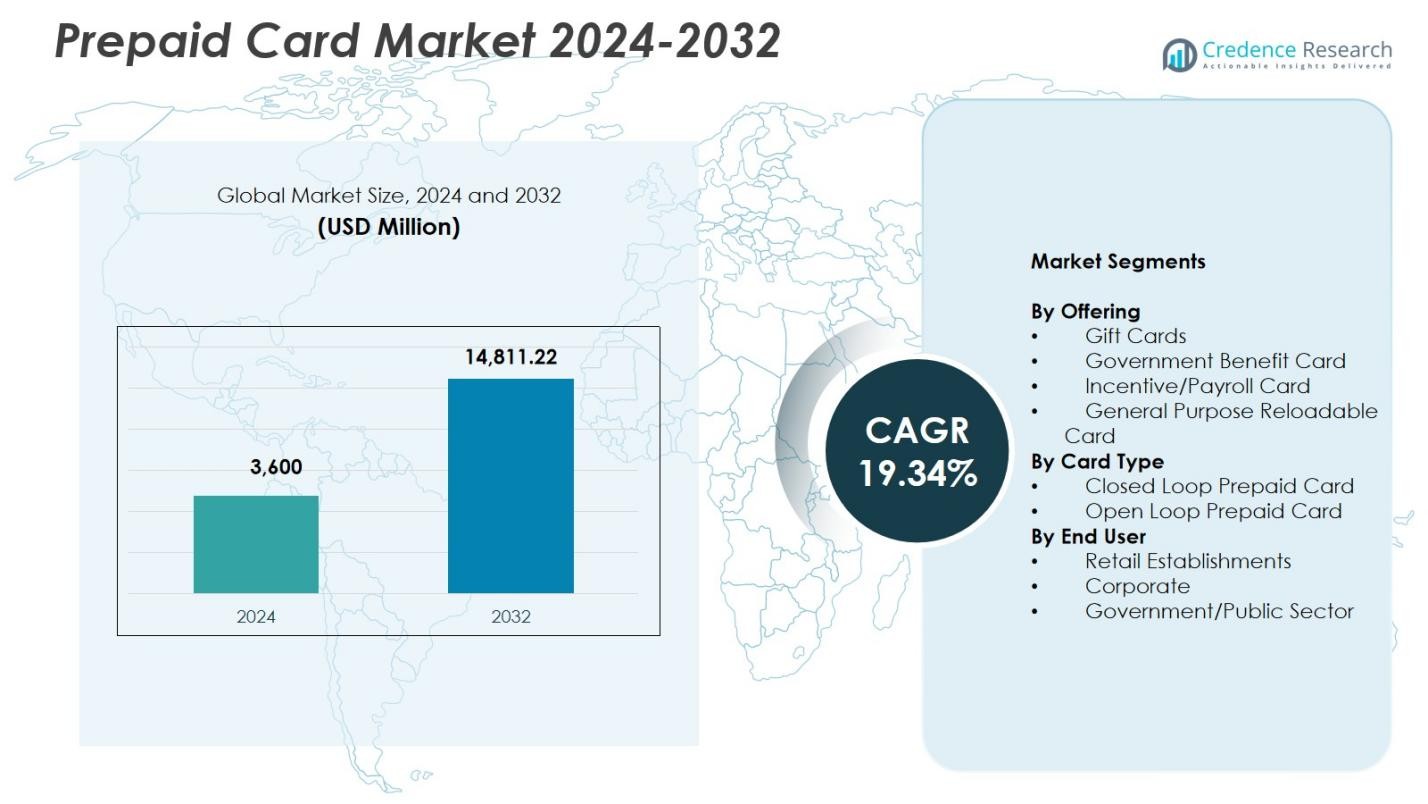
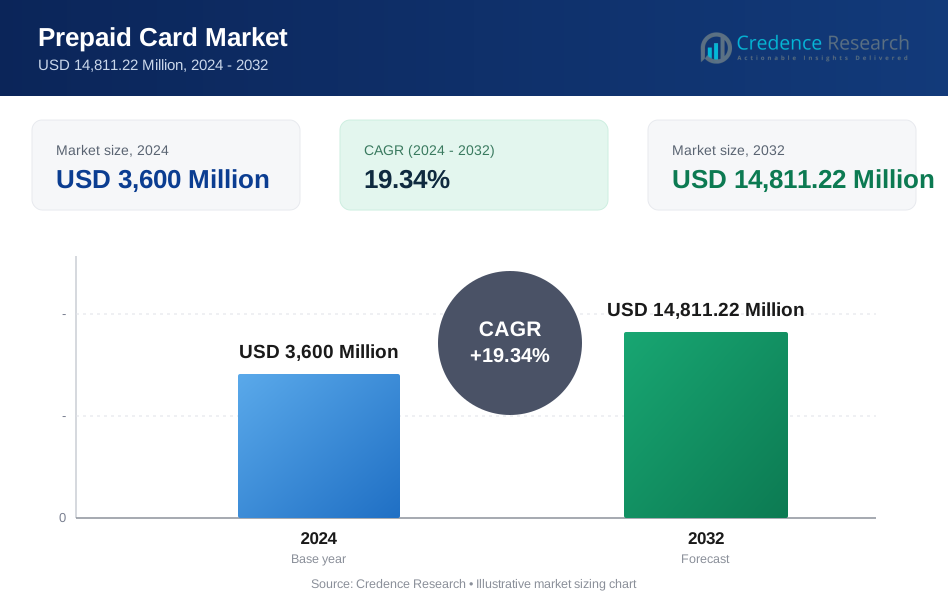
Prepaid Card Market size was valued USD 3,600 Million in 2024 and is anticipated to reach USD 14,811.22 Million by 2032, at a CAGR of 19.34% during the forecast period.
| REPORT ATTRIBUTE | DETAILS |
|---|---|
| Historical Period | 2020-2023 |
| Base Year | 2024 |
| Forecast Period | 2025-2032 |
| Prepaid Card Market Size 2024 | USD 3,600 Million |
| Prepaid Card Market, CAGR | 19.34% |
| Prepaid Card Market Size 2032 | USD 14,811.22 Million |
Prepaid Card Market features leading players such as Visa Inc., MasterCard Inc., American Express Company, Green Dot Corporation, Citigroup, Total System Services Inc., Kaiku Finance LLC, Mango Financial Inc., The PNC Financial Services Group Inc., and BBVA Compass Bancshares Inc., each strengthening their presence through diversified prepaid solutions and digital payment innovations. These companies focus on enhancing open loop and general-purpose reloadable card offerings while expanding partnerships with retailers, corporates, and government agencies. North America led the Prepaid Card Market with a 39.4% share in 2024, driven by strong fintech adoption, digital banking growth, and extensive prepaid integration across e-commerce and institutional payment systems.
Market Insights
- Prepaid Card Market recorded USD 3,600 Million in 2024 and will reach USD 14,811.22 Million by 2032, reflecting a CAGR of 19.34%.
- Strong market growth is driven by rising digital payment adoption, with the General Purpose Reloadable segment holding 41.6% share due to its versatility, financial inclusion support, and integration with mobile wallets.
- A key trend is the rapid expansion of open loop prepaid cards, dominating with 58.3% share as consumers prefer multi-merchant, cross-border, and e-commerce–enabled payment solutions.
- Leading players such as Visa, MasterCard, American Express, Green Dot, and Citigroup strengthen market presence through product innovation, card network expansion, and fintech collaborations.
- North America led with 39.4% share in 2024, followed by Europe at 27.8% and Asia-Pacific at 22.6%, while retail establishments dominated end-user adoption with 46.2% share across global prepaid ecosystems.
 Market Segmentation Analysis:
By Offering:
In the Prepaid Card Market, the General Purpose Reloadable (GPR) Card segment accounted for 41.6% market share in 2024, emerging as the dominant offering due to its versatility, financial inclusion benefits, and growing use among unbanked and underbanked consumers. Its reloadable feature supports recurring transactions, digital payments, and contactless usage, driving rapid adoption across retail and online channels. Gift cards and payroll cards continue to expand, but GPR cards lead growth as banks, fintech firms, and employers increasingly integrate them into mobile wallets and digital salary-disbursement ecosystems, accelerating market penetration.
- For instance, Green Dot's Prepaid Visa Debit Card enables users to reload funds at retailers like Walmart and 7-Eleven, supports direct deposit for paychecks up to two days early, and integrates with mobile apps for bill pay and spending tracking, aiding unbanked consumers in everyday purchases.
By Card Type:
The Open Loop Prepaid Card segment commanded 58.3% market share in 2024, making it the leading segment due to its universal acceptance across ATM networks, e-commerce platforms, and point-of-sale terminals. These cards support multi-merchant transactions, international payments, and integration with mobile payment systems, driving strong adoption among consumers and corporates. Rising demand for cross-border remittances, travel spending, and digital banking solutions further boosts the preference for open loop cards. Closed loop cards remain significant for brand-specific loyalty programs, but open loop solutions dominate because of their flexibility and broad financial utility.
- For instance, Blackhawk Network partnered with Mastercard to transition open-loop prepaid products to paper-based materials, achieving 60% paper conversion by end-2022 and targeting 75% by end-2023 to reduce plastic waste while maintaining usability wherever Mastercard is accepted.
By End User:
The Retail Establishments segment held 46.2% market share in 2024, emerging as the dominant end-user category as retailers increasingly deploy prepaid cards for customer loyalty, refunds, promotions, and omnichannel transactions. The segment benefits from expanding digital commerce, rising consumer preference for cashless purchases, and retailers’ adoption of prepaid programs to enhance customer retention. Corporate use of prepaid cards for expense management and employee incentives is growing, while public-sector demand rises for welfare distribution and subsidy payments. However, retail maintains leadership due to continuous expansion of closed loop and open loop card integrations across digital retail ecosystems.
Key Growth Drivers
Rising Demand for Cashless and Digital Payment Solutions
The Prepaid Card Market grows significantly as consumers and businesses accelerate their shift toward cashless transactions, driven by digital banking adoption, widespread smartphone penetration, and increasing reliance on e-commerce platforms. Prepaid cards provide secure, fee-controlled payment options that appeal to unbanked and underbanked populations. Their integration with mobile wallets, contactless payment systems, and online checkout gateways further enhances utility. Government initiatives promoting digital financial inclusion and real-time electronic payments continue to strengthen demand, positioning prepaid cards as a core component of modern payment ecosystems.
- For instance, Mastercard partners with Spain's Correos to issue Bono Cultural Joven prepaid cards, providing 18-year-olds a €400 grant restricted to cultural products and activities, enhancing targeted spending while tracking usage patterns.
Expansion of Government and Corporate Disbursement Programs
Government benefit distribution, salary disbursement, and corporate incentive programs increasingly rely on prepaid cards to ensure fast, transparent, and cost-efficient fund transfers. These cards streamline welfare payments, subsidies, tax refunds, and payroll processing, reducing administrative overhead and improving accessibility for recipients. Corporations utilize prepaid cards for travel expenses, employee incentives, and expense management to eliminate cash handling inefficiencies. The scalability of prepaid platforms and enhanced fraud-prevention capabilities enable broader institutional adoption, thereby sustaining strong growth momentum across both public and private sectors.
- For instance, ICICI Bank’s PayDirect Card enables companies to preload employee salaries, reimbursements, and incentives onto reloadable EMV chip-based cards, making funds available instantly on payday for ATM withdrawals and POS purchases.
Growing Retail Adoption and Consumer Loyalty Initiatives
Retail establishments continue to drive prepaid card expansion through extensive loyalty, promotional, and gift-card programs designed to enhance customer engagement and stimulate repeat purchases. Prepaid formats allow retailers to strengthen brand recognition and gain valuable insights into consumer spending patterns. Rising omnichannel retail strategies integrate prepaid cards across in-store and online platforms, increasing transaction volumes. As consumers seek flexible and secure payment options for shopping, travel, and entertainment, retail-driven prepaid solutions experience strong demand, reinforcing their role as an essential tool in personalized commerce and digital retail ecosystems.
Key Trends & Opportunities
Integration of Prepaid Cards with Mobile Wallets and Fintech Ecosystems
A major trend shaping the Prepaid Card Market is the rapid integration of prepaid cards into mobile wallets, neobanking platforms, and fintech ecosystems. This convergence enhances transactional convenience, enabling users to manage balances, track spending, and perform digital transfers instantly. Fintech firms leverage APIs and embedded finance solutions to launch innovative prepaid offerings tailored to gig workers, students, frequent shoppers, and travelers. As biometric authentication, contactless payments, and AI-based fraud detection advance, prepaid solutions gain new opportunities in digital-first payment models and global fintech collaborations.
- For instance, DoorDash provides Dashers with DasherDirect, a Stride Bank-issued Business Prepaid Visa Card accessible via a mobile app, allowing gig workers to deposit earnings for debit spending and no-fee ATM withdrawals at Allpoint network locations.
Expansion of Cross-Border and E-Commerce Payment Applications
Growing international travel, rising cross-border e-commerce activity, and increasing remittance flows create strong opportunities for prepaid cards with multi-currency, global acceptance, and enhanced security features. Open loop prepaid cards offer seamless international transactions without traditional banking constraints, appealing to travelers, migrant workers, and online shoppers. E-commerce marketplaces increasingly adopt prepaid cards for secure checkout, refunds, and loyalty rewards. As online spending accelerates and consumers seek low-risk alternatives to credit cards, prepaid cards emerge as essential tools supporting global digital commerce growth.
- For instance, Thomas Cook India launched the Borderless Prepaid Multi-Currency Travel Card, supporting 12 global currencies for seamless transactions at over 70 million Mastercard and Visa merchant establishments in more than 200 countries.
Key Challenges
Stringent Regulatory Compliance and Anti-Fraud Requirements
The Prepaid Card Market faces challenges due to evolving regulatory frameworks governing KYC, AML, transaction monitoring, and consumer protection. Providers must implement costly compliance systems and advanced fraud-detection tools to meet regulatory expectations. Heightened scrutiny over anonymous prepaid cards and cross-border transactions increases operational complexity. Compliance burdens may limit market entry for smaller fintech companies, slow product launches, and elevate administrative expenses. Balancing innovation with regulatory adherence remains a critical challenge that shapes product design, distribution, and risk-management strategies.
Intensifying Pressure from Alternative Digital Payment Methods
Prepaid cards face growing competition from mobile banking apps, digital wallets, Buy Now Pay Later (BNPL) solutions, and real-time payment platforms. These alternatives offer instant transfers, integrated budgeting tools, and flexible credit options, which may reduce prepaid card usage among digital-native consumers. As fintech ecosystems evolve, prepaid card providers must differentiate offerings through value-added features, personalization, and improved user experience. Failure to innovate could weaken market traction, especially among younger demographics who increasingly favor app-based financial tools over traditional prepaid instruments.
Regional Analysis
North America
North America held 39.4% market share in 2024, leading the Prepaid Card Market due to the strong presence of fintech ecosystems, widespread digital banking adoption, and high consumer preference for cashless transactions. The U.S. drives significant growth through extensive use of general-purpose reloadable cards, payroll cards, and government benefit disbursements. Retailers and e-commerce platforms increasingly deploy prepaid solutions for loyalty, refunds, and promotions, reinforcing market expansion. Strong regulatory frameworks, rising gig-economy payments, and advanced fraud-prevention technologies further strengthen prepaid card penetration across consumer and corporate segments.
Europe
Europe captured 27.8% market share in 2024, supported by expanding digital payments infrastructure, strong financial inclusion initiatives, and rising adoption of open loop prepaid cards for travel, corporate spending, and online shopping. The region benefits from regulated electronic money frameworks and growing demand for secure alternatives to credit cards. Government agencies increasingly utilize prepaid instruments for welfare payments, while retailers deploy gift and loyalty cards across omnichannel networks. Cross-border e-commerce growth, tourism recovery, and adoption of contactless prepaid solutions accelerate market momentum across major countries including the U.K., Germany, France, and Italy.
Asia-Pacific
Asia-Pacific accounted for 22.6% market share in 2024, emerging as the fastest-growing region driven by rapid digitization, expanding fintech adoption, and large unbanked populations transitioning toward prepaid financial tools. Governments promote prepaid solutions for subsidy distribution, transit systems, and public-sector payments. Mobile wallets integrated with prepaid cards strengthen market development, particularly in India, China, and Southeast Asia. Retail and e-commerce sectors increasingly leverage prepaid formats for promotional campaigns and digital rewards. The region’s strong economic growth, rising online transactions, and expanding merchant acceptance networks continue to create substantial future opportunities.
Latin America
Latin America recorded 6.4% market share in 2024, supported by growing demand for secure, low-cost financial solutions among unbanked and underbanked populations. Prepaid cards gain momentum for payroll, government aid distribution, and retail transactions as digital payment ecosystems mature across Brazil, Mexico, Chile, and Colombia. Fintech companies actively introduce reloadable prepaid cards linked to mobile banking platforms, enhancing financial accessibility and security. E-commerce expansion and increasing adoption of contactless payments further drive growth. However, market progression faces challenges related to regulatory variability and slower financial infrastructure modernization in certain economies.
Middle East & Africa
The Middle East & Africa region held 3.8% market share in 2024, with growth driven by digital banking initiatives, government-led financial inclusion programs, and rising demand for prepaid cards among migrant workers for remittances and salary disbursements. GCC countries adopt prepaid solutions for travel, retail, and corporate expense management, while African nations increasingly integrate prepaid cards into mobile money ecosystems. Retailers and public-sector bodies use prepaid formats for loyalty, subsidy distribution, and transit payments. Despite infrastructure limitations in some markets, expanding fintech participation and regulatory modernization continue to support regional prepaid card adoption.
Market Segmentations:
By Offering
- Gift Cards
- Government Benefit Card
- Incentive/Payroll Card
- General Purpose Reloadable Card
By Card Type
- Closed Loop Prepaid Card
- Open Loop Prepaid Card
By End User
- Retail Establishments
- Corporate
- Government/Public Sector
By Geography
- North America
- U.S.
- Canada
- Mexico
- Europe
- Germany
- France
- U.K.
- Italy
- Spain
- Rest of Europe
- Asia Pacific
- China
- Japan
- India
- South Korea
- South-east Asia
- Rest of Asia Pacific
- Latin America
- Brazil
- Argentina
- Rest of Latin America
- Middle East & Africa
- GCC Countries
- South Africa
- Rest of the Middle East and Africa
Competitive Landscape
The competitive landscape of the Prepaid Card Market features major players such as Visa Inc., MasterCard Inc., American Express Company, Green Dot Corporation, Citigroup, Total System Services, Inc., Kaiku Finance LLC, Mango Financial Inc., The PNC Financial Services Group Inc., and BBVA Compass Bancshares Inc. These companies strengthen their market presence through extensive card networks, diversified prepaid offerings, and continuous innovation in digital payment technologies. Leading brands focus on expanding open loop and general-purpose reloadable solutions, enhancing security features, and integrating prepaid cards with mobile wallets and fintech platforms. Strategic partnerships with retailers, government agencies, and corporate entities support growth across disbursement programs and loyalty ecosystems. Investments in fraud prevention, AI-driven analytics, and cross-border payment capabilities further differentiate providers in a rapidly evolving digital payments environment, while emerging fintech firms intensify competition with customizable, app-based prepaid solutions tailored for underserved and digital-native populations.
Key Player Analysis
- Green Dot Corporation
- Citigroup
- Kaiku Finance, LLC
- The PNC Financial Services Group, Inc.
- Mango Financial, Inc.
- American Express Company
- BBVA Compass Bancshares, Inc.
- Total System Services, Inc.
- MasterCard Inc.
- Visa, Inc.
Recent Developments
- In September 2025, Zaggle Prepaid Ocean Services Ltd. entered an agreement with Mastercard Asia Pacific Pte. Ltd. to launch and promote co-branded domestic prepaid cards across India.
- In May 2025, Green Dot Corporation announced that it is exploring strategic alternatives and potential sale, signaling possible M&A activity as part of a broader restructuring.
- In August 2025, Zum Rails and Mastercard Inc. launched a new prepaid card programme in Canada to support faster business payments.
- In February 2024, Awash Bank S.C. in Ethiopia, in partnership with Mastercard, launched a new Mastercard-branded international prepaid card and online payment gateway services.
Report Coverage
The research report offers an in-depth analysis based on Offering, Card Type, End User and Geography. It details leading market players, providing an overview of their business, product offerings, investments, revenue streams, and key applications. Additionally, the report includes insights into the competitive environment, SWOT analysis, current market trends, as well as the primary drivers and constraints. Furthermore, it discusses various factors that have driven market expansion in recent years. The report also explores market dynamics, regulatory scenarios, and technological advancements that are shaping the industry. It assesses the impact of external factors and global economic changes on market growth. Lastly, it provides strategic recommendations for new entrants and established companies to navigate the complexities of the market.
Future Outlook
- The Prepaid Card Market will expand rapidly as digital payments adoption accelerates across consumer and corporate segments.
- Integration of prepaid cards with fintech platforms and mobile wallets will strengthen user convenience and transaction efficiency.
- Government agencies will increasingly rely on prepaid cards for welfare distribution, subsidies, and public-sector payments.
- Open loop prepaid cards will gain wider adoption due to their versatility in domestic and cross-border transactions.
- Retailers will continue to drive growth through loyalty programs, gift cards, and omnichannel shopping incentives.
- Corporate demand for prepaid cards will rise for employee incentives, expense control, and travel spending management.
- Enhanced security features such as tokenization and biometric authentication will increase user trust and adoption.
- Growth in e-commerce and gig-economy platforms will boost prepaid card usage among digital-first consumers.
- Fintech collaborations will introduce advanced, customizable prepaid solutions for underserved populations.
- Regulatory modernization across regions will support transparent, compliant, and scalable prepaid ecosystems.
Request a Free Sample
Fill in your details and we'll send you a free sample report.
- Sample data tables & charts
- Research methodology
Need a Custom Version of This Report?
Tailor the scope, geography, or segments to your exact requirements.
- Custom geography or segment scope
- Direct access to our analyst team
Frequently Asked Questions
What is the current market size for Prepaid Card Market, and what is its projected size in 2032?
At what Compound Annual Growth Rate is the Prepaid Card Market projected to grow between 2025 and 2032?
Which Prepaid Card Market segment held the largest share in 2024?
What are the primary factors fueling the growth of the Prepaid Card Market?
Who are the leading companies in the Prepaid Card Market?
Which region commanded the largest share of the Prepaid Card Market in 2024?
Table of Content
Chapter 1. Report Introduction
- 1.1 Report Description & Purpose
- 1.1.1 Report Title & Market Definition
- 1.1.2 Unique Selling Propositions (USP) & Key Differentiators
- 1.1.3 Value Proposition for Stakeholders
- 1.2 Research Objectives
- 1.2.1 Market Sizing Objectives (Volume & Revenue)
- 1.2.2 Segmentation Objectives
- 1.2.3 Competitive Intelligence Objectives
- 1.2.4 Forecast & Scenario Objectives
- 1.3 Report Scope
- 1.3.1 Prepaid Card Scope – Types & Subtypes Covered
- 1.3.2 Geographic Scope – Regions & Countries Covered
- 1.3.3 Historical Period, Base Year & Forecast Period (2024; forecast to 2032)
- 1.3.4 Inclusions & Exclusions
- 1.4 HS Code & Classification Framework
- 1.5 Currency, Units & Pricing Basis
- 1.6 Target Stakeholders
- 1.7 Limitations & Assumptions
Chapter 2. Executive Summary
- 2.1 Global Prepaid Card Market Snapshot
- 2.1.1 Market Size – Historical (2024) & Forecast (2024-2032) (2024: USD 3,600 Million → 2032: USD 14,811.22 Million)
- 2.1.2 Volume & Revenue – Global Totals
- 2.1.3 Key Market Highlights – Top Five Facts
- 2.2 Prepaid Card Market Segmentation Snapshot
- 2.2.1 Market Split by Region – 2024 vs. 2032
- 2.3 Competitive Snapshot
- 2.3.1 Top 10 Players by Revenue Share – 2024
- 2.3.2 Top 10 Players by Volume Share – 2024
- 2.3.3 Recent Strategic Developments (18-Month Summary)
- 2.4 Key Investment Highlights & Strategic Conclusions
Chapter 3. Prepaid Card Market Dynamics & Industry Analysis
- 3.1 Market Overview & Context
- 3.1.1 Prepaid Card Market Position in the Broader Automotive Value Chain
- 3.1.2 OEM vs. Replacement Market Dynamics
- 3.1.3 Market Maturity & Development Stage by Region
- 3.2 Prepaid Card Market Drivers
- 3.3 Prepaid Card Market Restraints & Challenges
- 3.4 Prepaid Card Market Opportunities
- 3.5 Porter's Five Forces Analysis
- 3.5.1 Threat of New Entrants
- 3.5.2 Bargaining Power of Suppliers
- 3.5.3 Bargaining Power of Buyers
- 3.5.4 Threat of Substitutes
- 3.5.5 Competitive Rivalry – Intensity Assessment
- 3.6 Prepaid Card Value Chain Analysis
- 3.6.1 Upstream – Raw Material/Input Suppliers
- 3.6.1.1 Raw Material/Input 1
- 3.6.1.2 Raw Material/Input 2
- 3.6.1.3 Raw Material/Input 3
- 3.6.2 Midstream – Production/Manufacturing/Service Delivery
- 3.6.2.1 Production/Process Overview
- 3.6.2.2 Key Facility Locations & Capacity by Manufacturer
- 3.6.3 Downstream – Distribution & End Consumer
- 3.6.3.1 Primary Channel – B2B/OEM
- 3.6.3.2 Secondary Channels – Dealer, Retail, Online, Direct
- 3.6.4 Value Chain Profitability Analysis
- 3.6.1 Upstream – Raw Material/Input Suppliers
- 3.7 PESTEL Analysis
- 3.7.1 Political Factors
- 3.7.2 Economic Factors
- 3.7.3 Social Factors
- 3.7.4 Technological Factors
- 3.7.5 Environmental Factors
- 3.7.6 Legal Factors
- 3.8 Prepaid Card Supply Chain Analysis
- 3.8.1 Raw Material/Input Supply Risk Assessment
- 3.8.2 Manufacturing Concentration Risk (Geographic Exposure)
- 3.8.3 Trade Disruption Impact Analysis
- 3.9 Regulatory & Policy Landscape
Note: The regulatory and policy landscape section covers regulations based on their applicability to the market, Prepaid Card category, geography, and scope of the study. Only regulatory frameworks with a material impact on operations, compliance, trade, sustainability, or market access are analyzed in detail.
Chapter 4. Key Investment Pockets & Opportunity Analysis
- 4.1 Prepaid Card Market Attractiveness Analysis
- 4.1.1 By Region – Investment Attractiveness Matrix (Volume × CAGR)
- 4.2 Absolute Revenue Growth Opportunity
- 4.2.1 By Region – Absolute USD Growth Through 2032
- 4.3 Incremental Volume Opportunity
- 4.3.1 By Region – Incremental Volume Through 2032
- 4.3.2 Segment – Incremental Volume
- 4.4 Emerging Submarket Opportunity Deep Dive (Subject to Applicability)
- 4.5 Emerging Market Opportunity Scorecards
- 4.5.1 United States
- 4.5.2 Europe
- 4.5.3 Asia
- 4.5.4 Middle East & Africa
Note: Emerging Market Opportunity Scorecards will be included based on relevance and strategic importance. Regions listed are indicative and may vary depending on data availability and market dynamics.
Chapter 5. Prepaid Card Import-Export Analysis & Trade Flows
- 5.1 Global Trade Overview
- 5.1.1 Global Export Value by Country (2024)
- 5.1.2 Global Export Volume by Country (2024)
- 5.1.3 Global Import Value by Country (2024)
- 5.1.4 Global Import Volume by Country (2024)
- 5.1.5 Net Trade Balance by Country (2024)
- 5.2 Export Analysis – Segment
- 5.2.1 Type 1 (HS Code)
- 5.2.2 Type 2 (HS Code)
- 5.2.3 Type 3 (HS Code)
- 5.2.4 Type 4 (HS Code)
- 5.2.5 Type 5 (HS Code)
- 5.3 Import Analysis – Segment
- 5.3.1 Type 1 (HS Code)
- 5.3.2 Type 2 (HS Code)
- 5.3.3 Type 3 (HS Code)
- 5.3.4 Type 4 (HS Code)
- 5.3.5 Type 5 (HS Code)
- 5.4 Average Unit Trade Prices
- 5.4.1 Average Export Price – Segment & Country
- 5.4.2 Average Import Price – Segment & Source Country
- 5.4.3 Price Trends (2024)
- 5.5 Key Trade Route Analysis
- 5.5.1 Trade Route 1
- 5.5.2 Trade Route 2
- 5.5.3 Trade Route 3
- 5.5.4 Trade Route 4
- 5.5.5 Trade Route 5
- 5.6 Trade Policy Impact Assessment
- 5.6.1 US Anti-Dumping & Section 301 Tariffs
- 5.6.2 EU Customs Union Impact
- 5.6.3 Major Free Trade Agreements
- 5.6.4 USMCA Rules of Origin
Note: Trade policy analysis will be included only where relevant to the Prepaid Card market.
Chapter 6. Competitive Landscape & Company Benchmarking
- 6.1 Prepaid Card Market Concentration & Structure
- 6.1.1 Herfindahl-Hirschman Index (HHI) – vs. 2024
- 6.1.2 Tier 1, Tier 2 & Tier 3 Market Structure
- 6.1.3 Global, Regional & Local Player Dynamics
- 6.2 Prepaid Card Market Share Analysis – 2024
- 6.2.1 Global Revenue Share by Company
- 6.2.2 Global Volume Share by Company
- 6.2.3 Regional Revenue Share
- 6.2.4 Market Share Evolution ( vs. 2024)
- 6.2.5 OEM Segment Share by Company
- 6.2.6 Replacement Segment Share by Company
- 6.3 Production/Delivery Capacity & Facility Analysis
- 6.3.1 Global Installed Capacity
- 6.3.2 Capacity Utilization Rates
- 6.3.3 Production/Output Volume
- 6.3.4 Facility Locations & Capacity Map
- 6.3.5 Planned Capacity Additions
- 6.4 Prepaid Card Competitive Benchmarking Matrix
- 6.4.1 Revenue, Volume, CAGR & Profitability Comparison
- 6.4.2 Channel Revenue Mix
- 6.4.3 Geographic Revenue Exposure
- 6.4.4 R&D Intensity
- 6.4.5 Sustainability Maturity
- 6.5 Strategic Developments in Prepaid Card (Last 24 Months)
- 6.5.1 Mergers, Acquisitions & Divestments
- 6.5.2 New Prepaid Card Launches
- 6.5.3 Facility Expansions
- 6.5.4 Strategic Alliances, Joint Ventures & Partnerships
- 6.5.5 Distribution Expansion & Market Entry
- 6.5.6 Sustainability & ESG Initiatives
- 6.6 Competitive Strategy Mapping
- 6.6.1 Leader, Challenger, Follower & Niche Classification
- 6.6.2 Pricing Strategy Comparison
- 6.6.3 Channel Strategy Matrix
Note: Strategic developments are included based on their materiality and the availability of reliable information.
Chapter 7. Global Prepaid Card Market – By Distribution Channel
- 7.1 Segment Overview
- 7.1.1 Volume & Revenue Split by Channel (2024 & 2032)
- 7.1.2 Channel Mix Evolution (2024-2032)
Chapter 8. Regional Market Analysis – Global Overview
- 8.1 Global Regional Overview
- 8.1.1 Regional Volume Share
- 8.1.2 Regional Revenue Share
- 8.1.3 Regional Volume by Region
- 8.1.4 Regional Revenue by Region
- 8.1.5 Regional Forecast Through 2032
- 8.2 Cross-Regional Segment Analysis
- 8.2.1 By Distribution Channel
- 8.2.2 By Brand/Price Tier
Chapter 9. North America Prepaid Card Market
- 9.1 United States
- 9.2 Canada
- 9.3 Mexico
Chapter 10. Europe Prepaid Card Market
- 10.1 Germany
- 10.2 France
- 10.3 Italy
- 10.4 United Kingdom
- 10.5 Spain
- 10.6 Poland
- 10.7 Russia
- 10.8 Netherlands
- 10.9 Belgium
- 10.10 Sweden
- 10.11 Denmark
- 10.12 Norway
- 10.13 Rest of Europe
Chapter 11. Asia Pacific Prepaid Card Market
- 11.1 China
- 11.2 India
- 11.3 Japan
- 11.4 South Korea
- 11.5 Thailand
- 11.6 Indonesia
- 11.7 Vietnam
- 11.8 Malaysia
- 11.9 Australia
- 11.10 Rest of Asia Pacific
Chapter 12. Latin America Prepaid Card Market
- 12.1 Brazil
- 12.2 Argentina
- 12.3 Colombia
- 12.4 Chile
- 12.5 Rest of Latin America
Chapter 13. Middle East Prepaid Card Market
- 13.1 Saudi Arabia
- 13.2 United Arab Emirates
- 13.3 Turkey
- 13.4 Israel
- 13.5 Iran
- 13.6 Rest of the Middle East
Chapter 14. Africa Prepaid Card Market
- 14.1 South Africa
- 14.2 Egypt
- 14.3 Nigeria
- 14.4 Morocco
- 14.5 Rest of Africa
Chapter 15. Prepaid Card Company Profiles
- 15.1 [Company 01]
- 15.1.1 Company Overview
- 15.1.2 Key Management Personnel
- 15.1.3 Products & Services Portfolio
- 15.1.4 Financial Performance
- 15.1.5 Key Market Focus & Geographic Presence
- 15.1.6 Recent Developments & Strategic Initiatives
Note: The company profile list is preliminary and may change based on research findings, market developments, data availability, and client requirements.
Chapter 16. Appendices
- Appendix A – List of Abbreviations & Acronyms
- Appendix B – Industry Classification Code Reference – Full Series
- Appendix C – Production & Capacity Data Tables
- Appendix D – End-Use & Demand Base Tables
- Appendix E – Consumption & Replacement Rate Assumptions
- Appendix F – ASP Reference Tables
- Appendix G – Manufacturing & Facility Database
- Appendix H – Import-Export Data Tables
- Appendix I – Regulatory Summary Tables
- Appendix J – Primary Research Participant List (Anonymized)
- Appendix K – Primary Research Questionnaire Framework
- Appendix L – Data Sources & Bibliography
- Appendix M – Market Size Divergence & Source Comparison
Chapter 17. Research Methodology
- 17.1 Research Framework & Philosophy
- 17.2 Secondary Research – Sources, Hierarchy & Data Extraction
- 17.3 Data Modeling – Bottom-Up & Top-Down Market Sizing
- 17.4 Primary Research – Stakeholder Framework, LOI & Sample Sizes
- 17.5 Forecast Methodology – Regression, Scenario & Sensitivity Analysis
- 17.6 Quality Control – Four-Layer Validation Framework
- 17.7 Limitations & Standard Assumptions
- 17.8 Disclaimer
