
Market Overview:
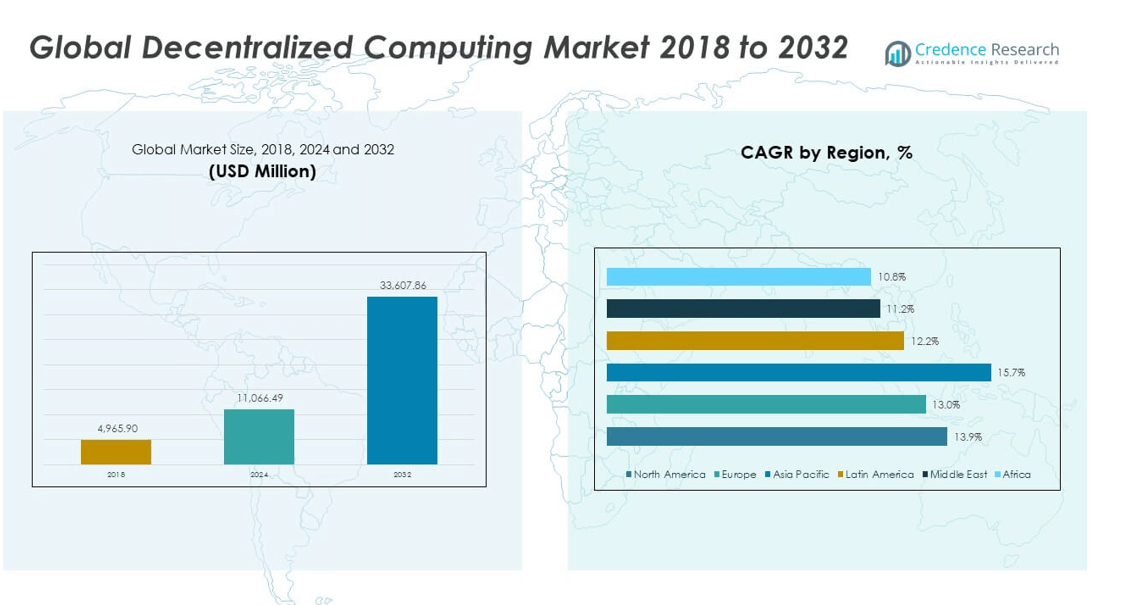
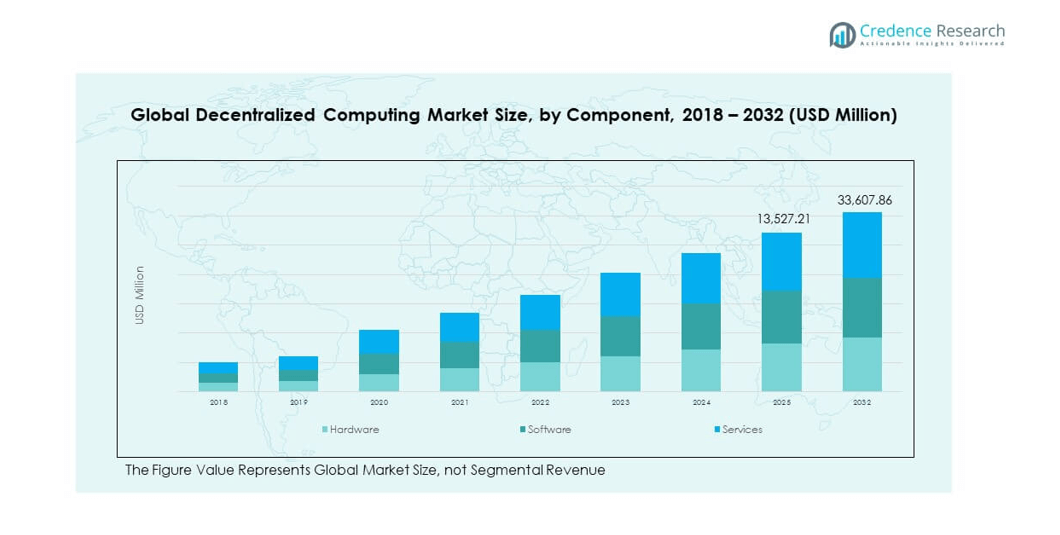
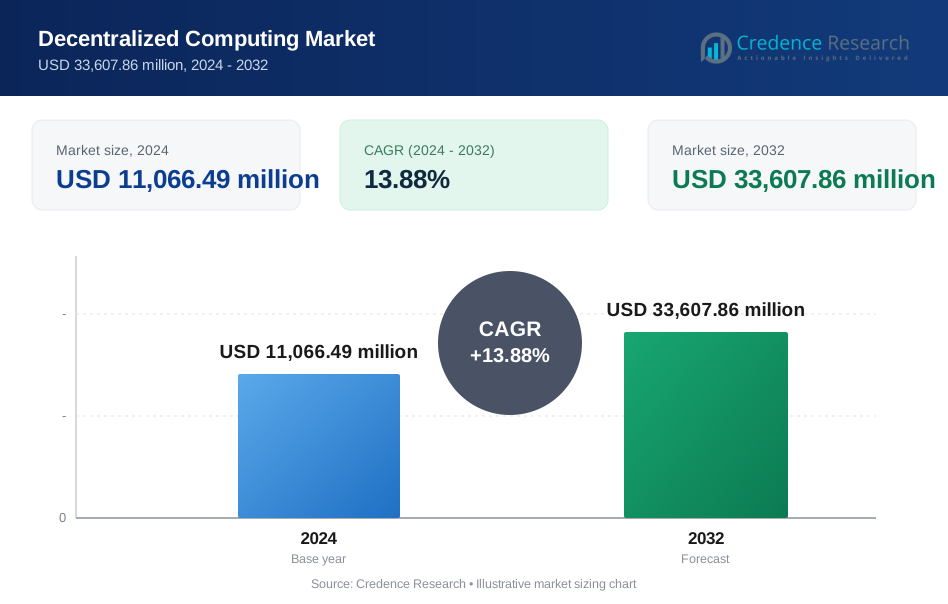
The Global Decentralized Computing Market size was valued at USD 4,965.90 million in 2018 to USD 11,066.49 million in 2024 and is anticipated to reach USD 33,607.86 million by 2032, at a CAGR of 13.88% during the forecast period.
| REPORT ATTRIBUTE | DETAILS |
|---|---|
| Historical Period | 2020-2023 |
| Base Year | 2024 |
| Forecast Period | 2025-2032 |
| Decentralized Computing Market Size 2024 | USD 11,066.49 million |
| Decentralized Computing Market, CAGR | 13.88% |
| Decentralized Computing Market Size 2032 | USD 33,607.86 million |
Market growth is driven by the increasing demand for secure, transparent, and scalable computing solutions. Organizations are adopting decentralized frameworks to reduce dependency on centralized servers, enhance privacy, and improve resilience against cyber threats. The rise of blockchain technology, edge computing, and peer-to-peer networks further supports adoption. Decentralized computing also benefits industries such as finance, healthcare, and supply chain, where data integrity and real-time processing are critical. Growing use cases in Web3 applications and digital assets are accelerating expansion.
Geographically, North America leads due to strong blockchain adoption and advanced IT infrastructure. Europe follows closely, driven by regulatory support for data sovereignty and cybersecurity. The Asia-Pacific region is emerging rapidly, supported by large-scale digital transformation initiatives, expanding cloud ecosystems, and growing investment in decentralized finance and edge computing solutions. Meanwhile, Latin America and the Middle East are gradually exploring opportunities, particularly in financial services and secure data management, as they strengthen their digital economies.
Market Insights:
- The Global Decentralized Computing Market size was USD 4,965.90 million in 2018, reached USD 11,066.49 million in 2024, and is projected to hit USD 33,607.86 million by 2032, growing at a CAGR of 13.88%.
- North America leads with a 43.5% share in 2024, driven by strong IT infrastructure and regulatory compliance; Europe follows with 27.5% due to strict data protection laws; Asia Pacific holds 20.3%, supported by digital adoption and enterprise transformation.
- Asia Pacific is the fastest-growing region, holding 20.3% share in 2024, fueled by smart city projects, digital finance, and heavy government investment in blockchain and IoT.
- Software dominates the market with a 52% share in 2024, reflecting its vital role in privacy management, compliance tools, and blockchain-driven security platforms.
- Services hold a 33% share, supported by strong demand for consulting, integration, and managed solutions, while hardware contributes the remaining 15% share with security appliances and supporting infrastructure.
Market Drivers
Rising Need for Secure and Transparent Computing Architectures
The Global Decentralized Computing Market is witnessing strong momentum due to rising cybersecurity concerns. Enterprises are increasingly shifting toward decentralized models to safeguard sensitive data. These frameworks minimize single points of failure and create more resilient networks. Blockchain-based validation ensures data integrity while reducing risks associated with unauthorized access. It empowers industries like finance, healthcare, and defense with better control over digital assets. Peer-to-peer architecture further enhances trust among stakeholders in critical operations. Growing awareness of digital privacy drives higher investments in decentralized platforms. A strong push from data protection regulations further accelerates this transition.
Growing Adoption of Blockchain and Distributed Ledger Technologies
The adoption of blockchain and distributed ledger technology (DLT) remains a central driver in this market. Industries utilize blockchain frameworks to secure transactions and strengthen transparency. It provides tamper-proof mechanisms, ensuring accountability across multiple stakeholders. Smart contracts automate processes and reduce operational inefficiencies. Organizations are integrating decentralized computing to expand scalability and enhance speed in transactions. Demand for DLT-based platforms accelerates innovation across fintech, logistics, and supply chains. Strong venture capital funding in blockchain startups also fuels growth. Growing enterprise partnerships with blockchain developers enhance commercial adoption further.
- For instance, Ethereum, a leading blockchain, supports thousands of decentralized applications (dApps). In 2024, the Dencun upgrade (launched March 13) improved Layer 2 scalability and lowered transaction costs. The same year, U.S. regulators approved spot Ethereum ETFs, which began trading in July.
Expanding Role of Edge Computing and IoT Integration
Edge computing adoption significantly boosts demand for decentralized solutions. It ensures faster data processing by reducing reliance on centralized cloud servers. The Global Decentralized Computing Market benefits from industries leveraging IoT devices that produce massive real-time data. It allows organizations to handle data locally, cutting latency and improving efficiency. Decentralized frameworks support predictive analytics and enhance responsiveness in smart cities. Businesses in manufacturing, healthcare, and transportation adopt such systems for improved decision-making. The rise of 5G networks further strengthens this integration. Increasing adoption of autonomous systems also drives wider deployment of edge-enabled decentralized models.
- For instance, Cisco provides edge computing and IoT networking platforms that support smart city initiatives worldwide, enabling real-time data processing for connected devices and critical urban infrastructure.
Increasing Relevance of Web3 and Digital Asset Ecosystem
Web3 applications and digital assets serve as vital growth drivers for decentralized platforms. The integration of decentralized applications (dApps) enhances efficiency across multiple sectors. It creates new models for data ownership, giving users greater control. Growing interest in decentralized finance (DeFi) solutions expands adoption across global economies. Businesses explore tokenization, NFTs, and smart contracts for innovative business models. The Global Decentralized Computing Market thrives as enterprises adapt to the emerging digital economy. It positions decentralized computing as a backbone for future-ready ecosystems. Rising developer ecosystems and startup communities accelerate innovation in Web3 applications worldwide.
Market Trends
Integration of AI with Decentralized Infrastructure
The Global Decentralized Computing Market is evolving through AI integration with decentralized platforms. Artificial intelligence strengthens decision-making by analyzing distributed datasets across networks. It reduces dependency on centralized systems and improves scalability. Combining AI with blockchain enhances fraud detection and operational accuracy. Edge AI also supports real-time analytics in industrial applications. Businesses adopt hybrid models where AI algorithms run securely on decentralized frameworks. It creates opportunities for innovation in predictive intelligence. Continuous improvements in AI chips and algorithms further complement decentralized adoption.
Rising Use of Decentralized Cloud Storage Solutions
Organizations are embracing decentralized cloud storage to reduce reliance on centralized providers. These solutions offer enhanced security, lower costs, and greater resilience. It empowers users with data ownership and privacy control. Growing distrust of centralized servers accelerates this adoption. Enterprises value improved redundancy and risk diversification. The Global Decentralized Computing Market leverages blockchain for transparent storage validation. Rising demand for decentralized storage supports expansion in e-commerce, healthcare, and media industries. Growing demand for compliance with data sovereignty laws strengthens market acceptance.
Increasing Interoperability Among Decentralized Platforms
Interoperability emerges as a critical trend reshaping this industry. Businesses seek seamless communication between multiple blockchain ecosystems. It enables integration of diverse decentralized applications without restrictions. Developers adopt cross-chain frameworks to improve connectivity. The Global Decentralized Computing Market supports ecosystems that break silos across industries. It allows digital assets, data, and smart contracts to move freely between networks. Interoperability strengthens enterprise adoption and user confidence. Governments and enterprises push for standards to ensure smoother functionality. Industry alliances and consortiums also play a critical role in driving interoperability.
- For instance, the Enterprise Ethereum Alliance (EEA) brings together hundreds of global organizations to establish technical standards for blockchain interoperability, particularly in financial services. Industry alliances and consortiums continue to play a critical role in advancing interoperability.
Growth of Token-Based Incentive Mechanisms
The market is witnessing broader use of token-based incentive models. Users receive rewards for sharing resources like bandwidth, storage, or computing power. It strengthens engagement and encourages wider adoption of decentralized systems. Businesses deploy tokenization to improve transparency in transactions. The Global Decentralized Computing Market evolves as platforms introduce governance tokens. It helps organizations establish user-driven ecosystems with greater participation. Token incentives also support new monetization strategies in digital economies. Startups and enterprises both explore this trend to expand scalability. Growing integration of tokens into gaming and metaverse platforms boosts adoption further.
- For instance, Helium Network rewards hotspot operators with its native HNT tokens for providing wireless coverage. In 2024, the network showed substantial growth in its mobile and IoT networks, particularly in the fourth quarter, with strategic partnerships expanding coverage in countries like Mexico and carrier offloading increasing significantly.
Market Challenges Analysis
Scalability and Infrastructure Limitations in Decentralized Frameworks
The Global Decentralized Computing Market faces challenges in managing scalability within distributed systems. Limited throughput and transaction speed often restrict adoption in large-scale operations. It becomes difficult for businesses to rely on decentralized systems for real-time processing. Network congestion and limited computing power reduce efficiency. Infrastructure costs increase with the need for advanced hardware and secure protocols. Enterprises remain cautious about transitioning from well-established centralized models. Addressing these scalability challenges remains crucial for long-term adoption. Advances in sharding and layer-2 technologies aim to reduce these limitations.
Regulatory Uncertainty and Data Governance Complexities
Unclear regulations create hurdles for industries exploring decentralized computing. Governments worldwide continue to debate frameworks for blockchain, digital assets, and decentralized applications. The Global Decentralized Computing Market struggles with varying compliance standards across regions. It complicates adoption, especially in finance and healthcare. Businesses must ensure data privacy while adhering to security laws. Concerns over misuse of decentralized systems for illicit activities intensify scrutiny. Clear policies and standardization are essential to build trust and expand adoption. Collaboration between regulators and industry groups could help create stable governance models.
Market Opportunities
Expansion in Emerging Economies and Digital Infrastructure Growth
Emerging economies provide significant opportunities for decentralized computing adoption. Governments invest in digital infrastructure, supporting advanced technologies like blockchain and edge computing. The Global Decentralized Computing Market benefits from these initiatives by tapping into fast-growing demand. It helps organizations address data security while enhancing operational flexibility. Businesses in finance, logistics, and healthcare increasingly rely on decentralized frameworks. Expanding connectivity in rural areas further strengthens adoption. Opportunities rise as nations focus on digital sovereignty and innovation. Growing startup ecosystems in emerging markets enhance development of decentralized applications.
Development of Industry-Specific Decentralized Applications
Industry-specific decentralized applications represent another major opportunity in this market. Enterprises develop tailored solutions to address healthcare, automotive, and energy challenges. It creates specialized systems that enhance efficiency and security. The Global Decentralized Computing Market grows as developers design scalable applications for unique needs. It promotes better data management and faster decision-making. Businesses also explore customized dApps for supply chains and digital identity verification. Collaboration between enterprises and technology providers accelerates this expansion. Growing demand for cross-sector pilot projects encourages faster commercialization of these solutions.
Market Segmentation Analysis:
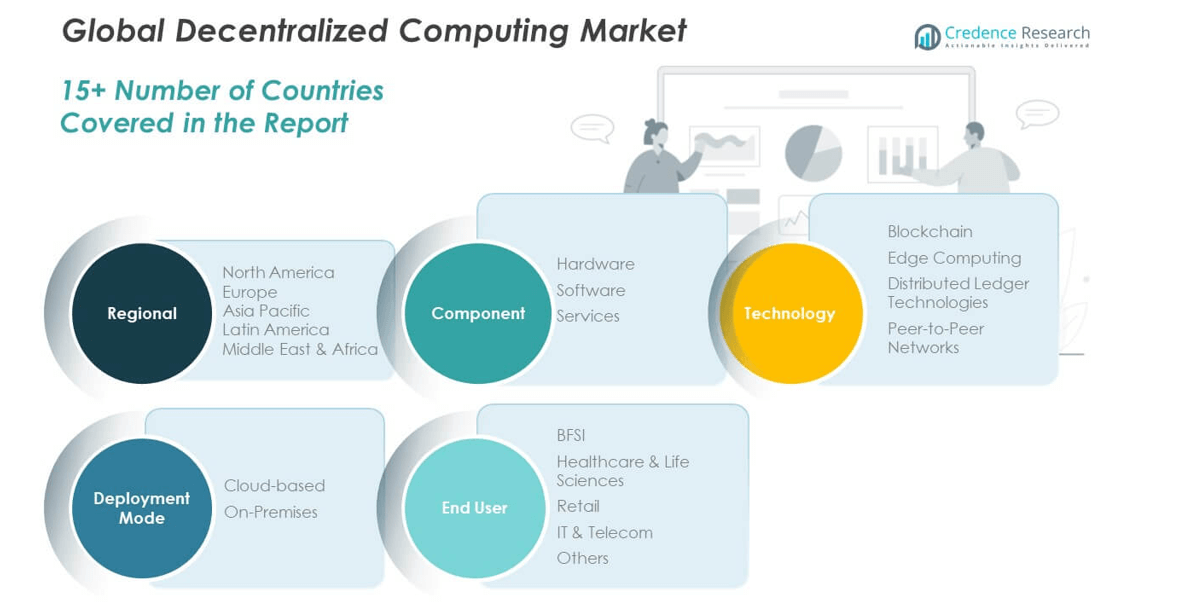
The Global Decentralized Computing Market is segmented
By component into hardware, software, and services. Hardware forms the foundation through nodes, servers, and networking equipment that enable decentralized frameworks. Software drives efficiency with blockchain protocols, smart contract platforms, and interoperability tools that support seamless integration. Services complement adoption through consulting, deployment, and managed solutions, offering enterprises scalability and operational flexibility. The balanced growth across these components highlights a strong ecosystem that supports innovation and adoption in multiple industries.
- For instance, Cisco provides secure hybrid cloud and networking infrastructure that can support enterprise-grade decentralized networks. This allows businesses to deploy blockchain nodes both on-premises and in the cloud,
By technology, the market covers blockchain, edge computing, distributed ledger technologies, and peer-to-peer networks. Blockchain remains dominant due to its proven applications in security, transparency, and smart contracts. Edge computing gains traction for real-time data processing closer to the source. Distributed ledger technologies expand enterprise use cases across compliance and governance. Peer-to-peer networks enhance resource sharing and resilience, encouraging adoption across consumer and enterprise sectors. It is evolving with new frameworks that improve scalability and interoperability.
- For instance, BitTorrent remains one of the world’s most widely adopted peer-to-peer protocols, enabling decentralized file sharing through a resilient architecture. Historically, clients within the BitTorrent ecosystem have reported over 100 million monthly active users, showcasing its significant scale and public adoption.
By deployment mode divides into cloud-based and on-premises systems. Cloud-based deployment leads adoption, offering scalability and cost efficiency for organizations managing dynamic workloads. On-premises models remain relevant for industries requiring strict data sovereignty and compliance standards.
By end user, the market spans BFSI, healthcare and life sciences, retail, IT and telecom, and others. BFSI leads adoption due to decentralized finance applications and secure transactions. Healthcare leverages decentralized computing for patient data protection and interoperability. Retail, IT, and telecom expand usage through customer experience, data management, and digital services.
Segmentation:
By Component
- Hardware
- Software
- Services
By Technology
- Blockchain
- Edge Computing
- Distributed Ledger Technologies
- Peer-to-Peer Networks
By Deployment Mode
- Cloud-based
- On-Premises
By End User
- BFSI
- Healthcare & Life Sciences
- Retail
- IT & Telecom
- Others
By Region
- North America
- U.S.
- Canada
- Mexico
- Europe
- UK
- France
- Germany
- Italy
- Spain
- Russia
- Belgium
- Netherlands
- Austria
- Sweden
- Poland
- Denmark
- Switzerland
- Rest of Europe
- Asia Pacific
- China
- Japan
- South Korea
- India
- Australia
- Thailand
- Indonesia
- Vietnam
- Malaysia
- Philippines
- Taiwan
- Rest of Asia Pacific
- Latin America
- Brazil
- Argentina
- Peru
- Chile
- Colombia
- Rest of Latin America
- Middle East
- UAE
- KSA
- Israel
- Turkey
- Iran
- Rest of Middle East
- Africa
- Egypt
- Nigeria
- Algeria
- Morocco
- Rest of Africa
Regional Analysis:
North America
The North America Global Decentralized Computing Market size was valued at USD 2,181.74 million in 2018 to USD 4,811.82 million in 2024 and is anticipated to reach USD 14,653.37 million by 2032, at a CAGR of 13.9% during the forecast period. North America holds a 43.5% market share in 2024, driven by strong adoption in the U.S. and Canada. Enterprises are investing in blockchain infrastructure, edge computing, and decentralized finance applications. The presence of leading cloud and software companies accelerates the development of decentralized ecosystems. It benefits from advanced regulatory frameworks that encourage innovation in digital services. BFSI and healthcare sectors dominate adoption due to strong data privacy demands. North America continues to lead in research collaborations and venture funding. High consumer awareness and strong infrastructure keep the region at the forefront of decentralized transformation.
Europe
The Europe Global Decentralized Computing Market size was valued at USD 1,416.99 million in 2018 to USD 3,044.59 million in 2024 and is anticipated to reach USD 8,708.39 million by 2032, at a CAGR of 13.0% during the forecast period. Europe accounts for a 27.5% market share in 2024, supported by strong regulations on data protection and digital sovereignty. Countries like Germany, the UK, and France are early adopters of blockchain and decentralized cloud. It gains momentum from EU-driven strategies promoting digital transformation. Healthcare and retail sectors adopt decentralized frameworks to improve efficiency and transparency. Businesses focus on compliance-driven adoption, creating opportunities for distributed ledger solutions. Europe benefits from strong R&D ecosystems and cross-border collaborations. It is evolving with government support for startups and digital identity initiatives. The region balances innovation with strict governance standards.
Asia Pacific
The Asia Pacific Global Decentralized Computing Market size was valued at USD 925.37 million in 2018 to USD 2,240.74 million in 2024 and is anticipated to reach USD 7,733.84 million by 2032, at a CAGR of 15.7% during the forecast period. Asia Pacific represents a 20.3% market share in 2024, reflecting its fast growth in China, Japan, South Korea, and India. Governments in the region actively invest in blockchain pilots and digital infrastructure. It benefits from large-scale adoption of edge computing to support smart cities and IoT ecosystems. BFSI and telecom industries lead in decentralized adoption for payment systems and secure data management. Rapid digital transformation across enterprises accelerates demand for decentralized platforms. Asia Pacific demonstrates high consumer adoption of Web3 and digital assets. It is emerging as a hub for startups in blockchain and token-based ecosystems. The region’s rapid growth positions it as the fastest-expanding market.
Latin America
The Latin America Global Decentralized Computing Market size was valued at USD 235.11 million in 2018 to USD 517.44 million in 2024 and is anticipated to reach USD 1,391.29 million by 2032, at a CAGR of 12.2% during the forecast period. Latin America contributes a 4.7% market share in 2024, driven by adoption in Brazil, Mexico, and Argentina. Enterprises adopt decentralized solutions for digital payments, identity management, and e-commerce. It benefits from growing fintech innovation and blockchain-enabled financial inclusion programs. Governments in the region explore blockchain to enhance transparency in public services. Retail and telecom industries lead with decentralized applications improving supply chains and connectivity. The region shows rising adoption in healthcare for secure medical records. Limited infrastructure creates challenges, but digital transformation initiatives expand opportunities. Latin America is steadily emerging as a growth-oriented market for decentralized computing.
Middle East
The Middle East Global Decentralized Computing Market size was valued at USD 125.86 million in 2018 to USD 253.85 million in 2024 and is anticipated to reach USD 636.48 million by 2032, at a CAGR of 11.2% during the forecast period. The Middle East secures a 2.3% market share in 2024, with GCC countries, Israel, and Turkey leading adoption. Governments invest heavily in blockchain and smart city projects, particularly in the UAE and Saudi Arabia. It benefits from initiatives to diversify economies beyond oil through digital innovation. BFSI and government services lead adoption for identity management and secure transactions. Businesses embrace decentralized cloud to ensure sovereignty and compliance. The market gains strength from partnerships between regional enterprises and global technology providers. Israel fosters strong research-driven adoption, especially in cybersecurity applications. It continues to expand with government-backed pilot projects and digital economy frameworks.
Africa
The Africa Global Decentralized Computing Market size was valued at USD 80.82 million in 2018 to USD 198.05 million in 2024 and is anticipated to reach USD 484.49 million by 2032, at a CAGR of 10.8% during the forecast period. Africa holds a 1.8% market share in 2024, with South Africa, Nigeria, and Egypt leading adoption. Decentralized solutions address financial inclusion challenges through blockchain-based payment systems. It benefits from the rising adoption of mobile-first applications and digital identity frameworks. Healthcare and agriculture sectors explore decentralized models to improve efficiency and transparency. Governments and NGOs invest in blockchain for supply chain traceability. Limited infrastructure slows widespread adoption, but innovation hubs drive progress in urban areas. Africa is increasingly adopting decentralized cloud services to bypass traditional infrastructure gaps. It presents long-term potential with the growth of fintech ecosystems.
Key Player Analysis:
- IBM
- Microsoft
- Amazon Web Services (AWS)
- Google Cloud
- Oracle
- ConsenSys
- Chainlink
- Protocol Labs (Filecoin, IPFS)
- Arweave
- Ocean Protocol
- Safe Health Systems
Competitive Analysis:
The Global Decentralized Computing Market features strong competition among technology giants, blockchain innovators, and specialized solution providers. Leading players such as IBM, Microsoft, Amazon Web Services, Google Cloud, and Oracle dominate through extensive infrastructure, enterprise reach, and continuous service innovation. Emerging players including ConsenSys, Chainlink, Protocol Labs, Arweave, and Ocean Protocol drive disruption with blockchain frameworks, decentralized storage, and peer-to-peer solutions. It benefits from a blend of established enterprises offering scalability and startups pushing agile innovation. Companies focus on mergers, partnerships, and ecosystem building to expand global presence. Strategic priorities include enhancing interoperability, strengthening cybersecurity, and delivering industry-specific decentralized applications. Market leaders invest in research and pilot projects to establish early advantages in Web3 and decentralized finance. Competitive intensity remains high, with enterprises aiming to capture growing demand across BFSI, healthcare, IT, telecom, and retail sectors.
Recent Developments:
- In August 2025, IBM and AMD announced a collaboration to develop scalable, open-source platforms that could redefine the future of computing, leveraging both companies' strengths in AI and hardware innovation. In May 2025, IBM expanded its partnership with Oracle to integrate its watsonx AI suite with Oracle Cloud Infrastructure, enhancing hybrid cloud and agentic AI capabilities.
- In August 2025, NTT DATA and Google Cloud formed a global partnership to drive innovation in agentic AI and cloud-native modernization for enterprise customers. The agreement brings together NTT DATA’s industry expertise with Google Cloud’s advanced AI and analytics.
- In July 2025, Oracle revealed a multibillion-dollar cloud deal (over $30 billion) focused on AI-optimized data centers, especially with UAE-based G42. This contract is expected to triple Oracle’s cloud revenue and highlights growing demand for large-scale decentralized computing infrastructure.
- In January 2025, PwC and Microsoft announced a strategic collaboration to deploy AI agents for transforming business processes and customer engagement across industries. The partnership leverages Microsoft's AI technology and PwC’s global reach to speed adoption of AI-powered strategic assets.
Report Coverage:
The research report offers an in-depth analysis based on Component, Technology, Deployment Mode and End User. It details leading market players, providing an overview of their business, product offerings, investments, revenue streams, and key applications. Additionally, the report includes insights into the competitive environment, SWOT analysis, current market trends, as well as the primary drivers and constraints. Furthermore, it discusses various factors that have driven market expansion in recent years. The report also explores market dynamics, regulatory scenarios, and technological advancements that are shaping the industry. It assesses the impact of external factors and global economic changes on market growth. Lastly, it provides strategic recommendations for new entrants and established companies to navigate the complexities of the market.
Future Outlook
- Growing enterprise adoption of decentralized computing frameworks across BFSI, healthcare, and telecom sectors.
- Rising integration of blockchain, edge computing, and peer-to-peer technologies into enterprise ecosystems.
- Expansion of Web3 applications and decentralized finance platforms driving digital transformation strategies.
- Increased investment in interoperable decentralized solutions to strengthen scalability and efficiency.
- Greater focus on decentralized cloud storage for secure, cost-effective, and transparent data management.
- Stronger regulatory frameworks shaping adoption and building enterprise trust in decentralized systems.
- Development of industry-specific decentralized applications supporting healthcare, retail, and logistics.
- Growing role of AI and IoT integration with decentralized computing for real-time analytics.
- Expansion in emerging economies supported by digital infrastructure and government initiatives.
- Intensifying competition between global technology leaders and blockchain-focused startups for market dominance.
Request a Free Sample
Fill in your details and we'll send you a free sample report.
- Sample data tables & charts
- Research methodology
Need a Custom Version of This Report?
Tailor the scope, geography, or segments to your exact requirements.
- Custom geography or segment scope
- Direct access to our analyst team
Frequently Asked Questions
What is the current market size for Global Decentralized Computing Market, and what is its projected size in 2032?
Which Global Decentralized Computing Market segment held the largest share in 2024?
What are the primary factors fueling the growth of the Global Decentralized Computing Market?
Who are the leading companies in the Global Decentralized Computing Market?
Table of Content
Chapter 1. Report Introduction
- 1.1 Report Description & Purpose
- 1.1.1 Report Title & Market Definition
- 1.1.2 Unique Selling Propositions (USP) & Key Differentiators
- 1.1.3 Value Proposition for Stakeholders
- 1.2 Research Objectives
- 1.2.1 Market Sizing Objectives (Volume & Revenue) (Volume Where Applicable)
- 1.2.2 Segmentation Objectives
- 1.2.3 Competitive Intelligence Objectives
- 1.2.4 Forecast & Scenario Objectives
- 1.3 Report Scope
- 1.3.1 Decentralized Computing Scope – Segments & Subsegments Covered
- 1.3.2 Geographic Scope – Regions & Countries Covered
- 1.3.3 Historical Period, Base Year & Forecast Period (2024; forecast to 2032)
- 1.3.4 Inclusions & Exclusions
- 1.4 Industry Classification & Applicable Codes
- 1.5 Currency, Measurement Units & Valuation Basis
- 1.6 Target Stakeholders
- 1.7 Limitations & Assumptions
Chapter 2. Executive Summary
- 2.1 Global Decentralized Computing Market Snapshot
- 2.1.1 Market Size – Historical (2024) & Forecast (2024-2032) (2024: USD 11,066.49 million → 2032: USD 33,607.86 million)
- 2.1.2 Volume & Revenue – Global Totals (Volume Where Applicable)
- 2.1.3 Key Market Highlights – Top Five Facts
- 2.2 Decentralized Computing Market Segmentation Snapshot
- 2.2.1 Market Split by Region – 2024 vs. 2032
- 2.3 Competitive Snapshot
- 2.3.1 Top 10 Players by Revenue Share – 2024
- 2.3.2 Top 10 Players by Volume Share – 2024 (Volume Where Applicable)
- 2.3.3 Recent Strategic Developments (18-Month Summary)
- 2.4 Key Investment Highlights & Strategic Conclusions
Chapter 3. Decentralized Computing Market Dynamics & Industry Analysis
- 3.1 Market Overview & Context
- 3.1.1 Decentralized Computing Market Position in the Broader Industry Value Chain
- 3.1.2 Demand Structure & Purchasing Dynamics
- 3.1.3 Market Maturity & Development Stage by Region
- 3.2 Decentralized Computing Market Drivers
- 3.3 Decentralized Computing Market Restraints & Challenges
- 3.4 Decentralized Computing Market Opportunities
- 3.5 Porter's Five Forces Analysis
- 3.5.1 Threat of New Entrants
- 3.5.2 Bargaining Power of Suppliers
- 3.5.3 Bargaining Power of Buyers
- 3.5.4 Threat of Substitutes
- 3.5.5 Competitive Rivalry – Intensity Assessment
- 3.6 Decentralized Computing Value Chain Analysis
- 3.6.1 Upstream – Key Inputs, Resources & Suppliers
- 3.6.1.1 Key Input/Resource 1
- 3.6.1.2 Key Input/Resource 2
- 3.6.1.3 Key Input/Resource 3
- 3.6.2 Midstream – Core Operations & Value Creation
- 3.6.2.1 Operating Model & Process Overview
- 3.6.2.2 Key Operating Locations & Capabilities by Company
- 3.6.3 Downstream – Market Channels & End Users
- 3.6.3.1 Direct Sales & Customer Engagement Channels
- 3.6.3.2 Indirect Sales, Intermediaries & Partner Channels
- 3.6.4 Value Chain Profitability Analysis
- 3.6.1 Upstream – Key Inputs, Resources & Suppliers
- 3.7 PESTEL Analysis
- 3.7.1 Political Factors
- 3.7.2 Economic Factors
- 3.7.3 Social Factors
- 3.7.4 Technological Factors
- 3.7.5 Environmental Factors
- 3.7.6 Legal Factors
- 3.8 Decentralized Computing Supply Chain Analysis
- 3.8.1 Critical Input & Resource Availability Risk Assessment
- 3.8.2 Supplier & Operational Concentration Risk (Geographic Exposure)
- 3.8.3 Supply & Service Disruption Impact Analysis
- 3.9 Regulatory & Policy Landscape
Note: The regulatory and policy landscape section covers regulations based on their applicability to the market, Decentralized Computing category, geography, and scope of the study. Only regulatory frameworks with a material impact on operations, compliance, trade, sustainability, or market access are analyzed in detail.
Chapter 4. Key Investment Pockets & Opportunity Analysis
- 4.1 Decentralized Computing Market Attractiveness Analysis
- 4.1.1 By Region – Investment Attractiveness Matrix (Market Size × CAGR)
- 4.2 Absolute Revenue Growth Opportunity
- 4.2.1 By Region – Absolute Revenue Growth Through 2032
- 4.3 Incremental Demand Opportunity
- 4.3.1 By Region – Incremental Demand Through 2032
- 4.3.2 Segment – Incremental Demand
- 4.4 Emerging Submarket Opportunity Deep Dive (Subject to Applicability)
- 4.5 Priority Market Opportunity Scorecards
- 4.5.1 United States
- 4.5.2 Europe
- 4.5.3 Asia
- 4.5.4 Middle East & Africa
Note: Priority market opportunity scorecards reflect the geographic scope and strategic relevance of the study. Listed markets are indicative and may be adapted to the industry.
Chapter 5. Decentralized Computing Cross-Border Trade & Market Access Analysis
- 5.1 International Trade & Cross-Border Activity Overview
- 5.1.1 Global Export Value by Country (2024)
- 5.1.2 Global Export Volume by Country (2024) (Volume Where Applicable)
- 5.1.3 Global Import Value by Country (2024)
- 5.1.4 Global Import Volume by Country (2024) (Volume Where Applicable)
- 5.1.5 Net Trade Balance by Country (2024)
- 5.2 Export Analysis – Segment
- 5.2.1 Category 1 (Applicable Classification Code)
- 5.2.2 Category 2 (Applicable Classification Code)
- 5.2.3 Category 3 (Applicable Classification Code)
- 5.2.4 Category 4 (Applicable Classification Code)
- 5.2.5 Category 5 (Applicable Classification Code)
- 5.3 Import Analysis – Segment
- 5.3.1 Category 1 (Applicable Classification Code)
- 5.3.2 Category 2 (Applicable Classification Code)
- 5.3.3 Category 3 (Applicable Classification Code)
- 5.3.4 Category 4 (Applicable Classification Code)
- 5.3.5 Category 5 (Applicable Classification Code)
- 5.4 Cross-Border Pricing & Transaction Benchmarks
- 5.4.1 Export Pricing – Segment & Country
- 5.4.2 Import Pricing – Segment & Source Country
- 5.4.3 Price Trends (2024)
- 5.5 Key Cross-Border Trade & Delivery Routes
- 5.5.1 Cross-Border Trade/Delivery Route 1
- 5.5.2 Cross-Border Trade/Delivery Route 2
- 5.5.3 Cross-Border Trade/Delivery Route 3
- 5.5.4 Cross-Border Trade/Delivery Route 4
- 5.5.5 Cross-Border Trade/Delivery Route 5
- 5.6 Trade Policy & Market Access Impact Assessment
- 5.6.1 Tariff & Non-Tariff Barriers
- 5.6.2 Regional Trade & Economic Integration Frameworks
- 5.6.3 Bilateral & Multilateral Trade Agreements
- 5.6.4 Cross-Border Operating, Licensing & Localization Requirements
Note: This chapter applies where cross-border trade or delivery is relevant to Decentralized Computing. Goods, services, and digital offerings are assessed using applicable classifications and transaction measures. Import-export volumes, trade balances, and route analyses are included only where meaningful to the market.
Chapter 6. Competitive Landscape & Company Benchmarking
- 6.1 Decentralized Computing Market Concentration & Structure
- 6.1.1 Herfindahl-Hirschman Index (HHI) – the historical period vs. 2024
- 6.1.2 Leading, Mid-Sized & Emerging Player Structure
- 6.1.3 Global, Regional & Local Player Dynamics
- 6.2 Decentralized Computing Market Share Analysis – 2024
- 6.2.1 Global Revenue Share by Company
- 6.2.2 Global Volume Share by Company (Volume Where Applicable)
- 6.2.3 Regional Revenue Share
- 6.2.4 Market Share Evolution (the historical period vs. 2024)
- 6.2.5 Company Market Share by Key Segment
- 6.2.6 Company Market Share by Customer Group
- 6.3 Operating Scale, Capacity & Infrastructure Analysis
- 6.3.1 Global Operating Scale & Supply Capacity
- 6.3.2 Resource Utilization & Operating Efficiency
- 6.3.3 Output, Service Delivery & Activity Metrics
- 6.3.4 Operating Footprint & Infrastructure Map
- 6.3.5 Planned Operational & Capacity Expansion
- 6.4 Decentralized Computing Competitive Benchmarking Matrix
- 6.4.1 Revenue, Growth, Profitability & Operating Metric Comparison
- 6.4.2 Channel Revenue Mix
- 6.4.3 Geographic Revenue Exposure
- 6.4.4 R&D Intensity
- 6.4.5 Sustainability Maturity
- 6.5 Strategic Developments in Decentralized Computing (Last 24 Months)
- 6.5.1 Mergers, Acquisitions & Divestments
- 6.5.2 New Products, Services & Solutions in Decentralized Computing
- 6.5.3 Operational & Infrastructure Expansions
- 6.5.4 Strategic Alliances, Joint Ventures & Partnerships
- 6.5.5 Distribution Expansion & Market Entry
- 6.5.6 Sustainability & ESG Initiatives
- 6.6 Competitive Strategy Mapping
- 6.6.1 Leader, Challenger, Follower & Niche Classification
- 6.6.2 Pricing Strategy Comparison
- 6.6.3 Channel Strategy Matrix
Note: Strategic developments are included based on their materiality and the availability of reliable information.
Chapter 7. Global Decentralized Computing Market – By Sales & Delivery Channel
- 7.1 Segment Overview
- 7.1.1 Volume & Revenue Split by Channel (2024 & 2032) (Volume Where Applicable)
- 7.1.2 Channel Mix Evolution (2024-2032)
Chapter 8. Regional Market Analysis – Global Overview
- 8.1 Global Regional Overview
- 8.1.1 Regional Volume Share (Volume Where Applicable)
- 8.1.2 Regional Revenue Share
- 8.1.3 Regional Volume by Region (Volume Where Applicable)
- 8.1.4 Regional Revenue by Region
- 8.1.5 Regional Forecast Through 2032
- 8.2 Cross-Regional Segment Analysis
- 8.2.1 By Sales & Delivery Channel
- 8.2.2 By Competitive Positioning & Price Tier
Chapter 9. North America Decentralized Computing Market
- 9.1 United States
- 9.2 Canada
- 9.3 Mexico
Chapter 10. Europe Decentralized Computing Market
- 10.1 Germany
- 10.2 France
- 10.3 Italy
- 10.4 United Kingdom
- 10.5 Spain
- 10.6 Poland
- 10.7 Russia
- 10.8 Netherlands
- 10.9 Belgium
- 10.10 Sweden
- 10.11 Denmark
- 10.12 Norway
- 10.13 Rest of Europe
Chapter 11. Asia Pacific Decentralized Computing Market
- 11.1 China
- 11.2 India
- 11.3 Japan
- 11.4 South Korea
- 11.5 Thailand
- 11.6 Indonesia
- 11.7 Vietnam
- 11.8 Malaysia
- 11.9 Australia
- 11.10 Rest of Asia Pacific
Chapter 12. Latin America Decentralized Computing Market
- 12.1 Brazil
- 12.2 Argentina
- 12.3 Colombia
- 12.4 Chile
- 12.5 Rest of Latin America
Chapter 13. Middle East Decentralized Computing Market
- 13.1 Saudi Arabia
- 13.2 United Arab Emirates
- 13.3 Turkey
- 13.4 Israel
- 13.5 Iran
- 13.6 Rest of the Middle East
Chapter 14. Africa Decentralized Computing Market
- 14.1 South Africa
- 14.2 Egypt
- 14.3 Nigeria
- 14.4 Morocco
- 14.5 Rest of Africa
Chapter 15. Decentralized Computing Company Profiles
- 15.1 [Company 01]
- 15.1.1 Company Overview
- 15.1.2 Key Management Personnel
- 15.1.3 Products & Services Portfolio
- 15.1.4 Financial Performance
- 15.1.5 Key Market Focus & Geographic Presence
- 15.1.6 Recent Developments & Strategic Initiatives
Note: The company profile list is preliminary and may change based on research findings, market developments, data availability, and client requirements.
Chapter 16. Appendices
- Appendix A – List of Abbreviations & Acronyms
- Appendix B – Industry Classification Code Reference – Full Series
- Appendix C – Supply, Output & Operating Capacity Data Tables
- Appendix D – End-Use & Demand Base Tables
- Appendix E – Demand, Adoption & Usage Assumptions
- Appendix F – Pricing & Revenue Metric Reference Tables
- Appendix G – Company Operations & Infrastructure Database
- Appendix H – Cross-Border Trade & Activity Data Tables (Where Applicable)
- Appendix I – Regulatory Summary Tables
- Appendix J – Primary Research Participant List (Anonymized)
- Appendix K – Primary Research Questionnaire Framework
- Appendix L – Data Sources & Bibliography
- Appendix M – Market Size Divergence & Source Comparison
Chapter 17. Research Methodology
- 17.1 Research Framework & Philosophy
- 17.2 Secondary Research – Sources, Hierarchy & Data Extraction
- 17.3 Data Modeling – Bottom-Up & Top-Down Market Sizing
- 17.4 Primary Research – Stakeholder Framework, LOI & Sample Sizes
- 17.5 Forecast Methodology – Regression, Scenario & Sensitivity Analysis
- 17.6 Quality Control – Four-Layer Validation Framework
- 17.7 Limitations & Standard Assumptions
- 17.8 Disclaimer
