
Polyamide resins and specialty fluids set import demand
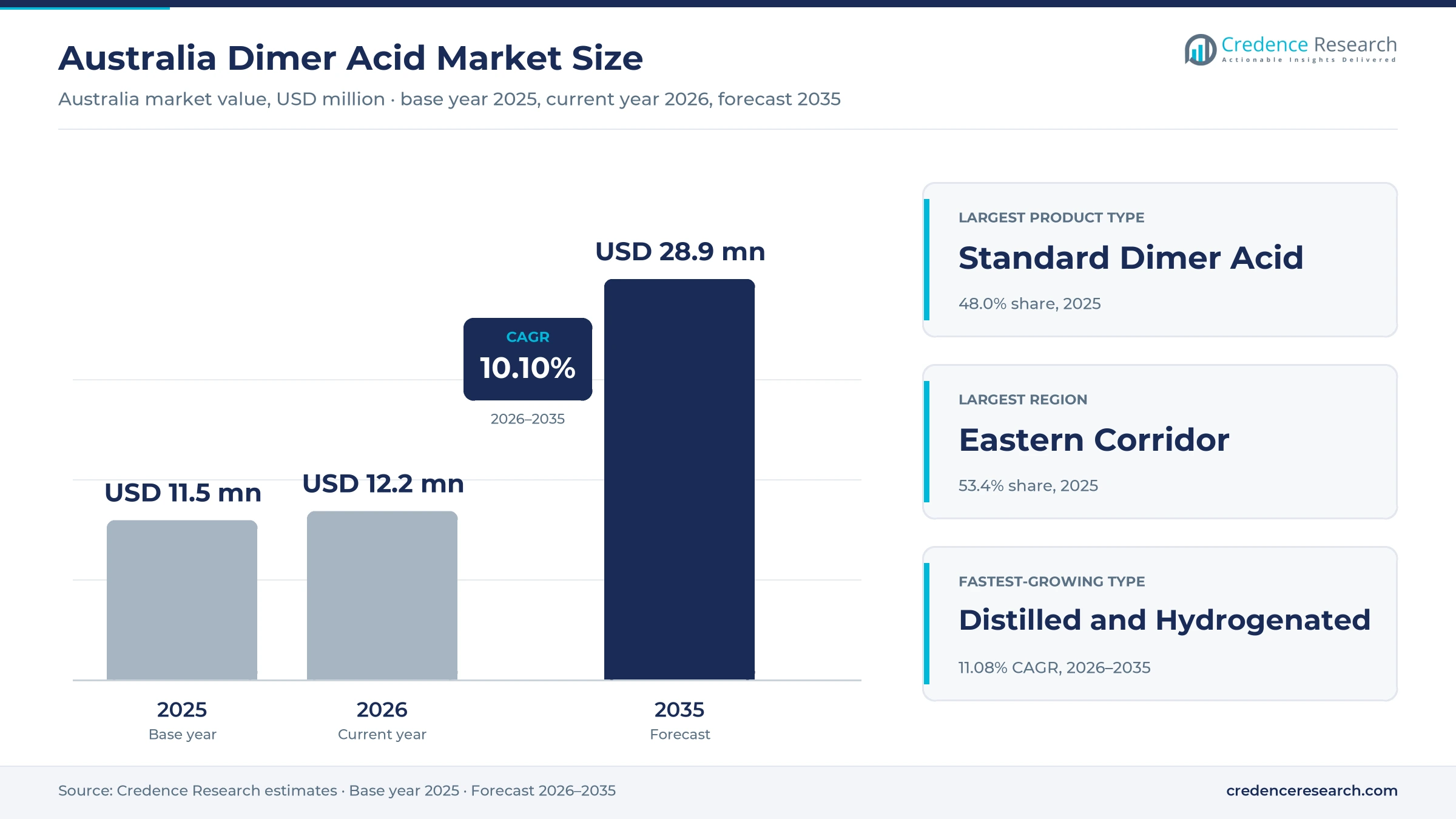
The Australia dimer acid market was valued at USD 11.5 million in 2025 and is projected to increase from USD 12.2 million in 2026 to USD 28.9 million by 2035, registering a CAGR of 10.10% during 2026–2035. Demand comes from polyamide resin makers, adhesive and ink formulators, coating producers, lubricant blenders and personal care ester makers that buy imported dimer grades through distributors or direct contracts. The Eastern manufacturing corridor held the largest regional share, 53.4% in 2025, because New South Wales and Queensland carry the largest share of resin, adhesive and coating formulation by Credence Research estimates. The Northern and western resource corridor is the fastest-growing region at 10.93% a year, as mining fleets and processing plants use more ester-based lubricants and corrosion inhibitors. At the same time, buyers increasingly ask suppliers to document vegetable or tall oil origin, which favors certified renewable grades and suppliers that hold stock locally.
Which dimer grades and uses does the estimate cover?
The estimate measures the value of dimer acid sold to Australian users, covering standard, distilled and distilled and hydrogenated grades made by joining two C18 unsaturated fatty acid molecules. It counts material used to make polyamide resins, coating binders, lubricant and functional fluid esters, and personal care esters, whether bought from local stock, on indent or directly from overseas producers.
The estimate excludes finished polyamide resins, dimer diols, trimer-rich byproduct streams, monomer acids and the formulated adhesives, inks or lubricants made from dimer acid. The value chain runs from tall oil, vegetable oil and animal fat fatty acids through overseas dimerization plants to Australian distributors, resin makers and formulators that ship drums, intermediate bulk containers or bulk loads to end users.
Australia Dimer Acid Market Insights
- The Australia dimer acid market was valued at USD 11.5 million in 2025 and is projected to reach USD 28.9 million by 2035, registering a CAGR of 10.10% during 2026–2035.
- The Eastern manufacturing corridor held a 53.4% share of 2025 value, because New South Wales and Queensland carry most resin, adhesive and coating formulation.
- Polyamide resin synthesis led applications with a 46.0% share of 2025 value, because hot melt adhesives, inks and epoxy hardeners depend on dimer-based resins.
- Australia's resource and energy export earnings are forecast at A$405 billion in 2025-26, which keeps mining fleets running hard and lifts demand for ester-based fluids.
- Distilled and hydrogenated dimer acid grows fastest at 11.08% a year during 2026–2035, as buyers seek low color and oxidation stability in fluids and cosmetics.
Standard grades lead as hydrogenated grades grow fastest
Why does standard dimer acid hold the largest share?
Based on product type, the market is categorized into standard dimer acid, distilled dimer acid and distilled and hydrogenated dimer acid. Standard dimer acid led with a 48.0% share of 2025 value, because general polyamide resins and corrosion inhibitors tolerate its higher trimer content at a lower price. Distilled and hydrogenated dimer acid grows fastest at 11.08% a year, as lubricant and cosmetic users pay for low color and oxidation stability.
How do polyamide resins and fluids split demand?
Based on application, the market is categorized into polyamide resin synthesis, coating binder synthesis, functional fluid synthesis and personal care ester synthesis. Polyamide resin synthesis led with a 46.0% share of 2025 value, because adhesives, inks and epoxy hardeners use the largest volumes. Functional fluid synthesis grows fastest at 10.91% a year, as mining and processing fleets use more ester-based lubricants and corrosion inhibitors.
Why do tall oil acids still dominate feedstock?
Based on feedstock, the market is categorized into tall-oil-derived fatty acids, vegetable-oil-derived fatty acids and animal-fat-derived fatty acids. Tall-oil-derived fatty acids led with a 52.0% share of 2025 value, because tall oil grades remain the lowest-cost route for general resins. Vegetable-oil-derived fatty acids grow fastest at 10.80% a year, as buyers ask for certified plant-based and traceable renewable origin.
How does local stockholding shape buying decisions?
Based on sales channel, the market is categorized into stocked specialty distribution, indent distribution and direct overseas procurement. Stocked specialty distribution led with a 50.0% share of 2025 value, because most formulators buy drums and intermediate bulk containers in small lots. Direct overseas procurement grows fastest at 10.62% a year, as larger resin and lubricant makers sign annual contracts with producers.
| Segment Group | Leading Sub-segment | Share, 2025 | Fastest-growing Sub-segment | CAGR, 2026–2035 |
|---|---|---|---|---|
| By Product Type | Standard dimer acid | 48.0% | Distilled and hydrogenated dimer acid | 11.08% |
| By Application | Polyamide resin synthesis | 46.0% | Functional fluid synthesis | 10.91% |
| By Feedstock | Tall-oil-derived fatty acids | 52.0% | Vegetable-oil-derived fatty acids | 10.80% |
| By Sales Channel | Stocked specialty distribution | 50.0% | Direct overseas procurement | 10.62% |
Request a Free Sample
Fill in your details and we'll send you a free sample report.
- Sample data tables & charts
- Research methodology
Polyamide specs, fluid performance and traceability
How do polyamide performance needs anchor dimer demand?
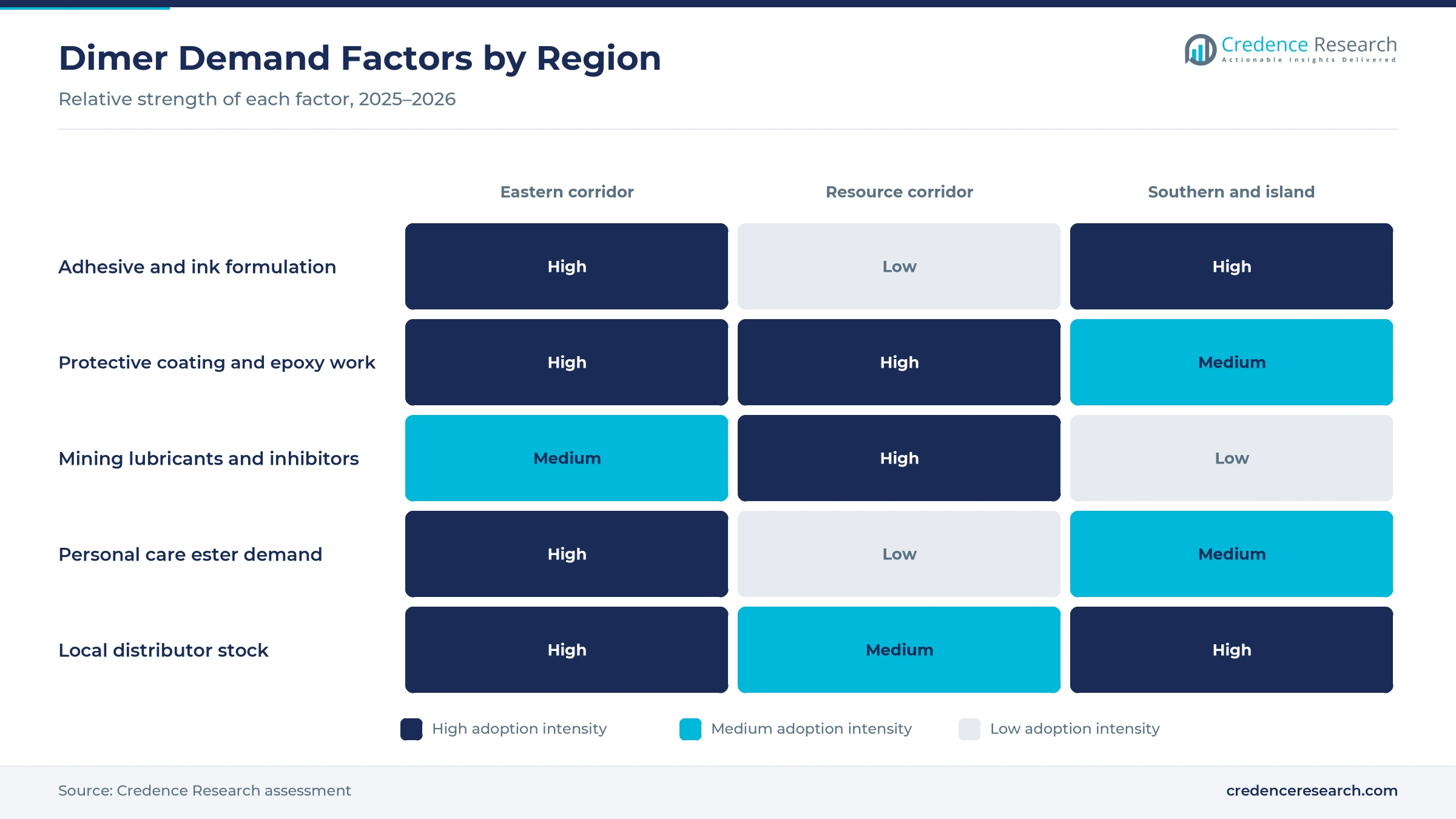
Polyamide resins made from dimer acid give hot melt adhesives, flexographic inks and epoxy hardeners flexibility, adhesion and water resistance, so Australian formulators keep specifying them. Cargill says its Pripol dimer acids improve polyesters, polyamides and epoxies through flexibility, water repellency and low moisture absorption. The same company describes Pripol 1013 as a distilled dimer acid with high difunctionality that enables high molecular weight polyamides. KLK OLEO lists its PLANTERA DM-95 grade, with more than 95% dimer content, for polyamide resin modification. Redox lists polyamide resin with CAS number 68082-29-1 in its surface coating product guide for Australian formulators. As a result, polyamide resin synthesis holds 46.0% of 2025 value, which ties this market closely to imported polyamide resins and the adhesives they feed.
Why do mining fleets lift functional fluid demand?
Functional fluids such as lubricant esters and corrosion inhibitors use dimer acid because its branched structure resists hydrolysis and oxidation under heavy loads. Australia's resource and energy export earnings are forecast at A$405 billion in 2025-26 and A$416 billion in 2026-27, according to a ministerial release citing the June 2026 Resources and Energy Quarterly. Oleon says its hydrogenated RADIACID 0960 grade is used to make lubricant esters, citing hydrolysis and thermo-oxidation resistance. SpecialChem lists Wilmar's BIODA dimer acid grades as corrosion inhibitors and lubricants. Haul trucks, processing plants and pipelines therefore help functional fluid synthesis grow at 10.91% a year, with the largest gains in Western Australia and the Northern Territory.
How do traceability rules favor renewable dimer grades?
Large Australian buyers now document where raw materials come from, which favors suppliers that can trace dimer acid to certified plant or tall oil feedstock. The Modern Slavery Statements Register shows 17,689 mandatory statements lodged, covering an indicative 29,456 entities under the Commonwealth Modern Slavery Act 2018. ASIC says entities that meet the thresholds in section 292A of the Corporations Act must prepare a sustainability report with climate disclosures under AASB S2. Oleon describes its RADIACID 0960 grade as 100% vegetable based with Non-GMO certification. Cargill describes Pripol as enabling bio-based formulations measured under ASTM D6866. As a result, vegetable-oil-derived fatty acids grow fastest among feedstocks at 10.80% a year.
Why does local stockholding matter under chemical rules?
Every business that imports an industrial chemical into Australia must register with the national regulator, which pushes small formulators to buy from registered local distributors. Registration with the Australian Industrial Chemicals Introduction Scheme under the Industrial Chemicals Act 2019 expires on Aug. 31 each year, according to the Australian Business Licence and Information Service. AICIS took over from NICNAS as the national regulator on July 1, 2020, CosmeticsDesign-Asia reported. Redox, operating since 1965 and listed on the ASX on July 3, 2023, says it has 11 regional sales offices in four countries and more than 50 storage locations. This compliance and logistics burden explains why stocked specialty distribution holds 50.0% of 2025 value.
Purer grades, plant feedstocks and coating hardeners
How is the shift to hydrogenated grades changing supply?
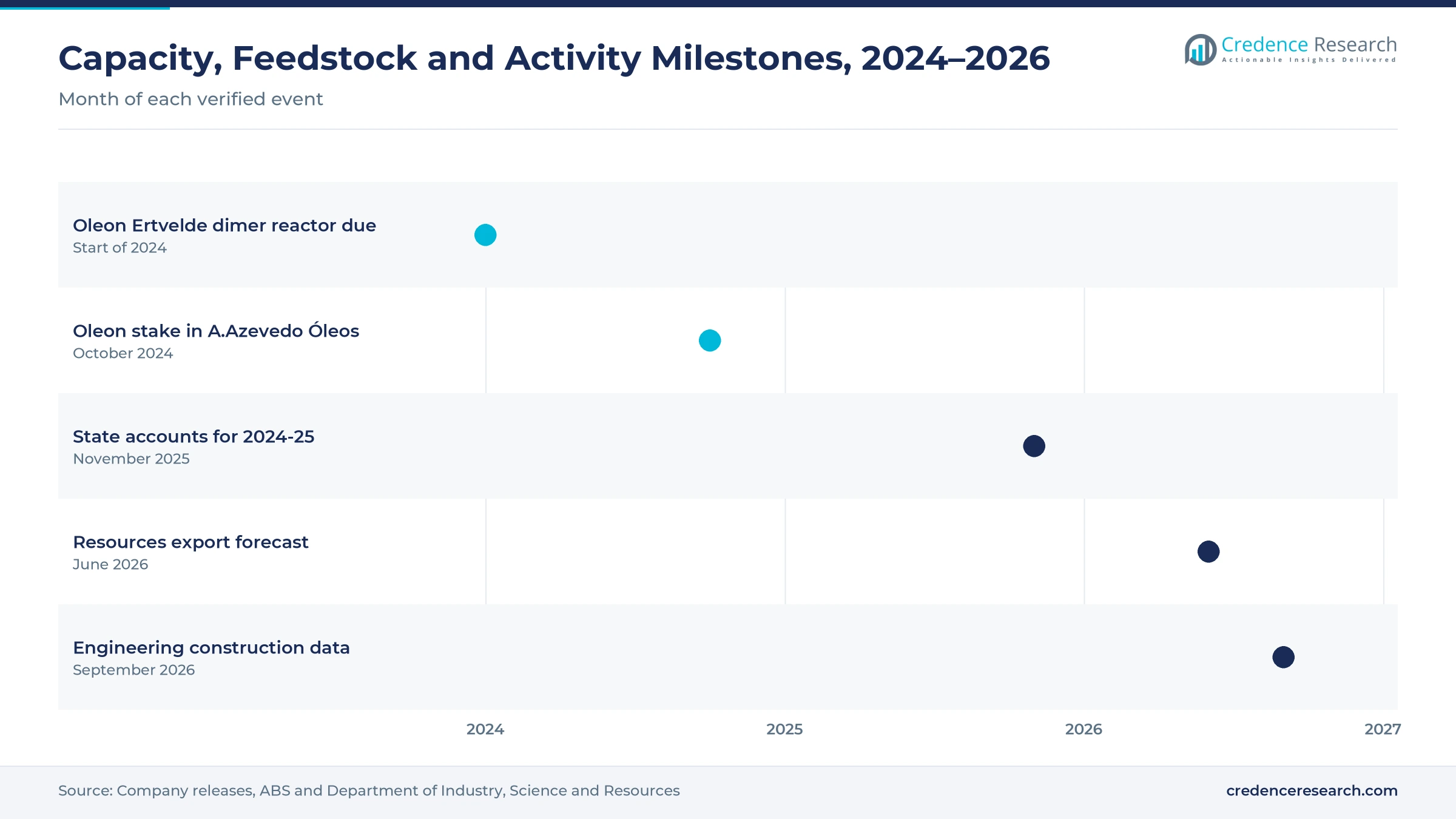
Producers are adding capacity for purer and color-stable dimer grades that suit lubricants, cosmetics and clear coatings. Oleon planned to double its isostearic acid and dimer unit at Ertvelde in Belgium to 14,125 metric tons a year, with a new reactor due at the start of 2024, Lubes'n'Greases reported. Oleon lists RADIACID 0960 with an iodine value of about 11, which signals a largely saturated, oxidation-resistant acid. Cargill describes Pripol 1009 as a very high purity dimer with thermo-oxidative stability and hydrolysis resistance. KLK OLEO sells a PLANTERA DM-98 grade with more than 98% dimer content. Together, these grades help distilled and hydrogenated dimer acid grow at 11.08% a year in Australia.
Why is the rise of plant-based feedstock gaining ground?
Producers are widening plant-based routes to dimer acid as buyers compare tall oil and vegetable origin. KLK OLEO describes its PLANTERA dimer grades as vegetable, renewable and bio-based, and it runs oleochemical complexes in Malaysia, Indonesia, China and Europe. Oleon announced on Oct. 1, 2024 that it acquired a majority stake in A.Azevedo Óleos, a Brazilian castor oil derivatives maker with about 250 employees. Oleon now lists seven production sites across Belgium, Germany, France, the United Kingdom, the United States and Malaysia. Tall-oil-derived fatty acids still hold 52.0% of 2025 value, because crude tall oil remains the cheapest route for general resin grades.
Can infrastructure coatings open more epoxy hardener work?
Polyamide hardeners made from dimer acid cure epoxy primers and linings that protect steel, concrete and pipework on mines, ports and utilities. The value of engineering construction work done reached A$36,462.8 million in the June quarter of 2026 in trend terms, the Australian Bureau of Statistics reported. Private sector work rose 5.5% from a year earlier, while public sector work fell 5.3%. Redox lists amine curatives such as isophorone diamine and diethylenetriamine beside polyamide resin in its coatings guide. Protective industrial coatings therefore give coating binder synthesis a steady base, especially for private mine, port and energy projects.
Is there an opening in personal care ester synthesis?
Hydrogenated dimer acid is used to make emollient esters for hair and skin care, which gives local brand owners a renewable ingredient with low odor and color. Oleon lists RADIACID 0960 for hair care and skin care under the INCI name hydrogenated dimer dilinoleic acid. Since July 1, 2020, new cosmetic ingredients made in or imported into Australia cannot rely on animal test data to prove safety, CosmeticsDesign-Asia reported. Redox lists personal care among the 15 market categories it serves. Brand owners that source from the wider oleochemicals chain can therefore use plant-based dimer esters in moisturizers, hair conditioners and color cosmetics.
Thin manufacturing, long lead times and project swings
How does a thin manufacturing base cap volumes?
Dimer acid demand depends on local resin, adhesive and coating plants, and that base is small. Manufacturing value added equaled about 5.3% of Australian GDP in 2025, according to World Bank data. The Australian Bureau of Statistics said mining and manufacturing were the largest detractors from national growth of 1.4% in 2024-25. As a result, formulators buy in small lots, and suppliers rely on specialty grades and fluids to add volume.
Why do overseas supply chains stretch lead times?
Leading producers run their dimerization lines in Europe and Asia, including Oleon's Ertvelde site in Belgium and KLK OLEO complexes in Malaysia and Indonesia. In turn, Australian buyers face long shipping times, currency swings and minimum order sizes for indent cargoes. Small formulators therefore pay a premium for local stock, while larger buyers hold safety stock or sign annual call-off agreements to protect production schedules.
How do construction swings disrupt project supply?
Epoxy hardeners and protective coatings follow project cycles, so changes in public works quickly alter project supply agreements. The Australian Bureau of Statistics reported that seasonally adjusted public sector engineering work fell 0.8% in the June quarter of 2026 to A$15,799.5 million. As a result, coating makers can delay orders when state programs slow. Suppliers that also serve adhesives and lubricants spread that risk across more customers.
Why does limited shelf life complicate small orders?
Dimer acid is sold in drums and intermediate bulk containers that small users may hold for months, which raises the risk of out-of-date stock. SpecialChem lists Wilmar's BIODA grades with a shelf life of one year from production. In turn, distributors must rotate inventory carefully across a large country with long freight routes. Buyers respond with spot purchase orders sized to near-term production, which raises handling costs per kilogram.
Eastern corridor leads as the resource corridor grows
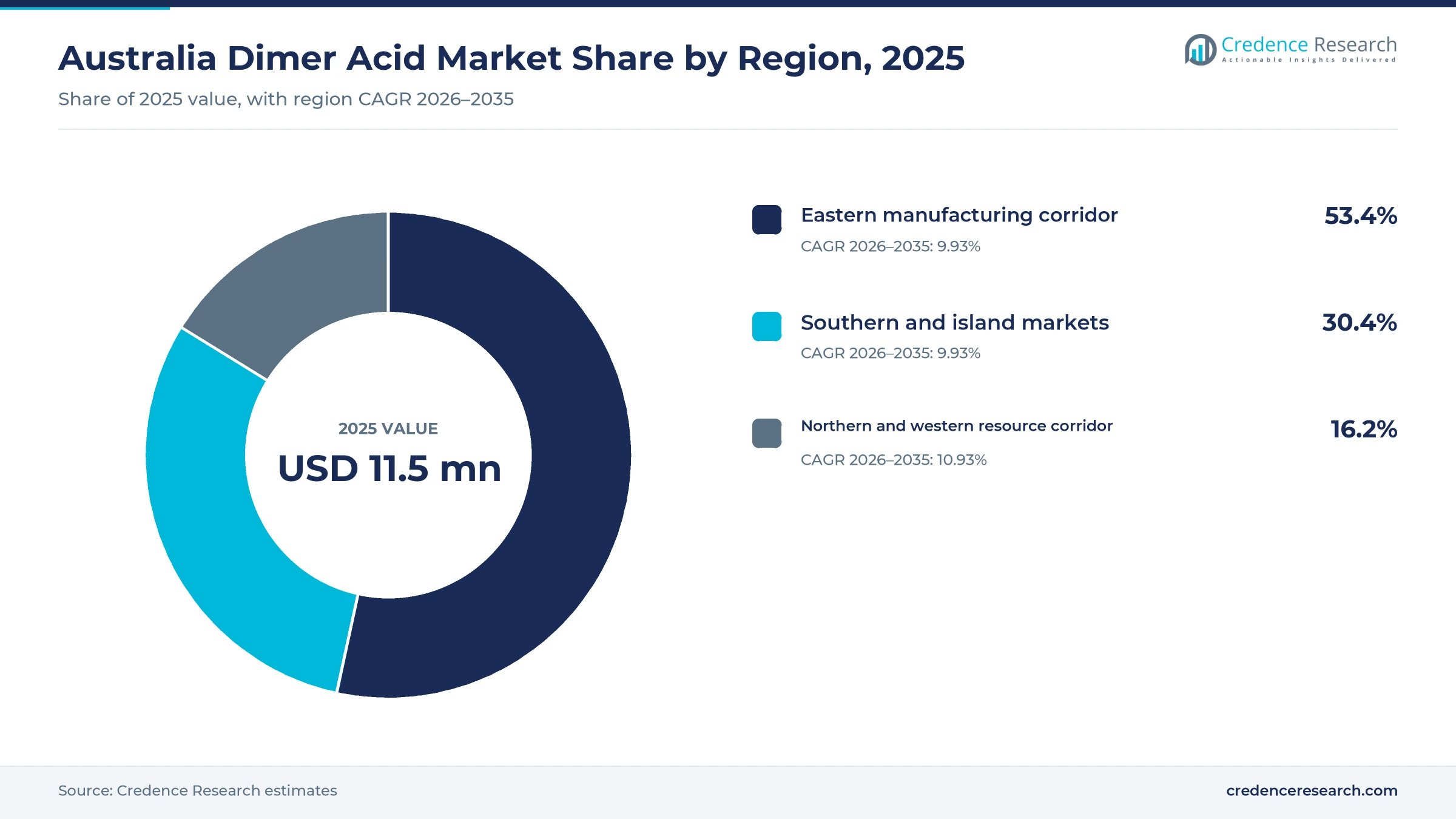
| Region | Value, 2025 (USD million) | Share, 2025 | CAGR, 2026–2035 |
|---|---|---|---|
| Eastern manufacturing corridor | 6.1 | 53.4% | 9.93% |
| Southern and island markets | 3.5 | 30.4% | 9.93% |
| Northern and western resource corridor | 1.9 | 16.2% | 10.93% |
Eastern manufacturing corridor leads on formulation
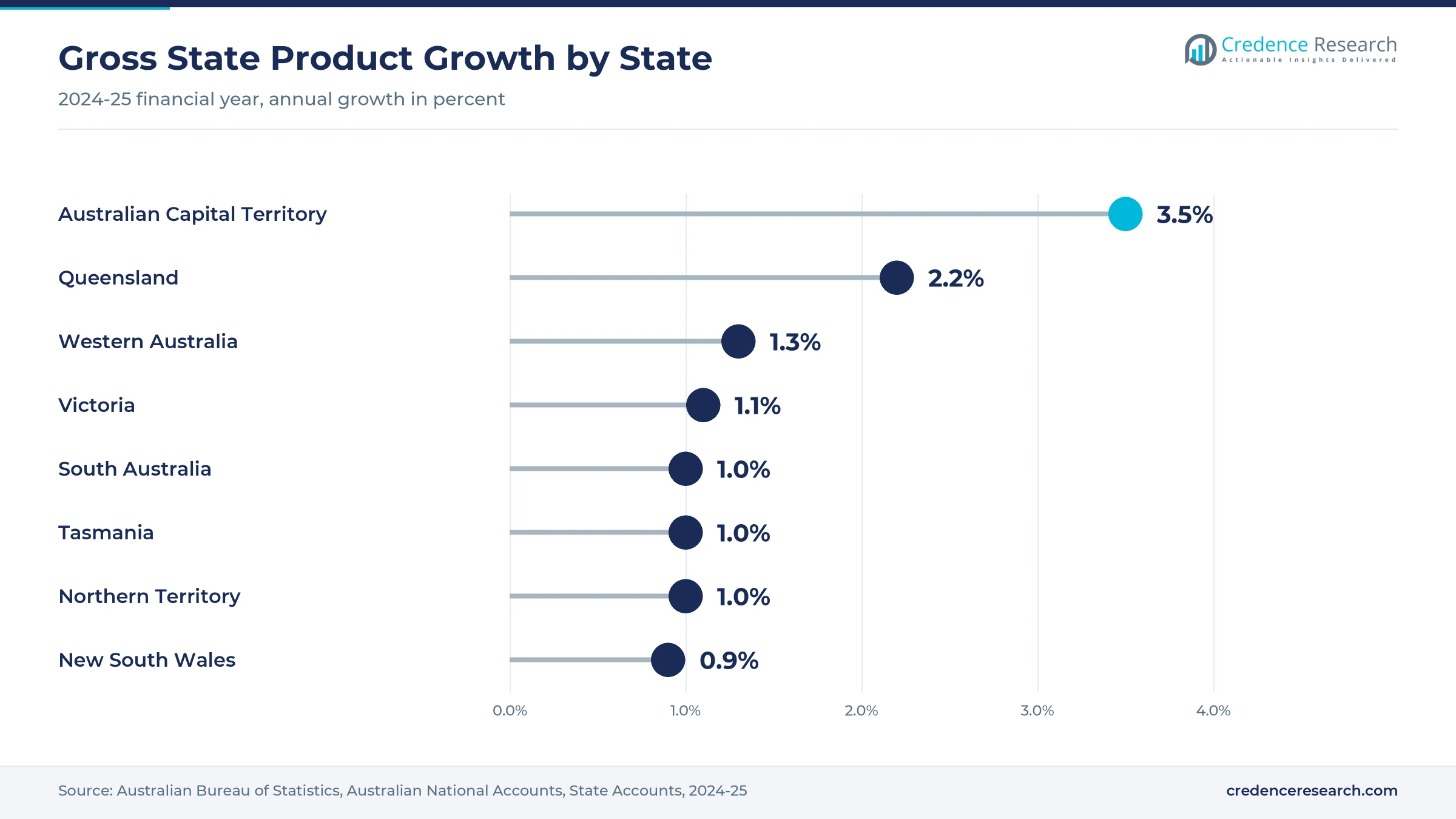
The Eastern manufacturing corridor held a 53.4% share of 2025 value and grows at 9.93% a year, because New South Wales and Queensland carry most adhesive, ink and coating formulation by Credence Research estimates. Queensland's gross state product rose 2.2% in 2024-25, ahead of 0.9% in New South Wales, the Australian Bureau of Statistics reported. Redox runs its head office at Minto and a manufacturing division at Girraween in Sydney. The corridor should keep the largest share of polyamide resin demand to 2035.
Why is the resource corridor the fastest-growing region?
The Northern and western resource corridor held a 16.2% share of 2025 value and grows fastest at 10.93% a year, because mines, processing plants and pipelines consume lubricant esters and corrosion inhibitors. Western Australia's gross state product rose 1.3% in 2024-25, while the Northern Territory grew 1.0%. As a result, functional fluid grades take a larger share of regional spending.
Southern and island markets grow on adhesives and coatings
Southern and island markets held a 30.4% share of 2025 value and grow at 9.93% a year, because Victoria adds a large adhesive and coating customer base by Credence Research estimates. Victoria's gross state product rose 1.1% in 2024-25, while South Australia and Tasmania each grew 1.0%, according to official state accounts. Redox runs a manufacturing division at Laverton North in Melbourne and an office in Adelaide. In turn, polyamide resins and coating binders take most of the zone's spending.
Capacity, feedstock deals and Australian activity data
| Development | Status and market relevance |
|---|---|
| In January 2023, Oleon announced plans to double its dimer and isostearic acid unit at Ertvelde, Belgium. | Lifts capacity to 14,125 metric tons a year for premium grades sold into Asia Pacific |
| In October 2024, Oleon acquired a majority stake in Brazilian castor oil processor A.Azevedo Óleos. | Widens plant-based feedstock options for specialty fatty acids |
| In November 2025, official state accounts showed Australian output grew 1.4% in 2024-25. | Confirms manufacturing and mining weakness that caps resin volumes |
| In June 2026, the Resources and Energy Quarterly forecast A$405 billion in 2025-26 export earnings. | Supports sustained use of lubricant esters and corrosion inhibitors |
| In September 2026, official data showed private engineering work up 5.5% on a year earlier. | Points to steady protective coating and epoxy hardener demand |
Distillation, hydrogenation and polyamide condensation
- Molecular distillation separates monomer and trimer fractions, which lifts dimer content above 95% for high molecular weight polyamides.
- Hydrogenation saturates the remaining double bonds, which lowers the iodine value to about 11 and improves color and oxidation stability.
- Polyamide condensation reacts dimer acid with amines into resins, which give hot melt adhesives, inks and epoxy hardeners flexibility and adhesion.
- Esterification joins dimer acid with alcohols into lubricant and emollient esters, which resist hydrolysis in fluids and cosmetics.
Need a Custom Version of This Report?
Tailor the scope, geography, or segments to your exact requirements.
- Custom geography or segment scope
- Direct access to our analyst team
Distributors and overseas producers share the supply
Competition in Australia splits between specialty distributors that hold local stock and global producers that sell through distributors or annual contracts. Redox, a family-founded distributor operating since 1965 and listed on the ASX on July 3, 2023, handles more than 1,000 specialty and commodity products. It serves 15 market categories, including mining, oil and gas, building and personal care, from offices across the mainland states. Cargill became a major dimer supplier when it completed its acquisition of most of Croda's performance technologies and industrial chemicals business on June 30, 2022, and it now sells the Pripol dimer acid range. Wilmar International offers BIODA dimer acid grades for corrosion inhibitors and lubricants, and its Australian presence includes Wilmar Sugar, which runs eight sugar mills in North and Central Queensland. Suppliers win business through local stock, technical support, traceable feedstock and reliable drum and bulk delivery.
Which distributors and producers serve Australian buyers?
| Company | Type | Role in the market |
|---|---|---|
| Redox Limited | Specialty distributor | Supplies polyamide resin, amines and fatty acids to Australian formulators from local stock |
| Cargill | Dimer producer | Sells Pripol dimer acids globally and runs a local bioindustrial unit in Australia |
| Wilmar International | Oleochemical producer | Offers BIODA dimer acid grades and operates Australian sugar assets |
Credence Research view on Australian dimer buying
Credence Research's view is that Australian dimer acid demand will grow steadily from a small base, because polyamide adhesives, protective coatings and resource-sector fluids all need flexible, water-resistant chemistry. Standard grades stay the largest product type, while distilled and hydrogenated grades grow fastest as lubricant and cosmetic users seek low color and oxidation stability. The resource corridor adds demand fastest, as mines and processing plants buy more ester fluids. Suppliers that pair local stock with traceable plant-based or tall oil origin and consistent technical support should win the most annual call-off agreements by 2035.
Official activity data and supplier pages shape the estimate
The report uses 2025 as the base year on a calendar basis, and market values come from the Credence Research model. That model combines official state accounts, engineering construction statistics, resource export forecasts, World Bank indicators, regulator guidance and company product information. Segment splits, the mapping of states to the client's regional zones and regional growth rates are Credence Research estimates. Sources used are government and regulator pages, statistical releases, company websites and trade media, and no interviews or surveys were used.
Specialty grades and resource fluids carry growth to 2035
The Australia dimer acid market is expected to reach USD 28.9 million by 2035, a 10.10% CAGR during 2026–2035, as polyamide resin makers, coating producers and lubricant blenders lift purchases of specialty grades. Growth should be strongest in distilled and hydrogenated grades, functional fluids and the resource corridor, because mines and processing plants need oxidation-stable esters and corrosion inhibitors. A thin manufacturing base, long overseas lead times and swings in public works could slow some orders, while traceable plant-based grades should support higher value per metric ton.
Frequently Asked Questions
How big is the Australia dimer acid market?
Which product type leads dimer acid demand?
Which application uses the most dimer acid?
Which region leads the market?
How does the resource sector support demand?
Why are renewable and traceable grades gaining share?
Who are the leading companies in the market?
What are the main challenges for suppliers?
Table of Content
Chapter 1 Market Segmentation
- 1.1 Segmentation Framework
- 1.1.1 Product and Service Classification
- 1.1.2 Application and End-Use Classification
- 1.1.3 Technology and Solution Classification
- 1.1.4 Customer and Distribution Channel Classification
- 1.1.5 Geographic Segmentation
- 1.1.6 Market Segment Definitions and Boundaries
- 1.2 By Product Type
- 1.2.1 Standard dimer acid
- 1.2.2 Distilled dimer acid
- 1.2.3 Distilled and hydrogenated dimer acid
- 1.3 By Application
- 1.3.1 Polyamide resin synthesis
- 1.3.2 Coating binder synthesis
- 1.3.3 Functional fluid synthesis
- 1.3.4 Personal care ester synthesis
- 1.4 By Feedstock
- 1.4.1 Tall-oil-derived fatty acids
- 1.4.2 Vegetable-oil-derived fatty acids
- 1.4.3 Animal-fat-derived fatty acids
- 1.5 By Sales Channel
- 1.5.1 Stocked specialty distribution
- 1.5.2 Indent distribution
- 1.5.3 Direct overseas procurement
Chapter 2 Introduction
- 2.1 Report Objectives and Scope
- 2.2 Product Definition and Industry Terminology
- 2.3 Market Inclusions and Exclusions
- 2.4 Research Process
- 2.4.1 Primary Research and Expert Interviews
- 2.4.2 Secondary Research and Source Review
- 2.4.3 Top-Down and Bottom-Up Estimation
- 2.4.4 Data Triangulation and Verification
- 2.5 Market Size Measurement Basis
- 2.5.1 2025: USD 11.5 million → 2035: USD 28.9 million
- 2.6 Historical and Forecast Reference Periods
- 2.6.1 Historical Period: 2018-2025
- 2.6.2 Base Year: 2025
- 2.6.3 Forecast Period: 2025-2035
- 2.7 Research Assumptions and Limitations
Chapter 3 Executive Summary
- 3.1 Market Snapshot and Key Findings
- 3.2 Base-Year Market Size, 2025
- 3.3 Forecast Market Size, 2035
- 3.4 Revenue and Volume Growth Outlook
- 3.5 Key Demand and Supply Indicators
- 3.6 Leading Market Segments
- 3.7 Fastest-Growing Market Opportunities
- 3.8 Regional Performance Highlights
- 3.9 Technology and Industry Transformation
- 3.10 Competitive Landscape Summary
- 3.11 Analyst View and Strategic Implications
Chapter 4 Australia Dimer Acid Market Trends and Developments
- 4.1 Historical Industry Development, 2018-2025
- 4.2 Recent Market Trends and Developments
- 4.3 Demand and Customer Behavior Trends
- 4.4 Technology and Product Innovation
- 4.5 Artificial Intelligence, Automation and Digitalization
- 4.6 Local Manufacturing and Supply Chain Realignment
- 4.7 Industry Partnerships, Mergers and Acquisitions
- 4.8 Sustainability and Circular Economy Developments
- 4.9 Government and Private Sector Investment Trends
- 4.10 Emerging Business Models and Commercialization
- 4.11 Industry Developments and Announcements
Chapter 5 Australia Dimer Acid Market Production, Supply and Demand Analysis
- 5.1 Demand Trend and Consumption Analysis, 2018-2025
- 5.2 Demand Forecast, 2025-2035
- 5.3 Production and Output Trend, 2018-2025
- 5.4 Production and Output Forecast, 2025-2035
- 5.5 Installed Capacity and Capacity Utilization
- 5.6 Company-Wise Production Plants and Statistics
- 5.6.1 Installed Production Capacity
- 5.6.2 Actual Production
- 5.6.3 Planned Capacity and Expansion Targets
- 5.7 Supply Chain Structure and Procurement Trends
- 5.8 Supply-Demand Gap and Bottlenecks
- 5.9 Import Dependence and Sourcing Structure
- 5.10 Contract Manufacturing and Outsourcing
- 5.11 Regional Supply and Demand Concentration
Chapter 6 Australia Dimer Acid Market Pricing Analysis
- 6.1 Pricing Structure and Measurement
- 6.2 Historical Pricing Trends, 2018-2025
- 6.3 Pricing Outlook, 2025-2035
- 6.4 Average Selling Price and Unit Economics
- 6.5 Pricing by Product and Market Segment
- 6.6 Geographic Pricing Differences
- 6.7 Key Input, Energy, Labor and Logistics Costs
- 6.8 Contract Pricing and Purchasing Models
- 6.9 Pricing Sensitivity and Competitive Positioning
- 6.10 Price, Margin and Profitability Implications
Chapter 7 Australia Dimer Acid Market Dynamics
- 7.1 Market Growth Drivers
- 7.1.1 Demand-Side Drivers
- 7.1.2 Technology and Innovation Drivers
- 7.1.3 Infrastructure and Investment Drivers
- 7.1.4 Regulatory and Policy Drivers
- 7.2 Market Restraints
- 7.2.1 Cost and Affordability Constraints
- 7.2.2 Technology and Adoption Barriers
- 7.2.3 Supply Chain and Operational Constraints
- 7.3 Market Challenges
- 7.3.1 Competitive Pressure and Margin Erosion
- 7.3.2 Skills, Infrastructure and Implementation Gaps
- 7.4 Emerging Market Opportunities
- 7.5 Market Dynamics Impact and Time-Horizon Assessment
Chapter 8 Australia Dimer Acid Value Chain Analysis
- 8.1 Industry Value Chain Overview
- 8.2 Upstream Suppliers and Critical Inputs
- 8.3 Technology and Component Providers
- 8.4 Manufacturing or Service Delivery
- 8.5 Distribution, Channel Partners and Integrators
- 8.6 Downstream Applications and End Users
- 8.7 Value Addition and Profit Pools
- 8.8 Vertical Integration and Outsourcing
- 8.9 Supplier Concentration and Risk
- 8.10 Supply Chain Localization and Resilience
Chapter 9 Australia Dimer Acid Market Regulations and Policies
- 9.1 Relevant Laws, Standards and Compliance Frameworks
- 9.2 Product, Service, Safety and Quality Requirements
- 9.3 Government Policies, Incentives and Subsidies
- 9.4 Imports, Exports and Trade Barriers
- 9.5 Public Procurement and Local Content Requirements
- 9.6 Environmental and Sustainability Compliance
- 9.7 Upcoming Policy Changes and Market Implications
Chapter 10 Australia Dimer Acid Market Hotspots and Opportunities
- 10.1 Market Opportunity Mapping and Growth Hotspots
- 10.2 High-Growth Applications and Customer Groups
- 10.3 Underserved Markets and White-Space Opportunities
- 10.4 Emerging Technology and Product Opportunities
- 10.5 New Capacity and Investment Hotspots
- 10.6 Market Entry and Expansion Opportunities
- 10.7 Distribution and Partnership Opportunities
- 10.8 Near-Term and Long-Term Commercial Potential
- 10.9 Opportunity Attractiveness and Execution Risks
Chapter 11 Australia Dimer Acid Market Outlook, 2025-2035
- 11.1 Market Size and Analysis
- 11.1.1 Revenue (Market Measurement: 2025: USD 11.5 million → 2035: USD 28.9 million)
- 11.1.2 Market Volume and Quantity Sold
- 11.1.3 Historical Market Size, 2018-2025
- 11.1.4 Base-Year Market Size, 2025
- 11.2 Market Forecast, 2025-2035
- 11.2.1 Revenue Forecast to 2035
- 11.2.2 Volume Forecast to 2035
- 11.2.3 CAGR and Year-on-Year Growth
- 11.2.4 Incremental Revenue Opportunity
- 11.3 Forecast Assumptions and Scenario Analysis
- 11.3.1 Base-Case Forecast
- 11.3.2 Optimistic and Conservative Scenarios
- 11.3.3 Technology, Pricing and Policy Sensitivities
- 11.4 Market Attractiveness and Growth Outlook
Chapter 12 Australia Dimer Acid Market Segmentation and Outlook
- 12.1 Segmentation Summary and Market Shares, 2025
- 12.2 Largest and Fastest-Growing Segments
- 12.3 By Product Type - Market Size and Forecast, 2025-2035
- 12.3.1 Segment Definition and Scope
- 12.3.2 Historical Market Size, 2018-2025
- 12.3.3 Revenue Forecast, 2025-2035
- 12.3.4 Volume Forecast, 2025-2035
- 12.3.5 Base-Year Market Share, 2025
- 12.3.6 Segment CAGR and Growth Drivers
- 12.3.7 Subsegment Market Size and Forecast
- 12.3.7.1 Standard dimer acid
- 12.3.7.2 Distilled dimer acid
- 12.3.7.3 Distilled and hydrogenated dimer acid
- 12.3.8 Subsegment Pricing and Adoption Trends
- 12.3.9 Leading Suppliers and Competition
- 12.3.10 Regional Demand and Opportunities
- 12.4 By Application - Market Size and Forecast, 2025-2035
- 12.4.1 Segment Definition and Scope
- 12.4.2 Historical Market Size, 2018-2025
- 12.4.3 Revenue Forecast, 2025-2035
- 12.4.4 Volume Forecast, 2025-2035
- 12.4.5 Base-Year Market Share, 2025
- 12.4.6 Segment CAGR and Growth Drivers
- 12.4.7 Subsegment Market Size and Forecast
- 12.4.7.1 Polyamide resin synthesis
- 12.4.7.2 Coating binder synthesis
- 12.4.7.3 Functional fluid synthesis
- 12.4.7.4 Personal care ester synthesis
- 12.4.8 Subsegment Pricing and Adoption Trends
- 12.4.9 Leading Suppliers and Competition
- 12.4.10 Regional Demand and Opportunities
- 12.5 By Feedstock - Market Size and Forecast, 2025-2035
- 12.5.1 Segment Definition and Scope
- 12.5.2 Historical Market Size, 2018-2025
- 12.5.3 Revenue Forecast, 2025-2035
- 12.5.4 Volume Forecast, 2025-2035
- 12.5.5 Base-Year Market Share, 2025
- 12.5.6 Segment CAGR and Growth Drivers
- 12.5.7 Subsegment Market Size and Forecast
- 12.5.7.1 Tall-oil-derived fatty acids
- 12.5.7.2 Vegetable-oil-derived fatty acids
- 12.5.7.3 Animal-fat-derived fatty acids
- 12.5.8 Subsegment Pricing and Adoption Trends
- 12.5.9 Leading Suppliers and Competition
- 12.5.10 Regional Demand and Opportunities
- 12.6 By Sales Channel - Market Size and Forecast, 2025-2035
- 12.6.1 Segment Definition and Scope
- 12.6.2 Historical Market Size, 2018-2025
- 12.6.3 Revenue Forecast, 2025-2035
- 12.6.4 Volume Forecast, 2025-2035
- 12.6.5 Base-Year Market Share, 2025
- 12.6.6 Segment CAGR and Growth Drivers
- 12.6.7 Subsegment Market Size and Forecast
- 12.6.7.1 Stocked specialty distribution
- 12.6.7.2 Indent distribution
- 12.6.7.3 Direct overseas procurement
- 12.6.8 Subsegment Pricing and Adoption Trends
- 12.6.9 Leading Suppliers and Competition
- 12.6.10 Regional Demand and Opportunities
- 12.7 Segment Growth Comparison
- 12.8 Segment Attractiveness and Priority Matrix
Chapter 13 Australia Dimer Acid End-Use and Application Market Outlook
- 13.1 End-Use Industry and Customer Demand Structure
- 13.2 Leading Applications and Customer Groups
- 13.3 End-Use Market Size, Share and Forecast
- 13.4 Major End-Use Industry Deep Dives
- 13.4.1 Customer Requirements and Use Cases
- 13.4.2 Demand and Replacement Cycles
- 13.4.3 Technical and Regulatory Considerations
- 13.4.4 Purchasing and Procurement Models
- 13.4.5 Leading Vendors and Distribution Channels
- 13.4.6 Forecast and Commercial Opportunities
- 13.5 Emerging Applications and Cross-Segment Demand
- 13.6 End-Use Industry Investment Priorities
Chapter 14 Australia Dimer Acid Geographic Market Outlook, 2025-2035
- 14.1 Domestic Market Distribution and Demand Clusters
- 14.2 State- or Province-Wise Market Size and Forecast, 2025-2035
- 14.3 City and Metropolitan Market Outlook
- 14.4 Industrial, Manufacturing and Commercial Clusters
- 14.5 Geographic Concentration of Key End Users
- 14.6 Local Pricing and Purchasing Differences
- 14.7 Domestic Production Facilities and Capacity Map
- 14.8 Local Infrastructure and Project Pipeline
- 14.9 State-Level Policy and Incentive Differences
- 14.10 Subnational Investment Hotspots and Opportunities
- 14.11 Distribution and Logistics Networks
- 14.12 Domestic Competitive Footprint
Chapter 15 Australia Dimer Acid Technology, Innovation and Sustainability Outlook
- 15.1 Technology Landscape and Maturity
- 15.2 Product, Process and Service Innovation
- 15.3 AI, Automation and Digital Tools in the Industry
- 15.4 Technology Adoption and Performance Benchmarking
- 15.5 Innovation Pipeline and R&D Investment
- 15.6 Patent and Intellectual Property Trends
- 15.7 Energy Efficiency and Resource Management
- 15.8 Sustainability, Recycling and Circularity
- 15.9 Technology Roadmap, 2025-2035
- 15.10 Risks of Obsolescence and Technology Substitution
Chapter 16 Australia Dimer Acid Market Key Strategic Imperatives
- 16.1 Growth and Market Entry Priorities
- 16.2 High-Return Products and Segments
- 16.3 Pricing, Profitability and Cost Optimization
- 16.4 Technology Investment and Product Differentiation
- 16.5 Supply Chain Localization and Resilience
- 16.6 Distribution and Customer Acquisition
- 16.7 Partnership, Acquisition and Capacity Strategy
- 16.8 Regional Expansion Priorities
- 16.9 Short-, Medium- and Long-Term Actions
Chapter 17 Competition Outlook
- 17.1 Industry Competition Characteristics
- 17.2 Market Structure and Concentration
- 17.3 Market Share and Competitive Positioning, 2025
- 17.4 Company-Wise Revenue and Product Benchmarking
- 17.5 Production and Service Capacity Benchmarking
- 17.6 Technology, Pricing and Differentiation
- 17.7 Regional Footprint and Distribution Strength
- 17.8 Mergers, Acquisitions and Strategic Alliances
- 17.9 New Entrants and Competitive Threats
- 17.10 Porter's Five Forces and Industry Attractiveness
- 17.11 Competitive Outlook, 2025-2035
Chapter 18 Company Profiles
- 18.1 Company Coverage and Selection Criteria
- 18.2 Redox Limited
- 18.2.1 Business Description
- 18.2.2 Company Ownership and Geographic Presence
- 18.2.3 Product and Service Portfolio
- 18.2.4 Manufacturing and Operating Footprint
- 18.2.5 Production Capacity and Expansion Plans
- 18.2.6 Financial Performance and Investment
- 18.2.7 Market Share and Competitive Position
- 18.2.8 Technology and Innovation Capabilities
- 18.2.9 Strategic Alliances or Partnerships
- 18.2.10 Recent Developments
- 18.2.11 Growth Strategy and Outlook
- 18.3 Cargill
- 18.4 Oleon
- 18.5 KLK OLEO
- 18.6 Wilmar International
- 18.7 Other Relevant Market Participants
Note: Every listed company is profiled on the structure shown under the first company. The company list is preliminary and may change based on research findings, market developments, data availability and client requirements.
Chapter 19 Disclaimer
- 19.1 Research and Forecast Disclaimer
- 19.2 Data Source and Estimation Limitations
Note: The depth of individual sections depends on data availability for this market. Volume, capacity, trade and other unit-based metrics are included where applicable.

