
Direct to Consumer Laboratory Testing Market Overview:
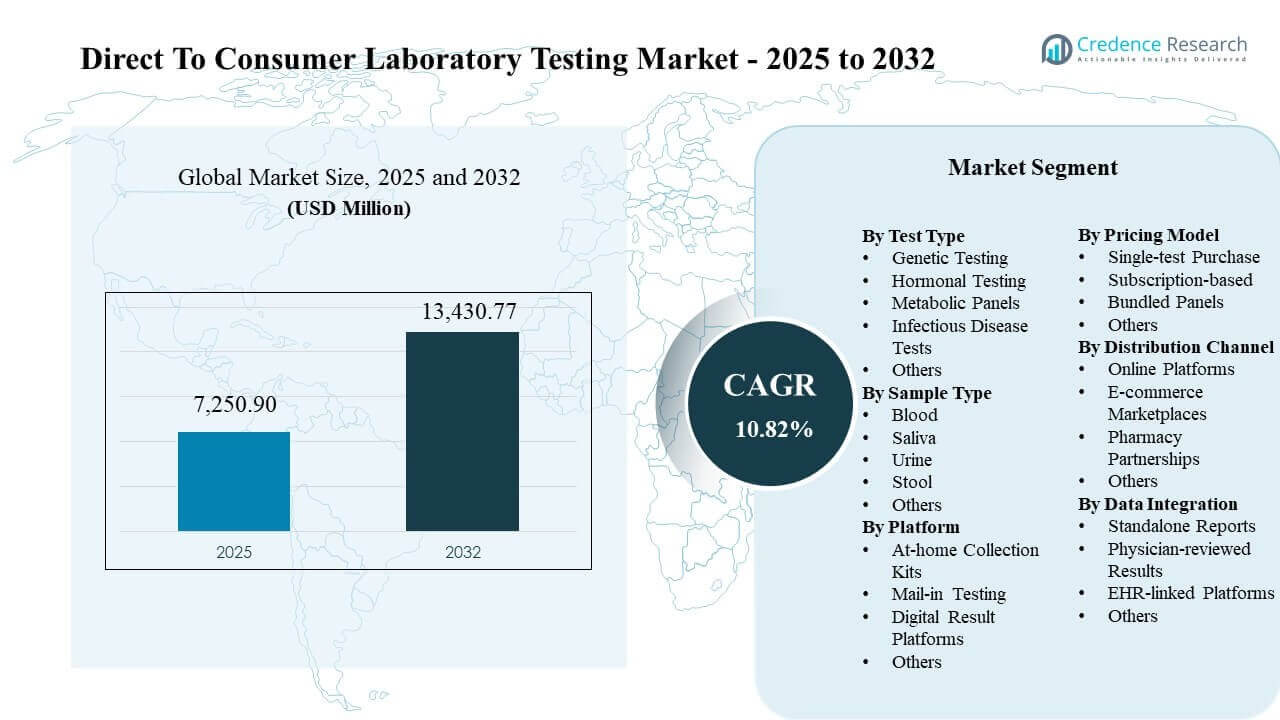
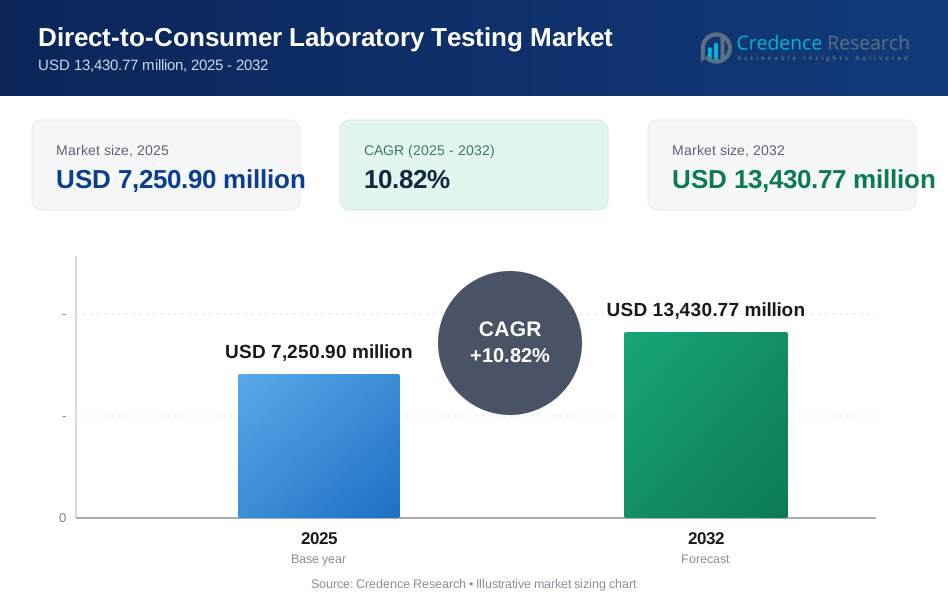
The Direct to Consumer Laboratory Testing Market size was estimated at USD 7,250.90 million in 2025 and is expected to reach USD 13,430.77 million by 2032, growing at a CAGR of 10.82% from 2025 to 2032. Demand is expanding as consumers seek faster access to health information without clinic scheduling delays, supported by broader test menus and more convenient home-collection workflows. Direct to Consumer Laboratory Testing Market growth also benefits from rising comfort with digital ordering, remote care touchpoints, and follow-up pathways that connect results to next-step actions.
| REPORT ATTRIBUTE | DETAILS |
|---|---|
| Historical Period | 2021-2024 |
| Base Year | 2025 |
| Forecast Period | 2026-2032 |
| Direct to Consumer Laboratory Testing Market Size 2025 | USD 7,250.90 million |
| Direct to Consumer Laboratory Testing Market, CAGR | 10.82% |
| Direct to Consumer Laboratory Testing Market Size 2032 | USD 13,430.77 million |
Key Market Trends & Insights
- The Direct to Consumer Laboratory Testing Market is projected to rise from USD 7,250.90 million (2025) to USD 13,430.77 million (2032).
- Direct to Consumer Laboratory Testing Market expansion is tracking a 10.82% CAGR during 2025–2032.
- North America accounted for 48.60% share in 2025, keeping the largest regional concentration of demand.
- Genetic Testing led By Test Type with a 37.20% share in 2025 as consumer awareness and repeat use-cases widened.
- Online Platforms led By Distribution Channel with a 68.90% share in 2025 as ordering and fulfillment remained digitally driven.
Segment Analysis
Direct to Consumer Laboratory Testing Market adoption is shaped by consumer preference for convenience, privacy, and speed, especially for wellness monitoring and condition-risk screening. Digital ordering and results delivery reduce friction and support repeat engagement through reminders, dashboards, and longitudinal tracking. Growing comfort with remote services also increases acceptance of home-collection kits and mail-based logistics, particularly when platforms provide clear guidance, collection support, and fast turnaround expectations.
Direct to Consumer Laboratory Testing Market competition is shifting toward interpretation quality and care-adjacent enablement rather than test availability alone. Physician review options, follow-up consult pathways, and AI-supported summaries raise perceived value and support retention. Data governance and trust also influence purchase decisions, especially in genetics and sensitive biomarker categories, pushing companies to strengthen privacy practices, consent clarity, and secure data handling.
By Test Type Insights
Genetic Testing accounted for the largest share of 37.20% in 2025. Direct to Consumer Laboratory Testing Market demand for Genetic Testing stays strong because consumers recognize the category and view results as useful for wellness decisions and family planning discussions. Test menu expansion improves relevance by pairing genetic insights with adjacent biomarkers and action guidance. Better onboarding, clearer reports, and optional counseling support reduce drop-off and help repeat usage.
By Sample Type Insights
Saliva accounted for the largest share of 44.80% in 2025. Direct to Consumer Laboratory Testing Market usage favors saliva collection because saliva sampling is noninvasive and easier to complete correctly without clinical assistance. Packaging and shipping are typically simpler than cold-chain dependent pathways, supporting mail-based fulfillment. Many consumer testing workflows also align saliva collection with familiar genetic and wellness panels, reinforcing repeat behavior.
By Platform Insights
Direct to Consumer Laboratory Testing Market platform adoption is led by models that reduce consumer effort from ordering through results delivery. At-home collection kits improve accessibility for users who prefer immediate sampling without travel. Mail-in testing supports broad geographic coverage and flexible scheduling, especially for privacy-sensitive use-cases. Digital result platforms strengthen engagement through dashboards, interpretation layers, and optional telehealth-style follow-up actions.
By Pricing Model Insights
Direct to Consumer Laboratory Testing Market pricing behavior varies by urgency, perceived value, and repeat-monitoring needs. Single-test purchases remain common for targeted screening and time-sensitive concerns. Bundled panels increase adoption by combining related biomarkers and improving perceived cost efficiency per insight delivered. Subscription-based options gain traction where recurring monitoring, coaching, or longitudinal tracking supports behavior change and retention.
By Distribution Channel Insights
Online Platforms accounted for the largest share of 68.90% in 2025. Direct to Consumer Laboratory Testing Market distribution favors Online Platforms because consumers want private ordering, broad test discovery, and home delivery without store dependence. Digital acquisition channels also support faster scaling and personalization through recommendations and targeted bundles. Partner channels such as pharmacies and employer programs expand reach but typically complement the primary digital funnel.
By Data Integration Insights
Direct to Consumer Laboratory Testing Market data integration maturity influences trust and repeat usage, especially for clinical-adjacent tests. Standalone reports serve low-acuity wellness needs where simplicity and speed matter most. Physician-reviewed results support higher confidence for abnormal findings and sensitive categories. EHR-linked platforms strengthen continuity by enabling results sharing with clinicians and supporting integrated care decisions across multiple touchpoints.
Direct to Consumer Laboratory Testing Market Drivers
Consumer preference for convenient access to testing
Direct to Consumer Laboratory Testing Market growth is driven by rising consumer demand for convenient access to diagnostics without clinic scheduling barriers. Home collection and mail-based workflows reduce time costs and support privacy-sensitive testing behaviors. Digital ordering improves test discovery and supports faster purchase decisions through clear menus and bundled options. Direct to Consumer Laboratory Testing Market expansion also benefits from broader comfort with remote services across healthcare interactions.
Expansion of test menus and preventive-health behaviors
Direct to Consumer Laboratory Testing Market demand increases as companies broaden test menus beyond single-purpose screening into preventive and wellness monitoring use-cases. Consumers increasingly view lab data as a routine input for lifestyle decisions, fertility planning, and chronic-risk awareness. Improved reporting, clearer education, and actionable summaries raise perceived utility. Direct to Consumer Laboratory Testing Market momentum strengthens when platforms provide next-step guidance and repeat monitoring pathways.
- For instance, 23andMe has genotyped more than 14 million customers and offers more than 65 reports spanning health predisposition, carrier status, wellness, and trait categories, demonstrating how DTC testing providers are expanding from narrowly focused testing into broader preventive-health engagement.
Growth of digital engagement and interpretation layers
Direct to Consumer Laboratory Testing Market acceleration is supported by digital engagement features that enhance retention beyond one-time testing. Dashboards, longitudinal tracking, and personalized recommendations raise repeat purchases and subscription conversion opportunities. Interpretation layers, including clinician review options and AI-driven summaries, increase confidence and reduce confusion. Direct to Consumer Laboratory Testing Market competition increasingly centers on insight quality, not only logistics and pricing.
Partner ecosystems that extend access and follow-up options
Direct to Consumer Laboratory Testing Market adoption benefits from partnerships that connect consumer testing to broader care pathways. Pharmacy collaborations, employer programs, and provider-affiliated models can reduce friction and increase trial volumes. Follow-up consult options support better consumer action after results, increasing perceived value. Direct to Consumer Laboratory Testing Market growth improves when distribution partners support trusted access points alongside the core digital channel.
- For instance, CVS Health and Quest Diagnostics expanded COVID-19 testing access to more than 1,000 CVS Pharmacy drive-thru locations in the U.S., illustrating how retail-health partnerships can rapidly widen consumer access points and connect testing users with follow-up healthcare channels.
Direct to Consumer Laboratory Testing Market Challenges
Direct to Consumer Laboratory Testing Market performance faces constraints from regulatory variability, compliance requirements, and quality expectations that differ by test category. The need for clear labeling, validated workflows, and robust sample handling can raise operational complexity. Miscollection risk and pre-analytical variability can affect result quality, especially for home-based sampling. Direct to Consumer Laboratory Testing Market players must also manage consumer misunderstandings through better instructions and report clarity.
Direct to Consumer Laboratory Testing Market adoption is also limited by consumer trust and data governance concerns, particularly for genetic and sensitive biomarker categories. Privacy expectations can influence purchase behavior and increase churn when policies are unclear. Reimbursement limitations keep many purchases out-of-pocket, which can reduce repeat testing in price-sensitive segments. Direct to Consumer Laboratory Testing Market participants must balance affordability with service quality, interpretation support, and secure data practices.
- For instance, LetsGetChecked reported in FDA-reviewed performance data that among 5,007 consecutive self-collected nasal swab samples, 100% contained the RNase P human gene, supporting sample adequacy, while its assay in asymptomatic individuals delivered 100% positive percent agreement and 99.2% negative percent agreement.
Market Trends and Opportunities
Direct to Consumer Laboratory Testing Market innovation is moving toward more integrated experiences that connect results to action. Physician review options, digital coaching, and guided follow-up pathways improve clinical confidence and reduce consumer uncertainty. AI-enabled explanations and longitudinal summaries strengthen engagement and encourage repeat monitoring. Direct to Consumer Laboratory Testing Market opportunity expands when platforms deliver clearer insights and easier next-step decisions.
- For instance, Everlywell’s Everlywell 360 combines clinician-reviewed care planning with an annual test covering 83 biomarkers across 6 health categories, and the company states this panel includes about 3x more biomarkers than a routine physical, showing how deeper data and guided interpretation can support repeat monitoring and more actionable follow-up.
Direct to Consumer Laboratory Testing Market growth opportunities are also emerging through multi-sample kits and broader biomarker bundles tailored to specific life stages and wellness goals. Partnerships with employers, pharmacies, and providers can increase reach and reduce customer acquisition costs. EHR-linked sharing and interoperable reporting strengthen care continuity, particularly for chronic-risk monitoring. Direct to Consumer Laboratory Testing Market participants that improve convenience and trust can capture larger recurring demand.
Regional Insights
North America
North America held a 48.60% share in 2025, supported by broad consumer awareness, mature logistics, and high digital health adoption. Direct to Consumer Laboratory Testing Market demand in North America benefits from large-scale marketing reach, established lab infrastructure, and strong private-pay capacity. Competitive intensity is high, encouraging rapid product iteration and richer interpretation features. Data privacy expectations remain influential, especially for genetics and sensitive testing categories.
Europe
Europe accounted for 25.20% share in 2025, supported by growing wellness monitoring adoption and expanding digital health pathways. Direct to Consumer Laboratory Testing Market activity in Europe is shaped by country-level policy differences, consumer trust requirements, and compliance expectations. Pharmacy networks and trusted health brands can help drive adoption alongside online ordering. Demand is rising for clearer reporting and follow-up pathways aligned with primary-care engagement.
Asia Pacific
Asia Pacific reached a 20.40% share in 2025, supported by large addressable populations and rising digital commerce penetration. Direct to Consumer Laboratory Testing Market expansion in Asia Pacific is encouraged by growing consumer health awareness, increasing telehealth usage, and mobile-first engagement behaviors. Competitive models vary across markets, with strong emphasis on affordability and fast fulfillment. Partnerships and localized logistics remain important to support reliable sampling and delivery.
Latin America
Latin America held a 4.10% share in 2025, with growth supported by improving e-commerce reach and rising demand for convenient screening options. Direct to Consumer Laboratory Testing Market uptake in Latin America often depends on urban logistics capability and consumer trust in home collection workflows. Pricing sensitivity can shape test selection and limit repeat monitoring. Employer programs and pharmacy collaborations can help expand access and strengthen credibility.
Middle East & Africa
Middle East and Africa accounted for a 1.70% share in 2025, reflecting earlier-stage adoption and uneven access infrastructure across countries. Direct to Consumer Laboratory Testing Market growth in Middle East and Africa benefits from increasing smartphone penetration and interest in private testing options. Logistics reliability and regulatory clarity can vary widely, influencing service consistency. Partnerships with healthcare providers and established retail channels can support trust and expand reach.
Competitive Landscape
Direct to Consumer Laboratory Testing Market competition includes large diagnostic incumbents and consumer-focused brands that differentiate through test breadth, turnaround expectations, digital experience, and interpretation quality. Companies compete on sample collection convenience, report clarity, privacy posture, and the ability to guide follow-up actions. Bundled panels, targeted wellness programs, and partner ecosystems help reduce churn and improve repeat usage. Direct to Consumer Laboratory Testing Market positioning increasingly depends on building trusted, end-to-end consumer experiences that connect testing to actionable decisions.
Quest Diagnostics maintains a strong position by pairing laboratory scale with consumer-oriented digital capabilities that support improved understanding of results. Direct to Consumer Laboratory Testing Market strategy for Quest Diagnostics emphasizes expanding consumer access pathways and strengthening interpretation support to increase engagement. Partnerships that broaden availability and improve convenience can support uptake across self-directed users. Trust, quality processes, and robust reporting help Quest Diagnostics compete across both consumer and clinical-adjacent use-cases.
The industry research and growth report includes detailed analyses of the competitive landscape of the market and information about key companies, including:
- Quest Diagnostics
- Labcorp
- Everlywell
- LetsGetChecked
- Color Health
- 23andMe
- Natera
- Invitae
- Myriad Genetics
- Fulgent Genetics
Qualitative and quantitative analysis of companies has been conducted to help clients understand the wider business environment as well as the strengths and weaknesses of key industry players. Data is qualitatively analyzed to categorize companies as pure play, category-focused, industry-focused, and diversified; it is quantitatively analyzed to categorize companies as dominant, leading, strong, tentative, and weak.
Recent Developments
- In September 2025, SumHealth and Nucleus Genomics announced a partnership to make whole-genome DNA testing available through healthcare providers, hospitals, pharmacies, and consumer health channels across the U.S. The partnership combines SumHealth’s healthcare distribution network with Nucleus’ full-genome sequencing technology and expands access to clinical-grade genetic screening through an at-home cheek swab.
- In July 2025, TTAM Research Institute completed the acquisition of the Personal Genome Service and Research Services business lines of 23andMe, Inc. This acquisition stands out as a significant consolidation move in the consumer genomics segment of the direct-to-consumer laboratory testing market.
- In May 2025, Targeted Genomics LLC entered into a commercialization agreement with OraSure Technologies, Inc. to expand consumer access to at-home celiac disease genetic testing. The partnership was aimed at broadening availability of specialized genetic testing through consumer-friendly home-based channels.
- In February 2025, Thorne HealthTech Inc. launched a new microbiome test that uses advanced sequencing to provide deeper insights into gut health and its connection to overall immunity. This launch reflects continued product innovation in at-home and consumer-directed health testing.
Report Scope
| Report Attribute | Details |
| Market size value in 2025 | USD 7,250.90 million |
| Revenue forecast in 2032 | USD 13,430.77 million |
| Growth rate (CAGR) | 10.82% (2025–2032) |
| Base year | 2025 |
| Forecast period | 2026-2032 |
| Quantitative units | USD million |
| Segments covered | By Test Type; By Sample Type; By Platform; By Pricing Model; By Distribution Channel; By Data Integration |
| Regional scope | North America, Europe, Asia Pacific, Latin America, Middle East & Africa |
| Key companies profiled | Quest Diagnostics; Labcorp; Everlywell; LetsGetChecked; Color Health; 23andMe; Natera; Invitae; Myriad Genetics; Fulgent Genetics |
| No. of Pages | 340 |
Segmentation
By Test Type
- Genetic Testing
- Hormonal Testing
- Metabolic Panels
- Infectious Disease Tests
- Others
By Sample Type
- Blood
- Saliva
- Urine
- Stool
- Others
By Platform
- At-home Collection Kits
- Mail-in Testing
- Digital Result Platforms
- Others
By Pricing Model
- Single-test Purchase
- Subscription-based
- Bundled Panels
- Others
By Distribution Channel
- Online Platforms
- E-commerce Marketplaces
- Pharmacy Partnerships
- Others
By Data Integration
- Standalone Reports
- Physician-reviewed Results
- EHR-linked Platforms
- Others
By Region
- North America
- U.S.
- Canada
- Mexico
- Europe
- Germany
- France
- U.K.
- Italy
- Spain
- Rest of Europe
- Asia Pacific
- China
- Japan
- India
- South Korea
- South-east Asia
- Rest of Asia Pacific
- Latin America
- Brazil
- Argentina
- Rest of Latin America
- Middle East & Africa
- GCC Countries
- South Africa
- Rest of the Middle East and Africa
Request a Free Sample
Fill in your details and we'll send you a free sample report.
- Sample data tables & charts
- Research methodology
Need a Custom Version of This Report?
Tailor the scope, geography, or segments to your exact requirements.
- Custom geography or segment scope
- Direct access to our analyst team
Frequently Asked Questions
What is the market size of Direct to Consumer Laboratory Testing Market in 2025 and 2032?
What is the CAGR of Direct to Consumer Laboratory Testing Market during 2025–2032?
What is the largest segment in Direct to Consumer Laboratory Testing Market?
What factors are driving growth in Direct to Consumer Laboratory Testing Market?
Which companies are leading in Direct to Consumer Laboratory Testing Market?
Which region leads the Direct to Consumer Laboratory Testing Market?
Table of Content
Chapter 1. Report Introduction
- 1.1 Report Description & Purpose
- 1.1.1 Report Title & Market Definition
- 1.1.2 Unique Selling Propositions (USP) & Key Differentiators
- 1.1.3 Value Proposition for Stakeholders
- 1.2 Research Objectives
- 1.2.1 Market Sizing Objectives (Volume & Revenue)
- 1.2.2 Segmentation Objectives
- 1.2.3 Competitive Intelligence Objectives
- 1.2.4 Forecast & Scenario Objectives
- 1.3 Report Scope
- 1.3.1 Direct-to-Consumer Laboratory Testing Scope – Types & Subtypes Covered
- 1.3.2 Geographic Scope – Regions & Countries Covered
- 1.3.3 Historical Period, Base Year & Forecast Period (2025; forecast to 2032)
- 1.3.4 Inclusions & Exclusions
- 1.4 HS Code & Classification Framework
- 1.5 Currency, Units & Pricing Basis
- 1.6 Target Stakeholders
- 1.7 Limitations & Assumptions
Chapter 2. Executive Summary
- 2.1 Global Direct-to-Consumer Laboratory Testing Market Snapshot
- 2.1.1 Market Size – Historical (2025) & Forecast (2025-2032) (2025: USD 7,250.90 million → 2032: USD 13,430.77 million)
- 2.1.2 Volume & Revenue – Global Totals
- 2.1.3 Key Market Highlights – Top Five Facts
- 2.2 Direct-to-Consumer Laboratory Testing Market Segmentation Snapshot
- 2.2.1 Market Split by Region – 2025 vs. 2032
- 2.3 Competitive Snapshot
- 2.3.1 Top 10 Players by Revenue Share – 2025
- 2.3.2 Top 10 Players by Volume Share – 2025
- 2.3.3 Recent Strategic Developments (18-Month Summary)
- 2.4 Key Investment Highlights & Strategic Conclusions
Chapter 3. Direct-to-Consumer Laboratory Testing Market Dynamics & Industry Analysis
- 3.1 Market Overview & Context
- 3.1.1 Direct-to-Consumer Laboratory Testing Market Position in the Broader Automotive Value Chain
- 3.1.2 OEM vs. Replacement Market Dynamics
- 3.1.3 Market Maturity & Development Stage by Region
- 3.2 Direct-to-Consumer Laboratory Testing Market Drivers
- 3.3 Direct-to-Consumer Laboratory Testing Market Restraints & Challenges
- 3.4 Direct-to-Consumer Laboratory Testing Market Opportunities
- 3.5 Porter's Five Forces Analysis
- 3.5.1 Threat of New Entrants
- 3.5.2 Bargaining Power of Suppliers
- 3.5.3 Bargaining Power of Buyers
- 3.5.4 Threat of Substitutes
- 3.5.5 Competitive Rivalry – Intensity Assessment
- 3.6 Direct-to-Consumer Laboratory Testing Value Chain Analysis
- 3.6.1 Upstream – Raw Material/Input Suppliers
- 3.6.1.1 Raw Material/Input 1
- 3.6.1.2 Raw Material/Input 2
- 3.6.1.3 Raw Material/Input 3
- 3.6.2 Midstream – Production/Manufacturing/Service Delivery
- 3.6.2.1 Production/Process Overview
- 3.6.2.2 Key Facility Locations & Capacity by Manufacturer
- 3.6.3 Downstream – Distribution & End Consumer
- 3.6.3.1 Primary Channel – B2B/OEM
- 3.6.3.2 Secondary Channels – Dealer, Retail, Online, Direct
- 3.6.4 Value Chain Profitability Analysis
- 3.6.1 Upstream – Raw Material/Input Suppliers
- 3.7 PESTEL Analysis
- 3.7.1 Political Factors
- 3.7.2 Economic Factors
- 3.7.3 Social Factors
- 3.7.4 Technological Factors
- 3.7.5 Environmental Factors
- 3.7.6 Legal Factors
- 3.8 Direct-to-Consumer Laboratory Testing Supply Chain Analysis
- 3.8.1 Raw Material/Input Supply Risk Assessment
- 3.8.2 Manufacturing Concentration Risk (Geographic Exposure)
- 3.8.3 Trade Disruption Impact Analysis
- 3.9 Regulatory & Policy Landscape
Note: The regulatory and policy landscape section covers regulations based on their applicability to the market, Direct-to-Consumer Laboratory Testing category, geography, and scope of the study. Only regulatory frameworks with a material impact on operations, compliance, trade, sustainability, or market access are analyzed in detail.
Chapter 4. Key Investment Pockets & Opportunity Analysis
- 4.1 Direct-to-Consumer Laboratory Testing Market Attractiveness Analysis
- 4.1.1 By Region – Investment Attractiveness Matrix (Volume × CAGR)
- 4.2 Absolute Revenue Growth Opportunity
- 4.2.1 By Region – Absolute USD Growth Through 2032
- 4.3 Incremental Volume Opportunity
- 4.3.1 By Region – Incremental Volume Through 2032
- 4.3.2 Segment – Incremental Volume
- 4.4 Emerging Submarket Opportunity Deep Dive (Subject to Applicability)
- 4.5 Emerging Market Opportunity Scorecards
- 4.5.1 United States
- 4.5.2 Europe
- 4.5.3 Asia
- 4.5.4 Middle East & Africa
Note: Emerging Market Opportunity Scorecards will be included based on relevance and strategic importance. Regions listed are indicative and may vary depending on data availability and market dynamics.
Chapter 5. Direct-to-Consumer Laboratory Testing Import-Export Analysis & Trade Flows
- 5.1 Global Trade Overview
- 5.1.1 Global Export Value by Country (2025)
- 5.1.2 Global Export Volume by Country (2025)
- 5.1.3 Global Import Value by Country (2025)
- 5.1.4 Global Import Volume by Country (2025)
- 5.1.5 Net Trade Balance by Country (2025)
- 5.2 Export Analysis – Segment
- 5.2.1 Type 1 (HS Code)
- 5.2.2 Type 2 (HS Code)
- 5.2.3 Type 3 (HS Code)
- 5.2.4 Type 4 (HS Code)
- 5.2.5 Type 5 (HS Code)
- 5.3 Import Analysis – Segment
- 5.3.1 Type 1 (HS Code)
- 5.3.2 Type 2 (HS Code)
- 5.3.3 Type 3 (HS Code)
- 5.3.4 Type 4 (HS Code)
- 5.3.5 Type 5 (HS Code)
- 5.4 Average Unit Trade Prices
- 5.4.1 Average Export Price – Segment & Country
- 5.4.2 Average Import Price – Segment & Source Country
- 5.4.3 Price Trends (2025)
- 5.5 Key Trade Route Analysis
- 5.5.1 Trade Route 1
- 5.5.2 Trade Route 2
- 5.5.3 Trade Route 3
- 5.5.4 Trade Route 4
- 5.5.5 Trade Route 5
- 5.6 Trade Policy Impact Assessment
- 5.6.1 US Anti-Dumping & Section 301 Tariffs
- 5.6.2 EU Customs Union Impact
- 5.6.3 Major Free Trade Agreements
- 5.6.4 USMCA Rules of Origin
Note: Trade policy analysis will be included only where relevant to the Direct-to-Consumer Laboratory Testing market.
Chapter 6. Competitive Landscape & Company Benchmarking
- 6.1 Direct-to-Consumer Laboratory Testing Market Concentration & Structure
- 6.1.1 Herfindahl-Hirschman Index (HHI) – vs. 2025
- 6.1.2 Tier 1, Tier 2 & Tier 3 Market Structure
- 6.1.3 Global, Regional & Local Player Dynamics
- 6.2 Direct-to-Consumer Laboratory Testing Market Share Analysis – 2025
- 6.2.1 Global Revenue Share by Company
- 6.2.2 Global Volume Share by Company
- 6.2.3 Regional Revenue Share
- 6.2.4 Market Share Evolution ( vs. 2025)
- 6.2.5 OEM Segment Share by Company
- 6.2.6 Replacement Segment Share by Company
- 6.3 Production/Delivery Capacity & Facility Analysis
- 6.3.1 Global Installed Capacity
- 6.3.2 Capacity Utilization Rates
- 6.3.3 Production/Output Volume
- 6.3.4 Facility Locations & Capacity Map
- 6.3.5 Planned Capacity Additions
- 6.4 Direct-to-Consumer Laboratory Testing Competitive Benchmarking Matrix
- 6.4.1 Revenue, Volume, CAGR & Profitability Comparison
- 6.4.2 Channel Revenue Mix
- 6.4.3 Geographic Revenue Exposure
- 6.4.4 R&D Intensity
- 6.4.5 Sustainability Maturity
- 6.5 Strategic Developments in Direct-to-Consumer Laboratory Testing (Last 24 Months)
- 6.5.1 Mergers, Acquisitions & Divestments
- 6.5.2 New Direct-to-Consumer Laboratory Testing Launches
- 6.5.3 Facility Expansions
- 6.5.4 Strategic Alliances, Joint Ventures & Partnerships
- 6.5.5 Distribution Expansion & Market Entry
- 6.5.6 Sustainability & ESG Initiatives
- 6.6 Competitive Strategy Mapping
- 6.6.1 Leader, Challenger, Follower & Niche Classification
- 6.6.2 Pricing Strategy Comparison
- 6.6.3 Channel Strategy Matrix
Note: Strategic developments are included based on their materiality and the availability of reliable information.
Chapter 7. Global Direct-to-Consumer Laboratory Testing Market – By Distribution Channel
- 7.1 Segment Overview
- 7.1.1 Volume & Revenue Split by Channel (2025 & 2032)
- 7.1.2 Channel Mix Evolution (2025-2032)
Chapter 8. Regional Market Analysis – Global Overview
- 8.1 Global Regional Overview
- 8.1.1 Regional Volume Share
- 8.1.2 Regional Revenue Share
- 8.1.3 Regional Volume by Region
- 8.1.4 Regional Revenue by Region
- 8.1.5 Regional Forecast Through 2032
- 8.2 Cross-Regional Segment Analysis
- 8.2.1 By Distribution Channel
- 8.2.2 By Brand/Price Tier
Chapter 9. North America Direct-to-Consumer Laboratory Testing Market
- 9.1 United States
- 9.2 Canada
- 9.3 Mexico
Chapter 10. Europe Direct-to-Consumer Laboratory Testing Market
- 10.1 Germany
- 10.2 France
- 10.3 Italy
- 10.4 United Kingdom
- 10.5 Spain
- 10.6 Poland
- 10.7 Russia
- 10.8 Netherlands
- 10.9 Belgium
- 10.10 Sweden
- 10.11 Denmark
- 10.12 Norway
- 10.13 Rest of Europe
Chapter 11. Asia Pacific Direct-to-Consumer Laboratory Testing Market
- 11.1 China
- 11.2 India
- 11.3 Japan
- 11.4 South Korea
- 11.5 Thailand
- 11.6 Indonesia
- 11.7 Vietnam
- 11.8 Malaysia
- 11.9 Australia
- 11.10 Rest of Asia Pacific
Chapter 12. Latin America Direct-to-Consumer Laboratory Testing Market
- 12.1 Brazil
- 12.2 Argentina
- 12.3 Colombia
- 12.4 Chile
- 12.5 Rest of Latin America
Chapter 13. Middle East Direct-to-Consumer Laboratory Testing Market
- 13.1 Saudi Arabia
- 13.2 United Arab Emirates
- 13.3 Turkey
- 13.4 Israel
- 13.5 Iran
- 13.6 Rest of the Middle East
Chapter 14. Africa Direct-to-Consumer Laboratory Testing Market
- 14.1 South Africa
- 14.2 Egypt
- 14.3 Nigeria
- 14.4 Morocco
- 14.5 Rest of Africa
Chapter 15. Direct-to-Consumer Laboratory Testing Company Profiles
- 15.1 [Company 01]
- 15.1.1 Company Overview
- 15.1.2 Key Management Personnel
- 15.1.3 Products & Services Portfolio
- 15.1.4 Financial Performance
- 15.1.5 Key Market Focus & Geographic Presence
- 15.1.6 Recent Developments & Strategic Initiatives
Note: The company profile list is preliminary and may change based on research findings, market developments, data availability, and client requirements.
Chapter 16. Appendices
- Appendix A – List of Abbreviations & Acronyms
- Appendix B – Industry Classification Code Reference – Full Series
- Appendix C – Production & Capacity Data Tables
- Appendix D – End-Use & Demand Base Tables
- Appendix E – Consumption & Replacement Rate Assumptions
- Appendix F – ASP Reference Tables
- Appendix G – Manufacturing & Facility Database
- Appendix H – Import-Export Data Tables
- Appendix I – Regulatory Summary Tables
- Appendix J – Primary Research Participant List (Anonymized)
- Appendix K – Primary Research Questionnaire Framework
- Appendix L – Data Sources & Bibliography
- Appendix M – Market Size Divergence & Source Comparison
Chapter 17. Research Methodology
- 17.1 Research Framework & Philosophy
- 17.2 Secondary Research – Sources, Hierarchy & Data Extraction
- 17.3 Data Modeling – Bottom-Up & Top-Down Market Sizing
- 17.4 Primary Research – Stakeholder Framework, LOI & Sample Sizes
- 17.5 Forecast Methodology – Regression, Scenario & Sensitivity Analysis
- 17.6 Quality Control – Four-Layer Validation Framework
- 17.7 Limitations & Standard Assumptions
- 17.8 Disclaimer
