Market Overview:
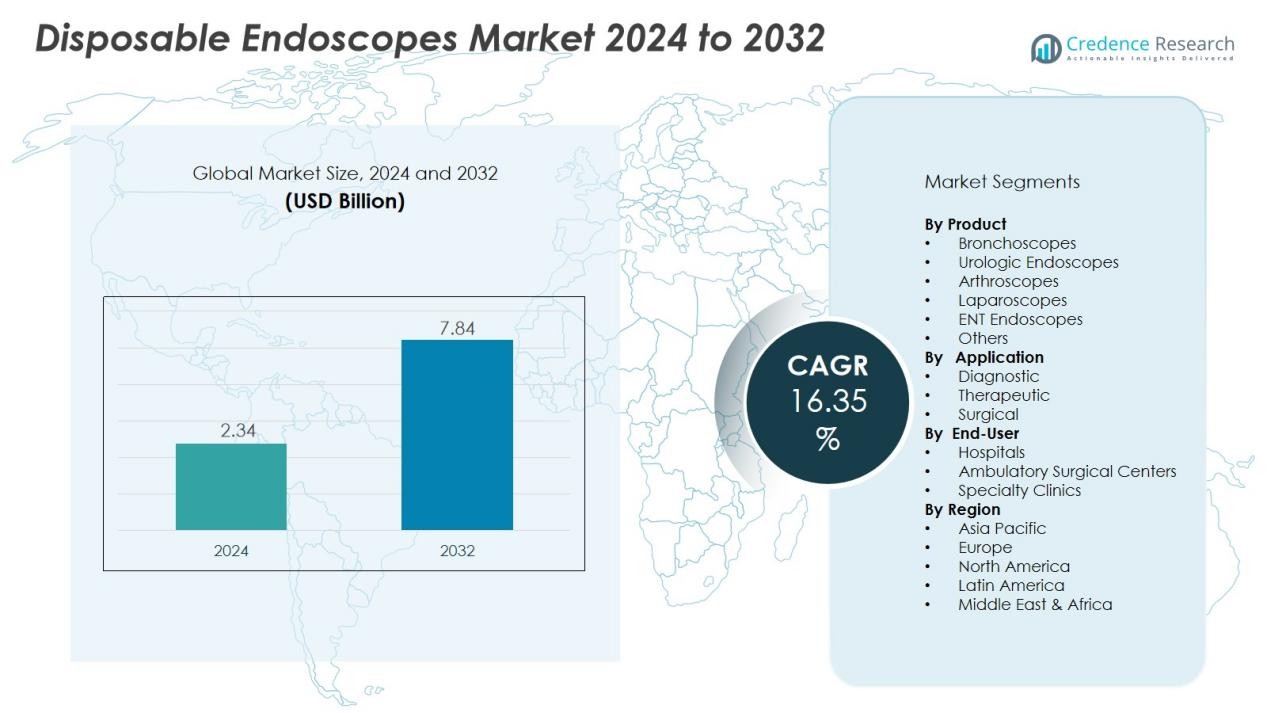
The Disposable Endoscopes Market size was valued at USD 2.34 billion in 2024 and is anticipated to reach USD 7.84 billion by 2032, at a CAGR of 16.35 % during the forecast period.
| REPORT ATTRIBUTE | DETAILS |
|---|---|
| Historical Period | 2020-2023 |
| Base Year | 2024 |
| Forecast Period | 2025-2032 |
| Disposable Endoscopes Market Size 2024 | USD 2.34 Billion |
| Disposable Endoscopes Market, CAGR | 16.35% |
| Disposable Endoscopes Market Size 2032 | USD 7.84 Billion |
Key drivers include heightened concerns over device-related infections, especially in reusable endoscopes, which boost demand for single-use options. Advancements in imaging quality, regulatory support for disposable devices, and rising procedural volumes in minimally invasive surgeries further enhance market growth. Increased awareness among healthcare professionals about cross-contamination risks also strengthens adoption.
Regionally, North America currently leads the market with the largest share, supported by strong healthcare infrastructure and early adoption of advanced medical technologies. Europe follows closely due to stringent sterilization standards and high procedural volumes. Asia-Pacific is emerging as the fastest-growing region, driven by the growing middle-class population, expanding healthcare access, and the rapid establishment of modern hospital networks in countries such as India and China.
Market Insights:
- The Disposable Endoscopes Market was valued at USD 1.12 billion in 2018, reached USD 2.34 billion in 2024, and is projected to attain USD 7.84 billion by 2032, growing at a CAGR of 16.35%.
- North America leads with 42% share, driven by advanced healthcare infrastructure, high procedural volumes, and strong infection control standards across hospitals and surgical centers.
- Europe holds 29% share due to stringent sterilization regulations, sustainability-focused healthcare policies, and rising collaborations between hospitals and device manufacturers.
- Asia-Pacific accounts for 21% share and stands as the fastest-growing region, supported by rapid healthcare modernization, government investment in infection prevention, and expanding hospital networks in China, India, and Japan.
- By product segmentation, bronchoscopes dominate with 34% share, followed by urologic endoscopes at 26%, reflecting strong demand from pulmonary and urology applications across hospitals and outpatient clinics.
Market Drivers:
Rising Focus on Infection Prevention and Patient Safety
The growing awareness of infection transmission risks in reusable devices drives market adoption. Healthcare facilities increasingly prefer disposable systems to eliminate cross-contamination during procedures. It ensures sterile conditions without relying on reprocessing or sterilization. The growing incidence of hospital-acquired infections strengthens the shift toward single-use endoscopy solutions. These factors position disposable endoscopes as an effective preventive alternative.
- For instance, Olympus Corporation received FDA 510(k) clearance for its RenaFlex single-use flexible ureteroscope system in April 2024, featuring a 9.5Fr outer diameter with a 3.6Fr working channel, designed to eliminate cross-contamination risks during urinary tract procedures through its disposable architecture that prevents reprocessing-related contamination.
Technological Advancements Enhancing Visualization and Efficiency
Continuous innovation in imaging technology improves the performance of disposable endoscopes. High-definition visualization, integrated illumination, and wireless connectivity enhance diagnostic accuracy and procedural control. It supports better surgical outcomes and workflow efficiency for physicians. Manufacturers focus on compact designs with improved maneuverability to match reusable device standards. These developments accelerate product acceptance in clinical environments.
- For instance, Ambu A/S launched the Ambu® aScope™ 4 Broncho, which delivers HD visualization and on-screen video resolution of up to 800 x 480 pixels, enabling more accurate airway diagnostics in clinical settings.
Cost-Effectiveness and Operational Convenience in Healthcare Settings
Disposable devices eliminate costs associated with maintenance, sterilization, and repair of reusable endoscopes. Hospitals and clinics benefit from predictable expenses and simplified inventory management. It reduces downtime between procedures and ensures consistent device availability. The lower operational burden encourages adoption in both high- and low-volume facilities. These advantages appeal to budget-conscious healthcare systems seeking efficiency without compromising safety.
Regulatory Support and Growing Healthcare Infrastructure
Supportive regulations promoting single-use medical devices strengthen industry growth. Authorities emphasize infection control standards, encouraging the replacement of reusable systems with disposable alternatives. It aligns with healthcare modernization efforts across developed and emerging economies. Expanding hospital infrastructure and rising procedural volumes sustain market demand. These factors collectively reinforce the growth momentum of the Disposable Endoscopes Market.
Market Trends:
Growing Integration of Advanced Imaging and Digital Connectivity
The integration of digital imaging, wireless transmission, and data storage systems defines a major trend in the market. Manufacturers focus on enhancing visualization quality through high-resolution sensors and integrated light sources. It improves procedural accuracy while reducing the need for complex external equipment. The rise of connected endoscopy units enables real-time data sharing, remote consultation, and tele-endoscopy services. Hospitals adopt such technologies to improve workflow and decision-making speed. The combination of digital compatibility and easy data transfer strengthens device appeal across diagnostic and surgical applications. The Disposable Endoscopes Market benefits from this steady movement toward smart, connected solutions.
- For Instance, Fujifilm's Eluxeo 800 series colonoscope, the EC-860S, which began launching in mid-2025 (e.g., in May for Europe), features a high-sensitivity CMOS sensor with a 170° field of view and a 3.8 mm instrument channel.
Expanding Adoption Across Multiple Clinical Specialties
Single-use endoscopes are gaining wider acceptance beyond traditional gastrointestinal and urology applications. It now extends into pulmonology, otolaryngology, and gynecology due to improved design flexibility and procedural accuracy. Hospitals favor disposable models to address high patient throughput and infection control demands. Manufacturers diversify portfolios with models tailored for specialty-specific procedures. The rising frequency of minimally invasive surgeries further supports this transition. Growing procedural volumes in outpatient centers and clinics increase accessibility and reduce patient waiting times. This expansion across clinical disciplines marks a key growth trend shaping the market’s evolution.
- For example, Boston Scientific introduced its EXALT™ Model B Single-Use Bronchoscope in 2021, increasing procedural efficiency for pulmonologists as supported by company claims and its FDA clearance and deployment in U.S. healthcare facilities.
Market Challenges Analysis:
High Product Cost and Limited Reimbursement Policies
The initial cost of disposable endoscopes remains a challenge for healthcare providers with limited budgets. Hospitals in developing regions often struggle to justify expenses compared to reusable systems. It restricts large-scale adoption, especially where reimbursement coverage for single-use devices is limited. Many health systems still lack clear reimbursement guidelines for disposable instruments. This uncertainty delays procurement decisions and affects profitability for manufacturers. Cost concerns also hinder the expansion of disposable solutions in smaller clinics and diagnostic centers.
Environmental Concerns and Waste Management Issues
The rising use of single-use medical devices increases plastic waste generation, creating environmental challenges. It raises concerns among regulators and sustainability advocates about long-term ecological effects. Hospitals must handle disposal and recycling under strict compliance standards, which increases operational costs. Limited recycling infrastructure in many regions amplifies the issue. Manufacturers are investing in eco-friendly materials and take-back programs to reduce the environmental footprint. Sustainability initiatives are crucial for addressing this growing challenge and maintaining market credibility.
Market Opportunities:
Expansion into Emerging Economies and Ambulatory Care Settings
Growing healthcare infrastructure in emerging economies presents a major opportunity for disposable endoscope manufacturers. Countries such as India, China, and Brazil are investing heavily in hospital modernization and infection control. It supports faster adoption of single-use medical devices to improve patient safety. Ambulatory surgical centers and outpatient clinics also prefer disposable systems for cost efficiency and operational flexibility. Rising awareness of cross-contamination risks encourages facilities to replace reusable devices. Government initiatives promoting healthcare standardization further expand the addressable market. These factors create a favorable environment for the Disposable Endoscopes Market to strengthen its global footprint.
Sustainability Innovations and Eco-Friendly Product Development
Manufacturers are exploring biodegradable and recyclable materials to address growing environmental concerns. It opens new opportunities to balance infection control with sustainable waste management. Companies investing in closed-loop recycling systems can differentiate themselves in competitive markets. Healthcare providers increasingly value products with verified eco-certifications and lower carbon impact. The trend supports collaboration between manufacturers, recyclers, and hospitals to develop green medical ecosystems. Advancements in sustainable manufacturing technologies will enhance brand reputation and regulatory approval prospects. These developments create long-term growth avenues for environmentally responsible market participants.
Market Segmentation Analysis:
By Product
The product segment includes bronchoscopes, urologic endoscopes, arthroscopes, laparoscopes, and others. Bronchoscopes hold the largest share due to rising demand for pulmonary procedures and infection control requirements. Urologic endoscopes follow closely, driven by their frequent use in diagnostic and therapeutic interventions. It benefits from high procedural volume in urology departments and growing awareness of cross-contamination risks. Arthroscopes and laparoscopes continue to gain attention with advancements in single-use surgical tools improving procedural precision. The diverse product range enables hospitals to customize device adoption based on clinical needs.
- For instance, Ambu's aScope 5 Broncho HD 5.0/2.2 delivers full-HD visualization with a 1920×1080 resolution display unit and features up/down bending angles of 195°/195° to navigate challenging bronchial segments with precision.
By Application
Applications span diagnostic, therapeutic, and surgical procedures across multiple specialties. Diagnostic endoscopy leads due to high demand in pulmonology, gastroenterology, and urology. It ensures clear visualization and prevents infection transmission during patient assessment. Therapeutic use also expands with an increasing focus on minimally invasive interventions. Surgical applications gain traction in outpatient centers seeking faster turnaround and lower reprocessing costs. This segmentation highlights the growing relevance of disposable models across core medical functions.
- For instance, single-use cystoscopes implemented at a high-volume ambulatory surgery center reduced hands-on labor time by 2 minutes 31 seconds per procedure (48% reduction), translating to approximately 20 additional minutes gained per day based on 8 daily procedures, enabling the facility to perform 9 additional cystoscopy patients daily without workflow delays.
By End-User
Hospitals dominate the end-user segment due to large-scale procedure volumes and infection control mandates. Clinics and ambulatory surgical centers adopt disposable systems to optimize workflow and reduce sterilization expenses. It supports enhanced flexibility and safety in short-duration treatments. The growing number of specialty clinics and outpatient facilities strengthens future adoption trends. Rising awareness among healthcare providers sustains demand across all care settings.
Segmentations:
By Product
- Bronchoscopes
- Urologic Endoscopes
- Arthroscopes
- Laparoscopes
- ENT Endoscopes
- Others
By Application
- Diagnostic
- Therapeutic
- Surgical
By End-User
- Hospitals
- Ambulatory Surgical Centers
- Specialty Clinics
By Region
- North America
- U.S.
- Canada
- Mexico
- Europe
- Germany
- France
- U.K.
- Italy
- Spain
- Rest of Europe
- Asia Pacific
- China
- Japan
- India
- South Korea
- South-east Asia
- Rest of Asia Pacific
- Latin America
- Brazil
- Argentina
- Rest of Latin America
- Middle East & Africa
- GCC Countries
- South Africa
- Rest of the Middle East and Africa
Regional Analysis:
North America Leading with Strong Technological and Regulatory Backbone
North America holds 42% share of the global market, driven by high procedural volumes and strong infection control standards. The United States dominates regional demand due to well-established healthcare systems and early technology adoption. It benefits from the presence of major manufacturers and advanced distribution networks. Favorable reimbursement structures and regulatory approvals from the FDA support continuous innovation. Hospitals and outpatient centers in the region emphasize single-use devices to minimize hospital-acquired infections. Canada follows a similar trend with rising adoption in public and private hospitals. Growing investment in disposable medical equipment strengthens the region’s leadership position.
Europe Strengthening Growth through Stringent Safety Standards
Europe accounts for 29% share of the Disposable Endoscopes Market, supported by regulatory emphasis on sterilization safety and sustainable healthcare practices. Countries such as Germany, the UK, and France lead demand through advanced endoscopic infrastructure. It gains momentum from national infection control programs encouraging replacement of reusable systems. Increasing collaborations between hospitals and device makers enhance accessibility of single-use instruments. Rising awareness of patient safety and contamination risk supports market penetration. Healthcare providers in Europe continue to shift toward environmentally responsible disposable designs. The focus on quality assurance and sustainability accelerates market development.
Asia-Pacific Emerging as the Fastest-Growing Regional Market
Asia-Pacific holds 21% share and represents the fastest-growing regional segment with strong potential for expansion. China, Japan, and India lead growth driven by healthcare modernization and procedural volume increase. It benefits from rising disposable income, improved hospital infrastructure, and government investment in infection prevention. The growing private healthcare sector accelerates product demand in urban centers. Local manufacturing initiatives and cost-efficient supply chains enhance market accessibility. Expanding medical tourism and awareness of hygiene standards support adoption across hospitals and clinics. These factors collectively position Asia-Pacific as a critical growth hub for global market players.
Key Player Analysis:
- Ambu A/S
- Boston Scientific Corporation
- obp Surgical Corporation
- COOPERSURGICAL, INC.
- Flexicare medical Limited
- Welch Allyn (Hill Rom)
- HOYA Corporation
- KARL STORZ
- Olympus Corporation
- OTU Medical
Competitive Analysis:
The Disposable Endoscopes Market features intense competition among global and regional manufacturers focused on technology advancement and cost optimization. Key players include Ambu A/S, Boston Scientific Corporation, obp Surgical Corporation, COOPERSURGICAL, INC., Flexicare Medical Limited, Welch Allyn (Hill Rom), and HOYA Corporation. It emphasizes continuous product innovation to enhance visualization, portability, and user safety. Leading companies invest in research and strategic collaborations to expand product portfolios across clinical specialties. Mergers and distribution partnerships strengthen their global footprint and improve market access. Competitive differentiation relies on device reliability, regulatory compliance, and environmental sustainability. Companies advancing smart, digitally integrated endoscopes gain a strong advantage in the evolving market landscape.
Recent Developments:
- In October 2025, Boston Scientific Corporation entered a definitive agreement to acquire Nalu Medical, Inc. for approximately $533 million, expanding its portfolio in chronic pain management technologies.
- In August 2024, CooperSurgical acquired obp Surgical, a US-based medical device company known for single-use cordless surgical retractors and suction devices, for approximately $100 million.
Report Coverage:
The research report offers an in-depth analysis based on Product, Application, End-User and Region. It details leading Market players, providing an overview of their business, product offerings, investments, revenue streams, and key applications. Additionally, the report includes insights into the competitive environment, SWOT analysis, current Market trends, as well as the primary drivers and constraints. Furthermore, it discusses various factors that have driven Market expansion in recent years. The report also explores Market dynamics, regulatory scenarios, and technological advancements that are shaping the industry. It assesses the impact of external factors and global economic changes on Market growth. Lastly, it provides strategic recommendations for new entrants and established companies to navigate the complexities of the Market.
Future Outlook:
- Growing adoption of single-use endoscopes will continue due to infection control and hygiene awareness.
- Technological innovation in imaging, connectivity, and ergonomics will improve diagnostic precision and procedural efficiency.
- Hospitals and ambulatory centers will expand usage across multiple specialties beyond gastroenterology and urology.
- Sustainability-focused designs using recyclable or biodegradable materials will gain regulatory and commercial importance.
- Increased collaboration between manufacturers and healthcare providers will drive customized product development.
- Training programs for medical staff will enhance confidence and accelerate clinical acceptance of disposable devices.
- Emerging economies will witness faster penetration supported by healthcare modernization and policy reforms.
- Cloud-based data integration and remote monitoring capabilities will strengthen digital healthcare ecosystems.
- Investment in local manufacturing and supply chains will reduce costs and ensure consistent device availability.
- Rising government initiatives promoting infection prevention and patient safety will sustain long-term market growth.

Request a Free Sample
Fill in your details and we'll send you a free sample report.
- Sample data tables & charts
- Research methodology
Need a Custom Version of This Report?
Tailor the scope, geography, or segments to your exact requirements.
- Custom geography or segment scope
- Direct access to our analyst team
Frequently Asked Questions
What is the current market size for the Disposable Endoscopes Market, and what is its projected size in 2032?
At what Compound Annual Growth Rate is the Disposable Endoscopes Market projected to grow between 2024 and 2032?
Which product segment held the largest share in the Disposable Endoscopes Market in 2024?
What are the primary factors fueling the growth of the Disposable Endoscopes Market?
Who are the leading companies operating in the Disposable Endoscopes Market?
Which region commanded the largest share of the Disposable Endoscopes Market in 2024?
Table of Content
Chapter 1 Market Segmentation
- 1.1 Segmentation Framework
- 1.1.1 Product and Service Classification
- 1.1.2 Application and End-Use Classification
- 1.1.3 Technology and Solution Classification
- 1.1.4 Customer and Distribution Channel Classification
- 1.1.5 Geographic Segmentation
- 1.1.6 Market Segment Definitions and Boundaries
Chapter 2 Introduction
- 2.1 Report Objectives and Scope
- 2.2 Product Definition and Industry Terminology
- 2.3 Market Inclusions and Exclusions
- 2.4 Research Process
- 2.4.1 Primary Research and Expert Interviews
- 2.4.2 Secondary Research and Source Review
- 2.4.3 Top-Down and Bottom-Up Estimation
- 2.4.4 Data Triangulation and Verification
- 2.5 Market Size Measurement Basis
- 2.5.1 2024: USD 2.34 billion → 2032: USD 7.84 billion
- 2.6 Historical and Forecast Reference Periods
- 2.6.1 Base Year: 2024
- 2.6.2 Forecast Period: 2024-2032
- 2.7 Research Assumptions and Limitations
Chapter 3 Executive Summary
- 3.1 Market Snapshot and Key Findings
- 3.2 Base-Year Market Size, 2024
- 3.3 Forecast Market Size, 2032
- 3.4 Revenue and Volume Growth Outlook
- 3.5 Key Demand and Supply Indicators
- 3.6 Leading Market Segments
- 3.7 Fastest-Growing Market Opportunities
- 3.8 Regional Performance Highlights
- 3.9 Technology and Industry Transformation
- 3.10 Competitive Landscape Summary
- 3.11 Analyst View and Strategic Implications
Chapter 4 Global Disposable Endoscopes Market Trends and Developments
- 4.1 Historical Industry Development
- 4.2 Recent Market Trends and Developments
- 4.3 Demand and Customer Behavior Trends
- 4.4 Technology and Product Innovation
- 4.5 Artificial Intelligence, Automation and Digitalization
- 4.6 Local Manufacturing and Supply Chain Realignment
- 4.7 Industry Partnerships, Mergers and Acquisitions
- 4.8 Sustainability and Circular Economy Developments
- 4.9 Government and Private Sector Investment Trends
- 4.10 Emerging Business Models and Commercialization
- 4.11 Industry Developments and Announcements
Chapter 5 Global Disposable Endoscopes Market Production, Supply and Demand Analysis
- 5.1 Demand Trend and Consumption Analysis
- 5.2 Demand Forecast, 2024-2032
- 5.3 Production and Output Trend
- 5.4 Production and Output Forecast, 2024-2032
- 5.5 Installed Capacity and Capacity Utilization
- 5.6 Company-Wise Production Plants and Statistics
- 5.6.1 Installed Production Capacity
- 5.6.2 Actual Production
- 5.6.3 Planned Capacity and Expansion Targets
- 5.7 Supply Chain Structure and Procurement Trends
- 5.8 Supply-Demand Gap and Bottlenecks
- 5.9 Import Dependence and Sourcing Structure
- 5.10 Contract Manufacturing and Outsourcing
- 5.11 Regional Supply and Demand Concentration
Chapter 6 Global Disposable Endoscopes Market Pricing Analysis
- 6.1 Pricing Structure and Measurement
- 6.2 Historical Pricing Trends
- 6.3 Pricing Outlook, 2024-2032
- 6.4 Average Selling Price and Unit Economics
- 6.5 Pricing by Product and Market Segment
- 6.6 Geographic Pricing Differences
- 6.7 Key Input, Energy, Labor and Logistics Costs
- 6.8 Contract Pricing and Purchasing Models
- 6.9 Pricing Sensitivity and Competitive Positioning
- 6.10 Price, Margin and Profitability Implications
Chapter 7 Global Disposable Endoscopes Market Dynamics
- 7.1 Market Growth Drivers
- 7.1.1 Demand-Side Drivers
- 7.1.2 Technology and Innovation Drivers
- 7.1.3 Infrastructure and Investment Drivers
- 7.1.4 Regulatory and Policy Drivers
- 7.2 Market Restraints
- 7.2.1 Cost and Affordability Constraints
- 7.2.2 Technology and Adoption Barriers
- 7.2.3 Supply Chain and Operational Constraints
- 7.3 Market Challenges
- 7.3.1 Competitive Pressure and Margin Erosion
- 7.3.2 Skills, Infrastructure and Implementation Gaps
- 7.4 Emerging Market Opportunities
- 7.5 Market Dynamics Impact and Time-Horizon Assessment
Chapter 8 Global Disposable Endoscopes Value Chain Analysis
- 8.1 Industry Value Chain Overview
- 8.2 Upstream Suppliers and Critical Inputs
- 8.3 Technology and Component Providers
- 8.4 Manufacturing or Service Delivery
- 8.5 Distribution, Channel Partners and Integrators
- 8.6 Downstream Applications and End Users
- 8.7 Value Addition and Profit Pools
- 8.8 Vertical Integration and Outsourcing
- 8.9 Supplier Concentration and Risk
- 8.10 Supply Chain Localization and Resilience
Chapter 9 Global Disposable Endoscopes Market Regulations and Policies
- 9.1 Relevant Laws, Standards and Compliance Frameworks
- 9.2 Product, Service, Safety and Quality Requirements
- 9.3 Government Policies, Incentives and Subsidies
- 9.4 Imports, Exports and Trade Barriers
- 9.5 Public Procurement and Local Content Requirements
- 9.6 Environmental and Sustainability Compliance
- 9.7 Upcoming Policy Changes and Market Implications
Chapter 10 Global Disposable Endoscopes Market Hotspots and Opportunities
- 10.1 Market Opportunity Mapping and Growth Hotspots
- 10.2 High-Growth Applications and Customer Groups
- 10.3 Underserved Markets and White-Space Opportunities
- 10.4 Emerging Technology and Product Opportunities
- 10.5 New Capacity and Investment Hotspots
- 10.6 Market Entry and Expansion Opportunities
- 10.7 Distribution and Partnership Opportunities
- 10.8 Near-Term and Long-Term Commercial Potential
- 10.9 Opportunity Attractiveness and Execution Risks
Chapter 11 Global Disposable Endoscopes Market Outlook, 2024-2032
- 11.1 Market Size and Analysis
- 11.1.1 Revenue (Market Measurement: 2024: USD 2.34 billion → 2032: USD 7.84 billion)
- 11.1.2 Market Volume and Quantity Sold
- 11.1.3 Historical Market Size
- 11.1.4 Base-Year Market Size, 2024
- 11.2 Market Forecast, 2024-2032
- 11.2.1 Revenue Forecast to 2032
- 11.2.2 Volume Forecast to 2032
- 11.2.3 CAGR and Year-on-Year Growth
- 11.2.4 Incremental Revenue Opportunity
- 11.3 Forecast Assumptions and Scenario Analysis
- 11.3.1 Base-Case Forecast
- 11.3.2 Optimistic and Conservative Scenarios
- 11.3.3 Technology, Pricing and Policy Sensitivities
- 11.4 Market Attractiveness and Growth Outlook
Chapter 12 Global Disposable Endoscopes Market Segmentation and Outlook
- 12.1 Segmentation Summary and Market Shares, 2024
- 12.2 Largest and Fastest-Growing Segments
- 12.3 Segment Growth Comparison
- 12.4 Segment Attractiveness and Priority Matrix
Chapter 13 Global Disposable Endoscopes Geographic Market Outlook, 2024-2032
- 13.1 Regional Market Size and Share, 2024
- 13.2 Regional Market Forecast, 2024-2032
- 13.3 Regional Pricing, Production and Demand Differences
- 13.4 North America
- 13.4.1 United States
- 13.4.2 Canada
- 13.4.3 Mexico
- 13.5 Europe
- 13.5.1 Germany
- 13.5.2 France
- 13.5.3 Italy
- 13.5.4 United Kingdom
- 13.5.5 Spain
- 13.5.6 Poland
- 13.5.7 Russia
- 13.5.8 Netherlands
- 13.5.9 Belgium
- 13.5.10 Sweden
- 13.5.11 Denmark
- 13.5.12 Norway
- 13.5.13 Rest of Europe
- 13.6 Asia Pacific
- 13.6.1 China
- 13.6.2 India
- 13.6.3 Japan
- 13.6.4 South Korea
- 13.6.5 Thailand
- 13.6.6 Indonesia
- 13.6.7 Vietnam
- 13.6.8 Malaysia
- 13.6.9 Australia
- 13.6.10 Rest of Asia Pacific
- 13.7 Latin America
- 13.7.1 Brazil
- 13.7.2 Argentina
- 13.7.3 Colombia
- 13.7.4 Chile
- 13.7.5 Rest of Latin America
- 13.8 Middle East
- 13.8.1 Saudi Arabia
- 13.8.2 United Arab Emirates
- 13.8.3 Turkey
- 13.8.4 Israel
- 13.8.5 Iran
- 13.8.6 Rest of the Middle East
- 13.9 Africa
- 13.9.1 South Africa
- 13.9.2 Egypt
- 13.9.3 Nigeria
- 13.9.4 Morocco
- 13.9.5 Rest of Africa
- 13.10 Regional Investment, Policy and Supply Chain Differences
- 13.11 Regional Competitive Landscape
- 13.12 Geographic Growth Hotspots
Chapter 14 Global Disposable Endoscopes Technology, Innovation and Sustainability Outlook
- 14.1 Technology Landscape and Maturity
- 14.2 Product, Process and Service Innovation
- 14.3 AI, Automation and Digital Tools in the Industry
- 14.4 Technology Adoption and Performance Benchmarking
- 14.5 Innovation Pipeline and R&D Investment
- 14.6 Patent and Intellectual Property Trends
- 14.7 Energy Efficiency and Resource Management
- 14.8 Sustainability, Recycling and Circularity
- 14.9 Technology Roadmap, 2024-2032
- 14.10 Risks of Obsolescence and Technology Substitution
Chapter 15 Global Disposable Endoscopes Market Key Strategic Imperatives
- 15.1 Growth and Market Entry Priorities
- 15.2 High-Return Products and Segments
- 15.3 Pricing, Profitability and Cost Optimization
- 15.4 Technology Investment and Product Differentiation
- 15.5 Supply Chain Localization and Resilience
- 15.6 Distribution and Customer Acquisition
- 15.7 Partnership, Acquisition and Capacity Strategy
- 15.8 Regional Expansion Priorities
- 15.9 Short-, Medium- and Long-Term Actions
Chapter 16 Competition Outlook
- 16.1 Industry Competition Characteristics
- 16.2 Market Structure and Concentration
- 16.3 Market Share and Competitive Positioning, 2024
- 16.4 Company-Wise Revenue and Product Benchmarking
- 16.5 Production and Service Capacity Benchmarking
- 16.6 Technology, Pricing and Differentiation
- 16.7 Regional Footprint and Distribution Strength
- 16.8 Mergers, Acquisitions and Strategic Alliances
- 16.9 New Entrants and Competitive Threats
- 16.10 Porter's Five Forces and Industry Attractiveness
- 16.11 Competitive Outlook, 2024-2032
Chapter 17 Company Profiles
- 17.1 Company Coverage and Selection Criteria
- 17.2 Leading Market Participants – Standard Profile Structure
- 17.2.1 Business Description
- 17.2.2 Company Ownership and Geographic Presence
- 17.2.3 Product and Service Portfolio
- 17.2.4 Manufacturing and Operating Footprint
- 17.2.5 Production Capacity and Expansion Plans
- 17.2.6 Financial Performance and Investment
- 17.2.7 Market Share and Competitive Position
- 17.2.8 Technology and Innovation Capabilities
- 17.2.9 Strategic Alliances or Partnerships
- 17.2.10 Recent Developments
- 17.2.11 Growth Strategy and Outlook
- 17.3 Other Relevant Market Participants
Note: Every listed company is profiled on the structure shown under the first company. The company list is preliminary and may change based on research findings, market developments, data availability and client requirements.
Chapter 18 Disclaimer
- 18.1 Research and Forecast Disclaimer
- 18.2 Data Source and Estimation Limitations
Note: The depth of individual sections depends on data availability for this market. Volume, capacity, trade and other unit-based metrics are included where applicable.