
Market Overview
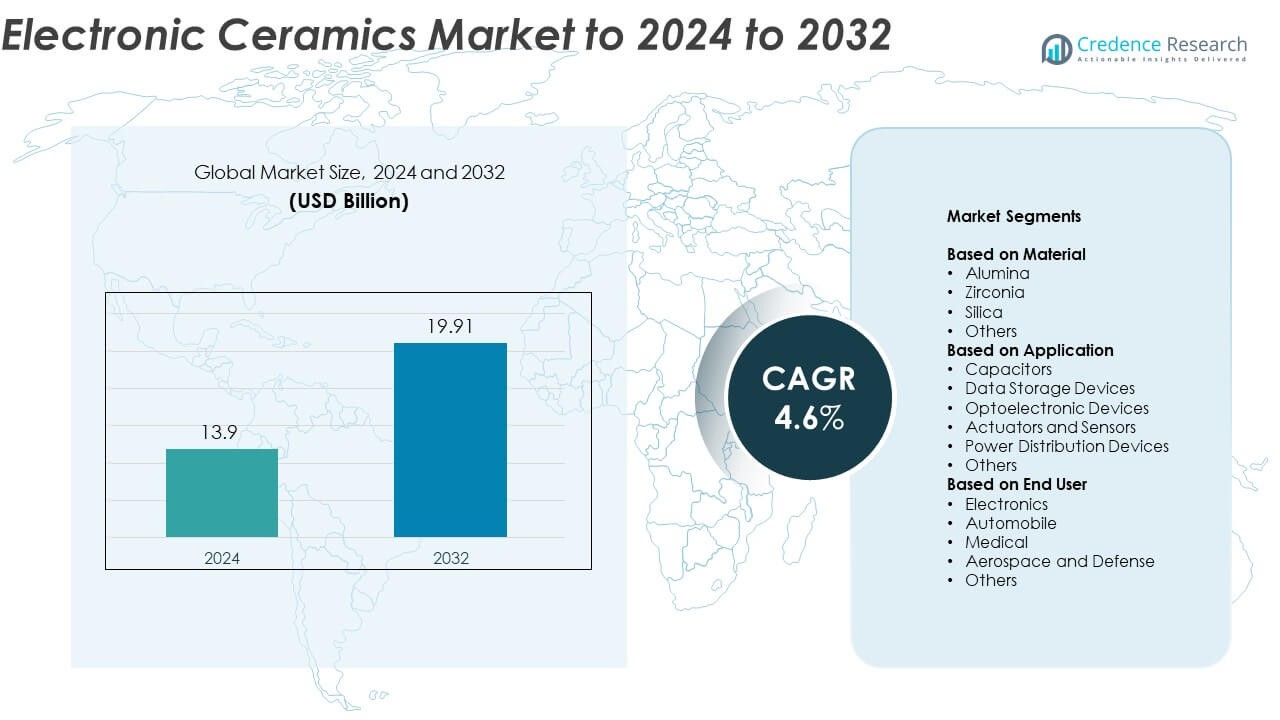
The Electronic Ceramics Market size was valued at USD 13.9 Billion in 2024 and is anticipated to reach USD 19.91 Billion by 2032, at a CAGR of 4.6% during the forecast period.
| REPORT ATTRIBUTE | DETAILS |
|---|---|
| Historical Period | 2020-2023 |
| Base Year | 2024 |
| Forecast Period | 2025-2032 |
| Electronic Ceramics Market Size 2024 | USD 13.9 Billion |
| Electronic Ceramics Market, CAGR | 4.6% |
| Electronic Ceramics Market Size 2032 | USD 19.91 Billion |
The electronic ceramics market is characterized by strong competition among major players such as CoorsTek Inc., CeramTec GmbH, Venator Materials PLC (Huntsman Corporation), Central Electronics Limited, Noritake Co. Limited, Compagnie de Saint-Gobain S.A., and Ferro Corporation. These companies emphasize innovation in dielectric, piezoelectric, and insulating materials to meet the demands of high-performance electronics, electric vehicles, and medical devices. North America leads the global market with a 37.6% share in 2024, supported by robust R&D infrastructure and growing adoption of advanced materials in semiconductor and defense industries. Asia Pacific follows closely, driven by large-scale electronics manufacturing in China, Japan, and South Korea.
Market Insights
- The electronic ceramics market was valued at USD 13.9 billion in 2024 and is projected to reach USD 19.91 billion by 2032, expanding at a CAGR of 4.6%.
- Rising demand for high-performance electronic components in electric vehicles, 5G infrastructure, and renewable energy systems is driving steady market growth.
- Advancements in miniaturization, dielectric materials, and additive manufacturing are shaping new trends, improving product reliability and design flexibility.
- The market remains moderately consolidated, with companies focusing on innovation and material optimization to enhance thermal and electrical performance.
- North America leads with a 37.6% share, followed by Asia Pacific at 29.8%, while the alumina segment dominates material usage with 41.2% share, supported by expanding applications in capacitors and sensors.
 Market Segmentation Analysis:
By Material
The alumina segment dominates the electronic ceramics market with approximately 41.2% share in 2024. Its leadership is attributed to high thermal conductivity, electrical insulation, and mechanical strength, making it suitable for substrates, sensors, and electronic packaging. Alumina ceramics are extensively used in integrated circuits and power modules due to their cost-effectiveness and reliability under high-temperature operations. Increasing demand for miniaturized electronic components in consumer devices and automotive electronics continues to boost alumina’s adoption, while zirconia and silica are gaining traction in high-performance applications requiring enhanced toughness and dielectric properties.
- For instance, Kyocera’s 99.6% alumina thin-film substrates are produced up to 120 × 120 mm with standard thicknesses of 0.25/0.38/0.635 mm, supporting high-heat, high-insulation uses.
By Application
The capacitors segment leads the market with nearly 33.6% share in 2024. This dominance is driven by the extensive use of multilayer ceramic capacitors in consumer electronics, telecommunication equipment, and electric vehicles. Rising demand for compact, energy-efficient components in 5G infrastructure and EV powertrains supports steady market growth. Ceramic materials offer high dielectric constants and stability across temperature ranges, ensuring superior performance and reliability. Growing production of miniaturized capacitors for smartphones and data storage devices further strengthens this segment’s position globally.
- For instance, Murata began mass production of a 47 µF MLCC in the 0402 size (1.0 × 0.5 mm) in July 2025, a world-first achievement enabling higher energy density and more compact electronic designs compared to previous 0603 size products of the same capacitance.
By End User
The electronics segment holds the largest market share of about 45.8% in 2024. Its dominance results from strong demand across semiconductors, sensors, and passive components in consumer and industrial devices. Expanding production of smartphones, wearable electronics, and electric vehicles fuels adoption of advanced ceramic materials due to their high insulation and heat resistance. Additionally, the shift toward IoT-enabled systems and renewable energy infrastructure drives further utilization of electronic ceramics. The automobile and medical sectors are emerging growth areas, supported by increasing use in actuators, sensors, and implantable devices.
Key Growth Drivers
Rising Demand for Advanced Electronic Components
The growing adoption of advanced electronic components in consumer electronics, electric vehicles, and industrial automation systems is a primary growth driver. Electronic ceramics enable high thermal stability, insulation, and miniaturization, which are critical for high-frequency and high-voltage devices. The rising penetration of 5G networks and smart devices further accelerates the demand for multilayer ceramic capacitors and piezoelectric sensors. Continuous innovations in materials with improved dielectric and piezoelectric properties are also expanding their use in power modules and signal processing components.
- For instance, TDK’s automotive-grade MLCC portfolio spans down to 0.4 × 0.2 mm (EIA 01005) with rated voltages from 2.5 V to 630 V, backing miniaturized, high-reliability designs.
Expansion of Electric Vehicles and Renewable Energy Systems
The global shift toward electric mobility and renewable energy generation is fueling the demand for electronic ceramics in energy storage and power control systems. Ceramic-based components such as insulators, actuators, and capacitors are essential for managing high-voltage operations in EV batteries and inverters. Their superior durability and temperature resistance ensure reliable performance in harsh environments. Governments promoting sustainable transportation and grid modernization are further boosting investment in electronic ceramics for clean energy applications.
- For instance, Samsung Electro-Mechanics notes an electric vehicle can require about 20,000–30,000 MLCCs, showing the scale of ceramic components in power and control electronics.
Growth in Healthcare and Medical Electronics
Increasing adoption of advanced medical electronics, including imaging systems, diagnostic sensors, and implantable devices, drives significant demand for electronic ceramics. These materials are used in ultrasound transducers, pacemakers, and bio-compatible sensors due to their stable piezoelectric properties and chemical inertness. The growing aging population and rising healthcare investments globally enhance market expansion. Additionally, advancements in miniaturized and high-precision medical instruments are further strengthening the application scope of ceramics in the medical device sector.
Key Trends & Opportunities
Integration of IoT and Smart Technologies
The integration of Internet of Things (IoT) and smart technologies is creating new opportunities for electronic ceramics in connected devices. These materials support compact, efficient, and high-performance components that enable seamless data transmission and energy efficiency. Expanding smart home systems, wearable electronics, and industrial sensors are key contributors to market growth. Manufacturers are focusing on developing thin-film and nanostructured ceramics to meet the evolving performance requirements of next-generation electronic systems.
- For instance, Murata began mass production of the world’s first 006003-inch size (0.16 × 0.08 mm) multilayer ceramic capacitor (MLCC) in September 2024, enabling extreme miniaturization for use in sensors and modules within connected devices.
Advancements in Ceramic Additive Manufacturing
The adoption of additive manufacturing for producing complex ceramic components is emerging as a major trend. 3D printing allows precise customization of ceramic structures for electronic applications, reducing waste and production costs. This technological shift enhances design flexibility and accelerates prototyping for specialized components such as sensors and substrates. Increased research in high-performance ceramic inks and powders is expected to expand the scalability of additive manufacturing within electronic ceramics production.
- For instance, Lithoz demonstrated that a network of 100 CeraFab S65 printers can produce nearly 14 million identical ceramic parts per year at 3:46 minutes per part, showcasing scalable serial production.
Key Challenges
High Production and Processing Costs
The manufacturing of electronic ceramics involves complex sintering and machining processes that require high temperatures and precise control. These procedures significantly increase production costs, limiting the adoption of ceramics in low-cost applications. The need for advanced equipment and raw material purity further raises capital investment. Cost reduction through process optimization and recycling of ceramic waste remains a key challenge for manufacturers seeking large-scale deployment in mass-market electronic devices.
Performance Limitations Under Extreme Conditions
Although electronic ceramics offer superior electrical and thermal properties, they can exhibit brittleness and reduced mechanical strength under extreme mechanical stress or rapid temperature changes. This limitation poses challenges in high-vibration or thermal-cycling environments such as aerospace and automotive systems. Ongoing research aims to enhance toughness and flexibility without compromising functional performance. Developing hybrid composites and advanced coatings presents an opportunity to overcome these durability constraints in demanding operational settings.
Regional Analysis
North America
North America dominates the electronic ceramics market with a 37.6% share in 2024. The region’s leadership stems from strong demand across consumer electronics, automotive electronics, and defense applications. High investment in advanced manufacturing and materials research supports technological progress in ceramic components. The presence of key semiconductor and aerospace companies accelerates product innovation in sensors, capacitors, and actuators. Expanding electric vehicle adoption and renewable energy integration further strengthen market growth, while the United States remains the key contributor due to robust industrial and R&D infrastructure.
Europe
Europe holds a 26.3% share of the electronic ceramics market in 2024. The region benefits from a strong base of automotive and aerospace industries, driving consistent use of ceramic-based components. Stringent environmental regulations encourage the adoption of durable, energy-efficient materials in power electronics and sensors. Germany, France, and the United Kingdom lead demand due to their advanced electronics and renewable energy sectors. Increased focus on miniaturization and lightweight materials in high-performance systems continues to propel market expansion across industrial and medical applications.
Asia Pacific
Asia Pacific accounts for a 29.8% share of the global electronic ceramics market in 2024. The region’s dominance is supported by large-scale electronics manufacturing in China, Japan, South Korea, and Taiwan. Strong production capabilities for semiconductors, sensors, and capacitors fuel steady demand for advanced ceramics. Rapid urbanization, expansion of 5G infrastructure, and the growing electric vehicle market contribute to sustained growth. Continuous investment in R&D and material innovation strengthens the regional supply chain, while rising consumer electronics demand ensures long-term market expansion.
Latin America
Latin America captures a 4.1% share of the electronic ceramics market in 2024. Market growth is driven by increasing adoption of electronic components in automotive and industrial automation sectors. Brazil and Mexico are key contributors due to expanding electronics assembly operations and growing renewable energy projects. The rising focus on smart manufacturing and electric mobility supports the use of high-performance ceramics. However, limited domestic production and reliance on imports present challenges, though growing regional investments are expected to enhance future market potential.
Middle East & Africa
The Middle East and Africa hold a 2.2% share of the electronic ceramics market in 2024. Growth in the region is supported by expanding power generation, healthcare, and defense applications. The UAE and Saudi Arabia are witnessing increased demand for advanced electronic components in automation and energy systems. Infrastructure development and industrial diversification initiatives are boosting electronics manufacturing activity. However, the market remains in a developing stage, with import dependence and limited technological capacity being key constraints to large-scale adoption.
Market Segmentations:
By Material
- Alumina
- Zirconia
- Silica
- Others
By Application
- Capacitors
- Data Storage Devices
- Optoelectronic Devices
- Actuators and Sensors
- Power Distribution Devices
- Others
By End User
- Electronics
- Automobile
- Medical
- Aerospace and Defense
- Others
By Geography
- North America
- U.S.
- Canada
- Mexico
- Europe
- Germany
- France
- U.K.
- Italy
- Spain
- Rest of Europe
- Asia Pacific
- China
- Japan
- India
- South Korea
- South-east Asia
- Rest of Asia Pacific
- Latin America
- Brazil
- Argentina
- Rest of Latin America
- Middle East & Africa
- GCC Countries
- South Africa
- Rest of the Middle East and Africa
Competitive Landscape
The competitive landscape of the electronic ceramics market features prominent players such as CoorsTek Inc., CeramTec GmbH, Venator Materials PLC (Huntsman Corporation), Central Electronics Limited, Noritake Co. Limited, Compagnie de Saint-Gobain S.A., Physik Instrumente (PI) GmbH & Co. KG., APC International Ltd., Ferro Corporation, Almatis GmbH, American Elements, Ishihara Sangyo Kaisha Ltd., and Sensor Technology Ltd. The market is moderately consolidated, with competition driven by product innovation, material quality, and customization capabilities. Companies focus on developing advanced ceramics with superior dielectric and thermal properties to meet evolving performance standards in automotive, medical, and semiconductor applications. Strategic partnerships and R&D investments are enhancing product portfolios and global reach, particularly in Asia Pacific and North America. Growing adoption of electric vehicles and 5G infrastructure is encouraging manufacturers to scale production of multilayer ceramic capacitors and piezoelectric components. Continuous focus on sustainability and high-temperature resilience further shapes competitive differentiation.
Key Player Analysis
- CoorsTek Inc.
- CeramTec GmbH
- Venator Materials PLC (Huntsman Corporation)
- Central Electronics Limited
- Noritake Co. Limited
- Compagnie de Saint-Gobain S.A.
- Physik Instrumente (PI) GmbH & Co. KG.
- APC International Ltd.
- Ferro Corporation
- Almatis GmbH
- American Elements
- Ishihara Sangyo Kaisha Ltd.
- Sensor Technology Ltd.
Recent Developments
- In 2025, Almatis broke ground on a new calcined alumina plant in the Qingdao Economic Development Zone, China.
- In 2025, CeramTec launched a new 98% alumina substrate for power electronics applications, showcasing this innovation at the PCIM Expo in Nuremberg, Germany.
- In 2025, Noritake Co. Limited Announced corporate split covering thick-film circuit substrate business. Move streamlines industrial ceramics operations.
Report Coverage
The research report offers an in-depth analysis based on Material, Application, End-User and Geography. It details leading market players, providing an overview of their business, product offerings, investments, revenue streams, and key applications. Additionally, the report includes insights into the competitive environment, SWOT analysis, current market trends, as well as the primary drivers and constraints. Furthermore, it discusses various factors that have driven market expansion in recent years. The report also explores market dynamics, regulatory scenarios, and technological advancements that are shaping the industry. It assesses the impact of external factors and global economic changes on market growth. Lastly, it provides strategic recommendations for new entrants and established companies to navigate the complexities of the market.
Future Outlook
- The demand for electronic ceramics will rise with the growing adoption of electric vehicles.
- Advancements in 5G infrastructure will boost the use of multilayer ceramic capacitors.
- Increased miniaturization of electronic devices will drive innovation in ceramic substrates.
- Medical electronics will expand applications for biocompatible and piezoelectric ceramics.
- Integration of IoT and AI-based systems will enhance the need for high-performance components.
- The shift toward renewable energy will support ceramics in power distribution equipment.
- Additive manufacturing will enable customized ceramic parts with improved efficiency.
- Asia Pacific will remain a key production hub due to strong semiconductor manufacturing.
- Research in nanoceramics will create new opportunities for high-frequency electronics.
- Sustainability goals will encourage the development of energy-efficient ceramic materials.

Request a Free Sample
Fill in your details and we'll send you a free sample report.
- Sample data tables & charts
- Research methodology
Need a Custom Version of This Report?
Tailor the scope, geography, or segments to your exact requirements.
- Custom geography or segment scope
- Direct access to our analyst team
Frequently Asked Questions
What is the current market size for Electronic Ceramics Market, and what is its projected size in 2032?
At what Compound Annual Growth Rate is the Electronic Ceramics Market projected to grow between 2025 and 2032?
Which Electronic Ceramics Market segment held the largest share in 2024?
What are the primary factors fueling the growth of the Electronic Ceramics Market?
Who are the leading companies in the Electronic Ceramics Market?
Which region commanded the largest share of the Electronic Ceramics Market in 2024?
Table of Content
Chapter 1 Market Segmentation
- 1.1 Segmentation Framework
- 1.1.1 Product and Service Classification
- 1.1.2 Application and End-Use Classification
- 1.1.3 Technology and Solution Classification
- 1.1.4 Customer and Distribution Channel Classification
- 1.1.5 Geographic Segmentation
- 1.1.6 Market Segment Definitions and Boundaries
Chapter 2 Introduction
- 2.1 Report Objectives and Scope
- 2.2 Product Definition and Industry Terminology
- 2.3 Market Inclusions and Exclusions
- 2.4 Research Process
- 2.4.1 Primary Research and Expert Interviews
- 2.4.2 Secondary Research and Source Review
- 2.4.3 Top-Down and Bottom-Up Estimation
- 2.4.4 Data Triangulation and Verification
- 2.5 Market Size Measurement Basis
- 2.5.1 2024: USD 13.9 billion → 2032: USD 19.91 billion
- 2.6 Historical and Forecast Reference Periods
- 2.6.1 Base Year: 2024
- 2.6.2 Forecast Period: 2024-2032
- 2.7 Research Assumptions and Limitations
Chapter 3 Executive Summary
- 3.1 Market Snapshot and Key Findings
- 3.2 Base-Year Market Size, 2024
- 3.3 Forecast Market Size, 2032
- 3.4 Revenue and Volume Growth Outlook
- 3.5 Key Demand and Supply Indicators
- 3.6 Leading Market Segments
- 3.7 Fastest-Growing Market Opportunities
- 3.8 Regional Performance Highlights
- 3.9 Technology and Industry Transformation
- 3.10 Competitive Landscape Summary
- 3.11 Analyst View and Strategic Implications
Chapter 4 Global Electronic Ceramics Market Trends and Developments
- 4.1 Historical Industry Development
- 4.2 Recent Market Trends and Developments
- 4.3 Demand and Customer Behavior Trends
- 4.4 Technology and Product Innovation
- 4.5 Artificial Intelligence, Automation and Digitalization
- 4.6 Local Manufacturing and Supply Chain Realignment
- 4.7 Industry Partnerships, Mergers and Acquisitions
- 4.8 Sustainability and Circular Economy Developments
- 4.9 Government and Private Sector Investment Trends
- 4.10 Emerging Business Models and Commercialization
- 4.11 Industry Developments and Announcements
Chapter 5 Global Electronic Ceramics Market Production, Supply and Demand Analysis
- 5.1 Demand Trend and Consumption Analysis
- 5.2 Demand Forecast, 2024-2032
- 5.3 Production and Output Trend
- 5.4 Production and Output Forecast, 2024-2032
- 5.5 Installed Capacity and Capacity Utilization
- 5.6 Company-Wise Production Plants and Statistics
- 5.6.1 Installed Production Capacity
- 5.6.2 Actual Production
- 5.6.3 Planned Capacity and Expansion Targets
- 5.7 Supply Chain Structure and Procurement Trends
- 5.8 Supply-Demand Gap and Bottlenecks
- 5.9 Import Dependence and Sourcing Structure
- 5.10 Contract Manufacturing and Outsourcing
- 5.11 Regional Supply and Demand Concentration
Chapter 6 Global Electronic Ceramics Market Pricing Analysis
- 6.1 Pricing Structure and Measurement
- 6.2 Historical Pricing Trends
- 6.3 Pricing Outlook, 2024-2032
- 6.4 Average Selling Price and Unit Economics
- 6.5 Pricing by Product and Market Segment
- 6.6 Geographic Pricing Differences
- 6.7 Key Input, Energy, Labor and Logistics Costs
- 6.8 Contract Pricing and Purchasing Models
- 6.9 Pricing Sensitivity and Competitive Positioning
- 6.10 Price, Margin and Profitability Implications
Chapter 7 Global Electronic Ceramics Market Dynamics
- 7.1 Market Growth Drivers
- 7.1.1 Demand-Side Drivers
- 7.1.2 Technology and Innovation Drivers
- 7.1.3 Infrastructure and Investment Drivers
- 7.1.4 Regulatory and Policy Drivers
- 7.2 Market Restraints
- 7.2.1 Cost and Affordability Constraints
- 7.2.2 Technology and Adoption Barriers
- 7.2.3 Supply Chain and Operational Constraints
- 7.3 Market Challenges
- 7.3.1 Competitive Pressure and Margin Erosion
- 7.3.2 Skills, Infrastructure and Implementation Gaps
- 7.4 Emerging Market Opportunities
- 7.5 Market Dynamics Impact and Time-Horizon Assessment
Chapter 8 Global Electronic Ceramics Value Chain Analysis
- 8.1 Industry Value Chain Overview
- 8.2 Upstream Suppliers and Critical Inputs
- 8.3 Technology and Component Providers
- 8.4 Manufacturing or Service Delivery
- 8.5 Distribution, Channel Partners and Integrators
- 8.6 Downstream Applications and End Users
- 8.7 Value Addition and Profit Pools
- 8.8 Vertical Integration and Outsourcing
- 8.9 Supplier Concentration and Risk
- 8.10 Supply Chain Localization and Resilience
Chapter 9 Global Electronic Ceramics Market Regulations and Policies
- 9.1 Relevant Laws, Standards and Compliance Frameworks
- 9.2 Product, Service, Safety and Quality Requirements
- 9.3 Government Policies, Incentives and Subsidies
- 9.4 Imports, Exports and Trade Barriers
- 9.5 Public Procurement and Local Content Requirements
- 9.6 Environmental and Sustainability Compliance
- 9.7 Upcoming Policy Changes and Market Implications
Chapter 10 Global Electronic Ceramics Market Hotspots and Opportunities
- 10.1 Market Opportunity Mapping and Growth Hotspots
- 10.2 High-Growth Applications and Customer Groups
- 10.3 Underserved Markets and White-Space Opportunities
- 10.4 Emerging Technology and Product Opportunities
- 10.5 New Capacity and Investment Hotspots
- 10.6 Market Entry and Expansion Opportunities
- 10.7 Distribution and Partnership Opportunities
- 10.8 Near-Term and Long-Term Commercial Potential
- 10.9 Opportunity Attractiveness and Execution Risks
Chapter 11 Global Electronic Ceramics Market Outlook, 2024-2032
- 11.1 Market Size and Analysis
- 11.1.1 Revenue (Market Measurement: 2024: USD 13.9 billion → 2032: USD 19.91 billion)
- 11.1.2 Market Volume and Quantity Sold
- 11.1.3 Historical Market Size
- 11.1.4 Base-Year Market Size, 2024
- 11.2 Market Forecast, 2024-2032
- 11.2.1 Revenue Forecast to 2032
- 11.2.2 Volume Forecast to 2032
- 11.2.3 CAGR and Year-on-Year Growth
- 11.2.4 Incremental Revenue Opportunity
- 11.3 Forecast Assumptions and Scenario Analysis
- 11.3.1 Base-Case Forecast
- 11.3.2 Optimistic and Conservative Scenarios
- 11.3.3 Technology, Pricing and Policy Sensitivities
- 11.4 Market Attractiveness and Growth Outlook
Chapter 12 Global Electronic Ceramics Market Segmentation and Outlook
- 12.1 Segmentation Summary and Market Shares, 2024
- 12.2 Largest and Fastest-Growing Segments
- 12.3 Segment Growth Comparison
- 12.4 Segment Attractiveness and Priority Matrix
Chapter 13 Global Electronic Ceramics Geographic Market Outlook, 2024-2032
- 13.1 Regional Market Size and Share, 2024
- 13.2 Regional Market Forecast, 2024-2032
- 13.3 Regional Pricing, Production and Demand Differences
- 13.4 North America
- 13.4.1 United States
- 13.4.2 Canada
- 13.4.3 Mexico
- 13.5 Europe
- 13.5.1 Germany
- 13.5.2 France
- 13.5.3 Italy
- 13.5.4 United Kingdom
- 13.5.5 Spain
- 13.5.6 Poland
- 13.5.7 Russia
- 13.5.8 Netherlands
- 13.5.9 Belgium
- 13.5.10 Sweden
- 13.5.11 Denmark
- 13.5.12 Norway
- 13.5.13 Rest of Europe
- 13.6 Asia Pacific
- 13.6.1 China
- 13.6.2 India
- 13.6.3 Japan
- 13.6.4 South Korea
- 13.6.5 Thailand
- 13.6.6 Indonesia
- 13.6.7 Vietnam
- 13.6.8 Malaysia
- 13.6.9 Australia
- 13.6.10 Rest of Asia Pacific
- 13.7 Latin America
- 13.7.1 Brazil
- 13.7.2 Argentina
- 13.7.3 Colombia
- 13.7.4 Chile
- 13.7.5 Rest of Latin America
- 13.8 Middle East
- 13.8.1 Saudi Arabia
- 13.8.2 United Arab Emirates
- 13.8.3 Turkey
- 13.8.4 Israel
- 13.8.5 Iran
- 13.8.6 Rest of the Middle East
- 13.9 Africa
- 13.9.1 South Africa
- 13.9.2 Egypt
- 13.9.3 Nigeria
- 13.9.4 Morocco
- 13.9.5 Rest of Africa
- 13.10 Regional Investment, Policy and Supply Chain Differences
- 13.11 Regional Competitive Landscape
- 13.12 Geographic Growth Hotspots
Chapter 14 Global Electronic Ceramics Technology, Innovation and Sustainability Outlook
- 14.1 Technology Landscape and Maturity
- 14.2 Product, Process and Service Innovation
- 14.3 AI, Automation and Digital Tools in the Industry
- 14.4 Technology Adoption and Performance Benchmarking
- 14.5 Innovation Pipeline and R&D Investment
- 14.6 Patent and Intellectual Property Trends
- 14.7 Energy Efficiency and Resource Management
- 14.8 Sustainability, Recycling and Circularity
- 14.9 Technology Roadmap, 2024-2032
- 14.10 Risks of Obsolescence and Technology Substitution
Chapter 15 Global Electronic Ceramics Market Key Strategic Imperatives
- 15.1 Growth and Market Entry Priorities
- 15.2 High-Return Products and Segments
- 15.3 Pricing, Profitability and Cost Optimization
- 15.4 Technology Investment and Product Differentiation
- 15.5 Supply Chain Localization and Resilience
- 15.6 Distribution and Customer Acquisition
- 15.7 Partnership, Acquisition and Capacity Strategy
- 15.8 Regional Expansion Priorities
- 15.9 Short-, Medium- and Long-Term Actions
Chapter 16 Competition Outlook
- 16.1 Industry Competition Characteristics
- 16.2 Market Structure and Concentration
- 16.3 Market Share and Competitive Positioning, 2024
- 16.4 Company-Wise Revenue and Product Benchmarking
- 16.5 Production and Service Capacity Benchmarking
- 16.6 Technology, Pricing and Differentiation
- 16.7 Regional Footprint and Distribution Strength
- 16.8 Mergers, Acquisitions and Strategic Alliances
- 16.9 New Entrants and Competitive Threats
- 16.10 Porter's Five Forces and Industry Attractiveness
- 16.11 Competitive Outlook, 2024-2032
Chapter 17 Company Profiles
- 17.1 Company Coverage and Selection Criteria
- 17.2 Leading Market Participants – Standard Profile Structure
- 17.2.1 Business Description
- 17.2.2 Company Ownership and Geographic Presence
- 17.2.3 Product and Service Portfolio
- 17.2.4 Manufacturing and Operating Footprint
- 17.2.5 Production Capacity and Expansion Plans
- 17.2.6 Financial Performance and Investment
- 17.2.7 Market Share and Competitive Position
- 17.2.8 Technology and Innovation Capabilities
- 17.2.9 Strategic Alliances or Partnerships
- 17.2.10 Recent Developments
- 17.2.11 Growth Strategy and Outlook
- 17.3 Other Relevant Market Participants
Note: Every listed company is profiled on the structure shown under the first company. The company list is preliminary and may change based on research findings, market developments, data availability and client requirements.
Chapter 18 Disclaimer
- 18.1 Research and Forecast Disclaimer
- 18.2 Data Source and Estimation Limitations
Note: The depth of individual sections depends on data availability for this market. Volume, capacity, trade and other unit-based metrics are included where applicable.

