Market Overview
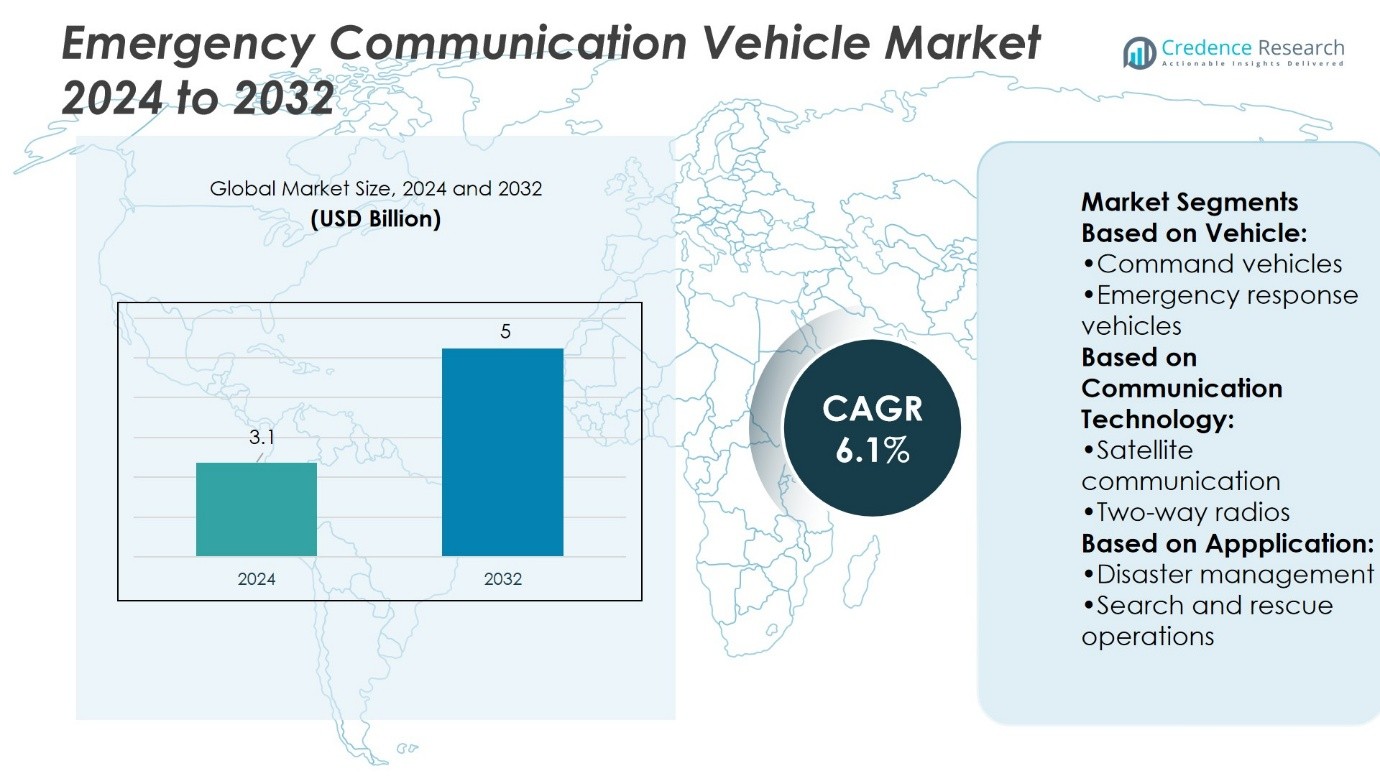
Emergency Communication Vehicle Market size was valued at USD 3.1 billion in 2024 and is anticipated to reach USD 5 billion by 2032, at a CAGR of 6.1% during the forecast period.
| REPORT ATTRIBUTE | DETAILS |
|---|---|
| Historical Period | 2020-2023 |
| Base Year | 2024 |
| Forecast Period | 2025-2032 |
| Emergency Communication Vehicle Market Size 2024 | USD 3.1 Billion |
| Emergency Communication Vehicle Market, CAGR | 6.1% |
| Emergency Communication Vehicle Market Size 2032 | USD 5 Billion |
The Emergency Communication Vehicle Market grows with rising demand for rapid-response systems, supported by government investments in disaster preparedness, homeland security, and public safety programs. Advanced vehicles equipped with satellite, 5G, and IoT-enabled communication ensure uninterrupted connectivity during natural disasters, large-scale emergencies, and security operations. It enables real-time coordination between medical, defense, and rescue agencies, improving efficiency in crisis management. The market also reflects a trend toward modular and energy-efficient platforms, including hybrid and electric fleets, aligning with sustainability goals. Increasing adoption of AI-driven analytics and interoperability solutions further strengthens operational effectiveness and positions the market for steady long-term growth.
North America holds the largest share of the Emergency Communication Vehicle Market, supported by advanced infrastructure and strong government funding. Europe follows with strict safety standards and adoption of hybrid fleets, while Asia-Pacific shows rapid growth driven by disaster management needs in China, Japan, and India. Latin America and the Middle East & Africa steadily expand with support from public safety initiatives. Key players shaping this competitive landscape include Rosenbauer International AG, Pierce Manufacturing Inc., REV Group, Inc., and Oshkosh Corporation.
Market Insights
- Emergency Communication Vehicle Market size was valued at USD 3.1 billion in 2024 and is anticipated to reach USD 5 billion by 2032, at a CAGR of 6.1%.
- Rising government investments in disaster preparedness, homeland security, and public safety programs drive adoption.
- Advanced vehicles with satellite, 5G, and IoT-enabled systems ensure uninterrupted connectivity during emergencies.
- Competition intensifies with focus on modular designs, hybrid fleets, and AI-driven communication solutions.
- High procurement and maintenance costs act as restraints for smaller agencies and developing regions.
- North America leads with strong infrastructure, Europe follows with sustainability initiatives, and Asia-Pacific grows rapidly with disaster management needs.
- Latin America and the Middle East & Africa expand steadily with public safety programs and international support.
Market Drivers
Growing Demand for Rapid Emergency Response Solutions
The Emergency Communication Vehicle Market grows with demand for quick and reliable response systems. Governments and agencies prioritize mobile communication units to strengthen disaster management. These vehicles provide connectivity during floods, wildfires, and earthquakes when networks fail. Public safety departments rely on them to maintain coordination between first responders. It ensures continuity of operations in critical situations where infrastructure collapses. Rising urban risks further amplify the adoption of these vehicles across regions.
- For instance, Continental AG’s 5G hybrid V2X platform integrates a Network Access Device (NAD) module supporting 4G and 5G cellular communication with Dedicated Short Range Communication (DSRC) capabilities.
Integration of Advanced Communication Technologies in Mobile Units
The integration of 5G, satellite, and IoT technologies drives the Emergency Communication Vehicle Market. Mobile units now deliver high-speed data transfer, real-time video, and voice communications. It improves situational awareness for law enforcement, rescue, and healthcare teams. Manufacturers invest in ruggedized systems that ensure uninterrupted service in remote terrains. Enhanced cybersecurity measures also protect communication against hacking or data leaks. The trend favors vehicles equipped with multi-band antennas and modular systems.
- For instance, REV Fire Group rolled out the Vector fully electric fire truck, which has a 327 kWh automotive-grade battery capacity and can drive and pump solely on electric power. The company also offers an optional diesel-powered range extender for extended operations or as a backup power source.
Rising Government Initiatives and Public Safety Investments
Public sector spending acts as a primary driver for the Emergency Communication Vehicle Market. Governments allocate funds for national security, disaster preparedness, and civil defense programs. It ensures deployment of communication fleets in both urban and rural locations. Regulations supporting resilient infrastructure strengthen demand for mobile command units. International aid organizations also adopt these vehicles for cross-border emergency support. Growing awareness of climate risks further influences public sector adoption.
Increasing Need for Interoperability and Coordination Across Agencies
Interoperability has become essential for the Emergency Communication Vehicle Market. Different agencies require platforms that integrate police, fire, medical, and defense communication. It allows real-time data sharing during multi-agency operations. Vendors focus on software-defined radios and unified command systems to meet this demand. The ability to link with drones and unmanned systems enhances field coordination. Market adoption rises as stakeholders prioritize vehicles that bridge communication gaps across agencies.
Market Trends
Adoption of Next-Generation Wireless and Satellite Connectivity
The Emergency Communication Vehicle Market advances with integration of 5G, satellite, and hybrid networks. These vehicles now support high-bandwidth data transfer for video surveillance and live updates. It ensures reliable coverage in urban and remote regions where terrestrial systems fail. Emergency agencies benefit from instant communication with command centers and field units. Vendors prioritize multi-network capabilities that secure seamless handovers between platforms. The trend positions these vehicles as central nodes in critical communication ecosystems.
- For instance, Marion Body Works builds custom pumper vehicles that can be configured with a 1,750 GPM Waterous CSU pump, a 1,000-gallon UPF Poly III water tank, and a 450 HP Cummins L9 diesel engine, enabling high-capacity water delivery for firefighting.
Integration of Artificial Intelligence and Smart Analytics
Artificial intelligence plays a growing role in the Emergency Communication Vehicle Market. AI-driven tools improve situational awareness by analyzing real-time voice, image, and sensor data. It helps responders predict risks and allocate resources effectively during crises. Manufacturers embed smart dashboards that deliver actionable insights instantly. Pattern recognition enhances threat detection, from crowd control to disaster zones. The shift toward intelligent decision support systems strengthens vehicle relevance in modern response strategies.
- For instance, KME offers pumper vehicles with an ultra-low 43-inch hosebed for rapid and ergonomic access, or a wide hosebed option with over 105 cubic feet of storage for maximizing volume.
Expansion of Custom-Built and Modular Vehicle Platforms
Demand grows for modular platforms in the Emergency Communication Vehicle Market. Agencies request vehicles tailored to their unique operational requirements. It enables integration of specialized tools, including drones, medical equipment, and tactical radios. Flexible vehicle designs allow faster deployment across varied terrains. This customization trend reduces downtime and improves mission adaptability. Rising procurement of multi-purpose units indicates a preference for scalable, cost-efficient solutions.
Focus on Sustainability and Energy-Efficient Vehicle Designs
Environmental considerations shape the Emergency Communication Vehicle Market through sustainable vehicle development. Agencies adopt hybrid and electric-powered fleets to reduce fuel reliance. It aligns with government regulations supporting carbon-neutral emergency systems. Lightweight materials improve fuel efficiency while maintaining durability in harsh environments. Solar power add-ons extend operational time without reliance on traditional energy. The market trend reflects growing alignment between emergency response needs and sustainability goals.
Market Challenges Analysis
High Operational Costs and Complex Deployment Barriers
The Emergency Communication Vehicle Market faces challenges from high procurement and operational costs. Advanced vehicles require significant investment in satellite systems, multi-band radios, and cybersecurity features. It creates budget constraints for smaller municipalities and developing regions. Complex deployment processes also delay adoption, especially in areas with limited technical expertise. Training and maintenance expenses further strain emergency agencies already operating on tight budgets. These barriers slow the pace of modernization and limit market penetration.
Interoperability Issues and Vulnerability to Cyber Threats
Interoperability remains a critical challenge for the Emergency Communication Vehicle Market. Agencies often use different communication standards, limiting seamless coordination during multi-jurisdictional operations. It reduces efficiency in emergencies where fast collaboration is essential. Cybersecurity also emerges as a growing concern due to reliance on digital platforms. Threats of hacking or data breaches compromise sensitive information during disaster response. Vendors must continuously update systems to safeguard communication channels and maintain trust among users.
Market Opportunities
Rising Demand for Disaster Preparedness and Public Safety Programs
The Emergency Communication Vehicle Market benefits from growing investment in disaster resilience. Governments and organizations expand budgets for rapid-response fleets to address climate-related emergencies. It creates opportunities for suppliers to deliver vehicles with advanced satellite, IoT, and 5G capabilities. Public safety programs increasingly emphasize real-time coordination across law enforcement, medical, and defense units. International humanitarian agencies also adopt these vehicles to ensure connectivity in conflict or disaster zones. The demand positions the market for long-term growth supported by policy and funding.
Technological Innovation and Expansion into Emerging Regions
Innovation in energy-efficient and modular platforms opens new opportunities for the Emergency Communication Vehicle Market. Hybrid and electric-powered designs gain traction as agencies pursue sustainable solutions. It encourages manufacturers to develop vehicles capable of longer missions with reduced environmental impact. Emerging regions in Asia-Pacific, Latin America, and Africa present untapped markets with rising security and disaster risks. Local partnerships enable faster entry and cost-effective deployment in these areas. The combination of innovation and regional expansion enhances future market potential.
Market Segmentation Analysis:
By Vehicle
The Emergency Communication Vehicle Market divides into command vehicles, emergency response vehicles, mobile communication centers, and rescue vehicles. Command vehicles dominate due to their role in coordinating multi-agency operations. It supports decision-making through integrated communication and monitoring systems. Emergency response vehicles follow, valued for quick deployment in urban and rural incidents. Mobile communication centers are expanding with demand for fully equipped, self-sufficient hubs capable of supporting large-scale operations. Rescue vehicles remain vital, ensuring immediate aid during natural disasters and critical incidents. The growth across these categories highlights rising reliance on versatile and specialized fleets.
- For instance, Telit Cinterion’s PLS63 LTE Cat 1 module provides a downlink data rate of 10.2 Mbps and an uplink rate of 5.2 Mbps within a compact 33 × 29 × 2.6 mm form factor, making it ideal for robust vehicle telematics and IoT deployments.
By Communication Technology
Communication technology segments include satellite communication, two-way radios, wireless and cellular networks, and IoT-based systems. Satellite communication holds a strong share, offering uninterrupted service in remote and disaster-hit areas. It ensures agencies remain connected when terrestrial networks collapse. Two-way radios continue to serve frontline responders due to their reliability and simplicity. Wireless and cellular networks are expanding with the rise of 5G-enabled vehicles supporting faster data transfer. IoT-based systems mark an emerging segment, driving predictive insights and connected fleet management. Each technology strengthens the operational efficiency of modern emergency vehicles.
- For instance, Infineon’s external XENSIV MEMS microphone model IM67D130A operates reliably from −40 °C to +105 °C, captures audio with a total harmonic distortion under 1% up to 130 dB SPL, and withstands peaks up to 130 dB SPL-ensuring crisp emergency sound detection in noisy environments.
By Application
Applications cover disaster management, search and rescue operations, and emergency medical services (EMS). Disaster management leads demand, with agencies deploying vehicles to maintain coordination during floods, earthquakes, and wildfires. It ensures critical communication even when conventional networks fail. Search and rescue operations highlight the importance of mobile connectivity in remote terrains. Emergency medical services rely on equipped vehicles that support telemedicine, patient monitoring, and real-time data exchange with hospitals. Rising urbanization and climate risks strengthen the role of all three segments. The application scope demonstrates the market’s alignment with evolving emergency preparedness needs.
Segments:
Based on Vehicle:
- Command vehicles
- Emergency response vehicles
Based on Communication Technology:
- Satellite communication
- Two-way radios
Based on Application:
- Disaster management
- Search and rescue operations
Based on the Geography:
- North America
- U.S.
- Canada
- Mexico
- Europe
- Germany
- France
- U.K.
- Italy
- Spain
- Rest of Europe
- Asia Pacific
- China
- Japan
- India
- South Korea
- South-east Asia
- Rest of Asia Pacific
- Latin America
- Brazil
- Argentina
- Rest of Latin America
- Middle East & Africa
- GCC Countries
- South Africa
- Rest of the Middle East and Africa
Regional Analysis
North America
North America holds a market share of nearly 35% in the Emergency Communication Vehicle Market, driven by strong government investments in homeland security and disaster response infrastructure. The region prioritizes advanced command vehicles and mobile communication centers integrated with satellite and 5G networks. It benefits from the presence of leading manufacturers and technology providers focusing on defense-grade communication systems. Federal and state agencies deploy specialized fleets to support disaster management, wildfire control, and medical emergencies. Canada and the United States emphasize interoperability standards across police, fire, and emergency medical services to strengthen coordinated operations. The rising frequency of hurricanes, wildfires, and mass-casualty events sustains demand for modernized emergency vehicles in this region. Strong budget allocations and technology adoption maintain North America’s leadership in the global landscape.
Europe
Europe accounts for a market share of about 27% in the Emergency Communication Vehicle Market, supported by stringent safety regulations and cross-border emergency preparedness programs. The region deploys command and rescue vehicles across EU nations for coordinated disaster response. It focuses on energy-efficient platforms, with hybrid and electric emergency fleets gaining traction in Germany, France, and the Nordic countries. Investments in modular mobile communication centers improve interoperability among civil protection agencies. The European Union also funds initiatives that standardize communication protocols to enhance cross-country collaboration during crises. Rising risks from floods, storms, and wildfires have encouraged national governments to strengthen mobile fleet capacity. With rapid technology integration and strong public funding, Europe continues to represent a critical market for emergency communication vehicles.
Asia-Pacific
Asia-Pacific represents a market share of nearly 22% in the Emergency Communication Vehicle Market, fueled by rapid urbanization, rising natural disaster incidents, and growing security concerns. Countries like China, Japan, and India invest heavily in advanced mobile communication centers to strengthen resilience. It reflects rising awareness of the need for quick response during earthquakes, tsunamis, and large-scale floods. Governments in Southeast Asia also prioritize disaster management fleets as climate risks intensify across coastal and island nations. The adoption of IoT-enabled systems and cellular communication platforms is rising in the region. Demand for rescue and emergency medical service vehicles is particularly strong in emerging economies with rising population density. Increasing defense budgets and infrastructure programs drive steady long-term growth across Asia-Pacific.
Latin America
Latin America contributes nearly 9% of the market share in the Emergency Communication Vehicle Market, shaped by rising investments in disaster resilience and public safety programs. Countries such as Brazil, Chile, and Mexico deploy emergency response vehicles for flood and earthquake preparedness. It reflects a rising focus on enhancing coordination between civil defense, police, and emergency medical teams. However, limited budgets in some nations slow adoption of advanced satellite-based platforms. Regional governments are increasingly adopting cost-efficient two-way radio and cellular-equipped vehicles. Rising natural disasters and security challenges in urban centers create opportunities for mobile communication centers. The market in Latin America is expanding with steady government initiatives and international aid programs supporting resilient communication systems.
Middle East & Africa
The Middle East & Africa holds a market share of nearly 7% in the Emergency Communication Vehicle Market, supported by rising investments in national security and disaster response infrastructure. Gulf nations deploy modern command vehicles for defense and large-scale event security. It reflects growing emphasis on equipping fleets with satellite and wireless networks for desert and remote terrains. African countries gradually adopt emergency medical service vehicles to strengthen healthcare access in rural zones. International agencies support the deployment of rescue and communication fleets in disaster-prone areas. Limited infrastructure and funding act as barriers, yet partnerships with global suppliers are bridging gaps. With expanding public safety initiatives and modernization programs, this region shows steady growth potential despite existing challenges.
Key Player Analysis
- Rosenbauer International AG
- Pierce Manufacturing Inc.
- Seagrave Fire Apparatus, LLC
- LDV, Inc.
- Ferrara Fire Apparatus, Inc.
- REV Group, Inc.
- Marion Body Works, Inc.
- Oshkosh Corporation
- KME Fire Apparatus
- E-One Inc.
Competitive Analysis
The Emergency Communication Vehicle Market features such as Rosenbauer International AG, Pierce Manufacturing Inc., Seagrave Fire Apparatus, LLC, LDV, Inc., Ferrara Fire Apparatus, Inc., REV Group, Inc., Marion Body Works, Inc., Oshkosh Corporation, KME Fire Apparatus, and E-One Inc. The Emergency Communication Vehicle Market demonstrates a competitive environment shaped by innovation, customization, and technological integration. Manufacturers focus on developing vehicles equipped with advanced satellite, 5G, and IoT-enabled communication systems to ensure uninterrupted connectivity in critical scenarios. Companies emphasize modular platforms that allow agencies to tailor vehicles for disaster management, emergency medical services, and rescue operations. The market also reflects rising investment in energy-efficient designs, including hybrid and electric-powered fleets, which align with global sustainability goals. Strong partnerships with government agencies and emergency service providers enhance market presence, while continuous research and development secures long-term competitiveness. This dynamic landscape highlights the importance of adaptability, reliability, and advanced communication capabilities in defining leadership across the sector.
Recent Developments
- In March 2025, Telit Cinterion launched two new modules-the LE310 LTE Cat. 1 bis and the SL871K2 GNSS-targeted at compact, low-power IoT applications such as asset tracking, telematics, and wearables. The LE310 offers global LTE Cat.
- In January 2025, Infineon Technologies AG announced the commencement of construction for a new semiconductor backend production facility in Samut Prakan, Thailand, located south of Bangkok. This highly automated facility is scheduled to begin operations early in 2026.
- In August 2024, AXISCADES Technologies Limited's subsidiary, Mistral Solutions Pvt. Ltd., successfully delivered a Mobile Communication Office Vehicle (MCOV) to the Gujarat State Police. This vehicle is designed to enhance disaster management capabilities and improve public safety operations.
- In May 2024, the Department of Information and Communications Technology (DICT) of the Philippines deployed upgraded Mobile Operations Vehicles for Emergencies (MOVE) to enhance emergency response capabilities in various regions, including Iloilo. This initiative is part of a broader effort to improve communication and coordination during crises.
Report Coverage
The research report offers an in-depth analysis based on Vehicle, Communication Technology, Application and Geography. It details leading market players, providing an overview of their business, product offerings, investments, revenue streams, and key applications. Additionally, the report includes insights into the competitive environment, SWOT analysis, current market trends, as well as the primary drivers and constraints. Furthermore, it discusses various factors that have driven market expansion in recent years. The report also explores market dynamics, regulatory scenarios, and technological advancements that are shaping the industry. It assesses the impact of external factors and global economic changes on market growth. Lastly, it provides strategic recommendations for new entrants and established companies to navigate the complexities of the market.
Future Outlook
- The market will expand with rising investments in disaster preparedness and public safety.
- Adoption of 5G-enabled and satellite-based vehicles will increase to ensure uninterrupted communication.
- Hybrid and electric-powered emergency fleets will gain traction to meet sustainability goals.
- Modular and customizable vehicle platforms will see higher demand from diverse agencies.
- AI-powered analytics will support faster decision-making during critical operations.
- Interoperability-focused systems will drive stronger coordination among multi-agency teams.
- Emerging economies will create new opportunities through infrastructure and safety investments.
- Demand for mobile communication centers will rise with growing urban risks.
- Cybersecurity upgrades will remain a priority to protect sensitive emergency data.
- Long-term growth will depend on technology partnerships and government collaborations.

Request a Free Sample
Fill in your details and we'll send you a free sample report.
- Sample data tables & charts
- Research methodology
Need a Custom Version of This Report?
Tailor the scope, geography, or segments to your exact requirements.
- Custom geography or segment scope
- Direct access to our analyst team
Frequently Asked Questions
What is the current market size for Emergency Communication Vehicle Market, and what is its projected size in 2032?
At what Compound Annual Growth Rate is the Emergency Communication Vehicle Market projected to grow between 2025 and 2032?
Which Emergency Communication Vehicle Market segment held the largest share in 2024?
What are the primary factors fueling the growth of the Emergency Communication Vehicle Market?
Who are the leading companies in the Emergency Communication Vehicle Market?
Which region commanded the largest share of the Emergency Communication Vehicle Market in 2024?
Table of Content
Chapter 1. Report Introduction
- 1.1 Report Description & Purpose
- 1.1.1 Report Title & Market Definition
- 1.1.2 Unique Selling Propositions (USP) & Key Differentiators
- 1.1.3 Value Proposition for Stakeholders
- 1.2 Research Objectives
- 1.2.1 Market Sizing Objectives (Volume & Revenue) (Volume Where Applicable)
- 1.2.2 Segmentation Objectives
- 1.2.3 Competitive Intelligence Objectives
- 1.2.4 Forecast & Scenario Objectives
- 1.3 Report Scope
- 1.3.1 Emergency Communication Vehicle Scope – Segments & Subsegments Covered
- 1.3.2 Geographic Scope – Regions & Countries Covered
- 1.3.3 Historical Period, Base Year & Forecast Period (2024; forecast to 2032)
- 1.3.4 Inclusions & Exclusions
- 1.4 Industry Classification & Applicable Codes
- 1.5 Currency, Measurement Units & Valuation Basis
- 1.6 Target Stakeholders
- 1.7 Limitations & Assumptions
Chapter 2. Executive Summary
- 2.1 Global Emergency Communication Vehicle Market Snapshot
- 2.1.1 Market Size – Historical (2024) & Forecast (2024-2032) (2024: USD 3.1 billion → 2032: USD 5 billion)
- 2.1.2 Volume & Revenue – Global Totals (Volume Where Applicable)
- 2.1.3 Key Market Highlights – Top Five Facts
- 2.2 Emergency Communication Vehicle Market Segmentation Snapshot
- 2.2.1 Market Split by Region – 2024 vs. 2032
- 2.3 Competitive Snapshot
- 2.3.1 Top 10 Players by Revenue Share – 2024
- 2.3.2 Top 10 Players by Volume Share – 2024 (Volume Where Applicable)
- 2.3.3 Recent Strategic Developments (18-Month Summary)
- 2.4 Key Investment Highlights & Strategic Conclusions
Chapter 3. Emergency Communication Vehicle Market Dynamics & Industry Analysis
- 3.1 Market Overview & Context
- 3.1.1 Emergency Communication Vehicle Market Position in the Broader Industry Value Chain
- 3.1.2 Demand Structure & Purchasing Dynamics
- 3.1.3 Market Maturity & Development Stage by Region
- 3.2 Emergency Communication Vehicle Market Drivers
- 3.3 Emergency Communication Vehicle Market Restraints & Challenges
- 3.4 Emergency Communication Vehicle Market Opportunities
- 3.5 Porter's Five Forces Analysis
- 3.5.1 Threat of New Entrants
- 3.5.2 Bargaining Power of Suppliers
- 3.5.3 Bargaining Power of Buyers
- 3.5.4 Threat of Substitutes
- 3.5.5 Competitive Rivalry – Intensity Assessment
- 3.6 Emergency Communication Vehicle Value Chain Analysis
- 3.6.1 Upstream – Key Inputs, Resources & Suppliers
- 3.6.1.1 Key Input/Resource 1
- 3.6.1.2 Key Input/Resource 2
- 3.6.1.3 Key Input/Resource 3
- 3.6.2 Midstream – Core Operations & Value Creation
- 3.6.2.1 Operating Model & Process Overview
- 3.6.2.2 Key Operating Locations & Capabilities by Company
- 3.6.3 Downstream – Market Channels & End Users
- 3.6.3.1 Direct Sales & Customer Engagement Channels
- 3.6.3.2 Indirect Sales, Intermediaries & Partner Channels
- 3.6.4 Value Chain Profitability Analysis
- 3.6.1 Upstream – Key Inputs, Resources & Suppliers
- 3.7 PESTEL Analysis
- 3.7.1 Political Factors
- 3.7.2 Economic Factors
- 3.7.3 Social Factors
- 3.7.4 Technological Factors
- 3.7.5 Environmental Factors
- 3.7.6 Legal Factors
- 3.8 Emergency Communication Vehicle Supply Chain Analysis
- 3.8.1 Critical Input & Resource Availability Risk Assessment
- 3.8.2 Supplier & Operational Concentration Risk (Geographic Exposure)
- 3.8.3 Supply & Service Disruption Impact Analysis
- 3.9 Regulatory & Policy Landscape
Note: The regulatory and policy landscape section covers regulations based on their applicability to the market, Emergency Communication Vehicle category, geography, and scope of the study. Only regulatory frameworks with a material impact on operations, compliance, trade, sustainability, or market access are analyzed in detail.
Chapter 4. Key Investment Pockets & Opportunity Analysis
- 4.1 Emergency Communication Vehicle Market Attractiveness Analysis
- 4.1.1 By Region – Investment Attractiveness Matrix (Market Size × CAGR)
- 4.2 Absolute Revenue Growth Opportunity
- 4.2.1 By Region – Absolute Revenue Growth Through 2032
- 4.3 Incremental Demand Opportunity
- 4.3.1 By Region – Incremental Demand Through 2032
- 4.3.2 Segment – Incremental Demand
- 4.4 Emerging Submarket Opportunity Deep Dive (Subject to Applicability)
- 4.5 Priority Market Opportunity Scorecards
- 4.5.1 United States
- 4.5.2 Europe
- 4.5.3 Asia
- 4.5.4 Middle East & Africa
Note: Priority market opportunity scorecards reflect the geographic scope and strategic relevance of the study. Listed markets are indicative and may be adapted to the industry.
Chapter 5. Emergency Communication Vehicle Cross-Border Trade & Market Access Analysis
- 5.1 International Trade & Cross-Border Activity Overview
- 5.1.1 Global Export Value by Country (2024)
- 5.1.2 Global Export Volume by Country (2024) (Volume Where Applicable)
- 5.1.3 Global Import Value by Country (2024)
- 5.1.4 Global Import Volume by Country (2024) (Volume Where Applicable)
- 5.1.5 Net Trade Balance by Country (2024)
- 5.2 Export Analysis – Segment
- 5.2.1 Category 1 (Applicable Classification Code)
- 5.2.2 Category 2 (Applicable Classification Code)
- 5.2.3 Category 3 (Applicable Classification Code)
- 5.2.4 Category 4 (Applicable Classification Code)
- 5.2.5 Category 5 (Applicable Classification Code)
- 5.3 Import Analysis – Segment
- 5.3.1 Category 1 (Applicable Classification Code)
- 5.3.2 Category 2 (Applicable Classification Code)
- 5.3.3 Category 3 (Applicable Classification Code)
- 5.3.4 Category 4 (Applicable Classification Code)
- 5.3.5 Category 5 (Applicable Classification Code)
- 5.4 Cross-Border Pricing & Transaction Benchmarks
- 5.4.1 Export Pricing – Segment & Country
- 5.4.2 Import Pricing – Segment & Source Country
- 5.4.3 Price Trends (2024)
- 5.5 Key Cross-Border Trade & Delivery Routes
- 5.5.1 Cross-Border Trade/Delivery Route 1
- 5.5.2 Cross-Border Trade/Delivery Route 2
- 5.5.3 Cross-Border Trade/Delivery Route 3
- 5.5.4 Cross-Border Trade/Delivery Route 4
- 5.5.5 Cross-Border Trade/Delivery Route 5
- 5.6 Trade Policy & Market Access Impact Assessment
- 5.6.1 Tariff & Non-Tariff Barriers
- 5.6.2 Regional Trade & Economic Integration Frameworks
- 5.6.3 Bilateral & Multilateral Trade Agreements
- 5.6.4 Cross-Border Operating, Licensing & Localization Requirements
Note: This chapter applies where cross-border trade or delivery is relevant to Emergency Communication Vehicle. Goods, services, and digital offerings are assessed using applicable classifications and transaction measures. Import-export volumes, trade balances, and route analyses are included only where meaningful to the market.
Chapter 6. Competitive Landscape & Company Benchmarking
- 6.1 Emergency Communication Vehicle Market Concentration & Structure
- 6.1.1 Herfindahl-Hirschman Index (HHI) – the historical period vs. 2024
- 6.1.2 Leading, Mid-Sized & Emerging Player Structure
- 6.1.3 Global, Regional & Local Player Dynamics
- 6.2 Emergency Communication Vehicle Market Share Analysis – 2024
- 6.2.1 Global Revenue Share by Company
- 6.2.2 Global Volume Share by Company (Volume Where Applicable)
- 6.2.3 Regional Revenue Share
- 6.2.4 Market Share Evolution (the historical period vs. 2024)
- 6.2.5 Company Market Share by Key Segment
- 6.2.6 Company Market Share by Customer Group
- 6.3 Operating Scale, Capacity & Infrastructure Analysis
- 6.3.1 Global Operating Scale & Supply Capacity
- 6.3.2 Resource Utilization & Operating Efficiency
- 6.3.3 Output, Service Delivery & Activity Metrics
- 6.3.4 Operating Footprint & Infrastructure Map
- 6.3.5 Planned Operational & Capacity Expansion
- 6.4 Emergency Communication Vehicle Competitive Benchmarking Matrix
- 6.4.1 Revenue, Growth, Profitability & Operating Metric Comparison
- 6.4.2 Channel Revenue Mix
- 6.4.3 Geographic Revenue Exposure
- 6.4.4 R&D Intensity
- 6.4.5 Sustainability Maturity
- 6.5 Strategic Developments in Emergency Communication Vehicle (Last 24 Months)
- 6.5.1 Mergers, Acquisitions & Divestments
- 6.5.2 New Products, Services & Solutions in Emergency Communication Vehicle
- 6.5.3 Operational & Infrastructure Expansions
- 6.5.4 Strategic Alliances, Joint Ventures & Partnerships
- 6.5.5 Distribution Expansion & Market Entry
- 6.5.6 Sustainability & ESG Initiatives
- 6.6 Competitive Strategy Mapping
- 6.6.1 Leader, Challenger, Follower & Niche Classification
- 6.6.2 Pricing Strategy Comparison
- 6.6.3 Channel Strategy Matrix
Note: Strategic developments are included based on their materiality and the availability of reliable information.
Chapter 7. Global Emergency Communication Vehicle Market – By Sales & Delivery Channel
- 7.1 Segment Overview
- 7.1.1 Volume & Revenue Split by Channel (2024 & 2032) (Volume Where Applicable)
- 7.1.2 Channel Mix Evolution (2024-2032)
Chapter 8. Regional Market Analysis – Global Overview
- 8.1 Global Regional Overview
- 8.1.1 Regional Volume Share (Volume Where Applicable)
- 8.1.2 Regional Revenue Share
- 8.1.3 Regional Volume by Region (Volume Where Applicable)
- 8.1.4 Regional Revenue by Region
- 8.1.5 Regional Forecast Through 2032
- 8.2 Cross-Regional Segment Analysis
- 8.2.1 By Sales & Delivery Channel
- 8.2.2 By Competitive Positioning & Price Tier
Chapter 9. North America Emergency Communication Vehicle Market
- 9.1 United States
- 9.2 Canada
- 9.3 Mexico
Chapter 10. Europe Emergency Communication Vehicle Market
- 10.1 Germany
- 10.2 France
- 10.3 Italy
- 10.4 United Kingdom
- 10.5 Spain
- 10.6 Poland
- 10.7 Russia
- 10.8 Netherlands
- 10.9 Belgium
- 10.10 Sweden
- 10.11 Denmark
- 10.12 Norway
- 10.13 Rest of Europe
Chapter 11. Asia Pacific Emergency Communication Vehicle Market
- 11.1 China
- 11.2 India
- 11.3 Japan
- 11.4 South Korea
- 11.5 Thailand
- 11.6 Indonesia
- 11.7 Vietnam
- 11.8 Malaysia
- 11.9 Australia
- 11.10 Rest of Asia Pacific
Chapter 12. Latin America Emergency Communication Vehicle Market
- 12.1 Brazil
- 12.2 Argentina
- 12.3 Colombia
- 12.4 Chile
- 12.5 Rest of Latin America
Chapter 13. Middle East Emergency Communication Vehicle Market
- 13.1 Saudi Arabia
- 13.2 United Arab Emirates
- 13.3 Turkey
- 13.4 Israel
- 13.5 Iran
- 13.6 Rest of the Middle East
Chapter 14. Africa Emergency Communication Vehicle Market
- 14.1 South Africa
- 14.2 Egypt
- 14.3 Nigeria
- 14.4 Morocco
- 14.5 Rest of Africa
Chapter 15. Emergency Communication Vehicle Company Profiles
- 15.1 [Company 01]
- 15.1.1 Company Overview
- 15.1.2 Key Management Personnel
- 15.1.3 Products & Services Portfolio
- 15.1.4 Financial Performance
- 15.1.5 Key Market Focus & Geographic Presence
- 15.1.6 Recent Developments & Strategic Initiatives
Note: The company profile list is preliminary and may change based on research findings, market developments, data availability, and client requirements.
Chapter 16. Appendices
- Appendix A – List of Abbreviations & Acronyms
- Appendix B – Industry Classification Code Reference – Full Series
- Appendix C – Supply, Output & Operating Capacity Data Tables
- Appendix D – End-Use & Demand Base Tables
- Appendix E – Demand, Adoption & Usage Assumptions
- Appendix F – Pricing & Revenue Metric Reference Tables
- Appendix G – Company Operations & Infrastructure Database
- Appendix H – Cross-Border Trade & Activity Data Tables (Where Applicable)
- Appendix I – Regulatory Summary Tables
- Appendix J – Primary Research Participant List (Anonymized)
- Appendix K – Primary Research Questionnaire Framework
- Appendix L – Data Sources & Bibliography
- Appendix M – Market Size Divergence & Source Comparison
Chapter 17. Research Methodology
- 17.1 Research Framework & Philosophy
- 17.2 Secondary Research – Sources, Hierarchy & Data Extraction
- 17.3 Data Modeling – Bottom-Up & Top-Down Market Sizing
- 17.4 Primary Research – Stakeholder Framework, LOI & Sample Sizes
- 17.5 Forecast Methodology – Regression, Scenario & Sensitivity Analysis
- 17.6 Quality Control – Four-Layer Validation Framework
- 17.7 Limitations & Standard Assumptions
- 17.8 Disclaimer