
Market Overview
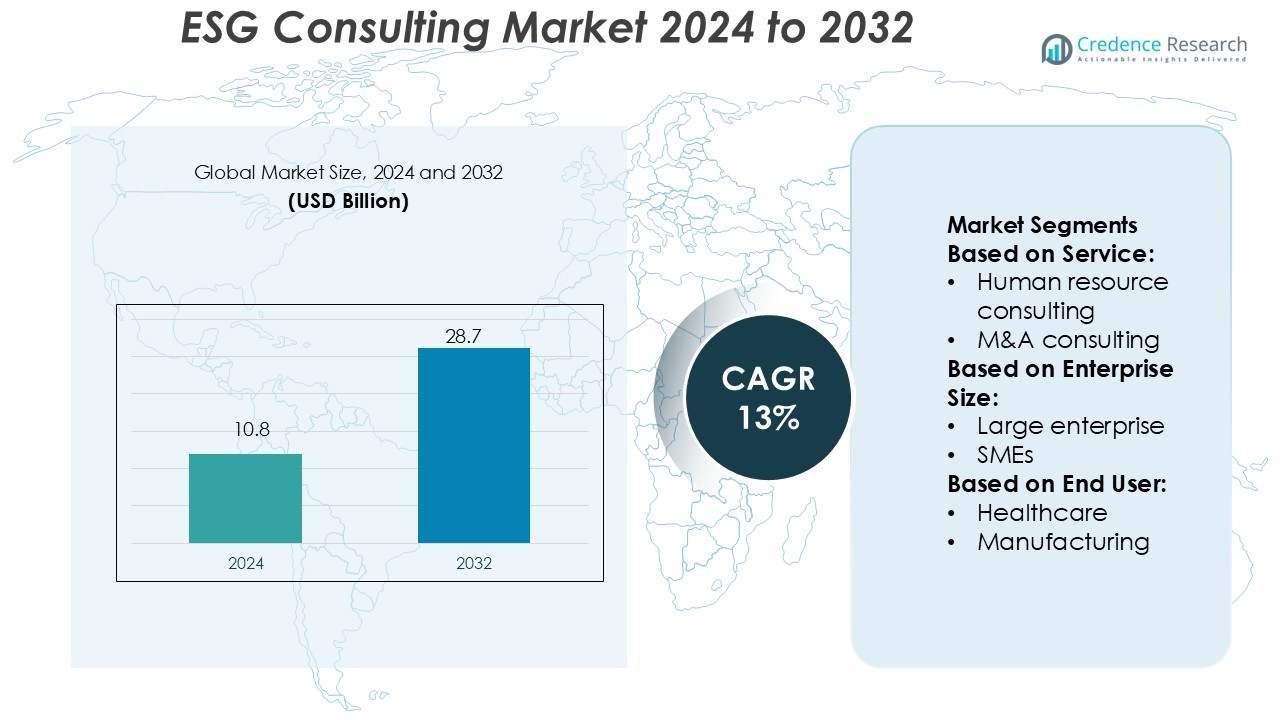
ESG Consulting Market size was valued USD 10.8 billion in 2024 and is anticipated to reach USD 28.7 billion by 2032, at a CAGR of 13% during the forecast period.
| REPORT ATTRIBUTE | DETAILS |
|---|---|
| Historical Period | 2020-2023 |
| Base Year | 2024 |
| Forecast Period | 2025-2032 |
| ESG Consulting Market Size 2024 | USD 10.8 Billion |
| ESG Consulting Market, CAGR | 13% |
| ESG Consulting Market Size 2032 | USD 28.7 Billion |
The ESG Consulting Market Deloitte Touche Tohmatsu Ltd., Cognizant, IBM, Capgemini, Accenture, Oracle, CGI Group, Clearfind, and Atos SE are key players in the ESG consulting market. These companies provide strategy, reporting, and sustainability advisory services using digital platforms and analytics tools. North America leads the market with a 42.15% share, driven by strong regulatory requirements, investor expectations, and corporate adoption of ESG frameworks. Growing demand from industries such as BFSI, manufacturing, healthcare, and IT supports market expansion, while innovation in digital reporting and supply-chain sustainability strengthens the competitive landscape globally.
Market Insights
- The ESG Consulting Market size was valued USD 10.8 billion in 2024 and is anticipated to reach USD 28.7 billion by 2032, at a CAGR of 13% during the forecast period.
- Growth is driven by rising regulatory requirements, investor scrutiny, and corporate commitments to sustainability and net-zero targets.
- Market trends include adoption of digital platforms, predictive analytics, real-time ESG reporting, and supply-chain sustainability integration.
- Competition is strong among Deloitte Touche Tohmatsu Ltd., Cognizant, IBM, Capgemini, Accenture, Oracle, CGI Group, Clearfind, and Atos SE, with firms differentiating through technology-driven advisory and sector-specific ESG frameworks.
- Regionally, North America leads with a 42.15% share, followed by Europe at 30%, Asia-Pacific at 20%, Latin America at 6–8%, and Middle East & Africa at 4–5%, with BFSI and manufacturing segments representing the largest end-user adoption.
 Market Segmentation Analysis:
By Service
Within the ESG consulting market, the strategy consulting sub‑segment dominates with over one‑third share, as firms focus on helping clients define ESG frameworks and governance models. Strategy consulting leads because organizations must align sustainability goals with business strategy and compliance obligations. Driving this sub‑segment are increased regulatory mandates, investor demands and corporate reporting requirements which force firms to engage external advisors for scenario modelling, materiality assessment and integration of ESG into corporate planning. Meanwhile, other services such as operations & supply‑chain consulting and HR consulting follow, but strategy consulting remains the primary entry point for ESG engagements.
- For instance, Accenture PLC reports that its global emissions (Scope 1, 2 and relevant Scope 3 categories) in fiscal 2024 were 654,819 metric tons CO₂e.
By Enterprise Size
Large enterprises represent the dominant client segment, accounting for roughly 60% of ESG consulting revenues, since they possess complex global operations, high regulatory exposure and the resources to invest in comprehensive ESG programs. These organisations increasingly engage consultants for risk assessment, sustainability reporting, stakeholder engagements and governance mechanisms. In contrast, SMEs, while growing in demand, typically adopt lighter‑touch services. The prevalence of large enterprises thus drives the market, as their need for broad ESG transformation supports sustained consulting engagement.
- For instance, Atos announced its “Genesis” plan in May 2025, reporting that it delivered over 250,000 “digital accreditations” to its workforce during the prior three years and intends to grow its newly created Data & AI business line from 2,000 to 10,000 employees by 2028.
By End User
Among end‑user industries, the BFSI sector holds the largest share-around 30%-in the ESG consulting market due to the sector’s exposure to regulatory frameworks, disclosure requirements and investor scrutiny. Financial institutions rely on ESG consulting firms to integrate sustainability into lending, investment and underwriting decisions and to manage transition risk. Manufacturing, healthcare, IT & telecom, retail, government and other industries follow, but the traditional dominance of the BFSI vertical underlines how regulation‑led demand shapes the market’s adoption pattern.
Key Growth Drivers
Regulatory and reporting mandates
Governments and regulators worldwide are imposing stricter ESG disclosure rules, compelling companies to engage external consultants to ensure compliance and credibility. The demand surge arises as firms seek to align with frameworks like the Task Force on Climate‑related Financial Disclosures (TCFD) and mandatory sustainability reports. These mandates drive consulting spend as organisations build frameworks, perform audits and implement governance systems. Such compliance pressure is a significant impetus for growth in the ESG consulting market.
- For instance, CGI states that its data-centres achieved 99.3% renewable electricity consumption in 2024, enabling those sites to report to clients under full Scope 2 renewables.
Investor pressure and capital‑market demands
Asset managers, institutional investors and lenders increasingly embed ESG criteria into their decision‑making, prompting companies to seek consultancy support for materiality assessments, data assurance and sustainable finance strategies. With investors scrutinising ESG performance and disclosure, consulting firms benefit from rising advisory engagements. This push from capital markets effectively strengthens the growth trajectory of ESG advisory services.
- For instance, Deloitte’s 2024 CxO Sustainability Report surveyed 2,103 executives across 27 countries and found that 85% of C-suite leaders say they increased sustainability investments in the past year.
Corporate net‑zero ambitions and supply‑chain transformation
Companies across sectors are committing to carbon‑neutral or net‑zero targets, which require comprehensive supply‑chain re‑engineering, operational emissions tracking and strategic road‑maps. Consulting firms are delivering scenario modelling, transition planning and supply‑chain decarbonisation support. These large‑scale transformation initiatives form the backbone of ESG consulting growth as organisations shift from reactive compliance to proactive sustainability strategies.
Key Trends & Opportunities
Digitalisation of ESG data and real‑time analytics
Consulting firms increasingly offer digital platforms, dashboards, and analytics tools that allow real‑time monitoring of ESG metrics, scenario modelling and predictive insights. With companies integrating ESG data into core business processes, service offerings are evolving from static reports to dynamic, tech‑enabled solutions. This trend presents an opportunity for consultancies to expand into software‑as‑a‑service, analytics and technology‑driven advisory models.
- For instance, BCG announced its tech build & design unit “BCG X”, comprised of nearly 3,000 technologists spanning 80+ cities, to build platforms that accelerate digital transformation including ESG-data solutions.
Expansion into emerging markets and sectoral niches
As regulatory frameworks mature in Europe and North America, consulting firms are turning to emerging markets in Asia Pacific, Latin America and Africa for growth. Additionally, niches such as green hydrogen, circular‑economy transitions and social equity programmes are gaining traction. These areas offer consultants new service lines and geographic reach beyond traditional corporate sustainability strategies.
- For instance, Oracle announced that its cloud training programme in India trained 400,000 students in AI, data science, and cloud technologies during a recent fiscal cycle - illustrating how the company is expanding digital infrastructure expertise into emerging markets.
Key Challenges
Lack of standardised metrics and inconsistent data
Despite rising demand, the ESG consulting market faces hurdles due to fragmented reporting frameworks, disparate metrics and varying regional standards. Many organisations struggle to align ESG disclosures or compare performance across peers, which reduces the effectiveness of advisory services. This lack of standardisation hampers consulting firms in delivering clear, comparable value to clients.
Talent shortage and scalability constraints
With ESG advisory demand growing rapidly, consulting firms face pressure to hire and train specialists in sustainability, climate science, supply‑chain decarbonisation and social innovation. Shortage of qualified talent slows project delivery and limits scalability of service models. Firms that cannot build sufficient teams may struggle to keep up with client expectations and market growth.
Regional Analysis
North America
North America holds the leading position in the ESG consulting market, capturing around 42 % of global share in 2024. This dominance stems from stringent regulatory frameworks and strong investor pressure which push companies to engage consultants for ESG reporting, governance, and risk analysis. U.S.‑based firms routinely contract advisory services to ensure compliance with frameworks such as the Sustainability Accounting Standards Board (SASB) and Task Force on Climate‑related Financial Disclosures (TCFD). Large enterprises in Canada and the U.S. also invest in sustainability strategy, driving consulting engagements. The market is thus buoyed by high demand for ESG consultancy, particularly in the financial and industrial sectors.
Europe
Europe accounts for approximately 30 % of the global ESG consulting market, backed by the EU’s regulatory initiatives such as the Corporate Sustainability Reporting Directive (CSRD) and strong stakeholder ESG expectations. Corporates across the UK, Germany and France hire consultants for regulatory gap‑analysis, sustainability strategy, and carbon‑risk modelling. Some local markets also benefit from subsidies for consultancy services linked to green transition. The presence of mature advisory firms and well‑established ESG service lines allows European companies to adopt more advanced consulting solutions, reinforcing the region’s stable share.
Asia‑Pacific
The Asia‑Pacific region holds roughly 20 % of the global ESG consulting market and is characterised by fast‑rising demand in China, India, Japan and Southeast Asia. Governments and large companies in the region launch net‑zero initiatives and green financing programmes, prompting engagements for supply‑chain decarbonisation, sustainable infrastructure and ESG risk modelling. Although regulatory regimes vary and maturity levels differ across countries, the region’s growth trajectory is strong as consulting firms expand local operations. Emerging markets also offer scope for lower‑cost advisory services adapted to regional conditions.
Latin America
Latin America covers an estimated 6 %–8 % of the global ESG consulting market. Growth is driven by infrastructure investment, renewable energy mandates and industry demand for sustainability disclosures in Brazil, Mexico and Chile. However, slower uptake of comprehensive ESG frameworks limits scale compared with mature regions. Consulting firms often focus on project‑based engagements such as greenhouse‑gas inventories or social‑impact assessments. With increasing multinational presence and rising regulatory interest, Latin America presents incremental growth potential for ESG advisory services.
Middle East & Africa (MEA)
The MEA region holds about 4 %–5 % of the global ESG consulting market. Demand is concentrated in Gulf‐Cooperation Council (GCC) oil and gas nations and North Africa, where sustainability programmes and green infrastructure projects are under development. Corporates engage consultants for energy‑transition roadmaps, social‑impact assessments and governance frameworks tied to sovereign wealth funds. Fragmented markets, legacy infrastructure and limited regulatory maturity slow uptake. Yet, international consulting firms view MEA as a strategic frontier for long‑term expansion as ESG advisory becomes integral to large infrastructure contracts.
Market Segmentations:
By Service:
- Human resource consulting
- M&A consulting
By Enterprise Size:
- Large enterprise
- SMEs
By End User:
- Healthcare
- Manufacturing
By Geography
- North America
- U.S.
- Canada
- Mexico
- Europe
- Germany
- France
- U.K.
- Italy
- Spain
- Rest of Europe
- Asia Pacific
- China
- Japan
- India
- South Korea
- South-east Asia
- Rest of Asia Pacific
- Latin America
- Brazil
- Argentina
- Rest of Latin America
- Middle East & Africa
- GCC Countries
- South Africa
- Rest of the Middle East and Africa
Competitive Landscape
The ESG consulting market players such as Deloitte Touche Tohmatsu Ltd., Cognizant, International Business Machines Corporation, Capgemini, Accenture PLC, Oracle Corp., CGI Group, Inc., Clearfind and Atos SE. The ESG consulting market is highly competitive, driven by increasing regulatory requirements, investor scrutiny, and corporate sustainability commitments. Firms focus on integrating ESG frameworks into business strategy, governance, and reporting processes to help organizations achieve net‑zero targets and enhance stakeholder trust. Adoption of advanced digital tools, predictive analytics, and real‑time monitoring enables companies to assess risks, optimise supply chains, and track ESG performance efficiently. Rising demand spans industries such as BFSI, manufacturing, healthcare, IT, and government sectors. The market also benefits from growing awareness of social responsibility, climate transition planning, and sustainable finance initiatives, encouraging continuous innovation and expansion of consultancy services globally.
Key Player Analysis
- Deloitte Touche Tohmatsu Ltd.
- Cognizant
- International Business Machines Corporation
- Capgemini
- Accenture PLC
- Oracle Corp.
- CGI Group, Inc.
- Clearfind
- Ernst & Young LLP
- Atos SE
Recent Developments
- In January 2025, BDO USA announced the strategic expansion of its management consulting services through the addition of Blue Beyond Consulting, a San Francisco-based firm specializing in human capital management and organizational effectiveness.
- In October 2024, Accenture completed the acquisition of Camelot Management Consultants, a Germany-based SAP-focused management and technology consulting firm. This acquisition aims to strengthen Accenture’s capabilities in SAP and AI-driven supply chain solutions, addressing the growing demand for intelligent and resilient supply chains.
- In August 2024, Uniqus Consultech launched its tech consulting practice, expanding its offerings beyond financial consulting to include cutting-edge technology solutions. This new initiative aims to address complex business challenges by integrating deep functional expertise in finance, risk, and sustainability with advanced technological capabilities.
- In October 2023, ClearBridge Investments and Franklin Templeton introduced a new value equity fund named the FTGF ClearBridge Global Sustainability Improvers Fund. This innovative fund aims to invest in companies that are actively improving their Environmental, Social, and Governance (ESG) practices rather than focusing solely on those with already robust ESG profiles.
Report Coverage
The research report offers an in-depth analysis based on Service, Enterprise Size, End-User and Geography. It details leading market players, providing an overview of their business, product offerings, investments, revenue streams, and key applications. Additionally, the report includes insights into the competitive environment, SWOT analysis, current market trends, as well as the primary drivers and constraints. Furthermore, it discusses various factors that have driven market expansion in recent years. The report also explores market dynamics, regulatory scenarios, and technological advancements that are shaping the industry. It assesses the impact of external factors and global economic changes on market growth. Lastly, it provides strategic recommendations for new entrants and established companies to navigate the complexities of the market.
Future Outlook
- Rising global regulation will drive more companies to engage ESG consulting for compliance and reporting.
- Investor demand for transparent ESG data will lead organisations to hire consultants for materiality assessments and data verification.
- Corporate net‑zero and sustainability goals will push firms to adopt consulting services for decarbonisation road‑maps and supply‑chain strategy.
- Digital tools and analytics in ESG consulting will expand, enabling real‑time monitoring, scenario modelling and automated disclosures.
- Expansion into emerging markets will open new geographies for consulting firms as companies in Asia‑Pacific, Latin America and Africa increase ESG spend.
- Sector‑specific advisory services will grow, as manufacturing, healthcare, retail and IT sectors require tailored ESG frameworks.
- M&A and strategic partnerships in the consulting industry will accelerate, enhancing firms’ capabilities across climate, social and governance domains.
- SMEs will increasingly adopt ESG consulting, increasing service bundling or lighter touch advisory to meet scaled‑down compliance needs.
- Consultants will face increasing pressure to prove ROI, driving adoption of performance‑based contracting and value measurement frameworks.
- Talent shortage and evolving standards will force consulting firms to invest heavily in training, tool‑development and platformisation of ESG services.

Request a Free Sample
Fill in your details and we'll send you a free sample report.
- Sample data tables & charts
- Research methodology
Need a Custom Version of This Report?
Tailor the scope, geography, or segments to your exact requirements.
- Custom geography or segment scope
- Direct access to our analyst team
Frequently Asked Questions
What is the current market size for ESG Consulting Market, and what is its projected size in 2032?
At what Compound Annual Growth Rate is the ESG Consulting Market projected to grow between 2025 and 2032?
Which ESG Consulting Market segment held the largest share in 2024?
What are the primary factors fueling the growth of the ESG Consulting Market?
Who are the leading companies in the ESG Consulting Market?
Which region commanded the largest share of the ESG Consulting Market in 2024?
Table of Content
Chapter 1 Market Segmentation
- 1.1 Segmentation Framework
- 1.1.1 Product and Service Classification
- 1.1.2 Application and End-Use Classification
- 1.1.3 Technology and Solution Classification
- 1.1.4 Customer and Distribution Channel Classification
- 1.1.5 Geographic Segmentation
- 1.1.6 Market Segment Definitions and Boundaries
Chapter 2 Introduction
- 2.1 Report Objectives and Scope
- 2.2 Product Definition and Industry Terminology
- 2.3 Market Inclusions and Exclusions
- 2.4 Research Process
- 2.4.1 Primary Research and Expert Interviews
- 2.4.2 Secondary Research and Source Review
- 2.4.3 Top-Down and Bottom-Up Estimation
- 2.4.4 Data Triangulation and Verification
- 2.5 Market Size Measurement Basis
- 2.5.1 2024: USD 10.8 billion → 2032: USD 28.7 billion
- 2.6 Historical and Forecast Reference Periods
- 2.6.1 Base Year: 2024
- 2.6.2 Forecast Period: 2024-2032
- 2.7 Research Assumptions and Limitations
Chapter 3 Executive Summary
- 3.1 Market Snapshot and Key Findings
- 3.2 Base-Year Market Size, 2024
- 3.3 Forecast Market Size, 2032
- 3.4 Revenue and Volume Growth Outlook
- 3.5 Key Demand and Supply Indicators
- 3.6 Leading Market Segments
- 3.7 Fastest-Growing Market Opportunities
- 3.8 Regional Performance Highlights
- 3.9 Technology and Industry Transformation
- 3.10 Competitive Landscape Summary
- 3.11 Analyst View and Strategic Implications
Chapter 4 Global ESG Consulting Market Trends and Developments
- 4.1 Historical Industry Development
- 4.2 Recent Market Trends and Developments
- 4.3 Demand and Customer Behavior Trends
- 4.4 Technology and Product Innovation
- 4.5 Artificial Intelligence, Automation and Digitalization
- 4.6 Local Manufacturing and Supply Chain Realignment
- 4.7 Industry Partnerships, Mergers and Acquisitions
- 4.8 Sustainability and Circular Economy Developments
- 4.9 Government and Private Sector Investment Trends
- 4.10 Emerging Business Models and Commercialization
- 4.11 Industry Developments and Announcements
Chapter 5 Global ESG Consulting Market Supply and Demand Analysis
- 5.1 Demand Trend and Consumption Analysis
- 5.2 Demand Forecast, 2024-2032
- 5.3 Supply Chain Structure and Procurement Trends
- 5.4 Supply-Demand Gap and Bottlenecks
- 5.5 Import Dependence and Sourcing Structure
- 5.6 Regional Supply and Demand Concentration
Chapter 6 Global ESG Consulting Market Pricing Analysis
- 6.1 Pricing Structure and Measurement
- 6.2 Historical Pricing Trends
- 6.3 Pricing Outlook, 2024-2032
- 6.4 Pricing by Product and Market Segment
- 6.5 Geographic Pricing Differences
- 6.6 Key Input, Energy, Labor and Logistics Costs
- 6.7 Contract Pricing and Purchasing Models
- 6.8 Pricing Sensitivity and Competitive Positioning
- 6.9 Price, Margin and Profitability Implications
Chapter 7 Global ESG Consulting Market Dynamics
- 7.1 Market Growth Drivers
- 7.1.1 Demand-Side Drivers
- 7.1.2 Technology and Innovation Drivers
- 7.1.3 Infrastructure and Investment Drivers
- 7.1.4 Regulatory and Policy Drivers
- 7.2 Market Restraints
- 7.2.1 Cost and Affordability Constraints
- 7.2.2 Technology and Adoption Barriers
- 7.2.3 Supply Chain and Operational Constraints
- 7.3 Market Challenges
- 7.3.1 Competitive Pressure and Margin Erosion
- 7.3.2 Skills, Infrastructure and Implementation Gaps
- 7.4 Emerging Market Opportunities
- 7.5 Market Dynamics Impact and Time-Horizon Assessment
Chapter 8 Global ESG Consulting Value Chain Analysis
- 8.1 Industry Value Chain Overview
- 8.2 Upstream Suppliers and Critical Inputs
- 8.3 Technology and Component Providers
- 8.4 Manufacturing or Service Delivery
- 8.5 Distribution, Channel Partners and Integrators
- 8.6 Downstream Applications and End Users
- 8.7 Value Addition and Profit Pools
- 8.8 Vertical Integration and Outsourcing
- 8.9 Supplier Concentration and Risk
- 8.10 Supply Chain Localization and Resilience
Chapter 9 Global ESG Consulting Market Regulations and Policies
- 9.1 Relevant Laws, Standards and Compliance Frameworks
- 9.2 Product, Service, Safety and Quality Requirements
- 9.3 Government Policies, Incentives and Subsidies
- 9.4 Imports, Exports and Trade Barriers
- 9.5 Public Procurement and Local Content Requirements
- 9.6 Data Protection, AI and Cybersecurity Compliance
- 9.7 Upcoming Policy Changes and Market Implications
Chapter 10 Global ESG Consulting Market Hotspots and Opportunities
- 10.1 Market Opportunity Mapping and Growth Hotspots
- 10.2 High-Growth Applications and Customer Groups
- 10.3 Underserved Markets and White-Space Opportunities
- 10.4 Emerging Technology and Product Opportunities
- 10.5 New Capacity and Investment Hotspots
- 10.6 Market Entry and Expansion Opportunities
- 10.7 Distribution and Partnership Opportunities
- 10.8 Near-Term and Long-Term Commercial Potential
- 10.9 Opportunity Attractiveness and Execution Risks
Chapter 11 Global ESG Consulting Market Outlook, 2024-2032
- 11.1 Market Size and Analysis
- 11.1.1 Revenue (Market Measurement: 2024: USD 10.8 billion → 2032: USD 28.7 billion)
- 11.1.2 Historical Market Size
- 11.1.3 Base-Year Market Size, 2024
- 11.2 Market Forecast, 2024-2032
- 11.2.1 Revenue Forecast to 2032
- 11.2.2 CAGR and Year-on-Year Growth
- 11.2.3 Incremental Revenue Opportunity
- 11.3 Forecast Assumptions and Scenario Analysis
- 11.3.1 Base-Case Forecast
- 11.3.2 Optimistic and Conservative Scenarios
- 11.3.3 Technology, Pricing and Policy Sensitivities
- 11.4 Market Attractiveness and Growth Outlook
Chapter 12 Global ESG Consulting Market Segmentation and Outlook
- 12.1 Segmentation Summary and Market Shares, 2024
- 12.2 Largest and Fastest-Growing Segments
- 12.3 Segment Growth Comparison
- 12.4 Segment Attractiveness and Priority Matrix
Chapter 13 Global ESG Consulting Geographic Market Outlook, 2024-2032
- 13.1 Regional Market Size and Share, 2024
- 13.2 Regional Market Forecast, 2024-2032
- 13.3 Regional Pricing, Production and Demand Differences
- 13.4 North America
- 13.4.1 United States
- 13.4.2 Canada
- 13.4.3 Mexico
- 13.5 Europe
- 13.5.1 Germany
- 13.5.2 France
- 13.5.3 Italy
- 13.5.4 United Kingdom
- 13.5.5 Spain
- 13.5.6 Poland
- 13.5.7 Russia
- 13.5.8 Netherlands
- 13.5.9 Belgium
- 13.5.10 Sweden
- 13.5.11 Denmark
- 13.5.12 Norway
- 13.5.13 Rest of Europe
- 13.6 Asia Pacific
- 13.6.1 China
- 13.6.2 India
- 13.6.3 Japan
- 13.6.4 South Korea
- 13.6.5 Thailand
- 13.6.6 Indonesia
- 13.6.7 Vietnam
- 13.6.8 Malaysia
- 13.6.9 Australia
- 13.6.10 Rest of Asia Pacific
- 13.7 Latin America
- 13.7.1 Brazil
- 13.7.2 Argentina
- 13.7.3 Colombia
- 13.7.4 Chile
- 13.7.5 Rest of Latin America
- 13.8 Middle East
- 13.8.1 Saudi Arabia
- 13.8.2 United Arab Emirates
- 13.8.3 Turkey
- 13.8.4 Israel
- 13.8.5 Iran
- 13.8.6 Rest of the Middle East
- 13.9 Africa
- 13.9.1 South Africa
- 13.9.2 Egypt
- 13.9.3 Nigeria
- 13.9.4 Morocco
- 13.9.5 Rest of Africa
- 13.10 Regional Investment, Policy and Supply Chain Differences
- 13.11 Regional Competitive Landscape
- 13.12 Geographic Growth Hotspots
Chapter 14 Global ESG Consulting Technology, Innovation and Sustainability Outlook
- 14.1 Technology Landscape and Maturity
- 14.2 Product, Process and Service Innovation
- 14.3 AI, Automation and Digital Tools in the Industry
- 14.4 Technology Adoption and Performance Benchmarking
- 14.5 Innovation Pipeline and R&D Investment
- 14.6 Energy Efficiency and Resource Management
- 14.7 Sustainability, Recycling and Circularity
- 14.8 Technology Roadmap, 2024-2032
- 14.9 Risks of Obsolescence and Technology Substitution
Chapter 15 Global ESG Consulting Market Key Strategic Imperatives
- 15.1 Growth and Market Entry Priorities
- 15.2 High-Return Products and Segments
- 15.3 Pricing, Profitability and Cost Optimization
- 15.4 Technology Investment and Product Differentiation
- 15.5 Supply Chain Localization and Resilience
- 15.6 Distribution and Customer Acquisition
- 15.7 Partnership, Acquisition and Capacity Strategy
- 15.8 Regional Expansion Priorities
- 15.9 Short-, Medium- and Long-Term Actions
Chapter 16 Competition Outlook
- 16.1 Industry Competition Characteristics
- 16.2 Market Structure and Concentration
- 16.3 Market Share and Competitive Positioning, 2024
- 16.4 Company-Wise Revenue and Product Benchmarking
- 16.5 Production and Service Capacity Benchmarking
- 16.6 Technology, Pricing and Differentiation
- 16.7 Regional Footprint and Distribution Strength
- 16.8 Mergers, Acquisitions and Strategic Alliances
- 16.9 New Entrants and Competitive Threats
- 16.10 Porter's Five Forces and Industry Attractiveness
- 16.11 Competitive Outlook, 2024-2032
Chapter 17 Company Profiles
- 17.1 Company Coverage and Selection Criteria
- 17.2 Leading Market Participants – Standard Profile Structure
- 17.2.1 Business Description
- 17.2.2 Company Ownership and Geographic Presence
- 17.2.3 Product and Service Portfolio
- 17.2.4 Manufacturing and Operating Footprint
- 17.2.5 Financial Performance and Investment
- 17.2.6 Market Share and Competitive Position
- 17.2.7 Technology and Innovation Capabilities
- 17.2.8 Strategic Alliances or Partnerships
- 17.2.9 Recent Developments
- 17.2.10 Growth Strategy and Outlook
- 17.3 Other Relevant Market Participants
Note: Every listed company is profiled on the structure shown under the first company. The company list is preliminary and may change based on research findings, market developments, data availability and client requirements.
Chapter 18 Disclaimer
- 18.1 Research and Forecast Disclaimer
- 18.2 Data Source and Estimation Limitations
Note: The depth of individual sections depends on data availability for this market. Volume, capacity, trade and other unit-based metrics are included where applicable.

