
Market Overview
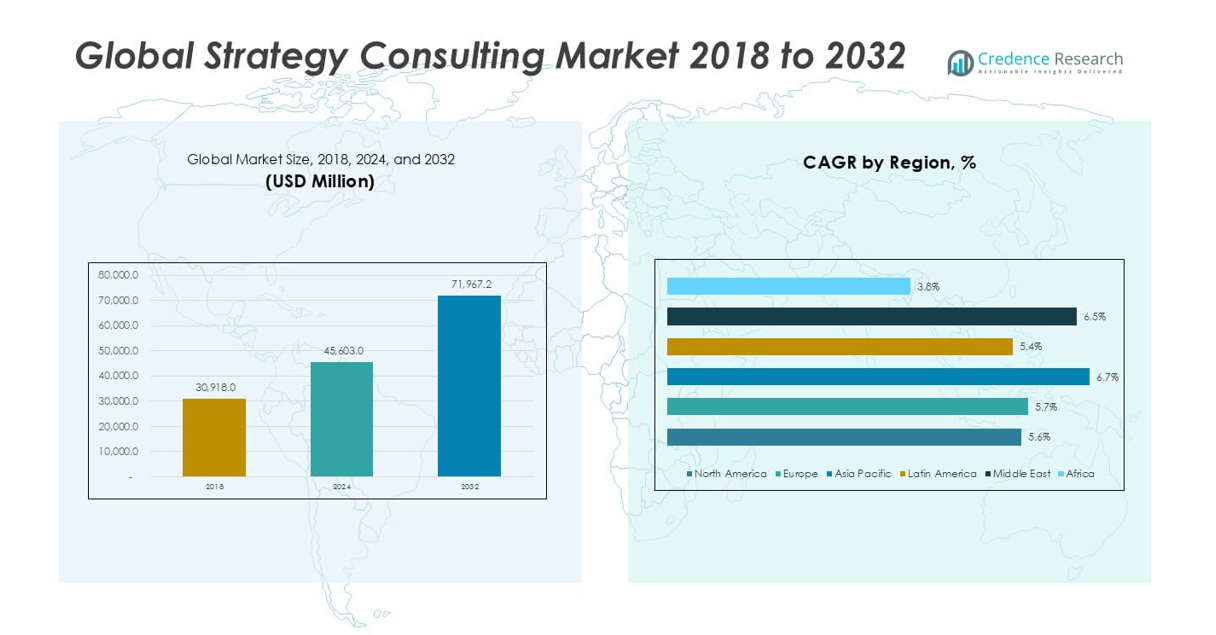
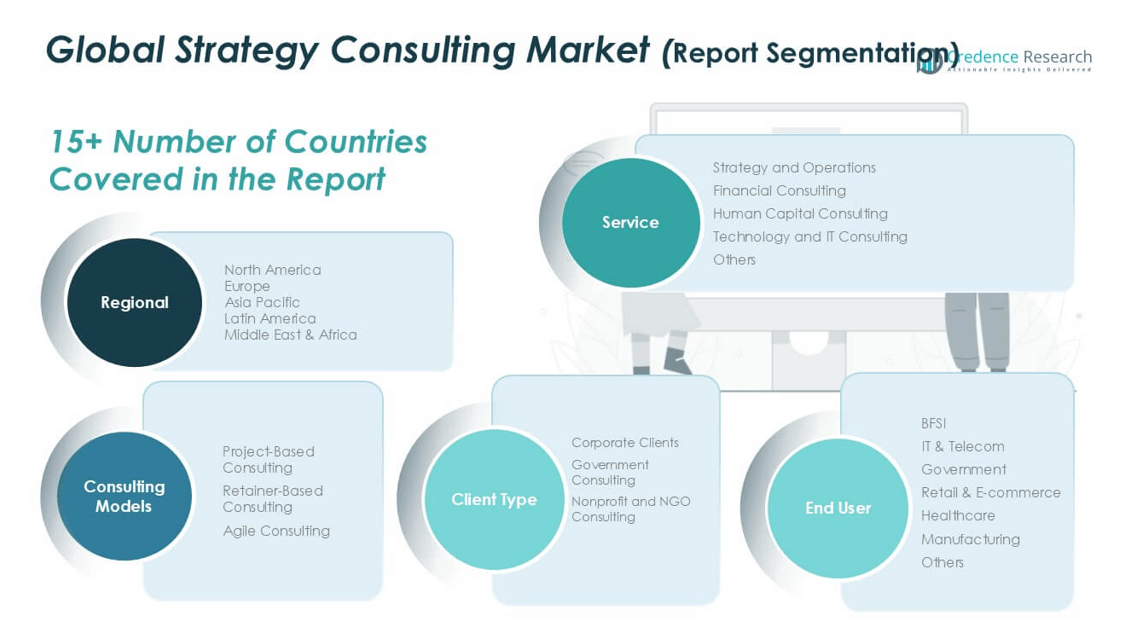
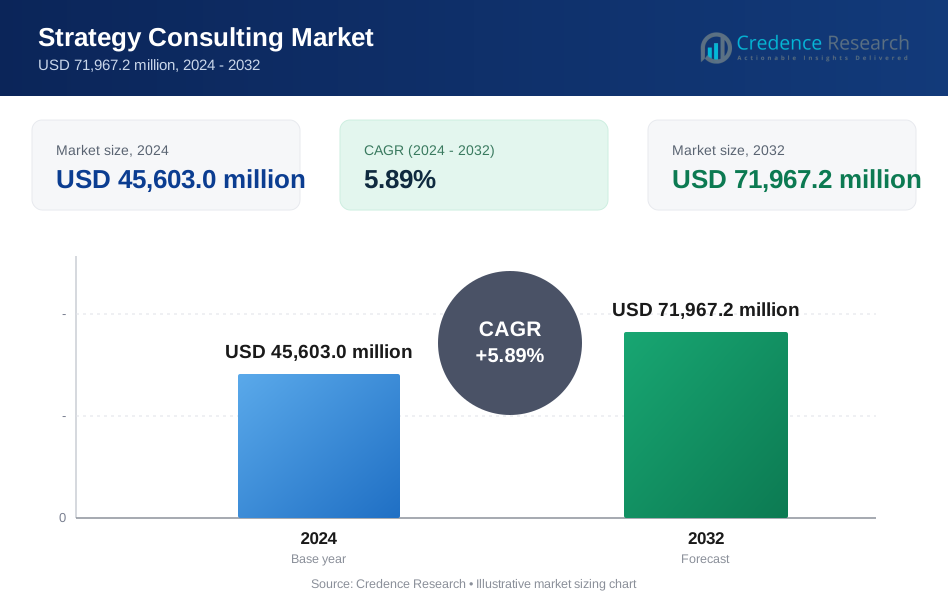
Global Strategy Consulting market size was valued at USD 30,918.0 million in 2018 to USD 45,603.0 million in 2024 and is anticipated to reach USD 71,967.2 million by 2032, at a CAGR of 5.89% during the forecast period.
| REPORT ATTRIBUTE | DETAILS |
|---|---|
| Historical Period | 2020-2023 |
| Base Year | 2024 |
| Forecast Period | 2025-2032 |
| Strategy Consulting Market Size 2024 | USD 45,603.0 million |
| Strategy Consulting Market, CAGR | 5.89% |
| Strategy Consulting Market Size 2032 | USD 71,967.2 million |
The global strategy consulting market is led by major firms such as McKinsey & Company, Boston Consulting Group, Bain & Company, Deloitte, PwC, Accenture, and Ernst & Young. These players dominate large, complex engagements through global reach and deep sector expertise. Europe is the leading region, holding the largest market share of about 34.2%, driven by mature corporate strategy adoption and regulatory advisory demand. North America follows with approximately 27.9% market share, supported by strong demand for digital transformation and M&A advisory. Asia Pacific accounts for around 23.5% market share, reflecting rapid enterprise expansion and market entry activity. Together, these regions concentrate the majority of global strategy consulting revenue.
Market Insights
- The global strategy consulting market reached USD 45,603.0 million in 2024 and is projected to reach USD 71,967.2 million by 2032, growing at a CAGR of 5.89% during the forecast period.
- Market growth is driven by digital transformation, M&A activity, and enterprise restructuring needs, with Strategy and Operations holding the largest service share at over 35% due to high demand for growth and cost strategies.
- Key trends include rising adoption of agile consulting models and outcome-based engagements, while project-based consulting leads consulting models with nearly 45% segment share across large transformation initiatives.
- The competitive landscape features global firms such as McKinsey, BCG, Bain, Deloitte, PwC, and Accenture, competing on industry expertise, analytics capability, and execution strength across multinational clients.
- Regionally, Europe leads with about 34.2% market share, followed by North America at 27.9% and Asia Pacific at 23.5%, while emerging regions show steady but slower adoption rates.
Market Segmentation Analysis:
By Service
The Service segment shows strong diversification across advisory capabilities. Strategy and Operations remains the dominant sub-segment, holding over 35% market share. Large enterprises rely on this service for growth planning and cost optimization. Demand rises from digital transformation and restructuring programs. Financial Consulting follows, driven by M&A, risk management, and compliance needs. Human Capital Consulting gains traction due to workforce transformation. Technology and IT Consulting grows steadily with cloud and data strategies. Strategy-led value creation continues to anchor service demand across industries.
- For instance, McKinsey & Company reports supporting more than 70 of the world’s 100 largest corporations annually, with strategy and operations engagements often involving teams of over 50 consultants across multi-month transformation programs.
By Consulting Models
The Consulting Models segment reflects evolving client engagement preferences. Project-Based Consulting dominates with nearly 45% market share. Clients prefer defined scope, timelines, and deliverables. This model suits transformation, market entry, and turnaround projects. Retainer-Based Consulting maintains stable demand from large corporates seeking ongoing advisory support. Agile Consulting shows fast growth from digital-native firms. Agile models support rapid iteration and cross-functional collaboration. The shift toward flexible delivery and outcome-based engagements strengthens adoption of modern consulting models.
- For instance, Accenture’s agile consulting engagements often operate in two-week sprint cycles and deploy cross-functional teams of 10–15 specialists, enabling continuous delivery across enterprise digital transformation programs.
By Client Type
The Client Type segment is led by Corporate Clients, accounting for over 60% market share. Corporations seek strategy consulting for competitiveness and shareholder value. Drivers include globalization, portfolio optimization, and technology adoption. Government Consulting follows, supported by policy reform and infrastructure planning. Public sector digitalization also boosts demand. Nonprofit and NGO Consulting holds a smaller share but grows steadily. NGOs seek impact measurement and funding strategy support. Complex stakeholder environments sustain long-term advisory needs across client types.
Key Growth Drivers
Enterprise Digital Transformation and Technology Integration
Digital transformation remains a core growth driver for strategy consulting firms. Enterprises face pressure to modernize operating models. Many firms adopt cloud platforms, analytics, and automation. Strategy consultants guide roadmap design and execution sequencing. Clients need alignment between technology and business goals. Consultants support platform selection and value tracking. Demand rises from data-driven decision needs. Cyber risk and AI adoption add complexity. Firms seek neutral advisors for vendor selection. Legacy system replacement drives multi-year engagements. Digital programs require change management support. This increases cross-functional consulting demand. Strategy firms benefit from board-level sponsorship. Transformation budgets remain resilient despite economic cycles. Digital urgency sustains long-term consulting pipelines.
- For instance, Accenture reported delivering large-scale digital transformation programs for over 9,000 enterprise clients globally, with many cloud and data engagements running across multi-year timelines and involving teams exceeding 100 consultants per client.
Market Volatility and Strategic Risk Management
Economic uncertainty strengthens demand for strategic advisory services. Firms face supply chain shocks and pricing pressure. Geopolitical risk impacts global operations. Strategy consultants support scenario planning and stress testing. Clients reassess market entry and exit decisions. Portfolio optimization becomes a priority. Cost restructuring programs gain traction. Risk-adjusted growth planning drives executive engagement. Consulting firms provide independent market intelligence. Data-backed insights support capital allocation decisions. Boards seek external validation during uncertainty. Regulatory changes also add strategic risk. Consultants help align compliance with growth goals. Volatile markets increase reliance on expert judgment. This sustains demand across sectors.
Expansion of M&A and Corporate Restructuring Activity
M&A activity fuels demand for strategy consulting services. Companies pursue inorganic growth for scale and capability access. Consultants support target screening and valuation logic. Commercial due diligence remains a key service area. Post-merger integration planning drives follow-on work. Restructuring advisory supports divestments and carve-outs. Private equity firms increase consulting usage. Speed and accuracy matter in competitive deals. Strategy firms offer sector expertise and benchmarks. Cross-border deals increase advisory complexity. Integration risks raise demand for operational alignment. Synergy realization requires structured execution. These drives sustained consulting engagement across deal cycles.
Key Trends & Opportunities
Rise of Agile and Outcome-Based Consulting Models
Clients increasingly favor agile consulting delivery models. Traditional long projects face scrutiny on ROI. Agile models focus on rapid sprints and measurable outcomes. Consultants embed with client teams. This improves execution speed and ownership. Outcome-based pricing gains acceptance. Clients link fees to value delivery. Digital-native firms prefer flexible engagement structures. Agile consulting supports continuous strategy refinement. This aligns with fast-changing markets. Consulting firms invest in capability building. Toolkits and digital accelerators enhance delivery. Smaller teams improve cost efficiency. This trend opens new mid-market opportunities. Agile adoption reshapes competitive differentiation.
- For instance, Accenture often structures its agile strategy engagements around typical agile principles, frequently utilizing two-week sprint cycles and deploying cross-functional teams of consultants often around 8 to 12 members who aim to deliver tangible working prototypes or decision frameworks by the conclusion of each sprint.
Growing Demand from Emerging Markets and Mid-Sized Enterprises
Emerging markets drive new growth opportunities. Companies expand into Asia, Africa, and Latin America. Strategy support is critical for local market entry. Regulatory navigation increases advisory demand. Mid-sized enterprises seek professionalized strategy frameworks. These firms face scaling challenges. Consultants offer cost-efficient modular services. Digital channels lower access barriers. Local partnerships enhance market reach. Public sector reforms also boost demand. Infrastructure and industrialization programs require planning support. This broadens the client base. Emerging markets deliver higher growth rates. Consulting firms adapt pricing and delivery models. Expansion beyond large enterprises accelerates market growth.
- For instance, Bain & Company reports serving clients across more than 40 countries, working on strategy engagements for various-sized enterprises including mid-sized firms to support market entry and operating model design. The scale and duration of this project teams vary considerably based on client needs.
Key Challenges
Pricing Pressure and Client Demand for Measurable ROI
Clients increasingly question consulting fees. Procurement teams push aggressive pricing. Buyers demand clear value justification. Outcome measurement becomes critical. Long-term engagements face scrutiny. Firms must link advice to results. This raises delivery risk for consultants. Talent costs continue to rise. Margin pressure impacts profitability. Smaller firms intensify competition. Clients also build internal strategy teams. This reduces external dependency. Differentiation becomes harder. Firms invest in analytics to prove impact. Transparent value metrics are essential. Pricing pressure remains a persistent challenge.
Talent Retention and Skills Gap in Advanced Consulting Areas
Talent availability challenges strategy consulting firms. Demand grows for digital and analytics skills. Experienced consultants face high burnout risk. Attrition rates remain elevated. Competition for top talent intensifies. Technology firms attract similar profiles. Training costs increase for consulting firms. Knowledge loss impacts client delivery. Junior talent requires longer ramp-up time. Specialized expertise commands premium compensation. Global mobility constraints affect staffing flexibility. Firms invest in learning platforms. Hybrid work changes team dynamics. Maintaining culture becomes harder. Talent constraints may limit growth capacity.
Regional Analysis
North America
North America held about 27.9% market share in 2018, valued at USD 8,623.03 million. The region remains a core revenue contributor. Large enterprises drive strong consulting demand. Strategy consulting supports digital transformation and M&A activity. The market reached USD 12,501.74 million in 2024. It is projected to reach USD 19,272.81 million by 2032. The region grows at a CAGR of 5.6%. Strong presence of global consulting firms supports growth. Board-level advisory demand remains high. Innovation-led industries sustain long-term consulting engagement.
Europe
Europe accounted for the largest share at about 34.2% in 2018, valued at USD 10,577.05 million. The region benefits from mature corporate strategy adoption. Regulatory complexity drives advisory demand. Consulting supports restructuring and sustainability planning. The market reached USD 15,426.84 million in 2024. It is forecast to reach USD 23,979.47 million by 2032. Europe grows at a CAGR of 5.7%. Public sector reforms add momentum. Cross-border strategy work remains strong. Industrial transformation supports stable consulting revenue growth.
Asia Pacific
Asia Pacific held around 23.5% market share in 2018, valued at USD 7,250.27 million. The region shows the fastest growth. Consulting demand rises from emerging economies. Market entry and expansion strategies drive engagement. The market reached USD 11,198.14 million in 2024. It is expected to reach USD 18,733.06 million by 2032. The region grows at a CAGR of 6.7%. Digital adoption accelerates consulting needs. Family-owned firms seek professional strategy support. Asia Pacific remains a high-growth consulting destination.
Latin America
Latin America captured about 7.5% market share in 2018, valued at USD 2,303.39 million. Economic reforms drive advisory demand. Consulting supports cost optimization and growth planning. The market reached USD 3,315.34 million in 2024. It is projected to reach USD 5,059.29 million by 2032. The region grows at a CAGR of 5.4%. Multinational expansion fuels strategy work. Private sector modernization supports demand. Political uncertainty increases scenario planning needs. Consulting firms focus on localized delivery models.
Middle East
The Middle East accounted for nearly 4.7% market share in 2018, valued at USD 1,443.87 million. Government-led diversification programs drive growth. Strategy consulting supports national vision plans. The market reached USD 2,201.97 million in 2024. It is expected to reach USD 3,627.15 million by 2032. The region grows at a CAGR of 6.5%. Public sector consulting dominates demand. Infrastructure and energy transitions fuel projects. International firms expand regional presence. High-value engagements support strong revenue growth.
Africa
Africa held about 2.3% market share in 2018, valued at USD 720.39 million. The region remains nascent but developing. Consulting demand grows from public sector reforms. The market reached USD 958.97 million in 2024. It is forecast to reach USD 1,295.41 million by 2032. Africa grows at a CAGR of 3.8%. Infrastructure planning drives advisory needs. Donor-funded programs support consulting activity. Market entry strategies attract multinational firms. Long-term development initiatives sustain gradual consulting growth.
Market Segmentations:
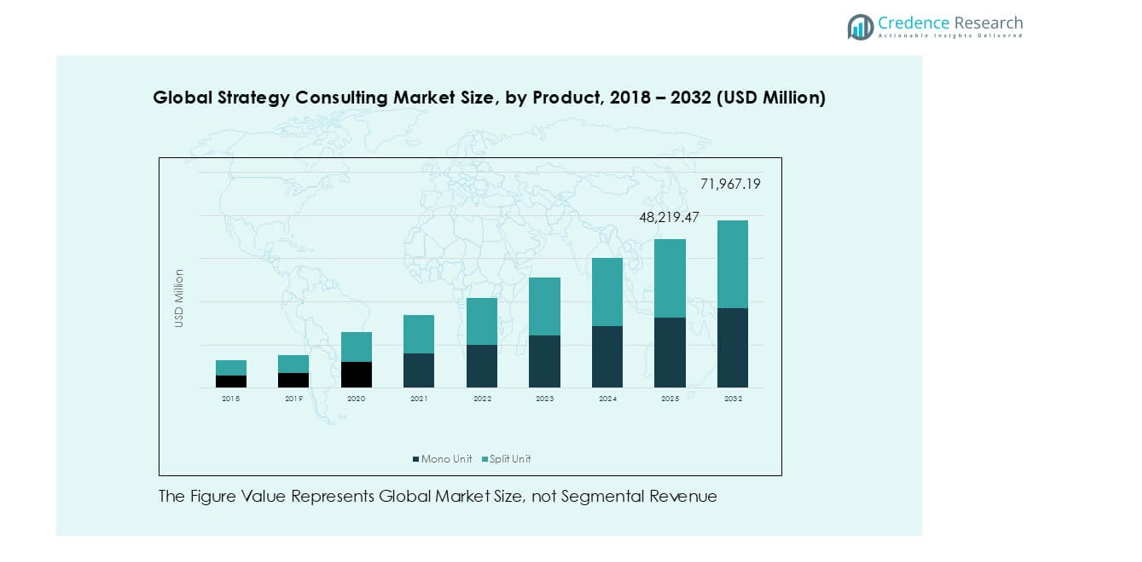
By Service
- Strategy and Operations
- Financial Consulting
- Human Capital Consulting
- Technology and IT Consulting
- Others
By Consulting Models
- Project-Based Consulting
- Retainer-Based Consulting
- Agile Consulting
By Client Type
- Corporate Clients
- Government Consulting
- Nonprofit and NGO Consulting
By End User
- BFSI
- IT & Telecom
- Government
- Retail & E-commerce
- Healthcare
- Manufacturing
- Others
By Geography
- North America
- U.S.
- Canada
- Mexico
- Europe
- Germany
- France
- U.K.
- Italy
- Spain
- Rest of Europe
- Asia Pacific
- China
- Japan
- India
- South Korea
- South-east Asia
- Rest of Asia Pacific
- Latin America
- Brazil
- Argentina
- Rest of Latin America
- Middle East & Africa
- GCC Countries
- South Africa
- Rest of the Middle East and Africa
Competitive Landscape
The global strategy consulting market shows a highly competitive and fragmented landscape. Large multinational firms dominate high-value engagements. These firms leverage deep industry expertise and global delivery networks. Competition centers on thought leadership and execution capability. Digital strategy and transformation advisory create differentiation. Firms invest heavily in analytics and AI tools. Mergers and partnerships expand service breadth. Mid-sized firms compete through niche specialization. Pricing pressure increases competitive intensity. Clients demand measurable outcomes and faster delivery. Brand reputation influences client selection. Talent quality remains a key competitive factor. Firms expand in emerging markets. Agile delivery models gain importance. Continuous innovation sustains competitive positioning.
Key Player Analysis
- Bain & Company
- The Boston Consulting Group (BCG)
- Ernst & Young Ltd. (EY)
- McKinsey & Company
- Deloitte
- CGI Group Inc.
- PwC
- Accenture
- RedSeer Strategy Consultants
Recent Developments
- In September 2025, Business Insider warned of a potential decade-long reduction in consulting headcount across levels as AI automates foundational tasks.
- In August 2025, The Economist assessed McKinsey’s strategic crossroads approaching its centenary, citing competitive and reputational challenges.
- In July 2025, Accenture acquired Maryville Consulting Group, strengthening specialized strategic-advisory depth.
Report Coverage
The research report offers an in-depth analysis based on Service, Consulting Models, Client Type, End User and Geography. It details leading market players, providing an overview of their business, product offerings, investments, revenue streams, and key applications. Additionally, the report includes insights into the competitive environment, SWOT analysis, current market trends, as well as the primary drivers and constraints. Furthermore, it discusses various factors that have driven market expansion in recent years. The report also explores market dynamics, regulatory scenarios, and technological advancements that are shaping the industry. It assesses the impact of external factors and global economic changes on market growth. Lastly, it provides strategic recommendations for new entrants and established companies to navigate the complexities of the market.
Future Outlook
- Demand for strategy consulting will rise as enterprises face faster market disruption.
- Digital transformation programs will continue to anchor long-term consulting engagements.
- AI-driven strategy design will gain wider adoption across industries.
- Consulting firms will expand agile and outcome-based delivery models.
- Mid-sized enterprises will increasingly adopt professional strategy advisory services.
- Emerging markets will contribute a growing share of new consulting demand.
- Sustainability and ESG strategy advisory will become a core service area.
- M&A and restructuring advisory will remain a steady revenue source.
- Talent development and retention will shape firm competitiveness.
- Data-led decision support will define future consulting differentiation.
Request a Free Sample
Fill in your details and we'll send you a free sample report.
- Sample data tables & charts
- Research methodology
Need a Custom Version of This Report?
Tailor the scope, geography, or segments to your exact requirements.
- Custom geography or segment scope
- Direct access to our analyst team
Frequently Asked Questions
What is the current market size for Strategy Consulting Market, and what is its projected size in 2030?
At what Compound Annual Growth Rate is the Strategy Consulting Market projected to grow between 2025 and 2030?
What are the primary factors fueling the growth of the Strategy Consulting Market?
Who are the leading companies in the Strategy Consulting Market?
Which region commanded the largest share of the Global Strategy Consulting market in 2024?
Table of Content
Chapter 1. Report Introduction
- 1.1 Report Description & Purpose
- 1.1.1 Report Title & Market Definition
- 1.1.2 Unique Selling Propositions (USP) & Key Differentiators
- 1.1.3 Value Proposition for Stakeholders
- 1.2 Research Objectives
- 1.2.1 Market Sizing Objectives (Volume & Revenue)
- 1.2.2 Segmentation Objectives
- 1.2.3 Competitive Intelligence Objectives
- 1.2.4 Forecast & Scenario Objectives
- 1.3 Report Scope
- 1.3.1 Strategy Consulting Scope – Types & Subtypes Covered
- 1.3.2 Geographic Scope – Regions & Countries Covered
- 1.3.3 Historical Period, Base Year & Forecast Period (2024; forecast to 2032)
- 1.3.4 Inclusions & Exclusions
- 1.4 HS Code & Classification Framework
- 1.5 Currency, Units & Pricing Basis
- 1.6 Target Stakeholders
- 1.7 Limitations & Assumptions
Chapter 2. Executive Summary
- 2.1 Global Strategy Consulting Market Snapshot
- 2.1.1 Market Size – Historical (2024) & Forecast (2024-2032) (2024: USD 45,603.0 million → 2032: USD 71,967.2 million)
- 2.1.2 Volume & Revenue – Global Totals
- 2.1.3 Key Market Highlights – Top Five Facts
- 2.2 Strategy Consulting Market Segmentation Snapshot
- 2.2.1 Market Split by Region – 2024 vs. 2032
- 2.3 Competitive Snapshot
- 2.3.1 Top 10 Players by Revenue Share – 2024
- 2.3.2 Top 10 Players by Volume Share – 2024
- 2.3.3 Recent Strategic Developments (18-Month Summary)
- 2.4 Key Investment Highlights & Strategic Conclusions
Chapter 3. Strategy Consulting Market Dynamics & Industry Analysis
- 3.1 Market Overview & Context
- 3.1.1 Strategy Consulting Market Position in the Broader Automotive Value Chain
- 3.1.2 OEM vs. Replacement Market Dynamics
- 3.1.3 Market Maturity & Development Stage by Region
- 3.2 Strategy Consulting Market Drivers
- 3.3 Strategy Consulting Market Restraints & Challenges
- 3.4 Strategy Consulting Market Opportunities
- 3.5 Porter's Five Forces Analysis
- 3.5.1 Threat of New Entrants
- 3.5.2 Bargaining Power of Suppliers
- 3.5.3 Bargaining Power of Buyers
- 3.5.4 Threat of Substitutes
- 3.5.5 Competitive Rivalry – Intensity Assessment
- 3.6 Strategy Consulting Value Chain Analysis
- 3.6.1 Upstream – Raw Material/Input Suppliers
- 3.6.1.1 Raw Material/Input 1
- 3.6.1.2 Raw Material/Input 2
- 3.6.1.3 Raw Material/Input 3
- 3.6.2 Midstream – Production/Manufacturing/Service Delivery
- 3.6.2.1 Production/Process Overview
- 3.6.2.2 Key Facility Locations & Capacity by Manufacturer
- 3.6.3 Downstream – Distribution & End Consumer
- 3.6.3.1 Primary Channel – B2B/OEM
- 3.6.3.2 Secondary Channels – Dealer, Retail, Online, Direct
- 3.6.4 Value Chain Profitability Analysis
- 3.6.1 Upstream – Raw Material/Input Suppliers
- 3.7 PESTEL Analysis
- 3.7.1 Political Factors
- 3.7.2 Economic Factors
- 3.7.3 Social Factors
- 3.7.4 Technological Factors
- 3.7.5 Environmental Factors
- 3.7.6 Legal Factors
- 3.8 Strategy Consulting Supply Chain Analysis
- 3.8.1 Raw Material/Input Supply Risk Assessment
- 3.8.2 Manufacturing Concentration Risk (Geographic Exposure)
- 3.8.3 Trade Disruption Impact Analysis
- 3.9 Regulatory & Policy Landscape
Note: The regulatory and policy landscape section covers regulations based on their applicability to the market, Strategy Consulting category, geography, and scope of the study. Only regulatory frameworks with a material impact on operations, compliance, trade, sustainability, or market access are analyzed in detail.
Chapter 4. Key Investment Pockets & Opportunity Analysis
- 4.1 Strategy Consulting Market Attractiveness Analysis
- 4.1.1 By Region – Investment Attractiveness Matrix (Volume × CAGR)
- 4.2 Absolute Revenue Growth Opportunity
- 4.2.1 By Region – Absolute USD Growth Through 2032
- 4.3 Incremental Volume Opportunity
- 4.3.1 By Region – Incremental Volume Through 2032
- 4.3.2 Segment – Incremental Volume
- 4.4 Emerging Submarket Opportunity Deep Dive (Subject to Applicability)
- 4.5 Emerging Market Opportunity Scorecards
- 4.5.1 United States
- 4.5.2 Europe
- 4.5.3 Asia
- 4.5.4 Middle East & Africa
Note: Emerging Market Opportunity Scorecards will be included based on relevance and strategic importance. Regions listed are indicative and may vary depending on data availability and market dynamics.
Chapter 5. Strategy Consulting Import-Export Analysis & Trade Flows
- 5.1 Global Trade Overview
- 5.1.1 Global Export Value by Country (2024)
- 5.1.2 Global Export Volume by Country (2024)
- 5.1.3 Global Import Value by Country (2024)
- 5.1.4 Global Import Volume by Country (2024)
- 5.1.5 Net Trade Balance by Country (2024)
- 5.2 Export Analysis – Segment
- 5.2.1 Type 1 (HS Code)
- 5.2.2 Type 2 (HS Code)
- 5.2.3 Type 3 (HS Code)
- 5.2.4 Type 4 (HS Code)
- 5.2.5 Type 5 (HS Code)
- 5.3 Import Analysis – Segment
- 5.3.1 Type 1 (HS Code)
- 5.3.2 Type 2 (HS Code)
- 5.3.3 Type 3 (HS Code)
- 5.3.4 Type 4 (HS Code)
- 5.3.5 Type 5 (HS Code)
- 5.4 Average Unit Trade Prices
- 5.4.1 Average Export Price – Segment & Country
- 5.4.2 Average Import Price – Segment & Source Country
- 5.4.3 Price Trends (2024)
- 5.5 Key Trade Route Analysis
- 5.5.1 Trade Route 1
- 5.5.2 Trade Route 2
- 5.5.3 Trade Route 3
- 5.5.4 Trade Route 4
- 5.5.5 Trade Route 5
- 5.6 Trade Policy Impact Assessment
- 5.6.1 US Anti-Dumping & Section 301 Tariffs
- 5.6.2 EU Customs Union Impact
- 5.6.3 Major Free Trade Agreements
- 5.6.4 USMCA Rules of Origin
Note: Trade policy analysis will be included only where relevant to the Strategy Consulting market.
Chapter 6. Competitive Landscape & Company Benchmarking
- 6.1 Strategy Consulting Market Concentration & Structure
- 6.1.1 Herfindahl-Hirschman Index (HHI) – vs. 2024
- 6.1.2 Tier 1, Tier 2 & Tier 3 Market Structure
- 6.1.3 Global, Regional & Local Player Dynamics
- 6.2 Strategy Consulting Market Share Analysis – 2024
- 6.2.1 Global Revenue Share by Company
- 6.2.2 Global Volume Share by Company
- 6.2.3 Regional Revenue Share
- 6.2.4 Market Share Evolution ( vs. 2024)
- 6.2.5 OEM Segment Share by Company
- 6.2.6 Replacement Segment Share by Company
- 6.3 Production/Delivery Capacity & Facility Analysis
- 6.3.1 Global Installed Capacity
- 6.3.2 Capacity Utilization Rates
- 6.3.3 Production/Output Volume
- 6.3.4 Facility Locations & Capacity Map
- 6.3.5 Planned Capacity Additions
- 6.4 Strategy Consulting Competitive Benchmarking Matrix
- 6.4.1 Revenue, Volume, CAGR & Profitability Comparison
- 6.4.2 Channel Revenue Mix
- 6.4.3 Geographic Revenue Exposure
- 6.4.4 R&D Intensity
- 6.4.5 Sustainability Maturity
- 6.5 Strategic Developments in Strategy Consulting (Last 24 Months)
- 6.5.1 Mergers, Acquisitions & Divestments
- 6.5.2 New Strategy Consulting Launches
- 6.5.3 Facility Expansions
- 6.5.4 Strategic Alliances, Joint Ventures & Partnerships
- 6.5.5 Distribution Expansion & Market Entry
- 6.5.6 Sustainability & ESG Initiatives
- 6.6 Competitive Strategy Mapping
- 6.6.1 Leader, Challenger, Follower & Niche Classification
- 6.6.2 Pricing Strategy Comparison
- 6.6.3 Channel Strategy Matrix
Note: Strategic developments are included based on their materiality and the availability of reliable information.
Chapter 7. Global Strategy Consulting Market – By Distribution Channel
- 7.1 Segment Overview
- 7.1.1 Volume & Revenue Split by Channel (2024 & 2032)
- 7.1.2 Channel Mix Evolution (2024-2032)
Chapter 8. Regional Market Analysis – Global Overview
- 8.1 Global Regional Overview
- 8.1.1 Regional Volume Share
- 8.1.2 Regional Revenue Share
- 8.1.3 Regional Volume by Region
- 8.1.4 Regional Revenue by Region
- 8.1.5 Regional Forecast Through 2032
- 8.2 Cross-Regional Segment Analysis
- 8.2.1 By Distribution Channel
- 8.2.2 By Brand/Price Tier
Chapter 9. North America Strategy Consulting Market
- 9.1 United States
- 9.2 Canada
- 9.3 Mexico
Chapter 10. Europe Strategy Consulting Market
- 10.1 Germany
- 10.2 France
- 10.3 Italy
- 10.4 United Kingdom
- 10.5 Spain
- 10.6 Poland
- 10.7 Russia
- 10.8 Netherlands
- 10.9 Belgium
- 10.10 Sweden
- 10.11 Denmark
- 10.12 Norway
- 10.13 Rest of Europe
Chapter 11. Asia Pacific Strategy Consulting Market
- 11.1 China
- 11.2 India
- 11.3 Japan
- 11.4 South Korea
- 11.5 Thailand
- 11.6 Indonesia
- 11.7 Vietnam
- 11.8 Malaysia
- 11.9 Australia
- 11.10 Rest of Asia Pacific
Chapter 12. Latin America Strategy Consulting Market
- 12.1 Brazil
- 12.2 Argentina
- 12.3 Colombia
- 12.4 Chile
- 12.5 Rest of Latin America
Chapter 13. Middle East Strategy Consulting Market
- 13.1 Saudi Arabia
- 13.2 United Arab Emirates
- 13.3 Turkey
- 13.4 Israel
- 13.5 Iran
- 13.6 Rest of the Middle East
Chapter 14. Africa Strategy Consulting Market
- 14.1 South Africa
- 14.2 Egypt
- 14.3 Nigeria
- 14.4 Morocco
- 14.5 Rest of Africa
Chapter 15. Strategy Consulting Company Profiles
- 15.1 [Company 01]
- 15.1.1 Company Overview
- 15.1.2 Key Management Personnel
- 15.1.3 Products & Services Portfolio
- 15.1.4 Financial Performance
- 15.1.5 Key Market Focus & Geographic Presence
- 15.1.6 Recent Developments & Strategic Initiatives
Note: The company profile list is preliminary and may change based on research findings, market developments, data availability, and client requirements.
Chapter 16. Appendices
- Appendix A – List of Abbreviations & Acronyms
- Appendix B – Industry Classification Code Reference – Full Series
- Appendix C – Production & Capacity Data Tables
- Appendix D – End-Use & Demand Base Tables
- Appendix E – Consumption & Replacement Rate Assumptions
- Appendix F – ASP Reference Tables
- Appendix G – Manufacturing & Facility Database
- Appendix H – Import-Export Data Tables
- Appendix I – Regulatory Summary Tables
- Appendix J – Primary Research Participant List (Anonymized)
- Appendix K – Primary Research Questionnaire Framework
- Appendix L – Data Sources & Bibliography
- Appendix M – Market Size Divergence & Source Comparison
Chapter 17. Research Methodology
- 17.1 Research Framework & Philosophy
- 17.2 Secondary Research – Sources, Hierarchy & Data Extraction
- 17.3 Data Modeling – Bottom-Up & Top-Down Market Sizing
- 17.4 Primary Research – Stakeholder Framework, LOI & Sample Sizes
- 17.5 Forecast Methodology – Regression, Scenario & Sensitivity Analysis
- 17.6 Quality Control – Four-Layer Validation Framework
- 17.7 Limitations & Standard Assumptions
- 17.8 Disclaimer
