
Market Overview
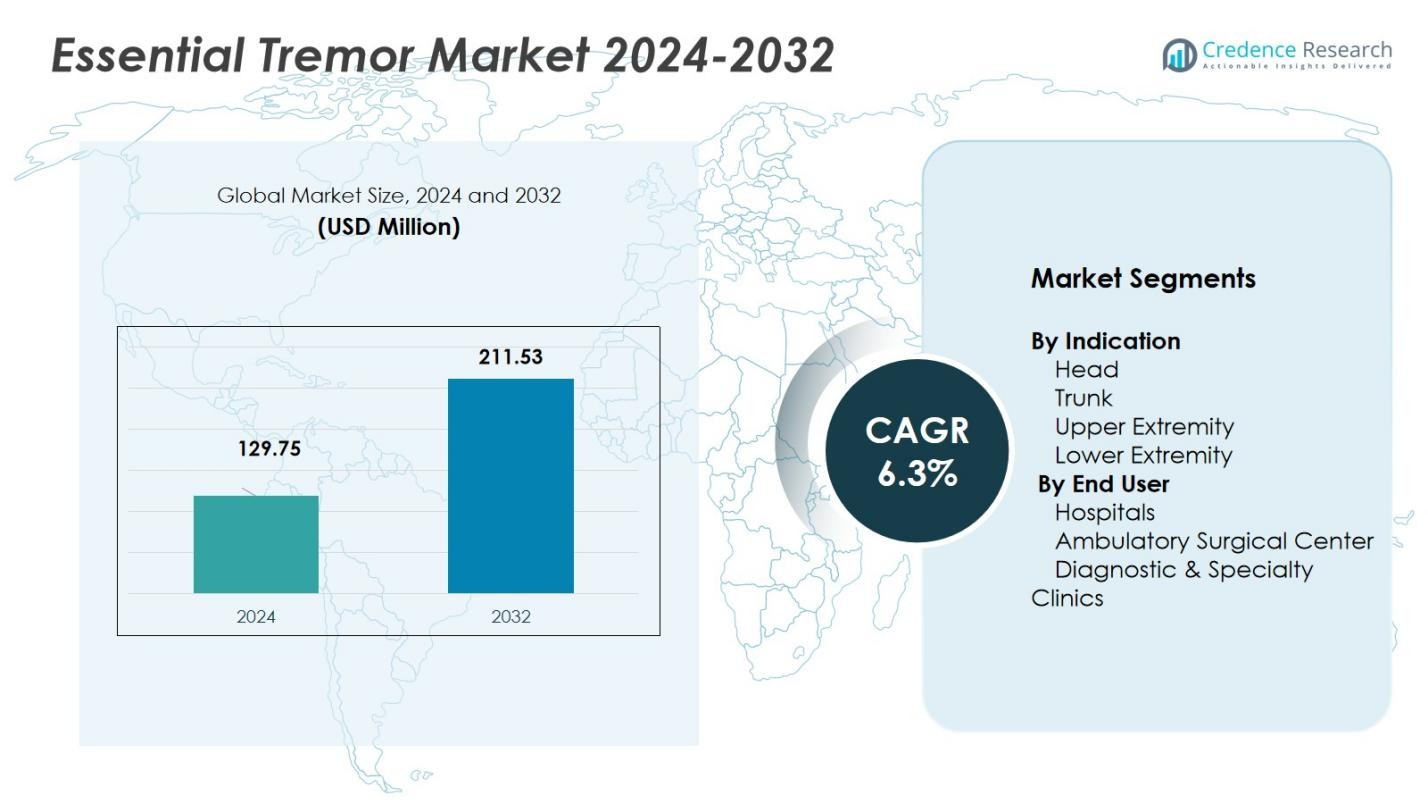
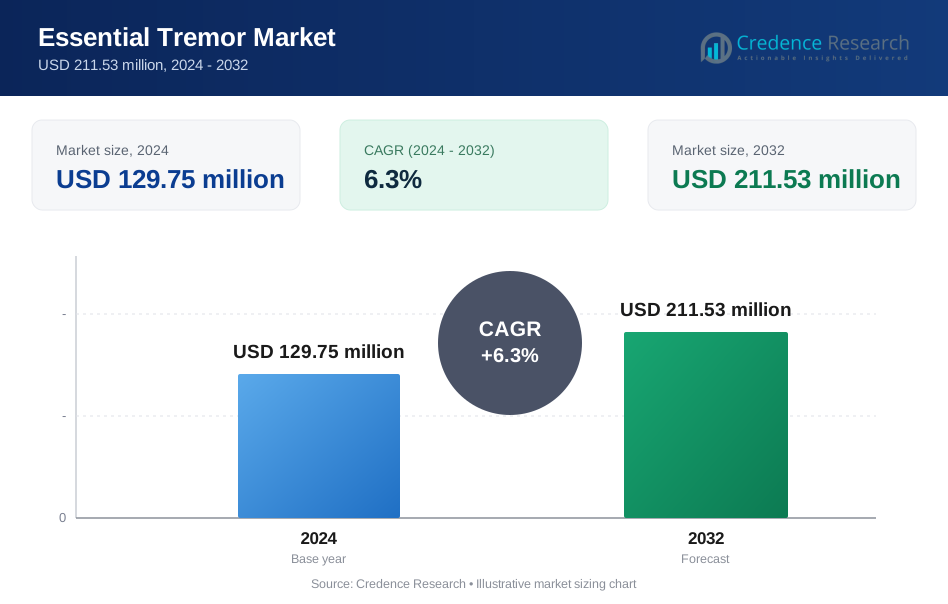
Essential Tremor Market size was valued at USD 129.75 million in 2024 and is anticipated to reach USD 211.53 million by 2032, at a CAGR of 6.3% during the forecast period.
| REPORT ATTRIBUTE | DETAILS |
|---|---|
| Historical Period | 2020-2023 |
| Base Year | 2024 |
| Forecast Period | 2025-2032 |
| Essential Tremor Market Size 2024 | USD 129.75 Million |
| Essential Tremor Market, CAGR | 6.3% |
| Essential Tremor Market Size 2032 | USD 211.53 Million |
The Essential Tremor Market is dominated by key players including InSightec Ltd., Merz Pharma, Neurocrine Biosciences, Sage Therapeutics, and Dopa Solutions. InSightec, with its MRI-guided focused ultrasound platform, is leading the non-invasive treatment segment, offering precision therapy with minimal patient risk. Merz Pharma and Neurocrine Biosciences provide effective pharmaceutical options, expanding treatment avenues for patients. Sage Therapeutics and Dopa Solutions focus on neurological interventions that enhance quality of life for essential tremor patients. North America holds the largest share of the market, accounting for 41% in 2024, driven by a strong healthcare infrastructure and high adoption of advanced treatments such as deep brain stimulation (DBS). Europe follows with a 28% share, benefiting from improved access to specialized care, while Asia-Pacific, with a 17% share, is experiencing rapid market growth, particularly in countries like Japan and China.
Market Insights
- The market was valued at USD 129.75 Million in 2024 and is projected to grow at a CAGR of 6.3 %.
- Rising prevalence of Essential Tremor, particularly in older populations, continues to drive demand for effective treatments worldwide.
- Rapid advances in treatment technologies, such as Deep Brain Stimulation (DBS) and non‑invasive therapies, expand treatment options and attract more patients.
- Growing awareness of the disorder and improved diagnostic capabilities lead to earlier detection and increased uptake of therapeutic interventions.
- Regional demand is led by North America with a 41 % share and Europe with a 28 % share, while Asia‑Pacific holds 17 %; the strong presence of Upper Extremity tremor segment (45 % share) further supports global market expansion.
 Market Segmentation Analysis:
By Indication:
The Essential Tremor market is segmented by indication into Head, Trunk, Upper Extremity, and Lower Extremity. The Upper Extremity segment holds the largest share, accounting for 45% of the market in 2024. This dominance is attributed to the high prevalence of tremors in the hands and arms, which significantly affect daily activities. The growing demand for treatments aimed at improving motor control and quality of life for patients with hand tremors drives the segment’s growth. Additionally, the increasing adoption of deep brain stimulation (DBS) for upper extremity tremor treatment supports this trend.
- For instance, Abbott's FDA-approved Infinity DBS system is widely used to target upper limb tremors by delivering precise brain stimulation, improving motor control.
By End User:
The Essential Tremor market’s end-user segment includes Hospitals, Ambulatory Surgical Centers (ASCs), and Diagnostic & Specialty Clinics. Hospitals lead the market with a share of 55% in 2024. The widespread availability of specialized care and advanced treatment options, such as DBS and focused ultrasound therapy, makes hospitals the preferred choice for essential tremor patients. The growing number of patients requiring surgical interventions, combined with improved healthcare infrastructure, supports the dominance of this segment. Additionally, hospitals offer comprehensive care for complex cases, further enhancing their market share.
- For instance, Massachusetts General Hospital provides extensive multidisciplinary care for complex tremor cases, integrating surgery with rehabilitation services.
Key Growth Drivers
Increasing Prevalence of Essential Tremor
The growing prevalence of essential tremor (ET), particularly in aging populations, is a significant driver for market expansion. As the global elderly population rises, the number of individuals affected by essential tremor is also increasing, leading to higher demand for treatment options. The condition’s impact on daily activities, such as writing and holding objects, drives patients to seek medical intervention, thereby propelling market growth. Additionally, the rising awareness about the disorder and its management fuels the adoption of advanced therapeutic solutions, supporting market growth.
- For instance, Cala Health offers the Cala kIQ, an FDA-cleared wearable device that delivers transcutaneous afferent patterned stimulation (TAPS) therapy, clinically proven to reduce action hand tremors in essential tremor patients.
Advancements in Treatment Technologies
Technological advancements in the treatment of essential tremor, such as deep brain stimulation (DBS) and focused ultrasound therapy, are significantly driving market growth. DBS is particularly effective for patients with severe tremors, offering a long-term solution by targeting brain regions responsible for tremor activity. Focused ultrasound, a non-invasive procedure, is gaining traction due to its ability to treat tremors without the need for surgery. These innovations, combined with the development of more precise and effective devices, are enhancing the overall treatment landscape, contributing to the market's expansion.
- For instance, Medtronic’s Activa® DBS system has shown sustained symptom relief in patients with severe tremors by precisely targeting key brain regions.
Rising Healthcare Expenditure
Rising healthcare expenditure, particularly in developed regions, is fostering the growth of the essential tremor market. Governments and private institutions are increasing investments in healthcare infrastructure, including specialized care for neurological disorders like essential tremor. This trend is enhancing access to advanced treatments and surgical interventions for patients. Moreover, insurance coverage for essential tremor treatments is improving, making it easier for patients to access therapies such as DBS, thereby boosting market growth. The overall increase in healthcare funding is expected to provide long-term support for the market.
Key Trends & Opportunities
Shift Towards Non-Invasive Treatment Options
There is a growing trend towards non-invasive treatment options for essential tremor, such as focused ultrasound and transcranial magnetic stimulation (TMS). These methods are preferred due to their lower risk profiles and quicker recovery times compared to traditional surgical interventions. Focused ultrasound, for example, provides patients with the benefits of precise tremor targeting without the need for incisions, making it an attractive option. This shift to less invasive therapies presents significant opportunities for companies to innovate and introduce new, safer treatment modalities for essential tremor.
- For instance, companies using MRgFUS technology benefit from real-time thermal feedback that enhances precision and safety during treatment.
Integration of Artificial Intelligence in Treatment
Artificial intelligence (AI) is increasingly being integrated into the diagnosis and treatment of essential tremor, providing an opportunity for the market to evolve. AI algorithms are being used to enhance tremor monitoring, optimize deep brain stimulation settings, and personalize treatment plans. These AI-driven technologies improve the accuracy of diagnosis and treatment outcomes, providing patients with more effective solutions. The increasing use of AI in healthcare opens up opportunities for companies to develop innovative products that can enhance the management of essential tremor and improve patient care.
- For instance, Cala Health uses AI-powered wearable devices to monitor tremor patterns and deliver non-invasive neuromodulation therapy with personalized feedback.
Key Challenges
High Treatment Costs
One of the major challenges faced by the essential tremor market is the high cost associated with advanced treatments, such as deep brain stimulation (DBS) and focused ultrasound. The initial cost of these therapies, along with ongoing maintenance and post-treatment care, can be prohibitively expensive for many patients, particularly in emerging economies. This cost barrier limits access to effective treatments and hinders market growth in some regions. Overcoming this challenge requires efforts to reduce treatment costs and improve insurance coverage to make these therapies more accessible to a broader patient population.
Limited Awareness and Misdiagnosis
Despite the growing prevalence of essential tremor, limited awareness of the condition remains a significant challenge. Many individuals with mild tremors may not seek medical attention, assuming the symptoms are benign or part of the aging process. Additionally, essential tremor is often misdiagnosed as Parkinson’s disease or another neurological disorder, leading to delays in proper treatment. Increased efforts to raise awareness among healthcare professionals and the general public, as well as improvements in diagnostic tools, are crucial to overcoming this challenge and ensuring that patients receive the appropriate care at the right time.
Regional Analysis
North America
North America leads the Essential Tremor market, holding a significant share of 41% in 2024. The region benefits from a well-established healthcare infrastructure, high awareness of neurological disorders, and broad adoption of advanced treatments like deep brain stimulation (DBS) and focused ultrasound. With a large aging population, North America sees a high prevalence of essential tremor, particularly among elderly individuals, driving the demand for innovative therapies. The presence of major market players and strong reimbursement systems further contribute to the dominance of this region, ensuring steady growth and adoption of novel treatment options.
Europe
Europe holds a market share of 28% in the Essential Tremor market. The region enjoys widespread accessibility to advanced neurological care and specialized treatments for essential tremor. The demand for both invasive and non-invasive therapies, including DBS and focused ultrasound, is rising due to the increasing recognition of essential tremor as a distinct disorder. Additionally, European healthcare systems are investing heavily in infrastructure, leading to improved diagnostic capabilities. With an aging population and an emphasis on minimally invasive procedures, Europe presents substantial opportunities for market growth.
Asia-Pacific
The Asia-Pacific region is experiencing rapid growth in the Essential Tremor market, accounting for 17% of the global market share in 2024. Countries like China, Japan, India, and South Korea are seeing an increase in diagnosis rates and healthcare access, driven by the growing elderly population and improved awareness of neurological disorders. The demand for advanced treatment options, including DBS and focused ultrasound, is rising as healthcare infrastructure improves. The region's projected rapid growth is supported by increased investment in healthcare facilities and rising disposable incomes, creating a significant opportunity for market expansion.
Latin America
Latin America holds a 7% share of the Essential Tremor market in 2024. While still emerging compared to North America and Europe, the region is witnessing steady growth due to improved healthcare infrastructure and a rising awareness of neurological disorders. Key countries like Brazil and Mexico are seeing an increase in investments for neurological care centers and diagnostic tools, fostering demand for treatment options such as DBS and focused ultrasound. As healthcare systems continue to evolve and access to advanced therapies increases, Latin America is expected to show gradual but promising growth in the coming years.
Middle East & Africa
The Middle East & Africa region holds the smallest share of the Essential Tremor market at 7% in 2024. However, the market is gradually expanding as healthcare investments increase and the prevalence of neurological disorders rises. Growing demand for specialized treatments, such as DBS and non-invasive therapies, is being supported by the expansion of healthcare infrastructure and medical tourism. Despite limited diagnostic capabilities and lower awareness compared to other regions, this region shows incremental growth potential due to ongoing improvements in healthcare access and increasing patient interest in advanced treatments.
Market Segmentations:
By Indication
- Head
- Trunk
- Upper Extremity
- Lower Extremity
By End User
- Hospitals
- Ambulatory Surgical Center
- Diagnostic & Specialty Clinics
By Geography
- North America
- U.S.
- Canada
- Mexico
- Europe
- Germany
- France
- U.K.
- Italy
- Spain
- Rest of Europe
- Asia Pacific
- China
- Japan
- India
- South Korea
- South-east Asia
- Rest of Asia Pacific
- Latin America
- Brazil
- Argentina
- Rest of Latin America
- Middle East & Africa
- GCC Countries
- South Africa
- Rest of the Middle East and Africa
Competitive Landscape
The competitive landscape of the Essential Tremor market is led by key players including InSightec Ltd., Merz Pharma, Neurocrine Biosciences, Sage Therapeutics, and Dopa Solutions. These companies shape the market through a blend of advanced therapeutic offerings, broad product portfolios, and strategic initiatives that target both non‑invasive and surgical treatments. InSightec stands out with its MRI‑guided focused ultrasound platform, which enables incision‑less, precision treatment of essential tremor and enhances patient adoption in scenarios where medication fails. Meanwhile, established device players such as Abbott Laboratories through their deep brain stimulation systems contribute to surgical treatment options, thereby complementing non‑invasive alternatives and enabling a comprehensive treatment landscape. The competitive structure emphasizes innovation, partnerships, and expansion of treatment access - for example, InSightec’s collaboration with Philips Healthcare to enhance MR‑guided focused ultrasound deployment globally. As a result, competition hinges not only on clinical efficacy but also on technology differentiation, regulatory approvals, and geographic reach, creating a dynamic environment where leading players constantly evolve their strategies to capture larger market share and address unmet patient needs.
Key Player Analysis
- Neurocrine Biosciences
- Philips Healthcare
- InSightec’s Ltd.
- Samsung Medicon
- Dopa Solutions
- Merz Pharma
- Siemens Healthcare
- Abbott
- Shenzen Midray
- Sage Therapeutics
Recent Developments
- In March 2024, InSightec secured reimbursement approval for its MR‑guided focused ultrasound therapy in Germany for essential tremor patients, improving treatment accessibility in that market.
- In January 2024, MR‑guided focused ultrasound treatment for essential tremor gained recommended national coverage in the Netherlands, marking increased institutional support for non‑invasive therapy.
- In October 2025, AbbVie reported positive topline results from a Phase 2 trial evaluating onabotulinumtoxinA (BOTOX®) for upper‑limb essential tremor.
- In April 2024, Merz Pharma’s subsidiary Merz Therapeutics entered into an asset‑purchase agreement to acquire two commercial neurology medicines, strengthening its neurological disorders portfolio.
Report Coverage
The research report offers an in-depth analysis based on Indication, End User and Geography. It details leading market players, providing an overview of their business, product offerings, investments, revenue streams, and key applications. Additionally, the report includes insights into the competitive environment, SWOT analysis, current market trends, as well as the primary drivers and constraints. Furthermore, it discusses various factors that have driven market expansion in recent years. The report also explores market dynamics, regulatory scenarios, and technological advancements that are shaping the industry. It assesses the impact of external factors and global economic changes on market growth. Lastly, it provides strategic recommendations for new entrants and established companies to navigate the complexities of the market.
Future Outlook
- The Essential Tremor market will continue to grow due to the rising prevalence of the condition, particularly in aging populations.
- Advancements in non-invasive treatment options, such as focused ultrasound, will drive market expansion by offering patients safer, quicker recovery alternatives.
- Increased adoption of deep brain stimulation (DBS) as a reliable treatment option will contribute significantly to market growth.
- The growing awareness and early diagnosis of essential tremor will lead to higher demand for therapeutic interventions.
- Rising healthcare expenditure, especially in emerging markets, will enhance access to advanced treatments and diagnostics.
- The integration of artificial intelligence and machine learning in treatment personalization will improve patient outcomes and boost market demand.
- Ongoing research and development will lead to innovative therapies with better efficacy and fewer side effects.
- Expansion of healthcare infrastructure in regions such as Asia-Pacific and Latin America will create new growth opportunities.
- Partnerships and collaborations between key players in the healthcare and technology sectors will accelerate market innovation and access.
- The increasing focus on personalized medicine and patient-centric approaches will drive the development of tailored treatments for essential tremor.
Request a Free Sample
Fill in your details and we'll send you a free sample report.
- Sample data tables & charts
- Research methodology
Need a Custom Version of This Report?
Tailor the scope, geography, or segments to your exact requirements.
- Custom geography or segment scope
- Direct access to our analyst team
Frequently Asked Questions
What is the current market size for Essential Tremor Market, and what is its projected size in 2032?
At what Compound Annual Growth Rate is the Essential Tremor Market projected to grow between 2025 and 2032?
Which Essential Tremor Market segment held the largest share in 2024?
What are the primary factors fueling the growth of the Essential Tremor Market?
Who are the leading companies in the Essential Tremor Market?
Which region commanded the largest share of the Essential Tremor Market in 2024?
Table of Content
Chapter 1. Report Introduction
- 1.1 Report Description & Purpose
- 1.1.1 Report Title & Market Definition
- 1.1.2 Unique Selling Propositions (USP) & Key Differentiators
- 1.1.3 Value Proposition for Stakeholders
- 1.2 Research Objectives
- 1.2.1 Market Sizing Objectives (Volume & Revenue)
- 1.2.2 Segmentation Objectives
- 1.2.3 Competitive Intelligence Objectives
- 1.2.4 Forecast & Scenario Objectives
- 1.3 Report Scope
- 1.3.1 Essential Tremor Scope – Types & Subtypes Covered
- 1.3.2 Geographic Scope – Regions & Countries Covered
- 1.3.3 Historical Period, Base Year & Forecast Period (2024; forecast to 2032)
- 1.3.4 Inclusions & Exclusions
- 1.4 HS Code & Classification Framework
- 1.5 Currency, Units & Pricing Basis
- 1.6 Target Stakeholders
- 1.7 Limitations & Assumptions
Chapter 2. Executive Summary
- 2.1 Global Essential Tremor Market Snapshot
- 2.1.1 Market Size – Historical (2024) & Forecast (2024-2032) (2024: USD 129.75 million → 2032: USD 211.53 million)
- 2.1.2 Volume & Revenue – Global Totals
- 2.1.3 Key Market Highlights – Top Five Facts
- 2.2 Essential Tremor Market Segmentation Snapshot
- 2.2.1 Market Split by Region – 2024 vs. 2032
- 2.3 Competitive Snapshot
- 2.3.1 Top 10 Players by Revenue Share – 2024
- 2.3.2 Top 10 Players by Volume Share – 2024
- 2.3.3 Recent Strategic Developments (18-Month Summary)
- 2.4 Key Investment Highlights & Strategic Conclusions
Chapter 3. Essential Tremor Market Dynamics & Industry Analysis
- 3.1 Market Overview & Context
- 3.1.1 Essential Tremor Market Position in the Broader Automotive Value Chain
- 3.1.2 OEM vs. Replacement Market Dynamics
- 3.1.3 Market Maturity & Development Stage by Region
- 3.2 Essential Tremor Market Drivers
- 3.3 Essential Tremor Market Restraints & Challenges
- 3.4 Essential Tremor Market Opportunities
- 3.5 Porter's Five Forces Analysis
- 3.5.1 Threat of New Entrants
- 3.5.2 Bargaining Power of Suppliers
- 3.5.3 Bargaining Power of Buyers
- 3.5.4 Threat of Substitutes
- 3.5.5 Competitive Rivalry – Intensity Assessment
- 3.6 Essential Tremor Value Chain Analysis
- 3.6.1 Upstream – Raw Material/Input Suppliers
- 3.6.1.1 Raw Material/Input 1
- 3.6.1.2 Raw Material/Input 2
- 3.6.1.3 Raw Material/Input 3
- 3.6.2 Midstream – Production/Manufacturing/Service Delivery
- 3.6.2.1 Production/Process Overview
- 3.6.2.2 Key Facility Locations & Capacity by Manufacturer
- 3.6.3 Downstream – Distribution & End Consumer
- 3.6.3.1 Primary Channel – B2B/OEM
- 3.6.3.2 Secondary Channels – Dealer, Retail, Online, Direct
- 3.6.4 Value Chain Profitability Analysis
- 3.6.1 Upstream – Raw Material/Input Suppliers
- 3.7 PESTEL Analysis
- 3.7.1 Political Factors
- 3.7.2 Economic Factors
- 3.7.3 Social Factors
- 3.7.4 Technological Factors
- 3.7.5 Environmental Factors
- 3.7.6 Legal Factors
- 3.8 Essential Tremor Supply Chain Analysis
- 3.8.1 Raw Material/Input Supply Risk Assessment
- 3.8.2 Manufacturing Concentration Risk (Geographic Exposure)
- 3.8.3 Trade Disruption Impact Analysis
- 3.9 Regulatory & Policy Landscape
Note: The regulatory and policy landscape section covers regulations based on their applicability to the market, Essential Tremor category, geography, and scope of the study. Only regulatory frameworks with a material impact on operations, compliance, trade, sustainability, or market access are analyzed in detail.
Chapter 4. Key Investment Pockets & Opportunity Analysis
- 4.1 Essential Tremor Market Attractiveness Analysis
- 4.1.1 By Region – Investment Attractiveness Matrix (Volume × CAGR)
- 4.2 Absolute Revenue Growth Opportunity
- 4.2.1 By Region – Absolute USD Growth Through 2032
- 4.3 Incremental Volume Opportunity
- 4.3.1 By Region – Incremental Volume Through 2032
- 4.3.2 Segment – Incremental Volume
- 4.4 Emerging Submarket Opportunity Deep Dive (Subject to Applicability)
- 4.5 Emerging Market Opportunity Scorecards
- 4.5.1 United States
- 4.5.2 Europe
- 4.5.3 Asia
- 4.5.4 Middle East & Africa
Note: Emerging Market Opportunity Scorecards will be included based on relevance and strategic importance. Regions listed are indicative and may vary depending on data availability and market dynamics.
Chapter 5. Essential Tremor Import-Export Analysis & Trade Flows
- 5.1 Global Trade Overview
- 5.1.1 Global Export Value by Country (2024)
- 5.1.2 Global Export Volume by Country (2024)
- 5.1.3 Global Import Value by Country (2024)
- 5.1.4 Global Import Volume by Country (2024)
- 5.1.5 Net Trade Balance by Country (2024)
- 5.2 Export Analysis – Segment
- 5.2.1 Type 1 (HS Code)
- 5.2.2 Type 2 (HS Code)
- 5.2.3 Type 3 (HS Code)
- 5.2.4 Type 4 (HS Code)
- 5.2.5 Type 5 (HS Code)
- 5.3 Import Analysis – Segment
- 5.3.1 Type 1 (HS Code)
- 5.3.2 Type 2 (HS Code)
- 5.3.3 Type 3 (HS Code)
- 5.3.4 Type 4 (HS Code)
- 5.3.5 Type 5 (HS Code)
- 5.4 Average Unit Trade Prices
- 5.4.1 Average Export Price – Segment & Country
- 5.4.2 Average Import Price – Segment & Source Country
- 5.4.3 Price Trends (2024)
- 5.5 Key Trade Route Analysis
- 5.5.1 Trade Route 1
- 5.5.2 Trade Route 2
- 5.5.3 Trade Route 3
- 5.5.4 Trade Route 4
- 5.5.5 Trade Route 5
- 5.6 Trade Policy Impact Assessment
- 5.6.1 US Anti-Dumping & Section 301 Tariffs
- 5.6.2 EU Customs Union Impact
- 5.6.3 Major Free Trade Agreements
- 5.6.4 USMCA Rules of Origin
Note: Trade policy analysis will be included only where relevant to the Essential Tremor market.
Chapter 6. Competitive Landscape & Company Benchmarking
- 6.1 Essential Tremor Market Concentration & Structure
- 6.1.1 Herfindahl-Hirschman Index (HHI) – vs. 2024
- 6.1.2 Tier 1, Tier 2 & Tier 3 Market Structure
- 6.1.3 Global, Regional & Local Player Dynamics
- 6.2 Essential Tremor Market Share Analysis – 2024
- 6.2.1 Global Revenue Share by Company
- 6.2.2 Global Volume Share by Company
- 6.2.3 Regional Revenue Share
- 6.2.4 Market Share Evolution ( vs. 2024)
- 6.2.5 OEM Segment Share by Company
- 6.2.6 Replacement Segment Share by Company
- 6.3 Production/Delivery Capacity & Facility Analysis
- 6.3.1 Global Installed Capacity
- 6.3.2 Capacity Utilization Rates
- 6.3.3 Production/Output Volume
- 6.3.4 Facility Locations & Capacity Map
- 6.3.5 Planned Capacity Additions
- 6.4 Essential Tremor Competitive Benchmarking Matrix
- 6.4.1 Revenue, Volume, CAGR & Profitability Comparison
- 6.4.2 Channel Revenue Mix
- 6.4.3 Geographic Revenue Exposure
- 6.4.4 R&D Intensity
- 6.4.5 Sustainability Maturity
- 6.5 Strategic Developments in Essential Tremor (Last 24 Months)
- 6.5.1 Mergers, Acquisitions & Divestments
- 6.5.2 New Essential Tremor Launches
- 6.5.3 Facility Expansions
- 6.5.4 Strategic Alliances, Joint Ventures & Partnerships
- 6.5.5 Distribution Expansion & Market Entry
- 6.5.6 Sustainability & ESG Initiatives
- 6.6 Competitive Strategy Mapping
- 6.6.1 Leader, Challenger, Follower & Niche Classification
- 6.6.2 Pricing Strategy Comparison
- 6.6.3 Channel Strategy Matrix
Note: Strategic developments are included based on their materiality and the availability of reliable information.
Chapter 7. Global Essential Tremor Market – By Distribution Channel
- 7.1 Segment Overview
- 7.1.1 Volume & Revenue Split by Channel (2024 & 2032)
- 7.1.2 Channel Mix Evolution (2024-2032)
Chapter 8. Regional Market Analysis – Global Overview
- 8.1 Global Regional Overview
- 8.1.1 Regional Volume Share
- 8.1.2 Regional Revenue Share
- 8.1.3 Regional Volume by Region
- 8.1.4 Regional Revenue by Region
- 8.1.5 Regional Forecast Through 2032
- 8.2 Cross-Regional Segment Analysis
- 8.2.1 By Distribution Channel
- 8.2.2 By Brand/Price Tier
Chapter 9. North America Essential Tremor Market
- 9.1 United States
- 9.2 Canada
- 9.3 Mexico
Chapter 10. Europe Essential Tremor Market
- 10.1 Germany
- 10.2 France
- 10.3 Italy
- 10.4 United Kingdom
- 10.5 Spain
- 10.6 Poland
- 10.7 Russia
- 10.8 Netherlands
- 10.9 Belgium
- 10.10 Sweden
- 10.11 Denmark
- 10.12 Norway
- 10.13 Rest of Europe
Chapter 11. Asia Pacific Essential Tremor Market
- 11.1 China
- 11.2 India
- 11.3 Japan
- 11.4 South Korea
- 11.5 Thailand
- 11.6 Indonesia
- 11.7 Vietnam
- 11.8 Malaysia
- 11.9 Australia
- 11.10 Rest of Asia Pacific
Chapter 12. Latin America Essential Tremor Market
- 12.1 Brazil
- 12.2 Argentina
- 12.3 Colombia
- 12.4 Chile
- 12.5 Rest of Latin America
Chapter 13. Middle East Essential Tremor Market
- 13.1 Saudi Arabia
- 13.2 United Arab Emirates
- 13.3 Turkey
- 13.4 Israel
- 13.5 Iran
- 13.6 Rest of the Middle East
Chapter 14. Africa Essential Tremor Market
- 14.1 South Africa
- 14.2 Egypt
- 14.3 Nigeria
- 14.4 Morocco
- 14.5 Rest of Africa
Chapter 15. Essential Tremor Company Profiles
- 15.1 [Company 01]
- 15.1.1 Company Overview
- 15.1.2 Key Management Personnel
- 15.1.3 Products & Services Portfolio
- 15.1.4 Financial Performance
- 15.1.5 Key Market Focus & Geographic Presence
- 15.1.6 Recent Developments & Strategic Initiatives
Note: The company profile list is preliminary and may change based on research findings, market developments, data availability, and client requirements.
Chapter 16. Appendices
- Appendix A – List of Abbreviations & Acronyms
- Appendix B – Industry Classification Code Reference – Full Series
- Appendix C – Production & Capacity Data Tables
- Appendix D – End-Use & Demand Base Tables
- Appendix E – Consumption & Replacement Rate Assumptions
- Appendix F – ASP Reference Tables
- Appendix G – Manufacturing & Facility Database
- Appendix H – Import-Export Data Tables
- Appendix I – Regulatory Summary Tables
- Appendix J – Primary Research Participant List (Anonymized)
- Appendix K – Primary Research Questionnaire Framework
- Appendix L – Data Sources & Bibliography
- Appendix M – Market Size Divergence & Source Comparison
Chapter 17. Research Methodology
- 17.1 Research Framework & Philosophy
- 17.2 Secondary Research – Sources, Hierarchy & Data Extraction
- 17.3 Data Modeling – Bottom-Up & Top-Down Market Sizing
- 17.4 Primary Research – Stakeholder Framework, LOI & Sample Sizes
- 17.5 Forecast Methodology – Regression, Scenario & Sensitivity Analysis
- 17.6 Quality Control – Four-Layer Validation Framework
- 17.7 Limitations & Standard Assumptions
- 17.8 Disclaimer
