
Cardiac Arrest Treatment Market Overview:
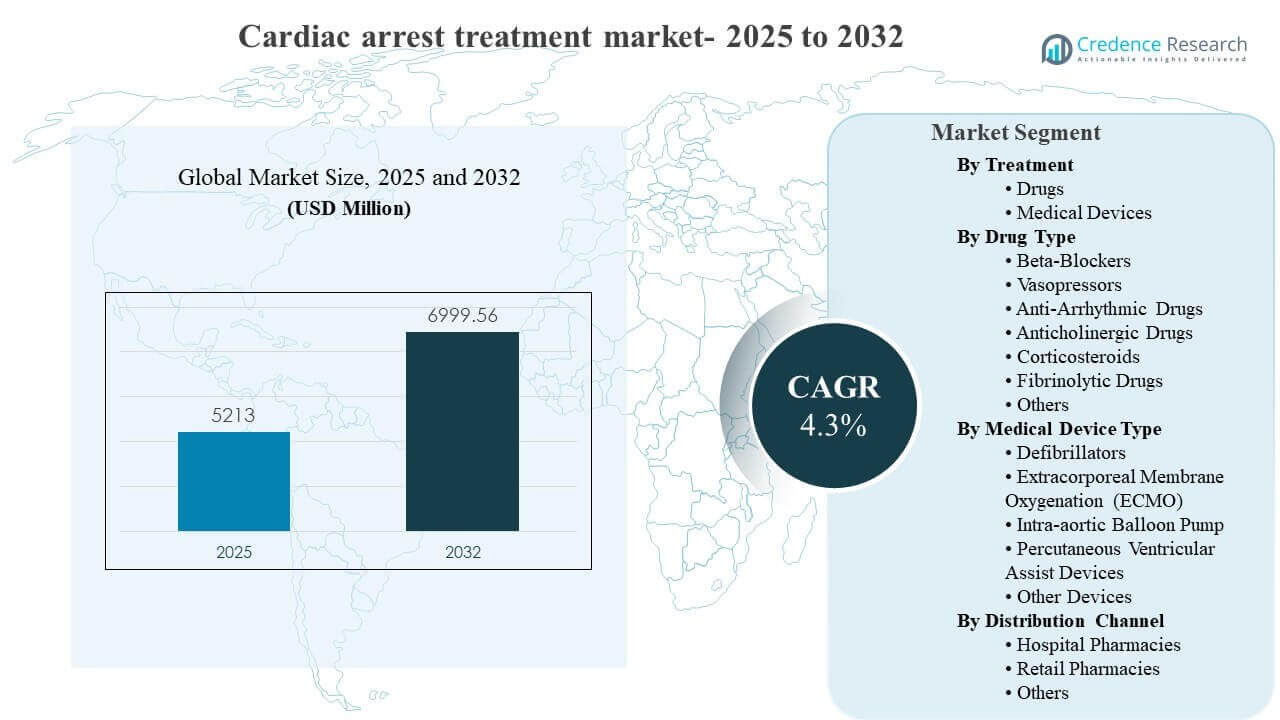
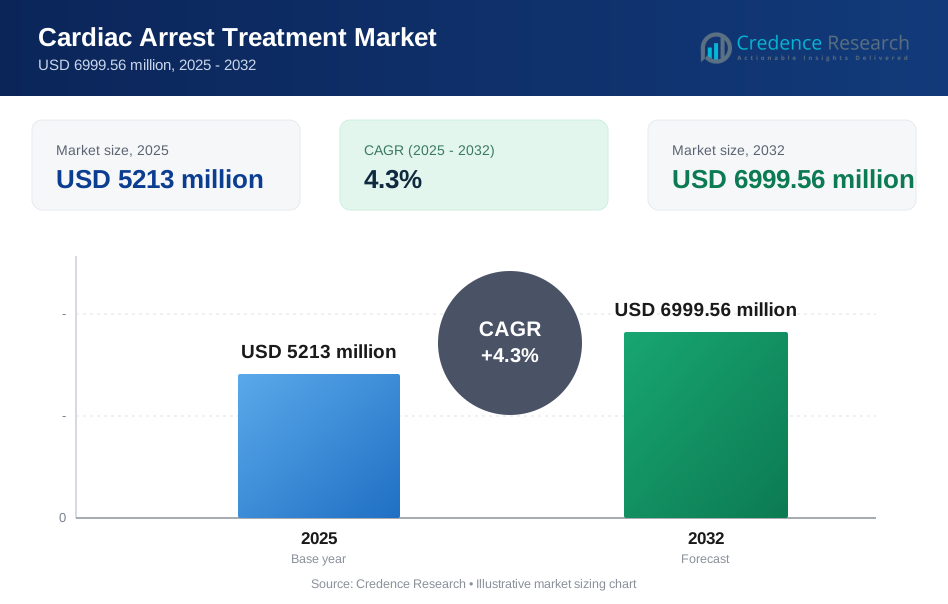
The global Cardiac Arrest Treatment market size was estimated at USD 5213 million in 2025 and is expected to reach USD 6999.56 million by 2032, growing at a CAGR of 4.3% from 2025 to 2032. Demand is primarily driven by rising incidence of sudden cardiac arrest and the need to shorten time-to-intervention across pre-hospital and in-hospital pathways, which increases adoption of defibrillation, advanced life support drug protocols, and post-resuscitation critical care solutions. Cardiac arrest treatment market expansion is further supported by broader deployment of emergency response infrastructure and growing availability of advanced circulatory support in tertiary centers.
| REPORT ATTRIBUTE | DETAILS |
|---|---|
| Historical Period | 2020-2024 |
| Base Year | 2025 |
| Forecast Period | 2026-2032 |
| Cardiac Arrest Treatment Market Size 2025 | USD 5213 million |
| Cardiac Arrest Treatment Market, CAGR | 4.3% |
| Cardiac Arrest Treatment Market Size 2032 | USD 6999.56 million |
Key Market Trends & Insights
- The Cardiac arrest treatment market was valued at USD 5213 million in 2025 and is projected to reach USD 6999.56 million by 2032.
- Cardiac arrest treatment market growth is projected at a 4.3% CAGR during 2025–2032.
- North America accounted for 39.0% of Cardiac arrest treatment market revenue in 2025, reflecting strong penetration of device-led response and acute-care protocols.
- Vasopressors represented 29.7% of Cardiac arrest treatment market drug-type demand in 2025, supported by broad algorithm usage in resuscitation care.
- Intravenous administration held 60.5% share in 2025, highlighting the dominance of rapid-onset delivery routes in emergency treatment workflows.
Segment Analysis
Cardiac arrest treatment market segmentation shows a clear split between pharmacologic stabilization and device-led resuscitation, with purchasing decisions heavily influenced by protocol standardization, response time targets, and the ability to integrate with emergency workflows. Hospitals and emergency services prioritize solutions that reduce time-to-defibrillation, improve cardiopulmonary resuscitation consistency, and enable structured post-event monitoring. Cardiac arrest treatment market demand also reflects the growing role of specialized centers that can provide advanced hemodynamic support in refractory cases, which elevates the relevance of high-acuity device pathways.
Cardiac arrest treatment market utilization patterns remain concentrated in acute settings where rapid access, reliability, and training readiness determine adoption. Drug demand is anchored by resuscitation algorithms that emphasize immediate hemodynamic support and rhythm control, supported by standardized stocking and code-cart readiness in hospitals. Device demand is reinforced by broader AED placement, connected response ecosystems, and improved clinical integration of monitoring and escalation pathways, which strengthens end-to-end care continuity from resuscitation through stabilization.
By Treatment Insights
Medical device adoption remains central to Cardiac arrest treatment market performance because immediate rhythm correction and circulatory stabilization require fast, standardized intervention in both pre-hospital and hospital environments. Wider AED deployment programs and improved response workflows support sustained device penetration, particularly in settings prioritizing rapid time-to-shock performance. Increasing use of advanced support pathways in tertiary centers also expands the role of high-acuity devices for refractory cases. Standardized training and protocolization across emergency teams further strengthens device-led care reliability.
By Drug Type Insights
Vasopressors accounted for the largest share of 29.7% in 2025. Cardiac arrest treatment market demand for vasopressors is supported by broad applicability across resuscitation protocols focused on restoring perfusion and supporting circulation during advanced life support. Standardized emergency algorithms and consistent stocking practices increase repeat utilization across hospitals and emergency medical services. Clinical emphasis on immediate hemodynamic support reinforces sustained purchasing and formulary presence for vasopressor therapies.
By Medical Device Type Insights
Defibrillators remain a foundational category within the Cardiac arrest treatment market because shock delivery is indispensable for managing shockable rhythms and improving survival odds when intervention occurs rapidly. Integration of AEDs into public-access environments supports wider deployment and recurrent replacement cycles driven by compliance and readiness requirements. Advanced circulatory support technologies gain relevance in specialized centers managing complex and refractory cases. Ongoing improvements in usability, portability, and workflow connectivity strengthen adoption across emergency response settings.
By Distribution Channel Insights
Hospital pharmacies continue to anchor Cardiac arrest treatment market distribution because emergency response protocols depend on immediate availability of resuscitation drugs and standardized kit readiness in acute-care environments. Centralized stocking, formulary controls, and code-cart replenishment practices drive predictable purchasing patterns for emergency therapeutics. Retail channels play a secondary role focused on post-event cardiovascular management and supportive medication access rather than immediate resuscitation needs. Supply reliability and cold-chain or controlled storage requirements further reinforce hospital-centric distribution.
Cardiac Arrest Treatment Market Drivers
Rising Sudden Cardiac Arrest Incidence And High-Intensity Acute Care Demand
Cardiac arrest treatment market growth is supported by the expanding burden of cardiovascular disease and the continued prevalence of sudden cardiac arrest events across aging populations. Emergency systems and hospitals increasingly prioritize rapid response capability because survival outcomes are highly time-dependent. This pushes investment in defibrillation readiness, standardized advanced life support drug protocols, and post-resuscitation critical care infrastructure. Cardiac arrest treatment market purchasing also rises as hospitals expand critical care capacity to manage stabilization, monitoring, and complications following return of spontaneous circulation.
- For instance, Stryker’s LIFEPAK 15 V4+ monitor/defibrillator delivers up to 360 J biphasic energy and includes CPR guidance shown to guide responders to perform compressions at 100 per minute, strengthening in-hospital readiness for high-acuity cardiac arrest events.
Expansion Of Emergency Response Infrastructure And AED Penetration
Cardiac arrest treatment market adoption is strengthened by wider deployment of AEDs across public places, workplaces, and institutional settings that aim to reduce time-to-shock. Programmatic AED placement, training initiatives, and readiness audits encourage consistent device replacement and service contracts. Emergency medical services also benefit from better equipment availability and more structured response coordination across dispatch, first responders, and hospital handoff. Cardiac arrest treatment market momentum increases when connected-response ecosystems improve alerting, device discoverability, and compliance tracking.
Protocol Standardization In Advanced Cardiac Life Support Pathways
Cardiac arrest treatment market demand rises as hospitals align care delivery with structured resuscitation and post-resuscitation pathways. Protocol standardization increases repeat utilization of core drug classes used during codes and streamlines stocking practices across departments. Training-based adherence reduces variability in clinical execution and supports consistent consumption of emergency medications and disposables. Cardiac arrest treatment market expansion is also supported by stronger quality metrics that emphasize rapid escalation, monitoring, and documented adherence to resuscitation workflows.
Growth Of Advanced Circulatory Support In Specialized Centers
Cardiac arrest treatment market opportunities expand as tertiary centers increase capability for advanced hemodynamic support in high-acuity cases. Specialized programs strengthen the role of technologies used in refractory cardiac arrest and severe cardiogenic shock pathways, which increases demand for advanced devices and associated consumables. Adoption is supported by clinician familiarity, improved patient selection protocols, and expansion of critical care teams. Cardiac arrest treatment market value also grows as device ecosystems integrate monitoring, escalation, and post-event stabilization workflows.
- For instance, Getinge’s Cardiohelp II platform supports v-a ECLS in cardiogenic shock and cardiopulmonary resuscitation with disposable blood-flow ranges of 0.5-5.0 L/min and 0.5-7.0 L/min, while also supporting air and ground transport for critically ill patients who require extracorporeal support escalation.
Cardiac Arrest Treatment Market Challenges
Cardiac arrest treatment market growth faces constraints related to cost, training intensity, and uneven access to advanced care pathways. High-acuity devices and specialized programs require experienced teams, standardized protocols, and high readiness, which can limit penetration outside top-tier hospitals. Budget limitations and procurement complexity can slow upgrades, particularly in smaller facilities. Cardiac arrest treatment market adoption can also be hindered when maintenance, servicing, and compliance requirements create operational friction for widespread device deployment.
- For instance, Stryker’s LUCAS 3 v3.1 chest compression system delivers automated compressions at 102 ± 2 compressions per minute with a depth of 53 ± 2 mm, and its settings can be configured to 102, 111, or 120 compressions per minute, highlighting how advanced resuscitation platforms require protocol alignment, trained operators, and ongoing device management before wider rollout.
Cardiac arrest treatment market performance is challenged by outcome variability and the complexity of real-world resuscitation execution. Differences in response time, bystander intervention, and pre-hospital coordination influence outcomes and can reduce consistency in utilization patterns. Drug therapy optimization is also constrained by protocol adherence and clinical heterogeneity across patient profiles. Cardiac arrest treatment market uptake may be further slowed by supply chain dependencies for critical components and the need for continuous training to maintain readiness.
Cardiac Arrest Treatment Market Trends and Opportunities
Cardiac arrest treatment market innovation is trending toward connected response ecosystems that improve device readiness, response coordination, and post-event data capture. AEDs and monitoring technologies increasingly integrate software layers that support compliance tracking, incident documentation, and workflow improvements. Hospitals are also strengthening post-resuscitation pathways with structured monitoring and escalation tools that improve continuity from emergency response to stabilization. Cardiac arrest treatment market opportunity rises when integrated systems reduce operational burden and improve training adherence.
- For instance, ZOLL’s AED 3 combines Wi-Fi-enabled readiness management with AEDtrax reporting that checks in daily and RapidShock analysis that can deliver a shock in as little as 5 seconds, while ZOLL’s Thermogard HQ post-arrest temperature management system can cool at up to 3.6°C per hour and maintain target temperature within 0.2°C 96.8% of the time.
Cardiac arrest treatment market opportunities are expanding through broader adoption of advanced circulatory support in specialized centers and improved clinical pathways for refractory cases. Growth is supported by clinical programs that standardize selection criteria, team readiness, and escalation protocols, which increases device utilization in high-acuity settings. At the same time, improved usability and portability of response devices supports deployment across more care sites. Cardiac arrest treatment market growth benefits when technology reduces complexity and improves time-critical execution.
Regional Insights
North America
North America leads the Cardiac arrest treatment market due to strong emergency response infrastructure, high penetration of defibrillation readiness programs, and broad access to hospital-based acute cardiac care. Large health systems support standardized protocols that increase consistency in resuscitation workflows and post-event monitoring. The region also benefits from device replacement cycles and strong demand for integrated monitoring pathways that support escalation and stabilization. North America accounted for 39.0% of Cardiac arrest treatment market revenue in 2025.
Europe
Europe shows strong Cardiac arrest treatment market demand supported by established hospital networks, structured emergency care pathways, and steady access to resuscitation drugs across major economies. The region benefits from consistent protocol adoption and increasing emphasis on response readiness across public and institutional settings. Growth is supported by continued modernization of acute cardiac care services and expanding monitoring and post-resuscitation stabilization capabilities. Europe represented 26.4% of Cardiac arrest treatment market revenue in 2025.
Asia Pacific
Asia Pacific is expanding within the Cardiac arrest treatment market as urbanization, improving hospital capacity, and growing awareness of sudden cardiac arrest elevate diagnosis-to-treatment readiness in large metropolitan systems. Investment in emergency response capability and critical care expansion supports adoption of both drug protocols and device-led pathways. Adoption remains uneven across countries, but scaling of tertiary centers and broader training initiatives increase utilization. Asia Pacific accounted for 25.1% of Cardiac arrest treatment market revenue in 2025.
Latin America
Latin America remains smaller but increasingly relevant in the Cardiac arrest treatment market due to concentration of advanced care in urban tertiary hospitals and improving emergency response capability in major economies. Demand is supported by growth in hospital capacity, access to essential emergency drugs, and selective expansion of device deployment in high-traffic public and institutional settings. Procurement remains cost-sensitive, which shapes adoption toward core, high-impact solutions. Latin America accounted for 6.8% of Cardiac arrest treatment market revenue in 2025.
Middle East & Africa
Middle East & Africa represents the smallest share of the Cardiac arrest treatment market due to uneven access to advanced emergency response infrastructure and variability in acute-care readiness across countries. Demand is concentrated in top-tier hospitals and private networks where protocolization, stocking practices, and device availability are stronger. Expansion is supported by gradual modernization of emergency services and growth in tertiary care capacity in select markets. Middle East & Africa accounted for 2.7% of Cardiac arrest treatment market revenue in 2025.
Competitive Landscape
Cardiac arrest treatment market competition is shaped by product reliability, ease of use, workflow integration, and service support across emergency response and acute-care environments. Companies differentiate through AED design improvements, monitoring integration, and clinical ecosystem partnerships that strengthen readiness and post-event care pathways. Portfolio breadth across devices and hospital solutions supports bundling and long-term customer relationships, particularly with large hospital networks. Cardiac arrest treatment market positioning also depends on training enablement, service coverage, and the ability to support compliance-driven deployment programs.
Koninklijke Philips N.V. maintains a strong position in the Cardiac arrest treatment market through integrated emergency response and monitoring ecosystems that support readiness, rapid intervention, and structured post-event care workflows. The company’s approach emphasizes device reliability, deployment scalability, and interoperability across acute care settings. Portfolio integration and service support strengthen customer retention across hospital networks and institutional buyers. This strategy supports differentiated adoption where workflow standardization and response coordination are procurement priorities.
The industry research and growth report includes detailed analyses of the competitive landscape of the market and information about key companies, including:
- Koninklijke Philips N.V.
- Abbott Laboratories
- Medtronic plc
- Boston Scientific Corporation
- Novartis AG
- ZOLL Medical Corporation
- GE HealthCare
- Stryker Corporation
Qualitative and quantitative analysis of companies has been conducted to help clients understand the wider business environment as well as the strengths and weaknesses of key industry players. Data is qualitatively analyzed to categorize companies as pure play, category-focused, industry-focused, and diversified; it is quantitatively analyzed to categorize companies as dominant, leading, strong, tentative, and weak.
Recent Developments
- In January 2026, Kestra Medical Technologies announced a strategic collaboration with Biobeat Technologies to expand diagnostic insight for patients using the ASSURE Wearable Cardioverter Defibrillator, and the agreement includes an exclusive license, a co-development arrangement, and a $5 million equity investment in Biobeat’s Series B financing.
- In August 2025, Cardio Partners, a division of Sarnova, announced the acquisition of RescueStat, a healthcare technology company focused on AED program management and remote monitoring, to strengthen its sudden cardiac arrest response capabilities and broaden its emergency readiness solutions.
- In June 2025, Bridgepoint announced that it had agreed to acquire a significant controlling stake in Safe Life, a global distributor of automated external defibrillators, and said the partnership would support wider access to AEDs, CPR training, maintenance, and replacement services.
- In June 2025, ZOLL Medical partnered with Simon’s Heart to provide 32 youth organizations across U.S. cities with automated external defibrillators and training, with the initiative aimed at improving readiness for sudden cardiac arrest among young athletes.
Report Scope
| Report Attribute | Details |
| Market size value in 2025 | USD 5213 million |
| Revenue forecast in 2032 | USD 6999.56 million |
| Growth rate (CAGR) | 4.3% (2025–2032) |
| Base year | 2025 |
| Forecast period | 2026-2032 |
| Quantitative units | USD million |
| Segments covered | By Treatment Outlook: Drugs, Medical Devices; By Drug Type Outlook: Beta-Blockers, Vasopressors, Anti-Arrhythmic Drugs, Anticholinergic Drugs, Corticosteroids, Fibrinolytic Drugs, Other Cardiac Emergency Drugs; By Medical Device Type Outlook: Defibrillators, Extracorporeal Membrane Oxygenation (ECMO), Intra-aortic Balloon Pump (IABP), Percutaneous Ventricular Assist Devices (pVAD/Impella), Other Devices; By Distribution Channel Outlook: Hospital Pharmacies, Retail Pharmacies, Others |
| Regional scope | North America, Europe, Asia Pacific, Latin America, Middle East & Africa |
| Key companies profiled | Koninklijke Philips N.V.; Abbott Laboratories; Medtronic plc; Boston Scientific Corporation; Novartis AG; ZOLL Medical Corporation; GE HealthCare; Stryker Corporation |
| No. of Pages | 332 |
Segmentation
By Treatment
- Drugs
- Medical Devices
By Drug Type
- Beta-Blockers
- Vasopressors
- Anti-Arrhythmic Drugs
- Anticholinergic Drugs
- Corticosteroids
- Fibrinolytic Drugs
- Other Cardiac Emergency Drugs
By Medical Device Type
- Defibrillators
- Extracorporeal Membrane Oxygenation (ECMO)
- Intra-aortic Balloon Pump (IABP)
- Percutaneous Ventricular Assist Devices (pVAD/Impella)
- Other Devices
By Distribution Channel
- Hospital Pharmacies
- Retail Pharmacies
- Others
By Region
- North America
- U.S.
- Canada
- Mexico
- Europe
- Germany
- France
- U.K.
- Italy
- Spain
- Rest of Europe
- Asia Pacific
- China
- Japan
- India
- South Korea
- South-east Asia
- Rest of Asia Pacific
- Latin America
- Brazil
- Argentina
- Rest of Latin America
- Middle East & Africa
- GCC Countries
- South Africa
- Rest of the Middle East and Africa
Request a Free Sample
Fill in your details and we'll send you a free sample report.
- Sample data tables & charts
- Research methodology
Need a Custom Version of This Report?
Tailor the scope, geography, or segments to your exact requirements.
- Custom geography or segment scope
- Direct access to our analyst team
Frequently Asked Questions
What is the market size of the Cardiac arrest treatment market in 2025 and 2032?
What is the CAGR of the Cardiac arrest treatment market during 2025–2032?
What is the largest segment in the Cardiac arrest treatment market?
What factors are driving growth in the Cardiac arrest treatment market?
Who are the leading companies in the Cardiac arrest treatment market?
Which region leads the Cardiac arrest treatment market?
Table of Content
Chapter 1. Report Introduction
- 1.1 Report Description & Purpose
- 1.1.1 Report Title & Market Definition
- 1.1.2 Unique Selling Propositions (USP) & Key Differentiators
- 1.1.3 Value Proposition for Stakeholders
- 1.2 Research Objectives
- 1.2.1 Market Sizing Objectives (Volume & Revenue)
- 1.2.2 Segmentation Objectives
- 1.2.3 Competitive Intelligence Objectives
- 1.2.4 Forecast & Scenario Objectives
- 1.3 Report Scope
- 1.3.1 Cardiac Arrest Treatment Scope – Types & Subtypes Covered
- 1.3.2 Geographic Scope – Regions & Countries Covered
- 1.3.3 Historical Period, Base Year & Forecast Period (2025; forecast to 2032)
- 1.3.4 Inclusions & Exclusions
- 1.4 HS Code & Classification Framework
- 1.5 Currency, Units & Pricing Basis
- 1.6 Target Stakeholders
- 1.7 Limitations & Assumptions
Chapter 2. Executive Summary
- 2.1 Global Cardiac Arrest Treatment Market Snapshot
- 2.1.1 Market Size – Historical (2025) & Forecast (2025-2032) (2025: USD 5213 million → 2032: USD 6999.56 million)
- 2.1.2 Volume & Revenue – Global Totals
- 2.1.3 Key Market Highlights – Top Five Facts
- 2.2 Cardiac Arrest Treatment Market Segmentation Snapshot
- 2.2.1 Market Split by Region – 2025 vs. 2032
- 2.3 Competitive Snapshot
- 2.3.1 Top 10 Players by Revenue Share – 2025
- 2.3.2 Top 10 Players by Volume Share – 2025
- 2.3.3 Recent Strategic Developments (18-Month Summary)
- 2.4 Key Investment Highlights & Strategic Conclusions
Chapter 3. Cardiac Arrest Treatment Market Dynamics & Industry Analysis
- 3.1 Market Overview & Context
- 3.1.1 Cardiac Arrest Treatment Market Position in the Broader Automotive Value Chain
- 3.1.2 OEM vs. Replacement Market Dynamics
- 3.1.3 Market Maturity & Development Stage by Region
- 3.2 Cardiac Arrest Treatment Market Drivers
- 3.3 Cardiac Arrest Treatment Market Restraints & Challenges
- 3.4 Cardiac Arrest Treatment Market Opportunities
- 3.5 Porter's Five Forces Analysis
- 3.5.1 Threat of New Entrants
- 3.5.2 Bargaining Power of Suppliers
- 3.5.3 Bargaining Power of Buyers
- 3.5.4 Threat of Substitutes
- 3.5.5 Competitive Rivalry – Intensity Assessment
- 3.6 Cardiac Arrest Treatment Value Chain Analysis
- 3.6.1 Upstream – Raw Material/Input Suppliers
- 3.6.1.1 Raw Material/Input 1
- 3.6.1.2 Raw Material/Input 2
- 3.6.1.3 Raw Material/Input 3
- 3.6.2 Midstream – Production/Manufacturing/Service Delivery
- 3.6.2.1 Production/Process Overview
- 3.6.2.2 Key Facility Locations & Capacity by Manufacturer
- 3.6.3 Downstream – Distribution & End Consumer
- 3.6.3.1 Primary Channel – B2B/OEM
- 3.6.3.2 Secondary Channels – Dealer, Retail, Online, Direct
- 3.6.4 Value Chain Profitability Analysis
- 3.6.1 Upstream – Raw Material/Input Suppliers
- 3.7 PESTEL Analysis
- 3.7.1 Political Factors
- 3.7.2 Economic Factors
- 3.7.3 Social Factors
- 3.7.4 Technological Factors
- 3.7.5 Environmental Factors
- 3.7.6 Legal Factors
- 3.8 Cardiac Arrest Treatment Supply Chain Analysis
- 3.8.1 Raw Material/Input Supply Risk Assessment
- 3.8.2 Manufacturing Concentration Risk (Geographic Exposure)
- 3.8.3 Trade Disruption Impact Analysis
- 3.9 Regulatory & Policy Landscape
Note: The regulatory and policy landscape section covers regulations based on their applicability to the market, Cardiac Arrest Treatment category, geography, and scope of the study. Only regulatory frameworks with a material impact on operations, compliance, trade, sustainability, or market access are analyzed in detail.
Chapter 4. Key Investment Pockets & Opportunity Analysis
- 4.1 Cardiac Arrest Treatment Market Attractiveness Analysis
- 4.1.1 By Region – Investment Attractiveness Matrix (Volume × CAGR)
- 4.2 Absolute Revenue Growth Opportunity
- 4.2.1 By Region – Absolute USD Growth Through 2032
- 4.3 Incremental Volume Opportunity
- 4.3.1 By Region – Incremental Volume Through 2032
- 4.3.2 Segment – Incremental Volume
- 4.4 Emerging Submarket Opportunity Deep Dive (Subject to Applicability)
- 4.5 Emerging Market Opportunity Scorecards
- 4.5.1 United States
- 4.5.2 Europe
- 4.5.3 Asia
- 4.5.4 Middle East & Africa
Note: Emerging Market Opportunity Scorecards will be included based on relevance and strategic importance. Regions listed are indicative and may vary depending on data availability and market dynamics.
Chapter 5. Cardiac Arrest Treatment Import-Export Analysis & Trade Flows
- 5.1 Global Trade Overview
- 5.1.1 Global Export Value by Country (2025)
- 5.1.2 Global Export Volume by Country (2025)
- 5.1.3 Global Import Value by Country (2025)
- 5.1.4 Global Import Volume by Country (2025)
- 5.1.5 Net Trade Balance by Country (2025)
- 5.2 Export Analysis – Segment
- 5.2.1 Type 1 (HS Code)
- 5.2.2 Type 2 (HS Code)
- 5.2.3 Type 3 (HS Code)
- 5.2.4 Type 4 (HS Code)
- 5.2.5 Type 5 (HS Code)
- 5.3 Import Analysis – Segment
- 5.3.1 Type 1 (HS Code)
- 5.3.2 Type 2 (HS Code)
- 5.3.3 Type 3 (HS Code)
- 5.3.4 Type 4 (HS Code)
- 5.3.5 Type 5 (HS Code)
- 5.4 Average Unit Trade Prices
- 5.4.1 Average Export Price – Segment & Country
- 5.4.2 Average Import Price – Segment & Source Country
- 5.4.3 Price Trends (2025)
- 5.5 Key Trade Route Analysis
- 5.5.1 Trade Route 1
- 5.5.2 Trade Route 2
- 5.5.3 Trade Route 3
- 5.5.4 Trade Route 4
- 5.5.5 Trade Route 5
- 5.6 Trade Policy Impact Assessment
- 5.6.1 US Anti-Dumping & Section 301 Tariffs
- 5.6.2 EU Customs Union Impact
- 5.6.3 Major Free Trade Agreements
- 5.6.4 USMCA Rules of Origin
Note: Trade policy analysis will be included only where relevant to the Cardiac Arrest Treatment market.
Chapter 6. Competitive Landscape & Company Benchmarking
- 6.1 Cardiac Arrest Treatment Market Concentration & Structure
- 6.1.1 Herfindahl-Hirschman Index (HHI) – vs. 2025
- 6.1.2 Tier 1, Tier 2 & Tier 3 Market Structure
- 6.1.3 Global, Regional & Local Player Dynamics
- 6.2 Cardiac Arrest Treatment Market Share Analysis – 2025
- 6.2.1 Global Revenue Share by Company
- 6.2.2 Global Volume Share by Company
- 6.2.3 Regional Revenue Share
- 6.2.4 Market Share Evolution ( vs. 2025)
- 6.2.5 OEM Segment Share by Company
- 6.2.6 Replacement Segment Share by Company
- 6.3 Production/Delivery Capacity & Facility Analysis
- 6.3.1 Global Installed Capacity
- 6.3.2 Capacity Utilization Rates
- 6.3.3 Production/Output Volume
- 6.3.4 Facility Locations & Capacity Map
- 6.3.5 Planned Capacity Additions
- 6.4 Cardiac Arrest Treatment Competitive Benchmarking Matrix
- 6.4.1 Revenue, Volume, CAGR & Profitability Comparison
- 6.4.2 Channel Revenue Mix
- 6.4.3 Geographic Revenue Exposure
- 6.4.4 R&D Intensity
- 6.4.5 Sustainability Maturity
- 6.5 Strategic Developments in Cardiac Arrest Treatment (Last 24 Months)
- 6.5.1 Mergers, Acquisitions & Divestments
- 6.5.2 New Cardiac Arrest Treatment Launches
- 6.5.3 Facility Expansions
- 6.5.4 Strategic Alliances, Joint Ventures & Partnerships
- 6.5.5 Distribution Expansion & Market Entry
- 6.5.6 Sustainability & ESG Initiatives
- 6.6 Competitive Strategy Mapping
- 6.6.1 Leader, Challenger, Follower & Niche Classification
- 6.6.2 Pricing Strategy Comparison
- 6.6.3 Channel Strategy Matrix
Note: Strategic developments are included based on their materiality and the availability of reliable information.
Chapter 7. Global Cardiac Arrest Treatment Market – By Distribution Channel
- 7.1 Segment Overview
- 7.1.1 Volume & Revenue Split by Channel (2025 & 2032)
- 7.1.2 Channel Mix Evolution (2025-2032)
Chapter 8. Regional Market Analysis – Global Overview
- 8.1 Global Regional Overview
- 8.1.1 Regional Volume Share
- 8.1.2 Regional Revenue Share
- 8.1.3 Regional Volume by Region
- 8.1.4 Regional Revenue by Region
- 8.1.5 Regional Forecast Through 2032
- 8.2 Cross-Regional Segment Analysis
- 8.2.1 By Distribution Channel
- 8.2.2 By Brand/Price Tier
Chapter 9. North America Cardiac Arrest Treatment Market
- 9.1 United States
- 9.2 Canada
- 9.3 Mexico
Chapter 10. Europe Cardiac Arrest Treatment Market
- 10.1 Germany
- 10.2 France
- 10.3 Italy
- 10.4 United Kingdom
- 10.5 Spain
- 10.6 Poland
- 10.7 Russia
- 10.8 Netherlands
- 10.9 Belgium
- 10.10 Sweden
- 10.11 Denmark
- 10.12 Norway
- 10.13 Rest of Europe
Chapter 11. Asia Pacific Cardiac Arrest Treatment Market
- 11.1 China
- 11.2 India
- 11.3 Japan
- 11.4 South Korea
- 11.5 Thailand
- 11.6 Indonesia
- 11.7 Vietnam
- 11.8 Malaysia
- 11.9 Australia
- 11.10 Rest of Asia Pacific
Chapter 12. Latin America Cardiac Arrest Treatment Market
- 12.1 Brazil
- 12.2 Argentina
- 12.3 Colombia
- 12.4 Chile
- 12.5 Rest of Latin America
Chapter 13. Middle East Cardiac Arrest Treatment Market
- 13.1 Saudi Arabia
- 13.2 United Arab Emirates
- 13.3 Turkey
- 13.4 Israel
- 13.5 Iran
- 13.6 Rest of the Middle East
Chapter 14. Africa Cardiac Arrest Treatment Market
- 14.1 South Africa
- 14.2 Egypt
- 14.3 Nigeria
- 14.4 Morocco
- 14.5 Rest of Africa
Chapter 15. Cardiac Arrest Treatment Company Profiles
- 15.1 [Company 01]
- 15.1.1 Company Overview
- 15.1.2 Key Management Personnel
- 15.1.3 Products & Services Portfolio
- 15.1.4 Financial Performance
- 15.1.5 Key Market Focus & Geographic Presence
- 15.1.6 Recent Developments & Strategic Initiatives
Note: The company profile list is preliminary and may change based on research findings, market developments, data availability, and client requirements.
Chapter 16. Appendices
- Appendix A – List of Abbreviations & Acronyms
- Appendix B – Industry Classification Code Reference – Full Series
- Appendix C – Production & Capacity Data Tables
- Appendix D – End-Use & Demand Base Tables
- Appendix E – Consumption & Replacement Rate Assumptions
- Appendix F – ASP Reference Tables
- Appendix G – Manufacturing & Facility Database
- Appendix H – Import-Export Data Tables
- Appendix I – Regulatory Summary Tables
- Appendix J – Primary Research Participant List (Anonymized)
- Appendix K – Primary Research Questionnaire Framework
- Appendix L – Data Sources & Bibliography
- Appendix M – Market Size Divergence & Source Comparison
Chapter 17. Research Methodology
- 17.1 Research Framework & Philosophy
- 17.2 Secondary Research – Sources, Hierarchy & Data Extraction
- 17.3 Data Modeling – Bottom-Up & Top-Down Market Sizing
- 17.4 Primary Research – Stakeholder Framework, LOI & Sample Sizes
- 17.5 Forecast Methodology – Regression, Scenario & Sensitivity Analysis
- 17.6 Quality Control – Four-Layer Validation Framework
- 17.7 Limitations & Standard Assumptions
- 17.8 Disclaimer
