Everyday snacking turns blueberries into a staple fruit
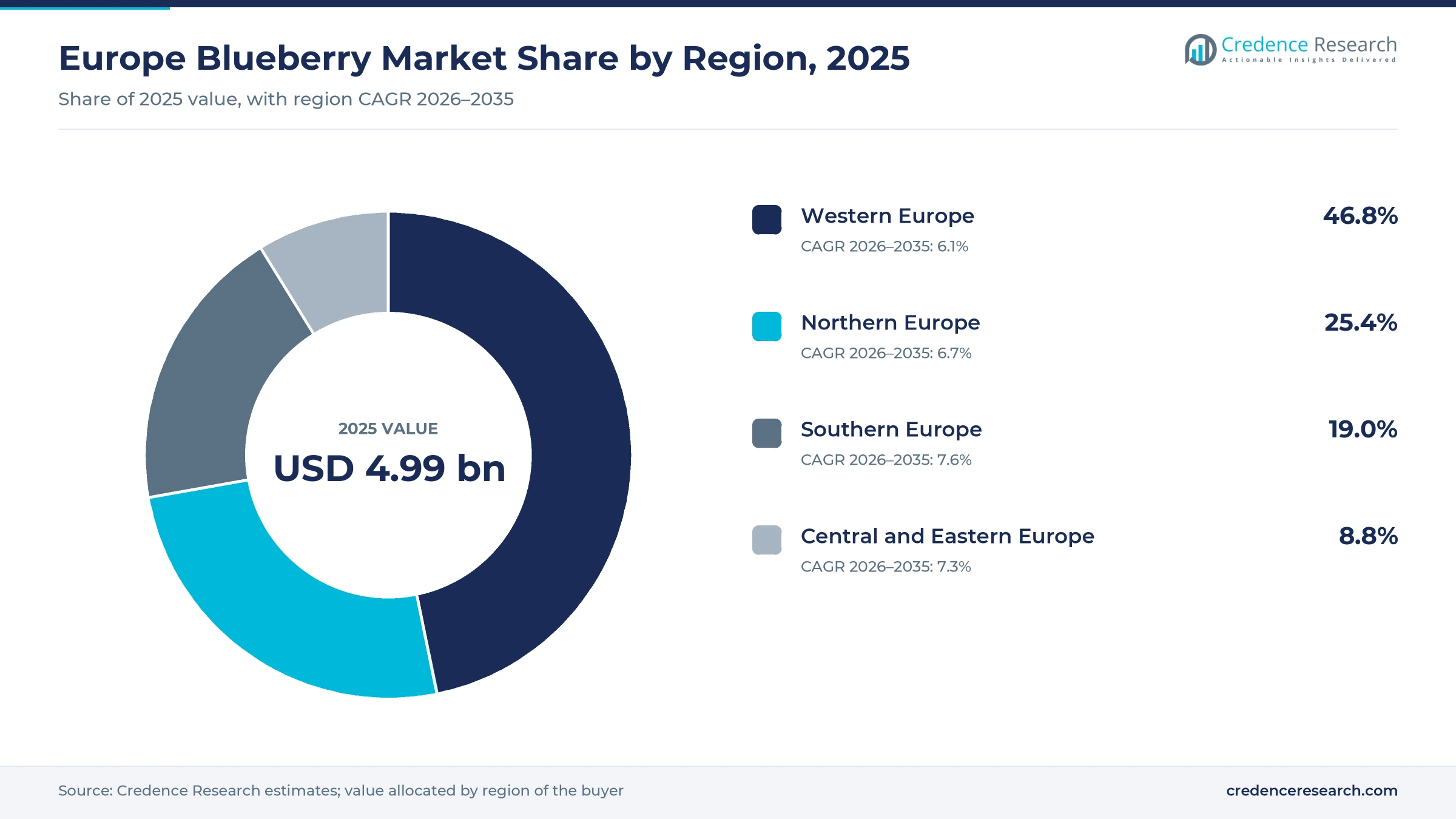
The Europe blueberry market was valued at USD 4.99 billion in 2025 and is projected to increase from USD 5.35 billion in 2026 to USD 9.54 billion by 2035, registering a CAGR of 6.65% during 2026–2035. Demand rests on households that now buy blueberries as an everyday snack and breakfast fruit, on discount grocers that sell larger packs at low prices, and on importers that keep shelves full for all 52 weeks of the year. Western Europe held the largest regional share, 46.8% in 2025, because the Netherlands and Germany combine large consumer bases with the trading hubs that route Southern Hemisphere and North African fruit across the continent. Southern Europe is the fastest-growing region at 7.6% a year as Italian and Spanish households adopt the fruit from a low base. Supply is also changing, since Morocco and Peru now fill the early-spring and winter windows that Spain and the summer crop once left empty.
Which blueberry products and buyers does the market include?
The market counts the value of cultivated highbush blueberries sold in Europe as fresh fruit, frozen fruit, dried fruit and processed ingredients such as purees and powders. Buyers range from households shopping in supermarkets and discount chains to cafes, bakeries, dairy and cereal makers, and schools or hospitals. Fresh fruit reaches shoppers in punnets ranging from single-serve snack packs to family trays, while foodservice and manufacturers buy bulk packs or frozen cartons.
The estimate excludes wild bilberries picked from forests, blueberry juice drinks and supplements sold mainly for health claims, and blueberries exported outside Europe. Value is counted at the final sale, so growers, variety owners, importers, packers, ripening and logistics hubs, and retailers all sit inside the chain that the shopper pays for.
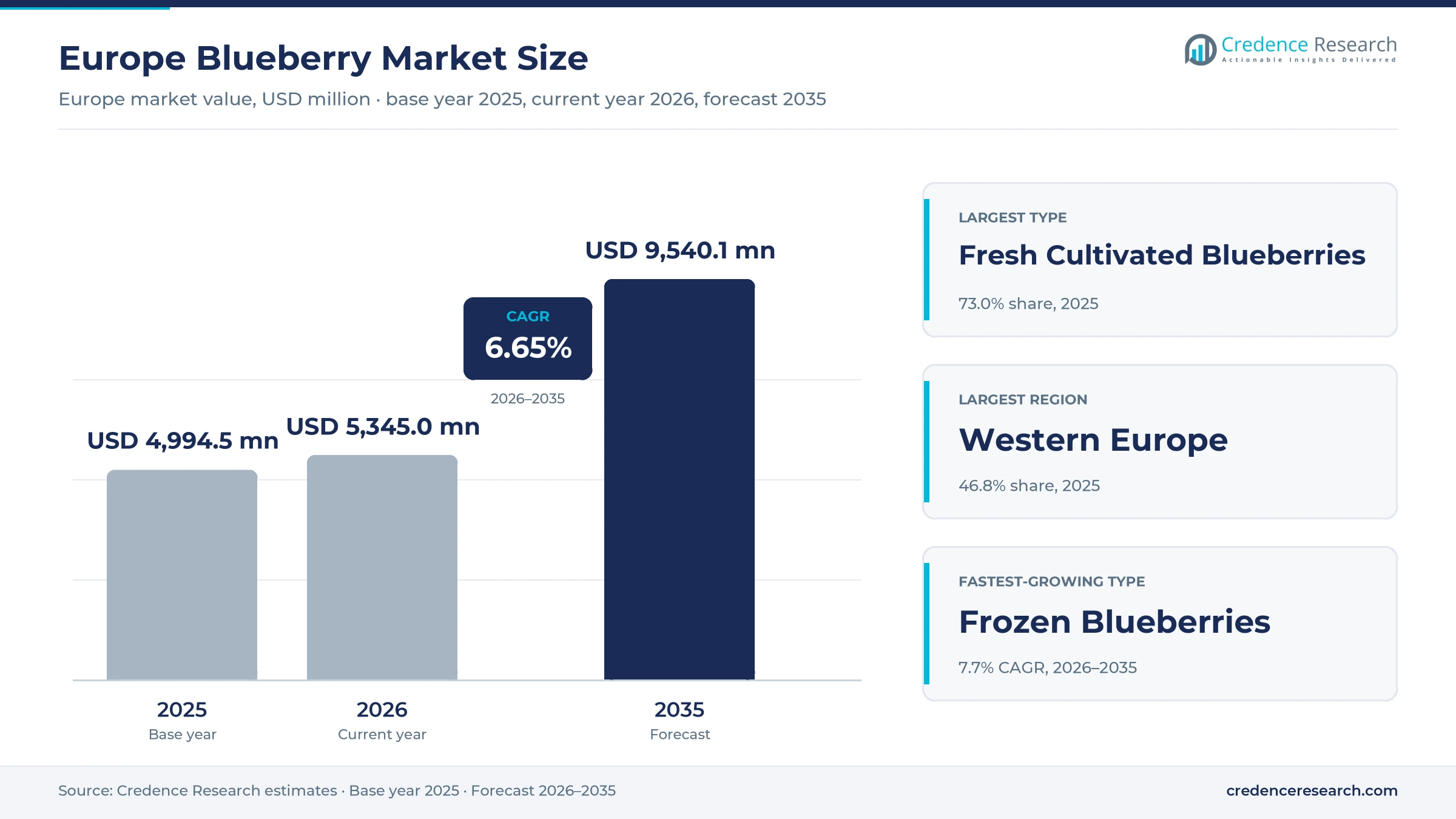
Europe Blueberry Market Insights
- The market grows from USD 4.99 billion in 2025 to USD 9.54 billion by 2035, a 6.65% pace driven by wider household buying and a fully year-round supply calendar.
- Western Europe led with 46.8% of 2025 value, while Southern Europe grows fastest at 7.6% a year as Italian and Spanish households adopt the fruit.
- Fresh Cultivated Blueberries held 73.0% of 2025 value, because supermarket punnets remain the main way European households buy and eat the fruit.
- Western and Central Europe imported a record 456,580 tons of fresh blueberries in 2025, according to the International Blueberry Organization, ahead of the United States.
- Proprietary genetics now shape competition, with EU plant variety protection granted to eight Mundo Azul varieties in February 2026 for Onubafruit growers in Iberia and Morocco.
Fresh punnets and household buyers hold most value
Why does fresh fruit dominate, and why is frozen growing fastest?
Based on product type, the market is categorized into fresh cultivated blueberries, frozen blueberries, dried blueberries and blueberry ingredients. Fresh Cultivated Blueberries led with 73.0% of 2025 value because most fruit is eaten raw, and YouGov data cited by Italian Berry put Italian household spending near €250 million in 2025. Frozen Blueberries grow fastest at 7.7% a year because tighter supply lifts value per kilo, with the Ukrainian Berry Association reporting that frozen exports from Ukraine fell from nearly 29,000 tons in 2024 to about 13,500 tons in 2025. Processors that buy frozen fruits and vegetables on annual contracts will feel the price rise first.
Which buyers spend the most, and which are adding volume fastest?
Based on customer type, the market is categorized into household consumers, foodservice operators, food manufacturers and institutional buyers. Household Consumers led with 72.0% of 2025 value because supermarket punnets reach millions of homes, and British Berry Growers reported in July 2026 that year-to-date sales of British-grown blueberries were 27% higher than a year earlier. Household Consumers also grow fastest at 6.9% a year as new homes enter the category, with Italian purchasing households rising from just over 4 million in 2020 to more than 9 million in 2025, according to YouGov data. Suppliers gain most by converting these occasional buyers into weekly shoppers.
Why do supermarkets lead while online grocery grows fastest?
Based on distribution channel, the market is categorized into supermarkets and hypermarkets, discount grocers, specialty produce retailers and online grocery. Supermarkets and Hypermarkets led with 51.0% of 2025 value because large chains can run year-round sourcing programs, and Tesco lists 18 possible origin countries, from Peru to Poland, for its standard 150 g pack. Online Grocery grows fastest at 8.6% a year as online buying becomes routine, since Eurostat reported in February 2025 that 77% of EU internet users had bought goods or services online in the previous year. Grocers that guarantee fresh delivery windows will capture this repeat basket.
How far are family packs eroding the small punnet?
Based on packaging format, the market is categorized into small snack punnets, mid-size punnets, family packs and bulk foodservice packs. The smallest punnet band led with 45.0% of 2025 value because the snack punnet is the standard supermarket unit, and Tesco sells its core, Finest and organic lines in 150 g packs. Family packs of 400 g to 500 g grow fastest at 7.9% a year as discounters push value, and Aldi Nord sold such a pack at €3.49 in August 2026. Vienna wholesaler Obst Stelzer also told FreshPlaza in June 2026 that retailer interest in larger promotional trays grows every year.
| Segment Group | Leading Sub-segment | Share, 2025 | Fastest-growing Sub-segment | CAGR, 2026–2035 |
|---|---|---|---|---|
| By Product Type | Fresh Cultivated Blueberries | 73.0% | Frozen Blueberries | 7.7% |
| By Customer Type | Household Consumers | 72.0% | Household Consumers | 6.9% |
| By Distribution Channel | Supermarkets and Hypermarkets | 51.0% | Online Grocery | 8.6% |
| By Packaging Format | 125-200 g Punnets | 45.0% | 400-500 g Family Packs | 7.9% |
Discount family packs undercut premium punnets on price
Blueberry pricing works per pack at retail, but the spread per kilo is wide. A standard U.K. punnet costs about £13 per kg, while a German discount family pack works out to about €7 per kg. Premium and organic lines carry clear premiums over the standard pack. Spanish growers in Huelva received an average farmgate price of €5.47 per kg in 2025/26, so the gap to the shelf covers packing, freight, retailer margin and waste. Italian households paid an average €12.33 per kg in 2025, 5.9% less than a year earlier, which shows how larger supply pushes retail prices down even as volumes grow. Suppliers protect margins through variety and pack premiums rather than base price.
| Product or format | Typical price or fee | Basis |
|---|---|---|
| Standard punnet, 150 g (Tesco) | £2.00 per pack (£13.33 per kg) | Tesco listing, viewed November 2026 |
| Premium punnet, 150 g (Tesco Finest) | £2.50 per pack (£16.67 per kg) | Tesco listing, viewed November 2026 |
| Certified organic punnet, 150 g (Tesco Organic) | £2.90 per pack (£19.33 per kg) | Tesco listing, viewed November 2026 |
| Discount family pack, 500 g (Aldi Nord) | €3.49 per pack (about €6.98 per kg) | Aldi Nord offer, Aug. 3 to 8, 2026 |
| Fresh fruit at the farmgate, Huelva | €5.47 per kg, 2025/26 season average | FreshPlaza, September 2026 |
| Frozen fruit, Ukrainian export price | €6.83 per kg, December 2025 | Ukrainian Berry Association, April 2026 |
Request a Free Sample
Fill in your details and we'll send you a free sample report.
- Sample data tables & charts
- Research methodology
Wider household buying and 52-week supply lift spend
Household penetration and snacking widen the buyer base
More households now buy blueberries every week, and the snack habit, which competes with packaged fruit snacks, is spreading from northwestern Europe to the south and east. YouGov data cited by Italian Berry show Italian household penetration rising from 16.5% in 2020 to 34.3% in 2025, a doubling in five years. German consumers ate 6.2 kg of berries per person in 2024/2025, according to Federal Ministry of Food and Agriculture figures reported by FreshPlaza, making berries the standout growth group even as total fruit intake fell to 69 kg. In the U.K., sales of British-grown blueberries in week 27 of 2026 were 73% higher than a year earlier, British Berry Growers said. Each gain in penetration adds repeat punnet sales, which is why Household Consumers carry 72.0% of value.
Counter-seasonal imports and new acreage fill all 52 weeks
Year-round supply has removed the old summer-only window, so retailers can now promote blueberries in every month of the year. Western and Central Europe imported a record 456,580 tons of fresh blueberries in 2025, the International Blueberry Organization reported, ahead of the United States. Southern Hemisphere shippers sent 151,653 tons to Europe in 2024/25, led by Peru, according to iQonsulting data reported by FreshPlaza. Morocco adds the early-spring window, producing 84,940 tons in 2025 from 6,800 planted hectares, FreshPlaza reported in September 2026. This layered supply lets Supermarkets and Hypermarkets run continuous programs, and it lowers the risk that a single bad harvest empties shelves across the continent.
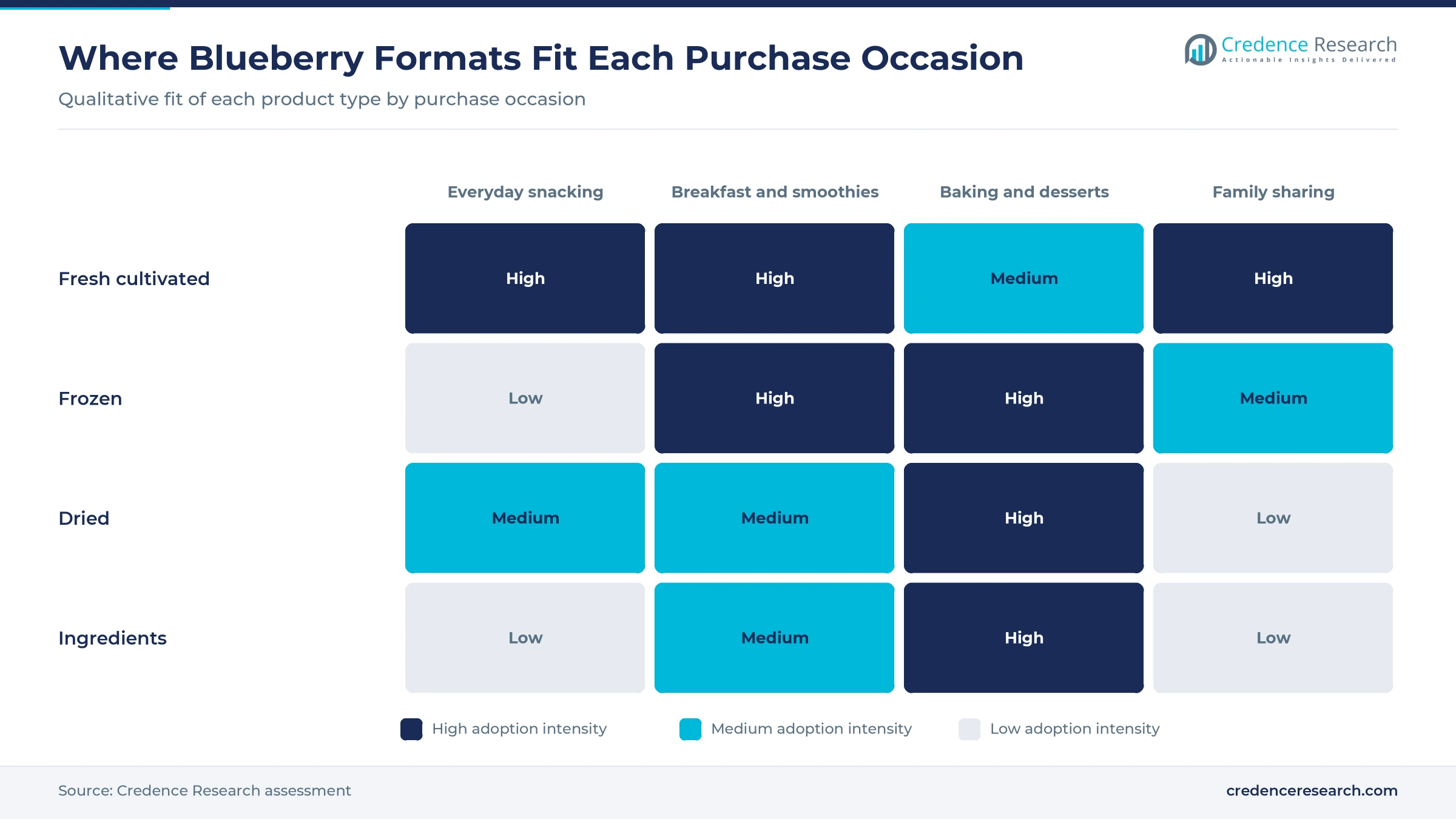
Branded packs and premium tiers raise value per kilo
Retailers and marketers are adding premium lines that sell flavor and origin rather than weight alone. Driscoll's presented its Sweetest Batch range at Fruit Logistica for a 2025 launch in Germany, bringing a premium line from the United States into Europe's second-largest import market. Angus Soft Fruits relaunched its Good Natured Berries brand in Morrisons stores in Scotland and in Costco across the U.K. in June 2025. At Tesco, a Finest punnet lists at £2.50, or £16.67 per kg, about 25% above the standard pack. These tiers let suppliers recover rising packing and labor costs, and they explain why branded and large-berry fruit gains value faster than tonnage.
Protected genetics lift eating quality and grower returns
Variety licensing has become a growth driver because better-tasting, firmer berries sell more often and travel farther. The EU Community Plant Variety Office granted protection on Feb. 16, 2026, to eight Mundo Azul varieties licensed exclusively to Onubafruit in Spain, Portugal and Morocco, with rights running to 2056, Italian Berry reported. Onubafruit expects about half of its roughly 20,000-ton crop to come from these varieties. AgroBerries said in June 2026 that its BerryWorld division will keep growing and marketing Mountain Blue Orchards genetics across Europe. Hall Hunter, which grows more than 40% of U.K. blueberries, says newer varieties produce larger, firmer and sweeter fruit. Protected genetics tie premium supply to a few licensed marketers.
Fiber packs and mechanical harvests reshape supply
Shift to fiber-based punnets ahead of the 2030 plastics rule
Packers are moving from plastic punnets toward cardboard and cellulose formats because EU rules will soon restrict small plastic packs. Regulation (EU) 2025/40 bans single-use plastic packaging for fresh fruit and vegetables sold in units under 1.5 kg from Jan. 1, 2030, the EU-funded AGRINFO service notes, unless the pack is needed to prevent water loss, microbial hazards or physical damage. The European Commission must publish guidelines with examples of permitted packaging by Feb. 12, 2027. Hortifrut has already introduced naturAll, branch-picked fruit packed in the Sierra de Huelva in a plastic-free cardboard box with cellulose windows, Tridge reported in August 2025. Suppliers that test fiber formats now will avoid a rushed changeover once the exemption list is settled.
Rise of mechanical harvesting as picking labor tightens
Growers are mechanizing harvest because hand picking is the largest and least predictable cost in blueberry production. Hall Hunter, which farms 200 hectares across eight sites in Surrey and Berkshire, uses Harvy 500 harvesters that pick up to 500 kg an hour against about 10 kg by hand, Fruitnet reported at the start of the 2026 season. The Scottish Government's June 2026 agricultural census found blueberry area down 24% and total soft fruit area at its lowest level since 2015, which shows how quickly growers exit when costs bite. Machine-harvestable varieties are becoming a selection criterion for northern growers, because a farm that cannot mechanize faces the labor limits described in the challenges below.
Opening in fast-growing import markets with low intake
Markets where blueberry intake is still low offer the clearest volume opening for exporters and marketers. Italian Berry, citing International Blueberry Organization data, reported that Italian imports rose 45% in 2025 and Irish imports 183%, leaving Ireland roughly eight times its 2022 level. Scandinavian imports climbed 42%, and Switzerland paid the highest average price per kilo in Europe. These markets combine fast growth with a high willingness to pay, so they reward suppliers that can guarantee fruit size and shelf life over long distances. Southern Europe offers the largest absolute gain because its starting penetration is the lowest of the four regions, as the regional section shows.
Opening for certified organic supply from eastern growers
Certified organic fruit is an opening because supply is thin and premiums across organic food ranges remain high. Tesco prices its organic punnet at £19.33 per kg, about 45% above its standard pack. Organic farms supplied about 13% of Germany's 2025 berry harvest from 32.2% of the berry area, Destatis reported, which shows how much lower organic yields are. Imports are also small, because Ukraine, which supplies almost all organic blueberries exported to the EU according to certifier Organic Standard, shipped only 91.8 tons in 2025, FreshPlaza reported. Growers in Poland, Romania and Ukraine that certify organic acreage can capture this premium while it lasts.
Oversupply, storms and labor caps test growers
Will supply growth outpace European consumption?
Global plantings are expanding faster than consumption, which threatens Europe blueberry prices in every season. The International Blueberry Organization put world output at about 2.33 million tons in 2025 and expects more than 3.36 million tons by 2029, with about 45,000 hectares not yet in full production. Francisco Manuel Pajuelo of Surexport told Blueberries Consulting in October 2026 that consumption is still not rising at the same rate as production. Growers still farming older open varieties face the steepest price pressure.
How much do storms disrupt supply from Spain and Morocco?
Extreme weather is making spring supply less reliable for European retailers. Storms reduced Andalusian blueberry output from March onward and pushed the peak harvest into the second half of May in 2025/26, and exports fell 4.4% to 68,856 tons while imports rose 16% to 17,090 tons, with Morocco supplying 89% of import value. In Morocco, wind, low temperatures and storms delayed the Larache harvest in the same season, Food Business MEA reported. Retailers that spread sourcing across several origins carry less risk, although switching origins raises freight costs.
Can small Polish farms compete with imported volume?
Fragmented farm structures leave Polish growers exposed to low-cost imported fruit. Poland grows about 62,000 to 64,000 tons a year on about 13,000 hectares, but the average farm covers only about 1.4 hectares, FreshPlaza reported in September 2026. Peru alone produced about 407,800 tons in 2025/26, more than six times the Polish crop. Small farms struggle to fund new varieties, cold storage and retail certification, so producer groups are the practical response.
Will seasonal labor caps limit northern harvests?
Labor supply is a binding limit in the U.K., where hand picking still dominates most blueberry farms. The government set 41,000 seasonal worker visas for horticulture in 2026, down from 43,000 in 2025, according to Fruitnet. Growers who cannot fill crews leave fruit unpicked or cut plantings. Mechanical harvesting and longer worker contracts are the main responses, but both require capital that smaller growers often lack.
Western Europe leads while Southern Europe grows fastest
| Region | Value, 2025 (USD billion) | Share, 2025 | CAGR, 2026–2035 |
|---|---|---|---|
| Western Europe | 2.34 | 46.8% | 6.1% |
| Northern Europe | 1.27 | 25.4% | 6.7% |
| Southern Europe | 0.95 | 19.0% | 7.6% |
| Central and Eastern Europe | 0.44 | 8.8% | 7.3% |
Western Europe leads through Dutch trading hubs and German demand
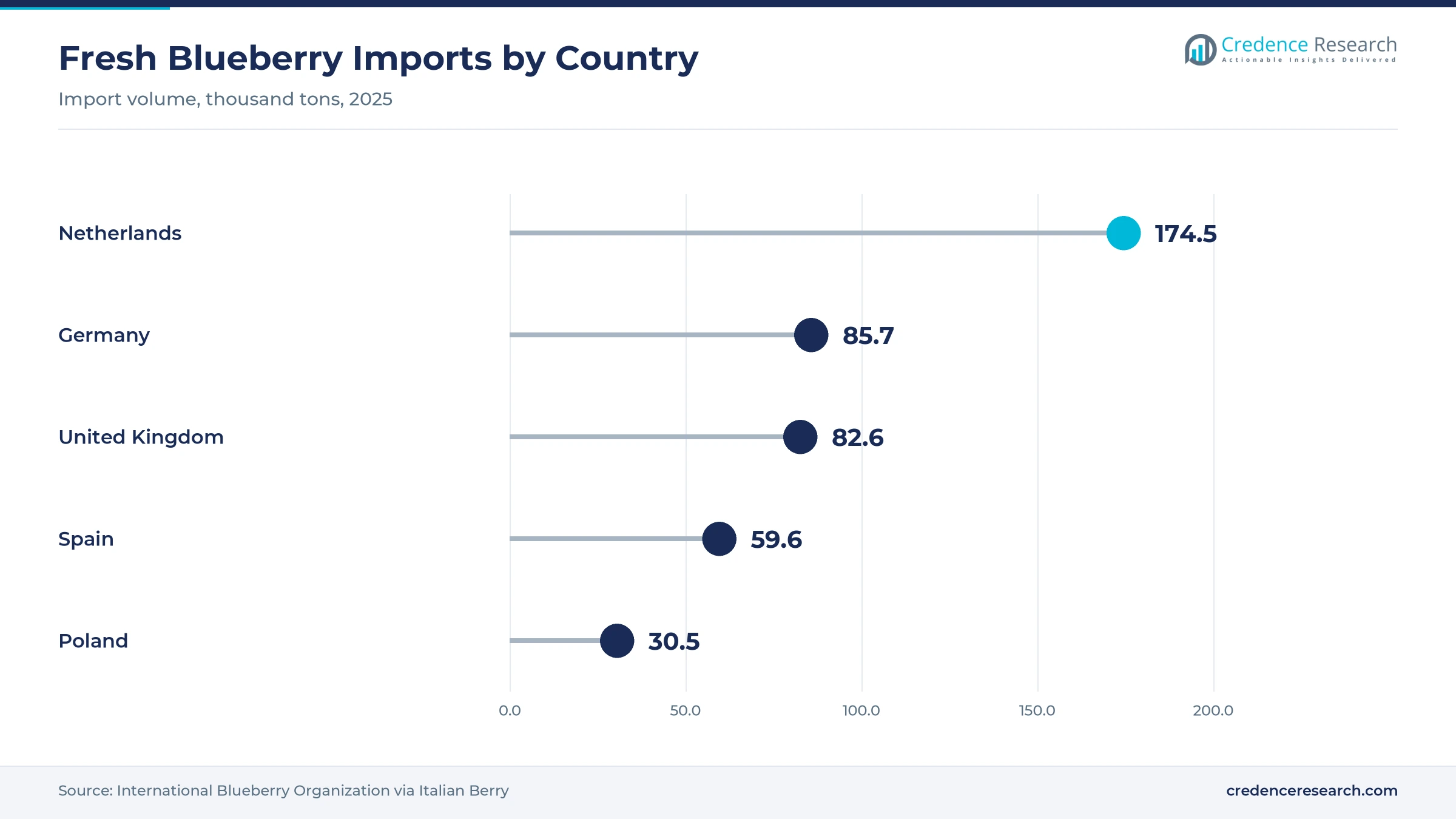
Western Europe held a 46.8% share of 2025 regional value and grows at 6.1% a year. The Netherlands imported 174,540 tons in 2025, up 29%, and serves as the main trading hub for neighboring markets, while Germany imported 85,650 tons, according to the International Blueberry Organization. German growers add domestic summer supply, harvesting 17,300 tons of cultivated blueberries in 2025, up 14.4% on 2024. Discounters sell large packs through the German season, so suppliers compete on price per kilo while Dutch importers manage the year-round flow.
Northern Europe pairs high intake with record U.K. imports
Northern Europe held a 25.4% share of 2025 regional value and grows at 6.7% a year. U.K. imports rose 15% to 82,630 tons in 2025, according to the International Blueberry Organization, and Morocco shipped 19,000 tons to the U.K. between July 2024 and June 2025, Food Business MEA reported. British-grown volume has also risen 40% over five years, British Berry Growers said in July 2026. The U.K. mixes a strong summer crop with dependable winter imports, which supports promotions in every month.
Southern Europe grows fastest as producers also become buyers
Southern Europe held a 19.0% share of 2025 regional value and grows fastest at 7.6% a year. Andalusia, centered on Huelva, produced 68,500 tons on 4,850 hectares in 2025/26, while Spain imported 59,580 tons in 2025, with Morocco supplying 43,110 tons of it. Portugal's small-berry output reached about 91,400 tons in 2025, according to an EY study for Lusomorango and Driscoll's reported by The Portugal News. Spanish packers now import Moroccan fruit to extend their own programs, which blurs the line between producer and buyer.
Central and Eastern Europe builds trade around Poland and Vienna
Central and Eastern Europe held an 8.8% share of 2025 regional value and grows at 7.3% a year. Poland is the region's largest grower and also imported 30,520 tons in 2025, according to the International Blueberry Organization, to cover months outside its summer crop. Obst Stelzer in Vienna acts as the hub for the Eastern European business of Herbert Widmann, FreshPlaza reported in June 2026, and Kaufland sold Romanian and Polish blueberries in XXL family packs in July 2026. Low household intake leaves the region with the most room to grow per person.
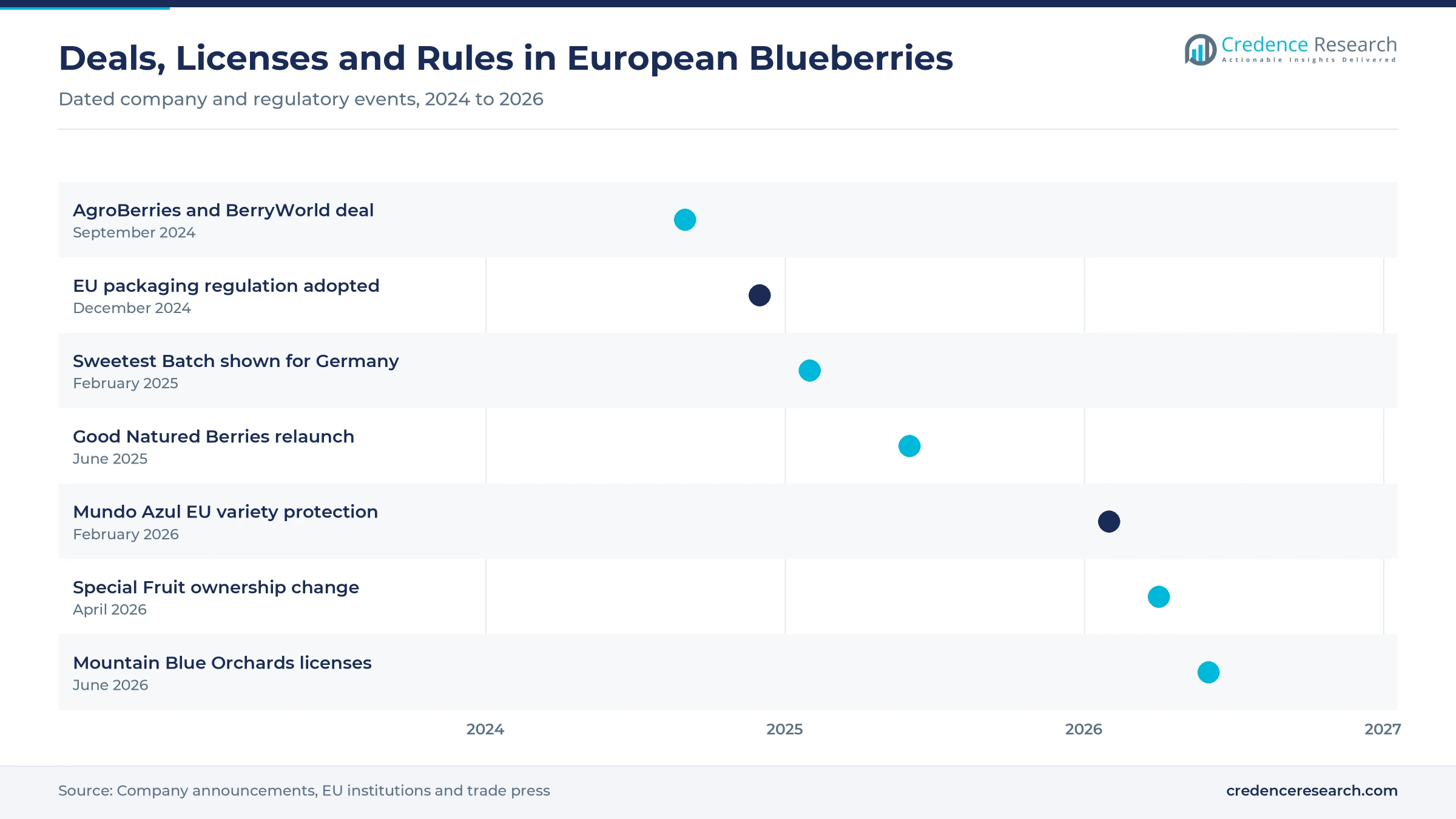
Mergers, licenses and new packs mark 2024 to 2026
| Development | Status and market relevance |
|---|---|
| In September 2024, AgroBerries announced the acquisition of BerryWorld Group, creating a business that markets about 150,000 tons of berries a year. | Announced; links Chilean and Peruvian supply to European retail |
| In August 2025, Hortifrut's naturAll, branch-picked blueberries packed in a plastic-free cardboard box in the Sierra de Huelva, was reported as a first for Europe. | On sale; tests fiber packs ahead of the 2030 rule |
| In February 2026, the Community Plant Variety Office granted EU protection to eight Mundo Azul blueberry varieties licensed to Onubafruit. | In force to 2056; secures Iberian premium supply |
| In April 2026, Special Fruit passed to new family shareholders, with a capital injection to fund expansion and grower partnerships. | Completed; strengthens Belgian import capacity |
| In June 2026, AgroBerries signed new Mountain Blue Orchards licensing agreements, with BerryWorld continuing to market the varieties across Europe. | Plantings from late 2026; new volumes from 2027 |
Genetics, harvesters and fiber packs shape quality
- Licensed proprietary genetics give marketers exclusive varieties with better flavor and shelf life, which is why the Mundo Azul and Mountain Blue Orchards agreements matter to retail programs.
- Mechanical harvesters cut picking hours sharply and make northern farms less dependent on seasonal worker visas.
- Fiber-based packs replace plastic punnets with cardboard and cellulose, as the naturAll box from the Sierra de Huelva already shows.
- Protected cultivation under polytunnels shields fruit from rain and hail, although the 2025/26 storms in Huelva damaged tunnels and showed its limits.
Need a Custom Version of This Report?
Tailor the scope, geography, or segments to your exact requirements.
- Custom geography or segment scope
- Direct access to our analyst team
Variety owners and multi-origin marketers set the pace
Competition in the Europe blueberry market centers on who controls genetics and year-round retail programs rather than on headline price. Driscoll's relies on proprietary varieties and premium lines such as Sweetest Batch, and it co-commissioned an EY study of the Portuguese berry sector with Lusomorango. Hortifrut differentiates through packing formats such as naturAll in the Sierra de Huelva. AgroBerries, through BerryWorld, markets about 150,000 tons of berries a year after the September 2024 deal, which was billed as creating the second-largest berry company in the world. Hall Hunter and Angus Soft Fruits compete on British origin, using mechanization and regional brands. Surexport grows in Spain and Portugal, while Special Fruit in Belgium and Herbert Widmann act as importers and distributors with wide grower networks. Smaller growers compete mainly on price during their home season. Retail buyers reward suppliers that guarantee size, flavor and continuity across 52 weeks.
How is supply organized, and where do margins sit?
Supply is organized in three layers that have very different economics. Global marketers such as Driscoll's, Hortifrut and AgroBerries control genetics, grower networks and retailer programs across both hemispheres. Regional growers such as Hall Hunter in England, Angus Soft Fruits in Scotland and Surexport in Spain and Portugal supply the home season and often import to fill gaps. Importers and wholesalers such as Special Fruit in Belgium and Herbert Widmann pack and distribute. Margins sit mostly with variety owners and marketers that hold year-round retail contracts, while growers of older open varieties absorb price swings. Entry barriers are rising because licensed genetics, certification and 52-week supply now matter more than land.
Which companies shape blueberry supply in Europe?
| Company | Type | Role in the market |
|---|---|---|
| Driscoll's | Global berry marketer | Sweetest Batch premium range presented for a 2025 launch in Germany |
| Hortifrut | Global grower and marketer | naturAll branch-picked blueberries packed in the Sierra de Huelva |
| AgroBerries (BerryWorld Group) | Global grower and marketer | Acquisition of BerryWorld announced September 2024; markets Mountain Blue Orchards genetics in Europe |
| Hall Hunter Partnership | U.K. grower | More than 40% of U.K. blueberry production from 200 hectares in Surrey and Berkshire |
| Angus Soft Fruits | U.K. grower and marketer | Good Natured Berries brand relaunched in Morrisons and Costco in June 2025 |
| Surexport | Iberian grower and marketer | Blueberry operations in Spain and Portugal |
| Special Fruit | Belgian importer | New family ownership and capital injection from April 14, 2026 |
| Widmann Früchte | German importer and distributor | Eastern European trade run through partner Obst Stelzer in Vienna |
Eating quality will decide who keeps premium prices
Credence Research's view is that the next phase of Europe blueberry growth will be won on eating quality and continuity rather than on extra tonnage. Supply is rising faster than consumption, so suppliers with older varieties will see prices fall while licensed, better-tasting fruit holds its premium. The household gains in Italy show that new buyers arrive quickly when quality and price meet, and Southern Europe should keep the fastest regional growth through the forecast. The most useful investments are proprietary genetics, fiber packaging ready for 2030 and mechanized northern harvests, because each protects margin against the price pressure ahead.
Supply volumes and shelf prices support the estimate
The report uses 2025 as the base year and forecasts values to 2035. Market values come from the Credence Research model, and segment and regional splits are Credence Research estimates. The size was cross-checked against apparent fresh supply, built from European production and import volumes and multiplied by retail and farmgate prices observed in the U.K., Germany, Italy and Spain, with frozen, dried and ingredient sales added. Evidence comes from national statistics offices, EU regulation, trade associations, company announcements, retailer listings and trade press. No interviews or surveys were conducted for the preparation of this report.
Southern buyers and family packs carry growth to 2035
Europe blueberry value should reach USD 9.54 billion by 2035, up from USD 5.35 billion in 2026 and well ahead of general fruit spending. Growth comes as household penetration in Southern and Eastern Europe moves toward northwestern levels and year-round supply keeps shelves full. Frozen Blueberries should expand at 7.7% a year as smoothie and breakfast use grows and tight raw material keeps prices firm. Larger family packs should gain share in discount chains, while plastic-free packs become standard after 2030. The main risk is a sustained price decline if new plantings in Peru, Morocco and China outrun demand, although suppliers with licensed varieties and reliable multi-origin programs should hold their margins through the cycle.
What separates the downside, base and upside paths to 2035?
The range of outcomes depends on whether consumption keeps pace with new supply. A downside path follows if plantings outrun demand and retail prices fall faster than volumes grow, while repeated storms in Spain and Morocco disrupt spring programs. The base case assumes steady household gains and orderly import growth. An upside path needs household penetration in Southern and Eastern Europe to approach northwestern levels and premium varieties to keep their price gap.
| Scenario | CAGR, 2026–2035 | Value, 2035 | What has to hold |
|---|---|---|---|
| Downside | 4.9% | USD 8.19 billion | Plantings outrun demand, retail prices slide and storms disrupt spring supply from Spain and Morocco |
| Base | 6.65% | USD 9.54 billion | Household penetration keeps rising and import growth stays orderly across all seasons |
| Upside | 8.1% | USD 10.73 billion | Southern and Eastern households approach northwestern intake and premium varieties hold their price gap |
Frequently Asked Questions
How big is the Europe blueberry market?
Which region leads blueberry sales in Europe?
Which region grows fastest?
Which product type holds the largest share?
Where does winter and spring supply come from?
How will EU packaging rules affect blueberry packs?
What is the biggest risk for blueberry suppliers?
Which companies are active in the market?
Table of Content
Chapter 1 Market Segmentation
- 1.1 Segmentation Framework
- 1.1.1 Product and Service Classification
- 1.1.2 Application and End-Use Classification
- 1.1.3 Technology and Solution Classification
- 1.1.4 Customer and Distribution Channel Classification
- 1.1.5 Geographic Segmentation
- 1.1.6 Market Segment Definitions and Boundaries
- 1.2 By Product Type
- 1.2.1 Fresh Cultivated Blueberries
- 1.2.2 Frozen Blueberries
- 1.2.3 Dried Blueberries
- 1.2.4 Blueberry Ingredients
- 1.3 By Customer Type
- 1.3.1 Household Consumers
- 1.3.2 Foodservice Operators
- 1.3.3 Food Manufacturers
- 1.3.4 Institutional Buyers
- 1.4 By Packaging Format
- 1.4.1 125-200 g Punnets
- 1.4.2 250-300 g Punnets
- 1.4.3 400-500 g Family Packs
- 1.4.4 Bulk Foodservice Packs
Chapter 2 Introduction
- 2.1 Report Objectives and Scope
- 2.2 Product Definition and Industry Terminology
- 2.3 Market Inclusions and Exclusions
- 2.4 Research Process
- 2.4.1 Primary Research and Expert Interviews
- 2.4.2 Secondary Research and Source Review
- 2.4.3 Top-Down and Bottom-Up Estimation
- 2.4.4 Data Triangulation and Verification
- 2.5 Market Size Measurement Basis
- 2.5.1 2025: USD 4.99 billion → 2035: USD 9.54 billion
- 2.6 Historical and Forecast Reference Periods
- 2.6.1 Historical Period: 2018-2025
- 2.6.2 Base Year: 2025
- 2.6.3 Forecast Period: 2025-2035
- 2.7 Research Assumptions and Limitations
Chapter 3 Executive Summary
- 3.1 Market Snapshot and Key Findings
- 3.2 Base-Year Market Size, 2025
- 3.3 Forecast Market Size, 2035
- 3.4 Revenue and Volume Growth Outlook
- 3.5 Key Demand and Supply Indicators
- 3.6 Leading Market Segments
- 3.7 Fastest-Growing Market Opportunities
- 3.8 Regional Performance Highlights
- 3.9 Technology and Industry Transformation
- 3.10 Competitive Landscape Summary
- 3.11 Analyst View and Strategic Implications
Chapter 4 Europe Blueberry Market Trends and Developments
- 4.1 Historical Industry Development, 2018-2025
- 4.2 Recent Market Trends and Developments
- 4.3 Demand and Customer Behavior Trends
- 4.4 Technology and Product Innovation
- 4.5 Artificial Intelligence, Automation and Digitalization
- 4.6 Local Manufacturing and Supply Chain Realignment
- 4.7 Industry Partnerships, Mergers and Acquisitions
- 4.8 Sustainability and Circular Economy Developments
- 4.9 Government and Private Sector Investment Trends
- 4.10 Emerging Business Models and Commercialization
- 4.11 Industry Developments and Announcements
Chapter 5 Europe Blueberry Market Production, Supply and Demand Analysis
- 5.1 Demand Trend and Consumption Analysis, 2018-2025
- 5.2 Demand Forecast, 2025-2035
- 5.3 Production and Output Trend, 2018-2025
- 5.4 Production and Output Forecast, 2025-2035
- 5.5 Installed Capacity and Capacity Utilization
- 5.6 Company-Wise Production Plants and Statistics
- 5.6.1 Installed Production Capacity
- 5.6.2 Actual Production
- 5.6.3 Planned Capacity and Expansion Targets
- 5.7 Supply Chain Structure and Procurement Trends
- 5.8 Supply-Demand Gap and Bottlenecks
- 5.9 Import Dependence and Sourcing Structure
- 5.10 Contract Manufacturing and Outsourcing
- 5.11 Regional Supply and Demand Concentration
Chapter 6 Europe Blueberry Market Pricing Analysis
- 6.1 Pricing Structure and Measurement
- 6.2 Historical Pricing Trends, 2018-2025
- 6.3 Pricing Outlook, 2025-2035
- 6.4 Average Selling Price and Unit Economics
- 6.5 Pricing by Product and Market Segment
- 6.6 Geographic Pricing Differences
- 6.7 Key Input, Energy, Labor and Logistics Costs
- 6.8 Contract Pricing and Purchasing Models
- 6.9 Pricing Sensitivity and Competitive Positioning
- 6.10 Price, Margin and Profitability Implications
Chapter 7 Europe Blueberry Market Dynamics
- 7.1 Market Growth Drivers
- 7.1.1 Demand-Side Drivers
- 7.1.2 Technology and Innovation Drivers
- 7.1.3 Infrastructure and Investment Drivers
- 7.1.4 Regulatory and Policy Drivers
- 7.2 Market Restraints
- 7.2.1 Cost and Affordability Constraints
- 7.2.2 Technology and Adoption Barriers
- 7.2.3 Supply Chain and Operational Constraints
- 7.3 Market Challenges
- 7.3.1 Competitive Pressure and Margin Erosion
- 7.3.2 Skills, Infrastructure and Implementation Gaps
- 7.4 Emerging Market Opportunities
- 7.5 Market Dynamics Impact and Time-Horizon Assessment
Chapter 8 Europe Blueberry Value Chain Analysis
- 8.1 Industry Value Chain Overview
- 8.2 Upstream Suppliers and Critical Inputs
- 8.3 Technology and Component Providers
- 8.4 Manufacturing or Service Delivery
- 8.5 Distribution, Channel Partners and Integrators
- 8.6 Downstream Applications and End Users
- 8.7 Value Addition and Profit Pools
- 8.8 Vertical Integration and Outsourcing
- 8.9 Supplier Concentration and Risk
- 8.10 Supply Chain Localization and Resilience
Chapter 9 Europe Blueberry Market Regulations and Policies
- 9.1 Relevant Laws, Standards and Compliance Frameworks
- 9.2 Product, Service, Safety and Quality Requirements
- 9.3 Government Policies, Incentives and Subsidies
- 9.4 Imports, Exports and Trade Barriers
- 9.5 Public Procurement and Local Content Requirements
- 9.6 Environmental and Sustainability Compliance
- 9.7 Upcoming Policy Changes and Market Implications
Chapter 10 Europe Blueberry Market Hotspots and Opportunities
- 10.1 Market Opportunity Mapping and Growth Hotspots
- 10.2 High-Growth Applications and Customer Groups
- 10.3 Underserved Markets and White-Space Opportunities
- 10.4 Emerging Technology and Product Opportunities
- 10.5 New Capacity and Investment Hotspots
- 10.6 Market Entry and Expansion Opportunities
- 10.7 Distribution and Partnership Opportunities
- 10.8 Near-Term and Long-Term Commercial Potential
- 10.9 Opportunity Attractiveness and Execution Risks
Chapter 11 Europe Blueberry Market Outlook, 2025-2035
- 11.1 Market Size and Analysis
- 11.1.1 Revenue (Market Measurement: 2025: USD 4.99 billion → 2035: USD 9.54 billion)
- 11.1.2 Market Volume and Quantity Sold
- 11.1.3 Historical Market Size, 2018-2025
- 11.1.4 Base-Year Market Size, 2025
- 11.2 Market Forecast, 2025-2035
- 11.2.1 Revenue Forecast to 2035
- 11.2.2 Volume Forecast to 2035
- 11.2.3 CAGR and Year-on-Year Growth
- 11.2.4 Incremental Revenue Opportunity
- 11.3 Forecast Assumptions and Scenario Analysis
- 11.3.1 Base-Case Forecast
- 11.3.2 Optimistic and Conservative Scenarios
- 11.3.3 Technology, Pricing and Policy Sensitivities
- 11.4 Market Attractiveness and Growth Outlook
Chapter 12 Europe Blueberry Market Segmentation and Outlook
- 12.1 Segmentation Summary and Market Shares, 2025
- 12.2 Largest and Fastest-Growing Segments
- 12.3 By Product Type - Market Size and Forecast, 2025-2035
- 12.3.1 Segment Definition and Scope
- 12.3.2 Historical Market Size, 2018-2025
- 12.3.3 Revenue Forecast, 2025-2035
- 12.3.4 Volume Forecast, 2025-2035
- 12.3.5 Base-Year Market Share, 2025
- 12.3.6 Segment CAGR and Growth Drivers
- 12.3.7 Subsegment Market Size and Forecast
- 12.3.7.1 Fresh Cultivated Blueberries
- 12.3.7.2 Frozen Blueberries
- 12.3.7.3 Dried Blueberries
- 12.3.7.4 Blueberry Ingredients
- 12.3.8 Subsegment Pricing and Adoption Trends
- 12.3.9 Leading Suppliers and Competition
- 12.3.10 Regional Demand and Opportunities
- 12.4 By Customer Type - Market Size and Forecast, 2025-2035
- 12.4.1 Segment Definition and Scope
- 12.4.2 Historical Market Size, 2018-2025
- 12.4.3 Revenue Forecast, 2025-2035
- 12.4.4 Volume Forecast, 2025-2035
- 12.4.5 Base-Year Market Share, 2025
- 12.4.6 Segment CAGR and Growth Drivers
- 12.4.7 Subsegment Market Size and Forecast
- 12.4.7.1 Household Consumers
- 12.4.7.2 Foodservice Operators
- 12.4.7.3 Food Manufacturers
- 12.4.7.4 Institutional Buyers
- 12.4.8 Subsegment Pricing and Adoption Trends
- 12.4.9 Leading Suppliers and Competition
- 12.4.10 Regional Demand and Opportunities
- 12.5 By Packaging Format - Market Size and Forecast, 2025-2035
- 12.5.1 Segment Definition and Scope
- 12.5.2 Historical Market Size, 2018-2025
- 12.5.3 Revenue Forecast, 2025-2035
- 12.5.4 Volume Forecast, 2025-2035
- 12.5.5 Base-Year Market Share, 2025
- 12.5.6 Segment CAGR and Growth Drivers
- 12.5.7 Subsegment Market Size and Forecast
- 12.5.7.1 125-200 g Punnets
- 12.5.7.2 250-300 g Punnets
- 12.5.7.3 400-500 g Family Packs
- 12.5.7.4 Bulk Foodservice Packs
- 12.5.8 Subsegment Pricing and Adoption Trends
- 12.5.9 Leading Suppliers and Competition
- 12.5.10 Regional Demand and Opportunities
- 12.6 Segment Growth Comparison
- 12.7 Segment Attractiveness and Priority Matrix
Chapter 13 Europe Blueberry End-Use and Application Market Outlook
- 13.1 End-Use Industry and Customer Demand Structure
- 13.2 Leading Applications and Customer Groups
- 13.3 End-Use Market Size, Share and Forecast
- 13.4 Major End-Use Industry Deep Dives
- 13.4.1 Customer Requirements and Use Cases
- 13.4.2 Demand and Replacement Cycles
- 13.4.3 Technical and Regulatory Considerations
- 13.4.4 Purchasing and Procurement Models
- 13.4.5 Leading Vendors and Distribution Channels
- 13.4.6 Forecast and Commercial Opportunities
- 13.5 Emerging Applications and Cross-Segment Demand
- 13.6 End-Use Industry Investment Priorities
Chapter 14 Europe Blueberry Geographic Market Outlook, 2025-2035
- 14.1 Regional Market Size and Country-Level Shares, 2025
- 14.2 Country Market Size Comparison, 2025
- 14.3 Country Market Forecasts, 2025-2035
- 14.4 Subregional Industrial and Demand Clusters
- 14.5 Intra-Regional Pricing and Cost Differences
- 14.6 Cross-Border Trade and Supply Networks
- 14.7 Regional Supply and Demand Balances
- 14.8 Country Opportunity Comparison and Prioritization
Note: Every listed country is covered on the structure shown under the first country.
Chapter 15 Europe Blueberry Technology, Innovation and Sustainability Outlook
- 15.1 Technology Landscape and Maturity
- 15.2 Product, Process and Service Innovation
- 15.3 AI, Automation and Digital Tools in the Industry
- 15.4 Technology Adoption and Performance Benchmarking
- 15.5 Innovation Pipeline and R&D Investment
- 15.6 Patent and Intellectual Property Trends
- 15.7 Energy Efficiency and Resource Management
- 15.8 Sustainability, Recycling and Circularity
- 15.9 Technology Roadmap, 2025-2035
- 15.10 Risks of Obsolescence and Technology Substitution
Chapter 16 Europe Blueberry Market Key Strategic Imperatives
- 16.1 Growth and Market Entry Priorities
- 16.2 High-Return Products and Segments
- 16.3 Pricing, Profitability and Cost Optimization
- 16.4 Technology Investment and Product Differentiation
- 16.5 Supply Chain Localization and Resilience
- 16.6 Distribution and Customer Acquisition
- 16.7 Partnership, Acquisition and Capacity Strategy
- 16.8 Regional Expansion Priorities
- 16.9 Short-, Medium- and Long-Term Actions
Chapter 17 Competition Outlook
- 17.1 Industry Competition Characteristics
- 17.2 Market Structure and Concentration
- 17.3 Market Share and Competitive Positioning, 2025
- 17.4 Company-Wise Revenue and Product Benchmarking
- 17.5 Production and Service Capacity Benchmarking
- 17.6 Technology, Pricing and Differentiation
- 17.7 Regional Footprint and Distribution Strength
- 17.8 Mergers, Acquisitions and Strategic Alliances
- 17.9 New Entrants and Competitive Threats
- 17.10 Porter's Five Forces and Industry Attractiveness
- 17.11 Competitive Outlook, 2025-2035
Chapter 18 Company Profiles
- 18.1 Company Coverage and Selection Criteria
- 18.2 Driscoll's
- 18.2.1 Business Description
- 18.2.2 Company Ownership and Geographic Presence
- 18.2.3 Product and Service Portfolio
- 18.2.4 Manufacturing and Operating Footprint
- 18.2.5 Production Capacity and Expansion Plans
- 18.2.6 Financial Performance and Investment
- 18.2.7 Market Share and Competitive Position
- 18.2.8 Technology and Innovation Capabilities
- 18.2.9 Strategic Alliances or Partnerships
- 18.2.10 Recent Developments
- 18.2.11 Growth Strategy and Outlook
- 18.3 Hortifrut
- 18.4 Agroberries (BerryWorld Group)
- 18.5 Angus Soft Fruits
- 18.6 S&A Produce
- 18.7 Hall Hunter Partnership
- 18.8 Surexport
- 18.9 BerryGroup
- 18.10 Special Fruit
- 18.11 Widmann Früchte
- 18.12 Other Relevant Market Participants
Note: Every listed company is profiled on the structure shown under the first company. The company list is preliminary and may change based on research findings, market developments, data availability and client requirements.
Chapter 19 Disclaimer
- 19.1 Research and Forecast Disclaimer
- 19.2 Data Source and Estimation Limitations
Note: The depth of individual sections depends on data availability for this market. Volume, capacity, trade and other unit-based metrics are included where applicable.