
Market Overview
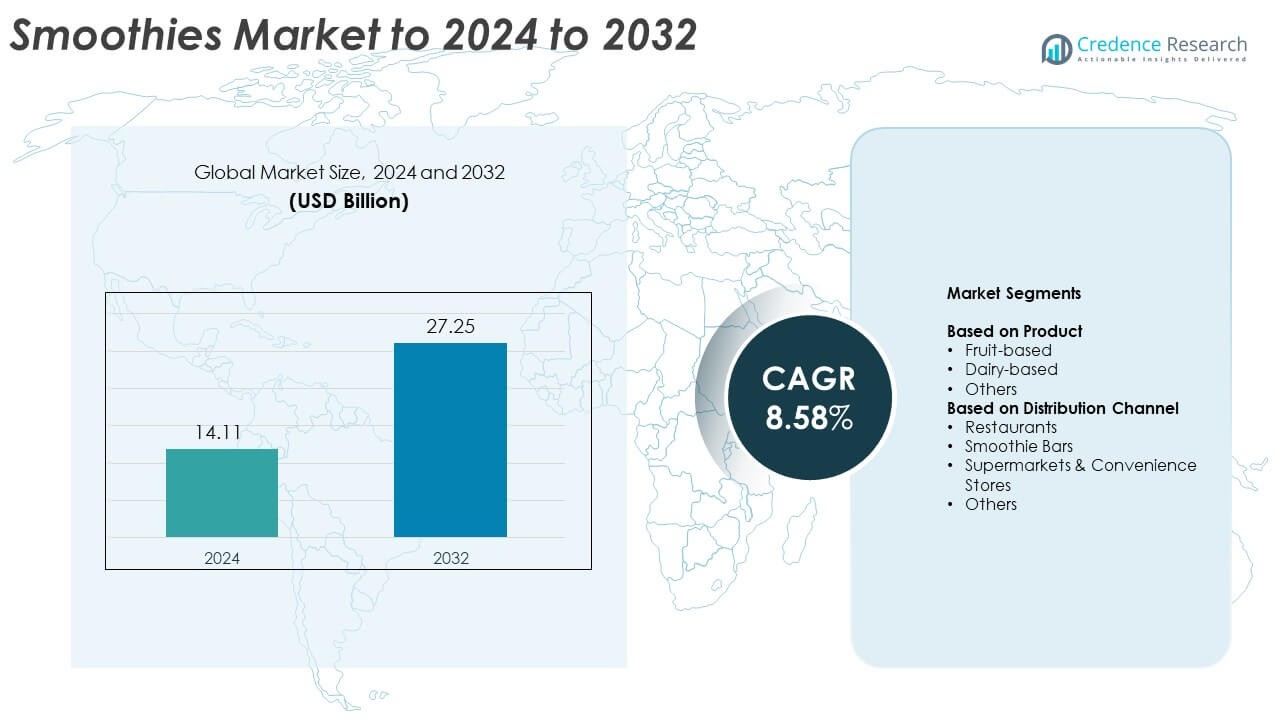
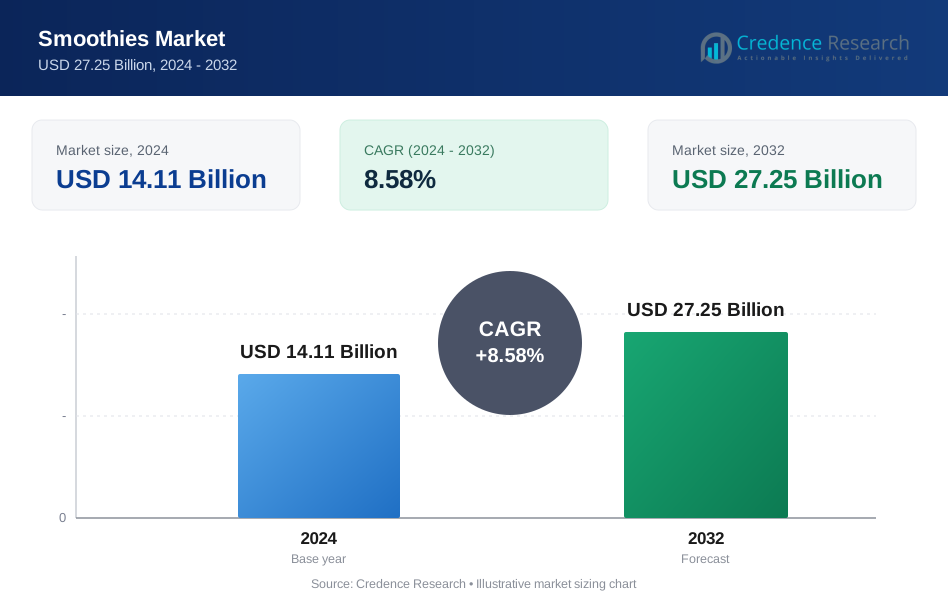
Smoothies Market size was valued at USD 14.11 Billion in 2024 and is anticipated to reach USD 27.25 Billion by 2032, at a CAGR of 8.58% during the forecast period.
| REPORT ATTRIBUTE | DETAILS |
|---|---|
| Historical Period | 2020-2023 |
| Base Year | 2024 |
| Forecast Period | 2025-2032 |
| Smoothies Market Size 2024 | USD 14.11 Billion |
| Smoothies Market , CAGR | 8.58% |
| Smoothies Market Size 2032 | USD 27.25 Billion |
The smoothies market includes major players such as Suja Juice, Maui Wowi Hawaiian Coffees & Smoothies, Tropical Smoothie Café, innocent ltd, Smoothie King, Ella’s Kitchen Ltd, The Smoothie Company, Jamba Juice LLC, Barfresh Food Group, Inc., and Bolthouse Farms, each contributing to strong product innovation and broader retail penetration. These companies compete through clean-label blends, functional ingredients, and expansion of ready-to-drink portfolios. North America leads the global market with about 38% share in 2024, driven by high demand for natural beverages, strong smoothie bar networks, and widespread availability of premium bottled offerings across supermarkets, cafés, and convenience stores.
Market Insights
- Smoothies market size reached USD 14.11 Billion in 2024 and is projected to reach USD 27.25 Billion by 2032, growing at a CAGR of 8.58%.
- Rising demand for clean-label, low-sugar, and nutrient-rich beverages drives strong adoption, with fruit-based products holding about 58% share due to wide flavor variety and strong health appeal.
- Key trends include rapid expansion of ready-to-drink formats, growth of plant-based and functional blends, and rising preference for customizable smoothie options in foodservice outlets.
- The market remains competitive as major brands improve cold-pressed lines, expand retail networks, and invest in sustainable packaging, while smoothie bars strengthen presence in urban locations.
- North America leads with about 38% share in 2024, followed by Europe at 28% and Asia Pacific at 24%, supported by strong retail penetration, high wellness awareness, and growing consumption of on-the-go nutrition across key countries.
Market Segmentation Analysis:
By Product
Fruit-based smoothies dominate this segment with about 58% share in 2024 due to strong demand for natural flavors, clean-label formulas, and vitamin-rich blends. Consumers prefer fruit-based options because these recipes support daily nutrition and offer broad flavor variety from berries to tropical mixes. Dairy-based smoothies maintain steady traction among buyers seeking protein-focused beverages, while other blends grow as brands add plant-based ingredients and functional additives. Growth also comes from rising interest in immunity-boosting drinks and expanding launches of ready-to-drink formats.
- For instance, Dole plc is a global leader in fresh produce, operating across 30 countries with approximately 110,000 acres of farms and other land holdings.
By Distribution Channel
Smoothie bars lead this segment with nearly 41% share in 2024 as consumers choose fresh, customizable blends prepared on demand. Growth at smoothie bars is driven by expansion of urban outlets, rising fitness culture, and preference for nutrient-dense grab-and-go options. Restaurants contribute steady volume as menus include premium shakes and wellness drinks. Supermarkets and convenience stores show rising sales through bottled smoothies supported by wider refrigeration space and growing availability of functional and low-sugar variants across retail shelves.
- For instance, Jamba publicly reports operating over 850 stores globally, verified through Focus Brands’ 2023 Franchise Disclosure Document.
Key Growth Drivers
Rising Demand for Healthy and Natural Beverages
Health-focused consumers drive strong demand for smoothies as they seek nutrient-rich drinks with clean ingredients. Growth rises as more buyers replace high-sugar beverages with fruit, vegetable, and protein blends. Brands respond with low-calorie, no-added-sugar, and functional options that support digestion, energy, and immunity. The shift toward wellness lifestyles, supported by wider retail availability, strengthens adoption across urban and semi-urban regions.
- For instance, the Innocent Drinks "Blender" facility in the Port of Rotterdam, which became operational in late 2021/early 2022, has a total annual production capacity of up to 300 million liters of chilled juices and smoothies for the European market
Expansion of Ready-to-Drink Smoothie Products
Ready-to-drink formats boost market growth by offering convenience and long shelf life. Consumers prefer bottled smoothies for on-the-go nutrition during work, travel, or fitness routines. Manufacturers expand production with advanced cold-press and HPP technologies that keep flavor and nutrients intact. The rise of busy lifestyles and wider placement of chilled RTD beverages in supermarkets and convenience stores further accelerates demand.
- For instance, Suja Life processes and bottles from 750,000 to 1,000,000 packages per week, according to a Beverage Industry profile on its HPP juice operations.
Growing Popularity of Plant-Based and Functional Ingredients
Plant-based blends gain strong traction as buyers shift away from dairy toward vegan and allergen-friendly options. Growth strengthens as brands add functional boosters such as probiotics, antioxidants, adaptogens, and high-fiber ingredients. These additions appeal to consumers seeking targeted health benefits like gut support and immunity enhancement. The trend aligns with rising interest in sustainable food choices and clean-label products across global markets.
Key Trends and Opportunities
Innovation in Customizable and On-Demand Smoothie Formats
Customization emerges as a major trend as consumers look for tailored blends to match personal taste and nutrition goals. Smoothie bars expand menus with options that allow users to choose fruits, vegetables, milks, proteins, and functional add-ins. This trend grows due to rising fitness culture and demand for fresh, made-to-order beverages. Brands gain opportunities by integrating digital ordering and loyalty programs that enhance customer engagement.
- For instance, as of late 2024, Smoothie King operates more than 1,200 stores nationwide in the U.S. and over 1,300 units worldwide, according to company reports released in Q4 2024 and Q1 2025
Growth of Low-Sugar, High-Protein, and Functional Smoothies
Clean-label preferences fuel development of low-sugar and high-protein smoothies designed for weight management and sports nutrition. Brands introduce natural sweeteners, fiber sources, and plant proteins to meet dietary requirements. Functional blends featuring immunity-boosting, anti-inflammatory, and digestive health ingredients create new opportunities across retail and foodservice. The shift toward balanced nutrition drives ongoing innovation in both RTD and freshly prepared formats.
- For instance, Huel reports having sold over 500 million meals globally since launch in 2015, according to its official brand communications and partner disclosures.
Rising Influence of E-Commerce and D2C Channels
Online platforms create strong opportunities as consumers order ready-made smoothies, subscription packs, and DIY kits. E-commerce supports wide product discovery and convenience for busy households. Direct-to-consumer brands leverage social media and personalized nutrition models to build strong engagement. Expanding cold-chain logistics improves delivery of frozen fruit packs and functional blends, strengthening long-term online adoption.
Key Challenges
High Sugar Content and Growing Regulatory Pressure
Many smoothies contain concentrated sugars from fruits, syrups, and bases, raising health concerns. Regulators push stricter labeling rules and sugar-reduction guidelines, affecting product formulations. Consumers also become more aware of hidden sugars, which slows adoption in some regions. Brands must reformulate with natural sweeteners and balanced ingredient mixes to address compliance and meet health-conscious expectations.
Supply Chain Volatility for Fruits and Raw Ingredients
Smoothie production depends heavily on consistent fruit supply, which fluctuates due to climate conditions, transport delays, and seasonality. Rising costs of berries, tropical fruits, and plant-based proteins strain margins for manufacturers and retailers. Disruptions increase dependency on frozen imports and processed ingredients, which can affect flavor and freshness. Companies must secure diversified sourcing and improve supply chain resilience to maintain quality and availability.
Regional Analysis
North America
North America holds about 38% share of the smoothies market in 2024, driven by strong demand for healthy, natural beverages across the U.S. and Canada. Growth is supported by high consumption of ready-to-drink blends, premium smoothie bar chains, and rising adoption of plant-based ingredients. Consumers choose smoothies as meal replacements and fitness-focused nutrition options. Wide retail availability and strong innovation in low-sugar, protein-rich formulas also strengthen regional leadership. Expanding distribution in supermarkets, cafés, and fast-casual outlets continues to push steady growth across major cities.
Europe
Europe accounts for nearly 28% share in 2024, supported by strong interest in clean-label beverages and rising preference for natural fruit blends. Consumers in countries such as the U.K., Germany, and France show high adoption of plant-based and functional smoothies for daily nutrition. Growth is driven by expanding cold-pressed offerings, demand for reduced-sugar options, and wider distribution of bottled blends in retail chains. Smoothie bars also gain traction due to rising wellness culture. Sustainability initiatives and recyclable packaging further shape product innovation across the region.
Asia Pacific
Asia Pacific captures about 24% share in 2024 and records the fastest growth due to rising urbanization, changing diets, and strong demand among younger consumers. Expanding café culture and preference for fruit-rich beverages drive adoption across China, Japan, India, and Southeast Asia. Brands introduce tropical and local fruit blends to match regional tastes. Growth also benefits from rising health awareness, increasing gym memberships, and wider entry of international smoothie chains. Supermarkets expand chilled sections for ready-to-drink formats, strengthening overall market penetration.
Latin America
Latin America represents around 6% share in 2024, supported by abundant fruit availability and growing interest in natural beverages. Countries such as Brazil, Mexico, and Chile show rising demand for fruit-based blends due to their strong health and wellness movements. Street vendors, cafés, and modern retail outlets contribute to wider access. Consumption increases as consumers adopt smoothies as energy-boosting and refreshing options in warm climates. Expanding production of ready-to-drink beverages and introduction of functional ingredients help broaden regional appeal.
Middle East & Africa
Middle East & Africa account for roughly 4% share in 2024, driven by demand in urban centers such as the UAE, Saudi Arabia, and South Africa. Growth rises as consumers seek healthier beverage alternatives and adopt smoothies as hydration and nutrition options suited to warm climates. International smoothie chains expand across major cities, boosting visibility. Retailers increase availability of bottled smoothies as cold-chain networks improve. Rising interest in fitness, clean eating, and plant-based options continues to support gradual market expansion across the region.
Market Segmentations:
By Product
- Fruit-based
- Dairy-based
- Others
By Distribution Channel
- Restaurants
- Smoothie Bars
- Supermarkets & Convenience Stores
- Others
By Geography
- North America
- Europe
- Asia Pacific
- Latin America
- Middle East
- Africa
Competitive Landscape
The smoothies market features established companies such as Suja Juice, Maui Wowi Hawaiian Coffees & Smoothies, Tropical Smoothie Café, innocent ltd, Smoothie King, Ella’s Kitchen Ltd, The Smoothie Company, Jamba Juice LLC, Barfresh Food Group, Inc., and Bolthouse Farms. The industry remains highly competitive as brands innovate with clean-label formulas, reduced-sugar blends, and functional ingredients to meet shifting consumer preferences. Companies focus on expanding ready-to-drink lines, enhancing cold-pressed offerings, and improving nutrition density to capture a larger audience. Retail presence strengthens through wider placement in supermarkets, convenience stores, and online platforms, while foodservice chains continue upgrading menus with customizable blends. Many brands invest in digital engagement, loyalty programs, and targeted marketing to differentiate in a crowded space. Sustainability also becomes a critical competitive factor as producers adopt recyclable packaging and ethical sourcing practices. Continuous product innovation and rapid distribution expansion define competition across global markets.
Key Player Analysis
- Suja Juice
- Maui Wowi Hawaiian Coffees & Smoothies
- Tropical Smoothie Café
- innocent ltd
- Smoothie King
- Ella’s Kitchen Ltd
- The Smoothie Company
- Jamba Juice LLC
- Barfresh Food Group, Inc.
- Bolthouse Farms
Recent Developments
- In 2025, Innocent Drinks (Innocent Ltd) launched a new line of high-vegetable content smoothies called Green Goodness and Red Goodness.
- In 2025, Generous Brands, a portfolio company of the private equity firm Butterfly and owner of Bolthouse Farms, announced its agreement to acquire the kombucha brand Health-Ade.
- In 2022, Barfresh Food Group, Inc. Launched a series of environmentally-friendly 7.6oz Smoothie Cartons aimed at offering economic and ecological benefits.
Report Coverage
The research report offers an in-depth analysis based on Product, Distribution Channel and Geography. It details leading market players, providing an overview of their business, product offerings, investments, revenue streams, and key applications. Additionally, the report includes insights into the competitive environment, SWOT analysis, current market trends, as well as the primary drivers and constraints. Furthermore, it discusses various factors that have driven market expansion in recent years. The report also explores market dynamics, regulatory scenarios, and technological advancements that are shaping the industry. It assesses the impact of external factors and global economic changes on market growth. Lastly, it provides strategic recommendations for new entrants and established companies to navigate the complexities of the market.
Future Outlook
- The smoothies market will grow as consumers continue choosing healthier beverage options.
- Ready-to-drink formats will expand due to rising demand for convenience and portability.
- Plant-based and dairy-free blends will gain more traction across global retail shelves.
- Brands will focus on low-sugar and clean-label formulations to meet health expectations.
- Smoothie bars will increase in major cities as fitness and wellness culture strengthens.
- Functional smoothies with probiotics, antioxidants, and adaptogens will see wider adoption.
- E-commerce and subscription models will play a larger role in product distribution.
- Innovation in frozen fruit packs and DIY kits will support at-home consumption.
- Sustainable packaging and eco-friendly materials will become a stronger industry priority.
- Emerging markets in Asia Pacific and Latin America will drive the next phase of expansion.
Request a Free Sample
Fill in your details and we'll send you a free sample report.
- Sample data tables & charts
- Research methodology
Need a Custom Version of This Report?
Tailor the scope, geography, or segments to your exact requirements.
- Custom geography or segment scope
- Direct access to our analyst team
Frequently Asked Questions
What is the current market size for Smoothies Market, and what is its projected size in 2032?
At what Compound Annual Growth Rate is the Smoothies Market projected to grow between 2025 and 2032?
Which Smoothies Market segment held the largest share in 2024?
What are the primary factors fueling the growth of the Smoothies Market?
Who are the leading companies in the Smoothies Market?
Which region commanded the largest share of the Smoothies Market in 2024?
Table of Content
Chapter 1. Report Introduction
- 1.1 Report Description & Purpose
- 1.1.1 Report Title & Market Definition
- 1.1.2 Unique Selling Propositions (USP) & Key Differentiators
- 1.1.3 Value Proposition for Stakeholders
- 1.2 Research Objectives
- 1.2.1 Market Sizing Objectives (Volume & Revenue) (Volume Where Applicable)
- 1.2.2 Segmentation Objectives
- 1.2.3 Competitive Intelligence Objectives
- 1.2.4 Forecast & Scenario Objectives
- 1.3 Report Scope
- 1.3.1 Smoothies Scope – Segments & Subsegments Covered
- 1.3.2 Geographic Scope – Regions & Countries Covered
- 1.3.3 Historical Period, Base Year & Forecast Period (2024; forecast to 2032)
- 1.3.4 Inclusions & Exclusions
- 1.4 Industry Classification & Applicable Codes
- 1.5 Currency, Measurement Units & Valuation Basis
- 1.6 Target Stakeholders
- 1.7 Limitations & Assumptions
Chapter 2. Executive Summary
- 2.1 Global Smoothies Market Snapshot
- 2.1.1 Market Size – Historical (2024) & Forecast (2024-2032) (2024: USD 14.11 Billion → 2032: USD 27.25 Billion)
- 2.1.2 Volume & Revenue – Global Totals (Volume Where Applicable)
- 2.1.3 Key Market Highlights – Top Five Facts
- 2.2 Smoothies Market Segmentation Snapshot
- 2.2.1 Market Split by Region – 2024 vs. 2032
- 2.3 Competitive Snapshot
- 2.3.1 Top 10 Players by Revenue Share – 2024
- 2.3.2 Top 10 Players by Volume Share – 2024 (Volume Where Applicable)
- 2.3.3 Recent Strategic Developments (18-Month Summary)
- 2.4 Key Investment Highlights & Strategic Conclusions
Chapter 3. Smoothies Market Dynamics & Industry Analysis
- 3.1 Market Overview & Context
- 3.1.1 Smoothies Market Position in the Broader Industry Value Chain
- 3.1.2 Demand Structure & Purchasing Dynamics
- 3.1.3 Market Maturity & Development Stage by Region
- 3.2 Smoothies Market Drivers
- 3.3 Smoothies Market Restraints & Challenges
- 3.4 Smoothies Market Opportunities
- 3.5 Porter's Five Forces Analysis
- 3.5.1 Threat of New Entrants
- 3.5.2 Bargaining Power of Suppliers
- 3.5.3 Bargaining Power of Buyers
- 3.5.4 Threat of Substitutes
- 3.5.5 Competitive Rivalry – Intensity Assessment
- 3.6 Smoothies Value Chain Analysis
- 3.6.1 Upstream – Key Inputs, Resources & Suppliers
- 3.6.1.1 Key Input/Resource 1
- 3.6.1.2 Key Input/Resource 2
- 3.6.1.3 Key Input/Resource 3
- 3.6.2 Midstream – Core Operations & Value Creation
- 3.6.2.1 Operating Model & Process Overview
- 3.6.2.2 Key Operating Locations & Capabilities by Company
- 3.6.3 Downstream – Market Channels & End Users
- 3.6.3.1 Direct Sales & Customer Engagement Channels
- 3.6.3.2 Indirect Sales, Intermediaries & Partner Channels
- 3.6.4 Value Chain Profitability Analysis
- 3.6.1 Upstream – Key Inputs, Resources & Suppliers
- 3.7 PESTEL Analysis
- 3.7.1 Political Factors
- 3.7.2 Economic Factors
- 3.7.3 Social Factors
- 3.7.4 Technological Factors
- 3.7.5 Environmental Factors
- 3.7.6 Legal Factors
- 3.8 Smoothies Supply Chain Analysis
- 3.8.1 Critical Input & Resource Availability Risk Assessment
- 3.8.2 Supplier & Operational Concentration Risk (Geographic Exposure)
- 3.8.3 Supply & Service Disruption Impact Analysis
- 3.9 Regulatory & Policy Landscape
Note: The regulatory and policy landscape section covers regulations based on their applicability to the market, Smoothies category, geography, and scope of the study. Only regulatory frameworks with a material impact on operations, compliance, trade, sustainability, or market access are analyzed in detail.
Chapter 4. Key Investment Pockets & Opportunity Analysis
- 4.1 Smoothies Market Attractiveness Analysis
- 4.1.1 By Region – Investment Attractiveness Matrix (Market Size × CAGR)
- 4.2 Absolute Revenue Growth Opportunity
- 4.2.1 By Region – Absolute Revenue Growth Through 2032
- 4.3 Incremental Demand Opportunity
- 4.3.1 By Region – Incremental Demand Through 2032
- 4.3.2 Segment – Incremental Demand
- 4.4 Emerging Submarket Opportunity Deep Dive (Subject to Applicability)
- 4.5 Priority Market Opportunity Scorecards
- 4.5.1 United States
- 4.5.2 Europe
- 4.5.3 Asia
- 4.5.4 Middle East & Africa
Note: Priority market opportunity scorecards reflect the geographic scope and strategic relevance of the study. Listed markets are indicative and may be adapted to the industry.
Chapter 5. Smoothies Cross-Border Trade & Market Access Analysis
- 5.1 International Trade & Cross-Border Activity Overview
- 5.1.1 Global Export Value by Country (2024)
- 5.1.2 Global Export Volume by Country (2024) (Volume Where Applicable)
- 5.1.3 Global Import Value by Country (2024)
- 5.1.4 Global Import Volume by Country (2024) (Volume Where Applicable)
- 5.1.5 Net Trade Balance by Country (2024)
- 5.2 Export Analysis – Segment
- 5.2.1 Category 1 (Applicable Classification Code)
- 5.2.2 Category 2 (Applicable Classification Code)
- 5.2.3 Category 3 (Applicable Classification Code)
- 5.2.4 Category 4 (Applicable Classification Code)
- 5.2.5 Category 5 (Applicable Classification Code)
- 5.3 Import Analysis – Segment
- 5.3.1 Category 1 (Applicable Classification Code)
- 5.3.2 Category 2 (Applicable Classification Code)
- 5.3.3 Category 3 (Applicable Classification Code)
- 5.3.4 Category 4 (Applicable Classification Code)
- 5.3.5 Category 5 (Applicable Classification Code)
- 5.4 Cross-Border Pricing & Transaction Benchmarks
- 5.4.1 Export Pricing – Segment & Country
- 5.4.2 Import Pricing – Segment & Source Country
- 5.4.3 Price Trends (2024)
- 5.5 Key Cross-Border Trade & Delivery Routes
- 5.5.1 Cross-Border Trade/Delivery Route 1
- 5.5.2 Cross-Border Trade/Delivery Route 2
- 5.5.3 Cross-Border Trade/Delivery Route 3
- 5.5.4 Cross-Border Trade/Delivery Route 4
- 5.5.5 Cross-Border Trade/Delivery Route 5
- 5.6 Trade Policy & Market Access Impact Assessment
- 5.6.1 Tariff & Non-Tariff Barriers
- 5.6.2 Regional Trade & Economic Integration Frameworks
- 5.6.3 Bilateral & Multilateral Trade Agreements
- 5.6.4 Cross-Border Operating, Licensing & Localization Requirements
Note: This chapter applies where cross-border trade or delivery is relevant to Smoothies. Goods, services, and digital offerings are assessed using applicable classifications and transaction measures. Import-export volumes, trade balances, and route analyses are included only where meaningful to the market.
Chapter 6. Competitive Landscape & Company Benchmarking
- 6.1 Smoothies Market Concentration & Structure
- 6.1.1 Herfindahl-Hirschman Index (HHI) – vs. 2024
- 6.1.2 Leading, Mid-Sized & Emerging Player Structure
- 6.1.3 Global, Regional & Local Player Dynamics
- 6.2 Smoothies Market Share Analysis – 2024
- 6.2.1 Global Revenue Share by Company
- 6.2.2 Global Volume Share by Company (Volume Where Applicable)
- 6.2.3 Regional Revenue Share
- 6.2.4 Market Share Evolution ( vs. 2024)
- 6.2.5 Company Market Share by Key Segment
- 6.2.6 Company Market Share by Customer Group
- 6.3 Operating Scale, Capacity & Infrastructure Analysis
- 6.3.1 Global Operating Scale & Supply Capacity
- 6.3.2 Resource Utilization & Operating Efficiency
- 6.3.3 Output, Service Delivery & Activity Metrics
- 6.3.4 Operating Footprint & Infrastructure Map
- 6.3.5 Planned Operational & Capacity Expansion
- 6.4 Smoothies Competitive Benchmarking Matrix
- 6.4.1 Revenue, Growth, Profitability & Operating Metric Comparison
- 6.4.2 Channel Revenue Mix
- 6.4.3 Geographic Revenue Exposure
- 6.4.4 R&D Intensity
- 6.4.5 Sustainability Maturity
- 6.5 Strategic Developments in Smoothies (Last 24 Months)
- 6.5.1 Mergers, Acquisitions & Divestments
- 6.5.2 New Products, Services & Solutions in Smoothies
- 6.5.3 Operational & Infrastructure Expansions
- 6.5.4 Strategic Alliances, Joint Ventures & Partnerships
- 6.5.5 Distribution Expansion & Market Entry
- 6.5.6 Sustainability & ESG Initiatives
- 6.6 Competitive Strategy Mapping
- 6.6.1 Leader, Challenger, Follower & Niche Classification
- 6.6.2 Pricing Strategy Comparison
- 6.6.3 Channel Strategy Matrix
Note: Strategic developments are included based on their materiality and the availability of reliable information.
Chapter 7. Global Smoothies Market – By Sales & Delivery Channel
- 7.1 Segment Overview
- 7.1.1 Volume & Revenue Split by Channel (2024 & 2032) (Volume Where Applicable)
- 7.1.2 Channel Mix Evolution (2024-2032)
Chapter 8. Regional Market Analysis – Global Overview
- 8.1 Global Regional Overview
- 8.1.1 Regional Volume Share (Volume Where Applicable)
- 8.1.2 Regional Revenue Share
- 8.1.3 Regional Volume by Region (Volume Where Applicable)
- 8.1.4 Regional Revenue by Region
- 8.1.5 Regional Forecast Through 2032
- 8.2 Cross-Regional Segment Analysis
- 8.2.1 By Sales & Delivery Channel
- 8.2.2 By Competitive Positioning & Price Tier
Chapter 9. North America Smoothies Market
- 9.1 United States
- 9.2 Canada
- 9.3 Mexico
Chapter 10. Europe Smoothies Market
- 10.1 Germany
- 10.2 France
- 10.3 Italy
- 10.4 United Kingdom
- 10.5 Spain
- 10.6 Poland
- 10.7 Russia
- 10.8 Netherlands
- 10.9 Belgium
- 10.10 Sweden
- 10.11 Denmark
- 10.12 Norway
- 10.13 Rest of Europe
Chapter 11. Asia Pacific Smoothies Market
- 11.1 China
- 11.2 India
- 11.3 Japan
- 11.4 South Korea
- 11.5 Thailand
- 11.6 Indonesia
- 11.7 Vietnam
- 11.8 Malaysia
- 11.9 Australia
- 11.10 Rest of Asia Pacific
Chapter 12. Latin America Smoothies Market
- 12.1 Brazil
- 12.2 Argentina
- 12.3 Colombia
- 12.4 Chile
- 12.5 Rest of Latin America
Chapter 13. Middle East Smoothies Market
- 13.1 Saudi Arabia
- 13.2 United Arab Emirates
- 13.3 Turkey
- 13.4 Israel
- 13.5 Iran
- 13.6 Rest of the Middle East
Chapter 14. Africa Smoothies Market
- 14.1 South Africa
- 14.2 Egypt
- 14.3 Nigeria
- 14.4 Morocco
- 14.5 Rest of Africa
Chapter 15. Smoothies Company Profiles
- 15.1 [Company 01]
- 15.1.1 Company Overview
- 15.1.2 Key Management Personnel
- 15.1.3 Products & Services Portfolio
- 15.1.4 Financial Performance
- 15.1.5 Key Market Focus & Geographic Presence
- 15.1.6 Recent Developments & Strategic Initiatives
Note: The company profile list is preliminary and may change based on research findings, market developments, data availability, and client requirements.
Chapter 16. Appendices
- Appendix A – List of Abbreviations & Acronyms
- Appendix B – Industry Classification Code Reference – Full Series
- Appendix C – Supply, Output & Operating Capacity Data Tables
- Appendix D – End-Use & Demand Base Tables
- Appendix E – Demand, Adoption & Usage Assumptions
- Appendix F – Pricing & Revenue Metric Reference Tables
- Appendix G – Company Operations & Infrastructure Database
- Appendix H – Cross-Border Trade & Activity Data Tables (Where Applicable)
- Appendix I – Regulatory Summary Tables
- Appendix J – Primary Research Participant List (Anonymized)
- Appendix K – Primary Research Questionnaire Framework
- Appendix L – Data Sources & Bibliography
- Appendix M – Market Size Divergence & Source Comparison
Chapter 17. Research Methodology
- 17.1 Research Framework & Philosophy
- 17.2 Secondary Research – Sources, Hierarchy & Data Extraction
- 17.3 Data Modeling – Bottom-Up & Top-Down Market Sizing
- 17.4 Primary Research – Stakeholder Framework, LOI & Sample Sizes
- 17.5 Forecast Methodology – Regression, Scenario & Sensitivity Analysis
- 17.6 Quality Control – Four-Layer Validation Framework
- 17.7 Limitations & Standard Assumptions
- 17.8 Disclaimer
