Cold Storage Market Overview:
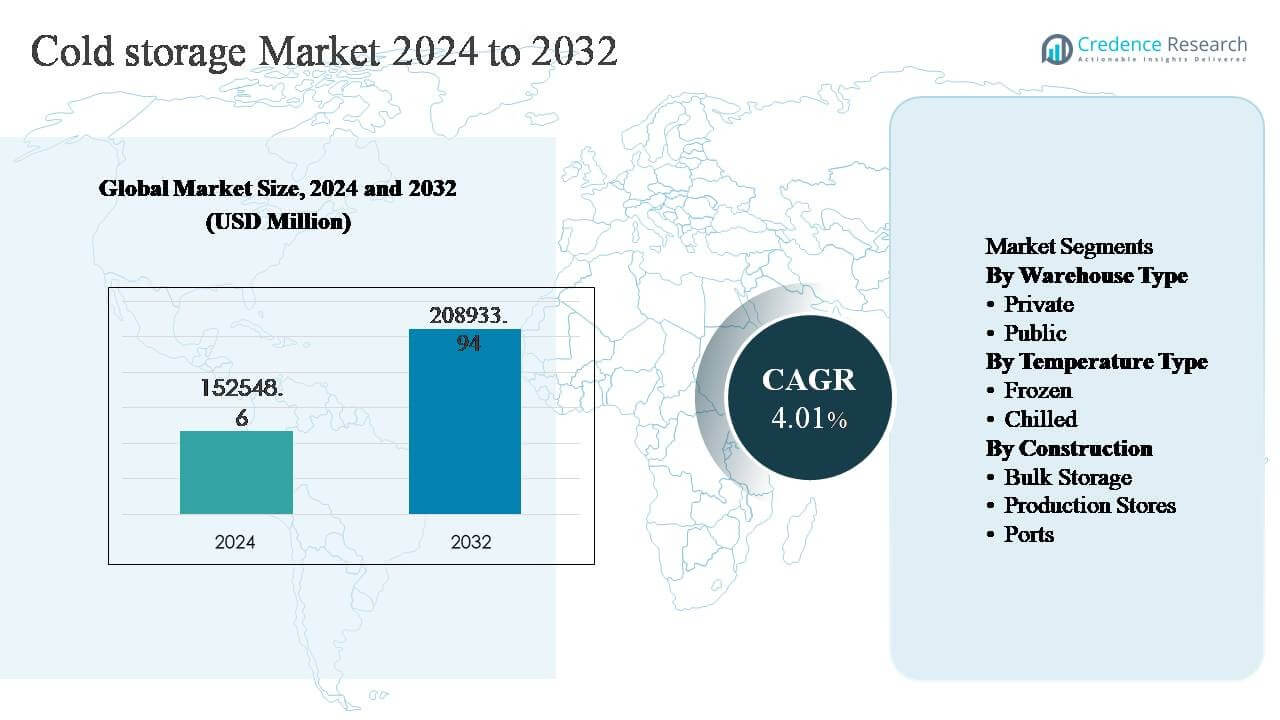
The global cold storage market was valued at USD 152,548.6 million in 2024 and is projected to reach USD 208,933.94 million by 2032, expanding at a compound annual growth rate (CAGR) of 4.01% during the forecast period.
| REPORT ATTRIBUTE | DETAILS |
|---|---|
| Historical Period | 2020-2023 |
| Base Year | 2024 |
| Forecast Period | 2025-2032 |
| Cold Storage Market Size 2024 | USD 152,548.6 million |
| Cold Storage Market , CAGR | 4.01% |
| Cold Storage Market Size 2032 | USD 208,933.94 million |
Cold Storage Market Insights
- Market growth is driven by rising demand for frozen foods, meat, seafood, dairy, and temperature-sensitive pharmaceuticals, with private warehouses holding around 60–65% segment share due to better control, customization, and integration with processing operations.
- Key market trends include automation, smart temperature monitoring, and energy-efficient refrigeration, while the frozen temperature segment dominates with nearly 55–60% share, reflecting long-term storage needs and global food trade growth.
- The competitive landscape features large-scale operators expanding capacity through acquisitions, automation, and port-centric facilities to secure long-term contracts and improve operational efficiency in a fragmented market.
- Regionally, North America leads with ~37% share, followed by Asia Pacific at ~29% driven by rapid infrastructure expansion, and Europe at ~27%, supported by strong regulatory compliance and cross-border food trade.
Cold Storage Market Segmentation Analysis:
By Warehouse Type:
By warehouse type, private cold storage represents the dominant sub-segment, accounting for an estimated 60-65% market share. This dominance is driven by large food processors, meat exporters, dairy companies, and pharmaceutical manufacturers increasingly investing in captive cold storage infrastructure to ensure supply chain control, product integrity, and regulatory compliance. Private facilities offer higher customization, integration with production lines, and better inventory visibility, reducing dependency on third-party operators. Meanwhile, public cold storage continues to expand steadily, supported by SMEs, seasonal agricultural storage needs, and the growth of third-party logistics providers offering flexible, multi-client warehousing solutions.
- For instance, pharmaceutical manufacturers such as Pfizer operate captive cold rooms and ultra-low temperature freezers across multiple sites, deploying freezer units capable of maintaining -70 °C storage conditions to support biologics and vaccine distribution compliance.
By Temperature Type:
By temperature type, the frozen segment holds the leading position with approximately 55-60% market share, supported by strong demand for frozen meat, seafood, ready-to-eat meals, and long-term food preservation. Frozen storage benefits from extended shelf life requirements and rising global trade of temperature-sensitive products. Growth is further supported by advancements in blast freezing and energy-efficient refrigeration systems. The chilled segment follows, driven by fresh produce, dairy, vaccines, and short-cycle food distribution. Increasing consumption of fresh and minimally processed foods, along with urban retail expansion, continues to sustain chilled storage demand.
- For instance, "In 2024, Lineage operationalized a high-capacity, fully automated distribution center utilizing advanced blast freezing cells capable of reducing core product temperatures to –18 °C (0 °F) significantly faster than traditional methods often cutting standard 72-hour freeze cycles by up to 50%.
By Construction:
By construction, bulk storage facilities dominate the market, contributing roughly 45-50% of total capacity, due to their suitability for large-volume storage of frozen foods, grains, and export-oriented commodities. Their dominance is reinforced by lower per-unit storage costs and compatibility with automated material handling systems. Production stores are gaining traction as food manufacturers integrate cold storage directly with processing plants to improve throughput and reduce spoilage. Port-based cold storage is expanding steadily, supported by rising cross-border trade in perishables and the modernization of port infrastructure to handle refrigerated cargo efficiently.
Key Growth Driver
Expansion of Temperature-Sensitive Food Supply Chains
The rapid expansion of global food supply chains for temperature-sensitive products remains a primary growth driver for the cold storage market. Rising consumption of frozen foods, seafood, meat, dairy, and ready-to-eat meals has intensified the need for reliable cold storage infrastructure across production, distribution, and retail stages. Urbanization and changing lifestyles are accelerating demand for convenience foods with extended shelf life, directly increasing frozen and chilled storage requirements. Additionally, globalization of food trade has increased cross-border movement of perishables, requiring compliant storage at ports, inland terminals, and logistics hubs. Food safety regulations and traceability mandates further compel producers and distributors to invest in modern cold storage systems that maintain strict temperature control and minimize spoilage, reinforcing sustained infrastructure expansion.
- For instance, DP World and its partners commissioned a state-of-the-art temperature-controlled logistics zone at the Jebel Ali Free Zone (Jafza). The facility is built on a 100,000-square-meter plot and provides 40,000 pallet positions with multi-temperature storage capabilities.
Growth of Pharmaceutical and Healthcare Cold Chains
The expanding pharmaceutical and healthcare sectors are significantly driving demand for advanced cold storage facilities. Vaccines, biologics, insulin, plasma, and specialty drugs require precise temperature-controlled environments to maintain efficacy throughout storage and distribution. Increased immunization programs, rising biologics production, and global clinical trial activities are strengthening the need for validated cold storage with real-time monitoring and compliance capabilities. Regulatory agencies mandate strict adherence to good distribution and storage practices, pushing healthcare manufacturers and logistics providers to invest in specialized cold storage infrastructure. The growing penetration of temperature-sensitive therapies in emerging economies further supports market growth, particularly for high-reliability frozen and chilled storage solutions.
- For instance, Pfizer operates ultra-low temperature storage infrastructure capable of maintaining -70 °C conditions for mRNA-based products, supported by thermal shippers designed to hold temperature stability for up to 10 days using dry ice replenishment protocols, ensuring integrity during long-distance distribution.
Modernization of Retail and E-commerce Logistics
The rapid growth of organized retail and e-commerce grocery platforms is accelerating cold storage demand globally. Supermarkets, hypermarkets, and online grocery delivery services require distributed cold storage networks to support fast replenishment and last-mile delivery of fresh and frozen products. The rise of quick-commerce and same-day delivery models has increased the need for strategically located cold warehouses near urban consumption centers. Retailers are increasingly investing in dedicated cold storage to improve inventory turnover, reduce food waste, and ensure consistent product quality. This shift toward decentralized, technology-enabled storage facilities continues to strengthen long-term market expansion.
Key Trend & Opportunity
Automation and Smart Cold Storage Facilities
Automation is emerging as a major trend and opportunity within the cold storage market. Operators are increasingly adopting automated storage and retrieval systems (ASRS), robotic pallet handling, and warehouse management software to improve space utilization, throughput, and labor efficiency. Smart cold storage facilities equipped with IoT sensors and AI-driven analytics enable real-time temperature monitoring, predictive maintenance, and energy optimization. These technologies reduce human exposure to extreme temperatures while enhancing operational accuracy and compliance. As labor shortages persist and operational costs rise, automation presents a strong opportunity for cold storage providers to improve profitability and scalability, particularly in high-volume frozen storage facilities.
- For instance, Americold implemented a network of wireless temperature and equipment health sensors across its automated sites, monitoring tens of thousands of refrigeration data points in real time and using AI-based diagnostics to predict compressor and evaporator maintenance requirements, reducing unplanned downtime while maintaining stable frozen and chilled storage conditions across large-scale facilities.
Sustainable and Energy-Efficient Infrastructure Development
Sustainability has become a critical focus area, creating opportunities for energy-efficient cold storage development. Operators are increasingly investing in advanced insulation materials, natural refrigerants, solar-powered refrigeration, and energy management systems to reduce carbon footprints and operating costs. Governments and regulatory bodies are also promoting green infrastructure through incentives and efficiency standards. Sustainable cold storage facilities not only lower long-term energy expenses but also align with corporate ESG goals, making them attractive to multinational food and pharmaceutical companies. This trend supports modernization of existing warehouses and development of next-generation cold storage facilities.
- For instance, Kloosterboer has implemented ammonia-based refrigeration systems across several of its European cold storage terminals, including facilities exceeding 60,000 pallet positions, where centralized refrigeration plants and heat recovery units are used to reclaim waste heat for office heating and defrost processes, lowering total refrigeration energy demand while sustaining frozen storage temperatures down to -25 °C.
Key Challenge
High Capital and Operating Costs
High capital investment requirements remain a key challenge for the cold storage market. Construction of cold warehouses demands significant upfront expenditure on refrigeration systems, insulation, automation, and backup power infrastructure. Additionally, operating costs are elevated due to continuous energy consumption, maintenance, and skilled labor requirements. Energy price volatility further impacts profitability, particularly for frozen storage facilities operating at ultra-low temperatures. These cost pressures can limit market entry for small and mid-sized operators and slow capacity expansion in cost-sensitive regions, creating barriers to broader market penetration.
Infrastructure Gaps and Operational Complexity
Infrastructure limitations and operational complexity pose another major challenge for the cold storage market. In many emerging economies, inadequate power supply, limited cold chain connectivity, and insufficient transport integration increase operational risks and product losses. Managing temperature consistency across multiple storage zones, handling diverse product categories, and complying with strict regulatory standards add complexity to operations. Any system failure can result in significant financial losses and product spoilage. Addressing these challenges requires continuous investment in resilient infrastructure, skilled workforce training, and robust monitoring systems, increasing operational burden for cold storage operators.
Regional Analysis
North America:
North America dominates the cold storage market, accounting for approximately 35-38% of global market share, supported by a highly developed food processing industry, strong pharmaceutical cold chain requirements, and advanced logistics infrastructure. The United States leads regional demand due to large-scale frozen food consumption, organized retail penetration, and robust vaccine and biologics storage needs. High adoption of automated cold warehouses, stringent food safety regulations, and extensive port-based cold storage capacity further strengthen the region’s position. Canada contributes steadily through meat, seafood, and agri-export storage, reinforcing North America’s leadership in high-capacity, technology-driven cold storage facilities.
Europe:
Europe holds an estimated 25-28% share of the global cold storage market, driven by strong regulatory frameworks, cross-border food trade, and high consumption of frozen and chilled products. Countries such as Germany, France, the Netherlands, and Spain act as major cold storage hubs due to dense logistics networks and port connectivity. Demand is reinforced by pharmaceutical manufacturing, vaccine distribution, and sustainability-focused warehouse modernization. Increasing investment in energy-efficient refrigeration systems and automation supports long-term growth. The region’s emphasis on food safety compliance and traceability continues to drive consistent cold storage capacity expansion.
Asia Pacific:
Asia Pacific represents the fastest-growing region, accounting for approximately 28-30% of the global market share, driven by rising urbanization, expanding middle-class consumption, and rapid growth in food retail and e-commerce. China and India lead capacity additions due to increasing demand for frozen foods, seafood exports, dairy products, and pharmaceutical storage. Government initiatives to reduce food wastage and strengthen agri-logistics are accelerating cold chain infrastructure development. Japan, South Korea, and Southeast Asian countries contribute through advanced cold storage technologies and export-oriented food processing, positioning Asia Pacific as a key long-term growth engine.
Latin America:
Latin America accounts for around 5-6% of the global cold storage market, supported by strong agricultural and meat export activities. Brazil, Mexico, Argentina, and Chile drive regional demand through storage of beef, poultry, fruits, and seafood for both domestic consumption and international trade. Expansion of food processing facilities and rising adoption of frozen food products are strengthening cold storage utilization. While infrastructure gaps persist in some areas, increasing private investment and modernization of port-based cold storage facilities are improving regional cold chain efficiency and supporting steady market expansion.
Middle East & Africa:
The Middle East & Africa region holds approximately 4-5% of global market share, driven by growing food imports, pharmaceutical distribution needs, and government-led infrastructure development. Gulf Cooperation Council countries lead regional demand due to heavy reliance on imported frozen and chilled foods, advanced logistics hubs, and port-centric cold storage investments. In Africa, growth is supported by rising urban populations, expanding retail chains, and initiatives to reduce post-harvest losses. Although challenges remain related to power reliability and infrastructure, continued investment is gradually strengthening cold storage capacity across the region.
Cold Storage Market Segmentations:
By Warehouse Type
- Private
- Public
By Temperature Type
- Frozen
- Chilled
By Construction
- Bulk Storage
- Production Stores
- Ports
By Geography
- North America
- U.S.
- Canada
- Mexico
- Europe
- Germany
- France
- U.K.
- Italy
- Spain
- Rest of Europe
- Asia Pacific
- China
- Japan
- India
- South Korea
- South-east Asia
- Rest of Asia Pacific
- Latin America
- Brazil
- Argentina
- Rest of Latin America
- Middle East & Africa
- GCC Countries
- South Africa
- Rest of the Middle East and Africa
Competitive Landscape
The competitive landscape of the cold storage market is characterized by a mix of global logistics providers, specialized cold chain operators, and regional warehouse companies competing on capacity scale, location coverage, service reliability, and technological capabilities. Leading players focus on expanding warehouse networks near ports, production hubs, and urban consumption centers to strengthen distribution efficiency. Strategic investments in automation, temperature monitoring systems, and energy-efficient refrigeration are increasingly used as differentiation tools to improve operating margins and compliance. Market participants are actively pursuing mergers, acquisitions, and joint ventures to consolidate fragmented regional markets and enhance geographic reach. Long-term contracts with food processors, pharmaceutical companies, and retailers provide revenue stability, while customized storage solutions support customer retention. Competition remains intense as new entrants and private investors continue to add capacity, pressuring pricing while accelerating innovation and modernization across the cold storage industry.
Key Player Analysis
- Lineage Logistics Holdings
- Americold Logistics
- United States Cold Storage
- Nichirei Corporation
- Kloosterboer
- Agro Merchants Group
- VersaCold Logistics Services
- Burris Logistics
- Tippmann Group
- Henningsen Cold Storage Co.
Recent Developments
- In April 2025, Lineage entered into a definitive acquisition agreement with Tyson Foods, Inc. to acquire four existing cold storage warehouses in the United States. These combined assets encompass approximately 49 million cubic feet of space with 160,000 pallet positions across Pottsville (PA), Olathe (KS), Rochelle (IL), and Tolleson (AZ), and are part of a broader plan to design, build, and operate two next-generation automated cold storage facilities for Tyson as an anchor customer. This transaction supports network scale-up and automation integration across critical distribution hubs.
- In March 2025, Americold announced the purchase of a cold storage facility in Houston, Texas, adding approximately 35,700 pallet positions to its network. The acquired warehouse has roughly 10.7 million cubic feet of temperature-controlled space and includes land for future expansion, enhancing capacity in the strategic Houston retail and distribution market.
Report Coverage
The research report offers an in-depth analysis based on Warehouse type, Temperature type, Construction and Geography. It details leading market players, providing an overview of their business, product offerings, investments, revenue streams, and key applications. Additionally, the report includes insights into the competitive environment, SWOT analysis, current market trends, as well as the primary drivers and constraints. Furthermore, it discusses various factors that have driven market expansion in recent years. The report also explores market dynamics, regulatory scenarios, and technological advancements that are shaping the industry. It assesses the impact of external factors and global economic changes on market growth. Lastly, it provides strategic recommendations for new entrants and established companies to navigate the complexities of the market.

Request a Free Sample
Fill in your details and we'll send you a free sample report.
- Sample data tables & charts
- Research methodology
Need a Custom Version of This Report?
Tailor the scope, geography, or segments to your exact requirements.
- Custom geography or segment scope
- Direct access to our analyst team
Frequently Asked Questions
What is the current market size for the cold storage market, and what is its projected size in 2032?
At what Compound Annual Growth Rate is the cold storage market projected to grow between 2024 and 2032?
Which cold storage segment held the largest share in 2024?
What are the primary factors fueling the growth of the cold storage market?
Who are the leading companies in the cold storage market?
Which region commanded the largest share of the cold storage market in 2024?
Table of Content
Chapter 1 Market Segmentation
- 1.1 Segmentation Framework
- 1.1.1 Product and Service Classification
- 1.1.2 Application and End-Use Classification
- 1.1.3 Technology and Solution Classification
- 1.1.4 Customer and Distribution Channel Classification
- 1.1.5 Geographic Segmentation
- 1.1.6 Market Segment Definitions and Boundaries
Chapter 2 Introduction
- 2.1 Report Objectives and Scope
- 2.2 Product Definition and Industry Terminology
- 2.3 Market Inclusions and Exclusions
- 2.4 Research Process
- 2.4.1 Primary Research and Expert Interviews
- 2.4.2 Secondary Research and Source Review
- 2.4.3 Top-Down and Bottom-Up Estimation
- 2.4.4 Data Triangulation and Verification
- 2.5 Market Size Measurement Basis
- 2.5.1 2024: USD 152,548.6 million → 2032: USD 208,933.94 million
- 2.6 Historical and Forecast Reference Periods
- 2.6.1 Base Year: 2024
- 2.6.2 Forecast Period: 2024-2032
- 2.7 Research Assumptions and Limitations
Chapter 3 Executive Summary
- 3.1 Market Snapshot and Key Findings
- 3.2 Base-Year Market Size, 2024
- 3.3 Forecast Market Size, 2032
- 3.4 Revenue and Volume Growth Outlook
- 3.5 Key Demand and Supply Indicators
- 3.6 Leading Market Segments
- 3.7 Fastest-Growing Market Opportunities
- 3.8 Regional Performance Highlights
- 3.9 Technology and Industry Transformation
- 3.10 Competitive Landscape Summary
- 3.11 Analyst View and Strategic Implications
Chapter 4 Global Cold Storage Market Trends and Developments
- 4.1 Historical Industry Development
- 4.2 Recent Market Trends and Developments
- 4.3 Demand and Customer Behavior Trends
- 4.4 Technology and Product Innovation
- 4.5 Artificial Intelligence, Automation and Digitalization
- 4.6 Local Manufacturing and Supply Chain Realignment
- 4.7 Industry Partnerships, Mergers and Acquisitions
- 4.8 Sustainability and Circular Economy Developments
- 4.9 Government and Private Sector Investment Trends
- 4.10 Emerging Business Models and Commercialization
- 4.11 Industry Developments and Announcements
Chapter 5 Global Cold Storage Market Production, Supply and Demand Analysis
- 5.1 Demand Trend and Consumption Analysis
- 5.2 Demand Forecast, 2024-2032
- 5.3 Production and Output Trend
- 5.4 Production and Output Forecast, 2024-2032
- 5.5 Installed Capacity and Capacity Utilization
- 5.6 Company-Wise Production Plants and Statistics
- 5.6.1 Installed Production Capacity
- 5.6.2 Actual Production
- 5.6.3 Planned Capacity and Expansion Targets
- 5.7 Supply Chain Structure and Procurement Trends
- 5.8 Supply-Demand Gap and Bottlenecks
- 5.9 Import Dependence and Sourcing Structure
- 5.10 Contract Manufacturing and Outsourcing
- 5.11 Regional Supply and Demand Concentration
Chapter 6 Global Cold Storage Market Pricing Analysis
- 6.1 Pricing Structure and Measurement
- 6.2 Historical Pricing Trends
- 6.3 Pricing Outlook, 2024-2032
- 6.4 Average Selling Price and Unit Economics
- 6.5 Pricing by Product and Market Segment
- 6.6 Geographic Pricing Differences
- 6.7 Key Input, Energy, Labor and Logistics Costs
- 6.8 Contract Pricing and Purchasing Models
- 6.9 Pricing Sensitivity and Competitive Positioning
- 6.10 Price, Margin and Profitability Implications
Chapter 7 Global Cold Storage Market Dynamics
- 7.1 Market Growth Drivers
- 7.1.1 Demand-Side Drivers
- 7.1.2 Technology and Innovation Drivers
- 7.1.3 Infrastructure and Investment Drivers
- 7.1.4 Regulatory and Policy Drivers
- 7.2 Market Restraints
- 7.2.1 Cost and Affordability Constraints
- 7.2.2 Technology and Adoption Barriers
- 7.2.3 Supply Chain and Operational Constraints
- 7.3 Market Challenges
- 7.3.1 Competitive Pressure and Margin Erosion
- 7.3.2 Skills, Infrastructure and Implementation Gaps
- 7.4 Emerging Market Opportunities
- 7.5 Market Dynamics Impact and Time-Horizon Assessment
Chapter 8 Global Cold Storage Value Chain Analysis
- 8.1 Industry Value Chain Overview
- 8.2 Upstream Suppliers and Critical Inputs
- 8.3 Technology and Component Providers
- 8.4 Manufacturing or Service Delivery
- 8.5 Distribution, Channel Partners and Integrators
- 8.6 Downstream Applications and End Users
- 8.7 Value Addition and Profit Pools
- 8.8 Vertical Integration and Outsourcing
- 8.9 Supplier Concentration and Risk
- 8.10 Supply Chain Localization and Resilience
Chapter 9 Global Cold Storage Market Regulations and Policies
- 9.1 Relevant Laws, Standards and Compliance Frameworks
- 9.2 Product, Service, Safety and Quality Requirements
- 9.3 Government Policies, Incentives and Subsidies
- 9.4 Imports, Exports and Trade Barriers
- 9.5 Public Procurement and Local Content Requirements
- 9.6 Environmental and Sustainability Compliance
- 9.7 Upcoming Policy Changes and Market Implications
Chapter 10 Global Cold Storage Market Hotspots and Opportunities
- 10.1 Market Opportunity Mapping and Growth Hotspots
- 10.2 High-Growth Applications and Customer Groups
- 10.3 Underserved Markets and White-Space Opportunities
- 10.4 Emerging Technology and Product Opportunities
- 10.5 New Capacity and Investment Hotspots
- 10.6 Market Entry and Expansion Opportunities
- 10.7 Distribution and Partnership Opportunities
- 10.8 Near-Term and Long-Term Commercial Potential
- 10.9 Opportunity Attractiveness and Execution Risks
Chapter 11 Global Cold Storage Market Outlook, 2024-2032
- 11.1 Market Size and Analysis
- 11.1.1 Revenue (Market Measurement: 2024: USD 152,548.6 million → 2032: USD 208,933.94 million)
- 11.1.2 Market Volume and Quantity Sold
- 11.1.3 Historical Market Size
- 11.1.4 Base-Year Market Size, 2024
- 11.2 Market Forecast, 2024-2032
- 11.2.1 Revenue Forecast to 2032
- 11.2.2 Volume Forecast to 2032
- 11.2.3 CAGR and Year-on-Year Growth
- 11.2.4 Incremental Revenue Opportunity
- 11.3 Forecast Assumptions and Scenario Analysis
- 11.3.1 Base-Case Forecast
- 11.3.2 Optimistic and Conservative Scenarios
- 11.3.3 Technology, Pricing and Policy Sensitivities
- 11.4 Market Attractiveness and Growth Outlook
Chapter 12 Global Cold Storage Market Segmentation and Outlook
- 12.1 Segmentation Summary and Market Shares, 2024
- 12.2 Largest and Fastest-Growing Segments
- 12.3 Segment Growth Comparison
- 12.4 Segment Attractiveness and Priority Matrix
Chapter 13 Global Cold Storage Geographic Market Outlook, 2024-2032
- 13.1 Regional Market Size and Share, 2024
- 13.2 Regional Market Forecast, 2024-2032
- 13.3 Regional Pricing, Production and Demand Differences
- 13.4 North America
- 13.4.1 United States
- 13.4.2 Canada
- 13.4.3 Mexico
- 13.5 Europe
- 13.5.1 Germany
- 13.5.2 France
- 13.5.3 Italy
- 13.5.4 United Kingdom
- 13.5.5 Spain
- 13.5.6 Poland
- 13.5.7 Russia
- 13.5.8 Netherlands
- 13.5.9 Belgium
- 13.5.10 Sweden
- 13.5.11 Denmark
- 13.5.12 Norway
- 13.5.13 Rest of Europe
- 13.6 Asia Pacific
- 13.6.1 China
- 13.6.2 India
- 13.6.3 Japan
- 13.6.4 South Korea
- 13.6.5 Thailand
- 13.6.6 Indonesia
- 13.6.7 Vietnam
- 13.6.8 Malaysia
- 13.6.9 Australia
- 13.6.10 Rest of Asia Pacific
- 13.7 Latin America
- 13.7.1 Brazil
- 13.7.2 Argentina
- 13.7.3 Colombia
- 13.7.4 Chile
- 13.7.5 Rest of Latin America
- 13.8 Middle East
- 13.8.1 Saudi Arabia
- 13.8.2 United Arab Emirates
- 13.8.3 Turkey
- 13.8.4 Israel
- 13.8.5 Iran
- 13.8.6 Rest of the Middle East
- 13.9 Africa
- 13.9.1 South Africa
- 13.9.2 Egypt
- 13.9.3 Nigeria
- 13.9.4 Morocco
- 13.9.5 Rest of Africa
- 13.10 Regional Investment, Policy and Supply Chain Differences
- 13.11 Regional Competitive Landscape
- 13.12 Geographic Growth Hotspots
Chapter 14 Global Cold Storage Technology, Innovation and Sustainability Outlook
- 14.1 Technology Landscape and Maturity
- 14.2 Product, Process and Service Innovation
- 14.3 AI, Automation and Digital Tools in the Industry
- 14.4 Technology Adoption and Performance Benchmarking
- 14.5 Innovation Pipeline and R&D Investment
- 14.6 Patent and Intellectual Property Trends
- 14.7 Energy Efficiency and Resource Management
- 14.8 Sustainability, Recycling and Circularity
- 14.9 Technology Roadmap, 2024-2032
- 14.10 Risks of Obsolescence and Technology Substitution
Chapter 15 Global Cold Storage Market Key Strategic Imperatives
- 15.1 Growth and Market Entry Priorities
- 15.2 High-Return Products and Segments
- 15.3 Pricing, Profitability and Cost Optimization
- 15.4 Technology Investment and Product Differentiation
- 15.5 Supply Chain Localization and Resilience
- 15.6 Distribution and Customer Acquisition
- 15.7 Partnership, Acquisition and Capacity Strategy
- 15.8 Regional Expansion Priorities
- 15.9 Short-, Medium- and Long-Term Actions
Chapter 16 Competition Outlook
- 16.1 Industry Competition Characteristics
- 16.2 Market Structure and Concentration
- 16.3 Market Share and Competitive Positioning, 2024
- 16.4 Company-Wise Revenue and Product Benchmarking
- 16.5 Production and Service Capacity Benchmarking
- 16.6 Technology, Pricing and Differentiation
- 16.7 Regional Footprint and Distribution Strength
- 16.8 Mergers, Acquisitions and Strategic Alliances
- 16.9 New Entrants and Competitive Threats
- 16.10 Porter's Five Forces and Industry Attractiveness
- 16.11 Competitive Outlook, 2024-2032
Chapter 17 Company Profiles
- 17.1 Company Coverage and Selection Criteria
- 17.2 Leading Market Participants – Standard Profile Structure
- 17.2.1 Business Description
- 17.2.2 Company Ownership and Geographic Presence
- 17.2.3 Product and Service Portfolio
- 17.2.4 Manufacturing and Operating Footprint
- 17.2.5 Production Capacity and Expansion Plans
- 17.2.6 Financial Performance and Investment
- 17.2.7 Market Share and Competitive Position
- 17.2.8 Technology and Innovation Capabilities
- 17.2.9 Strategic Alliances or Partnerships
- 17.2.10 Recent Developments
- 17.2.11 Growth Strategy and Outlook
- 17.3 Other Relevant Market Participants
Note: Every listed company is profiled on the structure shown under the first company. The company list is preliminary and may change based on research findings, market developments, data availability and client requirements.
Chapter 18 Disclaimer
- 18.1 Research and Forecast Disclaimer
- 18.2 Data Source and Estimation Limitations
Note: The depth of individual sections depends on data availability for this market. Volume, capacity, trade and other unit-based metrics are included where applicable.