
Europe gypsum board demand tilts toward renovation
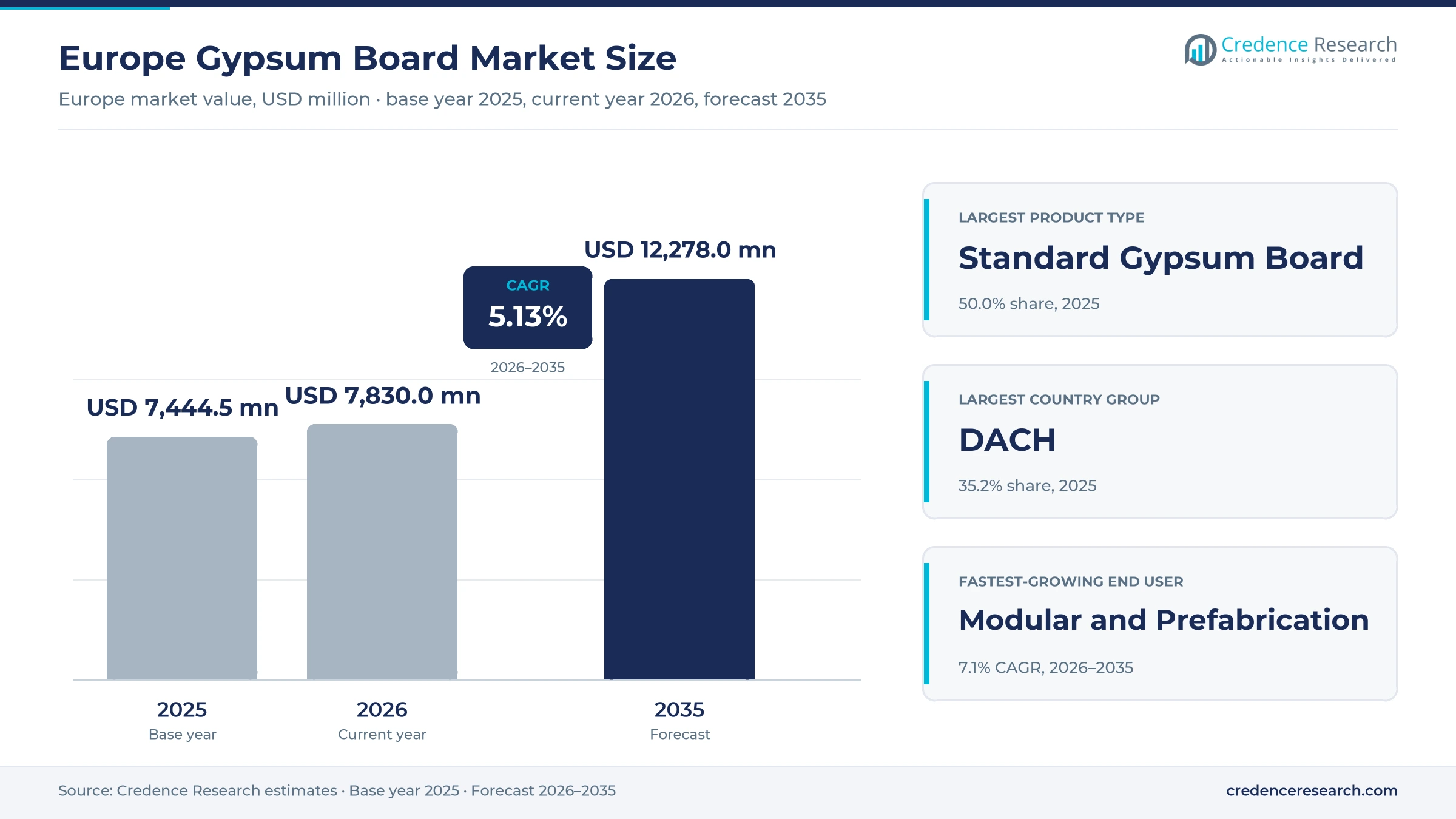
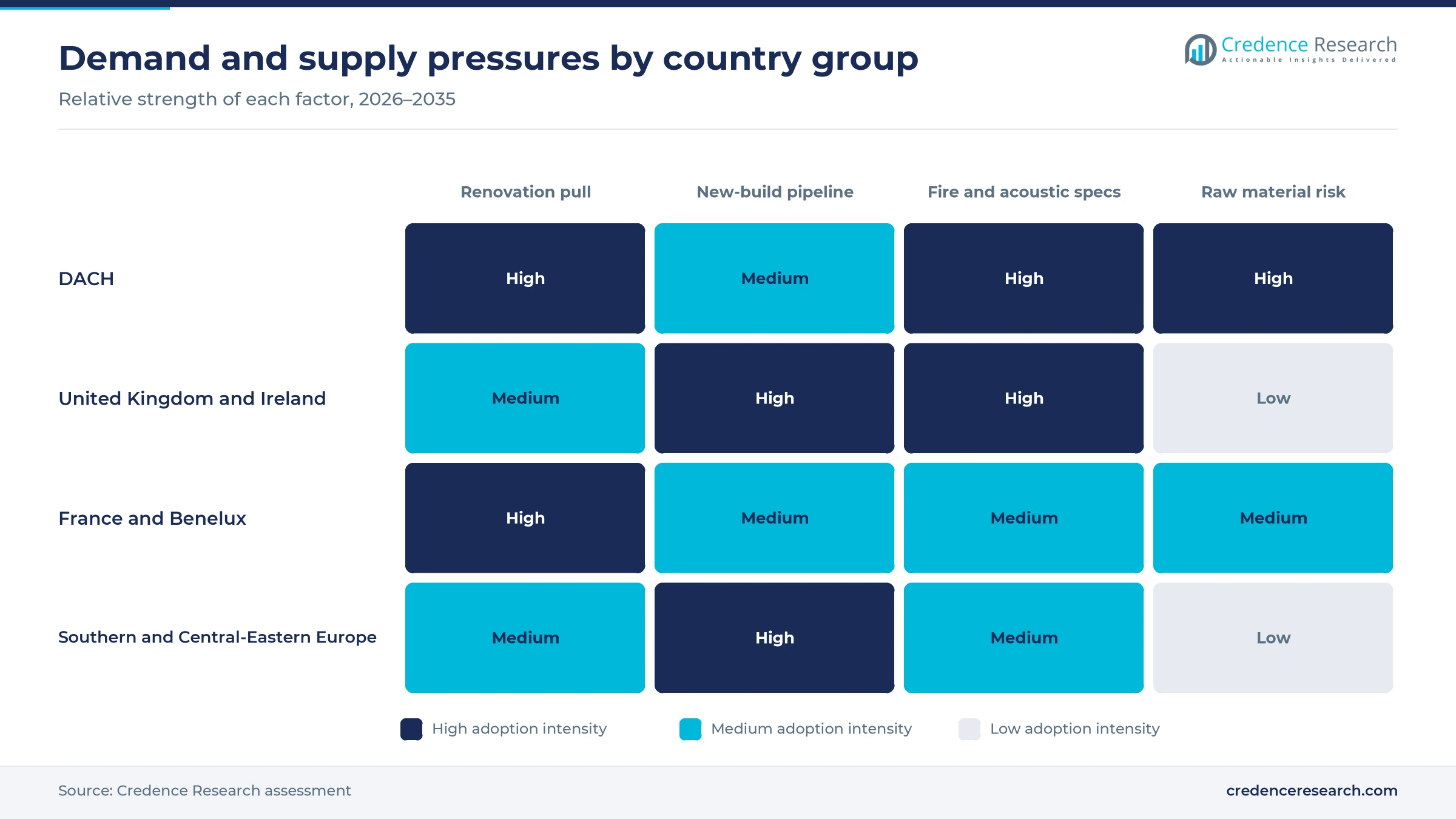
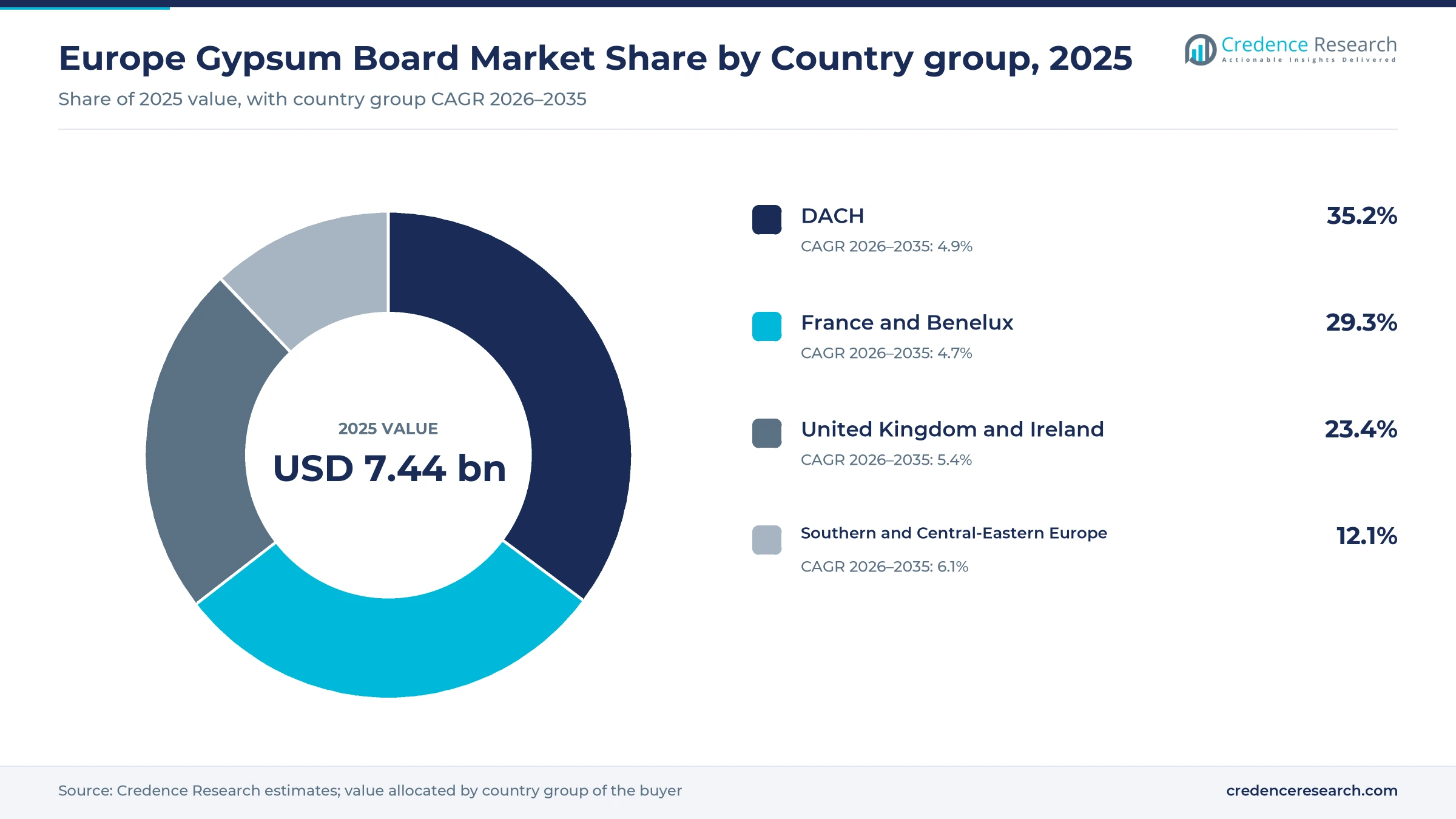
The Europe gypsum board market was valued at USD 7.44 billion in 2025 and is projected to increase from USD 7.83 billion in 2026 to USD 12.28 billion by 2035, registering a CAGR of 5.13% during 2026–2035. Demand comes from drywall and fit-out contractors, housebuilders and owners of offices, schools and hospitals that specify partition, lining and ceiling systems. DACH held the largest share, 35.2% in 2025, because Germany, Austria and Switzerland combine a large dry-construction trade with a dense network of board plants. Southern and Central-Eastern Europe is the fastest-growing country group at 6.1% a year, as new lines in Romania and Spain shorten delivery routes to growing building markets. The main regulatory change is the recast Energy Performance of Buildings Directive, which sets binding renovation milestones for the worst-performing buildings. Producers are also replacing flue gas gypsum from closing coal plants with natural and recycled gypsum, which changes plant costs and the carbon profile of each board.
Why do partitions, linings and ceilings absorb most board output?
The estimate counts paper-faced plasterboard, glass-mat faced boards, fiber-reinforced gypsum boards and lightweight core boards sold for partitions, wall linings, suspended ceilings and shaft enclosures, valued at the first sale by manufacturers and importers to merchants, contractors and prefabricators. Eurogypsum says European plants make about 1.7 billion square meters of plasterboard a year in 146 factories, supplied by 209 gypsum quarries.
Gypsum plasters, gypsum blocks, cement and fiber cement boards, metal studs, jointing compounds and installation labor sit outside the estimate, although they are sold in the same systems. Boards are heavy and low in value per ton, so producers serve national markets from nearby plants and compete on delivered price, system warranties and fire, acoustic and moisture test evidence that architects write into specifications.
Europe Gypsum Board Market Insights
- The Europe gypsum board market, valued at USD 7.44 billion in 2025, is projected to reach USD 12.28 billion by 2035, growing at a 5.13% CAGR on renovation demand.
- DACH led with 35.2% of 2025 value, because German, Austrian and Swiss dry construction uses boards in almost every partition and ceiling.
- Standard Gypsum Board held 50.0% of 2025 value, since most housing partitions and linings need only a basic paper-faced board.
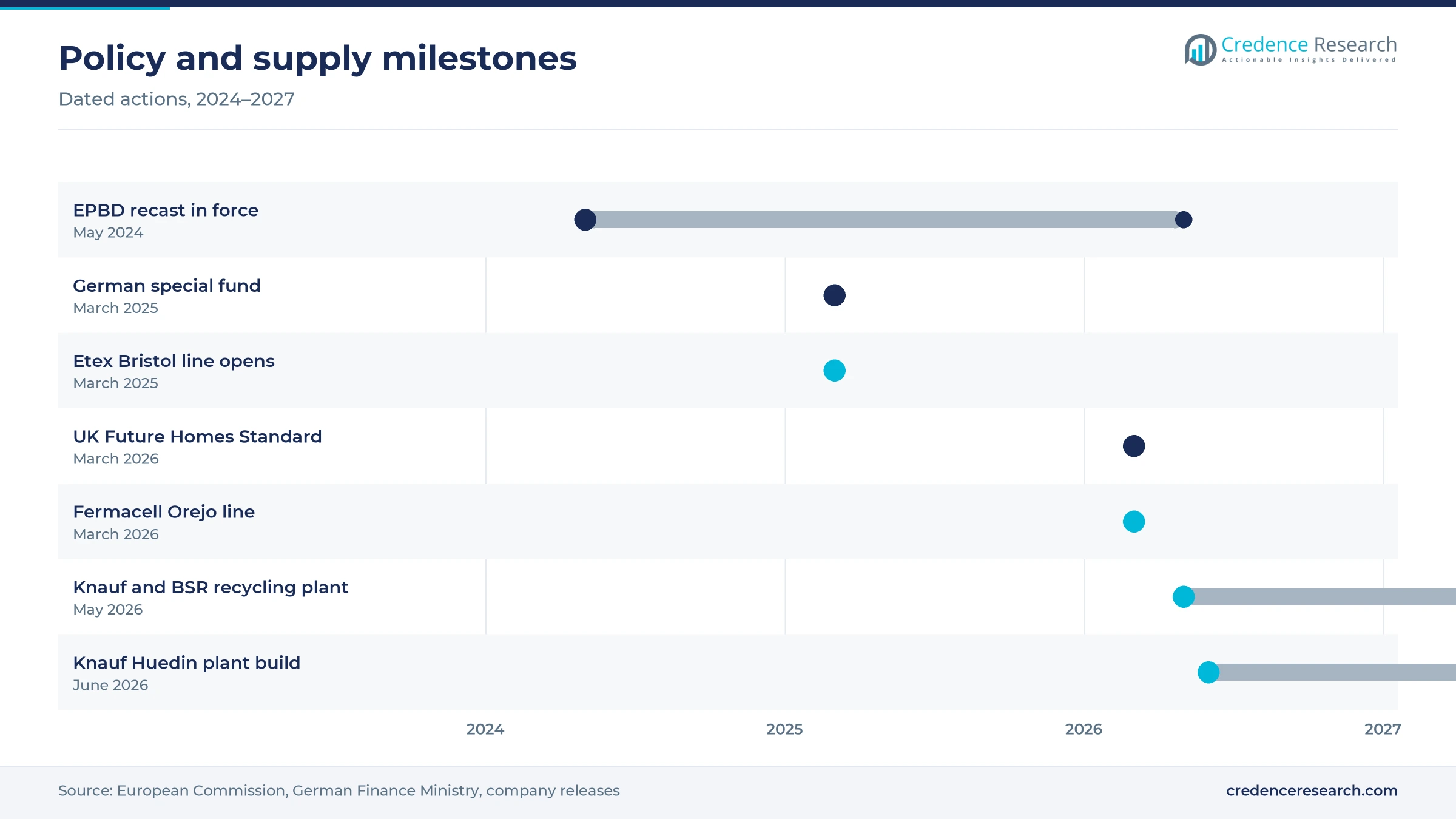
- Knauf and BSR announced on May 19, 2026, that they had received an emission control permit for a Bavarian plant that will recycle up to 90,000 metric tons of gypsum a year.
- James Hardie agreed in August 2026 to sell its fermacell business to Holcim for EUR 840 million, with closing expected in the first half of 2027.
Standard board leads while multi-performance grades gain
Why does standard board lead while multi-performance grades gain?
Based on product type, the market is categorized into standard gypsum board, fire-resistant gypsum board, moisture-resistant gypsum board and high-performance gypsum board. Standard Gypsum Board led with 50.0% of 2025 value because most housing partitions and linings need only a basic paper-faced board, and B&Q lists Gyproc standard 12.5 mm board at GBP 4.85 per square meter against GBP 7.36 for FireLine. High-Performance Gypsum Board grows fastest at 6.6% a year as specifiers combine acoustic, impact and recycled-content demands in one board. British Gypsum launched Gyproc SoundBloc Infinaé 100, its first board made from 100% recycled gypsum, on Jan. 17, 2025.
Why do partitions lead while wall linings grow fastest?
Based on application, the market is categorized into interior wall partitions, wall linings and furrings, suspended ceilings and shaft and fire enclosures. Interior Wall Partitions led with 40.0% of 2025 value because metal-stud partitions are the standard way to divide apartments, offices and hospitals, and German authorities approved 238,100 new dwellings in 2025, according to Destatis. Wall Linings and Furrings grow fastest at 5.8% a year as energy retrofits add internal insulation linings to occupied homes, and the recast directive requires at least 55% of the residential energy cut to come from the worst-performing buildings. Ceiling boards compete with mineral tiles and other false ceiling systems in offices.
Why do contractors lead while prefabricators grow fastest?
Based on end user, the market is categorized into drywall and fit-out contractors, residential developers and builders, commercial and institutional project owners, and modular and prefabrication manufacturers. Drywall and Fit-Out Contractors led with 45.0% of 2025 value because contractors buy board package by package through merchants, and Eurogypsum counts about 1.1 million plasterers and board installers across Europe. Modular and Prefabrication Manufacturers grow fastest at 7.1% a year as factories pre-line wall and floor elements, and James Hardie opened a fermacell fiber gypsum line at Orejo, Spain, in March 2026 after investing more than EUR 150 million, Builders Merchants Journal reported, serving modular construction and prefabrication customers.
| Segment Group | Leading Sub-segment | Share, 2025 | Fastest-growing Sub-segment | CAGR, 2026–2035 |
|---|---|---|---|---|
| By Product Type | Standard Gypsum Board | 50.0% | High-Performance Gypsum Board | 6.6% |
| By Application | Interior Wall Partitions | 40.0% | Wall Linings and Furrings | 5.8% |
| By End User | Drywall and Fit-Out Contractors | 45.0% | Modular and Prefabrication Manufacturers | 7.1% |
Fire and moisture grades earn a premium of about half
Boards are priced per square meter, and list prices step up sharply with each added performance. In the U.K., B&Q charges about 52% more per square meter for Gyproc FireLine than for standard board, and Hornbach in Germany charges about 44% more for moisture-resistant Knauf GKBI than for GKB. Producers adjust merchant price lists when energy and paper liner costs move, given the energy share of costs noted in the challenges. Large contractors negotiate project prices below these lists, so the premium on fire, acoustic and moisture boards is where producers earn most of their margin.
| Board type and market | Typical price or fee | Basis |
|---|---|---|
| Standard 12.5 mm board, U.K. retail | GBP 4.85 per square meter (GBP 13.97 a board) | B&Q list price, November 2026 |
| Fire-resistant 12.5 mm board, U.K. retail | GBP 7.36 per square meter (GBP 21.20 a board) | B&Q list price, November 2026 |
| Standard GKB 12.5 mm board, Germany retail | EUR 4.42 per square meter, EUR 3.95 for 50 or more boards | Hornbach list price, November 2026 |
| Moisture-resistant GKBI 12.5 mm board, Germany retail | EUR 6.38 per square meter, EUR 5.63 in bulk | Hornbach list price, November 2026 |
| Standard board, first sale to merchants | About EUR 2.50 to 3.50 per square meter | Credence Research estimate from list prices less VAT and merchant margin |
Request a Free Sample
Fill in your details and we'll send you a free sample report.
- Sample data tables & charts
- Research methodology
Renovation rules and a permit rebound lift board use
Renovation mandates put boards into occupied buildings
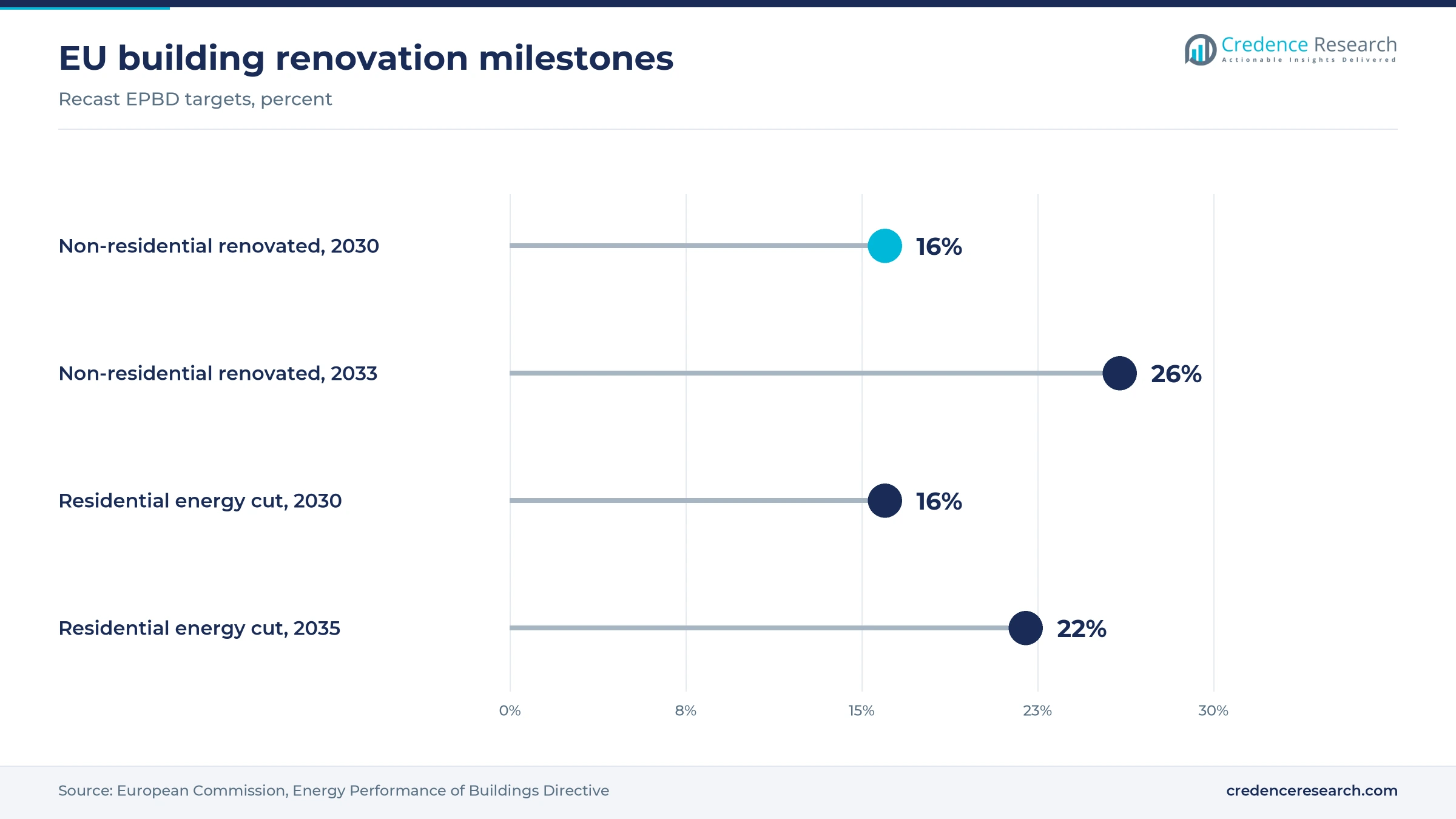
Building renovation is the steadiest source of new board demand, because energy upgrades open walls and ceilings that are then relined with insulated or standard boards. The recast Energy Performance of Buildings Directive entered into force on May 28, 2024, and it requires renovation of the worst-performing 16% of non-residential buildings by 2030 and 26% by 2033. The European Commission estimates that about 75% of EU buildings have poor energy performance, while only about 1% are energy-renovated each year. Member states must submit final national building renovation plans by Dec. 31, 2026. Board makers that sell lining systems together with thermal insulation gain most, because each renovated home needs boards, studs and insulation in one package.
German permits and French volumes point to recovery
A recovery in the new-build pipeline supports board volumes from 2026, because board is fitted late in a project, after permits turn into building starts. German authorities approved 238,100 dwellings in 2025, up 10.6% from 2024, Destatis data reported by Baulinks show, after several years of decline. Eurostat reported in February 2026 that EU construction output rose 0.5% in 2025 while the euro area stayed flat, so the trough has passed without a strong rebound. Saint-Gobain said its French volumes rose 1.0% in the fourth quarter of 2025, driven by new construction. Producers with idle line capacity in Germany and France can absorb this recovery without new capital spending, which should support margins before prices rise.
Fire, acoustic and carbon rules raise board specifications
Compliance rules push buyers from standard boards toward fire, acoustic and low-carbon grades, because each rule adds a performance that the cheapest board cannot document. The U.K. government published the Future Homes Standard on March 24, 2026, with the higher standard for new homes in force from 2028, Construction Management reported. Under the recast directive, new buildings over 1,000 square meters must disclose life-cycle global warming potential in their energy certificates from January 2028, and all new buildings from January 2030. Eurogypsum puts the average footprint of plasterboard at about 2 kg of CO2 per square meter, which makes verified recycled content a visible score. Producers with environmental product declarations for every board win specification share in tenders that score carbon.
Germany's infrastructure fund backs public building work
Public building programs add institutional demand, because schools, hospitals and childcare centers use fire-rated partitions and acoustic ceilings in large volumes. Germany amended its Basic Law in March 2025 to create a EUR 500 billion special fund for infrastructure and climate neutrality, with investments approved over 12 years. The fund allocates EUR 100 billion to the Länder and local authorities and lists education, childcare, hospital and housing infrastructure among eligible uses, according to the Federal Ministry of Finance. A further EUR 100 billion goes to the Climate and Transformation Fund. DACH already holds the largest regional share, so producers with German plants, such as Knauf at Iphofen, are best placed to win this public work.
Recycled cores and cleaner plants reshape supply
Recycled gypsum moves from waste stream to board core
Producers are shifting toward recycled gypsum in the board core to address landfill limits and carbon targets, creating openings for low-carbon boards across partitions and linings. Siniat announced in April 2025 that its RECYPLAC board, made entirely from recycled gypsum, would launch in July 2025 from the Ottmarsheim plant in France, and Etex says its group use of recycled gypsum rose 34% between 2018 and 2024. Placo's Chambéry plant now runs at 30% recycled content and recycled about 64,000 metric tons in 2025, out of 237,000 tons collected in France, Batiweb reported in April 2026. The constraint is collection rather than technology, so producers that run take-back services with merchants and demolition firms keep a cost and specification edge.
Plants shift to heat recovery and zero-waste lines
Board makers are shifting toward low-carbon heat, heat recovery and zero-waste lines to address energy costs and carbon disclosure, creating openings for low-carbon boards in certified and public projects. Placo is spending EUR 3 million at Chambéry to reuse heat from its crusher-cooker in the dryer, saving about 1,500 tons of CO2 a year, and it plans a district heating link by the end of 2027 and a biomass boiler in 2028 or 2029, Batiweb reported in April 2026. Etex says its EUR 200 million Bristol line, opened on March 17, 2025, makes boards with 23% to 45% recycled content and sends no waste to landfill, Global Gypsum reported. Lower-carbon lines will set the benchmark that importers must match.
Recycling capacity can fill the German gypsum gap
Gypsum recycling is a clear opening in Germany, where the coal exit removes the flue gas gypsum that board plants have relied on for decades. Knauf and BSR announced on May 19, 2026, that they had received an emission control permit for a Bavarian recycling plant that will process up to 90,000 metric tons a year from 2027. Knauf says available flue gas gypsum is already declining faster than originally forecast. Germany uses around 10 million tons of gypsum a year, Clean Energy Wire reported, so one plant covers only a small part of the gap. Demolition contractors, waste firms and recyclers that deliver clean, sorted board waste gain a paying buyer, while producers secure raw material without opening new quarries.
New plants open southern and eastern supply gaps
Southern and central-eastern Europe offers the clearest geographic opening, because much of its board travels far from western plants. Knauf is building a EUR 88 million plant at Huedin, Romania, with capacity of 30 million square meters a year, and Global Gypsum reported in June 2026 that its foundations were complete, with commissioning due by the end of 2027. Etex announced in 2023 a EUR 28 million plasterboard factory near Bucharest, due to operate in 2025, according to Romania Insider, but no public confirmation of its start-up was found, an evidence gap. Fassa Bortolo lists Tarancón, Spain, its second plasterboard plant after Calliano in Italy, as built in 2026, following a EUR 90 million plan announced in 2023. Contractors in the region gain shorter lead times from local supply.
Raw gypsum loss and energy costs squeeze producers
The coal exit removes Germany's cheapest gypsum source
Closing coal plants removes flue gas gypsum, the cheapest raw material for German board lines. Speakers at a Nordhausen university event in March 2025 said about five million metric tons will be lost each year, and Clean Energy Wire reported that more than half of German gypsum came from flue gas desulfurization units in 2020. Plants built around power station supply are most exposed, and Knauf began converting Iphofen to natural gypsum in 2023. A Halle court partly halted seven exploratory quarry drillings in the Südharz in January 2025.
Energy-heavy drying keeps cost pressure high
Drying wet board is energy intensive, and Eurogypsum said in May 2026 that energy accounts for around a quarter of production costs. Eurostat producer price data put the EU index for plaster products for construction at 134.1 in September 2026, just below its May 2023 peak of 134.7, so earlier price rises have not reversed. Single-plant independents that buy gas on short contracts are most exposed, because they cannot spread costs across sites or pass increases quickly to merchants that hold alternative suppliers.
Slow U.K. high-rise approvals delay fire-rated board orders
Approval delays for higher-risk buildings in England postpone the projects that use the most fire-rated board and shaft walling. Building Safety Regulator data for the 12 weeks to Feb. 25, 2026 show a median of 39 weeks to approve legacy new-build applications at Gateway 2, with 53% of legacy decisions approved. Suppliers of fire and shaft systems and dry-lining contractors in London are most exposed, since board orders follow construction starts rather than design approval, and each delayed tower defers several months of deliveries.
Weak German completions hold back commodity board
New housing completions in Germany fell 18% to 206,000 dwellings in 2025, the lowest level since 2012, according to Destatis data reported by Baulinks. Saint-Gobain reported that volumes in its Northern Europe segment fell 1.4% in 2025, with Germany still down pending its stimulus plan. Producers that rely on standard board for new housing are most exposed, because permits issued in 2025 take time to become fitted-out homes, and commodity grades compete mainly on delivered price while lines run below capacity.
DACH leads while southern and eastern markets grow fastest
| Country group | Value, 2025 (USD billion) | Share, 2025 | CAGR, 2026–2035 |
|---|---|---|---|
| DACH | 2.62 | 35.2% | 4.9% |
| France and Benelux | 2.18 | 29.3% | 4.7% |
| United Kingdom and Ireland | 1.74 | 23.4% | 5.4% |
| Southern and Central-Eastern Europe | 0.90 | 12.1% | 6.1% |
DACH leads on dense dry-construction demand
DACH held 35.2% of 2025 value and grows at 4.9% a year, because German, Austrian and Swiss dry construction uses boards in almost every partition, lining and ceiling. Knauf, which runs its home plant at Iphofen, gives the region strong local supply, and Hornbach lists standard Knauf board at EUR 4.42 per square meter. Growth trails the regional average because German producers must replace flue gas gypsum with costlier natural and recycled gypsum, which limits room for price cuts while housing completions stay low.
France and Benelux rely on large national plants
France and Benelux held 29.3% of 2025 value and grow at 4.7% a year, the slowest rate, because French new-build volumes only stabilized in the second half of 2025. France alone sells roughly 320 million square meters of plasterboard a year, Batiweb reported in April 2026, citing Placo, which makes about 12% of that volume at Chambéry. Siniat and Placo both produce recycled boards in France, so French tenders that score carbon favor domestic producers over imports, while Belgian and Dutch demand leans on the same suppliers.
United Kingdom and Ireland add capacity for housing
The United Kingdom and Ireland held 23.4% of 2025 value and grow at 5.4% a year, above the regional rate, because the government ties housing policy to 1.5 million new homes, as Housing Secretary Steve Reed said in March 2026. Knauf agreed in June 2022 to buy a new plasterboard plant at Newport, South Wales, from Gypfor, which it expected to raise its U.K. output of gypsum products by 20% once fully running in 2023. Gypfor boards still appear in U.K. merchant listings, so British buyers draw on Portuguese supply as well as domestic plants.
Southern and central-eastern markets grow fastest on new plants
Southern and Central-Eastern Europe held 12.1% of 2025 value and grows fastest at 6.1% a year, because local plants are replacing long-haul supply. The Tarancón plant noted above moves board production closer to Spanish building sites that were served from distant plants. Norgips built its Opole plant in Poland with IFC financing for up to 40 million square meters a year, fed by flue gas gypsum from the neighboring power plant. Gyptec Ibérica, part of Preceram Group, makes plasterboard at Figueira da Foz, Portugal, which keeps Iberian contractors supplied without long-haul freight.
New lines, recycling permits and a fermacell sale
| Development | Status and market relevance |
|---|---|
| In January 2025, British Gypsum launched Gyproc SoundBloc Infinaé 100 in the U.K., its first board made from 100% recycled gypsum. | Operational launch; supported by a job-site take-back service for used plasterboard, adhesives and fillers. |
| In March 2026, James Hardie opened a fermacell fiber gypsum line at Orejo, Spain, after investing more than EUR 150 million. | Operational launch; adds wall board, flooring and prefabrication capacity for Iberian and export buyers. |
| In May 2026, Knauf and BSR received an emission control permit for a gypsum recycling plant in Bavaria. | Approval; up to 90,000 metric tons a year, with processing targeted for 2027. |
| In June 2026, Global Gypsum reported that foundations of the EUR 88 million Knauf plant at Huedin, Romania, were complete. | Under construction; 30 million square meters a year, commissioning due by the end of 2027. |
| In August 2026, James Hardie agreed to sell its European fermacell business to Holcim for EUR 840 million. | Signed agreement; closing expected in the first half of 2027, subject to approvals and works council consultation. |
Facer, core and fiber choices set board performance
- Paper-faced plasterboard remains the workhorse, with a gypsum core between two paper liners that suit taped and skimmed interior walls.
- Glass-mat facers replace paper on sheathing and wet-area boards, which improves moisture and mold resistance where linings face weather or humidity.
- Fiber-reinforced gypsum mixes cellulose fibers through the core, which gives higher impact strength and screw holding for floors and prefabricated walls.
- Lightweight cores use foamed or additive-modified gypsum to cut board weight, which eases handling for installers and lowers transport costs.
Need a Custom Version of This Report?
Tailor the scope, geography, or segments to your exact requirements.
- Custom geography or segment scope
- Direct access to our analyst team
Three integrated groups set prices and specifications
Competition is led by Knauf, Saint-Gobain and Etex, which sell full partition, lining and ceiling systems backed by fire and acoustic test evidence. Saint-Gobain sells through Rigips in Germany, British Gypsum in the U.K. and Placo in France, and Etex sells through Siniat and Pladur, which it has owned outright since December 2017. James Hardie Europe sells fermacell fiber gypsum boards but has agreed to sell the business to Holcim, a deal expected to close in the first half of 2027. Independents compete on price and location, among them Norgips in Poland, Gypfor and Gyptec Ibérica in Portugal, and Technogips Pro in Bulgaria. Fassa Bortolo adds Italian and Spanish supply from its Calliano and Tarancón plasterboard plants. Recycled content and carbon data are becoming the main points of difference in specified projects.
How concentrated is the supply side?
The supply side of the market is concentrated in three integrated groups. Knauf, Saint-Gobain and Etex own quarries, recycling services, national brands and system test data, while independents such as Norgips, Gypfor, Gyptec Ibérica, Technogips Pro and Fassa Bortolo run one or a few plants. Entry is costly, because a new line needed EUR 28 million near Bucharest and EUR 200 million at Bristol, and each plant also needs a secure gypsum source. Margins sit in fire, acoustic and moisture boards and in full systems, while standard board trades close to delivered cost.
Companies profiled and their roles in this market
| Company | Type | Role in the market |
|---|---|---|
| Knauf Group | Full-line supplier | Boards and partition systems from Iphofen and Newport plants; Huedin line under construction |
| Saint-Gobain | Full-line supplier | Rigips, British Gypsum and Placo boards, including recycled Infinaé lines, and drylining systems |
| Etex (Siniat, Pladur) | Full-line supplier | Siniat and Pladur boards, recycled RECYPLAC, Bristol and Romanian plants |
| James Hardie Europe GmbH (fermacell) | Specialist | Fermacell fiber gypsum boards and floor elements; sale to Holcim pending |
| Norgips | Regional manufacturer | Plasterboard from Opole, Poland, using flue gas gypsum from the neighboring power plant |
| Gypfor S.A. | Regional manufacturer | Portuguese plasterboard maker selling standard and specialty boards to U.K. merchants |
| Gyptec Ibérica S.A. | Regional manufacturer | Technical plasterboards made at Figueira da Foz, Portugal, for Iberian projects |
| Technogips Pro | Regional manufacturer | Bulgarian plasterboard producer of BS Group supplying several European countries |
| Fassa Bortolo (Gypsotech) | Regional manufacturer | Plasterboard from Calliano, Italy and the new Tarancón plant in Spain |
Raw material security will decide producer margins
Credence Research's view is that raw material security, more than demand, will decide which producers gain share to 2035. Renovation milestones and public building funds give the market a steady floor, but German plants must replace millions of tons of flue gas gypsum with quarried and recycled material at higher cost. Producers that control take-back services and recycling plants, as Knauf, Saint-Gobain and Etex are building, can hold costs and win carbon-scored tenders. Single-plant independents face a squeeze on both sides, and further consolidation, like the pending fermacell sale, is likely.
Output volumes and list prices anchor the estimate
The report uses 2025 as the base year and forecasts to 2035. Market values come from the Credence Research model, which combines European plasterboard output reported by Eurogypsum with retail list prices from merchants in Germany and the U.K., adjusted to first-sale prices by board type. Country group, product, application and end-user splits are Credence Research estimates drawn from construction statistics from Eurostat and Destatis, company releases, regulator data and trade press. No interviews or surveys were used, and splits carry wider error ranges than the total.
Renovation and specialty boards carry growth to 2035
Growth to 2035 rests on renovation and on a richer product mix rather than on a large new-build boom. Renovation milestones for 2030 and 2033 keep lining and partition demand steady, while fire, acoustic and carbon rules move more square meters into premium boards. A new plant in Spain, built in 2026, and the Huedin line in Romania, due by the end of 2027, should lift supply and demand together in the fastest-growing country group. The main risks are slower national renovation plans and raw material costs in Germany, which would hold value growth toward the downside case.
What separates the downside and upside cases?
The range of outcomes depends mainly on renovation funding and on how fast German producers replace flue gas gypsum. In the downside case, national renovation plans slip, housing completions stay weak and raw material costs rise faster than prices. In the base case, permits turn into starts from 2026 and renovation milestones hold. In the upside case, public building programs in Germany and higher fire and carbon specifications lift the share of premium boards faster than expected.
| Scenario | CAGR, 2026–2035 | Value, 2035 | What has to hold |
|---|---|---|---|
| Downside | 3.5% | USD 10.70 billion | Renovation plans slip, housing completions stay weak and gypsum costs outpace prices |
| Base | 5.13% | USD 12.28 billion | Permits turn into starts from 2026 and renovation milestones hold across member states |
| Upside | 6.4% | USD 13.72 billion | Public building funds and stricter fire and carbon specifications raise the premium mix |
Frequently Asked Questions
How big is the Europe gypsum board market?
Which country group leads the Europe gypsum board market?
Which country group grows fastest?
Which product type holds the largest share?
How does the coal exit affect board producers?
How do renovation rules support demand?
How much more do fire-resistant boards cost?
Who are the leading companies in this market?
Table of Content
Chapter 1 Market Segmentation
- 1.1 Segmentation Framework
- 1.1.1 Product and Service Classification
- 1.1.2 Application and End-Use Classification
- 1.1.3 Technology and Solution Classification
- 1.1.4 Customer and Distribution Channel Classification
- 1.1.5 Geographic Segmentation
- 1.1.6 Market Segment Definitions and Boundaries
- 1.2 By Product Type
- 1.2.1 Standard Gypsum Board
- 1.2.2 Fire-Resistant Gypsum Board
- 1.2.3 Moisture-Resistant Gypsum Board
- 1.2.4 High-Performance Gypsum Board
- 1.3 By Application
- 1.3.1 Interior Wall Partitions
- 1.3.2 Wall Linings and Furrings
- 1.3.3 Suspended Ceilings
- 1.3.4 Shaft and Fire Enclosures
- 1.4 By End User
- 1.4.1 Drywall and Fit-Out Contractors
- 1.4.2 Residential Developers and Builders
- 1.4.3 Commercial and Institutional Project Owners
- 1.4.4 Modular and Prefabrication Manufacturers
- 1.5 By Country group
- 1.5.1 DACH
- 1.5.2 United Kingdom and Ireland
- 1.5.3 France and Benelux
- 1.5.4 Southern and Central-Eastern Europe
Chapter 2 Introduction
- 2.1 Report Objectives and Scope
- 2.2 Product Definition and Industry Terminology
- 2.3 Market Inclusions and Exclusions
- 2.4 Research Process
- 2.4.1 Primary Research and Expert Interviews
- 2.4.2 Secondary Research and Source Review
- 2.4.3 Top-Down and Bottom-Up Estimation
- 2.4.4 Data Triangulation and Verification
- 2.5 Market Size Measurement Basis
- 2.5.1 2025: USD 7.44 billion → 2035: USD 12.28 billion
- 2.6 Historical and Forecast Reference Periods
- 2.6.1 Historical Period: 2018-2025
- 2.6.2 Base Year: 2025
- 2.6.3 Forecast Period: 2025-2035
- 2.7 Research Assumptions and Limitations
Chapter 3 Executive Summary
- 3.1 Market Snapshot and Key Findings
- 3.2 Base-Year Market Size, 2025
- 3.3 Forecast Market Size, 2035
- 3.4 Revenue and Volume Growth Outlook
- 3.5 Key Demand and Supply Indicators
- 3.6 Leading Market Segments
- 3.7 Fastest-Growing Market Opportunities
- 3.8 Regional Performance Highlights
- 3.9 Technology and Industry Transformation
- 3.10 Competitive Landscape Summary
- 3.11 Analyst View and Strategic Implications
Chapter 4 Europe Gypsum Board Market Trends and Developments
- 4.1 Historical Industry Development, 2018-2025
- 4.2 Recent Market Trends and Developments
- 4.3 Demand and Customer Behavior Trends
- 4.4 Technology and Product Innovation
- 4.5 Artificial Intelligence, Automation and Digitalization
- 4.6 Local Manufacturing and Supply Chain Realignment
- 4.7 Industry Partnerships, Mergers and Acquisitions
- 4.8 Sustainability and Circular Economy Developments
- 4.9 Government and Private Sector Investment Trends
- 4.10 Emerging Business Models and Commercialization
- 4.11 Industry Developments and Announcements
Chapter 5 Europe Gypsum Board Market Production, Supply and Demand Analysis
- 5.1 Demand Trend and Consumption Analysis, 2018-2025
- 5.2 Demand Forecast, 2025-2035
- 5.3 Production and Output Trend, 2018-2025
- 5.4 Production and Output Forecast, 2025-2035
- 5.5 Installed Capacity and Capacity Utilization
- 5.6 Company-Wise Production Plants and Statistics
- 5.6.1 Installed Production Capacity
- 5.6.2 Actual Production
- 5.6.3 Planned Capacity and Expansion Targets
- 5.7 Supply Chain Structure and Procurement Trends
- 5.8 Supply-Demand Gap and Bottlenecks
- 5.9 Import Dependence and Sourcing Structure
- 5.10 Contract Manufacturing and Outsourcing
- 5.11 Regional Supply and Demand Concentration
Chapter 6 Europe Gypsum Board Market Pricing Analysis
- 6.1 Pricing Structure and Measurement
- 6.2 Historical Pricing Trends, 2018-2025
- 6.3 Pricing Outlook, 2025-2035
- 6.4 Average Selling Price and Unit Economics
- 6.5 Pricing by Product and Market Segment
- 6.6 Geographic Pricing Differences
- 6.7 Key Input, Energy, Labor and Logistics Costs
- 6.8 Contract Pricing and Purchasing Models
- 6.9 Pricing Sensitivity and Competitive Positioning
- 6.10 Price, Margin and Profitability Implications
Chapter 7 Europe Gypsum Board Market Dynamics
- 7.1 Market Growth Drivers
- 7.1.1 Demand-Side Drivers
- 7.1.2 Technology and Innovation Drivers
- 7.1.3 Infrastructure and Investment Drivers
- 7.1.4 Regulatory and Policy Drivers
- 7.2 Market Restraints
- 7.2.1 Cost and Affordability Constraints
- 7.2.2 Technology and Adoption Barriers
- 7.2.3 Supply Chain and Operational Constraints
- 7.3 Market Challenges
- 7.3.1 Competitive Pressure and Margin Erosion
- 7.3.2 Skills, Infrastructure and Implementation Gaps
- 7.4 Emerging Market Opportunities
- 7.5 Market Dynamics Impact and Time-Horizon Assessment
Chapter 8 Europe Gypsum Board Value Chain Analysis
- 8.1 Industry Value Chain Overview
- 8.2 Upstream Suppliers and Critical Inputs
- 8.3 Technology and Component Providers
- 8.4 Manufacturing or Service Delivery
- 8.5 Distribution, Channel Partners and Integrators
- 8.6 Downstream Applications and End Users
- 8.7 Value Addition and Profit Pools
- 8.8 Vertical Integration and Outsourcing
- 8.9 Supplier Concentration and Risk
- 8.10 Supply Chain Localization and Resilience
Chapter 9 Europe Gypsum Board Market Regulations and Policies
- 9.1 Relevant Laws, Standards and Compliance Frameworks
- 9.2 Product, Service, Safety and Quality Requirements
- 9.3 Government Policies, Incentives and Subsidies
- 9.4 Imports, Exports and Trade Barriers
- 9.5 Public Procurement and Local Content Requirements
- 9.6 Environmental and Sustainability Compliance
- 9.7 Upcoming Policy Changes and Market Implications
Chapter 10 Europe Gypsum Board Market Hotspots and Opportunities
- 10.1 Market Opportunity Mapping and Growth Hotspots
- 10.2 High-Growth Applications and Customer Groups
- 10.3 Underserved Markets and White-Space Opportunities
- 10.4 Emerging Technology and Product Opportunities
- 10.5 New Capacity and Investment Hotspots
- 10.6 Market Entry and Expansion Opportunities
- 10.7 Distribution and Partnership Opportunities
- 10.8 Near-Term and Long-Term Commercial Potential
- 10.9 Opportunity Attractiveness and Execution Risks
Chapter 11 Europe Gypsum Board Market Outlook, 2025-2035
- 11.1 Market Size and Analysis
- 11.1.1 Revenue (Market Measurement: 2025: USD 7.44 billion → 2035: USD 12.28 billion)
- 11.1.2 Market Volume and Quantity Sold
- 11.1.3 Historical Market Size, 2018-2025
- 11.1.4 Base-Year Market Size, 2025
- 11.2 Market Forecast, 2025-2035
- 11.2.1 Revenue Forecast to 2035
- 11.2.2 Volume Forecast to 2035
- 11.2.3 CAGR and Year-on-Year Growth
- 11.2.4 Incremental Revenue Opportunity
- 11.3 Forecast Assumptions and Scenario Analysis
- 11.3.1 Base-Case Forecast
- 11.3.2 Optimistic and Conservative Scenarios
- 11.3.3 Technology, Pricing and Policy Sensitivities
- 11.4 Market Attractiveness and Growth Outlook
Chapter 12 Europe Gypsum Board Market Segmentation and Outlook
- 12.1 Segmentation Summary and Market Shares, 2025
- 12.2 Largest and Fastest-Growing Segments
- 12.3 By Product Type - Market Size and Forecast, 2025-2035
- 12.3.1 Segment Definition and Scope
- 12.3.2 Historical Market Size, 2018-2025
- 12.3.3 Revenue Forecast, 2025-2035
- 12.3.4 Volume Forecast, 2025-2035
- 12.3.5 Base-Year Market Share, 2025
- 12.3.6 Segment CAGR and Growth Drivers
- 12.3.7 Subsegment Market Size and Forecast
- 12.3.7.1 Standard Gypsum Board
- 12.3.7.2 Fire-Resistant Gypsum Board
- 12.3.7.3 Moisture-Resistant Gypsum Board
- 12.3.7.4 High-Performance Gypsum Board
- 12.3.8 Subsegment Pricing and Adoption Trends
- 12.3.9 Leading Suppliers and Competition
- 12.3.10 Regional Demand and Opportunities
- 12.4 By Application - Market Size and Forecast, 2025-2035
- 12.4.1 Segment Definition and Scope
- 12.4.2 Historical Market Size, 2018-2025
- 12.4.3 Revenue Forecast, 2025-2035
- 12.4.4 Volume Forecast, 2025-2035
- 12.4.5 Base-Year Market Share, 2025
- 12.4.6 Segment CAGR and Growth Drivers
- 12.4.7 Subsegment Market Size and Forecast
- 12.4.7.1 Interior Wall Partitions
- 12.4.7.2 Wall Linings and Furrings
- 12.4.7.3 Suspended Ceilings
- 12.4.7.4 Shaft and Fire Enclosures
- 12.4.8 Subsegment Pricing and Adoption Trends
- 12.4.9 Leading Suppliers and Competition
- 12.4.10 Regional Demand and Opportunities
- 12.5 By End User - Market Size and Forecast, 2025-2035
- 12.5.1 Segment Definition and Scope
- 12.5.2 Historical Market Size, 2018-2025
- 12.5.3 Revenue Forecast, 2025-2035
- 12.5.4 Volume Forecast, 2025-2035
- 12.5.5 Base-Year Market Share, 2025
- 12.5.6 Segment CAGR and Growth Drivers
- 12.5.7 Subsegment Market Size and Forecast
- 12.5.7.1 Drywall and Fit-Out Contractors
- 12.5.7.2 Residential Developers and Builders
- 12.5.7.3 Commercial and Institutional Project Owners
- 12.5.7.4 Modular and Prefabrication Manufacturers
- 12.5.8 Subsegment Pricing and Adoption Trends
- 12.5.9 Leading Suppliers and Competition
- 12.5.10 Regional Demand and Opportunities
- 12.6 By Country group - Market Size and Forecast, 2025-2035
- 12.6.1 Segment Definition and Scope
- 12.6.2 Historical Market Size, 2018-2025
- 12.6.3 Revenue Forecast, 2025-2035
- 12.6.4 Volume Forecast, 2025-2035
- 12.6.5 Base-Year Market Share, 2025
- 12.6.6 Segment CAGR and Growth Drivers
- 12.6.7 Subsegment Market Size and Forecast
- 12.6.7.1 DACH
- 12.6.7.2 United Kingdom and Ireland
- 12.6.7.3 France and Benelux
- 12.6.7.4 Southern and Central-Eastern Europe
- 12.6.8 Subsegment Pricing and Adoption Trends
- 12.6.9 Leading Suppliers and Competition
- 12.6.10 Regional Demand and Opportunities
- 12.7 Segment Growth Comparison
- 12.8 Segment Attractiveness and Priority Matrix
Chapter 13 Europe Gypsum Board End-Use and Application Market Outlook
- 13.1 End-Use Industry and Customer Demand Structure
- 13.2 Leading Applications and Customer Groups
- 13.3 End-Use Market Size, Share and Forecast
- 13.4 Major End-Use Industry Deep Dives
- 13.4.1 Customer Requirements and Use Cases
- 13.4.2 Demand and Replacement Cycles
- 13.4.3 Technical and Regulatory Considerations
- 13.4.4 Purchasing and Procurement Models
- 13.4.5 Leading Vendors and Distribution Channels
- 13.4.6 Forecast and Commercial Opportunities
- 13.5 Emerging Applications and Cross-Segment Demand
- 13.6 End-Use Industry Investment Priorities
Chapter 14 Europe Gypsum Board Geographic Market Outlook, 2025-2035
- 14.1 Regional Market Size and Country-Level Shares, 2025
- 14.2 Country Market Size Comparison, 2025
- 14.3 Country Market Forecasts, 2025-2035
- 14.4 Subregional Industrial and Demand Clusters
- 14.5 Intra-Regional Pricing and Cost Differences
- 14.6 Cross-Border Trade and Supply Networks
- 14.7 Regional Supply and Demand Balances
- 14.8 Country Opportunity Comparison and Prioritization
Note: Every listed country is covered on the structure shown under the first country.
Chapter 15 Europe Gypsum Board Technology, Innovation and Sustainability Outlook
- 15.1 Technology Landscape and Maturity
- 15.2 Product, Process and Service Innovation
- 15.3 AI, Automation and Digital Tools in the Industry
- 15.4 Technology Adoption and Performance Benchmarking
- 15.5 Innovation Pipeline and R&D Investment
- 15.6 Patent and Intellectual Property Trends
- 15.7 Energy Efficiency and Resource Management
- 15.8 Sustainability, Recycling and Circularity
- 15.9 Technology Roadmap, 2025-2035
- 15.10 Risks of Obsolescence and Technology Substitution
Chapter 16 Europe Gypsum Board Market Key Strategic Imperatives
- 16.1 Growth and Market Entry Priorities
- 16.2 High-Return Products and Segments
- 16.3 Pricing, Profitability and Cost Optimization
- 16.4 Technology Investment and Product Differentiation
- 16.5 Supply Chain Localization and Resilience
- 16.6 Distribution and Customer Acquisition
- 16.7 Partnership, Acquisition and Capacity Strategy
- 16.8 Regional Expansion Priorities
- 16.9 Short-, Medium- and Long-Term Actions
Chapter 17 Competition Outlook
- 17.1 Industry Competition Characteristics
- 17.2 Market Structure and Concentration
- 17.3 Market Share and Competitive Positioning, 2025
- 17.4 Company-Wise Revenue and Product Benchmarking
- 17.5 Production and Service Capacity Benchmarking
- 17.6 Technology, Pricing and Differentiation
- 17.7 Regional Footprint and Distribution Strength
- 17.8 Mergers, Acquisitions and Strategic Alliances
- 17.9 New Entrants and Competitive Threats
- 17.10 Porter's Five Forces and Industry Attractiveness
- 17.11 Competitive Outlook, 2025-2035
Chapter 18 Company Profiles
- 18.1 Company Coverage and Selection Criteria
- 18.2 Knauf Group
- 18.2.1 Business Description
- 18.2.2 Company Ownership and Geographic Presence
- 18.2.3 Product and Service Portfolio
- 18.2.4 Manufacturing and Operating Footprint
- 18.2.5 Production Capacity and Expansion Plans
- 18.2.6 Financial Performance and Investment
- 18.2.7 Market Share and Competitive Position
- 18.2.8 Technology and Innovation Capabilities
- 18.2.9 Strategic Alliances or Partnerships
- 18.2.10 Recent Developments
- 18.2.11 Growth Strategy and Outlook
- 18.3 Saint-Gobain
- 18.4 Etex (Siniat, Pladur)
- 18.5 James Hardie Europe GmbH (fermacell)
- 18.6 Norgips
- 18.7 Gypfor S.A.
- 18.8 Gyptec Ibérica S.A.
- 18.9 Technogips Pro
- 18.10 Fassa Bortolo (Gypsotech)
- 18.11 Other Relevant Market Participants
Note: Every listed company is profiled on the structure shown under the first company. The company list is preliminary and may change based on research findings, market developments, data availability and client requirements.
Chapter 19 Disclaimer
- 19.1 Research and Forecast Disclaimer
- 19.2 Data Source and Estimation Limitations
Note: The depth of individual sections depends on data availability for this market. Volume, capacity, trade and other unit-based metrics are included where applicable.

