
Market Overview
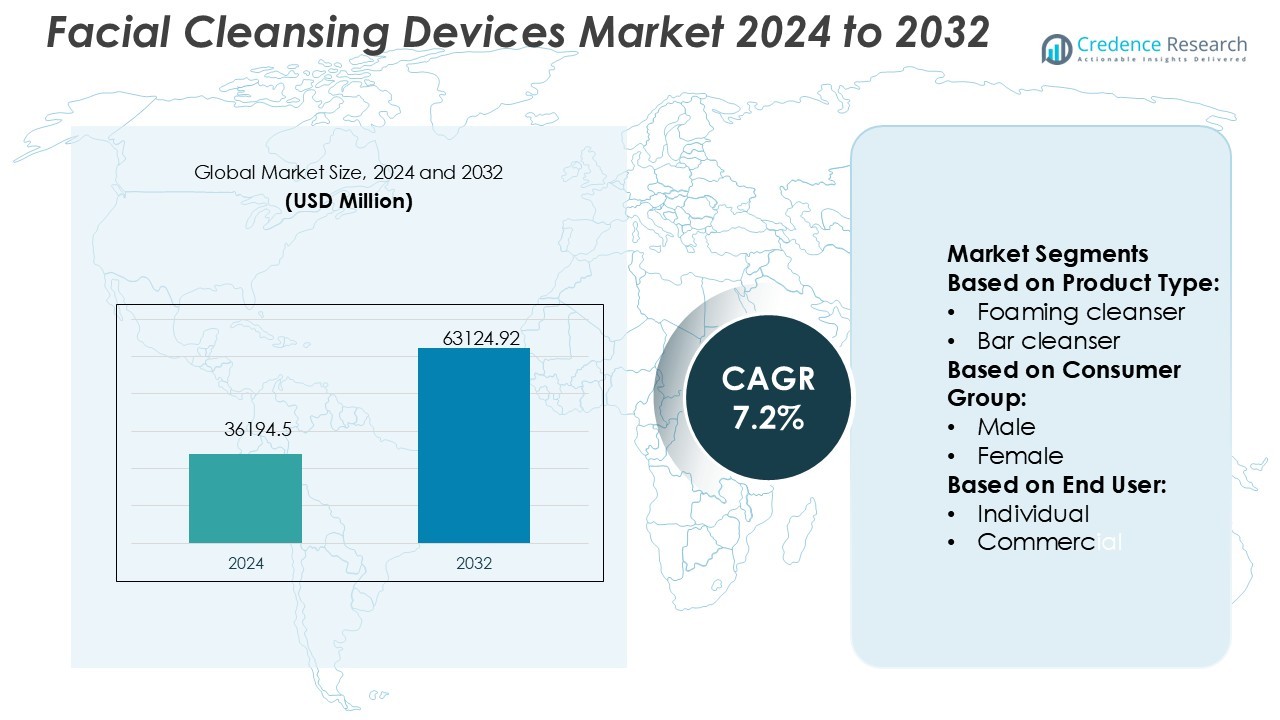
Facial Cleansing Devices Market size was valued USD 36194.5 million in 2024 and is anticipated to reach USD 63124.92 million by 2032, at a CAGR of 7.2% during the forecast period.
| REPORT ATTRIBUTE | DETAILS |
|---|---|
| Historical Period | 2020-2023 |
| Base Year | 2024 |
| Forecast Period | 2025-2032 |
| Facial Cleansing Devices Market Size 2024 | USD 36194.5 Million |
| Facial Cleansing Devices Market, CAGR | 7.2% |
| Facial Cleansing Devices Market Size 2032 | USD 63124.92 Million |
The Facial Cleansing Devices Market is highly competitive, with top players including FOREO, Philips, L’Oréal, Panasonic, Procter & Gamble, Nu Skin Enterprises, YA-MAN, Tria Beauty, Remington, and Home Skinovations. These companies dominate through innovation in sonic technology, ergonomic design, and AI-based skincare solutions. FOREO and YA-MAN lead the premium device segment with advanced smart cleansing systems, while Philips and Panasonic focus on multifunctional designs catering to mass consumers. L’Oréal and Procter & Gamble leverage extensive brand equity and global distribution networks to strengthen their positions. Regionally, North America leads the global market with a 34% share, supported by high disposable income, strong consumer awareness, and consistent demand for advanced beauty technology.
Market Insights
- The Facial Cleansing Devices Market size was valued at USD 36,194.5 million in 2024 and is projected to reach USD 63,124.92 million by 2032, registering a CAGR of 7.2% during the forecast period.
- Growing awareness of skincare, hygiene, and pollution-related skin issues drives strong demand for advanced cleansing devices across global markets.
- The market is witnessing trends such as AI-based personalization, eco-friendly materials, and multifunctional device designs enhancing consumer experience.
- Competitive intensity remains high, with FOREO, L’Oréal, Philips, and Panasonic leading through innovation and strategic product diversification, while premium and smart device segments dominate market revenue.
- Regionally, North America holds a 34% share, supported by high consumer spending and advanced retail infrastructure, while Asia-Pacific records the fastest growth driven by expanding beauty-conscious populations and rising adoption of affordable, tech-driven skincare devices.
Market Segmentation Analysis:
By Product Type
Gel cleansers dominate the Facial Cleansing Devices Market, holding a 37% share due to their gentle yet effective formulation suited for most skin types. These products are preferred for deep pore cleansing without irritation, driving steady demand across urban and dermatology-conscious consumers. Cream and lotion cleansers follow, targeting dry and sensitive skin segments. The growing consumer preference for pH-balanced, dermatologically tested products supports this dominance. Rising innovation in foam and bar formats adds variety, but gel cleansers remain the preferred choice for multifunctional cleansing benefits.
- For instance, FOREO LUNA 4 cleansing device integrates 16 T-Sonic pulsation intensities and ultra-hygienic silicone touchpoints. It offers up to 600 uses per full charge, improving both cleansing precision and user longevity.
By Consumer Group
The female segment leads the market with a 61% share, driven by higher skincare awareness and diverse product availability. Women’s growing adoption of personalized skincare routines, supported by advanced beauty tech and influencer marketing, continues to strengthen this segment. The male group shows notable growth, fueled by rising interest in grooming and anti-pollution skincare. Unisex products also gain traction as brands promote inclusivity and simplified routines appealing to shared households. However, female consumers remain the core demographic, sustaining consistent sales across retail and online platforms.
- For instance, Philips’ VisaPure Advanced brush uses Intelligent Head Recognition (via NFC tag) to auto-adjust rotation and vibration for each attachment. The deep pore brush on the device has about 20,000 individual bristles to reach pores and clean them gently.
By End User
Individual users account for 78% of the market, driven by the rising trend of at-home skincare routines and affordable cleansing devices. The pandemic accelerated DIY skincare adoption, increasing the demand for easy-to-use and technology-integrated facial cleansing tools. Commercial users, including salons, spas, and dermatology clinics, represent a smaller but steady share, supported by professional-grade devices with higher performance. Individual buyers continue to dominate due to increasing online product accessibility, awareness of skincare hygiene, and growing preference for self-care and preventive skin health solutions.
Key Growth Drivers
Rising Focus on Skincare and Hygiene
The increasing awareness of skin health and hygiene drives the adoption of facial cleansing devices. Consumers seek advanced tools that offer deeper cleaning compared to traditional methods. The rising prevalence of acne, pollution exposure, and makeup use further boost device demand. Brands are introducing dermatologist-approved, multi-functional devices that remove impurities and enhance skin texture. Continuous marketing campaigns by global beauty brands also educate consumers on daily cleansing routines, leading to steady market expansion across both developed and emerging regions.
- For instance, Remington’s Reveal FC1000 Facial Cleansing Brush features dual-action rotating and vibrating motion, includes three brush heads (normal, sensitive, massage) with 99.9% antimicrobial protection, and uses a one-minute timer with a gentle pulse every 20 seconds to guide usage.
Technological Advancements and Smart Features
Facial cleansing devices now integrate technologies such as sonic vibration, microcurrent stimulation, and AI-based skin analysis. These innovations deliver personalized skincare and improved cleansing efficiency, increasing customer appeal. Smart devices can track skin health and adapt intensity levels, attracting tech-savvy users. Companies like Foreo and L’Oréal are investing in IoT-enabled devices to enhance precision and connectivity. The fusion of technology and skincare creates a premium segment, boosting revenue growth and expanding brand differentiation in competitive global markets.
- For instance, YA-MAN’s Photo PLUS Prestige SP device uses a 3 MHz radio frequency (RF) output as its professional-grade heat energy source. Its split electrodes deliver EMS rotation synchronized with RF for facial muscle stimulation.
Growing Online Retail and E-commerce Accessibility
The rise of e-commerce and direct-to-consumer sales channels significantly boosts market reach. Online platforms offer consumers access to a wide product range, user reviews, and exclusive deals. Global beauty brands leverage social media and influencer marketing to target younger demographics, increasing sales conversions. Subscription models and virtual skincare consultations enhance convenience and trust. The easy availability of products through platforms such as Amazon, Sephora, and brand websites strengthens global distribution, driving consistent revenue growth across both mass and premium product categories.
Key Trends & Opportunities
Shift Toward Sustainable and Eco-Friendly Products
Consumers are increasingly favoring sustainable facial cleansing devices made with recyclable materials and rechargeable batteries. Brands are reducing plastic waste and promoting long-lasting devices to align with environmental goals. The trend toward eco-friendly skincare supports product innovation, including silicone-based designs and biodegradable packaging. Companies adopting green manufacturing practices gain competitive advantage and improved brand loyalty. This sustainability-driven transformation offers significant growth potential, especially among environmentally conscious consumers in North America and Europe.
- For instance, Panasonic has developed "kinari" resins, a cellulose fiber resin made from plant waste materials. The company increased the cellulose fiber content over time, reaching 55% in 2019 and achieving over 90% biomass content by 2022.
Integration of AI and Personalization in Skincare
AI and data-driven personalization are shaping the future of facial cleansing devices. Smart sensors analyze user skin conditions, recommend routines, and adjust device intensity accordingly. Leading brands integrate mobile apps that provide progress tracking and customized care plans. This shift toward personalized skincare enhances user engagement and repeat purchases. AI integration creates opportunities for subscription-based models and connected skincare ecosystems, making the market more dynamic and consumer-centric in the long term.
- For instance, L’Oréal’s Skin Genius AI tool is trained on a library of 10,000 dermatologist-graded images and achieves up to 97 % concordance with in-person clinical grading across eight skin parameters.
Key Challenges
High Product Cost and Limited Accessibility
Premium facial cleansing devices remain expensive, restricting adoption among price-sensitive consumers. Advanced features such as sonic pulsation and AI connectivity raise production costs, pushing retail prices higher. This limits penetration in emerging markets where disposable income remains lower. Many consumers still prefer affordable manual alternatives. Addressing this challenge requires localized manufacturing, strategic pricing, and the introduction of mid-range products to attract a wider audience while maintaining technological standards.
Skin Sensitivity and Product Misuse Concerns
Incorrect or excessive use of facial cleansing devices can cause skin irritation or damage, leading to negative consumer perception. Some users experience redness or dryness due to overexposure to vibration or brush friction. This challenge highlights the need for better consumer education and product safety testing. Manufacturers are investing in softer materials and adaptive speed settings to prevent skin issues. Clear usage guidelines and dermatologist endorsements are essential to build long-term trust and encourage safe adoption among new users.
Regional Analysis
North America
North America leads the Facial Cleansing Devices Market with a 34% share, supported by strong consumer awareness of skincare and high disposable income. The U.S. dominates regional demand due to advanced beauty technology adoption and the presence of leading brands like Foreo and L’Oréal. Frequent product launches and influencer-driven marketing strengthen sales across online and retail channels. The region’s preference for premium, dermatologist-tested products fuels continuous innovation. Rising demand for men’s grooming and sustainable beauty devices further supports market growth, particularly in Canada and the U.S., driving consistent expansion in the premium skincare segment.
Europe
Europe accounts for 28% of the market, driven by a mature beauty industry and high product acceptance in countries such as Germany, France, and the U.K. Consumers prioritize skin health, clean beauty, and eco-friendly materials, promoting adoption of rechargeable and silicone-based cleansing devices. The strong presence of established brands like Philips and Beiersdorf supports innovation and credibility. Regulatory emphasis on product safety and sustainability encourages consistent R&D investment. Growing e-commerce sales and consumer preference for dermatologist-endorsed devices sustain Europe’s position as a key contributor to the global facial cleansing devices landscape.
Asia-Pacific
Asia-Pacific holds a 30% market share, emerging as the fastest-growing region driven by rising urbanization and expanding middle-class populations. Countries like China, Japan, and South Korea lead demand due to strong beauty culture and digital marketing influence. Local brands and K-beauty innovations accelerate product penetration, while affordability and mobile commerce drive adoption among younger consumers. Increasing awareness of personal grooming, skincare education, and beauty tech integration propel regional growth. With rapid innovation, competitive pricing, and cultural emphasis on skincare, Asia-Pacific continues to attract both domestic and international players in the segment.
Latin America
Latin America represents a 5% share of the Facial Cleansing Devices Market, supported by expanding e-commerce networks and growing interest in personal care. Brazil and Mexico are key contributors, driven by increasing awareness of skincare hygiene and influence from global beauty brands. Affordable devices and promotional campaigns targeting younger consumers enhance adoption. However, limited product availability and high import costs pose barriers. The growing middle-class population and online retail expansion are expected to boost accessibility and drive gradual growth in the coming years, particularly in urban centers with rising beauty consciousness.
Middle East & Africa
The Middle East & Africa account for 3% of the global market, with rising demand from the UAE, Saudi Arabia, and South Africa. Increasing disposable income and exposure to global beauty trends drive adoption of premium facial cleansing devices. Regional consumers favor multifunctional and luxury products promoted through social media and beauty influencers. However, limited brand presence and higher prices restrict broader penetration. Strategic partnerships and local distribution expansions are improving accessibility. With growing beauty awareness and modern retail development, the region shows strong long-term potential for high-end skincare device adoption.
Market Segmentations:
By Product Type:
- Foaming cleanser
- Bar cleanser
By Consumer Group:
- Male
- Female
By End User:
- Individual
- Commercial
By Geography
- North America
- U.S.
- Canada
- Mexico
- Europe
- Germany
- France
- U.K.
- Italy
- Spain
- Rest of Europe
- Asia Pacific
- China
- Japan
- India
- South Korea
- South-east Asia
- Rest of Asia Pacific
- Latin America
- Brazil
- Argentina
- Rest of Latin America
- Middle East & Africa
- GCC Countries
- South Africa
- Rest of the Middle East and Africa
Competitive Landscape
The Facial Cleansing Devices Market features strong competition among key players such as FOREO, Philips, Remington, YA-MAN, Procter & Gamble, Tria Beauty, Panasonic, L’Oréal, Nu Skin Enterprises, and Home Skinovations. The Facial Cleansing Devices Market is characterized by intense competition driven by rapid innovation and brand differentiation. Companies focus on developing advanced technologies such as sonic pulsation, microcurrent stimulation, and AI-based skin analysis to enhance user experience and cleansing efficiency. The market also benefits from the rise of online retail and influencer marketing, which expand consumer reach and brand engagement. Sustainability has become a major strategic focus, with brands introducing eco-friendly materials and rechargeable devices to appeal to environmentally conscious buyers. Continuous R&D investments, product personalization, and integration of smart connectivity features further define the competitive dynamics of this evolving market.
Key Player Analysis
- FOREO
- Philips
- Remington
- YA-MAN
- Procter & Gamble
- Tria Beauty
- Panasonic
- L’Oréal
- Nu Skin Enterprises
- Home Skinovations
Recent Developments
- In July 2025, The Honest Company, Incorporated launched its Clean Conscious Wipes. These wipes are for sensitive skin as they include a gentle, biodegradable cleanser. Furthermore, they are free from plastic, quaternary compounds, fragrance, chlorine processing, and parabens.
- In October 2024, Kenvue declared that its Neutrogena brand is advancing dermatological beauty through multi-year collaborations with the world's most followed dermatologist, Dr. Muneeb Shah, and renowned skincare pioneer, Dr. Dhaval Bhanusali. This partnership reaffirms Neutrogena's dedication to combining science and beauty to provide exceptional product experiences and cutting-edge clinical efficacy.
- In July 2024, American Exchange Group acquired Indie Lee, a leading clean beauty brand known for its plant-based skincare products. The acquisition enhances American Exchange Group’s position in the premium, sustainable beauty market.
- In May 2024, Mary Kay further established its commitment to women's empowerment in Scandinavia by announcing its expansion into Denmark. One of the most egalitarian societies in the world, Denmark is a founding member of the European Union and ranks third in the EU on the Gender Equality Index, a measure that emphasizes gender equality.
Report Coverage
The research report offers an in-depth analysis based on Product Type, Consumer Group, End-User and Geography. It details leading market players, providing an overview of their business, product offerings, investments, revenue streams, and key applications. Additionally, the report includes insights into the competitive environment, SWOT analysis, current market trends, as well as the primary drivers and constraints. Furthermore, it discusses various factors that have driven market expansion in recent years. The report also explores market dynamics, regulatory scenarios, and technological advancements that are shaping the industry. It assesses the impact of external factors and global economic changes on market growth. Lastly, it provides strategic recommendations for new entrants and established companies to navigate the complexities of the market.
Future Outlook
- The market will experience steady growth driven by rising skincare awareness and hygiene focus.
- Smart cleansing devices with AI and app integration will gain wider consumer adoption.
- Eco-friendly and rechargeable products will become standard across leading brands.
- Personalized skincare solutions will drive innovation and long-term customer engagement.
- Emerging economies will see higher adoption due to growing middle-class consumers.
- E-commerce platforms will remain the dominant sales channel for device distribution.
- Product affordability and miniaturization will expand access to mass-market consumers.
- Male grooming and unisex skincare segments will record significant growth.
- Collaborations between dermatologists and tech firms will enhance product credibility.
- Sustainability and circular design practices will shape future product development strategies.

Request a Free Sample
Fill in your details and we'll send you a free sample report.
- Sample data tables & charts
- Research methodology
Market Dynamics
Rising Focus on Skincare and Hygiene
Increasing consumer awareness of skin health, pollution, and hygiene is driving demand for advanced facial cleansing devices that offer deeper and more effective cleaning than traditional methods. The prevalence of acne, makeup use, and pollution exposure further boosts adoption, especially as brands educate consumers on the benefits of daily cleansing routines.
Technological Advancements and Smart Features
The integration of sonic vibration, microcurrent stimulation, and AI-based skin analysis in facial cleansing devices is enhancing personalization and cleansing efficiency. These innovations attract tech-savvy consumers and create premium product segments, driving higher market value and differentiation.
Growing Online Retail and E-commerce Accessibility
The expansion of e-commerce platforms and direct-to-consumer sales channels has made facial cleansing devices more accessible globally. Online availability, user reviews, influencer marketing, and subscription models are increasing product reach and sales conversions, especially among younger demographics.
Shift Toward Sustainable and Eco-Friendly Products
Consumer preference for sustainable, rechargeable, and recyclable facial cleansing devices is prompting brands to innovate with eco-friendly materials and packaging. This trend is particularly strong in North America and Europe, where environmental consciousness drives purchasing decisions and brand loyalty.
Personalization and AI Integration in Skincare
Smart sensors and AI-driven personalization are enabling devices to analyze skin conditions and tailor routines, increasing user engagement and satisfaction. This trend supports repeat purchases and the development of connected skincare ecosystems, making the market more dynamic and consumer-centric.
Need a Custom Version of This Report?
Tailor the scope, geography, or segments to your exact requirements.
- Custom geography or segment scope
- Direct access to our analyst team
Frequently Asked Questions
What is the current market size for the Facial Cleansing Devices Market, and what is its projected size in 2032?
At what Compound Annual Growth Rate is the Facial Cleansing Devices Market projected to grow between 2025 and 2032?
Which Facial Cleansing Devices Market segment held the largest share in 2024?
What are the primary factors fueling the growth of the Facial Cleansing Devices Market?
Who are the leading companies in the Facial Cleansing Devices Market?
Which region commanded the largest share of the Facial Cleansing Devices Market in 2024?
Table of Content
Chapter 1 Market Segmentation
- 1.1 Segmentation Framework
- 1.1.1 Product and Service Classification
- 1.1.2 Application and End-Use Classification
- 1.1.3 Technology and Solution Classification
- 1.1.4 Customer and Distribution Channel Classification
- 1.1.5 Geographic Segmentation
- 1.1.6 Market Segment Definitions and Boundaries
- 1.2 By End User
- 1.2.1 Individual
- 1.2.2 Commercial
- 1.3 By Product Type
- 1.3.1 Gel Cleanser
- 1.3.2 Cream & Lotion Cleanser
- 1.3.3 Foaming Cleanser
- 1.3.4 Bar Cleanser
- 1.4 By Consumer Group
- 1.4.1 Female
- 1.4.2 Male
- 1.4.3 Unisex
Chapter 2 Introduction
- 2.1 Report Objectives and Scope
- 2.2 Product Definition and Industry Terminology
- 2.3 Market Inclusions and Exclusions
- 2.4 Research Process
- 2.4.1 Primary Research and Expert Interviews
- 2.4.2 Secondary Research and Source Review
- 2.4.3 Top-Down and Bottom-Up Estimation
- 2.4.4 Data Triangulation and Verification
- 2.5 Market Size Measurement Basis
- 2.5.1 2024: USD 36,194.5 million → 2032: USD 63,124.92 million
- 2.6 Historical and Forecast Reference Periods
- 2.6.1 Base Year: 2024
- 2.6.2 Forecast Period: 2024-2032
- 2.7 Research Assumptions and Limitations
Chapter 3 Executive Summary
- 3.1 Market Snapshot and Key Findings
- 3.2 Base-Year Market Size, 2024
- 3.3 Forecast Market Size, 2032
- 3.4 Revenue and Volume Growth Outlook
- 3.5 Key Demand and Supply Indicators
- 3.6 Leading Market Segments
- 3.7 Fastest-Growing Market Opportunities
- 3.8 Regional Performance Highlights
- 3.9 Technology and Industry Transformation
- 3.10 Competitive Landscape Summary
- 3.11 Analyst View and Strategic Implications
Chapter 4 Global Facial Cleansing Devices Market Trends and Developments
- 4.1 Historical Industry Development
- 4.2 Recent Market Trends and Developments
- 4.3 Demand and Customer Behavior Trends
- 4.4 Technology and Product Innovation
- 4.5 Artificial Intelligence, Automation and Digitalization
- 4.6 Local Manufacturing and Supply Chain Realignment
- 4.7 Industry Partnerships, Mergers and Acquisitions
- 4.8 Sustainability and Circular Economy Developments
- 4.9 Government and Private Sector Investment Trends
- 4.10 Emerging Business Models and Commercialization
- 4.11 Industry Developments and Announcements
Chapter 5 Global Facial Cleansing Devices Market Production, Supply and Demand Analysis
- 5.1 Demand Trend and Consumption Analysis
- 5.2 Demand Forecast, 2024-2032
- 5.3 Production and Output Trend
- 5.4 Production and Output Forecast, 2024-2032
- 5.5 Installed Capacity and Capacity Utilization
- 5.6 Company-Wise Production Plants and Statistics
- 5.6.1 Installed Production Capacity
- 5.6.2 Actual Production
- 5.6.3 Planned Capacity and Expansion Targets
- 5.7 Supply Chain Structure and Procurement Trends
- 5.8 Supply-Demand Gap and Bottlenecks
- 5.9 Import Dependence and Sourcing Structure
- 5.10 Contract Manufacturing and Outsourcing
- 5.11 Regional Supply and Demand Concentration
Chapter 6 Global Facial Cleansing Devices Market Pricing Analysis
- 6.1 Pricing Structure and Measurement
- 6.2 Historical Pricing Trends
- 6.3 Pricing Outlook, 2024-2032
- 6.4 Average Selling Price and Unit Economics
- 6.5 Pricing by Product and Market Segment
- 6.6 Geographic Pricing Differences
- 6.7 Key Input, Energy, Labor and Logistics Costs
- 6.8 Contract Pricing and Purchasing Models
- 6.9 Pricing Sensitivity and Competitive Positioning
- 6.10 Price, Margin and Profitability Implications
Chapter 7 Global Facial Cleansing Devices Market Dynamics
- 7.1 Market Growth Drivers
- 7.1.1 Demand-Side Drivers
- 7.1.2 Technology and Innovation Drivers
- 7.1.3 Infrastructure and Investment Drivers
- 7.1.4 Regulatory and Policy Drivers
- 7.2 Market Restraints
- 7.2.1 Cost and Affordability Constraints
- 7.2.2 Technology and Adoption Barriers
- 7.2.3 Supply Chain and Operational Constraints
- 7.3 Market Challenges
- 7.3.1 Competitive Pressure and Margin Erosion
- 7.3.2 Skills, Infrastructure and Implementation Gaps
- 7.4 Emerging Market Opportunities
- 7.5 Market Dynamics Impact and Time-Horizon Assessment
Chapter 8 Global Facial Cleansing Devices Value Chain Analysis
- 8.1 Industry Value Chain Overview
- 8.2 Upstream Suppliers and Critical Inputs
- 8.3 Technology and Component Providers
- 8.4 Manufacturing or Service Delivery
- 8.5 Distribution, Channel Partners and Integrators
- 8.6 Downstream Applications and End Users
- 8.7 Value Addition and Profit Pools
- 8.8 Vertical Integration and Outsourcing
- 8.9 Supplier Concentration and Risk
- 8.10 Supply Chain Localization and Resilience
Chapter 9 Global Facial Cleansing Devices Market Regulations and Policies
- 9.1 Relevant Laws, Standards and Compliance Frameworks
- 9.2 Product, Service, Safety and Quality Requirements
- 9.3 Government Policies, Incentives and Subsidies
- 9.4 Imports, Exports and Trade Barriers
- 9.5 Public Procurement and Local Content Requirements
- 9.6 Environmental and Sustainability Compliance
- 9.7 Upcoming Policy Changes and Market Implications
Chapter 10 Global Facial Cleansing Devices Market Hotspots and Opportunities
- 10.1 Market Opportunity Mapping and Growth Hotspots
- 10.2 High-Growth Applications and Customer Groups
- 10.3 Underserved Markets and White-Space Opportunities
- 10.4 Emerging Technology and Product Opportunities
- 10.5 New Capacity and Investment Hotspots
- 10.6 Market Entry and Expansion Opportunities
- 10.7 Distribution and Partnership Opportunities
- 10.8 Near-Term and Long-Term Commercial Potential
- 10.9 Opportunity Attractiveness and Execution Risks
Chapter 11 Global Facial Cleansing Devices Market Outlook, 2024-2032
- 11.1 Market Size and Analysis
- 11.1.1 Revenue (Market Measurement: 2024: USD 36,194.5 million → 2032: USD 63,124.92 million)
- 11.1.2 Market Volume and Quantity Sold
- 11.1.3 Historical Market Size
- 11.1.4 Base-Year Market Size, 2024
- 11.2 Market Forecast, 2024-2032
- 11.2.1 Revenue Forecast to 2032
- 11.2.2 Volume Forecast to 2032
- 11.2.3 CAGR and Year-on-Year Growth
- 11.2.4 Incremental Revenue Opportunity
- 11.3 Forecast Assumptions and Scenario Analysis
- 11.3.1 Base-Case Forecast
- 11.3.2 Optimistic and Conservative Scenarios
- 11.3.3 Technology, Pricing and Policy Sensitivities
- 11.4 Market Attractiveness and Growth Outlook
Chapter 12 Global Facial Cleansing Devices Market Segmentation and Outlook
- 12.1 Segmentation Summary and Market Shares, 2024
- 12.2 Largest and Fastest-Growing Segments
- 12.3 By End User - Market Size and Forecast, 2024-2032
- 12.3.1 Segment Definition and Scope
- 12.3.2 Historical Market Size
- 12.3.3 Revenue Forecast, 2024-2032
- 12.3.4 Volume Forecast, 2024-2032
- 12.3.5 Base-Year Market Share, 2024
- 12.3.6 Segment CAGR and Growth Drivers
- 12.3.7 Subsegment Market Size and Forecast
- 12.3.7.1 Individual
- 12.3.7.2 Commercial
- 12.3.8 Subsegment Pricing and Adoption Trends
- 12.3.9 Leading Suppliers and Competition
- 12.3.10 Regional Demand and Opportunities
- 12.4 By Product Type - Market Size and Forecast, 2024-2032
- 12.4.1 Segment Definition and Scope
- 12.4.2 Historical Market Size
- 12.4.3 Revenue Forecast, 2024-2032
- 12.4.4 Volume Forecast, 2024-2032
- 12.4.5 Base-Year Market Share, 2024
- 12.4.6 Segment CAGR and Growth Drivers
- 12.4.7 Subsegment Market Size and Forecast
- 12.4.7.1 Gel Cleanser
- 12.4.7.2 Cream & Lotion Cleanser
- 12.4.7.3 Foaming Cleanser
- 12.4.7.4 Bar Cleanser
- 12.4.8 Subsegment Pricing and Adoption Trends
- 12.4.9 Leading Suppliers and Competition
- 12.4.10 Regional Demand and Opportunities
- 12.5 By Consumer Group - Market Size and Forecast, 2024-2032
- 12.5.1 Segment Definition and Scope
- 12.5.2 Historical Market Size
- 12.5.3 Revenue Forecast, 2024-2032
- 12.5.4 Volume Forecast, 2024-2032
- 12.5.5 Base-Year Market Share, 2024
- 12.5.6 Segment CAGR and Growth Drivers
- 12.5.7 Subsegment Market Size and Forecast
- 12.5.7.1 Female
- 12.5.7.2 Male
- 12.5.7.3 Unisex
- 12.5.8 Subsegment Pricing and Adoption Trends
- 12.5.9 Leading Suppliers and Competition
- 12.5.10 Regional Demand and Opportunities
- 12.6 Segment Growth Comparison
- 12.7 Segment Attractiveness and Priority Matrix
Chapter 13 Global Facial Cleansing Devices End-Use and Application Market Outlook
- 13.1 End-Use Industry and Customer Demand Structure
- 13.2 Leading Applications and Customer Groups
- 13.3 End-Use Market Size, Share and Forecast
- 13.4 Major End-Use Industry Deep Dives
- 13.4.1 Customer Requirements and Use Cases
- 13.4.2 Demand and Replacement Cycles
- 13.4.3 Technical and Regulatory Considerations
- 13.4.4 Purchasing and Procurement Models
- 13.4.5 Leading Vendors and Distribution Channels
- 13.4.6 Forecast and Commercial Opportunities
- 13.5 Emerging Applications and Cross-Segment Demand
- 13.6 End-Use Industry Investment Priorities
Chapter 14 Global Facial Cleansing Devices Geographic Market Outlook, 2024-2032
- 14.1 Regional Market Size and Share, 2024
- 14.2 Regional Market Forecast, 2024-2032
- 14.3 Regional Pricing, Production and Demand Differences
- 14.4 North America
- 14.4.1 United States
- 14.4.2 Canada
- 14.4.3 Mexico
- 14.5 Europe
- 14.5.1 Germany
- 14.5.2 France
- 14.5.3 Italy
- 14.5.4 United Kingdom
- 14.5.5 Spain
- 14.5.6 Poland
- 14.5.7 Russia
- 14.5.8 Netherlands
- 14.5.9 Belgium
- 14.5.10 Sweden
- 14.5.11 Denmark
- 14.5.12 Norway
- 14.5.13 Rest of Europe
- 14.6 Asia Pacific
- 14.6.1 China
- 14.6.2 India
- 14.6.3 Japan
- 14.6.4 South Korea
- 14.6.5 Thailand
- 14.6.6 Indonesia
- 14.6.7 Vietnam
- 14.6.8 Malaysia
- 14.6.9 Australia
- 14.6.10 Rest of Asia Pacific
- 14.7 Latin America
- 14.7.1 Brazil
- 14.7.2 Argentina
- 14.7.3 Colombia
- 14.7.4 Chile
- 14.7.5 Rest of Latin America
- 14.8 Middle East
- 14.8.1 Saudi Arabia
- 14.8.2 United Arab Emirates
- 14.8.3 Turkey
- 14.8.4 Israel
- 14.8.5 Iran
- 14.8.6 Rest of the Middle East
- 14.9 Africa
- 14.9.1 South Africa
- 14.9.2 Egypt
- 14.9.3 Nigeria
- 14.9.4 Morocco
- 14.9.5 Rest of Africa
- 14.10 Regional Investment, Policy and Supply Chain Differences
- 14.11 Regional Competitive Landscape
- 14.12 Geographic Growth Hotspots
Chapter 15 Global Facial Cleansing Devices Technology, Innovation and Sustainability Outlook
- 15.1 Technology Landscape and Maturity
- 15.2 Product, Process and Service Innovation
- 15.3 AI, Automation and Digital Tools in the Industry
- 15.4 Technology Adoption and Performance Benchmarking
- 15.5 Innovation Pipeline and R&D Investment
- 15.6 Patent and Intellectual Property Trends
- 15.7 Energy Efficiency and Resource Management
- 15.8 Sustainability, Recycling and Circularity
- 15.9 Technology Roadmap, 2024-2032
- 15.10 Risks of Obsolescence and Technology Substitution
Chapter 16 Global Facial Cleansing Devices Market Key Strategic Imperatives
- 16.1 Growth and Market Entry Priorities
- 16.2 High-Return Products and Segments
- 16.3 Pricing, Profitability and Cost Optimization
- 16.4 Technology Investment and Product Differentiation
- 16.5 Supply Chain Localization and Resilience
- 16.6 Distribution and Customer Acquisition
- 16.7 Partnership, Acquisition and Capacity Strategy
- 16.8 Regional Expansion Priorities
- 16.9 Short-, Medium- and Long-Term Actions
Chapter 17 Competition Outlook
- 17.1 Industry Competition Characteristics
- 17.2 Market Structure and Concentration
- 17.3 Market Share and Competitive Positioning, 2024
- 17.4 Company-Wise Revenue and Product Benchmarking
- 17.5 Production and Service Capacity Benchmarking
- 17.6 Technology, Pricing and Differentiation
- 17.7 Regional Footprint and Distribution Strength
- 17.8 Mergers, Acquisitions and Strategic Alliances
- 17.9 New Entrants and Competitive Threats
- 17.10 Porter's Five Forces and Industry Attractiveness
- 17.11 Competitive Outlook, 2024-2032
Chapter 18 Company Profiles
- 18.1 Company Coverage and Selection Criteria
- 18.2 FOREO
- 18.2.1 Business Description
- 18.2.2 Company Ownership and Geographic Presence
- 18.2.3 Product and Service Portfolio
- 18.2.4 Manufacturing and Operating Footprint
- 18.2.5 Production Capacity and Expansion Plans
- 18.2.6 Financial Performance and Investment
- 18.2.7 Market Share and Competitive Position
- 18.2.8 Technology and Innovation Capabilities
- 18.2.9 Strategic Alliances or Partnerships
- 18.2.10 Recent Developments
- 18.2.11 Growth Strategy and Outlook
- 18.3 Philips
- 18.4 L’Oréal
- 18.5 Panasonic
- 18.6 Procter & Gamble
- 18.7 Nu Skin Enterprises
- 18.8 YA-MAN
- 18.9 Tria Beauty
- 18.10 Remington
- 18.11 Home Skinovations
- 18.12 Other Relevant Market Participants
Note: Every listed company is profiled on the structure shown under the first company. The company list is preliminary and may change based on research findings, market developments, data availability and client requirements.
Chapter 19 Disclaimer
- 19.1 Research and Forecast Disclaimer
- 19.2 Data Source and Estimation Limitations
Note: The depth of individual sections depends on data availability for this market. Volume, capacity, trade and other unit-based metrics are included where applicable.

