
Market Overview:
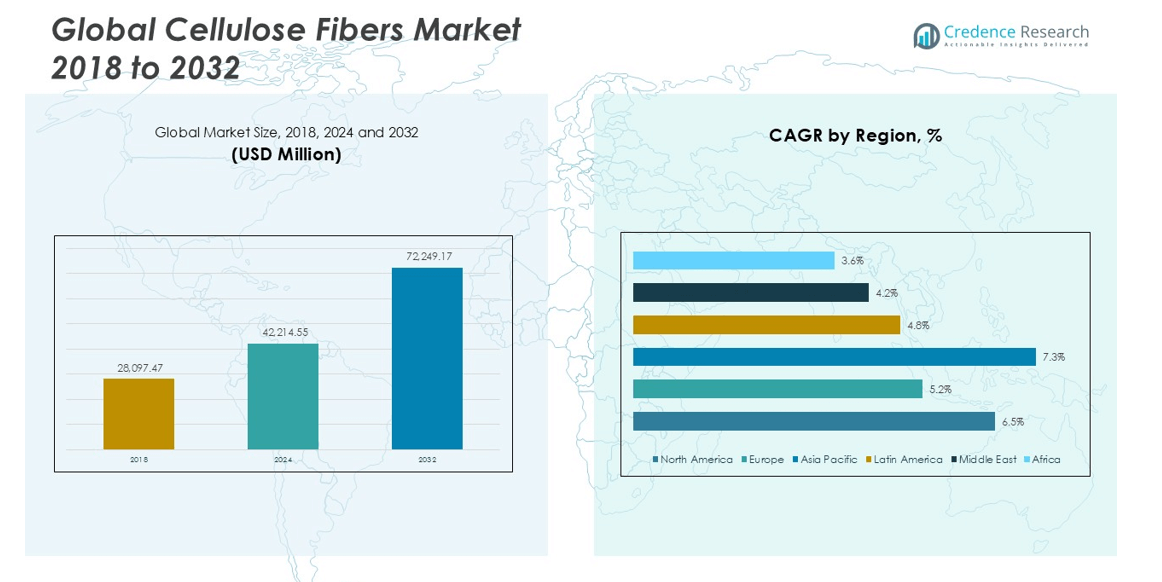
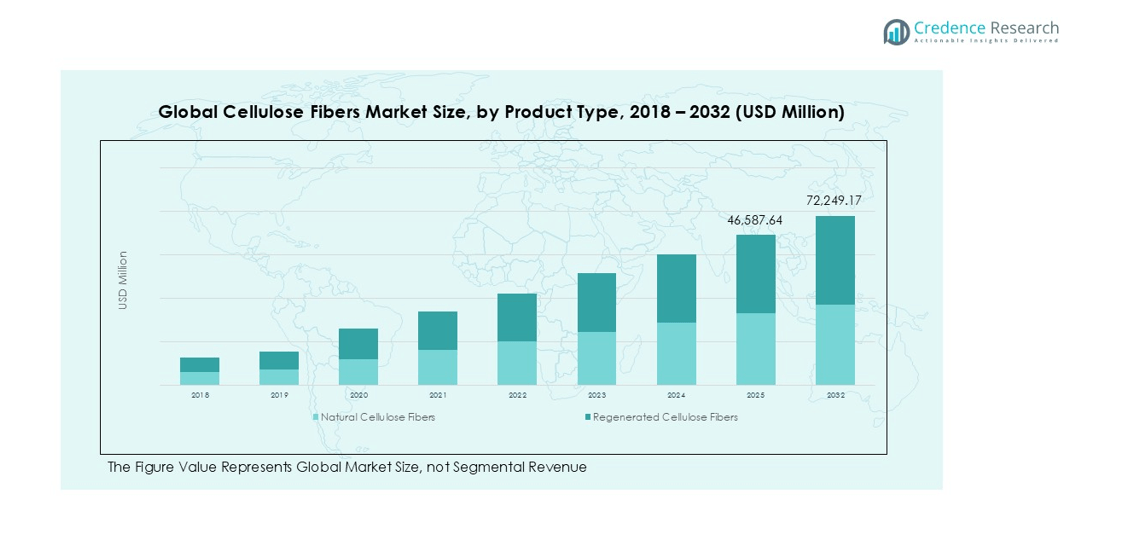
Cellulose Fibers market size was valued at USD 28,097.47 million in 2018, increased to USD 42,214.55 million in 2024, and is anticipated to reach USD 72,249.17 million by 2032, growing at a CAGR of 6.47% during the forecast period.
| REPORT ATTRIBUTE | DETAILS |
|---|---|
| Historical Period | 2020-2023 |
| Base Year | 2024 |
| Forecast Period | 2025-2032 |
| Cellulose Fibers Market Size 2024 | USD 42,214.55 million |
| Cellulose Fibers Market, CAGR | 6.47% |
| Cellulose Fibers Market Size 2032 | USD 72,249.17 million |
The Cellulose Fibers market is led by prominent players such as Lenzing AG, Aditya Birla Group (Grasim Industries), Eastman Chemical Company, Solvay S.A., and Mitsubishi Chemical Corporation, each holding a strong presence through advanced manufacturing capabilities and sustainable product innovations. These companies are focused on expanding their global footprint and strengthening supply chains to cater to the rising demand for eco-friendly fibers. Asia Pacific emerges as the leading region, commanding a 45.26% market share in 2024, driven by large-scale textile production, growing consumer markets, and increasing adoption of biodegradable materials in countries like China and India.
Market Insights
- The Cellulose Fibers market was valued at USD 42,214.55 million in 2024 and is projected to reach USD 72,249.17 million by 2032, growing at a CAGR of 6.47% during the forecast period.
- Increasing demand for sustainable and biodegradable materials across textiles, hygiene, and technical applications is a primary driver of market growth, especially among environmentally conscious consumers.
- A key trend includes the rapid advancement of regenerated fiber technologies such as lyocell and modal, driven by innovation and closed-loop production systems.
- The market is highly competitive with leading players like Lenzing AG, Aditya Birla Group, and Eastman Chemical Company focusing on R&D, product expansion, and sustainability certifications to strengthen their market position.
- Asia Pacific dominates the global market with a 45.26% share, followed by North America at 27.96%; Natural Cellulose Fibers lead the product segment due to their wide use in textiles and low environmental impact.
Market Segmentation Analysis:
By Product Type
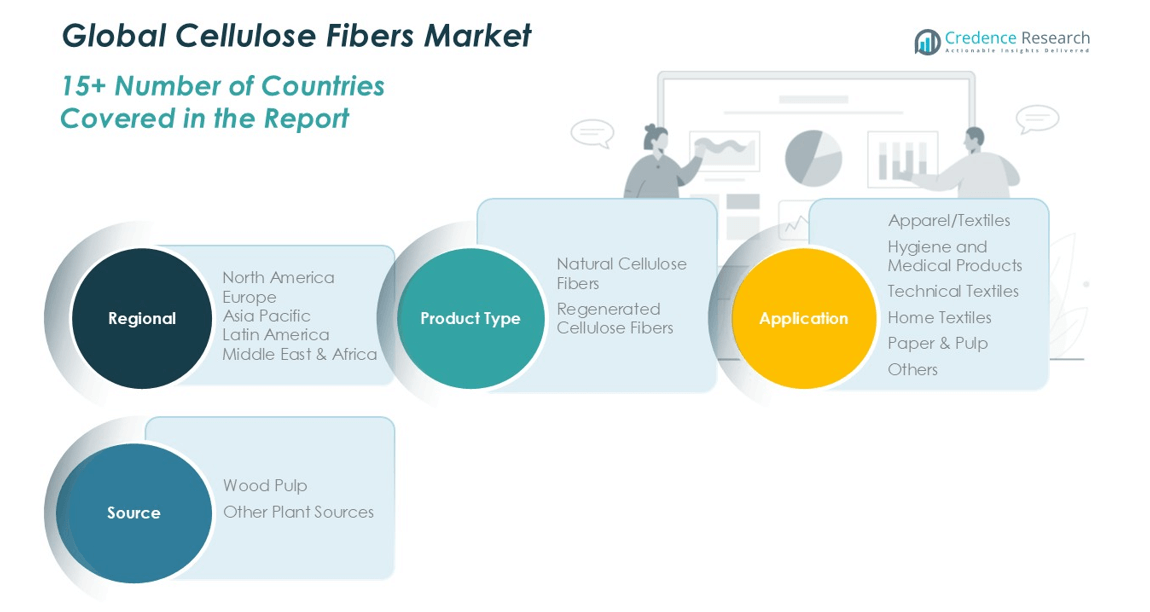
The Cellulose Fibers market is segmented into Natural Cellulose Fibers and Regenerated Cellulose Fibers. Among these, Natural Cellulose Fibers dominate the market, accounting for a significant share due to their widespread use in textiles and paper production. Their biodegradable nature and lower environmental footprint compared to synthetic fibers have fueled demand, particularly in regions emphasizing sustainability. Natural fibers such as cotton and flax continue to benefit from growing consumer awareness of eco-friendly products, while the agricultural sector’s focus on renewable sources further supports market expansion.
- For instance, Lenzing AG produces over 320,000 tonnes of cotton-based Lenzing™ Lyocell fibers annually, using a closed-loop solvent system that recycles over 99.5% of the solvent.
By Application
Within application segments, Apparel/Textiles hold the largest market share in the Cellulose Fibers market. The demand for lightweight, breathable, and biodegradable fabrics has significantly boosted the use of cellulose fibers in the fashion and apparel industry. Major apparel manufacturers are shifting toward sustainable raw materials, contributing to the growth of cellulose-based textiles. Other key applications include Hygiene and Medical Products, driven by increasing demand for disposable and skin-friendly materials, and Technical Textiles, supported by advancements in industrial and automotive sectors. Home Textiles and Paper & Pulp also contribute steadily due to consistent consumption patterns.
- For instance, Aditya Birla’s Birla Cellulose supplies more than 700,000 tonnes of viscose staple fiber annually to global apparel brands, with over 40% used in eco-certified textile applications.
By Source
In terms of source segmentation, Wood Pulp is the dominant sub-segment, capturing the majority of the market share. Its wide availability, cost-efficiency, and established processing infrastructure make it the preferred raw material for producing both natural and regenerated cellulose fibers. The shift toward sustainable forestry practices and certification systems has further strengthened wood pulp’s position in the market. In contrast, Other Plant Sources such as bamboo, hemp, and jute are gaining traction due to their renewability and low environmental impact, though their market share remains smaller compared to wood pulp.
Market Overview
Rising Demand for Sustainable and Biodegradable Textiles
The growing global emphasis on sustainability has significantly boosted demand for cellulose fibers, especially in the textile and fashion industries. Consumers and brands are increasingly shifting toward biodegradable and eco-friendly materials, favoring natural and regenerated cellulose fibers over synthetic alternatives. Regulatory mandates against plastic-based materials and increasing environmental awareness are further accelerating this transition. This trend is particularly evident in Europe and North America, where sustainable fashion is rapidly gaining ground, thus fueling market growth.
- For instance, Eastman Chemical Company has developed Naia™ Renew, a cellulose acetate fiber made with 60% certified wood pulp and 40% recycled content, supporting circular fashion with production already scaled to over 30,000 metric tonnes per year.
Expanding Applications Across Diverse Industries
Beyond apparel, cellulose fibers are witnessing rising demand in hygiene products, medical textiles, home furnishings, and technical textiles. Their moisture absorbency, softness, and hypoallergenic properties make them ideal for sanitary napkins, baby wipes, and surgical materials. The growing healthcare sector and rising hygiene awareness, especially in developing regions, are expanding the market footprint. Additionally, the use of cellulose fibers in industrial and automotive textiles is increasing, driven by the need for lightweight, sustainable alternatives.
- For instance, Ahlstrom supplies over 100,000 tonnes of specialty nonwovens annually for hygiene and medical applications, including surgical gowns and wound care products based on cellulose fiber blends.
Abundant Availability and Renewable Sourcing of Raw Materials
Cellulose fibers are derived from renewable sources such as wood pulp, cotton, and other plant-based materials. The abundant availability of wood pulp and ongoing research in alternative sources like bamboo and hemp provide a stable and scalable supply chain. With rising investments in sustainable forestry and efficient processing technologies, manufacturers are able to produce high-quality fibers at competitive costs. This renewable sourcing advantage supports long-term industry growth amid tightening environmental regulations and raw material volatility in other fiber markets.
Key Trends & Opportunities
Innovation in Regenerated Cellulose Fiber Technologies
Technological advancements in fiber regeneration are enabling the production of high-performance, eco-friendly cellulose fibers with enhanced strength, flexibility, and processing capabilities. Companies are investing in closed-loop production systems to reduce chemical waste and improve recyclability. Innovations in viscose, lyocell, and modal fibers are opening new application areas in technical and luxury textiles. This innovation trend is creating differentiation and premium product opportunities, attracting both manufacturers and end-users looking for sustainable yet functional textile solutions.
- For instance, Sateri-a subsidiary of Royal Golden Eagle-has upgraded its facilities with Best Available Techniques (BAT), reducing sulfur emissions by over 35,000 tonnes annually across its viscose mills in China.
Growing Penetration in Emerging Markets
Rapid urbanization, increasing disposable income, and evolving consumer preferences in Asia Pacific, Latin America, and Africa are driving cellulose fiber consumption. Countries like China, India, and Brazil are experiencing heightened demand for affordable and sustainable clothing, hygiene products, and household textiles. The expansion of retail infrastructure and government support for sustainable materials provide significant growth potential in these regions. These emerging markets represent untapped opportunities for manufacturers looking to diversify revenue streams and gain a competitive edge.
- For instance, Rayonier Advanced Materials manages over 2.4 million acres of forestland in the U.S. and Canada to secure pulpwood supply and reduce exposure to global pulp price volatility.
Key Challenges
Environmental Concerns in Regenerated Fiber Processing
While cellulose fibers are generally considered eco-friendly, the production of regenerated fibers like viscose can involve hazardous chemicals and water-intensive processes. Improper waste management and chemical disposal practices can lead to environmental pollution and regulatory scrutiny. This poses a challenge for manufacturers, especially those in regions with strict environmental regulations. Companies need to invest in cleaner technologies and adhere to certification standards, which can increase operational costs and affect profit margins.
Volatility in Raw Material Supply and Pricing
The supply of key raw materials such as wood pulp is subject to fluctuations due to climatic conditions, deforestation regulations, and global demand cycles. Price volatility in these raw materials can significantly impact production costs and supply chain stability. Smaller manufacturers often struggle to absorb such fluctuations, leading to reduced competitiveness. Developing robust sourcing strategies and establishing long-term supplier partnerships are essential to mitigating this challenge.
Competition from Synthetic Fibers
Synthetic fibers like polyester and nylon dominate the global textile market due to their low cost, durability, and wide application range. Despite the growing popularity of cellulose fibers, competition from synthetics remains a major hurdle. Market penetration is further constrained by consumer price sensitivity and the high cost of sustainable alternatives. Bridging the performance-cost gap and enhancing consumer awareness about the environmental impact of synthetic fibers are crucial to improving adoption rates of cellulose fibers.
Regional Analysis
Asia Pacific Asia Pacific dominates the global Cellulose Fibers market, accounting for the largest market share of approximately 45.26% in 2024. The market grew from USD 12,260.05 million in 2018 to USD 19,101.03 million in 2024, and is projected to reach USD 34,687.91 million by 2032, expanding at a CAGR of 7.3%. This growth is driven by robust textile manufacturing industries in China, India, and Southeast Asia, along with increasing demand for eco-friendly fibers. Rising disposable incomes, urbanization, and expansion in hygiene and medical textile sectors continue to support the region’s dominant position.
North America
North America holds the second-largest market share in the Cellulose Fibers market, representing around 27.96% in 2024. The market increased from USD 7,986.26 million in 2018 to USD 11,807.37 million in 2024, and is forecasted to reach USD 20,294.72 million by 2032, growing at a CAGR of 6.5%. Growth in the region is fueled by rising consumer preference for sustainable clothing, strong demand in technical and hygiene textiles, and advancements in regenerated fiber production. Favorable government regulations supporting sustainability and innovation in fiber technology also contribute to regional expansion.
Europe
Europe captures a market share of approximately 17.81% in 2024. The market rose from USD 5,292.02 million in 2018 to USD 7,519.16 million in 2024, and is expected to reach USD 11,712.87 million by 2032, registering a CAGR of 5.2%. Growth in Europe is supported by stringent environmental regulations and strong consumer demand for sustainable fashion. Countries like Germany, France, and the Nordic nations are leading adopters of eco-friendly materials, while increasing use in hygiene products and home textiles further boosts regional demand.
Latin America
Latin America holds a modest share of 4.56% in the global Cellulose Fibers market in 2024. The market expanded from USD 1,299.06 million in 2018 to USD 1,926.96 million in 2024, with projections to reach USD 2,910.69 million by 2032, growing at a CAGR of 4.8%. Brazil and Mexico drive regional growth through investments in sustainable materials and growing awareness around eco-conscious products. The textile and hygiene sectors are experiencing gradual modernization, creating opportunities for cellulose fiber adoption in domestic manufacturing and exports.
Middle East
The Middle East accounted for 2.59% of the Cellulose Fibers market in 2024. The market grew from USD 796.42 million in 2018 to USD 1,094.98 million in 2024, and is anticipated to reach USD 1,585.04 million by 2032, reflecting a CAGR of 4.2%. Growth is supported by increased investment in textile processing, particularly in the Gulf countries, and a shift towards diversifying economies beyond oil. The demand for sustainable and lightweight fabrics in apparel and home textiles is gradually rising, although market maturity remains lower compared to developed regions.
Africa
Africa represents the smallest share in the global market, contributing approximately 1.81% in 2024. The market value rose from USD 463.66 million in 2018 to USD 765.06 million in 2024, and is projected to reach USD 1,057.95 million by 2032, at a CAGR of 3.6%. While still emerging, the market is benefiting from increased demand for affordable clothing, improving infrastructure, and support for local textile manufacturing. Environmental awareness and availability of plant-based raw materials like cotton offer long-term growth prospects, though limited technological capabilities remain a constraint.
Market Segmentations:
By Product Type
- Natural Cellulose Fibers
- Regenerated Cellulose Fibers
By Application
- Apparel/Textiles
- Hygiene and Medical Products
- Technical Textiles
- Home Textiles
- Paper & Pulp
- Others
By Source
- Wood Pulp
- Other Plant Sources
By Geography
- North America
- U.S.
- Canada
- Mexico
- Europe
- UK
- France
- Germany
- Italy
- Spain
- Russia
- Belgium
- Netherlands
- Austria
- Sweden
- Poland
- Denmark
- Switzerland
- Rest of Europe
- Asia Pacific
- China
- Japan
- South Korea
- India
- Australia
- Thailand
- Indonesia
- Vietnam
- Malaysia
- Philippines
- Taiwan
- Rest of Asia Pacific
- Latin America
- Brazil
- Argentina
- Peru
- Chile
- Colombia
- Rest of Latin America
- Middle East
- UAE
- KSA
- Israel
- Turkey
- Iran
- Rest of Middle East
- Africa
- Egypt
- Nigeria
- Algeria
- Morocco
- Rest of Africa
Competitive Landscape
The competitive landscape of the Cellulose Fibers market is characterized by the presence of both global conglomerates and specialized regional players, with companies focusing on sustainability, innovation, and vertical integration to maintain a competitive edge. Key players such as Lenzing AG, Aditya Birla Group (Grasim Industries), Eastman Chemical Company, Solvay S.A., and Mitsubishi Chemical Corporation dominate the market through extensive product portfolios and strong global distribution networks. These companies invest heavily in R&D to enhance fiber performance and reduce environmental impact, particularly through closed-loop production and bio-based technologies. Mergers, acquisitions, and strategic collaborations are common strategies to expand capacity, diversify applications, and enter emerging markets. Additionally, firms are increasingly pursuing certifications and environmental compliance to meet stringent sustainability standards and appeal to eco-conscious consumers. While market entry barriers remain high due to capital-intensive manufacturing and raw material sourcing, innovation and regional expansion continue to define competitive differentiation in this growing market.
Key Player Analysis
- Lenzing AG
- Aditya Birla Group (Grasim Industries)
- Eastman Chemical Company
- Solvay S.A.
- Ahlstrom-Munksjö
- Sappi Lanaken Mills
- Celanese Corporation
- Rayonier Advanced Materials
- Mitsubishi Chemical Corporation
- Daicel Corporation
Recent Developments
- In March 2025, Lenzing AG presented innovations at Hannover Messe 2025, including the launch of the EU co-founded CELLFIL project to scale lyocell filaments and the “Glacial Threads: From Forests to Future Textiles” project, combining glacier protection and textile recycling. Lenzing also leads with net-zero targets and circular economy initiatives.
- In February 2025, Eastman's molecular recycling plant in Kingsport, Tennessee, reached full production capacity. This facility focuses on circular cellulose acetate fiber manufacturing, utilizing hard-to-recycle plastic and textile waste.
- In January 2025, expanded its LENZING™ Lyocell Fill portfolio to include finer, customizable cut lengths. These cellulosic fibers, used in home textiles and apparel, offer enhanced comfort, moisture control, and compatibility with other fiber blends. The expansion targets sustainability, as the fibers are EU Ecolabel and ClimatePartner certified, sourced from wood, and produced resource-efficiently.
- In January 2025, Aditya Birla Group's Grasim Industries/Birla Cellulose has finalized a long-term partnership with US recycler Circ to purchase 5,000+ metric tons of Circ's recycled pulp annually for their lyocell staple fiber production.
Market Concentration & Characteristics
The Cellulose Fibers Market exhibits a moderately consolidated structure, with a few dominant players holding significant market share and influencing pricing and innovation. It is characterized by high entry barriers due to capital-intensive production processes, complex supply chains, and the need for sustainable raw material sourcing. Key companies such as Lenzing AG, Aditya Birla Group, and Eastman Chemical Company maintain a strong foothold through vertical integration, advanced R&D capabilities, and global distribution networks. The market demonstrates a strong orientation toward sustainability, with manufacturers prioritizing biodegradable and low-impact fibers to align with environmental regulations and consumer expectations. Product differentiation through innovation in regenerated fibers like lyocell and modal plays a critical role in shaping competitive advantage. It also reflects diverse application potential across textiles, hygiene, medical, and technical segments. Growth is steady across regions, with Asia Pacific leading in production and consumption, while developed markets emphasize compliance and product quality to sustain their market presence.
Report Coverage
The research report offers an in-depth analysis based on Product Type, Application, Source and Geography. It details leading market players, providing an overview of their business, product offerings, investments, revenue streams, and key applications. Additionally, the report includes insights into the competitive environment, SWOT analysis, current market trends, as well as the primary drivers and constraints. Furthermore, it discusses various factors that have driven market expansion in recent years. The report also explores market dynamics, regulatory scenarios, and technological advancements that are shaping the industry. It assesses the impact of external factors and global economic changes on market growth. Lastly, it provides strategic recommendations for new entrants and established companies to navigate the complexities of the market.
Future Outlook
- Demand for sustainable and biodegradable fibers will continue to rise across the textile and hygiene sectors.
- Innovation in regenerated cellulose fibers will drive product development and market differentiation.
- Major players will invest in closed-loop and eco-friendly production technologies to meet regulatory standards.
- Asia Pacific will maintain its lead in production and consumption due to strong manufacturing infrastructure.
- North America and Europe will focus on high-quality and certified sustainable fiber products.
- Strategic collaborations and acquisitions will increase among companies to strengthen global market presence.
- Raw material diversification from wood pulp to alternative plant sources will gain momentum.
- The apparel and textile segment will remain the dominant application area over the forecast period.
- Rising environmental awareness will influence consumer preference for natural cellulose-based products.
- Cost optimization and supply chain efficiency will be key focus areas to maintain competitiveness.

Request a Free Sample
Fill in your details and we'll send you a free sample report.
- Sample data tables & charts
- Research methodology
Market Dynamics
Sustainability and Biodegradability Demand
Growing environmental awareness and regulatory mandates against plastic-based materials are driving the shift toward sustainable and biodegradable cellulose fibers, especially in textiles and hygiene products.
Advancements in Regenerated Fiber Technologies
Innovations in lyocell, modal, and viscose production, including closed-loop and low-impact processes, are expanding the application range and improving the environmental profile of cellulose fibers.
Expansion in Hygiene and Medical Applications
The superior absorbency, softness, and hypoallergenic properties of cellulose fibers are fueling their adoption in hygiene and medical products, such as sanitary napkins, wipes, and surgical textiles.
Abundant and Renewable Raw Material Sourcing
The widespread availability of wood pulp and other plant-based sources, coupled with sustainable forestry practices, ensures a stable and scalable supply chain for cellulose fiber production.
Growth in Emerging Markets
Rapid urbanization, rising disposable incomes, and evolving consumer preferences in Asia Pacific, Latin America, and Africa are increasing demand for affordable, sustainable clothing and hygiene products, boosting cellulose fiber consumption.
Need a Custom Version of This Report?
Tailor the scope, geography, or segments to your exact requirements.
- Custom geography or segment scope
- Direct access to our analyst team
Frequently Asked Questions
What is the current market size for Cellulose Fibers, and what is its projected size in 2032?
At what Compound Annual Growth Rate is the Cellulose Fibers market projected to grow between 2025 and 2032?
What are the primary factors fueling the growth of the Cellulose Fibers market?
Who are the leading companies in the Cellulose Fibers market?
Table of Content
Chapter 1 Market Segmentation
- 1.1 Segmentation Framework
- 1.1.1 Product and Service Classification
- 1.1.2 Application and End-Use Classification
- 1.1.3 Technology and Solution Classification
- 1.1.4 Customer and Distribution Channel Classification
- 1.1.5 Geographic Segmentation
- 1.1.6 Market Segment Definitions and Boundaries
- 1.2 By Source
- 1.2.1 Wood Pulp
- 1.2.2 Other Plant Sources
- 1.3 By Application
- 1.3.1 Apparel/Textiles
- 1.3.2 Hygiene and Medical Products
- 1.3.3 Technical Textiles
- 1.3.4 Home Textiles
- 1.3.5 Paper & Pulp
- 1.3.6 Others
- 1.4 By Product Type
- 1.4.1 Natural Cellulose Fibers
- 1.4.2 Regenerated Cellulose Fibers
Chapter 2 Introduction
- 2.1 Report Objectives and Scope
- 2.2 Product Definition and Industry Terminology
- 2.3 Market Inclusions and Exclusions
- 2.4 Research Process
- 2.4.1 Primary Research and Expert Interviews
- 2.4.2 Secondary Research and Source Review
- 2.4.3 Top-Down and Bottom-Up Estimation
- 2.4.4 Data Triangulation and Verification
- 2.5 Market Size Measurement Basis
- 2.5.1 2024: USD 42,214.55 million → 2032: USD 72,249.17 million
- 2.6 Historical and Forecast Reference Periods
- 2.6.1 Base Year: 2024
- 2.6.2 Forecast Period: 2024-2032
- 2.7 Research Assumptions and Limitations
Chapter 3 Executive Summary
- 3.1 Market Snapshot and Key Findings
- 3.2 Base-Year Market Size, 2024
- 3.3 Forecast Market Size, 2032
- 3.4 Revenue and Volume Growth Outlook
- 3.5 Key Demand and Supply Indicators
- 3.6 Leading Market Segments
- 3.7 Fastest-Growing Market Opportunities
- 3.8 Regional Performance Highlights
- 3.9 Technology and Industry Transformation
- 3.10 Competitive Landscape Summary
- 3.11 Analyst View and Strategic Implications
Chapter 4 Global Cellulose Fibers Market Trends and Developments
- 4.1 Historical Industry Development
- 4.2 Recent Market Trends and Developments
- 4.3 Demand and Customer Behavior Trends
- 4.4 Technology and Product Innovation
- 4.5 Artificial Intelligence, Automation and Digitalization
- 4.6 Local Manufacturing and Supply Chain Realignment
- 4.7 Industry Partnerships, Mergers and Acquisitions
- 4.8 Sustainability and Circular Economy Developments
- 4.9 Government and Private Sector Investment Trends
- 4.10 Emerging Business Models and Commercialization
- 4.11 Industry Developments and Announcements
Chapter 5 Global Cellulose Fibers Market Production, Supply and Demand Analysis
- 5.1 Demand Trend and Consumption Analysis
- 5.2 Demand Forecast, 2024-2032
- 5.3 Production and Output Trend
- 5.4 Production and Output Forecast, 2024-2032
- 5.5 Installed Capacity and Capacity Utilization
- 5.6 Company-Wise Production Plants and Statistics
- 5.6.1 Installed Production Capacity
- 5.6.2 Actual Production
- 5.6.3 Planned Capacity and Expansion Targets
- 5.7 Supply Chain Structure and Procurement Trends
- 5.8 Supply-Demand Gap and Bottlenecks
- 5.9 Import Dependence and Sourcing Structure
- 5.10 Contract Manufacturing and Outsourcing
- 5.11 Regional Supply and Demand Concentration
Chapter 6 Global Cellulose Fibers Market Pricing Analysis
- 6.1 Pricing Structure and Measurement
- 6.2 Historical Pricing Trends
- 6.3 Pricing Outlook, 2024-2032
- 6.4 Average Selling Price and Unit Economics
- 6.5 Pricing by Product and Market Segment
- 6.6 Geographic Pricing Differences
- 6.7 Key Input, Energy, Labor and Logistics Costs
- 6.8 Contract Pricing and Purchasing Models
- 6.9 Pricing Sensitivity and Competitive Positioning
- 6.10 Price, Margin and Profitability Implications
Chapter 7 Global Cellulose Fibers Market Dynamics
- 7.1 Market Growth Drivers
- 7.1.1 Demand-Side Drivers
- 7.1.2 Technology and Innovation Drivers
- 7.1.3 Infrastructure and Investment Drivers
- 7.1.4 Regulatory and Policy Drivers
- 7.2 Market Restraints
- 7.2.1 Cost and Affordability Constraints
- 7.2.2 Technology and Adoption Barriers
- 7.2.3 Supply Chain and Operational Constraints
- 7.3 Market Challenges
- 7.3.1 Competitive Pressure and Margin Erosion
- 7.3.2 Skills, Infrastructure and Implementation Gaps
- 7.4 Emerging Market Opportunities
- 7.5 Market Dynamics Impact and Time-Horizon Assessment
Chapter 8 Global Cellulose Fibers Value Chain Analysis
- 8.1 Industry Value Chain Overview
- 8.2 Upstream Suppliers and Critical Inputs
- 8.3 Technology and Component Providers
- 8.4 Manufacturing or Service Delivery
- 8.5 Distribution, Channel Partners and Integrators
- 8.6 Downstream Applications and End Users
- 8.7 Value Addition and Profit Pools
- 8.8 Vertical Integration and Outsourcing
- 8.9 Supplier Concentration and Risk
- 8.10 Supply Chain Localization and Resilience
Chapter 9 Global Cellulose Fibers Market Regulations and Policies
- 9.1 Relevant Laws, Standards and Compliance Frameworks
- 9.2 Product, Service, Safety and Quality Requirements
- 9.3 Government Policies, Incentives and Subsidies
- 9.4 Imports, Exports and Trade Barriers
- 9.5 Public Procurement and Local Content Requirements
- 9.6 Environmental and Sustainability Compliance
- 9.7 Upcoming Policy Changes and Market Implications
Chapter 10 Global Cellulose Fibers Market Hotspots and Opportunities
- 10.1 Market Opportunity Mapping and Growth Hotspots
- 10.2 High-Growth Applications and Customer Groups
- 10.3 Underserved Markets and White-Space Opportunities
- 10.4 Emerging Technology and Product Opportunities
- 10.5 New Capacity and Investment Hotspots
- 10.6 Market Entry and Expansion Opportunities
- 10.7 Distribution and Partnership Opportunities
- 10.8 Near-Term and Long-Term Commercial Potential
- 10.9 Opportunity Attractiveness and Execution Risks
Chapter 11 Global Cellulose Fibers Market Outlook, 2024-2032
- 11.1 Market Size and Analysis
- 11.1.1 Revenue (Market Measurement: 2024: USD 42,214.55 million → 2032: USD 72,249.17 million)
- 11.1.2 Market Volume and Quantity Sold
- 11.1.3 Historical Market Size
- 11.1.4 Base-Year Market Size, 2024
- 11.2 Market Forecast, 2024-2032
- 11.2.1 Revenue Forecast to 2032
- 11.2.2 Volume Forecast to 2032
- 11.2.3 CAGR and Year-on-Year Growth
- 11.2.4 Incremental Revenue Opportunity
- 11.3 Forecast Assumptions and Scenario Analysis
- 11.3.1 Base-Case Forecast
- 11.3.2 Optimistic and Conservative Scenarios
- 11.3.3 Technology, Pricing and Policy Sensitivities
- 11.4 Market Attractiveness and Growth Outlook
Chapter 12 Global Cellulose Fibers Market Segmentation and Outlook
- 12.1 Segmentation Summary and Market Shares, 2024
- 12.2 Largest and Fastest-Growing Segments
- 12.3 By Source - Market Size and Forecast, 2024-2032
- 12.3.1 Segment Definition and Scope
- 12.3.2 Historical Market Size
- 12.3.3 Revenue Forecast, 2024-2032
- 12.3.4 Volume Forecast, 2024-2032
- 12.3.5 Base-Year Market Share, 2024
- 12.3.6 Segment CAGR and Growth Drivers
- 12.3.7 Subsegment Market Size and Forecast
- 12.3.7.1 Wood Pulp
- 12.3.7.2 Other Plant Sources
- 12.3.8 Subsegment Pricing and Adoption Trends
- 12.3.9 Leading Suppliers and Competition
- 12.3.10 Regional Demand and Opportunities
- 12.4 By Application - Market Size and Forecast, 2024-2032
- 12.4.1 Segment Definition and Scope
- 12.4.2 Historical Market Size
- 12.4.3 Revenue Forecast, 2024-2032
- 12.4.4 Volume Forecast, 2024-2032
- 12.4.5 Base-Year Market Share, 2024
- 12.4.6 Segment CAGR and Growth Drivers
- 12.4.7 Subsegment Market Size and Forecast
- 12.4.7.1 Apparel/Textiles
- 12.4.7.2 Hygiene and Medical Products
- 12.4.7.3 Technical Textiles
- 12.4.7.4 Home Textiles
- 12.4.7.5 Paper & Pulp
- 12.4.7.6 Others
- 12.4.8 Subsegment Pricing and Adoption Trends
- 12.4.9 Leading Suppliers and Competition
- 12.4.10 Regional Demand and Opportunities
- 12.5 By Product Type - Market Size and Forecast, 2024-2032
- 12.5.1 Segment Definition and Scope
- 12.5.2 Historical Market Size
- 12.5.3 Revenue Forecast, 2024-2032
- 12.5.4 Volume Forecast, 2024-2032
- 12.5.5 Base-Year Market Share, 2024
- 12.5.6 Segment CAGR and Growth Drivers
- 12.5.7 Subsegment Market Size and Forecast
- 12.5.7.1 Natural Cellulose Fibers
- 12.5.7.2 Regenerated Cellulose Fibers
- 12.5.8 Subsegment Pricing and Adoption Trends
- 12.5.9 Leading Suppliers and Competition
- 12.5.10 Regional Demand and Opportunities
- 12.6 Segment Growth Comparison
- 12.7 Segment Attractiveness and Priority Matrix
Chapter 13 Global Cellulose Fibers End-Use and Application Market Outlook
- 13.1 End-Use Industry and Customer Demand Structure
- 13.2 Leading Applications and Customer Groups
- 13.3 End-Use Market Size, Share and Forecast
- 13.4 Major End-Use Industry Deep Dives
- 13.4.1 Customer Requirements and Use Cases
- 13.4.2 Demand and Replacement Cycles
- 13.4.3 Technical and Regulatory Considerations
- 13.4.4 Purchasing and Procurement Models
- 13.4.5 Leading Vendors and Distribution Channels
- 13.4.6 Forecast and Commercial Opportunities
- 13.5 Emerging Applications and Cross-Segment Demand
- 13.6 End-Use Industry Investment Priorities
Chapter 14 Global Cellulose Fibers Geographic Market Outlook, 2024-2032
- 14.1 Regional Market Size and Share, 2024
- 14.2 Regional Market Forecast, 2024-2032
- 14.3 Regional Pricing, Production and Demand Differences
- 14.4 North America
- 14.4.1 United States
- 14.4.2 Canada
- 14.4.3 Mexico
- 14.5 Europe
- 14.5.1 Germany
- 14.5.2 France
- 14.5.3 Italy
- 14.5.4 United Kingdom
- 14.5.5 Spain
- 14.5.6 Poland
- 14.5.7 Russia
- 14.5.8 Netherlands
- 14.5.9 Belgium
- 14.5.10 Sweden
- 14.5.11 Denmark
- 14.5.12 Norway
- 14.5.13 Rest of Europe
- 14.6 Asia Pacific
- 14.6.1 China
- 14.6.2 India
- 14.6.3 Japan
- 14.6.4 South Korea
- 14.6.5 Thailand
- 14.6.6 Indonesia
- 14.6.7 Vietnam
- 14.6.8 Malaysia
- 14.6.9 Australia
- 14.6.10 Rest of Asia Pacific
- 14.7 Latin America
- 14.7.1 Brazil
- 14.7.2 Argentina
- 14.7.3 Colombia
- 14.7.4 Chile
- 14.7.5 Rest of Latin America
- 14.8 Middle East
- 14.8.1 Saudi Arabia
- 14.8.2 United Arab Emirates
- 14.8.3 Turkey
- 14.8.4 Israel
- 14.8.5 Iran
- 14.8.6 Rest of the Middle East
- 14.9 Africa
- 14.9.1 South Africa
- 14.9.2 Egypt
- 14.9.3 Nigeria
- 14.9.4 Morocco
- 14.9.5 Rest of Africa
- 14.10 Regional Investment, Policy and Supply Chain Differences
- 14.11 Regional Competitive Landscape
- 14.12 Geographic Growth Hotspots
Chapter 15 Global Cellulose Fibers Technology, Innovation and Sustainability Outlook
- 15.1 Technology Landscape and Maturity
- 15.2 Product, Process and Service Innovation
- 15.3 AI, Automation and Digital Tools in the Industry
- 15.4 Technology Adoption and Performance Benchmarking
- 15.5 Innovation Pipeline and R&D Investment
- 15.6 Patent and Intellectual Property Trends
- 15.7 Energy Efficiency and Resource Management
- 15.8 Sustainability, Recycling and Circularity
- 15.9 Technology Roadmap, 2024-2032
- 15.10 Risks of Obsolescence and Technology Substitution
Chapter 16 Global Cellulose Fibers Market Key Strategic Imperatives
- 16.1 Growth and Market Entry Priorities
- 16.2 High-Return Products and Segments
- 16.3 Pricing, Profitability and Cost Optimization
- 16.4 Technology Investment and Product Differentiation
- 16.5 Supply Chain Localization and Resilience
- 16.6 Distribution and Customer Acquisition
- 16.7 Partnership, Acquisition and Capacity Strategy
- 16.8 Regional Expansion Priorities
- 16.9 Short-, Medium- and Long-Term Actions
Chapter 17 Competition Outlook
- 17.1 Industry Competition Characteristics
- 17.2 Market Structure and Concentration
- 17.3 Market Share and Competitive Positioning, 2024
- 17.4 Company-Wise Revenue and Product Benchmarking
- 17.5 Production and Service Capacity Benchmarking
- 17.6 Technology, Pricing and Differentiation
- 17.7 Regional Footprint and Distribution Strength
- 17.8 Mergers, Acquisitions and Strategic Alliances
- 17.9 New Entrants and Competitive Threats
- 17.10 Porter's Five Forces and Industry Attractiveness
- 17.11 Competitive Outlook, 2024-2032
Chapter 18 Company Profiles
- 18.1 Company Coverage and Selection Criteria
- 18.2 Lenzing AG
- 18.2.1 Business Description
- 18.2.2 Company Ownership and Geographic Presence
- 18.2.3 Product and Service Portfolio
- 18.2.4 Manufacturing and Operating Footprint
- 18.2.5 Production Capacity and Expansion Plans
- 18.2.6 Financial Performance and Investment
- 18.2.7 Market Share and Competitive Position
- 18.2.8 Technology and Innovation Capabilities
- 18.2.9 Strategic Alliances or Partnerships
- 18.2.10 Recent Developments
- 18.2.11 Growth Strategy and Outlook
- 18.3 Aditya Birla Group (Grasim Industries)
- 18.4 Eastman Chemical Company
- 18.5 Solvay S.A.
- 18.6 Mitsubishi Chemical Corporation
- 18.7 Ahlstrom-Munksjö
- 18.8 Sappi Lanaken Mills
- 18.9 Celanese Corporation
- 18.10 Rayonier Advanced Materials
- 18.11 Daicel Corporation
- 18.12 Other Relevant Market Participants
Note: Every listed company is profiled on the structure shown under the first company. The company list is preliminary and may change based on research findings, market developments, data availability and client requirements.
Chapter 19 Disclaimer
- 19.1 Research and Forecast Disclaimer
- 19.2 Data Source and Estimation Limitations
Note: The depth of individual sections depends on data availability for this market. Volume, capacity, trade and other unit-based metrics are included where applicable.

