
Market Overview:
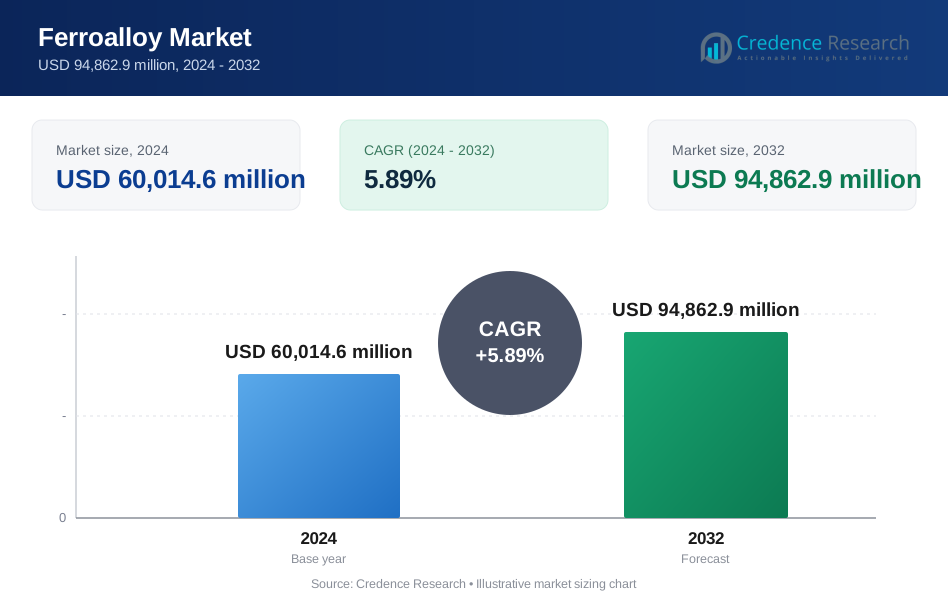
The Ferroalloy market size was valued at USD 60014.6 million in 2024 and is anticipated to reach USD 94862.9 million by 2032, at a CAGR of 5.89 % during the forecast period (2024-2032).
| REPORT ATTRIBUTE | DETAILS |
|---|---|
| Historical Period | 2020-2024 |
| Base Year | 2024 |
| Forecast Period | 2025-2032 |
| Ferroalloy Market Size 2024 | USD 60014.6 Million |
| Ferroalloy Market, CAGR | 5.89 % |
| Ferroalloy Market Size 2032 | USD 94862.9 Million |
Growth in the ferroalloy market is primarily fueled by the rising demand for high-strength, wear-resistant, and corrosion-resistant steel across construction, shipbuilding, aerospace, and energy sectors. Technological advancements in smelting and refining, coupled with the shift toward low-carbon steel production, are encouraging the adoption of energy-efficient and environmentally sustainable ferroalloy manufacturing processes. Increasing investment in electric arc furnace (EAF) steelmaking and the use of specialty alloys for value-added steel grades are further expanding market opportunities.
Regionally, Asia-Pacific dominates the ferroalloy market due to its large steel production base, particularly in China and India, supported by government-led infrastructure and industrialization programs. Europe holds a notable share, driven by specialty steel production and stringent quality standards. North America shows consistent growth, supported by automotive and oil & gas sector demand, while Latin America and the Middle East & Africa present untapped opportunities through capacity expansion and modernization of steel plants.

Market Insights:
- The ferroalloy market was valued at USD 60,014.6 million in 2024 and is expected to reach USD 94,862.9 million by 2032, growing at a CAGR of 5.89% from 2024 to 2032.
- Rising demand for high-strength, wear-resistant, and corrosion-resistant steel in construction, shipbuilding, aerospace, and energy sectors is a key growth driver.
- Expansion of global steel production, supported by infrastructure development and urbanization, is boosting ferroalloy consumption across multiple industries.
- Technological advancements, including the adoption of electric arc furnace (EAF) steelmaking and energy-efficient smelting, are improving production efficiency and sustainability.
- The market faces challenges from raw material price volatility, supply chain disruptions, high energy consumption, and stringent environmental regulations.
- Asia-Pacific leads with 70% market share, followed by Europe at 12% and North America at 10%, reflecting strong regional production and consumption patterns.
- Growing demand for specialty and high-purity ferroalloys in automotive, aerospace, and renewable energy sectors is creating new opportunities for product innovation and value-added applications.
Market Drivers:
Rising Demand from the Global Steel Industry:
The ferroalloy market benefits significantly from the expansion of the global steel sector, which consumes the majority of ferroalloy output for alloying and deoxidizing purposes. It supports the production of high-strength and wear-resistant steel grades essential for construction, automotive, shipbuilding, and heavy machinery applications. Increasing infrastructure investments in both developed and emerging economies are driving steel demand, thereby strengthening ferroalloy consumption. The correlation between steel production growth and ferroalloy demand ensures consistent market stability.
- For instance, ArcelorMittal produced 57.9million metric tons of steel in 2024, demonstrating the company’s technological capacity and reinforcing its position as one of the world’s leading steel producers.
Infrastructure Development and Urbanization:
Rapid urbanization and large-scale infrastructure projects are key drivers fueling the ferroalloy market. Government-led initiatives to build transport networks, residential complexes, and industrial facilities require high volumes of alloyed steel. It benefits from long-term construction pipelines in Asia-Pacific, the Middle East, and Africa, where economic development strategies prioritize infrastructure expansion. These factors create sustained demand for bulk and specialty ferroalloys.
- For instance, Gulf Ferro Alloys Company (Sabayek) in Saudi Arabia supports regional megaprojects and operates the largest ferroalloy plant in the GCC, with an annual capacity of 140,000 tons serving infrastructure steel demand.
Technological Advancements in Steelmaking Processes:
Advances in steelmaking technologies, particularly the adoption of electric arc furnace (EAF) methods, are driving efficiency in ferroalloy utilization. It enables manufacturers to produce steel with precise alloy compositions, enhancing product quality and performance. Energy-efficient smelting processes and improved refining techniques are reducing production costs and environmental impact. This shift supports greater integration of ferroalloys into high-value steel applications.
Rising Use of Specialty and Value-Added Steel:
The growth of industries such as aerospace, renewable energy, and high-performance automotive manufacturing is increasing demand for specialty steel grades. It requires specific ferroalloy compositions, such as ferrochrome, ferromanganese, and ferrosilicon, to achieve desired mechanical and chemical properties. The trend toward lightweight, corrosion-resistant, and high-strength steel is strengthening the market for high-purity and customized ferroalloys. This diversification into value-added segments enhances long-term growth prospects.
Market Trends:
Shift Toward Low-Carbon and Sustainable Production:
The ferroalloy market is experiencing a clear shift toward low-carbon and environmentally sustainable manufacturing practices. Producers are adopting energy-efficient smelting technologies, renewable energy integration, and advanced emission control systems to meet tightening environmental regulations. It is also witnessing increased investment in recycling and reuse of ferroalloy-rich steel scrap to reduce raw material dependency and carbon footprint. The development of biochar-based reductants and alternative raw materials is further supporting this sustainability drive. Growing pressure from global climate commitments is encouraging manufacturers to align operations with green steel initiatives. This transition is expected to redefine competitive positioning in the market over the next decade.
- For instance, Outokumpu invested EUR 40 million in a biocarbon production plant in Germany with 15,000 tonnes annual capacity by 2026.
Rising Demand for High-Purity and Customized Alloys;
The ferroalloy market is seeing greater demand for high-purity and customized alloy compositions to meet the evolving needs of advanced steel applications. It is driven by sectors such as aerospace, defense, energy, and automotive, which require precise metallurgical properties for performance-critical components. Manufacturers are investing in refining techniques and process automation to achieve consistent quality and tighter composition tolerances. The trend toward microalloying for enhanced steel strength and corrosion resistance is further expanding product innovation. This focus on specialized, value-added ferroalloys is creating new revenue opportunities while differentiating suppliers in a competitive environment. Increasing collaboration between steelmakers and ferroalloy producers is also accelerating tailored product development.
- For instance, Indian Metals & Ferro Alloys Limited (IMFA) is implementing a Rs 900 crore greenfield ferrochrome expansion project at Kalinganagar, Odisha, which will increase their annual ferrochrome capacity by 100,000 tonnes to reach 384,000 tonnes by September 2026.
Market Challenges Analysis:
Volatility in Raw Material Prices and Supply Risks:
The ferroalloy market faces significant challenges due to fluctuations in the prices of key raw materials such as manganese ore, chromium ore, and coke. It is highly sensitive to disruptions in mining output, trade restrictions, and geopolitical tensions that can tighten supply chains. Currency fluctuations and freight cost volatility further amplify input cost uncertainty for producers. Dependence on imports in certain regions increases vulnerability to supply instability. These factors can erode profit margins and hinder long-term production planning.
Environmental Regulations and High Energy Consumption:
Stringent environmental regulations on emissions and energy usage present operational challenges for the ferroalloy market. It relies on energy-intensive smelting processes, which face growing scrutiny under global carbon reduction commitments. Compliance with evolving standards requires significant investment in cleaner technologies, which can raise production costs. In regions with high electricity tariffs, energy expenses further impact competitiveness. Balancing regulatory compliance with cost efficiency remains a critical challenge for manufacturers.
Market Opportunities:
Expansion of Infrastructure and Industrial Projects in Emerging Markets:
The ferroalloy market holds strong growth potential from large-scale infrastructure and industrial development in emerging economies. It benefits from rising steel demand in transportation networks, urban housing, and energy projects across Asia-Pacific, the Middle East, and Africa. Government-backed industrialization programs and foreign direct investments are driving capacity expansion in steel manufacturing, directly increasing ferroalloy consumption. The growing adoption of high-strength steel in construction and engineering further strengthens market prospects. Strategic partnerships with regional steel producers can enhance supply security and market penetration.
Innovation in High-Performance and Specialty Alloys:
The ferroalloy market is positioned to gain from the rising need for high-performance and specialty steel in advanced sectors such as aerospace, defense, renewable energy, and electric vehicles. It can capitalize on demand for alloys with superior corrosion resistance, lightweight properties, and high mechanical strength. Investments in refining processes, automation, and metallurgical R&D are enabling precise alloy customization. Collaboration with steelmakers to develop application-specific compositions can secure long-term supply contracts. Growing interest in microalloying and advanced metallurgical techniques presents opportunities for product diversification and higher margins.
Market Segmentation Analysis:
By Product:
The ferroalloy market is segmented into ferromanganese, ferrochrome, ferrosilicon, and other specialty alloys. Ferromanganese holds a major share due to its essential role in deoxidizing and strengthening steel. Ferrochrome demand remains strong in stainless steel production, supported by the need for corrosion-resistant properties. Ferrosilicon is widely used for its role in improving steel strength and magnetic properties. Specialty alloys, including ferrotungsten and ferronickel, cater to high-performance applications in aerospace, energy, and defense sectors.
- For instance, Outokumpu produced 374,000 tonnes of ferrochrome in 2024, primarily for its own stainless steel manufacturing, ensuring consistent corrosion-resistant quality for markets in Europe and the Americas.
By Application:
The ferroalloy market serves applications in carbon steel, stainless steel, and alloy steel manufacturing. Carbon steel accounts for the largest share, driven by infrastructure, construction, and automotive demand. Stainless steel consumption is rising in kitchenware, architecture, and industrial equipment due to its durability and aesthetic appeal. Alloy steel, with enhanced strength and wear resistance, finds use in heavy machinery, shipbuilding, and aerospace applications.
- For instance, Cleveland-Cliffs Inc. supplied carbon steel for U.S. infrastructure projects, including bridges and highways, supporting over $1.2trillion in infrastructure upgrades as part of the U.S. Infrastructure Investment and Jobs Act.
By End Use Industry:
The ferroalloy market caters to end users in construction, automotive, aerospace, energy, and industrial machinery. Construction leads the segment due to large-scale infrastructure investments worldwide. Automotive applications focus on high-strength, lightweight steel for improved fuel efficiency and safety. Aerospace and energy sectors demand specialized alloys for performance-critical components. Industrial machinery relies on alloyed steels for durability in heavy-duty operations.
Segmentations:
By Product:
- Ferromanganese
- Ferrochrome
- Ferrosilicon
- Ferronickel
- Ferrotungsten
- Others
By Application:
- Carbon Steel
- Stainless Steel
- Alloy Steel
- Cast Iron
- Others
By End User:
- Construction
- Automotive
- Aerospace
- Energy
- Industrial Machinery
- Shipbuilding
- Others
By Region:
- North America
- U.S.
- Canada
- Mexico
- Europe
- Germany
- France
- U.K.
- Italy
- Spain
- Rest of Europe
- Asia Pacific
- China
- Japan
- India
- South Korea
- South-east Asia
- Rest of Asia Pacific
- Latin America
- Brazil
- Argentina
- Rest of Latin America
- Middle East & Africa
- GCC Countries
- South Africa
- Rest of the Middle East and Africa
Regional Analysis:
Asia-Pacific :
Asia-Pacific holds 70% market share in the ferroalloy market, driven by its dominance in global steel production and extensive manufacturing capacity. China and India are the largest contributors, supported by large-scale infrastructure development, industrial expansion, and strong domestic demand for steel. It benefits from abundant raw material availability, cost-effective labor, and significant government investment in heavy industries. Rapid urbanization and transportation network upgrades continue to stimulate steel consumption, ensuring sustained ferroalloy demand. Export competitiveness remains high due to integrated supply chains and technological advancements in smelting processes. Regional producers are also expanding capacity to meet both domestic and international requirements.
Europe :
Europe accounts for 12% market share in the ferroalloy market, supported by advanced engineering capabilities and strong demand for high-quality specialty steels. Germany, France, and Italy are key producers, focusing on alloys tailored for automotive, aerospace, and industrial applications. It benefits from strict quality regulations, well-developed logistics infrastructure, and R&D investment in metallurgical innovation. Sustainable production practices and compliance with stringent environmental standards strengthen market positioning. Regional producers are also leveraging partnerships with steelmakers to expand high-purity and customized alloy offerings. The presence of established manufacturing hubs ensures stable demand and steady export activity.
North America :
North America holds 10% market share in the ferroalloy market, driven by strong consumption from automotive, oil and gas, and construction sectors. The United States leads regional demand, supported by well-developed manufacturing infrastructure and high per capita steel usage. It benefits from technological advancements in production efficiency and alloy quality control. Government investments in infrastructure renewal projects are expected to boost steel and ferroalloy consumption. Import reliance for certain raw materials remains a factor, influencing supply chain strategies. The region’s focus on advanced steel grades creates opportunities for high-performance ferroalloy producers.
Key Player Analysis:
- Glencore
- Shanghai Shenjia Ferroalloys Co. Ltd
- Samancore Chrome
- Ferro Alloys Corporation Limited
- Tata Steel Limited
- S.C. Feral S.R.L
- Arcelor Mittal
- SAIL
- China Minmetals
- Jindal Group
Competitive Analysis:
The ferroalloy market is characterized by the presence of global leaders and regionally strong producers competing on capacity, product quality, and cost efficiency. Key players include Glencore, Shanghai Shenjia Ferroalloys Co. Ltd, Samancore Chrome, Ferro Alloys Corporation Limited, Tata Steel Limited, S.C. Feral S.R.L, Arcelor Mittal, and SAIL. It benefits from the integration of mining, processing, and distribution capabilities, enabling consistent supply to steel manufacturers. Competitive strategies focus on expanding production capacity, securing raw material sources, and developing high-purity and specialty alloy grades. Players are investing in technological upgrades to improve energy efficiency and meet environmental standards. Long-term contracts with steel producers strengthen market positions, while product innovation supports differentiation. The market remains influenced by regional cost advantages, trade policies, and the ability of companies to adapt to changing demand patterns in steel-intensive industries.
Recent Developments:
- In May 2025, Glencore finalized a 20-year liquefied natural gas (LNG) supply partnership with Commonwealth LNG to purchase2million tonnes per annum from their Louisiana facility.
- In July 2025, Tata Steel Limited finalized the acquisition of Neelachal Ispat Nigam Limited (NINL), making it a wholly owned subsidiary. This strategic move is aimed at expanding Tata Steel’s footprint in the Indian steel market.
- In February 2025, Minmetals Mining Group, a subsidiary of China Minmetals, acquired Anglo American’s nickel operations in Brazil for up to $500million, pending regulatory approval.
Market Concentration & Characteristics:
The ferroalloy market exhibits moderate to high concentration, with a mix of global leaders and regionally focused producers. It is dominated by companies with integrated operations, access to captive raw materials, and strong distribution networks, enabling consistent supply to major steel manufacturers. Competitive dynamics are influenced by production capacity, technological capabilities, and the ability to deliver customized alloy compositions. Entry barriers remain significant due to high capital investment, energy requirements, and compliance with environmental regulations. Long-term contracts between ferroalloy producers and steelmakers enhance market stability, while innovation in high-purity and specialty alloys supports differentiation. Global trade flows and regional cost advantages further shape competitive positioning in the market.
Report Coverage:
The research report offers an in-depth analysis based on Product, Application, End User and Region. It details leading Market players, providing an overview of their business, product offerings, investments, revenue streams, and key applications. Additionally, the report includes insights into the competitive environment, SWOT analysis, current Market trends, as well as the primary drivers and constraints. Furthermore, it discusses various factors that have driven Market expansion in recent years. The report also explores Market dynamics, regulatory scenarios, and technological advancements that are shaping the industry. It assesses the impact of external factors and global economic changes on Market growth. Lastly, it provides strategic recommendations for new entrants and established companies to navigate the complexities of the Market.
Future Outlook:
- Demand for ferroalloys will rise in line with the expansion of global steel production, particularly in infrastructure and industrial projects.
- Asia-Pacific will maintain dominance due to large-scale steelmaking capacity and strong domestic consumption.
- Adoption of energy-efficient and low-emission smelting technologies will accelerate to meet environmental compliance requirements.
- High-purity and customized alloy compositions will gain traction in aerospace, automotive, and renewable energy sectors.
- Increased investment in electric arc furnace (EAF) steelmaking will boost demand for alloying elements such as ferrosilicon and ferrochrome.
- Recycling of ferroalloy-rich steel scrap will expand as part of circular economy initiatives.
- Strategic partnerships between ferroalloy producers and steel manufacturers will strengthen supply chain integration.
- Emerging markets in Africa and the Middle East will offer new opportunities through infrastructure and industrial growth.
- Digitalization and automation in production will enhance quality control and operational efficiency.
- Volatility in raw material prices will drive producers to diversify sourcing strategies and secure long-term supply contracts.
Request a Free Sample
Fill in your details and we'll send you a free sample report.
- Sample data tables & charts
- Research methodology
Market Dynamics
Expansion of Global Steel Production
The ferroalloy market is closely tied to the steel industry, as ferroalloys are essential for alloying and deoxidizing steel. Growing infrastructure and industrial projects worldwide are driving steel production, which in turn boosts ferroalloy consumption.
Technological Advancements in Smelting and Refining
Innovations such as electric arc furnace (EAF) steelmaking and energy-efficient smelting processes are improving production efficiency and reducing environmental impact, making ferroalloy manufacturing more sustainable and cost-effective.
Shift Toward Low-Carbon and Sustainable Steel
The push for low-carbon steel production is encouraging the adoption of environmentally friendly ferroalloy manufacturing processes, including recycling and the use of alternative reductants, aligning with global climate commitments and regulatory requirements.
Rising Demand for Specialty and High-Purity Alloys
Growth in sectors like aerospace, automotive, and renewable energy is increasing the need for high-purity and customized ferroalloys, which are critical for producing advanced, high-performance steel grades with specific mechanical and chemical properties.
Infrastructure Development and Urbanization in Emerging Markets
Large-scale infrastructure projects and rapid urbanization, especially in Asia-Pacific, the Middle East, and Africa, are driving demand for alloyed steel, thereby increasing the consumption of ferroalloys in construction and industrial applications.
Need a Custom Version of This Report?
Tailor the scope, geography, or segments to your exact requirements.
- Custom geography or segment scope
- Direct access to our analyst team
Frequently Asked Questions
What is the current market size for the ferroalloy market, and what is its projected size in 2032?
At what Compound Annual Growth Rate is the ferroalloy market projected to grow between 2024 and 2032?
Which ferroalloy market segment held the largest share in 2024?
What are the primary factors fueling the growth of the ferroalloy market?
Who are the leading companies in the ferroalloy market?
Which region commanded the largest share of the ferroalloy market in 2024?
Table of Content
Chapter 1 Market Segmentation
- 1.1 Segmentation Framework
- 1.1.1 Product and Service Classification
- 1.1.2 Application and End-Use Classification
- 1.1.3 Technology and Solution Classification
- 1.1.4 Customer and Distribution Channel Classification
- 1.1.5 Geographic Segmentation
- 1.1.6 Market Segment Definitions and Boundaries
- 1.2 By Product
- 1.2.1 Ferromanganese
- 1.2.2 Ferrochrome
- 1.2.3 Ferrosilicon
- 1.2.4 Ferronickel
- 1.2.5 Ferrotungsten
- 1.2.6 Others
- 1.3 By End User
- 1.3.1 Construction
- 1.3.2 Automotive
- 1.3.3 Aerospace
- 1.3.4 Energy
- 1.3.5 Industrial Machinery
- 1.3.6 Shipbuilding
- 1.3.7 Others
- 1.4 By Application
- 1.4.1 Carbon Steel
- 1.4.2 Stainless Steel
- 1.4.3 Alloy Steel
- 1.4.4 Cast Iron
- 1.4.5 Others
Chapter 2 Introduction
- 2.1 Report Objectives and Scope
- 2.2 Product Definition and Industry Terminology
- 2.3 Market Inclusions and Exclusions
- 2.4 Research Process
- 2.4.1 Primary Research and Expert Interviews
- 2.4.2 Secondary Research and Source Review
- 2.4.3 Top-Down and Bottom-Up Estimation
- 2.4.4 Data Triangulation and Verification
- 2.5 Market Size Measurement Basis
- 2.5.1 2024: USD 60,014.6 million → 2032: USD 94,862.9 million
- 2.6 Historical and Forecast Reference Periods
- 2.6.1 Base Year: 2024
- 2.6.2 Forecast Period: 2024-2032
- 2.7 Research Assumptions and Limitations
Chapter 3 Executive Summary
- 3.1 Market Snapshot and Key Findings
- 3.2 Base-Year Market Size, 2024
- 3.3 Forecast Market Size, 2032
- 3.4 Revenue and Volume Growth Outlook
- 3.5 Key Demand and Supply Indicators
- 3.6 Leading Market Segments
- 3.7 Fastest-Growing Market Opportunities
- 3.8 Regional Performance Highlights
- 3.9 Technology and Industry Transformation
- 3.10 Competitive Landscape Summary
- 3.11 Analyst View and Strategic Implications
Chapter 4 Global Ferroalloy Market Trends and Developments
- 4.1 Historical Industry Development
- 4.2 Recent Market Trends and Developments
- 4.3 Demand and Customer Behavior Trends
- 4.4 Technology and Product Innovation
- 4.5 Artificial Intelligence, Automation and Digitalization
- 4.6 Local Manufacturing and Supply Chain Realignment
- 4.7 Industry Partnerships, Mergers and Acquisitions
- 4.8 Sustainability and Circular Economy Developments
- 4.9 Government and Private Sector Investment Trends
- 4.10 Emerging Business Models and Commercialization
- 4.11 Industry Developments and Announcements
Chapter 5 Global Ferroalloy Market Production, Supply and Demand Analysis
- 5.1 Demand Trend and Consumption Analysis
- 5.2 Demand Forecast, 2024-2032
- 5.3 Production and Output Trend
- 5.4 Production and Output Forecast, 2024-2032
- 5.5 Installed Capacity and Capacity Utilization
- 5.6 Company-Wise Production Plants and Statistics
- 5.6.1 Installed Production Capacity
- 5.6.2 Actual Production
- 5.6.3 Planned Capacity and Expansion Targets
- 5.7 Supply Chain Structure and Procurement Trends
- 5.8 Supply-Demand Gap and Bottlenecks
- 5.9 Import Dependence and Sourcing Structure
- 5.10 Contract Manufacturing and Outsourcing
- 5.11 Regional Supply and Demand Concentration
Chapter 6 Global Ferroalloy Market Pricing Analysis
- 6.1 Pricing Structure and Measurement
- 6.2 Historical Pricing Trends
- 6.3 Pricing Outlook, 2024-2032
- 6.4 Average Selling Price and Unit Economics
- 6.5 Pricing by Product and Market Segment
- 6.6 Geographic Pricing Differences
- 6.7 Key Input, Energy, Labor and Logistics Costs
- 6.8 Contract Pricing and Purchasing Models
- 6.9 Pricing Sensitivity and Competitive Positioning
- 6.10 Price, Margin and Profitability Implications
Chapter 7 Global Ferroalloy Market Dynamics
- 7.1 Market Growth Drivers
- 7.1.1 Demand-Side Drivers
- 7.1.2 Technology and Innovation Drivers
- 7.1.3 Infrastructure and Investment Drivers
- 7.1.4 Regulatory and Policy Drivers
- 7.2 Market Restraints
- 7.2.1 Cost and Affordability Constraints
- 7.2.2 Technology and Adoption Barriers
- 7.2.3 Supply Chain and Operational Constraints
- 7.3 Market Challenges
- 7.3.1 Competitive Pressure and Margin Erosion
- 7.3.2 Skills, Infrastructure and Implementation Gaps
- 7.4 Emerging Market Opportunities
- 7.5 Market Dynamics Impact and Time-Horizon Assessment
Chapter 8 Global Ferroalloy Value Chain Analysis
- 8.1 Industry Value Chain Overview
- 8.2 Upstream Suppliers and Critical Inputs
- 8.3 Technology and Component Providers
- 8.4 Manufacturing or Service Delivery
- 8.5 Distribution, Channel Partners and Integrators
- 8.6 Downstream Applications and End Users
- 8.7 Value Addition and Profit Pools
- 8.8 Vertical Integration and Outsourcing
- 8.9 Supplier Concentration and Risk
- 8.10 Supply Chain Localization and Resilience
Chapter 9 Global Ferroalloy Market Regulations and Policies
- 9.1 Relevant Laws, Standards and Compliance Frameworks
- 9.2 Product, Service, Safety and Quality Requirements
- 9.3 Government Policies, Incentives and Subsidies
- 9.4 Imports, Exports and Trade Barriers
- 9.5 Public Procurement and Local Content Requirements
- 9.6 Environmental and Sustainability Compliance
- 9.7 Upcoming Policy Changes and Market Implications
Chapter 10 Global Ferroalloy Market Hotspots and Opportunities
- 10.1 Market Opportunity Mapping and Growth Hotspots
- 10.2 High-Growth Applications and Customer Groups
- 10.3 Underserved Markets and White-Space Opportunities
- 10.4 Emerging Technology and Product Opportunities
- 10.5 New Capacity and Investment Hotspots
- 10.6 Market Entry and Expansion Opportunities
- 10.7 Distribution and Partnership Opportunities
- 10.8 Near-Term and Long-Term Commercial Potential
- 10.9 Opportunity Attractiveness and Execution Risks
Chapter 11 Global Ferroalloy Market Outlook, 2024-2032
- 11.1 Market Size and Analysis
- 11.1.1 Revenue (Market Measurement: 2024: USD 60,014.6 million → 2032: USD 94,862.9 million)
- 11.1.2 Market Volume and Quantity Sold
- 11.1.3 Historical Market Size
- 11.1.4 Base-Year Market Size, 2024
- 11.2 Market Forecast, 2024-2032
- 11.2.1 Revenue Forecast to 2032
- 11.2.2 Volume Forecast to 2032
- 11.2.3 CAGR and Year-on-Year Growth
- 11.2.4 Incremental Revenue Opportunity
- 11.3 Forecast Assumptions and Scenario Analysis
- 11.3.1 Base-Case Forecast
- 11.3.2 Optimistic and Conservative Scenarios
- 11.3.3 Technology, Pricing and Policy Sensitivities
- 11.4 Market Attractiveness and Growth Outlook
Chapter 12 Global Ferroalloy Market Segmentation and Outlook
- 12.1 Segmentation Summary and Market Shares, 2024
- 12.2 Largest and Fastest-Growing Segments
- 12.3 By Product - Market Size and Forecast, 2024-2032
- 12.3.1 Segment Definition and Scope
- 12.3.2 Historical Market Size
- 12.3.3 Revenue Forecast, 2024-2032
- 12.3.4 Volume Forecast, 2024-2032
- 12.3.5 Base-Year Market Share, 2024
- 12.3.6 Segment CAGR and Growth Drivers
- 12.3.7 Subsegment Market Size and Forecast
- 12.3.7.1 Ferromanganese
- 12.3.7.2 Ferrochrome
- 12.3.7.3 Ferrosilicon
- 12.3.7.4 Ferronickel
- 12.3.7.5 Ferrotungsten
- 12.3.7.6 Others
- 12.3.8 Subsegment Pricing and Adoption Trends
- 12.3.9 Leading Suppliers and Competition
- 12.3.10 Regional Demand and Opportunities
- 12.4 By End User - Market Size and Forecast, 2024-2032
- 12.4.1 Segment Definition and Scope
- 12.4.2 Historical Market Size
- 12.4.3 Revenue Forecast, 2024-2032
- 12.4.4 Volume Forecast, 2024-2032
- 12.4.5 Base-Year Market Share, 2024
- 12.4.6 Segment CAGR and Growth Drivers
- 12.4.7 Subsegment Market Size and Forecast
- 12.4.7.1 Construction
- 12.4.7.2 Automotive
- 12.4.7.3 Aerospace
- 12.4.7.4 Energy
- 12.4.7.5 Industrial Machinery
- 12.4.7.6 Shipbuilding
- 12.4.7.7 Others
- 12.4.8 Subsegment Pricing and Adoption Trends
- 12.4.9 Leading Suppliers and Competition
- 12.4.10 Regional Demand and Opportunities
- 12.5 By Application - Market Size and Forecast, 2024-2032
- 12.5.1 Segment Definition and Scope
- 12.5.2 Historical Market Size
- 12.5.3 Revenue Forecast, 2024-2032
- 12.5.4 Volume Forecast, 2024-2032
- 12.5.5 Base-Year Market Share, 2024
- 12.5.6 Segment CAGR and Growth Drivers
- 12.5.7 Subsegment Market Size and Forecast
- 12.5.7.1 Carbon Steel
- 12.5.7.2 Stainless Steel
- 12.5.7.3 Alloy Steel
- 12.5.7.4 Cast Iron
- 12.5.7.5 Others
- 12.5.8 Subsegment Pricing and Adoption Trends
- 12.5.9 Leading Suppliers and Competition
- 12.5.10 Regional Demand and Opportunities
- 12.6 Segment Growth Comparison
- 12.7 Segment Attractiveness and Priority Matrix
Chapter 13 Global Ferroalloy End-Use and Application Market Outlook
- 13.1 End-Use Industry and Customer Demand Structure
- 13.2 Leading Applications and Customer Groups
- 13.3 End-Use Market Size, Share and Forecast
- 13.4 Major End-Use Industry Deep Dives
- 13.4.1 Customer Requirements and Use Cases
- 13.4.2 Demand and Replacement Cycles
- 13.4.3 Technical and Regulatory Considerations
- 13.4.4 Purchasing and Procurement Models
- 13.4.5 Leading Vendors and Distribution Channels
- 13.4.6 Forecast and Commercial Opportunities
- 13.5 Emerging Applications and Cross-Segment Demand
- 13.6 End-Use Industry Investment Priorities
Chapter 14 Global Ferroalloy Geographic Market Outlook, 2024-2032
- 14.1 Regional Market Size and Share, 2024
- 14.2 Regional Market Forecast, 2024-2032
- 14.3 Regional Pricing, Production and Demand Differences
- 14.4 North America
- 14.4.1 United States
- 14.4.2 Canada
- 14.4.3 Mexico
- 14.5 Europe
- 14.5.1 Germany
- 14.5.2 France
- 14.5.3 Italy
- 14.5.4 United Kingdom
- 14.5.5 Spain
- 14.5.6 Poland
- 14.5.7 Russia
- 14.5.8 Netherlands
- 14.5.9 Belgium
- 14.5.10 Sweden
- 14.5.11 Denmark
- 14.5.12 Norway
- 14.5.13 Rest of Europe
- 14.6 Asia Pacific
- 14.6.1 China
- 14.6.2 India
- 14.6.3 Japan
- 14.6.4 South Korea
- 14.6.5 Thailand
- 14.6.6 Indonesia
- 14.6.7 Vietnam
- 14.6.8 Malaysia
- 14.6.9 Australia
- 14.6.10 Rest of Asia Pacific
- 14.7 Latin America
- 14.7.1 Brazil
- 14.7.2 Argentina
- 14.7.3 Colombia
- 14.7.4 Chile
- 14.7.5 Rest of Latin America
- 14.8 Middle East
- 14.8.1 Saudi Arabia
- 14.8.2 United Arab Emirates
- 14.8.3 Turkey
- 14.8.4 Israel
- 14.8.5 Iran
- 14.8.6 Rest of the Middle East
- 14.9 Africa
- 14.9.1 South Africa
- 14.9.2 Egypt
- 14.9.3 Nigeria
- 14.9.4 Morocco
- 14.9.5 Rest of Africa
- 14.10 Regional Investment, Policy and Supply Chain Differences
- 14.11 Regional Competitive Landscape
- 14.12 Geographic Growth Hotspots
Chapter 15 Global Ferroalloy Technology, Innovation and Sustainability Outlook
- 15.1 Technology Landscape and Maturity
- 15.2 Product, Process and Service Innovation
- 15.3 AI, Automation and Digital Tools in the Industry
- 15.4 Technology Adoption and Performance Benchmarking
- 15.5 Innovation Pipeline and R&D Investment
- 15.6 Patent and Intellectual Property Trends
- 15.7 Energy Efficiency and Resource Management
- 15.8 Sustainability, Recycling and Circularity
- 15.9 Technology Roadmap, 2024-2032
- 15.10 Risks of Obsolescence and Technology Substitution
Chapter 16 Global Ferroalloy Market Key Strategic Imperatives
- 16.1 Growth and Market Entry Priorities
- 16.2 High-Return Products and Segments
- 16.3 Pricing, Profitability and Cost Optimization
- 16.4 Technology Investment and Product Differentiation
- 16.5 Supply Chain Localization and Resilience
- 16.6 Distribution and Customer Acquisition
- 16.7 Partnership, Acquisition and Capacity Strategy
- 16.8 Regional Expansion Priorities
- 16.9 Short-, Medium- and Long-Term Actions
Chapter 17 Competition Outlook
- 17.1 Industry Competition Characteristics
- 17.2 Market Structure and Concentration
- 17.3 Market Share and Competitive Positioning, 2024
- 17.4 Company-Wise Revenue and Product Benchmarking
- 17.5 Production and Service Capacity Benchmarking
- 17.6 Technology, Pricing and Differentiation
- 17.7 Regional Footprint and Distribution Strength
- 17.8 Mergers, Acquisitions and Strategic Alliances
- 17.9 New Entrants and Competitive Threats
- 17.10 Porter's Five Forces and Industry Attractiveness
- 17.11 Competitive Outlook, 2024-2032
Chapter 18 Company Profiles
- 18.1 Company Coverage and Selection Criteria
- 18.2 Glencore
- 18.2.1 Business Description
- 18.2.2 Company Ownership and Geographic Presence
- 18.2.3 Product and Service Portfolio
- 18.2.4 Manufacturing and Operating Footprint
- 18.2.5 Production Capacity and Expansion Plans
- 18.2.6 Financial Performance and Investment
- 18.2.7 Market Share and Competitive Position
- 18.2.8 Technology and Innovation Capabilities
- 18.2.9 Strategic Alliances or Partnerships
- 18.2.10 Recent Developments
- 18.2.11 Growth Strategy and Outlook
- 18.3 Shanghai Shenjia Ferroalloys Co. Ltd
- 18.4 Samancore Chrome
- 18.5 Ferro Alloys Corporation Limited
- 18.6 Tata Steel Limited
- 18.7 S.C. Feral S.R.L
- 18.8 Arcelor Mittal
- 18.9 SAIL
- 18.10 China Minmetals
- 18.11 Jindal Group
- 18.12 Other Relevant Market Participants
Note: Every listed company is profiled on the structure shown under the first company. The company list is preliminary and may change based on research findings, market developments, data availability and client requirements.
Chapter 19 Disclaimer
- 19.1 Research and Forecast Disclaimer
- 19.2 Data Source and Estimation Limitations
Note: The depth of individual sections depends on data availability for this market. Volume, capacity, trade and other unit-based metrics are included where applicable.

