Market Overview:
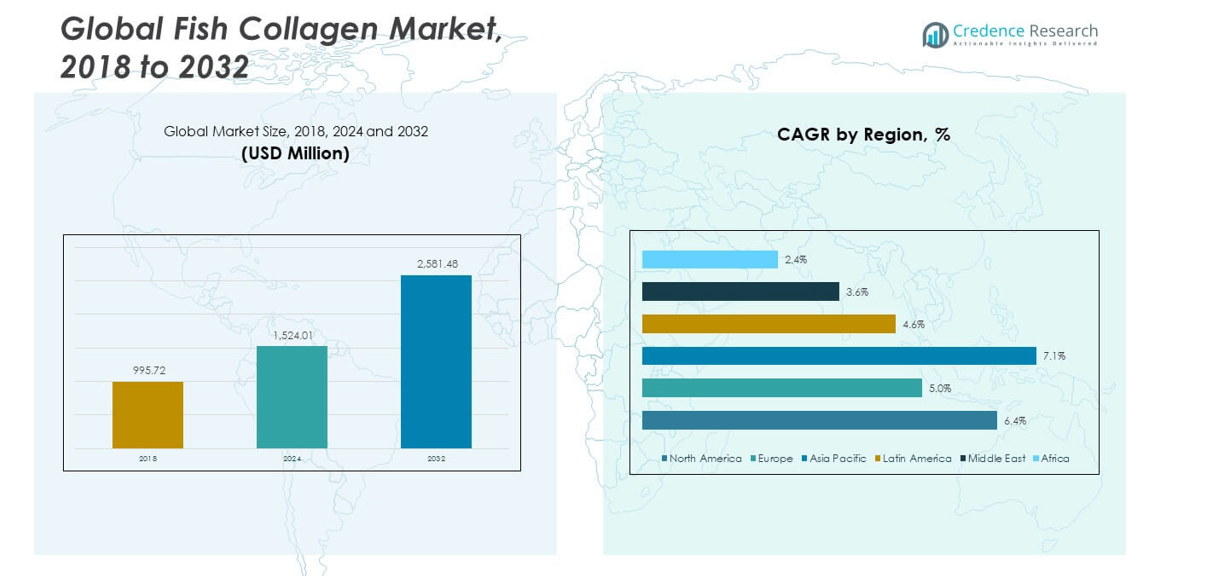
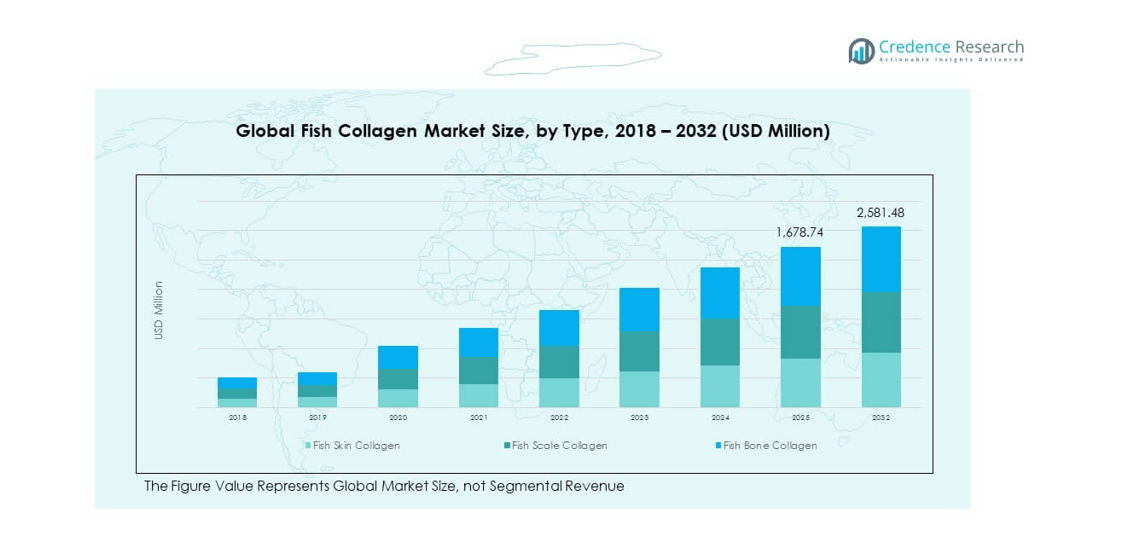
The Global Fish Collagen Market size was valued at USD 995.72 million in 2018 to USD 1,524.01 million in 2024 and is anticipated to reach USD 2,581.48 million by 2032, at a CAGR of 6.34% during the forecast period.
| REPORT ATTRIBUTE | DETAILS |
|---|---|
| Historical Period | 2020-2023 |
| Base Year | 2024 |
| Forecast Period | 2025-2032 |
| Fish Collagen Market Size 2024 | USD 1,524.01 million |
| Fish Collagen Market, CAGR | 6.34% |
| Fish Collagen Market Size 2032 | USD 2,581.48 million |
The market is growing rapidly due to increasing consumer awareness of the health and beauty benefits of collagen. Rising demand for natural and marine-based supplements in cosmetics, pharmaceuticals, and nutraceuticals supports expansion. The shift toward sustainable and eco-friendly ingredients from fish sources, coupled with innovations in collagen extraction and hydrolyzation technology, is enhancing product quality and driving broader adoption across industries.
Asia-Pacific dominates the fish collagen market due to abundant fish resources, large-scale collagen production, and rising health supplement consumption. North America and Europe follow closely, driven by the growing focus on anti-aging and functional food trends. Emerging markets in Latin America and the Middle East are witnessing increased collagen use in beauty and food products, supported by expanding distribution networks and consumer lifestyle changes.
Market Insights:
- The Global Fish Collagen Market was valued at USD 995.72 million in 2018, reached USD 1,524.01 million in 2024, and is projected to hit USD 2,581.48 million by 2032, growing at a CAGR of 6.34% during the forecast period.
- Asia Pacific holds the largest share at 41%, driven by abundant fish resources, strong collagen production capabilities, and rising demand for functional foods and beauty supplements.
- North America and Europe follow with 28% and 19% shares, respectively, supported by established nutraceutical and cosmetic industries, advanced processing technologies, and high consumer awareness of marine collagen benefits.
- Asia Pacific remains the fastest-growing region, supported by expanding healthcare expenditure, innovation in marine biotechnology, and increasing demand for natural and sustainable ingredients.
- By type, fish skin collagen dominates with around 55% share, followed by fish scale collagen at 30%, while fish bone collagen contributes approximately 15%, reflecting its growing use in food and pharmaceutical applications.
Market Drivers:
Rising Demand for Marine-Based Nutritional Ingredients in Health and Beauty Applications
The Global Fish Collagen Market is driven by increasing consumer preference for natural and marine-sourced ingredients in dietary supplements and cosmetics. Fish collagen offers superior bioavailability compared to bovine or porcine sources, improving skin elasticity and joint health. Growing awareness of anti-aging solutions is fueling its use in skincare and nutraceutical products. It benefits from clean-label trends and sustainability awareness among health-conscious consumers. Pharmaceutical industries are integrating fish collagen into wound healing and tissue repair formulations. Expanding e-commerce distribution also supports easy product accessibility. Collaboration between marine bioproduct firms and cosmetic manufacturers strengthens innovation in new formulations. Rising disposable incomes across developing economies enhance product adoption across demographics.
- For instance, GELITA AG introduced its fish-derived VERISOL® Bioactive Collagen Peptides in a clinical trial where daily intake of 5 g improved skin elasticity and reduced wrinkle volume after 4 weeks. It benefits from clean-label trends and sustainability awareness among health-conscious consumers.
Growing Technological Advancements in Extraction and Processing Techniques
Innovation in extraction technology is a major growth driver for the fish collagen industry. Manufacturers are using enzymatic hydrolysis and advanced filtration to produce high-purity collagen peptides. It helps in improving solubility, taste, and absorption, making products suitable for functional foods and beverages. Cost optimization in processing fish waste into collagen further strengthens sustainability. Research institutions and biotechnology firms are collaborating to enhance yield and efficiency. These innovations lower dependency on land-based collagen sources. Expanding investments in marine biotechnology contribute to value-added collagen products. The integration of automation and quality monitoring ensures consistent product standards. Evolving technology continues to increase market competitiveness.
- For instance, Nitta Gelatin’s Wellnex® line incorporates ASC-certified freshwater fish collagen peptides backed by randomized, double-blind human trials supporting significant skin-health improvements. Research institutions and biotechnology firms are collaborating to enhance yield and efficiency.
Increasing Awareness of Sustainable and Eco-Friendly Sourcing Practices
Sustainability is becoming central to collagen production, favoring fish-based collagen due to its eco-friendly profile. It supports circular economy models by utilizing fish skin, scales, and bones that would otherwise become waste. Growing environmental awareness among consumers and regulators promotes adoption of marine collagen alternatives. Global cosmetic and supplement companies are prioritizing responsibly sourced raw materials. Certification programs and traceability initiatives are enhancing transparency in production chains. This alignment with environmental regulations improves brand reputation and consumer trust. Manufacturers are highlighting reduced carbon footprint benefits in product marketing. Rising emphasis on green labeling further encourages preference for fish-derived collagen.
Expanding Applications Across Food, Beverage, and Pharmaceutical Industries
The fish collagen market is benefiting from broadening applications across multiple end-use sectors. It is increasingly used in protein-fortified beverages, gummies, and functional foods for its nutritional value. Pharmaceutical applications include tissue regeneration, bone health, and surgical biomaterials. The growing trend of preventive healthcare boosts its integration into everyday diets. Food manufacturers are focusing on flavor-neutral hydrolyzed collagen to attract mainstream consumers. The demand for high-protein, low-fat nutrition options supports wider acceptance. Collaborations between food tech startups and collagen suppliers are expanding new formulation possibilities. Rising research on marine collagen peptides’ bioactivity further validates its multifunctional benefits. The market’s cross-industry integration continues to accelerate its global growth.
Market Trends:
Emergence of Collagen-Infused Functional Beverages and Edible Supplements
The Global Fish Collagen Market is witnessing strong traction in collagen-infused functional beverages and dietary supplements. Consumers are increasingly adopting ready-to-drink collagen products for daily nutrition. It reflects growing interest in on-the-go health and wellness solutions. Beverage companies are incorporating collagen peptides into juices, coffee, and flavored waters. The convenience and taste-neutral profile make fish collagen ideal for these products. Beauty-from-within trends are further boosting demand among young adults. Innovative packaging and flavor combinations are improving consumer appeal. Companies are launching targeted formulations addressing skin, hair, and joint health. This trend strengthens brand differentiation in the competitive nutraceutical space.
- For instance, manufacturers use fish-derived peptides with molecular weights under 10 kDa to improve beverage solubility and consumer absorption. Consumers are increasingly adopting ready-to-drink collagen products for daily nutrition; it reflects growing interest in on-the-go health and wellness solutions. Beverage companies are incorporating fish collagen peptides into juices, coffee, and flavored waters.
Rising Integration of Marine Collagen in Skincare and Cosmetic Formulations
Skincare and personal care industries are rapidly expanding collagen-based product portfolios. The Global Fish Collagen Market benefits from its superior moisture retention and anti-aging properties. It is widely incorporated into creams, serums, and masks aimed at restoring skin elasticity. Consumers prefer fish-derived collagen for its purity and hypoallergenic nature. Cosmetic manufacturers emphasize marine sourcing to attract environmentally aware users. The rise of cruelty-free and natural beauty standards drives greater brand alignment with collagen-based innovations. Advanced formulations now combine peptides and antioxidants for better efficacy. Ongoing R&D focuses on nano-collagen delivery systems to enhance dermal penetration. Continuous innovation sustains product demand in premium beauty segments.
- For instance, GELITA’s VERISOL® fish-derived variant underwent clinical trials showing improvements in skin elasticity and wrinkle reduction within 8 weeks among women aged 50-70. It is widely incorporated into creams, serums, and masks aimed at restoring skin elasticity. Consumers prefer fish-derived collagen for its purity and hypoallergenic nature.
Growing Use of Collagen in Biomedical and Regenerative Medicine Applications
Biomedical research is increasingly focusing on fish collagen for tissue engineering and regenerative medicine. The Global Fish Collagen Market benefits from collagen’s excellent biocompatibility and structural integrity. It is used in wound dressings, scaffolds, and drug delivery systems for its healing efficiency. Research institutions are studying its potential for 3D bioprinting and prosthetic coatings. Hospitals and medical device makers are integrating fish collagen into advanced healthcare solutions. Its low immunogenicity makes it safer for diverse medical applications. Growth in chronic wound cases and aging populations further supports demand. Rising investment in bio-collagen R&D strengthens this trend globally. Such advancements expand the market beyond traditional consumer sectors.
Shift Toward Clean-Label, Traceable, and Ethical Collagen Products
Clean-label transparency has become a defining market trend for collagen-based offerings. The Global Fish Collagen Market is witnessing stricter labeling and sustainability disclosures from manufacturers. Consumers demand clarity regarding fish species, sourcing regions, and environmental practices. Regulatory bodies are enforcing traceability standards to prevent overfishing and unethical extraction. Companies are adopting QR-coded packaging to improve supply chain visibility. It helps strengthen brand loyalty among conscious consumers. Ethical marketing focusing on traceable marine collagen builds trust in mature markets. Sustainability certifications like MSC and ASC now play a vital role in branding. This shift promotes long-term credibility and competitive advantage across global markets.
Market Challenges Analysis:
High Production Costs and Supply Chain Complexity Affecting Profit Margins
The Global Fish Collagen Market faces challenges due to high extraction and processing costs. The production process requires specialized equipment and controlled environments, raising operational expenses. It often relies on specific fish species, making raw material availability unpredictable. Transportation and storage of raw fish waste add to logistical costs. Regulatory compliance for food and cosmetic use further increases expenditure. Smaller manufacturers struggle to maintain consistent quality within limited budgets. Market competition and price sensitivity also pressure profitability. Balancing sustainable sourcing with cost efficiency remains a major difficulty for new entrants. Supply chain disruptions and seasonal fishing patterns further intensify the challenge.
Regulatory Barriers and Consumer Misconceptions Limiting Adoption Rate
The fish collagen industry encounters regulatory variations across regions, complicating international trade. The Global Fish Collagen Market must adhere to safety and labeling standards that differ among countries. It creates delays in approvals for new formulations and health claims. Limited consumer knowledge about collagen types also hinders adoption in some regions. Misconceptions about marine allergens and odor issues reduce acceptance. Certification and compliance audits raise product development timeframes. Import restrictions on marine ingredients impact exports from coastal nations. Continuous education campaigns are required to improve awareness of collagen’s health benefits. Addressing regulatory inconsistencies is crucial for ensuring sustained market growth.
Market Opportunities:
Rising Potential for Collagen-Enriched Food and Beverage Expansion in Emerging Markets
The Global Fish Collagen Market offers strong opportunities across emerging economies with rising health awareness. Increasing demand for functional foods, ready-to-drink beverages, and protein supplements is creating new growth channels. It benefits from rising disposable incomes and lifestyle changes toward preventive wellness. Local manufacturers are introducing affordable collagen-based products targeting younger consumers. Expanding retail infrastructure and online platforms improve accessibility. Government support for marine resource utilization encourages domestic collagen processing. Companies investing in flavor-neutral and fortified formulations gain competitive edge. Collaborations with regional distributors enhance market reach across Asia-Pacific and Latin America. These regions represent the next wave of high-volume demand growth.
Growing Demand for Sustainable Marine Bioproducts and Circular Economy Integration
Sustainability-oriented consumers are driving new opportunities for marine-based collagen innovations. The Global Fish Collagen Market benefits from its alignment with circular economy principles using fish by-products. It supports waste reduction while offering eco-friendly alternatives to land-based sources. Cosmetic and food companies are promoting traceable, low-carbon collagen solutions. Rising adoption of marine biotechnology enhances scalability for future applications. Investments in R&D and certification programs improve credibility and export potential. Collaborations with fisheries and aquaculture firms ensure steady raw material supply. Global interest in green production methods positions marine collagen as a preferred bio-ingredient. These factors collectively strengthen the market’s long-term growth prospects.
Market Segmentation Analysis:
By Type
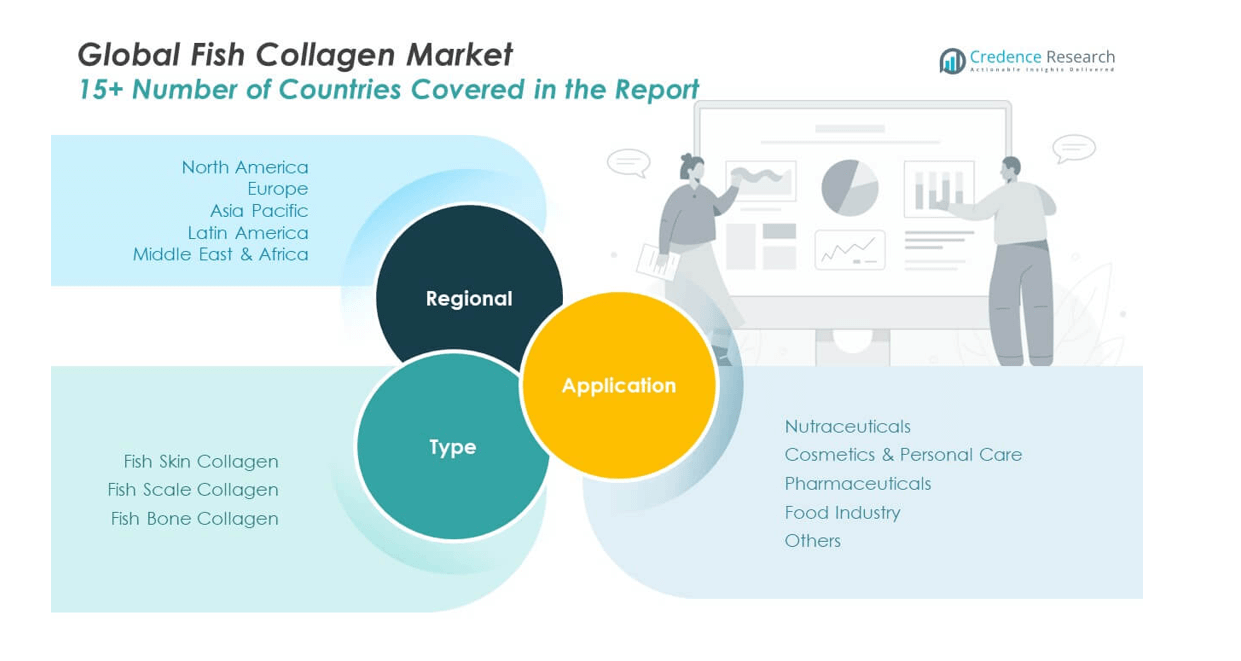
The Global Fish Collagen Market is segmented into fish skin collagen, fish scale collagen, and fish bone collagen. Fish skin collagen holds the largest share due to its high collagen content, easy extraction, and superior bioavailability. It is widely used in nutraceuticals, cosmetics, and pharmaceuticals because of its purity and functionality. Fish scale collagen is gaining demand for its high Type I collagen concentration and application in beauty and skincare products. Fish bone collagen, though less common, is valued for its mineral-rich profile and growing use in medical and food formulations. The continuous advancement in extraction technologies and cost-effective sourcing enhances the overall segment performance.
- For instance, in an in-vitro model the emPAI value for type I collagen in digested cod bone samples reached 1.247 vs. 0.325 in undigested, indicating high bio-accessibility of bone-sourced collagen and minerals. The continuous advancement in extraction technologies and cost-effective sourcing enhances the overall segment performance.
By Application
By application, the market is divided into nutraceuticals, cosmetics and personal care, pharmaceuticals, food industry, and others. The nutraceutical segment dominates due to rising demand for dietary supplements promoting joint and skin health. Cosmetics and personal care follow closely, driven by expanding anti-aging and skincare product lines. Pharmaceutical applications are increasing with collagen’s role in tissue repair, wound healing, and drug delivery systems. The food industry utilizes collagen for protein fortification and texture enhancement in beverages and snacks. Other uses include biomedical materials and pet nutrition. The diverse application scope reinforces the market’s versatility and long-term growth potential across industries.
- For instance, GELITA’s fish-derived Bioactive Collagen Peptides (BCP®) showed measurable skin elasticity improvement and wrinkle reduction after 4-8 weeks in women aged 50-70. Pharmaceutical applications are increasing with collagen’s role in tissue repair, wound healing, and drug delivery systems.
Segmentation:
- By Type:
- Fish Skin Collagen
- Fish Scale Collagen
- Fish Bone Collagen
- By Application:
- Nutraceuticals
- Cosmetics & Personal Care
- Pharmaceuticals
- Food Industry
- Others
- By Region:
- North America
- U.S.
- Canada
- Mexico
- Europe
- Germany
- France
- U.K.
- Italy
- Spain
- Rest of Europe
- Asia Pacific
- China
- Japan
- India
- South Korea
- South-east Asia
- Rest of Asia Pacific
- Latin America
- Brazil
- Argentina
- Rest of Latin America
- Middle East & Africa
- GCC Countries
- South Africa
- Rest of the Middle East and Africa
- North America
Regional Analysis:
North America
The North America Global Fish Collagen Market size was valued at USD 289.99 million in 2018 to USD 436.93 million in 2024 and is anticipated to reach USD 743.21 million by 2032, at a CAGR of 6.4% during the forecast period. The region holds around 28% of the global market share. It is driven by growing awareness of collagen-based health and beauty products. Consumers are adopting marine collagen supplements for skincare, joint health, and anti-aging benefits. The U.S. dominates regional demand due to a strong nutraceutical and cosmetic industry. Companies in the region focus on clean-label and sustainable sourcing practices. Expanding product portfolios in functional foods and beverages enhance market visibility. Increasing R&D investments in collagen extraction and formulation technologies further strengthen regional competitiveness. The rise in online supplement sales supports continued growth in this market.
Europe
The Europe Global Fish Collagen Market size was valued at USD 181.57 million in 2018 to USD 262.31 million in 2024 and is anticipated to reach USD 403.01 million by 2032, at a CAGR of 5.0% during the forecast period. Europe accounts for about 19% of the global market share. The market benefits from strong consumer interest in natural and ethical beauty ingredients. Regulatory support for marine-derived collagen enhances product safety and acceptance. The region’s aging population drives high demand for anti-aging and bone-strengthening supplements. France, Germany, and the UK lead in collagen-based cosmetics and functional foods. The growth of pharmaceutical and food applications reinforces market maturity. Companies emphasize traceable sourcing and sustainable production to meet EU environmental norms. Continuous innovation in nutraceutical formulations supports regional market stability.
Asia Pacific
The Asia Pacific Global Fish Collagen Market size was valued at USD 445.43 million in 2018 to USD 706.35 million in 2024 and is anticipated to reach USD 1,267.82 million by 2032, at a CAGR of 7.1% during the forecast period. The region holds the largest share, around 41%, of the global market. Rising health awareness and a preference for marine-based products drive demand across China, Japan, and South Korea. The expanding cosmetics and functional food sectors contribute significantly to growth. Local manufacturers leverage abundant fish resources for cost-effective collagen production. Japan remains a leader in marine collagen innovation and export. The adoption of collagen-infused beverages and supplements supports consumer trends toward preventive healthcare. Governments promoting sustainable fish utilization further encourage regional production. It remains the fastest-growing market globally due to population size and rising disposable incomes.
Latin America
The Latin America Global Fish Collagen Market size was valued at USD 43.27 million in 2018 to USD 65.33 million in 2024 and is anticipated to reach USD 96.83 million by 2032, at a CAGR of 4.6% during the forecast period. The region accounts for approximately 5% of the global market share. Growth is driven by rising adoption of collagen supplements for wellness and skincare. Brazil dominates the market due to its expanding beauty and nutraceutical industries. Consumers show growing interest in marine-based and sustainable ingredients. Companies are entering partnerships with local distributors to enhance accessibility. Increased health awareness supports demand for collagen-enriched food and beverages. Limited domestic production capabilities lead to import reliance from Asia and North America. Expanding e-commerce channels further aid product penetration across urban markets.
Middle East
The Middle East Global Fish Collagen Market size was valued at USD 23.46 million in 2018 to USD 32.24 million in 2024 and is anticipated to reach USD 44.28 million by 2032, at a CAGR of 3.6% during the forecast period. The region represents around 4% of the global market share. Demand is supported by rising interest in wellness, skincare, and fortified nutrition. Gulf Cooperation Council countries, particularly the UAE and Saudi Arabia, lead in premium beauty product consumption. The growth of fitness and nutraceutical sectors further strengthens the market. Limited marine processing capacity poses a challenge for large-scale production. Import-driven supply chains dominate the regional market landscape. Increasing awareness about marine-based collagen benefits supports consumer adoption. Investments in distribution partnerships improve access to global collagen brands.
Africa
The Africa Global Fish Collagen Market size was valued at USD 12.01 million in 2018 to USD 20.85 million in 2024 and is anticipated to reach USD 26.33 million by 2032, at a CAGR of 2.4% during the forecast period. The region holds roughly 3% of the global market share. It is in the early stage of development, with growing awareness of collagen’s nutritional benefits. South Africa leads regional demand due to higher consumer spending on wellness products. Market expansion is supported by imports of marine-based supplements and cosmetics. Limited production infrastructure and low affordability constrain growth. However, increasing urbanization and exposure to global beauty trends drive awareness. International brands are gradually entering the market through online retail. Rising interest in natural ingredients positions Africa as an emerging future market for collagen-based products.
Key Player Analysis:
- Rousselot
- Norland Products
- Weishardt
- Suprun Group
- Gelita AG
- Darling Ingredients
- Nitta Gelatin India
Competitive Analysis:
The Global Fish Collagen Market features a competitive landscape driven by large-scale investments and strategic alliances. Top players such as Gelita AG and Titan Biotech Limited command significant manufacturing capacity and global distribution networks. These firms focus on expanding product portfolios, optimizing extraction processes, and securing marine-byproduct supply chains. Market entrants face high barriers due to quality control demands, sustainability certifications, and regulatory compliance. It pressures smaller players to differentiate through niche formulations or regional specialization. The leading firms leverage vertical integration and R&D partnerships to maintain cost competitiveness. Competitive intensity remains high across applications – nutraceuticals, cosmetics, and pharmaceuticals. Future consolidation may emerge as companies seek scale advantages and stronger global reach.
Recent Developments:
- On May 12, 2025, Darling Ingredients announced a major joint venture with Tessenderlo Group to combine their collagen and gelatin businesses under the new company 'Nextida™.' This strategic partnership, expected to generate $1.5 billion annual revenue and enhance innovation in health-focused collagen products, positions the joint entity to benefit from global collagen market growth.
- Weishardt also advanced its sustainability credentials in the fish collagen market; it received Friend of the Sea certification for its Naticol peptides, affirming its commitment to sustainable sourcing and production practices for functional foods, nutricosmetics, and pharmaceuticals.
Report Coverage:
The research report offers an in-depth analysis based on type and application segments. It details leading market players, providing an overview of their business, product offerings, investments, revenue streams, and key applications. Additionally, the report includes insights into the competitive environment, SWOT analysis, current market trends, as well as the primary drivers and constraints. Furthermore, it discusses various factors that have driven market expansion in recent years. The report also explores market dynamics, regulatory scenarios, and technological advancements that are shaping the industry. It assesses the impact of external factors and global economic changes on market growth. Lastly, it provides strategic recommendations for new entrants and established companies to navigate the complexities of the market.
Future Outlook:
- Growth will accelerate in functional foods and beverages featuring fish collagen.
- Clean-label and traceable sourcing will become standard across product categories.
- Collagen peptides derived from fish sources will expand into personalized nutrition services.
- Regulatory harmonisation across regions will ease global market entry.
- Applications in tissue engineering and biomedical materials will diversify demand.
- Digital-first and direct-to-consumer channels will gain share in collagen product distribution.
- Sustainable use of fish by-products will reduce raw-material cost pressures.
- Emerging markets in Asia-Pacific and Latin America will offer high growth potential.
- Strategic alliances and M&A will reshape competitive dynamics.
- Price stratification will widen between premium sustainably-sourced products and mass-market offerings.

Request a Free Sample
Fill in your details and we'll send you a free sample report.
- Sample data tables & charts
- Research methodology
Need a Custom Version of This Report?
Tailor the scope, geography, or segments to your exact requirements.
- Custom geography or segment scope
- Direct access to our analyst team
Frequently Asked Questions
What is the current market size for the Global Fish Collagen Market, and what is its projected size in 2032?
At what Compound Annual Growth Rate is the Global Fish Collagen Market projected to grow between 2025 and 2032?
Which Global Fish Collagen Market segment held the largest share in 2024?
What are the primary factors fueling the growth of the Global Fish Collagen Market?
Who are the leading companies in the Global Fish Collagen Market?
Table of Content
Chapter 1 Market Segmentation
- 1.1 Segmentation Framework
- 1.1.1 Product and Service Classification
- 1.1.2 Application and End-Use Classification
- 1.1.3 Technology and Solution Classification
- 1.1.4 Customer and Distribution Channel Classification
- 1.1.5 Geographic Segmentation
- 1.1.6 Market Segment Definitions and Boundaries
Chapter 2 Introduction
- 2.1 Report Objectives and Scope
- 2.2 Product Definition and Industry Terminology
- 2.3 Market Inclusions and Exclusions
- 2.4 Research Process
- 2.4.1 Primary Research and Expert Interviews
- 2.4.2 Secondary Research and Source Review
- 2.4.3 Top-Down and Bottom-Up Estimation
- 2.4.4 Data Triangulation and Verification
- 2.5 Market Size Measurement Basis
- 2.5.1 2024: USD 1,524.01 million → 2032: USD 2,581.48 million
- 2.6 Historical and Forecast Reference Periods
- 2.6.1 Base Year: 2024
- 2.6.2 Forecast Period: 2024-2032
- 2.7 Research Assumptions and Limitations
Chapter 3 Executive Summary
- 3.1 Market Snapshot and Key Findings
- 3.2 Base-Year Market Size, 2024
- 3.3 Forecast Market Size, 2032
- 3.4 Revenue and Volume Growth Outlook
- 3.5 Key Demand and Supply Indicators
- 3.6 Leading Market Segments
- 3.7 Fastest-Growing Market Opportunities
- 3.8 Regional Performance Highlights
- 3.9 Technology and Industry Transformation
- 3.10 Competitive Landscape Summary
- 3.11 Analyst View and Strategic Implications
Chapter 4 Global Fish Collagen Market Trends and Developments
- 4.1 Historical Industry Development
- 4.2 Recent Market Trends and Developments
- 4.3 Demand and Customer Behavior Trends
- 4.4 Technology and Product Innovation
- 4.5 Artificial Intelligence, Automation and Digitalization
- 4.6 Local Manufacturing and Supply Chain Realignment
- 4.7 Industry Partnerships, Mergers and Acquisitions
- 4.8 Sustainability and Circular Economy Developments
- 4.9 Government and Private Sector Investment Trends
- 4.10 Emerging Business Models and Commercialization
- 4.11 Industry Developments and Announcements
Chapter 5 Global Fish Collagen Market Production, Supply and Demand Analysis
- 5.1 Demand Trend and Consumption Analysis
- 5.2 Demand Forecast, 2024-2032
- 5.3 Production and Output Trend
- 5.4 Production and Output Forecast, 2024-2032
- 5.5 Installed Capacity and Capacity Utilization
- 5.6 Company-Wise Production Plants and Statistics
- 5.6.1 Installed Production Capacity
- 5.6.2 Actual Production
- 5.6.3 Planned Capacity and Expansion Targets
- 5.7 Supply Chain Structure and Procurement Trends
- 5.8 Supply-Demand Gap and Bottlenecks
- 5.9 Import Dependence and Sourcing Structure
- 5.10 Contract Manufacturing and Outsourcing
- 5.11 Regional Supply and Demand Concentration
Chapter 6 Global Fish Collagen Market Pricing Analysis
- 6.1 Pricing Structure and Measurement
- 6.2 Historical Pricing Trends
- 6.3 Pricing Outlook, 2024-2032
- 6.4 Average Selling Price and Unit Economics
- 6.5 Pricing by Product and Market Segment
- 6.6 Geographic Pricing Differences
- 6.7 Key Input, Energy, Labor and Logistics Costs
- 6.8 Contract Pricing and Purchasing Models
- 6.9 Pricing Sensitivity and Competitive Positioning
- 6.10 Price, Margin and Profitability Implications
Chapter 7 Global Fish Collagen Market Dynamics
- 7.1 Market Growth Drivers
- 7.1.1 Demand-Side Drivers
- 7.1.2 Technology and Innovation Drivers
- 7.1.3 Infrastructure and Investment Drivers
- 7.1.4 Regulatory and Policy Drivers
- 7.2 Market Restraints
- 7.2.1 Cost and Affordability Constraints
- 7.2.2 Technology and Adoption Barriers
- 7.2.3 Supply Chain and Operational Constraints
- 7.3 Market Challenges
- 7.3.1 Competitive Pressure and Margin Erosion
- 7.3.2 Skills, Infrastructure and Implementation Gaps
- 7.4 Emerging Market Opportunities
- 7.5 Market Dynamics Impact and Time-Horizon Assessment
Chapter 8 Global Fish Collagen Value Chain Analysis
- 8.1 Industry Value Chain Overview
- 8.2 Upstream Suppliers and Critical Inputs
- 8.3 Technology and Component Providers
- 8.4 Manufacturing or Service Delivery
- 8.5 Distribution, Channel Partners and Integrators
- 8.6 Downstream Applications and End Users
- 8.7 Value Addition and Profit Pools
- 8.8 Vertical Integration and Outsourcing
- 8.9 Supplier Concentration and Risk
- 8.10 Supply Chain Localization and Resilience
Chapter 9 Global Fish Collagen Market Regulations and Policies
- 9.1 Relevant Laws, Standards and Compliance Frameworks
- 9.2 Product, Service, Safety and Quality Requirements
- 9.3 Government Policies, Incentives and Subsidies
- 9.4 Imports, Exports and Trade Barriers
- 9.5 Public Procurement and Local Content Requirements
- 9.6 Environmental and Sustainability Compliance
- 9.7 Upcoming Policy Changes and Market Implications
Chapter 10 Global Fish Collagen Market Hotspots and Opportunities
- 10.1 Market Opportunity Mapping and Growth Hotspots
- 10.2 High-Growth Applications and Customer Groups
- 10.3 Underserved Markets and White-Space Opportunities
- 10.4 Emerging Technology and Product Opportunities
- 10.5 New Capacity and Investment Hotspots
- 10.6 Market Entry and Expansion Opportunities
- 10.7 Distribution and Partnership Opportunities
- 10.8 Near-Term and Long-Term Commercial Potential
- 10.9 Opportunity Attractiveness and Execution Risks
Chapter 11 Global Fish Collagen Market Outlook, 2024-2032
- 11.1 Market Size and Analysis
- 11.1.1 Revenue (Market Measurement: 2024: USD 1,524.01 million → 2032: USD 2,581.48 million)
- 11.1.2 Market Volume and Quantity Sold
- 11.1.3 Historical Market Size
- 11.1.4 Base-Year Market Size, 2024
- 11.2 Market Forecast, 2024-2032
- 11.2.1 Revenue Forecast to 2032
- 11.2.2 Volume Forecast to 2032
- 11.2.3 CAGR and Year-on-Year Growth
- 11.2.4 Incremental Revenue Opportunity
- 11.3 Forecast Assumptions and Scenario Analysis
- 11.3.1 Base-Case Forecast
- 11.3.2 Optimistic and Conservative Scenarios
- 11.3.3 Technology, Pricing and Policy Sensitivities
- 11.4 Market Attractiveness and Growth Outlook
Chapter 12 Global Fish Collagen Market Segmentation and Outlook
- 12.1 Segmentation Summary and Market Shares, 2024
- 12.2 Largest and Fastest-Growing Segments
- 12.3 Segment Growth Comparison
- 12.4 Segment Attractiveness and Priority Matrix
Chapter 13 Global Fish Collagen Geographic Market Outlook, 2024-2032
- 13.1 Regional Market Size and Share, 2024
- 13.2 Regional Market Forecast, 2024-2032
- 13.3 Regional Pricing, Production and Demand Differences
- 13.4 North America
- 13.4.1 United States
- 13.4.2 Canada
- 13.4.3 Mexico
- 13.5 Europe
- 13.5.1 Germany
- 13.5.2 France
- 13.5.3 Italy
- 13.5.4 United Kingdom
- 13.5.5 Spain
- 13.5.6 Poland
- 13.5.7 Russia
- 13.5.8 Netherlands
- 13.5.9 Belgium
- 13.5.10 Sweden
- 13.5.11 Denmark
- 13.5.12 Norway
- 13.5.13 Rest of Europe
- 13.6 Asia Pacific
- 13.6.1 China
- 13.6.2 India
- 13.6.3 Japan
- 13.6.4 South Korea
- 13.6.5 Thailand
- 13.6.6 Indonesia
- 13.6.7 Vietnam
- 13.6.8 Malaysia
- 13.6.9 Australia
- 13.6.10 Rest of Asia Pacific
- 13.7 Latin America
- 13.7.1 Brazil
- 13.7.2 Argentina
- 13.7.3 Colombia
- 13.7.4 Chile
- 13.7.5 Rest of Latin America
- 13.8 Middle East
- 13.8.1 Saudi Arabia
- 13.8.2 United Arab Emirates
- 13.8.3 Turkey
- 13.8.4 Israel
- 13.8.5 Iran
- 13.8.6 Rest of the Middle East
- 13.9 Africa
- 13.9.1 South Africa
- 13.9.2 Egypt
- 13.9.3 Nigeria
- 13.9.4 Morocco
- 13.9.5 Rest of Africa
- 13.10 Regional Investment, Policy and Supply Chain Differences
- 13.11 Regional Competitive Landscape
- 13.12 Geographic Growth Hotspots
Chapter 14 Global Fish Collagen Technology, Innovation and Sustainability Outlook
- 14.1 Technology Landscape and Maturity
- 14.2 Product, Process and Service Innovation
- 14.3 AI, Automation and Digital Tools in the Industry
- 14.4 Technology Adoption and Performance Benchmarking
- 14.5 Innovation Pipeline and R&D Investment
- 14.6 Patent and Intellectual Property Trends
- 14.7 Energy Efficiency and Resource Management
- 14.8 Sustainability, Recycling and Circularity
- 14.9 Technology Roadmap, 2024-2032
- 14.10 Risks of Obsolescence and Technology Substitution
Chapter 15 Global Fish Collagen Market Key Strategic Imperatives
- 15.1 Growth and Market Entry Priorities
- 15.2 High-Return Products and Segments
- 15.3 Pricing, Profitability and Cost Optimization
- 15.4 Technology Investment and Product Differentiation
- 15.5 Supply Chain Localization and Resilience
- 15.6 Distribution and Customer Acquisition
- 15.7 Partnership, Acquisition and Capacity Strategy
- 15.8 Regional Expansion Priorities
- 15.9 Short-, Medium- and Long-Term Actions
Chapter 16 Competition Outlook
- 16.1 Industry Competition Characteristics
- 16.2 Market Structure and Concentration
- 16.3 Market Share and Competitive Positioning, 2024
- 16.4 Company-Wise Revenue and Product Benchmarking
- 16.5 Production and Service Capacity Benchmarking
- 16.6 Technology, Pricing and Differentiation
- 16.7 Regional Footprint and Distribution Strength
- 16.8 Mergers, Acquisitions and Strategic Alliances
- 16.9 New Entrants and Competitive Threats
- 16.10 Porter's Five Forces and Industry Attractiveness
- 16.11 Competitive Outlook, 2024-2032
Chapter 17 Company Profiles
- 17.1 Company Coverage and Selection Criteria
- 17.2 Leading Market Participants – Standard Profile Structure
- 17.2.1 Business Description
- 17.2.2 Company Ownership and Geographic Presence
- 17.2.3 Product and Service Portfolio
- 17.2.4 Manufacturing and Operating Footprint
- 17.2.5 Production Capacity and Expansion Plans
- 17.2.6 Financial Performance and Investment
- 17.2.7 Market Share and Competitive Position
- 17.2.8 Technology and Innovation Capabilities
- 17.2.9 Strategic Alliances or Partnerships
- 17.2.10 Recent Developments
- 17.2.11 Growth Strategy and Outlook
- 17.3 Other Relevant Market Participants
Note: Every listed company is profiled on the structure shown under the first company. The company list is preliminary and may change based on research findings, market developments, data availability and client requirements.
Chapter 18 Disclaimer
- 18.1 Research and Forecast Disclaimer
- 18.2 Data Source and Estimation Limitations
Note: The depth of individual sections depends on data availability for this market. Volume, capacity, trade and other unit-based metrics are included where applicable.